What Makes Avery Singer’s Work So Powerful?
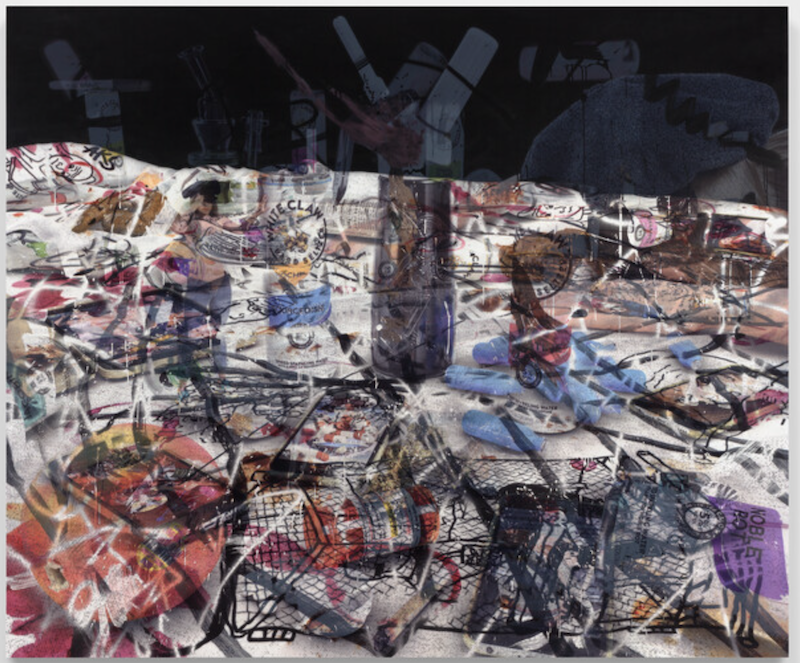
Avery Singer’s paintings are powerful because she turns digital mediation into a problem for painting rather than merely using technology to produce a contemporary-looking style.
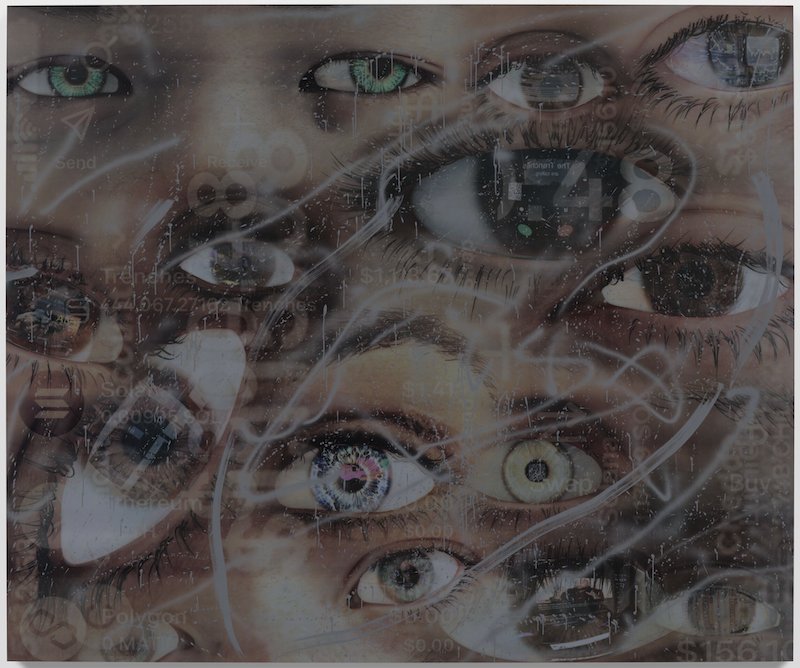
At first, the work can feel cold, mechanical, or difficult to enter. Figures appear faceted, fragmented, blurred, pixelated, or constructed from geometric planes. Interiors resemble architectural renderings, virtual stages, surveillance images, old photographs, or damaged computer files. Smooth gradients meet hard edges. Atmospheric blur collides with vectors, grids, spray-painted marks, and artificial light.
The paintings are physical objects, often made at a large scale, but they seem haunted by images that were never fully material.
Singer has built compositions using programs such as SketchUp and Blender, translated digitally modeled scenes through airbrush and masking, and combined computer-generated structures with manual painting processes. Her practice deliberately joins incompatible visual languages: virtual space and physical surface, automated production and artistic touch, photographic illusion and abstract construction. (Hammer Museum)
This creates the central pressure of the work:
The image appears to have been produced by a machine, but its meaning depends on the unstable human choices that shaped it.
Singer is not simply asking whether digital tools can make paintings.
She is asking what becomes of painting—and of the people pictured within it—after perception has been reorganized by software, screens, networks, rendering, surveillance, and automated image production.
The Problem Beneath the Work
Singer’s recurring artistic problem is not simply “painting in the digital age.”
A more precise formulation would be:
How can painting remain psychologically, materially, and historically active when images are increasingly designed, edited, circulated, and interpreted through computational systems?
Painting has long been associated with the artist’s hand, bodily gesture, material presence, and singular object.
Digital images appear to operate differently. They can be:
generated from code
altered without leaving visible evidence
reproduced endlessly
assembled from databases
viewed without physical location
rendered from impossible perspectives
compressed, filtered, sharpened, and blurred
circulated without stable context
detached from a clearly identifiable author
Singer brings these conditions into painting.
But she does not simply imitate the appearance of screens or software. She uses the tension between digital construction and physical execution to make the status of the image uncertain.
Is the painting handmade?
Machine-produced?
Photographic?
Rendered?
Abstract?
Figurative?
Personal?
Impersonal?
The answer is usually several of these at once.
The work does not resolve the difference between analog and digital.
It builds pressure from their collision.
Why the Work Can Initially Feel Impersonal
Singer’s early grayscale figures often resemble generic virtual mannequins.
Their bodies are angular.
Their faces may be simplified or unreadable.
Their environments appear constructed from planes rather than inhabited through touch, memory, or atmosphere.
The figures may look less like people than placeholders for people.
That impersonality is conceptually important.
A three-dimensional modeling program does not know what a body feels like from within. It understands the body as surfaces, coordinates, volumes, polygons, viewpoints, and manipulable form.
The human figure becomes data arranged in space.
Singer translates that condition back into painting.
The result is a strange contradiction:
The paintings contain bodies, but those bodies appear to have passed through systems that do not recognize interiority.
The figure may still perform gestures associated with artists, lovers, workers, social participants, or historical subjects. But the body’s physical and emotional life has been mediated through software.
This makes the work feel both familiar and estranged.
We recognize the scene.
We do not fully recognize the people.
How the Work Creates Pressure
The deepest pressure in Singer’s work comes from the conflict between human experience and computational representation.
A person experiences the world through:
memory
emotion
touch
bodily orientation
desire
fear
social relation
partial attention
subjective time
Software constructs a world through:
geometry
coordinates
layers
surfaces
light simulations
repeated forms
standardized tools
adjustable viewpoints
computational rules
Singer places the human figure inside this second system.
The figure may appear fragmented because virtual space does not need to preserve anatomical wholeness.
The face may become unreadable because the software model contains representation without psychology.
The room may seem coherent from one angle and impossible from another because digital space can be manipulated without obeying bodily perception.
This makes the work more than a technical experiment.
The paintings ask:
What happens to human complexity when the systems used to represent us understand us primarily as visual information?
That question has become increasingly urgent as digital images, generated media, social platforms, biometric systems, algorithmic classification, and AI tools shape how people become visible.
Singer’s recent work has extended this investigation into AI-based source imagery and visual cultures associated with surveillance, risk, warfare, and control, showing that her engagement with digital mediation continues to evolve rather than remaining fixed in early 3D-modeling aesthetics. (Hauser & Wirth)
The Image Before the Painting
Singer often begins with an image that has already passed through several stages of mediation.
A scene may be:
imagined or researched
constructed within modeling software
viewed through a virtual camera
altered through digital tools
projected, masked, or plotted
translated through airbrush
layered onto a physical surface
encountered later as a painting
There is no simple original.
The painting does not begin with direct observation of a stable subject. It begins inside a chain of translations.
That matters because the final surface contains traces of different image systems even when those traces are not literally visible.
The digital model contributes its artificial perspective.
The airbrush contributes smooth, seemingly mechanical transitions.
Masking produces hard separations.
Paint introduces physical residue, error, opacity, and surface.
Scale turns the screen-sized image into a bodily encounter.
The painting becomes an accumulation of mediations.
Singer does not hide the fact that contemporary vision is indirect. She makes indirectness the structure of the work.
Why the Formal Choices Matter
3D modeling
Singer’s use of 3D software allows her to construct figures, interiors, objects, and viewpoints before they become paintings. Programs such as SketchUp and Blender give her access to an artificial world where spatial relationships can be designed rather than observed. (Hammer Museum)
This is not merely a convenient preparatory method.
It changes the kind of image that painting receives.
Traditional figure painting often begins with a body in front of the artist.
Singer may begin with a body assembled from polygons.
Traditional perspective describes how space appears from a human viewpoint.
Digital modeling produces a space that exists mathematically and can be viewed from anywhere.
The software therefore acts on the subject before paint does.
It removes the body from direct experience and converts it into a construct.
Airbrush
The airbrush is crucial because it can mimic the smooth gradients and apparently touchless surfaces associated with rendering, photography, and commercial imagery.
Unlike a visibly loaded brushstroke, airbrushed paint can appear detached from the hand.
It seems to arrive as atmosphere.
This creates uncertainty about authorship.
The viewer sees paint but may not immediately feel the gesture that placed it there.
Yet airbrushing still requires physical decisions: distance, pressure, masking, timing, layering, control, and revision.
The surface appears mechanical while remaining labor-intensive.
That contradiction is essential:
The hand is present through the performance of its own disappearance.
Grayscale
Singer’s early grayscale palette makes the paintings resemble historical photographs, photocopies, architectural renderings, monochrome screens, or archival documents.
The Hammer Museum noted that this apparent age can be deceptive: the grayscale gives the works a false historical patina even though their scenes were constructed through recent software and online image research. (Hammer Museum)
The colorlessness therefore compresses different eras.
The paintings may look old and technologically new at the same time.
Grayscale also distances the viewer from immediate sensuality. Without naturalistic color, bodies become structures and scenes become records.
But gray is not neutral.
It can suggest:
memory
bureaucracy
documentation
machine vision
historical distance
emotional suppression
unfinished rendering
damaged evidence
the image before color is applied
Color’s absence becomes a pressure on interpretation.
Blur
Blur appears frequently in Singer’s later paintings.
It may suggest motion, photographic error, depth of field, damaged data, censorship, compression, atmospheric distance, or memory.
But blur does something more important:
It prevents the image from becoming fully available.
The viewer approaches an apparently precise, technically produced surface and encounters uncertainty.
This is a useful inversion.
Digital tools are often associated with clarity, enhancement, control, and infinite information.
Singer uses their visual language to produce obscurity.
The technologically constructed image does not necessarily help us see more.
It may make the subject less stable.
Pixelation and fragmentation
Singer’s figures and scenes may appear broken into facets, blocks, overlays, or partially disconnected pieces.
This fragmentation reflects the way digital images are built from separable units and editable layers.
But it also affects identity.
A face divided into fragments becomes difficult to read as a coherent person.
A body assembled from multiple visual systems cannot be reduced to one stable representation.
Fragmentation therefore acts as both technological form and psychological pressure.
The figure appears to exist across several versions of itself.
Scale
Singer’s paintings are often large enough to confront the viewer bodily.
This is important because the source imagery may originate within virtual environments or computer screens.
Scale reverses the normal relationship.
The screen image, usually small and controllable, becomes larger than the viewer.
Something designed through software acquires material authority.
The viewer can no longer scroll past it, minimize it, or close the window.
Digital distance becomes physical presence.
Masking and layering
Hard-edged masking allows Singer to separate visual systems within one image.
A soft, atmospheric area may meet an abrupt geometric boundary.
A figure may appear behind one layer and in front of another.
Marks may seem to float on a transparent interface between the viewer and the depicted world.
These layers make the painting resemble a screen containing several open windows or channels of information.
The viewer is not given one coherent space.
We receive an image assembled from competing surfaces.
That resembles contemporary perception itself: several forms of attention, memory, media, and information occupying the same moment.
The Central Contradiction
The central contradiction in Singer’s work is:
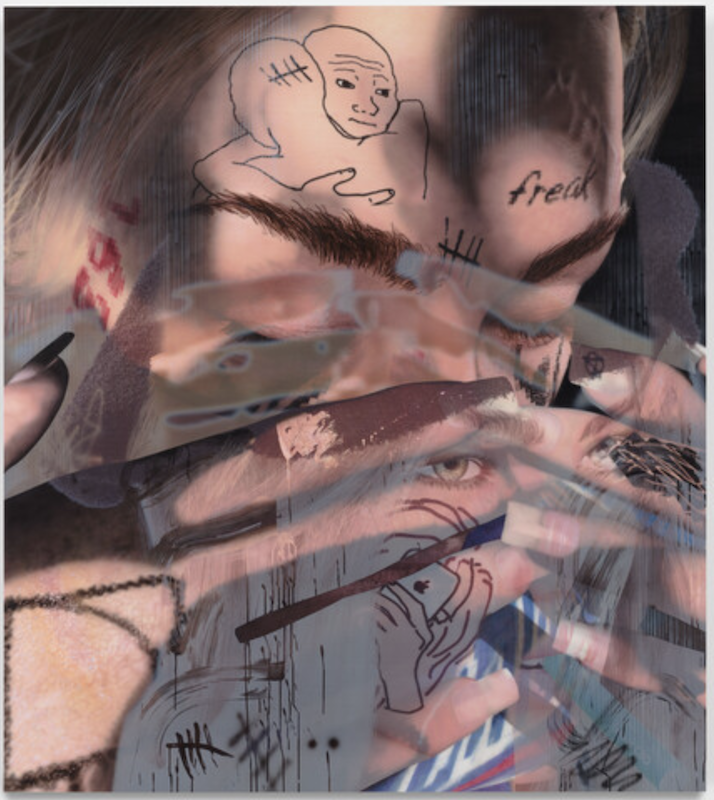
The image appears technologically controlled while remaining perceptually and psychologically unstable.
Her paintings may be:
digitally constructed but materially physical
mechanical in appearance but labor-intensive
highly designed but difficult to read
photographic but invented
figurative but emotionally distant
abstract but socially recognizable
precise but blurred
impersonal but shaped by memory
reproducible in origin but singular as objects
automated in process but dependent on artistic judgment
This contradiction keeps the work from becoming a simple celebration of new technology.
Singer does not present software as liberation from the history of painting.
Nor does she defend painting as a pure handmade refuge from digital culture.
She allows each system to contaminate the other.
The digital becomes painterly.
Painting becomes computational.
The hand adopts machine language.
The machine becomes a tool for subjective construction.
Painting After Photography Is No Longer Enough
For much of modern and contemporary art, painters have confronted the influence of photography.
Singer works in a visual environment where photography itself is no longer the final model.
Images are now also shaped by:
rendering
gaming
modeling software
filters
compositing
machine vision
facial recognition
surveillance
image-generation systems
3D scanning
virtual environments
algorithmic recommendation
compression and circulation
The image may never have corresponded to a single moment in front of a camera.
It may be synthesized.
Singer’s paintings address this expanded condition.
The question is no longer only:
Why paint after photography?
It becomes:
What can painting reveal about images that are already constructed, computed, layered, and detached from direct observation?
Painting offers slowness.
Material resistance.
Physical scale.
Surface irregularity.
A singular object.
But Singer does not use these qualities nostalgically.
She makes painting absorb the visual logic of the systems that appear to threaten or replace it.
Painting survives by becoming contaminated.
Authorship Under Pressure
Singer’s process raises a difficult question:
Who made the image?
The artist designed the composition.
Software produced aspects of space and rendering.
Digital tools shaped the source.
Masks controlled the application.
Airbrush translated information.
In some works, mechanical or automated processes contributed to execution.
More recently, AI-based tools have entered parts of the source-image process. (W Magazine)
Authorship becomes distributed.
But distributed authorship does not mean the artist disappears.
The artist decides:
which systems to use
what source material enters
how images are combined
which accidents remain
how large the painting becomes
where clarity breaks down
when the process stops
what cultural or psychological problem the technology serves
This leads to a crucial lesson:
Authorship does not require personally making every mark. It requires establishing the conditions under which every mark acquires meaning.
Singer’s authority lies less in proving manual virtuosity than in designing a process through which technology, image history, material, and interpretation collide.
The Artist as Constructed Role
Singer’s early works frequently addressed the culture surrounding artistic production: studios, artists, curators, institutions, performances, reputations, and the rituals through which artists are socially produced. The Hammer Museum described her work as engaging not only how artworks are made, but how artists themselves are “made” through relationships with institutions and art-world systems. (Hammer Museum)
This is important because the artist is also a mediated identity.
The public does not encounter an artist only through objects.
The artist becomes visible through:
exhibitions
interviews
installation photographs
market narratives
social media
criticism
biography
institutional validation
reputation
studio mythology
The image of the artist becomes another constructed output.
Singer’s block-like figures and artificial studio scenes expose the romantic image of artistic authenticity as a kind of performance.
The artist may appear spontaneous, rebellious, intellectual, bohemian, tortured, innovative, or technically advanced.
But those identities are shaped through cultural codes.
The work asks whether artistic identity is discovered or rendered.
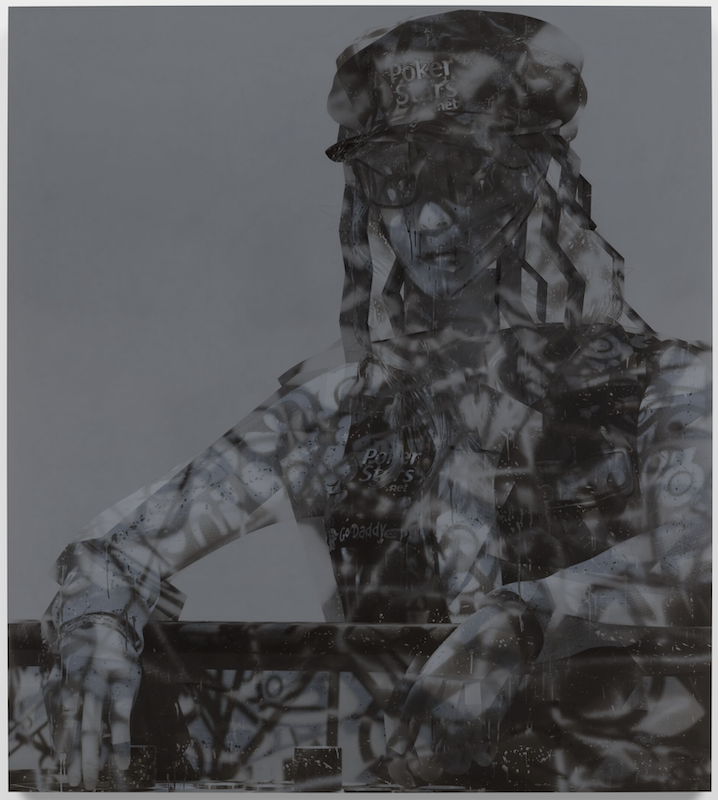
Memory Processed Through Technology
Singer’s more recent bodies of work show that digital mediation does not eliminate autobiography or emotion.
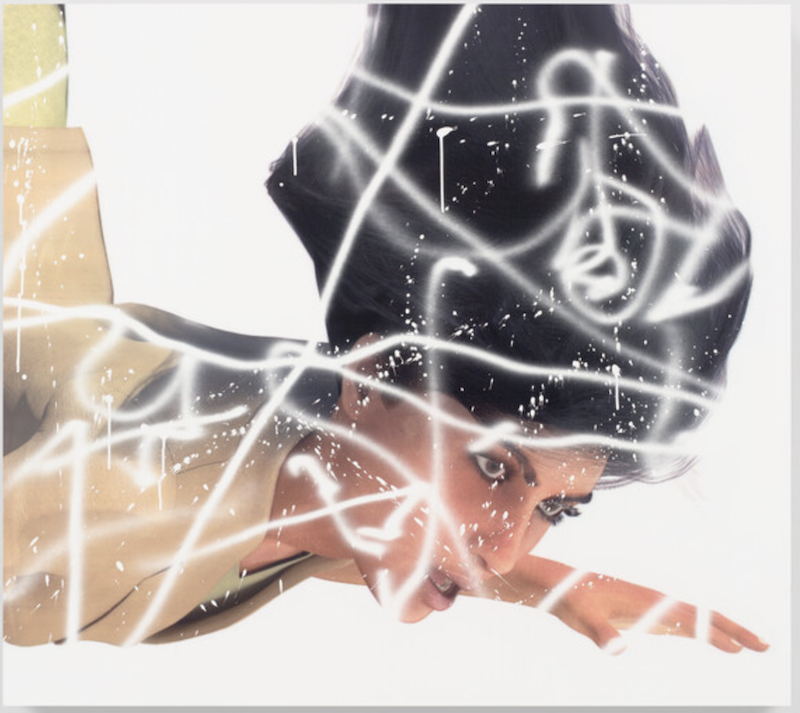
Her Unity Bachelor exhibition connected complex digital and manual processes with questions of memory, falling, online and offline identity, and early-2000s New York. The works referenced modernist and avant-garde art while treating digital construction as a way to approach personal and cultural experience. (Institute of Contemporary Art, Miami)
This expands the meaning of technological imagery.
A digitally constructed painting can still carry memory.
But the memory no longer appears as a transparent personal recollection.
It arrives fragmented, modeled, distorted, enlarged, blurred, and layered.
That may be more truthful to how memory now operates.
People increasingly remember events through:
photographs
news footage
screenshots
online archives
search results
social feeds
repeated media images
reconstructed narratives
Memory becomes inseparable from image circulation.
Singer’s paintings do not ask us to choose between authentic memory and mediated image.
They show that contemporary memory may already be mediated at its source.
The Viewer Inside the Interface
Singer’s compositions often position the viewer less like someone standing before a traditional scene and more like someone navigating an interface.
We may encounter:
overlapping planes
partial images
simulated depth
floating marks
abrupt crops
conflicting resolutions
virtual viewpoints
illegible data
images within images
The viewer must decide where to look and which visual layer to trust.
This resembles the experience of contemporary screens, where several systems compete for attention at once.
But unlike an actual interface, the painting does not respond.
We cannot click.
Zoom.
Rotate.
Undo.
Reveal hidden layers.
The painting imitates manipulable space while denying manipulation.
That gives the viewer a strange position:
We recognize the language of control, but we cannot control the image.
This reverses the ordinary power relation of digital media.
On a screen, the user often believes they command the image.
Before Singer’s paintings, the image withholds that command.
Controlled Illegibility
Singer’s work offers another example of controlled uncertainty.
The paintings may provide enough information for us to recognize a figure, room, gesture, or event. But they often refuse complete legibility.
A face may remain obscured.
A spatial relationship may be impossible.
A blur may conceal whether something is moving or disappearing.
A fragment may belong to several possible bodies.
This uncertainty is not random.
It reflects a world in which more visual information does not necessarily produce greater understanding.
We live among vast image systems.
Yet context is missing.
Authorship is uncertain.
Images are altered.
Sources are compressed.
Truth and fabrication share visual languages.
Singer turns that condition into painting.
The image looks informational while refusing to become knowledge.
That may be one of the deepest pressures in her work.
The Visual World Singer Has Built
Across her practice, Singer has developed a recognizable lexicon:
digitally modeled figures
constructed interiors
grayscale and synthetic color
airbrushed gradients
hard-edged masking
fragmented bodies
blurred faces
grids and vector-like forms
studio and art-world scenes
architectural rendering
photographic and archival effects
pixelation
layered interfaces
virtual viewpoints
modernist and avant-garde references
images that appear automated but remain materially painted
figures caught between avatar, memory, photograph, and body
These elements do more than identify her style.
They create a world in which every image appears to have passed through a system before reaching us.
The system is never neutral.
It determines what can be seen, how bodies are constructed, where authorship appears, and what kinds of uncertainty remain.
What Artists Can Learn
The lesson is not to imitate Singer’s grayscale palette, 3D figures, airbrush technique, digital rendering, fragmentation, or technological appearance.
The lesson is to understand how she makes process carry the problem of the work.
Technology should alter the artistic question, not merely update the style.
Using software becomes meaningful when the tool changes how space, bodies, authorship, memory, or perception function.
The process can become part of the subject.
How the image is made may reveal what the image is about.
Impersonality can carry pressure.
A cold or mechanical surface can show what is lost when human experience is translated into systems of visual information.
The hand does not need to disappear or dominate.
It can collaborate with machines, imitate them, resist them, or reveal itself through controlled absence.
Digital clarity can be used to create uncertainty.
Blur, fragmentation, masking, and conflicting resolutions can expose the limits of technologically mediated vision.
The figure can become an interface.
A body may be treated as image, data, avatar, surface, or editable construction without losing all psychological meaning.
Scale can convert virtual distance into physical confrontation.
A screen-born image becomes more consequential when it acquires material presence larger than the viewer.
Authorship can reside in orchestration.
The artist’s role may be to design the system, choose the transformations, regulate uncertainty, and make different forms of production collide.
Contemporary tools should enter a larger history.
Singer connects digital modeling to Cubism, Constructivism, modernism, photography, cinema, and painting rather than treating software as culturally isolated. (Hammer Museum)
The larger lesson is this:
A technological process becomes artistically powerful when it makes visible the pressures that technology places on bodies, memory, authorship, and perception.
Avery Singer does not simply use computers to design paintings.
She builds images in which digital and physical systems compete to define what painting, the figure, and the artist can now be.
Her work asks whether technological images give us greater control—or merely produce new forms of distance, opacity, and dependence.
The lesson is not to copy the appearance of the work.
The lesson is to understand the pressure that made the appearance necessary.