What Makes Damien Hirst’s Work So Powerful?
Damien Hirst’s work is powerful because he turns the most unavoidable human questions—death, fear, belief, beauty, medicine, money, decay, and the desire for control—into images and objects that can be understood almost instantly.
A shark floats in a glass tank.
A sheep is preserved in formaldehyde.
Colored spots are arranged across a white field.
Butterflies form radiant patterns.
Medicine cabinets promise order and cure.
A human skull is cast in platinum and covered with diamonds.
The work frequently arrives before interpretation. Its basic structure can often be grasped in seconds. Yet the strongest pieces remain psychologically difficult because they place incompatible conditions together:
life and death;
beauty and disgust;
science and religion;
order and decay;
permanence and decomposition;
spiritual longing and commercial spectacle;
serious fear and theatrical entertainment.
Hirst’s central inquiry might be stated this way:
How can art make death emotionally present when the mind cannot fully comprehend its own extinction?
Nearly every major body of work grows from that problem.
The animals, pills, vitrines, butterflies, skulls, spots, spin paintings, medical instruments, and monumental fictions may appear very different, but they repeatedly test the systems human beings create to contain what cannot finally be controlled.
What the Viewer Encounters
Hirst’s work often combines strong visual simplicity with physically or conceptually charged material.
The viewer may encounter:
dead animals preserved in formaldehyde;
insects living and dying inside gallery installations;
rows of pharmaceutical packaging;
brightly colored circles arranged with clinical regularity;
spin paintings produced through centrifugal motion;
real butterfly wings embedded in paint;
cabinets filled with surgical instruments;
skulls, bones, blood, cigarettes, flowers, and diamonds;
fabricated archaeological objects presented through elaborate fiction.
These works often resemble structures associated with authority:
scientific laboratories;
pharmacies;
hospitals;
museums;
churches;
luxury shops;
archaeological collections;
commercial displays.
The work borrows their visual confidence.
Glass vitrines imply preservation.
Grids imply rational organization.
Medicine packaging implies therapeutic knowledge.
Diamonds imply permanent value.
Museum labels imply historical truth.
But Hirst repeatedly reveals that these systems cannot eliminate mortality.
The animal remains dead.
The medicine cannot provide immortality.
The butterfly’s beauty depends upon a fragile body.
The diamond skull preserves the image of death while advertising extraordinary wealth.
The system appears powerful, yet the fact it tries to contain remains untouched.
The Inquiry Beneath the Work
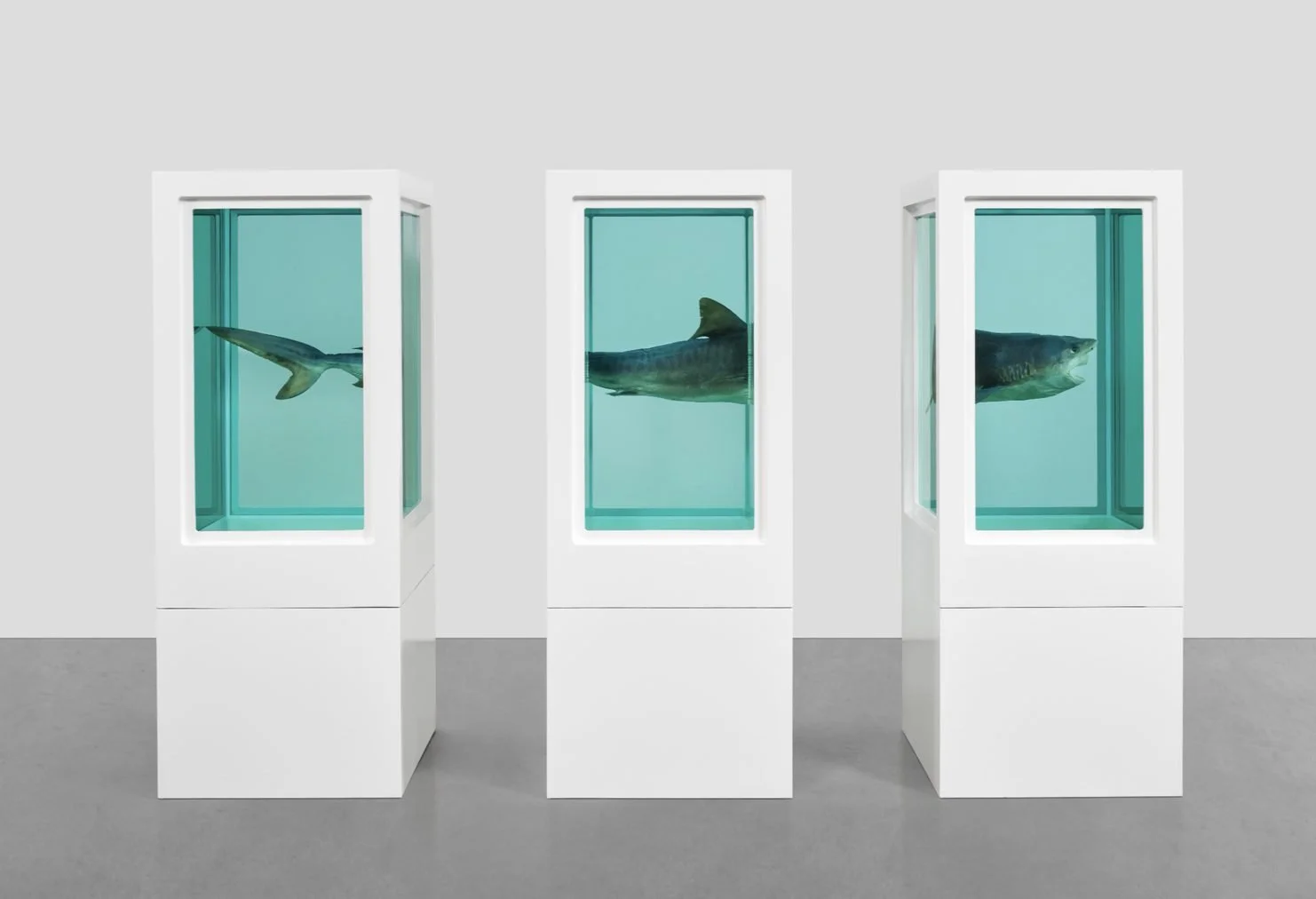
Hirst has said that his practice repeatedly returns to life, death, science, belief, and the fear of mortality. His landmark 1991 work The Physical Impossibility of Death in the Mind of Someone Living consists of a fourteen-foot tiger shark suspended in formaldehyde and has become one of contemporary art’s most recognizable confrontations with death. (Gagosian)
The title describes the problem more precisely than the object alone.
People understand death intellectually.
We see it.
We discuss it.
We know it will happen.
Yet consciousness cannot genuinely imagine its own nonexistence.
The shark gives physical form to that contradiction.
It is unmistakably dead, but it appears suspended in motion.
Its mouth remains open.
Its body seems capable of moving forward.
The tank preserves the animal while also separating it from ordinary life.
The viewer encounters something that looks present and absent at the same time.
The work does not explain death.
It places the viewer before an object the mind cannot comfortably resolve.
The Shark as Image and Encounter
The shark is already culturally charged.
It signifies:
predation;
fear;
speed;
danger;
evolutionary antiquity;
an environment inaccessible to most people.
Hirst did not choose a passive animal.
He chose a creature capable of activating fear even when it is motionless.
But the work’s power does not come only from the animal.
It comes from the entire structure:
the enormous glass tank;
the blue-green liquid;
the white architectural frame;
the museum environment;
the scientific appearance of preservation;
the viewer standing safely outside.
The tank gives the viewer control.
The shark removes it.
The object is contained physically but remains psychologically threatening.
That distinction is central to Hirst’s practice:
We can contain the body without containing what it means.
A Thousand Years: Life and Death as a System
In A Thousand Years from 1990, flies hatch, feed upon a severed cow’s head, move through a glass enclosure, and are killed by an insect electrocution device.
The work does not depict the life cycle symbolically.
It establishes a functioning system in which:
birth occurs;
consumption occurs;
reproduction occurs;
death occurs;
the cycle continues.
The vitrine resembles a scientific experiment.
But the experiment produces no solution.
It reveals process without offering transcendence.
The glass creates visual distance while allowing smell, disgust, fascination, and awareness of time to enter the encounter.
The work is controlled in design but partially uncontrollable in operation.
Flies move unpredictably.
Bodies accumulate.
Organic matter changes.
The artwork continues happening after installation.
This introduces an important capacity in Hirst’s practice:
He can make mortality operate as a real material condition rather than merely represent it as an image.
Vitrines and the Fantasy of Control
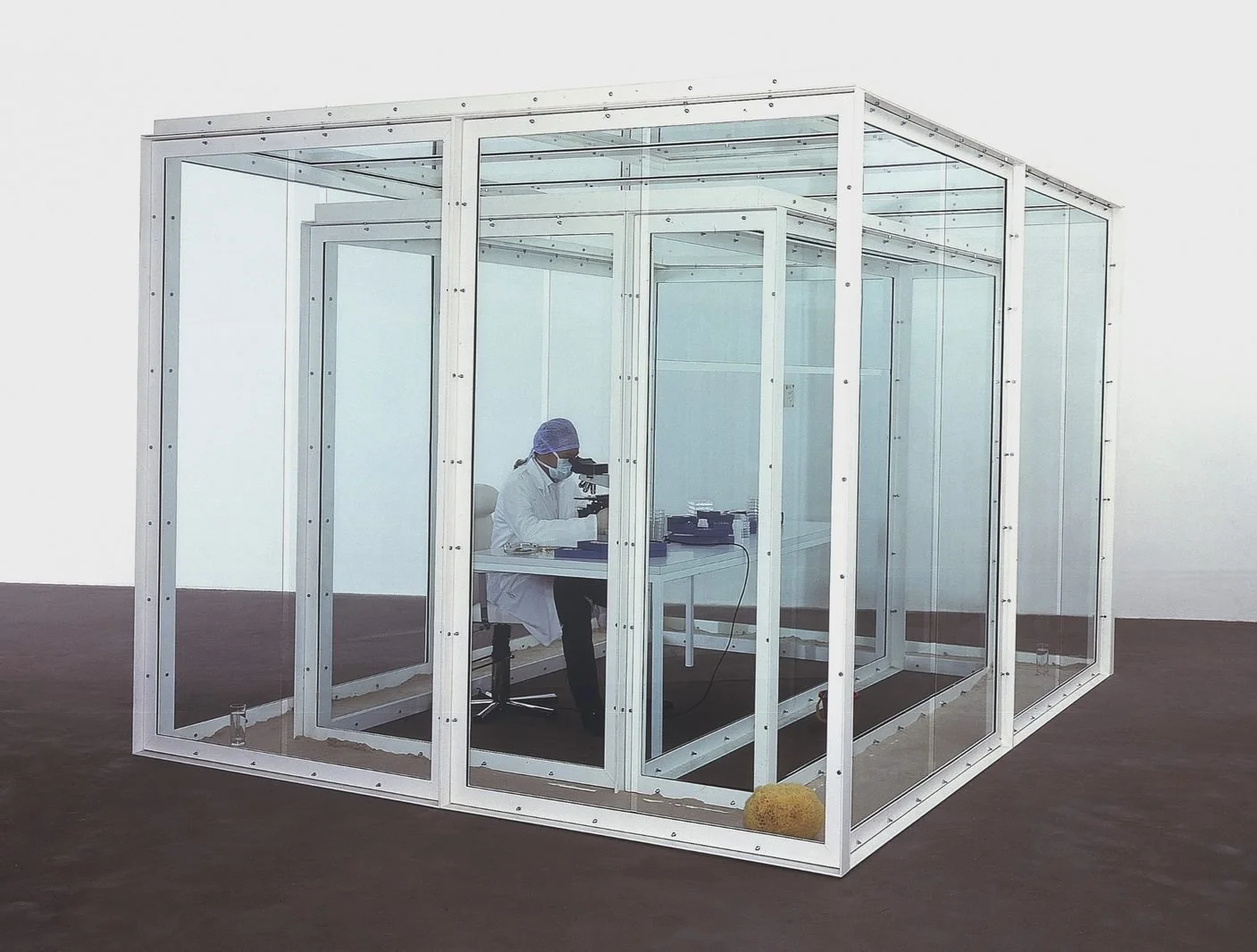
The glass vitrine is one of Hirst’s most important forms.
It is associated with:
museums;
science;
preservation;
classification;
sanitation;
display;
protection;
separation.
Glass allows complete visibility while preventing contact.
The viewer can inspect the animal but cannot touch it.
The object is exposed and inaccessible.
This creates a powerful psychological arrangement.
Death is brought close enough to examine but kept far enough away to remain manageable.
The vitrine becomes a model of how modern culture handles mortality:
hospitals isolate it;
morgues store it;
museums preserve it;
religions explain it;
language distances it;
commerce aestheticizes it.
Hirst’s work repeatedly asks whether containment reduces fear or merely gives fear a cleaner shape.
Natural History: Preserving What Cannot Be Saved
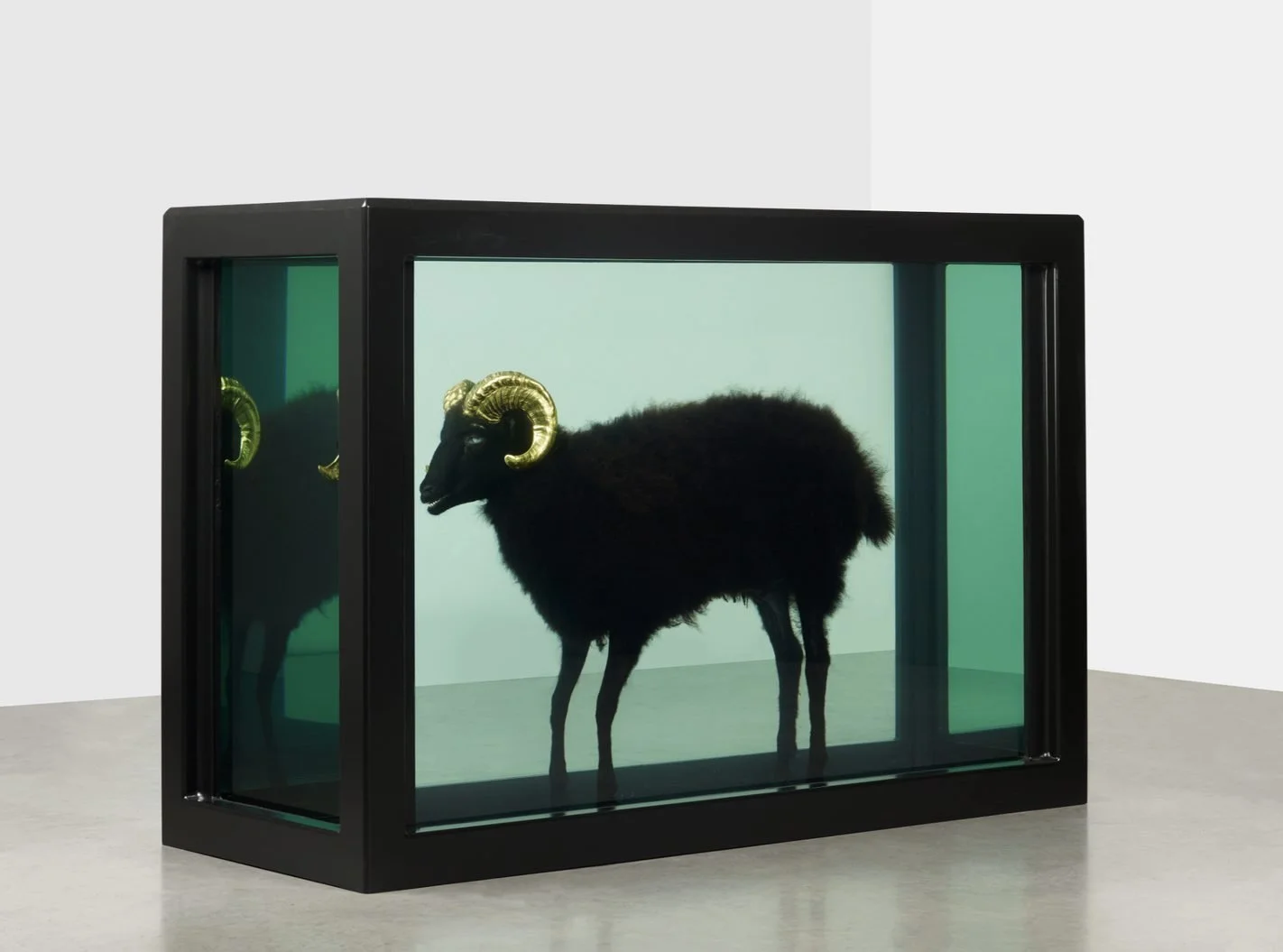
Hirst’s Natural History series includes sharks, sheep, cows, calves, zebras, doves, and other animals preserved, divided, or displayed in formaldehyde. Gagosian characterizes the series as one of his central efforts to bridge art and science through the presentation of animal bodies in clinical vitrines. (Gagosian)
The preservation process produces a contradiction.
The animal’s decay is slowed.
Its visible form remains.
But its life cannot be restored.
Preservation therefore becomes both triumph and failure.
Science can delay disappearance.
It cannot reverse death.
The animal looks complete, but completeness has become purely visual.
Hirst exposes the difference between:
keeping a body;
keeping a life.
That difference gives the works much of their emotional force.
Away from the Flock: Isolation Made Physical
In Away from the Flock, a sheep is suspended alone inside a tank.
The title transforms the animal from specimen into psychological figure.
A sheep commonly signifies:
belonging;
obedience;
innocence;
vulnerability;
sacrifice;
religious symbolism.
Separated from the flock, the animal becomes an image of individuality and abandonment.
The work can suggest:
social exclusion;
spiritual isolation;
artistic independence;
death as ultimate separation;
the desire to escape conformity;
the danger of leaving protection.
The sheep’s body remains calm.
The title supplies emotional pressure.
This is a recurring Hirst strategy:
A physically clear object receives instability through language.
The object says one thing.
The title opens several others.
Mother and Child (Divided)
In Mother and Child (Divided), a cow and calf are bisected and displayed in separate formaldehyde tanks. The work contributed to the body of work for which Hirst received the 1995 Turner Prize. (Christie's)
The division is clinical and violent.
The viewer can walk between the separated halves and inspect the animals’ interiors.
Something ordinarily hidden becomes completely visible.
Yet increased visibility does not produce greater understanding.
Seeing inside the animal does not reveal:
consciousness;
attachment;
pain;
motherhood;
life.
The work uses anatomical access to expose the limits of anatomy.
The body can be opened.
The relationship cannot.
The title again introduces emotional and religious associations that the physical specimen cannot contain by itself.
Maternal connection is set against literal separation.
Knowledge is set against loss.
Medicine Cabinets and the Promise of Cure
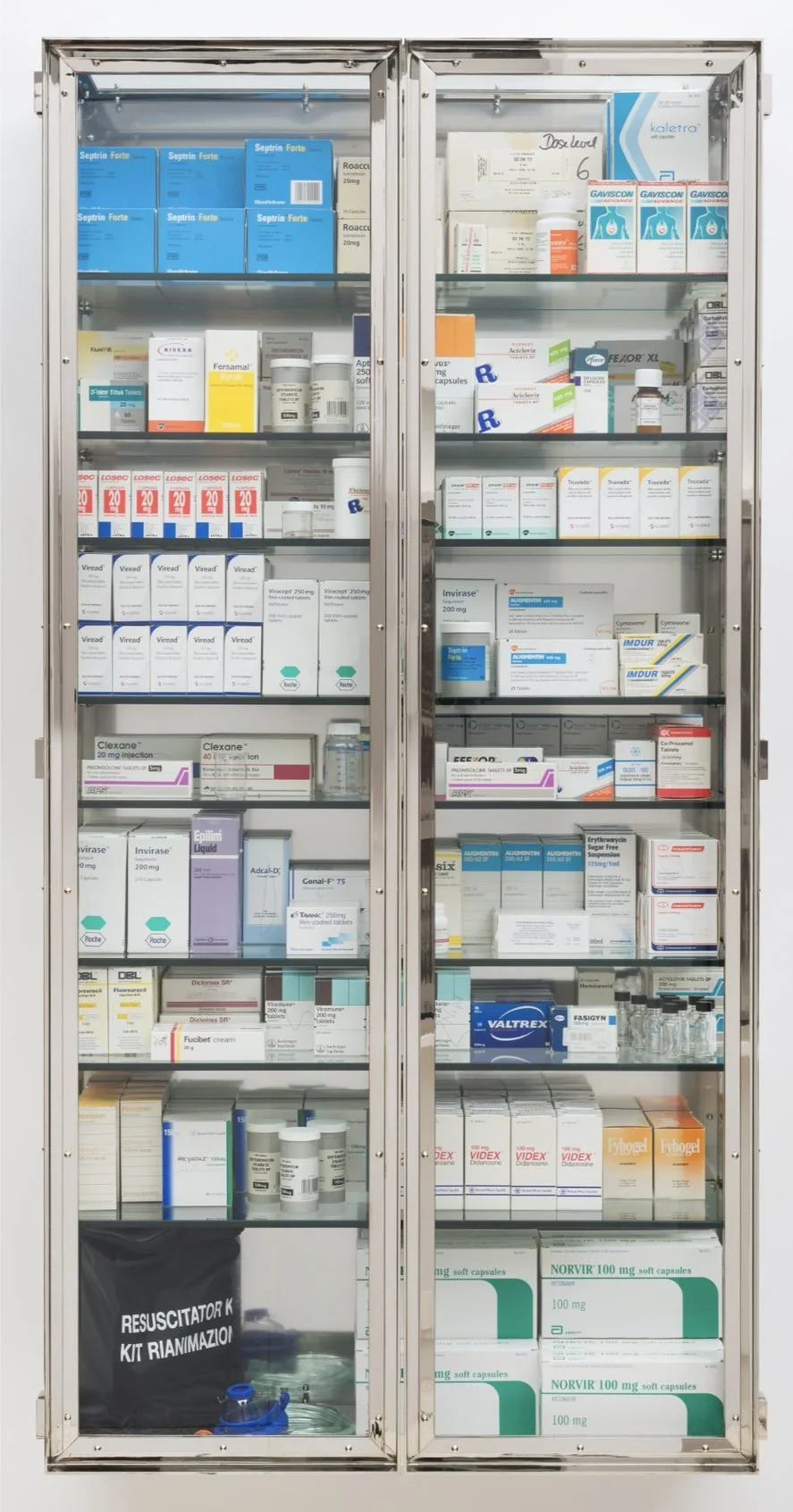
Hirst began making medicine cabinets early in his career. These works present pharmaceutical packaging in orderly rows behind glass.
The objects resemble commercial and medical systems designed to manage:
pain;
infection;
anxiety;
illness;
aging;
bodily failure.
The medicine cabinet appears reassuring because everything has a name, dosage, package, and place.
Disease has been classified.
Treatment has been organized.
But the system also reveals dependence.
The body is fragile enough to require continual intervention.
Medicine promises extended life but also reminds us that life is vulnerable.
The cabinet becomes a secular altar.
Instead of sacred relics, it contains pharmaceutical products.
Instead of faith in divine intervention, it presents faith in chemistry.
The arrangement does not simply criticize medicine. Hirst is fascinated by its visual and psychological authority.
The packaging looks certain.
The human body remains uncertain.
Pharmacy as a Model of Belief
Hirst’s pharmaceutical works repeatedly compare medicine with religion.
Both systems offer:
named authorities;
ritualized practices;
specialized spaces;
symbolic objects;
promises of relief;
explanations for suffering;
faith in forces the ordinary person may not fully understand.
A patient often cannot independently verify the chemical mechanism of a medication.
Trust enters the system.
The pill becomes a small object invested with enormous hope.
Hirst recognizes that modern belief has not disappeared.
It has shifted institutions.
The pharmacy can function like a church because both address fear, suffering, and mortality.
His work does not claim they are equivalent.
It reveals that human beings repeatedly build structures of belief around what they cannot control alone.
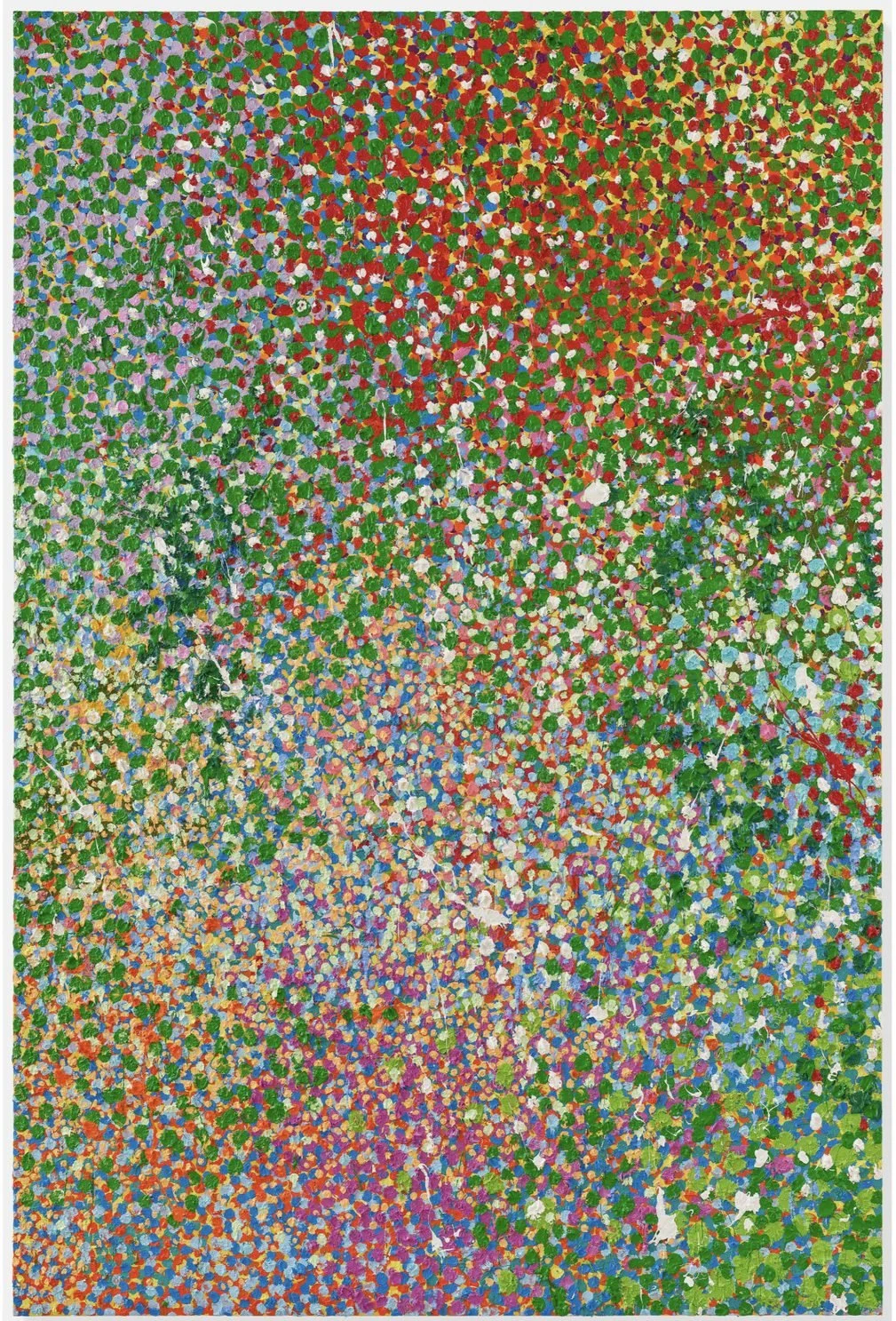
The Spot Paintings: Order Without Final Meaning
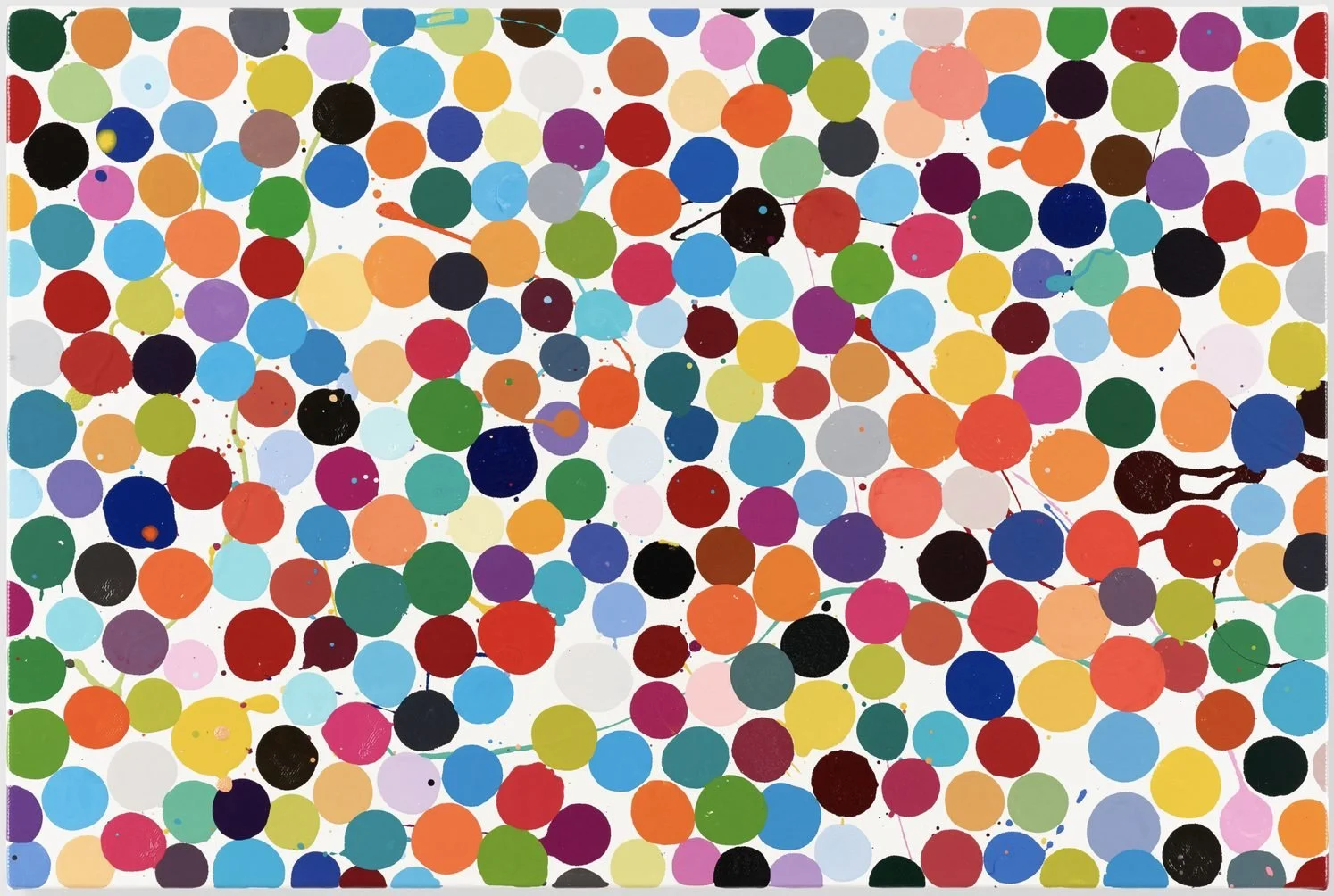
The Spot paintings consist of colored circles arranged within systematic grids, usually on white grounds. The series began in the 1980s and eventually expanded into hundreds of works produced in numerous scales and configurations. The titles often derive from chemical compounds or pharmaceutical substances. (Christie's)
At first glance, the works can feel cheerful and rational.
The spots are:
evenly shaped;
clearly separated;
brightly colored;
ordered;
repeatable;
potentially infinite.
They appear to remove:
expressive gesture;
personal handwriting;
narrative;
psychological mess.
Yet their apparent neutrality is unstable.
Color produces pleasure.
The pharmaceutical titles introduce sickness, treatment, dosage, and bodily risk.
The grid promises order.
The number of possible arrangements threatens endless proliferation.
The paintings look complete but belong to a system that could continue indefinitely.
This makes the Spot paintings less about individual composition than about serial production, classification, and the fantasy of perfect organization.
Authorship and the Delegated Hand
Many Spot paintings and other works have been fabricated with the assistance of Hirst’s studio.
This has generated enduring questions about authorship.
Does the artist need to physically make the object?
Can the concept, system, quality control, and final authorization constitute authorship?
Hirst’s practice belongs to a long history of artists who used workshops, assistants, industrial fabricators, and delegated production.
But he makes that structure unusually visible.
The Spot paintings often seem designed to minimize the expressive hand.
Their conceptual logic supports repeatability.
The studio becomes a production system.
This is not separate from the work’s meaning.
The paintings resemble pharmaceutical and industrial products partly because they are produced through organized labor.
The removal of personal touch becomes one of their subjects.
The artist acts less like an isolated craftsperson and more like:
director;
entrepreneur;
system designer;
brand;
producer.
This model transformed expectations surrounding the contemporary artist and intensified the connection among artistic authorship, industrial production, and commercial identity.
Spin Paintings: Control Through Surrender
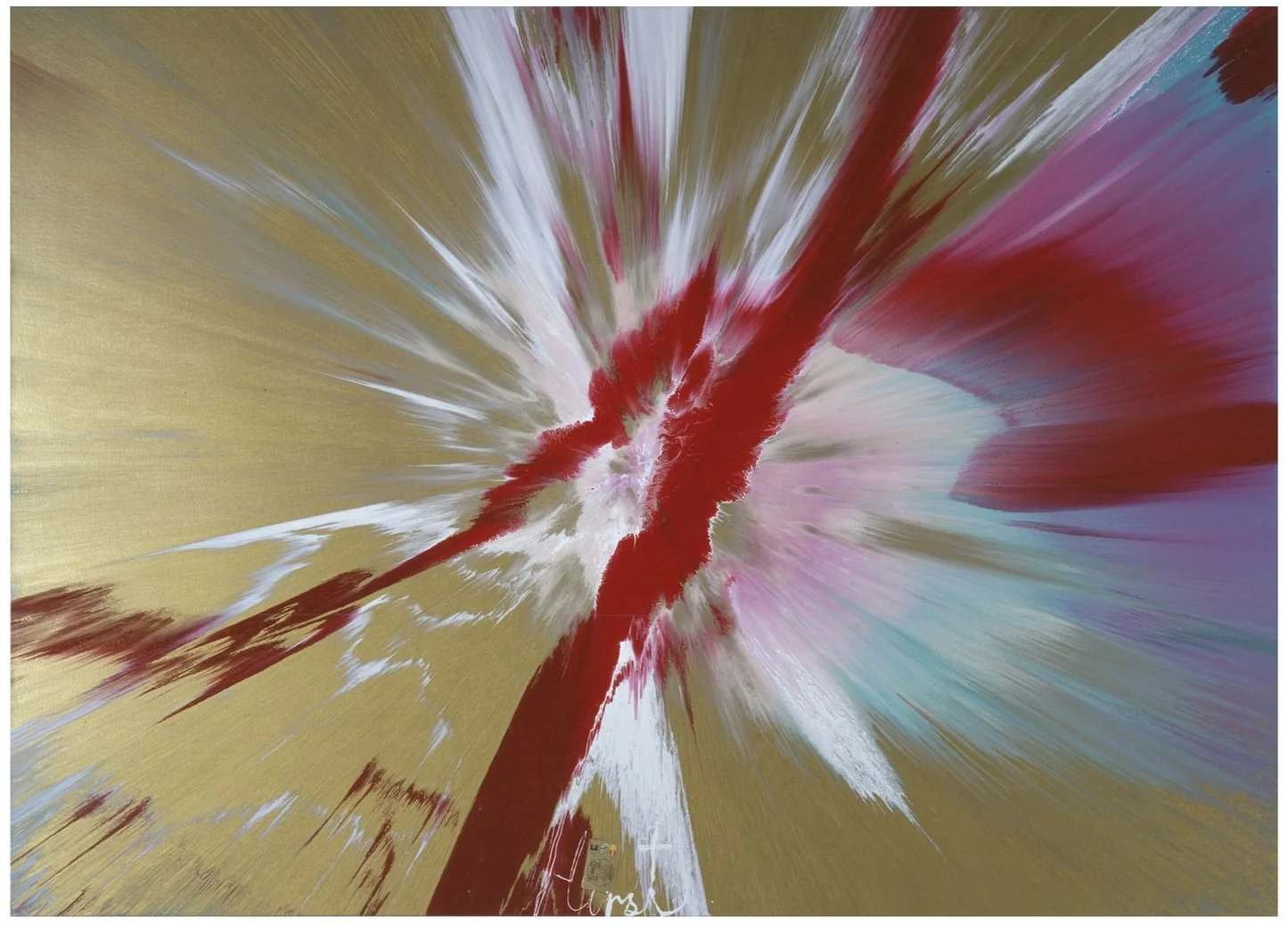
The Spin paintings appear to reverse the Spot paintings.
Where the spots are regulated, separated, and systematic, spin paintings are made by pouring or applying paint to a rotating surface.
Centrifugal force distributes the color.
The results are:
energetic;
irregular;
theatrical;
difficult to predict;
visually exuberant.
Yet chance is still staged.
The artist selects:
the colors;
the quantity of paint;
the timing;
the rotation;
the scale;
the moment to stop.
The paintings are neither fully controlled nor fully accidental.
They dramatize a different response to uncertainty.
The Spot paintings attempt to order it.
The Spin paintings activate it.
Together they suggest two competing human strategies:
build a system
or
release control and watch what happens.
Butterflies: Beauty Dependent on Death
Butterflies are among Hirst’s most persistent materials and images.
They carry familiar associations:
transformation;
resurrection;
fragility;
the soul;
brief life;
decorative beauty.
Hirst has used live butterflies, dead butterflies, wings embedded in paint, and patterned arrangements resembling stained-glass windows or mandalas.
The resulting works are visually seductive.
But their beauty is inseparable from death.
The wings retain intense color after the organism has died.
This creates a painful contradiction:
The thing survives most beautifully as an image after it can no longer live.
The butterfly therefore becomes an ideal Hirst material.
It joins:
life and object;
transformation and preservation;
spirituality and decoration;
beauty and mortality.
The viewer may first respond to color and pattern, then realize that the surface is composed from bodies.
Pleasure becomes ethically and emotionally unstable.
The Butterfly Rooms
In installations containing live butterflies, the gallery becomes an artificial ecosystem.
Butterflies emerge, fly, feed, reproduce, and die within the exhibition.
The environment may feel enchanting.
It can also feel disturbing.
The viewer becomes part of a system where life has been organized for aesthetic experience.
This produces an ethical pressure that Hirst’s work often depends upon.
Are the butterflies:
living participants;
material;
symbols;
performers;
victims;
evidence of natural beauty;
evidence of human control?
The work does not allow an easy separation between admiration and exploitation.
The beauty remains genuine.
So does the discomfort.
For the Love of God: Death, Luxury, and Value
For the Love of God from 2007 is a platinum cast of an eighteenth-century human skull covered with 8,601 diamonds. The original teeth remain set into the jaw. (tate.org.uk)
The skull is one of the oldest artistic symbols of mortality.
It says:
You will die.
The diamonds signify almost the opposite:
permanence;
rarity;
wealth;
desire;
brilliance;
enduring value.
Hirst forces them together.
The result is both spectacular and absurd.
The skull’s surface appears immortal.
Its form announces death.
The work asks whether wealth can defeat mortality or merely decorate it.
It also collapses several systems of value:
biological;
spiritual;
artistic;
financial;
symbolic.
The human skull is universally common.
The diamonds are economically rare.
The artwork converts the combination into another form of exceptional value.
This makes the object self-implicating.
It is not simply a criticism of luxury.
It is a luxury object.
Its contradiction cannot be observed from a morally clean distance.
Money as Material
Hirst is unusual because money is not merely part of the context surrounding his work.
It frequently becomes part of the work’s subject.
His practice has involved:
large-scale studio production;
aggressive market visibility;
branded series;
high-profile auctions;
direct engagement with collectors;
ownership and display structures;
spectacular materials;
repetition at industrial scale.
In 2008, the Beautiful Inside My Head Forever auction bypassed the conventional gallery route and sold newly produced work directly through Sotheby’s. Many works from the auction later circulated through the secondary market. (Christie's)
The event blurred boundaries among:
exhibition;
auction;
performance;
business strategy;
artistic statement.
It raised a difficult question:
Is market activity external to the art, or can the production of market value itself become part of the artistic experiment?
Hirst’s career makes the distinction difficult to maintain.
The Artist as Brand
Hirst’s imagery is extraordinarily recognizable.
The shark, spots, butterfly wings, pills, skulls, spin paintings, and vitrines function almost like visual logos.
This recognition helped create one of contemporary art’s most powerful artistic brands.
But branding introduces a serious risk.
A living inquiry can become a set of repeatable products.
The shark can become “the Hirst shark.”
The spots can become “the Hirst spots.”
Mortality can become a marketable aesthetic.
Hirst’s practice therefore embodies a contradiction shared by contemporary culture:
The more successfully an image communicates, the more easily it can become a commodity emptied of its original pressure.
His work is valuable for studying this danger because he does not stand outside it.
He amplifies it.
Treasures from the Wreck of the Unbelievable
In 2017, Hirst presented Treasures from the Wreck of the Unbelievable, an enormous project built around a fabricated archaeological narrative.
The exhibition proposed that a collection belonging to a freed slave named Cif Amotan II had sunk in the ancient world and was later recovered from the ocean. The objects were displayed in forms that appeared:
newly restored;
covered with coral;
damaged by submersion;
historically classified;
mythological;
anachronistic.
The fiction mixed archaeology, museum display, cinematic spectacle, historical references, popular culture, and deliberate absurdity. Christie's describes the project as an entirely conceived hoard presented through the logic of excavation and belief. (Christie's)
The inquiry shifted from death as biological fact toward truth as institutional construction.
Museum presentation encourages belief.
Labels create authority.
Material age suggests authenticity.
Documentary imagery simulates evidence.
The project asked:
What are viewers willing to believe when fiction is supported by the visual language of scholarship?
Belief and the Museum
Treasures exposed a mechanism already present throughout Hirst’s practice.
The museum or gallery does not simply display meaning.
It helps produce meaning.
Place a sheep in a farmyard and it remains livestock.
Place the same body in formaldehyde inside a white gallery and it becomes:
specimen;
sculpture;
symbol;
commodity;
cultural event.
Place a newly fabricated object in an archaeological vitrine and the viewer begins searching for historical meaning.
Hirst repeatedly studies how institutional framing transforms perception.
His work is not only about the object.
It is about the authority surrounding the object.
This creates a larger inquiry:
How much of belief comes from what we see, and how much comes from the system telling us how to see it?
Spectacle as Artistic Medium
Hirst is frequently criticized for spectacle.
The criticism is justified when spectacle substitutes for discovery.
A large shark, diamond skull, monumental exhibition, or enormous production budget can command attention regardless of depth.
But spectacle is also one of Hirst’s deliberate materials.
Contemporary life is structured by spectacle:
advertising;
entertainment;
luxury;
news;
branding;
celebrity;
museums;
financial markets;
social media.
Hirst understands that attention itself has value.
He creates images capable of entering mass culture.
This gives the work unusual reach.
But reach introduces instability.
A powerful image may carry philosophical pressure into public consciousness.
It may also become exhausted through familiarity.
The spectacular object can force confrontation or prevent deeper looking.
Hirst’s strongest work uses spectacle as an entrance into fear.
His weaker work risks making spectacle the final experience.
The Central Contradiction
The deepest contradiction in Hirst’s work is:
He uses systems of preservation, beauty, order, wealth, and spectacle to reveal that nothing can finally protect us from death.
The works are:
immediate and philosophically difficult;
beautiful and cruel;
clinical and emotional;
humorous and terrifying;
spiritually charged and commercially aggressive;
materially direct and institutionally constructed;
accessible and ethically unstable.
Hirst does not resolve these contradictions.
He turns them into images powerful enough to circulate widely.
That circulation is both part of the achievement and part of the problem.
How the Medium Thinks
Hirst chooses materials whose real-world identities remain active.
Formaldehyde does not merely symbolize preservation.
It physically preserves tissue.
A pill does not merely symbolize hope.
It is designed to alter the body.
A butterfly wing does not merely depict fragility.
It is the remains of a fragile organism.
A diamond does not merely symbolize value.
It carries actual economic value.
A shark does not represent danger abstractly.
Its body retains the physical form of a predator.
Glass does not merely symbolize separation.
It physically prevents contact.
The materials already contain meaning before the artist arranges them.
Hirst’s capacity lies in choosing materials whose literal functions become philosophical contradictions.
The Viewer’s Position
Hirst often positions the viewer as:
witness;
consumer;
believer;
skeptic;
museum visitor;
patient;
spectator;
potential corpse.
The glass tank protects the viewer while reminding them that protection is temporary.
The medicine cabinet invites trust while revealing dependence.
The butterfly painting offers beauty through death.
The diamond skull seduces through wealth while returning the viewer to mortality.
The spectacle encourages looking.
The content makes looking uncomfortable.
The viewer is rarely given a morally pure position.
To admire the work may be to admire:
death;
preservation;
wealth;
control;
exploitation;
spectacle.
That discomfort is often deliberate.
What the Practice Has Discovered
Across several decades, Hirst’s work appears to have produced several major discoveries.
1. Death becomes more immediate when physically present
A real animal body carries a different pressure from a representation of one.
2. Preservation reveals its own failure
Keeping the form of a body cannot preserve the life it contained.
3. Modern medicine operates partly through belief
Scientific authority does not eliminate fear; it reorganizes hope.
4. Beauty and mortality intensify one another
Butterflies, flowers, diamonds, and color become more powerful when their fragility or futility remains visible.
5. Systems of order can expose anxiety
Grids, vitrines, cabinets, labels, and classifications reveal the fear they were designed to manage.
6. Institutional authority shapes belief
Museum presentation can make fiction feel historical and an ordinary object feel culturally exceptional.
7. Market activity can become part of artistic meaning
Production, pricing, branding, and circulation can be treated as active components of the work rather than invisible background.
8. A universal question can support radically different forms
The recurring fear of death can generate sculpture, painting, installation, performance, fiction, and commercial spectacle.
The Artistic Capacity
Hirst has developed the capacity to turn abstract fears into visually immediate structures.
He can make:
death feel physically present;
preservation look like failure;
medicine resemble faith;
beauty depend upon destruction;
luxury expose mortality;
order reveal anxiety;
commercial display carry spiritual pressure;
a simple object become a universal trigger.
This capacity depends upon compression.
Hirst rarely requires obscure symbolism to establish the central encounter.
The shark is a shark.
The skull is a skull.
The pills are pills.
The butterflies are butterflies.
The work becomes complex through the contradiction among their literal identities, material functions, titles, and institutional settings.
The World Hirst Has Built
Hirst’s artistic world includes recurring:
animals;
tanks;
glass;
steel;
formaldehyde;
pills;
medical packaging;
spots;
butterflies;
skulls;
flowers;
diamonds;
cigarettes;
instruments;
laboratories;
churches;
museums;
displays.
These elements form a coherent world organized around the human desire to manage mortality.
Science tries to explain it.
Medicine tries to delay it.
Religion tries to transcend it.
Beauty tries to make it bearable.
Wealth tries to distract from it.
Art tries to survive it.
None succeeds completely.
Is the Language Still Learning?
This is the crucial critical question in Hirst’s practice.
His early work transformed the possibilities of contemporary art by combining conceptual clarity, real biological material, institutional display, mass-cultural imagery, and aggressive public visibility.
But a successful discovery can harden into formula.
The work risks becoming:
another preserved animal;
another field of spots;
another butterfly pattern;
another expensive material;
another variation on death;
another spectacle identified immediately as Hirst.
The practice remains alive when a new body of work changes the conditions of the inquiry.
The Medicine Cabinets shift death toward cure and belief.
The Spot paintings shift it toward system and pharmaceutical order.
The butterfly works shift it toward beauty and transformation.
The diamond skull shifts it toward wealth and permanence.
Treasures shifts it toward fiction, institutional authority, and belief.
Recent attention to Hirst’s drawings has also exposed the preparatory and developmental processes underlying works often experienced only as highly finished objects or studio productions. The 2025 Albertina Modern exhibition was the first museum survey devoted specifically to his works on paper. (Gagosian)
The language weakens when the recognizable surface arrives before a new discovery.
A Hirst object can be visually effective without extending the inquiry.
Recognition is not the same as development.
Risks and Limits
Hirst’s work faces unusually visible risks.
Spectacle replacing depth
An extraordinary object may command attention without sustaining inquiry.
Repetition becoming product
A series may move from generative system to commercial inventory.
Death becoming entertainment
Mortality can become an exciting visual experience rather than a genuine confrontation.
Real bodies becoming material
The use of animals and insects raises ethical questions about whether life is subordinated to artistic impact.
Commercial success absorbing criticism
The work’s critique of money and value can become indistinguishable from participation in those systems.
Delegation weakening necessity
Studio production can expand artistic capacity, but it can also produce works whose execution feels detached from discovery.
Universal symbolism becoming simplification
Sharks, skulls, pills, and butterflies are powerful triggers, but their accessibility can reduce complexity when not placed under new pressure.
These risks do not sit outside the practice.
They define the terrain on which it operates.
What the Work Expands
Hirst expands what artistic seriousness can look like.
A serious work does not need to be visually difficult, quiet, handmade, obscure, or modest.
It can be:
immediate;
theatrical;
popular;
funny;
horrifying;
industrially produced;
commercially visible;
visually simple.
He also expands the possible role of the artist.
The artist can operate as:
maker;
curator;
director;
collector;
entrepreneur;
exhibition designer;
system builder;
cultural impresario.
That expansion carries costs, but it changed the structure of contemporary artistic practice.
Most importantly, Hirst demonstrates that one foundational inquiry can generate an enormous artistic world.
The work does not require a new existential question every year.
It requires new ways of placing the existing question under pressure.
What Artists Can Learn
The lesson is not to imitate preserved animals, pharmaceutical grids, butterflies, spectacle, or expensive materials.
The deeper lesson is to identify a question strong enough to survive repeated transformation.
Hirst’s inquiry into death moves through:
science;
medicine;
religion;
beauty;
wealth;
preservation;
classification;
market value;
institutional belief;
fiction.
Each system provides another way to approach the same impossible fact.
Artists can also learn from his clarity.
A work can be immediately legible without being shallow.
The central image may be simple when the contradiction surrounding it is deep.
But Hirst also provides a warning.
A powerful discovery can become a brand.
A repeatable language can become inventory.
A universal symbol can become a shortcut.
The artist must continually distinguish between:
extending the inquiry
and
reproducing the evidence of an established identity.
Hirst’s strongest work makes death impossible to ignore while demonstrating how many structures human beings build to avoid facing it directly.
His achievement is to turn the systems designed to reassure us—science, medicine, beauty, wealth, museums, and art itself—into reminders that mortality remains beyond control.