What Makes Deana Lawson’s Work So Powerful?
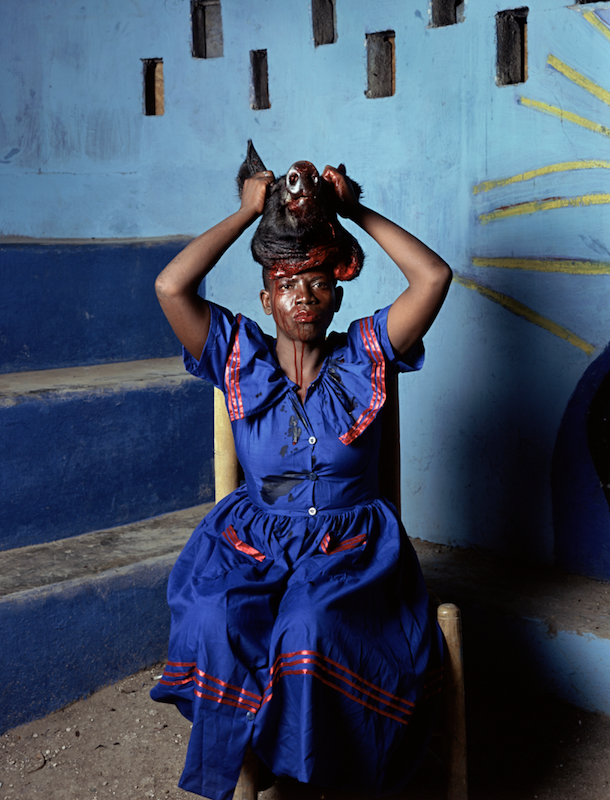
Deana Lawson’s photographs are powerful because she turns intimacy into a carefully constructed field of pressure.
At first, her images may resemble private family photographs: couples seated on beds, parents with children, bodies in modest rooms, patterned curtains, worn furniture, clothing, mirrors, televisions, and domestic objects. The people often appear close enough to know. Their rooms seem inhabited rather than designed. Their poses can feel casual, sensual, proud, guarded, or familiar.
But the scenes are not simply documentary glimpses into everyday life. Lawson meticulously directs and poses many of her subjects, including acquaintances and strangers encountered in public. Her photographs move among the visual languages of the family album, studio portrait, staged tableau, documentary photograph, and appropriated image. (ICA Boston)
This creates the central tension in her work:
The images feel deeply intimate, yet the intimacy has been deliberately staged for public view.
That contradiction makes Lawson’s photographs difficult to settle. They appear truthful and invented, private and theatrical, ordinary and mythic at the same time.
The Problem Beneath the Work
Lawson’s recurring artistic problem is not simply Black identity, family, domestic life, or intimacy.
A more precise formulation would be:
How can photography transform everyday Black life into a space of beauty, authority, intimacy, and mythology without reducing the people pictured to social evidence, stereotype, or spectacle?
Photography carries a complicated promise of truth. A family photograph seems to preserve a real relationship. A documentary image seems to offer evidence. A portrait appears to tell us something about a person.
Lawson uses those expectations, but she does not allow them to remain innocent.
Her photographs borrow the visual familiarity of family albums and domestic snapshots while making their construction visible. A pose may feel both relaxed and unusually exact. A room may appear found, yet every object begins to seem significant. The frontal lighting can expose surfaces with almost uncomfortable clarity. A subject may offer the camera direct access while remaining psychologically unreadable.
MoMA PS1 describes this layering in Coulson Family, where the photograph moves among the family snapshot, archival document, and posed portrait. What initially appears straightforward becomes increasingly choreographed, suggesting that photographic fiction may reveal truths that an allegedly neutral document cannot. (MoMA PS1)
Lawson does not merely photograph people.
She constructs a visual condition in which the meaning of being photographed becomes unstable.
How the Work Creates Pressure
The deepest pressure in Lawson’s work comes from the collision between access and control.
The viewer is permitted into bedrooms, living rooms, kitchens, family arrangements, romantic encounters, and bodily spaces that normally belong to private life. Yet this access never feels complete.
The subjects may reveal their bodies without revealing their interiority. They may face the camera directly without becoming fully available. They may appear exposed while still controlling the psychological terms of the encounter.
This produces several simultaneous pressures:
the pressure of private life becoming public image
the pressure of the body being looked at
the pressure of ordinary people entering art-historical and institutional space
the pressure of photography’s claim to truth
the pressure between social vulnerability and pictorial authority
the pressure between being documented and being transformed into myth
Lawson has described her work as both a mirror of everyday life and a projection of what she wants to happen. She uses photography not only to reflect existing conditions, but also to propose a different standard of value—one in which everyday Black lives are presented as beautiful, powerful, and intelligent. (ICA Boston)
That distinction matters.
A mirror records what appears to be there.
A projection constructs another possibility.
Lawson’s photographs do both.
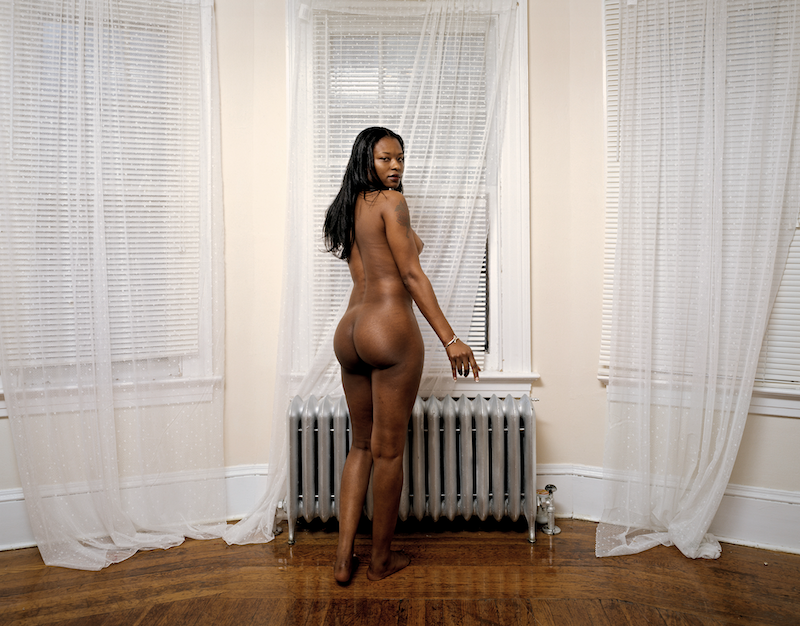
The Room Is Never Just a Room
Domestic space is one of Lawson’s most important formal and psychological tools.
The rooms often contain patterned upholstery, bedding, curtains, religious imagery, family photographs, cosmetics, televisions, plastic coverings, mirrors, electrical cords, food, clothing, and evidence of everyday use. These details are not neutral background information.
They act on the figures.
The room may suggest class, taste, memory, aspiration, intimacy, labor, protection, sexuality, family history, or social belonging. It can feel comforting and cramped, proud and precarious, familiar and theatrical.
This makes the setting an active pressure system.
The domestic interior tells us something about the subject, but it also complicates our desire to interpret the subject too quickly. The objects appear meaningful, yet their meanings are not entirely explained. They create an environment rich enough to invite projection but specific enough to resist becoming generic.
The room becomes part family archive, part stage, part psychological portrait.
For artists working with figures and environments, this is a major lesson:
A setting becomes powerful when it does not merely surround the figure but changes the conditions under which the figure can be seen.
Why the Formal Choices Matter
Lawson’s formal choices are inseparable from the deeper problem of her work.
Staging
Staging makes the photograph feel both truthful and unstable.
The image contains real people, bodies, belongings, and environments, but their arrangement has been directed. This prevents the viewer from treating the photograph as unmediated access to someone else’s life.
Staging exposes photography as construction.
At the same time, it allows Lawson to transform an individual encounter into something more concentrated, symbolic, and psychologically charged.
Direct gaze
Many of Lawson’s subjects look directly at the camera.
The gaze does not always ask for approval or invite easy intimacy. It can confront, resist, assess, seduce, or withhold. The subject becomes aware of being seen and appears to look back at the viewer through the camera.
That reverses the apparent power relationship.
The viewer may have visual access, but the subject is not necessarily passive within that access.
The body
Bodies in Lawson’s photographs are often physically present, sensuous, imperfect, decorated, exposed, or carefully posed.
The body carries sexuality, vulnerability, history, labor, family relation, age, status, and self-presentation. Yet the body is not treated merely as biological fact. It becomes a site where public meaning is written and contested.
Nudity does not automatically equal surrender.
Clothing does not automatically equal protection.
A body can be revealed and still remain sovereign.
Domestic detail
The density of objects gives each photograph a thick social and material atmosphere.
Nothing feels completely incidental. A curtain, cord, blanket, framed picture, television, hairstyle, wall color, or piece of furniture may alter how the entire scene is read.
The environment becomes a lexicon.
These objects do not merely describe a lifestyle. They help construct a world in which family, desire, memory, class, beauty, and aspiration remain active at once.
Large scale and clarity
When images associated with private albums or modest interiors are enlarged and placed inside museums, their social position changes.
The personal becomes monumental.
People and spaces that could be overlooked within dominant image culture acquire scale, ceremony, and authority. Lawson’s first museum survey emphasized more than fifteen years of work challenging conventional representations of Black life through multiple photographic forms. (ICA Boston)
The shift in scale is therefore not only visual. It is cultural.
The Central Contradiction
Lawson’s work holds several contradictions, but the most important is:
The image offers intimacy while making intimacy impossible to possess.
The viewer sees bodies, relationships, rooms, and gestures associated with private life. Yet the photographic construction prevents those things from becoming transparent.
The subjects may appear:
exposed but protected
familiar but unknown
ordinary but monumental
documentary but invented
sensual but self-possessed
socially vulnerable but pictorially powerful
specific individuals but also mythic figures
This is why the photographs continue opening after the first encounter.
They do not resolve into a simple celebration of family, an ethnographic document, an argument about representation, or a display of photographic style. Each of those readings is present, but none is sufficient by itself.
The contradictions remain active.
From Everyday Life to Myth
One of Lawson’s most distinctive achievements is her ability to elevate ordinary people without erasing the realities of their environments.
The photograph does not require wealth, polished architecture, fashionable restraint, or conventional ideals of refinement to create dignity. Instead, dignity emerges through pose, attention, scale, compositional control, physical presence, and the artist’s belief in the significance of the subject.
Critics have described Lawson’s visual world as one in which Black subjects acquire a sense of grandeur and restored glory. Her images move beyond correcting absence or demanding inclusion. They construct their own terms of beauty, kinship, sensuality, power, and spiritual significance. (The New Yorker)
That is more ambitious than representation alone.
Lawson is not merely asking that the subjects be seen.
She is changing the visual conditions under which seeing takes place.
How the Viewer Becomes Implicated
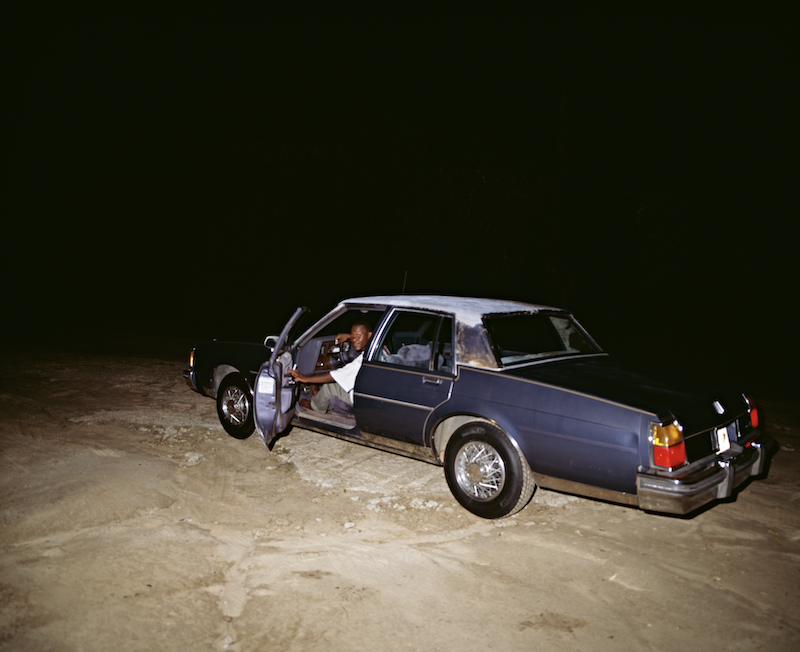
Lawson’s work gives the viewer an unstable role.
Are we a guest?
A family member?
A witness?
A voyeur?
An intruder?
A museum visitor consuming the signs of another person’s private life?
The photographs do not answer these questions for us. Instead, they make us feel the uncertainty.
The intimacy of the scenes encourages closeness, but their formal construction makes that closeness suspect. We become aware of our desire to interpret bodies, rooms, relationships, class, sexuality, and identity from visual evidence.
The photograph appears to give us information.
Then it reveals how quickly we turn information into assumptions.
This is where the work moves beyond representation and begins criticizing representation itself. In the MoMA PS1 discussion of Coulson Family, Lawson’s images are understood as intimate collaborations that resist stable categories of trauma, joy, documentary truth, or prescribed representation. (MoMA PS1)
The viewer is therefore not outside the pressure system.
Our looking completes it.
The Visual World Lawson Has Built
Across her practice, Lawson has developed a recognizable lexicon:
domestic interiors
frontal light
direct gazes
beds and couches
couples and family groups
nudity and adornment
mirrors and reflective surfaces
patterned fabrics
family photographs
hair, clothing, jewelry, and bodily presentation
intimate rooms transformed into ceremonial spaces
photographs that hover between family album and constructed icon
These elements form more than a style.
They create a world governed by a consistent intelligence: private life becomes staged visibility, visibility becomes power and risk, and ordinary space becomes mythic without ceasing to be materially specific.
What Artists Can Learn
The lesson is not to imitate Lawson’s interiors, direct flash, staged poses, or intimate subject matter.
The lesson is to understand how she makes intimacy structurally unstable.
For artists working with figures, rooms, photography, or domestic life, Lawson offers several larger principles:
An environment should carry social and psychological information.
A room should not merely identify a location. It should influence how the person inside it becomes visible.
Exposure and surrender are not the same thing.
A figure can reveal the body while withholding the self.
Staging can produce truth without pretending to be neutral.
Construction does not necessarily weaken authenticity. It can make the conditions of representation more visible.
Ordinary life can become monumental through attention.
The artist does not need to replace everyday experience with spectacle. The act of looking can change what a culture recognizes as valuable.
The viewer should not remain innocent.
A powerful portrait does more than present a person. It makes the viewer confront how they interpret, classify, desire, judge, or consume that person.
The larger lesson is this:
Intimacy becomes powerful when the image gives the viewer access but refuses possession.
Deana Lawson’s photographs do not merely show people inside private spaces. They create a system in which body, room, pose, photography, history, and viewer all place pressure on one another.
The lesson is not to copy the appearance of the work.
The lesson is to understand the pressure that made the appearance necessary.