What Makes Roni Horn’s Work So Powerful?
Roni Horn’s work is powerful because she treats identity not as something stable that an artwork can reveal, but as something continually produced through relation.
A face changes with weather.
A river changes with light, tide, pollution, movement, and the viewer’s position.
Two apparently identical sculptures become different through proximity.
A solid glass object resembles liquid water.
A self-portrait emerges through gifts selected by other people.
A sentence can become image, drawing, rhythm, hesitation, and emotional pressure.
Horn’s work often appears quiet, restrained, and formally simple. Yet beneath that restraint is a persistent dismantling of certainty.
The viewer repeatedly encounters things that seem recognizable:
a portrait;
a body of water;
a pair of objects;
a word;
a photograph;
a transparent sculpture.
But the longer one looks, the less stable each category becomes.
Her central inquiry might be stated this way:
What if identity is not an essence contained within a person or object, but a mutable condition created through weather, language, memory, repetition, place, and relation to others?
Horn does not illustrate change by showing one stable thing transformed into another. She creates works whose identity remains unsettled throughout the encounter.
What the Viewer Encounters
Horn works across photography, sculpture, drawing, installation, books, and writing. Her practice repeatedly returns to water, doubling, language, portraiture, weather, Iceland, material transformation, and the instability of perception. Hauser & Wirth describes her work as persistently concerned with the protean nature of identity, meaning, and perception, as well as with doubling and difference. (Hauser & Wirth)
The viewer may encounter:
one hundred photographs of the same woman;
paired objects that appear identical;
large cast-glass cylinders with rough sides and luminous surfaces;
photographs of the River Thames annotated with small texts;
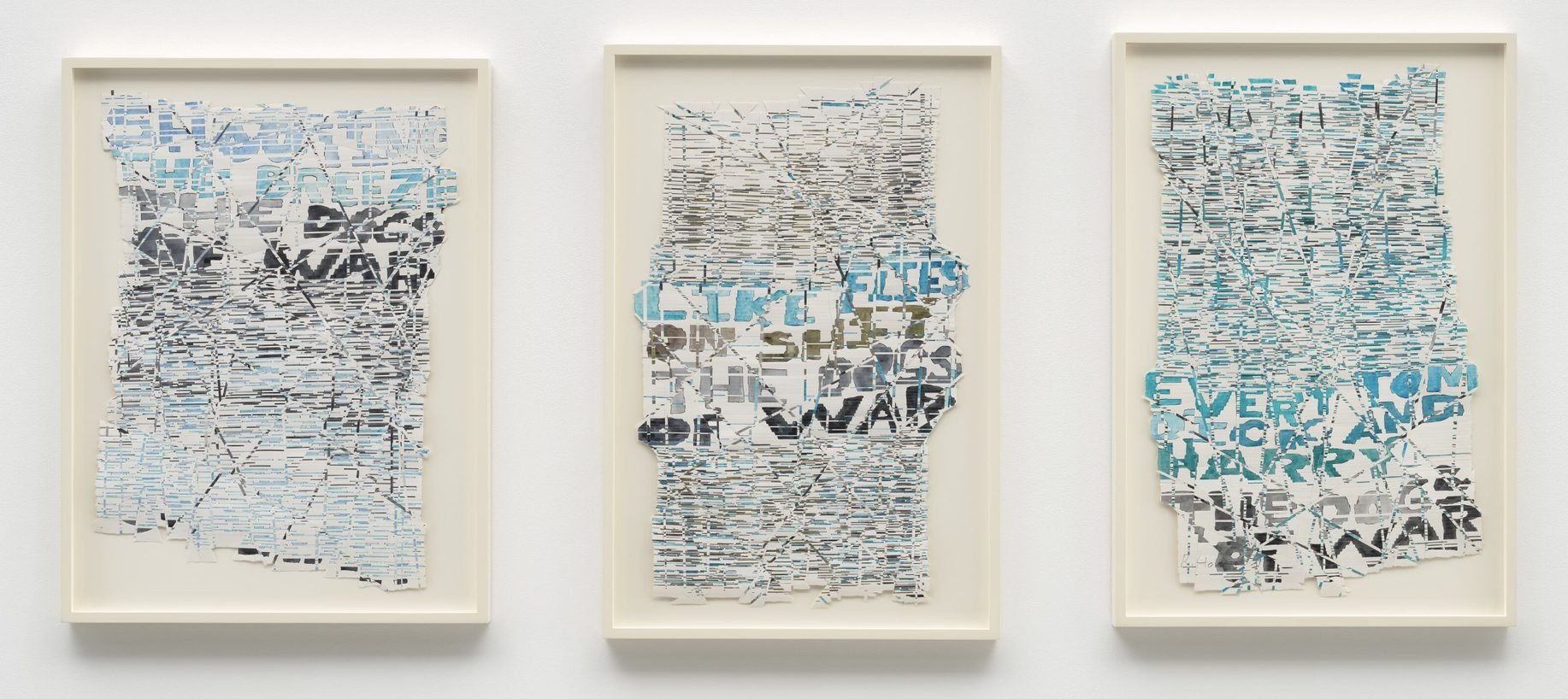
drawings cut into pieces and reassembled;
blocks, rods, or forms positioned in relation to architecture;
groups of words repeated until their meaning becomes unstable;
images that operate differently as books than as wall installations.
The work rarely announces its meaning dramatically.
Instead, it creates a situation in which perception begins to doubt itself.
Are two things the same?
Did the object change, or did the light change?
Is the face expressing emotion, or reacting physically to weather?
Is the water deep or merely reflective?
Does repetition establish identity, or dissolve it?
Horn’s work makes uncertainty active without turning it into confusion.
The Inquiry Beneath the Work
Much portraiture is built upon the belief that an image can disclose who a person is.
A face becomes evidence of:
character;
mood;
age;
gender;
history;
individuality.
Horn repeatedly disrupts this belief.
She is less interested in the portrait as a container of identity than in the conditions through which identity appears.
A face may change because of:
sun;
cold;
wind;
water;
the photographer;
the viewer;
duration;
sequencing;
comparison with another image.
The person is not absent.
But the person cannot be separated from the situation producing their appearance.
This principle extends beyond portraiture.
Water has no single appearance independent of:
weather;
light;
depth;
surrounding architecture;
surface movement;
the viewer’s angle.
A glass sculpture changes according to daylight and position.
A word changes according to repetition and context.
A pair changes how each component is perceived.
The deeper proposition is:
Nothing possesses a complete identity alone.
Identity emerges between things.
You Are the Weather: The Face as Changing Environment
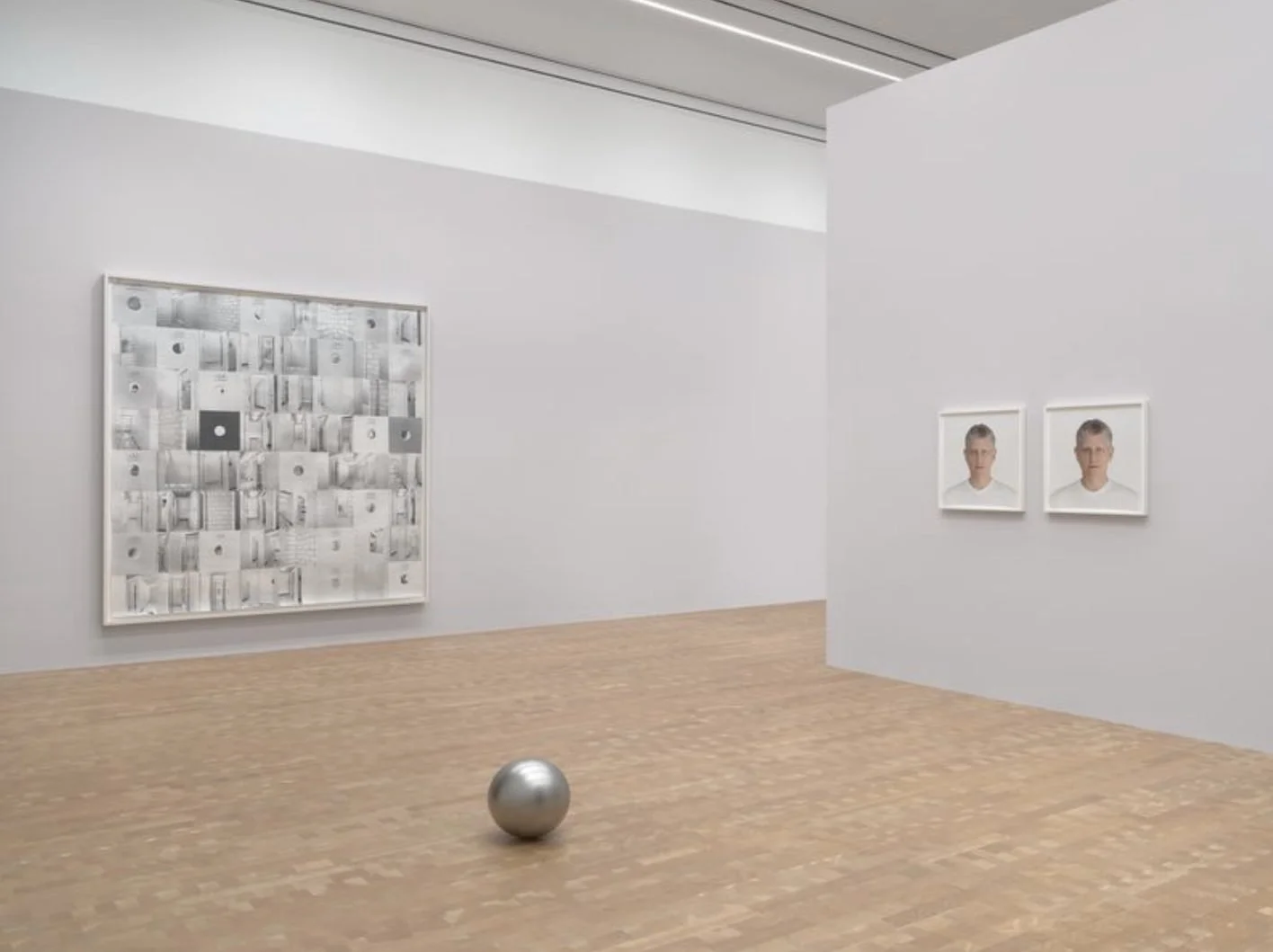
One of Horn’s most important works, You Are the Weather, consists of one hundred close photographic images of a woman immersed in Icelandic hot springs. The photographs were made during a 1994 trip, and the complete installation includes black-and-white and color prints arranged in a continuous sequence around the room. (Art-It)
The framing changes very little.
The woman’s wet face repeatedly occupies nearly the same position.
Yet no two images feel identical.
Her expression appears to shift through:
irritation;
alertness;
vulnerability;
confrontation;
amusement;
fatigue;
withdrawal;
desire.
The viewer begins interpreting these changes psychologically.
Perhaps she is reacting to the photographer.
Perhaps she is judging the viewer.
Perhaps her feelings are becoming visible.
But Horn has explained that many apparent emotional changes were caused by weather: sun in the eyes, snow, wind, temperature, and changing atmospheric conditions. The viewer experiences the expression as personally directed, even though the weather may have produced it. (The Guardian)
This creates the work’s central reversal:
The viewer believes they are reading the subject, but may actually be reading their own response to environmental change.
The portrait becomes a feedback system.
The woman is affected by weather.
The viewer interprets her face.
The title implicates the viewer:
You are the weather.
The Portrait That Refuses a Single Person
A conventional portrait often seeks one defining image.
Horn gives us one hundred.
This abundance does not produce complete knowledge.
It produces greater uncertainty.
Each photograph complicates the previous one.
A face that seemed calm becomes severe in the next image.
A hostile expression becomes vulnerable when compared with another.
A seemingly intimate gaze becomes impersonal through repetition.
Horn has said that the work was connected to the possibility of every individual being a multitude rather than a single stable identity. (Art-It)
The series therefore does not reveal the subject gradually, as though one hundred images could finally disclose the whole person.
It demonstrates that the whole person may not exist as one unified image.
More views do not necessarily produce certainty. They may expose multiplicity.
This is a major artistic discovery.
The work does not merely show that people change over time.
It suggests that contradiction may be constitutive of identity.
The person can be:
open and guarded;
intimate and distant;
calm and irritated;
vulnerable and controlling;
recognizable and unknowable.
No single expression cancels the others.
Intimacy Without Possession
The photographs are physically close.
The subject’s face fills the frame.
Her eyes meet the camera.
Wet skin, hair, pores, and minor changes become visible.
This creates intimacy.
But proximity does not grant possession.
The viewer cannot stabilize the woman’s emotional condition.
Her gaze returns attention rather than remaining passively available.
The work therefore distinguishes between:
closeness;
knowledge.
A viewer can be very close to another person and still misread them.
One may feel addressed when the other person is responding to something entirely different.
Horn makes this ordinary interpersonal uncertainty visible.
The work becomes not only a portrait but an inquiry into projection.
We constantly interpret other people’s faces through our own:
desires;
fears;
assumptions;
histories;
insecurities.
The title reveals that the observer is never outside the weather of the encounter.
Doubling and the Difference Inside Sameness
Pairs and doubles recur throughout Horn’s practice.
She may place two objects in relation to one another, present paired photographs, repeat similar forms, or build installations in which apparently identical elements occupy different positions.
At Dia Beacon, Horn’s current long-term presentation emphasizes this sustained interest in doubling through paired sculptures and drawings whose near-identical forms reveal subtle physical differences. (Dia Art Foundation)
The pair creates a specific perceptual condition.
When the viewer encounters one object, the question is:
What is it?
When the viewer encounters two related objects, the question changes:
How are they different?
This shift intensifies attention.
A slight change in:
scale;
material;
angle;
surface;
distance;
placement;
light
becomes consequential.
Doubling does not confirm identity.
It destabilizes it.
Two things may look identical from one position and visibly distinct from another.
The viewer must move, compare, remember, and revise.
The Pair as Relationship
Horn’s paired works suggest that identity may be relational rather than autonomous.
One object affects how the other is perceived.
Neither remains completely independent.
The pair can evoke:
twins;
lovers;
repetition;
mirroring;
memory;
difference;
recognition;
misrecognition.
But Horn does not usually tell the viewer what kind of relationship is being staged.
The space between the objects becomes active.
It may feel like:
distance;
attraction;
tension;
equivalence;
separation;
dependency.
The work resides partly in the interval.
This makes the viewer’s own movement essential.
From one position, the pair may merge visually.
From another, their difference expands.
Identity changes with relation and position.
Water as Perpetual Relation
Water is one of the most persistent forces in Horn’s work.
She has photographed the Thames, worked repeatedly with Icelandic springs and glaciers, created glass sculptures that resemble pools, and described water as compelling partly because its identity exists through continual relation rather than fixed substance. (Art21)
Water can be:
transparent;
opaque;
reflective;
dark;
luminous;
calm;
violent;
shallow;
deep.
It changes according to external conditions while remaining materially water.
This makes it an ideal form for Horn’s inquiry.
Water has identity without visual stability.
It can reflect something else and become temporarily inseparable from what it reflects.
Its surface conceals depth.
Its apparent color may belong to the sky, sediment, light, pollution, or surrounding environment.
Water does not merely symbolize mutability.
It performs it continuously.
Still Water: Looking at the Thames
In Still Water (The River Thames, for Example), Horn photographed sections of the Thames and added small numbered annotations connected to footnotes, quotations, observations, references, and associations. She has discussed the series alongside Some Thames and Doubt by Water as part of her wider inquiry into water, looking, and uncertainty. (Art21)
The photographs can initially look like abstract surfaces.
The river appears as:
texture;
depth;
reflection;
darkness;
turbulence;
color.
Only gradually does the viewer register that this surface is a specific body of water carrying social, historical, emotional, and physical associations.
The annotations interrupt purely visual contemplation.
Language enters the water.
A number sends the viewer elsewhere.
The photograph becomes unstable between:
image;
document;
text;
archive;
meditation;
physical site.
The viewer looks at water while also being pulled into systems of language and thought.
Surface and Depth
Water intensifies a recurring problem throughout Horn’s work:
How much can surface tell us about what lies beneath it?
A face is a surface.
A photograph is a surface.
A river is a surface.
Glass presents a surface.
Language also has surface meanings that may conceal ambiguity.
Horn does not reject surfaces in favor of hidden truth.
She questions the belief that depth exists independently and can eventually be uncovered.
The surface is already active.
It reflects, distorts, conceals, reveals, and changes.
The face does not hide one permanent self behind it.
The river does not conceal one final image below.
The glass sculpture does not have one correct appearance waiting to be discovered.
Depth and surface continually produce one another.
Cast Glass and the Illusion of Liquid
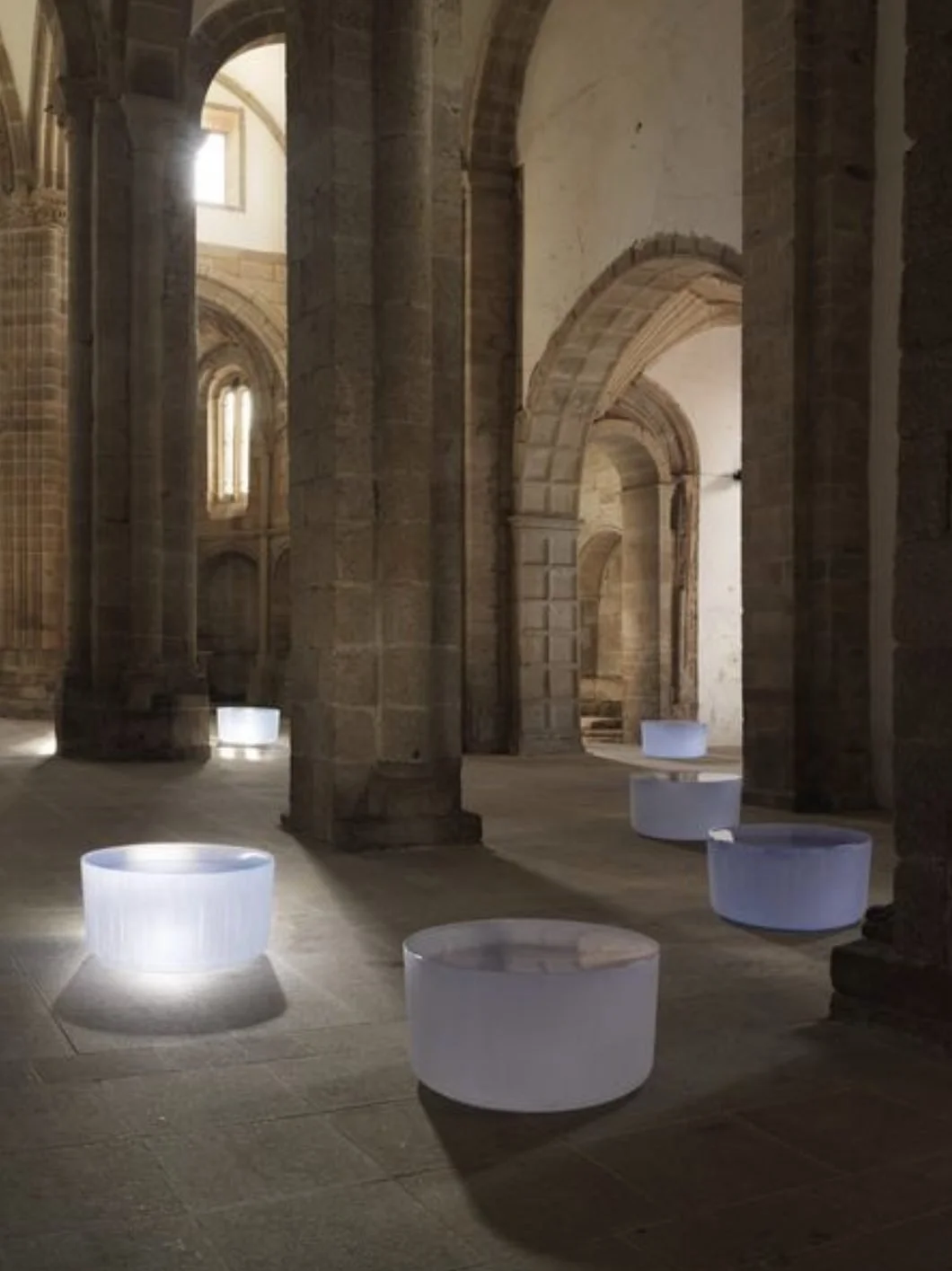
Since the mid-1990s, Horn has produced substantial cast-glass sculptures. Molten glass is poured into molds and cooled slowly, creating objects with rough, opaque sides and smooth, fire-polished upper surfaces. Their tops can resemble perfectly still pools of water. (Hauser & Wirth)
These objects create an extraordinary contradiction.
Glass is physically solid.
The surface appears liquid.
The viewer may experience the urge to touch or penetrate the top while knowing it cannot be entered.
The work can appear:
heavy and weightless;
transparent and opaque;
solid and fluid;
empty and full;
colorless and chromatic.
Light enters the material and seems to become trapped inside.
Minor changes in illumination alter its apparent depth and color.
The sculpture therefore does not possess one stable visual state.
Its identity depends upon:
architecture;
daylight;
weather;
neighboring objects;
the viewer’s movement.
The glass behaves like water without pretending to be water.
Material Contradiction as Inquiry
Horn does not use glass merely because it is beautiful.
The material allows a specific impossibility:
A solid object can appear to be a liquid condition.
This contradiction forces the viewer to negotiate between knowledge and perception.
The viewer knows:
it is solid;
it is glass;
it is heavy;
the surface cannot be entered.
But the eye continues to experience:
depth;
softness;
liquidity;
reflection;
immersion.
The sculpture makes certainty divide against itself.
What we know does not cancel what we perceive.
This is central to Horn’s practice.
She is interested in conditions where two incompatible truths remain active.
Well and Truly: Moving Through Difference
Installations such as Well and Truly place multiple cast-glass sculptures across a large gallery space. The forms may appear related but differ subtly in color, opacity, scale, and light response.
The viewer cannot understand the installation from one fixed position.
Movement becomes necessary.
A sculpture that appeared pale blue from a distance may become nearly transparent at close range.
Another may look dense from one side and luminous from another.
The space between objects creates changing alignments.
The viewer becomes a moving variable within the installation.
This is not interactivity in the technological sense.
The sculpture does not respond mechanically.
Instead, perception itself becomes the changing system.
The work changes because the viewer cannot remain in one position.
Iceland as Place and Method
Horn has traveled regularly to Iceland since the 1970s, and the country has become central to her work through its water, weather, geography, isolation, language, and dramatic environmental change. She has described herself as a “chronic tourist,” emphasizing repeated return without claiming complete belonging.
Iceland is not merely a picturesque subject.
It provides a working condition in which identity appears visibly unstable.
Weather changes rapidly.
Water shifts between:
ocean;
river;
rain;
snow;
ice;
steam;
spring;
glacier.
Light alters dramatically across seasons.
Landscape can appear solid and permanent while remaining geologically and climatically active.
Horn does not use Iceland as untouched nature.
She uses it as a place where mutability cannot be ignored.
The environment continually resists the fantasy of stable appearance.
Library of Water: Place Preserved Through Difference
Horn’s Library of Water in Stykkishólmur, Iceland, contains columns filled with water collected from Icelandic glaciers. The installation also incorporates weather-related language into the floor, joining material, place, memory, climate, and text. (The Guardian)
The project resembles an archive.
But what is being archived is inherently unstable.
Water gathered from different glaciers appears similar.
Yet each sample comes from a distinct geographic and material history.
The library does not preserve books or images.
It preserves difference inside apparent sameness.
The work has gained further pressure as glaciers continue to change and diminish.
The water becomes:
material record;
local presence;
environmental memory;
evidence of transformation.
But it does not provide a complete scientific account.
It remains sensuous, spatial, and poetic.
Weather as an Emotional System
Weather is often treated as external background.
Horn makes it inseparable from subjectivity.
Weather changes:
facial expression;
bodily sensation;
attention;
movement;
mood;
perception of place.
One may believe an emotion originates entirely inside the self, when it is partly produced by temperature, humidity, wind, darkness, or light.
This complicates the idea of psychological interiority.
The self is not sealed.
It is porous.
Environment enters the body.
The body interprets environment.
The face becomes the visible site of that exchange.
Horn’s work suggests:
Emotion may be partly meteorological.
That does not make emotion unreal.
It shows that internal and external conditions cannot be cleanly separated.
Drawing as Construction and Rupture
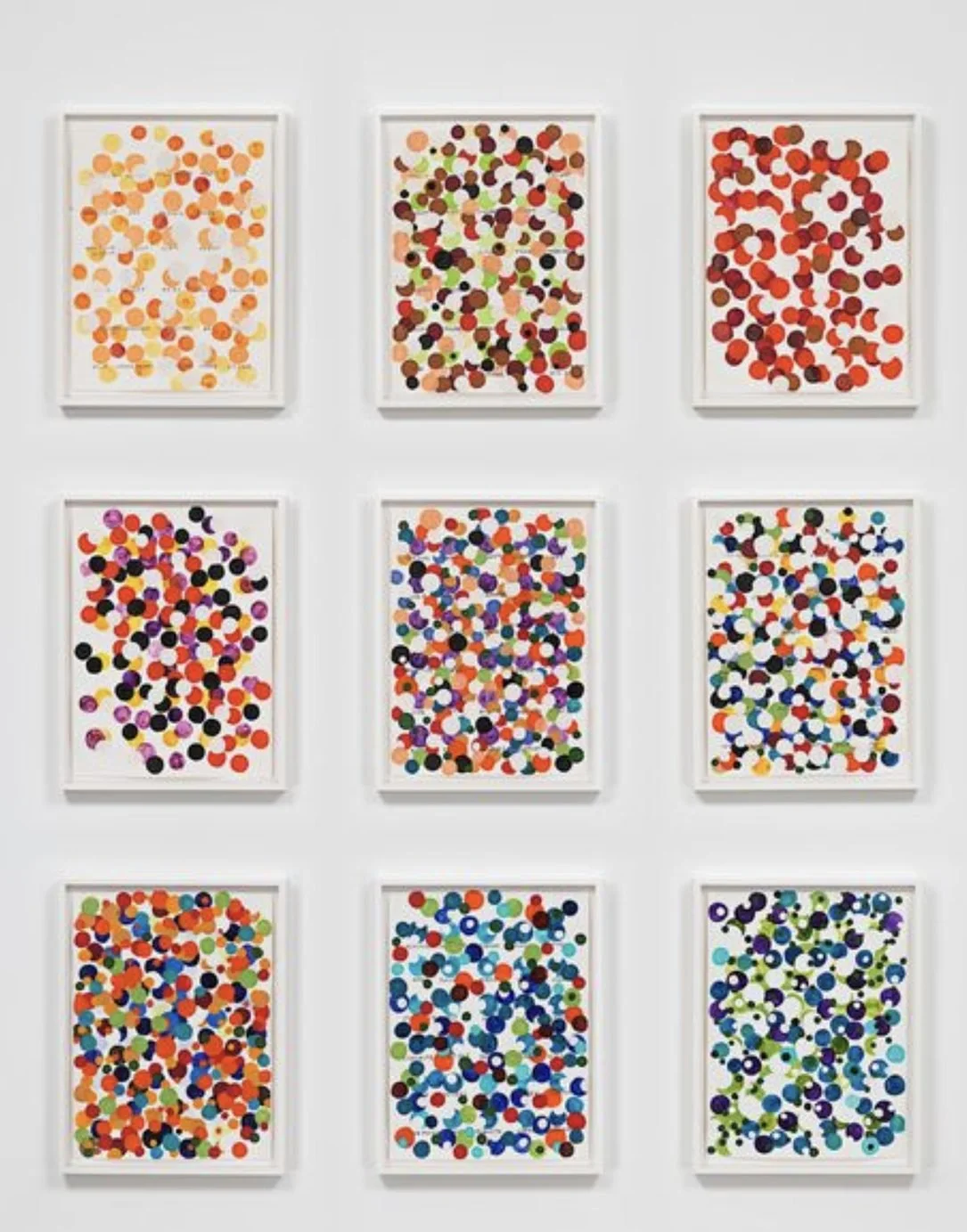
Horn’s drawings often begin as separate sheets, marks, words, or forms that are cut apart and reassembled. The resulting surfaces preserve visible seams, interruptions, and misalignments.
At Dia Beacon, works such as Untitled (Hamilton) demonstrate this process: Horn divides paper into sections she calls plates and reconstructs them, allowing irregular cut lines to record displacement and the physical construction of space. (Dia Art Foundation)
The drawing is not simply made through accumulation.
It is made through:
cutting;
separation;
relocation;
repair;
recombination.
This process creates a powerful model of identity.
The whole does not precede the fragments.
The whole is produced through their changing relations.
The seams remain visible.
Unity does not erase rupture.
Language as Material
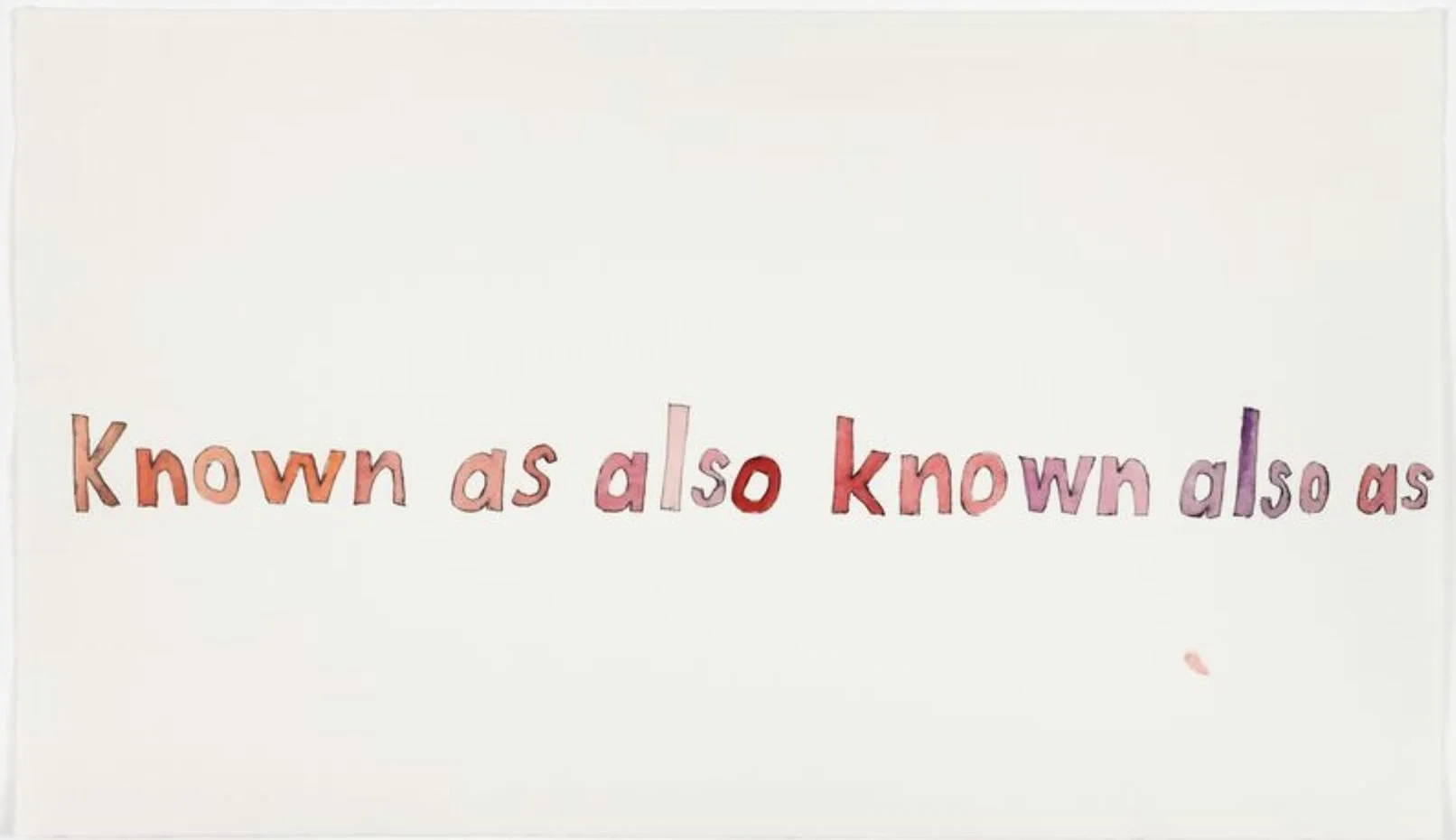
Words appear throughout Horn’s drawings, books, photographs, installations, and titles.
She uses:
quotations;
fragments;
literary references;
repeated phrases;
jokes;
footnotes;
handwritten language;
altered syntax.
Horn has discussed titles as active components that can change how images, sculptures, and installations are encountered rather than merely naming them afterward. (Art21)
Language in her work does not stabilize interpretation.
It often multiplies possibilities.
A title may:
redirect attention;
contradict the image;
create intimacy;
introduce humor;
evoke literature;
make the viewer question what seemed obvious.
Words become visual and spatial.
Their meaning changes through:
repetition;
placement;
fragmentation;
scale;
handwriting;
context.
Language behaves like water.
It changes according to what surrounds it.
Seizure of Hope: Repetition Under Political Pressure
Horn’s 2026 exhibition Seizure of Hope at Hauser & Wirth London presents seventy-six graphite and colored wax pencil drawings built around the repeated phrase “I am paralysed with hope.” The exhibition also includes glass sculpture and extends her ongoing investigation of language, transformation, ambiguity, and emotional contradiction. (Hauser & Wirth)
The phrase contains an immediate contradiction.
Hope is usually associated with:
movement;
possibility;
endurance;
action.
Paralysis implies:
immobility;
fear;
incapacity;
suspension.
To be “paralysed with hope” is to experience hope as both sustaining and disabling.
Repeated across many drawings, the phrase becomes less like a statement and more like:
rhythm;
compulsion;
prayer;
protest;
self-command;
emotional residue.
The writing does not simply communicate the sentence.
Its spacing, smudging, pressure, interruption, and repetition give the phrase a body.
Hope as Contradictory State
The recent drawings reveal something already present throughout Horn’s practice.
She is drawn to conditions that refuse stable opposition.
Hope is not simply the opposite of despair.
Identity is not simply the opposite of difference.
Solidity is not simply the opposite of liquidity.
Sameness is not simply the opposite of variation.
A work can hold both simultaneously.
This connects Horn’s recent language directly to the broader practice.
“I am paralysed with hope” functions like the glass sculptures:
solid and liquid;
fixed and changing.
It functions like the portraits:
intimate and unknowable;
singular and multiple.
The phrase becomes another mutable object.
Self-Portrait Through Other People’s Choices
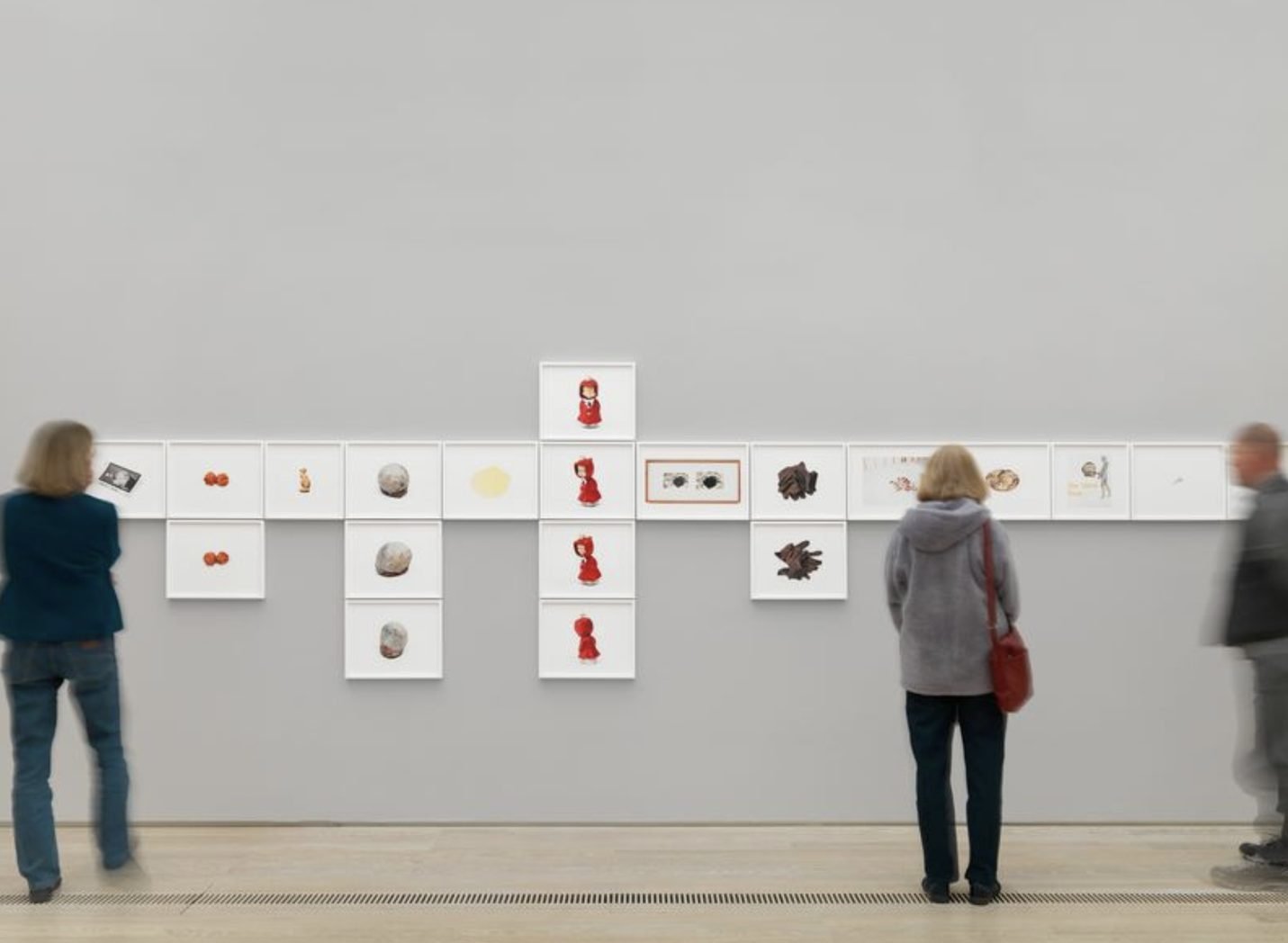
In The Selected Gifts, 1974–2015, Horn photographed objects that had been given to her over approximately four decades. Together, the images create an indirect self-portrait assembled through other people’s selections.
The work asks:
Can a person be represented through what others believed belonged to them?
Each gift contains an interpretation.
Someone chose an object because it seemed:
appropriate;
humorous;
intimate;
useful;
symbolic;
connected to Horn’s interests or identity.
The self-portrait therefore emerges through accumulated projections.
It is autobiographical but not self-authored in a simple sense.
The work aligns with Horn’s broader understanding of identity as relational.
Others participate in producing who we become.
Their interpretations may be accurate, mistaken, affectionate, controlling, or surprising.
All become part of the archive.
Gender and the Refusal of Fixed Categories
Horn’s work has long resisted fixed gender identification, both through her own public presence and through works that destabilize conventional distinctions between masculine and feminine, subject and object, self and other.
But the practice does not usually transform identity into a direct declaration.
It produces situations in which stable categories become insufficient.
A portrait may feel erotic without establishing a conventional gender relation.
A doubled form may appear identical while remaining distinct.
A self may emerge through environmental and relational conditions rather than fixed attributes.
Horn’s interest lies less in replacing one identity category with another than in preserving multiplicity.
This makes the work especially relevant to a broader inquiry into contradictory selves.
The self does not become authentic by selecting one final version.
Authenticity may involve acknowledging that several incompatible versions remain real.
The Artwork as Encounter Between Two
Horn’s work often avoids the single autonomous object.
Even when only one sculpture is present, it enters into relation with:
architecture;
weather;
light;
language;
the viewer.
The artwork is never fully alone.
This produces an ethic of attention.
To understand something, one must observe:
what it is beside;
what changes around it;
how another position alters it;
what the viewer brings to it;
what time does to perception.
The object does not disclose itself instantly.
It requires sustained relation.
Horn’s quietness is therefore not passive.
It places responsibility on the viewer.
The viewer must remain long enough for certainty to weaken.
The Central Contradiction
The deepest contradiction in Horn’s practice is:
Her works often appear formally stable while making identity, meaning, and perception fundamentally unstable.
They are:
minimal and psychologically complex;
solid and liquid;
intimate and withholding;
repetitive and continuously different;
materially precise and perceptually uncertain;
autobiographical and impersonal;
quiet and emotionally charged;
singular and multiple.
The formal restraint is essential.
If the work were visually chaotic, instability would be obvious.
Horn makes uncertainty emerge inside clarity.
A simple pair becomes difficult.
A transparent object becomes opaque.
A repeated face becomes unknowable.
A familiar sentence becomes strange.
The Viewer’s Position
Horn positions the viewer as an active but unreliable interpreter.
The viewer must:
compare;
remember;
move;
project;
revise;
recognize misreading;
tolerate uncertainty.
In You Are the Weather, the viewer believes the subject’s expression may be directed toward them.
In the paired works, the viewer must decide whether two things are identical.
In the glass sculptures, the eye experiences liquidity while the mind knows solidity.
In the Thames photographs, visual immersion is interrupted by language.
The viewer is never entirely outside the work.
Perception contributes to what the work becomes.
But the viewer is not given complete authority.
The work repeatedly exposes the limits of interpretation.
How the Medium Thinks
Horn’s materials are selected because their physical properties enact the inquiry.
Photography brings:
repetition;
apparent evidence;
sequencing;
comparison;
the possibility of portraiture.
Glass brings:
weight;
transparency;
opacity;
reflection;
the appearance of liquid;
sensitivity to light.
Water brings:
continual change;
relation;
surface;
depth;
environmental responsiveness.
Drawing brings:
touch;
cutting;
reconstruction;
visible seams;
repetition.
Language brings:
ambiguity;
reference;
rhythm;
contradiction;
context.
Each medium does something another cannot.
The practice remains coherent not because every work looks the same, but because every material is asked to test identity under changing conditions.
What the Practice Has Discovered
Across photography, sculpture, drawing, language, books, and installation, Horn’s practice appears to have produced several major discoveries.
1. Identity may be relational rather than internal
A person or object becomes visible through environmental, interpersonal, material, and perceptual conditions.
2. Repetition does not confirm sameness
The more something is repeated, the more difference may become visible.
3. Doubling can intensify individuality
A pair reveals distinctions that one object alone might conceal.
4. More images do not necessarily produce more knowledge
Accumulation can multiply uncertainty rather than resolve it.
5. Surface is not the enemy of depth
Surface actively produces meaning through reflection, concealment, change, and relation.
6. Material contradiction can become philosophical inquiry
A solid glass sculpture can make liquidity perceptually present without representing water literally.
7. Place and self continually alter one another
Weather, landscape, water, language, and bodily experience participate in identity.
8. Unity can preserve rupture
Cut and reconstructed drawings form wholes that retain visible evidence of separation.
The Artistic Capacity
Horn has developed the capacity to make very small perceptual differences carry large psychological and philosophical consequences.
She can make:
one face become many possible people;
a pair destabilize sameness;
a solid object behave like water;
repetition increase difference;
a river become image, text, memory, and physical place;
language become material;
formal restraint produce emotional uncertainty;
a viewer become aware of their own projection.
Her work depends on precision.
A slight change in:
distance;
color;
sequence;
light;
expression;
word placement;
material surface
must matter.
The work does not rely on spectacle.
Its intensity accumulates through comparison.
The World Horn Has Built
Horn’s artistic world includes recurring:
water;
weather;
rivers;
faces;
doubles;
pairs;
glass;
Iceland;
words;
cut paper;
gifts;
books;
reflections;
mutable surfaces.
These elements are connected by one underlying condition:
Nothing remains identical when encountered again.
The same river is not the same river.
The same face is not the same face.
The same phrase is not the same phrase after repetition.
The same sculpture is not the same sculpture under different light.
The same person is not the same person in another relationship.
Horn’s world is coherent because change is not treated as an interruption of identity.
Change is how identity exists.
Is the Language Still Learning?
Horn’s work faces a risk distinct from spectacle-driven practices.
Its restraint can become an established atmosphere:
quiet;
elegant;
ambiguous;
reflective;
materially refined.
Subtlety can become a recognizable style just as easily as visual excess.
The critical question is:
Does each new work create a distinct condition of uncertainty, or does it merely repeat the appearance of ambiguity?
The language remains alive when:
a new pair changes how relation is understood;
text introduces a different emotional pressure;
a material contradiction reorganizes perception;
a portrait changes the viewer’s role;
repetition produces an unexpected difference;
a new installation makes movement necessary.
Recent projects demonstrate continued development across media. The 2025 Dia Beacon installation brought paired sculptures and reconstructed drawings into sustained spatial relation, while Seizure of Hope in 2026 introduces urgent political and emotional pressure through repeated language and new glass work. (Dia Art Foundation)
The work weakens only when uncertainty becomes vague rather than exact.
Horn’s best work is never vaguely mysterious.
It establishes a precise contradiction the viewer cannot easily resolve.
Risks and Limits
Horn’s practice carries several important risks.
Ambiguity becoming emotional distance
Refusing closure can preserve complexity, but it may also prevent emotional consequence if the work becomes too detached.
Refinement becoming authority
Beautiful glass and careful installation can make the work feel significant before its inquiry has been fully activated.
Repetition becoming predictable
Pairs, serial portraits, and recurring water imagery can become familiar devices.
Mutability becoming a universal answer
Not every identity or social condition is equally fluid. Emphasizing change can sometimes understate the force of fixed institutions, histories, and material constraints.
Quietness becoming prestige
Minimal presentation can acquire cultural authority simply through restraint.
These pressures do not invalidate the work.
They establish the standard it must continue meeting.
Every subtle variation must matter.
What the Work Expands
Horn expands what portraiture can be.
A portrait does not need to reveal a stable character.
It can reveal the impossibility of reducing a person to one image.
She expands what sculpture can be.
A solid object can become an inquiry into water, light, weather, reflection, and perceptual instability.
She expands what repetition can do.
Repetition can produce difference rather than uniformity.
She expands what identity can mean.
Identity can be understood not as a possession but as a condition continually created through relation.
Most importantly, Horn shows that contradiction does not have to appear dramatic.
It can exist quietly inside:
two similar objects;
a changing expression;
a polished surface;
a repeated phrase;
a river seen again.
What Artists Can Learn
The lesson is not to imitate Horn’s glass cylinders, paired objects, Icelandic photographs, or restrained installations.
The deeper lesson is to ask whether the work allows its subject to remain variable.
A portrait does not always need to define its subject.
It may create conditions through which several incompatible identities remain visible.
Repetition does not need to reproduce a successful image.
It may reveal differences too subtle to perceive otherwise.
A material can do more than represent an idea.
Its actual physical behavior can become the inquiry.
Horn also demonstrates that artistic pressure does not require visual noise.
A quiet work can be powerful when its apparent simplicity contains a precise instability.
Her achievement is to make identity feel neither hidden nor fixed, but continually generated: by weather, water, language, memory, material, repetition, other people, and the changing position from which we look.