What Makes Barbara Kruger’s Work So Powerful?
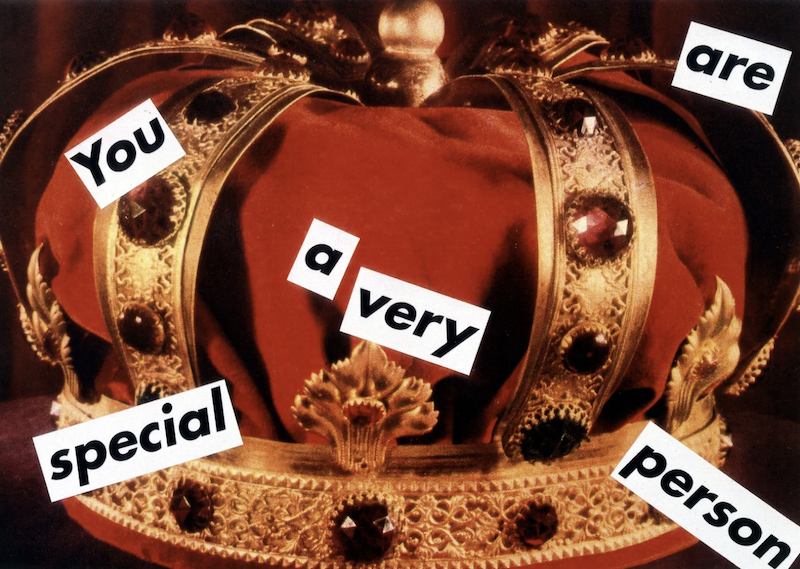
Barbara Kruger’s work is powerful because she uses the visual language of authority to expose how authority speaks through us.
At first, her work appears almost immediately understandable.
A black-and-white photograph.
A red field.
Bold white or black type.
A brief declaration or question:
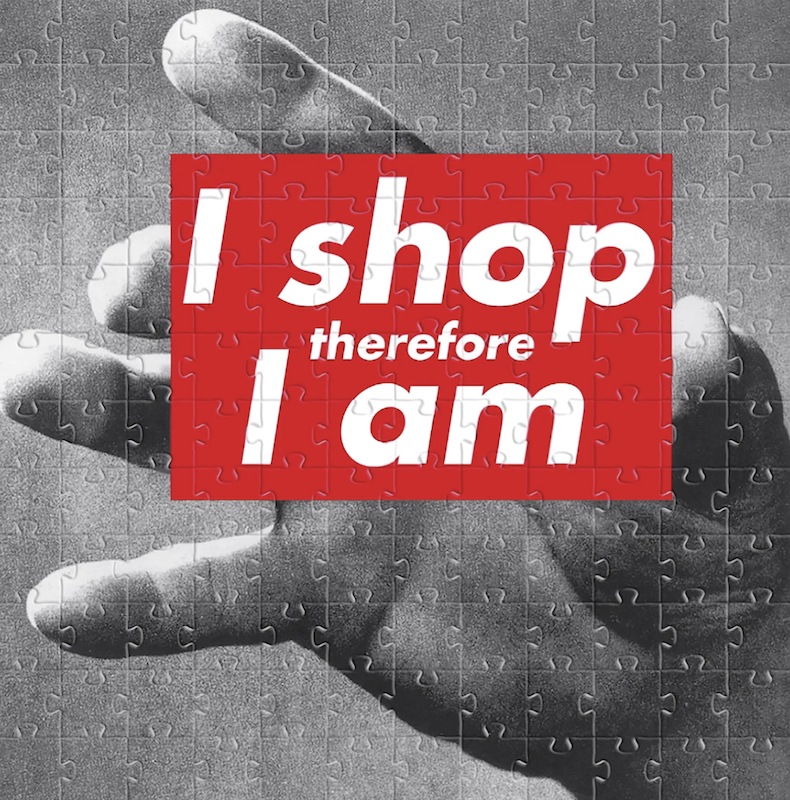
I shop therefore I am.
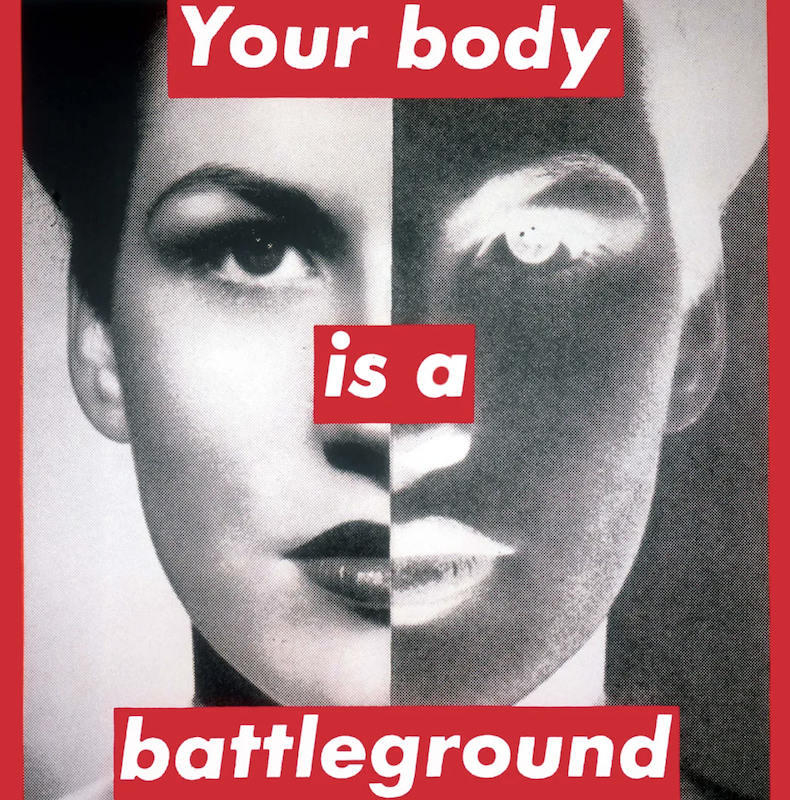
Your body is a battleground.
Who speaks? Who is silent?
You are not yourself.
The visual language resembles advertising, magazine design, political propaganda, public signage, social media, or a command from an institutional system. The words are short. The typography is forceful. The image is instantly legible.
But legibility is not the same as simplicity.
Kruger’s work does not merely deliver political slogans. It creates situations in which language becomes unstable. We may understand every word while remaining uncertain about who is speaking, who is being addressed, and what position we occupy.
Who is the “I”?
Who is the “you”?
Who belongs to “we”?
Is the statement criticizing consumer culture, or seducing us with its visual power?
Is the work speaking for the viewer, accusing the viewer, or revealing that someone else has already been speaking through us?
The central pressure is:
We believe we are reading the message, but the message is also reading and positioning us.
The Problem Beneath the Work
Kruger’s recurring artistic problem is not simply consumerism, feminism, advertising, or political power.
A more precise formulation would be:
How do images and language shape what people desire, fear, believe, buy, and become before they recognize that they are being influenced?
Power does not operate only through laws, police, governments, or direct commands.
It also operates through ordinary language:
you deserve this
be yourself
protect your family
become beautiful
buy now
choose freely
prove your worth
believe
obey
belong
succeed
improve
consume
These messages enter daily life through advertising, news media, entertainment, religion, politics, education, branding, and social platforms.
They frequently sound personal.
They address “you.”
They promise individual freedom.
But they may also organize behavior at a mass scale.
Kruger takes the language of persuasion and removes it from its normal commercial or political setting. Once isolated, enlarged, and redirected, the familiar phrase begins to reveal its underlying structure.
The work asks:
Who benefits when I believe this?
Who taught me to desire this?
Is this my voice, or a voice I have internalized?
When I say “I,” how much of that identity has already been constructed for me?
The Language of Advertising Turned Against Itself
Kruger’s background in magazine design is central to her work.
Before becoming widely known as an artist, she worked in publishing, including as a designer and picture editor. That experience gave her practical knowledge of how photographs, typography, cropping, scale, and placement direct attention and create meaning. (The Museum of Modern Art)
Advertising rarely asks viewers to analyze its visual construction.
It wants the message to feel immediate.
The image attracts.
The headline directs interpretation.
The composition tells the eye where to go.
The slogan converts a complicated human desire into a short, repeatable phrase.
Kruger adopts that efficiency.
But she changes its purpose.
An advertisement may say:
Buy this object and become more complete.
Kruger replies:
I shop therefore I am.
The phrase transforms René Descartes’s philosophical proposition about consciousness into a statement about consumer identity.
Existence becomes purchasing.
The self becomes a market activity.
But the work does not merely say that shopping is bad. Its form is visually desirable. The design is polished, bold, memorable, and easily reproduced. It looks like something that could itself become a product.
That contradiction is crucial:
Kruger criticizes the seductions of mass media by becoming extremely skilled at seduction.
She does not stand outside advertising and speak in a visually pure language.
She enters its machinery.
She borrows its speed, confidence, repetition, and visual authority, then redirects those forces toward doubt.
Why the Pronouns Matter
Kruger repeatedly uses pronouns such as:
I
you
we
they
us
your
our
These small words are among the most important materials in her work.
A pronoun creates a relationship before we know who occupies it.
When a work says you, the viewer is addressed directly.
But the nature of that address remains uncertain.
Is “you”:
the individual viewer?
men?
women?
consumers?
collectors?
citizens?
people with institutional power?
the art world?
the artist herself?
everyone?
The pronoun feels precise because it points directly at us.
Yet it is structurally ambiguous.
This allows a single statement to move among accusation, intimacy, command, warning, confession, and seduction.
The word we is equally unstable.
“We” may create solidarity.
It may also conceal exclusion.
Political leaders, advertisers, institutions, and social groups frequently use “we” as if consensus already exists:
We believe.
We must act.
We all want this.
We are one people.
But who was allowed to define the group?
Who remains outside it?
Kruger’s pronouns reveal that language does not merely describe social relationships.
It creates them.
The pronoun assigns positions: speaker, audience, ally, enemy, insider, outsider, authority, and subject.
The Viewer Is Not Outside the Work
Many political artworks allow viewers to agree with the message from a safe distance.
The viewer recognizes injustice, condemns it, and leaves feeling morally aligned with the artwork.
Kruger complicates that comfort.
Her work often addresses the viewer as someone already participating in the system under criticism.
In Untitled (You Invest in the Divinity of the Masterpiece), the word “you” implicates viewers in the cultural and financial system that transforms artworks and artists into objects of faith, prestige, and monetary value. MoMA describes the work as connecting religious belief with belief in the masterpiece and the market that sustains it. (The Museum of Modern Art)
The viewer may be:
a museum visitor
an art buyer
a believer in artistic genius
a consumer of culture
someone seeking status through taste
someone benefiting from the institutions being questioned
The work does not allow the viewer to imagine that power belongs only to distant corporations or governments.
We participate through attention, belief, desire, purchasing, repetition, and compliance.
This is a major shift from much of the figurative art we have studied.
In portraiture, the viewer may confront another person.
In Kruger’s work, the viewer confronts a language system that has already entered the viewer’s own mind.
Text Does Not Explain the Image
In conventional illustration, the image and text often support the same message.
The picture shows something.
The words explain it.
Kruger creates more unstable relationships.
The text may contradict the photograph.
It may redirect it.
It may expose a hidden power relation.
It may make an ordinary image suddenly sexual, political, economic, or threatening.
The photograph is frequently appropriated rather than created by Kruger. It arrives with an existing visual history—advertising, journalism, popular culture, domestic imagery, or archival photography.
The text acts upon that inherited image.
This resembles collage, but the collision is conceptual rather than only physical.
The image says one thing.
The words make another interpretation unavoidable.
Neither remains unchanged.
The text does not caption the photograph. It places the photograph under interrogation.
Why the Work Uses Found Images
Appropriation is necessary to Kruger’s project because her subject is not simply personal expression.
She is examining images that already circulate publicly.
Found photographs carry the assumptions of their original systems:
how women are pictured
how masculinity is performed
how families are idealized
how beauty is standardized
how authority is staged
how desire is manufactured
how bodies become commodities
how social roles become visually natural
Kruger does not need to invent these visual codes.
They are already present.
Her act is to expose and reorganize them.
This also complicates authorship.
The photograph may come from mass media.
The typography resembles commercial design.
The language may sound like a familiar slogan or cliché.
Kruger’s authorship resides in selection, framing, juxtaposition, address, and circulation.
She demonstrates that an artist does not need to invent every element in order to create a distinct and forceful work.
Authorship can mean changing the power relationship among existing images, words, and audiences.
Red, Black, and White
Kruger’s signature palette is visually aggressive because it reduces the image to high contrast.
Red commands attention.
Black creates force and seriousness.
White produces clarity and visual interruption.
The combination recalls:
advertising
propaganda
newspapers
warning signs
political posters
tabloid headlines
public instructions
commercial branding
These colors operate before the sentence is fully read.
They announce urgency.
The visual system says:
This matters.
Look now.
Do not ignore this.
The palette is therefore not merely branding.
It reproduces the emotional mechanics of mass communication.
Yet Kruger also understands that repetition can turn critique into a recognizable style. Her visual language has itself been imitated, commercialized, and absorbed into branding—most famously in comparisons to the streetwear company Supreme. MoMA notes that the appropriation of her graphic language intensifies the questions her work raises about originality and ownership. (The Museum of Modern Art)
This creates an extraordinary contradiction.
A visual language designed to criticize consumerism becomes commercially desirable.
The critique becomes a brand.
But rather than invalidating the work, this confirms one of its central insights:
No image can remain completely outside the systems of circulation, consumption, and imitation it critiques.
“Your Body Is a Battleground”
One of Kruger’s most widely recognized images, Untitled (Your Body Is a Battleground), was created in connection with the 1989 reproductive-rights movement.
The phrase transforms the body from a private biological fact into a contested political territory.
The body becomes a site where:
law
religion
medicine
gender
sexuality
family
government
public morality
personal autonomy
struggle for authority.
The divided face reinforces that tension. Positive and negative photographic values split the image into opposing visual states.
But the face remains one person.
The conflict is not between two separate people.
It passes through the same body.
The phrase remains powerful because it does not describe only one political moment. It identifies a recurring structure:
The body becomes a battleground whenever institutions claim the authority to determine what a person may do, become, reveal, or control.
The word your is central.
The statement is personal.
But it also tells the viewer that privacy has already become political.
Desire and Power
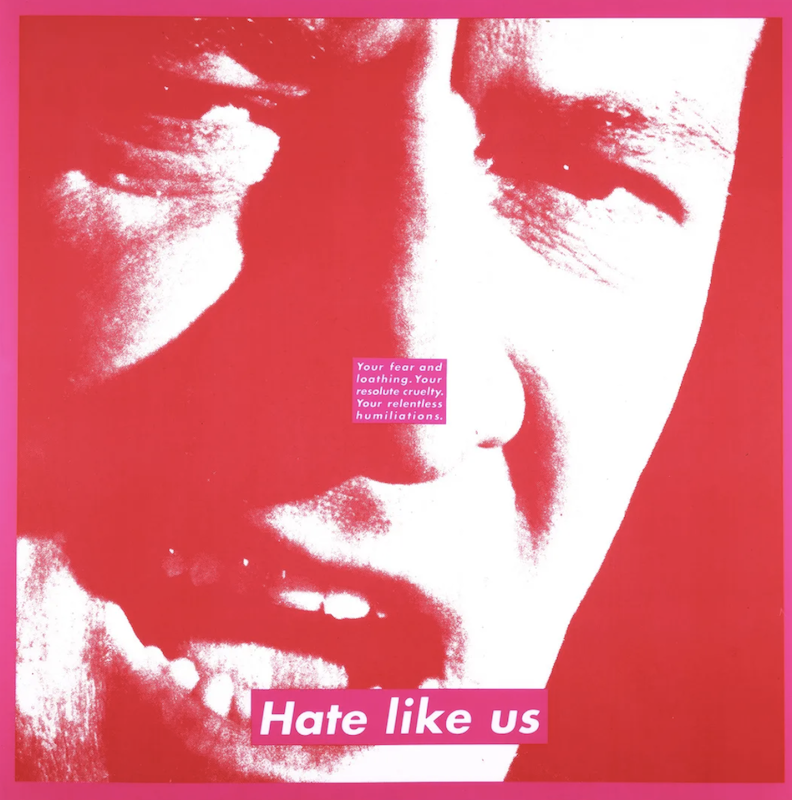
Kruger’s work repeatedly connects power with desire.
This matters because control is often imagined as something imposed against a person’s will.
But many systems operate more effectively by producing desire.
Advertising does not normally command:
Obey us.
It says:
This is what you want.
Consumer culture promises that objects can provide identity, confidence, attractiveness, belonging, security, or self-expression.
The person experiences the purchase as choice.
Kruger asks whether desire can still be considered entirely private when enormous industries are dedicated to manufacturing it.
This does not mean every desire is false.
It means desire has a history.
It is shaped through images, comparisons, repetition, aspiration, envy, fear, and social reward.
Power becomes most effective when its commands are experienced as personal wishes.
That is why Kruger’s work often sounds intimate.
The language of power frequently speaks in the voice of the self.
The Command and the Question
Kruger uses both declarations and questions.
The declarations feel authoritative:
I shop therefore I am.
Your body is a battleground.
We will no longer be seen and not heard.
You are not yourself.
The viewer receives them almost as commands or verdicts.
But Kruger also uses questions:
Who speaks?
Who is silent?
Who is beyond the law?
Who is free to choose?
Who follows orders?
Who salutes longest?
Questions change the pressure.
A declaration may position the viewer immediately.
A question forces the viewer to generate an answer.
That answer may reveal assumptions the viewer did not know they possessed.
At the Hirshhorn, Belief+Doubt surrounds visitors with language across walls, floors, escalators, and the museum bookstore. Questions concerning freedom, law, speech, silence, money, democracy, and belief become an environment rather than a single framed object. (Hirshhorn Museum)
Kruger has described herself as interested in introducing doubt at moments when ideological certainty becomes especially powerful. (Hirshhorn Museum)
This may be one of the most important lessons in her practice:
The work does not always need to provide a better slogan. It can destabilize the slogans through which people organize reality.
From Image to Environment
Kruger’s early photo-text works can be encountered quickly.
A viewer sees the image, reads the phrase, and experiences the collision.
Her large installations expand that encounter into architecture.
Language may cover:
walls
floors
ceilings
columns
escalators
windows
museum façades
public transportation
billboards
commercial objects
The viewer no longer stands outside the work and looks at it.
The viewer enters the sentence.
Words pass beneath the feet, tower overhead, wrap around the body, and compete across surfaces.
Reading becomes physical.
The Smithsonian describes Belief+Doubt as a space in which text surrounds visitors and reveals itself through their movement. (Smithsonian Institution)
This shift is conceptually necessary.
Kruger’s subject is not language as an isolated intellectual object.
It is the way language structures social space.
Public space is already filled with instructions:
buy
stop
enter
exit
wait
pay
obey
identify yourself
prove authorization
choose
vote
consume
By covering architecture with language, Kruger makes the usually invisible verbal structure of public life impossible to ignore.
The building begins to speak, and the viewer realizes that buildings and institutions have always been speaking.
The Museum Is Not Neutral
Kruger often directs her critique toward the space in which the artwork appears.
A museum presents itself as a place of culture, education, preservation, and public value.
But it is also shaped by:
wealth
donors
trustees
collecting power
social prestige
institutional authority
cultural hierarchy
the art market
decisions about inclusion and exclusion
When Kruger places language about money, power, belief, truth, or value inside a museum, the text does not refer only to society outside.
It acts on the institution hosting it.
A museum bookstore is especially charged.
Visitors move from art into commerce.
They may purchase books, posters, gifts, clothing, and reproductions.
Culture becomes merchandise.
Kruger’s installation does not treat this as a minor contradiction.
It uses the bookstore as part of the work’s meaning.
The critique occupies the site of consumption.
It may itself become something consumed.
Again, the contradiction remains unresolved.
Repetition, Circulation, and the Moving Present
Kruger has frequently returned to earlier phrases and images, remaking them in new formats and contexts.
Her major exhibition Thinking of You. I Mean Me. I Mean You. included early pasteups, architectural vinyl, animation, and multichannel video. Rather than presenting her work as a fixed chronological retrospective, the exhibition emphasized repetition, revision, and replay across changing media environments. (Art Institute of Chicago)
This is important because language changes as culture changes.
A phrase encountered:
in a magazine
on a billboard
on a bus
in a museum
on a phone
inside an immersive video installation
does not function identically.
The audience has changed.
The speed of circulation has changed.
The political context has changed.
The visual environment has changed.
Kruger treats earlier work not as completed historical evidence but as material that can be reactivated.
Repetition becomes a way to test whether the pressure still holds—and how the surrounding system has changed.
Kruger and Social Media
Kruger developed her visual language before contemporary social platforms, but her work now seems remarkably suited to them.
Short phrases.
Bold design.
Immediate address.
Conflict.
Compression.
Repeatability.
Text placed over images.
These are central features of contemporary online communication.
But social media intensifies the problem she identified.
People now participate continuously in producing and circulating persuasive images.
The distinction among advertiser, consumer, brand, audience, and product has weakened.
A person may:
sell a lifestyle
perform authenticity
package political beliefs
optimize identity for visibility
repeat slogans
build a personal brand
become economically valuable through attention
Kruger’s work helps us see that social platforms did not invent these pressures.
They accelerated and personalized the visual language of advertising.
The commercial message no longer always comes from a corporation.
It may come from a friend, influencer, political group, artist, or from the public self one has constructed.
Her question—You are not yourself—becomes even more unsettling in that environment.
The Central Contradiction
The central contradiction in Kruger’s work is:
She uses the seductive authority of mass communication to teach viewers to distrust seductive authority.
Her work is:
immediate but conceptually unstable
legible but unresolved
visually pleasurable but politically suspicious
critical of branding but powerfully branded
public but psychologically intimate
direct but ambiguous
appropriated but unmistakably authored
commercial in appearance but anti-commercial in pressure
easy to reproduce but dependent on context
declarative but designed to create doubt
The work cannot escape the visual systems it critiques.
That is not a failure.
It is the condition of the problem.
There is no perfectly innocent language outside ideology, persuasion, commerce, or power.
Kruger therefore works from inside the contaminated field.
Is It Art or Graphic Design?
Kruger’s work raises a familiar objection:
Is this simply graphic design with political content?
The question is useful because her work intentionally occupies that boundary.
Graphic design normally serves a defined communication objective.
It may sell a product, identify a brand, organize information, or persuade an audience toward a particular action.
Kruger uses many of the same tools.
But she destabilizes the objective.
The message does not settle into one instruction.
Instead, it exposes the conditions under which instructions gain authority.
Graphic design generally seeks clarity.
Kruger uses clarity to produce uncertainty.
Advertising tries to conceal its manipulation beneath desire.
Kruger makes manipulation itself visible.
The important distinction is not whether typography belongs to art or design.
It is what the structure asks the viewer to experience.
Kruger transforms communication from the delivery of a message into an examination of who has the power to deliver messages at all.
The Visual and Conceptual World She Has Built
Across her practice, Kruger has developed a recognizable lexicon:
found black-and-white photographs
red, white, and black
bold sans-serif typography
short declarations
pronouns
questions
commands
cropped bodies and faces
advertising language
political slogans
public signage
institutional architecture
billboards, buses, posters, clothing, and consumer objects
museum walls and floors covered with text
conflicting voices
repetition and replay
words that implicate rather than explain
language occupying the viewer’s physical space
These elements form more than a style.
They create a system in which every act of reading becomes a question about authority.
Who speaks?
Who is addressed?
Who is excluded?
Who believes?
Who profits?
Who is allowed to answer?
What Artists Can Learn
The lesson is not to imitate Kruger’s red rectangles, bold typography, found photographs, or slogan-like statements.
The lesson is to understand how she turns communication itself into a field of pressure.
Directness does not require simplicity.
A work may be immediately readable while remaining conceptually unresolved.
Language is a material.
Pronouns, commands, questions, clichés, and slogans can organize power, identity, and viewer position.
The viewer should not automatically occupy the morally correct position.
Political work becomes more demanding when it implicates rather than merely instructs.
Appropriation should change authority.
A found image becomes meaningful when its original assumptions are exposed, redirected, or contradicted.
Graphic seduction can carry critique.
Beauty, polish, clarity, and memorability do not have to be rejected. They can become the mechanisms through which the work reveals persuasion.
Context changes meaning.
A sentence on a shopping bag, billboard, museum floor, bus, or phone screen becomes a different social act.
Questions can be more powerful than answers.
An artwork may create doubt rather than replace one ideology with another.
Institutions can become part of the material.
A museum, gallery, store, street, or media platform is not merely where the work appears. Its authority, economics, and audience can become part of what the work examines.
Repetition can test the present.
Returning to an earlier phrase can reveal how culture, technology, and political pressure have changed around it.
A distinct visual language should serve a recurring problem.
Kruger’s style remains powerful because it is structurally connected to persuasion, circulation, authority, and public address.
The larger lesson is:
Language becomes artistically powerful when it does not merely state an opinion, but reveals how opinions, identities, desires, and social positions are manufactured.
Barbara Kruger does not simply place words over pictures.
She constructs encounters in which language commands us, flatters us, accuses us, includes us, excludes us, and speaks through us.
Her work shows that the public image does not only represent identity.
It helps produce identity.
The viewer enters believing they are free to interpret the message.
The work asks whether that freedom has already been designed.
The lesson is not to copy the appearance of the work.
The lesson is to understand the pressure that made the appearance necessary.