What Makes Catherine Opie’s Work So Powerful?
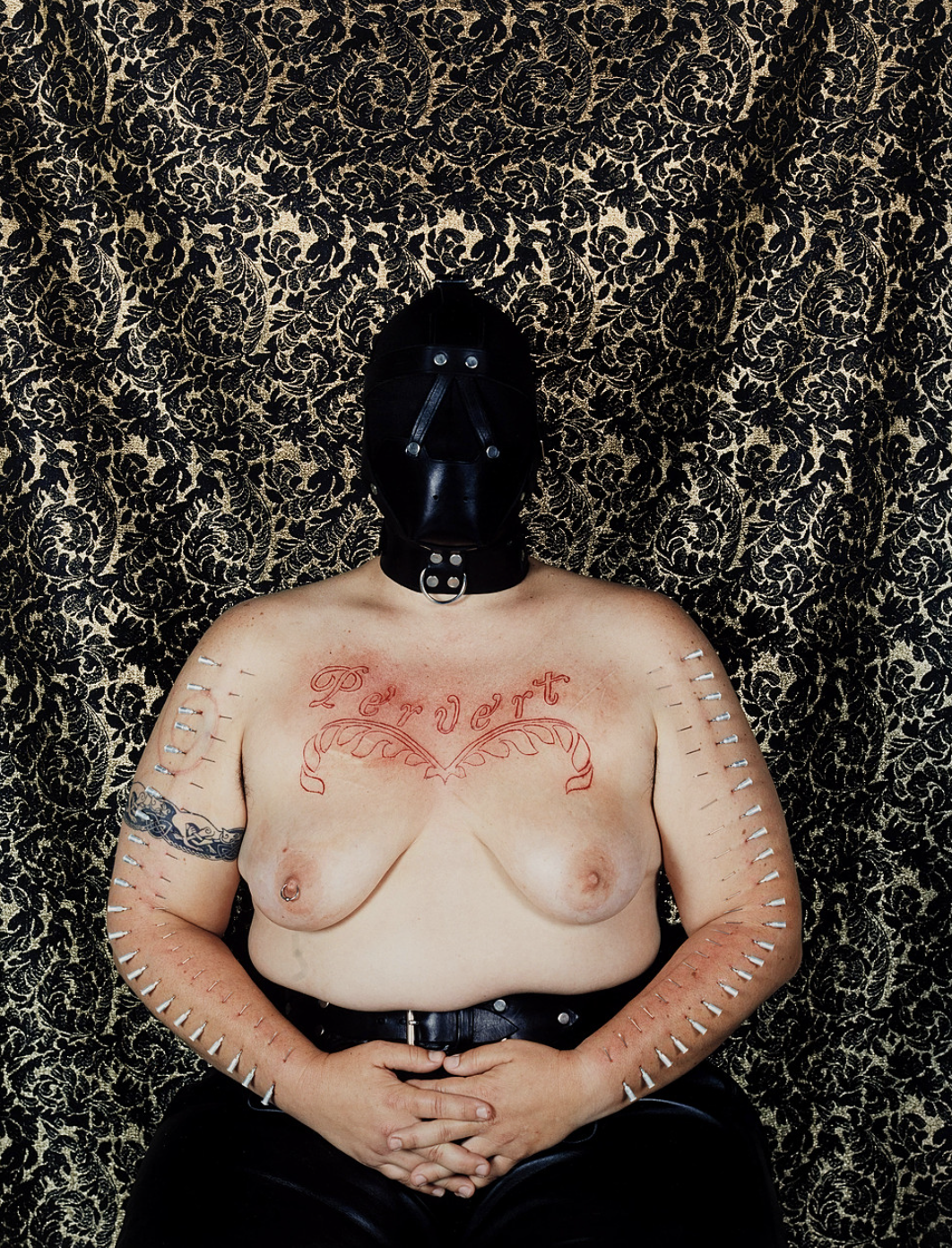
Catherine Opie’s work is powerful because she turns belonging into something that must be built, pictured, protected, and continually renegotiated.
At first, her photographs can appear remarkably direct.
A person stands before a richly colored backdrop.
A family gathers inside a home.
A freeway cuts across an empty sky.
A mansion presents its sealed façade.
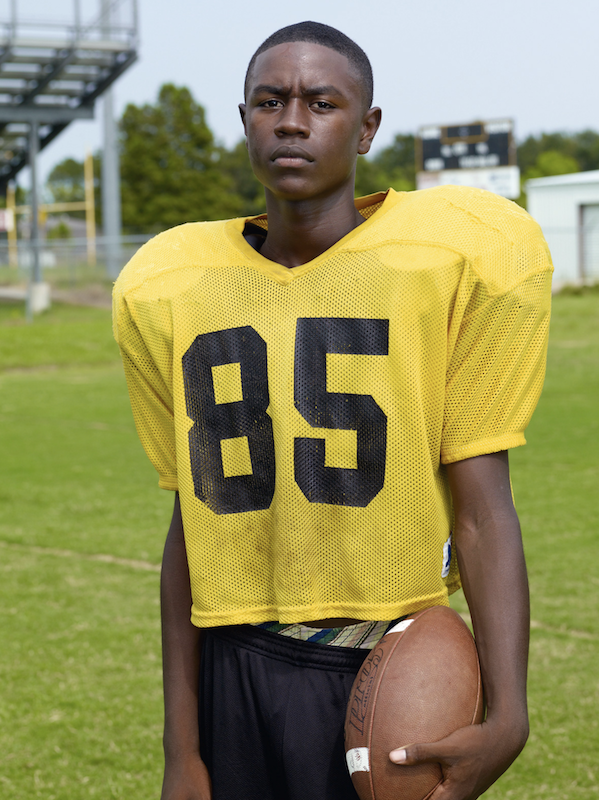
A high-school football player faces the camera.
A surfer waits in the ocean.
A city appears almost deserted.
The photographs often possess formal calm. Opie’s subjects are clearly framed, carefully lit, and given time to occupy the image. Even when the person’s clothing, body modification, sexuality, or social identity challenges conventional expectations, the photograph itself does not appear visually chaotic.
This calm is not neutral.
It gives the subject authority.
Opie has worked across studio portraiture, domestic photography, urban landscapes, architecture, sports, and natural environments. Although these bodies of work can appear very different, the Guggenheim identifies a persistent concern with communal, sexual, and cultural identity—and with the conditions under which communities form and become defined. (The Guggenheim Museums and Foundation)
The deeper pressure is:
How can photography give people and communities public recognition without flattening them into categories, spectacles, or sociological evidence?
Opie’s portraits do not simply declare that marginalized people exist.
They ask what it means to picture someone as a full participant in social and civic life.
The Problem Beneath the Work
Opie’s recurring artistic problem is not simply queer identity, community, portraiture, or American culture.
A more precise formulation would be:
How can photography represent people who have been excluded from conventional images of family, citizenship, beauty, and belonging while preserving their individuality, complexity, and right to define themselves?
Photography has often been used to classify people.
It has identified:
criminals
patients
racial types
social classes
sexual identities
workers
families
citizens
outsiders
The camera can recognize.
It can also inspect.
It can preserve.
It can expose.
It can dignify.
It can turn a person into evidence.
This makes portraiture politically complicated.
A photograph of a marginalized person can increase visibility. But visibility alone does not guarantee respect. The subject may become a curiosity, stereotype, victim, representative type, or object of consumption.
Opie addresses this problem by combining social specificity with formal dignity.
Her subjects may wear clothing, tattoos, leather, uniforms, jewelry, facial hair, or bodily modifications that communicate membership in particular communities. Yet they are not reduced to those signs.
The photograph tells us something.
It does not tell us everything.
The sitter becomes socially legible without becoming completely available.
Recognition Rather Than Normalization
One way to represent an excluded community is to emphasize that its members are “just like everyone else.”
This strategy can create empathy.
But it can also imply that difference deserves acceptance only when it resembles an existing norm.
Opie’s work does something more difficult.
She does not erase difference in order to establish humanity.
Her early portraits of queer friends, leather communities, drag performers, transgender people, and people with highly constructed identities often make difference unmistakably visible. The Guggenheim’s survey began with series including Being and Having and Portraits, which documented and celebrated queer communities in San Francisco and Los Angeles. (The Guggenheim Museums and Foundation)
The subjects do not need to become visually conventional before being granted seriousness.
They may appear theatrical, erotic, masculine, feminine, vulnerable, defiant, tender, scarred, adorned, or deliberately self-invented.
The photograph’s respect does not depend on normalizing them.
This distinction is central:
Recognition says: I see your particularity and accept that it belongs within the social world.
Normalization says:
I will accept you once your difference no longer unsettles me.
Opie refuses that bargain.
Portraiture as Civic Space
Opie’s portraits often borrow the gravity of historical painting.
A sitter may be isolated against a saturated background.
The pose may be frontal or carefully arranged.
The figure occupies the image with composure.
The lighting can feel almost ceremonial.
These choices connect people from queer and alternative communities to the traditions through which rulers, aristocrats, religious figures, and socially important citizens have historically been pictured.
This is not merely stylistic elevation.
Portrait traditions have helped determine who deserves to be remembered.
Who appears monumental?
Who receives a name?
Whose face enters public culture?
Whose body is presented as worthy of sustained looking?
By applying formal dignity to people frequently excluded from official visual history, Opie reorganizes portraiture’s civic function.
The photograph becomes a small public institution.
It says:
This person belongs within the field of representation.
But Opie does not simply place unconventional subjects into an unchanged traditional format. Their bodies and identities alter what dignity, citizenship, family, masculinity, femininity, and beauty can look like.
The historical portrait is not merely extended.
It is revised.
The Background Is Not Empty
Many of Opie’s studio portraits use strong monochromatic or patterned backgrounds.
These fields isolate the figure from ordinary surroundings.
That separation performs several functions.
It removes distraction.
It denies viewers the ability to explain the person entirely through environment.
It creates visual concentration.
It allows clothing, posture, skin, gesture, facial expression, and self-presentation to become especially significant.
The background may also recall:
portrait painting
heraldic color
studio photography
religious icons
commercial portraiture
theatrical staging
The figure becomes both contemporary person and formal image.
This raises a subtle tension.
The background gives the sitter dignity and visual authority.
But it also makes the sitter intensely available for examination.
The photograph balances presentation with protection.
The sitter is offered to public vision, but the controlled setting prevents the surrounding world from claiming complete explanatory power.
Self-Fashioning and the Right to Appear
Clothing and bodily presentation matter deeply in Opie’s work.
A mustache, tattoo, leather vest, suit, dress, haircut, piercing, uniform, or pose may indicate how the sitter wishes to be seen.
These details are not superficial additions to an underlying “true” self.
They are forms through which identity becomes public.
Opie understands that people construct themselves socially.
This does not make identity false.
It makes identity active.
The sitter participates in producing the portrait.
They bring:
a chosen appearance
community codes
bodily history
gender expression
sexuality
humor
vulnerability
social role
personal style
The photographer does not manufacture the person from nothing.
Nor does she merely uncover a hidden essence.
The image emerges through encounter.
Portraiture becomes a collaboration between how the sitter wishes to appear and what the photograph makes visible.
This gives self-fashioning ethical importance.
For people whose identities have historically been named and classified by others, controlling one’s appearance can become a form of self-authorship.
Looking Without Treating Difference as Spectacle
Opie’s photographs invite sustained looking.
But they often prevent that looking from becoming sensational.
The sitter is not pictured as a shocking discovery.
The photographic style is measured, direct, and formally controlled.
This matters especially when bodies contain marks or practices that some viewers may find unfamiliar.
Tattooing, piercing, scarification, gender transition, leather culture, drag, and queer sexuality can easily be represented through sensationalist imagery.
A camera might emphasize extremity.
Opie instead establishes presence.
The photograph does not deny that the body carries social meaning.
It changes the terms under which the body is viewed.
The viewer may initially notice difference.
But the duration and formality of the portrait encourage a transition:
from category to person
from spectacle to encounter
from curiosity to recognition
The work does not forbid looking.
It teaches a different quality of attention.
Community Without Sameness
A community is often pictured as a unified group.
Members gather together, perform shared rituals, or display common symbols.
Opie frequently constructs community differently.
She photographs individuals.
Each person remains distinct.
Across a series, relationships begin to form through:
repeated formats
shared visual codes
titles and names
overlapping social worlds
clothing and bodily signs
the artist’s sustained attention
Community emerges through accumulated particularity.
The individuals do not become interchangeable representatives of “queerness.”
Their differences produce the community.
This is one of Opie’s most valuable insights:
Belonging does not require the disappearance of difference. A community may become visible precisely through the variations among its members.
The series creates collective identity without turning the collective into a uniform type.
Family as an Invented Structure
Opie’s work repeatedly returns to domestic life, kinship, parenthood, and family.
Her Domestic series photographed lesbian families engaged in ordinary household life, while other works have addressed her own desires for intimacy, partnership, parenthood, and belonging. The Guggenheim describes Domestic as moving inside homes to document lesbian families in everyday activity. (The Guggenheim Museums and Foundation)
These photographs matter because dominant visual culture has historically presented family through narrow conventions:
heterosexual couple
biological parenthood
gendered household roles
private domestic respectability
generational continuity
Opie’s photographs expand the family image.
But again, she does not simply claim that alternative families are identical to conventional ones.
She asks how family is made.
Through care?
Commitment?
Shared space?
Parenthood?
Desire?
Ritual?
Legal recognition?
Chosen kinship?
Memory?
The photographs show that family is not only inherited.
It can be constructed through sustained acts of belonging.
Kinship becomes a practice rather than merely a biological fact.
The Self-Portraits and the Body as Public Argument
Opie’s self-portraits make the relationship between private desire and public symbolism especially intense.
In several widely discussed works, her back or chest bears cut or scarred images connected to domestic longing, queer identity, motherhood, and social violence.
The body becomes both person and surface.
Private desire is literally made visible.
But the images are not simple confessions.
They operate through art-historical references, controlled poses, decorative backgrounds, symbolic wounds, and a highly formal photographic style.
The body becomes an argument about:
who is allowed to imagine family
whose desire appears culturally legitimate
how queer identity is marked publicly
how violence enters private life
whether vulnerability and authority can coexist
The self-portrait grants profound access.
Yet it also remains constructed.
We see the body.
We do not receive unmediated possession of the person.
This reflects a broader principle in Opie’s work:
Disclosure can be real without eliminating form, privacy, or self-control.
Houses as Portraits
Opie’s portraits of Beverly Hills and Bel Air houses initially seem like a departure from her photographs of people.
The buildings are often closed, frontal, monumental, and unoccupied.
But Opie approaches them as portraits.
The façade becomes a face.
Architecture communicates:
wealth
privacy
taste
protection
aspiration
social status
exclusion
fear
domestic fantasy
The Guggenheim notes that in the Houses series, each mansion façade possesses a distinct character comparable to Opie’s portraits of friends. (The Guggenheim Museums and Foundation)
Yet the houses withhold the people inside them.
We see gates, hedges, doors, walls, and styles.
The domestic interior remains inaccessible.
This creates a revealing contrast with Domestic.
The mansions offer impressive public images but little visible life.
The lesbian households show lived relationships, care, and ordinary activity.
One body of work presents architecture as social armor.
The other presents home as a network of relationships.
Together they ask:
Is home a building, a public symbol, a protected enclosure, or the relationships enacted within it?
Freeways and the Architecture of Belonging
Opie’s freeway photographs may initially seem even further removed from identity.
There are often no visible people.
Concrete structures cross pale skies.
The images can appear quiet, formal, and almost archaeological.
But freeways organize social life.
They determine:
who can move
where neighborhoods connect
which communities are divided
how cities expand
how labor and commerce circulate
how distance is experienced
whose homes are displaced
which areas receive investment
The Guggenheim describes Freeways as a formal meditation on Los Angeles’s highway system and connects Opie’s architectural work to structures treated as icons or traces of human presence. (The Guggenheim Museums and Foundation)
The freeway is therefore not an empty structure.
It is a social system made concrete.
Its apparent neutrality conceals decisions about mobility, power, planning, race, class, and urban belonging.
Opie photographs it with the gravity of a monument.
But the monument is ambiguous.
It represents connection and division at the same time.
The American Landscape
Opie frequently describes American places without relying on conventional national symbols.
Her America appears through:
highways
mini-malls
houses
city streets
high-school football
surfers
national parks
political gatherings
domestic interiors
ordinary communities
This creates an expanded civic portrait.
America is not presented as one coherent identity.
It is a network of communities, landscapes, architectures, rituals, exclusions, aspirations, and contested forms of belonging.
Her work asks:
Who gets to appear inside the American image?
The question applies both to people and places.
A queer family is American.
A leather community is American.
A suburban mansion is American.
A freeway is American.
A football field is American.
An empty city street is American.
The series accumulate into a national portrait without pretending that the nation is unified.
Empty Landscapes and Human Traces
Many of Opie’s landscape and architectural photographs contain few or no people.
Yet human presence remains everywhere.
A road indicates movement.
A building indicates habitation.
A field indicates organized activity.
A sign indicates language and commerce.
A shoreline suggests waiting, recreation, migration, or distance.
The absence of figures changes the form of portraiture.
Instead of showing the body directly, Opie photographs the structures through which bodies live.
This expands the question of identity.
Identity is not only visible in the face.
It is embedded in:
architecture
infrastructure
domestic space
public ritual
landscape
social organization
The empty scene becomes a collective portrait.
It shows the conditions people have built—and the conditions that act upon them.
Sports, Ritual, and Collective Identity
Opie has photographed high-school football players, football games, surfers, and other communal activities.
Sports provide a powerful structure for examining belonging because they combine:
uniforms
rules
bodily discipline
competition
spectatorship
local identity
masculinity and femininity
ritual
collective emotion
A uniform makes the individual part of a team.
But portraiture can return individuality to the uniformed body.
The player is both person and social role.
Sports also reveal how communities gather around shared symbols.
The field, stadium, team colors, and repeated rituals produce belonging.
Yet belonging can also regulate behavior.
The athlete must perform strength, loyalty, skill, endurance, or gender in culturally recognizable ways.
Opie’s broader practice repeatedly holds these two conditions together:
Communities make identity possible, but they also establish the codes through which identity becomes legible.
Formal Rigor and Social Complexity
Opie’s work is often described through its subjects: queer communities, families, cities, architecture, landscapes, and American social life.
But the work’s formal control is equally important.
She uses:
frontal composition
saturated backgrounds
careful lighting
repeated formats
large scale
clarity
symmetry
architectural geometry
black-and-white tonal precision
strategic emptiness
serial structure
The Guggenheim emphasizes that her varied bodies of work maintain consistent formal rigor across color and black-and-white photography. (The Guggenheim Museums and Foundation)
This rigor prevents the photographs from becoming casual documentation.
The subject is not merely recorded.
It is given structure.
But form does not neutralize social difference.
It allows difference to remain visible without becoming visually chaotic or anthropologically distant.
Formality becomes a means of sustained respect.
The Central Contradiction
The central contradiction in Opie’s work is:
Belonging gives people recognition and protection, but every community also creates boundaries, codes, and conditions for membership.
Her photographs hold together:
individuality and community
visibility and privacy
difference and civic recognition
self-fashioning and social classification
domestic intimacy and public politics
inclusion and exclusion
documentary evidence and formal construction
vulnerability and authority
chosen family and inherited convention
movement and division
national identity and internal difference
Opie does not present community as uncomplicated safety.
Communities can provide:
love
recognition
family
language
protection
shared history
They can also produce:
expectations
hierarchies
exclusions
codes of behavior
pressure to perform belonging correctly
The work remains powerful because it values community without idealizing it.
Photography as Relationship
Photography is often discussed as an act of taking.
Take a photograph.
Capture an image.
Shoot a subject.
These phrases contain a subtle language of possession.
Opie’s work proposes another model.
Portraiture can be an act of relation.
The photograph emerges because the sitter allows an encounter to occur.
The photographer brings attention, structure, history, and formal decisions.
The sitter brings presence, self-presentation, trust, resistance, and autonomy.
Neither completely controls the result.
This makes portraiture ethical not because it avoids power, but because it acknowledges that power must be negotiated.
The photographer has the camera.
The sitter has a life that exceeds the image.
The portrait becomes successful when the photograph recognizes that difference rather than pretending to eliminate it.
The Viewer’s Position
Opie asks the viewer to look carefully without assuming mastery.
We may recognize signs of gender, sexuality, class, occupation, community, architecture, or geography.
But those signs do not complete the person.
The viewer must navigate several impulses:
curiosity
identification
attraction
discomfort
admiration
categorization
projection
recognition
The work does not pretend that looking can become innocent.
Instead, it slows the process down.
The formal clarity asks us to notice what we think we already understand.
A tattoo may be visible.
A social identity may be legible.
A house may display wealth.
A uniform may imply a role.
But the photograph preserves a gap between sign and total knowledge.
That gap is where respect becomes possible.
The Visual World Opie Has Built
Across her practice, Opie has developed a broad but coherent lexicon:
frontal studio portraits
saturated colored backgrounds
queer friends and chosen communities
drag, leather, gender performance, and bodily modification
names and titles that preserve individual identity
self-portraits involving vulnerability and symbolic inscription
families inside domestic space
sealed mansion façades
empty freeways
mini-malls and urban signs
American cities
surfers, athletes, crowds, and social rituals
landscapes shaped by human movement
formal clarity
serial structures
people and places treated as civic portraits
The work moves between body and environment.
But the deeper question remains consistent:
What structures allow someone to appear as belonging—and who controls those structures?
What Artists Can Learn
The lesson is not to imitate Opie’s colored portrait backgrounds, frontal compositions, queer iconography, architectural photographs, or documentary series.
The lesson is to understand how she makes recognition into a formal and ethical problem.
Visibility is not the same as recognition.
Showing a marginalized person is not enough. The artwork must determine the terms under which that person is seen.
Difference does not need to be normalized to become dignified.
A subject should not have to resemble an accepted ideal before receiving formal seriousness.
Formality can communicate respect.
Lighting, scale, repetition, clarity, and compositional control can give sustained authority to people or places that visual culture treats casually.
Community can emerge through particularity.
A group does not need to be represented as uniform. Accumulated individual differences can produce a richer collective identity.
Self-presentation is part of identity.
Clothing, pose, bodily modification, and social codes should not automatically be dismissed as masks hiding a true self. They may be tools of authorship.
Architecture can function as portraiture.
Buildings, roads, domestic spaces, and public structures reveal how people organize privacy, status, movement, and belonging.
Absence can still contain social evidence.
An empty landscape may carry the traces of communities, decisions, histories, and power.
The photographer-subject relationship matters.
Portraiture should acknowledge that the sitter’s life exceeds the image.
Belonging should remain contradictory.
Community can protect and constrain, recognize and categorize, include and exclude.
The larger lesson is:
Representation becomes powerful when it does not merely make a person visible, but establishes that their particular way of being belongs within the shared social image.
Catherine Opie’s work expands the portrait beyond the face.
A body can be a portrait.
A house can be a portrait.
A freeway can be a portrait.
A family can be a portrait.
A city can be a portrait.
Together, these images ask who is permitted to appear as part of American life—and what forms, spaces, rituals, and relationships make that belonging visible.
The lesson is not to copy the appearance of the work.
The lesson is to understand the pressure that made the appearance necessary.