What Makes Loie Hollowell’s Work So Powerful?
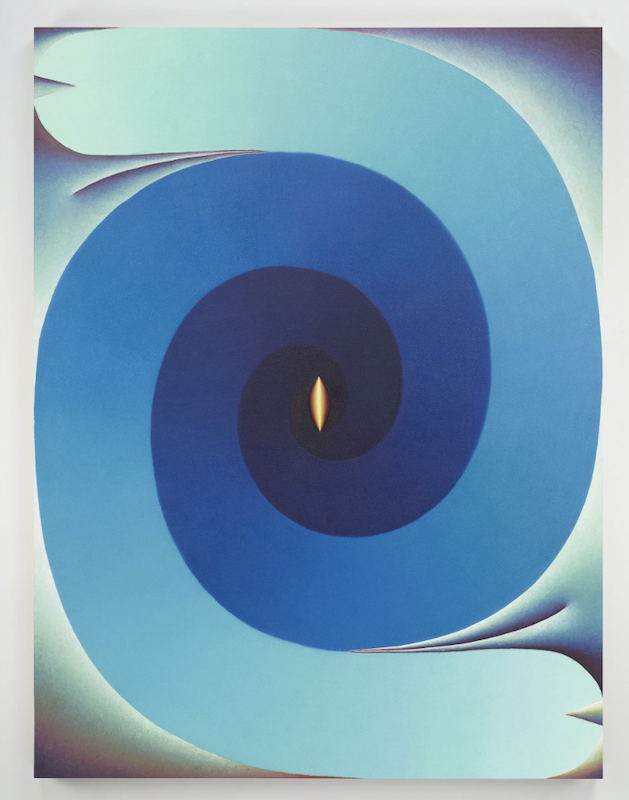
Loie Hollowell’s work is powerful because she transforms private bodily sensation into an abstract visual system that can be felt without being literally illustrated.
At first, her paintings may appear luminous, symmetrical, polished, and almost cosmic.
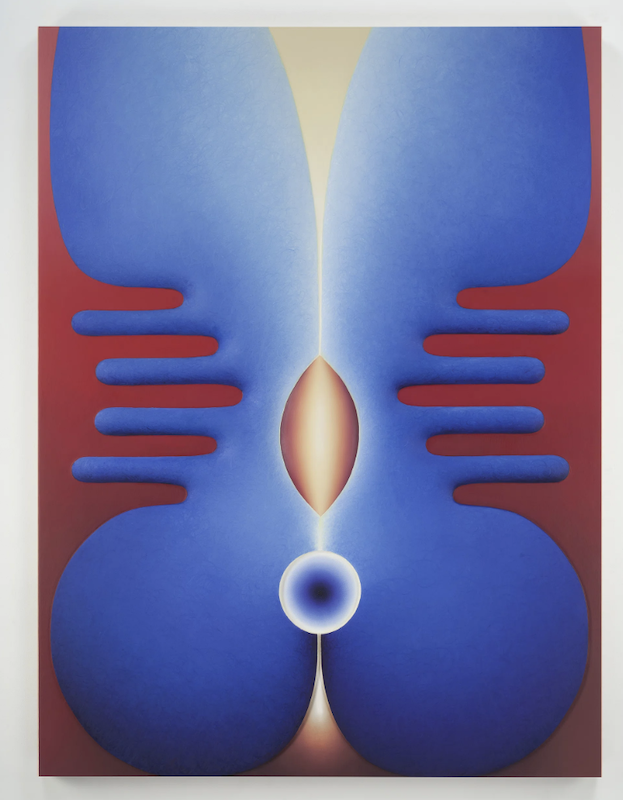
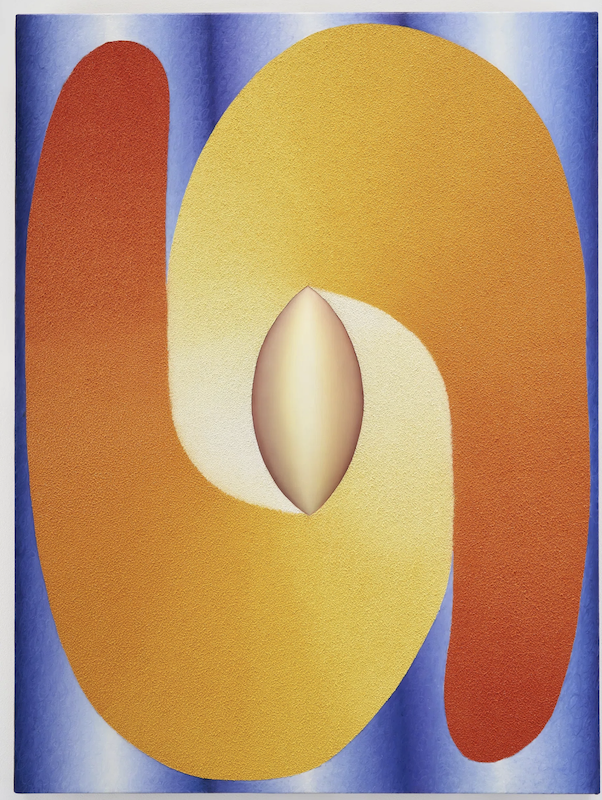
Orbs float inside fields of radiant color. Almond-shaped forms open and close. Convex shapes protrude from the surface. Gradients create the illusion of internal light. Repeated curves suggest breasts, bellies, buttocks, vulvas, heads, eggs, planets, portals, or sacred symbols.
The work can look spiritual.
It can also look unmistakably bodily.
That tension is central.
Hollowell is known for paintings and drawings that occupy the threshold between abstraction and figuration. Her work begins in autobiography and repeatedly addresses sexuality, pregnancy, childbirth, breastfeeding, and motherhood through geometric forms, color, relief, and bodily symbolism. (Pace Gallery)
But the work is not simply a coded diary.
It is not asking the viewer to decode each form and reconstruct a private story.
Its deeper ambition is more difficult:
How can the body be translated into color, pressure, volume, rhythm, light, and spatial tension without reducing bodily experience to illustration?
Hollowell’s paintings do not merely depict the body.
They try to behave like bodily experience.
They swell.
Contract.
Split.
Pulse.
Open.
Press outward.
Radiate.
Hold tension.
Release it.
The body becomes a formal system.
The Problem Beneath the Work
Hollowell’s recurring artistic problem is not simply female sexuality, pregnancy, motherhood, or biomorphic abstraction.
A more precise formulation would be:
How can intensely private, physical, and gendered experiences become publicly shareable without being stripped of their bodily force or reduced to narrative explanation?
Certain bodily experiences are difficult to represent because they are felt from within.
Pain can be described.
Pleasure can be depicted.
Pregnancy can be photographed.
Birth can be narrated.
But none of these fully communicates what the body experiences as pressure, expansion, rupture, rhythm, exhaustion, fear, or transformation.
The body does not experience itself as an image.
It experiences:
weight
heat
contraction
fullness
emptiness
stretching
pain
touch
fluid
pressure
repetition
anticipation
release
Hollowell turns these sensations into formal relationships.
A protruding orb may create fullness.
A split sphere may suggest opening.
A central vertical line may organize the body around gravity.
A repeated series may track the stages of labor.
A gradient may make a form seem to glow from within.
Symmetry may hold the body together while internal forms suggest that it is being transformed.
The work therefore moves away from depicting what the body looks like and toward constructing what bodily change feels like.
Why Abstraction Is Necessary
Hollowell’s use of abstraction is not simply an aesthetic preference.
It solves a representational problem.
Literal images of sex, pregnancy, birth, or breastfeeding may immediately become medical, documentary, erotic, sentimental, or politically illustrative.
Those associations can overwhelm sensation.
Abstraction allows Hollowell to remove some of the social narratives surrounding the body while preserving its physical intensity.
A breast can become an orb.
A vulva can become a mandorla.
A pregnant abdomen can become a swelling field.
The spine can become a plumb line.
Contractions can become repeated openings.
The figure disappears as a conventional image, but the body remains as structure.
Abstraction allows the experience to become less anatomically specific while becoming more physically present.
This is one reason the work can affect viewers who have not shared Hollowell’s biography.
A viewer may not know that a form refers to pregnancy or labor.
They may still feel compression, release, balance, vulnerability, fullness, or tension.
Hollowell has said she wants viewers to absorb an impression of brightness, richness, or radiance that connects to their own bodily experience rather than merely understand the details of hers. (Pace Gallery)
The work begins autobiographically.
It becomes meaningful when autobiography is transformed into form.
The Body as Geometry
Hollowell reduces the body to recurring geometric shapes:
circles
spheres
ovals
mandorlas
vertical axes
mirrored curves
lobes
stacked forms
openings
radiating bands
These forms are simple enough to appear universal.
But they are never completely neutral.
A circle may be a breast, belly, ovum, head, or planet.
An almond shape may be a vulva, eye, wound, portal, or sacred enclosure.
Two stacked forms may suggest head and abdomen.
A split orb may evoke both a body opening and a world dividing.
Hollowell’s lexicon includes traditional symbolic forms such as the mandorla, ogee, and lingam, connecting bodily imagery to sacred and art-historical systems. (Pace Gallery)
Geometry performs two functions at once.
It organizes private experience into a coherent language.
It also lifts the body toward archetype, icon, and cosmology.
The body becomes specific and symbolic simultaneously.
This is the central strength of Hollowell’s abstraction:
The geometric form is never only formal, and the bodily reference is never only descriptive.
Symmetry and the Desire for Order
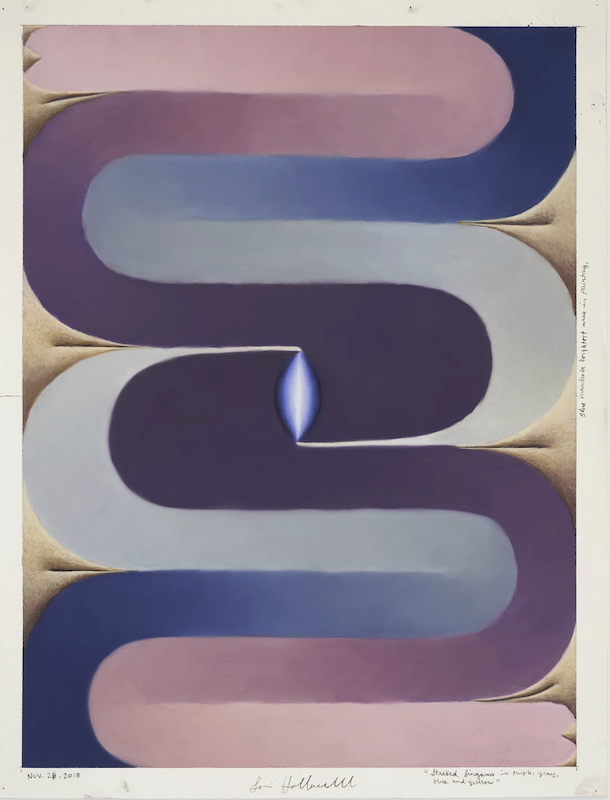
Many of Hollowell’s paintings are highly symmetrical.
A vertical axis divides the composition.
Forms mirror one another.
Color radiates evenly.
The body appears organized around a central structure.
Symmetry can suggest:
stability
balance
sacred order
bodily anatomy
reflection
containment
ritual
transcendence
But bodily experience is not always symmetrical.
Pregnancy alters balance.
Labor is rhythmic but unpredictable.
Sex can involve control and surrender.
Motherhood creates repetition without stability.
Pain may arrive unevenly.
The body changes in ways that cannot be fully managed.
This makes symmetry psychologically charged.
It may express the desire to give form to experience that felt overwhelming or chaotic.
The painting holds what the body could not hold still.
But the order is never complete.
The forms swell beyond the flat surface.
Colors vibrate.
Openings divide central structures.
The symmetry stabilizes the composition while the bodily forms threaten to expand, rupture, or transform it.
The painting creates order around an experience that resists complete control.
Color as Bodily Energy
Color in Hollowell’s work is not applied as local description.
A blue shape is not necessarily a blue object.
A red field is not merely a red background.
Color functions as energy.
It may suggest:
heat
blood
pressure
calm
pain
arousal
anxiety
spiritual radiance
internal light
physiological intensity
emotional transition
Gradients are particularly important.
A form may move from darkness at its center toward brightness at its edge.
Or light may seem to emerge from within.
This gives the painting an internal source of energy.
The form does not appear illuminated from outside.
It appears to generate light.
That internal luminosity gives bodily forms a cosmic or sacred quality.
The breast, belly, vulva, or head becomes less like an object and more like a field of force.
Color therefore transforms anatomy into sensation.
A viewer does not merely identify a body part.
They encounter pressure, warmth, expansion, or intensity.
The Painting as Relief
Hollowell’s works often appear flat from a distance.
Up close, the surface becomes sculptural.
She uses materials including oil paint, acrylic medium, sawdust, and high-density foam to construct protruding shapes that extend beyond the conventional picture plane. (Pace Gallery)
This physical relief is essential.
A painted illusion of a breast or belly would remain an image.
A form that actually projects into the room creates bodily presence.
The viewer must move slightly to understand it.
Light changes across the surface.
Shadows form along its edges.
The painting begins to occupy the viewer’s space.
This creates an unstable category:
Is it painting?
Sculpture?
Image?
Object?
Body?
The work refuses to remain completely optical.
It asks to be experienced spatially.
The body is not only represented on the surface; it physically reorganizes the surface.
The relief also changes the meaning of touch.
The forms may look soft, rounded, and tactile.
Yet the viewer cannot touch them.
They invite bodily recognition while remaining protected as artworks.
This produces desire and distance at once.
Convex and Concave
Hollowell repeatedly works with convex and concave forms.
Convexity suggests outward pressure.
A belly grows.
A breast swells.
A sphere pushes toward the viewer.
Concavity suggests inward movement.
An opening recedes.
A void appears.
The surface accepts or receives.
These spatial directions carry bodily and psychological meaning.
Convex forms may imply:
fullness
pregnancy
projection
presence
expansion
visibility
Concave forms may imply:
absence
receptivity
interiority
vulnerability
passage
release
When both appear in the same work, the painting becomes a system of exchange between outward and inward force.
This is especially relevant to experiences of sex, birth, and motherhood, where bodies expand, open, release, receive, and reorganize.
The painting does not describe these events sequentially.
It gives them spatial form.
The Split Orb
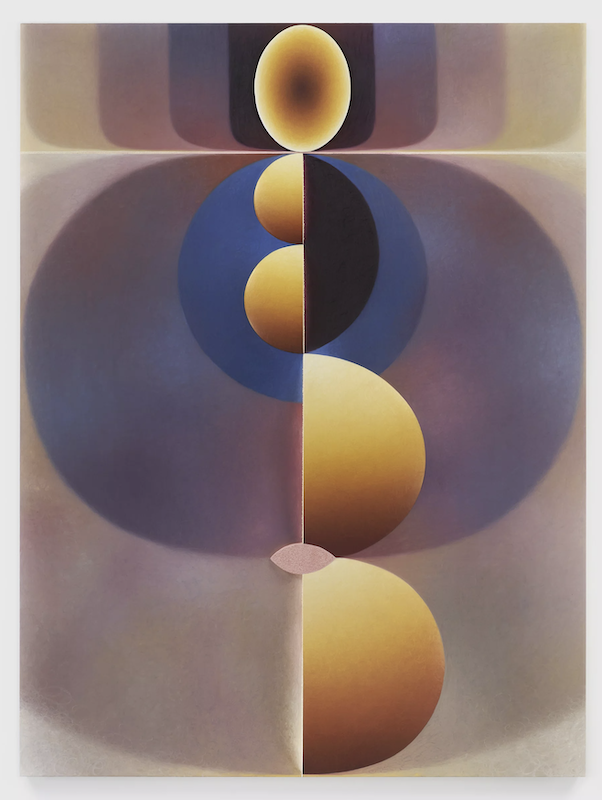
The Split Orb paintings translate childbirth into one of Hollowell’s clearest visual systems.
Two rounded forms are stacked vertically and divided in varying degrees. The upper orb may represent the head or brain, while the lower form may suggest the pregnant abdomen and cervix. The degree of opening relates to stages of dilation during labor. (Pace Gallery)
The form is simple.
Its implications are not.
A split orb can suggest:
opening
rupture
division
birth
psychic fracture
emergence
danger
transformation
The body must open in order for another body to emerge.
That process is generative and violent.
The body creates life through an event that can feel like physical disintegration.
Hollowell does not resolve this contradiction into a sentimental image of motherhood.
The orb remains beautiful.
It also appears under pressure.
Creation occurs through splitting.
That may be the deepest structure in these works.
The body does not remain intact while producing transformation.
It is changed by what it creates.
Contractions and Repetition
Contractions provide a natural bridge between bodily experience and serial abstraction.
A contraction repeats.
It builds.
Peaks.
Releases.
Returns.
The repetition is predictable and unpredictable at once.
The body enters a rhythm it cannot simply stop.
Hollowell’s serial works use repeated images and incremental changes to convert labor into visual duration.
One painting alone can show a state.
A sequence can show transformation.
Repeated forms become evidence of bodily time.
This connects to one of the broader principles emerging across our research:
Repetition becomes meaningful when each repetition records a changed condition.
The repeated orb is not decorative pattern.
Its opening changes.
Its color changes.
Its pressure changes.
Its position within the larger process changes.
The series becomes a record of transition.
Sex, Pregnancy, and Motherhood Are Not Separate Subjects
Hollowell’s work connects sexuality, conception, pregnancy, birth, breastfeeding, and motherhood rather than treating them as unrelated phases.
This is important because visual culture often separates the sexualized female body from the maternal body.
The erotic breast and the nursing breast are culturally treated as though they belong to different identities.
The sexual body is desired.
The pregnant body is idealized or medicalized.
The birthing body is often hidden.
The postpartum body is expected to recover.
The maternal body becomes associated with care rather than erotic autonomy.
Hollowell refuses these divisions.
The same bodily forms change function over time.
Breasts may be erotic, swollen, painful, nurturing, or mechanically pumped.
The abdomen may be sexual, pregnant, emptied, scarred, or transformed.
The vulva may be an erotic symbol and a site of labor.
The body does not become a different body when its social role changes.
It accumulates meanings.
This gives the work political force without requiring slogans.
The body exceeds the narrow identities assigned to it by each stage of life.
Breastfeeding and the Redistribution of the Body
Breastfeeding introduces another important pressure.
The body that once belonged primarily to the self becomes organized around another person’s needs.
Time changes.
Sleep changes.
Touch changes.
The breast becomes food, schedule, labor, pain, intimacy, and responsibility.
Hollowell’s postpartum drawings and paintings address nursing, pumping, engorgement, exhaustion, and the repeated demands of care. Her Going Soft works include abstracted references to breasts, milk, breast pumps, hands, bellies, and the psychological instability of postpartum life. (Pace Gallery)
This expands her central problem.
The issue is not only how the body changes physically.
It is how bodily ownership changes.
Who has access to the body?
Who needs it?
Who touches it?
When does care become depletion?
When does nourishment become labor?
A maternal body can be revered symbolically while being exhausted materially.
Hollowell’s forms hold fullness and emptiness together.
A full breast implies nourishment.
It may also imply pain.
An empty breast implies relief.
It may also imply depletion.
The bodily form becomes a site where care and loss of autonomy coexist.
The Sacred and the Sexual
Hollowell’s forms frequently resemble sacred imagery.
Radiating light, symmetry, central axes, mandorlas, and luminous colors recall icons, devotional paintings, Tantric diagrams, and spiritual abstraction.
But the forms also resemble sexual anatomy.
This produces a deliberate fusion.
The sacred is bodily.
The sexual is cosmic.
The maternal is monumental.
The vulva can resemble a portal.
The pregnant belly can resemble a planet.
The breast can become an orb of light.
This reverses a long cultural history in which bodily sexuality—especially female sexuality—has been treated as impure or opposed to spiritual transcendence.
Hollowell does not abandon the body in order to reach the sacred.
The body is the route.
Transcendence occurs through embodiment, not escape from it.
That is a significant distinction.
Her work does not spiritualize the body by making it less physical.
It spiritualizes pressure, fluid, pain, pleasure, birth, and bodily transformation.
Beauty and the Risk of Decoration
Hollowell’s paintings are extremely beautiful.
Their gradients are controlled.
Their colors are radiant.
Their compositions are balanced.
Their surfaces are polished.
This creates risk.
The work could be received as decorative, luxurious, psychedelic, or formally pleasing without its bodily pressures being recognized.
The question becomes:
What prevents the work from becoming only beautiful design?
The answer lies in the necessity of the formal system.
The orb is not an arbitrary shape.
The split is not a decorative device.
The relief is not surface novelty.
The symmetry is not merely compositional elegance.
The gradient is not simply atmospheric color.
Each choice translates a physical or psychological condition.
Beauty carries pressure because it is attached to opening, rupture, pain, sexuality, care, and bodily transformation.
But the risk remains productive.
The viewer may be seduced before realizing what the image contains.
This resembles Wangechi Mutu’s use of beauty, though the visual languages are radically different.
Mutu uses seduction to lead the viewer into fragmentation and violence.
Hollowell uses radiance to lead the viewer into embodied intensity.
Illusion and Physical Reality
Hollowell’s paintings oscillate between illusion and objecthood.
From a distance, shading can make a flat shape seem dimensional.
Up close, actual relief may confirm or contradict that illusion.
A viewer may not know where painted volume ends and physical projection begins.
This matters because bodily experience also exists between perception and matter.
Pain is physically real, but its intensity is subjectively experienced.
Pregnancy is materially visible, but much of it remains internal.
Sexual sensation is bodily and psychological.
Birth is biological and symbolic.
Hollowell uses optical ambiguity to model this condition.
The viewer sees a form.
Then realizes the form occupies space.
The visual becomes physical.
The physical becomes symbolic.
The paintings are not satisfied with representing embodiment. They make seeing itself feel embodied.
The Viewer’s Body
Hollowell’s work does not implicate the viewer primarily through accusation, as Barbara Kruger does.
It works through bodily analogy.
The viewer recognizes:
roundness
pressure
opening
balance
warmth
tension
softness
radiance
weight
vulnerability
Even without sharing the artist’s experience, the viewer possesses a body.
This creates a bridge.
The work does not require literal identification.
A person does not need to have been pregnant to understand expansion.
They do not need to have given birth to understand pressure and rupture.
They do not need to breastfeed to understand fullness, depletion, or repeated demand.
The paintings translate specific experiences into bodily structures broad enough to activate other forms of memory.
That is how private experience becomes public without becoming generic.
The Central Contradiction
The central contradiction in Hollowell’s work is:
The paintings use order, symmetry, beauty, and radiant abstraction to represent bodily experiences defined by instability, pain, rupture, vulnerability, and loss of control.
Her work is:
abstract but autobiographical
geometric but bodily
sacred but sexual
controlled but about surrender
luminous but painful
symmetrical but transformative
flat but sculptural
universal in form but personally specific
beautiful but physically unsettling
self-contained but concerned with bodily interdependence
The contradiction cannot be resolved.
If the work became more literal, it might lose its experiential openness.
If it became purely formal, it would lose bodily necessity.
Hollowell holds the work precisely between those conditions.
Is the Work Too Universalizing?
There is a legitimate critical question in translating gendered bodily experience into archetypal geometry.
When a specific experience becomes a sphere, mandorla, axis, or glowing field, does it risk becoming too universal?
Does the abstraction soften the social, medical, economic, or political realities of pregnancy and childbirth?
Does radiant beauty make pain easier to consume?
These questions are worth retaining.
Hollowell’s strongest work does not erase specificity.
It remains anchored in titles, bodily measurements, serial stages, casts, materials, and autobiographical experience.
The forms may appear cosmic, but they emerge from labor, dilation, milk, exhaustion, bodily fluids, and care.
The work is strongest when transcendence does not rescue the body from material reality.
It expands the meaning of that reality.
From Private Experience to Shared Form
Autobiographical art can fail when the viewer is asked to care only because something happened to the artist.
Personal importance does not automatically become artistic importance.
Hollowell’s work avoids that problem by translating experience into a repeatable visual grammar.
The viewer does not need the full biography to encounter:
expansion
pressure
opening
division
fullness
radiance
contraction
release
The private event becomes a formal structure.
This is a crucial studio lesson:
Personal experience becomes generative when it produces a language capable of doing more than recounting the event.
The strongest autobiographical work does not merely say:
“This happened to me.”
It asks:
“What form did this experience reveal?”
The Visual World Hollowell Has Built
Across her practice, Hollowell has developed a coherent lexicon:
stacked orbs
split spheres
mandorlas
vertical axes
symmetry
pregnant bellies
breasts
vulvar openings
heads and brains
convex and concave forms
gradients
internal luminosity
saturated color
high-density foam
sawdust and acrylic medium
sculptural relief
contraction sequences
bodily casts
sexuality, pregnancy, birth, breastfeeding, and postpartum states
sacred geometry
bodily landscapes
images that hover between icon, anatomy, planet, and portal
This lexicon is recognizable, but it is not arbitrary branding.
Its forms continue generating new relationships because the body continues changing.
The same orb can mean:
ovum
belly
breast
head
world
fullness
enclosure
rupture
The visual world remains alive because its symbols are stable enough to recur and open enough to transform.
What Artists Can Learn
The lesson is not to imitate Hollowell’s glowing gradients, symmetrical orbs, bodily geometry, relief surfaces, or sacred-sexual imagery.
The lesson is to understand how she converts sensation into formal necessity.
Abstraction can begin in the body.
It does not need to reject lived experience. Shape, color, rhythm, and volume can carry bodily memory.
Personal experience must become a language.
Autobiography becomes powerful when it generates forms that can operate beyond the original event.
A formal choice should behave like the experience.
A contraction may require repetition. Pregnancy may require expansion. Birth may require splitting. Fullness may require physical projection.
Beauty can carry pain.
A radiant surface becomes serious when its beauty is inseparable from vulnerability, labor, rupture, or transformation.
Symmetry can express pressure rather than peace.
Order may reveal the attempt to hold together an experience defined by instability.
Relief can make painting bodily.
Actual projection, shadow, and volume can turn an image into a physical encounter.
Specificity and openness can coexist.
The work can originate in a particular gendered experience while creating formal conditions that other bodies can recognize.
The sacred does not require escape from the body.
Sex, birth, fluid, pain, care, and physical transformation can become sources of transcendence.
Repetition should record change.
A series becomes meaningful when each repeated form registers another stage, pressure, or bodily state.
The body can be represented without being pictured literally.
Anatomy may disappear while embodiment remains.
The larger lesson is:
Bodily experience becomes artistically powerful when the work does not merely depict what happened to the body, but reconstructs the forces through which the body changed.
Loie Hollowell does not simply make paintings about sexuality, pregnancy, birth, or motherhood.
She builds a visual system in which color swells, surfaces protrude, orbs divide, and symmetry struggles to contain transformation.
Her paintings make private sensation public without pretending that experience can be fully explained.
They do not show us the body from outside.
They ask us to feel how form changes when the body is experienced from within.
The lesson is not to copy the appearance of the work.
The lesson is to understand the pressure that made the appearance necessary.