What Makes Christina Quarles’s Work So Powerful?
Christina Quarles’s paintings are powerful because she makes the body feel trapped between what it experiences and the categories imposed upon it.
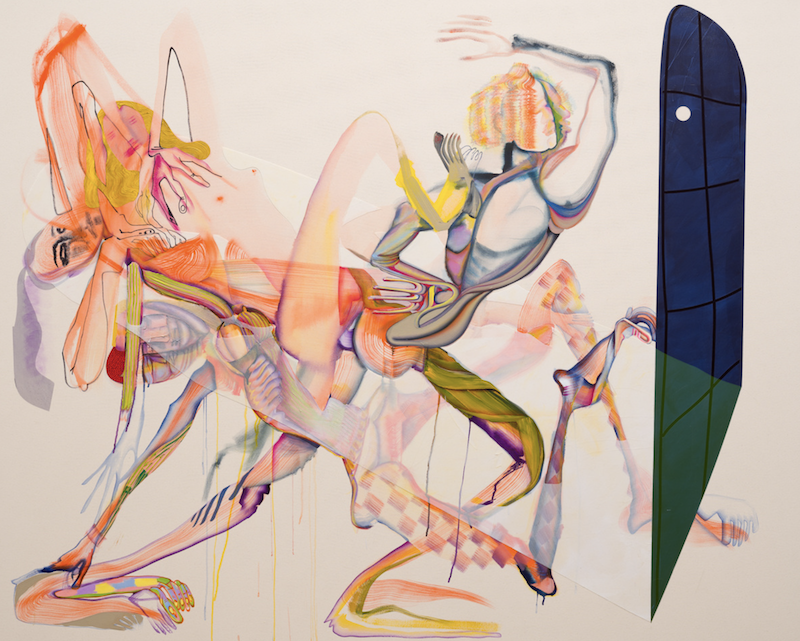
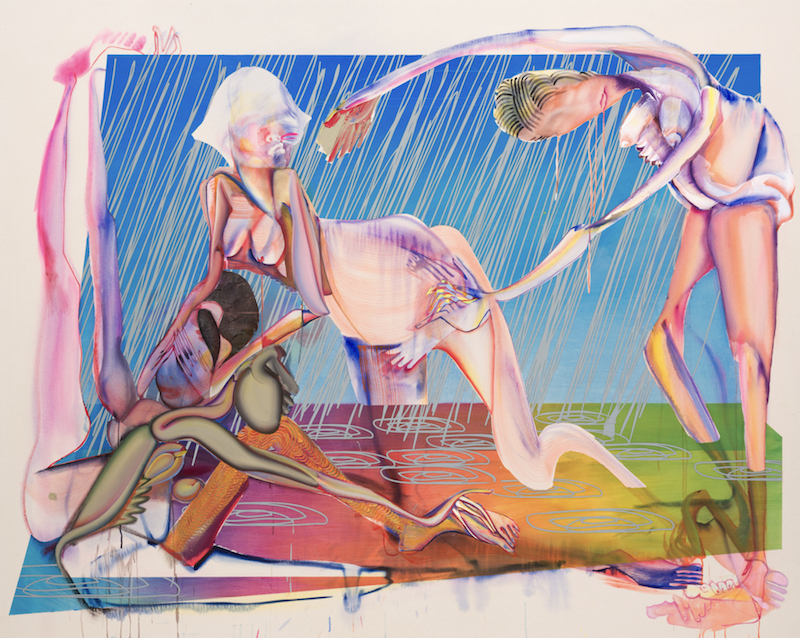
At first, her work can be difficult to read. Arms, legs, torsos, breasts, faces, and hands twist through one another. Bodies seem to merge, split, stretch, collapse, or pass through different spatial layers. Some areas are loosely painted and flesh-like. Others contain hard-edged patterns, digital gradients, stripes, grids, or flat planes of color.
It may be unclear where one person ends and another begins.
It may be unclear whether a figure is lying down, standing, embracing someone, struggling against them, or becoming part of the surrounding space.
That uncertainty is not a failure of description.
It is the subject of the work.
Quarles paints what it feels like to inhabit a body that other people believe they can classify more easily than the person living inside it.
Her paintings are not conventional scenes of distorted anatomy. They are visual systems in which bodies encounter gender, race, sexuality, language, space, desire, and the pressure to become legible.
The Problem Beneath the Work
Quarles’s recurring artistic problem is not simply identity or bodily ambiguity.
A more precise formulation would be:
How can painting show the gap between the complexity of embodied experience and the simplified identities that other people assign to the body?
A body is visible from the outside.
Because it is visible, it becomes vulnerable to classification.
Viewers may immediately attempt to determine:
gender
race
sexuality
relationship
bodily position
emotional state
which limbs belong to which person
whether the encounter is affectionate, erotic, painful, or violent
Quarles repeatedly frustrates those attempts.
Her figures contain recognizable bodily signs, but those signs do not form stable identities. A breast may suggest gender without fixing it. Skin color may shift across a single body. A limb may belong to more than one figure. A pose may resemble intimacy and confinement simultaneously.
The body remains present, but its meaning keeps moving.
Quarles has discussed her work in relation to being queer and multiracial and to experiences of being classified in ways that do not correspond to how she understands herself. She uses the burdened history and conventions of painting to explore identities that deviate from expected categories and to expose moments when those systems of classification begin to break down. (Wikipedia)
Why the Paintings Initially Feel Confusing
The confusion comes partly from the way viewers are trained to read figurative painting.
Normally, we expect a body to behave as a stable object.
An arm belongs to one torso.
A leg extends according to recognizable anatomy.
A figure occupies one spatial plane.
The background contains the person.
Perspective helps organize distance.
Quarles weakens or removes those assurances.
A limb may travel across multiple visual systems. It may begin as modeled flesh, pass through a patterned plane, flatten into a graphic contour, and reappear elsewhere in the composition.
The viewer tries to reconstruct the figure.
But every reconstruction produces another contradiction.
This creates an important experience:
The viewer feels the pressure of trying to make an unstable body conform to a stable reading.
The painting makes classification feel physical.
That is one reason the work can feel uncomfortable before it becomes intellectually clear. We are not simply observing confusion. We are performing the desire to resolve it.
How the Work Creates Pressure
The central pressure comes from the conflict between embodied complexity and external legibility.
The figures appear to experience themselves from within, while the viewer reads them from outside.
These positions do not align.
From the outside, a body appears bounded and identifiable.
From within, embodiment may feel unstable, contradictory, relational, changing, and difficult to separate from memory, desire, surroundings, and other people.
Quarles turns this mismatch into form.
The bodies seem unable to fit inside:
anatomical boundaries
gender categories
racial classifications
perspectival space
graphic structures
relationships
the rectangular canvas itself
They push, fold, extend, and collapse against these systems.
The distortion is therefore not an ornamental expression of emotional turmoil. It models the experience of living inside structures that cannot adequately contain the self.
The Central Contradiction
The central contradiction in Quarles’s work is:
The body is immediately visible but persistently illegible.
Her figures are:
exposed but difficult to possess
intertwined but isolated
erotic but uncomfortable
bodily but spatially impossible
specific but unclassifiable
joined but unable to merge completely
fluid but physically constrained
abstracted but intensely embodied
playful in color but psychologically pressured
These contradictions prevent the paintings from resolving into a single message.
A tangled group of bodies may suggest sex, affection, dependence, struggle, alienation, or all of them at once.
The work does not tell us which interpretation is correct because certainty would undermine the deeper problem.
The painting asks what happens when experience cannot be separated neatly into one identity, one body, one relationship, or one emotional state.
Why the Formal Choices Matter
Distorted anatomy
Quarles possesses a strong understanding of figure drawing, which allows her to distort anatomy deliberately rather than arbitrarily. Her figures remain bodily enough to trigger recognition, but they refuse to behave according to ordinary anatomical logic. Her early training emphasized repeated gestural drawing and preserving revised marks rather than erasing them, an approach that contributed to her layered treatment of the figure. (Wikipedia)
The distortion makes the body unstable without eliminating it.
This distinction matters.
Complete abstraction would free the viewer from the need to classify the figure. Conventional realism would allow classification to happen too easily.
Quarles keeps the body between those conditions.
It remains recognizable enough to attract judgment and unstable enough to frustrate it.
Intertwined limbs
Limbs frequently pass across, beneath, and through one another.
This makes relationships difficult to decode.
Are the figures supporting each other?
Restraining each other?
Having sex?
Falling?
Resting?
Trying to escape?
The ambiguity shows that bodily contact does not automatically produce emotional clarity.
People may be physically joined while remaining psychologically separate. They may depend upon one another and feel trapped by that dependence. Intimacy may provide belonging while threatening individuality.
The figures do not merely touch.
They create problems for one another’s boundaries.
Patterned planes
Quarles often inserts stripes, checks, grids, gradients, and patterned surfaces that differ sharply from the gestural treatment of the bodies.
These structures may resemble walls, floors, screens, fabrics, digital interfaces, or abstract compositional devices. Yet they rarely establish a coherent environment.
Instead, they cut through the bodies or divide the canvas into competing spatial systems.
Pattern becomes a form of external order.
The pattern says:
Here is the structure.
Here is the boundary.
Here is the plane through which the figure must pass.
But the bodies do not fit cleanly within it.
They bend around the structure, push through it, become trapped against it, or appear simultaneously in front of and behind it.
Pattern therefore becomes pressure rather than decoration.
Digital and painted space
Quarles has incorporated digitally developed shapes, gradients, and patterns into compositions before translating or integrating them into painting. This introduces a tension between embodied gesture and impersonal spatial construction. (Wikipedia)
The bodily passages feel flexible, touch-based, uncertain, and revised.
The digital structures feel crisp, predetermined, mechanical, and controlled.
This difference creates a visual analogy:
The lived body is messy.
The category is clean.
The person is changing.
The system wants consistency.
The figure must navigate a world whose structures are more rigid than the experience they attempt to organize.
Multiple spatial systems
Traditional perspective creates one coherent space.
Quarles frequently creates several incompatible spaces inside the same painting.
A figure may seem to occupy shallow space in one section and deep space in another. A flat plane may function simultaneously as wall, floor, screen, shape, and barrier. Limbs may project outward while the torso appears compressed.
This spatial instability prevents the body from settling.
The figure cannot find a single position from which it makes complete sense.
That is conceptually necessary because Quarles is interested in identities that cannot be understood from a single perspective.
Color
Her use of pastel pinks, fleshy neutrals, acidic greens, purples, oranges, blues, and synthetic gradients can initially make the paintings feel playful or seductive.
But the color often works against the physical discomfort of the figures.
Beautiful passages surround contorted bodies.
Soft gradients meet compressed anatomy.
Decorative surfaces intersect with bodily confusion.
This creates another contradiction:
The paintings look pleasurable while making embodiment feel difficult.
Color draws the viewer inward.
The bodies refuse a comfortable encounter once the viewer arrives.
The canvas edge
The figures often appear too large, too extended, or too entangled for the available space.
Limbs press against edges or disappear beyond them. Bodies fold because they cannot fully expand. The rectangular support begins to resemble a container.
The canvas is not simply where the body appears.
It becomes another structure the body cannot comfortably inhabit.
Figuration and Abstraction Are Not Opposites
Quarles’s paintings help explain why the boundary between figuration and abstraction can itself become an artistic problem.
The abstract elements do not merely surround the bodies.
They change how the bodies can exist.
A patterned section may flatten a limb.
A color field may dissolve a torso.
A hard-edged plane may interrupt physical continuity.
A gestural mark may belong simultaneously to anatomy and to painting as material.
The body becomes abstract because stable representation cannot adequately contain its experience.
At the same time, the abstraction becomes bodily because viewers continue trying to locate flesh, touch, weight, desire, and gesture inside it.
The work does not alternate between figure and abstraction.
It forces each to destabilize the other.
Abstraction becomes the pressure acting on the figure, while the figure makes abstraction feel bodily.
The Body and the Category
One of the deepest insights in Quarles’s work is that categories can be useful and violent at the same time.
Categories help people communicate, organize experience, form communities, and recognize shared conditions.
But categories can also overwrite complexity.
A label may describe an important part of someone while failing to describe the person.
The paintings do not offer a fantasy of existing outside all categories. The figures remain visibly marked by bodily and social signs.
Instead, Quarles shows the friction between the person and the label.
The category touches the body.
It shapes how the body is seen.
But it cannot account for everything the body contains.
That remainder—the part that does not fit—is where the paintings live.
Intimacy Under Pressure
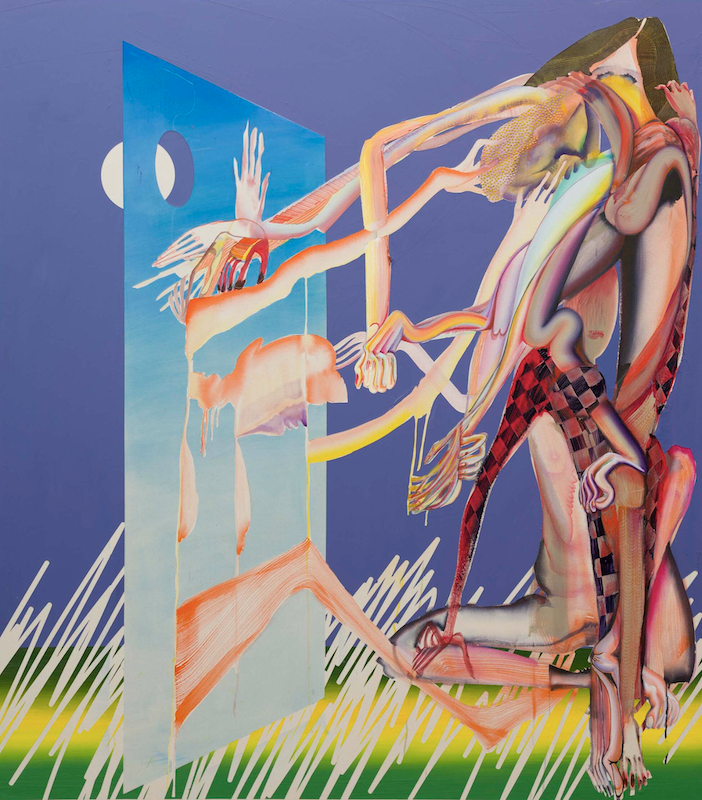
Many of Quarles’s figures appear in pairs or groups.
Bodies overlap so intensely that individual anatomy becomes difficult to separate. This may initially look like unity, but the relationships rarely feel entirely harmonious.
The figures may appear lonely inside physical closeness.
They may be unable to distinguish support from constraint.
They may share a space without sharing the same experience of it.
This creates a powerful understanding of intimacy:
To be joined to another person does not mean becoming fully understood by them.
The other person may provide recognition and still misread us.
They may create freedom and limitation simultaneously.
They may help define the self while threatening its boundaries.
Quarles’s paintings do not present relationships as solutions to instability. Relationships become additional systems through which identity must be negotiated.
Language and Titles
Her titles frequently use colloquial spelling, compressed language, vernacular speech, song-like phrases, or words that seem overheard rather than formally written.
This language can feel intimate, humorous, wounded, evasive, or emotionally direct.
Yet the titles do not explain the paintings.
Like the bodies, they resist standardization.
The spelling may emphasize sound over correctness. A phrase may imply a conversation without revealing who is speaking. Pronouns may remain unclear. Emotional meaning may be suggested but not stabilized.
Language therefore behaves much like anatomy in the work.
It communicates while refusing complete clarity.
The title offers another partial body: recognizable, expressive, and unresolved.
The Viewer’s Desire to Solve the Body
Quarles strongly implicates the viewer because her paintings activate a nearly automatic interpretive response.
We try to identify:
Whose arm is that?
How many people are present?
Is this figure male or female?
What race is being depicted?
Are these people lovers?
Is the scene pleasurable or painful?
Where are they located?
Those questions seem reasonable, but the work gradually reveals that they are also classificatory demands.
Why must the body become stable before we can relate to it?
Why must gender, anatomy, race, space, and relationship resolve into clear information?
Why does ambiguity create discomfort?
The viewer’s confusion becomes evidence of how deeply visual culture has trained us to treat bodies as readable objects.
Quarles does not prevent interpretation.
She prevents interpretation from becoming possession.
Her Visual World
Across her practice, Quarles has developed a recognizable lexicon:
intertwined and contorted bodies
ambiguous gender and anatomy
limbs that belong to uncertain figures
breasts, hands, feet, faces, and torsos treated as shifting signs
hard-edged stripes, grids, and patterned planes
synthetic gradients
gestural flesh-like passages
incompatible perspectives
bodies compressed by the canvas
intimacy mixed with isolation
colloquial and phonetically altered titles
figures passing through spatial boundaries
beauty mixed with discomfort
bodies that remain visible but unresolved
This lexicon creates a visual world in which identity is never presented as an isolated essence.
It emerges through friction among body, viewer, language, relationship, space, history, and category.
Why the Work Matters Now
Quarles’s paintings belong to a broader contemporary conversation about how identity is classified, performed, contested, and misread.
But the work does not simply illustrate the proposition that identity is fluid.
That would be too easy.
Her paintings show that fluidity can be physically and psychologically difficult.
Not fitting a category may create possibility, but it may also produce misrecognition, isolation, discomfort, and pressure.
The figures do not float freely beyond identity.
They struggle through the structures that attempt to define them.
That makes the paintings more complex than a celebration of ambiguity.
Ambiguity is not presented as a fashionable virtue.
It is presented as a lived condition.
What Artists Can Learn
The lesson is not to imitate Quarles’s tangled anatomy, pastel palette, digital patterns, gestural brushwork, or ambiguous figures.
The lesson is to understand why the body has to become unstable.
Distortion should model an experience.
A distorted figure becomes meaningful when its anatomy reveals psychological, social, perceptual, or spatial pressure.
Abstraction should act on the subject.
Abstract forms should not merely accompany the figure. They can restrict, divide, dissolve, classify, or reorganize it.
Confusion can be precise.
The viewer may not understand exactly what is happening, but the work should know which certainties it is denying and why.
Pattern can function as a system.
A grid, stripe, or decorative plane can become the structure against which the body struggles.
Identity pressure should become physical.
Rather than merely announcing that identity is complex, the work can make boundaries, anatomy, space, and relationships behave complexly.
Ambiguity should not become vagueness.
Quarles’s paintings contain carefully controlled contradictions. The figures are unstable, but the artistic problem is highly specific.
The viewer’s frustration can become part of the meaning.
Difficulty matters when it reveals the viewer’s demand that bodies become quickly readable.
The larger lesson is this:
The body becomes powerful when its inability to fit the image reveals the inadequacy of the systems used to define it.
Christina Quarles does not distort the body merely to make it expressive or strange.
She constructs paintings in which bodies collide with categories, other bodies, spatial structures, and the limits of representation itself.
The paintings initially seem confusing because we are trying to solve them.
Their deeper force appears when we recognize that being unsolvable is the condition they are built to make us experience.
The lesson is not to copy the appearance of the work.
The lesson is to understand the pressure that made the appearance necessary.