What Makes Tschabalala Self’s Work So Powerful?
Tschabalala Self’s work is powerful because she turns the Black body from an object of social projection into a site of self-construction.
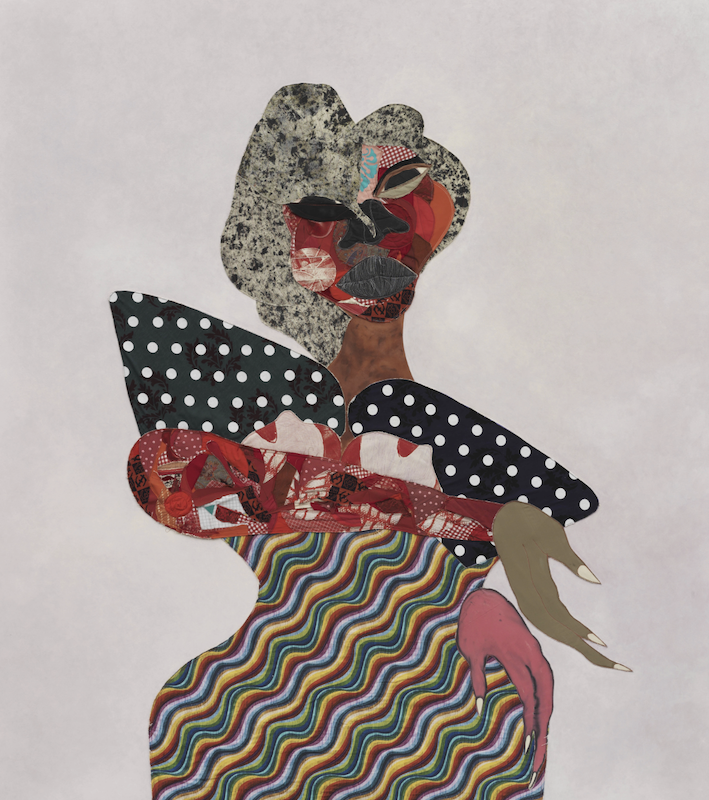
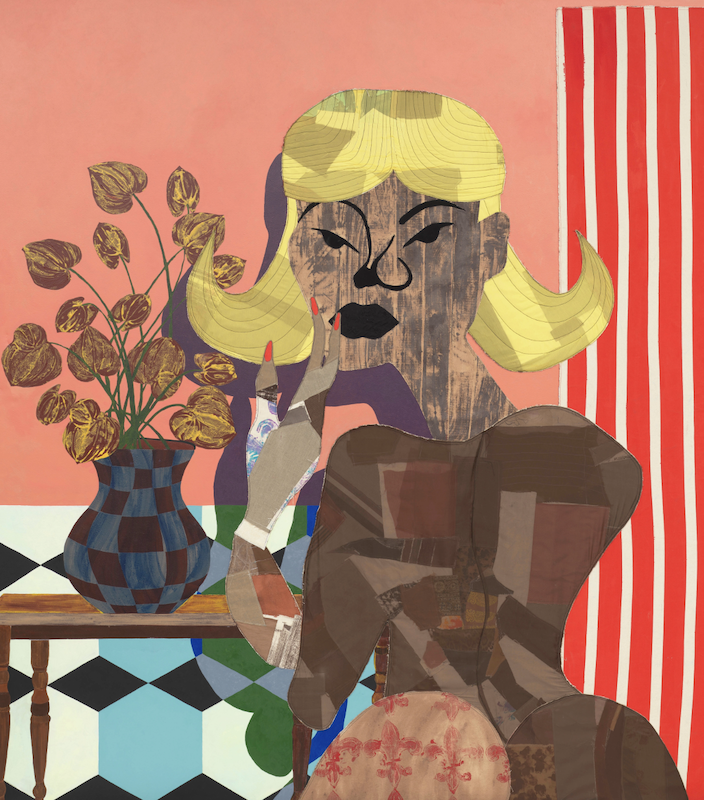
At first, her figures can appear playful, exuberant, and visually immediate. Bodies stretch, bend, recline, pose, dance, embrace, and occupy rooms with exaggerated confidence. Limbs swell or narrow. Hips, breasts, hands, feet, lips, clothing, hair, and facial features become unusually pronounced. Painted passages meet patterned fabric, printed material, drawing, collage, stitching, and sculptural form.
The bodies do not conform to anatomical realism, but they do not feel arbitrary. They appear assembled according to another logic: the logic of embodiment as something socially interpreted, psychologically experienced, materially constructed, and actively performed.
Self combines fabric, collage, painting, and experimental printmaking to create composite figures rather than portraits of particular individuals. She has described these figures as accumulations of people and references rather than representations of singular sitters. (ACCA)
That gives the work its central pressure:
The body is constantly being read from the outside, yet it continues to invent itself from within.
The Problem Beneath the Work
Self’s recurring problem is not simply how to represent Black bodies or Black womanhood.
A more precise formulation would be:
How can an artist construct Black figures who remain sexually, socially, and psychologically visible without allowing outside stereotypes to determine what those bodies mean?
Bodies do not enter images neutrally.
Viewers bring assumptions about race, gender, sexuality, beauty, class, desirability, respectability, vulnerability, and power. Certain physical features have been exaggerated throughout visual culture in order to stereotype, fetishize, ridicule, classify, or consume Black bodies.
Self does not avoid exaggeration.
She takes control of it.
The body may be enlarged, fragmented, patterned, compressed, or theatrically posed, but these transformations no longer operate solely as distortions imposed from outside. They become tools of authorship.
The figure constructs its own visual terms.
That is the deeper shift in the work. Self does not simply replace a negative image with a positive one. She questions the system through which bodies become legible in the first place.
How the Work Creates Pressure
The pressure in Self’s work comes from the collision between embodiment and representation.
A body is lived from within.
An image is read from outside.
Between those two conditions lies a struggle.
The figure may feel pleasure, confidence, awkwardness, desire, exposure, fatigue, intimacy, or self-possession. But the viewer encounters only visible signs: posture, clothing, anatomy, skin, gesture, expression, setting, and social codes.
Self makes that gap impossible to ignore.
Her figures often appear highly exposed, yet not necessarily vulnerable to the viewer. Their bodies are available to sight, but their meanings are not settled. Exaggerated anatomy initially seems to invite immediate interpretation, only to complicate it.
A large hip may evoke sexuality, fertility, fashion, stereotype, bodily confidence, humor, or formal rhythm.
An elongated leg may suggest elegance, artificiality, theatrical posing, or refusal of anatomical containment.
A direct stance may feel assertive but also staged.
A reclining body may appear relaxed, seductive, defensive, or monumental.
The figure attracts interpretation while resisting conclusion.
Fragmentation Is Not Damage
One of Self’s most important formal strategies is fragmentation.
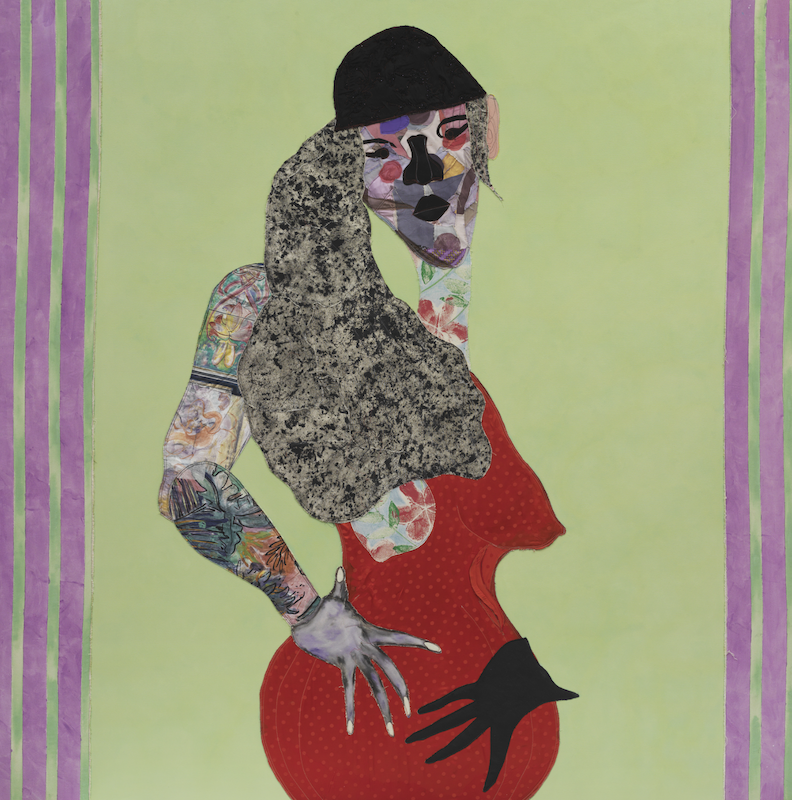
Her figures are often built from separate pieces of material. A torso may be painted, a limb sewn from fabric, a face drawn, and an article of clothing assembled from another patterned surface. The body is visibly constructed from discontinuous parts.
In another context, fragmentation might imply injury, instability, or loss.
Self uses it more expansively.
The fragment becomes a building block.
The seams do not hide the fact that the figure has been made. They announce it.
This matters because identity is also constructed from pieces:
bodily experience
social perception
inherited history
desire
memory
gender performance
fashion
cultural symbolism
private fantasy
public judgment
The figure’s body does not need to appear seamless in order to feel whole.
In fact, its visible construction may be the source of its power.
Wholeness does not require smoothness.
Self’s figures are coherent because their fragments act together, not because the seams disappear.
Why the Formal Choices Matter
Fabric
Fabric carries several meanings at once.
It refers to clothing, adornment, domestic space, touch, protection, taste, class, gender, and bodily presentation. It is intimate because it lies against the body, but public because clothing helps construct the image presented to the world.
Self does not merely paint clothing.
She uses actual textile surfaces to build bodies.
This collapses the distinction between the person and what the person wears. Pattern is no longer placed on top of the figure as decoration. It becomes flesh, volume, gesture, and identity.
Fabric therefore behaves as both material and social code.
It can conceal and reveal.
Protect and display.
Individualize and stereotype.
The material makes these contradictions physically present.
Stitching and seams
Stitching holds the body together while preserving evidence that it was assembled.
A seam is both connection and division.
It tells us that two unlike parts have been joined but have not become identical.
This makes stitching conceptually necessary. It provides a material language for identity as a negotiated structure rather than a fixed essence.
The body appears unified, but its unity has been worked for.
Exaggerated anatomy
Self’s figures often contain expanded hips, breasts, feet, hands, lips, thighs, and other features associated with social or sexual interpretation.
The exaggeration can initially look humorous, celebratory, provocative, or cartoon-like. But it also raises a more difficult question:
Who controls exaggeration?
Historically, distortion has often been used against Black bodies. In Self’s work, exaggeration is reclaimed as compositional force and self-definition.
The enlarged feature no longer merely confirms an external stereotype. It may dominate the image, destabilize the viewer, establish rhythm, assert pleasure, create awkwardness, or refuse polite bodily containment.
Self does not neutralize the charge.
She redirects it.
Pose
The poses in Self’s work are rarely incidental.
Figures stand with legs apart, lean dramatically, display themselves, turn away, recline, embrace, sit, or inhabit spaces with overt bodily awareness. Their gestures often seem both natural and performed.
Pose becomes the point where the private body becomes a public image.
It communicates confidence, sexuality, defensiveness, social role, mood, and self-presentation. But because the anatomy is constructed and exaggerated, the pose never reads as simple evidence of character.
The body performs visibility without becoming fully explained by it.
Pattern
Pattern activates the body rather than merely embellishing it.
Different fabrics can break anatomy into zones, redirect the eye, flatten volume, or make parts of the figure appear to advance and recede. Pattern may emphasize the body’s social construction by making its surface resemble clothing, upholstery, architecture, or domestic décor.
It also complicates the boundary between figure and field.
A body can merge with a room.
A garment can behave like skin.
An interior can become an extension of the figure.
This is particularly important because Self frequently works with domestic and neighborhood settings, including her extended Bodega Run project and exhibitions structured around home, social space, and everyday environments. (Pilar Corrias)
Flatness and volume
Self’s figures frequently oscillate between flat graphic shape and bodily volume.
A limb may appear almost like a cut-paper silhouette, while another passage feels tactile and sculptural. Painted illusion meets literal fabric. A body may seem monumental despite being visibly assembled on a flat surface.
This instability prevents the viewer from forgetting that the body is both a person and an image.
The figure occupies space.
The figure is also a constructed sign.
The Central Contradiction
The central contradiction in Self’s work is:
The figure is highly visible but refuses to become visually controlled.
The bodies may be:
exposed but self-possessed
fragmented but whole
stereotyped in appearance but resistant in meaning
sexually charged but not passively consumable
playful but historically pressured
artificial but emotionally convincing
exaggerated but psychologically credible
public in image but private in interiority
Self does not resolve these contradictions by presenting a purified or idealized version of Black embodiment.
She allows the body to remain messy, pleasurable, socially coded, theatrical, vulnerable, absurd, powerful, and incomplete.
That complexity matters.
A supposedly “positive” image can become restrictive when it requires the figure to appear dignified, respectable, inspirational, beautiful, empowered, or morally exemplary at all times.
Self’s figures are freer than that.
They can be awkward.
Desiring.
Self-conscious.
Excessive.
Tender.
Uncertain.
Comical.
Dominant.
They do not need to represent an ideal in order to possess authority.
The Body as Social Construction
Self’s figures demonstrate that bodies are not understood through anatomy alone.
A body becomes socially meaningful through clothing, posture, setting, movement, gaze, language, race, gender, and cultural memory.
The physical form becomes inseparable from the signs attached to it.
Self turns that condition into material structure.
Her collage process does not simply symbolize constructed identity. It makes construction visible. A figure composed from different materials mirrors the way a social identity is assembled from different codes and expectations.
But construction does not mean falseness.
Something made can still be real.
A performed identity can still contain truth.
A composite body can still possess presence.
Self’s work challenges the belief that authenticity must exist beneath social construction as a pure, untouched core. Instead, the self emerges through negotiation with the materials, histories, desires, and perceptions surrounding it.
Sexuality Without Simple Possession
Sexuality is a strong current throughout Self’s work.
Bodies display themselves. Clothing reveals or accentuates. Couples touch, embrace, or occupy emotionally charged spaces. Anatomy can become theatrical and overt.
Yet the work does not offer sexuality as uncomplicated access.
The viewer may be attracted, amused, unsettled, or uncertain. A pose that seems seductive may also feel exaggerated enough to expose the visual codes of seduction. A bodily feature may attract attention while making the viewer conscious of why it attracts attention.
The work therefore implicates desire.
It does not simply say:
Look at this body.
It asks:
What have you been taught to see in this body?
And then:
Who benefits from that way of seeing?
Sexual visibility becomes both pleasure and pressure.
Domestic and Social Space
Self’s figures often inhabit bedrooms, living spaces, shops, neighborhood environments, and other socially coded settings. Her Bodega Run works drew specifically on the New York City bodega as a social, economic, and cultural site rather than merely as a backdrop. (Pilar Corrias)
These environments matter because the body behaves differently depending on where it appears.
A figure in a bedroom may seem intimate or exposed.
A figure in a shop may become a consumer, worker, observer, or social type.
A seated figure in a domestic setting may appear at rest, yet the act of occupying space can become politically charged when certain bodies have historically been denied safety, leisure, or unrestricted visibility.
The setting helps produce identity.
But the figure also alters the setting.
Its scale, posture, pattern, and psychological force can overwhelm the room, turning domestic architecture into an extension of the body.
The environment does not contain the figure easily.
From Painting to Sculpture and Installation
Self’s practice has expanded beyond conventional painting into sculpture, installation, works on paper, video, and immersive environments. Her 2025 exhibition Skin Tight brought paintings, three-dimensional works, and video together in psychologically charged spaces concerned with how identities are constructed and perceived. (ACCA)
This expansion is a logical development of the work’s central problem.
If the body is already constructed from fabric, stitching, volume, and collage, then the figure naturally presses beyond the flat picture plane.
Sculpture makes bodily presence literal.
Installation places the viewer inside the figure’s psychological and social field.
The body no longer exists only as something viewed across a distance. It shares physical space with the viewer.
That shift increases the pressure of looking.
A painted figure can be surveyed.
A life-size or monumental sculptural figure confronts the viewer bodily.
How the Viewer Becomes Implicated
Self’s work makes the viewer aware of classification.
We see a body and immediately begin organizing it.
Male or female.
Desirable or undesirable.
Powerful or vulnerable.
Elegant or vulgar.
Confident or exposed.
Realistic or grotesque.
Individual or stereotype.
Those judgments often occur before conscious reflection.
Self’s figures accelerate the process by giving the viewer strongly coded signs, then making those signs unstable. Exaggerated anatomy seems legible until it becomes too theatrical to function as simple description. Pattern appears decorative until it begins constructing the body. Sexuality appears available until the figure’s posture or gaze reclaims control.
The work reveals that the viewer is not merely observing identity.
The viewer is participating in its production.
The Visual World Self Has Built
Across her practice, Self has developed a recognizable lexicon:
composite Black figures
stitched and collaged bodies
exaggerated hips, limbs, hands, feet, lips, and breasts
patterned fabric used as skin and clothing
direct, theatrical, or socially coded poses
domestic interiors
bedrooms, shops, bodegas, and neighborhood spaces
bold flat color
seams and visible construction
bodies merging with architecture or décor
couples, embraces, desire, and bodily proximity
graphic silhouettes
sculptural figures built from soft materials
playful surfaces carrying historical pressure
This is not merely a recognizable style.
It is a visual system for examining how bodies are made legible, projected upon, desired, disciplined, and reclaimed.
What Artists Can Learn
The lesson is not to imitate Self’s fabric collage, exaggerated anatomy, bright color, distorted figures, or stitched surfaces.
The lesson is to understand how she turns bodily construction into artistic agency.
Distortion becomes meaningful when it changes who controls the image.
Exaggeration should not merely make a figure look unusual. It should expose, redirect, or reclaim the meanings attached to the body.
Fragmentation does not have to signify brokenness.
A figure can be assembled from discontinuous parts and still possess extraordinary coherence and authority.
Material can carry social meaning.
Fabric is not only texture. It brings clothing, domesticity, protection, gender, taste, class, intimacy, and public presentation into the body.
Pattern should act on anatomy.
It can divide, construct, conceal, enlarge, flatten, merge, or transform the figure.
Sexuality should complicate the gaze.
A sexually visible body becomes more powerful when the work makes viewers examine their own desire and assumptions.
The body can resist realism without losing humanity.
Psychological credibility does not depend on anatomical accuracy.
A figure should not be reduced to either stereotype or correction.
Replacing a harmful image with an idealized one can create another restriction. Complexity gives the body greater freedom.
The larger lesson is this:
The body becomes powerful when its visible construction reveals that identity is being authored rather than merely assigned.
Tschabalala Self’s figures do not escape the social meanings imposed upon bodies. They absorb, exaggerate, fragment, rearrange, and redirect those meanings.
They turn the body from a surface interpreted by others into a visual world capable of constructing itself.
The lesson is not to copy the appearance of the work.
The lesson is to understand the pressure that made the appearance necessary.