What Makes Hurvin Anderson’s Paintings So Powerful?
Hurvin Anderson’s paintings are powerful because they turn places into unstable psychological spaces where memory, cultural identity, longing, distance, and belonging remain unresolved.
At first, many of the paintings appear to depict familiar locations:
A barbershop
A garden
A public park
A tropical landscape
A domestic interior
An abandoned hotel
A swimming pool
A fenced recreational space
Yet these places rarely feel fully available.
A grille blocks the viewer’s path. Foliage obscures the landscape. A room is empty. A figure appears far away, blurred, turned aside, or almost absorbed by the setting. Objects dissolve into blocks of color. Perspective opens a route into the image while another device prevents entry.
The paintings offer a place and withdraw it simultaneously.
Anderson has described the emotional condition behind his work as being in one place while thinking about another. Born in Birmingham to Jamaican parents, he developed his practice between British experience, inherited Caribbean memory, family photographs, travel, and the history of painting. His work repeatedly explores spaces connected to Caribbean immigrant communities, including barbershops, gardens, parks, and domestic interiors. (Art Collection)
His paintings do not simply ask where someone belongs.
They ask what happens when belonging is divided between places that are lived, remembered, inherited, imagined, or viewed from a distance.
The Problem Beneath the Work
Anderson repeatedly returns to a central artistic problem:
How can painting give form to the experience of belonging to a place while also feeling separated from it?
This is not simply a problem of geographic displacement.
A person may live in Britain while carrying family memories of Jamaica.
A landscape may feel culturally familiar even if it was not the landscape of one’s own childhood.
A photograph may offer apparent access to the past while also emphasizing that the moment is gone.
A community space may feel intimate to those who belong there and inaccessible to those outside it.
A garden may represent home, labor, migration, cultivation, nostalgia, or colonial history at the same time.
Anderson’s paintings inhabit these divided relationships.
They do not present identity as one stable origin.
Instead, identity develops through tension among:
Britain and the Caribbean
Personal experience and inherited memory
Recognition and estrangement
Presence and absence
Observation and recollection
Figuration and abstraction
Public space and private belonging
Access and obstruction
The deeper problem becomes:
How can a painting make a place feel emotionally real without pretending that the artist or viewer can enter it completely?
Place as a Psychological Condition
Anderson’s landscapes are not simply records of physical locations.
They are spaces shaped by memory.
A garden may be reconstructed from photographs, visual fragments, earlier studies, remembered color, and later experience. The resulting image does not function like a documentary photograph. It carries the uncertainty of looking backward.
One section may feel sharply observed.
Another may dissolve.
A plant may become a large abstract field.
A fence may appear more visually dominant than the landscape behind it.
A figure may seem barely anchored to the location.
These disruptions make place behave psychologically.
Memory does not preserve everything equally.
It often retains:
A certain quality of light
A color relationship
The shape of a room
A patterned wall
A doorway
A fence
A person’s posture
A feeling of warmth or exclusion
Other details disappear.
Anderson does not repair those gaps. He uses them.
The incomplete image becomes a truthful form for incomplete access.
The Diasporic Double View
Diaspora often produces a doubled relationship to place.
One location may be physically present while another remains emotionally active.
A person may know a country through parents, stories, food, music, photographs, community rituals, and periodic visits rather than through continuous residence.
That place can feel like home and not-home at once.
Anderson’s paintings do not resolve this contradiction into a simple celebration of multicultural identity.
They preserve the discomfort.
The Caribbean may appear lush, colorful, warm, and desirable, but it can also feel distant, obscured, abandoned, or difficult to possess.
Britain may be the place of lived experience, yet the spaces associated with Caribbean community can operate as cultural interiors within the larger nation.
Anderson’s work is informed by his Birmingham upbringing within an African-Caribbean community and by his family’s Jamaican background. Official accounts of his practice consistently connect his paintings to memory, nationhood, identity, and the experience of occupying more than one cultural position. (Art Collection)
The paintings therefore embody a double view:
The artist looks from inside and outside at the same time.
He belongs to the history he examines.
He is also separated from parts of it by generation, geography, memory, and the mediating image.
The Barbershop as Cultural Space
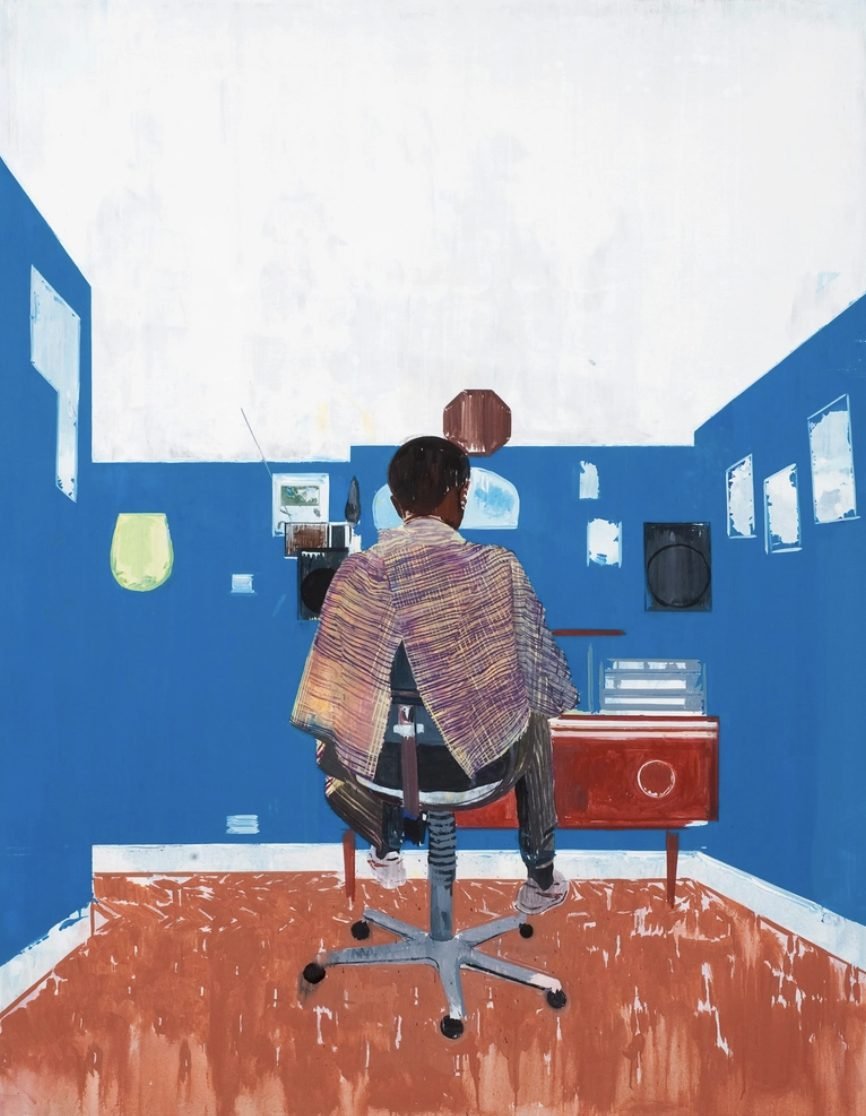
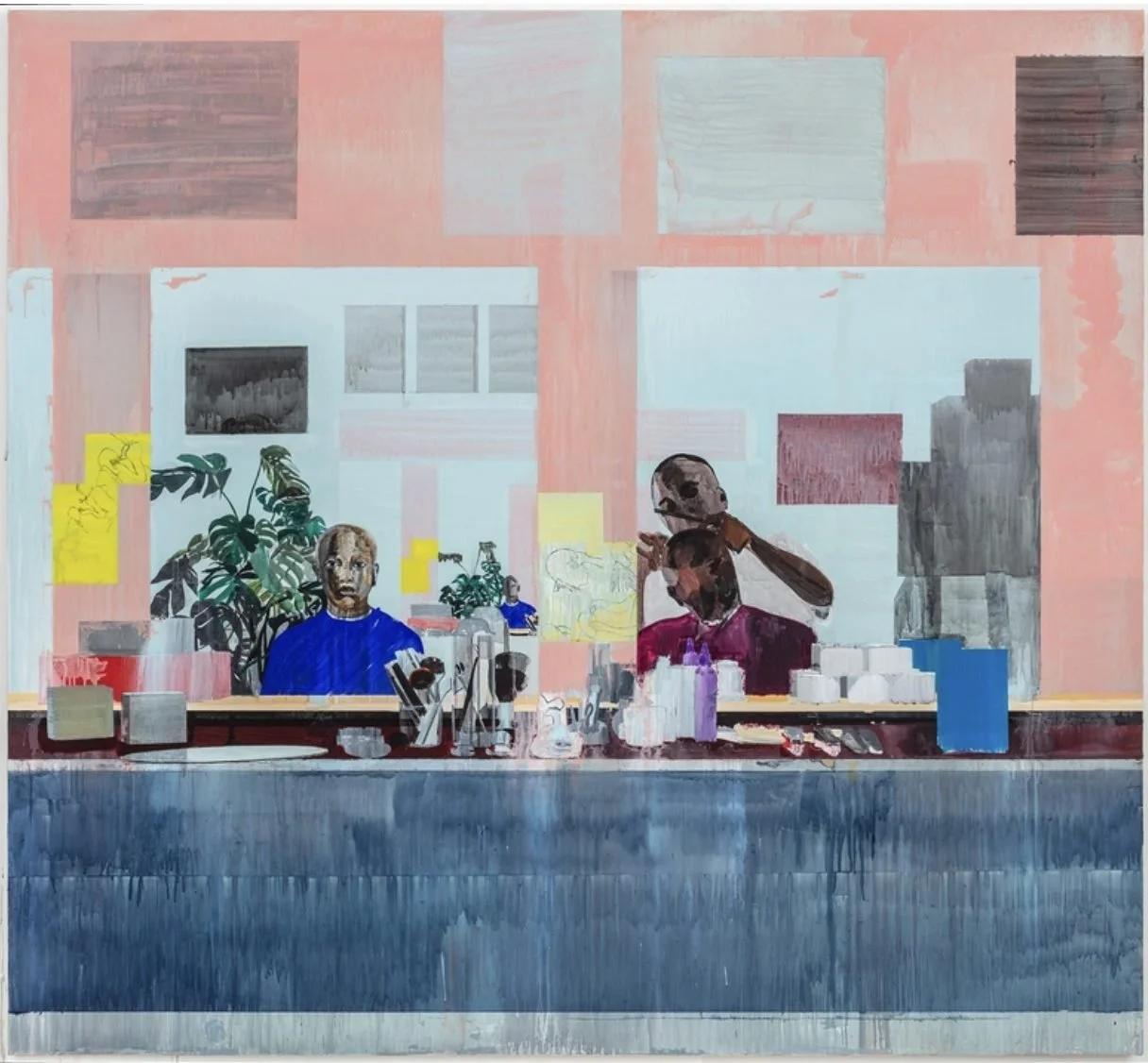
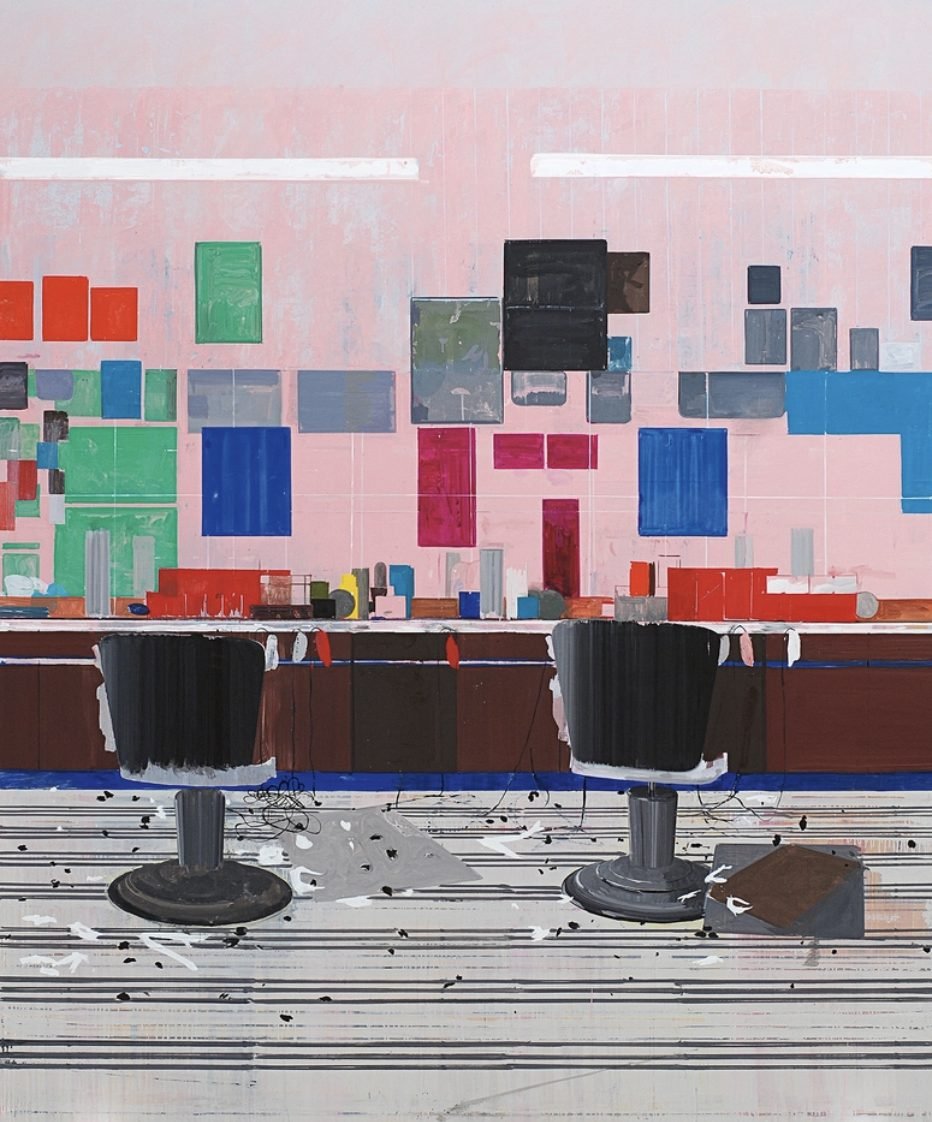
The barbershop is one of Anderson’s most important recurring subjects.
His paintings show barber chairs, mirrors, posters, counters, tools, fluorescent lights, hair clippings, wall decorations, and improvised interiors.
The rooms are often empty.
That emptiness is central.
A barbershop is not merely a commercial interior. Within Caribbean immigrant communities in Britain, domestic and informal barbershops could function as social spaces, places of conversation, self-presentation, cultural exchange, economic activity, and community formation. Anderson’s Peter’s Series developed from the image of a barbershop established inside a private home, recalling how such spaces served immigrant communities arriving in Britain. (Michael Werner Gallery)
When Anderson removes the people, the room retains their presence indirectly.
The chairs imply bodies.
Hair on the floor suggests recent activity.
Mirrors imply faces.
Posters suggest styles and identities.
Tools remain prepared for use.
The room becomes an archive of social life.
The absence of figures does not empty the painting.
It turns attention toward the structure that made gathering possible.
The Empty Chair
The barber chair becomes one of Anderson’s strongest visual devices.
It may represent:
The absent customer
The barber’s labor
A stage of transformation
A social position waiting to be occupied
Masculine ritual
Cultural continuity
The passage of time
A community no longer physically present
A chair is an ordinary object.
But an empty chair is relational.
It points toward the body that should be there.
In Anderson’s barbershop paintings, the chairs can also resemble abstract shapes or sculptural forms. Their functional identity becomes unstable as they are flattened, simplified, repeated, or separated from human use.
The room begins in representation and moves toward abstraction.
The object remains recognizable, but its meaning expands.
Repetition as Investigation
Anderson frequently returns to the same source image or setting across several paintings, drawings, and variations.
This repetition is not merely serial production.
Each return asks a different question.
A barbershop may become:
More empty
More abstract
More colorful
More spatially fragmented
More dominated by pattern
More dependent on the chair
More distant from its photographic source
A garden may be painted with different obstructions or degrees of visibility.
A repeated scene may move gradually away from representation until only its structural rhythm remains.
Anderson has compared this process to a dub version in music: removing or altering a central element allows the remaining structure to acquire a different life. (Michael Werner Gallery)
This is an important way to understand his development.
He does not repeat because the subject has been solved.
He repeats because each painting reveals that the subject remains unsolved.
Painting as Dub
Dub music takes an existing recording and transforms it through subtraction, echo, repetition, delay, emphasis, and spatial reorganization.
A vocal line may disappear.
The bass may become more dominant.
A rhythm may echo.
An apparently secondary sound becomes central.
Anderson’s paintings often operate similarly.
He may remove the figure from a source image.
He may enlarge the fence.
He may reduce the posters to rectangles.
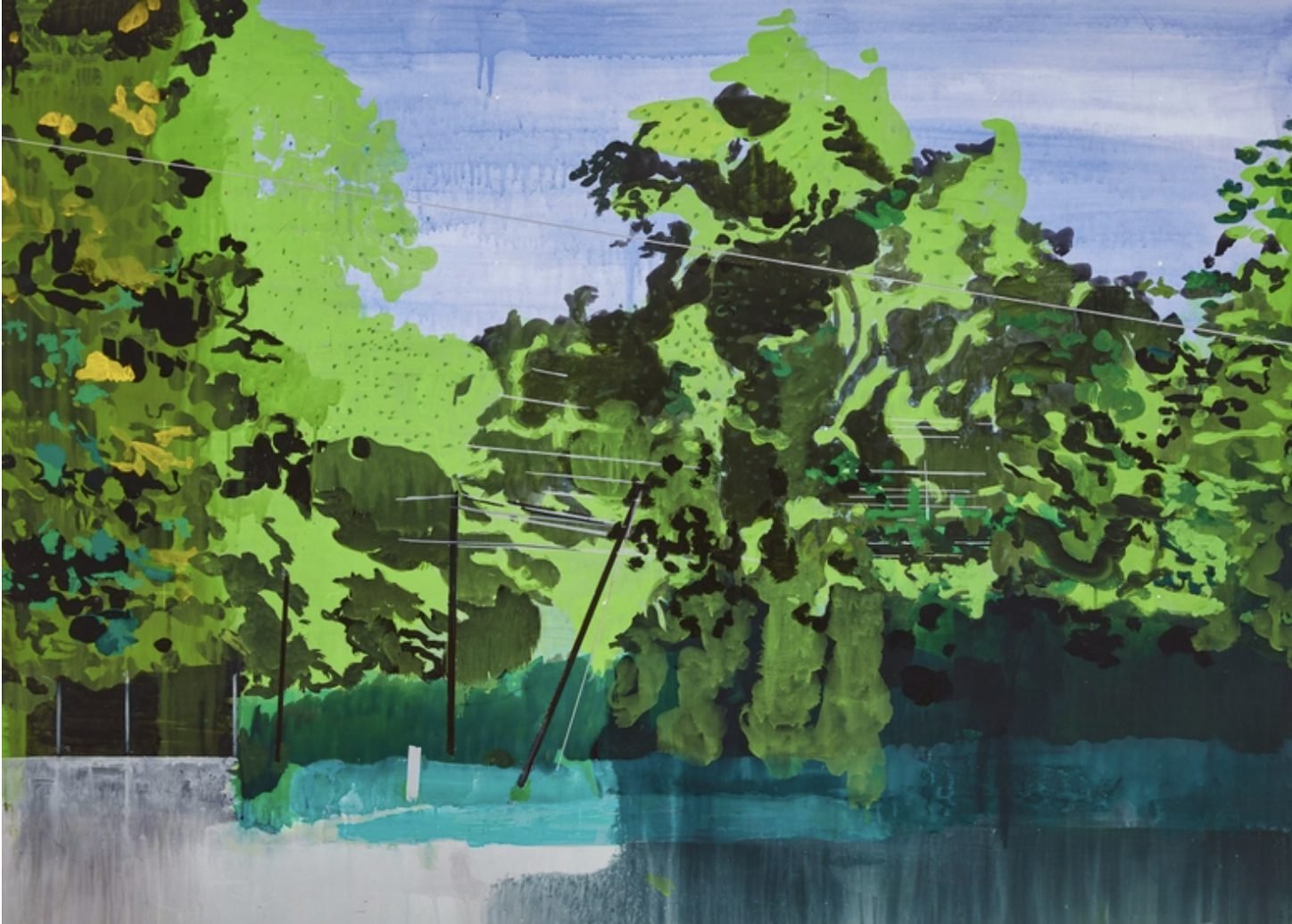
He may turn foliage into atmospheric color.
He may retain the architecture while dissolving the event.
What is removed becomes psychologically active.
The absence is not a failure to provide information.
It is a deliberate restructuring of attention.
This gives the paintings a musical logic.
The source remains present as a ghost, but the new work develops through variation.
Barriers and Screens
Fences, grilles, railings, netting, windows, barriers, and patterned screens recur throughout Anderson’s work.
These devices are not simply decorative.
They establish the viewer’s position.
The viewer may see the garden but remain outside it.
The viewer may look through a grille into a room.
The viewer may face a fence whose pattern competes with the landscape beyond.
The barrier creates several simultaneous effects:
It confirms that a place exists.
It allows partial visibility.
It prevents physical or psychological entry.
It divides insider from outsider.
It turns space into pattern.
It makes looking self-conscious.
This is one of Anderson’s most powerful solutions.
Instead of explaining cultural distance through narrative, he turns distance into pictorial structure.
The viewer experiences exclusion through the act of looking.
The Viewer at the Threshold
Many of Anderson’s paintings place the viewer near an entrance without allowing arrival.
A pathway extends inward.
A fence stands across it.
A room opens but remains unoccupied.
Vegetation conceals what lies behind it.
This threshold position mirrors the emotional condition of diasporic memory.
One may feel close to a cultural origin without inhabiting it fully.
One may recognize a space without owning it.
One may enter through family memory while remaining aware that the memory belongs partly to another generation.
The paintings therefore avoid both complete belonging and complete alienation.
The viewer remains suspended between them.
Figuration and Abstraction
Anderson’s work moves continually between recognizable imagery and abstraction.
A landscape may contain trees, pathways, flowers, architecture, and figures. Yet these elements can dissolve into flat planes, stains, grids, loose gestures, or atmospheric fields.
This movement is not simply stylistic experimentation.
It expresses the instability of memory and access.
Figuration offers recognition.
Abstraction interrupts certainty.
The viewer may think:
I know what this is.
I am not sure what I am seeing.
The place feels familiar.
The place remains inaccessible.
That oscillation keeps the painting alive.
The abstract passages do not remove social meaning.
They show where meaning becomes incomplete.
Abstraction as Distance
In Anderson’s work, abstraction can function as distance.
A source photograph may appear to provide factual information. But through repeated painting, cropping, simplification, and revision, specific details disappear.
A poster becomes a colored rectangle.
A person becomes a blurred shape.
Leaves become green marks.
Architecture becomes a grid.
The image is gradually separated from the original event.
This distance can represent:
Time passing
Memory weakening
Emotional uncertainty
Cultural displacement
The limits of photography
The impossibility of returning
Abstraction does not necessarily make the work less personal.
It can reveal how personal experience becomes difficult to recover.
Color as Memory
Anderson uses color with great sensitivity.
His paintings may contain intense greens, blues, yellows, pinks, oranges, and violets, but the color rarely feels simply celebratory.
A tropical green can become lush, oppressive, artificial, nostalgic, or threatening.
A pale blue can create distance.
A pink ground can make a landscape feel remembered rather than observed.
A bright surface may be interrupted by gray architecture or a dark fence.
Color becomes emotionally unstable.
The same hue may suggest both attraction and unease.
Recent criticism of Anderson’s major 2026 Tate Britain retrospective emphasized the hazy, heat-filled, beautiful yet unsettled quality of his paintings, and the way they hold Birmingham and Jamaica, acceptance and rejection, memory and estrangement in unresolved relation. (The Guardian)
This is why color matters so much.
It does not simply describe the environment.
It tells the viewer how uncertain the relationship to that environment has become.
Beauty Without Resolution
Anderson’s paintings can be extraordinarily beautiful.
Gardens shimmer.
Plants spread through saturated fields.
Color creates atmosphere and depth.
Patterns organize the surface.
Yet beauty does not resolve the underlying uncertainty.
The garden remains blocked.
The place remains empty.
The figure remains distant.
The remembered landscape cannot be entered.
This makes Anderson especially relevant to the larger question of whether beauty can remain serious.
His answer is clearly yes.
But beauty must carry pressure.
A beautiful landscape becomes meaningful because it contains distance, history, obstruction, longing, or exclusion.
Beauty does not eliminate complexity.
It attracts the viewer into it.
The Garden as Cultural Construction
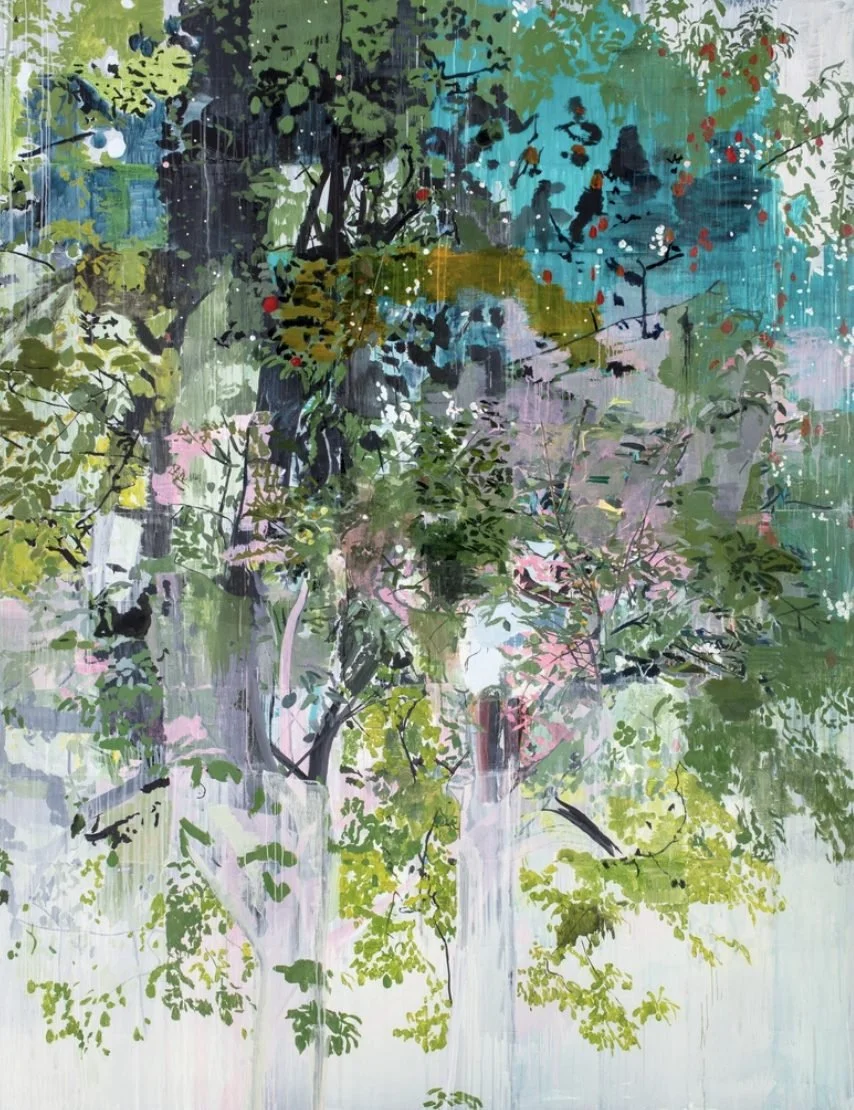
Gardens appear repeatedly in Anderson’s work.
A garden might initially seem natural, but gardens are constructed spaces.
They reflect:
Climate
Migration
Taste
Labor
Ownership
Domestic life
Cultural memory
Colonial botanical histories
The movement of plants across countries
A Caribbean garden in Britain may preserve a relationship to another climate and culture.
A Jamaican garden may contain traces of colonial land use, tourism, domestic cultivation, or abandoned architecture.
A garden can therefore become a model of diasporic identity.
Plants are moved.
They adapt.
They grow in new contexts.
They preserve traces of origin while becoming part of another environment.
Anderson’s gardens are not simple metaphors, but this parallel gives them psychological depth.
Nature and Architecture
Many of Anderson’s landscapes contain tension between vegetation and built structure.
Leaves grow around walls.
Trees obscure buildings.
Fences divide gardens.
Plants reclaim abandoned hotels.
Architecture attempts to organize space while nature exceeds or conceals it.
The contrast can suggest:
Human control and organic growth
Colonial construction and ecological persistence
Memory and ruin
Order and instability
Occupation and abandonment
In works connected to abandoned Jamaican hotel spaces, foliage enters and overtakes the architecture, turning tourism, modernity, history, and decay into one unstable environment. His Reverb exhibition developed from encounters with abandoned hotel architecture near Oracabessa, Jamaica.
The landscape is not empty nature.
It contains historical structures.
The Abandoned Hotel
An abandoned hotel is a particularly charged subject.
A hotel is designed for temporary occupation.
It promises leisure, travel, service, luxury, and escape.
In a Caribbean context, it may also carry histories of tourism, economic inequality, colonial desire, and the consumption of landscape.
When the hotel is abandoned, these promises collapse.
Architecture remains without guests.
Nature enters.
The building becomes ruin.
Anderson’s treatment of such spaces avoids straightforward historical explanation. Instead, structure and foliage compete.
The viewer sees the remains of hospitality but cannot enter the lost social world.
The painting becomes another threshold.
Family Photographs and Unstable Evidence
Anderson has used family photographs as sources throughout his career.
A family photograph appears to preserve a moment.
But it also contains several forms of distance.
The event has passed.
The people have changed.
The photographer selected the frame.
The image may be faded, cropped, or separated from its original context.
Later viewers may know the people but not the exact emotional condition of the scene.
In Anderson’s paintings, photographic figures can become blurred, doubled, or absorbed into the environment.
A recent review of his Tate retrospective noted paintings in which family figures appear ghostlike or temporally doubled, emphasizing how the promise of photographic truth collapses through painting. (The Guardian)
Painting does not restore the lost moment.
It exposes how unstable the evidence has become.
Photography and the Gap of Memory
Photography offers Anderson useful distance from direct observation.
Working from a photograph allows him to pause, select, crop, repeat, remove, and transform.
But the photograph is not treated as neutral.
It is already an image of separation.
The photograph says:
This existed, but it is no longer here in the same way.
Painting intensifies that distance.
Each translation introduces another layer:
Event
Photograph
Memory
Selection
Drawing
Painting
Revision
The final painting is not a recovery of the original place.
It is a record of repeated mediation.
Black Social Space Without the Figure
One of Anderson’s distinctive achievements is his ability to address Black social experience through spaces and objects rather than through continuous figural representation.
The barbershop can remain culturally specific even when no person appears.
A garden can carry migration and memory.
A grille can represent the structure of access.
A chair can indicate ritual and community.
This expands the possibilities of identity-based painting.
Identity does not always need to appear as a visible body.
It can exist in:
Architecture
Objects
Spatial arrangement
Color
Absence
Use
Social memory
The empty room can carry cultural presence.
The Problem of Nostalgia
Anderson’s subject matter could easily become nostalgic.
Family photographs, community spaces, gardens, Jamaica, and childhood memory all carry the possibility of sentimental longing.
But the paintings resist easy nostalgia.
The remembered place is often:
Obstructed
Empty
Blurred
Fragmented
Overgrown
Repeated until unstable
Visually attractive but unreachable
Nostalgia wants to convert the past into a coherent, emotionally available place.
Anderson prevents that coherence.
The work allows longing while exposing its limits.
The past remains desirable precisely because it cannot be recovered completely.
Nationhood and Landscape
Landscape painting has often helped construct national identity.
A nation imagines itself through its land:
Countryside
Coastline
Gardens
mountains
parks
agricultural fields
tropical vegetation
Anderson complicates this tradition by placing British and Caribbean landscapes into dialogue.
His work asks:
Which landscape represents home?
Can two landscapes occupy one identity?
How does colonial history shape the movement between them?
Who is permitted to belong inside a national landscape?
Can an inherited landscape feel intimate without becoming fully one’s own?
Recent criticism has connected Anderson’s work to the history of British landscape painting while emphasizing how he rethinks nationhood, empire, migration, and the meeting of English and Jamaican environments. (Financial Times)
Landscape is therefore not background.
It is a political and psychological structure.
The “Welcome” That Withholds Entry
Some of Anderson’s works use decorative screens or grilles associated with domestic and social spaces.
A title or visual motif may suggest welcome.
Yet the viewer remains outside.
This contradiction is central:
The image offers hospitality while preserving a boundary.
The grille may be beautiful.
Its pattern may create rhythm.
But it is still a barrier.
This allows decoration to perform two roles at once:
Visual invitation
Physical exclusion
Pattern becomes psychologically charged.
It controls access.
Why the Formal Choices Matter
Anderson’s formal vocabulary supports the deeper problem at nearly every level.
Obstruction makes distance visible
Fences, grilles, leaves, and screens prevent direct entry.
Repetition shows memory changing
The same subject becomes less stable each time it is revisited.
Empty rooms make social absence active
Objects retain the memory of bodies.
Blurred figures resist complete possession
The viewer recognizes a person without receiving full access.
Color carries emotional contradiction
Beauty, longing, heat, melancholy, and estrangement coexist.
Abstraction registers loss of detail
The place survives, but its factual completeness does not.
Photographic sources introduce mediation
The scene has already become an image before painting begins.
Sparse narrative preserves uncertainty
The viewer encounters a condition rather than a complete story.
The Central Contradictions
Anderson’s paintings hold several opposing forces together:
Belonging and estrangement
Britain and the Caribbean
Presence and absence
Figuration and abstraction
Beauty and melancholy
Access and obstruction
Personal memory and collective history
Familiarity and distance
Natural growth and built structure
Social space and emptiness
Invitation and exclusion
Observation and recollection
The deepest contradiction may be:
The paintings make a place feel intensely present while showing that it cannot be entered, recovered, or possessed completely.
That is the emotional engine of the work.
The Viewer’s Position
Anderson gives the viewer several roles.
The viewer becomes an outsider
Barriers and empty rooms make entry uncertain.
The viewer becomes a rememberer
The paintings activate the fragmented logic of memory even when the viewer has never visited the depicted place.
The viewer becomes a cultural interpreter
Objects and environments carry histories that may not be immediately legible.
The viewer becomes a navigator
Figuration and abstraction require continual adjustment.
The viewer becomes aware of desire
The beauty of the landscape produces a wish to enter.
The painting makes that wish visible and then frustrates it.
The viewer becomes aware of limits
Seeing a place does not mean belonging to it.
The World Anderson Has Built
His recurring lexicon includes:
Barbershop chairs
Mirrors
Posters
Fluorescent lights
Hair clippings
Grilles
Fences
Gardens
Trees
Tropical foliage
Parks
Empty interiors
Family figures
Abandoned architecture
Pools
Paths
Windows
Patterned screens
Saturated color
Blurred photographic forms
These elements create a coherent world without becoming fixed symbols.
A fence may protect, imprison, decorate, or exclude.
A chair may represent labor, ritual, absence, or transformation.
A garden may embody memory, cultivation, desire, or cultural displacement.
A blurred figure may be disappearing into the past or emerging from it.
A fluorescent light may describe a room while flattening it into geometry.
The lexicon remains alive because each motif changes through repetition.
The Risk of Atmospheric Memory Painting
Anderson’s practice carries real risks.
Haze can become generalized nostalgia.
Blur can become a tasteful sign of memory.
Tropical color can become exotic beauty.
Empty interiors can become elegant melancholy.
Repetition can become a recognizable formula.
Barriers can symbolize distance too predictably.
The critical question is:
Does each painting discover a new relationship among place, memory, identity, and access, or does it merely reproduce the established Anderson atmosphere of beautiful estrangement?
The strongest paintings make formal decisions feel necessary.
The fence does not merely signify separation; it determines the entire visual encounter.
The empty chair reorganizes the room.
The abstract passage shows where the remembered place breaks down.
The color makes longing pleasurable and uneasy at once.
A weaker painting might retain the atmosphere without renewing the problem.
How His Work Differs from Peter Doig’s
Anderson and Peter Doig share an interest in memory, landscape, photography, atmosphere, and places that remain psychologically distant.
But their central problems differ.
Doig often asks:
What happens to a place when lived experience, photographic imagery, cinema, memory, and imagination merge?
Anderson asks more specifically:
What happens when a place is tied to cultural belonging but remains partially inaccessible through migration, generation, geography, and memory?
Doig’s distance is often dreamlike and temporal.
Anderson’s distance is also cultural and social.
Doig’s landscapes can feel like remembered images whose origins have become unstable.
Anderson’s places often carry the pressure of diaspora, community, nationhood, and who is permitted to enter.
The formal similarities make the difference especially useful.
How His Work Differs from Michael Armitage’s
Armitage combines political events, mythology, media, memory, and art history into unstable narrative worlds.
Anderson is quieter.
His paintings often remove the event.
They focus on the place left behind.
Armitage’s instability tends to produce transformation, dream, social conflict, and narrative collision.
Anderson’s instability produces distance, obstruction, repetition, and suspended belonging.
Armitage asks how representation changes an event.
Anderson asks how memory changes a place.
Why the Work Belongs to the Present
Anderson’s work belongs to a world shaped by migration, mixed inheritance, family memory, tourism, cultural displacement, and divided belonging.
Many people live in one country while carrying emotional or familial ties to another.
Places are increasingly encountered through:
Photographs
Video
Family stories
Social media
periodic travel
inherited rituals
food
music
community spaces
cultural imagination
A person may feel attached to a place they know incompletely.
They may feel at home in more than one place and fully at home in neither.
Anderson gives this condition a visual structure.
The work does not define identity as rootlessness.
It shows that attachment can survive distance.
But attachment does not erase the boundary.
What Artists Can Learn
The lesson is not to imitate Anderson’s barbershops, tropical gardens, empty chairs, grilles, blurred photographs, saturated greens, or repeated source images.
Those are the visible solutions produced by his particular investigation.
The larger lesson is that place becomes powerful when it carries a divided relationship.
Anderson demonstrates that:
A landscape can hold cultural identity rather than merely depict scenery.
Absence can preserve social presence.
A barrier can determine the psychology of looking.
Repetition can show memory changing over time.
Abstraction can register incomplete access.
Beauty can carry longing and estrangement.
Objects can preserve the history of a community.
Photographs can function as evidence of distance rather than factual certainty.
Empty space can activate the bodies no longer present.
Pattern can invite and exclude simultaneously.
A recurring subject can remain alive when each return changes the underlying question.
Identity can be embedded in spaces, objects, colors, and structures without requiring a visible figure.
A painting can offer recognition without granting possession.
Anderson does not simply paint a place.
The place is lived.
It becomes a photograph.
The photograph becomes family memory.
Memory crosses geography and generations.
Painting reconstructs the place.
Abstraction interrupts the reconstruction.
A fence blocks entry.
The place remains emotionally present but physically and historically beyond reach.
The lesson is not to copy the appearance of the work. It is to understand the pressure that made the appearance necessary.
Hurvin Anderson turns landscape and interior space into divided fields of memory where beauty, cultural belonging, absence, and obstruction keep the viewer suspended between recognition and distance.