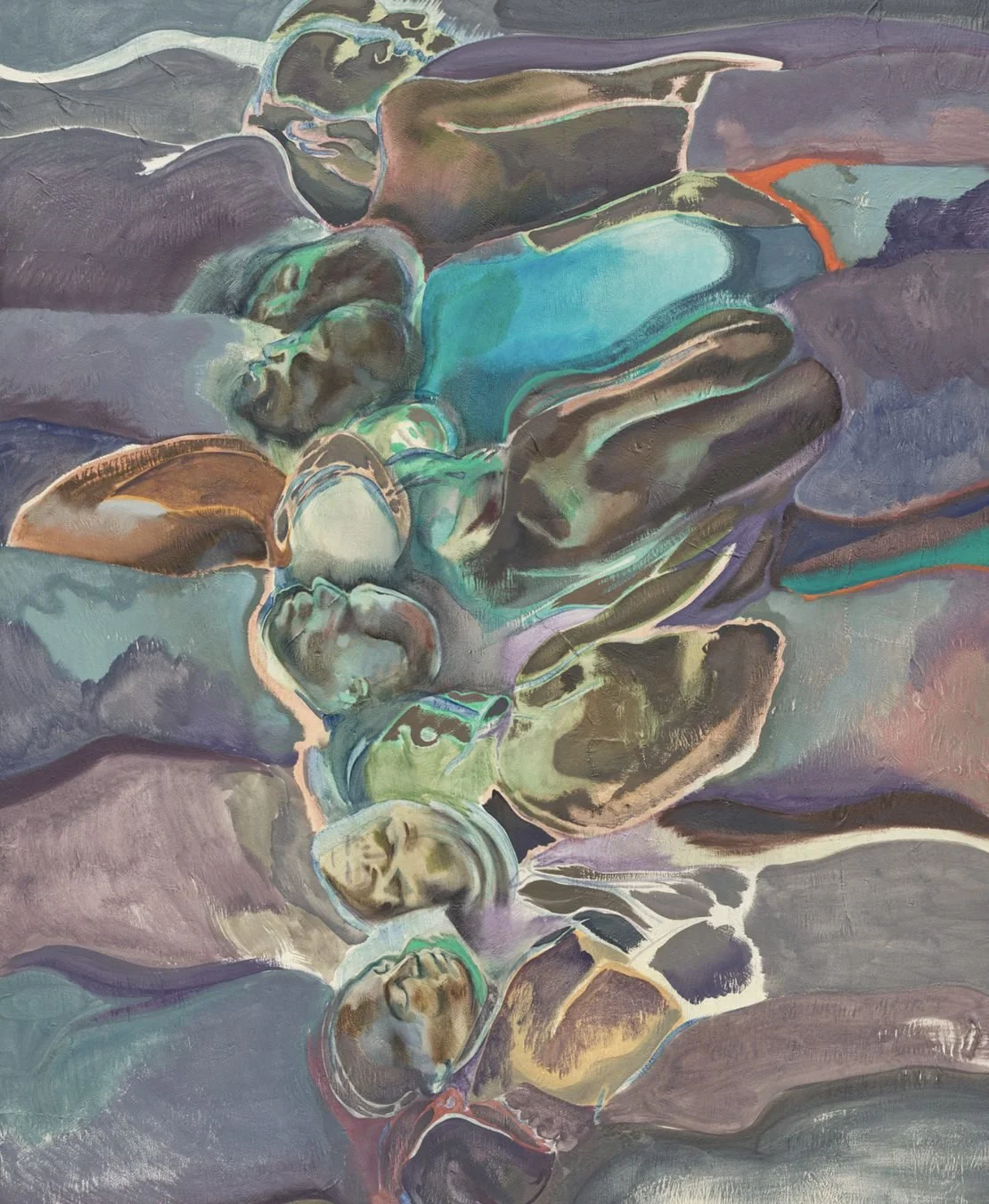
What Makes Michael Armitage’s Paintings So Powerful?
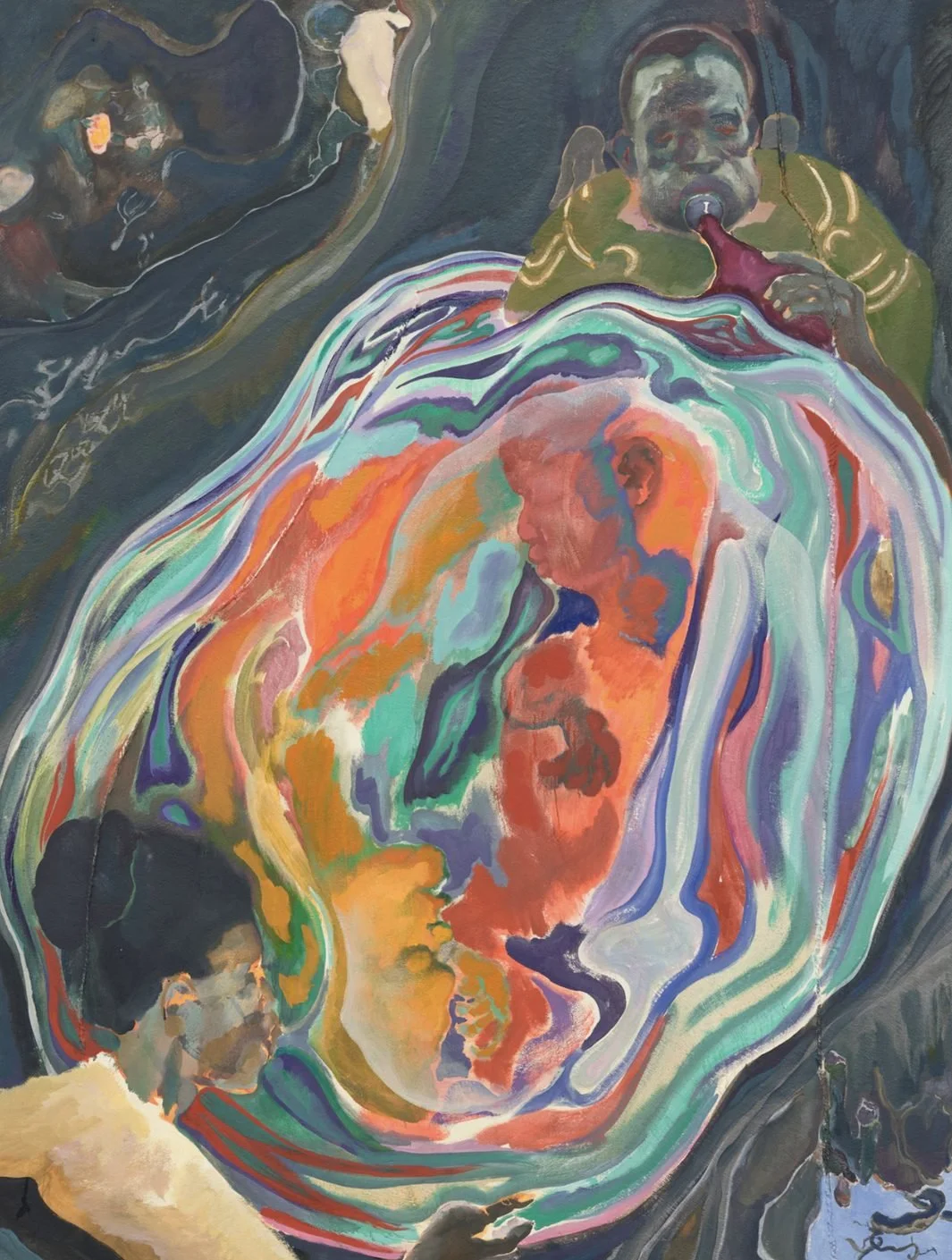
Michael Armitage’s paintings are powerful because they turn contemporary events, personal memories, political conflict, folklore, and art history into unstable visual worlds where reality and invention cannot be separated cleanly.
At first, the paintings can appear lush and seductive.
Figures move through landscapes of pink, green, violet, blue, orange, ochre, and deep black. Bodies stretch, twist, gather, fall, flee, dance, fight, watch, or wait. Animals enter scenes without explanation. Trees curve unnaturally. Faces appear inside foliage or emerge from uncertain spaces. Crowds coexist with isolated individuals. Political rallies, domestic violence, migration, ritual, sexuality, rumor, and myth can occupy the same surface.
The paintings often feel dreamlike.
But the dream is never free from reality.
Armitage draws upon news reports, internet imagery, personal observation, remembered events, gossip, political demonstrations, cinema, East African art, and European painting. MoMA has described his practice as bringing contemporary visual culture into dialogue with art history and with modernism’s development both within and beyond the West. His gallery likewise emphasizes that the paintings weave together current news, historical sources, online material, and recollections of Kenya. (The Museum of Modern Art)
The result is not documentary painting.
It is painting about what happens when events enter memory, culture, rumor, fear, fantasy, and inherited visual language.
The Problem Beneath the Work
Armitage repeatedly returns to a central artistic problem:
How can painting give form to contemporary social and political experience when reality is already entangled with memory, mythology, media, cultural inheritance, and imagination?
His paintings are not simply depictions of Kenya or East Africa.
They are not direct illustrations of political events.
They do not claim to provide complete historical explanation.
Instead, they examine how experience becomes an image.
A political rally may be witnessed directly, recorded by cameras, circulated online, remembered later, connected to earlier violence, and unconsciously reorganized through compositions inherited from European painting.
A childhood memory may remain emotionally vivid while factual details become unstable.
A newspaper image may enter public consciousness and combine with rumor, prejudice, fantasy, or folklore.
A violent event may be remembered through one gesture, one color, one body, or one fragment of landscape.
Armitage paints inside this instability.
His deeper question is not merely:
What happened?
It is:
What does an event become after it passes through perception, memory, representation, cultural history, and the painter’s imagination?
Reality Under the Pressure of Invention
Armitage’s paintings often contain recognizable contemporary situations.
These may include:
Election rallies
Police violence
Public protest
Migration
Social unrest
Religious gatherings
Domestic abuse
Community events
Urban life
Ecological disturbance
Yet the paintings rarely remain faithful to one photographic source or one observed event.
Figures may be rearranged.
Scale may become irrational.
Animals may appear symbolically.
Separate times may occupy one field.
A face may emerge from the landscape.
A political event may acquire the structure of a religious painting, a mythological scene, or a nightmare.
This transformation does not necessarily move the work away from truth.
It proposes that social reality already contains irrationality, symbolism, fear, desire, and cultural memory.
A crowd is never experienced only as a countable group of bodies.
It may feel hopeful, dangerous, euphoric, threatening, vulnerable, theatrical, or uncontrollable.
A political leader may become a symbolic figure before the historical consequences of leadership are fully understood.
A violent scene may become mythic in memory because its emotional force exceeds the available facts.
Armitage uses invention to reveal these psychological and cultural dimensions.
Painting Between Witness and Distance
Armitage occupies a complicated relationship to many of his subjects.
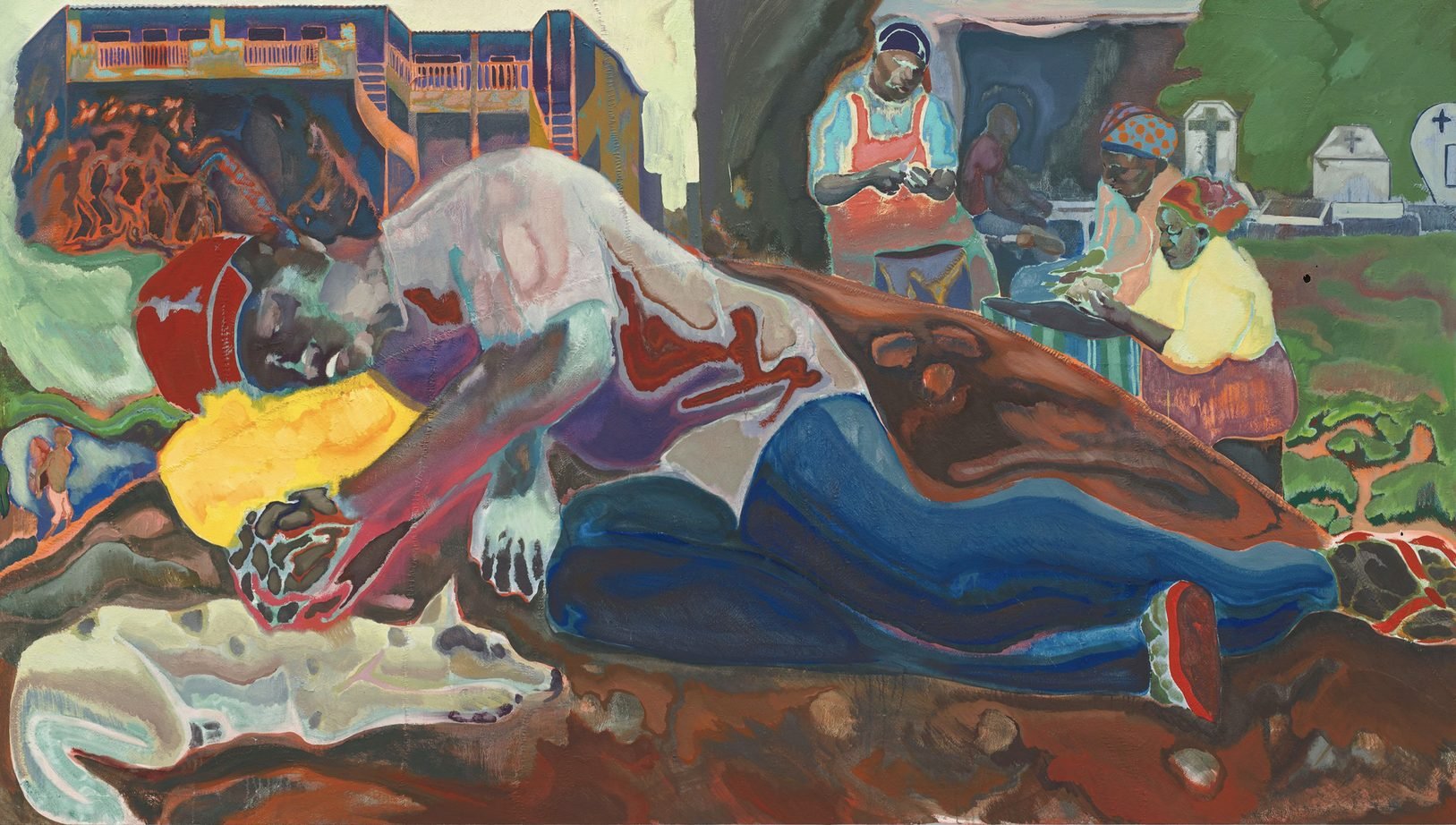
He was born in Nairobi, trained in Britain, and has worked between multiple cultural and geographic contexts. His paintings emerge from real attachments to East Africa, but he does not claim that personal connection grants complete authority over every experience represented. MoMA describes him as Kenyan British and identifies Nairobi and London as important contexts for his practice; more recent gallery information lists his life and work across Nairobi and Indonesia. (The Museum of Modern Art)
This creates an important tension:
He may witness events directly.
He may encounter them through media.
He may remember them from childhood.
He may approach them after geographic distance.
He may translate them through artistic traditions developed elsewhere.
He may remain both culturally connected and critically outside particular experiences.
The paintings do not eliminate this uncertainty.
They preserve it.
The viewer often senses that the artist is close enough to feel the pressure of an event but distant enough to recognize that no single image can explain it completely.
This position prevents the work from becoming simple reportage.
It also creates ethical risk.
How can an artist represent the suffering, displacement, violence, or political vulnerability of others without turning those experiences into visual material?
Armitage’s strongest paintings respond by avoiding complete narrative control. The subjects remain specific, but the painting does not pretend to deliver the final interpretation.
Lubugo Bark Cloth as a Living Ground
One of the most important features of Armitage’s work is his use of lubugo, a traditional Ugandan bark cloth.
Lubugo is made by removing bark from the mutuba tree and repeatedly beating it until it expands into a flexible textile-like sheet. The tree can regenerate its bark, making the process connected to cycles of removal, healing, and continued growth. Armitage has described the adoption of this material as transformative to his painting practice. (The Museum of Modern Art)
The material changes everything.
Lubugo is not a smooth, neutral canvas.
It contains:
Seams
Holes
Tears
Stains
Irregular edges
Variations in thickness
Rough fibers
Evidence of beating and stretching
Marks of organic growth
These features remain active beneath the paint.
A hole may interrupt a body.
A seam may divide a face.
A thickened area may become landscape.
A tear may affect the direction of a figure.
The support does not simply receive the image.
It participates in constructing it.
The Surface Has Its Own History
A conventional primed canvas can create the impression of a blank beginning.
Lubugo arrives with a past already visible.
It has grown as part of a tree.
It has been removed.
It has undergone repeated physical impact.
Separate pieces may have been stitched together.
The surface may be repaired, uneven, or incomplete before painting begins.
This history creates a material parallel to Armitage’s broader subject.
The paintings concern societies, memories, landscapes, and images that are also never blank.
They arrive already marked by:
Colonial history
Cultural inheritance
Political conflict
Personal memory
Media circulation
Religious belief
Existing visual traditions
Previous violence
The image must negotiate with what is already there.
The bark cloth makes that condition physical.
Material Damage and Represented Violence
Lubugo’s irregular surface can intensify the violence within a painting.
A hole may resemble a wound.
A seam may cut through the body.
A rough passage may make flesh appear damaged or unstable.
But this relationship must be handled carefully.
The material should not become a convenient symbol in which every tear automatically means trauma.
Its deeper importance lies in resistance.
The support prevents the image from becoming seamless.
It interrupts pictorial certainty.
The viewer cannot forget that the scene has been built on an object with its own physical condition.
A painted figure and the material beneath it remain partially independent.
This produces a valuable instability:
The image wants to become a world, while the bark cloth keeps returning it to matter.
Beauty and Political Unease
Armitage’s paintings are often exceptionally beautiful.
His color can be luminous, unexpected, and emotionally complex. Landscapes flow through pinks, greens, blues, yellows, and violets. Figures may glow against atmospheric fields. Thin oil paint allows the bark to remain visible, producing delicate and shifting surfaces.
That beauty creates a difficult contradiction.
The paintings may address:
Violence
Political manipulation
Mob behavior
Displacement
Death
Social inequality
Fear
Ecological crisis
Yet the viewer is attracted through color, rhythm, and painterly invention.
This raises a central question:
Does beauty deepen attention to difficult experience, or does it make suffering easier to consume?
Armitage does not avoid this danger.
He uses seduction as an entry point.
The viewer may initially enter through color and atmosphere, then gradually discover bodily distortion, social conflict, or moral uncertainty.
Beauty becomes productive when it delays recognition without neutralizing the event.
The strongest paintings make pleasure and discomfort inseparable.
Why the Formal Choices Matter
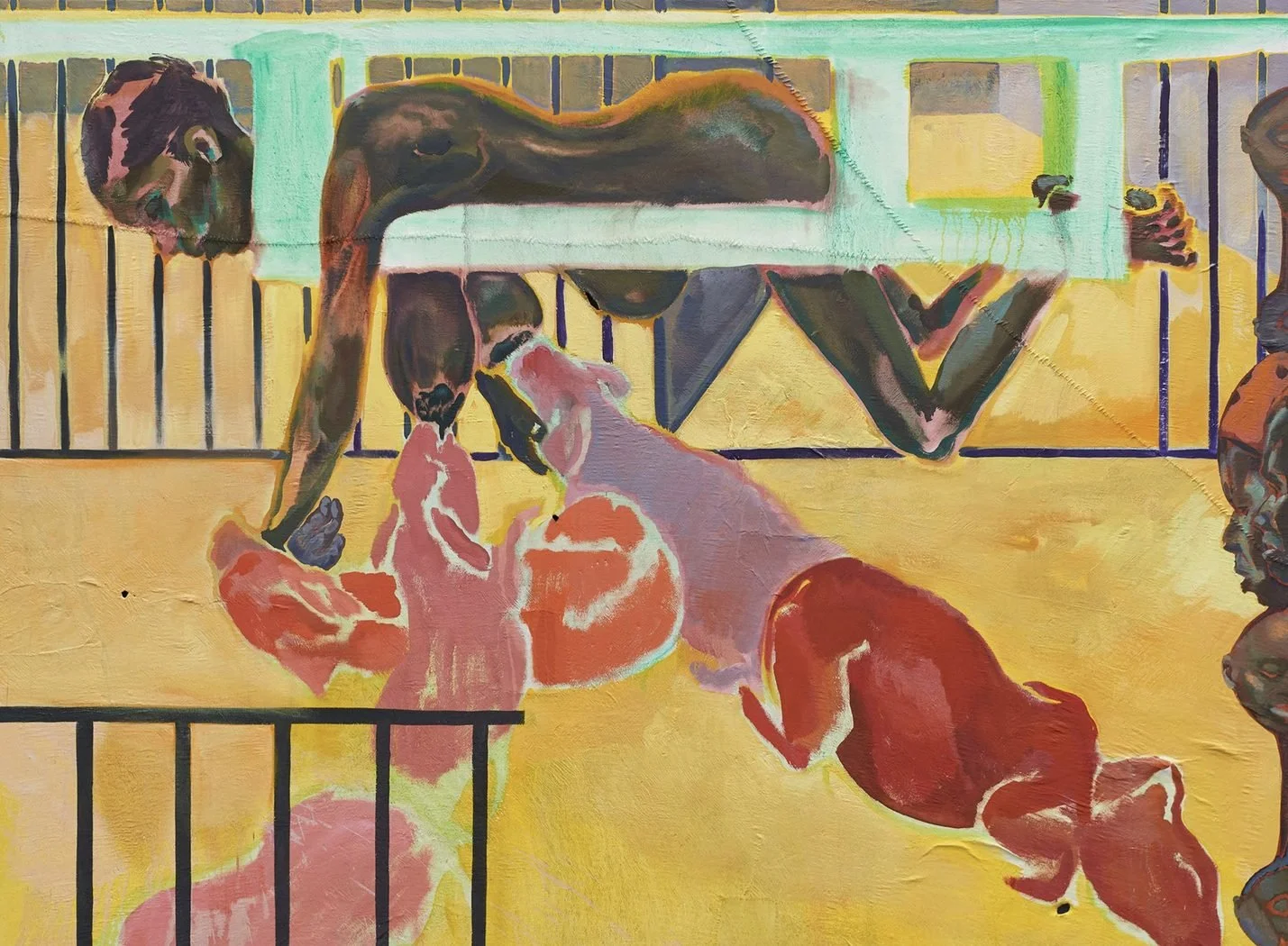
Armitage’s visual language may appear fluid and dreamlike, but its force depends on highly specific formal decisions.
Thin oil paint preserves the material ground
Armitage often applies oil paint in translucent or relatively thin layers.
This allows the color and texture of the bark cloth to remain visible.
The support enters the flesh, sky, vegetation, and architecture.
The image never becomes completely opaque.
This produces a world that feels simultaneously present and unstable.
The painting appears to emerge from the material rather than simply covering it.
Irregular anatomy prevents easy realism
Bodies in Armitage’s paintings may be elongated, fragmented, compressed, or distorted.
These figures can appear graceful and injured at once.
An arm may stretch unnaturally.
A face may dissolve into surrounding color.
A body may seem to occupy more than one position.
Distortion prevents the scene from functioning as straightforward documentation.
It allows emotional, political, and symbolic forces to become bodily.
A figure is not only shown experiencing instability.
The body is formally made unstable.
Landscape absorbs narrative
The environment often does more than contain the figures.
Color, vegetation, animals, sky, architecture, and bodily forms may flow into one another.
A face can appear within a field.
A branch may resemble a limb.
A crowd may dissolve into terrain.
The landscape becomes psychologically and politically active.
It can suggest:
Witness
Threat
memory
fertility
concealment
territorial conflict
environmental damage
mythological space
The event does not take place on neutral ground.
The ground absorbs it.
Animals destabilize human authority
Monkeys, dogs, crocodiles, birds, and other animals appear throughout Armitage’s work.
They may function as:
Witnesses
doubles
omens
comic disruptions
symbols drawn from folklore
signs of instinct
figures of threat
observers outside human systems
Animals complicate scenes that might otherwise become morally straightforward.
A political crowd and a group of animals may occupy the same field.
Human behavior can begin to appear ritualistic, theatrical, predatory, or absurd.
The animal does not necessarily decode the painting.
It makes human certainty less secure.
Multiple scenes disturb linear time
Armitage may combine several events within one painting.
Foreground and background do not always belong to the same moment.
Different scales can suggest separate temporal or psychological zones.
A central figure may be surrounded by memories, fears, symbols, and parallel events.
This resembles the structure of recollection more than the structure of a photograph.
Memory does not preserve time evenly.
It creates clusters.
One incident becomes central.
Another survives at the edge.
A later interpretation enters an earlier event.
The painting allows those times to coexist.
Cropping removes explanatory certainty
Figures may enter or leave the composition abruptly.
Bodies can be partially visible.
Events extend beyond the frame.
This prevents the scene from becoming a complete account.
The viewer arrives in the middle.
Something occurred before the visible moment and will continue afterward.
The painting becomes a fragment of a world rather than a sealed narrative.
Color separates emotional truth from factual description
Armitage’s color frequently departs from natural observation.
Skin, foliage, ground, and sky may shift into unexpected hues.
This does not simply make the work expressive.
Color reorganizes relationships.
A violent scene may appear strangely luminous.
A landscape may feel seductive and diseased at once.
A figure may become visually connected to the surrounding earth.
Emotional truth becomes more important than local color.
Art History as an Active Structure
Armitage’s paintings engage deeply with European art history.
His sources and affinities include artists such as:
Francisco Goya
Paul Gauguin
Édouard Manet
Titian
Théodore Géricault
Peter Paul Rubens
Edgar Degas
European religious painting
History painting
Romantic landscape
Modern figurative painting
Armitage has identified encountering Goya’s Black Paintings as a particularly profound experience. His gallery and museum presentations also emphasize the dialogue between contemporary East African subjects and compositions inherited from Western art history. (White Cube)
But the work does not simply quote famous paintings.
Historical compositions become frameworks through which contemporary events are reorganized.
A political demonstration may acquire the bodily rhythm of a battle painting.
A crowded public scene may echo religious composition.
A vulnerable figure may occupy a pose inherited from martyrdom, mythology, or classical painting.
This creates friction.
The prestigious visual language of European history painting is used to depict events and populations frequently excluded from that history.
At the same time, the inherited composition carries colonial and cultural authority that cannot be accepted innocently.
Armitage uses the structure while making its instability visible.
Parallel Cultural Histories
MoMA described Armitage’s work as exploring “parallel cultural histories.” This phrase is useful because it avoids treating European and East African art as one central tradition and one peripheral influence. (The Museum of Modern Art)
His paintings enter dialogue with:
European canonical painting
East African modernism
Contemporary Kenyan visual culture
Popular imagery
Folklore
Political media
Local memory
Lubugo production
Cinema
Internet circulation
These sources do not merge into a smooth global style.
They retain different histories and relationships to power.
A European composition may provide structure.
An East African event may provide political urgency.
The bark cloth may shape the physical image.
Folklore may transform the narrative.
Media imagery may determine a gesture.
The painting becomes a meeting place where no source remains fully intact.
The Danger of the Western Canon
Working with European art history creates a genuine risk.
The inherited composition may lend importance to the contemporary scene, but it could also imply that the event becomes artistically significant only after being translated through European precedent.
Armitage’s use of lubugo and engagement with East African artists complicate that hierarchy.
The paintings do not simply place African subjects inside European painting.
They force European painting to operate on an East African material ground and within cultural narratives it cannot control completely.
The bark interrupts the canon.
Local visual traditions interrupt the canon.
Contemporary events alter inherited composition.
The influence moves in more than one direction.
Politics Without Illustration
Political painting often struggles between two dangers.
On one side, it may become too literal:
A message is predetermined.
The image illustrates the correct position.
The viewer receives moral instruction.
Formal complexity becomes secondary.
On the other side, political meaning may become so ambiguous that the real event disappears into aesthetic atmosphere.
Armitage works between these risks.
His paintings often begin with specific political circumstances. Yet they do not usually provide a stable hero, villain, explanation, or resolution.
A crowd can embody hope and danger.
A public gathering can appear democratic and manipulable.
Leadership can promise change and reproduce disappointment.
Violence may be visible without becoming morally simple.
This ambiguity is not neutrality.
It acknowledges that political experience is psychologically, socially, and historically complex.
Crowds and Collective Emotion
Crowds recur throughout Armitage’s paintings.
A crowd can appear as:
Political public
Mob
audience
community
ritual gathering
displaced population
collective witness
field of vulnerability
Individual bodies may remain visible, but personal identity becomes less secure inside the group.
The crowd has emotional force beyond any one person.
It can generate:
Hope
fear
belonging
pressure
anonymity
danger
spectacle
power
Painting allows Armitage to move between the collective and the individual.
A central figure may dominate while smaller bodies accumulate around the edges.
A person may appear caught within forces larger than individual choice.
The crowd becomes a structure through which politics enters the body.
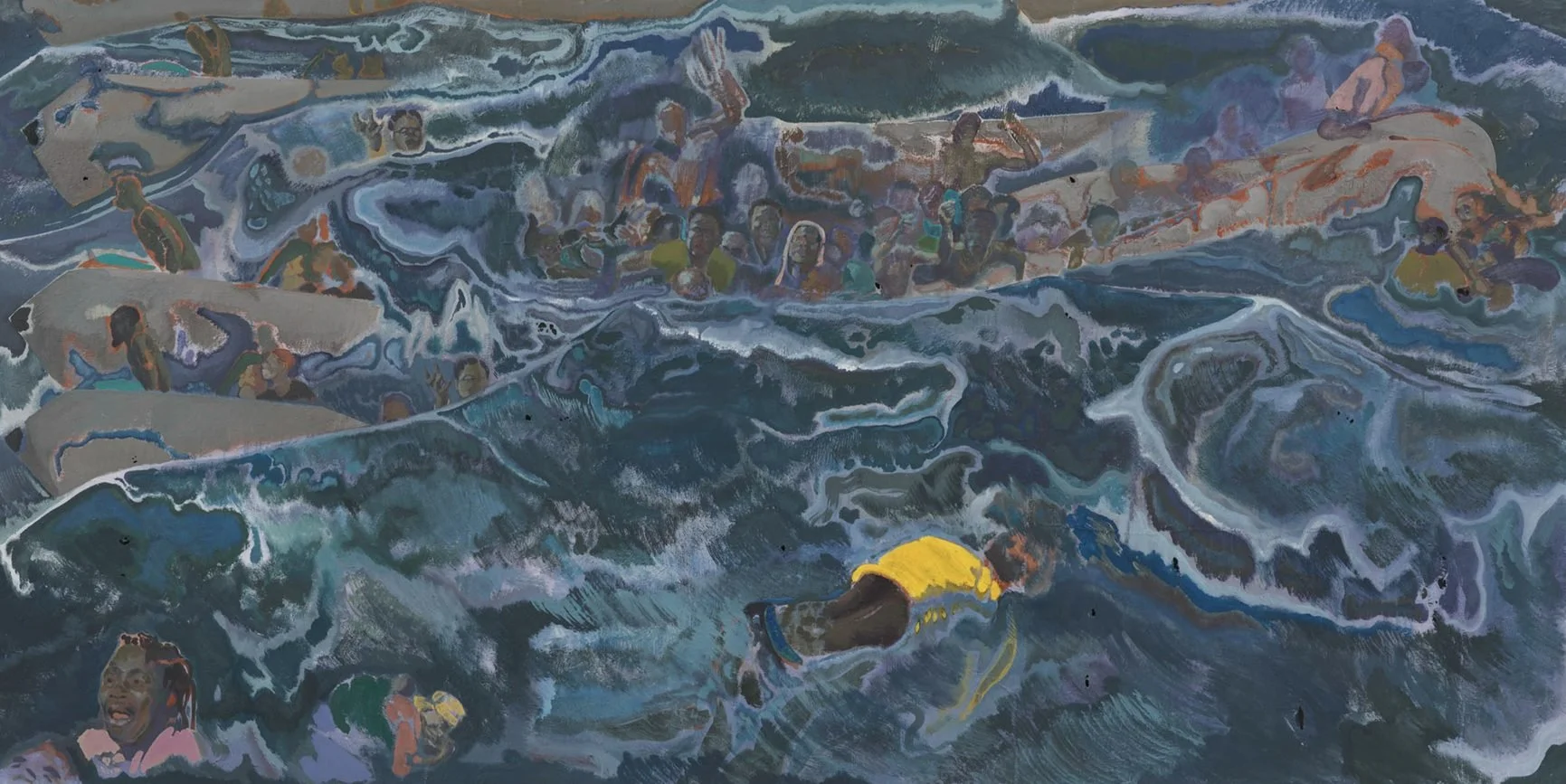
Migration and the Problem of Representation
Armitage’s more recent work has addressed migration routes across the Sahara and Mediterranean, including the emotional and physical pressures of displacement. His 2025 exhibition Crucible included new paintings and bronze reliefs engaging migration and perilous journeys. (David Zwirner)
Migration presents an especially difficult problem for representation.
News imagery often reduces displaced people to:
Crowds
boats
statistics
crisis symbols
anonymous victims
political evidence
An artwork risks repeating that reduction.
Armitage’s painterly distortion can resist documentary consumption by refusing the illusion that the viewer has received complete access.
But beauty, myth, and ambiguity can also distance the suffering involved.
The success of the work depends on whether transformation preserves the event’s pressure rather than converting it into generalized tragedy.
Memory as an Unreliable Witness
Some of Armitage’s works begin from memories formed in childhood or from events that remained psychologically unresolved.
Memory is not neutral evidence.
It changes with age.
Later knowledge enters earlier experience.
Details disappear.
One image becomes exaggerated.
Fear reorganizes scale.
Rumor and fact merge.
A childhood memory may remain vivid precisely because it was never fully understood.
Painting is well suited to this uncertainty.
It does not need to reconstruct an event as a factual sequence.
It can preserve:
Emotional intensity
bodily reaction
fragments
distortions
symbolic associations
uncertainty about what was seen
The image may be unreliable as documentation and truthful as psychological evidence.
Myth, Folklore, and Social Reality
Mythical, spiritual, and folkloric elements can enter otherwise contemporary scenes.
This does not necessarily make the work escapist.
Belief, rumor, superstition, religion, and oral narratives are part of lived reality.
A person may interpret a political event through spiritual language.
An animal may carry cultural meanings beyond biological identity.
A dream may influence real behavior.
A rumor may produce material consequences.
Armitage’s paintings allow these systems to coexist.
The modern world does not eliminate myth.
It reorganizes it.
The Central Contradictions
Armitage’s work holds several opposing forces together:
Beautiful and violent
Observed and invented
Contemporary and art historical
Political and dreamlike
Specific and mythological
Documentary and unreliable
Local and transnational
Seductive and ethically uncomfortable
Materially fragile and pictorially monumental
Personal and collective
Historically grounded and temporally unstable
Familiar and hallucinatory
The deepest contradiction may be:
The paintings seek to bear witness while admitting that every act of representation transforms what it claims to show.
The work does not abandon truth.
It questions the idea that truth can remain untouched by images.
The Viewer’s Position
Armitage gives the viewer several roles.
The viewer becomes a witness
Political and social events appear before the viewer, sometimes with considerable bodily force.
The viewer becomes an interpreter
Narrative relationships remain incomplete.
The viewer must determine how figures, animals, landscapes, and events connect.
The viewer becomes seduced
Color, atmosphere, and painterly beauty draw the viewer toward scenes that may contain distress or violence.
The viewer becomes ethically uncertain
The pleasure of looking may conflict with the seriousness of the subject.
The viewer becomes historically divided
European compositional references coexist with East African materials and narratives.
The viewer must negotiate more than one artistic history.
The viewer becomes aware of incomplete access
The painting offers emotional proximity but not documentary mastery.
The event remains partly beyond possession.
The World Armitage Has Built
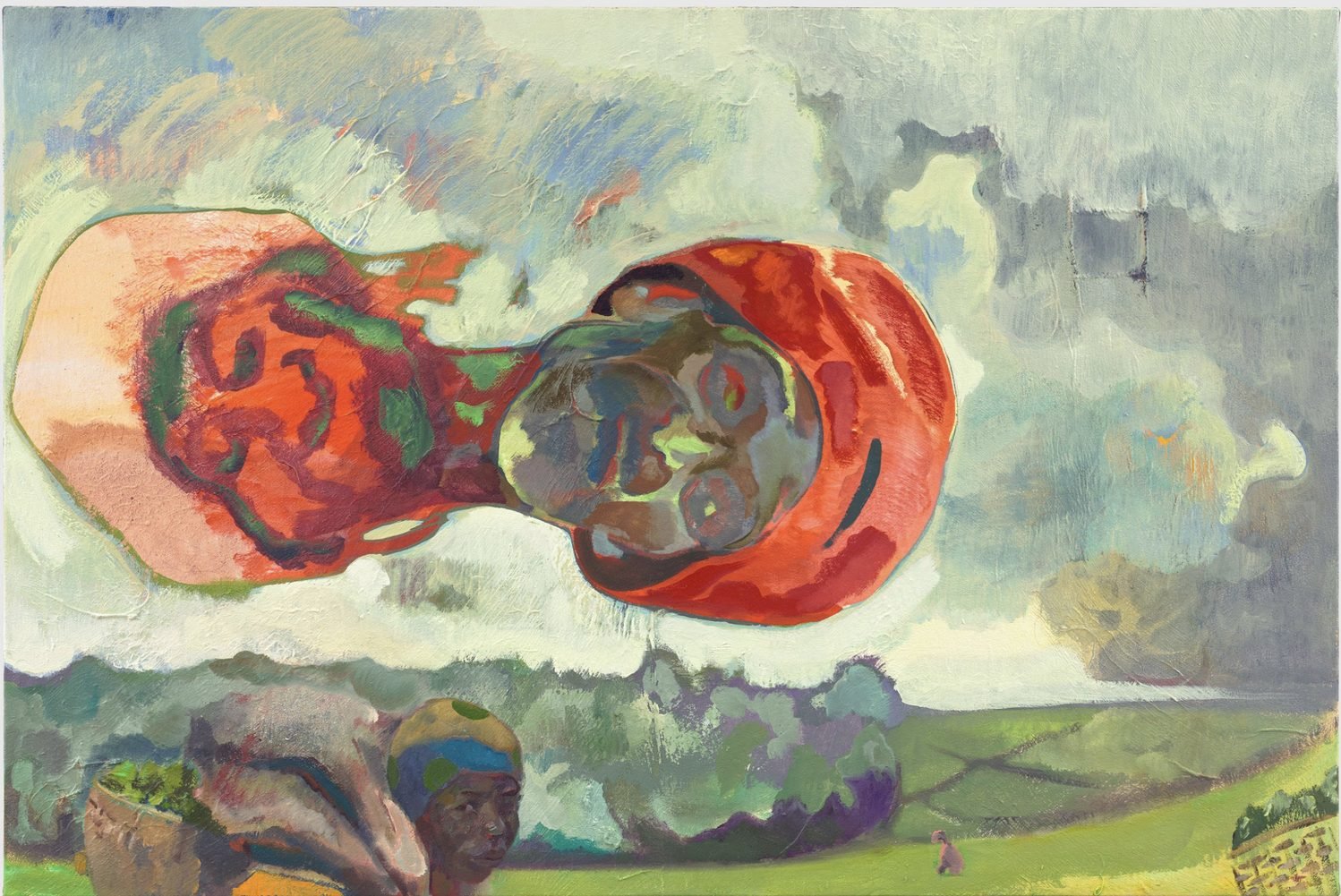
His recurring lexicon includes:
Crowds
political gatherings
solitary bodies
animals
trees
mangroves
water
pathways
fires
distorted faces
bodily violence
public ritual
unstable landscapes
lubugo seams
translucent paint
dreamlike color
historical compositions
migration
folklore
memory fragments
These elements form a recognizable world without becoming fixed symbols.
An animal may be witness, threat, omen, comedy, or moral double.
A tree may divide the painting, conceal an event, or connect human activity to ecological space.
Water may offer passage, danger, separation, or death.
A crowd may embody democratic hope or collective violence.
A seam may function as material fact, compositional division, bodily wound, or historical rupture.
The lexicon remains alive because each element changes according to the event surrounding it.
Building Cultural Infrastructure
Armitage’s significance extends beyond his paintings.
He founded the Nairobi Contemporary Art Institute, an organization dedicated to supporting and preserving contemporary art in East Africa. His institutional work reflects a concern with artistic education, archives, exhibition opportunities, and the local conditions through which art becomes visible. (The Standard)
This matters because representation is not shaped only inside paintings.
It is also shaped by:
Museums
Schools
Archives
Galleries
Funding
Writing
Preservation
Access to materials
Local exhibition systems
An artist working across cultural histories must also confront the unequal infrastructure through which some histories are preserved and others remain difficult to access.
Building an institution becomes another way of addressing visibility.
The Risk of Lyrical Political Painting
Armitage’s practice carries several real risks.
Political subject matter can lend seriousness before the painting earns it.
Beautiful color can aestheticize suffering.
Distortion can become a generalized sign of psychological depth.
Lubugo can become a recognizable cultural marker rather than a continuing material problem.
Animals and myth can become exotic atmosphere.
European art-historical quotation can dominate the East African histories the work seeks to engage.
Ambiguous narratives can weaken responsibility.
The critical question is:
Does each painting transform a specific event, memory, or social condition into a necessary visual structure, or does it reproduce the established Armitage atmosphere of beauty, distortion, politics, and dream?
The strongest works maintain pressure among source, material, composition, subject, and ethical uncertainty.
The weaker possibility would be generalized political surrealism.
Why the Work Belongs to the Present
Armitage’s work belongs to a world in which reality increasingly arrives through unstable mixtures of:
News media
Social platforms
Personal testimony
Political propaganda
Historical imagery
Internet gossip
Cultural memory
Video
Photography
Rumor
Algorithmic circulation
An event can become symbolic before facts are established.
Images cross national borders faster than context.
Local suffering can become global content.
Political narratives compete for control of visual evidence.
Armitage’s paintings slow this instability down while refusing to eliminate it.
They acknowledge that contemporary experience is shaped not only by what happens, but by the images, histories, fears, and beliefs through which events are interpreted.
What Artists Can Learn
The lesson is not to imitate Armitage’s lubugo bark cloth, distorted figures, dreamlike landscapes, animals, political crowds, translucent paint, or references to European history painting.
Those are the visible solutions produced by his investigation.
The larger lesson is that social reality can become painterly without being reduced to illustration.
Armitage demonstrates that:
A material ground can carry cultural and physical history.
The support can participate in constructing the image.
Political events can remain morally complex.
Memory can provide psychological truth without documentary certainty.
Art history can become a structure to transform rather than an authority to obey.
Beauty can draw attention toward difficult experience.
Distortion can make social pressure bodily.
Landscape can absorb political and emotional conflict.
Animals and folklore can destabilize human narratives.
Multiple times can coexist inside one composition.
Cultural histories can meet without becoming identical.
Ambiguity becomes meaningful when it remains connected to specific events.
Bearing witness does not require pretending to possess the whole truth.
Armitage does not simply paint an event.
The event becomes an image.
The image enters public circulation.
Public imagery mixes with memory.
Memory encounters art history.
Art history meets an East African material ground.
The bark interrupts the picture.
The painting returns the event as something emotionally present but permanently transformed.
The lesson is not to copy the appearance of the work. It is to understand the pressure that made the appearance necessary.
Michael Armitage turns painting into an unstable meeting place where contemporary events, memory, material, mythology, and competing art histories transform one another without settling into a single truth.