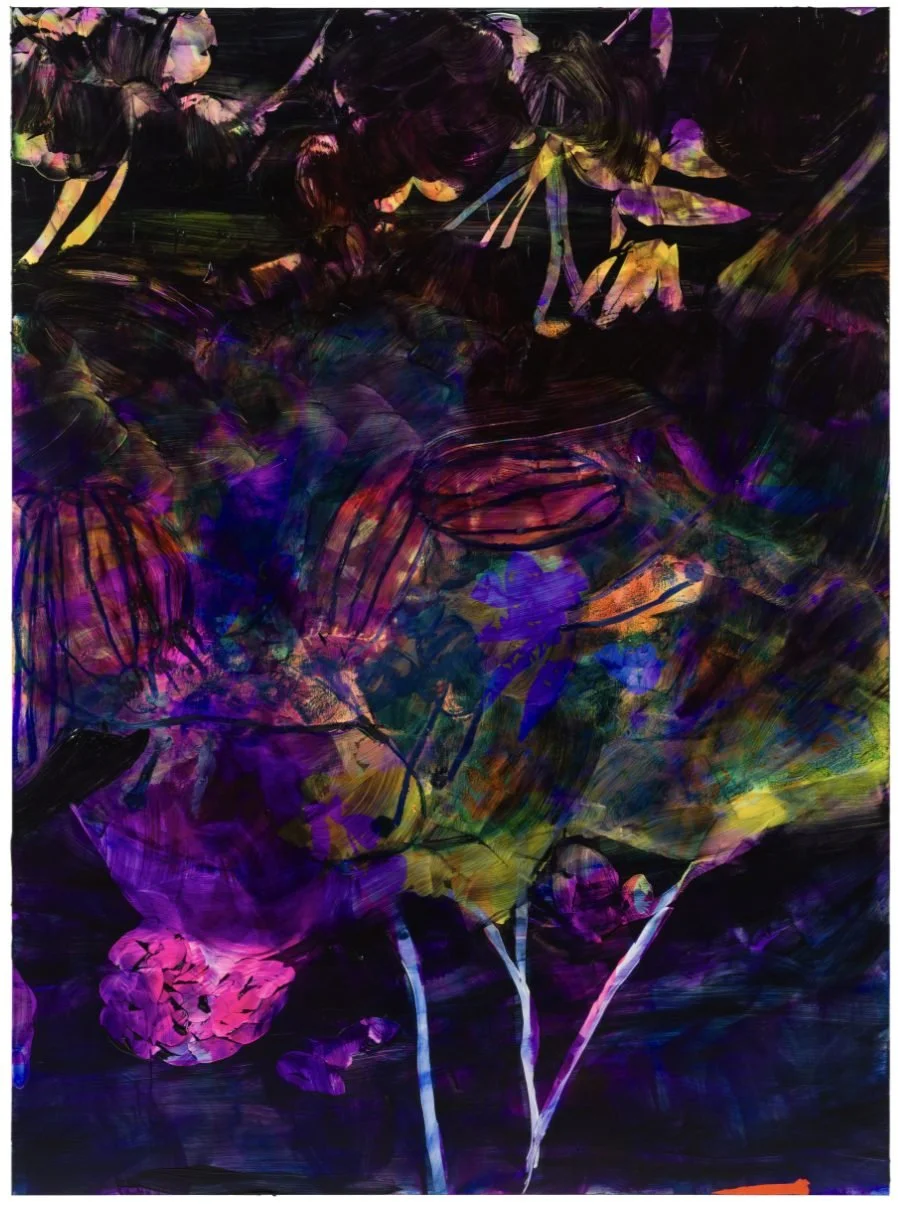
What Makes Jadé Fadojutimi’s Paintings So Powerful?
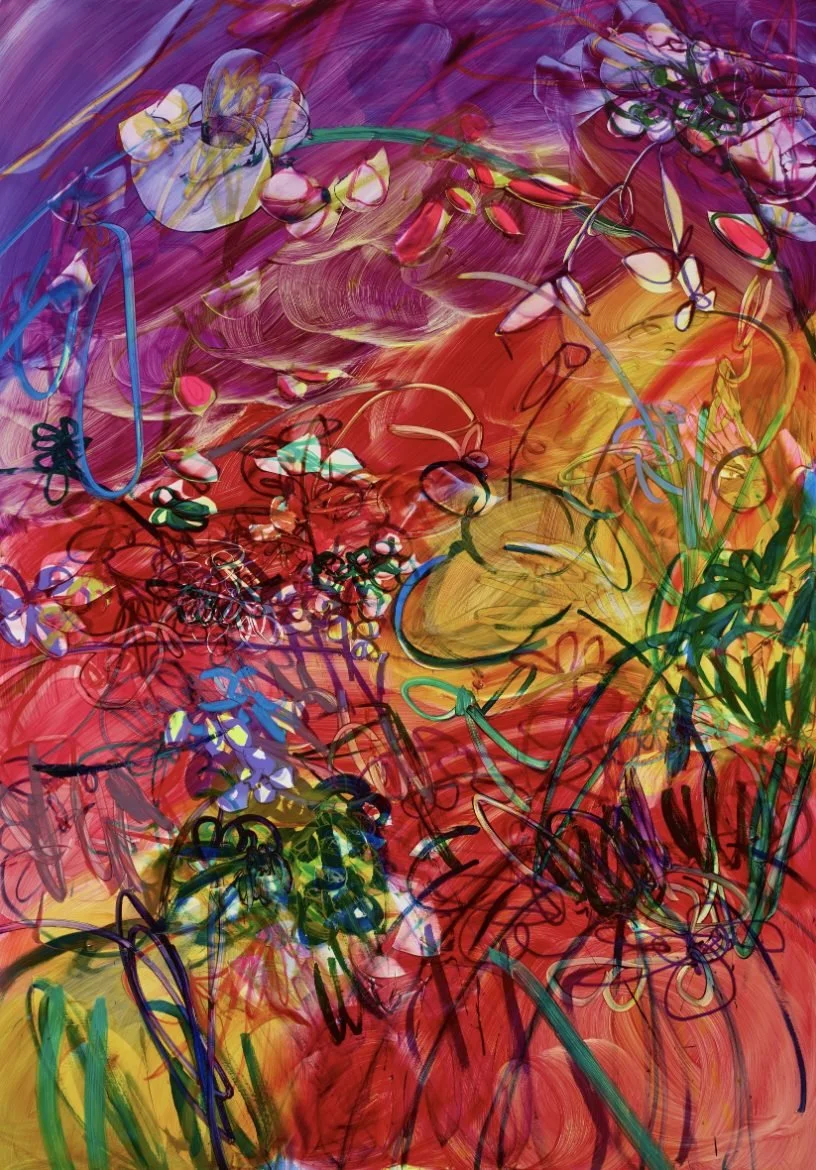
Jadé Fadojutimi’s paintings are powerful because they turn the instability of selfhood into environments of color, movement, memory, and emotional transformation.
At first, the work can appear overwhelmingly energetic.
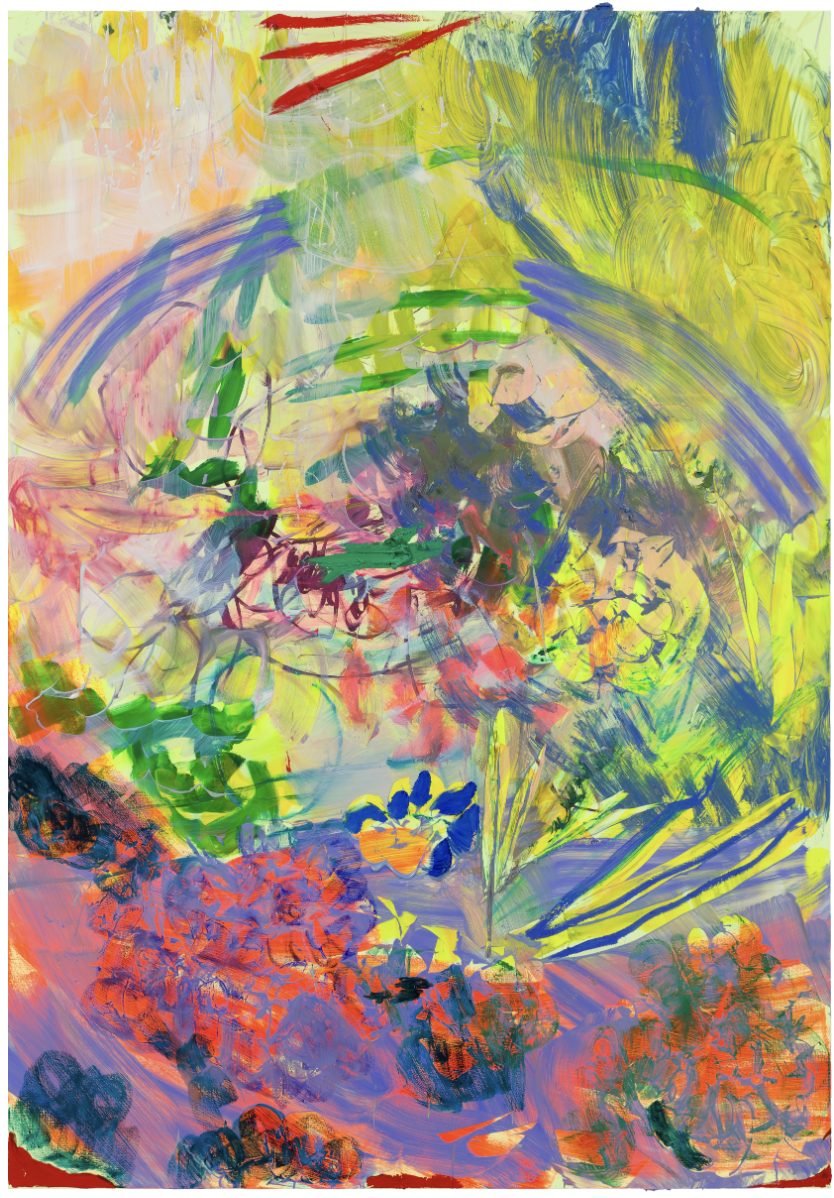
Lines loop, collide, fracture, and race across the canvas. Bright greens push against violets, yellows, reds, blues, pinks, and dark passages. Thin marks cut through broad fields. Repeated shapes suggest leaves, eyes, clothing, furniture, windows, bodies, pathways, or fragments of landscape without settling into any one identity.
The paintings move between abstraction and figuration, but they do not treat that boundary simply as a perceptual game.
Their instability is psychological.
A space begins to form and then collapses. A figure appears without becoming fully embodied. A mark resembles an object for a moment before returning to color and line. Depth opens and then flattens. Areas of exuberance are interrupted by congestion, darkness, or visual anxiety.
Fadojutimi has referred to her paintings as “emotional landscapes,” using color, space, line, layers, and disparate marks to question everyday experience, memory, and self-knowledge. (British Art at Yale)
The paintings do not describe a stable self moving through a stable world.
They show identity being continually produced through contact with surroundings.
The Problem Beneath the Work
Fadojutimi repeatedly returns to a central artistic problem:
How can painting give form to a self that is continually changing in response to memory, emotion, environment, culture, and everyday experience?
Her paintings are not simply expressions of mood.
Nor are they abstractions whose primary purpose is color, gesture, or formal freedom.
They investigate the relationship between the self and the world that shapes it.
Identity, in this work, does not appear as a fixed inner core waiting to be revealed. It is constructed through encounters:
A room
A piece of clothing
A landscape
A remembered conversation
Music
Anime
Video games
Fashion
Architecture
Weather
Anxiety
Pleasure
Cultural belonging
Private fantasy
Fadojutimi has identified Japanese animation, soundtracks, video games, fashion, objects, and surrounding environments among the sources through which she examines identity and attempts to build a sense of self. (Studio Museum in Harlem)
These sources do not usually appear as illustrations.
They enter the paintings as rhythms, colors, spatial structures, emotional associations, and fragments of visual memory.
The deeper problem is therefore not:
Who am I?
It is closer to:
How is a self temporarily assembled from everything it encounters—and what happens when those relationships change?
Identity as a Moving Relationship
Many artworks concerned with identity seek to make identity visible.
They may present recognizable bodies, cultural symbols, biographies, social categories, or personal narratives.
Fadojutimi works differently.
Her paintings rarely provide a stable figure that can carry identity clearly. Instead, identity is experienced through the organization and disruption of the entire field.
A dark passage may create withdrawal.
A luminous color may create openness.
A cluster of marks may suggest social pressure or mental congestion.
A loose, sweeping line may create physical confidence.
A fragile grid may suggest an attempt to organize unstable experience.
The self does not stand outside these conditions.
It emerges through them.
This gives the work a more relational understanding of identity:
The self is not only what exists internally. It is what forms between a person and the environments, objects, memories, desires, and systems surrounding them.
When those surroundings change, the work changes.
Fadojutimi has described this connection directly: when she changes, the paintings change as well. Her work treats introspection not as the discovery of one permanent identity but as a continuing process. (Studio Museum in Harlem)
The Painting as Environment
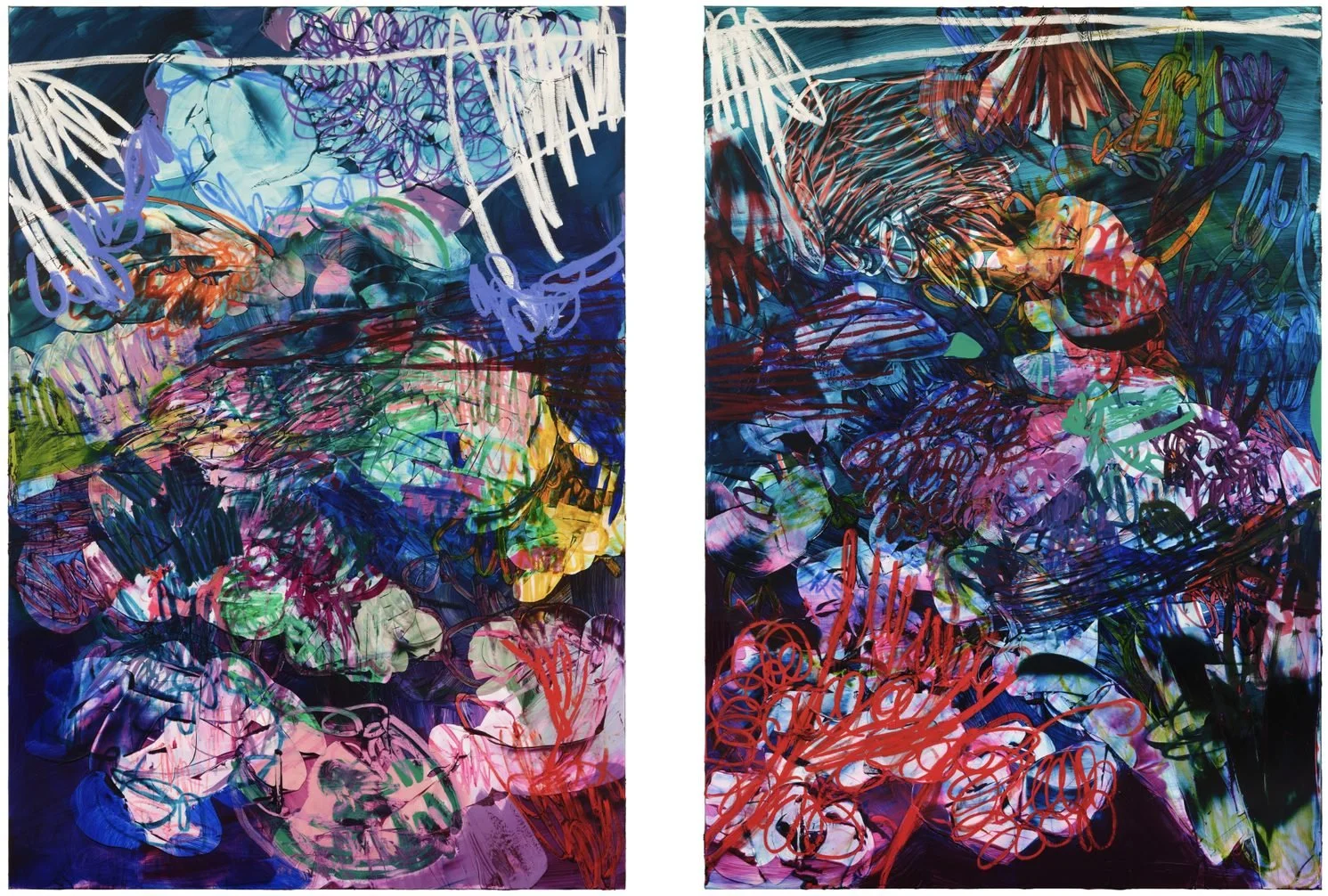
Fadojutimi’s large canvases frequently feel less like images placed on a wall than spaces the viewer encounters bodily.
Some resemble gardens, interiors, forests, maps, theatrical sets, weather systems, or imaginary landscapes. Yet these possible environments remain unstable.
A green area may suggest vegetation.
A rigid line may resemble architecture.
A patterned form may imply clothing or upholstery.
A circular mark may feel like an eye, opening, flower, or signal.
The paintings provide enough visual suggestion for a world to begin forming, but not enough information for that world to become fully named.
This places the viewer inside a condition rather than in front of a narrative.
The question is not merely:
What does this represent?
It becomes:
What kind of emotional and perceptual world is this, and how does it change while it is being observed?
Her monumental scale strengthens this effect. The paintings surround the field of vision and require the viewer to move among different zones of density, openness, color, and rhythm. Institutions describing her work emphasize continual transformation, layered space, and the interaction between large-scale abstraction and hints of figuration. (Institute of Contemporary Art, Miami)
Color as Emotional Structure
Color is one of the most immediate pleasures in Fadojutimi’s work.
But color does not merely beautify the paintings or announce emotional intensity.
It structures the experience.
A painting may contain brilliant green, acidic yellow, hot pink, violet, orange, deep blue, and black. These colors do not always resolve into conventional harmony. They attract, interrupt, destabilize, and redirect one another.
Color can create:
Acceleration
Hesitation
Joy
Unease
Depth
Flatness
Exposure
Protection
Expansion
Compression
One passage may feel ecstatic.
Another may feel claustrophobic.
A color that initially appears joyful may become abrasive when surrounded by darker marks. A heavy field may open when crossed by a luminous line. Several colors can remain active without combining into a single emotional state.
This matters because feelings are rarely pure.
Excitement may contain anxiety.
Belonging may contain estrangement.
Pleasure may coexist with vulnerability.
Confidence may be interrupted by self-doubt.
Fadojutimi’s color holds these emotional shifts without forcing them into one mood.
The painting does not illustrate an emotion.
It behaves like emotion.
Line as Movement and Thought
Lines move through Fadojutimi’s paintings with unusual independence.
They twist, knot, stretch, repeat, enclose, cut through, and escape from larger forms. Some lines feel drawn rapidly. Others appear hesitant, decorative, architectural, or calligraphic.
A line can function as:
Gesture
Boundary
Path
Branch
Limb
Thread
Cage
Rhythm
Writing
Nervous energy
Because the line repeatedly changes its function, it becomes difficult to separate drawing from subject.
The mark does not simply depict movement.
It moves.
This gives the paintings a sense of thought unfolding in real time. One mark proposes a direction. Another interrupts it. A shape creates temporary order. A later gesture undermines that stability.
The surface resembles a mind attempting to understand itself while continuing to receive new information.
Why the Formal Choices Matter
Fadojutimi’s visual language can look spontaneous, but its force depends on the relationships among several formal systems.
Abstraction keeps identity open
A fully described figure could become too stable.
Viewers might read the body through gender, race, age, clothing, expression, and social category before encountering the more fluid psychological condition of the work.
Abstraction prevents that immediate closure.
The self can appear as atmosphere, rhythm, pressure, movement, or spatial instability rather than as one readable body.
Figuration provides a point of entry
The paintings do not remain entirely detached from recognizable life.
Fragments can suggest:
Plants
furniture
clothing
figures
rooms
windows
pathways
skies
eyes
decorative objects
These hints give the viewer a jumping-off point.
They allow perception to begin constructing a world.
But the forms remain incomplete enough to resist final identification.
This creates the balance between entry and openness:
The viewer receives enough structure to begin, but not enough resolution to stop interpreting.
Layering makes changing experience visible
Marks overlap, cover, reveal, and interrupt one another.
Earlier decisions survive beneath later interventions. Separate visual systems can occupy the same area without blending completely.
The painting therefore contains several emotional and temporal states at once.
An open gesture may remain beneath a later structure.
A bright field may be partially buried.
A fragile mark may survive inside visual congestion.
Layering makes identity appear cumulative but unresolved.
Grids create temporary order
Grid-like structures sometimes appear within the paintings.
A grid can suggest:
Architecture
organization
furniture
social systems
perspective
containment
attempts at mental control
But the grids are often unstable.
They bend, dissolve, become obscured, or collide with freer gestures.
The grid does not establish permanent order.
It reveals the desire for order inside a world that resists it.
Scale makes introspection public
The paintings often emerge from private experience and self-questioning, yet their monumental dimensions transform that introspection into an environment shared with viewers.
A feeling that might have remained inward becomes spatial.
The viewer confronts uncertainty at bodily scale.
This prevents introspection from becoming small, confessional, or diary-like. The private self becomes a public field without being translated into a literal personal story.
Oil stick preserves drawing inside painting
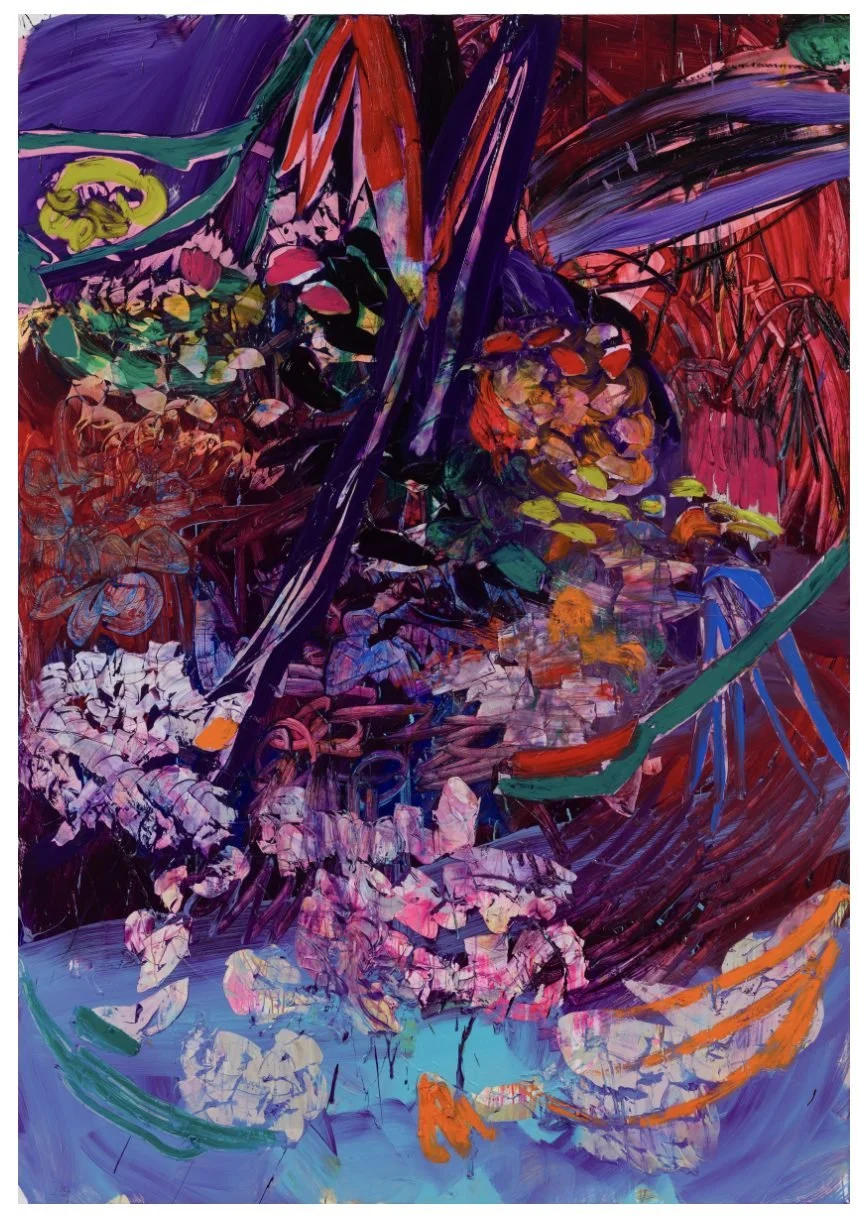
Fadojutimi uses oil paint alongside oil stick and other materials, allowing lines to remain assertive across painted fields. Works described by galleries and institutions often combine looping drawing, layered oil, and gestural color. (Gagosian)
The oil stick can cut through depth and return attention to the surface.
It allows drawing to interrupt painting.
That interruption prevents the image from becoming too atmospheric or settled.
Memory Without Illustration
Memory enters Fadojutimi’s work indirectly.
A remembered object may not appear as a recognizable object.
A place may survive as a color relationship.
A piece of music may become tempo.
A garment may become pattern.
An animated scene may contribute spatial drama or emotional exaggeration.
A room may return as a grid, enclosure, or visual rhythm.
This is important because memory rarely preserves experience evenly.
Certain colors remain.
A mood survives.
An insignificant object acquires emotional importance.
A place becomes inseparable from what happened there.
Fadojutimi’s 2024 exhibition title, DWELVE: A Goosebump in Memory, combined the ideas of dwelling and delving, linking familiar spaces with deeper discovery. The exhibition included large paintings alongside more intimate works on paper, extending her investigation of memory, environment, and self-questioning. (Gagosian)
Memory becomes not a stored image but a place the artist enters and changes.
The Studio as a Psychological Instrument
The studio is especially important to Fadojutimi’s practice.
It is not merely the room where finished paintings are produced. It functions as an environment through which she examines herself.
Objects, clothing, sounds, books, images, and accumulated materials can become part of the psychological conditions of painting. The Studio Museum describes the studio as integral to her practice and painting as a method of introspection shaped by surrounding materials. (Studio Museum in Harlem)
This offers a broader understanding of artistic environment.
A studio is not neutral.
Its arrangement affects attention.
Its objects activate associations.
Its scale changes bodily movement.
Its sounds alter rhythm.
Its accumulated history changes what feels possible.
Fadojutimi’s work suggests that self-knowledge can emerge through interaction with the physical environment rather than through detached reflection alone.
Japanese Visual Culture as Transformation
Japanese anime, fashion, video games, and landscape have been important to Fadojutimi’s visual development. A period in Kyoto and repeated engagement with Japanese culture contributed to the formation of her painting language. (Taka Ishii Gallery / タカ・イシイギャラリー)
But the work does not simply reproduce anime characters or Japanese design.
The influences are metabolized.
Anime may contribute:
Emotional intensity
Exaggerated atmosphere
Dramatic shifts of scale
Fluid movement
Charged color
fantastical environments
transformations of bodies and spaces
Fashion may contribute:
Pattern
surface
constructed identity
color combinations
self-presentation
the psychological role of clothing
Video games may contribute:
navigable environments
layered worlds
portals
changing perspectives
movement through unstable space
These sources become part of how the paintings think rather than imagery placed on top of them.
The influence is successful because it changes the formal logic of the work.
Clothing and the Construction of Self
Clothing occupies an important position in Fadojutimi’s wider visual world.
Clothing is both external and intimate.
It touches the body but remains visible to others.
It can express:
Desire
belonging
protection
fantasy
social code
transformation
self-invention
performance
A garment can change how a person feels internally as well as how that person is read publicly.
This makes fashion especially relevant to a practice concerned with unstable identity.
The self is not only revealed through appearance.
It can be constructed through appearance.
In the paintings, pattern and color may carry this relationship without depicting clothing literally. Ornament becomes psychological. Surface becomes a way of testing who a person might become.
Titles as Emotional Openings
Fadojutimi’s titles often sound poetic, conversational, anxious, humorous, or introspective.
Examples such as When Teddy Left, A Declaration of War, I Present Your Royal Highness, and A Goosebump in Memory suggest emotional situations without explaining the image. (Gagosian)
The titles create a second field of association.
A painting may appear exuberant until the title introduces loss.
A playful form may acquire defensiveness.
A dense environment may begin to feel like memory rather than landscape.
The title does not decode the painting.
It provides another emotional pressure.
The Central Contradictions
Fadojutimi’s paintings hold several opposing forces together:
Abstract and suggestively figurative
Joyful and anxious
Spontaneous and constructed
Intimate and monumental
Personal and publicly accessible
Decorative and psychologically charged
Open and congested
Fluid and contained
Playful and defensive
Environmental and introspective
Energetic and vulnerable
Self-expressive and uncertain about the self
The deepest contradiction may be:
The paintings search for self-knowledge while showing that the self changes during the search.
Painting does not produce a final answer.
It records the instability of asking.
The Viewer’s Position
Fadojutimi assigns the viewer an active but uncertain role.
The viewer becomes a navigator
The eye moves through paths, barriers, clusters, openings, and layered spaces.
There is rarely one dominant route.
The viewer becomes a projector
Incomplete forms invite associations.
One viewer may see a garden.
Another may see a room, body, map, storm, or animated world.
The viewer becomes emotionally responsive
Color and rhythm generate reactions before the forms are understood.
Feeling arrives before explanation.
The viewer becomes physically involved
Large canvases require movement and changes of distance.
From afar, the work may organize into an environment.
Up close, that environment becomes individual marks and material decisions.
The viewer becomes aware of instability
Each attempt to name the image remains temporary.
The painting changes according to attention, memory, distance, and mood.
The World Fadojutimi Has Built
Her recurring lexicon includes:
Looping lines
grids
foliage-like shapes
fragments of interiors
bright color fields
dark interruptions
pathways
layered marks
textile-like patterns
openings
enclosures
animated movement
oil-stick drawing
shifting depths
poetic titles
monumental canvases
intimate works on paper
These elements create a recognizable visual world, but their functions remain mobile.
A grid may be architecture, protection, order, or confinement.
A green field may become garden, atmosphere, garment, or emotional expansion.
A dark cluster may create shadow, anxiety, shelter, or interruption.
A line may be a route, limb, branch, boundary, or thought.
The lexicon remains alive because nothing is permanently assigned.
The Risk of Emotional Abstraction
Fadojutimi’s practice carries a real risk.
Large scale, vivid color, energetic gesture, and claims about identity or emotion can produce immediate excitement.
But excitement alone does not guarantee depth.
The paintings could become:
Colorful spectacle
generalized emotional intensity
gestural abundance
fashionable abstraction
repeated visual turbulence
a recognizable mixture of anime influence and painterly expression
The critical question is:
Does each painting make a specific psychological relationship visible, or does it merely reproduce the appearance of emotional complexity?
The strongest works provide enough internal structure to make their instability meaningful.
Forms recur.
Spatial tensions develop.
Color changes emotional roles.
Lines construct and disrupt.
Open areas interact with dense passages.
A weaker version would offer activity without necessity.
This is especially important because “emotion” can become too broad a justification. Nearly any expressive painting can be described as emotional.
Fadojutimi’s work becomes more distinctive when emotion is understood relationally:
A feeling is produced through the changing relationship among self, object, environment, memory, and perception.
How Her Instability Differs from Cecily Brown’s
The visual movement between abstraction and figuration creates an obvious comparison with Cecily Brown.
But their deeper problems differ.
Brown’s paintings repeatedly connect instability with:
Bodies
desire
art history
mortality
erotic recognition
the impossibility of possessing an image
Fadojutimi’s instability is more closely connected to:
Self-knowledge
emotional change
surroundings
memory
cultural influence
the construction of identity
Brown’s image seems to ask:
What do bodies and desire become when nothing remains visually fixed?
Fadojutimi’s paintings ask:
What does the self become when it is continually altered by everything around it?
Brown’s transformations often intensify appetite and mortality.
Fadojutimi’s transformations often intensify introspection and environmental sensitivity.
The formal resemblance makes the difference in artistic problem especially instructive.
Why the Work Belongs to the Present
Fadojutimi’s paintings belong to a contemporary world in which identity is increasingly experienced as fluid, performed, culturally layered, and environmentally responsive.
People construct themselves through:
Clothing
media
music
digital spaces
cultural affiliation
private memory
social expectations
physical environments
online identities
global visual languages
The self may shift from one setting to another.
A person can feel differently in different clothes, rooms, cities, relationships, or communities.
Identity becomes less like a fixed portrait and more like an evolving interface between internal experience and external conditions.
Fadojutimi’s paintings give this instability a physical form.
They do not reduce identity to a category or statement.
They show identity behaving as movement.
What Artists Can Learn
The lesson is not to imitate Fadojutimi’s vivid colors, looping lines, monumental canvases, unstable grids, anime influences, or landscape-like abstractions.
Those are the visible solutions produced by her investigation.
The larger lesson is that selfhood can become a formal system rather than merely a subject.
Fadojutimi demonstrates that:
Color can behave like changing emotional temperature.
Line can record thought and movement.
Abstraction can keep identity from becoming fixed.
Figurative suggestion can provide entry without creating closure.
Environment can become inseparable from psychology.
A studio can function as an instrument of self-investigation.
Cultural influences become powerful when they alter visual structure.
Pattern can carry memory, fashion, protection, and self-construction.
Layering can hold several emotional states at once.
Scale can transform private introspection into shared physical experience.
Titles can open emotional possibilities without explaining the image.
Instability becomes meaningful when the work provides enough structure for the viewer to enter.
Her paintings do not present the self as something already known.
The environment enters the body.
Memory enters color.
Clothing becomes identity.
Feeling becomes space.
A line proposes order.
Another mark changes the terms.
The self begins to appear and is transformed again.
The lesson is not to copy the appearance of the work. It is to understand the pressure that made the appearance necessary.
Jadé Fadojutimi turns abstraction into an evolving emotional environment where identity is not represented as a fixed image but continually assembled through contact with the world.