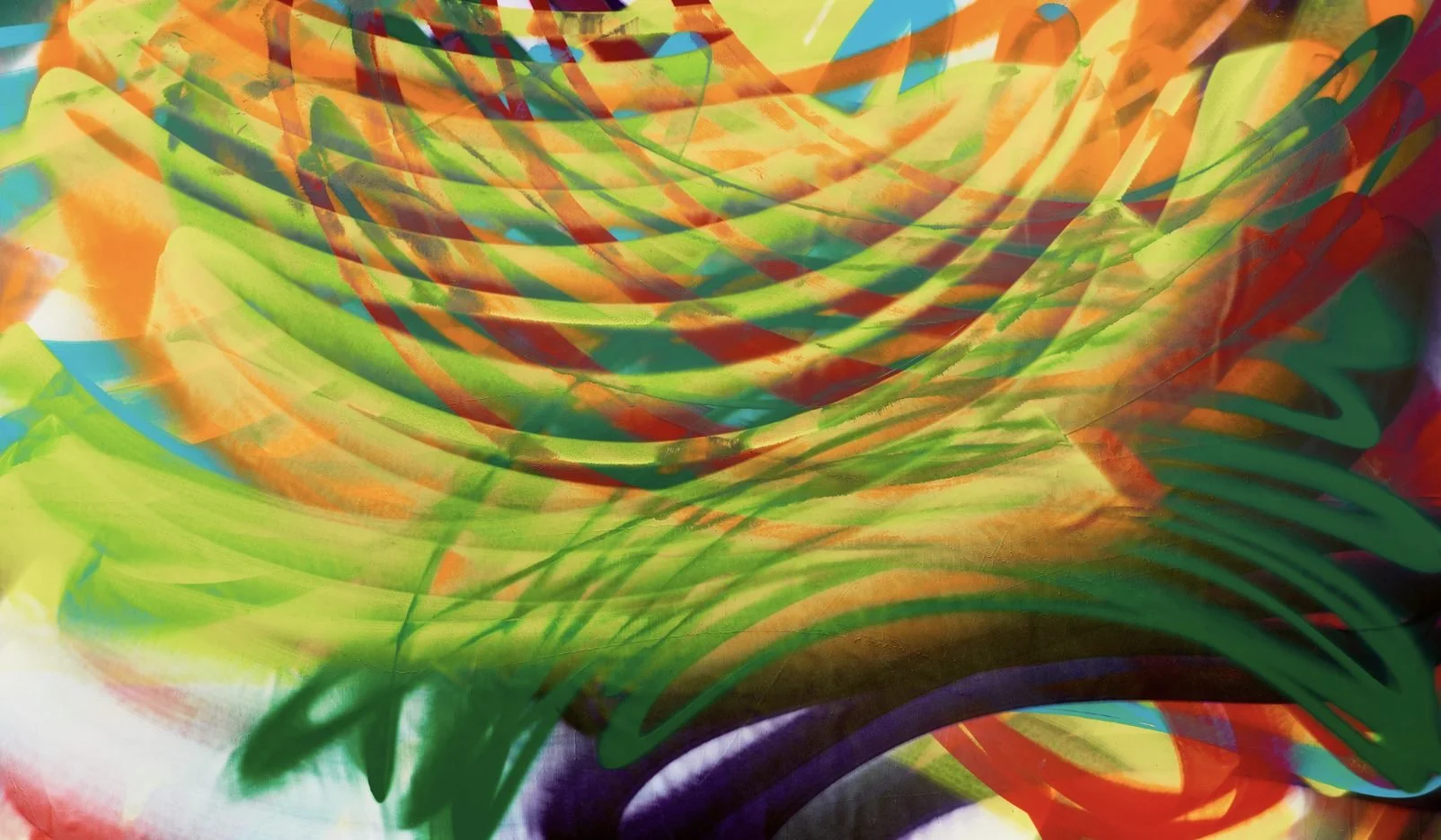
What Makes Katharina Grosse’s Paintings So Powerful?
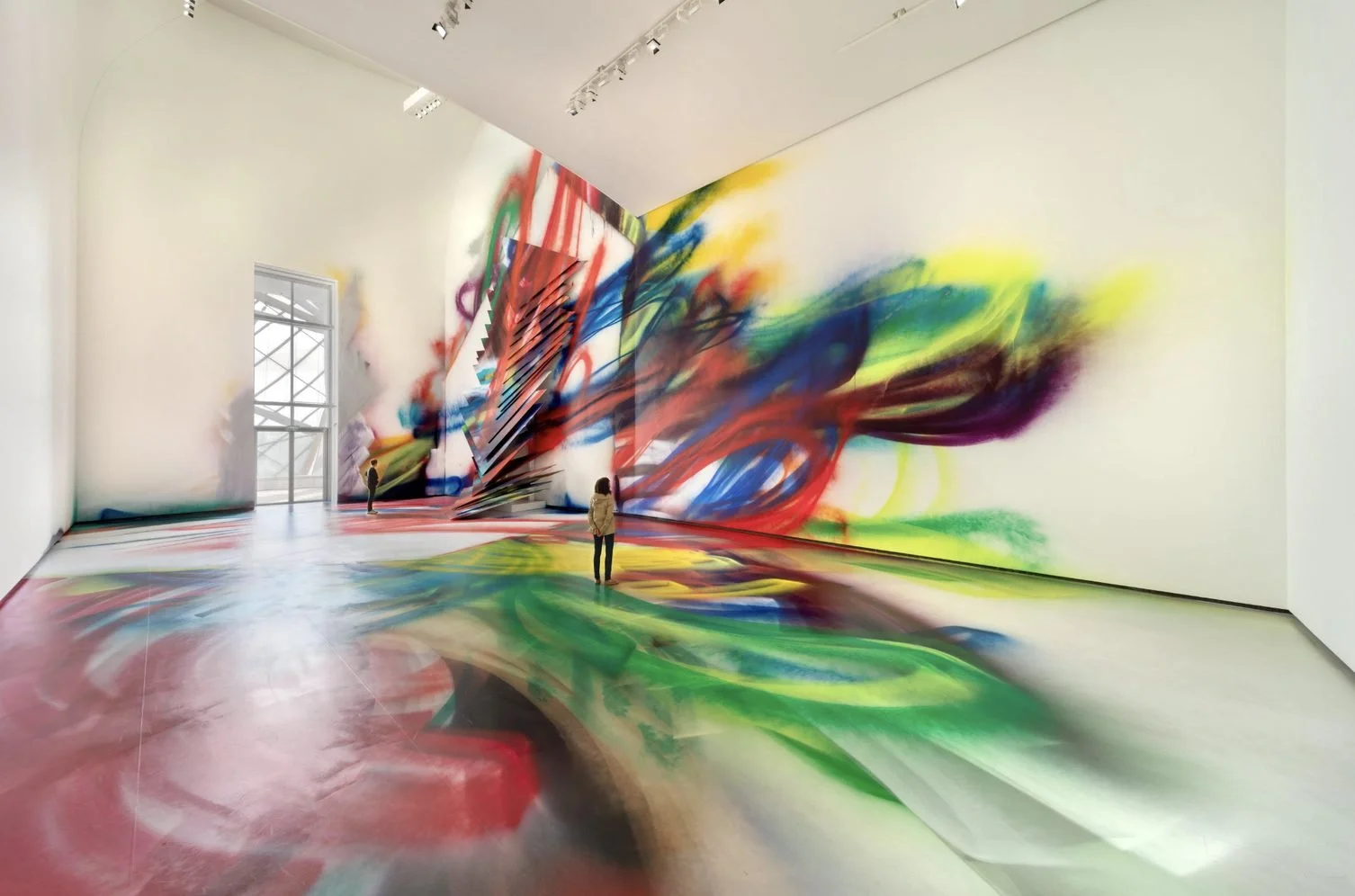
Katharina Grosse’s work is powerful because she treats color not as something placed inside an image, but as a force capable of reorganizing physical reality.
Her paintings may occupy:
stretched canvas
walls
floors
furniture
fabric
sculptural forms
abandoned buildings
trees
soil
public architecture
entire landscapes
Using an industrial spray gun, Grosse projects acrylic color across these surfaces without respecting the boundaries that normally separate painting, sculpture, architecture, object, and environment. Since the late 1990s, this method has allowed her to move painting beyond the framed canvas while continuing to work within painting’s central concerns: color, gesture, composition, illusion, surface, and bodily perception.
The immediate experience can be exhilarating.
Color appears to explode across the room.
Walls seem to lose their stability.
Objects disappear beneath pigment.
The floor becomes part of the composition.
The viewer no longer stands outside the painting.
The viewer enters it.
But the work is not important merely because it is large, bright, immersive, or spectacular.
The deeper problem is:
How can painting escape the boundaries of the image and become a temporary reality that changes how the viewer experiences space, scale, movement, and physical presence?
Grosse does not simply make large paintings.
She investigates what happens when painting no longer knows where it is supposed to stop.
Color as an Event
In conventional painting, color is usually contained by an object.
The canvas provides an edge.
The wall surrounds the painting.
The viewer stands at a distance.
Grosse disrupts all three conditions.
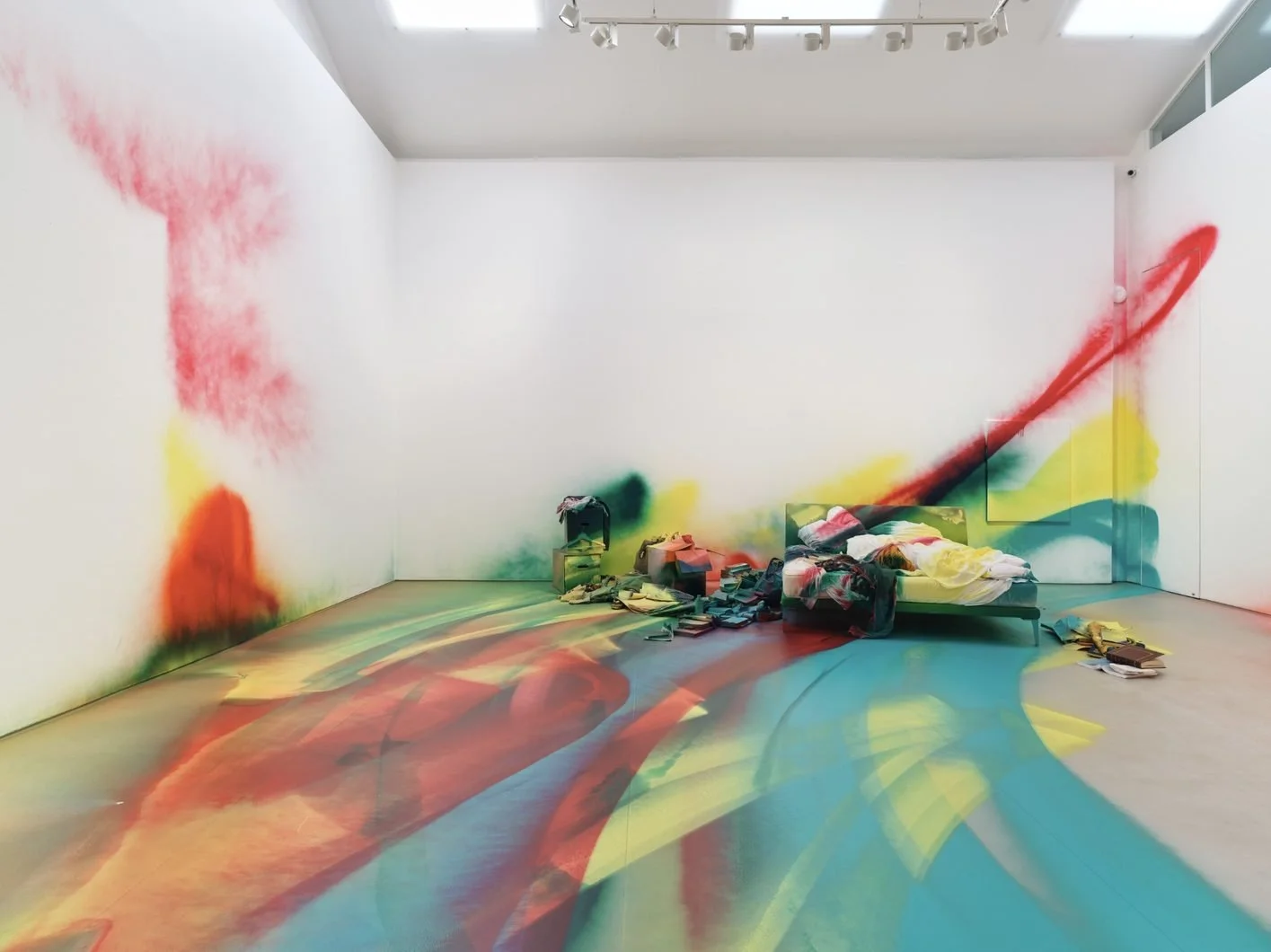
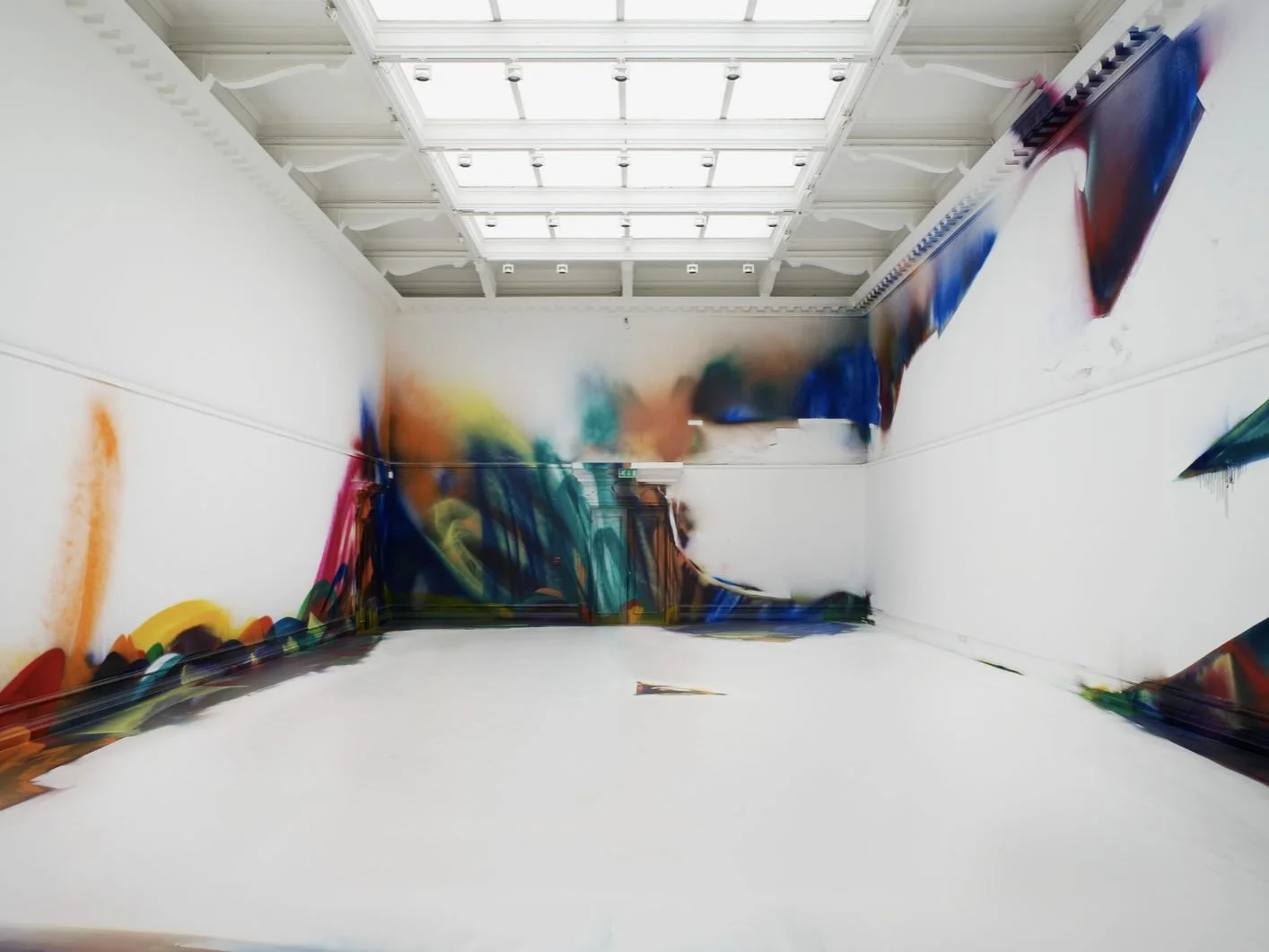
Her color crosses from one surface to another without recognizing the difference between them. A painted gesture may begin on a wall, continue across fabric, pass over an object, and dissolve onto the floor.
The color does not describe an event.
It becomes the event.
This is one of the most important distinctions in her work.
Color is not merely used to represent:
emotion
landscape
atmosphere
light
identity
symbolic meaning
It behaves as an autonomous physical force.
The spray may obscure architecture, flatten differences among objects, create false depth, or make a solid surface appear transparent and unstable.
The viewer sees the room that exists and another visual reality imposed upon it simultaneously.
Grosse’s color therefore creates a contradiction:
The architecture remains physically unchanged while becoming perceptually reorganized.
The wall is still a wall.
But it no longer behaves only like one.
Painting Without a Stable Edge
The edge of a painting traditionally separates artwork from world.
Inside the edge is composition.
Outside the edge is context.
Grosse removes that certainty.
When pigment spreads across floors, walls, objects, and exterior terrain, the viewer can no longer determine where the painting ends and the surrounding world begins.
This changes the role of composition.
Composition is no longer contained inside a rectangle.
It develops through:
architectural scale
walking distance
changing viewpoints
physical obstructions
overlapping surfaces
irregular boundaries
the movement of the viewer
the temporary conditions of the site
A section that appears dominant from one location may disappear when approached from another.
A line that seems continuous may break as it crosses a corner.
A field of color may appear flat from a distance and reveal several separate surfaces at close range.
The painting cannot be experienced from one correct position.
The viewer must move.
This gives the work duration.
Looking becomes physical navigation.
The Spray Gun and the Separation of Hand from Surface
Grosse began using an industrial spray gun in the late 1990s. The tool allows her to apply paint without touching the surface directly and to work across scales far larger than the reach of the arm.
This distance matters conceptually.
A brush confirms contact.
The hand touches the canvas through the tool.
A spray gun projects paint through space.
The mark arrives remotely.
The gesture is bodily, but the body does not directly meet the surface.
That separation gives the work several qualities at once:
immediacy
speed
distance
control
unpredictability
bodily force
mechanical mediation
The spray gun extends the artist’s movement while also transforming it.
A small motion may produce a large mark.
A shift in distance changes the edge.
A change in speed alters density.
Air pressure, angle, surface texture, masking, and the architecture itself influence the result.
The artist directs the event but does not control every particle.
The process therefore sits between intention and consequence.
This is not spontaneous expression in the simple sense.
It is a system in which bodily decisions pass through machinery, air, pigment, architecture, and gravity before becoming visible.
Gesture Larger Than the Body
Abstract Expressionism often treated the brushstroke as evidence of the artist’s body.
The mark recorded the movement of the arm.
Grosse expands this relationship.
Her gestures can exceed human scale.
A painted arc may stretch across an entire building.
A cloud of color may rise several stories.
A sweep may require platforms, lifts, extensive movement, or repeated passes through a site.
The result feels bodily, but no ordinary body could create the gesture through direct touch.
This produces another contradiction:
the work feels intensely physical
the mark appears larger than the body that made it
The artist’s body becomes both present and absent.
We perceive speed, direction, pressure, hesitation, and force.
But the scale prevents us from reconstructing the gesture completely.
The mark becomes something between human action and environmental event.
It resembles:
weather
smoke
light
erosion
impact
growth
contamination
atmospheric movement
Yet the colors often remain visibly artificial.
They do not try to imitate nature.
They interrupt it.
Artificial Color Against the Existing World
Grosse frequently uses intense, synthetic colors that remain distinct from the surfaces beneath them.
A building does not become naturally red.
A tree does not convincingly become purple.
The pigment announces itself as an intervention.
This artificiality is important.
The work is not trying to harmonize with the environment.
It creates a second condition layered over the first.
Natural and artificial realities coexist.
Color may appear liberating because it releases objects from their expected identities.
A wall can become a field.
A tree can become part of a painted rhythm.
A pile of earth can become a sculptural color mass.
But color may also feel invasive.
It covers.
It contaminates.
It disregards established boundaries.
It temporarily subjects everything within reach to one visual system.
Grosse’s installations therefore contain a subtle tension between freedom and domination.
Color appears liberated from the canvas, but it also takes possession of whatever it touches.
Color as Freedom and Control
At first glance, Grosse’s work can feel like pure freedom.
The colors spread.
The gestures expand.
The painting refuses borders.
The viewer is released from the fixed viewpoint of conventional pictorial space.
But the work is also highly controlled.
Grosse selects:
the site
the surfaces
the palette
the direction of movement
the scale
which areas remain unpainted
where masking interrupts the spray
how the viewer enters and moves
how architecture participates
The installation may look explosive, but it is not simply uncontrolled expression.
This matters because energy alone would not sustain the work.
The central contradiction is:
The paintings create an experience of radical freedom through carefully structured decisions.
The work feels open because the structure has been designed to produce openness.
This is a valuable lesson for any artist drawn to energetic color.
Freedom in a painting does not come from avoiding control.
It comes from creating a structure capable of allowing unpredictable visual relationships to occur.
The Unpainted Area
The most dramatic parts of Grosse’s work are often the saturated zones.
But the unpainted areas are equally important.
White walls, raw materials, visible architecture, untouched floor, and masked shapes allow the color to register as an intervention rather than become an undifferentiated environment.
The unpainted surface provides evidence of the world before the painting arrived.
It preserves contrast between:
existing structure and painted event
control and spill
object and visual transformation
permanence and temporary occupation
architecture and illusion
Without restraint, the color could become mere sensory excess.
The unpainted areas create boundaries inside the boundaryless work.
They give the eye places to pause.
They allow separate gestures to remain legible.
They reveal that the apparent expansiveness of the painting is produced through selective decisions.
Absence becomes part of the composition.
Space Becomes Unreliable
Grosse’s work changes how physical space is read.
Sprayed lines may ignore corners.
Color can flatten the distinction between a vertical wall and horizontal floor.
Overlapping transparent fields may create depth where none exists.
Dense pigment can make a flat surface appear like a physical mass.
Painted fabric may behave simultaneously as image, object, wall, landscape, and suspended body.
The viewer knows the architecture remains stable.
Yet perception keeps reorganizing it.
This creates a productive conflict between bodily knowledge and visual experience.
The body says:
This is a room.
The eyes say:
This is a moving field.
The viewer must hold both conditions at once.
The work does not replace reality.
It makes reality unstable enough to be perceived again.
Painting as Temporary Reality
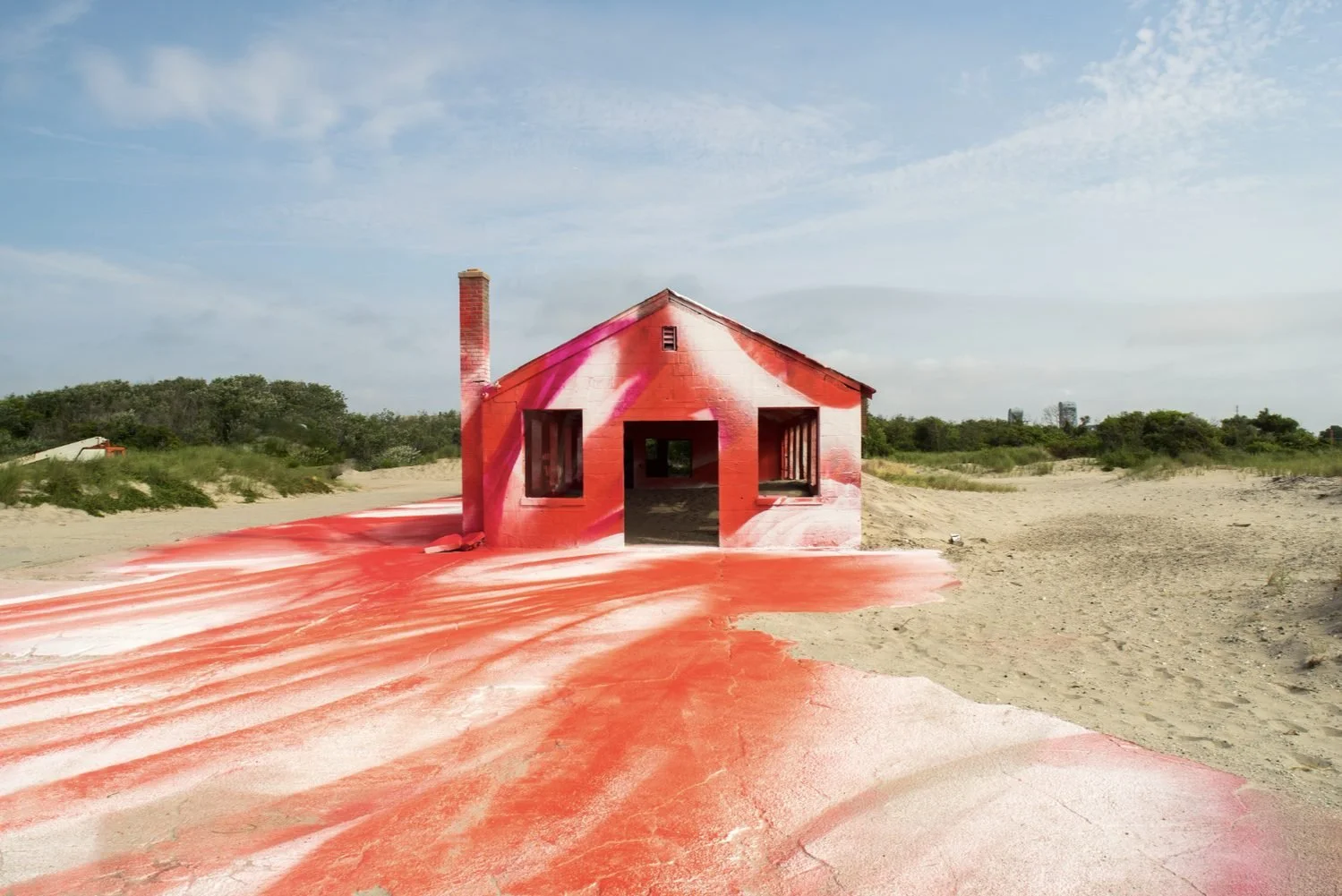
Many of Grosse’s large site-responsive works are temporary.
They may be dismantled, covered, weathered, demolished, or otherwise cease to exist in their original form. Grosse has treated this limited lifespan as part of the work rather than merely an unfortunate consequence of installation.
This temporariness changes the meaning of scale.
Monumental art often seeks permanence.
Grosse creates immense works that may disappear.
The painting occupies architecture or landscape with extraordinary force, yet that occupation remains provisional.
This produces a contradiction between:
monumentality and impermanence
visual power and physical vulnerability
transformation and eventual return
possession and release
The work may dominate a site temporarily while acknowledging that it cannot own the site permanently.
Its disappearance is not necessarily failure.
The work survives as experience, memory, image, and altered perception.
Site-Specific but Not Site-Obedient
Grosse’s installations respond to architecture, but they do not simply enhance or decorate it.
She may use:
scale
entrances
windows
corners
beams
floor transitions
exterior boundaries
circulation routes
Yet the painting often behaves as though the architecture’s rules do not apply.
Color crosses the divisions the building establishes.
A doorway may remain physically important while becoming visually absorbed.
A wall may cease to function as a background.
A floor may become vertically active in the composition.
The work therefore responds to the site by resisting its organization.
This distinction is important.
Site-specificity does not mean obedience to context.
It can mean identifying the structures that control experience and inventing another visual logic across them.
The Viewer Inside the Painting
Most paintings place the viewer outside the depicted world.
Grosse places the viewer inside the visual event.
The viewer’s body becomes a temporary figure within the work.
Other visitors appear against color fields.
Their clothing, movement, scale, and shadows become part of the composition.
The painting changes as people walk through it.
This does not make the viewer a collaborator in the full sense, because the major visual decisions have already been established.
But the viewer completes the work perceptually.
Each person experiences a different sequence:
approach
immersion
partial view
obstruction
bodily comparison
changing scale
exit
recollection
The painting is never available all at once.
This makes memory necessary.
The viewer must assemble the work from successive encounters.
Scale and Human Smallness
Grosse has spoken about the relationship between imagining at an enormous scale and experiencing oneself as physically small within one’s surroundings.
Her installations make this condition tangible.
The viewer may feel:
energized
released
disoriented
diminished
absorbed
overwhelmed
physically alert
Large scale is not simply used to impress.
It changes the viewer’s status.
A conventional painting can be visually possessed from a distance.
A monumental environment cannot.
The viewer cannot hold the whole work in one glance.
The body must surrender the fantasy of complete control.
This connects Grosse’s work to one of the central themes in our wider research:
Access does not equal possession.
The viewer may enter the painting but cannot master it from one position.
Canvas and Environment
Although Grosse is widely known for immersive installations, she also maintains a sustained studio practice on canvas. Museum surveys have emphasized that her studio paintings and environmental works belong to one continuous investigation rather than separate practices.
The canvases show that expansion beyond the frame is not her only concern.
Within rectangular supports, she continues to investigate:
overlapping gestures
masking
visual interruption
depth
transparency
speed
layered time
color relationships
the difference between open and closed space
The canvas becomes a concentrated site where many of the same pressures operate.
Marks appear to continue beyond the edge.
Masked passages interrupt apparent spontaneity.
Layers record revisions.
Color seems simultaneously atmospheric and materially flat.
The canvas paintings demonstrate that scale alone is not the source of the work’s power.
The underlying problem remains active even when the architecture is removed.
Repetition Without an Original
One of Grosse’s important exhibition titles is Repetitions without Origin.
The phrase provides a useful way to understand her visual language.
Her gestures may resemble:
brushstrokes
digital marks
clouds
stains
shadows
projected light
natural formations
But they do not reproduce one original object.
The same kind of mark can appear on canvas, wall, floor, sculpture, or landscape while changing according to surface and scale.
Repetition therefore does not confirm a stable motif.
It tests how a visual action changes when transferred into another condition.
This is the mature form of repetition we identified in our research:
Repetition becomes comparative evidence.
The gesture is repeated, but its meaning shifts.
Painting and Reality
Grosse’s work complicates the division between representation and abstraction.
Her paintings do not usually depict recognizable scenes.
Yet they do not remain separate from reality.
They operate directly upon real objects and spaces.
The painting is abstract, but its consequences are physical.
A painted tree is not an image of a tree.
It is a tree whose visual identity has been changed.
A sprayed room is not a representation of space.
It is space reorganized by painting.
This leads to one of the deepest problems in her practice:
Can painting create reality without representing it?
Grosse’s answer appears to be yes—but only temporarily.
Color establishes another world while leaving the original one visible beneath it.
The Risk of Spectacle
Grosse’s work carries an obvious risk.
Large-scale, brightly colored installations are highly photogenic.
They can be consumed quickly as:
immersive spectacle
social-media background
decorative public art
visual entertainment
evidence of scale and production power
A viewer may respond only to the excitement of color.
The complexity of space, temporariness, bodily scale, control, masking, and perceptual instability may be overlooked.
The work can also risk repeating a recognizable formula:
Spray intense color across a large environment.
This raises the same question we have asked of other artists with powerful signature devices:
Does each installation discover something specific about its site, or does the site merely receive the artist’s established visual language?
The strongest works create a real conflict with the architecture, landscape, history, movement, and scale of the location.
A weaker work might simply enlarge the brand.
Why the Work Matters Now
Grosse’s work belongs to a culture in which images increasingly appear on screens as flat, portable, rapidly consumed surfaces.
Her installations insist on:
bodily presence
physical movement
changing viewpoint
architectural scale
direct sensory experience
the impossibility of seeing everything at once
Yet the work is also exceptionally photogenic and circulates widely as imagery.
This produces a contemporary tension.
The installation resists the screen because it must be experienced physically.
But the screen transforms it into an instantly recognizable spectacle.
The work therefore occupies the boundary between embodied experience and image circulation.
That boundary makes the paintings especially relevant now.
They ask what painting can still do that an image on a screen cannot.
What Artists Can Learn
The lesson is not to imitate Grosse’s spray gun, bright color, monumental scale, painted rooms, or immersive installations.
Those are the visible solutions produced by her problem.
The larger lessons are:
Color can act rather than describe.
Painting can reorganize reality without depicting it.
Scale should change the viewer’s status, not merely impress.
A tool should transform the relationship among body, gesture, and surface.
Freedom requires structure.
Unpainted areas can be as active as saturated ones.
Repetition should test changing conditions.
Architecture can become a participant rather than a backdrop.
The viewer’s movement can become part of composition.
Temporary work can still possess monumental force.
Beauty can be intellectually rigorous without becoming apologetic.
A strong artistic problem should remain active on both canvas and environmental scale.
Spectacle must contain enough structure to survive beyond the first impression.
For an artist interested in color, her most important lesson may be:
Color becomes conceptually powerful when it changes the conditions under which everything else is experienced.
Color should not merely make the painting more expressive.
It can change:
what feels near or distant
where the body appears to belong
how architecture is understood
where the eye can rest
whether the figure feels protected or exposed
whether space appears stable
whether the viewer feels separate from or absorbed by the image
Grosse begins with color.
The color leaves the canvas.
It crosses the wall.
It covers the object.
It interrupts architecture.
It expands beyond the viewer’s field of vision.
The viewer moves through it.
Physical reality remains present but no longer feels visually fixed.
The lesson is not simply to use more color.
It is to ask what color can make possible.
Katharina Grosse transforms color from an element inside painting into a temporary environmental force, making the world itself behave like an unstable image and placing the viewer physically inside the act of seeing.