What Makes Tomma Abts’s Paintings So Powerful?
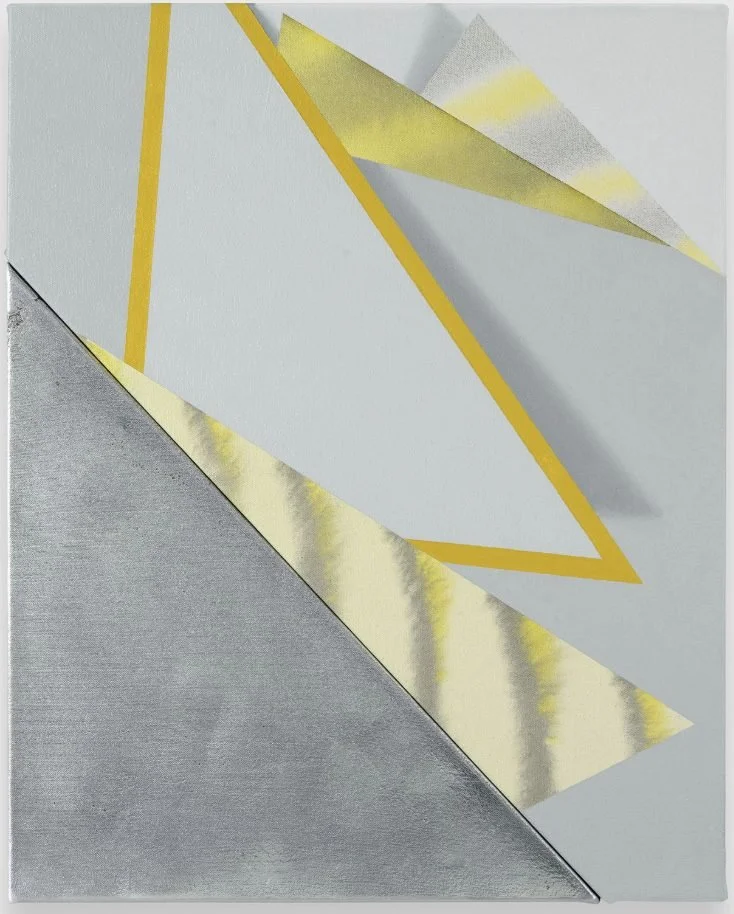
Tomma Abts’s paintings are powerful because they demonstrate that abstraction does not need grand scale, explicit politics, personal narrative, or expressive drama to create serious pressure.
Her paintings are usually small.
Many measure approximately 48 by 38 centimeters—roughly nineteen by fifteen inches—and are surrounded by generous areas of empty gallery wall. Since 1998, she has repeatedly returned to this intimate vertical format, although more recent work has introduced larger supports, multipart paintings, silk, and small cast-metal additions.
At first, the paintings can appear restrained.
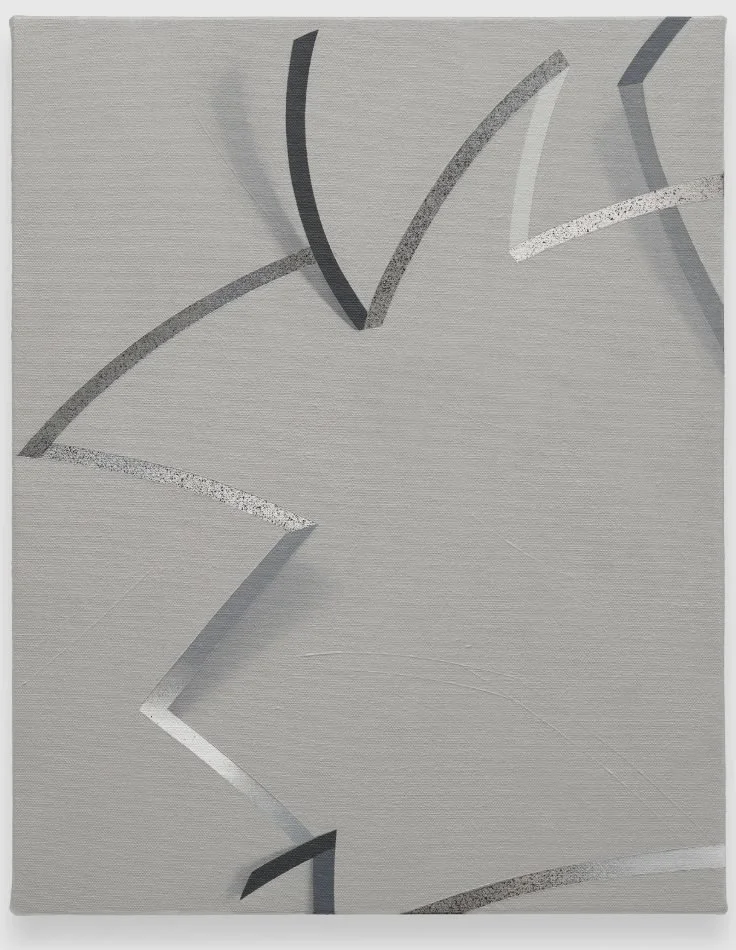
They contain:
folded planes
interlocking bands
curved forms
sharp edges
fine ridges
shadows
narrow openings
muted colors
geometric structures
surfaces that seem carved, layered, bent, or suspended
There are no recognizable people, landscapes, historical events, or narrative scenes.
Nothing tells the viewer what the painting is “about.”
Yet the images feel unusually specific.
The shapes do not look like arbitrary design.
They seem to have arrived through a long process of negotiation, correction, resistance, and discovery.
The deeper problem in Abts’s work is:
How can an abstract painting develop enough internal necessity to feel like a discovered reality rather than an invented arrangement?
She does not begin with a predetermined composition or preliminary drawing. Her paintings evolve gradually through addition, removal, overpainting, adjustment, and reconsideration. The final surface preserves traces of that process through ridges, uneven textures, layered edges, subtle shadows, and color changes.
The painting becomes the record of its own search.
Beginning Without a Plan
Abts often begins with no fixed image and no clear idea of how the painting will end.
This does not mean the process is casual or purely spontaneous.
She works within strict conditions:
a repeated scale
a vertical format
a limited physical surface
abstract form
carefully controlled color
sustained revision
no obligation to depict the external world
These restrictions create a contained laboratory.
Because the format remains relatively stable, the real variation occurs inside the painting.
A line is introduced.
A plane begins to form.
Another shape crosses it.
A section is covered.
An earlier edge survives as a ridge.
A shadow creates the illusion of depth.
A color destabilizes the structure.
The artist does not simply execute an idea.
She responds to what the painting has become.
This creates a productive reversal:
The artist begins the painting, but the developing painting begins to determine what the artist can do next.
Each decision changes the field of possibilities.
As the work develops, some directions become available and others disappear.
The composition gradually acquires its own internal demands.
Process as Subject
Abts’s paintings are sometimes described as being about the process of their own creation.
That does not mean they merely display painterly labor.
They are not demonstrations of technique.
The process becomes important because it produces a form of intelligence that could not be planned in advance.
The painting contains evidence of:
hesitation
correction
concealment
persistence
conflict
revision
failed directions
unexpected discoveries
gradual resolution
The finished image does not erase this history completely.
Fine ridges and raised edges reveal that forms have been painted over or moved.
Some shadows appear to describe three-dimensional structures, while others may be remnants of earlier compositional decisions.
The viewer encounters the final state and the pressure of previous states simultaneously.
The surface says:
This image has arrived.
But it also says:
It could have become something else.
That tension prevents the painting from feeling like clean graphic design.
Constraint Produces Freedom
Katharina Grosse creates freedom by allowing color to cross architecture, objects, and landscape.
Tomma Abts creates freedom through the opposite strategy.
She limits the field.
The canvas is small.
The format is repeated.
The subject is absent.
The process unfolds slowly.
Yet these restrictions produce an extraordinary number of possibilities.
This reveals an important artistic principle:
Freedom does not always require expansion. It can emerge through sustained attention inside a narrow structure.
Because Abts does not need to invent a new subject for each work, she can focus on subtle differences:
how one plane overlaps another
whether a curve feels inflated or cut away
whether a shadow creates depth or contradiction
how color changes spatial hierarchy
whether a form appears solid, transparent, folded, or hollow
how much pressure can be created inside a small field
The constraint concentrates thought.
Nothing can rely on scale, narrative, cultural reference, or spectacle to create importance.
Every relationship must earn its place.
Small Scale and Concentrated Attention
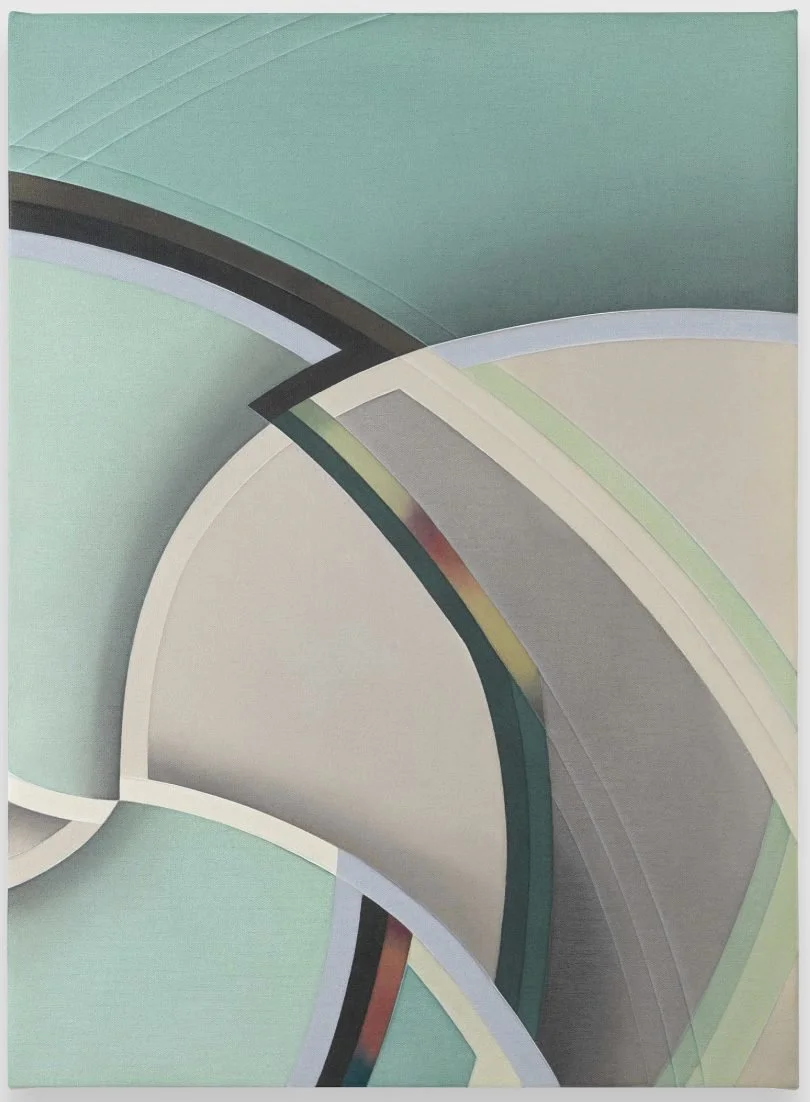
The small size of Abts’s paintings is conceptually important.
A large painting can dominate the viewer physically.
Abts’s paintings cannot rely on that authority.
They ask the viewer to approach.
From across the gallery, they may appear like quiet objects or compressed signs.
At close range, the surfaces reveal:
minute color shifts
fine ridges
thin seams
layered edges
slight irregularities
delicate shadows
evidence of correction
tensions between flatness and depth
The viewer’s relationship becomes intimate.
The painting does not surround the body.
It concentrates the eye.
This scale changes the power dynamic.
The work does not overwhelm the viewer.
It withholds itself until the viewer offers attention.
Its authority is therefore earned through density rather than size.
The painting becomes monumental through concentration rather than physical expansion.
Abstraction Without Generality
Weak abstraction often feels general.
The forms could be moved, replaced, recolored, or removed without changing the deeper meaning.
Abts’s strongest paintings feel highly particular.
A shape may be unfamiliar, but it does not feel interchangeable.
Its exact width, curve, shadow, color, and position determine the entire composition.
The image seems to possess an identity even though it represents nothing recognizable.
This is one of the central achievements of her work:
She makes nonrepresentational forms feel as specific as individual people or objects.
The painting does not depict a thing.
It becomes a thing.
This specificity is strengthened by her titles. Many paintings receive invented personal names, usually assigned after completion. The titles do not explain the images or identify hidden subjects; they give each work an individual identity without converting it into representation.
The painting remains abstract but no longer anonymous.
Illusion Without Representation
Abts’s paintings frequently create the impression of three-dimensional space.
Forms seem to:
fold
bend
cast shadows
rise from the surface
recede behind other forms
twist
open
interlock
hover
Yet the spatial system is rarely physically coherent.
Shadows may imply incompatible light sources.
A form may appear solid in one passage and flat in another.
A plane may seem to fold forward while also occupying impossible depth.
The paintings borrow the visual language of illusion without submitting to realistic space.
This places the viewer between two kinds of knowledge:
the canvas is flat
the forms appear dimensional
The contradiction never resolves.
Abts uses illusion not to convince the viewer that a depicted object exists, but to destabilize the boundary between image and object.
The painting becomes spatially persuasive without representing a believable world.
Shadows That Cannot Be Trusted
The painted shadows are especially important.
In conventional representation, a shadow helps explain:
the location of a light source
the position of an object
the depth of a space
the relationship among forms
Abts uses shadows to create clarity and uncertainty at the same time.
A shadow may make a shape appear raised from the canvas.
But another shadow may contradict it.
A highlight may suggest a fold that could not physically exist.
The painting offers enough illusion to activate bodily understanding, then prevents that understanding from stabilizing.
This creates visual pressure.
The viewer repeatedly tries to reconstruct the object or space.
But there is no complete object to reconstruct.
The painting remains convincing in parts and impossible as a whole.
Structure and Instability
Abts’s paintings often look balanced.
The forms appear carefully distributed.
Edges align.
Colors repeat.
The composition seems resolved.
But this stability contains instability.
A narrow band may appear to hold several larger planes together.
A small opening may prevent the image from becoming visually sealed.
A curve may introduce bodily softness into a rigid geometric system.
A shadow may shift a form from flat pattern into uncertain volume.
The strongest paintings feel as though they have reached a temporary equilibrium.
They are stable, but not inevitable in the sense of being predictable.
They appear to have survived many other possible arrangements.
This is different from decorative harmony.
Decorative harmony makes the relationships pleasing.
Abts’s equilibrium makes the relationships necessary.
Color as Structural Pressure
Color in Abts’s paintings is rarely used as pure emotional display.
Her palettes may be muted, dusty, cool, metallic, pale, or unexpectedly sharp.
Color helps establish:
depth
weight
separation
continuity
emphasis
visual speed
density
temperature
uncertainty
A pale form may appear to move forward because of its relationship to a darker plane.
A sharp color may activate an otherwise restrained field.
Two nearly similar hues may make an edge difficult to locate.
Color becomes inseparable from structure.
It does not decorate completed forms.
It helps determine what the forms are capable of doing.
This differs sharply from Grosse’s environmental color.
Grosse uses color to break boundaries and reorganize space around the viewer.
Abts uses color to construct and destabilize an internal world within the canvas.
Both show that color can act rather than merely express.
But one expands.
The other concentrates.
The Surface Remembers
Because Abts repeatedly revises her paintings, the surface accumulates history.
Covered shapes may leave raised outlines.
Painted-over passages may affect later colors.
A ridge may record a former boundary.
The final painting is not a clean diagram produced in a single stage.
It is materially thick with previous decisions.
The surface therefore functions like memory.
It does not reveal every earlier state.
But those states continue shaping what remains visible.
This connects Abts to a broader principle from our research:
History and memory often operate most powerfully as residue.
The painting’s past survives indirectly.
It is embedded in thickness, pressure, edges, and interruption.
Painting as Decision-Making
Abts’s work makes painting feel like a process of decision under uncertainty.
At each stage, the artist must determine:
what to preserve
what to cover
which relationship has potential
what has become too predictable
when a shape feels arbitrary
when a contradiction becomes productive
whether the painting needs another intervention
when the image has become complete
There is no external subject against which the painting can be checked.
She cannot ask whether the portrait resembles the sitter or whether the landscape looks accurate.
The standard must emerge from the painting itself.
This makes judgment central.
The work depends on sensitivity to internal necessity.
A form is not correct because it corresponds to reality.
It is correct because the painting can no longer function convincingly without it.
That makes Abts especially relevant to the studio test:
Would the painting lose meaning if I removed this choice?
Her paintings appear built through asking that question repeatedly.
Formalism With Pressure
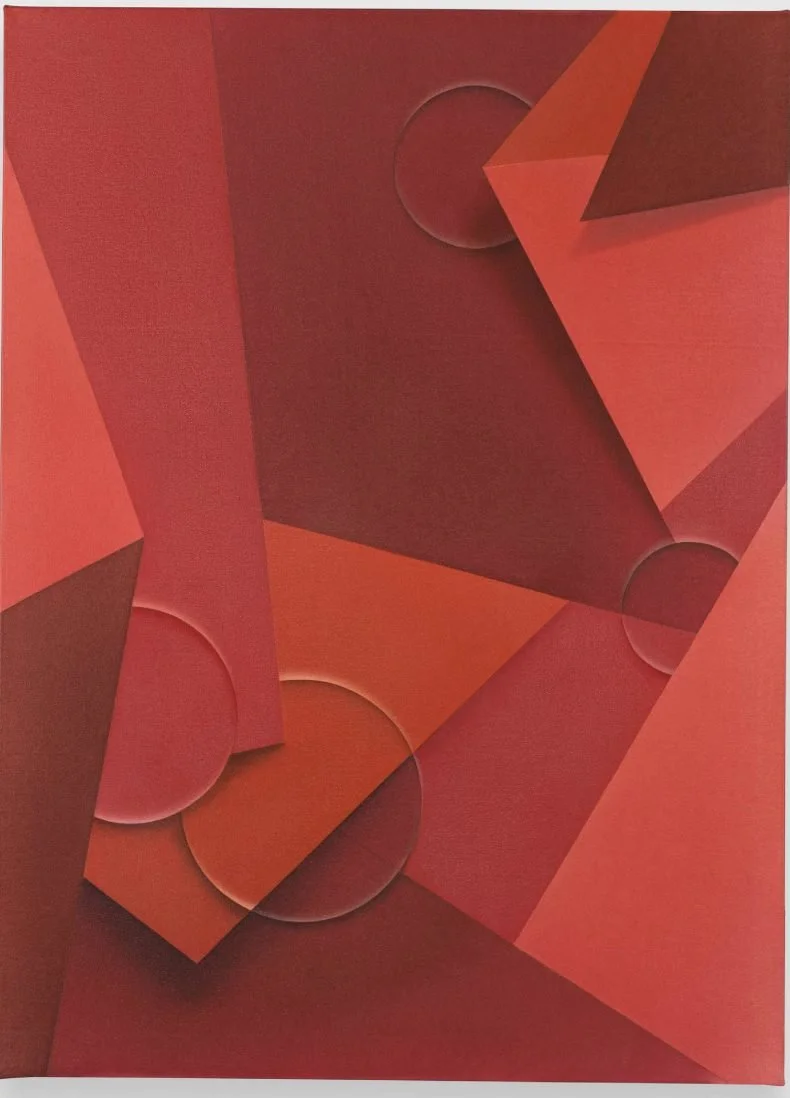
Abts is an important challenge to the idea that contemporary abstraction needs an explicit social, political, biographical, or historical subject to matter.
Her work demonstrates that formal relationships can still carry serious intellectual and psychological weight.
But the lesson is not that form alone is automatically meaningful.
Her formalism contains pressure because it is grounded in:
uncertainty
revision
duration
judgment
resistance
material memory
unstable perception
the search for necessity
The paintings are not “about nothing.”
They are about how something acquires form when neither its identity nor its destination is known in advance.
This transforms pure abstraction into an inquiry about:
making decisions without certainty
allowing identity to emerge gradually
negotiating freedom and constraint
recognizing when an image has become itself
accepting that resolution contains buried alternatives
The work can therefore feel psychologically resonant without depicting psychology.
Identity Emerging Through Process
Although there are no figures, Abts’s paintings offer an unusual model of identity.
The image does not begin with a fixed essence.
It becomes itself through relationships, changes, failures, revisions, and accumulated decisions.
This resembles one of the major ideas across our artist research:
Identity is relational rather than fixed.
In Abts’s work, that principle applies to the painting itself.
A form has meaning because of what surrounds it.
A color changes according to adjacent colors.
A shape becomes dominant or recessive through context.
The image’s identity emerges from the entire network.
Nothing exists independently.
The painting is not the expression of an already complete idea.
It is the record of an identity becoming visible through process.
The Risk of Formal Insularity
Abts’s work also presents a real risk.
Because the paintings are small, abstract, carefully made, and internally focused, they can seem culturally sealed.
A viewer may ask:
Why do these formal problems matter beyond painting?
Is internal complexity enough?
Does the work withdraw from social reality?
Does refinement become exclusivity?
Is the difficulty productive or simply specialized?
These are legitimate questions.
Her work does not provide the kinds of external urgency found in artists dealing directly with race, political violence, gender, migration, or historical trauma.
Its claim is different.
It argues that sustained attention, visual judgment, uncertainty, and form-making remain serious human activities.
The paintings investigate how order emerges without a predetermined system.
That is less publicly dramatic, but not necessarily less profound.
The risk appears when internal refinement becomes self-protective—when formal intelligence circulates only among viewers already trained to value subtle abstraction.
The strongest works overcome this risk through visual tension immediate enough to attract attention before specialized knowledge arrives.
The Risk of Preciousness
The small scale and meticulous surfaces can also make the paintings appear precious.
They may be treated as exquisite objects whose value lies in rarity, refinement, or connoisseurship.
Abts avoids this when the surface retains visible struggle.
The ridges, corrections, awkward transitions, and spatial contradictions prevent the paintings from becoming perfectly polished design objects.
Their beauty contains labor and uncertainty.
The images feel resolved, but not frictionless.
That distinction is crucial.
A merely precious object asks to be admired.
A strong Abts painting asks to be examined.
Why the Work Matters Now
Contemporary visual culture encourages:
rapid consumption
instant recognition
large scale
clear branding
easy reproduction
immediate explanation
spectacular imagery
Abts’s paintings resist these conditions.
They are:
physically small
slow to understand
difficult to reproduce accurately
resistant to quick interpretation
visually specific without being narratively legible
dependent on close attention
Their power often weakens in a thumbnail.
Subtle surface ridges, spatial contradictions, and color relations require physical proximity.
This gives the work contemporary relevance.
It insists that meaning may emerge slowly.
It suggests that looking can be a sustained encounter rather than an act of immediate classification.
What Artists Can Learn
The lesson is not to imitate Abts’s small canvases, invented titles, geometric forms, muted colors, or painted shadows.
Those are the visible results of her investigation.
The larger lessons are:
Constraint can generate freedom.
Small scale can create concentrated authority.
Abstraction must become specific rather than general.
Process should produce discoveries that planning could not.
Revision can remain materially present.
Formal relationships can carry psychological pressure.
Color should help create structure rather than decorate it.
Illusion can be used without representation.
A painting can hold uncertainty while remaining precise.
Resolution should preserve evidence of struggle.
Repetition of format can deepen investigation rather than create monotony.
A recurring structure should make subtle differences more meaningful.
Formalism remains viable when it contains necessity, resistance, and discovery.
The painting can develop an identity rather than illustrate one.
The artist’s judgment becomes visible through what is retained, revised, and removed.
For an artist working with figures, color, pattern, and environments, Abts provides an important counterweight.
She shows that depth does not always come from adding more subject matter, symbols, or narrative.
Sometimes the painting becomes stronger by narrowing the variables and intensifying the relationships among them.
A useful studio application would be:
hold the figure constant
hold the scale constant
hold the environment constant
change only the pattern’s relationship to the body
allow each painting to develop through revision
preserve evidence of the changes
determine when variation becomes meaning rather than decoration
Abts begins without a fixed image.
A shape appears.
Another shape changes it.
A color establishes depth.
A shadow contradicts that depth.
A form is buried.
Its edge remains.
The composition becomes increasingly specific.
Eventually the painting reaches a state in which every part seems dependent on every other part.
The image represents nothing.
But it has become unmistakably itself.
Tomma Abts transforms abstraction into a record of identity emerging through constraint, revision, judgment, and accumulated decisions, proving that a small painting can achieve enormous pressure when every formal relationship becomes necessary.