What Makes Firelei Báez’s Paintings So Powerful?
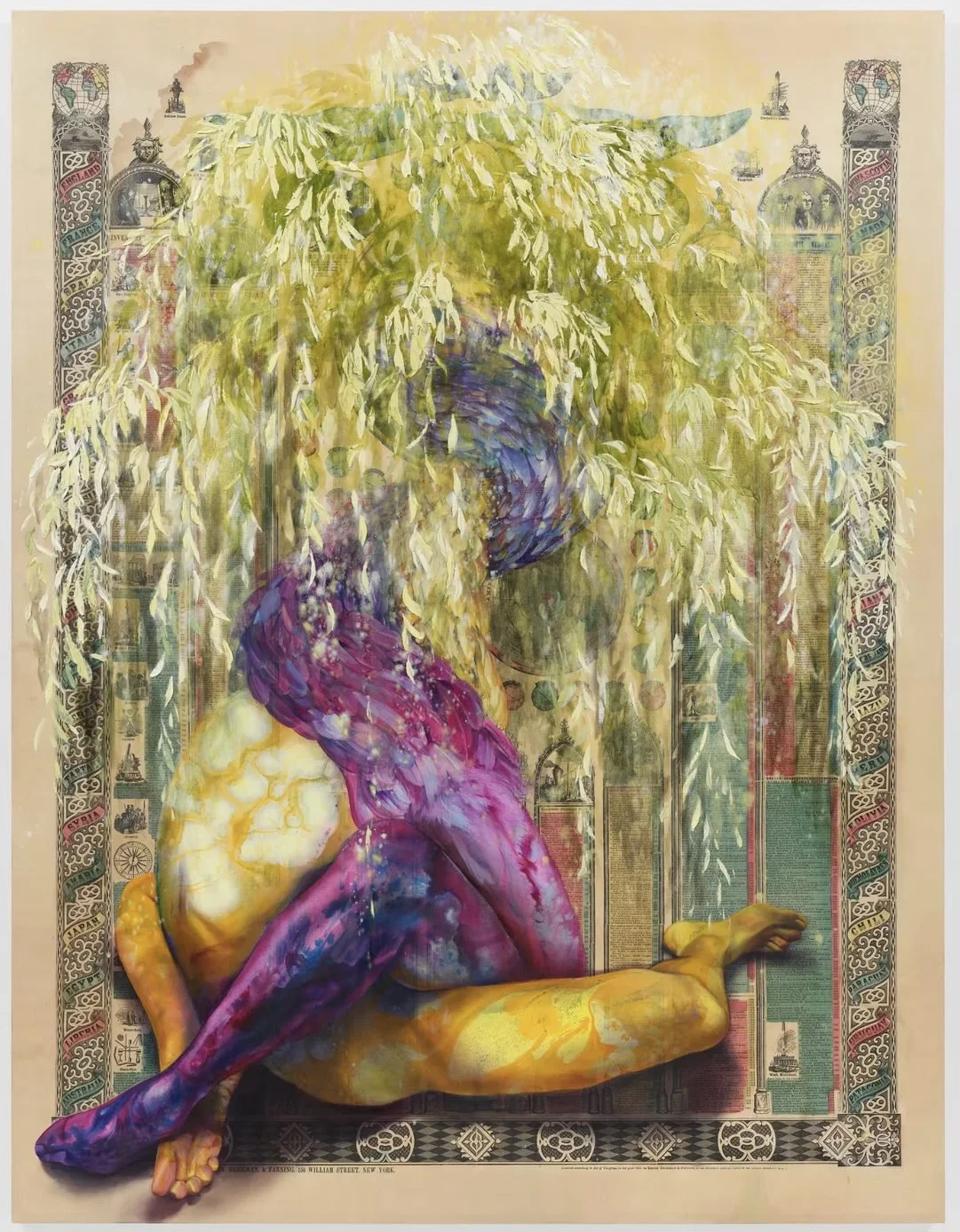
Firelei Báez’s paintings are powerful because they transform the visual languages once used to classify, map, contain, and diminish people into exuberant worlds of movement, beauty, invention, and possibility.
Her work may combine:
historical maps
colonial diagrams
archival documents
architectural plans
heraldic symbols
botanical forms
patterned bodies
mythical creatures
abstract color
ornament
landscape
fragments of human anatomy
Figures emerge from these historical surfaces, but they rarely behave like conventional portraits.
They may appear:
feathered
scaled
fur-covered
floral
aquatic
monstrous
elegant
unstable
partially invisible
fused with the environment
The bodies do not fit easily into one category.
They appear human and nonhuman, historical and futuristic, vulnerable and powerful.
Báez draws from African diasporic histories and the colonial history of the Atlantic world, while also using anthropology, geography, folklore, fantasy, science fiction, and social history to unsettle fixed categories of race, gender, and nationality.
The work is immediately beautiful.
Saturated color moves across the surface.
Patterns multiply.
Bodies seem to grow, dissolve, and reassemble.
But the beauty is not an escape from history.
It is a method of transforming history.
The central problem beneath the work is:
How can painting take the maps, archives, symbols, and categories created by colonial power and turn them into visual worlds that those systems can no longer control?
Báez does not merely expose historical violence.
She imagines what might exist beyond the structures that produced it.
The Map as an Instrument of Power
Maps are often treated as neutral descriptions of the world.
They appear factual.
They measure land.
They identify borders.
They organize territory.
But maps also express power.
They determine:
who owns a place
who names it
which borders appear legitimate
which communities become visible
which histories are omitted
how land can be divided, governed, exploited, or exchanged
Colonial maps did not merely record territory.
They helped make conquest appear orderly and rational.
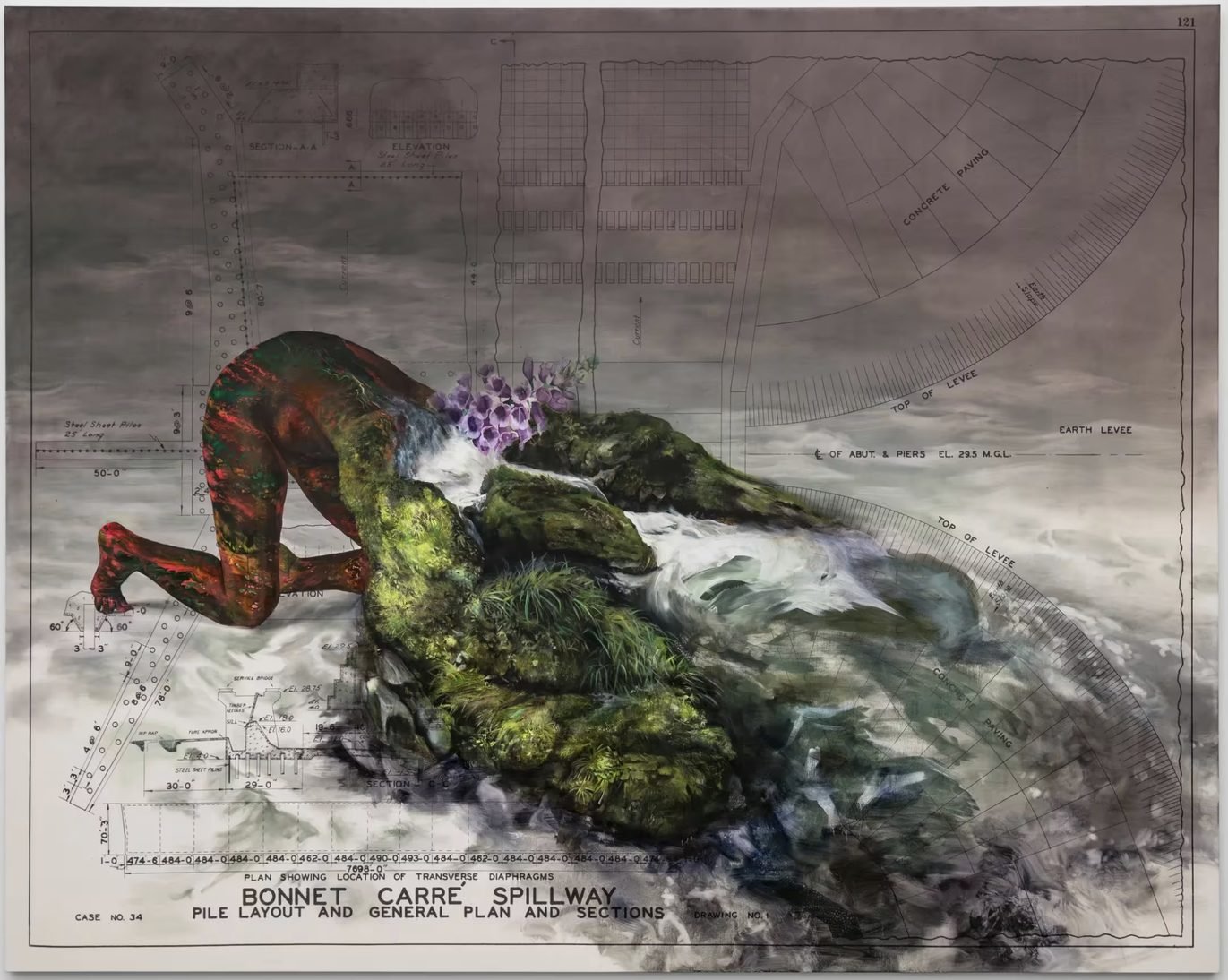
Báez frequently paints over reproductions of maps and other historical documents. The printed structure remains visible beneath the new image, but it no longer controls the entire surface.
Color spreads across borders.
Figures interrupt grids.
Hair, foliage, feathers, water, flesh, and pattern cross the lines intended to organize them.
The map remains present as evidence.
But its authority has been weakened.
This produces one of the central reversals in her work:
The historical document becomes the background, while the body once subjected to its system becomes the dominant visual force.
The map no longer contains the figure.
The figure overwhelms the map.
History as a Surface to Be Rewritten
Báez does not usually erase the historical material completely.
That is important.
The old map, document, plan, or diagram remains visible enough for the viewer to understand that the painting has entered an inherited system.
The past is not replaced by a clean new image.
It survives beneath the transformation.
This allows several conditions to remain active:
historical violence and imaginative freedom
evidence and invention
inherited structure and visual rebellion
classification and metamorphosis
archival authority and painterly instability
The new image does not pretend that history can simply be overcome.
Instead, it shows history being contested.
The surface becomes a struggle between what has been recorded and what can still be imagined.
This connects Báez to a major principle from our broader research:
History is often strongest in contemporary art when it remains visible as residue rather than appearing as a completed story.
Báez’s paintings preserve the systems of the past while refusing to let them determine the future.
The Body That Cannot Be Classified
Colonial systems depended heavily on classification.
People were organized according to:
race
nationality
gender
legal status
labor
geography
ancestry
perceived biological difference
Classification converts complexity into categories that can be managed.
Báez’s bodies resist that process.
They are frequently hybrid.
A figure may contain:
human limbs
animal textures
floral growth
feathers
scales
patterned skin
flowing hair
abstract color
forms that seem liquid or atmospheric
The viewer recognizes parts but cannot stabilize the whole.
The figure remains visible without becoming fully legible.
This is not ambiguity for its own sake.
The body becomes difficult to classify because classification is part of the historical problem being challenged.
The figure refuses the demand to become one thing.
It may be simultaneously:
beautiful and monstrous
feminine and beyond gender
ancestral and futuristic
bodily and environmental
wounded and triumphant
culturally specific and mythologically open
The deeper artistic strategy is:
The body becomes free by exceeding the categories through which it was once controlled.
The Ciguapa
One recurring figure in Báez’s work draws from the ciguapa, a creature from Dominican folklore often described as a wild female being with long hair and backward-facing feet.
The ciguapa is difficult to track because her footprints appear to indicate the opposite direction of her movement.
This makes her especially powerful within Báez’s larger investigation.
She is a figure who cannot be followed through ordinary systems of evidence.
She resists capture, interpretation, and possession.
The ciguapa may suggest:
freedom from social control
refusal of domestic order
bodily autonomy
environmental belonging
danger
erotic power
cultural memory
unreadable movement
Her backward feet turn the logic of tracking against itself.
The sign remains visible, but its meaning misdirects the pursuer.
This corresponds closely to another major principle from our research:
Visibility does not have to produce access.
The ciguapa can appear without becoming available.
She can leave evidence without surrendering herself to it.
Beauty as Counterpower
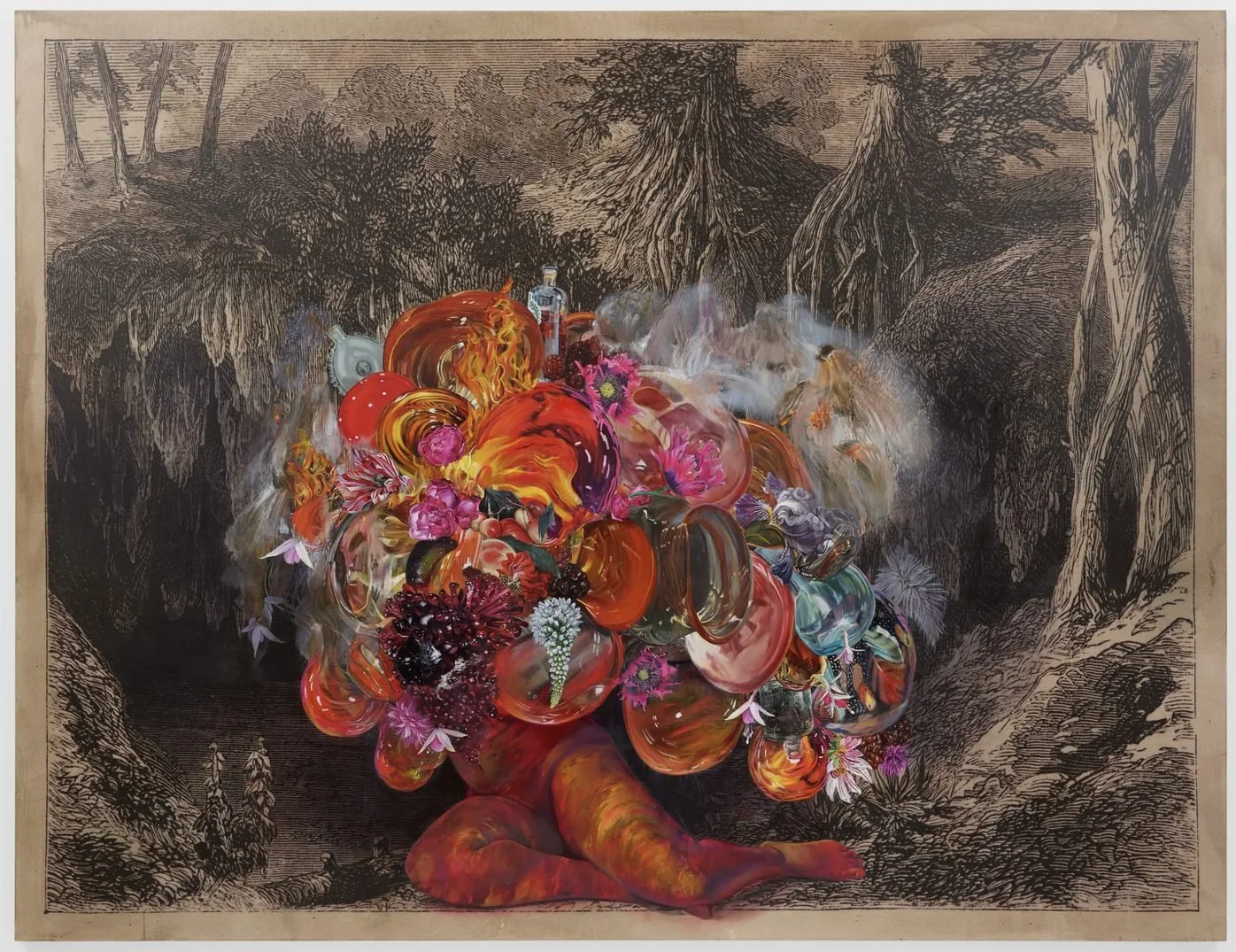
Báez’s paintings are often radiant.
They contain intense reds, blues, greens, pinks, violets, oranges, and golds.
Flowers, feathers, curls, decorative forms, and patterned surfaces generate visual pleasure.
This beauty is not secondary to the political or historical content.
It is part of how the work resists systems based on deprivation, containment, and loss.
Historical critique in contemporary art often uses:
darkness
ruin
absence
damaged imagery
muted color
solemnity
Báez often chooses abundance instead.
Her paintings can feel:
joyful
sensual
excessive
celebratory
luxurious
fertile
energetic
That does not mean the history has become pleasant.
Rather, beauty creates a form of counterpower.
The figure is not restricted to appearing as evidence of suffering.
She can occupy:
fantasy
pleasure
ornament
mystery
elegance
transformation
overwhelming visual presence
Báez fills historical absence not only with information but with imaginative abundance. Hauser & Wirth characterizes her work as placing diasporic histories into imaginative realms and filling gaps in history through joyful rebellion.
The work asks:
What happens when people historically represented through domination are granted extravagance, beauty, instability, and mythic power?
Pattern as Transformation
Pattern plays several roles in Báez’s paintings.
It may operate as:
skin
clothing
environment
camouflage
ornament
cultural memory
movement
bodily transformation
visual excess
Pattern does not merely decorate a completed figure.
It helps construct the figure.
A body may seem to emerge from repeated marks.
A patterned surface may spread beyond the body and into the surrounding space.
The boundary between figure and environment becomes unstable.
This creates a tension between concealment and expansion.
Pattern may hide the body by making it difficult to separate from the background.
But pattern may also enlarge the body by allowing its visual language to spread across the image.
The figure no longer occupies the environment as an isolated object.
She begins to transform the environment into an extension of herself.
This is especially relevant to one of the central ideas in our research:
The strongest figure may eventually reorganize the world around her presence.
In Báez’s work, self-authorship is not limited to the body.
The figure rewrites the surface around her.
Ornament Against Colonial Order
Colonial maps and documents depend on visual order.
They use:
grids
lines
borders
labels
measurements
repeated symbols
standardized categories
Báez counters this order with ornament.
Her decorative language is fluid, layered, irregular, proliferating, and difficult to contain.
The contrast is not simply between geometry and organic form.
It is between two systems of organization.
The colonial document tries to stabilize the world.
Báez’s ornament makes the world mobile again.
Flowers, hair, feathers, scales, waves, and abstract gestures refuse the fixed logic of the underlying map.
Decoration therefore becomes political without functioning as a slogan.
It changes the structure of the image.
The painting replaces the authority of the grid with a system based on growth, mutation, rhythm, and movement.
This gives ornament a serious conceptual role:
Ornament becomes the visual language of a world that refuses to remain administratively fixed.
Fiction as Historical Method
Báez does not respond to gaps in history by attempting a straightforward reconstruction.
She uses fiction.
This may appear risky.
If history has been erased, why introduce fantasy rather than recover facts?
The answer is that archives are never complete.
They often preserve the viewpoint of institutions that had the power to record.
Many lives survive only partially, if at all.
Fiction allows Báez to move beyond the archive’s limitations.
She does not claim that imagined figures are documentary evidence.
Instead, she creates forms of presence that history failed to preserve.
Fantasy can provide:
mobility
power
pleasure
complexity
alternative ancestry
speculative identity
freedom from realism
futures not determined by the past
Her work demonstrates that invention can be historically serious.
The painting does not ask:
What exactly happened?
It may ask:
What forms of life, power, and possibility were excluded from the official record?
This is fiction used not to escape history but to challenge history’s monopoly over reality.
Mythology as an Alternative Archive
Folklore and mythology preserve forms of knowledge that official archives often dismiss.
They carry:
communal memory
warning
survival strategies
cultural identity
spiritual belief
bodily knowledge
alternative ideas of nature and power
Báez brings mythical creatures and folkloric references into contact with maps, diagrams, and official documents.
This creates a confrontation between different systems of knowledge.
The map claims authority through measurement.
Myth claims authority through cultural transmission.
The archive records what institutions considered important.
Folklore preserves what communities continued to remember.
Neither system is presented as completely transparent.
But the painting disrupts the assumption that official documents are the only serious evidence.
Myth becomes another way of knowing.
The Body and the Environment
Báez’s figures often blur into natural forms.
Bodies may appear connected to:
water
plants
geological structures
storms
animal life
coral
hair-like vegetation
atmospheric color
This can suggest that the separation between human identity and environment is itself unstable.
Colonialism did not only classify people.
It also classified land, plants, animals, and resources according to their potential usefulness.
Báez’s hybrid bodies resist the division between person and nature.
A figure may seem less like an individual standing in a landscape and more like an ecosystem.
This changes the meaning of power.
Power does not necessarily appear as domination over the environment.
It may emerge through connection, adaptation, mutation, and interdependence.
The body becomes expansive rather than bounded.
Movement Against Borders
Báez’s forms rarely appear static.
Hair flows.
Color spreads.
Bodies twist.
Patterns cross boundaries.
Water and atmosphere move through the surface.
This motion matters because colonial and national systems rely on stable borders.
The paintings repeatedly refuse stability.
Movement may suggest:
migration
escape
diaspora
transformation
changing identity
cultural circulation
survival
refusal of confinement
The Atlantic world in Báez’s work is not simply a geographic region.
It is a network shaped by forced movement, migration, trade, cultural exchange, violence, and survival.
The paintings do not reduce that history to one narrative.
They create visual conditions in which movement remains active.
Painting Over the Archive
There is a productive ethical question in painting over historical documents.
Does the new image obscure the evidence?
Does beauty aestheticize violence?
Does fantasy make history less specific?
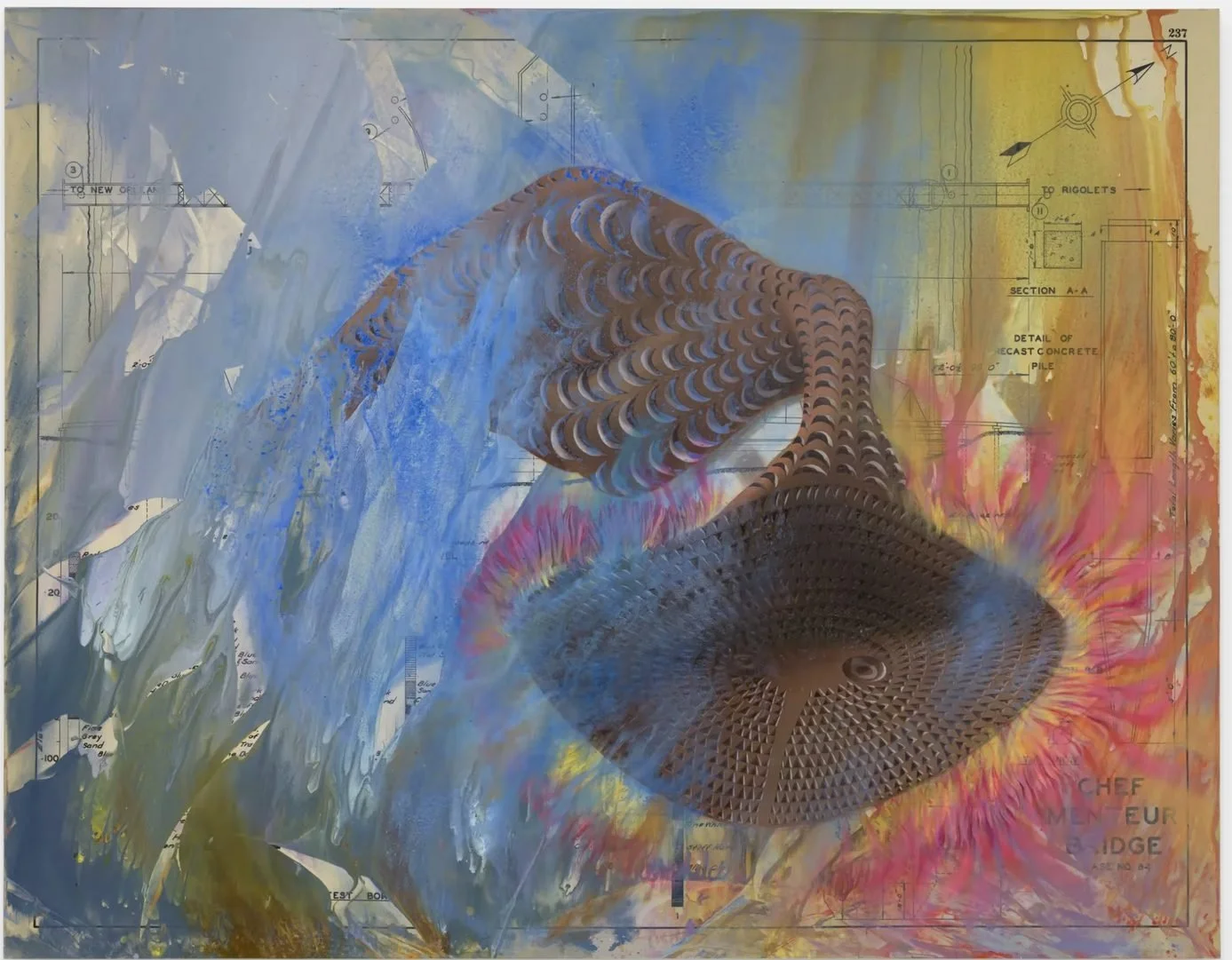
Báez manages this risk by allowing the underlying source to remain partially visible.
The map or document continues to exert pressure.
It is not merely a decorative vintage background.
The viewer can still detect:
grids
labels
geographic outlines
architectural structures
borders
diagrams
The new painting interrupts the source but does not fully silence it.
This preserves the conflict.
The beauty cannot become innocent because the structure beneath it remains visible.
The strongest works create a real contest between historical classification and imaginative transformation.
Monumental Scale and Authority
Many of Báez’s paintings are large enough to confront the viewer physically.
The figure may exceed ordinary human scale.
This gives bodies that were historically classified, studied, exoticized, or marginalized a new form of authority.
Scale changes the viewer’s relationship to the subject.
The viewer does not simply inspect the figure.
The figure occupies the viewer’s field of vision.
This reverses the traditional direction of control.
The body becomes difficult to contain visually, just as it is difficult to classify conceptually.
The ICA Boston’s survey emphasized Báez’s monumental paintings, drawings, installations, and richly layered uses of pattern and saturated color in relation to the colonial histories of the Atlantic basin.
Scale therefore becomes more than spectacle.
It grants the imagined body environmental and pictorial authority.
Ruin and Reconstruction
Báez has also worked sculpturally with architecture and historical ruin.
For the ICA Watershed, she created a monumental installation that reimagined the ruins of Haiti’s Sans-Souci Palace as though they had emerged after water receded from the site. The project connected Haitian history with the Watershed’s location in a working shipyard associated with trade, migration, and entry.
The ruin is significant because ruins usually suggest loss.
They preserve evidence of what no longer survives.
Báez uses ruin as a site of imaginative return.
Architecture appears displaced from its expected location and time.
The historical structure becomes:
ghost
monument
body
survivor
speculative future
submerged memory
The ruin is not restored to an original state.
It is relocated and transformed.
This is consistent with her larger practice.
The goal is not historical reconstruction.
It is the creation of another relationship to historical remains.
Abstraction and Figuration
Báez’s work moves continuously between abstraction and recognizable form.
A passage may initially appear as pure color.
Then it becomes:
hair
water
muscle
foliage
fabric
animal skin
atmospheric movement
A body may emerge briefly and then dissolve again.
This instability is conceptually important.
The figure cannot be separated cleanly from the forces around it.
Abstraction allows the body to remain open.
It resists becoming a fixed portrait or stable symbol.
Figuration provides enough presence for the viewer to encounter a body.
Abstraction prevents the encounter from becoming possession.
The figure remains available and unavailable simultaneously.
The Viewer’s Desire to Identify
Báez’s figures trigger the viewer’s urge to decode.
The viewer may ask:
What creature is this?
Is the figure male or female?
Which culture does this symbol come from?
What map is underneath?
What historical event is being referenced?
What does the pattern mean?
Some of these questions are productive.
But the work also exposes the desire to stabilize the image through identification.
The viewer may be repeating the classificatory impulse that the painting resists.
Knowing the source does not complete the figure.
Recognizing the map does not resolve the painting.
The work remains excessive.
It contains more visual possibility than classification can manage.
The viewer’s failure to finish the image becomes part of the meaning.
Joy Without Innocence
One of the most distinctive qualities of Báez’s work is its joy.
The color can feel generous.
The forms can feel expansive.
The surfaces often suggest vitality rather than deprivation.
But joy is not presented as innocence.
It exists in direct contact with histories of:
slavery
colonialism
racial classification
migration
displacement
cultural erasure
territorial control
This makes joy a deliberate position.
It refuses the idea that historical seriousness requires permanent visual suffering.
Joy may function as:
survival
resistance
imagination
refusal
cultural continuity
future-making
The painting does not deny damage.
It rejects damage as the only possible identity.
The Risk of Visual Abundance
Báez’s greatest strength also presents a risk.
The paintings are extremely rich.
They contain color, pattern, historical references, maps, bodies, mythology, abstraction, and decorative detail.
This abundance can become overwhelming.
A viewer may respond only to:
beauty
virtuosity
color
scale
exotic imagery
symbolic density
The work risks becoming visually spectacular before its structure is understood.
There is also a danger that historical maps may become a recognizable signature device:
archival background plus hybrid figure plus abundant pattern.
The critical question is:
Does each painting create a specific struggle between its source material and its transformed figure, or does the historical document merely support an established visual formula?
The strongest works make the archive and the new image alter one another.
A weaker work might use history as atmospheric credibility.
The Risk of Generalized Liberation
Another risk concerns transformation itself.
Hybrid bodies, fantasy, mythology, and fluid identity are widely used in contemporary art as signs of liberation.
But transformation can become too easy symbolically.
A figure that is part human, part animal, and part plant may automatically suggest resistance to classification.
The challenge is to make each transformation historically and psychologically specific.
What classification is being resisted?
What visual history is being revised?
What form of freedom is being imagined?
What remains unresolved?
Without specificity, hybridity can become a generalized contemporary style.
Báez’s strongest works avoid this by grounding invention in particular maps, archives, folkloric figures, architectural histories, and cultural narratives.
Why the Work Matters Now
Báez’s work belongs to a present shaped by renewed struggles over:
borders
migration
national identity
historical memory
citizenship
race
public monuments
archives
cultural ownership
environmental crisis
Maps and categories continue to organize who belongs, who moves freely, and whose history becomes official.
At the same time, digital culture increasingly turns identity into searchable, measurable, and classifiable information.
Báez responds by creating bodies that cannot be reduced to stable data.
Her figures remain visually intense but informationally incomplete.
They suggest that freedom may require not only better representation but resistance to the demand for complete legibility.
What Artists Can Learn
The lesson is not to imitate Báez’s maps, hybrid bodies, folklore, feathers, flowers, saturated color, or archival surfaces.
Those are the visible solutions produced by her particular investigation.
The larger lessons are:
Historical sources can be transformed rather than merely quoted.
Beauty can function as counterpower.
Pattern can construct the body rather than decorate it.
Fiction can address gaps that documentation cannot repair.
Mythology can operate as an alternative archive.
A figure can remain visible while resisting classification.
Ornament can dismantle rigid systems of order.
Abstraction can protect figuration from becoming fixed.
Scale can reverse the power relationship between viewer and subject.
The environment can become an extension of the body.
Historical evidence should remain active beneath imaginative transformation.
Joy can carry political and historical seriousness.
Hybridity must remain specific rather than become an automatic symbol of freedom.
Visual abundance requires strong structure.
The strongest intervention changes both the inherited source and the new image.
For an artist working with beauty, color, pattern, environment, and identity, Báez offers an especially important lesson:
Pattern and beauty become conceptually powerful when they do not merely describe identity but actively free the figure from the systems attempting to define it.
A useful studio translation might be:
begin with an environment that already carries social authority
identify the visual systems that classify the figure
allow pattern to cross those systems
let color reorganize the hierarchy
make the figure transform the environment rather than merely endure it
preserve enough of the original structure for the conflict to remain visible
Báez begins with a map.
The map divides the world.
It names territory.
It establishes borders.
A figure appears.
The body crosses the lines.
Pattern spreads.
Color overwhelms the grid.
The figure becomes animal, plant, atmosphere, myth, and future.
The map remains visible but can no longer control what it contains.
Firelei Báez transforms the visual systems of colonial classification into abundant worlds of metamorphosis, using beauty, pattern, fiction, and hybrid bodies to imagine forms of diasporic presence that history can neither fully contain nor define.