What Makes Mamma Andersson’s Paintings So Powerful?
Mamma Andersson’s paintings are powerful because they turn familiar interiors, landscapes, objects, and inherited images into psychological spaces that feel remembered, staged, and emotionally uncertain.
Her work often includes:
sparsely furnished rooms
northern landscapes
cabins
trees
snow
lakes
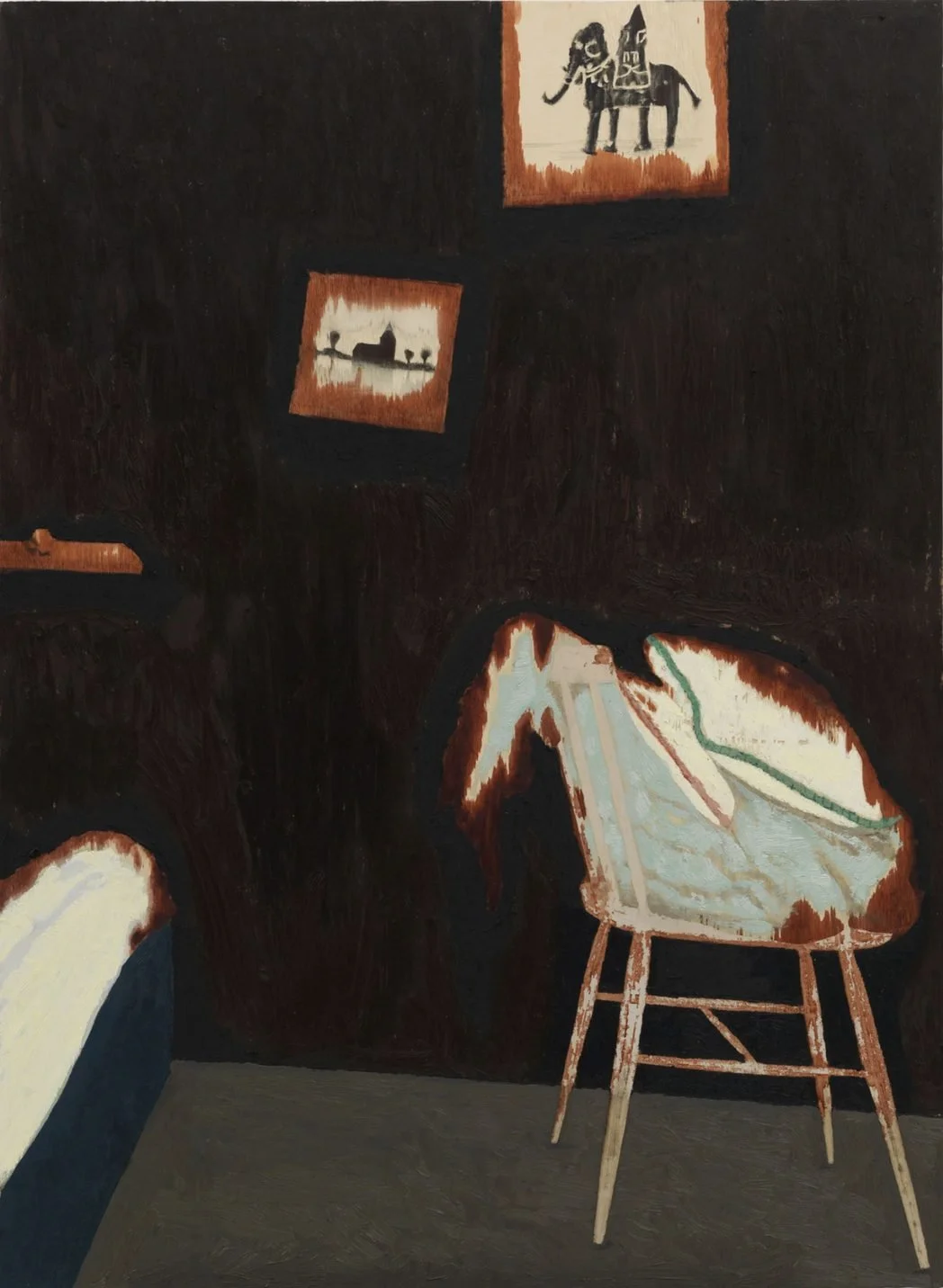
paintings within paintings
theater-like spaces
domestic objects
masks
animals
isolated figures
fragments of historical imagery
At first, these scenes can appear quiet and accessible.
A room contains a chair and table.
A road disappears into a forest.
Swans gather on dark water.
Paintings hang inside another painted interior.
The imagery often feels recognizable, but something remains unsettled.
The perspective may not align.
The scale of an object may feel slightly wrong.
One area is densely painted while another dissolves into thin wash.
The room seems inhabited, but no one is present.
The landscape looks remembered rather than observed.
Andersson draws from photography, film, theater sets, art history, period interiors, and the northern Swedish landscape associated with her upbringing. Her paintings frequently merge different temporal and visual sources rather than describing one stable location or moment.
The deeper problem beneath the work is:
How can painting transform familiar images and places into psychological environments where memory, reality, fiction, and art history remain active at the same time?
Her work does not use atmosphere merely to create mood.
Atmosphere becomes the structure through which the viewer experiences uncertainty.
Familiarity Becoming Strange
Andersson often begins with imagery that appears culturally familiar.
The viewer recognizes:
a domestic interior
a romantic landscape
a theater curtain
a wooden cabin
a lake
a portrait
a still life
a winter road
These subjects carry inherited expectations.
A domestic room should offer shelter.
A landscape should provide spatial orientation.
A theater should distinguish performance from reality.
A photograph should refer to a prior event.
But Andersson weakens those expectations.
Her rooms can feel abandoned, staged, or emotionally unavailable.
Her landscapes can seem inaccessible despite their apparent openness.
Her interiors may contain pictures, objects, and furnishings that fail to establish a coherent life.
Familiarity gives the viewer a point of entry.
Strangeness prevents the viewer from settling there.
Earlier descriptions of her work have emphasized this shift from comfortable domestic or natural imagery toward skewed perspectives, incompatible spaces, effaced edges, and an otherworldly atmosphere.
The central contradiction is:
The scene appears known, but it cannot be remembered completely.
Atmosphere as Structure
Atmosphere is often discussed as if it were a vague emotional quality.
A painting feels melancholy.
A room feels lonely.
A landscape feels mysterious.
But Andersson’s atmosphere is constructed through specific formal decisions.
She uses:
muted and unexpected color
abrupt changes in paint handling
compressed perspective
large empty areas
selective detail
cropped forms
unresolved edges
mismatched scale
graphic silhouettes
layered pictorial references
Her paintings combine textured brushwork, loose washes, stark lines, and evocative color in ways that allow surfaces to shift between density and disappearance.
Atmosphere emerges because the parts do not resolve into one stable reality.
A heavily worked tree may stand against a nearly empty sky.
A flat black shape may interrupt a softly painted room.
An interior may appear deep in one passage and abruptly shallow in another.
The emotional tension comes from the painting’s structure.
The mood is not added afterward.
It is built into how the space behaves.
Memory Without Illustration
Andersson’s work frequently engages memory, but she does not treat memory as a collection of accurate images.
Memory is unstable.
It may:
preserve one detail and lose another
merge several places
attach emotion to an ordinary object
reorganize time
repeat an image incorrectly
convert reality into atmosphere
combine lived experience with images seen elsewhere
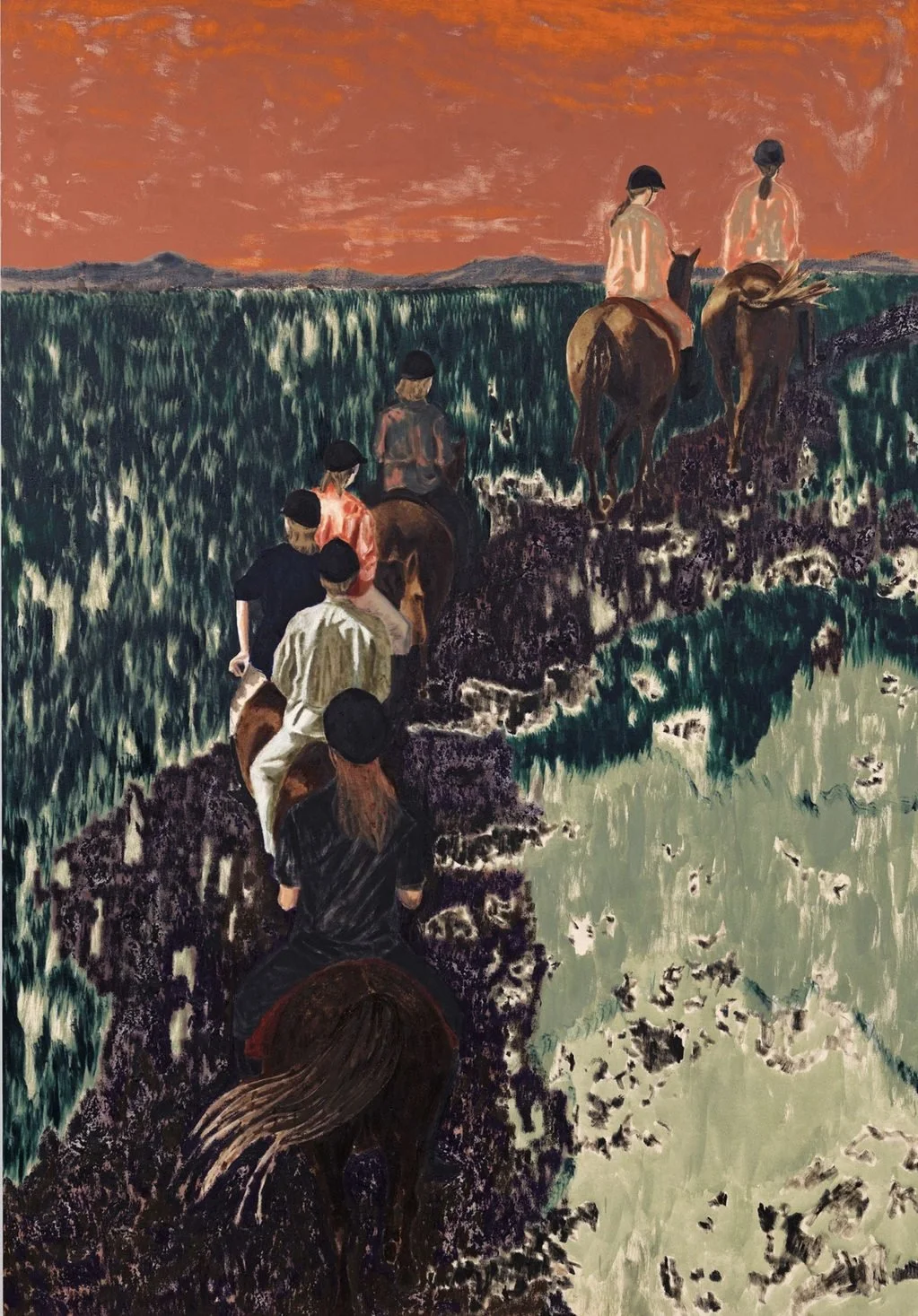
In paintings associated with The Lost Paradise, Andersson revisited motifs including domestic interiors, trees, horses, and young women while connecting childhood recollection with fantasy and imagined futures.
This is important because the paintings do not simply depict remembered subjects.
Their form behaves like memory.
One passage is clear.
Another disappears.
Objects are present without complete context.
Time feels layered.
The past seems near but cannot be entered.
The image appears emotionally specific while remaining narratively incomplete.
Memory becomes a way of organizing uncertainty.
Images Inside Images
Andersson frequently includes paintings, photographs, posters, screens, or framed pictures within her compositions.
This creates several layers of representation.
The viewer may be looking at:
a painting
of a room
containing another painting
based partly on a photograph
altered through memory and invention
Each layer increases distance from any original event.
The image inside the image may become more vivid than the surrounding room.
A reproduction may appear to contain more emotional life than the space in which it hangs.
The painting asks:
Which image is the primary reality?
Does the room contain the memory?
Or has the memory created the room?
Are we looking at lived experience or at a life assembled through images?
This makes the interior behave like a mind filled with stored visual material.
The room becomes less a physical setting than a chamber of association.
The Theater of Domestic Space
Many Andersson interiors feel theatrical.
Furniture appears arranged rather than used.
Curtains frame space.
Objects stand like props.
Walls resemble constructed backdrops.
Rooms seem prepared for an event that has already ended or never began.
Her interest in theater sets and staged imagery contributes to this quality.
The theatricality changes the meaning of domestic space.
Home is usually associated with:
privacy
familiarity
habit
personal history
safety
But a staged home creates doubt.
Is this a real interior?
Is someone performing domestic life?
Has the person left?
Are the objects preserving presence, or revealing absence?
The room offers evidence of life but no complete access to it.
Domestic space becomes both intimate and artificial.
Absence as Presence
Figures appear in some Andersson paintings, but many of her strongest images depend on absence.
An empty chair suggests a body.
A table suggests prior activity.
A cabin implies habitation.
A curtain implies a performance.
A road implies movement.
A painting on the wall implies someone who selected and lived with it.
The missing figure becomes psychologically present through objects and space.
This allows absence to function as more than emptiness.
It becomes a pressure.
The viewer begins reconstructing:
who was here
what occurred
why the space feels abandoned
whether the absence is temporary
whether the scene belongs to memory, fiction, or death
But the painting provides no final answer.
Absence activates the viewer’s imagination while preserving uncertainty.
Landscape as Psychic Space
Andersson’s landscapes often draw upon the sparse topography of northern Sweden, including forests, water, snow, cabins, and mountainous or remote terrain.
Yet the paintings rarely function as straightforward records of place.
The landscape may feel:
remembered
dreamlike
theatrical
foreboding
nostalgic
isolated
emotionally coded
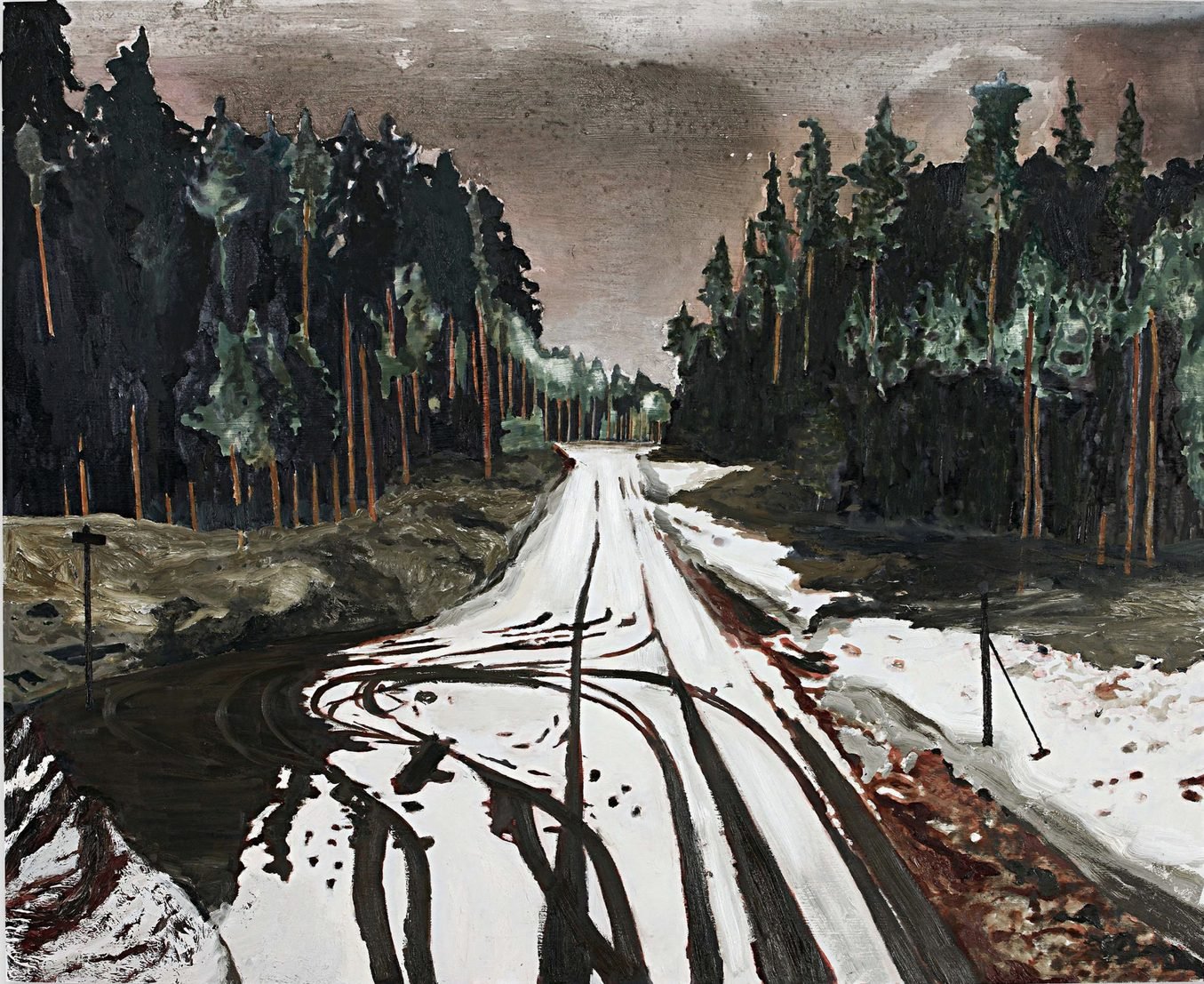
In Dead End, a snowy road moves toward a dark forest, but the image resists simple scenic beauty. The route becomes psychologically charged, suggesting movement without clear destination.
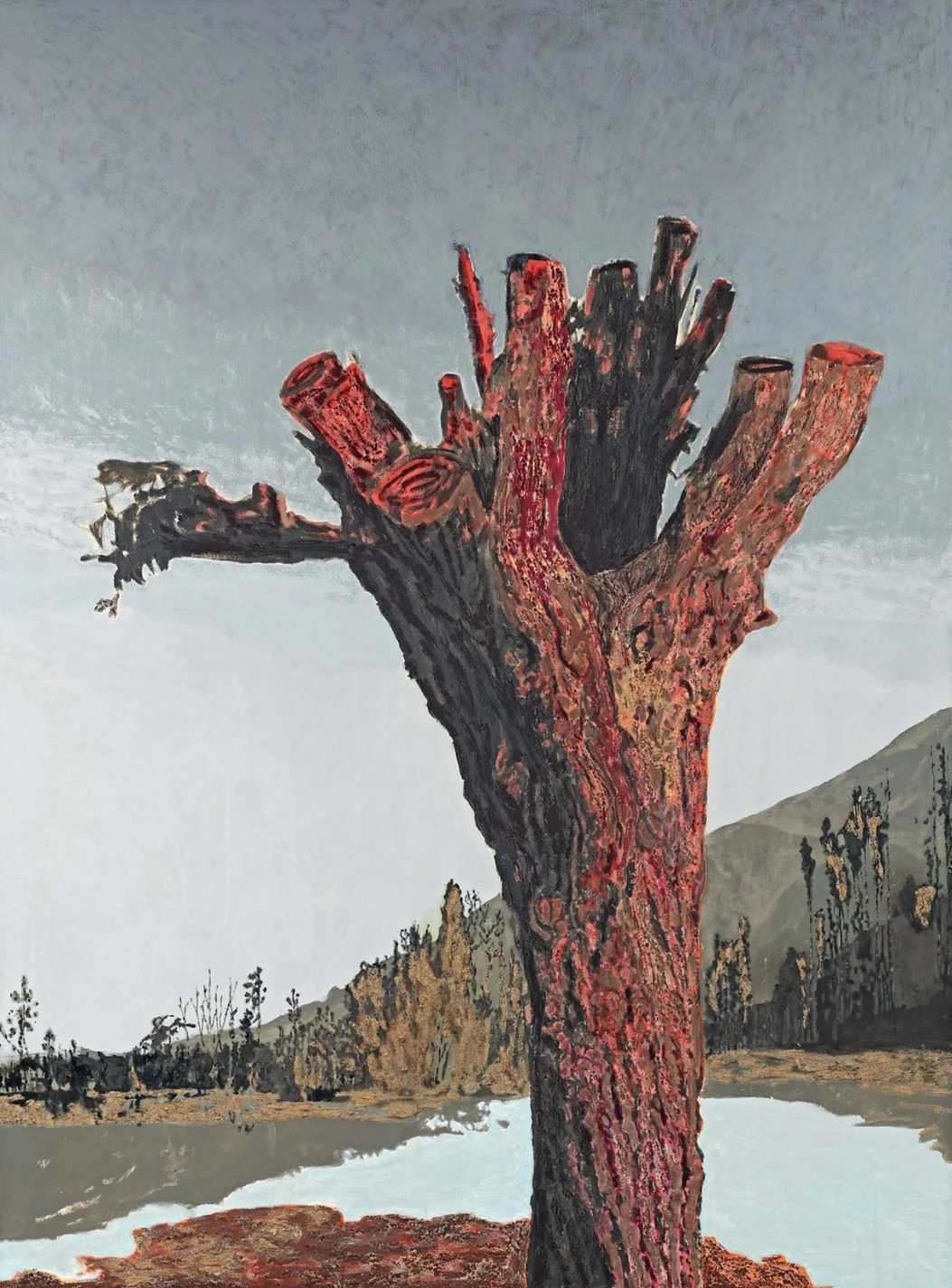
In Silent Dawn, the contrast between thin trees, water, earth, and a dominant foreground trunk creates depth while also obstructing entry.
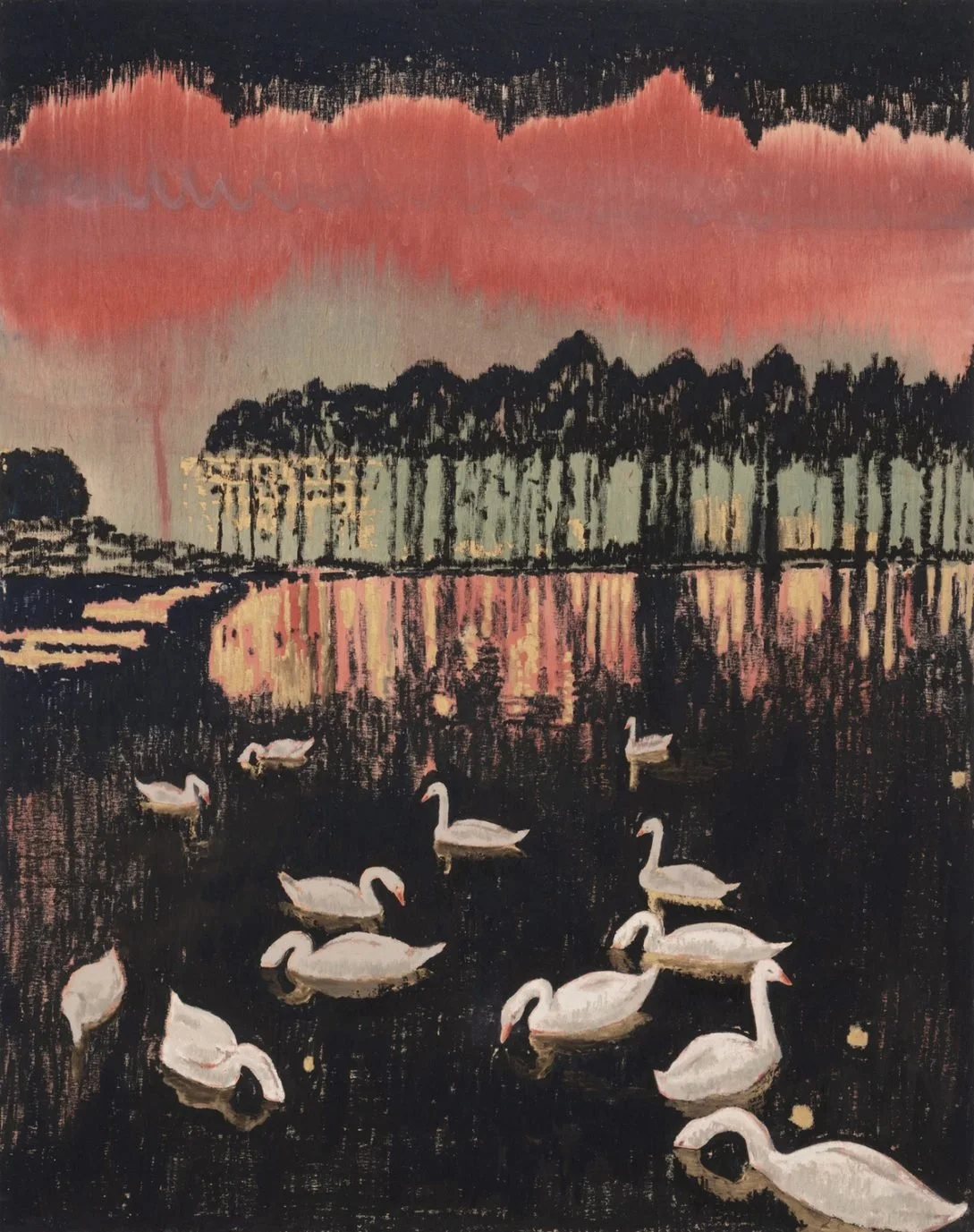
In Swannery, pale birds gather against dark water beneath an intense horizon, turning a natural scene into something ceremonial and uncanny.
The landscape does not merely surround the viewer.
It withholds itself.
Place becomes an emotional condition rather than a geographic fact.
Paint Handling as Psychological Difference
Andersson does not treat the whole canvas uniformly.
One form may be:
thick
tactile
opaque
scraped
graphic
loosely washed
almost unfinished
These different treatments create competing levels of reality.
A heavily painted object may feel immediate and bodily.
A washed-out passage may feel remembered or distant.
A sharp silhouette may resemble a cutout or stage prop.
An erased edge may make the image feel unstable.
The painting’s psychology is partly produced through these material differences.
Not everything belongs to the same degree of presence.
Some things insist.
Others recede.
Some appear real.
Others appear reproduced, imagined, or half-forgotten.
The surface becomes a map of attention and emotional weight.
Romanticism Without Escape
Andersson’s landscapes and interiors often recall nineteenth-century Romanticism, particularly its interest in landscape, solitude, mystery, nature, and subjective feeling. Her gallery has described her work as joining aspects of late nineteenth-century Romanticism with layered contemporary psychological composition.
But she does not simply revive Romantic landscape.
Traditional Romanticism often offered nature as:
sublime
spiritually meaningful
emotionally overwhelming
separate from modern life
Andersson’s landscapes are more mediated.
They may derive from photographs, films, reproductions, memories, and other paintings.
Nature has already passed through culture.
The landscape cannot be experienced innocently.
It is filtered through inherited imagery.
This creates a contemporary Romanticism in which longing remains active, but direct access has become impossible.
Time Without a Stable Period
Andersson’s paintings often lack clear contemporary markers.
Furniture, clothing, interiors, and landscapes may appear to belong to several periods simultaneously.
Her work has been described as evoking timelessness and merging past, present, and future.
This does not produce neutral timelessness.
It creates temporal uncertainty.
The viewer cannot locate the scene comfortably.
The image may feel:
historical
recent
remembered
imagined
post-event
outside ordinary time
This makes the painting behave like memory or dream, where several periods coexist without explanation.
Time becomes another unstable material.
The Everyday as Emotionally Loaded
Andersson often uses ordinary subjects:
chairs
tables
curtains
paintings
trees
roads
animals
household objects
None of these subjects is automatically profound.
Their importance comes from arrangement.
A chair becomes charged because of where it sits, what surrounds it, and who is absent.
A road becomes disturbing because it offers direction without reassurance.
A wall of pictures becomes psychologically dense because the images seem to compete with the room containing them.
The everyday is not transformed through spectacle.
It is transformed through attention and displacement.
This is a useful lesson:
Ordinary subject matter becomes powerful when the relationships around it make the familiar difficult to inhabit.
Narrative Without Story
Andersson’s paintings often suggest that something has happened.
But they rarely explain what.
The viewer may sense:
aftermath
waiting
departure
memory
interruption
secrecy
loss
anticipation
These are narrative conditions without narrative closure.
The painting provides clues but no story.
This differs from vagueness.
The objects and spaces are specific.
The emotional relationships are carefully constructed.
What remains missing is the event that would make everything understandable.
The viewer occupies the gap between evidence and explanation.
Borrowed Images and Original Experience
Because Andersson draws from many existing visual sources, her work raises a question about originality.
How can personal experience emerge from images that already exist?
Her answer lies in transformation.
She does not preserve the source as fixed information.
She changes:
scale
context
color
material
spatial relationships
level of detail
emotional emphasis
A film still, historical photograph, or painting reproduction becomes one element inside a larger psychological construction.
Originality does not require inventing every image from nothing.
It can emerge through the specific relationships an artist creates among inherited images.
Quietness With Pressure
Andersson’s work is important to our research because it demonstrates that pressure does not need to appear loud.
Her paintings often avoid:
monumental spectacle
overt political symbols
aggressive gesture
dramatic narrative
direct confrontation
Yet they remain psychologically dense.
The pressure comes through:
silence
absence
spatial mismatch
uncertain time
material shifts
blocked entry
emotional residue
incomplete narrative
The paintings do not force attention.
They gradually make familiarity unstable.
This is concentrated pressure rather than visual aggression.
The Risk of Mood Painting
Andersson’s greatest strength also creates a risk.
Her images are atmospheric, poetic, and visually appealing.
This can encourage viewers or imitators to reduce the work to:
melancholy interiors
Nordic landscape
muted color
nostalgic imagery
mysterious emptiness
tasteful painterly surfaces
Atmosphere can become a style.
A weak imitation might arrange a sparse room, lower the color, leave the story unclear, and assume that emotional depth will follow.
But mood alone is not enough.
The strongest Andersson paintings depend on precise structural instability:
conflicting space
uneven material presence
images nested inside images
temporal ambiguity
emotional relationships among objects
tension between familiarity and estrangement
The critical question is:
Does the atmosphere emerge from the painting’s structure, or has atmosphere been applied as an aesthetic effect?
The Risk of Nostalgia
Andersson’s use of historical imagery, old interiors, northern landscapes, and memories can also risk nostalgia.
Nostalgia simplifies the past into a lost world of emotional coherence.
Her strongest paintings resist this simplification.
The past does not appear complete or comforting.
It appears fragmented, staged, inaccessible, and contaminated by later images.
The paintings do not return the viewer to a secure past.
They show that the past can only be encountered through incomplete representation.
Why the Work Matters Now
Contemporary life is saturated with images.
Personal memory is increasingly entangled with:
photographs
movies
social media
design imagery
advertising
reproductions
archives
It can become difficult to distinguish what was directly experienced from what was seen through another image.
Andersson’s paintings inhabit this condition.
They show memory as a visual construction assembled from:
lived places
cultural images
art history
fantasy
mood
loss
repetition
Her work suggests that identity and memory are not formed only from events.
They are also formed from images that become internal environments.
What Artists Can Learn
The lesson is not to imitate Andersson’s muted landscapes, empty rooms, nostalgic objects, Nordic atmosphere, or paintings within paintings.
Those are the visible outcomes of her investigation.
The larger lessons are:
Atmosphere should emerge from structure.
Familiar imagery becomes powerful when its stability is disturbed.
An environment can carry psychology without containing a figure.
Absence can make a body more present.
Memory should alter space, material, and focus.
Images within images can expose how perception is mediated.
Uneven paint handling can create different degrees of reality.
Quiet work can sustain significant pressure.
Ordinary objects gain meaning through relationships.
Narrative can remain open without becoming vague.
Historical influence should be transformed into contemporary psychological experience.
Nostalgia becomes deeper when the past remains inaccessible.
Borrowed imagery can become personal through reorganization.
Mood should never replace formal decision-making.
For an artist interested in beauty, environments, identity, and visibility, Andersson offers a particularly useful lesson:
The environment does not need to explain the figure; it can become the emotional and psychological evidence of a figure who is absent, remembered, or still forming.
A useful studio experiment might begin with one familiar interior.
Then produce several versions:
one in which the room shelters the figure
one in which the figure has disappeared but remains psychologically present
one in which pictures and objects overpower the room
one in which the space appears remembered rather than physically observed
one in which beauty becomes slightly artificial or staged
The question would not be:
How do I make the room mysterious?
It would be:
What structural relationship makes this familiar room impossible to experience innocently?
Andersson begins with a recognizable place.
A room appears.
An object remains.
A picture opens another world.
Perspective begins to shift.
One surface thickens.
Another disappears.
The figure is absent.
The past enters the present.
The familiar place becomes emotionally specific but impossible to explain completely.
Mamma Andersson transforms interiors, landscapes, and inherited images into psychological environments where memory, absence, fiction, and reality overlap, proving that atmosphere becomes profound when it is constructed through precise spatial, material, and temporal uncertainty.