What Makes Lisa Yuskavage’s Paintings So Powerful?
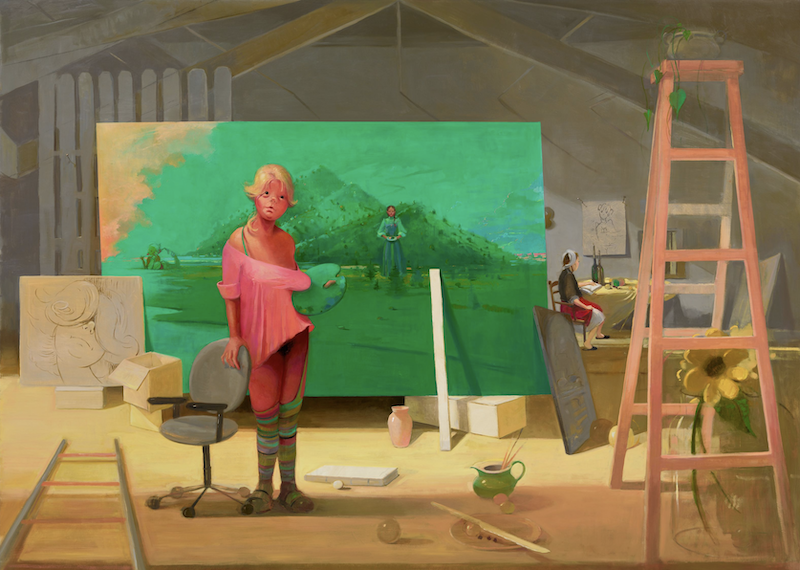
Lisa Yuskavage’s paintings are powerful because they refuse to let beauty stay innocent.
Her work is seductive, but not comfortably seductive. It is vulgar, but not merely vulgar. It is funny, but not light. It is erotic, but also awkward, wounded, theatrical, self-conscious, and strange. Yuskavage has built a world where color, desire, shame, fantasy, art history, and looking all become unstable at the same time.
What makes her work serious is not that she paints provocative women. It is that she makes the viewer feel the instability of wanting, judging, laughing, recoiling, and sympathizing all at once.
Beauty as a Dangerous Problem
Yuskavage keeps returning to one of the most difficult problems in painting:
What happens when beauty, vulgarity, desire, shame, fantasy, and art history occupy the same image?
That question has driven her work for decades. David Zwirner describes Yuskavage as one of the most original and influential painters of the past thirty years, noting that her work affirms the singularity of painting while challenging conventional ideas of genre and viewership. Her characters are described as “at once exhibitionist and introspective,” and her compositions combine representational and abstract elements, with color as the primary vehicle of meaning. (David Zwirner)
That phrase — exhibitionist and introspective — gets close to the heart of her work.
Her figures seem to show too much, but they also seem inaccessible. They are exposed, but not fully available. They can feel absurd, erotic, cartoonish, vulnerable, artificial, and self-aware. The viewer is pulled into the image, but the image does not allow the viewer to feel clean about that attraction.
This is why Yuskavage’s work cannot be reduced to erotic figuration. The deeper subject is the emotional and moral instability of looking.
A World of Color, Desire, and Unease
Yuskavage’s visual world is unmistakable.
It includes saturated color, glowing skies, theatrical interiors, strange studio spaces, doll-like bodies, exaggerated femininity, luminous flesh, acidic light, awkward poses, fantasy landscapes, art-school references, painterly atmosphere, and scenes that feel half-private and half-performed.
Her paintings often seem to belong to a world where everything is too much: the bodies, the color, the mood, the sexuality, the sweetness, the artificiality, the embarrassment. But that excess is not random. It is the climate of the work.
David Zwirner’s 2025 Los Angeles exhibition text emphasizes her fictionalized artist’s studio settings, where spaces become stages and characters from her world are intertwined. The same text highlights Christopher Bedford’s observation that color is Yuskavage’s principal tool for creating meaning — not a supporting element, but the subject’s aura and, in turn, a subject of the painting itself. (David Zwirner)
That is crucial. In Yuskavage, color does not merely beautify the image. Color creates psychological atmosphere.
Pink can feel erotic, childish, artificial, tender, or suffocating.
Green can feel toxic, pastoral, dreamy, or sickly.
Yellow can feel radiant, spiritual, cheap, or unstable.
Red can feel theatrical, sexual, violent, warm, or claustrophobic.
Her color often seduces first and unsettles second. It turns beauty into pressure.
The Viewer Is Never Neutral
One reason Yuskavage’s work has such force is that it implicates the viewer.
The viewer is not simply looking at a figure. The viewer becomes aware of looking. The work asks: What do you want from this image? Are you attracted? Amused? Embarrassed? Judgmental? Protective? Disgusted? Curious? Complicit?
David Zwirner’s 2018 press release says Yuskavage’s characters assume dual roles as both subject and object, complicating the position of viewership. It also describes them as playful and harmonious at times, rueful and conflicted at others, inside fantastical compositions where realistic and abstract elements coexist and color determines meaning. (David Zwirner)
That “dual role” matters. Her figures are looked at, but they also seem to know something about being looked at. They are objectified, but not passive. They can seem cartoonish, yet emotionally specific. They can appear ridiculous, yet strangely dignified.
A weaker artist might paint sexualized figures and produce either fantasy or critique.
Yuskavage’s stronger move is that she refuses to make the viewer’s role simple. The work does not let the viewer stand safely outside the image and declare it either empowering or exploitative, beautiful or ugly, sincere or ironic. The viewer has to sit inside the contradiction.
Painting Against Good Taste
Yuskavage’s paintings often risk bad taste.
That is part of their power.
They risk sweetness, vulgarity, sentimentality, kitsch, awkwardness, and overripe beauty. They risk being misunderstood as merely provocative or regressive. But the risk is not accidental. It belongs to the work’s deepest question.
A New Yorker review from 2011 described Yuskavage’s work as having “dangerous beauty,” noting her fusion of kitsch elements with techniques recalling Old Masters and her creation of complex, art-historical narratives inside provocative paintings. (The New Yorker)
That mixture is important. Yuskavage is not simply rejecting tradition. She is contaminating it. Old Master light, art-school figure painting, erotic fantasy, bad-girl imagery, cartoonish exaggeration, and painterly beauty all coexist in the same unstable space.
Her work asks what happens when painting’s refined traditions meet images that polite taste wants to dismiss as vulgar, embarrassing, or low.
That is why the paintings can feel so alive. They do not protect themselves with good taste.
The Studio as Theater
In recent work, Yuskavage has increasingly used the imagined studio as a stage. This is significant because it turns the process of art-making itself into part of the drama.
David Zwirner’s 2023 Paris exhibition text describes large-scale paintings set in imagined artist’s studios, saturated with jewel-like pigments. These studio spaces become stages where characters from her oeuvre are intertwined, and the exhibition title Rendez-vous suggests the way painting allows different moments in time to coexist in one space. (David Zwirner)
This makes the work more self-aware.
The studio is not just a setting. It is a theater of looking, making, modeling, posing, remembering, staging, and repeating. The figures are not only subjects. They are characters inside painting’s own history.
The studio becomes a place where the model, painter, viewer, artwork, and fantasy all meet.
Why the Work Lasts
Yuskavage’s paintings last because they do not resolve.
They hold contradiction:
beautiful and vulgar
tender and cruel
funny and sad
erotic and embarrassing
painterly and kitsch
artificial and emotionally exposed
high art and low culture
subject and object
fantasy and self-awareness
This is where her work gains interpretive stamina. The viewer cannot summarize it too easily. Every clear reading produces its opposite.
If the work is feminist, why does it seem to indulge the very imagery it critiques?
If it is erotic, why is it so awkward?
If it is vulgar, why is it so painterly and tender?
If it is funny, why does it feel so lonely?
If the figures are objectified, why do they also seem strangely inward?
These contradictions are not weaknesses. They are the engine of the work.
What Artists Can Learn from Yuskavage
The lesson is not to imitate Yuskavage’s figures, sexuality, color, or provocation.
The lesson is that beauty becomes powerful when it is allowed to become unstable.
Yuskavage shows that “bad taste” can be serious if it is transformed into pressure. Kitsch can become psychological. Vulgarity can become a way to expose the viewer’s expectations. Color can become emotional weather. Eroticism can become a trap, a performance, a wound, or a mirror.
A weaker artist might think:
“I should make my work more provocative.”
A stronger lesson would be:
“What kind of beauty am I afraid to risk? What kind of discomfort does my work need to hold without resolving?”
Yuskavage’s strongest work is not powerful because it shocks. It is powerful because it makes looking feel morally, emotionally, and aesthetically unstable.
Closing Insight
Lisa Yuskavage’s greatness is not that she paints desire. It is that she makes desire uncomfortable, funny, beautiful, vulgar, tender, and impossible to fully separate from the viewer’s own act of looking.