What Makes Tracey Emin’s Work So Powerful?
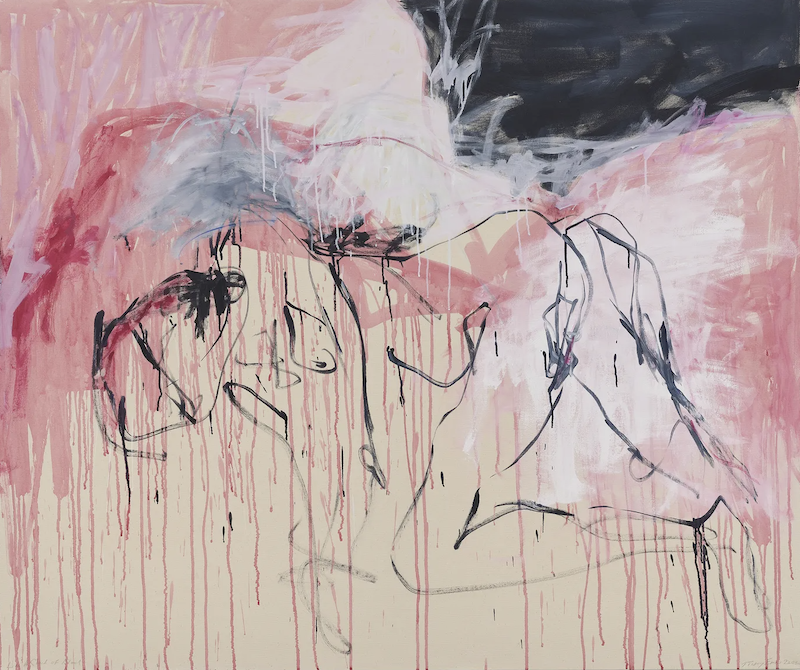
Tracey Emin’s work is powerful because it turns exposure into form.
At first, her art can seem almost too direct: beds, bodies, lovers, abortions, grief, loneliness, illness, sex, handwritten confessions, raw lines, urgent color, and emotional declarations. But the strength of Emin’s work is not simply that she reveals private pain. The strength is that she transforms vulnerability into an artistic language.
Her work asks a difficult question again and again:
How can private experience become public form without becoming merely diary, spectacle, or sentimentality?
That is the problem underneath the practice. Emin looks directly at love, desire, loss, grief, shame, solitude, illness, and survival, but the work is strongest when experience becomes structure: line, text, fabric, object, bed, body, neon, scale, absence, and gesture.
Life as Material, Not Just Biography
Emin’s work is often described as autobiographical, but that word can be misleading if it makes the art sound like a life story simply placed into a gallery.
White Cube writes that Emin “looks to her life for her primary material,” using candor to probe both the construction of the self and the impulse to create. The gallery connects her work to love, desire, loss, grief, self-portraiture, the nude, family, childhood, troubled adolescence, relationships, pregnancies, abortions, writing, neon, sculpture, film, drawing, and painting. But crucially, it says these experiences are explored in a way that is “neither tragic nor sentimental,” intersecting with her commitment to the formal disciplines of art. (White Cube)
That phrase matters: neither tragic nor sentimental.
This is what keeps Emin’s strongest work from becoming simple confession. She does not merely say, “This happened to me.” She turns what happened into an object, a mark, a room, a surface, a sentence, a trace, or a bodily atmosphere.
A weaker artist might use trauma or vulnerability as proof of depth.
Emin’s stronger move is to make vulnerability behave formally. The rawness becomes line. The grief becomes space. The bed becomes sculpture. The sentence becomes image. The body becomes mark.
A World of Exposure, Absence, and Emotional Directness
Emin has built a visual world that is instantly recognizable, even though she works across many media.
Her world includes:
handwritten text,
neon declarations,
embroidered blankets,
beds and rooms,
loose drawn bodies,
red and blue painterly marks,
white space,
sexual memory,
absence,
loneliness,
female bodily experience,
and a voice that feels exposed but controlled.
This world is not polished in the conventional sense. It often feels urgent, wounded, stripped down, and emotionally immediate. But it is not careless. The simplicity is part of the force.
White Cube notes that her choice of medium is integral to the story she tells. Her hand-embroidered blankets and quilts, associated with women’s work, combine uneven stitching, scraps of material, and uncorrected syntax to make language physically vulnerable. (White Cube)
That is the visual world: the private made material, but not cleaned up.
The work often feels as if it is close to collapse. A line barely holds a body. A sentence barely holds grief. A room barely holds memory. A bed barely holds a life. But that fragility is the point. Emin’s world is built from things that seem unable to fully protect the self.
Why the Surface Feels Charged
The pressure in Emin’s work comes from the tension between exposure and form.
The work often feels emotionally naked, but it is also composed. It risks confession, but it is not only confession. It risks sentiment, but it does not become sentimental. It risks spectacle, but it often turns spectacle back into loneliness.
Her famous installation My Bed is a clear example. White Cube describes the work as an uncensored re-presentation of her own bed during a distraught period, with objects such as slippers, condoms, cigarettes, empty bottles, and underwear accumulating around it. The gallery frames the bed as abstracted from function, placed in conversation with art history, and transformed into a stage for life events: birth, sleep, sex, depression, illness, and death. (White Cube)
That is why My Bed is not only a messy bed.
It is a portrait without a body.
A self-portrait through aftermath.
A domestic object turned into evidence.
A private collapse placed in public view.
A stage where absence becomes presence.
The pressure comes from the viewer’s discomfort. We are looking at something most people would hide. But we are also looking at a carefully framed object inside the history of art. The work implicates the viewer: are we witnessing, judging, pitying, consuming, or intruding?
The Body as Line
In Emin’s recent paintings, the body often appears through loose, urgent, almost collapsing marks. Figures are suggested rather than fully described. The body can seem wounded, dissolving, sexual, grieving, or half-remembered.
White Cube’s 2024 exhibition I followed you to the end describes new paintings and sculptures moving through love and loss, mortality and rebirth. The gallery emphasizes her expressive painterly vocabulary, with deft, impulsive strokes capturing figures “in the throes of becoming,” while carmine, ivory, deep blues, and black temper volatile physical and emotional states with contemplation and stillness. (White Cube)
That phrase — figures in the throes of becoming — is very useful.
Emin’s bodies often do not feel fixed. They feel like bodies remembered, desired, lost, mourned, or barely held together. The line does not simply outline the figure. It enacts the instability of being a body under emotional pressure.
The drawing is not weak because it is loose. The looseness is the structure.
A tighter, more anatomically resolved figure might actually weaken the work because it would make the body too stable. Emin’s bodies need to tremble, smear, bend, disappear, and return.
The Risk of Sincerity
Emin’s work risks sincerity in a way that many contemporary artists avoid.
Irony can be protective. Theory can be protective. Coolness can be protective. Even shock can be protective if it keeps the artist from appearing emotionally exposed.
Emin often refuses that protection.
Her work risks being called too much: too personal, too raw, too emotional, too direct, too confessional, too embarrassing. But that risk is also where the force comes from. The work does not hide behind taste.
White Cube quotes Emin saying, “The most beautiful thing is honesty, even if it’s really painful to look at.” (White Cube)
That honesty can be difficult because it does not arrive as refined autobiography. It arrives as evidence: stained sheets, stitched words, uneven spelling, exposed names, empty bottles, bodies drawn in red, a bed made public.
The work’s danger is that it could fail as art and collapse into confession. But when it succeeds, confession becomes form.
Why the Work Lasts
Emin’s work lasts because it holds contradiction.
It is raw and disciplined.
Personal and public.
Exposed and formal.
Vulnerable and confrontational.
Feminine and aggressive.
Tender and brutal.
Private and theatrical.
Confessional and art-historical.
Sincere and difficult to trust completely.
The viewer never gets a neutral position. You may feel moved, uncomfortable, skeptical, protective, repelled, or implicated. That instability is part of the work’s strength.
The strongest Emin works do not ask only, “What happened to the artist?”
They ask:
What do we hide?
What do we display?
What does pain look like after the body leaves the room?
How much honesty can an artwork hold?
When does vulnerability become spectacle?
When does private experience become public truth?
Those questions are larger than biography.
What Artists Can Learn from Emin
The lesson is not to make confessional art.
That would be the wrong takeaway.
The lesson is that personal material only becomes strong when it is transformed into form. Emin’s work is powerful when the line, object, surface, text, material, or space carries the emotional pressure. The biography may open the door, but the artwork has to stand on its own.
A weaker artist might think:
“I should reveal more.”
A stronger lesson would be:
“What experience, feeling, memory, or vulnerability can I transform into a visual language?”
Or even better:
“What form does this emotional pressure require?”
Emin shows that honesty is not enough by itself. Honesty has to become structure.
Closing Insight
Tracey Emin’s greatness is not that she exposes her life. It is that she turns exposure into a language of line, object, text, body, absence, and emotional risk.