What Makes Lorna Simpson’s Work So Powerful?
Lorna Simpson’s work is powerful because it makes images withhold as much as they reveal.
Her art is not only about representation, identity, race, gender, or history. It is about the instability of representation itself. What can an image tell us? What does it refuse to tell us? What happens when language seems to clarify an image but actually makes it more mysterious? What happens when the body is fragmented, turned away, partially obscured, or submerged inside history?
Simpson’s work matters because she does not simply make hidden subjects visible. She makes visibility itself difficult.
When Images Refuse to Explain Themselves
Simpson first became widely known for conceptual photography that paired staged images with text. These works often showed Black figures from behind or in fragments, set against neutral backgrounds, accompanied by language that seemed to offer clues but never fully resolved the image.
Hauser & Wirth describes Simpson’s early work as using juxtapositions of text and staged images to raise questions about representation, identity, gender, race, and history. The gallery notes that she was part of a generation of artists using conceptual strategies to undermine the apparent neutrality of language and images. Her figures were often seen only from behind or in fragments, and her text created an “equivocal web of meaning” where what is unseen and unsaid becomes as important as what is disclosed. (Hauser & Wirth)
That is the pressure at the center of Simpson’s work.
The image does not give full access.
The text does not solve the image.
The viewer is not allowed to possess the subject.
This is very different from simple portraiture. Simpson’s work does not say, “Here is who this person is.” It asks why viewers expect images to deliver identity in the first place.
The Problem Beneath the Work
Simpson keeps returning to a deep and durable problem:
How can art expose the limits of images and language in representing race, gender, memory, history, and the self?
That question has allowed her practice to expand across photography, text, collage, film, video, painting, drawing, sculpture, and found imagery without losing its core.
The subject is not merely Black identity or female identity, though both are central. The deeper issue is how identity becomes framed, fragmented, interpreted, misread, archived, projected onto, and withheld.
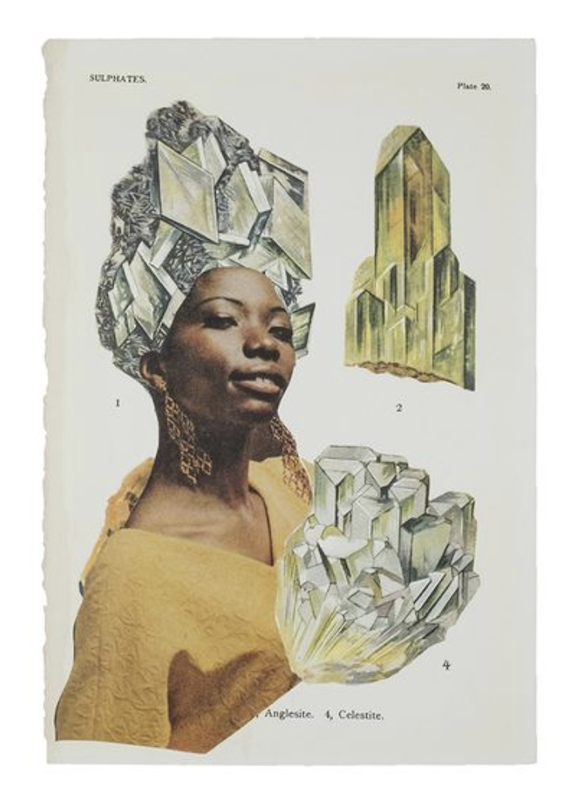
Hauser & Wirth notes that over more than thirty years Simpson has continued to probe these questions while expanding her practice across media, including film, video, painting, drawing, and sculpture. Her recent work incorporates vintage Jet and Ebony magazine imagery, found photo booth images, discarded press photographs, and natural elements such as ice, continuing to thread paradoxes of figuration and abstraction, past and present, destruction and creation, and male and female. (Hauser & Wirth)
That expansion matters. Simpson is not repeating one successful format. She is returning to the same problem under new conditions.
The question moves from staged photography to collage.
From collage to painting.
From text to atmosphere.
From the body to weather.
From the archive to the environment.
From representation to disappearance.
The problem stays alive because the image never becomes trustworthy enough to settle.
A World of Fragments, Text, Ice, Blue, and Withheld Bodies
Simpson has created a visual world built from partial access.
Her recurring vocabulary includes:
fragmented bodies,
turned backs,
cropped faces,
wigs,
text fragments,
magazine images,
photo booth pictures,
ice,
blue-black atmospheres,
washed-out landscapes,
found photographs,
and images that seem to hover between evidence and dream.
In her early work, the world is often spare and conceptual: bodies isolated against neutral space, text arranged like evidence, images stripped of context. In later work, especially her large paintings, the world becomes more atmospheric and immersive. The image is no longer only withheld through cropping or text. It is submerged in pigment, weather, water, ice, darkness, and blue.
Hauser & Wirth’s text for Darkening describes Simpson’s large-scale paintings as combining figuration and abstraction, with spliced photos and fragmented text abstracted beyond comprehension inside inky washes of black, gray, and startling blue. The exhibition returned to long-standing themes of representation, identity, gender, race, and history while expanding them through vast, poetic tableaux. (Hauser & Wirth)
This is a major shift, but not a break.
The early work withholds through framing and language.
The later work withholds through atmosphere and material.
The world remains Simpson’s because the viewer is still dealing with partial knowledge.
Why the Surface Feels Charged
Simpson’s surfaces feel charged because they contain tension between evidence and obscurity.
Found photographs usually promise access to the real. Magazine images promise glamour, lifestyle, aspiration, beauty, and cultural memory. Text promises clarification. Ice and weather promise natural metaphor. But Simpson does not allow these materials to behave innocently.
A photograph becomes unstable.
A magazine image becomes haunted.
A body becomes partial.
Text becomes fragmentary.
Ice becomes memory, preservation, danger, erasure, and historical chill.
Blue becomes beauty, atmosphere, melancholy, depth, and threat.
In Unanswerable, Hauser & Wirth explains that Simpson continued developing found images from vintage Ebony and Jet magazines, publications that chronicled Black life and culture when those subjects were underrepresented elsewhere. Simpson connected this to fragmentation, saying that fragmentation of the body is prevalent in culture and reflected in her work: people are fragmented both by the way society regulates bodies and by the way people think about themselves. (Hauser & Wirth)
That gives the work its force.
Fragmentation is not just a style. It is social, psychological, historical, and bodily.
The body is fragmented because the image fragments it.
Society fragments it.
Memory fragments it.
Language fragments it.
The viewer’s expectations fragment it.
This is why Simpson’s work can feel quiet and severe but still deeply charged.
The Viewer Becomes Part of the Problem
Simpson’s work implicates the viewer by making looking uncertain.
You may want the image to tell you who someone is.
You may want the text to explain what you are seeing.
You may want the archive to provide historical truth.
You may want the face to become legible.
But Simpson often denies that satisfaction.
The viewer becomes aware of their own habits: reading bodies, assigning identity, trusting photographs, filling gaps, wanting access, assuming that a visible subject is a knowable subject.
This is especially powerful in the early work, where the figures are often seen from behind or in fragments. The subject is present, but not available for easy consumption. The image allows looking while resisting possession.
That resistance is central to Simpson’s intelligence.
Her work does not simply correct misrepresentation by offering a clearer image. It challenges the entire desire for images to make people fully knowable.
Painting After Photography
Simpson’s move into large-scale painting is especially interesting because it does not abandon her earlier concerns. It expands them.
A Vogue profile described Simpson’s move from photography-based art into painting as a radical change, noting large canvases that evoke natural turbulence while continuing her long-standing engagement with race, gender, identity, and image-making. (Vogue)
The recent paintings are not just atmospheric. They transform photographic and archival sources into unstable fields. The image becomes less legible, but more physically present.
This is where Simpson’s work becomes especially useful for painters.
She shows that painting can take photographic material and make it less certain, not more. Instead of translating a photograph into a clearer image, she lets painting introduce atmosphere, ambiguity, weather, and time.
The photograph becomes haunted by paint.
Why the Work Lasts
Simpson’s work lasts because it does not answer the questions it raises.
It holds contradiction:
visible and withheld
documentary and fictional
archival and dreamlike
personal and historical
beautiful and severe
racially specific and formally open
textual and ambiguous
photographic and painterly
evidence and mystery
That unresolved quality gives the work interpretive stamina. The viewer keeps returning because no single reading fully explains the image.
Is this about identity? Yes, but not only identity.
Is this about photography? Yes, but not only photography.
Is this about race and gender? Yes, but not only race and gender.
Is this about memory? Yes, but memory as mediated, fragmented, and historically pressured.
Simpson’s power lies in refusing to flatten those pressures into one message.
What Artists Can Learn from Simpson
The lesson is not to imitate Simpson’s text-image format, blue palette, magazine fragments, or archival sources.
The lesson is to understand how withholding can create force.
A weaker artist might think:
“I should make the image more mysterious.”
A stronger lesson would be:
“What does my work refuse to give the viewer, and why?”
Simpson shows that ambiguity becomes powerful when it is specific. Her work is not vague. It is withheld. That is different.
Vagueness comes from not making enough decisions.
Withholding comes from making precise decisions about access, identity, language, memory, and power.
For artists, that distinction is essential.
The work does not have to explain everything. But it does have to know what it is withholding.
Closing Insight
Lorna Simpson’s greatness is not that she represents identity. It is that she makes representation itself unstable, showing how images, language, memory, and history reveal the self only by also concealing it.