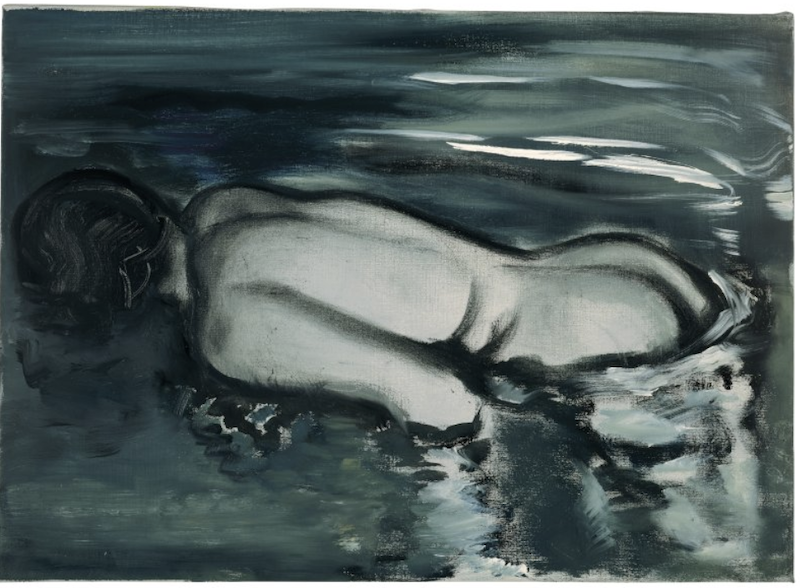
What Makes Marlene Dumas’s Paintings So Powerful?
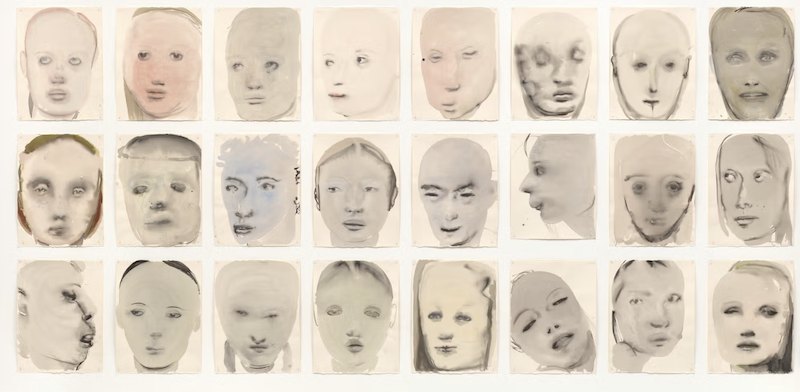
Marlene Dumas’s paintings are powerful because they turn secondhand images into firsthand emotional encounters.
At first, the work often appears direct. A face fills the canvas. A body stands alone. A child looks outward. A dead celebrity lies exposed. A lover, victim, political figure, model, saint, criminal, or anonymous stranger becomes the center of attention.
Yet the paintings do not provide stable portraits.
The features bleed, stain, dissolve, and shift. Flesh becomes pale, blue, green, bruised, gray, pink, red, or nearly transparent. Eyes appear watchful, vacant, accusatory, seductive, terrified, exhausted, or impossible to read. A mouth may suggest pleasure, grief, silence, death, or violence at the same time.
The figures feel intensely present.
But they do not become fully knowable.
Dumas’s paintings are rarely made directly from a living model. They emerge from an extensive archive of photographs drawn from newspapers, magazines, pornography, film, art history, personal snapshots, police images, and other forms of visual culture. She takes images that have already been framed, circulated, interpreted, consumed, or forgotten and subjects them to the instability of paint. (David Zwirner)
The result is not simply a painted copy of a photograph.
It is a confrontation with what happens when one person looks at another through an image.
The Problem Beneath the Work
Dumas repeatedly returns to a central artistic problem:
How can painting recover emotional, bodily, and moral intensity from images that have already been mediated, circulated, and culturally interpreted?
This problem allows her work to move across an enormous range of subjects:
Love
Sex
Birth
Death
Race
Apartheid
Religion
War
Celebrity
Motherhood
Shame
Grief
Violence
Political power
Vulnerability
The subjects differ, but the central tension remains.
A photograph appears to preserve a person or event. Yet every photograph also creates distance. It freezes one instant, removes context, converts a body into an image, and places that image in the hands of viewers who may know nothing about the person depicted.
Dumas begins inside that distance.
She does not attempt to restore the original person completely. Painting cannot return a dead body to life, explain a stranger’s inner world, or recover everything that existed outside the photographic frame.
Instead, she makes the distance itself emotionally active.
The painting asks:
What does this image allow the viewer to feel?
What has already been taken away?
What is being projected onto the subject?
What happens when private experience becomes public imagery?
Can an image preserve dignity while exposing the body?
Can paint make a familiar face strange enough to be seen again?
The deeper subject is not only the person represented.
It is the burden placed upon the image.
The Image as Burden
The title of Dumas’s major retrospective, The Image as Burden, offers one of the clearest ways to understand her practice. The exhibition brought together more than one hundred works and later traveled from the Stedelijk Museum to Tate Modern and Fondation Beyeler. (Stedelijk Museum)
An image becomes a burden because it carries meanings that exceed the person depicted.
A face may carry:
Race
Gender
Fame
Crime
innocence
sexuality
political history
religious symbolism
public scandal
private grief
the viewer’s desire
the viewer’s fear
Once an image enters public circulation, it is no longer controlled by its subject.
A photograph of Marilyn Monroe can become glamour, tragedy, celebrity, sexuality, exploitation, nostalgia, mortality, or cultural decline.
A photograph of a political prisoner can become evidence, propaganda, spectacle, memorial, or news.
A photograph of a child can evoke innocence, vulnerability, discomfort, possession, or fear.
Dumas does not remove those associations.
She allows them to accumulate.
But paint makes them unstable.
The painted image no longer carries the apparent factual certainty of photography. Features distort. Color becomes emotional rather than descriptive. The source is translated through touch, speed, hesitation, accident, and interpretation.
The image remains burdened, but its burden becomes visible.
From Secondhand Image to Firsthand Encounter
Dumas has often worked from images she did not create herself.
This could seem to increase distance from the subject.
Instead, it becomes the source of the work’s intensity.
The photographic source has already transformed life into representation. By painting from that source, Dumas introduces another transformation.
The process might be understood as a sequence:
A person or event exists.
A camera extracts an image.
The image enters an archive or public culture.
Dumas selects it.
Painting alters its scale, color, surface, emphasis, and emotional temperature.
The viewer encounters a new object with only an indirect connection to the original person.
Each stage creates loss.
But each stage also creates new meaning.
Dumas does not hide the fact that the image is mediated. She emphasizes it. The paintings often feel like memories of photographs rather than windows onto reality.
This is why they can seem both intimate and remote.
The viewer is brought close to a face while remaining separated from the life behind it.
Paint as Emotional Instability
Dumas’s handling of paint is fluid, economical, and often visibly vulnerable.
A wash may run downward like tears, blood, sweat, water, or photographic degradation. A single dark stroke may create an eye, shadow, wound, or mouth. Thin paint allows the canvas to remain visible beneath the figure. Features may appear to have been discovered within the stain rather than carefully built through conventional modeling.
This apparent looseness is not merely expressive style.
It allows the image to remain psychologically unstable.
A fully modeled face can create the illusion of solidity. Dumas’s faces often seem to be forming and disintegrating simultaneously.
The paint may suggest:
A body coming into visibility
A memory fading
Flesh losing life
Identity becoming uncertain
Emotion moving across a face
A photograph chemically deteriorating
A person becoming an image
The material behaves like the instability of representation itself.
Paint does not simply describe vulnerability.
It becomes vulnerable.
Why the Formal Choices Matter
Dumas’s work can appear spontaneous, but the formal language is highly purposeful.
Thin paint prevents bodily certainty
Her figures frequently appear through translucent washes and abbreviated marks.
This thinness makes the body feel exposed and insubstantial. It can seem present but unable to defend itself against the viewer.
The figure is not protected by thick material or polished illusion.
It hovers near disappearance.
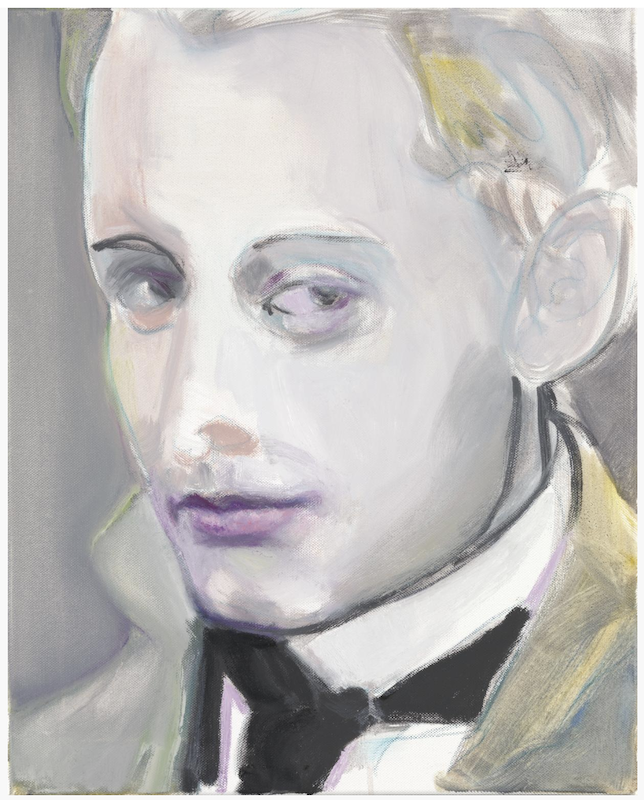
Distorted color separates emotion from likeness
Dumas rarely depends on naturalistic skin color.
Faces may become blue, green, gray, violet, blood-red, or ghostly white. These changes prevent the viewer from treating color as neutral description.
Color may carry:
Fear
Illness
erotic charge
death
racial projection
artificiality
shame
coldness
spiritual intensity
emotional distance
The color does not simply tell viewers how to feel. It destabilizes the category of the body being seen.
A pale face may appear innocent, diseased, dead, spectral, racially coded, or overexposed by photographic light.
The uncertainty remains active.
Cropping creates confrontation
Many portraits fill the canvas tightly.
The face may be cut off near the forehead, chin, or sides. The figure has little environmental context.
This removes narrative escape.
The viewer cannot look elsewhere.
The face becomes an event.
But the closeness does not necessarily create intimacy. It can also resemble surveillance, mugshots, medical photographs, pornography, news photography, or the involuntary exposure of a body.
Cropping intensifies presence while withholding knowledge.
Scale changes the politics of looking
Dumas moves between very small paintings and monumental standing figures.
Small works can feel private, fragile, or almost devotional. The viewer must approach closely.
Large bodies become public, confrontational, and difficult to possess visually. In Myths & Mortals, monumental full-length figures over nine feet tall stood alongside much smaller works, creating dramatic shifts between intimacy and authority. (Marlene Dumas)
Scale allows vulnerability and power to change places.
A naked body may appear exposed at one size and commanding at another.
A famous face may become unexpectedly small, as in Dead Marilyn, which measures only about sixteen by twenty inches despite the subject’s enormous cultural presence. (The Museum of Modern Art)
Empty grounds isolate the figure
Many bodies appear against simplified or undefined backgrounds.
This removes social context and places pressure on gesture, posture, expression, and color.
The subject becomes both an individual and an image detached from ordinary life.
The emptiness may suggest:
Studio space
photographic backdrop
psychological void
public display
timelessness
death
isolation
The figure has nowhere to hide.
Titles redirect interpretation
Dumas’s titles often create friction with the image.
A title may introduce biography, mythology, politics, humor, poetry, or contradiction. It can turn an anonymous figure into a historical subject or make an apparently straightforward portrait more unstable.
The title does not solve the painting.
It adds another voice.
The viewer must negotiate among image, source, title, cultural memory, and personal response.
The Face as an Unstable Field
Dumas is often described as a portrait painter, but her portraits do not behave like conventional records of personality.
They do not promise access to the authentic self.
Instead, the face becomes a field where competing interpretations gather.
A face may be:
A person
A mask
A racial category
A public persona
A sexual object
A victim
A celebrity
A corpse
A political symbol
A remembered loved one
An image separated from its owner
The face appears to offer access because human beings are trained to read emotion through facial expression.
Dumas exploits that expectation.
An eye may seem frightened and then accusing.
A mouth may appear sensual and then wounded.
A blank expression may suggest dignity, shock, vacancy, resistance, or death.
The viewer keeps interpreting because the face appears readable.
The painting remains powerful because that reading never becomes secure.
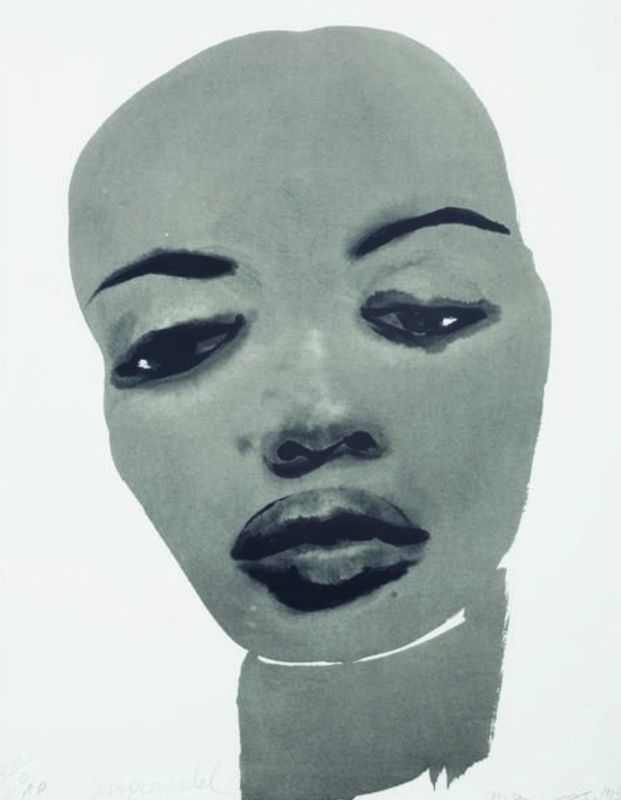
Exposure and Withholding
Dumas frequently depicts nude or partially nude bodies.
Yet nudity in her work does not produce complete access.
A body may be visually exposed while remaining psychologically withheld.
This is a crucial contradiction.
The viewer can see skin, genitals, breasts, posture, and physical vulnerability. But visibility does not produce possession.
The body may resist through:
Direct gaze
Scale
awkwardness
distortion
emotional opacity
paint
title
absence of narrative
refusal of ideal beauty
Dumas’s figures often appear vulnerable without becoming passive.
They may be embarrassed, sensual, defiant, isolated, exhausted, grieving, or self-possessed. The work does not assign one stable identity.
This allows the body to remain human rather than becoming a simple symbol.
Desire, Shame, and the Viewer
Dumas’s work repeatedly connects painting with desire.
But desire is rarely clean or celebratory.
It may contain:
Awkwardness
loneliness
age
power
objectification
jealousy
shame
grief
absence
fear of loss
Her writing on Myths & Mortals emphasizes emotional multiplicity: eroticism can coexist with injury, love with death, pleasure with isolation, and attraction with awkwardness. (Marlene Dumas)
This makes the viewer’s position unstable.
The viewer may feel attracted to a figure and then become uncomfortable with that attraction.
A vulnerable body may generate tenderness and voyeurism simultaneously.
A corpse may provoke horror, curiosity, grief, and visual fascination.
A child’s face may appear innocent and disturbingly exposed.
Dumas does not tell the viewer which response is morally correct.
She makes the conflict visible.
The viewer becomes aware that looking is never neutral.
Death and the Limits of Portraiture
Death appears repeatedly in Dumas’s work.
This may take the form of:
Corpses
mourning
political victims
suicide
murder
dead celebrities
religious death
mythological death
personal bereavement
Death creates the ultimate problem for portraiture.
A portrait traditionally preserves presence.
A death image records absence.
The person is visible but no longer available.
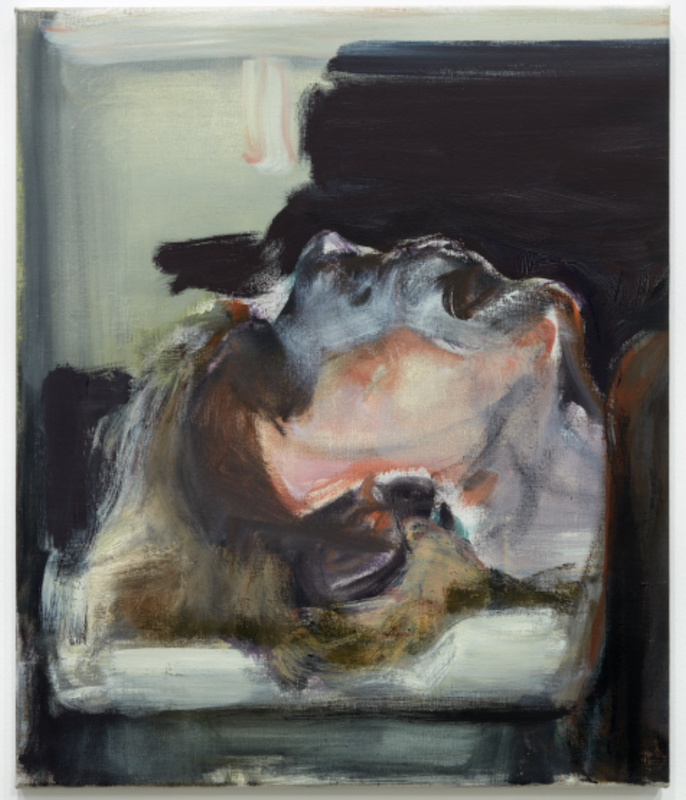
Dumas’s Dead Marilyn makes this contradiction explicit. She based the small painting on an autopsy photograph of Marilyn Monroe after the image unexpectedly resurfaced from her archive. Dumas connected the work both to the death of her own mother and to a broader sense of historical and cultural ending. She described it as a portrait of Marilyn, death, an era, and one’s own potential mortality. (The Museum of Modern Art)
The work therefore does not merely depict a dead celebrity.
It asks what a portrait becomes when the subject can no longer answer the image.
The viewer looks at a body whose public identity remains powerful but whose private life is permanently inaccessible.
Celebrity and mortality collapse into the same face.
Public Image and Private Self
Dumas’s paintings repeatedly explore the unstable boundary between public and private identity. Her gallery describes this shifting relationship as a major concern across four decades of work. (David Zwirner)
This tension appears especially clearly in images of famous people.
A celebrity is widely recognized but rarely known personally.
The public face circulates through photography, film, gossip, advertising, and collective memory. It becomes familiar enough to feel intimate.
But that intimacy is artificial.
Dumas takes familiar faces and makes them strange again.
Paint interrupts the smoothness of the public image. Features become uncertain. Glamour drains away or turns spectral. The viewer confronts not the person, but the distance between the person and the image through which that person has been consumed.
The same problem extends beyond celebrity.
Any portrait produces a public surface from a private life.
Dumas asks what is lost, invented, projected, or exposed in that conversion.
Race and the Violence of Classification
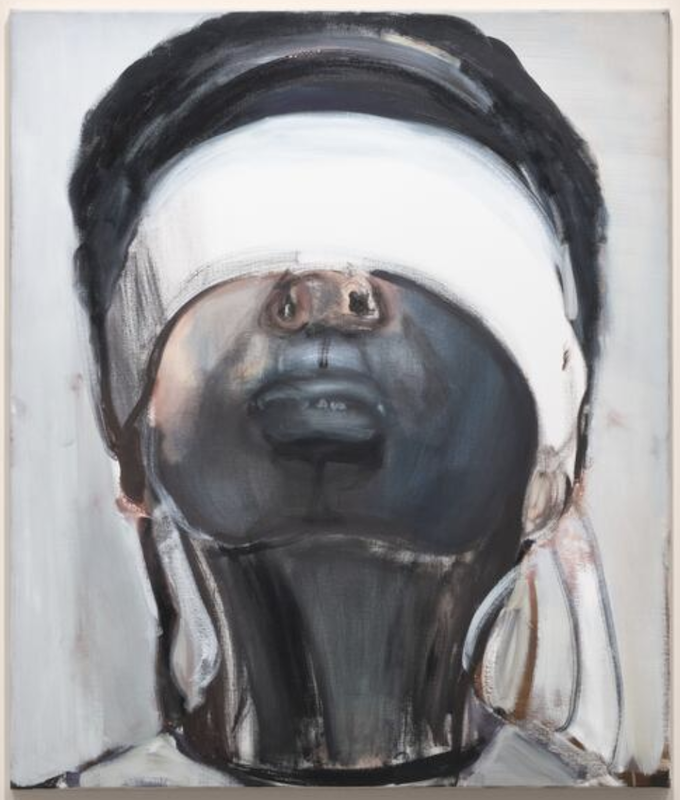
Dumas grew up in South Africa under apartheid and moved to Amsterdam in 1976. Questions of racial classification, identity, representation, and political power have remained central to her work. (David Zwirner)
Her paintings do not usually explain racial systems through narrative.
Instead, they expose how quickly viewers interpret bodies through color, facial features, titles, photographic conventions, and cultural assumptions.
A face may be described as white, Black, diseased, innocent, foreign, familiar, beautiful, threatening, or vulnerable before the viewer knows anything about the person depicted.
The painting makes that speed of classification visible.
Dumas complicates racial identity through unnatural color and unstable surfaces. Skin no longer behaves like a reliable category.
This does not erase race.
It reveals that race is simultaneously bodily, visual, historical, political, and projected.
The viewer becomes implicated in the act of classification.
The Child as Innocence and Threat
Children recur throughout Dumas’s work.
They may appear fragile, strange, confrontational, ghostly, sexualized by adult projection, or disturbingly self-possessed.
A child is culturally expected to signify innocence.
Dumas rarely allows that meaning to remain uncomplicated.
Her children may have:
Unreadable expressions
stained hands
confrontational gazes
awkward bodies
adult emotional intensity
vulnerable exposure
unsettling scale
The image can activate protection and fear at once.
This destabilizes the viewer’s expectation that childhood should be visually pure or psychologically transparent.
The child becomes a person before becoming a symbol of innocence.
Myth, Religion, and Human Vulnerability
Dumas frequently draws from religious and mythological imagery, including Christ, Mary Magdalene, Venus, Adonis, and other inherited figures.
She does not treat these subjects as remote historical icons.
She returns them to bodily experience.
The divine figure becomes flesh.
The mythological lover becomes awkward.
The saint becomes sexual.
The body experiences pregnancy, pain, pleasure, age, exposure, grief, and mortality.
This translation allows inherited stories to remain emotionally active.
In the Venus and Adonis works, eroticism repeatedly approaches death. Venus reaches toward a lover she cannot keep. The apparent embrace is also contact with a dying body. Dumas’s broader world allows pleasure and death, agony and ecstasy, to occupy the same image. (Marlene Dumas)
Myth becomes powerful because it does not remove ordinary human vulnerability.
It enlarges it.
The Central Contradictions
Dumas’s paintings hold opposing forces without resolving them:
Intimate and mediated
Exposed and withheld
Beautiful and damaged
Tender and cruel
Specific and anonymous
Public and private
Erotic and mournful
Living and deathlike
Spontaneous and controlled
Personal and political
Familiar and strange
Bodily and ghostly
The central contradiction may be:
Her figures are emotionally immediate even though access to them is always secondhand.
The photograph creates distance.
Painting creates presence.
But painting cannot erase the distance.
The viewer remains caught between encounter and separation.
The Viewer’s Position
Dumas assigns the viewer several uncomfortable roles.
The viewer becomes an interpreter
A facial expression appears emotionally meaningful but refuses one stable reading.
The viewer supplies narrative.
The viewer becomes a voyeur
Private bodies, sexual images, corpses, children, and vulnerable figures are made publicly visible.
Looking can feel intrusive.
The viewer becomes a mourner
Images of death and absence can provoke grief even when the subject is personally unknown.
The viewer becomes a consumer of images
The paintings remind viewers that suffering, sexuality, fame, and death circulate through visual culture as material for attention.
The viewer becomes a classifier
Race, gender, age, beauty, innocence, danger, and identity are inferred from unstable visual evidence.
The viewer becomes emotionally exposed
The figure may remain unreadable, but the viewer’s desire, fear, prejudice, tenderness, or discomfort becomes increasingly clear.
Dumas does not simply reveal her subjects.
She reveals the viewer’s habits of interpretation.
The World Dumas Has Built
Dumas’s recurring lexicon includes:
Faces
eyes
mouths
naked bodies
children
lovers
corpses
celebrities
criminals
saints
political figures
mothers
wounds
stains
translucent flesh
photographic sources
mythological figures
isolated bodies
confrontational titles
These motifs create a world where human beings are continuously transformed into images and images are asked to carry lives they cannot fully contain.
A face can be icon, victim, mask, celebrity, memory, or stranger.
A nude can be erotic, humiliated, autonomous, vulnerable, or monumental.
A stain can be shadow, bruise, blood, decay, or paint.
A photograph can be evidence, exploitation, memory, source, or burden.
The lexicon remains alive because no element keeps one meaning.
Openness Without Vagueness
Dumas values openness and multiplicity. Her paintings frequently allow emotional opposites to coexist rather than directing the viewer toward one conclusion. (Marlene Dumas)
But openness does not mean that anything can mean anything.
The paintings begin from specific images, bodies, histories, titles, and cultural situations.
The ambiguity is grounded.
A dead body remains a dead body even while it becomes a portrait of celebrity, history, grief, and mortality.
A racialized face remains politically charged even when color becomes unnatural.
A sexual body remains exposed even while resisting possession.
The work remains open because the specific evidence supports several competing truths.
This is the distinction between ambiguity and vagueness.
Vagueness avoids commitment.
Dumas’s ambiguity intensifies commitment by refusing to reduce complex human experience to one interpretation.
The Risk of Emotional Expression
Dumas’s visual language carries genuine risks.
Loose paint can become mannerism.
Distortion can become a predictable sign of psychological depth.
Extreme subjects can produce emotional intensity through content rather than painting.
Vulnerability can become spectacle.
Ambiguity can become generalized sadness or unease.
The critical question is whether each work transforms its source into a distinct encounter or merely repeats the familiar Dumas effect of spectral flesh and unstable emotion.
Her strongest paintings establish a precise relationship among source, subject, title, scale, color, and material.
The paint does not simply make the image look wounded.
It changes how the image can be understood.
Why the Work Belongs to the Present
Dumas’s work is deeply connected to a culture in which human beings are increasingly known through circulated images.
People encounter:
War through press photography
Death through news media
Desire through pornography and advertising
Public figures through carefully managed portraits
Strangers through social platforms
Victims through documentary evidence
Loved ones through stored photographs
Political conflict through viral imagery
Images make distant people visible.
But visibility can create empathy, exploitation, indifference, desire, judgment, or false intimacy.
Dumas’s paintings slow this process down.
They remove the image from rapid circulation and return it as a physical object that demands sustained looking.
Painting cannot restore the original person.
But it can make the ethical and emotional difficulty of looking harder to avoid.
What Artists Can Learn
The lesson is not to imitate Dumas’s fluid washes, distorted faces, photographic sources, spectral color, naked bodies, or emotionally charged subjects.
Those are the visible solutions produced by her investigation.
The larger lesson is that representation becomes powerful when the distance between image and subject remains active.
Dumas demonstrates that:
A source image should be transformed rather than merely reproduced.
Thin paint can make bodily vulnerability material.
Distorted color can expose the instability of classification.
Cropping can intensify confrontation.
Scale can reverse relationships between vulnerability and power.
A title can complicate rather than explain an image.
The face can remain emotionally forceful without becoming psychologically transparent.
Nudity can expose the body while preserving interiority.
Ambiguity becomes strong when it remains grounded in specific evidence.
The viewer’s act of interpretation can become part of the work.
Painting can make familiar images strange enough to be seen again.
Emotional intensity becomes deeper when tenderness, shame, desire, violence, and mortality remain unresolved.
Dumas does not erase the photographic source.
She paints the distance between the source and the person it claims to show.
The body becomes a photograph.
The photograph becomes public evidence.
The public image becomes private interpretation.
The paint turns that interpretation unstable again.
The lesson is not to copy the appearance of the work. It is to understand the pressure that made the appearance necessary.
Marlene Dumas turns mediated images into unstable encounters where visibility intensifies emotion without ever producing complete knowledge.