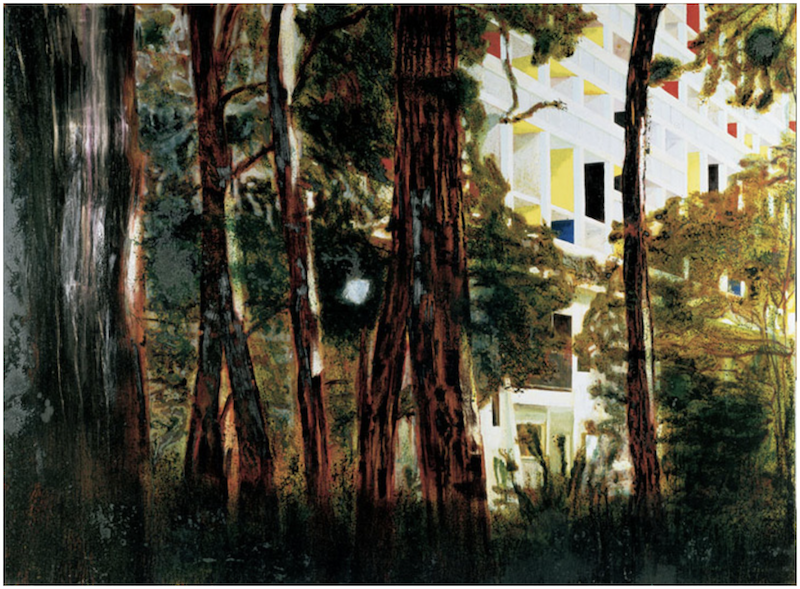
What Makes Peter Doig’s Paintings So Powerful?
Peter Doig’s paintings are powerful because they transform remembered places and borrowed images into environments that feel familiar, emotionally charged, and impossible to enter completely.
At first, the works often appear to be landscapes or scenes:
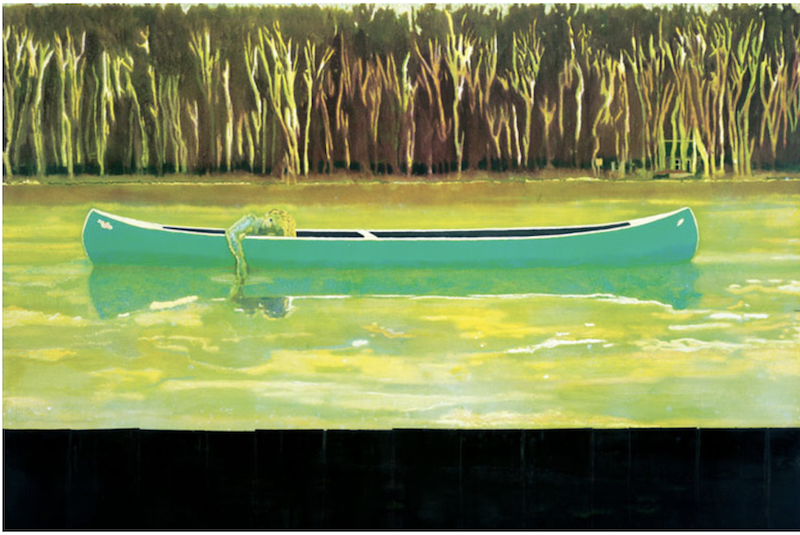
A canoe floating across dark water
A solitary house surrounded by snow
A figure standing beside a road
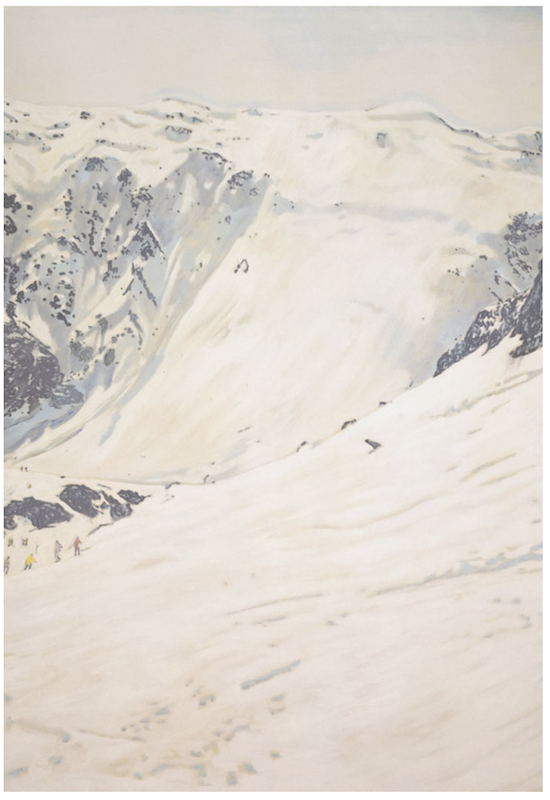
Skiers moving through a mountain landscape
A person framed by trees
A group gathered near the sea
A building glimpsed through branches
A reflection breaking apart on a lake
The subjects are recognizable, but the paintings do not behave like straightforward records of real locations.
Color drifts away from natural description. Snow becomes pink, yellow, blue, or mottled with pattern. Water becomes an opaque screen. Trees interrupt the view like curtains. Reflections duplicate and distort the scene. Figures appear suspended between presence and absence. Buildings seem inhabited by memory rather than people.
Doig’s landscapes feel known without becoming identifiable.
They resemble places that have been visited, forgotten, dreamed about, seen in a photograph, encountered in a film, or reconstructed years later from incomplete memory.
The paintings do not preserve experience accurately.
They show what happens to experience after time has altered it.
The Problem Beneath the Work
Doig’s work repeatedly returns to a central problem:
How can painting give physical form to the unstable space between lived experience, remembered place, borrowed imagery, and imagination?
His paintings are not simply dreamlike landscapes.
They investigate how images remain inside the mind after their original context has disappeared.
A place may begin with an autobiographical connection, but it rarely remains a literal record. Doig has lived across Trinidad, Canada, Britain, Germany, and the United States, and movement between places has shaped his relationship to landscape and belonging. Yet he has resisted reducing the paintings to exact autobiography, saying that autobiographical elements are present while resisting overly specific readings. (Tate)
This distinction matters.
A painting may begin with a place from Doig’s life, but it is transformed through:
Distance
Recollection
Photographs
Films
Postcards
Newspaper images
Album covers
Earlier paintings
Repeated studies
Changes in color
Material invention
The source becomes a departure point rather than an answer.
The deeper subject is not the place itself.
It is the way a place becomes psychologically charged after it has been left behind.
Memory Does Not Reproduce the Past
Memory is often described as a form of storage, as though an experience enters the mind and remains there unchanged.
Doig’s paintings suggest something less stable.
Memory selects.
It compresses.
It combines unrelated moments.
It exaggerates color.
It loses detail.
It repeats certain images while allowing others to disappear.
It may preserve atmosphere more strongly than fact.
A remembered place can therefore feel emotionally exact while being visually inaccurate.
Doig’s paintings operate within this contradiction. They frequently look specific enough to imply a real location, but altered enough to resist documentary certainty.
A house may be recognizable as a type of house without belonging securely to one place.
A canoe may feel attached to a particular story while also becoming a timeless symbol.
A snowy landscape may evoke Canada, childhood, cinema, loneliness, and painting history at once.
The image is not false simply because it is transformed.
Its truth lies in how memory behaves.
The Distance Between Source and Painting
Doig frequently works from found images and personal photographs rather than painting directly from nature. Tate has documented his use of photographs as starting points, while museum accounts of his practice emphasize the transformation that occurs between the source image and the completed painting. (YouTube)
This distance is essential.
Painting from a photograph removes the artist from the original moment.
The event has already passed.
The photograph has already framed it.
Details have already been flattened.
Scale has already changed.
The image may already have circulated through another cultural context.
Doig then transforms it again through painting.
The process creates several layers:
An event or place once existed.
A photograph or film converted it into an image.
Time separated the image from its original situation.
The artist selected and remembered it.
Painting altered its color, scale, surface, rhythm, and atmosphere.
The viewer encounters the result without access to the original experience.
The painting becomes an image of distance.
It is connected to reality but cannot return to it.
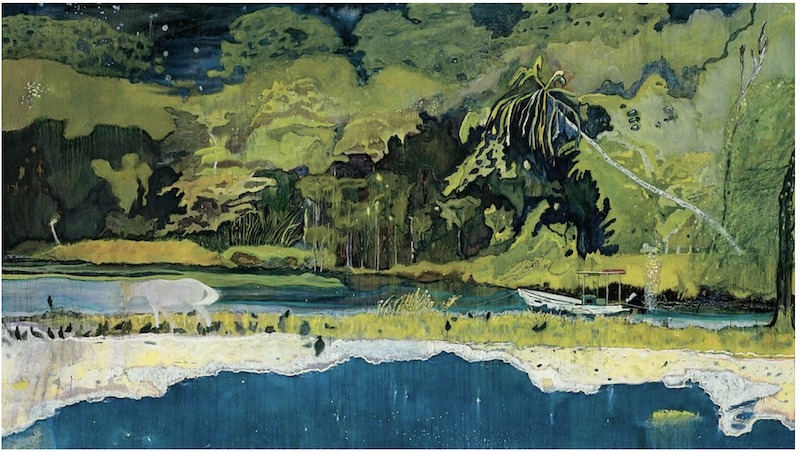
Landscape as a Psychological Condition
Doig’s landscapes do not function primarily as descriptions of scenery.
They function as psychological environments.
Snow, water, forests, roads, buildings, and mountains carry emotional pressure because they regulate access.
A forest may hide something.
Water may separate the viewer from a figure.
A road may suggest departure without revealing a destination.
A house may promise shelter while appearing unreachable.
A reflection may open another world while preventing entry.
The landscape is rarely neutral.
It behaves as though it knows more than the viewer.
This gives the paintings their peculiar mixture of beauty and unease. The scene may appear calm, but that calm often feels suspended. Something has happened, is about to happen, or remains buried inside the image.
Doig does not need to depict a dramatic event.
The environment itself carries the tension.
Water as Distance, Reflection, and Threshold
Water is one of Doig’s most persistent motifs.
It appears as:
Lakes
Seas
Rivers
Pools
Reflections
Dark surfaces
Dividing bands
Open passages
Uncertain depths
Water allows the painting to hold several spaces simultaneously.
There is the world above the water.
There is the reflected version of that world.
There may be another space beneath the surface.
Each one is visible, but none is fully accessible.
Reflection duplicates the image while altering it. A tree becomes a vertical disturbance. A figure becomes a stain. A house becomes a broken pattern. The reflected world resembles the first without being identical to it.
This makes water an ideal structure for memory.
Memory also repeats reality through distortion.
In Echo Lake, completed in 1999, a solitary figure stands near a dark body of water, calling or gesturing toward an unseen space. The scene draws upon the final image of the film Friday the 13th, but Doig transforms the cinematic source into a larger meditation on repetition, distance, reflection, and uncertain response. (The Museum of Modern Art)
The title intensifies the structure.
An echo returns a sound after its source has already occurred.
A reflection returns an image after separating it from the object.
A memory returns an experience after the experience has passed.
The painting operates through all three.
The Canoe as a Vessel of Isolation
The canoe is perhaps Doig’s most recognizable recurring motif.
It can suggest:
Travel
Solitude
Passage
Migration
Recreation
Danger
Suspension
Myth
Cinema
Death
Psychological drift
A canoe is designed for movement, yet Doig’s canoes often appear strangely still.
They float without an obvious destination.
A single figure may sit inside, but the person’s identity and purpose remain unclear.
The boat becomes a vessel between worlds.
It is neither securely attached to land nor fully lost at sea.
This gives it an existential quality.
The canoe carries a body through space, but it may also carry memory through time.
The motif recurs in works spanning different periods, including 100 Years Ago, an oil-on-paper work from 2002 held by MoMA. Repetition does not fix the canoe’s meaning; each appearance places it inside a different atmosphere of isolation, history, travel, or uncertainty. (The Museum of Modern Art)
Snow as Screen and Interference
Snow is another recurring element in Doig’s early work.
Snow can cover detail, simplify space, reflect light, obscure boundaries, and transform familiar environments.
It therefore performs several functions at once:
Atmosphere
Memory
Pattern
Concealment
Silence
Distance
Visual noise
In paintings such as Pink Snow, snow does not merely describe weather. It creates an ornamental screen between the viewer and the depicted world. MoMA describes the work’s jewel-like surface as visual interference that complicates the viewer’s relationship to the scene. The large painting measures approximately eight feet high, turning snowfall into an immersive perceptual field rather than a small descriptive detail. (The Museum of Modern Art)
The viewer looks through the snow and at the snow simultaneously.
The flakes create depth by implying distance.
They also flatten the painting by spreading pattern across the surface.
The scene exists behind a veil that is itself visually seductive.
Snow therefore becomes a model of memory: it preserves a general shape while covering precise information.
Trees as Curtains
Trees frequently interrupt Doig’s landscapes.
Their trunks and branches may stand between the viewer and:
A house
A figure
A body of water
A road
An event
Another layer of space
Rather than framing the scene politely, they can block it.
The viewer is made to look through a barrier.
This creates a tension between access and obstruction.
The painting invites entry into the landscape while making entry difficult.
Branches may also divide the composition into fragments, producing a rhythm that shifts attention between surface and depth.
A tree is simultaneously:
An object in the landscape
A vertical mark
A screen
A frame
A barrier
A repeating pattern
Doig’s trees often make the act of looking visible.
The viewer does not simply see a place.
The viewer sees through something.
Houses and the Problem of Belonging
Buildings in Doig’s work often appear secluded, partially hidden, or psychologically distant.
A house conventionally signifies:
Home
Stability
Shelter
Ownership
Family
Interior life
Belonging
But Doig’s houses rarely provide uncomplicated security.
They may appear abandoned, inaccessible, concealed by trees, surrounded by snow, or suspended within strange color.
The viewer remains outside.
The building becomes an image of belonging that cannot be entered.
This is especially significant in relation to Doig’s itinerant biography, though the works should not be reduced to autobiography. His transitory upbringing and movement among countries provide context for a practice in which place repeatedly appears both familiar and foreign. (Acquavella Galleries)
The house promises an interior.
The painting withholds it.
Why the Formal Choices Matter
Doig’s paintings are recognizable, but their force does not come from atmosphere alone.
The formal choices make instability visible.
Color separates emotional truth from factual truth
Doig’s color often departs from natural observation.
Snow becomes pink.
Water becomes orange, green, black, or electric blue.
Skin tones change according to the painting’s atmosphere.
A forest can become violet, acidic, luminous, or almost opaque.
These alterations prevent the painting from being read as a neutral view.
Color transforms a place into an emotional condition.
The unusual color may feel more psychologically accurate than literal description because it expresses how the scene has been remembered, imagined, or culturally mediated.
Thin washes create uncertainty
Some passages are painted thinly enough for the support or earlier layers to remain visible.
These areas may feel:
Faded
Distant
Weathered
Unfinished
Transparent
Temporally unstable
Thinness allows the image to appear as though it is still arriving or already disappearing.
The painting does not seal the world completely.
Thick paint creates material interruption
Other passages become dense, clotted, or heavily worked.
Paint may interrupt illusion, forcing the viewer to recognize the surface as an object.
A tree may become a heavy vertical deposit.
Snow may become repeated material dots.
A reflection may become streaked pigment.
This tension between image and matter keeps the landscape unstable.
The viewer enters the scene and is then returned to the canvas.
Layering makes recollection visible
Doig revises, covers, repeats, and rebuilds images across studies and paintings.
A source does not move directly into a final work. It passes through multiple versions.
Layering makes this transformation physical.
The finished painting can contain traces of earlier decisions without revealing a clean history of how it was made.
Memory behaves similarly.
Later experiences alter earlier ones.
The past is not erased, but it becomes difficult to separate from what came afterward.
Scale turns private imagery into environment
Many of Doig’s paintings are large enough to surround the viewer’s field of vision.
A small photographic source may become a monumental painted world.
This transformation changes the image’s authority.
What may have begun as a minor snapshot, film still, or remembered scene becomes an environment that the viewer confronts bodily.
Scale gives private memory public presence.
Reflection doubles the world
Reflections create formal symmetry while undermining certainty.
The reflected image may be more visually dominant than the object producing it.
This makes it difficult to determine which space is primary.
The real world and its duplicate become interdependent.
Cropping removes explanation
Scenes often feel taken from a larger narrative.
A figure appears without introduction.
A building is seen from an odd angle.
A road exits the canvas.
A group stands together, but the reason for the gathering is unknown.
Cropping suggests a story while withholding the information required to complete it.
Repetition transforms motifs into memory
Doig returns to canoes, water, houses, trees, snow, roads, music, and solitary figures across decades.
The repetition does not simply produce a signature.
Each return tests how the image changes under new conditions.
A canoe in Canada is not identical to a canoe in Trinidad.
A landscape recalled in London is not the same landscape experienced years earlier.
Repetition allows difference to become visible.
The Central Contradictions
Doig’s paintings hold several opposing forces together:
Familiar and foreign
Remembered and invented
Beautiful and uneasy
Still and psychologically active
Figurative and materially abstract
Personal and culturally borrowed
Specific and unlocatable
Inviting and inaccessible
Nostalgic and resistant to nostalgia
Cinematic and materially handmade
Timeless and built from historical images
Present and already lost
The central contradiction may be:
The paintings make places feel deeply remembered while preventing the viewer from knowing exactly what has been remembered.
The emotional atmosphere is specific.
The factual narrative remains open.
This is why the works can feel intimate without becoming private illustrations.
Atmosphere Without Emptiness
Atmosphere is one of the most difficult qualities to use seriously.
A painting can easily become “moody” without having much beneath the mood.
Doig avoids this at his best because atmosphere is generated by structural decisions:
Barriers interrupt access.
Reflections divide reality.
Figures remain isolated.
Sources arrive through cultural memory.
Color destabilizes location.
Surface shifts between illusion and material.
Repeated motifs carry time.
Narrative fragments remain unresolved.
The atmosphere is not applied afterward.
It emerges from the conditions of looking.
The viewer feels uncertain because the painting is organized around uncertain access.
The Viewer’s Position
Doig gives the viewer several roles.
The viewer becomes a rememberer
The paintings often feel familiar even when the scene has never been personally experienced.
The viewer may project private associations onto:
Snow
Houses
Water
Roads
Night
Boats
Forests
The painting activates memory without providing a shared factual story.
The viewer becomes an outsider
The landscape may appear enterable, but trees, water, distance, darkness, and cropping prevent full access.
The viewer remains at the edge of the event.
The viewer becomes a searcher
Small figures, hidden buildings, reflections, and layered passages reward sustained looking.
The scene reveals itself gradually.
The viewer becomes uncertain about time
The painting may evoke a contemporary photograph, an old postcard, a childhood memory, a film still, and an art-historical landscape at once.
No single period takes control.
The viewer becomes aware of image construction
From a distance, the landscape may feel immersive.
Up close, it becomes stains, brushwork, drips, dots, and layered pigment.
The painting alternates between world and object.
The World Doig Has Built
Doig’s recurring lexicon includes:
Canoes
Lakes
Reflections
Snow
Houses
Trees
Roads
Skiers
Solitary figures
Shadowed faces
Tropical foliage
Night scenes
Music
Film imagery
Repeated horizons
Unreachable buildings
Divided surfaces
These motifs create a recognizable world without becoming fixed symbols.
Water may suggest memory in one work and danger in another.
A house may offer belonging or isolation.
Snow may conceal, beautify, flatten, or distance.
A canoe may carry travel, death, leisure, myth, or suspended time.
A tree may belong to the landscape while also preventing access to it.
The lexicon remains alive because each motif changes according to the atmosphere surrounding it.
Music and Communal Memory
Music has long been part of Doig’s imagery and cultural world, particularly through posters, album covers, musicians, listening spaces, and the StudioFilmClub he helped establish in Trinidad.
His 2025–2026 Serpentine project, House of Music, brought recent paintings together with restored analogue sound systems and music selected from his personal archive of records and tapes. The exhibition extended his interest in sites of communal gathering, listening, cinema, and creative exchange. (Serpentine Galleries)
This development makes sense within the larger practice.
Music also transforms memory without preserving an event literally.
A song can return a person to a place, mood, relationship, or time without reconstructing it completely.
It creates emotional recognition without factual restoration.
In that sense, music and painting perform related work for Doig.
Both allow the past to return as atmosphere.
Art History as Something Remembered
Doig’s paintings draw upon traditions of landscape painting, including Romanticism, Impressionism, Expressionism, Post-Impressionism, and modern figurative painting.
But art history does not appear as a list of quotations.
It enters as remembered visual possibility.
A color may evoke Matisse.
A landscape may recall Munch.
A reflection may suggest Monet.
A figure may carry the awkwardness of Gauguin or the isolation of Edward Hopper.
A surface may shift between decorative beauty and emotional disturbance.
These influences have been absorbed into a world shaped equally by film, photography, popular culture, travel, music, and lived experience.
The important question is not where each element originated.
It is what happens after those sources occupy the same painting.
Doig treats influence much as he treats memory: inherited images are transformed by time, distance, context, and material.
The Risk of Dreamlike Painting
Doig’s work carries a genuine risk.
Dreamlike landscapes, unusual color, solitary figures, reflections, and mysterious buildings can become an easily recognizable atmosphere.
Mystery may harden into style.
A landscape may appear evocative without containing a specific pressure.
Nostalgia may become sentimental.
Source imagery may become merely picturesque.
The critical question is therefore:
Does the painting transform a particular image into a new psychological condition, or does it merely reproduce the appearance of memory and mystery?
Doig’s strongest paintings create precise relationships among source, surface, obstruction, distance, color, and viewer position.
The scene does not simply look strange.
The viewer’s access to it has been carefully structured.
The less successful possibility would be atmosphere without necessity.
Why the Work Belongs to the Present
Doig’s work may appear removed from digital culture, but it addresses a highly contemporary condition.
Modern experience is increasingly mediated through images.
People remember places partly through:
Photographs
Film
Video
News images
Social media
Screens
Advertising
Reproductions
Shared cultural imagery
The memory of an event may become inseparable from the photograph taken during it.
A place may be known through cinema before being visited physically.
An image encountered online may feel autobiographical despite belonging to someone else.
Doig’s practice anticipates and explores this merging of lived and mediated experience.
His paintings do not ask whether an image is purely personal or purely borrowed.
They show that memory is already culturally mixed.
The world reaches the mind through images, and those images return transformed.
What Artists Can Learn
The lesson is not to imitate Doig’s canoes, snowy forests, isolated houses, dark lakes, unusual color, cinematic cropping, or dreamlike atmosphere.
Those are the visible solutions produced by his particular investigation.
The larger lesson is that memory can become a formal system rather than merely a subject.
Doig demonstrates that:
A source image should be transformed rather than copied.
Emotional accuracy does not require factual accuracy.
Landscape can operate as a psychological condition.
Color can separate remembered experience from observed reality.
Reflection can create multiple levels of space and time.
Obstruction can make looking more active.
Repetition can reveal how an image changes across years.
Surface can alternate between immersion and interference.
Atmosphere becomes serious when it arises from structure.
Personal experience can remain present without becoming narrowly autobiographical.
A place can feel deeply specific while remaining open to another viewer’s memory.
Doig does not paint the past as though it can be recovered intact.
He paints the distance between the past and its return.
The event becomes a photograph.
The photograph becomes a memory.
The memory becomes a painting.
The painting becomes a place the viewer almost recognizes.
The lesson is not to copy the appearance of the work. It is to understand the pressure that made the appearance necessary.
Peter Doig turns landscape painting into an unstable meeting place between memory, image, place, and the impossibility of returning completely to what has passed.