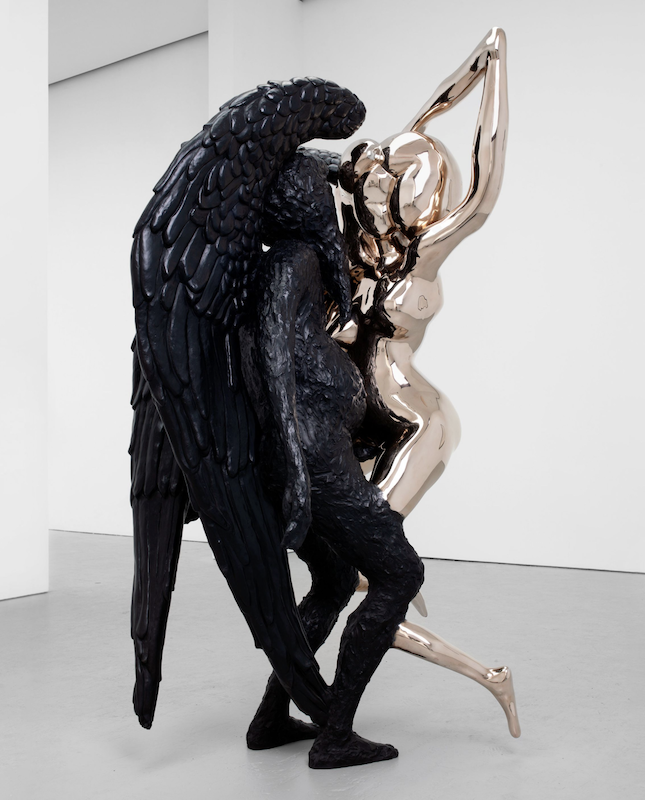
What Makes Chris Ofili’s Paintings So Powerful?
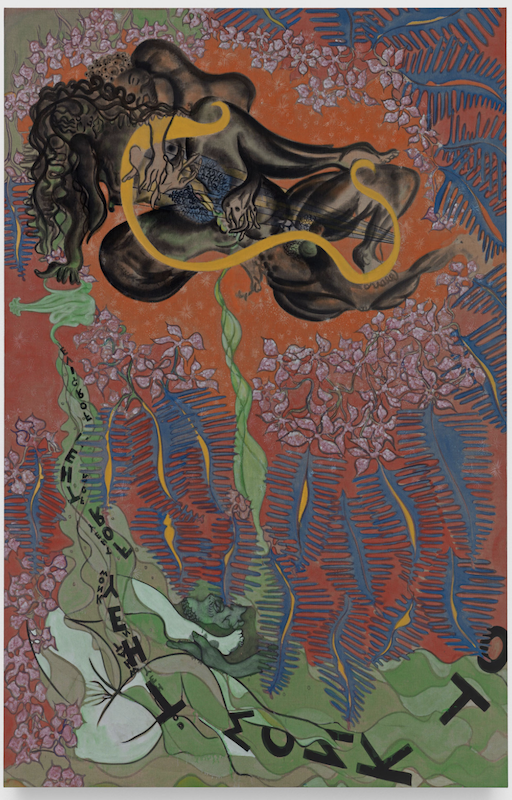
Chris Ofili’s paintings are powerful because they turn visual pleasure into a site of cultural, spiritual, bodily, and moral contradiction.
At first, the work can appear dazzling.
Surfaces shimmer with glitter, resin, beads, dots, layered color, ornamental lines, and fragments of imagery. Figures emerge from dense decorative fields. Sacred references collide with popular culture. Mythological beings share space with contemporary bodies. Beauty, humor, sexuality, violence, religion, caricature, and fantasy can all occupy the same painting.
The images often feel abundant rather than restrained.
They invite the eye through:
Saturated color
Rhythmic pattern
Luminous surfaces
Decorative borders
Repeated dots
Stylized figures
Jewellike details
Layered cultural references
Sensual materials
Dreamlike environments
Yet the pleasure is never simple.
The glitter may intensify a sacred image while also making it theatrical or artificial. Ornament may celebrate beauty while approaching excess. A figure may appear exalted and stereotyped at the same time. Religious imagery may carry reverence, comedy, eroticism, and provocation simultaneously.
Ofili does not treat these forces as contradictions that must be solved.
He allows them to remain active together.
His paintings ask whether beauty can carry historical damage, whether sacred images can survive contact with popular culture, whether identity can be represented without becoming fixed, and whether decoration can function as a serious form of thought.
The Problem Beneath the Work
Ofili’s practice repeatedly returns to a generative problem:
How can painting transform inherited images, cultural stereotypes, religious symbols, bodily desire, and decorative beauty into a visual world that resists fixed meaning?
His paintings are not simply celebrations of Black identity, spiritual imagery, or ornamental excess.
They are sites of transformation.
A stereotype can become a mask, a joke, an accusation, or a self-authored image.
A religious figure can become sacred and profane at once.
Glitter can operate as beauty, artificiality, spectacle, devotion, and seduction.
Pattern can create visual pleasure while also complicating access to the image.
A culturally loaded material can be treated as abject, sacred, comic, bodily, sculptural, or ceremonial.
Ofili’s paintings repeatedly take forms that arrive with established meanings and place them under enough pressure that those meanings begin to shift.
His work bridges figuration and abstraction while drawing from a broad range of cultural and aesthetic sources. His galleries describe the paintings as investigations into desire, identity, representation, and creative transformation rather than as expressions of one stable iconography. (Victoria Miro)
The deeper problem is not simply how to represent identity.
It is how to keep identity, culture, spirituality, and desire from hardening into a single interpretation.
Decoration as a Way of Thinking
One of the most important achievements in Ofili’s work is the transformation of decoration into structure.
Decoration is often treated suspiciously in serious art. It may be dismissed as:
Surface pleasure
Excess
Distraction
Fashion
Craft
Sentimentality
Commercial appeal
Visual entertainment
Ofili does not reject those associations.
He works through them.
His paintings may be intensely attractive. The surfaces shimmer. Repeated dots produce rhythm. Borders frame and contain the image. Color creates density and atmosphere. Decorative elements slow the eye and encourage close inspection.
But ornament does more than beautify the painting.
It regulates visibility.
A figure may emerge only gradually from the patterned field. Dots can both describe and interrupt the body. Glitter can illuminate the image while flattening it into a reflective surface. Repetition can unify the painting while making it more difficult to separate figure from environment.
Decoration becomes active because it changes how the image can be seen.
The pattern does not sit on top of the meaning.
It produces the conditions through which meaning appears.
This is one of Ofili’s largest contributions to contemporary painting:
He demonstrates that ornament can carry history, identity, spirituality, pleasure, concealment, excess, and perceptual uncertainty at the same time.
The Surface as a Cultural Collision
Ofili’s paintings frequently bring together sources that conventional cultural hierarchies might keep separate.
These can include:
Catholic imagery
African and diasporic visual traditions
Hip-hop
comic books
pornography
mythology
popular music
devotional painting
art history
caricature
botanical imagery
Trinidadian culture
Carnival
contemporary politics
The result is not a neutral collage of references.
Each source changes when placed beside the others.
Sacred imagery becomes bodily.
Popular imagery gains ritual weight.
Caricature becomes both critique and self-conscious performance.
Pornographic fragments become decorative, grotesque, humorous, or accusatory.
High art and popular culture no longer remain securely separated.
This matters because cultural identity is rarely formed from one pure source.
It is layered, inherited, imposed, chosen, performed, and revised.
Ofili’s paintings behave in the same way.
They do not present culture as a stable inheritance.
They show culture being continually assembled.
Material That Refuses Neutrality
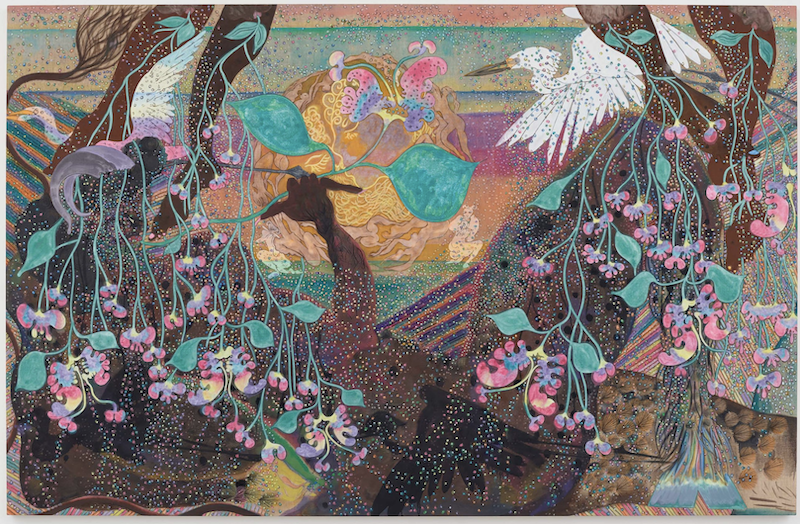
Ofili became internationally famous partly through his use of elephant dung, glitter, beads, resin, collage, and other unconventional materials.
These materials attracted enormous attention, especially when used in religious works such as The Holy Virgin Mary. But their importance extends beyond provocation.
Elephant dung carries several possible associations:
Bodily waste
Fertility
Nature
Africa
Sacred matter
Humiliation
Humor
Sculpture
Ritual
Stereotype
Cultural projection
The material cannot be assigned one meaning.
A viewer may initially treat it as abject or insulting. Another may understand it through fertility, ritual, earth, bodily life, or sculptural support. The tension among these readings becomes part of the work.
Ofili often used pieces of dung as painted elements and as supports beneath canvases, preventing the material from remaining merely a shocking addition to the surface. It became structural, symbolic, humorous, and materially necessary.
This is important.
A provocative material becomes stronger when it does more than attract attention.
It must alter the object’s logic.
In Ofili’s early paintings, the unusual support changes the viewer’s relationship to the painting. The canvas no longer appears to float neutrally on the wall. It rests on culturally and bodily charged matter.
The supposedly elevated object depends on what polite culture might prefer to reject.
The Sacred and the Profane
Ofili repeatedly draws sacred and profane imagery into the same visual field.
This is not simply irreverence.
Religious traditions themselves often hold contradictions involving:
Spirit and flesh
Purity and sin
Reverence and fear
Transcendence and suffering
Ecstasy and discipline
Beauty and sacrifice
Divine perfection and human desire
Ofili’s paintings bring these contradictions into contemporary visual form.
A sacred figure may be sensuous, stylized, comic, monumental, or materially impure. A mythological scene may become psychologically contemporary. Sin may appear seductive rather than morally simple.
His later series The Seven Deadly Sins does not assign one painting neatly to each sin. Instead, the works encompass broader fields of excess, attraction, transgression, and human behavior. The gallery describes these paintings as dreamlike spaces where human and mythological beings coexist under forces of attraction and repulsion. (Victoria Miro)
This refusal of moral clarity is central.
The paintings do not illustrate sin as a set of lessons.
They make sinfulness feel like a condition of being human.
Beauty That Cannot Remain Innocent
Ofili’s work often offers beauty immediately.
The color is rich.
The surface sparkles.
The compositions can feel lush, rhythmic, and sensuous.
But beauty in these paintings is never completely innocent.
It may attract the viewer toward an image containing violence, stereotype, sexuality, shame, racial history, or moral ambiguity.
The pleasure of looking becomes complicated.
This creates a central pressure:
The viewer enjoys the surface while becoming uncertain about what that enjoyment means.
Is the glitter celebratory?
Is it excessive?
Is it devotional?
Is it artificial?
Is the decorative field protecting the figure or turning the figure into spectacle?
Is the beauty resisting stereotype or making stereotype newly consumable?
The paintings rarely answer these questions.
They keep the viewer inside them.
The Black Figure and the Problem of Representation
Ofili emerged in a cultural environment where Black figures were often either absent from major painting traditions or burdened with representational expectations.
A Black artist could be expected to produce work that was:
Politically legible
Socially responsible
Authentically representative
Oppositional
Educational
Easily interpretable
Corrective of historical absence
Ofili resisted this narrowing.
His figures can be comic, divine, erotic, absurd, glamorous, grotesque, mythological, foolish, vulnerable, heroic, or morally unstable.
They do not bear the burden of presenting one approved image of Blackness.
This gives the work freedom.
Black identity becomes expansive rather than exemplary.
It can include stereotype and fantasy, beauty and failure, cultural pride and cultural contradiction.
The figure is not liberated by becoming ideal.
The figure is liberated by being allowed complexity.
This distinguishes Ofili’s practice from art that treats positive representation as the only corrective to harmful imagery.
Ofili often works closer to transformation:
He takes charged images and subjects them to enough invention that they can no longer remain what they were.
Why the Formal Choices Matter
Ofili’s work is visually distinctive, but its power depends on what the formal choices do.
Repetition creates rhythm and ritual
Repeated dots are one of the most recognizable features of his early paintings.
They can evoke:
Beads
Cells
stars
lights
skin
music
decoration
counting
ceremony
visual noise
Repetition slows the process of making and looking.
Each dot is small, but the accumulation creates an atmosphere larger than the individual mark.
This can make the surface feel ritualized.
The repetition appears devotional and obsessive at once.
It also prevents the viewer from separating figure and ground too easily. The image is embedded within a field of repeated attention.
Glitter creates unstable light
Glitter reflects rather than simply holds color.
Its appearance changes with light, angle, and movement.
This means the surface cannot be experienced fully from one fixed position.
Glitter introduces:
Seduction
instability
theatricality
artificiality
celebration
kitsch
spectacle
luminosity
A sacred image rendered in glitter may feel radiant and devotional.
It may also feel commercial, excessive, or visually unreliable.
That instability is precisely why the material matters.
Resin creates depth and preservation
Resin can seal materials beneath a smooth surface.
It preserves and distances at the same time.
The viewer can see what lies beneath but cannot touch it directly.
This gives the painting a layered, almost archaeological structure.
Images, fragments, dots, and materials appear suspended inside the work.
Resin therefore turns surface into memory.
It protects the image while making its separation from the viewer visible.
Collage interrupts visual unity
Fragments from magazines and other printed sources introduce images that were created for different purposes.
A pornographic fragment may enter a sacred composition.
A popular image may become part of an ornamental system.
The imported image retains traces of its former context while being altered by the new one.
Collage makes cultural collision physically visible.
It prevents the painting from pretending to come from one unified visual tradition.
Dense pattern controls access
Pattern can overwhelm figure and narrative.
A body may be present without becoming immediately legible.
This creates a delayed encounter.
The viewer must search through surface pleasure to locate the image.
Pattern therefore becomes both invitation and obstruction.
Color creates emotional and cultural atmosphere
Ofili’s early paintings frequently use vibrant, high-key color.
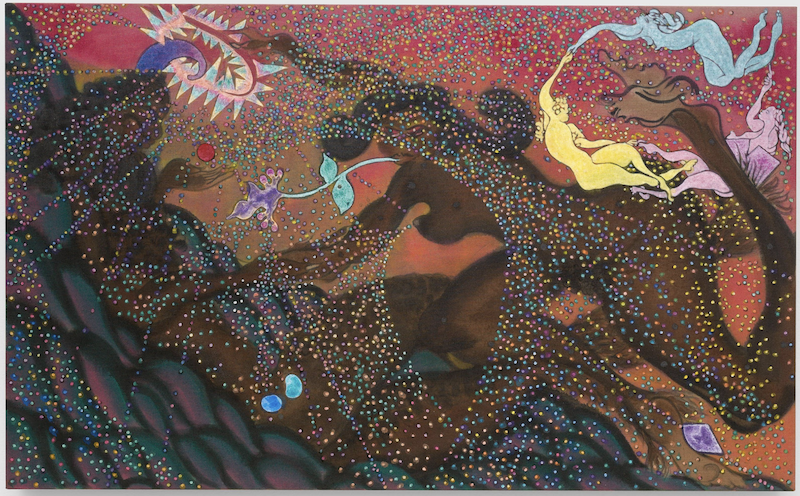
Later works, especially after his move to Trinidad, explored darker blue and nocturnal palettes. These paintings require the viewer’s eyes to adjust, allowing figures and scenes to emerge gradually from darkness. His major Night and Day survey emphasized this transition toward moonlit blue works and a more atmospheric visual language. (Wikipedia)
This shift demonstrates that Ofili’s practice is not dependent on one decorative formula.
The underlying concern remains transformation and partial visibility.
In the bright paintings, excess complicates access.
In the blue paintings, darkness complicates access.
The visual solution changes while the deeper problem survives.
Night Vision and Slow Revelation
The blue paintings mark an important development in Ofili’s practice.
Rather than surrounding the viewer with glittering abundance, these works often require patience.
Figures may be difficult to see at first.
Dark blues, silvers, violets, blacks, and subtle lines create nocturnal scenes that gradually become visible.
The eye must adjust.
This changes the viewer’s role.
Looking becomes less immediate and more bodily.
The painting teaches the viewer how to see it.
The longer the viewer remains, the more the image appears.
But the image may never become completely secure.
This is a different form of seduction from the early work.
The bright paintings attract through excess.
The blue paintings attract through withholding.
Both depend on partial access.
Trinidad and the Expansion of the Visual World
Ofili moved to Trinidad in 2005, and the island’s landscape, light, culture, music, Carnival traditions, and mythological atmosphere became increasingly important to the work.
The change did not produce simple tropical imagery.
Instead, it expanded the visual conditions available to the paintings.
Night, foliage, moonlight, bodies, devils, mythology, landscape, and transformation became increasingly active.
The Trinidadian environment also allowed Ofili to move beyond some of the public controversy surrounding his earlier work and deepen the dreamlike and spiritual dimensions of the practice.
The paintings became less dependent on dense material accumulation and more invested in fluid line, atmospheric color, and ambiguous narrative.
This evolution matters because it demonstrates a strong body of work rather than a successful brand.
The recognizable early vocabulary was not endlessly repeated.
The practice changed.
Myth as a Contemporary Structure
Ofili increasingly uses mythology not as historical illustration but as a flexible structure for desire, morality, violence, identity, and transformation.
Myth allows several times to coexist:
Ancient and contemporary
personal and collective
sacred and popular
local and universal
historical and imagined
A mythological figure does not need to belong to one literal moment.
It can carry inherited meaning while also becoming newly strange.
In Ofili’s work, myth creates distance from immediate social explanation.
It allows cultural and psychological questions to become larger than one event.
But myth also introduces risk.
It can universalize too easily or detach the work from specific historical pressures.
Ofili’s strongest works avoid that emptiness because their materials, bodies, references, and cultural sources remain specific even when the narrative becomes dreamlike.
The Viewer’s Position
Ofili places the viewer in several overlapping roles.
The viewer becomes a seeker
Dense surfaces and dark images require sustained attention.
Meaning is not delivered immediately.
The viewer becomes seduced
Color, glitter, pattern, and sensual material create pleasure before interpretation stabilizes.
The viewer becomes morally uncertain
Sacred, profane, comic, erotic, and stereotyped elements coexist.
The viewer cannot rely on one approved response.
The viewer becomes culturally self-conscious
Loaded materials and images expose assumptions.
A viewer may discover that disgust, reverence, offense, or fascination depends partly on cultural expectations brought to the work.
The viewer becomes physically active
Reflective surfaces and dark palettes change according to movement, angle, distance, and time.
The painting cannot be fully grasped from one position.
The Central Contradictions
Ofili’s work holds many opposing forces together:
Sacred and profane
Beautiful and abject
Decorative and politically charged
Comic and serious
Spiritual and bodily
Black identity and resistance to fixed identity
Excessive and controlled
Popular and art historical
Seductive and obstructive
Reverent and irreverent
Mythological and contemporary
Visible and concealed
The deepest contradiction may be:
The paintings offer visual abundance while refusing interpretive certainty.
The viewer receives more color, material, image, and reference than can be easily processed.
Abundance does not produce clarity.
It produces complexity.
The World Ofili Has Built
Ofili’s recurring lexicon includes:
Glitter
dots
beads
resin
elephant dung
dark blue fields
mythological beings
sacred figures
lovers
sinners
devils
foliage
stars
decorative borders
repeated faces
cultural fragments
nocturnal landscapes
flowing lines
bodies in transformation
These motifs do not retain one meaning.
The dot can be decorative, devotional, cellular, musical, or cosmic.
Dung can be abject, sacred, comic, structural, or fertile.
Blue can suggest night, spirit, concealment, melancholy, or erotic atmosphere.
The figure can be icon, stereotype, fantasy, myth, or person.
The lexicon remains alive because the elements continue to change function.
The Risk of Spectacle
Ofili’s work carries several genuine risks.
The glitter and dung can become more famous than the paintings.
Provocation can overshadow structure.
Decoration can become spectacle.
Cultural references can be consumed as exoticism.
Visual abundance can become branding.
Mythology can become atmospheric rather than necessary.
The critical question is whether the formal system continues to transform its sources or merely repeats a recognizable Ofili vocabulary.
The strongest works do not merely combine unusual materials.
They alter how those materials can be understood.
They do not merely present cultural contradiction.
They make contradiction perceptually active.
The Caged Bird’s Song and Translation Across Media
Ofili’s large tapestry The Caged Bird’s Song demonstrates how his concerns extend beyond painting.
The work originated as a watercolor and was translated into a triptych tapestry by Dovecot’s master weavers over several years. Ofili described the project as a tension between the free-flowing behavior of watercolor and the slow, structured process of weaving. He emphasized that the woven work was an interpretation rather than a reproduction. (National Gallery)
This distinction is important.
Translation introduces transformation.
The image must pass from one material logic into another.
Liquid pigment becomes thread.
Spontaneity becomes accumulated labor.
A private painted gesture becomes a collaborative object.
The image survives, but it does not remain the same.
That process reflects a larger principle running through Ofili’s practice:
Cultural forms remain alive not by staying pure, but by changing as they move.
Why the Work Belongs to the Present
Ofili’s work speaks to a contemporary world shaped by:
Hybrid identities
Migration
diasporic culture
contested symbols
visual stereotypes
religious conflict
popular media
cultural appropriation
moral polarization
struggles over representation
tension between pleasure and politics
Contemporary culture often demands that images declare what side they occupy.
Ofili resists that demand.
His paintings remain morally, culturally, and visually unstable.
This does not make them politically empty.
It allows them to reveal how images gather contradictory meanings.
A symbol may be sacred to one viewer and offensive to another.
A material may signify Africa, waste, fertility, stereotype, nature, or provocation depending on the context.
A decorative surface may celebrate identity while also exposing the desire to consume difference.
Ofili’s work remains contemporary because it understands that cultural meaning is contested rather than fixed.
What Artists Can Learn
The lesson is not to imitate Ofili’s glitter, dots, elephant dung, jeweled surfaces, sacred imagery, mythological figures, or dark blue palette.
Those are the visible solutions produced by his particular investigation.
The larger lesson is that beauty and decoration can become serious when they alter how meaning is produced.
Ofili demonstrates that:
Ornament can control visibility.
Repetition can become ritual.
Material can carry cultural contradiction.
Beauty can complicate moral judgment.
Sacred and profane imagery can remain active together.
Identity can be expanded by refusing ideal representation.
Cultural sources can be transformed rather than merely quoted.
Darkness can slow perception.
Excess can obstruct as well as seduce.
A visual language can evolve radically without losing its underlying problem.
Translation across media can preserve an image by changing it.
His paintings do not treat culture as a stable set of symbols.
They treat culture as a field of transformation.
The sacred becomes bodily.
The bodily becomes spiritual.
The decorative becomes political.
The abject becomes precious.
The stereotype becomes unstable.
The image becomes myth.
Myth returns as contemporary experience.
The lesson is not to copy the appearance of the work. It is to understand the pressure that made the appearance necessary.
Chris Ofili turns beauty, ornament, cultural inheritance, and contradiction into a visual world where no image is allowed to keep only one meaning.