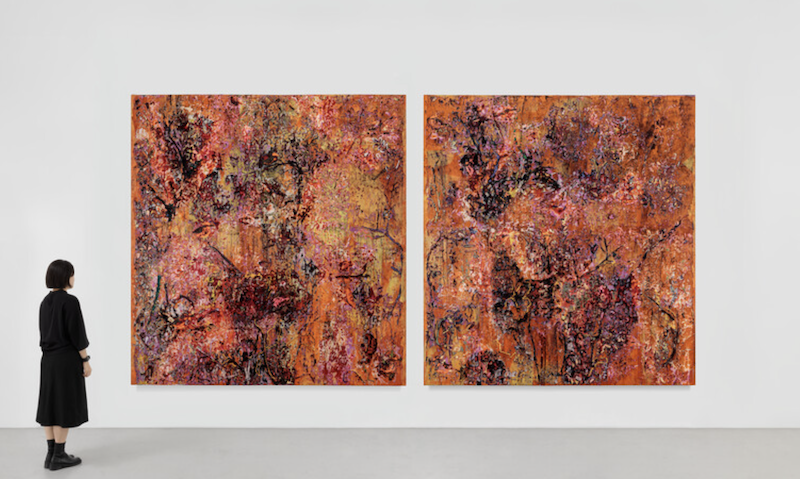
What Makes Mark Bradford’s Work So Powerful?
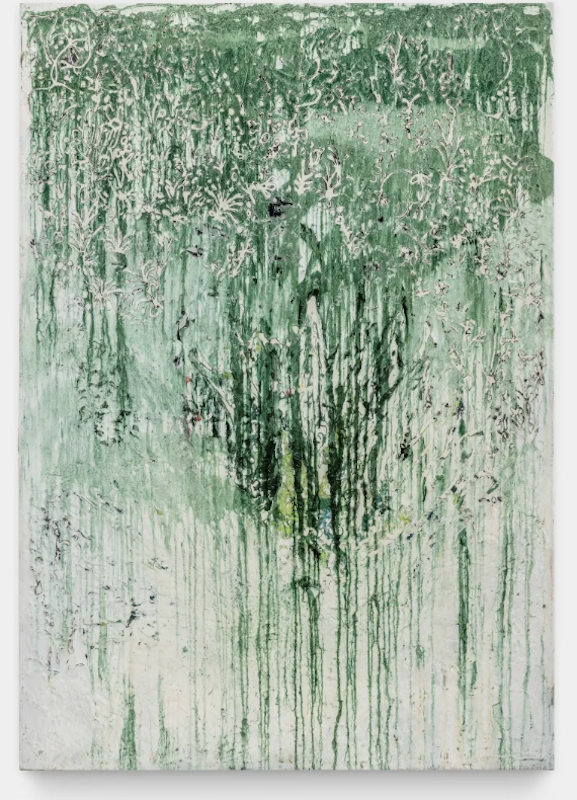
Mark Bradford’s work is powerful because he turns the physical remains of urban life into abstract maps of power, movement, damage, exclusion, and survival.
At first, his paintings can appear to be enormous fields of visual activity. Lines cross and knot. Grids emerge and collapse. Bright colors break through dirty whites, blacks, browns, reds, yellows, and blues. Surfaces appear torn, weathered, scraped, excavated, burned, or eroded.
From a distance, the works may resemble:
Aerial maps
Street networks
Electrical systems
Geological formations
Crowds
Damaged walls
Transportation routes
Data visualizations
Explosions
Ruins
Up close, their apparent imagery breaks down into paper, adhesive, string, fragments of printed language, paint, and accumulated material.
Bradford’s work is often described as abstraction, but it does not withdraw from the social world.
It is built from that world.
Advertisements, merchant posters, billboards, salon papers, comic books, newspapers, maps, and other discarded materials carry traces of the neighborhoods, economies, labor systems, desires, and pressures from which they came. Bradford layers, bonds, tears, sands, scrapes, cuts, and excavates these materials until the surface becomes both image and evidence. (Hauser & Wirth)
His paintings do not illustrate social systems from a safe distance.
They make those systems material.
The Problem Beneath the Work
Bradford’s work repeatedly returns to a central problem:
How can abstraction reveal the social, economic, geographic, and political forces that organize urban life without reducing those forces to a simple illustration or message?
The city is not merely a subject in his work.
It is a structure.
Urban life appears through:
Grids
Routes
Divisions
Accumulations
Barriers
Erasures
Repeated lines
Damaged surfaces
Crowded information
Zones of visibility and disappearance
These structures can resemble the systems through which cities distribute opportunity and risk.
Some neighborhoods receive investment.
Others are neglected.
Some populations move freely.
Others encounter surveillance, policing, displacement, segregation, or economic exclusion.
Some histories become monumental.
Others are covered, erased, or left to deteriorate.
Bradford transforms these conditions into spatial and material relationships rather than depicting them literally. His gallery describes his work as an exploration of social and political systems that objectify marginalized communities and vulnerable bodies, while his map-based paintings expose the boundaries and biases built into cities, neighborhoods, housing systems, and trade routes. (Hauser & Wirth)
The deeper problem is how to make structural power visible when that power often operates indirectly.
Abstraction Made from the Street
Bradford’s materials matter because they come from lived environments.
He does not begin with neutral paper chosen only for its formal qualities. He has used materials associated with hair salons, informal commerce, advertising, public notices, street communication, and disposable urban culture. The Broad notes that his early material vocabulary included permanent-wave endpapers, bobby pins, and hair dyes from the salon environment in which he grew up and worked. His practice later expanded to incorporate discarded signs, flyers, advertisements, and other remnants of city life. (The Broad)
These materials have already performed social work before entering the studio.
They may have:
Advertised employment
Promised credit
Offered legal assistance
Announced a service
Sold beauty
Targeted a particular neighborhood
Communicated urgency
Marked a wall
Divided public space
Recorded an informal economy
Once placed inside the artwork, they retain traces of those functions even when their language becomes unreadable.
The paper may be torn beyond recognition, but it does not become culturally empty.
It remains paper that has circulated through a particular world.
This gives Bradford’s abstraction an unusual density. The material is both visual and historical. It carries color, texture, typography, labor, commerce, neighborhood identity, and social pressure simultaneously.
Surface as Archaeology
Bradford often builds his paintings by layering material and then removing it.
He attaches paper to the support, covers it, bonds it, and later cuts, sands, tears, scrapes, peels, or grinds back through the accumulated surface. The finished painting is therefore produced through construction and destruction at the same time. (Hauser & Wirth)
This process resembles excavation.
A lower layer becomes visible only because an upper layer has been damaged.
A bright color appears through a wound.
A line survives after the surrounding surface has been stripped away.
A fragment of text emerges but cannot be completely recovered.
The painting begins to behave like a city whose history remains present beneath newer development.
Buildings rise over earlier buildings.
Neighborhoods are renamed.
Walls are repainted.
Businesses disappear.
Populations are displaced.
Infrastructure divides communities.
Official narratives cover local memory.
Yet earlier histories remain embedded in the site.
Bradford’s surfaces give physical form to this accumulation.
They do not present history as a clean sequence. They show it as layers competing for visibility.
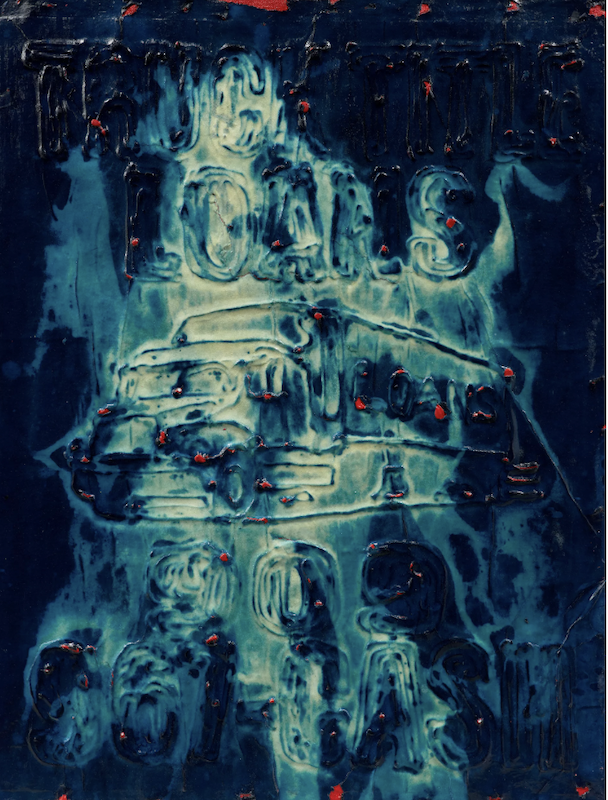
Destruction as a Way of Revealing
In many artistic processes, destruction removes meaning.
In Bradford’s work, destruction often reveals it.
Tearing opens the surface.
Scraping exposes what has been buried.
Erosion produces depth.
Damage creates access to history.
This does not make destruction automatically redemptive. The surfaces can also suggest violence, dispossession, disaster, abandonment, or social fracture.
The important contradiction is that the same action can both injure and uncover.
Bradford’s work therefore holds two opposing possibilities:
A surface can be damaged by history, and damage can be the means through which history becomes visible.
The paintings frequently look as though they have survived something.
But they do not reveal exactly what happened.
They present aftermath without a complete event.
The viewer must read pressure from the condition of the surface.
Why the Formal Choices Matter
Bradford’s large abstract paintings have an immediately recognizable visual language, but their power depends on the necessity behind that language.
Paper carries social circulation
Paper is lightweight, inexpensive, temporary, reproducible, and widely distributed.
It circulates through everyday life in ways that traditional painting materials often do not. It can carry official information, advertising, private appeals, public warnings, entertainment, and economic promises.
By using paper gathered from urban environments, Bradford connects abstraction to systems of communication and exchange.
Paper also remains vulnerable.
It tears, wrinkles, stains, fades, and deteriorates.
Its physical fragility allows social pressure to become visible through damage.
Layering creates historical depth
Each layer adds time.
Earlier decisions are covered but not fully eliminated. Later interventions alter the meaning of what came before.
The surface becomes an archive without becoming a readable document.
This is crucial. Bradford does not simply present research or historical information. He transforms accumulated material into a condition the viewer must encounter bodily.
History becomes density, obstruction, residue, and pressure.
Grids create systems
Grids appear repeatedly in Bradford’s work.
They may resemble streets, city blocks, maps, networks, property divisions, institutional plans, or systems of circulation.
A grid promises order.
It divides space into units.
It suggests that the world can be organized, surveyed, controlled, or navigated.
But Bradford’s grids rarely remain stable. They break, buckle, disappear beneath material, become tangled, or collide with irregular forms.
The grid becomes a model of imposed structure under pressure.
It may organize the city, but it also reveals who controls that organization.
Lines create routes and restrictions
Lines in Bradford’s paintings can resemble roads, borders, transportation paths, wiring, veins, cracks, or movements through crowds.
A line may offer passage.
It may also create separation.
This dual function allows the paintings to hold mobility and confinement at once.
The same visual element can suggest connection, escape, surveillance, access, or exclusion.
Scale creates public experience
Bradford’s paintings are often monumental.
Some stretch across entire walls and exceed the viewer’s field of vision. Deep Blue, for example, extends more than fifty feet across, while Tomorrow Is Another Day spans nearly eighteen feet. (The Broad)
At that scale, the painting behaves less like a private image and more like an environment.
The viewer cannot take it in from one position.
From a distance, the work may resemble a map or total system.
Up close, that apparent system collapses into torn edges, fibers, adhesive, printed fragments, cuts, and scars.
The experience moves between macro and micro:
City and individual
System and material
Geography and body
Structure and wound
Public history and local trace
Scale allows these perspectives to remain active together.
Repetition creates pressure
Repeated lines, fragments, cells, blocks, and gestures can create the feeling of a system operating continuously.
The repetition may evoke:
Bureaucracy
Urban planning
Traffic
Economic circulation
Administrative control
Collective movement
Repeated injury
Accumulated labor
But the repetition is rarely perfectly mechanical.
Irregularities remain.
The system appears powerful but not complete.
Color emerges through damage
Bright color often appears beneath darker or more neutral surfaces.
These colors can feel like signals, buried advertisements, exposed infrastructure, surviving memory, or flashes of vitality.
Because they emerge through tearing and excavation, color does not function merely as decoration.
It becomes evidence that another layer exists below the visible one.
Color may suggest survival, but it may also resemble exposure.
What was protected has been opened.
The Central Contradictions
Bradford’s work holds several forces in unresolved tension:
Abstract and socially specific
Monumental and materially fragile
Ordered and chaotic
Constructed and destroyed
Mapped and disorienting
Public and locally embedded
Beautiful and damaged
Systematic and bodily
Accumulated and erased
Legible and unreadable
The central contradiction may be:
The paintings appear to map social systems while making those systems impossible to comprehend completely.
A viewer may sense roads, boundaries, neighborhoods, crowds, or networks, but no stable legend explains how to read them.
This matters because social systems themselves are often experienced in fragments.
A person encounters a denied loan, a closed business, a longer commute, a police boundary, a changing rent, a missing service, or a neighborhood advertisement.
The larger structure connecting those events may remain invisible.
Bradford’s paintings create a similar relationship between local evidence and systemic uncertainty.
Material and the Body
Bradford’s paintings rarely contain conventional human figures, yet they remain deeply bodily.
The surface is cut, scarred, stretched, scraped, covered, exposed, and repaired.
These actions can evoke bodily experiences without illustrating a body directly.
The painting may resemble:
Skin
Scar tissue
A wound
A bandage
A nervous system
A circulatory network
A body under stress
A body carrying memory
This gives the abstraction emotional and political force.
A city is not merely architecture.
It is experienced through bodies.
Infrastructure determines how long someone travels.
Borders determine who may enter.
Housing systems determine safety and stability.
Economic structures shape health, labor, and exposure.
Public policy becomes physical experience.
Bradford allows material surface to connect structural systems with bodily consequence.
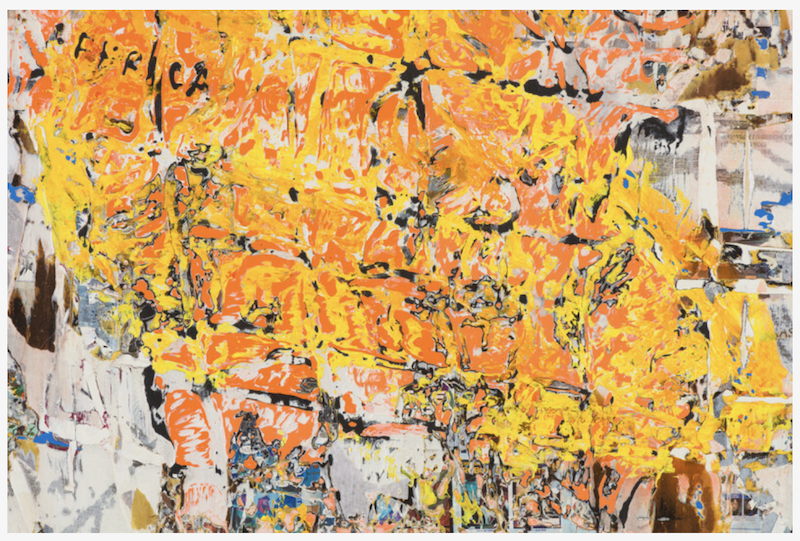
Maps That Cannot Be Neutral
Maps often appear to be objective descriptions of space.
But every map makes choices.
It determines:
What becomes visible
What receives a name
Where boundaries are drawn
Which routes matter
What is placed at the center
What disappears
Who has authority to describe the territory
Bradford’s map-like paintings expose this instability.
His work has drawn upon city plans, neighborhood maps, public-housing layouts, trade routes, and other forms of spatial organization. Rather than treating maps as neutral information, he uses them to investigate how power becomes embedded in geography. (Hauser & Wirth)
The surface may initially appear to provide an overview.
But the overview breaks down.
Routes become tangled.
Borders dissolve.
Areas are blocked.
Information is buried.
The supposedly authoritative view from above becomes uncertain.
This challenges the fantasy that a city can be understood completely from a detached position.
The City as an Unequal Field
Bradford’s abstraction is especially attentive to how urban environments distribute visibility and value.
Public space is covered with signals about what a neighborhood needs and what businesses believe can be sold there.
Advertisements for quick loans, legal services, low-cost goods, employment, housing, beauty, or emergency assistance can reveal economic conditions indirectly.
They form a kind of unofficial portrait of the neighborhood.
By incorporating such material, Bradford allows local economies to enter abstract painting without illustrating individual stories.
The result is not documentary art in a conventional sense.
The evidence has been fragmented.
But its pressure remains.
A torn advertisement may no longer communicate its full message, yet it still carries the urgency, targeting, and visual aggression of street commerce.
History as Something Still Operating
Bradford often engages specific historical events without translating them into conventional narrative images.
Corner of Desire and Piety, for example, uses repeated notices related to propane delivery for FEMA trailers after Hurricane Katrina. Its silver surface behaves like a barrier until the text begins to reveal the social and institutional context embedded within the panels. (The Broad)
Scorched Earth uses a blacked-out aerial map to evoke disappearance, ruin, and the destruction of Black communities. The Broad describes its layered topography as registering both psychological and physical loss. (The Broad)
In works such as these, history does not appear as a scene from the past.
It appears as a condition still embedded in the present.
The material has been damaged because the history remains unresolved.
The Viewer’s Position
Bradford gives the viewer several roles.
The viewer becomes a map reader
From a distance, the eye searches for systems, routes, boundaries, and organizational logic.
The viewer assumes that the surface can be decoded.
The viewer becomes an archaeologist
Up close, the work becomes material evidence.
The viewer studies torn paper, buried language, scars, layers, and exposed fragments.
The viewer becomes physically small
Monumental scale places the body in relation to structures larger than itself.
The painting may feel like a city, institution, wall, or social system that cannot be controlled from one position.
The viewer becomes aware of partial knowledge
No amount of looking produces complete access.
A fragment may reveal something, but the whole remains unstable.
This mirrors the difficulty of understanding systems that people experience personally but cannot observe in their entirety.
The viewer becomes implicated in distance
The map-like view can create the illusion of detached knowledge.
But the damaged materials resist that detachment.
They remind the viewer that every abstract system has material and bodily consequences.
The World Bradford Has Built
Bradford’s recurring lexicon includes:
Maps
Grids
Street lines
Boundaries
Paper
Advertisements
Posters
Repeated text
Blocked zones
Tangled routes
Excavated layers
Blackened areas
Buried color
Damaged walls
Urban residue
Monumental fields
These elements create a recognizable world without functioning as fixed symbols.
A grid may suggest order in one work and confinement in another.
A black field may operate as absence, blockage, protection, or destruction.
A torn surface may suggest violence, archaeology, transformation, or survival.
Paper may function as communication, skin, history, waste, or evidence.
The motifs remain active because their meanings shift with the problem.
Abstraction Without Escape
Abstraction has sometimes been understood as a retreat from politics, narrative, and social specificity.
Bradford demonstrates another possibility.
Abstraction can reveal systems that are too dispersed, large, contradictory, or invisible to be represented through one scene.
A single figurative image might show one person affected by a social structure.
Bradford’s abstraction attempts to model the structure itself.
The painting can hold:
Multiple routes
Accumulated histories
Overlapping populations
Conflicting boundaries
Layers of information
Destruction across time
Movement through unequal space
Abstraction becomes useful precisely because the subject cannot be reduced to one event.
The Risk of Monumental Social Abstraction
Bradford’s work also carries genuine risks.
Large-scale distressed abstraction can become visually spectacular.
A viewer might admire its texture, color, size, and physical intensity without engaging the histories embedded in its materials.
The torn-paper surface could become a recognizable style.
Damage could become an aesthetic.
Social pressure could be reduced to visual drama.
The critical question is therefore:
Does the process make a specific structure, history, or condition newly visible, or does the work merely repeat the appearance of social complexity?
Bradford’s strongest works maintain a connection among material source, process, title, spatial structure, and historical pressure.
The surface does not simply look excavated.
There is something at stake in what has been buried and what becomes exposed.
Why the Work Belongs to the Present
Bradford’s work belongs strongly to a world shaped by:
Urban inequality
Housing pressure
Migration
Infrastructure
Informal economies
Displacement
Environmental disaster
Segregation
Data mapping
Network systems
Public communication
Contested history
Contemporary life is increasingly understood through systems and maps.
People navigate digital networks, transportation systems, economic zones, demographic categories, property boundaries, and algorithmic classifications.
Yet these systems are not experienced equally.
Bradford’s work makes the supposedly abstract structures of contemporary life feel physical.
The grid is torn.
The route is blocked.
The information is buried.
The surface is scarred.
The map no longer appears neutral.
What Artists Can Learn
The lesson is not to imitate Bradford’s monumental scale, torn-paper surfaces, map imagery, grids, street materials, or archaeological appearance.
Those are the solutions produced by his particular investigation.
The larger lesson is that abstraction can remain socially specific without becoming illustration.
Bradford demonstrates that:
Material can arrive with a history already inside it.
Surface can behave like an archive.
Damage can expose rather than merely destroy.
A grid can reveal systems of organization and control.
Maps can make power visible.
Scale can place the body inside a larger structure.
Repetition can evoke bureaucracy, circulation, or accumulated pressure.
Color can operate as buried evidence.
Abstraction can model conditions too complex for a single narrative image.
Social meaning becomes stronger when it is built into the object rather than attached afterward.
His paintings do not simply refer to cities.
They behave like cities.
They accumulate, divide, conceal, circulate, decay, rebuild, and preserve traces of what has been removed.
The lesson is not to copy the appearance of the work. It is to understand the pressure that made the appearance necessary.
Mark Bradford turns abstraction into a material archaeology of the systems that organize public life.