What Makes Cecily Brown’s Paintings So Powerful?
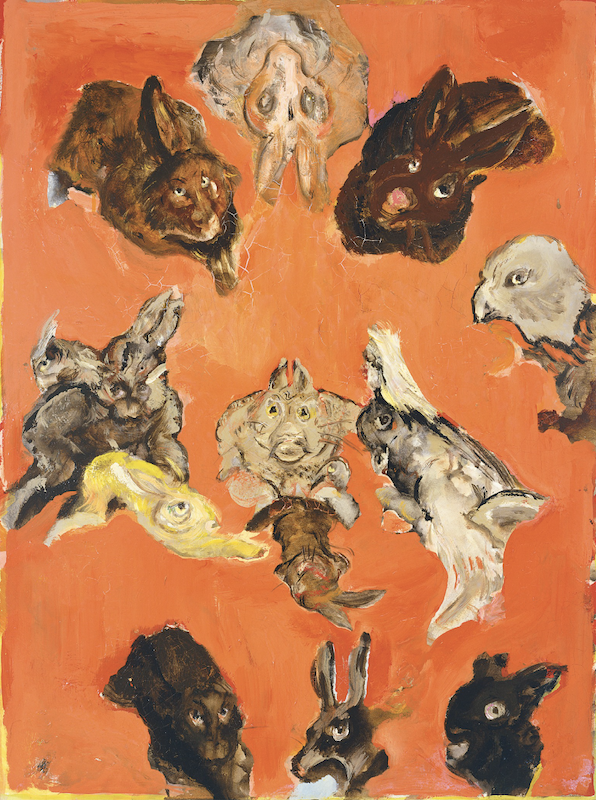
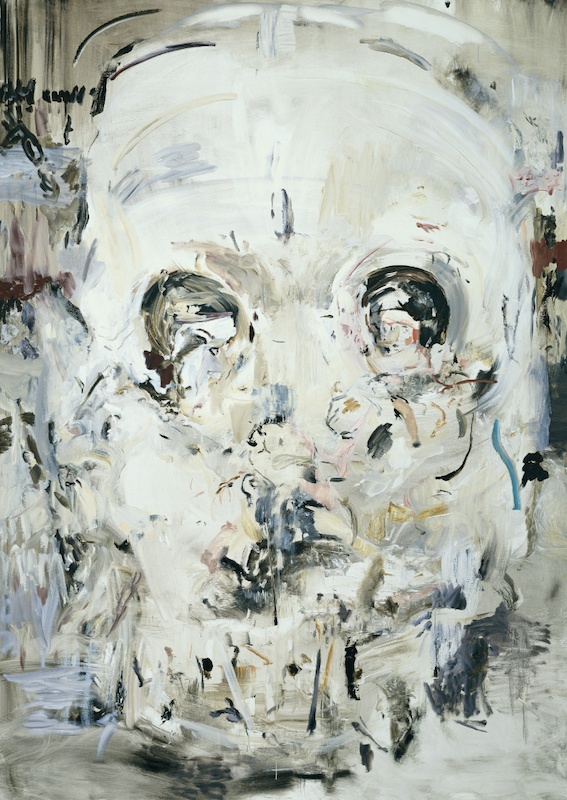
Cecily Brown’s paintings are powerful because they hold the image in a continuous state of becoming and disappearing.
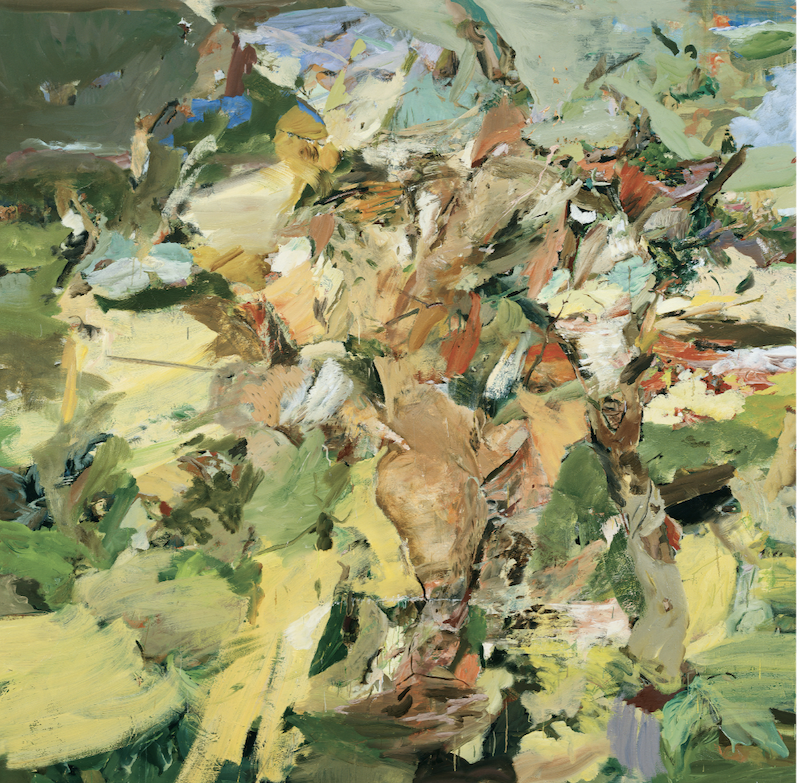
At first, the work can appear overwhelmingly energetic. Bodies, limbs, faces, animals, landscapes, fabrics, flowers, and fragments of art history churn through fields of restless brushwork. Flesh tones collide with greens, reds, blues, yellows, violets, blacks, and dirty whites. Transparent washes pass over thick, opaque marks. Figures emerge for a moment and then dissolve back into paint.
The viewer may recognize an arm, a face, an embracing couple, a reclining body, a flower, a horse, or the suggestion of a landscape. But recognition rarely lasts. Every image threatens to become something else.
Brown’s paintings do not simply alternate between abstraction and figuration. They make the instability between those conditions into the central experience of the work.
The viewer is caught between seeing paint as matter and seeing paint as image.
That perceptual uncertainty carries larger pressures involving desire, touch, appetite, violence, mortality, art history, and the difficulty of possessing what one sees.
The Problem Beneath the Work
Brown’s work repeatedly returns to a generative problem:
How can painting hold bodies, desire, memory, and art history in a state where images continually emerge but never become fully stable or possessable?
Her paintings are not simply gestural abstractions containing hidden figures. Nor are they conventional figurative scenes partially obscured by expressive brushwork.
The deeper problem is the relationship between recognition and dissolution.
A figure begins to appear.
The viewer attempts to complete it.
Another mark interrupts that reading.
The body becomes landscape.
The landscape becomes paint.
A patch of color becomes flesh.
The flesh becomes atmosphere.
This instability matters because desire often begins with partial visibility. Something glimpsed can provoke more attention than something fully described. Brown has explicitly emphasized the power of partial recognition, remarking that what is merely glimpsed can feel more real than what is completely shown. (Gagosian)
The paintings use this condition to keep looking active.
They do not give the viewer a finished image to consume. They create an image that must continually be assembled, lost, and assembled again.
Paint in Continual Transformation
Brown’s paintings seem to remain in motion even after the paint has dried.
A mark may function as several things at once:
A brushstroke
A limb
A fold of fabric
A patch of light
A flower
A bodily opening
A cloud
A shadow
A piece of landscape
This multiplicity gives the paintings their unusual vitality.
Brown has described painting as a form of alchemy in which paint becomes image and both are transformed into something new. Gagosian similarly characterizes her material language as moving between liquid and solid, transparency and opacity, while her compositions shift restlessly between abstraction and figuration. (Gagosian)
The transformation is not merely visual spectacle. It allows the material to behave like the subjects Brown repeatedly explores.
Desire is unstable.
Bodies change.
Pleasure passes.
Life becomes death.
Images are remembered imperfectly.
Art history survives through fragments.
Paint does not simply illustrate these conditions. Its behavior enacts them.
The Body That Cannot Be Secured
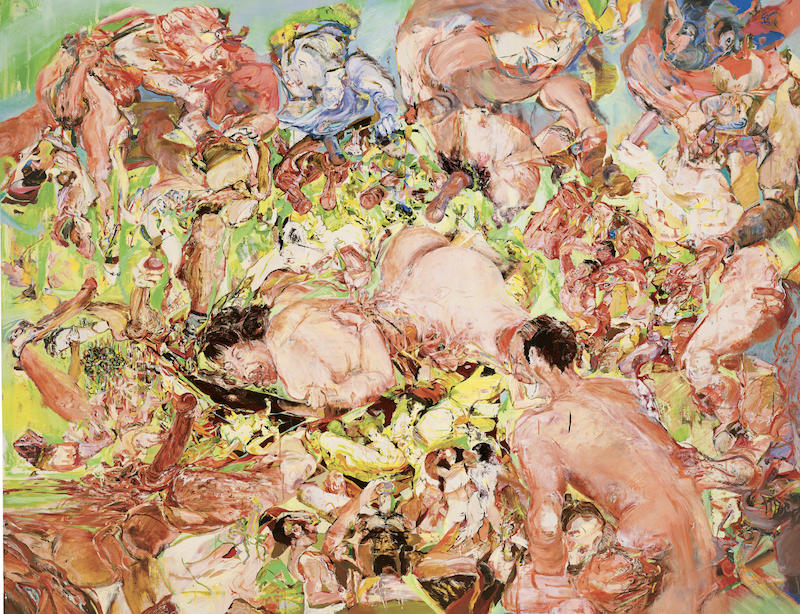
Bodies are everywhere in Brown’s work, but they are rarely offered as complete, stable forms.
They appear through fragments:
Bent knees
Open mouths
Eyes
Breasts
Buttocks
Fingers
Backs
Faces
Intertwined limbs
Animal bodies
Human-animal mixtures
At times, multiple figures appear to collide or merge. It becomes difficult to determine where one body ends and another begins.
This uncertainty is central to the erotic force of the work.
Eroticism does not come only from explicit sexual subject matter. It emerges through the instability of boundaries. Bodies appear to enter one another, dissolve into their surroundings, or become inseparable from the act of painting.
The viewer may think a figure has been located, only to realize that the apparent body is produced by several unrelated marks. The eye participates in constructing the erotic image.
The painting therefore places desire partly inside the viewer’s perception.
What is seen depends on what the viewer expects, remembers, imagines, or wants to find.
Desire as Looking
Brown’s paintings frequently make looking feel hungry.
The eye moves quickly across the surface, searching for recognizable forms. A face appears and disappears. A body seems to emerge beneath the brushwork. A dense cluster promises a scene but refuses to become fully legible.
The viewer is encouraged to keep searching.
This makes the act of looking resemble desire itself:
It seeks an object.
It anticipates completion.
It responds intensely to partial revelation.
It becomes frustrated by uncertainty.
It returns to what it cannot fully possess.
The paintings offer continual visual gratification, but they refuse final satisfaction.
This is one reason their sensuality cannot be reduced to sexual imagery. The entire perceptual structure is erotic. The eye approaches, touches, withdraws, loses, and searches again.
The image remains available enough to generate desire but unstable enough to prevent possession.
Why the Formal Choices Matter
Brown’s paintings have a highly distinctive appearance, but their force does not come from energetic brushwork alone. The major formal choices are necessary to the deeper problem.
Abstraction prevents narrative closure
A conventional figurative painting can tell viewers what is happening, who is present, and how bodies relate to one another.
Brown repeatedly interrupts that certainty.
Gesture breaks apart anatomy. Color disconnects objects from natural appearance. Figures collapse into their settings. Marks cover or transform one another.
Abstraction prevents the scene from becoming fixed.
It keeps the image open to several possibilities at once.
Figuration prevents abstraction from becoming merely decorative
Brown does not allow the paintings to settle into pure formalism either.
Fragments of bodies, landscapes, animals, still lifes, and historical compositions continually pull the surface back toward recognizable experience.
The marks carry bodily associations. Pale pinks resemble flesh. Dark openings suggest mouths, eyes, wounds, or shadows. Sweeping forms imply limbs or movement.
Figuration gives the abstraction psychological and erotic pressure.
Each side prevents the other from settling:
Figuration keeps abstraction embodied.
Abstraction keeps figuration unstable.
Layering makes time visible
Brown builds paintings through accumulation, revision, covering, scraping, and overlapping.
Earlier decisions remain partially visible beneath later ones. One image appears to pass through another. Transparent marks reveal what lies underneath, while opaque passages bury previous forms.
The surface records time.
Looking becomes an encounter with several moments at once:
The first image
The revised image
The covered image
The remembered source
The form presently visible
The form that might still emerge
The painting does not illustrate duration. It contains duration materially.
Scale turns looking into bodily immersion
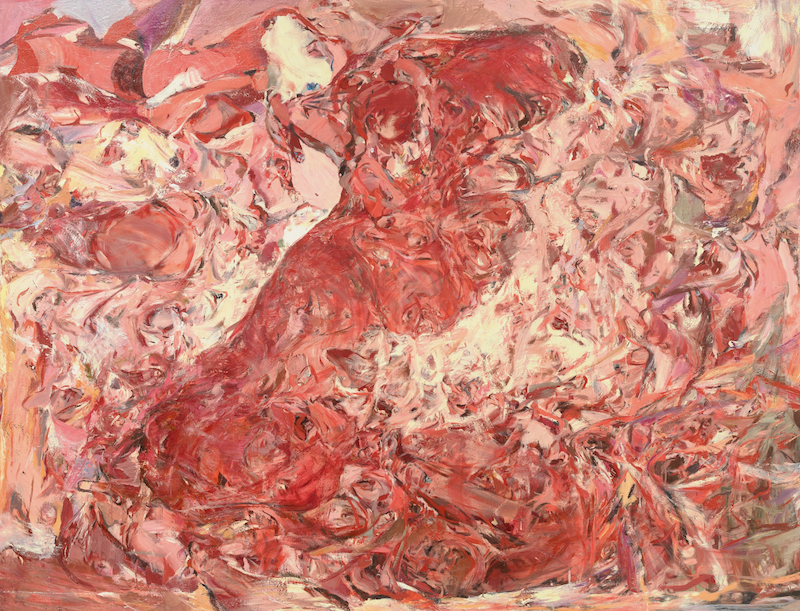
Many of Brown’s paintings are large enough to surround the viewer’s field of vision. All of Your Troubles Come from Yourself, made between 2006 and 2009, measures approximately eight feet in both height and width. (Whitney Museum of American Art)
At this scale, the surface cannot be absorbed as one stable image.
From a distance, viewers may perceive an overall composition. Up close, that composition breaks into marks, drips, edges, stains, and fragments.
The body must move between positions.
The painting changes according to distance:
Far away, an image begins to organize itself.
Closer, that image becomes paint.
Moving sideways, different forms emerge.
Stepping back, the fragments reorganize.
Scale converts uncertainty into a physical experience.
Color creates changing temperatures
Brown’s color is rarely stable or merely harmonious.
Flesh tones may become sickly, lush, overheated, bruised, luminous, or decaying. Greens can suggest vegetation, artificial light, rot, or bodily unease. Reds may carry pleasure, violence, ornament, or exposed flesh. Pale blues and whites can open the surface before darker marks compress it again.
Color moves the paintings between emotional states without assigning a single mood.
The same canvas can feel ecstatic, comic, violent, tender, and exhausted.
Brushwork creates different speeds
Some marks sweep across the surface rapidly. Others are small, hesitant, or concentrated. Thin stains open space. Thick passages slow the eye. Sharp lines create momentary definition before dissolving into broader strokes.
The surface therefore contains several speeds of attention.
The viewer may rush through one area, pause over another, and become trapped inside a dense cluster elsewhere.
Energy is not produced simply by making every mark active. It comes from variation:
Acceleration and pause
Density and openness
Clarity and interference
Expansion and compression
Recognition and loss
The paintings feel alive because their internal rhythms remain unequal.
The Central Contradictions
Brown’s work holds several opposing forces at once:
Figurative and abstract
Seductive and frustrating
Energetic and controlled
Bodily and atmospheric
Pleasurable and violent
Historical and immediate
Comic and grave
Excessive and carefully structured
Recognizable and unstable
Alive and haunted by death
These contradictions do not merely coexist as subjects. They are built into the behavior of the paint.
The central contradiction is:
The paintings make images intensely present while preventing them from becoming fully secure.
The viewer sees more the longer the work is observed, but greater looking does not necessarily produce greater certainty.
Instead, each discovery destabilizes another.
Pleasure and Mortality
Brown’s paintings have often been associated with eroticism, appetite, sensuality, and bodily excess. But pleasure is rarely isolated from mortality.
Her 2023 Metropolitan Museum of Art survey was titled Death and the Maid, bringing together approximately fifty paintings, drawings, sketchbooks, and monotypes from across her career. The exhibition emphasized recurring concerns such as still life, vanitas, mirroring, death, bodily pleasure, and the passage of time. (The Metropolitan Museum of Art)
This relationship between desire and death deepens the work.
Bodies are pleasurable because they are temporary.
Paintings preserve images while showing them dissolving.
Still-life abundance carries the possibility of decay.
Flowers bloom and collapse.
Flesh appears vivid and already on the verge of becoming matter.
Brown’s work often feels caught between an orgy and a battlefield, a garden and a ruin, an ecstatic gathering and an aftermath.
The instability between abstraction and figuration becomes a way of holding life and death within the same surface.
Art History as Living Material
Brown draws extensively from the history of painting, including artists such as Peter Paul Rubens, Nicolas Poussin, Francisco Goya, Édouard Manet, Edgar Degas, Willem de Kooning, Francis Bacon, and Joan Mitchell. Her work also engages still life, vanitas, pastoral scenes, battle painting, erotic imagery, and other inherited genres. (Whitney Museum of American Art)
But these sources do not remain intact.
A historical composition may provide the underlying arrangement of bodies, only to be fragmented by gesture. A pastoral scene may become erotic, violent, or chaotic. A still life may merge with flesh. A familiar pose may survive as only a bent limb or curved passage of paint.
Brown treats art history as material rather than authority.
She does not simply quote earlier paintings to demonstrate knowledge. She breaks them apart, layers them with other sources, and allows their fragments to become active inside a contemporary visual field.
This transformation matters because historical paintings already contain cultural ideas about:
Gender
Beauty
Violence
Desire
Power
Class
Nature
The body
The role of the viewer
By destabilizing their compositions, Brown also destabilizes the meanings they carried.
Her paintings ask what remains alive in an inherited image after its narrative, hierarchy, and historical certainty have been disturbed.
The Female Body and the History of Looking
Brown entered a tradition in which large-scale gestural painting had often been associated with masculine authority, while the female body had frequently been presented as an object for male viewing.
Her work occupies both positions at once.
She assumes the physical scale, painterly freedom, and gestural ambition historically associated with major male painters. At the same time, she fills those fields with unstable bodies, sexual imagery, pleasure, humor, and ambiguity.
This does not simply reverse the gaze or replace one authority with another. The figures often remain too unstable for a fixed relationship between observer and observed.
Who is looking?
Who is being looked at?
Where does one body begin?
Is the viewer witnessing pleasure, inventing it, or participating in the construction of the scene?
The work does not offer a clean answer.
That uncertainty prevents the female body from becoming a stable object while also preventing the painting from becoming a straightforward statement of empowerment.
The problem remains active inside perception.
The Viewer’s Position
Brown gives the viewer an unusually active role.
The viewer becomes a hunter for images
The surface invites searching.
A recognizable form produces a moment of reward, encouraging further inspection.
The viewer becomes a collaborator
Because forms are incomplete, the viewer helps construct them. Marks become bodies partly through expectation and association.
The viewer does not merely receive the image. The viewer participates in making it.
The viewer becomes aware of desire
The attempt to uncover bodies and scenes can reveal the viewer’s own appetite for recognition, intimacy, sexuality, narrative, or visual control.
The viewer becomes physically mobile
Large scale requires changes in distance. No single position provides a complete experience.
The viewer becomes uncertain
The painting repeatedly withdraws what it seemed to reveal.
This instability prevents passive consumption. The viewer must continue negotiating between paint, image, memory, and projection.
The World Brown Has Built
Brown’s artistic world contains a recurring lexicon:
Fragmented bodies
Erotic encounters
Animals
Flowers
Landscapes
Gardens
Battle scenes
Still lifes
Mirrors
Beds
Limbs
Faces
Swirling clusters
Flesh-like color
Transparent washes
Dense fields
Art-historical fragments
These elements do not remain fixed symbols.
A flower may resemble an opening in the body.
A limb may become a branch.
A landscape may become a mass of flesh.
A sexual encounter may become a battle.
A still life may become a vanitas image.
A historical source may become a contemporary perceptual event.
This is what turns repetition into a lexicon rather than a brand. The motifs return, but their meanings remain unstable.
Coherence Inside Apparent Chaos
Brown’s paintings can initially look spontaneous or chaotic. Yet their vitality depends on strong internal organization.
Dense passages are balanced by areas of relative openness. Dark marks anchor lighter fields. Repeated curves move the eye across the canvas. Color reappears in separated areas to establish relationships. Figures may be obscured, but their underlying arrangements often come from carefully studied historical compositions.
The paintings do not abandon structure.
They conceal and destabilize it.
This distinction is essential.
Random activity would produce visual noise. Brown’s work produces governed instability. The viewer senses that the image is under pressure rather than merely disorganized.
The strongest paintings make chaos feel necessary because multiple systems remain active simultaneously:
Historical composition
Bodily recognition
Material gesture
Color rhythm
Erotic suggestion
Spatial ambiguity
Narrative fragments
The surface pulses because these systems continually support and interrupt one another.
The Risk of Painterly Excess
Brown’s visual language carries a real danger.
Expressive brushwork, erotic fragments, art-historical references, and the oscillation between abstraction and figuration can become an easily recognizable formula.
A dense surface is not automatically complex.
A hidden figure is not automatically psychologically charged.
Energetic paint is not automatically alive.
The critical question is whether each painting produces a specific perceptual and emotional condition or merely repeats the established Cecily Brown effect.
Her strongest works create a carefully calibrated struggle between recognition and dissolution. The image emerges enough to matter but never enough to become fixed.
A weaker version of the method would merely scatter bodily clues throughout expressive paint.
This risk offers a larger distinction:
Complexity depends not on how much is present, but on how many meaningful relationships remain active.
Why the Work Belongs to the Present
Brown works deeply within the history of oil painting, yet her paintings model a distinctly contemporary condition.
Modern viewers encounter images in fragments:
Cropped photographs
Rapid video cuts
Layered screens
Scrolling feeds
Partial memories
Overlapping references
Bodies transformed into visual content
Images consumed before they can be fully understood
Brown’s paintings slow this instability down without resolving it.
They present a field in which too much visual information is available, yet certainty remains difficult. Recognition happens quickly and disappears just as quickly.
The paintings therefore address more than the history of abstraction.
They examine how perception operates in a culture of visual excess.
The viewer sees continually but cannot secure what is seen.
What Artists Can Learn
The lesson is not to imitate Brown’s energetic brushwork, fragmented bodies, fleshy palette, large canvases, erotic imagery, or art-historical references.
Those are the visible solutions produced by her particular problem.
The larger lesson is that instability can become a precise artistic structure.
Brown demonstrates that:
Abstraction can keep an image from closing.
Figuration can give gesture bodily pressure.
Layering can make time physically visible.
Scale can turn perception into movement.
Color can shift emotional temperature.
Art history can become active material rather than quotation.
Partial visibility can intensify desire.
The viewer’s search for meaning can become part of the artwork.
Energy becomes meaningful when several visual systems remain in productive conflict.
The paintings do not merely look energetic.
Their energy comes from the fact that nothing is permitted to remain one thing for long.
Paint becomes flesh.
Flesh becomes landscape.
Pleasure becomes violence.
History becomes immediate sensation.
Recognition becomes uncertainty.
Life moves toward death and then returns as paint.
The lesson is not to copy the appearance of the work. It is to understand the pressure that made the appearance necessary.
Cecily Brown turns painting into a field where bodies, images, desire, and history continually emerge without ever becoming fully possessable.