What Makes Michaël Borremans’s Paintings So Powerful?
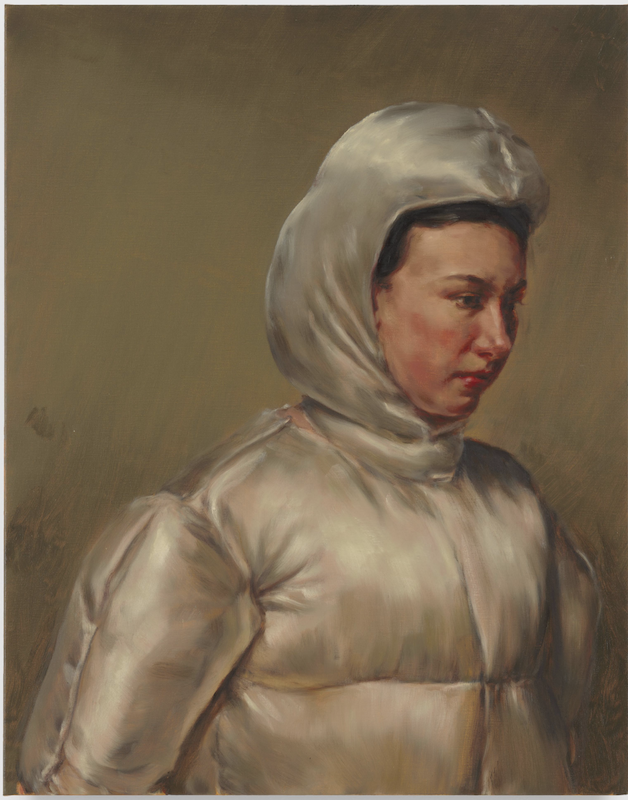
Michaël Borremans’s paintings are powerful because they use the authority of traditional painting to make images feel less trustworthy.
At first, the work appears familiar. A face emerges from a muted background. A child sits or sleeps. A solitary figure wears an unusual costume. A group performs an activity whose purpose is unclear. The lighting recalls an old photograph, a film still, or a European painting from another century.
The scenes are beautifully rendered. Flesh appears soft and luminous. Forms emerge through restrained tonal shifts. The compositions feel controlled, quiet, and deliberate.
Yet the longer the paintings are observed, the less stable they become.
The figures remain visible but psychologically inaccessible. Their actions appear purposeful, but the purpose is withheld. Their costumes suggest social roles without explaining them. Their environments resemble stages, laboratories, classrooms, ceremonies, or institutional spaces, yet none of those interpretations becomes secure.
The image looks convincing.
What it means remains uncertain.
The Problem Beneath the Work
Borremans repeatedly returns to a central problem:
How can painting make an image appear convincing while revealing that appearance, identity, and meaning are fundamentally unstable?
This is why his technical refinement matters so much.
If these scenes were painted carelessly, their irrationality might appear accidental. Because they are rendered with such control, the viewer assumes that every object, gesture, costume, and expression has been placed there for a reason.
The paintings create confidence before undermining it.
Traditional Western painting often used technical authority to make religious figures, rulers, historical events, social hierarchies, and human identities appear believable and significant. Borremans inherits that authority but changes what it does.
His paintings do not make their subjects easier to understand.
They make uncertainty feel authoritative.
The work asks whether an image can reveal a person at all—or whether it merely creates a persuasive surface onto which viewers project stories, emotions, identities, and judgments.
A World of Staged Appearances
Borremans’s paintings frequently feel staged.
The figures appear posed, costumed, arranged, instructed, examined, or made to perform. Yet the person or system directing the performance remains outside the frame.
This creates the impression that an invisible authority governs the scene.
It might be:
The artist
The camera
Social convention
An institution
Political ideology
Art history
The viewer
The image itself
The paintings rarely identify that authority directly. Instead, they show its effects.
A figure has been placed in a room.
A body has been positioned for inspection.
A costume has been assigned.
An activity is taking place.
But the rules remain inaccessible.
This withheld causality creates much of the psychological pressure. The viewer encounters the evidence of a system without being allowed to understand the system itself.
Borremans’s practice has long crossed painting, drawing, photography, and film, and his work retains a strong awareness of photographic cropping, constructed scenes, selective focus, and mediated imagery. His paintings have been described as meticulously composed works that resist immediate interpretation and challenge the apparent stability of representation. (David Zwirner)
Beauty as a Form of Unease
One of the most important qualities of Borremans’s work is that beauty does not resolve the paintings.
It intensifies them.
His paint handling can be elegant and sensual. Faces glow softly. Clothing catches subdued light. Browns, grays, ochres, faded reds, dirty whites, and restrained flesh tones create visual harmony.
That harmony attracts the viewer.
But the pleasure of looking soon becomes uncomfortable.
The subject may appear vulnerable, passive, artificial, exposed, or controlled. A beautifully painted face may resemble a person, a mannequin, a sculpture, a specimen, or a detached prop. A graceful costume may conceal identity rather than express it. A tender scene may contain the atmosphere of humiliation, punishment, or threat.
The viewer is drawn toward an image that cannot be trusted.
Beauty therefore becomes part of the problem.
It does not decorate the uncertainty. It creates the confidence that uncertainty later disrupts.
Why the Formal Choices Matter
Borremans’s visual language is highly coherent because the major formal choices all support the same deeper investigation.
Technical refinement creates authority
The paintings borrow the visual credibility of European figurative painting.
Careful modeling, subdued illumination, tonal control, and convincing bodily presence tell the viewer that the image deserves attention. The technique gives the scene weight before the narrative begins to fracture.
The refinement is not merely evidence of skill.
It creates the trust that the painting will eventually undermine.
Muted color withholds emotional instruction
Bright color can quickly direct interpretation. Red may signal danger. Yellow may suggest warmth. Blue may imply sadness or distance.
Borremans’s restrained palette rarely provides such simple instructions.
Instead, color creates atmosphere without determining how the viewer should feel. The same brown-gray world can appear tender, institutional, historical, theatrical, oppressive, or dreamlike.
The emotional temperature remains unstable.
Isolation removes explanatory context
Figures often appear against sparse or indeterminate backgrounds.
This removes the information that might make the scene understandable:
Where is the figure?
What occurred before this moment?
What will happen next?
Who else is present?
Is the figure acting voluntarily?
Is the scene real, imagined, rehearsed, or remembered?
The missing environment becomes psychologically active.
The less context the painting provides, the more intensely the viewer examines the remaining evidence.
Cropping suggests a missing world
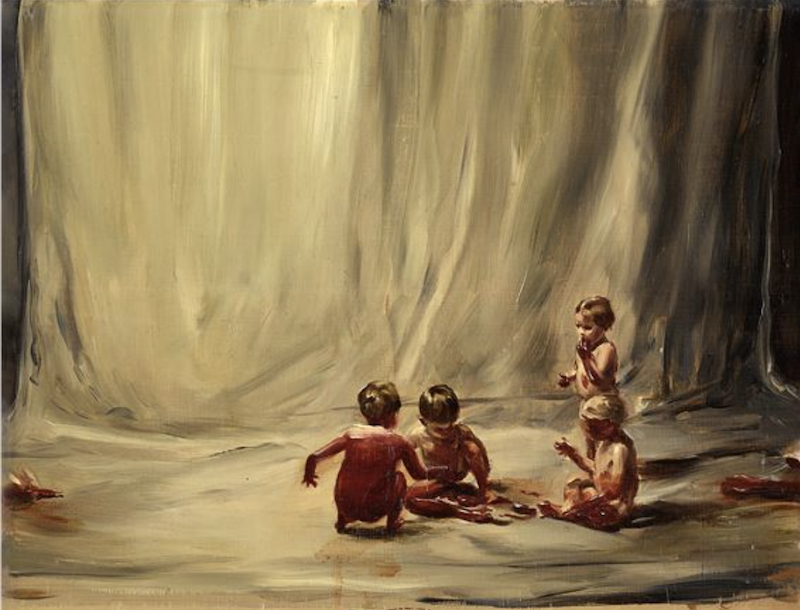
Borremans often uses photographic and cinematic framing. Bodies may be cut off by the edge. A scene may resemble a fragment extracted from a much larger event.
This suggests that the explanation exists somewhere outside the visible image.
The painting appears to withhold precisely the information that would make it legible.
Selective focus destabilizes reality
Some passages are sharply described, while others dissolve into soft edges and tonal haze.
This resembles the behavior of photography, memory, and attention. The effect allows the scene to feel physically convincing without becoming fully secure.
The image is neither straightforward realism nor an obvious dream.
It occupies a more disturbing territory between the two.
Costume turns identity into performance
Costumes imply social roles, historical periods, occupations, ceremonies, disguises, hierarchies, or forms of discipline.
Yet Borremans’s costumes rarely clarify who the figures are.
Instead, they separate the visible role from the unknown person beneath it.
Identity begins to feel assigned rather than naturally expressed.
Scale controls intimacy and power
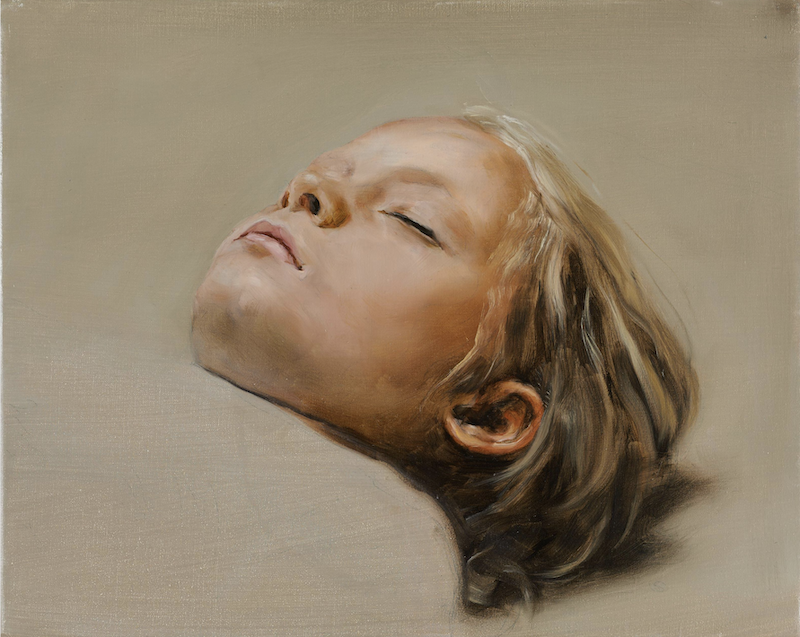
Many of Borremans’s paintings are relatively small. Sleeper, painted in 2007–2008, measures only 40 by 50 centimeters. The intimate scale requires viewers to move close, creating a private encounter with a subject who remains psychologically unavailable.
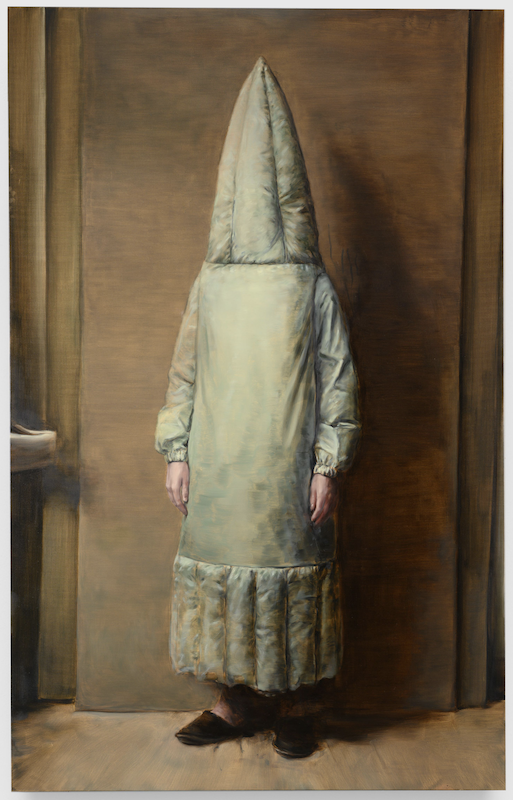
Other works become monumental. Large Rocket from 2019 measures three meters high, transforming a strangely costumed figure into an imposing public presence.
Small scale makes looking intimate.
Large scale makes the irrational authoritative.
Both serve the same problem.
The Central Contradictions
Borremans’s paintings remain alive because they hold multiple opposing truths without resolving them.
They are:
Beautiful and disturbing
Intimate and inaccessible
Historical and contemporary
Controlled and irrational
Tender and cruel
Specific and anonymous
Human and object-like
Visible and unknowable
The deepest contradiction may be this:
The subjects are made intensely visible while being denied stable identity.
This distinguishes Borremans’s work from paintings that merely use mystery as atmosphere.
The ambiguity is not vague. The details are often extremely precise. What remains unstable is how those details should be interpreted.
Vagueness provides too little information to produce meaningful thought.
Borremans provides enough information to produce several incompatible explanations.
The Viewer’s Position
Borremans does not leave the viewer outside the problem.
The paintings make looking itself feel unstable.
The viewer becomes a voyeur
Many figures appear unaware of being watched. They sleep, look downward, turn away, perform an activity, or remain psychologically elsewhere.
The viewer receives access without reciprocity.
The viewer becomes an examiner
Because the scene is unexplained, every detail becomes evidence.
Posture, clothing, skin, gaze, gesture, setting, and scale are inspected for clues. The figure begins to resemble a specimen whose condition must be diagnosed.
The viewer becomes a projection machine
The work does not provide a secure emotional interpretation, so the viewer supplies one.
The figure appears:
Vulnerable
Sinister
Humiliated
Innocent
Artificial
Exhausted
Controlled
Dead
Asleep
These interpretations may reveal as much about the viewer as they do about the painting.
The viewer becomes a consumer of beauty
The surface may remain pleasurable even when the scene feels ethically or psychologically uncomfortable.
The viewer must confront the possibility of enjoying an image that appears to expose, isolate, or objectify its subject.
Borremans does not directly accuse the viewer. He creates enough uncertainty for the viewer’s own habits of looking to become visible.
Painting as an Unreliable Object
Borremans has stated that a painting is not merely an image but an object with a multilayered character. That distinction helps explain why his work cannot be reduced to enigmatic subject matter. (Art Institute of Chicago)
The physical painting matters.
Its scale determines the viewer’s bodily distance.
Its surface alternates between illusion and visible paint.
Its historical appearance carries cultural authority.
Its material presence slows down an image that might otherwise be consumed quickly.
The work therefore asks two questions at once:
What does this image appear to show?
And:
What kind of object is producing that appearance?
The paintings do not merely depict unstable realities. They expose painting itself as a device for constructing belief.
The World Borremans Has Built
Borremans has developed a recognizable artistic world from recurring elements:
Muted theatrical light
Isolated figures
Passive or sleeping bodies
Costumes and disguises
Unexplained tasks
Artificial rooms
Curtains and stages
Selective focus
Strange ceremonies
Historical echoes
Quiet menace
Suspended time
These motifs form more than a recognizable style.
They express a consistent way of seeing:
Human beings exist inside systems of representation, performance, categorization, and power that they do not fully control.
The works do not need to depict the same subject because the same intelligence governs them.
A child, a masked figure, a commuter, an animal, or a porcelain object can enter this world and become subject to its rules.
A recent museum survey brought together nearly fifty paintings from two decades, including portraits, animals, objects, early works, and major series. The range demonstrates how Borremans has sustained a recurring representational problem without limiting the practice to one subject.
The Risk of a Recognizable Formula
Borremans’s method carries a genuine danger.
The combination of muted color, technical refinement, isolated subjects, unexplained activity, and psychological unease is highly recognizable. What begins as a coherent world could eventually harden into a brand.
An enigmatic image is not necessarily a profound one.
The important critical question is whether each painting discovers a new dimension of the central problem or simply reproduces the established Borremans effect.
The strongest works make uncertainty specific.
The weaker possibility would be mystery applied as a familiar atmosphere.
This distinction matters when studying any artist with a recognizable visual language. Coherence creates identity, but too much predictability turns identity into formula.
Why the Work Feels Contemporary
Borremans’s paintings may resemble historical European art, but their central problem belongs strongly to the present.
Contemporary life is saturated with constructed images:
Social-media identities
Advertising
Political image management
Cinematic framing
Public relations
Artificial personas
Edited photographs
Algorithmic feeds
Synthetic images
Deepfakes
People are more visible than ever, yet visibility does not necessarily produce knowledge.
A face can circulate everywhere while the person behind it remains inaccessible. An image can feel intimate while being completely staged. Technical realism can create credibility without truth.
Borremans’s paintings understand this condition without illustrating phones, screens, software, or social media.
Their contemporary force lies deeper:
They examine the authority images exercise even when their meanings cannot be trusted.
What Artists Can Learn
The lesson is not to imitate Borremans’s muted palette, Old Master technique, isolated figures, strange costumes, or enigmatic narratives.
Those are the visible results of his investigation.
The larger lesson is that every formal choice can participate in a central problem.
Technical refinement can create trust.
Beauty can conceal danger.
Cropping can activate missing information.
Scale can control intimacy and authority.
Costume can separate identity from appearance.
Background can withhold context.
Ambiguity can expose the viewer’s need for certainty.
Borremans demonstrates that visual restraint does not require conceptual restraint. A quiet painting can contain enormous pressure when what is visible conflicts with what can be known.
The lesson is not to copy the appearance of the work.
It is to understand the pressure that made the appearance necessary.
Michaël Borremans uses the authority of painting to undermine the authority of images.