What Makes Rashid Johnson’s Work So Powerful?
Rashid Johnson’s work is powerful because he turns materials associated with Black cultural life, domestic ritual, intellectual history, self-care, anxiety, and aspiration into a coherent artistic world. Black soap, shea butter, ceramic tile, mirrors, plants, books, rugs, vinyl records, wood, wax, film, painting, and architecture do not function as illustrations of identity. They become active substances through which identity is built, fractured, protected, performed, and revised.
At first encounter, Johnson’s work can feel materially abundant. A wall may be covered in white ceramic tile and smeared with black soap and wax. A face may emerge through frantic scratches. A steel structure may hold tropical plants, books, monitors, rugs, ceramics, and a functioning piano. A mirror may be branded, sprayed, obscured, or interrupted. The viewer encounters a vocabulary that feels domestic, intellectual, bodily, architectural, and ceremonial at once.
The deeper inquiry is:
How can private psychological experience and shared cultural history inhabit the same material system without either one reducing the other?
Johnson’s work does not treat identity as a stable category inherited intact from history. It presents identity as something assembled through materials, habits, readings, fantasies, anxieties, family histories, music, political pressures, and acts of care.
What the Viewer Encounters
Johnson’s practice spans photography, painting, drawing, sculpture, video, film, mosaic, installation, and architecture. His recurring materials include black soap, shea butter, wax, white ceramic tile, mirrors, branded wood, books, plants, rugs, vinyl records, oyster shells, and culturally specific grooming or domestic products. These materials are often combined within dense, highly structured compositions. (Hauser & Wirth)
The contrasts are immediate:
black soap against white tile;
soft shea butter against rigid steel;
living plants inside geometric grids;
mirrors disrupted by spray paint;
books displayed as objects;
frantic faces contained within orderly mosaics;
domestic materials enlarged into monuments.
The work repeatedly places structure and disorder together.
A grid promises order.
The marks inside it appear anxious, wounded, improvised, or explosive.
A plant suggests growth.
The steel frame contains and organizes it.
A mirror offers reflection.
Paint, branding, and material residue interrupt what can be seen.
Johnson’s work therefore begins with a condition of divided experience:
The individual is held by systems while also trying to exceed them.
The Inquiry Beneath the Work
Johnson was born in Chicago in 1977 and initially trained in photography before expanding into sculpture, installation, film, and painting. Across that development, he has remained concerned with personal and collective identity, art history, Black cultural life, literature, philosophy, materiality, and critical history. (Hauser & Wirth)
The work is often described as being about Black identity, but that formulation is too broad.
Johnson is more specifically interested in the unstable relationship between:
the self one inherits;
the self one performs;
the self others expect;
the self one imagines;
the self that becomes anxious under pressure;
the self that seeks healing, escape, or reinvention.
His materials often carry both practical and symbolic functions.
Shea butter can moisturize the body, but it can also signify Afrocentric identity, care, commerce, ancestry, or the performance of cultural authenticity.
Black soap can clean, soothe, and protect. It can also become thick, dark matter that obscures, stains, and accumulates.
Books can transmit intellectual history, but they can also become status objects, cultural signals, or evidence of aspiration.
Plants require care, light, water, and time. They introduce dependence and vulnerability into otherwise rigid structures.
Johnson’s artistic world becomes powerful because no material has only one meaning.
Material as Lived Experience
Johnson has described himself as a materialist at heart. His earliest photographic works already reflected a fascination with process, surface, and historical technique, and his later installations extended that interest into culturally resonant substances. (Art21)
This matters because his materials are not neutral symbols selected from outside his life.
Black soap and shea butter were familiar from childhood and from Afrocentric cultural spaces. Their use connects personal memory, bodily care, cultural commerce, and larger ideas about Blackness. (Art21)
The work therefore asks:
What happens when an ordinary material enters the museum?
Its practical identity does not disappear.
Shea butter remains a substance associated with the body.
Black soap remains connected to cleansing.
But institutional framing changes their status. They become sculpture, pigment, symbol, archive, and commodity.
This transformation creates pressure.
The material is both intimate and public.
Useful and aesthetic.
Culturally specific and internationally circulated.
Personal and marketable.
Johnson does not solve these tensions. He allows the material to carry them.
From Photography to Material Systems
Johnson first became known through photographic portraits, including works made with nineteenth-century processes. These early images already investigated how Black identity was staged, framed, historicized, and made visible.
Photography offered a way to examine representation.
But Johnson’s later move into sculpture and installation allowed him to investigate something broader:
not only how identity looks, but how identity is materially constructed.
A photograph can represent a person associated with particular books, music, rituals, and histories.
An installation can bring those materials into the same physical system.
The change in medium expanded the inquiry from image to environment.
Books could become architecture.
Soap could become paint.
Plants could become living participants.
The viewer could move among the references rather than viewing them from outside.
This was not a rejection of photography. It was a recognition that the inquiry required more than an image.
Black Soap and the Cosmic Slop Works
Johnson’s Cosmic Slop works use black soap and wax on wood panels. The mixture is spread, scraped, marked, and built into dark, highly tactile surfaces. The title refers to the Funkadelic song “Cosmic Slop,” linking the material to music, cultural memory, dirt, excess, and improvisation. Examples of the series appeared prominently in Johnson’s 2025 Guggenheim survey. (The Guggenheim Museums and Foundation)
The term “slop” is important.
It suggests:
mess;
residue;
mixture;
waste;
food;
bodily substance;
something without fixed form.
“Cosmic,” by contrast, suggests:
vastness;
spirituality;
metaphysical scale;
the universe;
transcendence.
Johnson holds those registers together.
The ordinary and the cosmic.
The bodily and the philosophical.
The low and the elevated.
The works transform a cleansing material into something visibly dirty, dense, and unstable.
Soap usually removes residue.
Here, soap becomes residue.
That contradiction makes the material conceptually active.
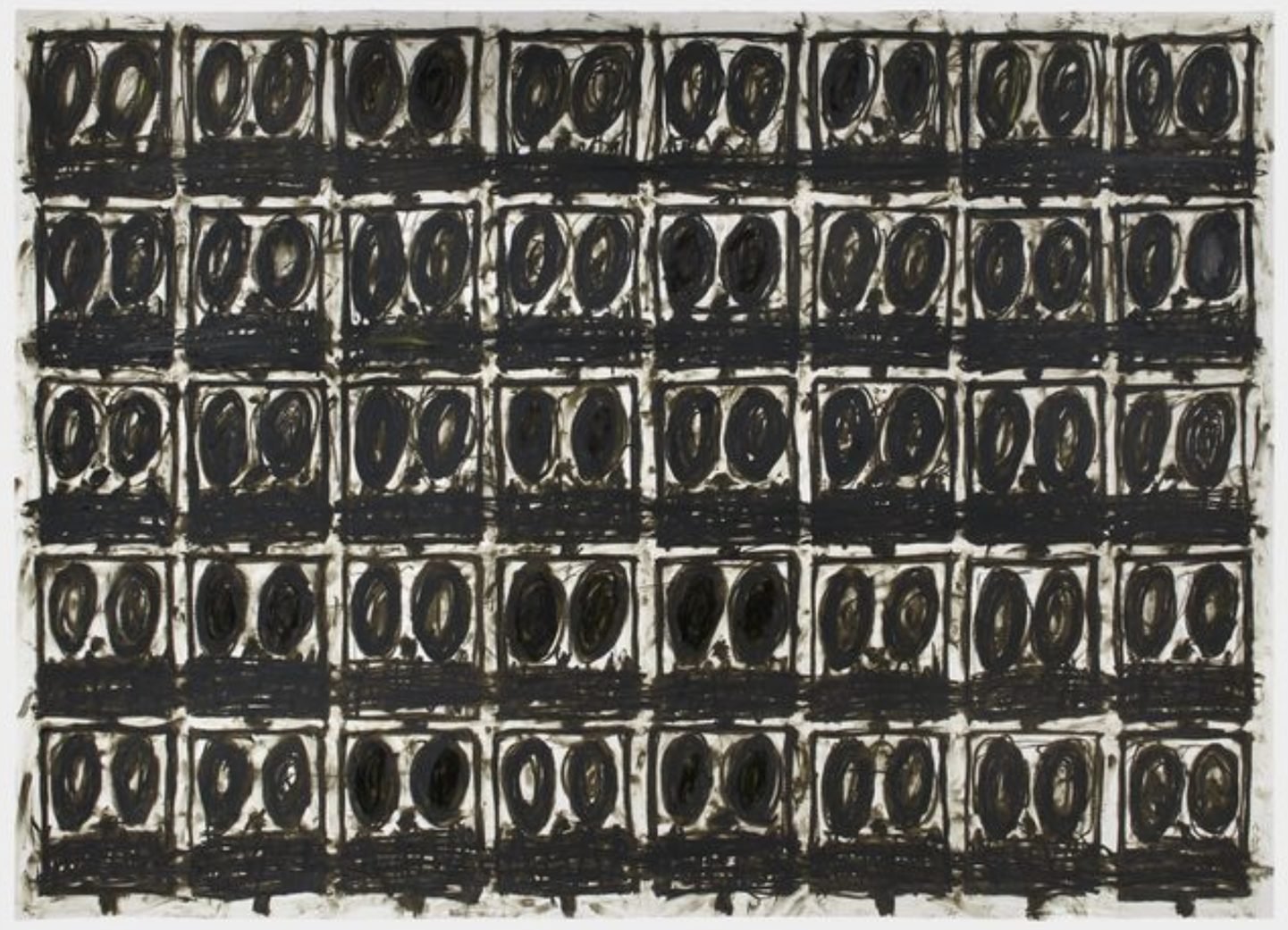
Anxious Men: Psychology Scratched into Matter
Johnson’s Anxious Men series marked a major turn toward a more direct representation of psychological pressure. The works often feature simplified faces scratched into black soap and wax spread over white ceramic tile. Wide eyes, clenched teeth, looping lines, and compressed features create figures that appear terrified, agitated, trapped, or emotionally overloaded. The series was first presented in a focused 2015 exhibition at the Drawing Center. (Art21)
The faces are crude but not careless.
Their urgency depends on the opposition between:
the regularity of the tile;
the instability of the drawn face.
The tile creates a clean, ordered grid associated with bathrooms, kitchens, sanitation, modern architecture, and domestic space.
The face appears unable to conform to that order.
Its lines twist, repeat, and collide.
The figure looks contained but not calmed.
This creates the series’ central formal insight:
Anxiety is not placed inside the composition as a subject. It is made to disrupt the structure designed to contain it.
The material process enacts psychological distress.
The black soap is applied, then scratched through.
The face emerges through removal and abrasion.
Anxiety becomes both image and action.
The Anxious Face as Individual and Social Condition
The anxious figure can be read as Johnson himself, as a generalized Black male figure, or as a broader emblem of contemporary psychological life.
Its power lies in resisting complete identification.
If the figure were only autobiographical, the work might become private confession.
If it were only sociological, it might become an illustration of collective suffering.
Johnson keeps the face suspended between the two.
The anxiety is personal and historical.
It may carry:
racial pressure;
political instability;
masculine expectation;
social performance;
fear of failure;
fear of visibility;
family responsibility;
creative uncertainty;
the pressures of public identity.
The face becomes a place where several forms of pressure converge.
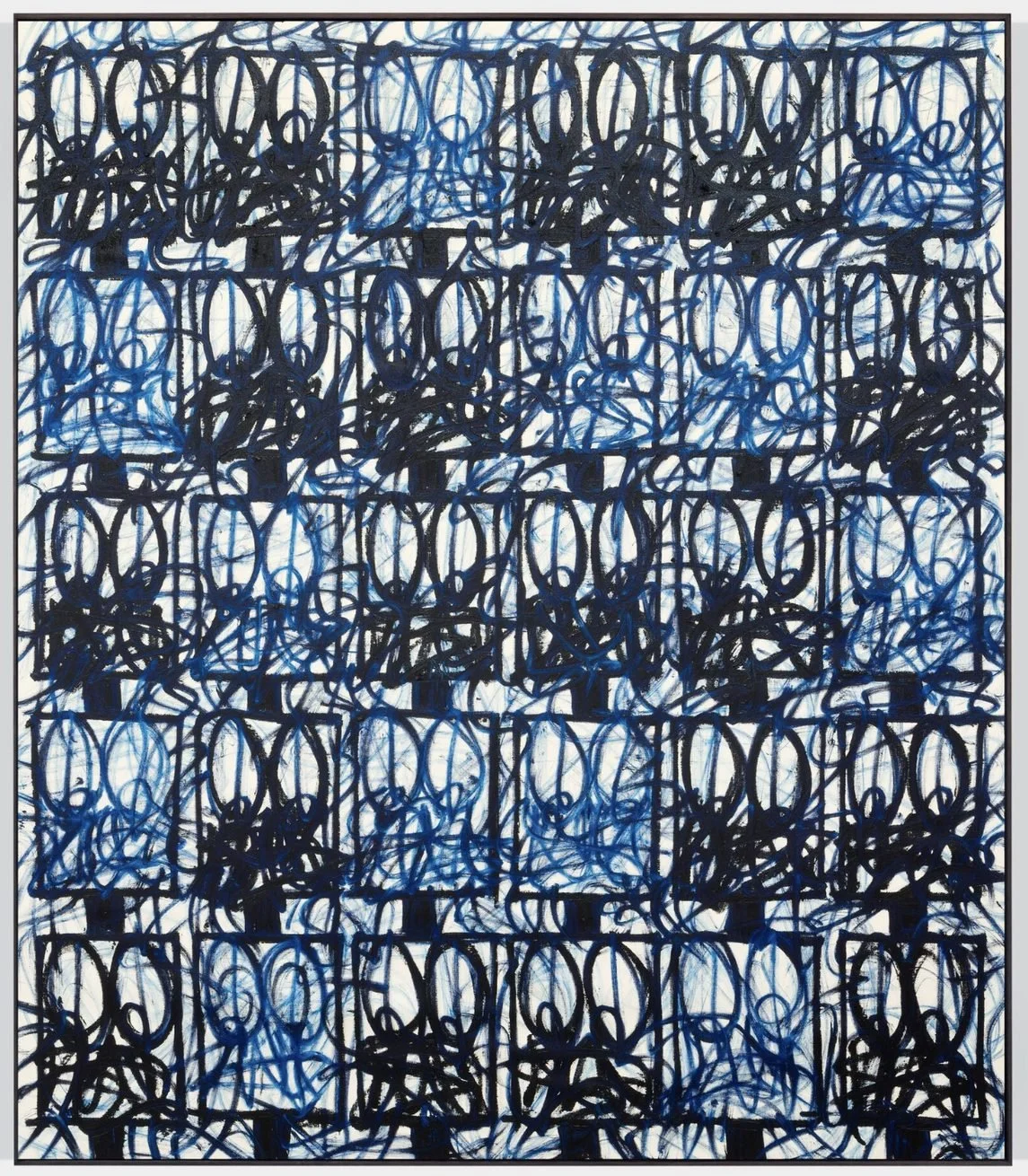
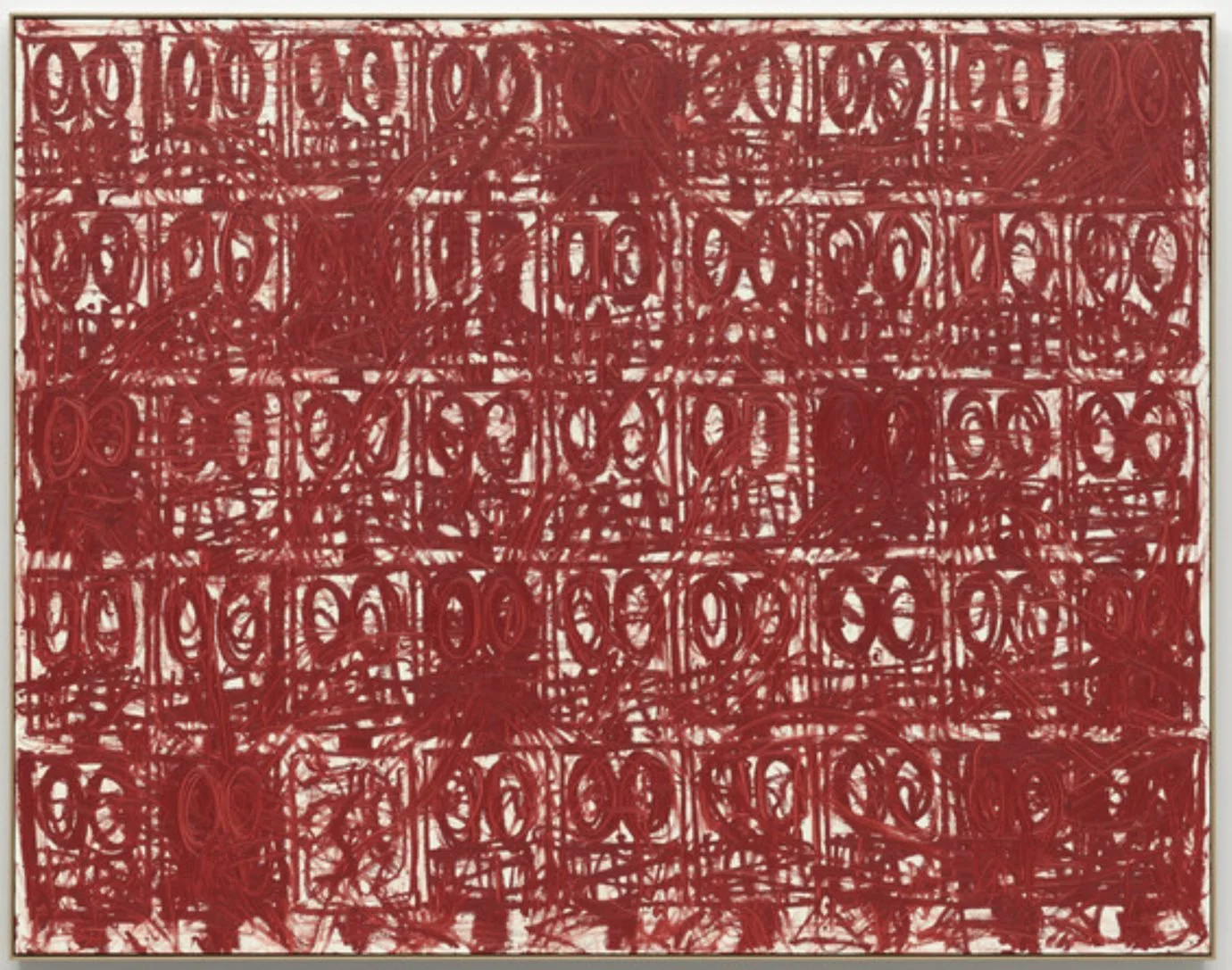
Johnson later expanded the motif into Anxious Audiences, Broken Men, Broken Crowds, red paintings, mosaics, bronze sculptures, and related series. The figure moved from one isolated face toward groups, fragments, and broader emotional atmospheres. The Guggenheim’s three-decade survey traced this development across more than ninety works. (The Guggenheim Museums and Foundation)
From Anxiety to Brokenness
The Broken Men and Broken Crowds works complicate the earlier anxious figure.
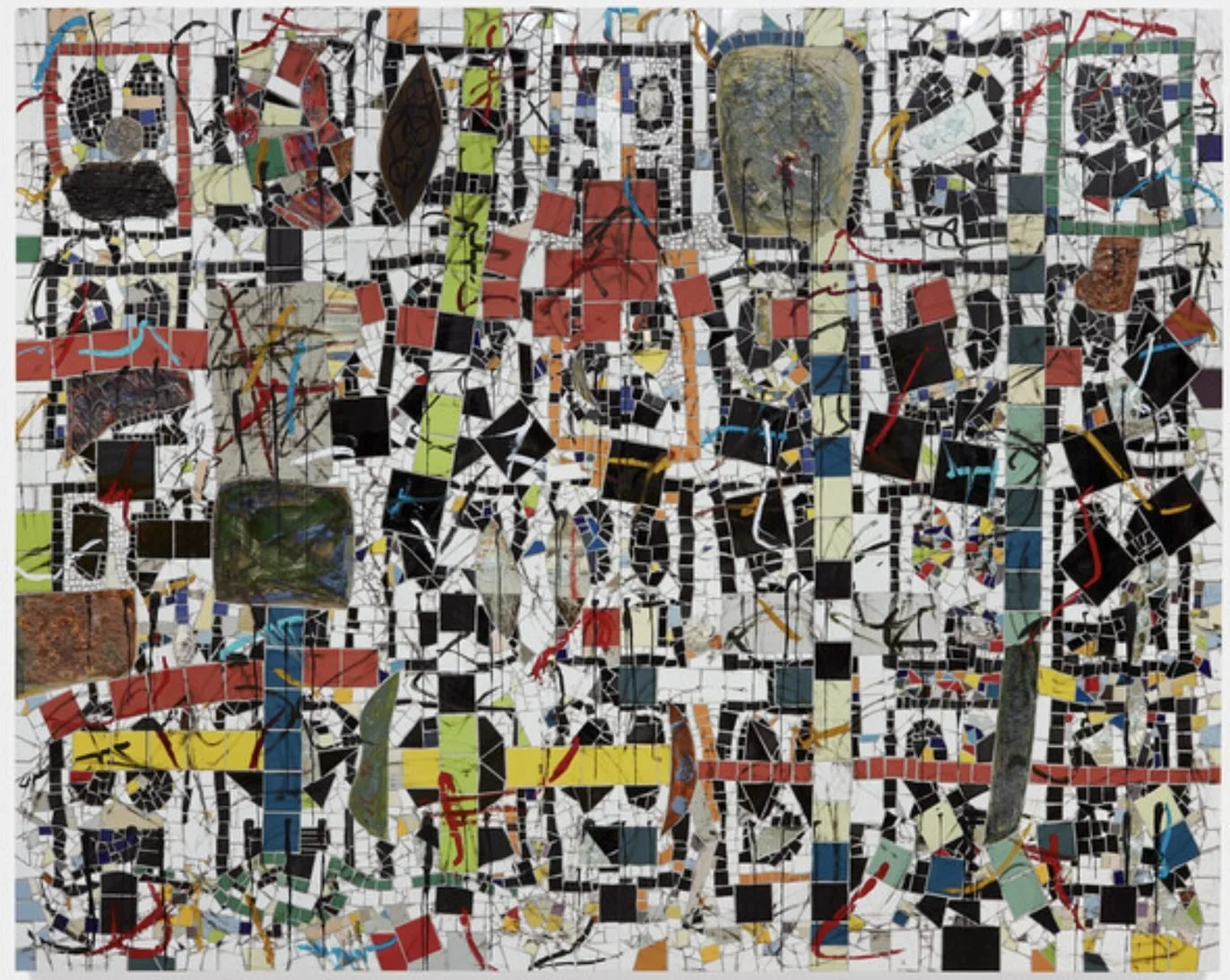
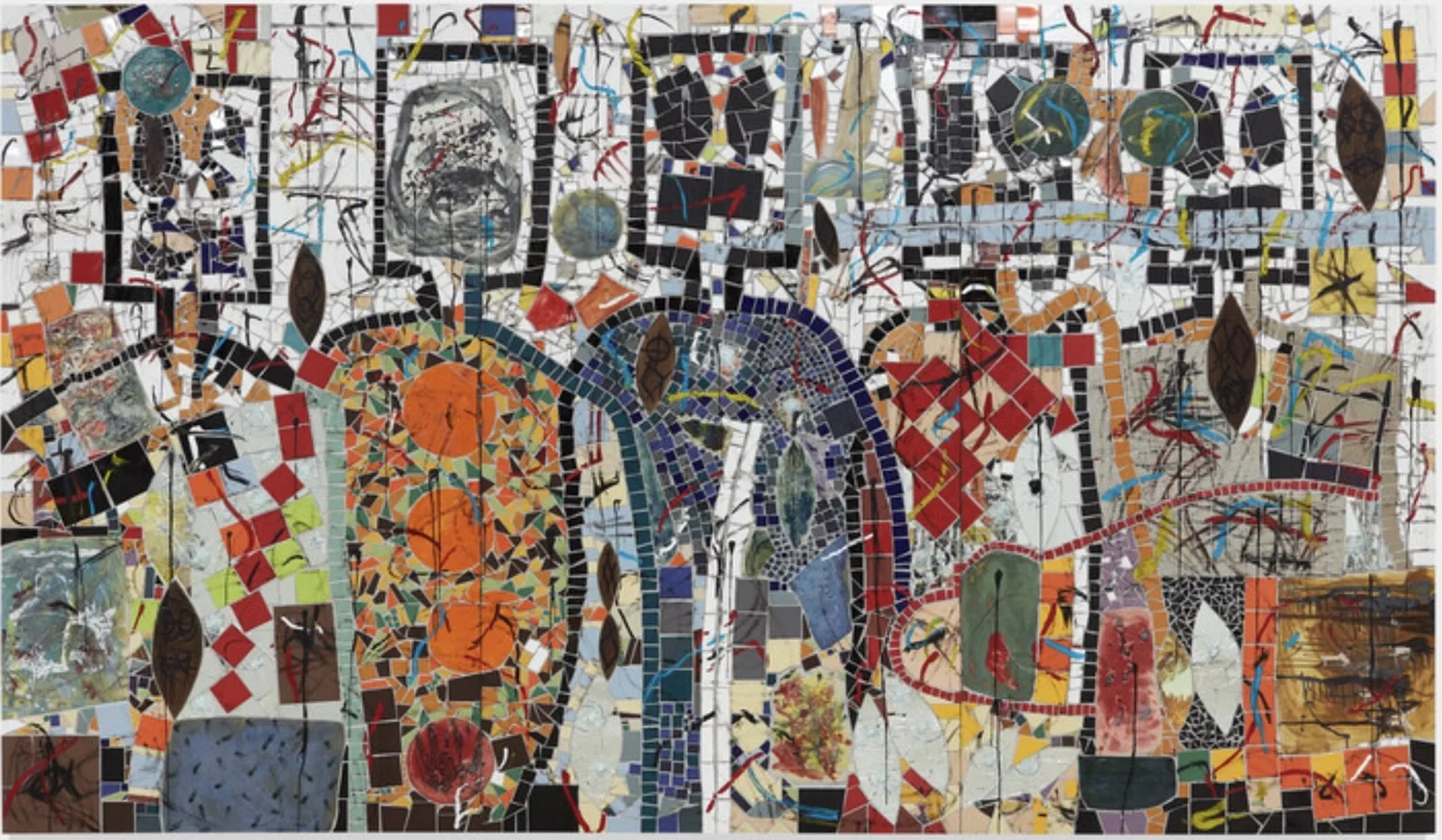
Mirror fragments, ceramic tile, black soap, wax, spray paint, oil stick, oyster shells, and other materials fracture the face into irregular fields. The figure is no longer simply anxious inside an intact structure. The structure itself has broken apart.
This is a meaningful revision.
The earlier works suggest:
the self is under pressure.
The broken works suggest:
the self and its containing system have both become unstable.
Yet brokenness does not produce disappearance.
The face remains.
Fragments are recombined into mosaics.
Damage becomes structure.
This recalls Huma Bhabha’s ability to make damage intensify presence, but Johnson’s method is different. Bhabha works through bodily ruin and archaeological time. Johnson works through cultural materials, psychological pressure, and domestic architecture.
The mosaic format turns fracture into organization.
The broken pieces do not return to seamless unity.
They remain visibly broken while participating in a new whole.
Mirrors and the Divided Viewer
Mirrors recur throughout Johnson’s work.
They may be:
polished;
fragmented;
sprayed;
branded;
partially obscured;
incorporated into mosaics or shelving structures.
The mirror implicates the viewer directly.
A work concerned with identity begins reflecting the person looking at it.
But the reflection is often incomplete.
The viewer sees themselves:
beside black soap;
interrupted by marks;
fragmented by tile;
surrounded by cultural references;
absorbed into a composition they did not control.
The mirror therefore does not simply symbolize self-knowledge.
It reveals the instability of self-recognition.
The viewer enters the work but cannot see themselves clearly.
This produces a strong viewer position:
The observer becomes part of the identity system while losing control over how they appear within it.
Shelves, Grids, and the Architecture of Identity
Johnson’s large steel shelving structures are among his most important inventions.
They may contain:
plants;
books;
monitors;
ceramics;
shea butter sculptures;
rugs;
radios;
vinyl records;
lights;
furniture;
musical instruments.
The grid appears rational and modernist. It offers order, compartmentalization, and display.
But the contents are heterogeneous, living, personal, cultural, and unstable.
This structure becomes a model of identity.
A person is not one thing.
A person may contain:
inherited history;
domestic habit;
intellectual aspiration;
music;
care;
anxiety;
fantasy;
political awareness;
objects of comfort;
signs of status.
The shelving organizes these elements without resolving them into one definition.
The work becomes a self-portrait without depicting a face.
Antoine’s Organ: Structure, Care, and Collective Life
Antoine’s Organ from 2016 is one of Johnson’s clearest demonstrations of this expanded artistic system.
The monumental steel structure contains plants, books, rugs, shea butter objects, monitors, lights, and a piano. Musicians can enter and perform within it, activating the sculpture through live sound.
The installation holds several contradictions:
rigid structure and organic growth;
private study and public performance;
individual identity and collective experience;
cultural archive and living environment;
institutional sculpture and domestic care.
The plants are especially important.
They need ongoing attention.
They cannot remain unchanged.
They grow, wilt, respond to light, and depend on caretakers.
Their presence introduces empathy and responsibility into the work. Johnson has connected plants with care and the capacity to recognize needs beyond one’s own. (The Guggenheim Museums and Foundation)
The sculpture therefore does not merely symbolize growth.
It requires care in order to remain alive.
This is form enacting inquiry.
Books as Material and Intellectual Lineage
Johnson frequently incorporates books by writers such as Ralph Ellison, James Baldwin, Zora Neale Hurston, Richard Wright, W.E.B. Du Bois, and Amiri Baraka. His influences also include artists such as Norman Lewis, Sam Gilliam, Alma Thomas, Cy Twombly, and Marcel Broodthaers. (Hauser & Wirth)
The books operate in several ways.
They are:
sources of thought;
records of Black intellectual history;
autobiographical markers;
objects of display;
symbols of aspiration;
building blocks within installations.
But displaying books can also become performative.
A library communicates intelligence and cultural affiliation.
Johnson appears aware of this tension.
The book may represent genuine intellectual formation while also functioning as a visual sign of being formed.
That contradiction is essential to the work:
Culture shapes the self, but the self also learns to perform culture.
The books remain meaningful because the practice does not treat them as pure, transparent evidence of authenticity.
Self-Care and the Pressure to Heal
Shea butter, soap, plants, yoga, domestic interiors, baths, and bodily rituals introduce ideas of care throughout Johnson’s work.
But care is never presented as a simple solution.
Self-care may be:
practical;
restorative;
commodified;
culturally coded;
aspirational;
insufficient against structural pressure.
In the video Black Yoga, Johnson uses the language of wellness and physical discipline while complicating its relationship to race, masculinity, performance, and absurdity. Other works place shea butter, rugs, furniture, and music within spaces of rest or reflection. (The Guggenheim Museums and Foundation)
The work asks:
Can care repair what history and social pressure have damaged?
The answer is not complete.
Care matters.
But care does not erase anxiety.
Plants may grow inside the grid, but the grid remains.
Shea butter may soothe the body, but the body remains socially exposed.
Healing becomes necessary and provisional.
Film and Interior Life
Johnson’s films extend his inquiry into family, solitude, movement, ritual, and psychological interiority.
Works such as The Hikers, Black and Blue, and Sanguine use cinematic space to investigate bodies navigating landscapes, homes, relationships, and emotional states. His 2024 exhibition Anima brought painting, sculpture, and film together around interiority and self-reflection. (Hauser & Wirth)
Film allows Johnson to introduce duration.
A sculpture presents a material condition.
Film shows a person moving through that condition over time.
Gesture, silence, sound, hesitation, and repetition create forms of psychological pressure unavailable to static objects.
This reveals that Johnson’s practice is not simply multidisciplinary.
Each medium isolates a different part of the same inquiry:
photography examines representation;
sculpture organizes cultural materials;
mosaic makes fragmentation structural;
film reveals interiority through duration;
installation creates environments of care and performance;
painting concentrates emotion into color and gesture.
The Move into Painting
Johnson’s later practice has increasingly embraced oil painting.
His Anxious Red, Bruise, Surrender, Soul, God, and related paintings retain connections to earlier faces and material systems while expanding into color, gesture, repetition, and abstraction.
This move is important because paint changes the role of the material vocabulary.
Black soap, tile, plants, and books arrive with specific cultural and practical associations.
Oil paint carries the long history of painting itself.
Johnson can therefore ask what happens when his inquiry enters a medium with immense art-historical authority.
The paintings risk becoming more conventional.
But they also allow:
greater chromatic range;
speed;
emotional immediacy;
direct gesture;
movement between figure and abstraction.
The strongest paintings preserve the psychological and cultural pressure of the earlier work without depending entirely on recognizable material symbols.
The Central Contradiction
The deepest contradiction in Johnson’s practice is:
Identity is constructed through culture, but no cultural vocabulary can fully contain the individual.
His materials offer belonging.
They also risk becoming categories.
Black soap, shea butter, jazz, books, rugs, plants, and historical references can create a rich world of cultural specificity.
But if they become fixed signs, they can turn identity into a recognizable package.
Johnson’s best work keeps that problem active.
The anxious face resists the orderly grid.
The living plant exceeds the steel structure.
The mirror includes the viewer but fractures the reflection.
The book carries knowledge while also performing intellectual identity.
The self depends on culture and struggles against simplification by culture.
The Viewer’s Position
Johnson positions the viewer as:
observer;
reflected participant;
reader of cultural signs;
visitor within a domestic-intellectual environment;
witness to anxiety;
audience member;
temporary inhabitant.
The installations often invite proximity and contemplation.
Plants, rugs, music, books, and furniture can create a sense of welcome.
But the welcome remains unstable.
The materials may be culturally specific.
The viewer may recognize some references and miss others.
The mirror may implicate the viewer without granting interpretive authority.
The viewer enters the world but does not automatically possess it.
This creates a productive balance between access and opacity.
What the Practice Has Discovered
Across photography, sculpture, mosaics, film, and painting, Johnson’s practice appears to have produced several important discoveries.
1. Identity can be built from materials without becoming reducible to symbols
Objects carry cultural history, but their meanings remain unstable and relational.
2. Anxiety can become structural
Psychological pressure can disrupt the grid, architecture, and surface rather than appearing only as facial expression.
3. Care can become artistic form
Plants, soap, butter, furniture, music, and ritual can require attention rather than merely symbolize healing.
4. Fragmentation can produce a new kind of coherence
Broken tile and mirror can create a whole without pretending that damage has disappeared.
5. Cultural inheritance can be both sustaining and restrictive
The same vocabulary that provides belonging can become a performance imposed on the self.
6. The individual and collective cannot be separated cleanly
Private anxiety is shaped by public history, and public symbols enter intimate life.
7. A multidisciplinary practice can remain coherent through a recurring material logic
The medium changes, but the inquiry remains recognizable.
The Artistic Capacity
Johnson has developed the capacity to make private psychological life and shared cultural history inhabit the same material system.
He can make:
soap carry memory and anxiety;
tile become domestic order and psychological confinement;
plants become care and dependence;
mirrors become unstable self-recognition;
books become intellectual lineage and performance;
grids become structure and restriction;
fragments become damaged continuity;
installations become living self-portraits.
His achievement lies in integration.
The materials do not sit beside one another as references.
They form an ecology.
Each modifies the meaning of the others.
The World Johnson Has Built
Johnson’s artistic world includes recurring:
black soap;
shea butter;
tile;
mirrors;
books;
plants;
branded wood;
rugs;
records;
ceramic vessels;
anxious faces;
grids;
shelves;
films;
music;
domestic rituals.
This is one of the most coherent material lexicons in contemporary art.
The vocabulary remains alive when the materials change function.
A plant can become:
growth;
care;
fragility;
aspiration;
escape;
another life dependent on the structure.
A grid can become:
modernist order;
shelving;
prison;
archive;
support;
social system.
Black soap can become:
cleansing;
dirt;
pigment;
cultural memory;
psychological residue.
A living world accumulates meaning.
A brand merely repeats its signs.
Is the Language Still Learning?
Johnson’s success makes this question essential.
His materials are immediately recognizable. Black soap, tile, plants, shelves, books, mirrors, and anxious faces can produce a familiar Rashid Johnson visual system.
The danger is that cultural richness becomes inventory.
A plant-filled grid may appear meaningful before its specific relationships are examined.
An anxious face may become an emblem rather than a discovery.
A culturally resonant material may carry the work through association rather than formal necessity.
Critical response to his large 2025 Guggenheim survey reflected this tension. The exhibition demonstrated the breadth and development of a three-decade practice, but some critics argued that the abundance of materials and references occasionally became conceptually overextended. (The Guggenheim Museums and Foundation)
The relevant question is:
Does each new work reorganize the relationship among self, culture, anxiety, and care, or does it merely restage an established lexicon?
The language remains alive when:
painting reduces dependence on recognizable symbols;
film deepens interiority;
living materials introduce genuine responsibility;
broken forms revise earlier anxious ones;
performance changes the installation over time;
new works allow care, joy, quiet, or surrender to complicate anxiety.
What the Work Expands
Johnson expands what a self-portrait can be.
A self-portrait does not require a face.
It can be:
a shelf of books;
a plant under artificial light;
a smeared field of black soap;
a mirror that refuses clarity;
a room filled with sound;
a grid strained by organic growth;
a collection of materials tied to memory and aspiration.
He also expands the relationship between conceptual art and lived experience.
The objects are intellectually coded, but they remain sensuous, useful, vulnerable, and bodily.
The work can be read critically and encountered physically.
Johnson demonstrates that cultural identity is neither pure essence nor empty construction.
It is a living arrangement of inherited and chosen materials under continual pressure.
What Artists Can Learn
The lesson is not to borrow culturally resonant materials and expect their associations to create depth.
The lesson is to build a material language through sustained use, lived familiarity, formal transformation, and revision.
A material becomes powerful when it can carry several truths at once.
An object associated with care may also reveal vulnerability.
A cultural symbol may offer belonging while exposing performance.
A grid may create stability while producing confinement.
A mirror may offer recognition while fragmenting the self.
Johnson’s strongest work demonstrates that personal and collective meaning do not need to be separated.
The private self is made through shared culture.
Shared culture becomes real through private use.
His achievement is to make identity feel neither fixed nor formless, but materially constructed: an unstable architecture of memory, anxiety, care, aspiration, history, and continuous self-revision.