What Makes Lucas Arruda’s Work So Powerful?
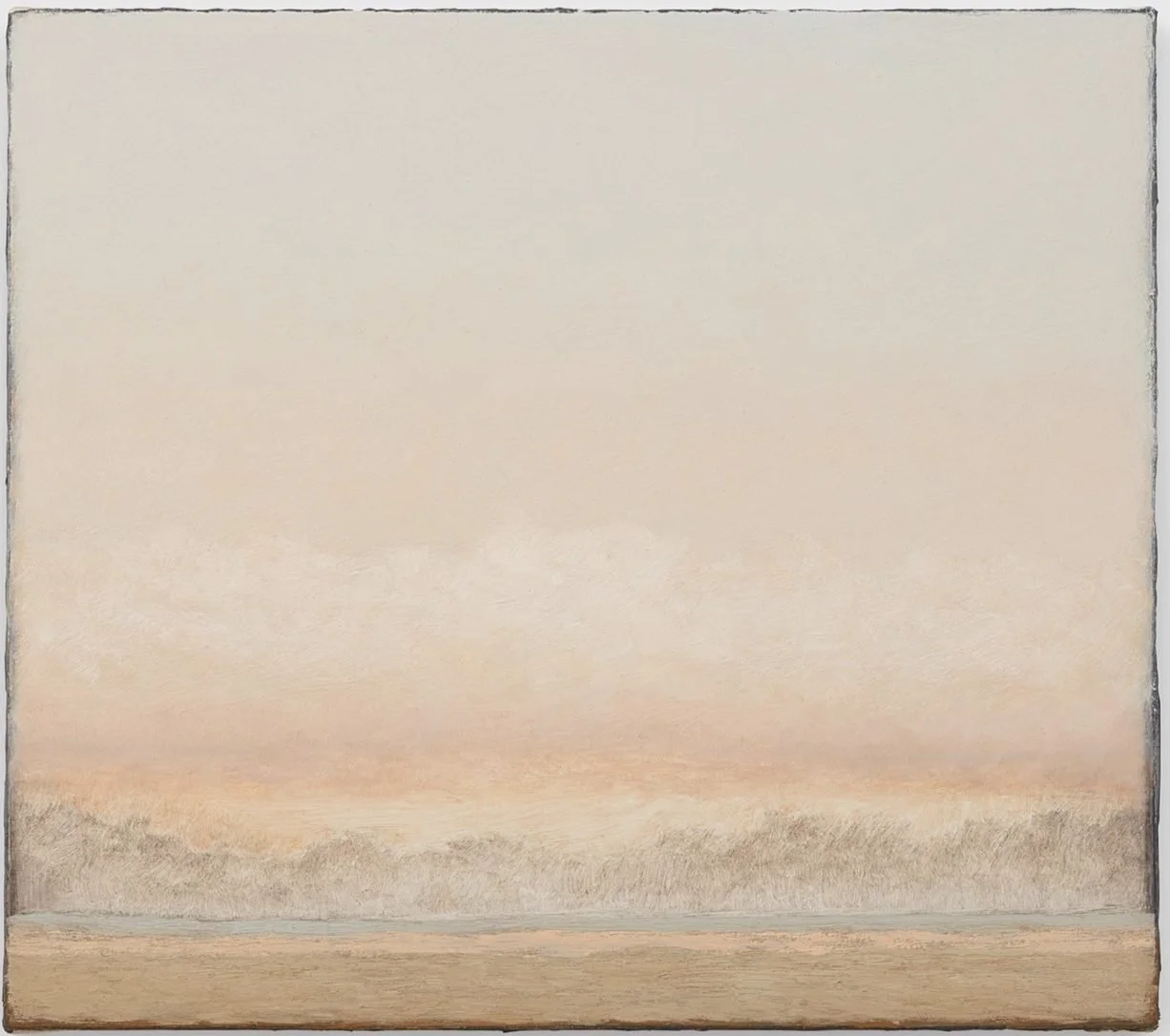
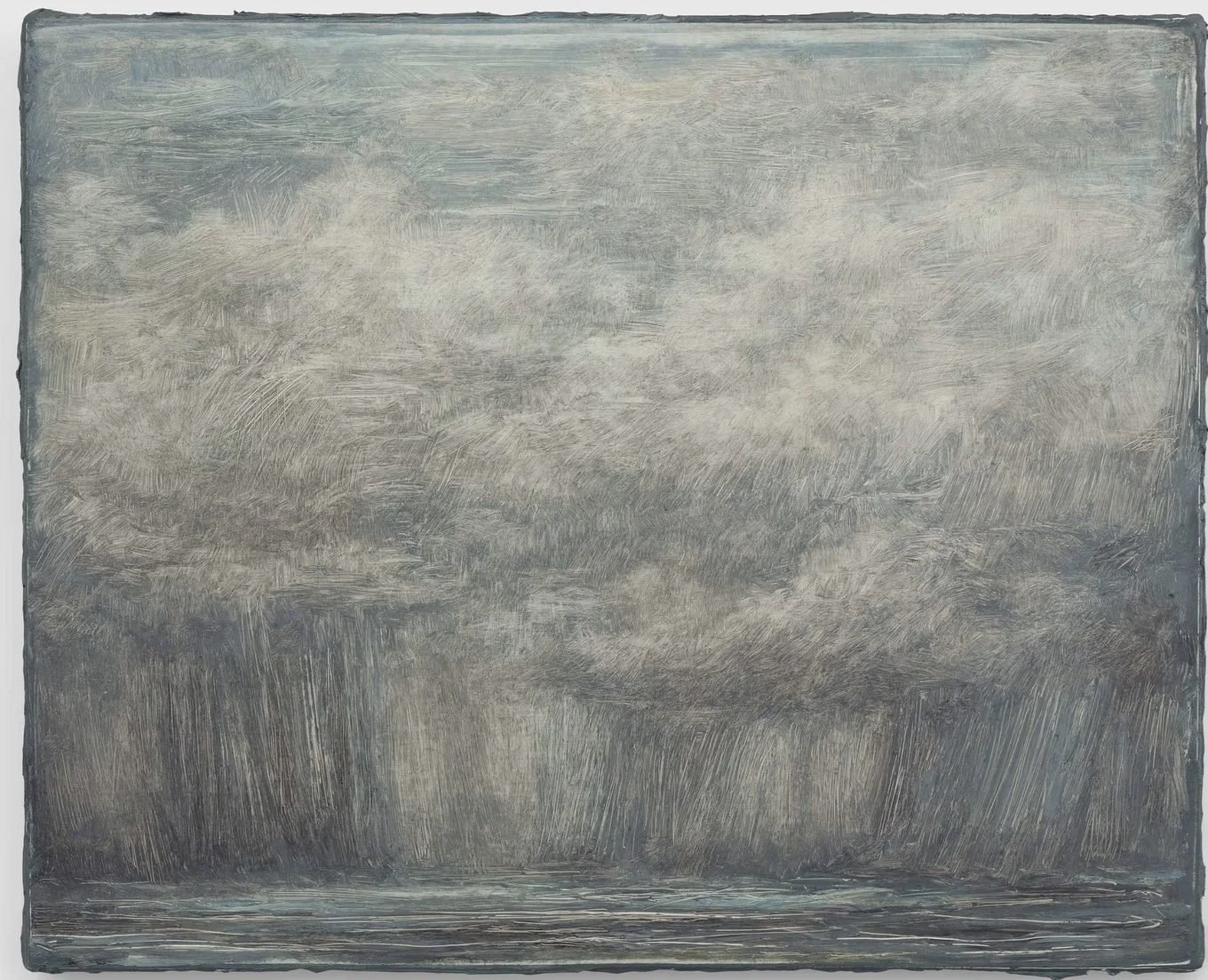
Lucas Arruda’s work is powerful because he turns landscape painting into an instrument for observing states of consciousness. His small canvases seem to depict oceans, horizons, forests, mist, clouds, and distant light, yet they rarely describe identifiable places. The landscape emerges only provisionally—then begins dissolving back into paint.
At first encounter, the paintings can appear almost empty. A faint horizontal division separates sky from water or earth. Light gathers in the center, disappears into darkness, or spreads through a fog of muted gray, blue, green, ochre, and brown. Some works contain dense forests; others approach complete abstraction. Their modest size stands in sharp contrast to the apparent vastness of the spaces they evoke.
Arruda does not paint from direct observation. His landscapes are developed from memory and imagination in the studio, and he has described them as ideas or states of landscape rather than representations of particular locations. His ongoing Deserto-Modelo series occupies the unstable boundary between abstraction and figuration. (David Zwirner)
The central inquiry beneath the work is:
How can painting create the experience of a vast external landscape when the true subject is an internal condition of memory, perception, and light?
Arruda’s achievement is not merely that he paints atmospheric scenes. He has developed the capacity to make minimal visual information open into immense psychological space.
What the Viewer Encounters
Many of Arruda’s paintings are small enough to demand physical closeness. The viewer cannot absorb them from across a large room in the same way one might encounter a monumental landscape. One must approach, adjust to their scale, and allow the eyes to become sensitive to subtle differences.
The paintings often contain only a few apparent elements:
a horizon;
a dark foreground;
a luminous upper field;
a band of water;
a distant cloud;
a mass of trees;
a faint reflection;
a small accumulation of light.
These elements are never fully secure.
A horizon may be clearly visible at first and then disappear into the surrounding brushwork. What seemed like water may become a horizontal smear of blue. A forest may emerge from scratched, layered paint before collapsing into dense texture. Light may appear to come from the depicted sky, but it may also seem to emanate from the physical surface.
The viewer moves continually between two experiences:
seeing a landscape
and
seeing paint become a landscape.
That movement is the work’s basic perceptual engine.
The image is never so abstract that the possibility of place disappears completely. It is never so descriptive that the place becomes fixed.
The Inquiry Beneath the Work
Landscape painting traditionally suggests that the artist stands before a visible world and translates it into an image.
Arruda weakens that assumption.
His paintings do not begin from a stable landscape waiting to be recorded. They begin from something less tangible:
remembered atmosphere;
emotional temperature;
fragments of natural experience;
accumulated visual memory;
the sensation of distance;
an internal image that has no exact external equivalent.
Arruda grew up and continues to work in São Paulo, but the forests and coastal environments of northern São Paulo state have remained important sources of visual and atmospheric experience. He has described taking in the rainforest’s atmosphere and carrying it back into his city studio rather than reproducing a single observed view. (Financial Times)
The distinction is important.
He is not primarily asking:
What did this location look like?
He is asking:
What remains internally after the location is no longer present?
The landscape becomes a structure through which memory can acquire form without pretending to become exact.
This also explains the title Deserto-Modelo. The phrase draws on Brazilian poet João Cabral de Melo Neto and associates the desert with a metaphysical or irrational space rather than merely a geographic environment. “Modelo” can signify a model, vision, or state.
The desert is therefore not simply a place without vegetation.
It is a mental condition:
open;
emptied;
suspended;
distant from ordinary time;
available for projection.
Landscape as a Cultural Habit
Arruda has observed that the principal reason to call these works landscapes is cultural: viewers recognize a horizontal division and interpret it through the accumulated history of landscape images. (Studio International)
A band crossing a rectangular surface becomes a horizon because viewers have learned how landscape works.
That recognition may occur with very little information.
A dark area below and a lighter field above can become:
land and sky;
sea and atmosphere;
foreground and distance;
matter and light.
Arruda uses this cultural habit as an artistic resource.
He does not need to describe individual trees, waves, rocks, or clouds in order to evoke a world. He can activate the idea of landscape with a few spatial cues, then allow the rest of the painting to remain uncertain.
This produces a deeper inquiry:
How much can be removed before landscape disappears—and how much uncertainty can remain before abstraction becomes emotionally empty?
His paintings occupy that threshold with extraordinary sensitivity.
The Horizon as a Generative Constraint
The horizon is one of Arruda’s most persistent formal devices.
It divides the surface while joining two fields.
It can suggest:
distance;
stability;
separation;
longing;
orientation;
an unreachable elsewhere.
Yet the horizon in these paintings is rarely mechanically precise. It may flicker, fade, thicken, tilt slightly, or become partially obscured.
Its instability matters.
A perfect horizon would make the world feel ordered and secure. Arruda’s horizon often offers orientation without certainty.
The viewer knows approximately where they are:
facing outward;
looking across;
positioned before distance.
But the place itself remains unavailable.
The horizon therefore becomes less a description of geography than a psychological structure.
It gives the mind somewhere to project itself.
Small Paintings, Vast Space
Arruda’s small scale is not incidental.
A large landscape can surround the viewer through physical size. It can simulate the expansiveness of nature by becoming monumental.
Arruda creates magnitude through compression.
The small painting does not reproduce the physical scale of a horizon. It concentrates the sensation of one.
This reversal produces a distinct intimacy.
The viewer does not stand inside the landscape.
The viewer approaches something closer to:
a remembered image;
a mental aperture;
a private vision;
a fragment seen behind closed eyes.
The limited scale also increases the importance of every tonal shift. A narrow line of blue can establish an ocean. A pale abrasion can become distant weather. A dark accumulation at the edge can alter the emotional weight of the entire image.
What appears simple is governed by extreme sensitivity.
The painting feels vast because almost nothing has been used unnecessarily.
The Discovery of Light
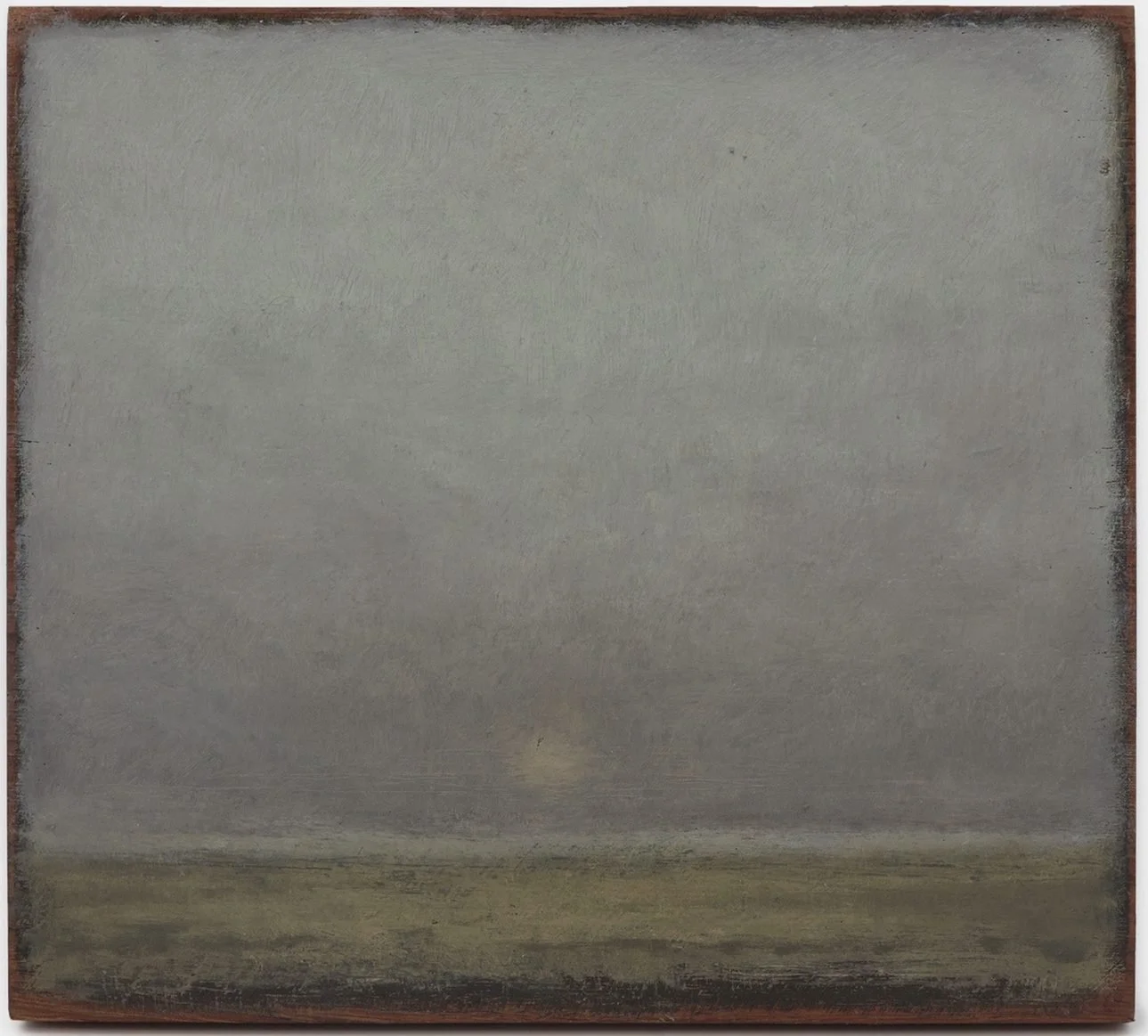
Light is the true organizing force in Arruda’s work.
It may appear as:
a glow at the horizon;
a pale opening in dense gray;
illumination passing through trees;
brightness reflected across water;
a vertical band;
a field spreading from within the paint.
Yet the source of illumination is often unclear.
There may be no visible sun.
The light does not necessarily behave according to natural optics.
It may seem atmospheric, spiritual, emotional, or material.
This uncertainty allows light to operate simultaneously as:
depicted phenomenon;
spatial organizer;
emotional condition;
evidence of paint;
metaphor for perception itself.
Arruda’s 2024 exhibition Assum Preto included paintings alongside a site-specific light installation, extending the investigation beyond the painted image and into the physical gallery. The exhibition continued his effort to blur mnemonic and imaginative experience and to treat landscape as a state of mind rather than a specific location. (David Zwirner)
The move into installation reveals that the practice is not simply committed to representing light.
It is investigating what light does to attention.
Paint as Atmosphere
Arruda’s images depend on paint remaining materially active.
The surfaces may contain:
dragged pigment;
soft veils;
scraping;
overpainting;
exposed canvas;
blurred transitions;
dense accumulations;
dry-brushed marks;
erasures.
These operations prevent atmosphere from becoming a purely illustrative effect.
The mist appears because forms have been obscured.
Distance emerges because layers partially conceal one another.
Light becomes visible because paint has been thinned, lifted, softened, or contrasted against darkness.
The medium behaves like the condition it investigates.
Memory does not preserve every detail evenly. Some elements remain sharp. Others fade, merge, or disappear.
Arruda’s surfaces operate similarly.
The landscape feels remembered because the painting has been built through selective appearance and loss.
Forests and the Limits of Visibility
Arruda’s forest paintings introduce a different kind of spatial experience from the open horizons.
Instead of looking outward across distance, the viewer faces density.
Branches, leaves, trunks, shadows, and tangled vegetation gather into compressed fields. Space exists, but entry is difficult. The eye can penetrate only partially before becoming absorbed in texture.
These works hold two apparently opposite experiences:
lush abundance;
visual obstruction.
The forest may promise immersion while denying access.
This produces a useful contrast with the open Deserto-Modelo paintings.
The horizon works create distance through emptiness.
The forest works create distance through excess.
Both arrive at the same deeper condition:
the visible world remains present but cannot be completely entered or possessed.
The 2023 exhibition Assum Preto in Madrid gathered more than twenty forest-oriented paintings, emphasizing the relation between visibility and invisibility in Arruda’s practice.
Memory Without Narrative
Arruda’s paintings are memory-driven, but they rarely provide autobiographical stories.
There are no identifiable figures explaining whose memory is being represented. There is usually no specific event, date, or setting.
Memory appears structurally rather than narratively.
It operates through:
incompleteness;
repetition;
tonal uncertainty;
emotional atmosphere;
indistinct scale;
unstable distance;
the return of related forms.
This distinguishes Arruda from artists who use landscape to reconstruct a personal history through recognizable places.
He preserves the emotional force of memory while removing most of its informational content.
The result is specific without being anecdotal.
A painting may feel mournful, peaceful, ominous, radiant, or suspended, but the viewer cannot reduce that sensation to a single story.
That openness gives the images their psychological reach.
How the Practice Developed
Arruda was born in São Paulo in 1983 and received his BFA from Faculdade Santa Marcelina in 2009. His career has remained centered on the evolving Deserto-Modelo series, while also expanding into film, slide projection, and light installation. (David Zwirner)
This development is notable because it does not represent an abandonment of the original inquiry.
Instead, each medium isolates a different component of the same problem.
Painting investigates how material marks become atmosphere.
Slide projection explores serial images and projected illumination.
Film introduces duration.
Light installation removes the depicted landscape almost entirely and retains only the conditions through which a landscape might be perceived.
The inquiry becomes increasingly concentrated:
What remains of landscape when image, location, and recognizable form are gradually removed?
In this sense, the work develops through reduction rather than expansion.
Arruda does not need to add more information.
He needs to determine how little is necessary for perception to remain alive.
Dialogue with Impressionism
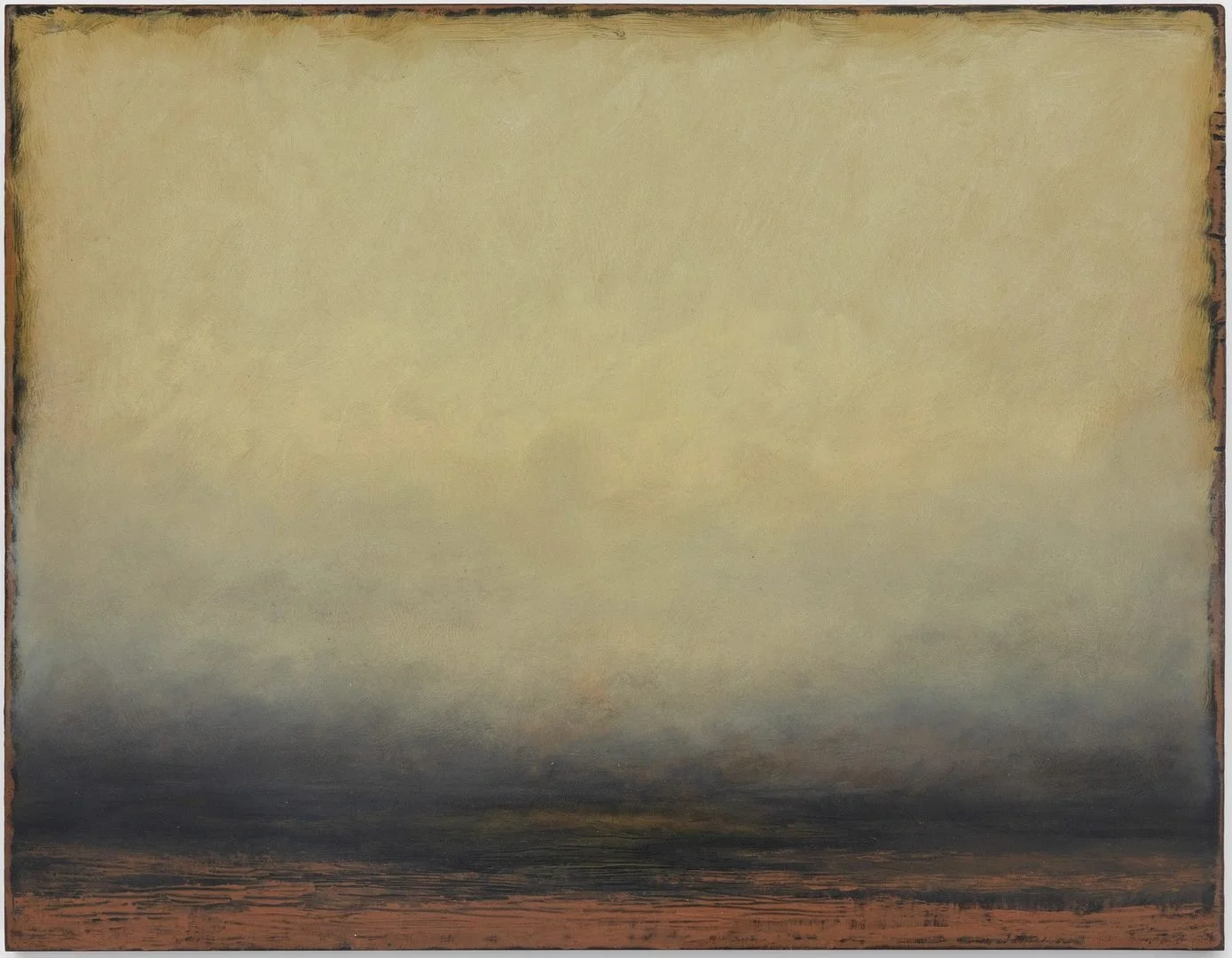
In 2025, the Musée d’Orsay presented Arruda’s paintings in dialogue with works in its Impressionist galleries. The project, Qu’importe le paysage, was the museum’s first monographic contemporary presentation devoted to an artist from the Southern Hemisphere. A simultaneous exhibition at Carré d’Art in Nîmes expanded the presentation to include film and installation. (Musée d'Orsay)
The dialogue with Impressionism is revealing.
Like the Impressionists, Arruda is deeply concerned with:
light;
atmosphere;
fleeting perception;
the instability of visible conditions;
painting as an encounter between sensation and material.
But the difference is equally important.
Impressionist paintings often begin from a visible external motif transformed by changing light.
Arruda’s paintings begin from an internal image already altered by memory.
The historical sequence can be compressed as:
observed landscape → changing perception → painted sensation
in Impressionism,
and:
remembered sensation → imagined landscape → painted state
in Arruda.
The landscape no longer precedes the painting as a stable external fact.
It emerges through the act of painting.
The Central Contradiction
The deepest contradiction in Arruda’s work is:
The paintings offer immense perceptual space while withholding almost all concrete location.
They are:
intimate and vast;
empty and emotionally full;
abstract and recognizably scenic;
materially worked and visually weightless;
quiet and psychologically charged;
specific in sensation and indeterminate in subject.
This contradiction prevents the paintings from becoming generic atmospheric decoration.
A beautiful haze is not enough.
The work becomes consequential because the viewer repeatedly approaches the threshold of recognition without gaining complete certainty.
The world appears.
Then the world withdraws.
The Viewer’s Position
Arruda positions the viewer as a contemplative observer, but not as a master of the view.
Traditional landscape painting can imply possession. The viewer surveys an organized territory from a stable position.
Arruda removes that authority.
The viewer encounters:
an incomplete horizon;
an uncertain scale;
a space without coordinates;
a forest that cannot be entered;
light whose source cannot be located.
The small format intensifies this relationship.
The viewer must approach closely, but proximity does not produce greater factual knowledge.
Instead, closeness reveals:
brushwork;
scraped pigment;
thin layers;
uncertainty in the image’s construction.
The nearer one gets, the less secure the landscape becomes.
This reverses ordinary visual expectation.
Distance gives the illusion of place.
Closeness reveals painting.
The Practice as Sustained Repetition
Arruda has remained committed to a narrow range of formats and recurring visual structures:
small canvases;
horizons;
forests;
muted tonal fields;
light emerging from darkness;
repeated titles within the Deserto-Modelo series.
This concentration resembles Stanley Whitney’s use of a stable grid, though the perceptual objectives are different.
Whitney uses repetition to sharpen relationships among discrete colors.
Arruda uses repetition to test the smallest conditions through which landscape can appear.
Each work asks:
How faint can the horizon become?
How much darkness can surround the light?
How little form is required for depth?
When does atmosphere become vague?
When does abstraction lose emotional specificity?
When does recognizability become too complete?
The repetition becomes meaningful when these questions remain active.
What the Practice Has Discovered
Across painting, projection, film, and installation, Arruda’s work appears to have produced several important discoveries.
1. Landscape can emerge from almost no descriptive information
A horizon, tonal division, and small concentration of light may be sufficient to activate immense space.
2. Memory can be represented without narrative
Loss, distance, and emotional residue can be carried by material and atmosphere rather than biographical detail.
3. Small scale can intensify vastness
Compression can make perceptual space more private and concentrated.
4. Uncertainty can sharpen perception
When the image remains unresolved, the viewer becomes more attentive to minor changes in color, edge, and light.
5. Paint can behave like memory
Layering, scraping, fading, concealment, and reappearance can make the surface enact the instability of recollection.
6. Landscape can exist as an internal state
The work does not need an identifiable place to produce the bodily and emotional experience of one.
7. Light can remain after the image is removed
Arruda’s installations suggest that illumination itself may carry the perceptual structure of landscape.
The Artistic Capacity
Arruda has developed the capacity to make minimal material differences generate expansive psychological space.
He can make:
a narrow band become a horizon;
a stain become weather;
an abrasion become distant light;
layered texture become forest;
a small canvas feel nearly limitless;
uncertainty remain specific rather than vague.
This capacity depends on restraint.
He must know not only what to add, but what can be withheld.
Too much description would fix the location.
Too little structure would leave only atmosphere.
The work succeeds within the narrow interval between those failures.
Arruda does not paint less because the subject is simple. He paints less because every additional fact could weaken the internal image.
The World Arruda Has Built
Arruda’s artistic world contains a limited but evolving vocabulary:
horizons;
oceans;
clouds;
forests;
mist;
darkness;
reflected light;
small canvases;
muted palettes;
projected illumination;
unnamed landscapes.
The works are usually untitled within the larger Deserto-Modelo designation, which prevents the viewer from attaching them to specific geography or narrative.
This world feels coherent because every element participates in the same inquiry into appearance and disappearance.
Water may become reflection or emptiness.
Forest may become memory or obstruction.
The horizon may become orientation or separation.
Light may become perception, revelation, or loss.
The vocabulary remains narrow, but its emotional functions continue changing.
Is the Language Still Learning?
Arruda’s practice faces a clear risk.
The small, hazy landscape has become an immediately recognizable and highly marketable form. The paintings can be mistaken for refined objects of meditative beauty whose primary function is atmosphere.
The central critical question is:
Does each painting produce a distinct perceptual event, or does it merely repeat the appearance of inwardness?
The language remains alive when:
the horizon changes the viewer’s spatial orientation;
light establishes a new emotional pressure;
forest and open space produce different kinds of inaccessibility;
the material process creates genuine tension between image and abstraction;
another medium reveals a previously hidden aspect of the inquiry.
The language weakens when subtlety becomes uniformity.
Muted color is not automatically depth.
Small scale is not automatically intimacy.
Indistinct imagery is not automatically memory.
Quietness must still produce discovery.
The 2024 and 2025 exhibitions suggest that Arruda continues testing the inquiry through forest imagery, light installation, film, and dialogue with historical landscape painting rather than relying only on the familiar horizon format. (David Zwirner)
What the Work Expands
Arruda expands what contemporary landscape painting can be.
He demonstrates that landscape does not require:
direct observation;
geographic specificity;
monumental scale;
detailed description;
narrative;
environmental spectacle.
A landscape can exist as:
a memory threshold;
an internal image;
an emotional orientation;
a structure of light;
a cultural expectation activated by minimal form.
He also expands abstraction by showing that atmospheric ambiguity can remain precise.
The work does not choose between abstraction and representation.
It uses the instability between them as its subject.
Most importantly, Arruda transforms landscape from an object viewed externally into a state generated internally.
What Artists Can Learn
The lesson is not to imitate Arruda’s small horizons, muted palette, hazy surfaces, or contemplative atmosphere.
The lesson is to understand how restraint can concentrate experience.
A work does not need to provide more information in order to produce greater depth.
It may need to identify the smallest formal condition capable of carrying the inquiry.
For an artist investigating memory, this might mean allowing parts of the image to disappear.
For an artist investigating distance, it might mean withholding access rather than illustrating separation.
For an artist investigating perception, it might mean preserving the moment before recognition stabilizes.
For an artist investigating atmosphere, every tonal shift must affect the viewer’s spatial and emotional orientation.
Arruda’s paintings show that quietness becomes powerful when it is highly specific.
His achievement is to make a few inches of paint behave like an immeasurable distance—and to reveal that the landscape we encounter most deeply may be the one that never existed outside the mind.