What Makes Nicolas Party’s Work So Powerful?
Nicolas Party’s work is powerful because he takes the most familiar genres in painting—portraiture, landscape, and still life—and makes them feel like artifacts from a world that resembles ours without fully belonging to it. Faces become smooth masks. Trees rise like theatrical props. Mountains turn into stacked color. Fruit appears sensuous but biologically uncertain. Entire rooms become painted environments in which framed works, murals, sculpture, architecture, and color operate as one constructed world.
At first encounter, the work can seem charming, decorative, even playful. The colors are vivid. The surfaces are soft. The forms are simplified. The imagery is immediately recognizable.
But recognition never produces complete familiarity.
A portrait may depict a person without revealing an individual. A landscape may appear inviting while containing no inhabitable place. A still life may present fruit that looks ripe, swollen, artificial, and faintly threatening at once. The beauty is real, but it is not entirely comfortable.
Party’s central inquiry might be stated this way:
How can familiar forms become strange enough to expose how much perception depends on conventions, categories, and inherited images?
His work does not reject beauty or representation. It uses their apparent accessibility to move the viewer toward uncertainty.
What the Viewer Encounters
Party is best known for portraits, landscapes, and still lifes made primarily in soft pastel. His subjects are simplified into rounded volumes, clear silhouettes, smooth gradients, and saturated color. He also works through painting, drawing, sculpture, murals, and immersive exhibition design. Hauser & Wirth describes his practice as simultaneously celebrating and challenging the conventions of representational painting. (Hauser & Wirth)
The work may include:
androgynous faces;
enlarged heads;
fruit and vessels;
trees and forests;
mountain ranges;
waterfalls;
clouds;
fires;
dinosaurs;
biomorphic forms;
painted architectural walls;
sculptural heads and busts.
Many images initially appear simple enough to grasp at a glance.
A portrait presents a head and shoulders.
A landscape presents trees, mountains, sky, and sun.
A still life presents fruit against a colored ground.
But the simplification does not make the image neutral. It concentrates the viewer’s attention on the small number of decisions that remain:
the unnatural color of skin;
the strange symmetry of a face;
the emotional blankness of the eyes;
the impossible smoothness of a surface;
the theatrical separation of foreground and background;
the way one form resembles another across genres.
A head may resemble an egg, fruit, stone, mask, or planet.
A tree may resemble a flame, body, or architectural column.
Mountains may appear geological, dreamlike, painted, and artificial at the same time.
The work creates a world in which categories are recognizable but unstable.
The Inquiry Beneath the Work
Party repeatedly returns to the traditional genres of Western painting.
This is important because portraiture, landscape, and still life are not merely groups of subjects. They are historical systems for organizing the world.
Portraiture separates the person from the surrounding environment and makes identity visually available.
Landscape converts nature into a coherent view.
Still life isolates objects and turns them into arrangements of matter, value, mortality, abundance, and possession.
Party preserves these genres while weakening the assumptions that make them seem natural.
His portraits appear human, but they often resist:
gender certainty;
psychological access;
specific biography;
natural skin color;
ordinary bodily proportion.
His landscapes contain recognizable natural forms, but they resist:
geographic location;
ordinary scale;
natural perspective;
human habitation;
stable historical time.
His still lifes present objects that seem familiar, but their identity may remain uncertain.
The inquiry is therefore not simply:
What does a portrait, landscape, or still life look like today?
It is:
How little information is required for viewers to identify a person, place, or object—and how far can those conventions be altered before recognition becomes unstable?
Party uses beauty to hold the viewer within that uncertainty.
Soft Pastel and the Construction of Artificial Naturalness
Soft pastel is central to Party’s work.
Pastel occupies an unusual position between drawing and painting. It is a dry material applied directly to a surface and often blended by hand. It can produce extraordinary saturation, softness, and tonal transition without the reflective surface associated with oil paint.
Party’s use of pastel allows him to create forms that appear:
velvety;
powdery;
matte;
luminous;
intensely colored;
almost without visible brushwork.
The absence of conventional brushstrokes matters.
A painted face often carries the visible history of decisions made with a tool. Party’s blended surfaces suppress much of that evidence. Skin becomes impossibly continuous. Gradients appear almost atmospheric. Forms seem less painted than generated.
This gives the work a paradoxical character.
The images are visibly handmade, but their smoothness can feel artificial.
The material is fragile and dusty, but the forms seem sealed.
The colors appear sensual, but the surfaces keep the viewer at a distance.
Pastel therefore supports the inquiry by producing a visual world that feels bodily and disembodied at once.
The surface attracts through softness while withholding the evidence of ordinary flesh.
Historical Fragility and Contemporary Intensity
Pastel also carries an important historical tension.
The medium is associated with eighteenth-century portraiture, especially images of aristocratic refinement, beauty, elegance, and social display. It has also often been treated as more delicate, decorative, or minor than oil painting.
Party revives this historically loaded medium at monumental scale and with extreme chromatic intensity.
In the 2019 exhibition Pastel at the FLAG Art Foundation, he created a unified rose-colored environment containing large pastel murals alongside historical and contemporary pastel works by other artists. The exhibition placed his practice within a much longer material history rather than presenting pastel as an eccentric contemporary novelty. (The FLAG Art Foundation)
His transformation of the medium involves several reversals:
intimate material becomes architectural;
fragile dust becomes visually monumental;
historical elegance becomes uncanny;
delicate portraiture becomes psychologically remote;
decorative color becomes an environmental force.
The softness of pastel does not make the work gentle.
It allows strangeness to arrive without visual aggression.
The Portrait as Person and Type
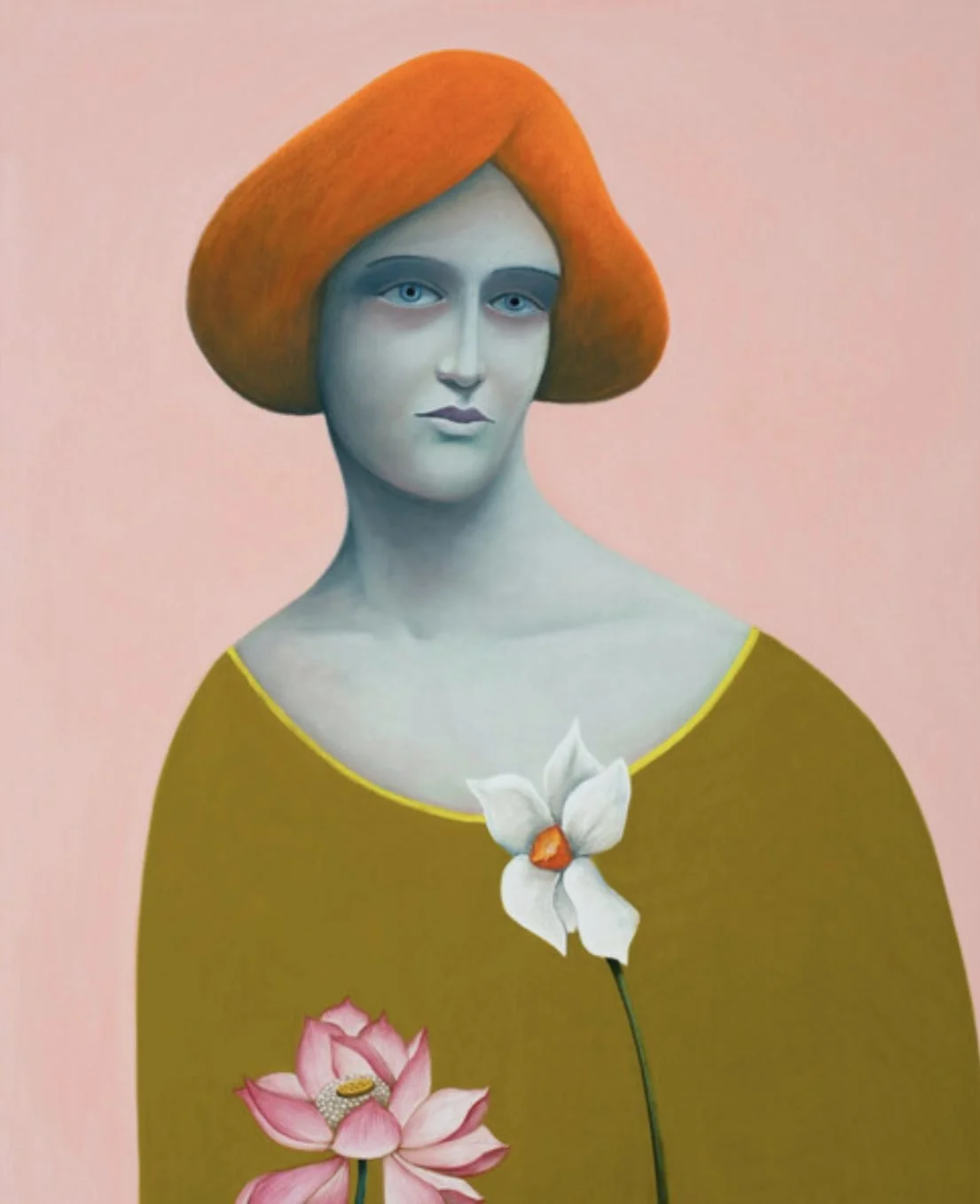
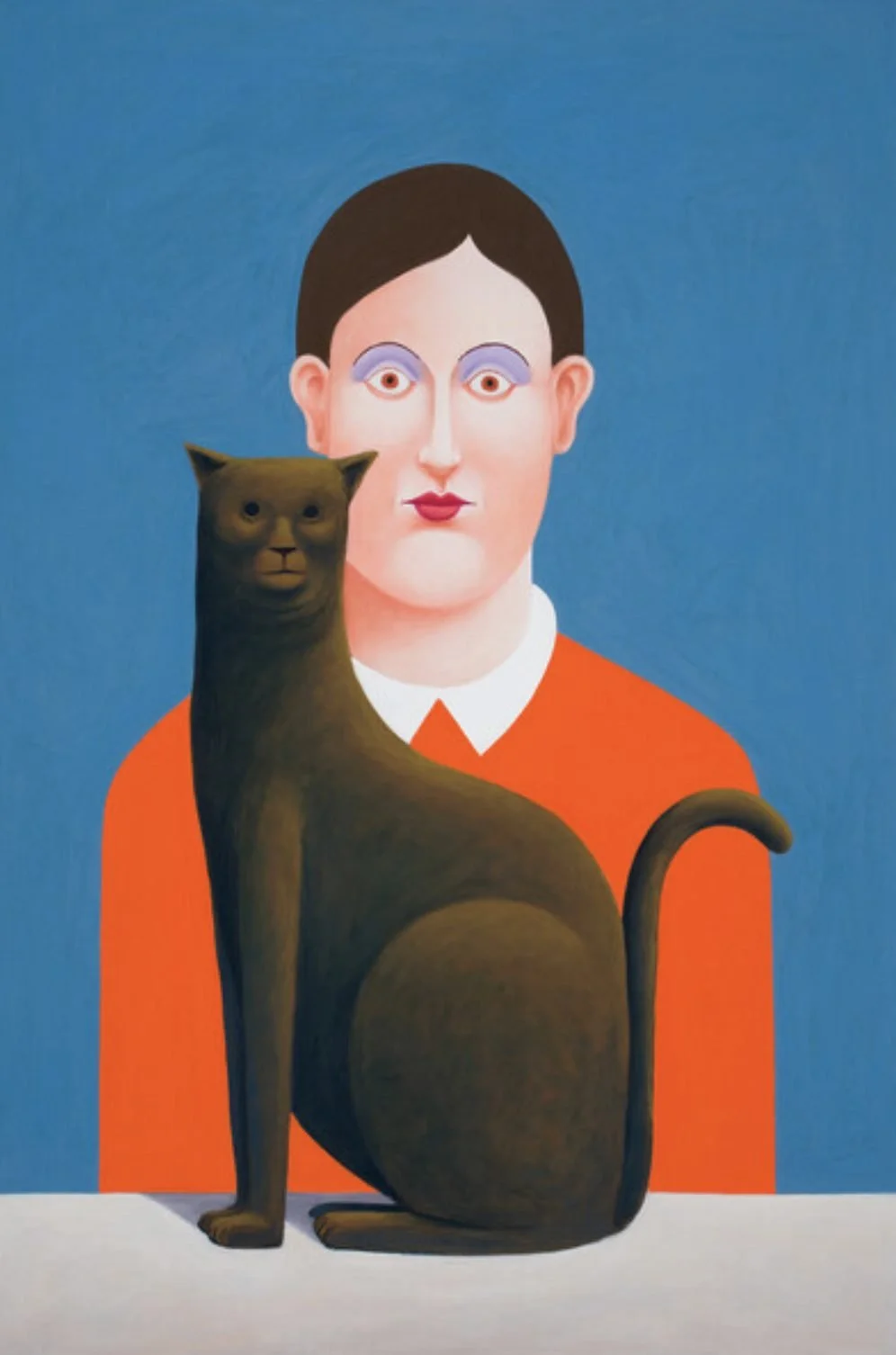
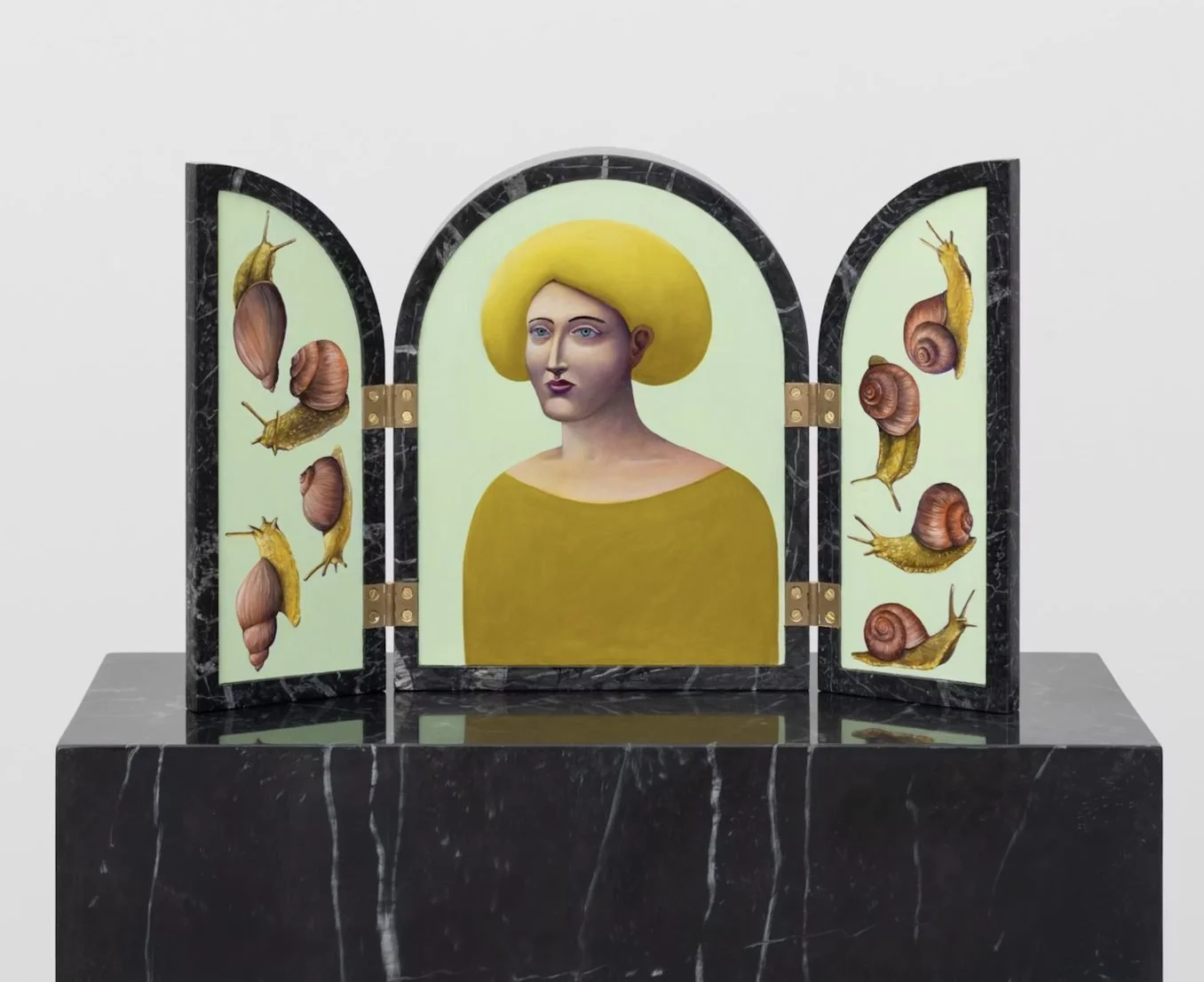
Party’s portraits often present frontal or nearly frontal heads against flat or simplified grounds. The faces are smooth, symmetrical, highly stylized, and emotionally restrained.
They can recall:
Renaissance portraits;
eighteenth-century pastel sitters;
modernist simplification;
theatrical masks;
mannequins;
dolls;
early digital avatars;
anonymous figures in dreams.
The portraits frequently appear androgynous. Hair, clothing, facial shape, skin color, and pose may offer signals without producing a stable identity. Karma describes his figures as androgynous and biomorphic subjects that challenge conventional codes of representation. (Karma)
This ambiguity does not come from distortion alone.
It comes from the tension between specificity and generalization.
Each face appears carefully constructed. Yet the figure may lack the irregular details through which viewers ordinarily assign:
age;
personality;
gender;
biography;
social class;
mood.
The figure is present but not available.
This creates a central problem:
Can a portrait remain compelling when it withholds the individual psychology portraiture traditionally promises?
Party’s answer is to make identity reside less in biography than in the encounter among color, form, gaze, and cultural type.
The viewer recognizes “a person,” but the person remains closer to an archetype, apparition, or role than a knowable individual.
The Face as Landscape
Party repeatedly makes different genres resemble one another.
A forehead may carry the rounded smoothness of fruit.
Hair may take the shape of a sculpted cloud.
Cheeks may resemble hills.
Eyes may appear as isolated graphic signs within a large field of color.
This visual migration between categories is one of the practice’s deepest strengths.
Portraiture, landscape, and still life are not separate worlds. They share a vocabulary of:
rounded volume;
symmetry;
gradient;
surface;
color;
containment;
organic shape.
A head can become a still life object.
A mountain can become a body.
Fruit can become a portrait.
This suggests that genre is partly an act of classification imposed by the viewer.
The same form can change identity according to context.
Party does not only make familiar subjects strange. He reveals that familiarity depends on where a form is placed and what we are told it is.
Landscapes Without Human History
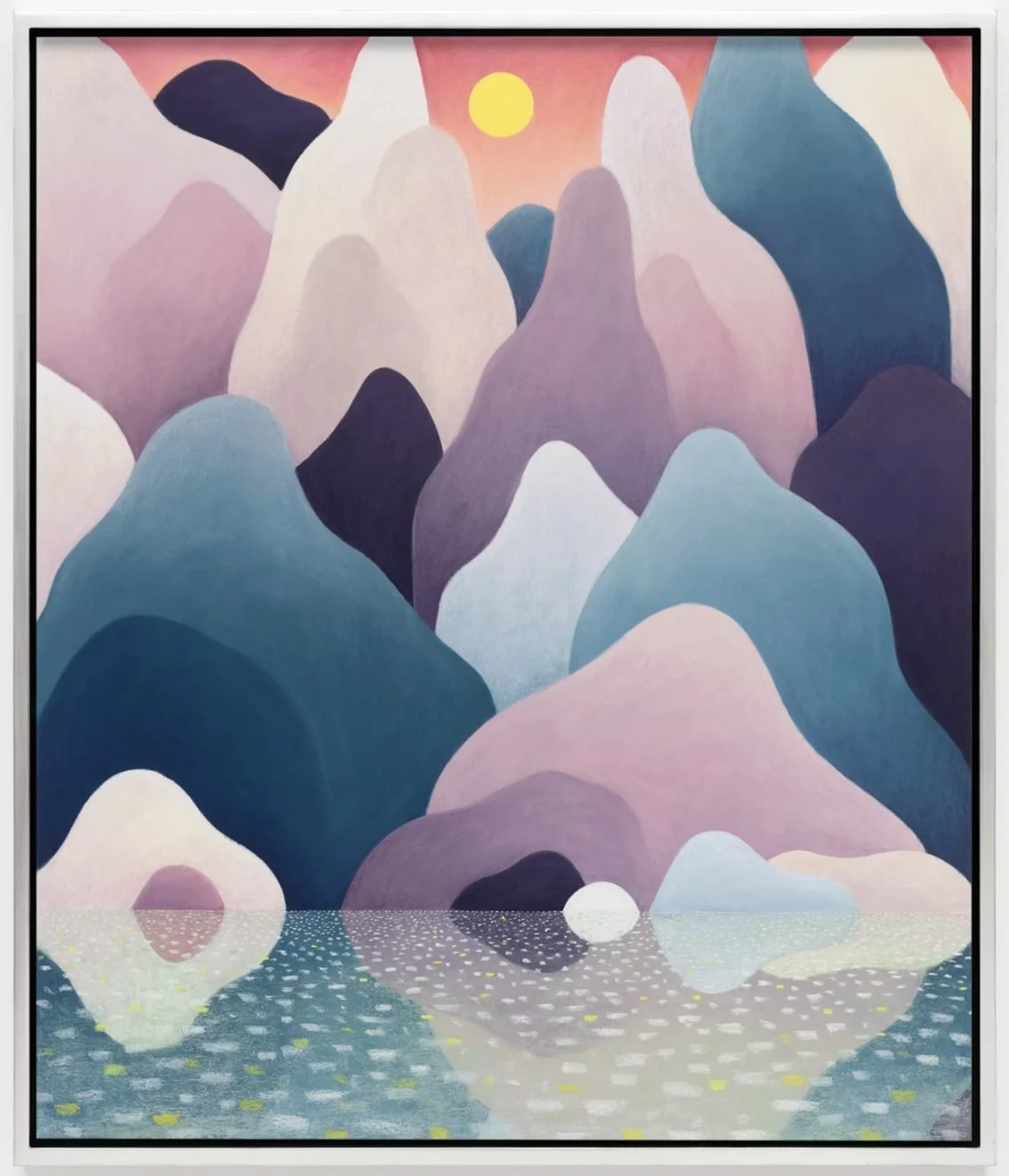
Party’s landscapes often present trees, mountains, lakes, suns, clouds, and other recognizable natural features. Yet they rarely describe actual locations.
Perspective may be compressed.
Color may be wholly artificial.
Trees may appear as repeated types rather than observed organisms.
Mountains may resemble stacked theatrical scenery.
Human figures are usually absent.
In discussing his landscapes, Party has described environments belonging either to a time before humanity or long after human culture has ceased to shape the land.
This temporal ambiguity gives the landscapes greater pressure.
They can appear:
idyllic and posthuman;
ancient and futuristic;
calm and apocalyptic;
natural and completely constructed.
The absence of people does not necessarily make the scene peaceful.
It may suggest that humanity has not yet arrived—or has already disappeared.
The landscape therefore holds two incompatible fantasies:
nature liberated from human intervention;
nature remaining after human extinction.
Beauty becomes inseparable from absence.
Nature as Stage
Party’s landscapes do not attempt to reproduce the complexity of natural observation.
Their trees and mountains often behave like symbolic units.
A tree becomes “tree.”
A mountain becomes “mountain.”
A sun becomes a perfect disc.
This simplification gives the environment a theatrical quality.
The viewer does not feel transported into unmediated nature. The viewer becomes conscious of entering a representation of nature assembled from cultural signs.
That distinction is crucial.
A naturalistic landscape can create the illusion that the artist is showing the world as it appears.
Party shows how strongly the idea of nature has already been shaped by:
painting;
illustration;
theater;
decorative art;
animation;
museums;
childhood imagery;
historical genre conventions.
His landscapes are artificial because our images of nature are already artificial.
The work does not present nature before culture.
It presents the fantasy of nature after centuries of images.
Still Life and the Anxiety of Matter
Party’s still lifes frequently contain fruit or other rounded objects presented with extreme clarity.
These objects can appear:
ripe;
smooth;
swollen;
sensuous;
artificial;
edible;
inedible;
biological;
sculptural.
A pear may be unmistakably recognizable while also resembling a body part, stone, or invented organism.
This is where the smooth surface becomes especially consequential.
Real fruit carries:
bruises;
irregular texture;
signs of ripening;
decay;
evidence of touch.
Party removes much of this incidental information.
The object becomes idealized and uncanny.
Traditional still life often uses fruit to address mortality. Ripeness contains the beginning of decay. Abundance remains temporary.
Party’s fruit appears almost outside ordinary time. Its perfection can seem preserved, synthetic, or post-biological.
The object may never rot because it was never fully alive.
This shifts the traditional still-life problem:
What happens when natural objects become so perfected by representation that their vitality becomes uncertain?
Murals and the Exhibition as a Total Image
Party does not treat framed pictures as isolated autonomous objects.
He frequently paints gallery walls, changes their colors, creates large murals, adds architectural openings, and arranges portraits, landscapes, still lifes, and sculptures within highly controlled environments.
The exhibition becomes a complete composition.
A framed portrait may appear against a forest mural.
A sculpture may stand before an enormous landscape.
A doorway may become a transition between one chromatic world and another.
The walls do not merely support the art.
They change the meaning of the objects.
The immersive setting at Hauser & Wirth, museum presentations such as When Tomorrow Comes, and earlier projects at the Hammer Museum and elsewhere demonstrate Party’s sustained interest in extending the image into architecture. (Hammer Museum)
This produces a critical distinction from conventional immersive art.
Party’s environments do not dissolve the individual artwork into projection or spectacle. The framed object remains important. Immersion is created through relationships among:
image;
wall color;
mural;
scale;
sculpture;
doorway;
sequence.
The viewer moves through a painting system.
The Framed Work and the Mural
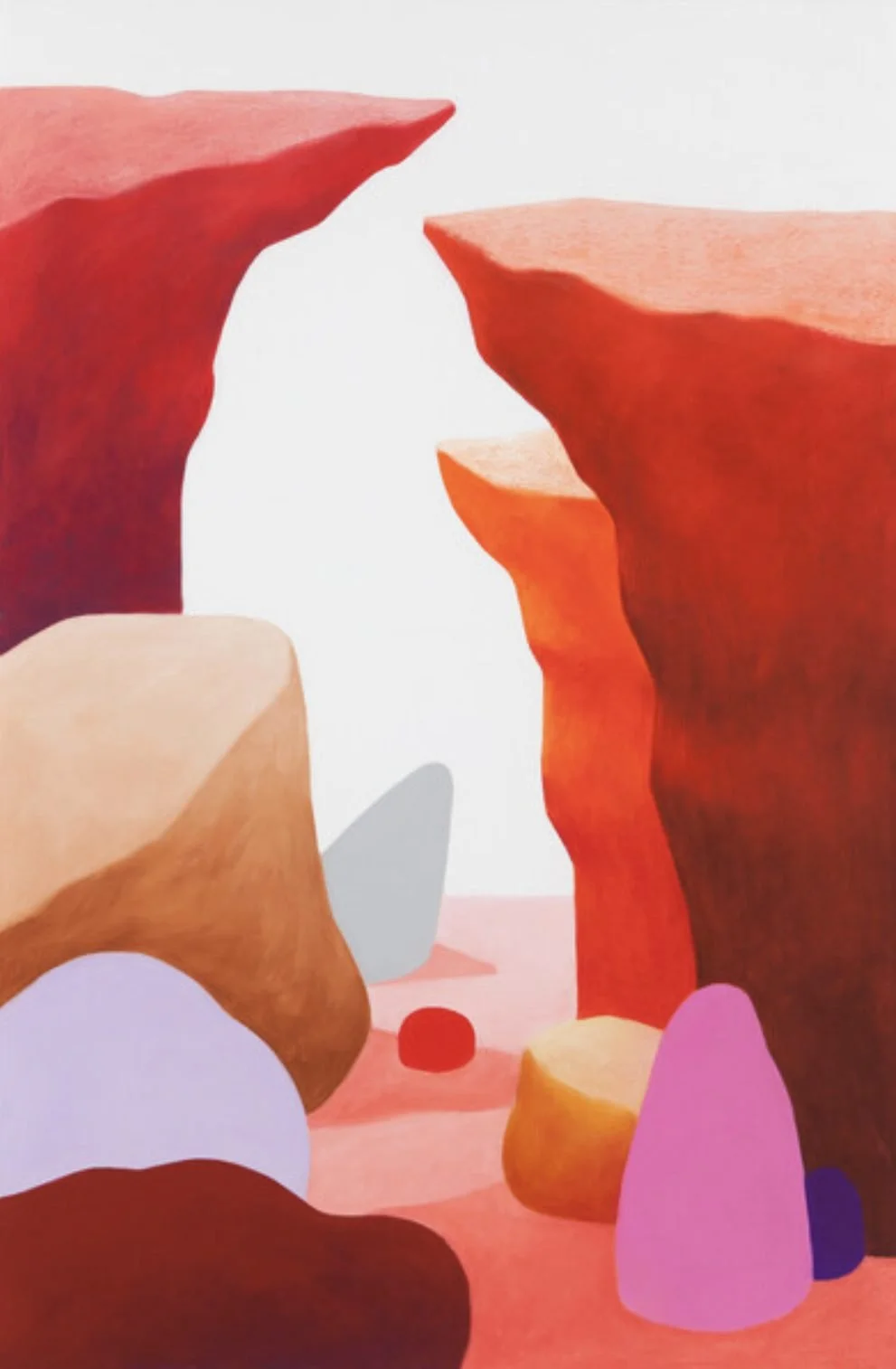
The relationship between mural and framed painting is especially important.
Murals are:
site-specific;
architectural;
temporary;
expansive;
difficult to own as conventional objects.
Framed works are:
portable;
discrete;
collectible;
preserved;
separated from architecture.
Party repeatedly places these two conditions together.
The mural may create the larger world.
The framed work interrupts, concentrates, or contradicts it.
At the Holburne Museum in 2025, Party created a large pastel mural after a seventeenth-century painting of a violent peasant brawl, then hung a smaller work depicting horses and a spectral face over its center, obscuring part of the mural. He explained that the combination was what transformed the historical image into his own work. (The Guardian)
The act of covering is not incidental.
The framed work does not merely decorate the mural.
It interrupts historical visibility.
One image competes with another.
The exhibition becomes an argument about:
quotation;
inheritance;
obstruction;
authorship;
preservation;
disappearance.
How the Practice Developed
Party trained in visual art after an early engagement with graffiti and later expanded across painting, drawing, sculpture, murals, and immersive installations. His graffiti experience is relevant not because the mature work visually resembles tagging, but because it introduced painting as something capable of occupying architecture rather than remaining inside a frame.
The practice has gradually developed through several linked discoveries:
1. Simplification can intensify strangeness
Removing descriptive detail does not necessarily make an image more accessible. It can expose the conventions through which recognition operates.
2. Pastel can become monumental
A historically fragile and intimate medium can transform entire walls and spaces.
3. Genre can behave as a shared vocabulary
Portraits, landscapes, and still lifes can exchange forms rather than remain separate traditions.
4. The exhibition can become an artwork
Color, architecture, framed images, murals, and sculpture can operate as one system.
5. Art history can become active material
Historical works can be enlarged, obstructed, restaged, recolored, and placed in conflict with new images rather than merely cited.
6. Beauty can create uncertainty
The viewer can be seduced into an encounter whose categories become increasingly unstable.
These discoveries gradually expanded Party’s work from discrete images into constructed environments.
Art History as a Living Image Bank
Party’s work contains a broad range of historical references.
His portraits, still lifes, and landscapes have been connected to artists and traditions including:
Rosalba Carriera;
Félix Vallotton;
Giorgio Morandi;
Pablo Picasso;
Milton Avery;
René Magritte;
seventeenth-century Dutch painting;
eighteenth-century pastel portraiture;
modernist landscape;
Surrealism.
The references matter because Party does not treat art history as a linear story of progress.
Older images remain available for reuse.
A historical portrait may become contemporary through altered color and gender ambiguity.
A still life may retain its compositional structure while its objects become biologically uncertain.
A landscape may carry the clarity of decorative modernism while suggesting ecological aftermath.
His relationship to Magritte is particularly revealing. Both artists use clear, polished representation to destabilize the relationship between object and category. Neither requires expressive distortion to produce uncertainty.
But Party’s transformation differs from Magritte’s linguistic and conceptual paradoxes.
Party makes uncertainty sensuous.
Color and surface create pleasure before the viewer recognizes the instability.
Beauty as a Trap Door
Party’s work is visually attractive.
This should not be treated as a weakness automatically.
Beauty performs essential work.
It encourages the viewer to approach.
It makes the simplified forms feel immediately legible.
It creates trust.
Then the image begins to withdraw that trust.
A face is beautiful but emotionally vacant.
A landscape is radiant but uninhabitable.
Fruit is seductive but possibly artificial.
A mural is enchanting but may depict fire, extinction, violence, or a world without humans.
Beauty becomes a trap door.
The viewer enters through pleasure and discovers uncertainty underneath.
This leads to the central pressure in Party’s work:
The work looks easier to know than it actually is.
The Central Contradiction
The deepest contradiction in Party’s practice is:
The images are highly accessible in appearance but resistant to stable recognition.
They are:
familiar and alien;
beautiful and unsettling;
simple and conceptually unstable;
historical and contemporary;
bodily and object-like;
natural and artificial;
playful and post-apocalyptic;
decorative and psychologically distant.
Neither side defeats the other.
If the work became more overtly disturbing, it would lose the strange force of seduction.
If it became merely decorative, the inquiry would collapse into style.
The work depends on maintaining a precise threshold:
enough familiarity to enter, enough estrangement to prevent possession.
The Viewer’s Position
Party positions the viewer as both visitor and classifier.
The viewer moves through his environments while continually making identifications:
portrait;
woman;
man;
tree;
fruit;
mountain;
fire;
water;
night;
day.
But those classifications never feel entirely secure.
The work makes viewers aware of how quickly they turn visual signs into categories.
In the immersive installations, the viewer also becomes physically subordinate to the painted world.
Oversized trees, mountains, heads, and walls transform the gallery into a theatrical environment. The viewer is no longer outside the picture.
Yet unlike Pipilotti Rist’s fluid projections, Party’s environments remain fixed and staged. The viewer does not dissolve into them. The viewer walks through a constructed order whose artificiality remains visible.
This produces a position similar to moving through a dream, museum diorama, theatrical set, or symbolic landscape.
The world invites entry without promising belonging.
Time, Extinction, and the Posthuman Landscape
Party’s later exhibitions have increasingly engaged with time, environmental change, prehistoric life, fire, ruins, and possible futures without humanity.
When Tomorrow Comes included murals of waterfalls, burning forests, cloud formations, mountains, ruins, and paintings of dinosaurs. The exhibition framed these elements around the relationship between nature, humanity, ecological crisis, and recurring cultural fantasies of apocalypse.
This development adds historical and ecological pressure to the earlier artificial landscapes.
The absence of people begins to carry more consequence.
The simplified natural world no longer appears merely whimsical.
It can seem like:
a reconstruction of nature;
a memory of lost ecosystems;
a world before human culture;
a world after human disappearance;
an image generated from fragments of art history.
Party does not depict ecological crisis through documentary imagery.
He makes the landscape’s temporal location uncertain.
The viewer cannot determine whether the scene is a beginning or an aftermath.
How the Medium Thinks
Pastel is necessary to Party’s inquiry because it allows several contradictions to coexist.
It is:
dry but sensuous;
fragile but intense;
historical but contemporary;
handmade but visually seamless;
intimate but capable of monumental scale;
powdery but capable of creating solid-looking forms.
The pastel surface can seem soft enough to touch while remaining physically untouchable. Contact could damage it.
That vulnerability reinforces the distance between visual seduction and material access.
The murals deepen this tension. They transform architecture but remain temporary. After an exhibition, they may be covered or destroyed.
A world that appears complete can disappear.
The material therefore introduces mortality into a practice often defined by smooth, preserved-looking images.
The permanent-looking world is built from dust.
The Artistic Capacity
Party has developed the capacity to make inherited visual conventions feel newly uncertain without abandoning their pleasure or clarity.
He can make:
a portrait remain present without becoming psychologically legible;
a landscape feel beautiful without becoming inhabitable;
fruit become sensuous without remaining fully natural;
pastel act like architecture;
art history become an active spatial environment;
simplification produce ambiguity rather than certainty;
decoration carry philosophical and ecological pressure.
This capacity depends on control.
Party’s work does not create uncertainty through expressive chaos.
It creates uncertainty through excessive clarity.
Everything appears carefully defined, yet the category of what we are seeing remains unstable.
The World Party Has Built
Party’s artistic world includes recurring:
heads;
fruit;
vessels;
mountains;
trees;
flames;
suns;
clouds;
waterfalls;
saturated wall colors;
smooth gradients;
pastel surfaces;
sculptural busts;
architectural murals;
historical quotations.
These elements form a coherent world because they share the same operating logic.
Forms are simplified into types.
Color is intensified beyond ordinary nature.
Surfaces suppress incidental detail.
Objects migrate among categories.
The world appears self-contained, theatrical, and removed from ordinary time.
A portrait, fruit, tree, or mountain does not merely belong to its own genre. Each seems produced by the same artificial ecology.
Is the Language Still Learning?
Party’s visual language is immediately recognizable.
This creates a serious risk.
The combination of:
smooth pastel;
saturated color;
simplified faces;
biomorphic fruit;
fantastical landscapes;
painted gallery walls;
immersive installation
can become a highly successful brand.
The work is visually attractive, photographable, collectible, and compatible with ambitious museum installations. These conditions do not invalidate it, but they increase the importance of critical scrutiny.
The central question is:
Are the familiar forms being placed under new pressure, or are they simply appearing in new combinations?
The practice remains alive when:
portraiture develops new forms of ambiguity;
the landscape gains ecological or temporal consequence;
art-historical quotation changes the viewer’s relationship to the source;
the mural and framed work enter a necessary conflict;
the exhibition structure creates meanings unavailable to isolated images.
The work weakens when uncanniness becomes a predictable coating applied to familiar genres.
A strange-colored face is not automatically psychologically complex.
A beautiful mural is not automatically a meaningful environment.
A historical quotation is not automatically transformation.
Party’s strongest work is not merely recognizable. It reveals why recognizability itself is unstable.
Risks and Limits
Party’s work faces several closely related risks.
Artificiality becoming mannerism
The smooth surfaces and stylized forms may become predictable rather than unsettling.
Immersion becoming luxury display
Painted walls and total environments can amplify meaning, but they can also turn exhibitions into elaborate branded stages.
Ambiguity becoming emotional distance
Withholding identity can create productive uncertainty, but repeated blankness may prevent deeper psychological variation.
Beauty losing pressure
Color and surface can open the inquiry, but pleasure can become the final result.
Art history becoming prestige
Historical references matter only when they alter the inherited form rather than supplying cultural authority.
These limits make Party an especially useful artist to study.
His work sits directly on the boundary between a living artistic world and a highly marketable signature.
What the Work Expands
Party expands what traditional genres can do without abandoning their recognizable structure.
He demonstrates that portraiture can investigate identity without biography.
Landscape can address ecological time without documentary representation.
Still life can question biological reality without losing sensuality.
Pastel can move from intimate drawing to monumental architecture.
An exhibition can become a single painted cosmos rather than a neutral arrangement of objects.
Most importantly, he reveals that representational clarity does not have to produce certainty.
An image can be immediately readable and remain fundamentally unresolved.
What Artists Can Learn
The lesson is not to imitate Party’s smooth faces, strange fruit, vivid landscapes, or painted gallery walls.
The lesson is to understand how familiarity can become an instrument of uncertainty.
A recognizable form can be altered through:
color;
scale;
surface;
simplification;
context;
repetition;
juxtaposition;
architectural placement.
The viewer does not always need to be confronted through chaos, ugliness, or obscurity.
Beauty can establish trust.
Clarity can invite recognition.
Tradition can create familiarity.
Then a precise deviation can make the entire system unstable.
Party’s strongest work demonstrates that strangeness does not require inventing an unrecognizable world.
Sometimes it requires showing the familiar world so clearly, smoothly, and seductively that its categories begin to feel artificial.
His achievement is to make beauty behave like a mask: visually complete, immediately attractive, and increasingly uncertain the longer we remain before it.