What Makes Stanley Whitney’s Work So Powerful?
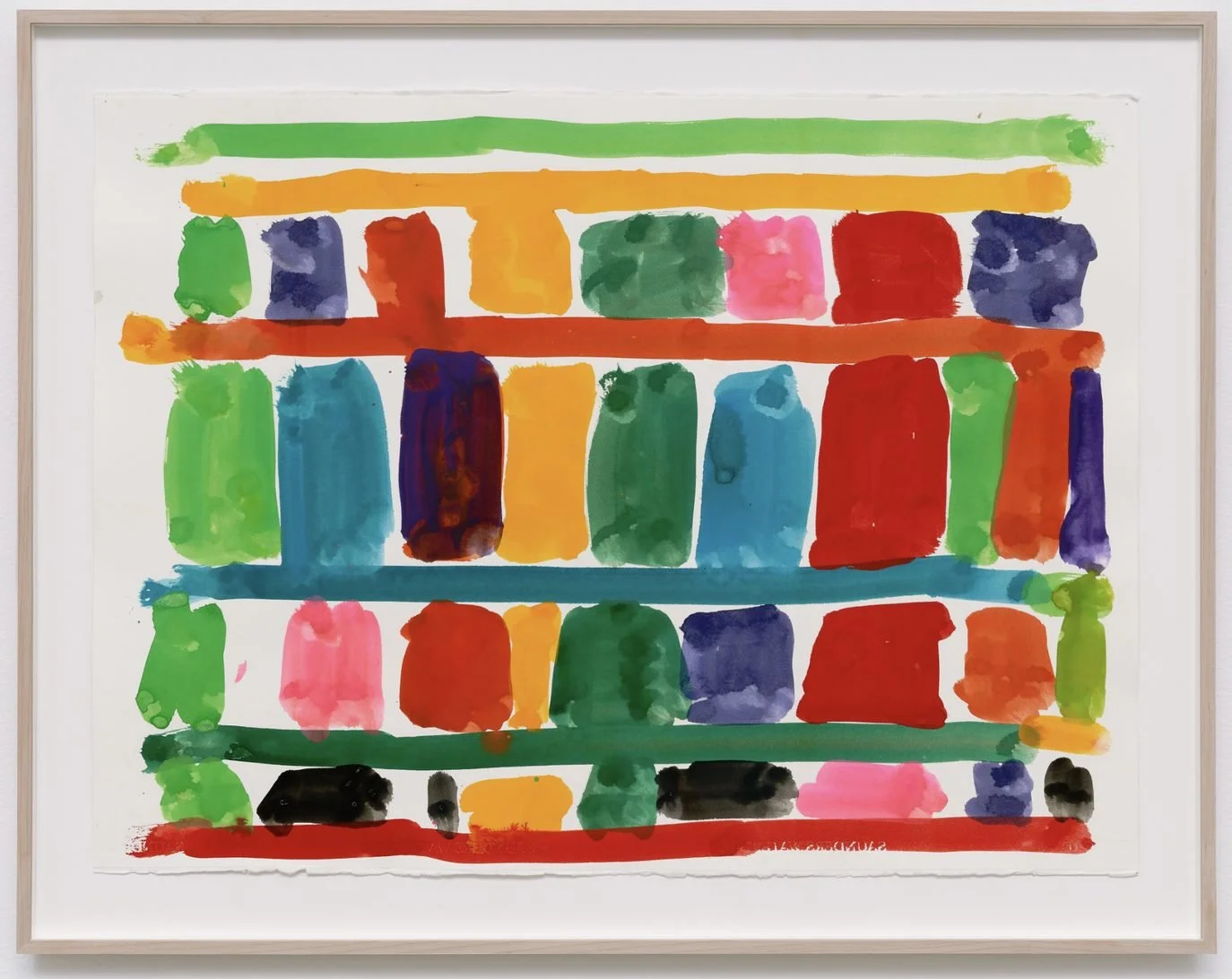
Stanley Whitney’s work is powerful because he turns limitation into freedom. For decades, he has returned to a loose grid of colored rectangles arranged in horizontal rows. The structure barely changes, yet the paintings never feel identical. Each becomes a new negotiation among hue, weight, rhythm, opacity, pressure, pause, and surprise.
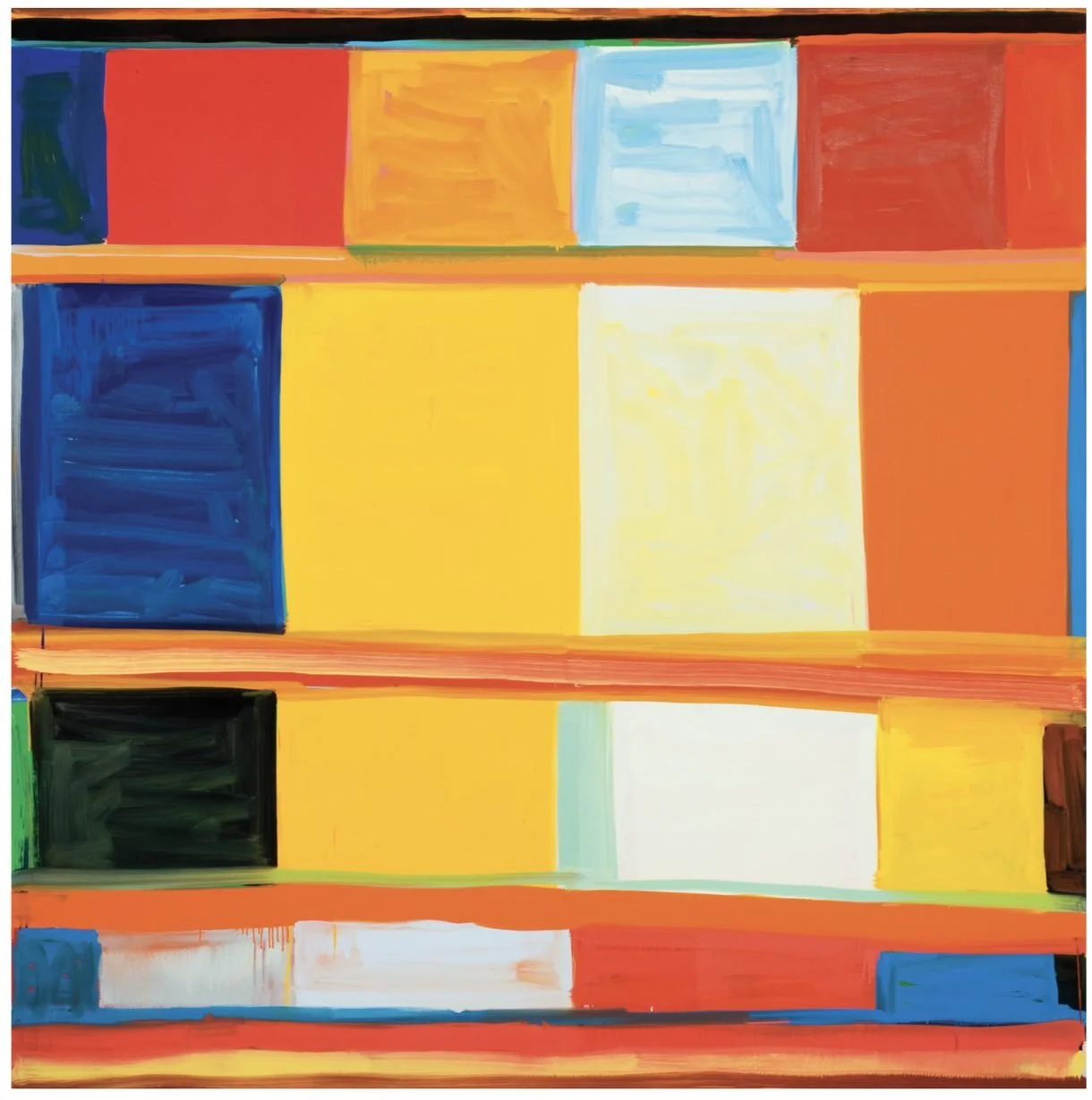
At first encounter, the paintings can appear almost disarmingly straightforward. Large blocks of red, blue, yellow, green, orange, pink, black, brown, violet, and white sit beside one another. Dark horizontal bands divide the rows. The grid looks simple enough to understand immediately.
But recognition is only the beginning.
Whitney’s paintings are not puzzles to decode or diagrams with hidden messages. Their complexity lies in the relationships among colors. A yellow may expand beside black. A red may become heavy next to pink and luminous beside green. A muted brown can slow the entire painting. A thin line may hold several saturated fields together while also interrupting their flow.
The format remains stable so that color can remain unpredictable.
Whitney’s central inquiry might be stated this way:
How can a fixed structure produce continuing freedom, rhythm, emotional variation, and discovery?
His achievement is not merely the creation of a recognizable grid. He has developed a system disciplined enough to concentrate attention and open enough to let each color alter everything around it.
What the Viewer Encounters
Whitney’s mature paintings are usually square or nearly square. They contain three or four horizontal rows of loosely painted rectangular blocks, separated by darker bands. The blocks are not mechanically measured. Edges wobble. Paint overlaps. Brushstrokes remain visible. Some areas are dense and opaque; others are thinner, softer, or more transparent.
The colors do not behave like clean digital units.
They have:
weight;
texture;
temperature;
speed;
depth;
resistance;
memory of the brush.
A red block may seem to push forward. A pale blue may open a pocket of air. Black can create gravity, silence, or interruption. A hot orange may pull nearby colors toward greater intensity. One muted passage can prevent the composition from becoming merely cheerful.
The eye does not follow one prescribed route. It may begin anywhere and move:
horizontally across a row;
vertically through several blocks;
diagonally among distant echoes;
toward the heaviest color;
away from a clash;
back to a color whose meaning changed after seeing the rest.
Whitney has described his desire for paintings that are still and rhythmic at once, without a fixed beginning or end, and that can be lived with rather than merely glanced at. (Gagosian)
The grid provides orientation, but color determines the journey.
The Inquiry Beneath the Work
Whitney’s paintings investigate a basic but inexhaustible problem:
How can separate colors coexist without losing their individuality?
This is not only a formal problem. It is also emotional, spatial, musical, and relational.
Every block must remain itself while participating in a larger whole. No color exists independently. Its character changes according to:
what touches it;
what precedes it;
what sits above or below it;
how much space it occupies;
how thickly it is painted;
whether another color repeats elsewhere;
how the horizontal bands regulate movement.
The painting therefore becomes a structure of coexistence.
Unity is not achieved by making everything similar. It emerges through negotiated difference.
Whitney’s work resists two opposite failures:
chaos, in which every color competes without structure;
uniformity, in which structure suppresses variation.
The grid prevents dispersal.
Color prevents rigidity.
The paintings live in the tension between the two.
A Long Search for Structure
Whitney did not arrive immediately at the format for which he is now known. His first retrospective, How High the Moon, traced roughly fifty years of work and showed the gradual evolution of his abstraction. In the early 1990s, rounded zones of color began settling into loose grids; by 2002, he had arrived at the square paintings composed of richly colored, irregular rows that define much of his mature work. (ICA Boston)
That long development matters.
The grid was not selected because it was fashionable, efficient, or instantly recognizable. It emerged as a solution to a persistent difficulty: how to give color enough space to act without allowing the composition to become diffuse.
Earlier paintings often contained color moving more freely through open or atmospheric space. The energy could be expansive, but Whitney continued searching for a structure capable of concentrating it.
The mature grid appears almost inevitable only in retrospect.
Its simplicity is the result of decades of elimination.
Whitney discovered that he did not need to invent a new composition for every painting. He needed a stable situation in which color could continually reinvent the composition.
This reverses a common assumption about originality.
Instead of asking:
What new form should I create?
Whitney asks:
What new event can occur inside a form I already trust?
Rome and the Discovery of Architectural Color
Time spent living and working in Italy during the 1990s was important to Whitney’s development. He has spoken about Rome and Italian art as helping him understand how color could occupy space with greater physical and architectural clarity. Gagosian’s account of his career identifies his years in Rome as pivotal to the evolution of the mature paintings. (Gagosian)
Italian architecture offered a different model from the open expansiveness associated with much American abstraction.
Color could be:
contained by walls;
organized into rooms;
held within frescoes;
separated by architectural divisions;
experienced as part of a built environment.
The eventual grid can be understood as a kind of architecture for color.
Each rectangle becomes a room.
The horizontal bands become floors, beams, ledges, or pauses.
But the architecture is not rigid. The handmade edges and uneven proportions keep it breathing.
The structure holds color without imprisoning it.
The Grid as a Necessary Constraint
The grid has a long history in modern art. It can suggest:
order;
rationality;
repetition;
industrial design;
architecture;
mathematics;
modernist purity;
control.
Whitney transforms that inheritance.
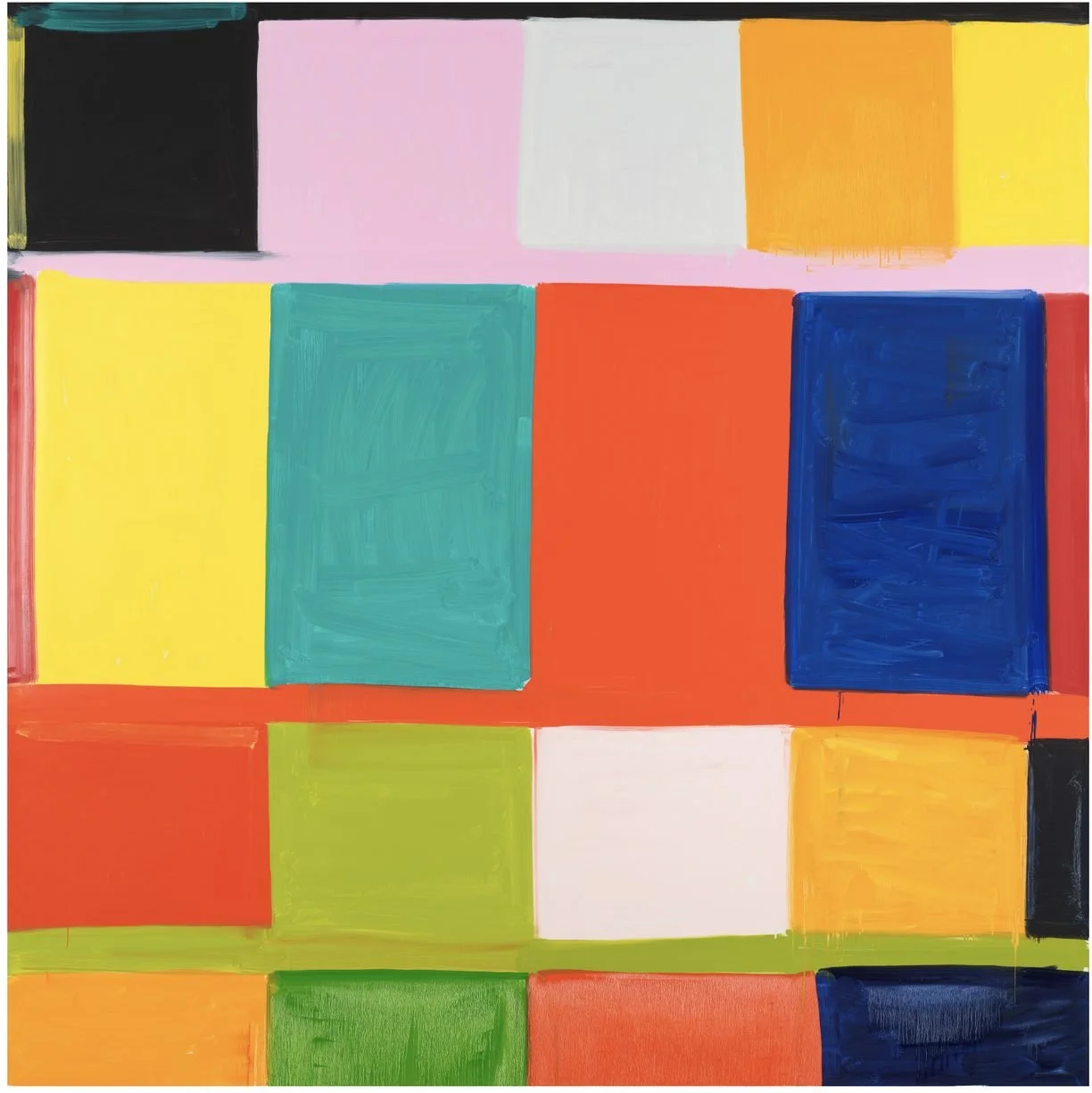
His grid does not eliminate touch. It makes touch more visible.
Because the overall format is predictable, small deviations matter:
a crooked edge;
a thin strip of underpainting;
a patch of exposed canvas;
an unexpectedly narrow block;
a thickly brushed area beside a translucent one;
a horizontal band that bends under the pressure of the colors around it.
A perfectly measured grid would stabilize the work too completely.
Whitney’s irregular grid holds order and improvisation together.
The paintings are structured but not predetermined.
That distinction is crucial.
A system can establish the conditions for discovery without dictating the result.
The grid tells Whitney where the encounter will occur. It does not tell him what the encounter will become.
Painting One Color at a Time
Whitney generally builds the paintings sequentially, placing one color and then responding to what it demands next. Gagosian describes his process as laying down one vivid color at a time and establishing relationships between each block, its neighbors, and the composition as a whole. (Gagosian)
This means the painting develops through response rather than execution of a complete prior design.
Each decision changes the problem.
A blue placed first may call for:
a warmer counterweight;
a darker interruption;
a softer transition;
an echo elsewhere;
a color that clashes rather than harmonizes.
The artist cannot know the full painting in advance because every new color changes the meaning of those already present.
The process resembles conversation.
One statement creates the need for another.
Some responses agree.
Others interrupt, resist, complicate, or redirect.
The painting is finished not when every color matches, but when all the differences form a convincing whole.
The Relationship Between Freedom and Judgment
Whitney’s work makes improvisation look effortless, but the paintings depend on highly developed judgment.
Freedom in art is often misunderstood as the absence of rules.
Whitney demonstrates another possibility:
Freedom may require a structure strong enough to make each decision consequential.
In an unrestricted field, almost any mark can be added anywhere. That abundance of possibility can weaken necessity.
Inside Whitney’s grid, every color must answer a precise situation:
What can sit beside this red?
How much yellow can the painting bear?
Does this black create gravity or kill the rhythm?
Should a color repeat?
Does the lower row stabilize the upper ones?
Is the painting becoming too harmonious?
Does it need interruption?
Constraint makes judgment visible.
The repeated structure strips away the distraction of constant compositional invention. It concentrates the artist’s attention on the exact behavior of color.
This is why the paintings feel both spontaneous and disciplined.
Their freedom has been earned through limitation.
Color as Relationship Rather Than Symbol
Whitney’s colors do not usually function through fixed symbolism.
Red does not always mean passion.
Black does not always mean grief.
Blue does not always mean calm.
Their meaning emerges relationally.
A red beside yellow may feel hot and expansive. The same red beside brown may become earthy or dense. Black beside pink can sharpen the pink’s sweetness; black beside blue can create a deeper, slower field.
Color acts less like vocabulary and more like tone of voice.
Its effect depends on context.
This makes the paintings resistant to paraphrase. They do not communicate a message that can be extracted from the visual experience.
Their meaning lies in the experience of relation itself.
The viewer learns that no color has a completely independent identity.
Every color is altered by proximity.
Music and the Structure of Time
Music—especially jazz—has been central to Whitney’s thinking. He grew up surrounded by music, and his retrospective took its title, How High the Moon, from a jazz standard associated with improvisational interpretation. (ICA Boston)
The relationship to jazz is not simply metaphorical.
Whitney’s paintings share several operating principles with improvised music:
a stable structure supports variation;
repetition creates expectation;
deviation becomes meaningful because a pattern exists;
individual voices retain identity inside an ensemble;
rhythm organizes movement without dictating one path;
pauses are as important as intensity;
tension does not require permanent resolution.
The horizontal rows can feel like measures or phrases.
Repeated colors act like returning notes.
Dark bands create rests, breaks, or bass lines.
A surprising color can function like an improvised entry that changes how the entire sequence is heard.
Yet painting is physically still.
Whitney’s capacity lies in making stillness contain duration.
The viewer experiences time through the movement of attention.
A painting does not unfold automatically like music. The viewer activates its rhythm by looking.
Call and Response
Jazz also offers a useful way to understand how Whitney’s colors interact.
One block calls.
Another responds.
The response may:
repeat;
reverse;
intensify;
soften;
contradict;
delay;
complete;
reopen.
A green in the top row may receive an answer from another green near the bottom, but the second green is altered by everything encountered between them.
The eye remembers the first color while meeting the second.
This creates temporal depth within a flat surface.
The painting is not a collection of isolated rectangles. It is a field of remembered relationships.
Color becomes both immediate and cumulative.
Black as Structure, Weight, and Pause
Black plays an especially complex role in Whitney’s paintings.
It can function as:
color;
boundary;
interruption;
silence;
weight;
depth;
rhythm;
emotional gravity.
The horizontal dividing bands are often dark, giving the paintings an architectural skeleton. But black also appears inside the grid as one color among others.
This dual role is important.
Black can hold the structure together while also participating in the improvisation.
It may slow the painting, absorb nearby intensity, or force brighter colors into greater visibility. A large black block can create a pause so strong that the surrounding colors seem to reorganize themselves around it.
Whitney does not treat black as the absence of color.
He treats it as an active presence.
Color, Race, and the Freedom to Be Abstract
Whitney’s commitment to abstraction developed within an art world that often expected Black artists to make explicitly representational or politically legible work. He has discussed the difficulty of pursuing abstraction while facing assumptions about what Black art should look like or address. His 2015 Studio Museum exhibition helped bring greater recognition to a practice he had sustained for decades. (Vogue)
This context matters, but it should not reduce the paintings to an argument about identity.
Whitney’s abstraction is not empty of lived experience because it does not depict a body or event.
His insistence on color, freedom, music, beauty, and formal inquiry carries its own historical force.
The freedom to pursue abstraction without having one’s work treated as socially evasive is not distributed equally.
Whitney’s practice therefore holds another contradiction:
The paintings claim complete formal freedom, but that freedom was pursued within institutions that repeatedly tried to define what Black artistic responsibility should be.
The work does not need to illustrate that pressure for the pressure to belong to its history.
Titles as Doors Rather Than Explanations
Whitney often gives his paintings titles connected to:
music;
literature;
political events;
artists;
personal memory;
phrases carrying emotional resonance.
Examples include titles that invoke songs, writers, historical violence, or cultural figures. The titles do not function as codes that explain which color represents which subject.
Instead, they change the atmosphere around the painting.
A title may introduce:
mourning;
admiration;
anger;
longing;
memory;
dedication;
political urgency.
The painting remains abstract, but the title opens another emotional register.
This allows formal autonomy and worldly experience to coexist.
The color does not illustrate the title.
The title places the color under pressure.
Dance the Orange
The title of Whitney’s 2015 Studio Museum exhibition, Dance the Orange, captures his ability to turn color into action.
Orange is not merely present.
It dances.
This suggests that a color can have:
tempo;
posture;
social energy;
physical character.
The phrase also reveals the humor and sensuality in Whitney’s abstraction. The paintings are serious without becoming severe.
Color can think and still remain pleasurable.
That balance is central to his work.
Pleasure is not a distraction from formal intelligence. It is one of the ways formal intelligence becomes perceptible.
How High the Moon: A Practice Seen Across Time
The traveling retrospective How High the Moon offered the clearest account yet of Whitney’s five-decade development. It began at the Buffalo AKG Art Museum in 2024, traveled to the Walker Art Center, and was presented at the Institute of Contemporary Art/Boston in 2025. (ICA Boston)
The retrospective made an important point visible:
Whitney’s mature structure is not evidence that the artist stopped changing.
It is the result of learning what kind of change mattered most.
Earlier works show a search through:
open fields;
atmospheric arrangements;
loosely clustered forms;
shifting geometries;
increasingly concentrated color.
The mature grid does not erase this history. It contains it.
The irregular edges preserve openness.
The brushwork preserves the body.
The color preserves improvisation.
The repeated structure allows the artist to continue asking increasingly precise questions.
This is a model of artistic development through concentration rather than expansion.
Some artists learn by adding media, materials, subjects, and systems.
Whitney learned by removing variables until the remaining ones became inexhaustible.
The Central Contradiction
The deepest contradiction in Whitney’s work is:
The paintings repeat the same structure, yet each one insists on singular experience.
Repetition can become mechanical.
Whitney uses it to sharpen difference.
The grid may suggest control, but the color behaves intuitively.
The paintings are flat, yet they generate space.
They are still, yet they feel rhythmic.
They are abstract, yet they carry emotional and cultural memory.
They are immediately pleasurable, yet they reward prolonged attention.
These opposing conditions remain active because neither cancels the other.
Structure does not defeat freedom.
Freedom does not dissolve structure.
How the Medium Thinks
Painting is necessary to Whitney’s inquiry because color in paint is physical.
It has:
thickness;
opacity;
transparency;
texture;
drag;
edge;
revision;
evidence of touch.
A digital arrangement of the same hues would not behave identically.
Whitney’s colors are not simply selected. They are mixed, applied, adjusted, covered, and physically negotiated.
The uneven surface allows one color to feel materially different from another.
A translucent passage may seem to breathe.
A thick block may feel dense and immovable.
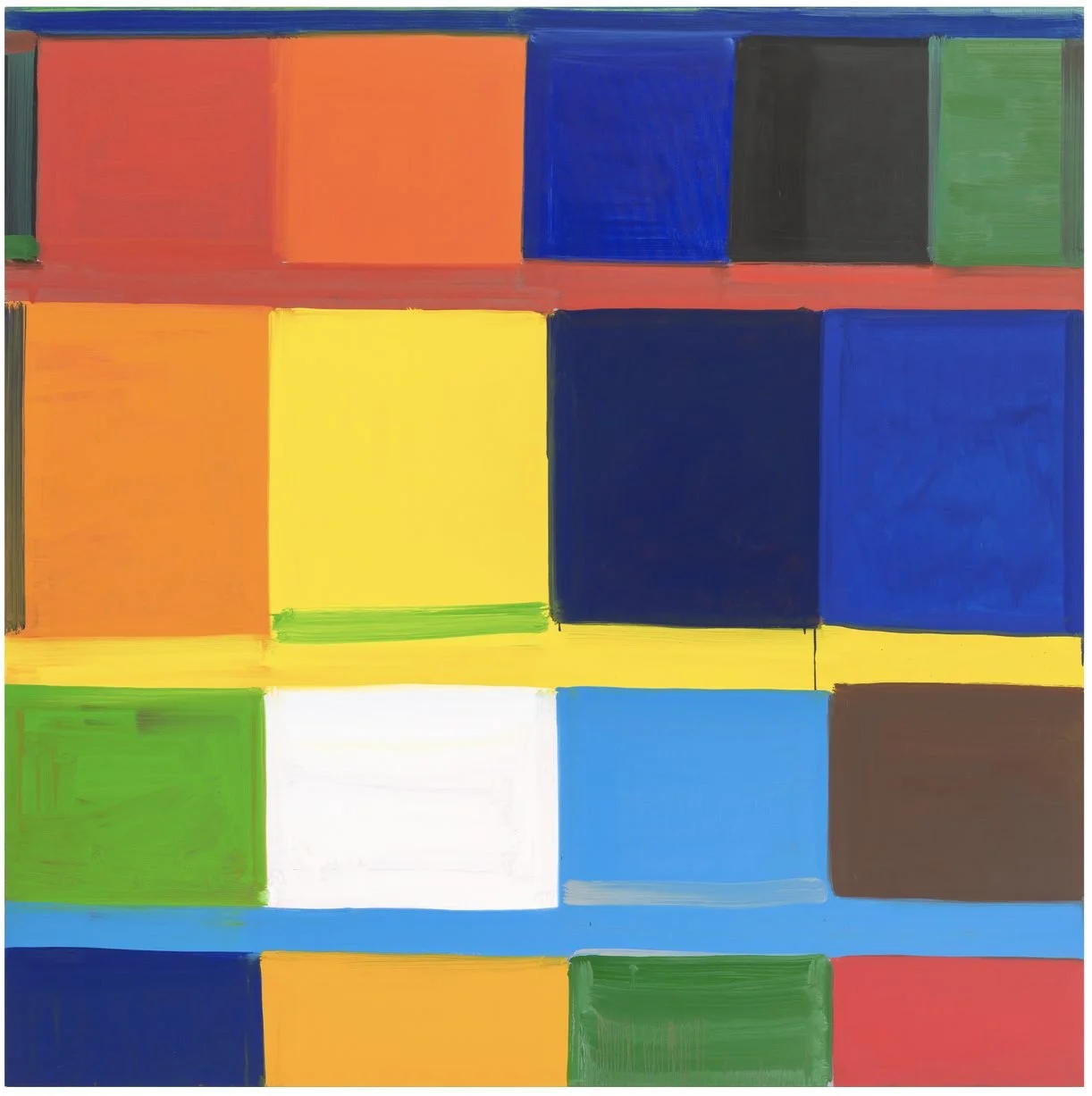
Visible brushwork prevents the grid from becoming a diagram.
Painting turns color relationships into embodied decisions.
The Viewer’s Position
Whitney positions the viewer as an active listener.
The work does not provide a narrative or recognizable subject to follow. The viewer must attend to:
variation;
recurrence;
interval;
weight;
contrast;
tempo;
pause.
This requires a slower kind of looking.
The first impression may be brightness and order.
Sustained attention reveals:
colors that do not quite match expectations;
uneven edges;
subtle shifts in density;
repetitions that are not true repetitions;
moments where the grid nearly loses stability;
passages that become more powerful only after the eye has traveled elsewhere.
The viewer is not asked to solve the painting.
The viewer is asked to remain responsive inside it.
That is closer to listening than decoding.
What the Practice Has Discovered
Across decades of experimentation, Whitney’s practice appears to have made several important discoveries.
1. Constraint can produce greater freedom
A stable structure can release the artist from endless compositional invention and concentrate attention on subtler decisions.
2. Repetition can intensify difference
Returning to the same format makes small variations more consequential.
3. Color creates space through relation
Depth does not require perspective or modeling. One color can advance, recede, expand, or compress according to what surrounds it.
4. Stillness can contain rhythm
A painting can generate duration through the movement and memory of the viewer’s attention.
5. Beauty can remain intellectually rigorous
Pleasure does not weaken formal inquiry when every relationship remains necessary.
6. A mature language need not be abandoned to remain alive
Development can occur through increasing precision inside a recurring system.
7. Unity does not require sameness
A whole can emerge from distinct elements that retain their individual force.
The Artistic Capacity
Whitney has developed the capacity to make color behave as a living social, spatial, and musical relation.
He can make a limited grid produce:
surprise;
harmony;
friction;
pause;
movement;
emotional temperature;
architectural stability;
improvisational freedom.
This capacity depends on extraordinary sensitivity to relation.
No color is impressive by itself.
The achievement lies in knowing:
what it needs beside it;
what can oppose it;
what will make it quieter;
what will make it sing;
when repetition creates rhythm;
when another color would become excessive.
Whitney does not simply choose beautiful colors.
He creates conditions in which colors make one another newly visible.
The World Whitney Has Built
Whitney’s artistic world appears highly concentrated:
square canvases;
horizontal rows;
dark bands;
irregular rectangles;
saturated color;
visible brushwork;
musical titles;
related works on paper.
Yet this limited vocabulary contains enormous range.
A painting may feel:
celebratory;
solemn;
playful;
dense;
meditative;
agitated;
spacious;
compressed.
The recurring forms change emotional function through their relationships.
A yellow block may become radiance in one painting and pressure in another.
Black may stabilize one composition and rupture another.
Pink may create tenderness, irony, heat, or dissonance.
The world remains alive because the vocabulary is stable but its syntax keeps changing.
Is the Language Still Learning?
Whitney’s mature format creates the obvious risk of formula.
The paintings are instantly recognizable. A loose grid of vivid blocks can become a reliable signature, especially within a market that rewards visual consistency.
The critical question is:
Does each painting discover a new color relationship, or merely reproduce the appearance of a Stanley Whitney?
This question cannot be answered by the format alone.
A repeated structure becomes a brand when the internal decisions cease to matter.
It remains a living language when each work establishes a different emotional, spatial, and rhythmic necessity.
Whitney’s recent exhibitions continue to present new variations within the format, including shifts in scale, density, palette, opacity, and works on paper. His 2025 exhibition Return to the Garden brought new and recent paintings to Athens after the major retrospective had made the evolution of his practice more widely visible. (Gagosian)
The strongest paintings justify the repetition because their color relationships feel discovered rather than filled in.
The weaker possibility is always nearby: color blocks arranged competently inside a trusted grid.
That danger is not separate from the achievement.
It is the risk Whitney accepts by working inside such concentrated limits.
What the Work Expands
Whitney expands what repetition can mean in painting.
He shows that repetition does not have to signal:
mechanical production;
exhausted invention;
conceptual neutrality;
market branding.
It can become a method for increasing sensitivity.
The repeated grid allows artists and viewers to perceive differences that a constantly changing format might conceal.
Whitney also expands abstraction by making formal freedom compatible with cultural memory, pleasure, music, and emotional experience.
Most importantly, he offers a model of artistic maturity based not on perpetual reinvention but on deepening attention.
The practice evolves because the artist becomes capable of hearing finer differences inside the same structure.
What Artists Can Learn
The lesson is not to imitate Whitney’s grid or arrange bright rectangles on a canvas.
The lesson is to understand what a productive constraint can do.
A strong structure can:
reduce superficial choices;
concentrate judgment;
make subtle variation visible;
create continuity across a body of work;
allow one result to influence the next;
reveal whether the language is still learning.
Constraint becomes valuable when it opens a field of discovery rather than predetermining the result.
Repetition becomes valuable when it increases difference rather than suppressing it.
Color becomes powerful when it acts relationally rather than decoratively.
Whitney’s paintings demonstrate that freedom does not always come from breaking the structure.
Sometimes freedom comes from trusting a structure deeply enough to discover how much life it can hold.
His achievement is to make a fixed grid feel less like a cage than a musical form—stable enough to return to, open enough to improvise within, and sensitive enough to make every new color change the meaning of the whole.