What Makes Tala Madani’s Paintings So Powerful?
Tala Madani’s paintings are powerful because they use comedy, ugliness, bodily humiliation, and painterly pleasure to expose the absurdity of power.
Her pictures are often immediately funny.
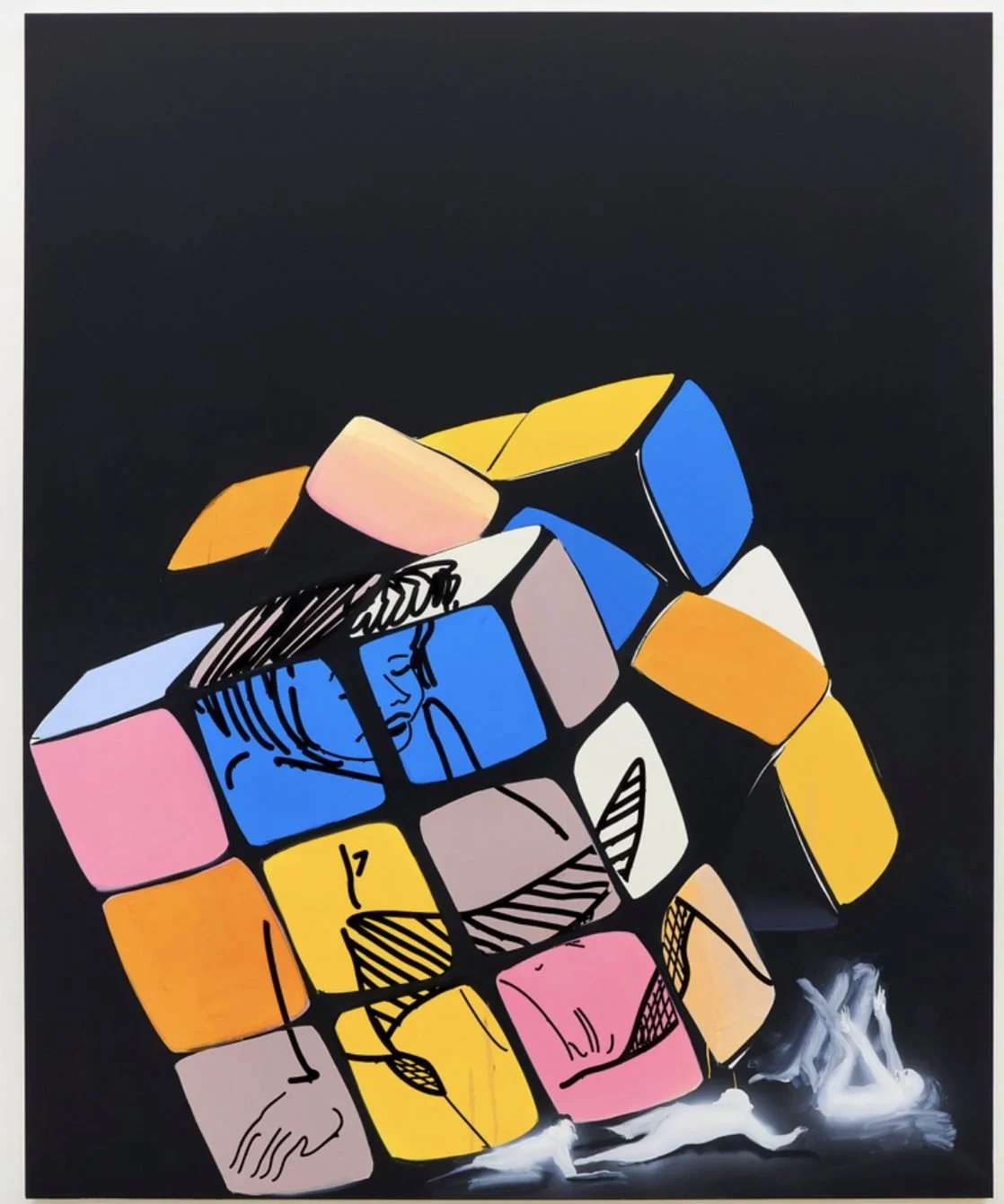
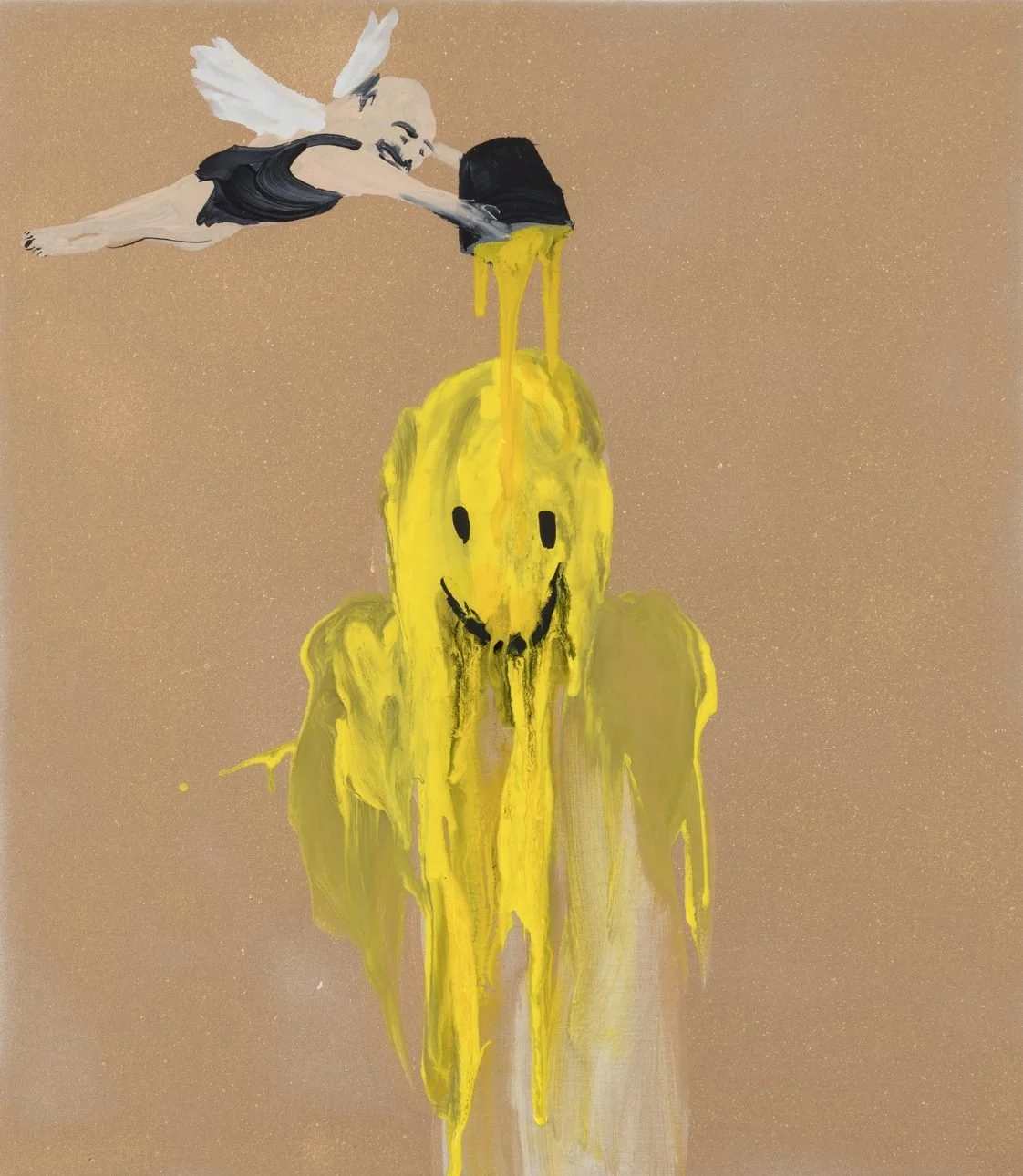
Bald, soft-bodied men crawl, perform rituals, attack one another, worship projections, mishandle objects, or become entangled in bodily fluids. Figures appear arrogant and helpless at once. Light beams shoot from bodies. Paint behaves like excrement, semen, blood, or illumination. Domestic spaces become stages for crude ceremonies whose rules remain unexplained.
The scenes can resemble cartoons, slapstick comedy, political satire, nightmares, or children behaving badly.
Yet beneath the humor is a serious investigation of authority, masculinity, representation, motherhood, and the body. Madani creates alternate worlds that feel ridiculous but remain disturbingly close to our own. MoMA describes her paintings and stop-motion animations as provocative, humorous, and unsettling realities shaped by concerns including patriarchy and xenophobia. (The Museum of Modern Art)
Her work asks what power looks like after dignity collapses.
The Problem Beneath the Work
Madani repeatedly returns to a central artistic problem:
How can painting expose the fantasies, rituals, and insecurities beneath social authority without replacing them with another moralizing image of power?
Her paintings do not generally portray powerful men as impressive villains.
Instead, they make authority look:
Infantile
Bodily
theatrical
insecure
repetitive
sexually confused
dependent on spectators
vulnerable to embarrassment
The figures often seem to be performing masculinity for one another.
They form groups, enact rituals, dominate weaker bodies, create hierarchies, and imitate authority. But their power continually collapses into farce.
A man who appears commanding may also look ridiculous.
A collective ceremony may resemble both political organization and playground cruelty.
A beam of divine light may emerge from an undignified part of the body.
Madani does not simply criticize powerful individuals. She exposes power as a performance sustained through repetition, belief, spectacle, and group participation.
The Male Body Without Heroism
Much of Western painting has used the male body to represent strength, intellect, heroism, divinity, political authority, or artistic genius.
Madani replaces that tradition with a recurring cast of balding, middle-aged, frequently naked men. Art21 describes these figures as stocky men whose libidinal disorder disrupts the situations into which she places them. (Art21)
Their bodies are not idealized.
They sag, leak, crouch, stumble, expose themselves, or submit to incomprehensible procedures. They may be perpetrators and victims within the same scene.
This dismantles the visual connection between masculinity and control.
The men possess bodies they cannot fully govern.
Their authority is constantly interrupted by:
Appetite
fear
desire
waste
aging
dependence
physical vulnerability
Madani does not merely feminize or weaken the male body. She removes the protective myths that make male power appear self-contained.
The body reveals what authority tries to hide.
Humor as a Critical Tool
Humor is central to Madani’s work because it changes the viewer’s relationship to power.
A solemn political image may encourage reverence or direct opposition. Comedy creates another possibility: it makes authority difficult to take at its own estimation.
Laughter reduces distance.
It exposes contradictions quickly.
It allows viewers to recognize cruelty, vanity, insecurity, and irrationality without receiving a formal political lecture.
But the humor is rarely comfortable.
The viewer may laugh at an image involving humiliation, violence, bodily fluids, or domination and then become aware of that laughter.
This creates a second problem:
What exactly did the viewer find funny?
Was it the powerful man becoming ridiculous?
The vulnerable body?
The violence?
The taboo?
The painting does not allow humor to remain innocent.
Laughter becomes a form of implication.
Grotesque Bodies and Social Truth
Madani frequently uses the grotesque.
Bodies deform.
Substances leak.
Anatomy becomes exaggerated.
The boundary between a figure and its waste may collapse.
The grotesque body contradicts the fantasy of the autonomous individual.
It is porous.
It consumes and expels.
It depends on other bodies.
It can be penetrated, contaminated, embarrassed, or transformed.
This makes the grotesque especially useful for questioning political and patriarchal authority. Systems of power often present themselves as orderly, rational, clean, and controlled.
Madani reveals the bodily chaos underneath that image.
Her work asks whether supposedly elevated structures—government, religion, masculinity, artistic authority, family hierarchy—are built over impulses that are far less dignified.
Paint as Body and Image
Madani’s paint often performs several roles simultaneously.
A brushstroke may be:
Light
liquid
bodily waste
illumination
violence
paint itself
the substance from which a figure is made
The Henry Art Gallery notes that beams and bodily fluids emerging from her figures become metaphors for paint’s tactile expressivity. (Henry Art Gallery)
This is important because the work does not merely depict bodily mess.
The material of painting becomes part of that mess.
A loose passage may describe a substance while reminding the viewer that the figure is made from the same substance.
Paint gives the body form and then appears to dissolve, stain, or humiliate it.
Representation becomes unstable:
The material used to create authority can also destroy its image.
This is one reason Madani’s brushwork often remains quick and visibly unresolved. Excessive refinement would stabilize the scene and give its figures too much pictorial dignity.
The looseness keeps them vulnerable.
Projection, Screens, and Manufactured Authority
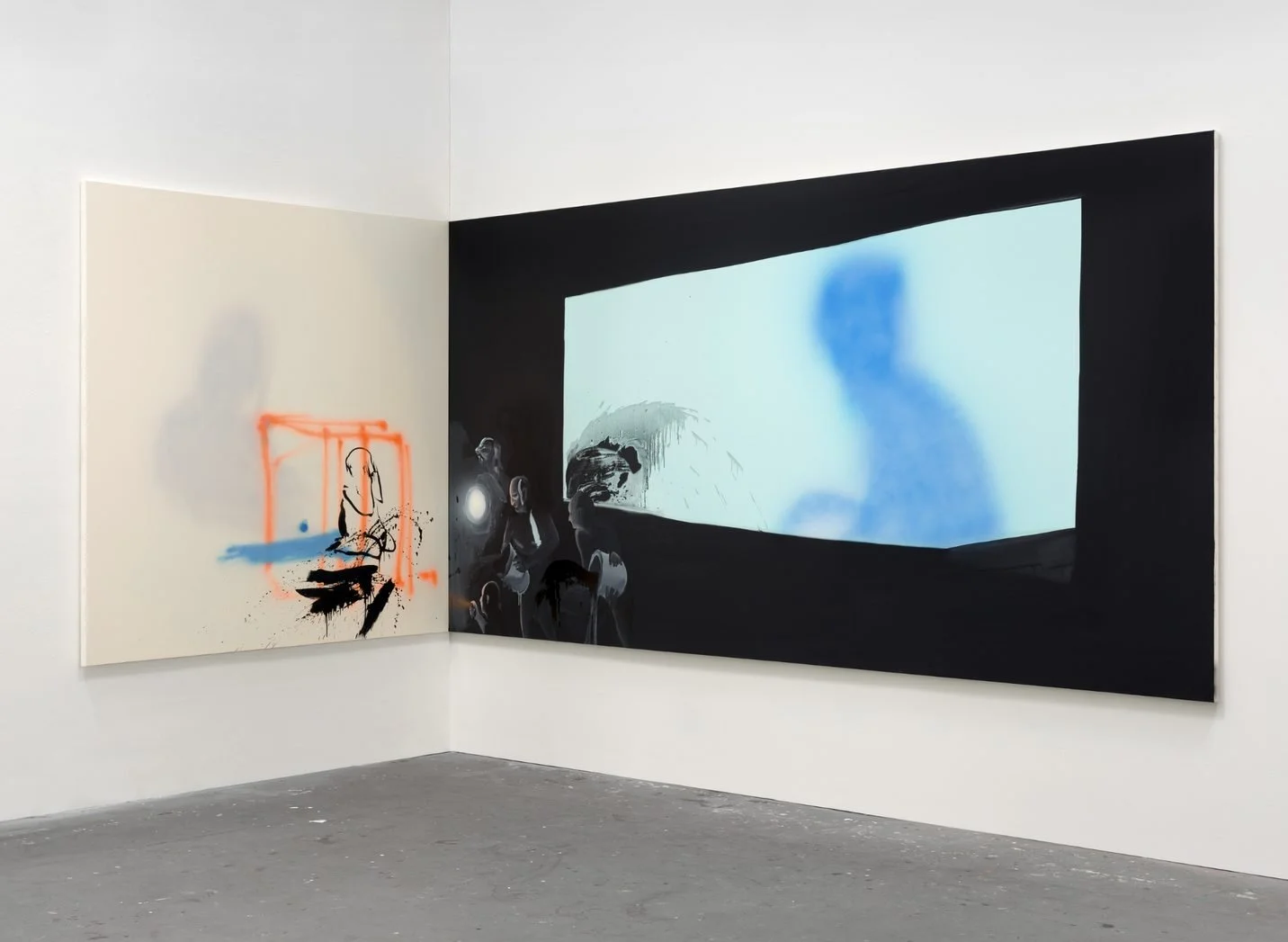
Screens, projected images, framed pictures, shadows, and beams of light recur throughout Madani’s work.
Figures frequently gather around an image or appear controlled by one.
Projection can suggest:
Cinema
propaganda
religious revelation
education
fantasy
surveillance
social media
collective belief
A projected image seems powerful because it organizes attention. People face it, obey it, worship it, fear it, or mistake it for reality.
Yet projection is immaterial.
It depends on machinery, darkness, a surface, and an audience willing to look.
Madani uses that contradiction to investigate authority.
The image dominates the figures, but its power is conditional.
The social order may be organized around something no more substantial than light.
This raises a broader question:
How much authority exists because people continually project it, reproduce it, and orient themselves toward it?
Painting and Animation
Madani works in both painting and stop-motion animation. The animations grow from the same language of drawing and painting rather than functioning as a separate cinematic practice. In discussing her early videos at MoMA, she emphasized that their movement emerged from painted and drawn forms. (The Museum of Modern Art)
Animation allows her scenes to develop consequences.
A figure moves.
A gesture repeats.
A harmless action becomes violent.
A substance spreads.
A visual joke transforms into punishment.
The repetition can feel mechanical, compulsive, or ritualized.
Painting suspends the absurd event at its most charged moment.
Animation shows how absurd systems perpetuate themselves.
Together, the two media explore power as both image and behavior.
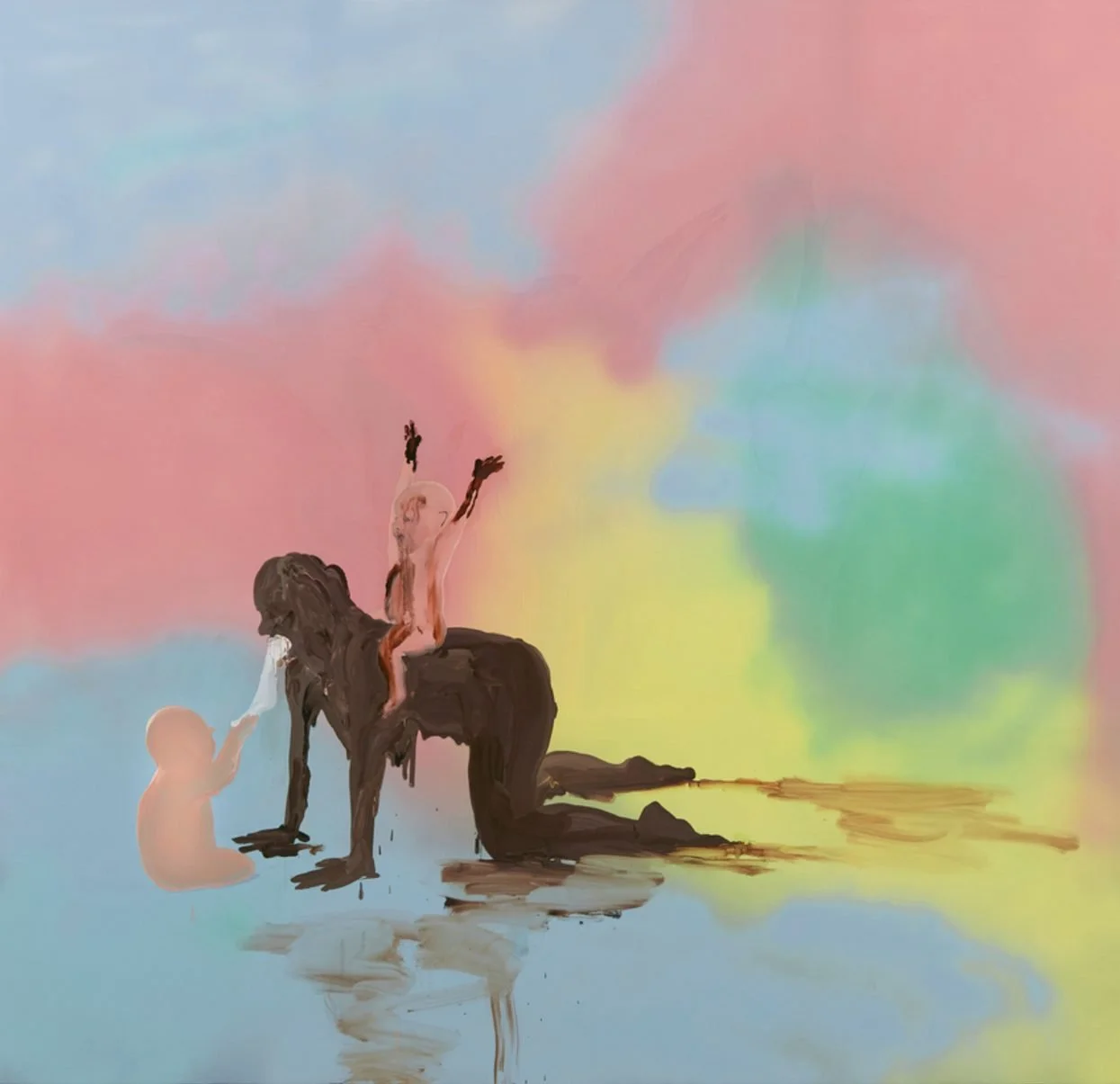
The Shit Moms
Madani later introduced figures often called the Shit Moms—maternal forms constructed from brown bodily matter.
These works shifted her attention from male rituals toward motherhood, care, contamination, sacrifice, and cultural expectations imposed on women.
The figures may nurture, clean, protect, stain, or overwhelm their children. Motherhood appears loving and destructive, necessary and impossible, selfless and bodily.
The maternal body is usually idealized as clean, giving, patient, and naturally devoted.
Madani rejects that idealization.
Her mothers are literally made from what culture seeks to hide or remove.
This does not simply degrade motherhood.
It exposes the impossible contradiction within the role:
The mother is expected to absorb every form of disorder while remaining pure herself.
The work turns waste into a form of care.
It also asks whether influence can ever occur without contamination. To raise, teach, or protect another person is inevitably to leave marks upon them.
Madani’s 2022–23 MOCA survey, Biscuits, brought together approximately fifteen years of paintings and animations, including the development of these maternal figures. (303 Gallery)
Why the Formal Choices Matter
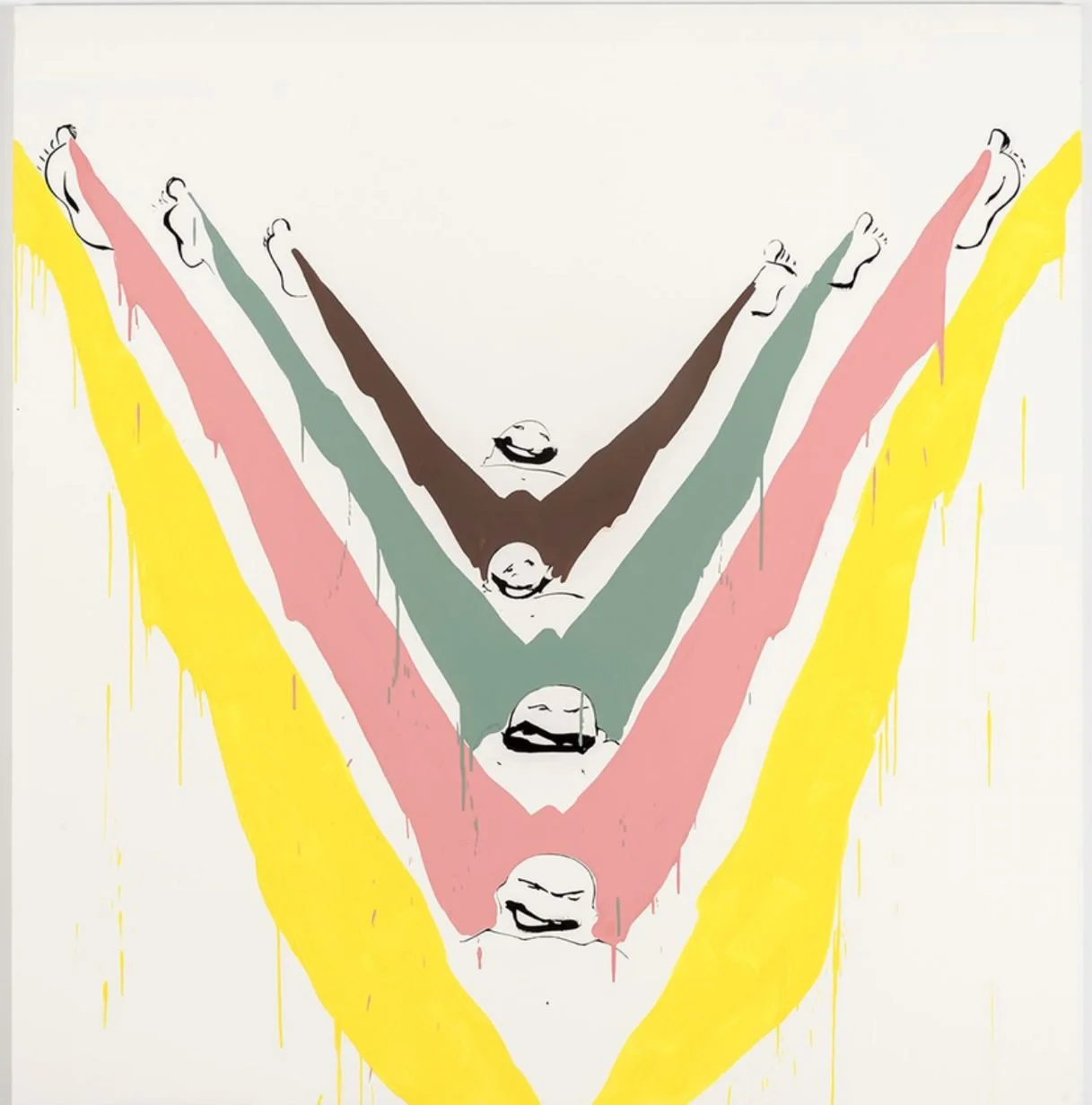
Madani’s work can appear casually painted, but the apparent crudity is carefully matched to the problem.
Caricature removes prestige
Simplified bodies make figures readable immediately while denying them heroic individuality.
They behave more like recurring social types than portraits.
Loose brushwork keeps authority unstable
The figures look as though they could dissolve, smear, or be revised at any moment.
Their identity never becomes fully secure.
Empty stages expose behavior
Backgrounds are often sparse.
Without elaborate settings, attention concentrates on gesture, hierarchy, and bodily relationship.
The figures appear as though they are participating in experiments.
Scale shifts between intimacy and spectacle
Small paintings can resemble private jokes or secret acts.
Larger works transform absurd behavior into public ceremony.
Repetition turns comedy into a system
One ridiculous man might be an individual.
A group repeating the same action begins to suggest ideology, ritual, or social conditioning.
Attractive paint complicates disgust
Madani’s color and brushwork can be pleasurable even when the subject is repellent.
The viewer is seduced by the same image that produces discomfort.
The Central Contradictions
Madani’s paintings hold opposing forces together:
Comic and violent
Crude and formally intelligent
Childlike and politically serious
Seductive and disgusting
Masculine and helpless
Authoritative and absurd
Maternal and contaminating
Painterly and scatological
Fantastical and socially recognizable
Playful and punitive
The deepest contradiction may be:
Her figures seek authority, purity, or control through actions that reveal their dependence, insecurity, and bodily disorder.
The more urgently they perform power, the less convincing they become.
The Viewer’s Position
Madani makes the viewer a complicated participant.
The viewer becomes a spectator
The scenes often resemble performances staged for observation.
The viewer becomes amused
The visual joke creates immediate access.
The viewer becomes uncomfortable
Humor gives way to violence, humiliation, or recognition.
The viewer becomes implicated
Laughing may reproduce the cruelty depicted.
The viewer becomes an interpreter
The scenes suggest political, sexual, familial, or religious rituals without settling into one allegory.
This uncertainty is important.
A fixed symbolic translation would make the works easier to master.
Madani keeps their absurdity active.
Cultural Specificity Without Illustration
Madani was born in Tehran in 1981 and is based in Los Angeles. Her work has been shaped by the social and political contexts of Iran and the United States, but she resists assigning her scenes to one nation or culture. (David Kordansky Gallery)
This prevents the figures from becoming illustrations of “Iranian men,” “Western patriarchy,” or any single society.
Their behavior is culturally suggestive but broadly recognizable.
Political cartoons, medieval imagery, animation, modern painting, and popular visual culture all enter the work. (The Museum of Modern Art)
The result is not cultural neutrality.
It is a refusal to let viewers locate irrational authority safely somewhere else.
The men might belong to another culture.
They might also be us.
The Risk of Grotesque Satire
Madani’s work carries real risks.
Grotesque male figures can become predictable.
Bodily fluids can become an easy sign of transgression.
Provocation can overshadow structure.
The paintings can be dismissed as crude jokes or celebrated merely because they violate decorum.
The critical question is:
Does the obscenity reveal something precise about authority, care, representation, or social behavior—or does it merely repeat the pleasure of being offensive?
The strongest paintings use bodily matter as a structural language.
Waste reveals dependency.
Humiliation reveals unstable hierarchy.
Projection reveals manufactured belief.
Repetition reveals social conditioning.
A weaker work would retain the grotesque appearance without renewing the underlying problem.
Why the Work Belongs to the Present
Madani’s work is especially relevant to a culture in which authority is continuously performed through images.
Political leaders manage appearances.
Masculinity is taught and repeated.
Social media converts identity into spectacle.
Public humiliation becomes entertainment.
Ideology travels through memes, screens, symbols, and repeated gestures.
People may obey images whose authority depends entirely on collective attention.
Madani reduces these structures to bodily theatre.
Her work proposes that power is not always majestic.
It may be ridiculous, needy, theatrical, and sustained by people too embarrassed to admit that the performance has failed.
What Artists Can Learn
The lesson is not to imitate Madani’s bald men, bodily fluids, scatological imagery, crude jokes, projections, or loose cartoon-like figures.
Those are the visible solutions produced by her investigation.
The larger lesson is that humor can become a serious method of revealing power.
Madani demonstrates that:
Authority can be criticized by making its performance visible.
Humor can implicate the viewer rather than simply entertain.
The grotesque body can expose fantasies of purity and control.
Paint can function as image, substance, bodily matter, and destruction at once.
Caricature can reveal social behavior without requiring portraiture.
Repetition can transform an absurd act into a system.
Empty settings can concentrate psychological and political relationships.
Ugliness can carry formal intelligence.
Seduction and disgust can remain active together.
Maternal imagery can resist idealization without rejecting care.
Cultural critique becomes stronger when viewers cannot locate the problem entirely outside themselves.
Madani’s paintings begin with a joke.
A figure performs authority.
The performance becomes ritual.
The ritual exposes insecurity.
The body leaks.
The image loses dignity.
The viewer laughs.
The laughter reveals another structure of power.
The lesson is not to copy the appearance of the work. It is to understand why ridicule, paint, bodily vulnerability, and absurdity are necessary to the investigation.
Tala Madani turns grotesque comedy into a painterly examination of how authority, masculinity, motherhood, and social order are performed through bodies that can never remain as controlled or dignified as power requires.