What Makes Loie Hollowell’s Work So Powerful?
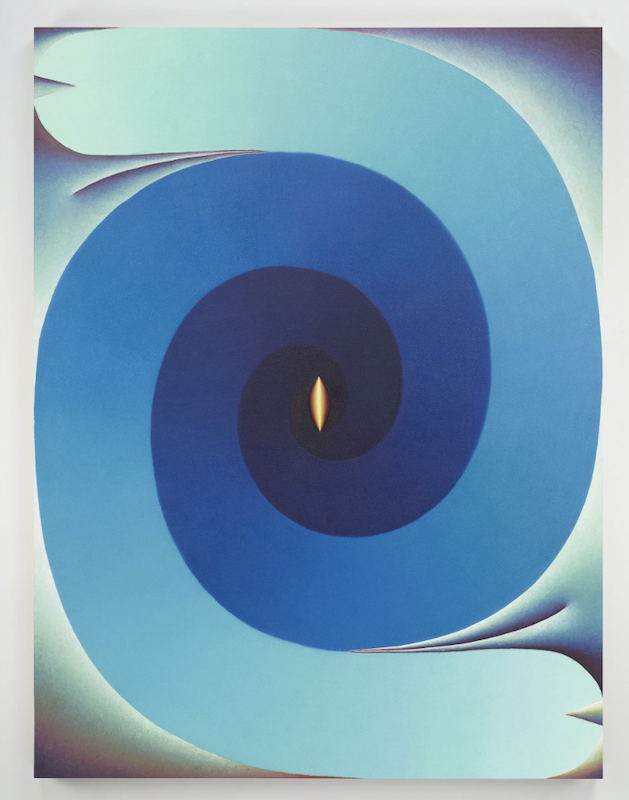
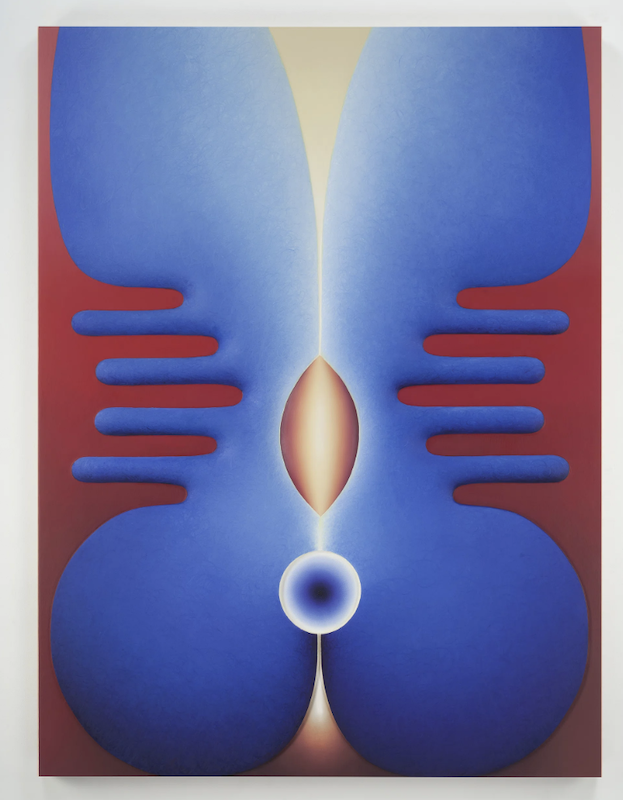
Loie Hollowell’s work is powerful because she transforms private bodily sensation into an abstract visual system that can be felt without being literally illustrated.
At first, her paintings may appear luminous, symmetrical, polished, and almost cosmic.
Orbs float inside fields of radiant color. Almond-shaped forms open and close. Convex shapes protrude from the surface. Gradients create the illusion of internal light. Repeated curves suggest breasts, bellies, buttocks, vulvas, heads, eggs, planets, portals, or sacred symbols.
The work can look spiritual.
It can also look unmistakably bodily.
That tension is central.
Hollowell is known for paintings and drawings that occupy the threshold between abstraction and figuration. Her work begins in autobiography and repeatedly addresses sexuality, pregnancy, childbirth, breastfeeding, and motherhood through geometric forms, color, relief, and bodily symbolism. (Pace Gallery)
But the work is not simply a coded diary.
It is not asking the viewer to decode each form and reconstruct a private story.
Its deeper ambition is more difficult:
How can the body be translated into color, pressure, volume, rhythm, light, and spatial tension without reducing bodily experience to illustration?
Hollowell’s paintings do not merely depict the body.
They try to behave like bodily experience.
They swell.
Contract.
Split.
Pulse.
Open.
Press outward.
Radiate.
Hold tension.
Release it.
The body becomes a formal system.
The Problem Beneath the Work
Hollowell’s recurring artistic problem is not simply female sexuality, pregnancy, motherhood, or biomorphic abstraction.
A more precise formulation would be:
How can intensely private, physical, and gendered experiences become publicly shareable without being stripped of their bodily force or reduced to narrative explanation?
Certain bodily experiences are difficult to represent because they are felt from within.
Pain can be described.
Pleasure can be depicted.
Pregnancy can be photographed.
Birth can be narrated.
But none of these fully communicates what the body experiences as pressure, expansion, rupture, rhythm, exhaustion, fear, or transformation.
The body does not experience itself as an image.
It experiences:
weight
heat
contraction
fullness
emptiness
stretching
pain
touch
fluid
pressure
repetition
anticipation
release
Hollowell turns these sensations into formal relationships.
A protruding orb may create fullness.
A split sphere may suggest opening.
A central vertical line may organize the body around gravity.
A repeated series may track the stages of labor.
A gradient may make a form seem to glow from within.
Symmetry may hold the body together while internal forms suggest that it is being transformed.
The work therefore moves away from depicting what the body looks like and toward constructing what bodily change feels like.
Why Abstraction Is Necessary
Hollowell’s use of abstraction is not simply an aesthetic preference.
It solves a representational problem.
Literal images of sex, pregnancy, birth, or breastfeeding may immediately become medical, documentary, erotic, sentimental, or politically illustrative.
Those associations can overwhelm sensation.
Abstraction allows Hollowell to remove some of the social narratives surrounding the body while preserving its physical intensity.
A breast can become an orb.
A vulva can become a mandorla.
A pregnant abdomen can become a swelling field.
The spine can become a plumb line.
Contractions can become repeated openings.
The figure disappears as a conventional image, but the body remains as structure.
Abstraction allows the experience to become less anatomically specific while becoming more physically present.
This is one reason the work can affect viewers who have not shared Hollowell’s biography.
A viewer may not know that a form refers to pregnancy or labor.
They may still feel compression, release, balance, vulnerability, fullness, or tension.
Hollowell has said she wants viewers to absorb an impression of brightness, richness, or radiance that connects to their own bodily experience rather than merely understand the details of hers. (Pace Gallery)
The work begins autobiographically.
It becomes meaningful when autobiography is transformed into form.
The Body as Geometry
Hollowell reduces the body to recurring geometric shapes:
circles
spheres
ovals
mandorlas
vertical axes
mirrored curves
lobes
stacked forms
openings
radiating bands
These forms are simple enough to appear universal.
But they are never completely neutral.
A circle may be a breast, belly, ovum, head, or planet.
An almond shape may be a vulva, eye, wound, portal, or sacred enclosure.
Two stacked forms may suggest head and abdomen.
A split orb may evoke both a body opening and a world dividing.
Hollowell’s lexicon includes traditional symbolic forms such as the mandorla, ogee, and lingam, connecting bodily imagery to sacred and art-historical systems. (Pace Gallery)
Geometry performs two functions at once.
It organizes private experience into a coherent language.
It also lifts the body toward archetype, icon, and cosmology.
The body becomes specific and symbolic simultaneously.
This is the central strength of Hollowell’s abstraction:
The geometric form is never only formal, and the bodily reference is never only descriptive.
Symmetry and the Desire for Order
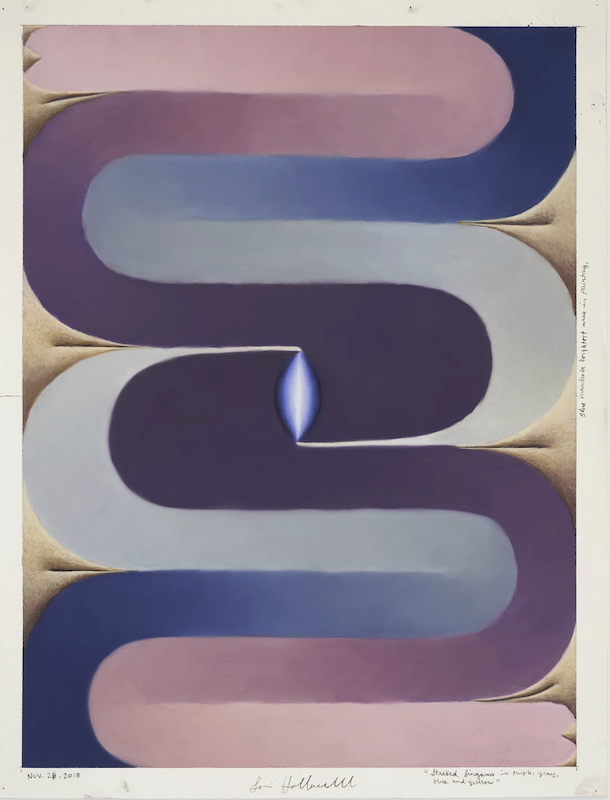
Many of Hollowell’s paintings are highly symmetrical.
A vertical axis divides the composition.
Forms mirror one another.
Color radiates evenly.
The body appears organized around a central structure.
Symmetry can suggest:
stability
balance
sacred order
bodily anatomy
reflection
containment
ritual
transcendence
But bodily experience is not always symmetrical.
Pregnancy alters balance.
Labor is rhythmic but unpredictable.
Sex can involve control and surrender.
Motherhood creates repetition without stability.
Pain may arrive unevenly.
The body changes in ways that cannot be fully managed.
This makes symmetry psychologically charged.
It may express the desire to give form to experience that felt overwhelming or chaotic.
The painting holds what the body could not hold still.
But the order is never complete.
The forms swell beyond the flat surface.
Colors vibrate.
Openings divide central structures.
The symmetry stabilizes the composition while the bodily forms threaten to expand, rupture, or transform it.
The painting creates order around an experience that resists complete control.
Color as Bodily Energy
Color in Hollowell’s work is not applied as local description.
A blue shape is not necessarily a blue object.
A red field is not merely a red background.
Color functions as energy.
It may suggest:
heat
blood
pressure
calm
pain
arousal
anxiety
spiritual radiance
internal light
physiological intensity
emotional transition
Gradients are particularly important.
A form may move from darkness at its center toward brightness at its edge.
Or light may seem to emerge from within.
This gives the painting an internal source of energy.
The form does not appear illuminated from outside.
It appears to generate light.
That internal luminosity gives bodily forms a cosmic or sacred quality.
The breast, belly, vulva, or head becomes less like an object and more like a field of force.
Color therefore transforms anatomy into sensation.
A viewer does not merely identify a body part.
They encounter pressure, warmth, expansion, or intensity.
The Painting as Relief
Hollowell’s works often appear flat from a distance.
Up close, the surface becomes sculptural.
She uses materials including oil paint, acrylic medium, sawdust, and high-density foam to construct protruding shapes that extend beyond the conventional picture plane. (Pace Gallery)
This physical relief is essential.
A painted illusion of a breast or belly would remain an image.
A form that actually projects into the room creates bodily presence.
The viewer must move slightly to understand it.
Light changes across the surface.
Shadows form along its edges.
The painting begins to occupy the viewer’s space.
This creates an unstable category:
Is it painting?
Sculpture?
Image?
Object?
Body?
The work refuses to remain completely optical.
It asks to be experienced spatially.
The body is not only represented on the surface; it physically reorganizes the surface.
The relief also changes the meaning of touch.
The forms may look soft, rounded, and tactile.
Yet the viewer cannot touch them.
They invite bodily recognition while remaining protected as artworks.
This produces desire and distance at once.
Convex and Concave
Hollowell repeatedly works with convex and concave forms.
Convexity suggests outward pressure.
A belly grows.
A breast swells.
A sphere pushes toward the viewer.
Concavity suggests inward movement.
An opening recedes.
A void appears.
The surface accepts or receives.
These spatial directions carry bodily and psychological meaning.
Convex forms may imply:
fullness
pregnancy
projection
presence
expansion
visibility
Concave forms may imply:
absence
receptivity
interiority
vulnerability
passage
release
When both appear in the same work, the painting becomes a system of exchange between outward and inward force.
This is especially relevant to experiences of sex, birth, and motherhood, where bodies expand, open, release, receive, and reorganize.
The painting does not describe these events sequentially.
It gives them spatial form.
The Split Orb
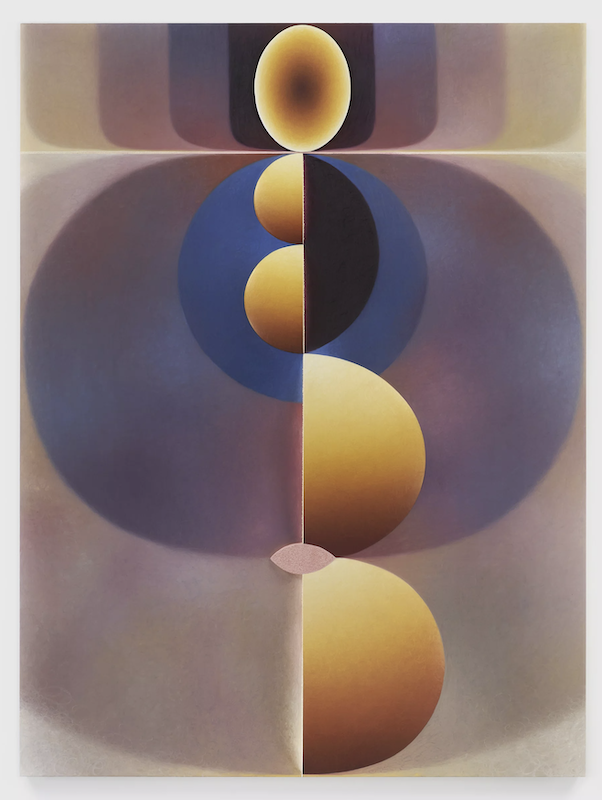
The Split Orb paintings translate childbirth into one of Hollowell’s clearest visual systems.
Two rounded forms are stacked vertically and divided in varying degrees. The upper orb may represent the head or brain, while the lower form may suggest the pregnant abdomen and cervix. The degree of opening relates to stages of dilation during labor. (Pace Gallery)
The form is simple.
Its implications are not.
A split orb can suggest:
opening
rupture
division
birth
psychic fracture
emergence
danger
transformation
The body must open in order for another body to emerge.
That process is generative and violent.
The body creates life through an event that can feel like physical disintegration.
Hollowell does not resolve this contradiction into a sentimental image of motherhood.
The orb remains beautiful.
It also appears under pressure.
Creation occurs through splitting.
That may be the deepest structure in these works.
The body does not remain intact while producing transformation.
It is changed by what it creates.
Contractions and Repetition
Contractions provide a natural bridge between bodily experience and serial abstraction.
A contraction repeats.
It builds.
Peaks.
Releases.
Returns.
The repetition is predictable and unpredictable at once.
The body enters a rhythm it cannot simply stop.
Hollowell’s serial works use repeated images and incremental changes to convert labor into visual duration.
One painting alone can show a state.
A sequence can show transformation.
Repeated forms become evidence of bodily time.
This connects to one of the broader principles emerging across our research:
Repetition becomes meaningful when each repetition records a changed condition.
The repeated orb is not decorative pattern.
Its opening changes.
Its color changes.
Its pressure changes.
Its position within the larger process changes.
The series becomes a record of transition.
Sex, Pregnancy, and Motherhood Are Not Separate Subjects
Hollowell’s work connects sexuality, conception, pregnancy, birth, breastfeeding, and motherhood rather than treating them as unrelated phases.
This is important because visual culture often separates the sexualized female body from the maternal body.
The erotic breast and the nursing breast are culturally treated as though they belong to different identities.
The sexual body is desired.
The pregnant body is idealized or medicalized.
The birthing body is often hidden.
The postpartum body is expected to recover.
The maternal body becomes associated with care rather than erotic autonomy.
Hollowell refuses these divisions.
The same bodily forms change function over time.
Breasts may be erotic, swollen, painful, nurturing, or mechanically pumped.
The abdomen may be sexual, pregnant, emptied, scarred, or transformed.
The vulva may be an erotic symbol and a site of labor.
The body does not become a different body when its social role changes.
It accumulates meanings.
This gives the work political force without requiring slogans.
The body exceeds the narrow identities assigned to it by each stage of life.
Breastfeeding and the Redistribution of the Body
Breastfeeding introduces another important pressure.
The body that once belonged primarily to the self becomes organized around another person’s needs.
Time changes.
Sleep changes.
Touch changes.
The breast becomes food, schedule, labor, pain, intimacy, and responsibility.
Hollowell’s postpartum drawings and paintings address nursing, pumping, engorgement, exhaustion, and the repeated demands of care. Her Going Soft works include abstracted references to breasts, milk, breast pumps, hands, bellies, and the psychological instability of postpartum life. (Pace Gallery)
This expands her central problem.
The issue is not only how the body changes physically.
It is how bodily ownership changes.
Who has access to the body?
Who needs it?
Who touches it?
When does care become depletion?
When does nourishment become labor?
A maternal body can be revered symbolically while being exhausted materially.
Hollowell’s forms hold fullness and emptiness together.
A full breast implies nourishment.
It may also imply pain.
An empty breast implies relief.
It may also imply depletion.
The bodily form becomes a site where care and loss of autonomy coexist.
The Sacred and the Sexual
Hollowell’s forms frequently resemble sacred imagery.
Radiating light, symmetry, central axes, mandorlas, and luminous colors recall icons, devotional paintings, Tantric diagrams, and spiritual abstraction.
But the forms also resemble sexual anatomy.
This produces a deliberate fusion.
The sacred is bodily.
The sexual is cosmic.
The maternal is monumental.
The vulva can resemble a portal.
The pregnant belly can resemble a planet.
The breast can become an orb of light.
This reverses a long cultural history in which bodily sexuality—especially female sexuality—has been treated as impure or opposed to spiritual transcendence.
Hollowell does not abandon the body in order to reach the sacred.
The body is the route.
Transcendence occurs through embodiment, not escape from it.
That is a significant distinction.
Her work does not spiritualize the body by making it less physical.
It spiritualizes pressure, fluid, pain, pleasure, birth, and bodily transformation.
Beauty and the Risk of Decoration
Hollowell’s paintings are extremely beautiful.
Their gradients are controlled.
Their colors are radiant.
Their compositions are balanced.
Their surfaces are polished.
This creates risk.
The work could be received as decorative, luxurious, psychedelic, or formally pleasing without its bodily pressures being recognized.
The question becomes:
What prevents the work from becoming only beautiful design?
The answer lies in the necessity of the formal system.
The orb is not an arbitrary shape.
The split is not a decorative device.
The relief is not surface novelty.
The symmetry is not merely compositional elegance.
The gradient is not simply atmospheric color.
Each choice translates a physical or psychological condition.
Beauty carries pressure because it is attached to opening, rupture, pain, sexuality, care, and bodily transformation.
But the risk remains productive.
The viewer may be seduced before realizing what the image contains.
This resembles Wangechi Mutu’s use of beauty, though the visual languages are radically different.
Mutu uses seduction to lead the viewer into fragmentation and violence.
Hollowell uses radiance to lead the viewer into embodied intensity.
Illusion and Physical Reality
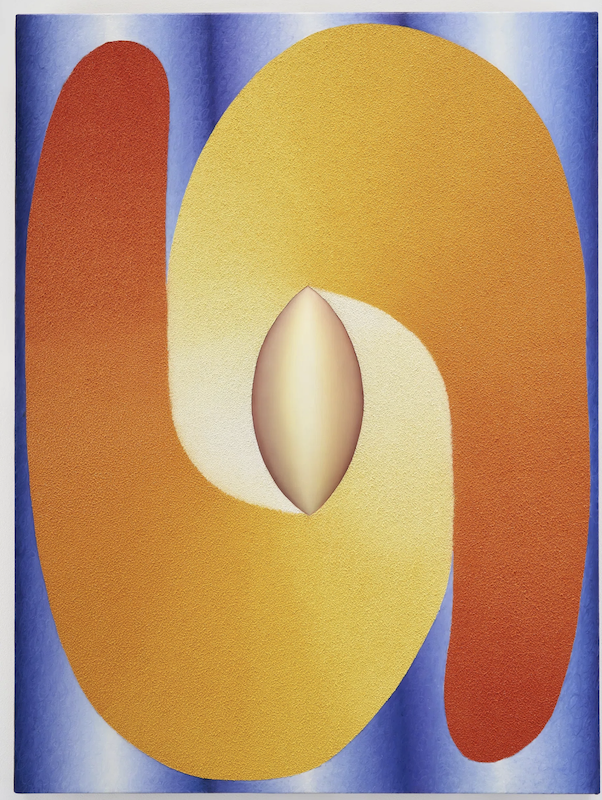
Hollowell’s paintings oscillate between illusion and objecthood.
From a distance, shading can make a flat shape seem dimensional.
Up close, actual relief may confirm or contradict that illusion.
A viewer may not know where painted volume ends and physical projection begins.
This matters because bodily experience also exists between perception and matter.
Pain is physically real, but its intensity is subjectively experienced.
Pregnancy is materially visible, but much of it remains internal.
Sexual sensation is bodily and psychological.
Birth is biological and symbolic.
Hollowell uses optical ambiguity to model this condition.
The viewer sees a form.
Then realizes the form occupies space.
The visual becomes physical.
The physical becomes symbolic.
The paintings are not satisfied with representing embodiment. They make seeing itself feel embodied.
The Viewer’s Body
Hollowell’s work does not implicate the viewer primarily through accusation, as Barbara Kruger does.
It works through bodily analogy.
The viewer recognizes:
roundness
pressure
opening
balance
warmth
tension
softness
radiance
weight
vulnerability
Even without sharing the artist’s experience, the viewer possesses a body.
This creates a bridge.
The work does not require literal identification.
A person does not need to have been pregnant to understand expansion.
They do not need to have given birth to understand pressure and rupture.
They do not need to breastfeed to understand fullness, depletion, or repeated demand.
The paintings translate specific experiences into bodily structures broad enough to activate other forms of memory.
That is how private experience becomes public without becoming generic.
The Central Contradiction
The central contradiction in Hollowell’s work is:
The paintings use order, symmetry, beauty, and radiant abstraction to represent bodily experiences defined by instability, pain, rupture, vulnerability, and loss of control.
Her work is:
abstract but autobiographical
geometric but bodily
sacred but sexual
controlled but about surrender
luminous but painful
symmetrical but transformative
flat but sculptural
universal in form but personally specific
beautiful but physically unsettling
self-contained but concerned with bodily interdependence
The contradiction cannot be resolved.
If the work became more literal, it might lose its experiential openness.
If it became purely formal, it would lose bodily necessity.
Hollowell holds the work precisely between those conditions.
Is the Work Too Universalizing?
There is a legitimate critical question in translating gendered bodily experience into archetypal geometry.
When a specific experience becomes a sphere, mandorla, axis, or glowing field, does it risk becoming too universal?
Does the abstraction soften the social, medical, economic, or political realities of pregnancy and childbirth?
Does radiant beauty make pain easier to consume?
These questions are worth retaining.
Hollowell’s strongest work does not erase specificity.
It remains anchored in titles, bodily measurements, serial stages, casts, materials, and autobiographical experience.
The forms may appear cosmic, but they emerge from labor, dilation, milk, exhaustion, bodily fluids, and care.
The work is strongest when transcendence does not rescue the body from material reality.
It expands the meaning of that reality.
From Private Experience to Shared Form
Autobiographical art can fail when the viewer is asked to care only because something happened to the artist.
Personal importance does not automatically become artistic importance.
Hollowell’s work avoids that problem by translating experience into a repeatable visual grammar.
The viewer does not need the full biography to encounter:
expansion
pressure
opening
division
fullness
radiance
contraction
release
The private event becomes a formal structure.
This is a crucial studio lesson:
Personal experience becomes generative when it produces a language capable of doing more than recounting the event.
The strongest autobiographical work does not merely say:
“This happened to me.”
It asks:
“What form did this experience reveal?”
The Visual World Hollowell Has Built
Across her practice, Hollowell has developed a coherent lexicon:
stacked orbs
split spheres
mandorlas
vertical axes
symmetry
pregnant bellies
breasts
vulvar openings
heads and brains
convex and concave forms
gradients
internal luminosity
saturated color
high-density foam
sawdust and acrylic medium
sculptural relief
contraction sequences
bodily casts
sexuality, pregnancy, birth, breastfeeding, and postpartum states
sacred geometry
bodily landscapes
images that hover between icon, anatomy, planet, and portal
This lexicon is recognizable, but it is not arbitrary branding.
Its forms continue generating new relationships because the body continues changing.
The same orb can mean:
ovum
belly
breast
head
world
fullness
enclosure
rupture
The visual world remains alive because its symbols are stable enough to recur and open enough to transform.
What Artists Can Learn
The lesson is not to imitate Hollowell’s glowing gradients, symmetrical orbs, bodily geometry, relief surfaces, or sacred-sexual imagery.
The lesson is to understand how she converts sensation into formal necessity.
Abstraction can begin in the body.
It does not need to reject lived experience. Shape, color, rhythm, and volume can carry bodily memory.
Personal experience must become a language.
Autobiography becomes powerful when it generates forms that can operate beyond the original event.
A formal choice should behave like the experience.
A contraction may require repetition. Pregnancy may require expansion. Birth may require splitting. Fullness may require physical projection.
Beauty can carry pain.
A radiant surface becomes serious when its beauty is inseparable from vulnerability, labor, rupture, or transformation.
Symmetry can express pressure rather than peace.
Order may reveal the attempt to hold together an experience defined by instability.
Relief can make painting bodily.
Actual projection, shadow, and volume can turn an image into a physical encounter.
Specificity and openness can coexist.
The work can originate in a particular gendered experience while creating formal conditions that other bodies can recognize.
The sacred does not require escape from the body.
Sex, birth, fluid, pain, care, and physical transformation can become sources of transcendence.
Repetition should record change.
A series becomes meaningful when each repeated form registers another stage, pressure, or bodily state.
The body can be represented without being pictured literally.
Anatomy may disappear while embodiment remains.
The larger lesson is:
Bodily experience becomes artistically powerful when the work does not merely depict what happened to the body, but reconstructs the forces through which the body changed.
Loie Hollowell does not simply make paintings about sexuality, pregnancy, birth, or motherhood.
She builds a visual system in which color swells, surfaces protrude, orbs divide, and symmetry struggles to contain transformation.
Her paintings make private sensation public without pretending that experience can be fully explained.
They do not show us the body from outside.
They ask us to feel how form changes when the body is experienced from within.
The lesson is not to copy the appearance of the work.
The lesson is to understand the pressure that made the appearance necessary.
What Makes Catherine Opie’s Work So Powerful?

Catherine Opie’s work is powerful because she turns belonging into something that must be built, pictured, protected, and continually renegotiated.
At first, her photographs can appear remarkably direct.
A person stands before a richly colored backdrop.
A family gathers inside a home.
A freeway cuts across an empty sky.
A mansion presents its sealed façade.
A high-school football player faces the camera.
A surfer waits in the ocean.
A city appears almost deserted.
The photographs often possess formal calm. Opie’s subjects are clearly framed, carefully lit, and given time to occupy the image. Even when the person’s clothing, body modification, sexuality, or social identity challenges conventional expectations, the photograph itself does not appear visually chaotic.
This calm is not neutral.
It gives the subject authority.
Opie has worked across studio portraiture, domestic photography, urban landscapes, architecture, sports, and natural environments. Although these bodies of work can appear very different, the Guggenheim identifies a persistent concern with communal, sexual, and cultural identity—and with the conditions under which communities form and become defined. (The Guggenheim Museums and Foundation)
The deeper pressure is:
How can photography give people and communities public recognition without flattening them into categories, spectacles, or sociological evidence?
Opie’s portraits do not simply declare that marginalized people exist.
They ask what it means to picture someone as a full participant in social and civic life.
The Problem Beneath the Work
Opie’s recurring artistic problem is not simply queer identity, community, portraiture, or American culture.
A more precise formulation would be:
How can photography represent people who have been excluded from conventional images of family, citizenship, beauty, and belonging while preserving their individuality, complexity, and right to define themselves?
Photography has often been used to classify people.
It has identified:
criminals
patients
racial types
social classes
sexual identities
workers
families
citizens
outsiders
The camera can recognize.
It can also inspect.
It can preserve.
It can expose.
It can dignify.
It can turn a person into evidence.
This makes portraiture politically complicated.
A photograph of a marginalized person can increase visibility. But visibility alone does not guarantee respect. The subject may become a curiosity, stereotype, victim, representative type, or object of consumption.
Opie addresses this problem by combining social specificity with formal dignity.
Her subjects may wear clothing, tattoos, leather, uniforms, jewelry, facial hair, or bodily modifications that communicate membership in particular communities. Yet they are not reduced to those signs.
The photograph tells us something.
It does not tell us everything.
The sitter becomes socially legible without becoming completely available.
Recognition Rather Than Normalization
One way to represent an excluded community is to emphasize that its members are “just like everyone else.”
This strategy can create empathy.
But it can also imply that difference deserves acceptance only when it resembles an existing norm.
Opie’s work does something more difficult.
She does not erase difference in order to establish humanity.
Her early portraits of queer friends, leather communities, drag performers, transgender people, and people with highly constructed identities often make difference unmistakably visible. The Guggenheim’s survey began with series including Being and Having and Portraits, which documented and celebrated queer communities in San Francisco and Los Angeles. (The Guggenheim Museums and Foundation)
The subjects do not need to become visually conventional before being granted seriousness.
They may appear theatrical, erotic, masculine, feminine, vulnerable, defiant, tender, scarred, adorned, or deliberately self-invented.
The photograph’s respect does not depend on normalizing them.
This distinction is central:
Recognition says: I see your particularity and accept that it belongs within the social world.
Normalization says:
I will accept you once your difference no longer unsettles me.
Opie refuses that bargain.
Portraiture as Civic Space
Opie’s portraits often borrow the gravity of historical painting.
A sitter may be isolated against a saturated background.
The pose may be frontal or carefully arranged.
The figure occupies the image with composure.
The lighting can feel almost ceremonial.
These choices connect people from queer and alternative communities to the traditions through which rulers, aristocrats, religious figures, and socially important citizens have historically been pictured.
This is not merely stylistic elevation.
Portrait traditions have helped determine who deserves to be remembered.
Who appears monumental?
Who receives a name?
Whose face enters public culture?
Whose body is presented as worthy of sustained looking?
By applying formal dignity to people frequently excluded from official visual history, Opie reorganizes portraiture’s civic function.
The photograph becomes a small public institution.
It says:
This person belongs within the field of representation.
But Opie does not simply place unconventional subjects into an unchanged traditional format. Their bodies and identities alter what dignity, citizenship, family, masculinity, femininity, and beauty can look like.
The historical portrait is not merely extended.
It is revised.
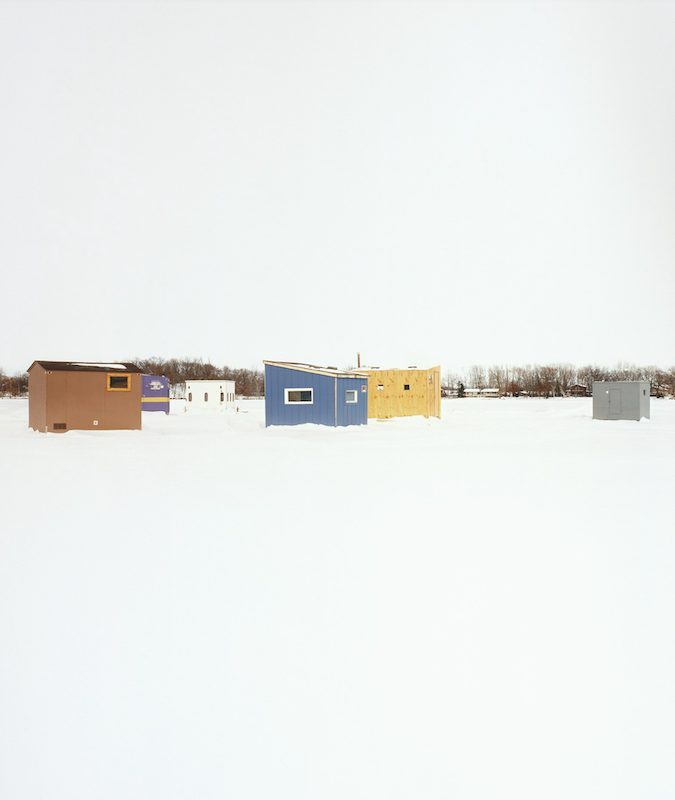
The Background Is Not Empty
Many of Opie’s studio portraits use strong monochromatic or patterned backgrounds.
These fields isolate the figure from ordinary surroundings.
That separation performs several functions.
It removes distraction.
It denies viewers the ability to explain the person entirely through environment.
It creates visual concentration.
It allows clothing, posture, skin, gesture, facial expression, and self-presentation to become especially significant.
The background may also recall:
portrait painting
heraldic color
studio photography
religious icons
commercial portraiture
theatrical staging
The figure becomes both contemporary person and formal image.
This raises a subtle tension.
The background gives the sitter dignity and visual authority.
But it also makes the sitter intensely available for examination.
The photograph balances presentation with protection.
The sitter is offered to public vision, but the controlled setting prevents the surrounding world from claiming complete explanatory power.
Self-Fashioning and the Right to Appear
Clothing and bodily presentation matter deeply in Opie’s work.
A mustache, tattoo, leather vest, suit, dress, haircut, piercing, uniform, or pose may indicate how the sitter wishes to be seen.
These details are not superficial additions to an underlying “true” self.
They are forms through which identity becomes public.
Opie understands that people construct themselves socially.
This does not make identity false.
It makes identity active.
The sitter participates in producing the portrait.
They bring:
a chosen appearance
community codes
bodily history
gender expression
sexuality
humor
vulnerability
social role
personal style
The photographer does not manufacture the person from nothing.
Nor does she merely uncover a hidden essence.
The image emerges through encounter.
Portraiture becomes a collaboration between how the sitter wishes to appear and what the photograph makes visible.
This gives self-fashioning ethical importance.
For people whose identities have historically been named and classified by others, controlling one’s appearance can become a form of self-authorship.
Looking Without Treating Difference as Spectacle
Opie’s photographs invite sustained looking.
But they often prevent that looking from becoming sensational.
The sitter is not pictured as a shocking discovery.
The photographic style is measured, direct, and formally controlled.
This matters especially when bodies contain marks or practices that some viewers may find unfamiliar.
Tattooing, piercing, scarification, gender transition, leather culture, drag, and queer sexuality can easily be represented through sensationalist imagery.
A camera might emphasize extremity.
Opie instead establishes presence.
The photograph does not deny that the body carries social meaning.
It changes the terms under which the body is viewed.
The viewer may initially notice difference.
But the duration and formality of the portrait encourage a transition:
from category to person
from spectacle to encounter
from curiosity to recognition
The work does not forbid looking.
It teaches a different quality of attention.
Community Without Sameness
A community is often pictured as a unified group.
Members gather together, perform shared rituals, or display common symbols.
Opie frequently constructs community differently.
She photographs individuals.
Each person remains distinct.
Across a series, relationships begin to form through:
repeated formats
shared visual codes
titles and names
overlapping social worlds
clothing and bodily signs
the artist’s sustained attention
Community emerges through accumulated particularity.
The individuals do not become interchangeable representatives of “queerness.”
Their differences produce the community.
This is one of Opie’s most valuable insights:
Belonging does not require the disappearance of difference. A community may become visible precisely through the variations among its members.
The series creates collective identity without turning the collective into a uniform type.
Family as an Invented Structure
Opie’s work repeatedly returns to domestic life, kinship, parenthood, and family.
Her Domestic series photographed lesbian families engaged in ordinary household life, while other works have addressed her own desires for intimacy, partnership, parenthood, and belonging. The Guggenheim describes Domestic as moving inside homes to document lesbian families in everyday activity. (The Guggenheim Museums and Foundation)
These photographs matter because dominant visual culture has historically presented family through narrow conventions:
heterosexual couple
biological parenthood
gendered household roles
private domestic respectability
generational continuity
Opie’s photographs expand the family image.
But again, she does not simply claim that alternative families are identical to conventional ones.
She asks how family is made.
Through care?
Commitment?
Shared space?
Parenthood?
Desire?
Ritual?
Legal recognition?
Chosen kinship?
Memory?
The photographs show that family is not only inherited.
It can be constructed through sustained acts of belonging.
Kinship becomes a practice rather than merely a biological fact.
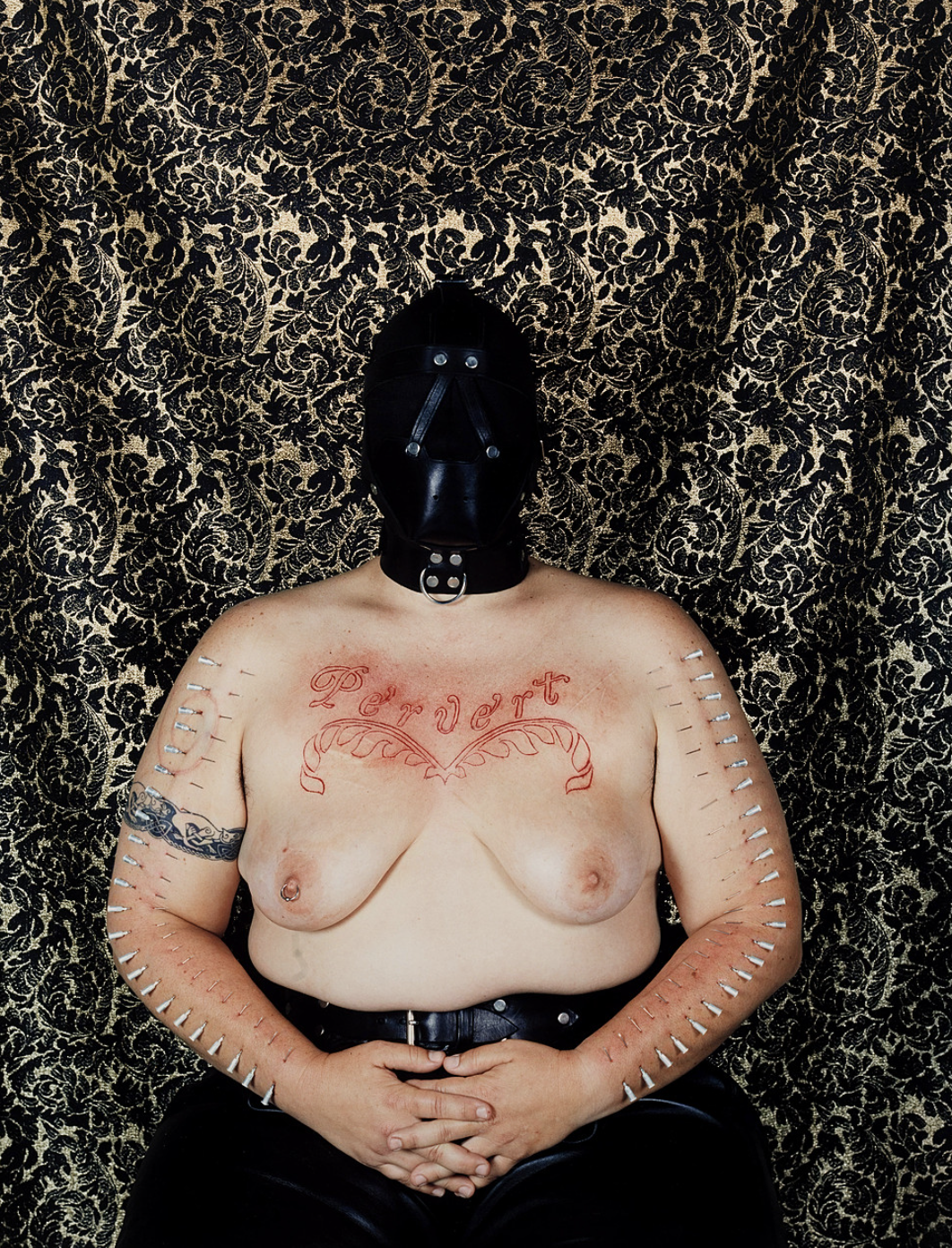
The Self-Portraits and the Body as Public Argument
Opie’s self-portraits make the relationship between private desire and public symbolism especially intense.
In several widely discussed works, her back or chest bears cut or scarred images connected to domestic longing, queer identity, motherhood, and social violence.
The body becomes both person and surface.
Private desire is literally made visible.
But the images are not simple confessions.
They operate through art-historical references, controlled poses, decorative backgrounds, symbolic wounds, and a highly formal photographic style.
The body becomes an argument about:
who is allowed to imagine family
whose desire appears culturally legitimate
how queer identity is marked publicly
how violence enters private life
whether vulnerability and authority can coexist
The self-portrait grants profound access.
Yet it also remains constructed.
We see the body.
We do not receive unmediated possession of the person.
This reflects a broader principle in Opie’s work:
Disclosure can be real without eliminating form, privacy, or self-control.
Houses as Portraits
Opie’s portraits of Beverly Hills and Bel Air houses initially seem like a departure from her photographs of people.
The buildings are often closed, frontal, monumental, and unoccupied.
But Opie approaches them as portraits.
The façade becomes a face.
Architecture communicates:
wealth
privacy
taste
protection
aspiration
social status
exclusion
fear
domestic fantasy
The Guggenheim notes that in the Houses series, each mansion façade possesses a distinct character comparable to Opie’s portraits of friends. (The Guggenheim Museums and Foundation)
Yet the houses withhold the people inside them.
We see gates, hedges, doors, walls, and styles.
The domestic interior remains inaccessible.
This creates a revealing contrast with Domestic.
The mansions offer impressive public images but little visible life.
The lesbian households show lived relationships, care, and ordinary activity.
One body of work presents architecture as social armor.
The other presents home as a network of relationships.
Together they ask:
Is home a building, a public symbol, a protected enclosure, or the relationships enacted within it?
Freeways and the Architecture of Belonging
Opie’s freeway photographs may initially seem even further removed from identity.
There are often no visible people.
Concrete structures cross pale skies.
The images can appear quiet, formal, and almost archaeological.
But freeways organize social life.
They determine:
who can move
where neighborhoods connect
which communities are divided
how cities expand
how labor and commerce circulate
how distance is experienced
whose homes are displaced
which areas receive investment
The Guggenheim describes Freeways as a formal meditation on Los Angeles’s highway system and connects Opie’s architectural work to structures treated as icons or traces of human presence. (The Guggenheim Museums and Foundation)
The freeway is therefore not an empty structure.
It is a social system made concrete.
Its apparent neutrality conceals decisions about mobility, power, planning, race, class, and urban belonging.
Opie photographs it with the gravity of a monument.
But the monument is ambiguous.
It represents connection and division at the same time.
The American Landscape
Opie frequently describes American places without relying on conventional national symbols.
Her America appears through:
highways
mini-malls
houses
city streets
high-school football
surfers
national parks
political gatherings
domestic interiors
ordinary communities
This creates an expanded civic portrait.
America is not presented as one coherent identity.
It is a network of communities, landscapes, architectures, rituals, exclusions, aspirations, and contested forms of belonging.
Her work asks:
Who gets to appear inside the American image?
The question applies both to people and places.
A queer family is American.
A leather community is American.
A suburban mansion is American.
A freeway is American.
A football field is American.
An empty city street is American.
The series accumulate into a national portrait without pretending that the nation is unified.
Empty Landscapes and Human Traces
Many of Opie’s landscape and architectural photographs contain few or no people.
Yet human presence remains everywhere.
A road indicates movement.
A building indicates habitation.
A field indicates organized activity.
A sign indicates language and commerce.
A shoreline suggests waiting, recreation, migration, or distance.
The absence of figures changes the form of portraiture.
Instead of showing the body directly, Opie photographs the structures through which bodies live.
This expands the question of identity.
Identity is not only visible in the face.
It is embedded in:
architecture
infrastructure
domestic space
public ritual
landscape
social organization
The empty scene becomes a collective portrait.
It shows the conditions people have built—and the conditions that act upon them.

Sports, Ritual, and Collective Identity
Opie has photographed high-school football players, football games, surfers, and other communal activities.
Sports provide a powerful structure for examining belonging because they combine:
uniforms
rules
bodily discipline
competition
spectatorship
local identity
masculinity and femininity
ritual
collective emotion
A uniform makes the individual part of a team.
But portraiture can return individuality to the uniformed body.
The player is both person and social role.
Sports also reveal how communities gather around shared symbols.
The field, stadium, team colors, and repeated rituals produce belonging.
Yet belonging can also regulate behavior.
The athlete must perform strength, loyalty, skill, endurance, or gender in culturally recognizable ways.
Opie’s broader practice repeatedly holds these two conditions together:
Communities make identity possible, but they also establish the codes through which identity becomes legible.
Formal Rigor and Social Complexity
Opie’s work is often described through its subjects: queer communities, families, cities, architecture, landscapes, and American social life.
But the work’s formal control is equally important.
She uses:
frontal composition
saturated backgrounds
careful lighting
repeated formats
large scale
clarity
symmetry
architectural geometry
black-and-white tonal precision
strategic emptiness
serial structure
The Guggenheim emphasizes that her varied bodies of work maintain consistent formal rigor across color and black-and-white photography. (The Guggenheim Museums and Foundation)
This rigor prevents the photographs from becoming casual documentation.
The subject is not merely recorded.
It is given structure.
But form does not neutralize social difference.
It allows difference to remain visible without becoming visually chaotic or anthropologically distant.
Formality becomes a means of sustained respect.
The Central Contradiction
The central contradiction in Opie’s work is:
Belonging gives people recognition and protection, but every community also creates boundaries, codes, and conditions for membership.
Her photographs hold together:
individuality and community
visibility and privacy
difference and civic recognition
self-fashioning and social classification
domestic intimacy and public politics
inclusion and exclusion
documentary evidence and formal construction
vulnerability and authority
chosen family and inherited convention
movement and division
national identity and internal difference
Opie does not present community as uncomplicated safety.
Communities can provide:
love
recognition
family
language
protection
shared history
They can also produce:
expectations
hierarchies
exclusions
codes of behavior
pressure to perform belonging correctly
The work remains powerful because it values community without idealizing it.
Photography as Relationship
Photography is often discussed as an act of taking.
Take a photograph.
Capture an image.
Shoot a subject.
These phrases contain a subtle language of possession.
Opie’s work proposes another model.
Portraiture can be an act of relation.
The photograph emerges because the sitter allows an encounter to occur.
The photographer brings attention, structure, history, and formal decisions.
The sitter brings presence, self-presentation, trust, resistance, and autonomy.
Neither completely controls the result.
This makes portraiture ethical not because it avoids power, but because it acknowledges that power must be negotiated.
The photographer has the camera.
The sitter has a life that exceeds the image.
The portrait becomes successful when the photograph recognizes that difference rather than pretending to eliminate it.
The Viewer’s Position
Opie asks the viewer to look carefully without assuming mastery.
We may recognize signs of gender, sexuality, class, occupation, community, architecture, or geography.
But those signs do not complete the person.
The viewer must navigate several impulses:
curiosity
identification
attraction
discomfort
admiration
categorization
projection
recognition
The work does not pretend that looking can become innocent.
Instead, it slows the process down.
The formal clarity asks us to notice what we think we already understand.
A tattoo may be visible.
A social identity may be legible.
A house may display wealth.
A uniform may imply a role.
But the photograph preserves a gap between sign and total knowledge.
That gap is where respect becomes possible.
The Visual World Opie Has Built
Across her practice, Opie has developed a broad but coherent lexicon:
frontal studio portraits
saturated colored backgrounds
queer friends and chosen communities
drag, leather, gender performance, and bodily modification
names and titles that preserve individual identity
self-portraits involving vulnerability and symbolic inscription
families inside domestic space
sealed mansion façades
empty freeways
mini-malls and urban signs
American cities
surfers, athletes, crowds, and social rituals
landscapes shaped by human movement
formal clarity
serial structures
people and places treated as civic portraits
The work moves between body and environment.
But the deeper question remains consistent:
What structures allow someone to appear as belonging—and who controls those structures?
What Artists Can Learn
The lesson is not to imitate Opie’s colored portrait backgrounds, frontal compositions, queer iconography, architectural photographs, or documentary series.
The lesson is to understand how she makes recognition into a formal and ethical problem.
Visibility is not the same as recognition.
Showing a marginalized person is not enough. The artwork must determine the terms under which that person is seen.
Difference does not need to be normalized to become dignified.
A subject should not have to resemble an accepted ideal before receiving formal seriousness.
Formality can communicate respect.
Lighting, scale, repetition, clarity, and compositional control can give sustained authority to people or places that visual culture treats casually.
Community can emerge through particularity.
A group does not need to be represented as uniform. Accumulated individual differences can produce a richer collective identity.
Self-presentation is part of identity.
Clothing, pose, bodily modification, and social codes should not automatically be dismissed as masks hiding a true self. They may be tools of authorship.
Architecture can function as portraiture.
Buildings, roads, domestic spaces, and public structures reveal how people organize privacy, status, movement, and belonging.
Absence can still contain social evidence.
An empty landscape may carry the traces of communities, decisions, histories, and power.
The photographer-subject relationship matters.
Portraiture should acknowledge that the sitter’s life exceeds the image.
Belonging should remain contradictory.
Community can protect and constrain, recognize and categorize, include and exclude.
The larger lesson is:
Representation becomes powerful when it does not merely make a person visible, but establishes that their particular way of being belongs within the shared social image.
Catherine Opie’s work expands the portrait beyond the face.
A body can be a portrait.
A house can be a portrait.
A freeway can be a portrait.
A family can be a portrait.
A city can be a portrait.
Together, these images ask who is permitted to appear as part of American life—and what forms, spaces, rituals, and relationships make that belonging visible.
The lesson is not to copy the appearance of the work.
The lesson is to understand the pressure that made the appearance necessary.
What Makes Barbara Kruger’s Work So Powerful?
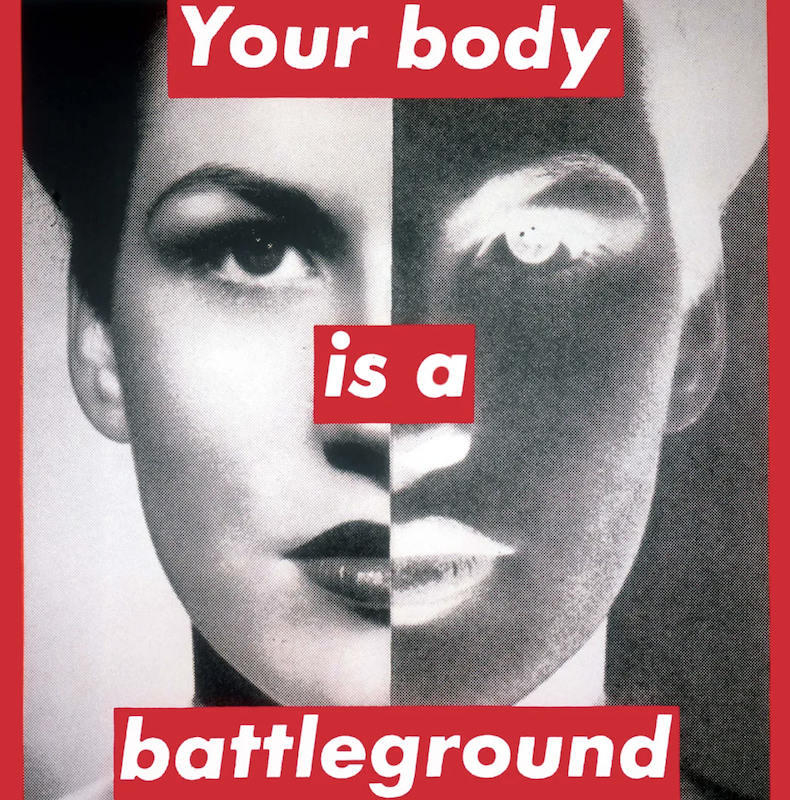
Barbara Kruger’s work is powerful because she uses the visual language of authority to expose how authority speaks through us.
At first, her work appears almost immediately understandable.
A black-and-white photograph.
A red field.
Bold white or black type.
A brief declaration or question:
I shop therefore I am.
Your body is a battleground.
Who speaks? Who is silent?
You are not yourself.
The visual language resembles advertising, magazine design, political propaganda, public signage, social media, or a command from an institutional system. The words are short. The typography is forceful. The image is instantly legible.
But legibility is not the same as simplicity.
Kruger’s work does not merely deliver political slogans. It creates situations in which language becomes unstable. We may understand every word while remaining uncertain about who is speaking, who is being addressed, and what position we occupy.
Who is the “I”?
Who is the “you”?
Who belongs to “we”?
Is the statement criticizing consumer culture, or seducing us with its visual power?
Is the work speaking for the viewer, accusing the viewer, or revealing that someone else has already been speaking through us?
The central pressure is:
We believe we are reading the message, but the message is also reading and positioning us.
The Problem Beneath the Work
Kruger’s recurring artistic problem is not simply consumerism, feminism, advertising, or political power.
A more precise formulation would be:
How do images and language shape what people desire, fear, believe, buy, and become before they recognize that they are being influenced?
Power does not operate only through laws, police, governments, or direct commands.
It also operates through ordinary language:
you deserve this
be yourself
protect your family
become beautiful
buy now
choose freely
prove your worth
believe
obey
belong
succeed
improve
consume
These messages enter daily life through advertising, news media, entertainment, religion, politics, education, branding, and social platforms.
They frequently sound personal.
They address “you.”
They promise individual freedom.
But they may also organize behavior at a mass scale.
Kruger takes the language of persuasion and removes it from its normal commercial or political setting. Once isolated, enlarged, and redirected, the familiar phrase begins to reveal its underlying structure.
The work asks:
Who benefits when I believe this?
Who taught me to desire this?
Is this my voice, or a voice I have internalized?
When I say “I,” how much of that identity has already been constructed for me?
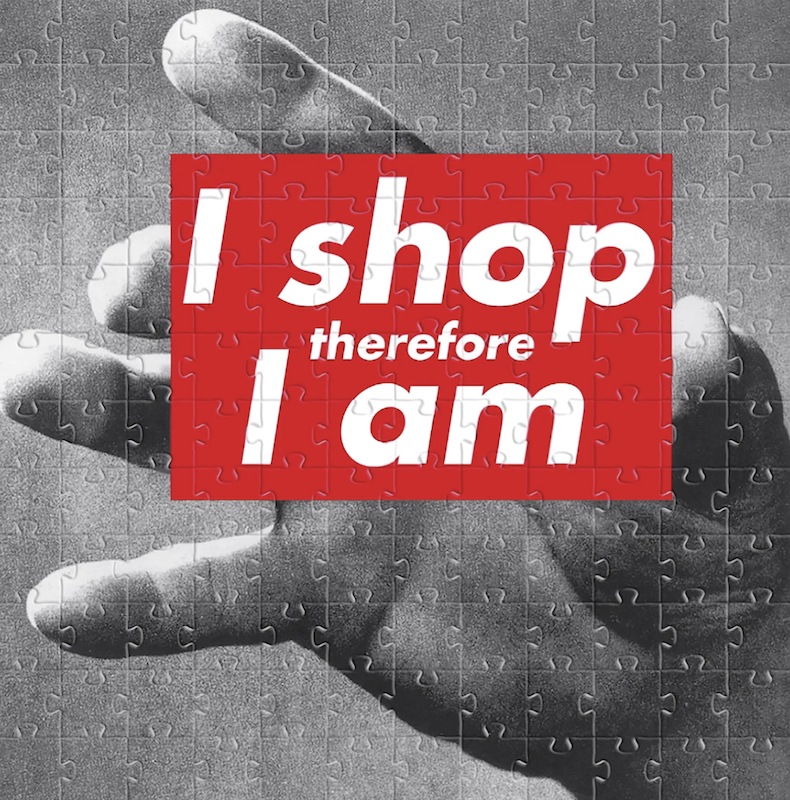
The Language of Advertising Turned Against Itself
Kruger’s background in magazine design is central to her work.
Before becoming widely known as an artist, she worked in publishing, including as a designer and picture editor. That experience gave her practical knowledge of how photographs, typography, cropping, scale, and placement direct attention and create meaning. (The Museum of Modern Art)
Advertising rarely asks viewers to analyze its visual construction.
It wants the message to feel immediate.
The image attracts.
The headline directs interpretation.
The composition tells the eye where to go.
The slogan converts a complicated human desire into a short, repeatable phrase.
Kruger adopts that efficiency.
But she changes its purpose.
An advertisement may say:
Buy this object and become more complete.
Kruger replies:
I shop therefore I am.
The phrase transforms René Descartes’s philosophical proposition about consciousness into a statement about consumer identity.
Existence becomes purchasing.
The self becomes a market activity.
But the work does not merely say that shopping is bad. Its form is visually desirable. The design is polished, bold, memorable, and easily reproduced. It looks like something that could itself become a product.
That contradiction is crucial:
Kruger criticizes the seductions of mass media by becoming extremely skilled at seduction.
She does not stand outside advertising and speak in a visually pure language.
She enters its machinery.
She borrows its speed, confidence, repetition, and visual authority, then redirects those forces toward doubt.
Why the Pronouns Matter
Kruger repeatedly uses pronouns such as:
I
you
we
they
us
your
our
These small words are among the most important materials in her work.
A pronoun creates a relationship before we know who occupies it.
When a work says you, the viewer is addressed directly.
But the nature of that address remains uncertain.
Is “you”:
the individual viewer?
men?
women?
consumers?
collectors?
citizens?
people with institutional power?
the art world?
the artist herself?
everyone?
The pronoun feels precise because it points directly at us.
Yet it is structurally ambiguous.
This allows a single statement to move among accusation, intimacy, command, warning, confession, and seduction.
The word we is equally unstable.
“We” may create solidarity.
It may also conceal exclusion.
Political leaders, advertisers, institutions, and social groups frequently use “we” as if consensus already exists:
We believe.
We must act.
We all want this.
We are one people.
But who was allowed to define the group?
Who remains outside it?
Kruger’s pronouns reveal that language does not merely describe social relationships.
It creates them.
The pronoun assigns positions: speaker, audience, ally, enemy, insider, outsider, authority, and subject.
The Viewer Is Not Outside the Work
Many political artworks allow viewers to agree with the message from a safe distance.
The viewer recognizes injustice, condemns it, and leaves feeling morally aligned with the artwork.
Kruger complicates that comfort.
Her work often addresses the viewer as someone already participating in the system under criticism.
In Untitled (You Invest in the Divinity of the Masterpiece), the word “you” implicates viewers in the cultural and financial system that transforms artworks and artists into objects of faith, prestige, and monetary value. MoMA describes the work as connecting religious belief with belief in the masterpiece and the market that sustains it. (The Museum of Modern Art)
The viewer may be:
a museum visitor
an art buyer
a believer in artistic genius
a consumer of culture
someone seeking status through taste
someone benefiting from the institutions being questioned
The work does not allow the viewer to imagine that power belongs only to distant corporations or governments.
We participate through attention, belief, desire, purchasing, repetition, and compliance.
This is a major shift from much of the figurative art we have studied.
In portraiture, the viewer may confront another person.
In Kruger’s work, the viewer confronts a language system that has already entered the viewer’s own mind.
Text Does Not Explain the Image
In conventional illustration, the image and text often support the same message.
The picture shows something.
The words explain it.
Kruger creates more unstable relationships.
The text may contradict the photograph.
It may redirect it.
It may expose a hidden power relation.
It may make an ordinary image suddenly sexual, political, economic, or threatening.
The photograph is frequently appropriated rather than created by Kruger. It arrives with an existing visual history—advertising, journalism, popular culture, domestic imagery, or archival photography.
The text acts upon that inherited image.
This resembles collage, but the collision is conceptual rather than only physical.
The image says one thing.
The words make another interpretation unavoidable.
Neither remains unchanged.
The text does not caption the photograph. It places the photograph under interrogation.
Why the Work Uses Found Images
Appropriation is necessary to Kruger’s project because her subject is not simply personal expression.
She is examining images that already circulate publicly.
Found photographs carry the assumptions of their original systems:
how women are pictured
how masculinity is performed
how families are idealized
how beauty is standardized
how authority is staged
how desire is manufactured
how bodies become commodities
how social roles become visually natural
Kruger does not need to invent these visual codes.
They are already present.
Her act is to expose and reorganize them.
This also complicates authorship.
The photograph may come from mass media.
The typography resembles commercial design.
The language may sound like a familiar slogan or cliché.
Kruger’s authorship resides in selection, framing, juxtaposition, address, and circulation.
She demonstrates that an artist does not need to invent every element in order to create a distinct and forceful work.
Authorship can mean changing the power relationship among existing images, words, and audiences.
Red, Black, and White
Kruger’s signature palette is visually aggressive because it reduces the image to high contrast.
Red commands attention.
Black creates force and seriousness.
White produces clarity and visual interruption.
The combination recalls:
advertising
propaganda
newspapers
warning signs
political posters
tabloid headlines
public instructions
commercial branding
These colors operate before the sentence is fully read.
They announce urgency.
The visual system says:
This matters.
Look now.
Do not ignore this.
The palette is therefore not merely branding.
It reproduces the emotional mechanics of mass communication.
Yet Kruger also understands that repetition can turn critique into a recognizable style. Her visual language has itself been imitated, commercialized, and absorbed into branding—most famously in comparisons to the streetwear company Supreme. MoMA notes that the appropriation of her graphic language intensifies the questions her work raises about originality and ownership. (The Museum of Modern Art)
This creates an extraordinary contradiction.
A visual language designed to criticize consumerism becomes commercially desirable.
The critique becomes a brand.
But rather than invalidating the work, this confirms one of its central insights:
No image can remain completely outside the systems of circulation, consumption, and imitation it critiques.
“Your Body Is a Battleground”
One of Kruger’s most widely recognized images, Untitled (Your Body Is a Battleground), was created in connection with the 1989 reproductive-rights movement.
The phrase transforms the body from a private biological fact into a contested political territory.
The body becomes a site where:
law
religion
medicine
gender
sexuality
family
government
public morality
personal autonomy
struggle for authority.
The divided face reinforces that tension. Positive and negative photographic values split the image into opposing visual states.
But the face remains one person.
The conflict is not between two separate people.
It passes through the same body.
The phrase remains powerful because it does not describe only one political moment. It identifies a recurring structure:
The body becomes a battleground whenever institutions claim the authority to determine what a person may do, become, reveal, or control.
The word your is central.
The statement is personal.
But it also tells the viewer that privacy has already become political.
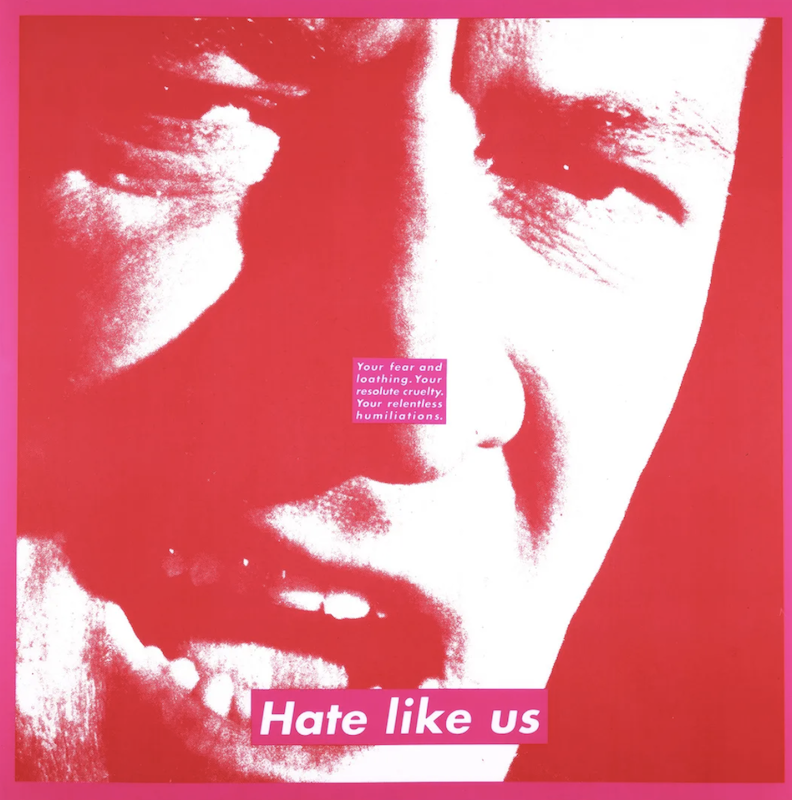
Desire and Power
Kruger’s work repeatedly connects power with desire.
This matters because control is often imagined as something imposed against a person’s will.
But many systems operate more effectively by producing desire.
Advertising does not normally command:
Obey us.
It says:
This is what you want.
Consumer culture promises that objects can provide identity, confidence, attractiveness, belonging, security, or self-expression.
The person experiences the purchase as choice.
Kruger asks whether desire can still be considered entirely private when enormous industries are dedicated to manufacturing it.
This does not mean every desire is false.
It means desire has a history.
It is shaped through images, comparisons, repetition, aspiration, envy, fear, and social reward.
Power becomes most effective when its commands are experienced as personal wishes.
That is why Kruger’s work often sounds intimate.
The language of power frequently speaks in the voice of the self.
The Command and the Question
Kruger uses both declarations and questions.
The declarations feel authoritative:
I shop therefore I am.
Your body is a battleground.
We will no longer be seen and not heard.
You are not yourself.
The viewer receives them almost as commands or verdicts.
But Kruger also uses questions:
Who speaks?
Who is silent?
Who is beyond the law?
Who is free to choose?
Who follows orders?
Who salutes longest?
Questions change the pressure.
A declaration may position the viewer immediately.
A question forces the viewer to generate an answer.
That answer may reveal assumptions the viewer did not know they possessed.
At the Hirshhorn, Belief+Doubt surrounds visitors with language across walls, floors, escalators, and the museum bookstore. Questions concerning freedom, law, speech, silence, money, democracy, and belief become an environment rather than a single framed object. (Hirshhorn Museum)
Kruger has described herself as interested in introducing doubt at moments when ideological certainty becomes especially powerful. (Hirshhorn Museum)
This may be one of the most important lessons in her practice:
The work does not always need to provide a better slogan. It can destabilize the slogans through which people organize reality.
From Image to Environment
Kruger’s early photo-text works can be encountered quickly.
A viewer sees the image, reads the phrase, and experiences the collision.
Her large installations expand that encounter into architecture.
Language may cover:
walls
floors
ceilings
columns
escalators
windows
museum façades
public transportation
billboards
commercial objects
The viewer no longer stands outside the work and looks at it.
The viewer enters the sentence.
Words pass beneath the feet, tower overhead, wrap around the body, and compete across surfaces.
Reading becomes physical.
The Smithsonian describes Belief+Doubt as a space in which text surrounds visitors and reveals itself through their movement. (Smithsonian Institution)
This shift is conceptually necessary.
Kruger’s subject is not language as an isolated intellectual object.
It is the way language structures social space.
Public space is already filled with instructions:
buy
stop
enter
exit
wait
pay
obey
identify yourself
prove authorization
choose
vote
consume
By covering architecture with language, Kruger makes the usually invisible verbal structure of public life impossible to ignore.
The building begins to speak, and the viewer realizes that buildings and institutions have always been speaking.
The Museum Is Not Neutral
Kruger often directs her critique toward the space in which the artwork appears.
A museum presents itself as a place of culture, education, preservation, and public value.
But it is also shaped by:
wealth
donors
trustees
collecting power
social prestige
institutional authority
cultural hierarchy
the art market
decisions about inclusion and exclusion
When Kruger places language about money, power, belief, truth, or value inside a museum, the text does not refer only to society outside.
It acts on the institution hosting it.
A museum bookstore is especially charged.
Visitors move from art into commerce.
They may purchase books, posters, gifts, clothing, and reproductions.
Culture becomes merchandise.
Kruger’s installation does not treat this as a minor contradiction.
It uses the bookstore as part of the work’s meaning.
The critique occupies the site of consumption.
It may itself become something consumed.
Again, the contradiction remains unresolved.
Repetition, Circulation, and the Moving Present
Kruger has frequently returned to earlier phrases and images, remaking them in new formats and contexts.
Her major exhibition Thinking of You. I Mean Me. I Mean You. included early pasteups, architectural vinyl, animation, and multichannel video. Rather than presenting her work as a fixed chronological retrospective, the exhibition emphasized repetition, revision, and replay across changing media environments. (Art Institute of Chicago)
This is important because language changes as culture changes.
A phrase encountered:
in a magazine
on a billboard
on a bus
in a museum
on a phone
inside an immersive video installation
does not function identically.
The audience has changed.
The speed of circulation has changed.
The political context has changed.
The visual environment has changed.
Kruger treats earlier work not as completed historical evidence but as material that can be reactivated.
Repetition becomes a way to test whether the pressure still holds—and how the surrounding system has changed.
Kruger and Social Media
Kruger developed her visual language before contemporary social platforms, but her work now seems remarkably suited to them.
Short phrases.
Bold design.
Immediate address.
Conflict.
Compression.
Repeatability.
Text placed over images.
These are central features of contemporary online communication.
But social media intensifies the problem she identified.
People now participate continuously in producing and circulating persuasive images.
The distinction among advertiser, consumer, brand, audience, and product has weakened.
A person may:
sell a lifestyle
perform authenticity
package political beliefs
optimize identity for visibility
repeat slogans
build a personal brand
become economically valuable through attention
Kruger’s work helps us see that social platforms did not invent these pressures.
They accelerated and personalized the visual language of advertising.
The commercial message no longer always comes from a corporation.
It may come from a friend, influencer, political group, artist, or from the public self one has constructed.
Her question—You are not yourself—becomes even more unsettling in that environment.
The Central Contradiction
The central contradiction in Kruger’s work is:
She uses the seductive authority of mass communication to teach viewers to distrust seductive authority.
Her work is:
immediate but conceptually unstable
legible but unresolved
visually pleasurable but politically suspicious
critical of branding but powerfully branded
public but psychologically intimate
direct but ambiguous
appropriated but unmistakably authored
commercial in appearance but anti-commercial in pressure
easy to reproduce but dependent on context
declarative but designed to create doubt
The work cannot escape the visual systems it critiques.
That is not a failure.
It is the condition of the problem.
There is no perfectly innocent language outside ideology, persuasion, commerce, or power.
Kruger therefore works from inside the contaminated field.
Is It Art or Graphic Design?
Kruger’s work raises a familiar objection:
Is this simply graphic design with political content?
The question is useful because her work intentionally occupies that boundary.
Graphic design normally serves a defined communication objective.
It may sell a product, identify a brand, organize information, or persuade an audience toward a particular action.
Kruger uses many of the same tools.
But she destabilizes the objective.
The message does not settle into one instruction.
Instead, it exposes the conditions under which instructions gain authority.
Graphic design generally seeks clarity.
Kruger uses clarity to produce uncertainty.
Advertising tries to conceal its manipulation beneath desire.
Kruger makes manipulation itself visible.
The important distinction is not whether typography belongs to art or design.
It is what the structure asks the viewer to experience.
Kruger transforms communication from the delivery of a message into an examination of who has the power to deliver messages at all.
The Visual and Conceptual World She Has Built
Across her practice, Kruger has developed a recognizable lexicon:
found black-and-white photographs
red, white, and black
bold sans-serif typography
short declarations
pronouns
questions
commands
cropped bodies and faces
advertising language
political slogans
public signage
institutional architecture
billboards, buses, posters, clothing, and consumer objects
museum walls and floors covered with text
conflicting voices
repetition and replay
words that implicate rather than explain
language occupying the viewer’s physical space
These elements form more than a style.
They create a system in which every act of reading becomes a question about authority.
Who speaks?
Who is addressed?
Who is excluded?
Who believes?
Who profits?
Who is allowed to answer?
What Artists Can Learn
The lesson is not to imitate Kruger’s red rectangles, bold typography, found photographs, or slogan-like statements.
The lesson is to understand how she turns communication itself into a field of pressure.
Directness does not require simplicity.
A work may be immediately readable while remaining conceptually unresolved.
Language is a material.
Pronouns, commands, questions, clichés, and slogans can organize power, identity, and viewer position.
The viewer should not automatically occupy the morally correct position.
Political work becomes more demanding when it implicates rather than merely instructs.
Appropriation should change authority.
A found image becomes meaningful when its original assumptions are exposed, redirected, or contradicted.
Graphic seduction can carry critique.
Beauty, polish, clarity, and memorability do not have to be rejected. They can become the mechanisms through which the work reveals persuasion.
Context changes meaning.
A sentence on a shopping bag, billboard, museum floor, bus, or phone screen becomes a different social act.
Questions can be more powerful than answers.
An artwork may create doubt rather than replace one ideology with another.
Institutions can become part of the material.
A museum, gallery, store, street, or media platform is not merely where the work appears. Its authority, economics, and audience can become part of what the work examines.
Repetition can test the present.
Returning to an earlier phrase can reveal how culture, technology, and political pressure have changed around it.
A distinct visual language should serve a recurring problem.
Kruger’s style remains powerful because it is structurally connected to persuasion, circulation, authority, and public address.
The larger lesson is:
Language becomes artistically powerful when it does not merely state an opinion, but reveals how opinions, identities, desires, and social positions are manufactured.
Barbara Kruger does not simply place words over pictures.
She constructs encounters in which language commands us, flatters us, accuses us, includes us, excludes us, and speaks through us.
Her work shows that the public image does not only represent identity.
It helps produce identity.
The viewer enters believing they are free to interpret the message.
The work asks whether that freedom has already been designed.
The lesson is not to copy the appearance of the work.
The lesson is to understand the pressure that made the appearance necessary.
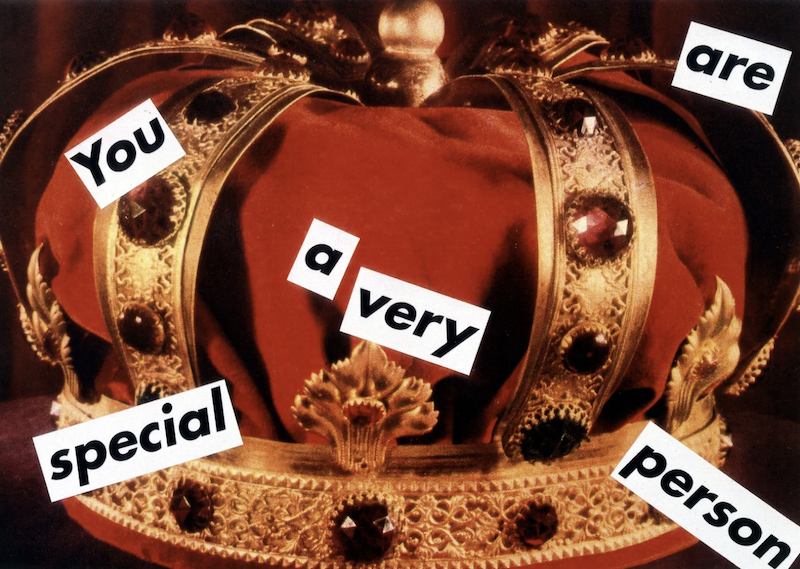
What Makes Shirin Neshat’s Work So Powerful?
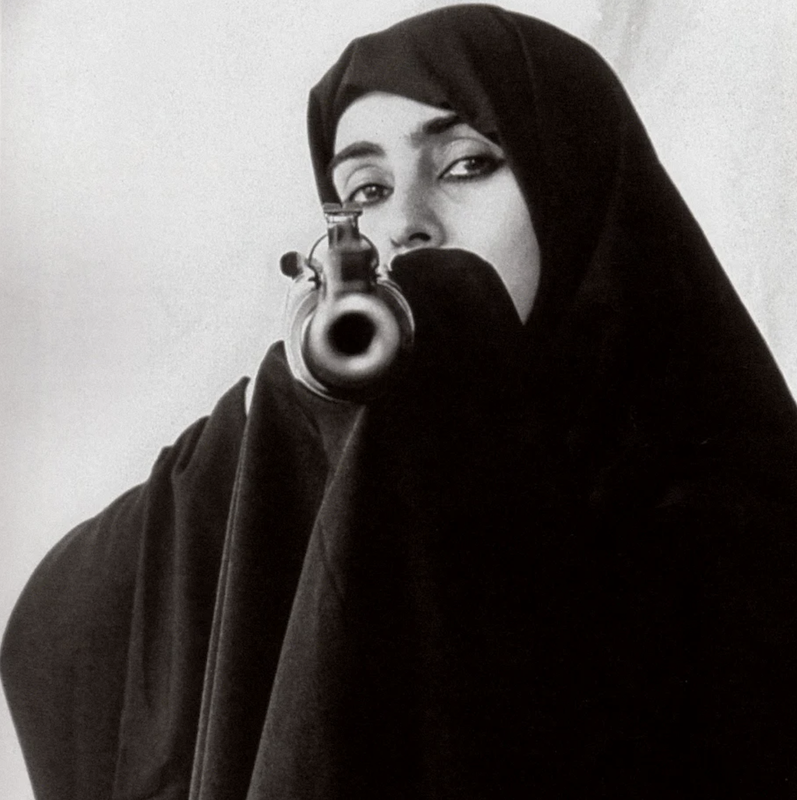
Shirin Neshat’s work is powerful because she turns visibility into a divided condition: the figure is revealed and concealed, empowered and controlled, culturally specific and publicly misread at the same time.
At first, her best-known photographs from the Women of Allah series appear stark and symbolic. Veiled women face the camera in black and white. Persian calligraphy covers exposed faces, hands, and feet. Rifles enter the composition beside eyes, skin, cloth, and prayer-like gestures.
The images can appear to present clear oppositions:
woman and weapon
devotion and militancy
body and language
concealment and exposure
femininity and political authority
silence and speech
But the work becomes more difficult the longer we remain with it.
The veil does not simply signify oppression.
The weapon does not simply signify power.
The text does not merely explain the woman.
The direct gaze does not completely reveal her interior life.
Neshat creates images whose elements carry conflicting meanings that cannot be reduced to a single message. The Women of Allah series emerged after she returned to Iran following years abroad and encountered a society transformed by the 1979 revolution and its aftermath. The photographs combine veiled, sometimes armed women with handwritten Persian texts, including writings by women poets. (The Metropolitan Museum of Art)
The central pressure is:
The woman is intensely visible, yet the cultural and political meanings surrounding her prevent that visibility from becoming simple understanding.
The Problem Beneath the Work
Neshat’s recurring problem is not simply the treatment of women in Islamic society.
A more precise formulation would be:
How can an artist represent women shaped by religion, revolution, patriarchy, political resistance, cultural belonging, and Western projection without reducing them to either powerless victims or uncomplicated symbols of strength?
This is difficult because images of Muslim women are frequently interpreted through existing ideological frameworks.
One viewer may see the veil and immediately assume submission.
Another may see a weapon and interpret militancy.
Another may understand religious devotion.
Another may project Western ideas of liberation.
Another may romanticize resistance.
The figure becomes surrounded by readings before she is encountered as a person.
Neshat does not eliminate these readings. She places them into conflict.
The woman may be devout and resistant.
Protected and restricted.
Militant and vulnerable.
Silent and expressive.
A political symbol and an individual presence.
The work does not resolve which interpretation is correct because its deeper subject is the instability of interpretation itself.
Representation From Exile
Exile is central to Neshat’s visual world.
An artist living away from her country occupies an unstable position. She may remain culturally connected while being physically separated. She may understand the society through memory, longing, family history, political events, and return visits, but she cannot claim completely unmediated access.
This produces a divided perspective:
insider and outsider
participant and observer
belonging and displacement
cultural memory and present reality
familiarity and estrangement
Neshat does not speak from a completely secure position inside or outside Iranian culture.
That instability becomes productive.
Her work repeatedly asks what it means to belong to a place that has changed, to remember a culture from a distance, and to become publicly identified with a country from which one is separated.
Exile therefore does not function merely as biography.
It becomes a visual condition.
The figures appear divided between worlds, just as Neshat’s installations often divide the viewer between screens, spaces, genders, and incompatible perspectives.
How the Work Creates Pressure
The deepest pressure in Neshat’s work comes from the collision between cultural identity and systems of interpretation.
The woman in the image is never encountered alone.
She is seen through:
religion
revolution
gender
nationalism
exile
Orientalism
Western feminism
political violence
poetry
family and cultural memory
the institutional gaze of museums
the viewer’s assumptions about Iran and Islam
These systems compete to define her.
Neshat makes that struggle visible without pretending that the artist can provide one final, authoritative answer.
This distinguishes her work from political illustration.
Political illustration often tells the viewer what conclusion to reach.
Neshat builds contradictions that make every conclusion feel incomplete.
The viewer cannot remain comfortable inside a single interpretation.
The Veil as a Contested Surface
The veil is one of the most visually powerful elements in Neshat’s early work because it already carries enormous cultural meaning.
It may signify:
faith
modesty
cultural identity
law
discipline
protection
control
resistance
belonging
political ideology
Western projection
Neshat does not treat the veil as a neutral garment.
But she also refuses to let one interpretation dominate.
Visually, the dark fabric conceals much of the body while framing the face, hands, or feet with extraordinary intensity. What remains visible becomes more charged because so much else is withheld.
The veil therefore regulates access.
It determines what the viewer receives.
It creates a boundary between the figure’s public image and the body that remains inaccessible beneath it.
This connects directly to the larger insight developed across our research:
Concealment does not always erase the figure. It can concentrate visibility.
The covered body may become more symbolically visible even as it becomes less physically available.
That contradiction gives the veil its pressure.
Text Written Across the Body
Neshat frequently overlays Persian calligraphy onto exposed skin.
The text creates several simultaneous relationships.
It can resemble:
speech
prayer
poetry
political declaration
testimony
law
cultural memory
ornament
a wound or inscription imposed upon the body
For viewers who cannot read Persian, the writing may initially appear decorative. Its curves create visual rhythm and surface density.
But that inability to read is part of the encounter.
The viewer sees language without gaining full access to meaning.
The body appears covered in information, yet the information remains unavailable.
This produces an important reversal:
The image is visually legible but linguistically withheld.
A Western viewer may be accustomed to interpreting the veiled woman from outside. The unreadable text disrupts that confidence.
The figure contains a cultural and poetic world the viewer may not be able to enter.
The text prevents the body from becoming only an image.
It gives the surface a voice, but not necessarily a voice everyone can possess.
The Metropolitan Museum notes that texts used in Women of Allah include feminist poetry and writings by Iranian women, while the handwritten language acts in relation to speech, prayer, revolution, and women’s political participation. (The Metropolitan Museum of Art)
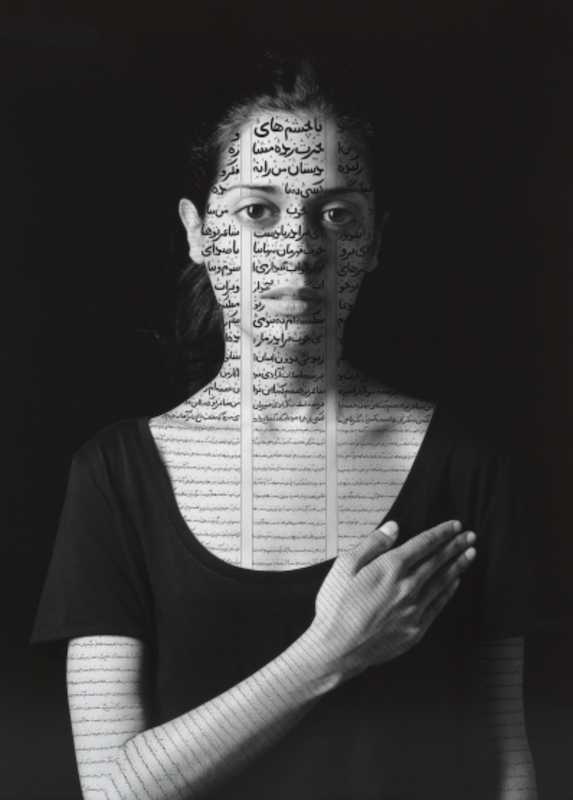
The Weapon and the Contradiction of Power
The rifles in Women of Allah are among the series’ most confrontational elements.
A weapon can signify agency.
It can also signify coercion.
It may imply revolution, martyrdom, national defense, political violence, fear, or ideological discipline.
Placed beside a woman’s face, hands, or body, the weapon unsettles familiar assumptions about femininity.
The figure is not passive.
But she is not simply liberated either.
The gun may provide power while binding her more tightly to political systems.
It may allow resistance while exposing her to violence.
It may challenge Western stereotypes of Muslim women while creating another image that can become stereotyped.
This is why the rifle is not merely a provocative prop.
It makes power ambiguous.
Possessing a weapon does not automatically mean possessing control over the conditions that made the weapon necessary.
The work holds female agency and political danger together.
Black and White as Moral Pressure
Neshat’s black-and-white photography creates stark formal clarity.
Dark cloth meets light skin.
Ink crosses flesh.
The metallic weapon cuts through fabric and body.
The absence of color removes some of the ordinary visual information that might soften the image. The photograph begins to resemble:
journalism
historical evidence
an archive
a political poster
a memorial image
a sacred icon
propaganda
The Met connects the format and imagery of the series to press photographs documenting women’s involvement in the revolution and the Iran–Iraq War. (The Metropolitan Museum of Art)
But black and white also encourages the viewer to expect moral opposition:
good and evil
oppressor and victim
faith and freedom
violence and innocence
Neshat then destabilizes those binaries through the complexity of the figure.
The format looks clear.
The meaning is not.
That contradiction is formally necessary.
The Direct Gaze
Many of Neshat’s women look directly at the viewer.
The gaze can feel confrontational, self-possessed, solemn, intimate, or accusatory.
Yet it does not make the subject transparent.
A direct gaze creates contact without surrendering interiority.
The figure acknowledges that she is being viewed.
She may also appear to examine the person looking at her.
This makes the viewer aware of their interpretive position.
What assumptions did the viewer bring to the veil?
To the weapon?
To the Persian text?
To the phrase “Muslim woman”?
The woman’s gaze does not tell us what to think.
It prevents us from imagining that our looking is invisible or innocent.
Video and the Division of Space
Neshat’s video installations extend these concerns beyond the single photographic image.
Works such as Rapture divide men and women into separate social, architectural, and symbolic spaces. The viewer may be positioned between opposing projections and required to turn physically from one side to the other. The Guggenheim’s presentation of Neshat’s video work describes scenes in which men and women occupy sharply divided collective roles and landscapes. (The Guggenheim Museums and Foundation)
This format changes the viewer’s role.
We cannot see both sides completely at once.
To look at one screen is to turn away from the other.
That bodily limitation becomes conceptually meaningful.
The viewer experiences division rather than merely learning about it.
Gender separation becomes spatial structure.
The installation does not only represent opposing social worlds.
It places the viewer between them.
Gender as Choreography
In Neshat’s films, men and women often move differently, gather differently, vocalize differently, and occupy different environments.
Gender becomes more than identity.
It becomes choreography.
Bodies are organized through:
architecture
ritual
clothing
collective movement
silence
voice
public and private space
permission
prohibition
This shows how social systems enter the body.
A person does not merely possess a gender identity internally. Gender shapes where the person may stand, how they move, whether they speak, and how they are viewed.
The environment therefore becomes a gendered pressure system.
A fortress, shoreline, street, prayer space, desert, or domestic setting establishes different possibilities for the body.
The setting is not background.
It distributes freedom and restriction.
Voice, Silence, and Authority
Sound is crucial in Neshat’s moving-image work.
One of her best-known installations, Turbulent, contrasts a male singer performing before an audience with a woman performing an unconventional, wordless vocal piece in an empty space.
The structure places institutional permission against artistic freedom.
The man possesses the recognized public platform.
The woman lacks the permitted audience.
Yet her voice exceeds the established musical structure.
This creates another contradiction:
The person denied formal authority may produce the more expansive and destabilizing expression.
Silence and voice are never simple opposites in Neshat’s work.
A silent figure may carry enormous force.
A vocal figure may remain socially excluded.
Speech may grant presence.
It may also expose the speaker to punishment or interpretation.
The important question is not merely who speaks.
It is who is authorized to be heard.
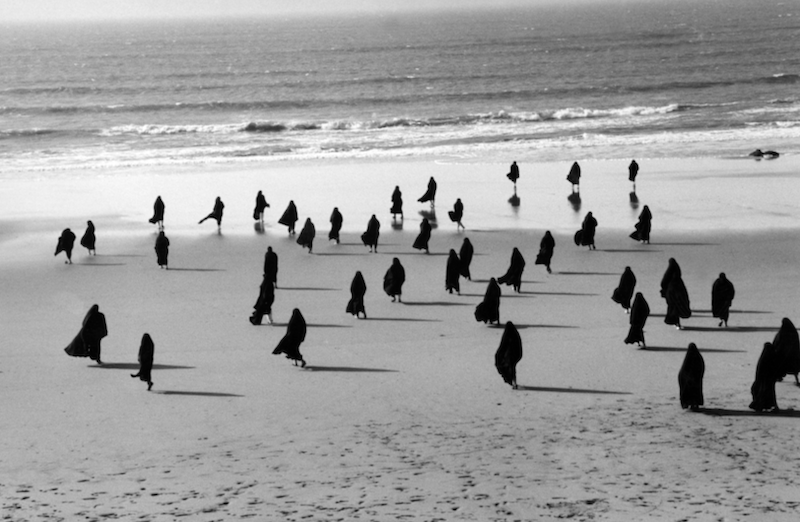
The Central Contradiction
The central contradiction in Neshat’s work is:
The figure becomes a powerful public image while remaining trapped inside the cultural and political meanings projected onto her.
Her women may be:
concealed but intensely visible
silent but textually inscribed
armed but vulnerable
devout but politically resistant
culturally specific but internationally interpreted
collective symbols but psychologically individual
controlled by social systems but capable of defiance
exiled yet deeply attached to place
aesthetically beautiful but politically unsettled
Neshat does not solve these contradictions.
To resolve them would reduce the figure to a message.
Instead, the work preserves the double bind:
The woman must become visible in order to resist erasure.
But increased visibility creates new possibilities for projection, simplification, and control.
The Danger of the Symbolic Woman
A recurring danger in political art is that the individual person becomes a symbol.
“The Muslim woman” may be used to represent:
oppression
religious devotion
revolutionary resistance
cultural authenticity
patriarchy
feminism
East versus West
Once the figure becomes symbolic, her complexity may disappear.
Neshat knowingly works near that danger.
Her images are highly formalized and iconic. The veil, gun, text, and frontal gaze invite symbolic interpretation.
But contradiction interrupts the symbol.
The figure cannot be classified securely as victim, militant, believer, feminist, martyr, or revolutionary.
She remains caught among these identities.
That instability prevents the image from becoming simple propaganda.
Exile and the Invention of Home
Neshat’s later work expands from post-revolutionary Iran toward migration, displacement, dreams, memory, and immigrant experience.
Exile creates a complicated relationship to home.
Home may become:
a place remembered
a place politically inaccessible
a fantasy
a wound
a cultural language
a family history
a condition recreated elsewhere
a country that no longer resembles memory
The displaced person may become highly identified with the homeland by others while feeling internally divided from it.
This is another form of visibility pressure.
The exile may be asked to represent a culture she cannot fully inhabit.
Neshat’s work resists presenting exile as either complete loss or complete freedom.
Distance produces insight.
It also produces longing, guilt, idealization, and uncertainty.
Controlled Duality
Neshat often structures her work through opposition:
man / woman
East / West
speech / silence
private / public
body / text
faith / politics
exile / homeland
individual / collective
visibility / concealment
But she does not use these pairs merely to declare that the world is divided.
She uses them to show that each side contains contradictions.
The woman may possess forms of power unavailable to the man.
The public space may produce authority but also conformity.
The private space may produce restriction but also imagination.
Exile may create loss but also critical distance.
Strong duality therefore does not mean simplistic opposition.
It means building two pressure systems that expose the limits of one another.
How the Viewer Becomes Implicated
Neshat’s work implicates the viewer by making interpretation feel culturally loaded.
A viewer may believe they are simply observing an image.
But the work asks:
What do you assume the veil means?
Do you interpret religion only as control?
Do you romanticize political resistance?
Do you read the armed woman as empowered or threatening?
Do you expect the figure to explain her culture to you?
Does unreadable language make you curious, frustrated, or dismissive?
Are you encountering a woman, or an image of “the Muslim woman” already formed in your mind?
What authority do you believe your own cultural framework gives you?
The viewer becomes implicated because every visual element arrives with inherited meaning.
The work does not allow us to pretend that interpretation begins from neutrality.
The Visual World Neshat Has Built
Across her practice, Neshat has developed a recognizable lexicon:
veiled women
exposed faces, hands, and feet
Persian calligraphy written over skin
black-and-white photography
direct gazes
weapons
prayer and ritual gestures
divided screens
male and female groups
deserts, shorelines, fortresses, streets, and thresholds
music, silence, and wordless voice
exile, migration, dreams, and memory
ceremonial movement
the body caught between personal identity and political symbolism
images that appear formally clear but remain ideologically unstable
These elements form more than a signature style.
They create a world governed by divided visibility.
The subject is repeatedly seen through systems that claim to explain her but never fully succeed.
What Artists Can Learn
The lesson is not to imitate Neshat’s veils, calligraphy, weapons, black-and-white photography, or divided video screens.
The lesson is to understand how she makes cultural interpretation part of the pressure system.
Symbols should remain unstable.
A veil, weapon, uniform, religious object, or national symbol becomes powerful when it carries conflicting meanings rather than delivering one fixed message.
Text can create voice without complete access.
Language may deepen the figure while preserving cultural distance and withholding.
Concealment can intensify visibility.
What is covered may make what remains exposed more psychologically and politically charged.
Formal division can become lived experience.
Separate screens, spaces, colors, or fields can force viewers to experience conflicting systems rather than merely observe them.
Cultural identity should not resolve into illustration.
The work becomes stronger when the figure exceeds the issue she appears to represent.
Political art needs contradiction.
A subject can be oppressed and powerful, devout and resistant, collective and individual at once.
The gaze can reverse interpretation.
A figure who looks back reminds the viewer that cultural judgment is also being examined.
Exile can become a formal position.
Distance, memory, divided perspective, and incomplete belonging can determine how images are constructed.
Voice is different from authority.
The most powerful expression may come from the figure denied the official platform.
The larger lesson is this:
Cultural identity becomes powerful when the artwork reveals not only how a figure is seen, but the competing systems that struggle to control what her visibility means.
Shirin Neshat does not offer a simple image of Muslim women, Iranian identity, exile, faith, or political resistance.
She constructs images in which body, text, gaze, religion, gender, revolution, memory, and viewer interpretation remain in conflict.
The work does not tell us which single meaning is correct.
It makes us confront why we expected the figure to provide one.
The lesson is not to copy the appearance of the work.
The lesson is to understand the pressure that made the appearance necessary.
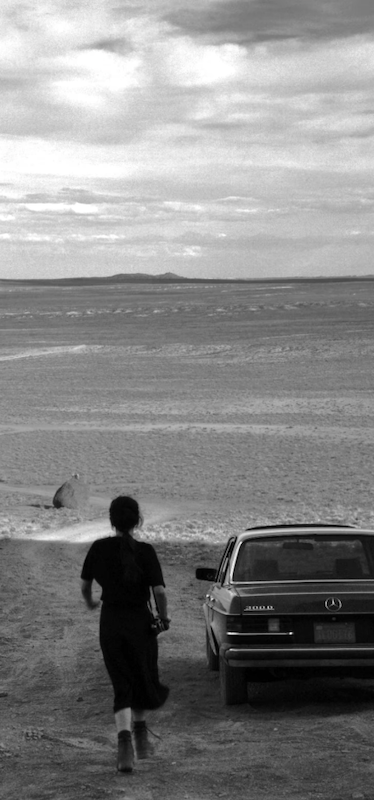
What Makes Wangechi Mutu’s Work So Powerful?
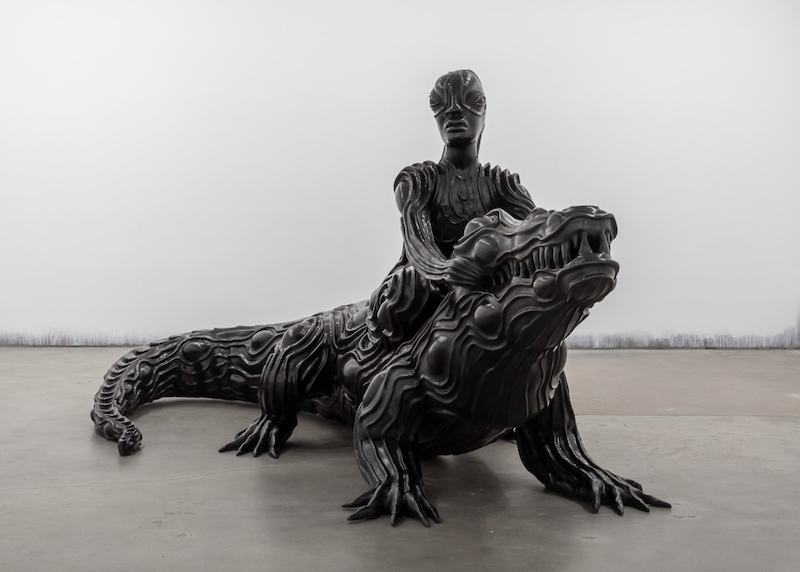
Wangechi Mutu’s work is powerful because she turns the body into a contested world where beauty, violence, gender, race, nature, technology, mythology, and colonial history are forced to coexist.
At first, her figures can appear spectacularly beautiful. They possess elaborate skin, elongated limbs, ornamental surfaces, animal features, mechanical appendages, feathers, fur, plants, wounds, jewelry, and seductive poses. Some seem like fashion models. Others resemble warriors, deities, cyborgs, mermaids, insects, ancestral spirits, diseased bodies, or beings from an unknown future.
But these figures are never simply fantasies.
They are assembled from visual materials that already carry cultural pressure: fashion magazines, pornography, medical diagrams, ethnographic imagery, images of machinery, botanical forms, African artifacts, popular media, and art history. Mutu cuts, recombines, paints over, extends, and transforms those sources until the body becomes impossible to classify securely. (SFMOMA)
The result is a figure that feels both wounded and newly empowered.
The body has been fragmented by systems of representation, but it uses those fragments to invent another form of life.
That is the central force of Mutu’s work.
She does not attempt to restore the body to an innocent, untouched, or supposedly authentic state. She builds hybrid beings from the very images, histories, desires, and violences that have shaped how bodies are seen.
The Problem Beneath the Work
Mutu’s recurring problem is not simply Black female identity, collage, Afrofuturism, mythology, or the relationship between women and nature.
A more precise formulation would be:
How can the body survive the images, histories, technologies, desires, and systems of power that have attempted to define it—and can fragmentation become the beginning of a new mythology rather than only evidence of damage?
The Black female body has frequently been treated as a surface onto which other people project meaning.
It has been made to signify:
sexuality
exoticism
primitiveness
fertility
labor
danger
beauty
disease
strength
victimhood
cultural authenticity
racial difference
Mutu’s work exposes those projections, but it does not stop at critique. She rearranges them.
A mouth taken from one source may join skin from another.
A machine part may become a limb.
A plant may become hair.
An animal form may become armor.
A wound may become ornament.
A technological fragment may suggest mutation rather than repair.
The figure is not restored to wholeness by erasing contradiction.
She becomes powerful by reorganizing contradiction.
This gives Mutu’s work a different relationship to identity than conventional portraiture.
She is not asking:
Who is this woman?
She is asking:
What forces have produced this body, and what new being might emerge if those forces are recombined?
Why the Figures Are Hybrid
Hybridity is one of Mutu’s most recognizable strategies.
Her beings combine:
human and animal
organic and mechanical
beautiful and grotesque
African and Western
ancient and futuristic
wounded and powerful
erotic and threatening
earthly and supernatural
These combinations are not decorative inventions.
They reflect the difficulty of inhabiting identities shaped by multiple histories and visual systems.
A hybrid cannot be contained by one category.
It is never completely one thing or the other.
That creates both freedom and tension.
The hybrid figure may escape the fixed identity imposed upon it, but it also carries the pressure of never being allowed to become stable. The body is continually adapting, mutating, protecting itself, and becoming something else.
Mutu’s figures therefore do not represent hybridity as peaceful cultural harmony.
They reveal that mixed identity may contain conflict, displacement, invention, rupture, memory, and survival.
The hybrid body becomes a record of what has acted upon it.
It also becomes evidence that those forces have not succeeded in finishing it.
How the Work Creates Pressure
The deepest pressure in Mutu’s work comes from the collision between seduction and violence.
The figures attract the viewer.
Their surfaces are intricate.
Their bodies may appear elegant, erotic, fashionable, or commanding.
Their colors, textures, poses, and details reward close looking.
But the longer the viewer stays, the less stable that pleasure becomes.
A glossy surface may resemble scar tissue.
A beautiful leg may be mechanical.
An ornament may look parasitic.
A face may be assembled from incompatible features.
A glamorous pose may recall both fashion photography and bodily display.
A floral form may resemble disease.
The viewer is caught between attraction and unease.
That contradiction is necessary because many of the visual sources Mutu uses are already built around desire and control. Fashion imagery idealizes bodies while disciplining them. Pornographic imagery offers access while reducing bodies to consumption. Ethnographic imagery claims knowledge while turning cultures into objects of classification. Medical imagery reveals the body while fragmenting it into pathology.
Mutu allows those visual systems to remain present, but she prevents any one of them from controlling the final figure.
The viewer is seduced by the surface and then forced to confront what that seduction contains.
Collage as a Political and Psychological Structure
Collage is not merely Mutu’s technique.
It is the logic of the body in her work.
A collage openly reveals that the image has been constructed from fragments. Its seams may be visible. Its sources may remain partly recognizable. Different systems of scale, texture, perspective, and representation occupy the same surface.
This makes collage especially suited to a body shaped by competing projections.
The figure does not pretend to come from one origin.
She is assembled from incompatible histories.
Fashion.
Science.
Colonial representation.
Pornography.
Nature.
Technology.
Myth.
Advertising.
Personal imagination.
The body becomes an archive.
But unlike a conventional archive, it does not preserve its sources neutrally. It cuts into them, contaminates them, and rearranges their authority.
This is a crucial distinction:
Mutu does not merely collect images of power. She dismembers and redistributes them.
The image source loses control over what its fragment means.
A glamorous eye no longer belongs exclusively to an advertisement.
A mechanical part no longer belongs only to technological progress.
A medical image no longer belongs solely to scientific authority.
Collage frees the fragment from its original system and gives it another function.
Fragmentation Is Both Violence and Possibility
Fragmentation in Mutu’s work cannot be understood only as liberation.
Cutting a body into pieces carries historical and psychological violence.
It recalls:
bodily injury
objectification
medical dissection
colonial classification
sexual consumption
racial stereotyping
the fragmentation of identity across cultures
the reduction of a person to desirable or threatening parts
The cut is therefore never completely innocent.
But the collage does not leave the body dismembered.
The fragments generate a new being.
This creates one of Mutu’s central contradictions:
The same act that records violence also creates transformation.
A seam can mark where the body was broken.
It can also mark where the body authored a new connection.
A missing part can signify loss.
It can also create space for mutation.
An artificial limb can suggest damage.
It can also create abilities the original body did not possess.
Fragmentation becomes powerful because it remains double.
Mutu does not turn trauma into uncomplicated empowerment. The new being carries the memory of the cut.
Beauty Is Not Innocent
Beauty is one of Mutu’s most effective tools because she does not treat it as the opposite of critical seriousness.
Her work is visually seductive on purpose.
Beauty brings the viewer close.
Then it complicates the viewer’s position.
The figures may contain long legs, narrow waists, polished surfaces, dramatic hair, elegant gestures, ornate pattern, and fashion-like poses. But the idealized image repeatedly breaks down.
The body is too strange.
Too wounded.
Too powerful.
Too hybrid.
Too artificial.
Too alive in the wrong ways.
Beauty becomes unstable.
The viewer must ask:
Why does this figure attract me?
Which visual conventions have taught me to recognize beauty?
What kinds of bodies are expected to remain beautiful?
When does ornament become damage?
When does attraction become consumption?
Is this figure presenting herself, or has she been assembled for display?
Does her beauty protect her or increase her vulnerability?
Mutu does not reject beauty because beauty has been used to discipline bodies.
She places beauty under pressure until its hidden structures become visible.
The Black Female Body as a Battleground
Mutu’s work repeatedly uses the female body as a place where personal, political, ecological, and historical forces intersect. Institutions describing her practice have emphasized how she examines the eroticization of Black women, racial archetypes, gender roles, colonialism, globalization, ecology, displacement, and perceptions of Africa. (fondationlouisvuitton.fr)
The body becomes a battleground because it is asked to carry too many meanings.
It is expected to be:
culturally authentic
racially representative
sexually available or morally respectable
naturally strong
historically wounded
politically legible
visually spectacular
symbolically useful
Mutu’s figures refuse to stabilize around those demands.
They may look regal but monstrous.
Sexual but dangerous.
Wounded but autonomous.
Ancient but technologically altered.
Feminine but not compliant.
They do not offer an ideal image that corrects every damaging stereotype.
Instead, they become too complex to perform a single approved identity.
This is important.
A “positive” representation can still imprison the subject if it demands dignity, beauty, strength, or moral perfection at all times.
Mutu’s beings are stranger and freer than that.
They can be excessive.
Predatory.
Erotic.
Diseased.
Comic.
Violent.
Sacred.
Artificial.
Protective.
Unknowable.
They do not have to reassure the viewer.
Nature Is Not a Passive Background
Plants, soil, roots, trees, water, animals, insects, shells, and organic forms appear throughout Mutu’s practice.
But nature in her work is not presented as pure, peaceful, or separate from human history.
It mutates with the body.
A figure may grow branches, possess animal limbs, emerge from water, merge with soil, or resemble an unknown species.
This creates a world where the boundaries between human and nonhuman life are unstable.
The body is not placed into nature.
It participates in nature’s transformations.
This challenges the idea that the human body is an isolated, sovereign form.
It also complicates histories in which women and African cultures have been described as closer to nature—and therefore supposedly less rational, modern, or civilized.
Mutu does not simply reject that association.
She transforms it.
The merger with nature may become a source of power, kinship, ecological memory, protection, or future survival.
But it may also carry predation, decay, disease, and uncontrollable growth.
Nature is neither ideal refuge nor primitive condition.
It is another active force.
Technology and the Cyborg Body
Many of Mutu’s figures contain mechanical, artificial, prosthetic, or futuristic elements.
This makes them resemble cyborgs.
But technology in her work does not always represent clean progress.
Mechanical forms can appear invasive, violent, necessary, elegant, or empowering.
The technological addition may repair a body.
It may also reveal how deeply the body has been altered by external systems.
The cyborg is useful because it breaks down familiar distinctions:
natural / artificial
body / machine
original / modified
human / object
victim / weapon
past / future
A cyborg body carries evidence that purity is no longer possible—perhaps that purity never existed.
Mutu’s beings do not return to an untouched identity before colonialism, technology, global media, or displacement.
They build futures from contaminated material.
This gives the work an Afrofuturist dimension, but the future is not presented as sleek technological perfection.
It is bodily, spiritual, ecological, wounded, and ancestral.
The future contains the past rather than replacing it.
Mythology as Self-Authorship
Mutu frequently creates beings that resemble goddesses, spirits, mermaids, warriors, ancestors, or creatures from unwritten myths.
This mythological quality matters because mythology gives a culture images through which it understands origin, power, morality, danger, sexuality, nature, and transformation.
But inherited mythologies often center bodies and histories different from Mutu’s own.
She therefore invents new figures.
These beings do not simply enter existing myths.
They create another cosmology.
The Fondation Louis Vuitton describes Mutu’s practice as inventing a contemporary postcolonial, feminist, and environmental mythology through forms in which animal, human, and plant kingdoms intertwine. (fondationlouisvuitton.fr)
Myth becomes a form of self-authorship.
The artist does not wait for dominant culture to provide an adequate image.
She creates a being for whom no existing category is sufficient.
That is a powerful studio lesson:
When inherited images cannot hold the complexity of the subject, the artist may need to invent a new creature.
From Collage to Sculpture
Mutu’s movement into sculpture is a natural extension of her central problem.
Her collaged figures always seemed to be pressing beyond the surface.
They contained volume, armor, machinery, bodily mutation, and monumental presence.
Sculpture allows those beings to enter the viewer’s physical space.
Works such as Water Woman, MamaRay, and other bronze or mixed-material figures combine human, aquatic, botanical, animal, and mythic forms. Her broad survey Intertwined brought together nearly one hundred works across collage, painting, sculpture, drawing, film, and installation, showing that hybridity governs the entire practice rather than one medium. (New Orleans Museum of Art)
In sculpture, the hybrid body no longer remains something the viewer can inspect safely from across a framed image.
It occupies the room.
It has weight.
It casts shadows.
The viewer must move around it.
Its bodily scale changes the power relationship.
A collage can suggest an invented being.
A sculpture gives that being physical authority.
Reclaiming Monumentality
Mutu’s sculptural work also engages the history of monuments and architectural authority.
Her four bronze figures for the Metropolitan Museum of Art’s façade commission occupied niches long designed to hold sculpture but previously left empty. The works brought hybrid female figures into one of the most symbolically powerful architectural spaces in Western art. (National Galleries of Scotland)
This was not simply inclusion.
It changed what the museum façade could signify.
The monumental figure had historically been associated with rulers, saints, classical heroes, civic virtues, and patriarchal authority.
Mutu introduced beings that were African, female, hybrid, futuristic, ancestral, and resistant to stable classification.
They did not ask to become classical figures.
They altered the language of monumentality.
This connects her to Kerry James Marshall.
Marshall reorganizes painting around Black pictorial authority.
Mutu reorganizes mythology and monumentality around beings that dominant history did not know how to name.
Materials Carry Memory
Mutu works with materials including ink, paint, printed paper, Mylar, soil, wood, bronze, organic matter, hair-like fibers, textiles, and found materials. Her survey connected early collages with sculptures made from natural materials sourced in Nairobi and works cast in bronze. (New Orleans Museum of Art)
These materials are not interchangeable.
Each carries a different relation to body, history, and place.
Magazine paper carries mass media and consumer desire.
Mylar creates a smooth, resistant surface on which ink pools and behaves unpredictably.
Soil carries land, burial, origin, cultivation, ancestry, and territorial history.
Bronze carries permanence, monumentality, public authority, and art history.
Hair-like fibers carry bodily identity, femininity, labor, cultural styling, and ritual.
Wood carries growth, place, touch, and ecological time.
The material becomes part of the argument.
A mythic figure cast in bronze claims permanence.
A collage assembled from disposable magazines exposes the instability of mass-produced representation.
A form made from soil reconnects the body to land and mortality.
Mutu chooses materials according to what histories and forms of power they already contain.
The Central Contradiction
The central contradiction in Mutu’s work is:
The body is visibly made from forces that have damaged and objectified it, yet those same materials become the means of its transformation and power.
Her figures are:
beautiful but wounded
fragmented but newly whole
seductive but threatening
organic but technological
ancestral but futuristic
human but more-than-human
objectified but self-authored
monstrous but regal
damaged but generative
culturally specific but mythologically expansive
The contradiction remains unresolved because survival does not erase injury.
Self-authorship does not remove the history of projection.
Transformation does not restore innocence.
The figure’s power comes partly from carrying all these conditions simultaneously.
Monstrosity as Freedom
The word “monstrous” can sound negative, but monstrosity is important in Mutu’s work.
A monster crosses boundaries that society wants to keep separate.
Human and animal.
Woman and weapon.
Beauty and disease.
Nature and machine.
Victim and threat.
The monster exposes the instability of the classification system.
It is frightening because it cannot be placed securely.
But that instability can also create freedom.
A body that successfully conforms to an ideal remains controlled by the ideal.
A monstrous body can exceed the standard entirely.
Mutu’s figures often become powerful at the moment they stop trying to remain acceptable.
Their excess prevents easy consumption.
Their mutation breaks the image’s original rules.
Their bodies become too strange to function only as fashion, pornography, science, ethnography, or stereotype.
The monster is not merely what dominant culture fears.
It can be the form that survives dominant culture’s categories.
The Viewer’s Position
Mutu implicates the viewer through attraction.
We may first approach because the figure is beautiful, elaborate, erotic, mysterious, or technically fascinating.
Then we begin inspecting the parts.
Where did this eye come from?
What is happening to the skin?
Is that ornament or injury?
Is the figure human?
Is she inviting us or threatening us?
This act of inspection becomes uncomfortable because it echoes the systems Mutu critiques.
The viewer begins behaving like:
a consumer
a collector
a scientist
an ethnographer
a voyeur
a fashion spectator
a diagnostician
someone attempting to classify an unknown body
The work gives the viewer enormous visual access.
But the abundance of information does not produce mastery.
The more we inspect, the less stable the figure becomes.
This reverses the expected relationship between looking and knowledge.
The work gives the viewer more to see while making the figure harder to possess.
Her Visual World
Across her practice, Mutu has developed a deep and expanding lexicon:
hybrid female bodies
fragmented anatomy
fashion and magazine imagery
mechanical limbs
animals, plants, insects, and aquatic forms
wounds and ornament
hair, fur, feathers, scales, and shells
goddesses, warriors, mermaids, and ancestral beings
ink pooled on smooth surfaces
soil, wood, bronze, and organic materials
human-machine hybrids
beauty mixed with disease
colonial and ethnographic references
futuristic and mythological environments
bodies that appear damaged, armed, evolving, or reborn
monumental figures that occupy architectural space
These elements form more than a recognizable style.
They create a cosmology.
The figures seem to belong to the same expanding universe, but no two resolve the body in exactly the same way.
The world remains generative because hybridity can continue producing new beings, materials, histories, and relationships.
What Artists Can Learn
The lesson is not to imitate Mutu’s collage, hybrid women, magazine fragments, animal anatomy, mythological imagery, or Afrofuturist surfaces.
The lesson is to understand how she turns fragmentation into world-building.
Collage should change the authority of the source.
The borrowed image should not remain a quotation. Cutting and recombination should make it perform a function it could not perform before.
Fragmentation can hold violence and possibility simultaneously.
A broken or divided body does not need to become either pure victimhood or uncomplicated empowerment.
Beauty should carry the history of looking.
Seductive surfaces become powerful when they make the viewer question the desires and standards that produced attraction.
Hybridity should create a new condition, not merely mix appearances.
Human, animal, technological, cultural, and botanical forms should transform one another.
The body can become a world.
Anatomy may carry landscape, history, technology, mythology, ecology, and political pressure.
Materials should bring their own histories.
Paper, soil, bronze, hair, ink, and found imagery should contribute meaning before the artist alters them.
Mythology can become self-authorship.
When inherited visual traditions cannot hold the subject, the artist can invent beings, symbols, and origin stories that establish another system of meaning.
Monstrosity can resist classification.
The figure may become more autonomous when it stops conforming to a body the viewer already knows how to consume.
The viewer’s attraction can become part of the critique.
A beautiful image can draw the viewer into a process of looking that the work later destabilizes.
The larger lesson is this:
A fragmented body becomes powerful when it does not merely display what has been done to it, but reorganizes those fragments into a form the existing system cannot control.
Wangechi Mutu’s figures carry the pressure of colonial imagery, gender, race, desire, technology, displacement, ecological crisis, and bodily representation.
But they are not passive containers for those histories.
They mutate.
They grow armor.
They merge with animals, plants, machines, water, soil, and myth.
They become beings for whom the old categories are no longer sufficient.
The lesson is not to copy the appearance of the work.
The lesson is to understand the pressure that made the appearance necessary.
What Makes Avery Singer’s Work So Powerful?
Avery Singer’s paintings are powerful because she turns digital mediation into a problem for painting rather than merely using technology to produce a contemporary-looking style.
At first, the work can feel cold, mechanical, or difficult to enter. Figures appear faceted, fragmented, blurred, pixelated, or constructed from geometric planes. Interiors resemble architectural renderings, virtual stages, surveillance images, old photographs, or damaged computer files. Smooth gradients meet hard edges. Atmospheric blur collides with vectors, grids, spray-painted marks, and artificial light.
The paintings are physical objects, often made at a large scale, but they seem haunted by images that were never fully material.
Singer has built compositions using programs such as SketchUp and Blender, translated digitally modeled scenes through airbrush and masking, and combined computer-generated structures with manual painting processes. Her practice deliberately joins incompatible visual languages: virtual space and physical surface, automated production and artistic touch, photographic illusion and abstract construction. (Hammer Museum)
This creates the central pressure of the work:
The image appears to have been produced by a machine, but its meaning depends on the unstable human choices that shaped it.
Singer is not simply asking whether digital tools can make paintings.
She is asking what becomes of painting—and of the people pictured within it—after perception has been reorganized by software, screens, networks, rendering, surveillance, and automated image production.
The Problem Beneath the Work
Singer’s recurring artistic problem is not simply “painting in the digital age.”
A more precise formulation would be:
How can painting remain psychologically, materially, and historically active when images are increasingly designed, edited, circulated, and interpreted through computational systems?
Painting has long been associated with the artist’s hand, bodily gesture, material presence, and singular object.
Digital images appear to operate differently. They can be:
generated from code
altered without leaving visible evidence
reproduced endlessly
assembled from databases
viewed without physical location
rendered from impossible perspectives
compressed, filtered, sharpened, and blurred
circulated without stable context
detached from a clearly identifiable author
Singer brings these conditions into painting.
But she does not simply imitate the appearance of screens or software. She uses the tension between digital construction and physical execution to make the status of the image uncertain.
Is the painting handmade?
Machine-produced?
Photographic?
Rendered?
Abstract?
Figurative?
Personal?
Impersonal?
The answer is usually several of these at once.
The work does not resolve the difference between analog and digital.
It builds pressure from their collision.
Why the Work Can Initially Feel Impersonal
Singer’s early grayscale figures often resemble generic virtual mannequins.
Their bodies are angular.
Their faces may be simplified or unreadable.
Their environments appear constructed from planes rather than inhabited through touch, memory, or atmosphere.
The figures may look less like people than placeholders for people.
That impersonality is conceptually important.
A three-dimensional modeling program does not know what a body feels like from within. It understands the body as surfaces, coordinates, volumes, polygons, viewpoints, and manipulable form.
The human figure becomes data arranged in space.
Singer translates that condition back into painting.
The result is a strange contradiction:
The paintings contain bodies, but those bodies appear to have passed through systems that do not recognize interiority.
The figure may still perform gestures associated with artists, lovers, workers, social participants, or historical subjects. But the body’s physical and emotional life has been mediated through software.
This makes the work feel both familiar and estranged.
We recognize the scene.
We do not fully recognize the people.
How the Work Creates Pressure
The deepest pressure in Singer’s work comes from the conflict between human experience and computational representation.
A person experiences the world through:
memory
emotion
touch
bodily orientation
desire
fear
social relation
partial attention
subjective time
Software constructs a world through:
geometry
coordinates
layers
surfaces
light simulations
repeated forms
standardized tools
adjustable viewpoints
computational rules
Singer places the human figure inside this second system.
The figure may appear fragmented because virtual space does not need to preserve anatomical wholeness.
The face may become unreadable because the software model contains representation without psychology.
The room may seem coherent from one angle and impossible from another because digital space can be manipulated without obeying bodily perception.
This makes the work more than a technical experiment.
The paintings ask:
What happens to human complexity when the systems used to represent us understand us primarily as visual information?
That question has become increasingly urgent as digital images, generated media, social platforms, biometric systems, algorithmic classification, and AI tools shape how people become visible.
Singer’s recent work has extended this investigation into AI-based source imagery and visual cultures associated with surveillance, risk, warfare, and control, showing that her engagement with digital mediation continues to evolve rather than remaining fixed in early 3D-modeling aesthetics. (Hauser & Wirth)
The Image Before the Painting
Singer often begins with an image that has already passed through several stages of mediation.
A scene may be:
imagined or researched
constructed within modeling software
viewed through a virtual camera
altered through digital tools
projected, masked, or plotted
translated through airbrush
layered onto a physical surface
encountered later as a painting
There is no simple original.
The painting does not begin with direct observation of a stable subject. It begins inside a chain of translations.
That matters because the final surface contains traces of different image systems even when those traces are not literally visible.
The digital model contributes its artificial perspective.
The airbrush contributes smooth, seemingly mechanical transitions.
Masking produces hard separations.
Paint introduces physical residue, error, opacity, and surface.
Scale turns the screen-sized image into a bodily encounter.
The painting becomes an accumulation of mediations.
Singer does not hide the fact that contemporary vision is indirect. She makes indirectness the structure of the work.
Why the Formal Choices Matter
3D modeling
Singer’s use of 3D software allows her to construct figures, interiors, objects, and viewpoints before they become paintings. Programs such as SketchUp and Blender give her access to an artificial world where spatial relationships can be designed rather than observed. (Hammer Museum)
This is not merely a convenient preparatory method.
It changes the kind of image that painting receives.
Traditional figure painting often begins with a body in front of the artist.
Singer may begin with a body assembled from polygons.
Traditional perspective describes how space appears from a human viewpoint.
Digital modeling produces a space that exists mathematically and can be viewed from anywhere.
The software therefore acts on the subject before paint does.
It removes the body from direct experience and converts it into a construct.
Airbrush
The airbrush is crucial because it can mimic the smooth gradients and apparently touchless surfaces associated with rendering, photography, and commercial imagery.
Unlike a visibly loaded brushstroke, airbrushed paint can appear detached from the hand.
It seems to arrive as atmosphere.
This creates uncertainty about authorship.
The viewer sees paint but may not immediately feel the gesture that placed it there.
Yet airbrushing still requires physical decisions: distance, pressure, masking, timing, layering, control, and revision.
The surface appears mechanical while remaining labor-intensive.
That contradiction is essential:
The hand is present through the performance of its own disappearance.
Grayscale
Singer’s early grayscale palette makes the paintings resemble historical photographs, photocopies, architectural renderings, monochrome screens, or archival documents.
The Hammer Museum noted that this apparent age can be deceptive: the grayscale gives the works a false historical patina even though their scenes were constructed through recent software and online image research. (Hammer Museum)
The colorlessness therefore compresses different eras.
The paintings may look old and technologically new at the same time.
Grayscale also distances the viewer from immediate sensuality. Without naturalistic color, bodies become structures and scenes become records.
But gray is not neutral.
It can suggest:
memory
bureaucracy
documentation
machine vision
historical distance
emotional suppression
unfinished rendering
damaged evidence
the image before color is applied
Color’s absence becomes a pressure on interpretation.
Blur
Blur appears frequently in Singer’s later paintings.
It may suggest motion, photographic error, depth of field, damaged data, censorship, compression, atmospheric distance, or memory.
But blur does something more important:
It prevents the image from becoming fully available.
The viewer approaches an apparently precise, technically produced surface and encounters uncertainty.
This is a useful inversion.
Digital tools are often associated with clarity, enhancement, control, and infinite information.
Singer uses their visual language to produce obscurity.
The technologically constructed image does not necessarily help us see more.
It may make the subject less stable.
Pixelation and fragmentation
Singer’s figures and scenes may appear broken into facets, blocks, overlays, or partially disconnected pieces.
This fragmentation reflects the way digital images are built from separable units and editable layers.
But it also affects identity.
A face divided into fragments becomes difficult to read as a coherent person.
A body assembled from multiple visual systems cannot be reduced to one stable representation.
Fragmentation therefore acts as both technological form and psychological pressure.
The figure appears to exist across several versions of itself.
Scale
Singer’s paintings are often large enough to confront the viewer bodily.
This is important because the source imagery may originate within virtual environments or computer screens.
Scale reverses the normal relationship.
The screen image, usually small and controllable, becomes larger than the viewer.
Something designed through software acquires material authority.
The viewer can no longer scroll past it, minimize it, or close the window.
Digital distance becomes physical presence.
Masking and layering
Hard-edged masking allows Singer to separate visual systems within one image.
A soft, atmospheric area may meet an abrupt geometric boundary.
A figure may appear behind one layer and in front of another.
Marks may seem to float on a transparent interface between the viewer and the depicted world.
These layers make the painting resemble a screen containing several open windows or channels of information.
The viewer is not given one coherent space.
We receive an image assembled from competing surfaces.
That resembles contemporary perception itself: several forms of attention, memory, media, and information occupying the same moment.
The Central Contradiction
The central contradiction in Singer’s work is:
The image appears technologically controlled while remaining perceptually and psychologically unstable.
Her paintings may be:
digitally constructed but materially physical
mechanical in appearance but labor-intensive
highly designed but difficult to read
photographic but invented
figurative but emotionally distant
abstract but socially recognizable
precise but blurred
impersonal but shaped by memory
reproducible in origin but singular as objects
automated in process but dependent on artistic judgment
This contradiction keeps the work from becoming a simple celebration of new technology.
Singer does not present software as liberation from the history of painting.
Nor does she defend painting as a pure handmade refuge from digital culture.
She allows each system to contaminate the other.
The digital becomes painterly.
Painting becomes computational.
The hand adopts machine language.
The machine becomes a tool for subjective construction.
Painting After Photography Is No Longer Enough
For much of modern and contemporary art, painters have confronted the influence of photography.
Singer works in a visual environment where photography itself is no longer the final model.
Images are now also shaped by:
rendering
gaming
modeling software
filters
compositing
machine vision
facial recognition
surveillance
image-generation systems
3D scanning
virtual environments
algorithmic recommendation
compression and circulation
The image may never have corresponded to a single moment in front of a camera.
It may be synthesized.
Singer’s paintings address this expanded condition.
The question is no longer only:
Why paint after photography?
It becomes:
What can painting reveal about images that are already constructed, computed, layered, and detached from direct observation?
Painting offers slowness.
Material resistance.
Physical scale.
Surface irregularity.
A singular object.
But Singer does not use these qualities nostalgically.
She makes painting absorb the visual logic of the systems that appear to threaten or replace it.
Painting survives by becoming contaminated.
Authorship Under Pressure
Singer’s process raises a difficult question:
Who made the image?
The artist designed the composition.
Software produced aspects of space and rendering.
Digital tools shaped the source.
Masks controlled the application.
Airbrush translated information.
In some works, mechanical or automated processes contributed to execution.
More recently, AI-based tools have entered parts of the source-image process. (W Magazine)
Authorship becomes distributed.
But distributed authorship does not mean the artist disappears.
The artist decides:
which systems to use
what source material enters
how images are combined
which accidents remain
how large the painting becomes
where clarity breaks down
when the process stops
what cultural or psychological problem the technology serves
This leads to a crucial lesson:
Authorship does not require personally making every mark. It requires establishing the conditions under which every mark acquires meaning.
Singer’s authority lies less in proving manual virtuosity than in designing a process through which technology, image history, material, and interpretation collide.
The Artist as Constructed Role
Singer’s early works frequently addressed the culture surrounding artistic production: studios, artists, curators, institutions, performances, reputations, and the rituals through which artists are socially produced. The Hammer Museum described her work as engaging not only how artworks are made, but how artists themselves are “made” through relationships with institutions and art-world systems. (Hammer Museum)
This is important because the artist is also a mediated identity.
The public does not encounter an artist only through objects.
The artist becomes visible through:
exhibitions
interviews
installation photographs
market narratives
social media
criticism
biography
institutional validation
reputation
studio mythology
The image of the artist becomes another constructed output.
Singer’s block-like figures and artificial studio scenes expose the romantic image of artistic authenticity as a kind of performance.
The artist may appear spontaneous, rebellious, intellectual, bohemian, tortured, innovative, or technically advanced.
But those identities are shaped through cultural codes.
The work asks whether artistic identity is discovered or rendered.
Memory Processed Through Technology
Singer’s more recent bodies of work show that digital mediation does not eliminate autobiography or emotion.
Her Unity Bachelor exhibition connected complex digital and manual processes with questions of memory, falling, online and offline identity, and early-2000s New York. The works referenced modernist and avant-garde art while treating digital construction as a way to approach personal and cultural experience. (Institute of Contemporary Art, Miami)
This expands the meaning of technological imagery.
A digitally constructed painting can still carry memory.
But the memory no longer appears as a transparent personal recollection.
It arrives fragmented, modeled, distorted, enlarged, blurred, and layered.
That may be more truthful to how memory now operates.
People increasingly remember events through:
photographs
news footage
screenshots
online archives
search results
social feeds
repeated media images
reconstructed narratives
Memory becomes inseparable from image circulation.
Singer’s paintings do not ask us to choose between authentic memory and mediated image.
They show that contemporary memory may already be mediated at its source.
The Viewer Inside the Interface
Singer’s compositions often position the viewer less like someone standing before a traditional scene and more like someone navigating an interface.
We may encounter:
overlapping planes
partial images
simulated depth
floating marks
abrupt crops
conflicting resolutions
virtual viewpoints
illegible data
images within images
The viewer must decide where to look and which visual layer to trust.
This resembles the experience of contemporary screens, where several systems compete for attention at once.
But unlike an actual interface, the painting does not respond.
We cannot click.
Zoom.
Rotate.
Undo.
Reveal hidden layers.
The painting imitates manipulable space while denying manipulation.
That gives the viewer a strange position:
We recognize the language of control, but we cannot control the image.
This reverses the ordinary power relation of digital media.
On a screen, the user often believes they command the image.
Before Singer’s paintings, the image withholds that command.
Controlled Illegibility
Singer’s work offers another example of controlled uncertainty.
The paintings may provide enough information for us to recognize a figure, room, gesture, or event. But they often refuse complete legibility.
A face may remain obscured.
A spatial relationship may be impossible.
A blur may conceal whether something is moving or disappearing.
A fragment may belong to several possible bodies.
This uncertainty is not random.
It reflects a world in which more visual information does not necessarily produce greater understanding.
We live among vast image systems.
Yet context is missing.
Authorship is uncertain.
Images are altered.
Sources are compressed.
Truth and fabrication share visual languages.
Singer turns that condition into painting.
The image looks informational while refusing to become knowledge.
That may be one of the deepest pressures in her work.
The Visual World Singer Has Built
Across her practice, Singer has developed a recognizable lexicon:
digitally modeled figures
constructed interiors
grayscale and synthetic color
airbrushed gradients
hard-edged masking
fragmented bodies
blurred faces
grids and vector-like forms
studio and art-world scenes
architectural rendering
photographic and archival effects
pixelation
layered interfaces
virtual viewpoints
modernist and avant-garde references
images that appear automated but remain materially painted
figures caught between avatar, memory, photograph, and body
These elements do more than identify her style.
They create a world in which every image appears to have passed through a system before reaching us.
The system is never neutral.
It determines what can be seen, how bodies are constructed, where authorship appears, and what kinds of uncertainty remain.
What Artists Can Learn
The lesson is not to imitate Singer’s grayscale palette, 3D figures, airbrush technique, digital rendering, fragmentation, or technological appearance.
The lesson is to understand how she makes process carry the problem of the work.
Technology should alter the artistic question, not merely update the style.
Using software becomes meaningful when the tool changes how space, bodies, authorship, memory, or perception function.
The process can become part of the subject.
How the image is made may reveal what the image is about.
Impersonality can carry pressure.
A cold or mechanical surface can show what is lost when human experience is translated into systems of visual information.
The hand does not need to disappear or dominate.
It can collaborate with machines, imitate them, resist them, or reveal itself through controlled absence.
Digital clarity can be used to create uncertainty.
Blur, fragmentation, masking, and conflicting resolutions can expose the limits of technologically mediated vision.
The figure can become an interface.
A body may be treated as image, data, avatar, surface, or editable construction without losing all psychological meaning.
Scale can convert virtual distance into physical confrontation.
A screen-born image becomes more consequential when it acquires material presence larger than the viewer.
Authorship can reside in orchestration.
The artist’s role may be to design the system, choose the transformations, regulate uncertainty, and make different forms of production collide.
Contemporary tools should enter a larger history.
Singer connects digital modeling to Cubism, Constructivism, modernism, photography, cinema, and painting rather than treating software as culturally isolated. (Hammer Museum)
The larger lesson is this:
A technological process becomes artistically powerful when it makes visible the pressures that technology places on bodies, memory, authorship, and perception.
Avery Singer does not simply use computers to design paintings.
She builds images in which digital and physical systems compete to define what painting, the figure, and the artist can now be.
Her work asks whether technological images give us greater control—or merely produce new forms of distance, opacity, and dependence.
The lesson is not to copy the appearance of the work.
The lesson is to understand the pressure that made the appearance necessary.
What Makes Jordan Casteel’s Work So Powerful?
Jordan Casteel’s paintings are powerful because she turns being noticed into being recognized.
At first, her work may appear straightforward. People sit on sidewalks, subway seats, stoops, couches, folding chairs, or behind neighborhood storefronts. Friends lean into one another. Vendors remain surrounded by the objects of their trade. Students, relatives, couples, children, and strangers look toward the artist—or continue attending to their own lives.
The paintings are large, vividly colored, and filled with specific details: clothing, signs, plants, furniture, pavement, product displays, subway poles, brickwork, plastic bags, patterned fabric, and personal possessions.
Casteel often begins with people she knows or encounters in everyday life. She photographs them in their homes, workplaces, neighborhoods, or public spaces, then translates those encounters into paintings whose scale and duration exceed the original photographic moment. Her subjects have included relatives, friends, students, Harlem residents, street vendors, subway passengers, and local business owners. (Art Institute of Chicago)
The deeper force of the work lies in the difference between seeing someone and recognizing them.
A person can be highly visible in public and still remain socially unseen.
A vendor may be encountered every day but treated as part of the streetscape.
A subway passenger may be observed, classified, and forgotten within seconds.
A Black man may be noticed through fear or stereotype without being encountered as an individual.
Casteel slows that process down.
Her paintings ask what becomes possible when an ordinary encounter is given enough time, scale, attention, and care to become recognition.
The Problem Beneath the Work
Casteel’s recurring artistic problem is not simply how to represent Black people or members of a community.
A more precise formulation would be:
How can portraiture make people who are frequently passed over, stereotyped, or visually consumed become fully present as particular individuals without pretending that the artist—or the viewer—can completely know them?
This is a difficult problem because portraiture can appear generous while still exercising control.
The artist selects the subject.
The artist chooses the pose, frame, scale, setting, and moment.
The artist carries the subject’s image into galleries, museums, collections, and public circulation.
The viewer is then invited to look at someone who may never look back from the same social position.
Casteel does not solve that imbalance by pretending it does not exist. Instead, she builds her paintings from relationship, conversation, repeated attention, and collaboration. The Studio Museum describes her practice as a commitment to and collaboration with her subjects, while Casteel has spoken of wanting audiences to encounter the men she painted as fathers, sons, brothers, cousins, and individuals with their own stories. (Cantor Arts Center)
The portrait therefore becomes more than an image of a person.
It becomes evidence that an encounter took place.
From Visibility to Recognition
The word visibility appears frequently in discussions of contemporary portraiture. But visibility alone is not necessarily liberating.
A person can become visible as:
a racial category
a threat
a social type
a consumer
an object of desire
evidence of poverty
a symbol of resilience
an anonymous body in public space
None of those conditions guarantees recognition.
Recognition requires more.
It asks the viewer to encounter a person as specific, relational, and irreducible.
Casteel has described an inclination toward seeing people who might easily go unseen. Her nearly life-size and monumental portraits convert fleeting encounters into sustained acts of attention. (Cantor Arts Center)
That is why scale matters so much in her work.
The person is not merely enlarged.
The encounter is enlarged.
The amount of attention ordinarily granted to a passing stranger is transformed into the duration and physical presence of painting.
How the Work Creates Pressure
The central pressure in Casteel’s work comes from the relationship between empathy and asymmetry.
The paintings are generous. They communicate affection, curiosity, admiration, and close attention.
But the viewer still occupies a position of looking.
The subject becomes monumental while remaining exposed to interpretation.
A direct gaze may welcome the viewer, confront them, assess them, or simply acknowledge their presence. An averted gaze may protect interiority. A relaxed body may suggest trust, but it does not make the person completely available.
This creates several simultaneous pressures:
public visibility and individual privacy
intimacy and social distance
observation and relationship
likeness and projection
recognition and classification
monumentality and ordinary life
artist control and subject autonomy
Casteel does not eliminate the distance between viewer and subject.
She makes that distance ethically and emotionally active.
The painting asks the viewer to come closer without claiming that closeness produces complete knowledge.
The Gaze Is Returned
Direct gaze is one of Casteel’s most important formal devices.
Many of her subjects look outward from the canvas. Because the paintings are large, this gaze can become physically forceful. The viewer does not simply inspect the figure. The figure appears to register the viewer’s presence.
The title of Casteel’s early museum survey, Returning the Gaze, captured this reversal. The exhibition emphasized intimate, large-scale portrayals of Harlem community members, including people who might otherwise be overlooked. (Cantor Arts Center)
The returned gaze changes the structure of looking.
A passive subject is available for inspection.
A subject who looks back introduces reciprocity.
The figure may appear to ask:
Who are you?
Why are you looking?
What have you already assumed?
How long are you willing to remain?
The gaze does not necessarily accuse the viewer. It establishes that the encounter has two sides.
This is important because Casteel’s paintings are rooted in actual exchanges. The subject was not simply discovered as raw visual material. A conversation occurred. Permission was requested. Photographs were made. The relationship continued through the act of painting.
The viewer arrives later.
The returned gaze reminds us that we are entering an encounter that began before us.
Scale as Social Revaluation
Casteel’s portraits often approach or exceed human scale.
This gives people encountered in ordinary settings the physical authority associated with public monuments, history paintings, and institutional portraiture. The Cantor Arts Center described her works as monumental paintings that make everyday existence feel extraordinary. (Cantor Arts Center)
But scale does not turn the subjects into distant heroes.
Their everyday specificity remains.
A T-shirt still carries text.
A storefront remains cluttered.
Shoes rest on pavement.
A chair bears the marks of use.
Friends lean into one another with imperfect posture.
The paintings therefore hold a productive contradiction:
The subject is monumental without becoming idealized beyond recognition.
Casteel does not need to transform ordinary people into rulers, saints, celebrities, or symbols of flawless dignity before granting them pictorial importance.
Their presence is already enough.
This distinguishes monumentality from heroic elevation.
Heroic elevation may remove the person from everyday life.
Casteel’s scale insists that everyday life itself deserves elevation.
Color Disrupts Automatic Reading
Casteel is known for painting skin through vivid, unexpected hues. Blue, green, orange, violet, red, and other colors can coexist within a face or body.
These choices do not erase race. Instead, they interrupt the viewer’s confidence in how race is being visually recognized.
A viewer may identify a subject as Black before consciously noticing that the painted skin is blue, green, pink, or orange. That delay exposes how quickly racial classification can occur—often before sustained looking begins. Casteel has discussed using unconventional color to encourage viewers to reconsider their initial judgments and the speed with which they recognize racial identity. (Vogue)
The color therefore performs several functions.
It makes skin painterly rather than merely descriptive.
It integrates the figure into the surrounding chromatic field.
It gives each person an emotional and visual temperature.
It reveals the viewer’s automatic classificatory habits.
And it protects the subject from being reduced to naturalistic racial coding.
Color does not make identity disappear.
It makes the act of reading identity more visible.
Color as Relation
Casteel’s color also demonstrates that skin does not exist independently from its environment.
A face may contain reflections from clothing, walls, storefronts, artificial lights, vegetation, or surrounding objects. The same person might feel radically different depending on the colors that organize the painting.
This creates a relational model of identity.
The figure changes the environment through presence.
The environment enters the figure through color.
Neither remains visually isolated.
That directly supports a larger principle:
A person is not simply placed inside a color field. The person and the field produce one another.
This is especially useful for artists interested in identity as context-dependent. Color can show that the surrounding world has entered the body without requiring literal narrative explanation.
A green passage may suggest reflected light, emotional atmosphere, social environment, or painterly invention at once.
The color remains specific but not reducible to one meaning.
The Environment as Social Evidence
Casteel’s environments are full of information.
In portraits of Harlem vendors, the goods surrounding the sitter help describe labor, resourcefulness, repetition, neighborhood economy, and public identity.
In domestic portraits, couches, artworks, patterned fabrics, plants, photographs, and personal belongings become extensions of lived experience.
In subway paintings, poles, seats, bags, phones, clothing, and bodily spacing reveal how people negotiate anonymity and proximity.
These details do not function merely as realistic background.
They show that identity is relational.
The subject’s world includes:
work
family
taste
commerce
community
architecture
neighborhood
personal history
social position
daily ritual
Casteel’s earlier series included furnishings and possessions that deepened viewers’ encounters with the sitters, while her later Harlem works expanded into streets, businesses, subway scenes, and neighborhood life. (Cantor Arts Center)
The environment helps us see the person more fully.
But it also introduces a risk.
Viewers may use visible objects to make assumptions about class, identity, aspiration, education, taste, or personality.
Casteel gives us abundant information while reminding us that information is not complete knowledge.
The setting becomes both access and boundary.
The Street Is Not Merely Public Space
Casteel’s portraits of street vendors and neighborhood figures change how public space is understood.
A public location can make a person highly visible while denying them sustained recognition.
The vendor may be repeatedly encountered by hundreds of people.
Yet each encounter may remain transactional and brief.
Casteel interrupts that pattern.
She takes someone who occupies public space and gives that person the duration of private attention.
The painting reverses the usual speed of the street.
The viewer cannot pass by in the same way.
Signs, merchandise, clothing, architecture, and the sitter’s bodily presence create a dense field that rewards prolonged looking.
The public figure becomes particular.
The streetscape becomes a social portrait.
The Subway and Anonymous Proximity
Casteel’s subway works introduce a different kind of encounter.
The subway places strangers near one another without requiring intimacy. People share physical space while protecting psychological distance.
A passenger may be:
looked at without acknowledgment
physically close but socially inaccessible
absorbed in a phone
resting
waiting
watching others
protecting personal space
briefly transformed into someone else’s visual memory
Casteel’s subway paintings often begin with photographs made during transit and translate cropped gestures or fleeting views into paintings. The Hirshhorn described these works as images of everyday gestures witnessed on New York City subways, while the Art Institute notes that her photographic source material becomes the basis for a more improvisational painting process. (Art Institute of Chicago)
This creates an important tension.
The original encounter may last seconds.
The painting may require weeks or months.
The viewer may spend far longer with the painted figure than the artist spent in the initial moment.
Painting transforms fleeting proximity into sustained relation.
But because the subject may not look back or may not know they have become the focus of attention, the subway works also sharpen the ethical question of observation.
What is the difference between noticing and taking?
When does attention become care?
When does it become possession?
The paintings do not resolve that tension. They make it part of the work.
Photography and Painting
Casteel frequently begins with a camera. She may take many photographs of a person or encounter, then arrange those images around the canvas as source material. The Art Institute describes these photographs as scores for an improvisational process rather than rigid templates. (Art Institute of Chicago)
That distinction matters.
Photography records a particular instant.
Painting reconstructs the encounter through time.
Casteel may alter color, emphasize details, compress space, enlarge gestures, change relationships among objects, or allow the materiality of paint to move beyond the photograph.
The painting is therefore not merely a copy of photographic evidence.
It becomes a second encounter.
The camera gathers visual information.
Painting determines what that information will mean.
This translation allows likeness to coexist with invention.
A wrinkle, hand, fold of fabric, or patch of pavement may receive more attention than photographic hierarchy would ordinarily grant it.
Painting slows the image enough for seemingly minor details to become evidence of individuality.
The Portrait as Relationship
One of the most important features of Casteel’s practice is that her portraits frequently emerge from direct social contact.
She has described image-making as carrying responsibility because the artist becomes the holder of part of another person. She has also used the phrase “two-sided generosity” to describe what can be created between artist and subject. (Vogue)
This helps explain why the paintings feel different from anonymous social documentation.
The subject is not simply an example of a demographic condition.
The person has participated in an encounter.
That relationship may remain visible through:
bodily ease
direct gaze
the decision to be photographed at home or work
the inclusion of meaningful possessions
gestures between family members or friends
the specificity of posture and clothing
the title, often preserving the sitter’s name
Naming is especially significant.
A named subject resists becoming a generic type.
The title says:
This is not merely “a vendor.”
This is not merely “a Black man.”
This is not merely “a couple.”
This person has a name and a life beyond the viewer’s encounter.
The painting does not give us that whole life.
But it refuses to let us pretend that the image is all there is.
Particularity Without Biography
Casteel’s work offers an interesting contrast with Lynette Yiadom-Boakye.
Yiadom-Boakye protects her fictional figures by withholding biography. Their freedom comes partly from having no recoverable lives outside the painting.
Casteel works from actual people and preserves names, relationships, possessions, and environments.
Her figures are biographically anchored.
Yet the viewer still does not fully know them.
This reveals two different routes toward protecting interiority:
Yiadom-Boakye withholds factual identity.
Casteel provides factual specificity without confusing it with total knowledge.
In Casteel’s paintings, knowing someone’s name does not mean possessing their inner life.
Seeing their room does not explain their psychology.
Recognizing their social position does not finish their identity.
This is a valuable distinction:
Specificity can deepen recognition without eliminating mystery.
The Central Contradiction
The central contradiction in Casteel’s work is:
The paintings create extraordinary closeness while preserving the distance between one person and another.
Her subjects may be:
monumental but ordinary
visible but not fully known
socially specific but psychologically unresolved
observed but collaborative
publicly displayed but individually protected
vividly colored but emotionally subtle
approachable but self-possessed
representative of a community but never reducible to a category
The paintings invite empathy without claiming that empathy removes difference.
That is important.
Empathy can become another form of possession when the viewer believes:
I understand this person completely.
Casteel offers a more disciplined form of attention.
The viewer may feel connection while remaining aware that the subject exceeds the painting.
Everyday Presence as Pictorial Authority
Kerry James Marshall turns Black visibility into pictorial and historical authority by reorganizing the language of ambitious painting around Black life.
Casteel’s intervention is related but distinct.
Her authority often begins with attention.
She grants everyday people:
scale
duration
chromatic complexity
compositional centrality
names
social context
direct encounter
room to occupy the canvas fully
The subject does not need to perform historical importance.
The painting’s attention produces importance.
This gives ordinary presence unusual force.
The sitter does not become powerful by leaving everyday life behind.
Power comes from remaining completely present within it.
Community Without Romanticization
Casteel is frequently described as a painter of community, but community can become a sentimental idea if it is treated only as warmth, harmony, or belonging.
Her paintings are more interesting than that.
Community is visible through:
repeated encounters
local businesses
friendship
family
labor
neighborhood familiarity
shared public space
mutual recognition
people occupying the same environment differently
A community is not a single identity.
It is a network of specific people and relationships.
Casteel avoids turning Harlem or any other social setting into a generic symbol of collective life. Individual names, gestures, objects, and postures remain important.
The larger social world emerges through accumulated particularity.
Community is not represented by making everyone the same. It becomes visible by allowing difference to remain inside relation.
The Viewer’s Position
Casteel places the viewer in the position of a potential encounter.
Her subjects often meet our gaze at approximately human scale or larger. We stand before them rather than looking down at them.
But we are not automatically welcomed into their lives.
The paintings ask the viewer to negotiate several questions:
Am I looking at a person or a social category?
What did I assume before examining the details?
Am I treating the setting as evidence about the sitter?
Do I believe empathy means I understand them?
Am I willing to look slowly?
What changes when the person looks back?
Does my attention recognize individuality, or merely consume difference?
The work makes looking feel relational.
The subject is not simply there to produce an emotional lesson for the viewer.
The viewer must take responsibility for the quality of their attention.
The Visual World Casteel Has Built
Across her practice, Casteel has developed a recognizable lexicon:
monumental portraits of ordinary people
direct and averted gazes
unexpected colors within skin
named subjects
friends, relatives, students, vendors, and strangers
Harlem streets and businesses
subway interiors
domestic rooms
chairs, stoops, couches, storefronts, and public seating
signs, products, clothing, plants, books, and personal objects
cropped gestures
figures embedded in richly described environments
photography transformed through painterly improvisation
strong figure-ground color relationships
public encounters converted into prolonged attention
These elements create more than a portrait style.
They build a world in which attention becomes an ethical and pictorial act.
What Artists Can Learn
The lesson is not to imitate Casteel’s monumental portraits, unexpected skin colors, frontal poses, street scenes, or detailed environments.
The lesson is to understand how she transforms attention into recognition.
Visibility is not enough.
A figure can be highly visible while remaining stereotyped, ignored, or socially unseen. The work must create conditions in which individuality can emerge.
Scale can change the value of an encounter.
Monumentality becomes meaningful when it asks the viewer to give sustained attention to someone they might otherwise pass quickly.
Color can interrupt classification.
Unexpected color should do more than create visual excitement. It can expose how automatically viewers read race, body, mood, and identity.
The environment should deepen rather than explain the figure.
Objects, clothing, architecture, and place can provide social specificity without pretending to disclose the subject completely.
A returned gaze can establish reciprocity.
The subject should not always remain passive beneath the viewer’s inspection.
Particularity protects against symbolism.
Names, gestures, possessions, postures, and relationships help prevent a person from becoming merely representative of a group.
Empathy should preserve difference.
The goal is not to make the viewer believe they completely understand the subject. Connection becomes more ethical when mystery remains.
An ordinary life does not require dramatic transformation to become significant.
Attention, scale, duration, color, and compositional care can reveal importance already present.
The larger lesson is this:
Recognition becomes powerful when the artwork gives a person sustained attention without claiming ownership over who that person is.
Jordan Casteel’s paintings do not merely make overlooked people more visible.
They slow the viewer down long enough for visibility to become encounter.
They transform passing observation into sustained relation.
And they remind us that truly seeing another person does not mean finishing, explaining, or possessing them.
The lesson is not to copy the appearance of the work.
The lesson is to understand the pressure that made the appearance necessary.
What Makes Salman Toor’s Work So Powerful?
Salman Toor’s paintings are powerful because he turns queer social life into a fragile world of belonging—one that can feel intimate, glamorous, awkward, exposed, and threatened at the same time.
At first, his paintings can appear charming and immediately accessible. Young men gather in apartments, bars, bedrooms, museums, streets, and immigration offices. They dance, embrace, drink, smoke, scroll through phones, whisper, pose, wait, or collapse into one another after a long night.
The figures are often elongated and delicately awkward. Their wrists bend dramatically. Their noses extend into elegant points. Their bodies appear loose, theatrical, vulnerable, and slightly cartoon-like. Lamps, candles, glasses, phones, clothing, plants, furniture, and clutter give the rooms a lived-in quality.
Most strikingly, many scenes are submerged in green.
The green may feel warm and communal, but it can also appear nocturnal, poisonous, artificial, melancholy, or unreal. Toor has described the color as capable of being hot and cold, jewel-like and toxic, with associations ranging from emerald and jade to absinthe and nocturnal light. (The New Yorker)
The beauty of the scenes initially welcomes the viewer.
But beneath that beauty lies a more difficult question:
How can queer people build spaces of intimacy and belonging when their visibility can offer freedom in one setting and danger in another?
The Problem Beneath the Work
Toor’s recurring problem is not simply queer identity, friendship, nightlife, or the South Asian diaspora.
A more precise formulation would be:
How can painting create a world in which queer brown men can experience friendship, desire, leisure, tenderness, and self-invention while remaining conscious that the surrounding world may classify, exclude, scrutinize, or threaten them?
His paintings frequently move between two different conditions.
Inside apartments, bedrooms, bars, and gatherings, the figures may relax into intimacy. They touch one another, dance, gossip, flirt, drink, dress, and inhabit their bodies with relative freedom.
Elsewhere, a figure may stand alone beneath institutional lighting, pass through security, confront police scrutiny, wait in an immigration office, or become isolated within a public space.
The same person can therefore experience visibility in opposing ways.
Among friends, visibility may create recognition.
In public, visibility may create exposure.
In private, the body can become playful and fluid.
Under institutional observation, that body may become evidence to be inspected.
Toor’s paintings have been understood as reflections on the identities imposed upon and adopted by queer South Asian men living in diaspora. His work places these figures inside social worlds from which they have often been absent in Western painting. (Wikipedia)
The deeper problem is not simply whether the figure is seen.
It is:
Under whose gaze is the figure being seen, and what does that gaze allow or threaten?
How the Work Creates Pressure
The central pressure in Toor’s work comes from the collision between belonging and precarity.
His figures create small worlds in which they can become legible to one another. Friendship, shared cultural experience, queerness, fashion, humor, music, touch, and nightlife form a temporary social shelter.
But the shelter never feels completely secure.
The room may be warm, yet the night exists outside it.
The embrace may be tender, yet one person may still appear emotionally distant.
The party may feel liberating, yet someone remains alone at its edge.
A glowing phone may connect the figure to others while simultaneously isolating him.
A public display of affection may communicate freedom while increasing exposure.
An apartment may feel like home, but home itself may be temporary, diasporic, or divided across countries and memories.
This creates a recurring emotional mixture:
pleasure and melancholy
intimacy and loneliness
safety and exposure
glamour and awkwardness
desire and shame
community and alienation
freedom and surveillance
home and displacement
recognition and misrecognition
The work does not resolve these forces.
That is why the scenes feel emotionally alive rather than merely celebratory.
The Green World
Green is one of Toor’s most recognizable formal choices, but it is not merely a signature palette.
It creates the psychological climate of the paintings.
Green can make an apartment feel enclosed within its own atmosphere, almost detached from ordinary time. It can suggest nightclub lighting, a phone screen, urban darkness, memory, fantasy, intoxication, sickness, safety, or artificial illumination.
Because green is not a conventionally natural color for flesh, it also changes the figures.
Skin, clothing, walls, and air begin to share the same emotional field. The people appear partly absorbed into the environment that shelters them.
This gives green several simultaneous functions:
Green as refuge
The color unifies the room and its inhabitants.
Everyone seems to belong to the same nocturnal world. The atmosphere becomes a protective enclosure separating the gathering from the harsher space outside.
Green as artificiality
The light may feel theatrical, cinematic, or digitally mediated.
The figures appear to be living inside a constructed image of freedom rather than a neutral reality.
Green as intoxication
It can suggest alcohol, nightlife, desire, exhaustion, and the altered emotional state of a late gathering.
Green as danger
Its poisonous associations prevent the scenes from becoming completely comforting.
The shelter may be temporary. The intimacy may remain vulnerable.
Green as memory
Because Toor often paints from memory and invention rather than directly from life, the unified color can make the scene feel remembered, imagined, or emotionally reconstructed rather than literally documented. He has described turning toward paintings of friends and social life made directly from imagination, without elaborate preliminary planning. (The New Yorker)
Green therefore does not only color the setting.
It tells us how the setting feels.
The room becomes an emotional climate rather than a neutral location.
Home as a Queer Social Field
Toor’s interiors are crucial because they create spaces where the figures can temporarily loosen the roles demanded by the public world.
Inside these rooms, bodies behave differently.
A wrist can become delicate.
A stance can become theatrical.
Men can embrace, recline, whisper, dance, dress elaborately, or appear emotionally vulnerable.
The apartment becomes more than housing.
It becomes a place where identity can be rehearsed, discovered, exaggerated, shared, and recognized.
This is why his gatherings often feel like chosen-family scenes.
The figures do not simply occupy the same room. They produce a social environment in which one another’s gestures become intelligible.
A pose that might be mocked or disciplined elsewhere becomes ordinary within the gathering.
A touch that might attract danger outside becomes part of daily intimacy.
A body that might be classified from a distance becomes familiar to friends.
The room creates permission.
But this permission remains conditional.
A door, window, phone, uniformed figure, or implied outside world may remind us that the shelter has boundaries. The figures are not free from social pressure. They have constructed a temporary counterworld inside it.
Why the Formal Choices Matter
Small and intimate scale
Many of Toor’s narrative paintings are relatively small.
This suits their emotional world.
The scenes do not address the viewer with the monumental authority of a public mural. They invite close looking, like illustrations, diary images, private memories, or paintings discovered in a domestic room.
The scale makes the viewer approach.
But approaching also makes us aware that we are looking into intimate situations.
We become close enough to observe gestures and relationships but remain outside the friendship group.
That distance is important.
The paintings offer access to the world without pretending that the viewer automatically belongs within it.
Loose brushwork
Toor often allows forms to remain abbreviated, gestural, and slightly unstable.
Faces can be recognizable without being tightly rendered. Bodies may stretch or collapse according to emotional rather than anatomical logic. Objects emerge through quick, economical marks.
The loose handling prevents the figures from becoming frozen into polished social types.
They appear to be forming as we look.
This suits a world concerned with self-invention, experimentation, and identities that remain open.
The brushwork also softens the boundary between reality and fantasy. These are not neutral records of social life. They are remembered and desired versions of it.
Elongated bodies
The figures’ bodies often feel narrow, fluid, and delicate.
Hands and wrists can become unusually expressive. Limbs bend into graceful or awkward positions. The men may appear physically vulnerable while also possessing theatrical elegance.
This anatomy complicates conventional masculinity.
The body does not need to appear heavy, stable, muscular, or controlled to possess presence.
Its fragility becomes expressive.
The elongated figure can signal femininity, nervousness, eroticism, uncertainty, refinement, performance, or social exposure. It does not settle into one interpretation.
Gesture
Toor’s figures communicate through small gestures:
a hand touching another person’s face
an arm around a shoulder
a wrist held loosely
a head bowed toward a phone
a figure leaning into conversation
someone dancing while another watches
a person standing alone in the middle of a crowded room
These gestures often carry more psychological information than facial expression.
A gathering may be socially active, yet one gesture can reveal isolation.
A casual embrace may carry tenderness and dependency.
A dance may communicate freedom but also the desire to be noticed.
Gesture becomes the place where belonging is tested.
Phones and screens
Smartphones appear repeatedly in Toor’s visual world.
They connect his scenes to contemporary life, but they are not simply signs of modernity.
A phone can function as:
connection
distraction
private communication
surveillance
social validation
escape from discomfort
evidence of belonging
a portable public image
a source of emotional separation
A figure at a party may be physically present but psychologically elsewhere through the phone.
The device creates another room inside the room.
It can protect someone from social awkwardness while also preventing deeper contact.
This is especially relevant to your own interest in the self becoming an image optimized for visibility. Toor’s figures inhabit physical social spaces while simultaneously existing within digital systems of communication, self-presentation, and judgment.
Clothing
Clothing is one of the ways Toor’s figures construct themselves.
Jackets, shorts, scarves, shirts, boots, hats, jewelry, and carefully chosen silhouettes allow the body to become expressive before it speaks.
Clothing can communicate desire, subculture, aspiration, femininity, masculinity, theatricality, and belonging.
But it can also operate as armor.
The right outfit may help a figure enter a social world while making that person more visible to hostile judgment elsewhere.
Style therefore carries both pleasure and risk.
Clutter
The interiors contain lamps, glasses, ashtrays, books, clothing, furniture, plants, cables, candles, and scattered personal belongings.
These details make the rooms feel inhabited, but they also operate as evidence of a shared life.
The clutter says that people have stayed here.
They have eaten, dressed, argued, rested, desired, waited, and returned.
Unlike a polished public image, the room contains residue.
The environment preserves the traces of private experience.
The Central Contradiction
The central contradiction in Toor’s work is:
Belonging offers freedom, but it does not eliminate vulnerability.
His figures may be:
socially connected but privately lonely
visible but insecure
glamorous but awkward
free inside the room but threatened outside it
intimate but emotionally uncertain
surrounded by friends but lost in thought
playful but historically burdened
at home but still diasporic
desired but afraid of judgment
contemporary but painted through inherited European traditions
The contradiction prevents the paintings from becoming uncomplicated images of queer joy.
Joy is present.
But it exists under pressure.
That makes the joy feel more valuable rather than less authentic.
The figures are not celebrating because the world has become safe.
They create celebration as a temporary space inside an unsafe or uncertain world.
Queer Joy Without Simplification
Contemporary art about marginalized identity can sometimes become constrained by expectations.
The artist may be expected to show trauma, oppression, political resistance, or exemplary empowerment. Alternatively, the work may be praised simply for showing joy.
Toor avoids both reductions.
His figures experience pleasure, but they are not always triumphant.
They experience vulnerability, but they are not reduced to victims.
They may be vain, shy, intoxicated, jealous, lonely, flirtatious, self-conscious, affectionate, bored, or emotionally unavailable.
That range matters.
It allows queer brown figures to possess ordinary psychological complexity.
Their lives do not need to become either tragedy or celebration in order to deserve painting.
The paintings give them access to the full emotional territory historically granted to figures in genre painting: friendship, foolishness, lust, leisure, boredom, performance, insecurity, and private drama.
Old Masters and New Lives
Toor studied and absorbed European painters such as Van Dyck, Caravaggio, Rubens, Watteau, Manet, and Velázquez. His earlier work often attempted a more direct mastery of their techniques before he developed the looser narrative language associated with his current paintings. (The New Yorker)
That history remains visible.
His crowded interiors recall tavern scenes, fêtes galantes, religious gatherings, domestic genre painting, and paintings of fashionable urban life.
But the figures occupying these inherited structures are queer, brown, diasporic, contemporary, and connected through smartphones and modern nightlife.
The art-historical reference does not function merely as homage.
It changes what the older language can hold.
Watteau’s flirtatious gardens become queer apartments.
Manet’s modern nightlife becomes a brown queer bar.
Baroque drama becomes immigration anxiety, romantic longing, or the emotional aftermath of a party.
Toor has also placed contemporary queer figures directly into dialogue with Old Master collections, including through Museum Boys, shown as part of the Frick Collection’s project pairing contemporary queer perspectives with historic paintings.
The deeper intervention is not simply that queer brown men now appear in art history.
It is that their daily lives become worthy of the tenderness, drama, beauty, and pictorial attention historically reserved for other subjects.
Public Space and Institutional Scrutiny
Not all of Toor’s paintings take place in protective interiors.
Some show figures inside immigration, security, museum, police, or bureaucratic environments.
These spaces operate according to different visual rules.
At the party, gesture can remain ambiguous and playful.
At the checkpoint, ambiguity becomes suspicious.
At home, clothing can express identity.
Under institutional scrutiny, clothing and appearance may become evidence used to classify the person.
At a gathering, the figure is seen by people who recognize him.
Within bureaucracy, he may be reduced to documentation, nationality, risk, or type.
This creates a sharp distinction:
Recognition sees a person within a relationship. Scrutiny sees a body within a system.
Toor’s work repeatedly moves between those conditions.
The private world cannot be fully understood without the public pressure surrounding it.
The warmth of the apartment becomes more meaningful because the viewer senses what the figures may confront outside.
Desire and Awkwardness
Toor does not idealize queer intimacy.
His figures can be uncertain about how to approach one another. One person may desire another who is distracted. Someone may stand alone while couples embrace. A touch may feel welcome, hesitant, unequal, or unanswered.
This awkwardness is important because desire rarely produces perfect mutual understanding.
The body may communicate interest while the face expresses anxiety.
A person may perform confidence while fearing rejection.
A party may create possibility while intensifying awareness of loneliness.
Toor makes desire social rather than purely erotic.
It involves status, timing, confidence, belonging, recognition, and self-image.
Who is being watched?
Who is wanted?
Who appears comfortable?
Who is trying to look comfortable?
Who is included in the group?
Who remains on its edge?
The paintings turn the social field into an emotional hierarchy that the viewer must slowly decode.
The Viewer’s Position
Toor often places the viewer just outside the circle of intimacy.
We can see into the room, but the figures are usually absorbed in one another, their phones, their drinks, their thoughts, or their private dramas.
This creates several possible viewer roles:
guest
outsider
voyeur
friend
witness
potential threat
someone remembering a similar night
someone excluded from this social world
The paintings do not establish one stable position.
A viewer who recognizes the experience may feel invited.
Another may feel like an intruder.
Another may exoticize the figures.
Another may see ordinary friendship.
The work therefore reveals that belonging is relational. It depends partly on what knowledge, assumptions, desires, and histories the viewer brings into the room.
The painting asks:
Do you see these figures as people living ordinary emotional lives, or as representatives of identities you believe need explanation?
The answer implicates the viewer.
The Visual World Toor Has Built
Across his practice, Toor has developed a recognizable lexicon:
queer brown men
green nocturnal interiors
apartments, bedrooms, bars, streets, museums, and checkpoints
elongated limbs and expressive wrists
pointed noses and delicately constructed faces
phones, lamps, glasses, candles, clothing, and clutter
friendship groups and chosen-family gatherings
figures dancing, embracing, waiting, scrolling, or withdrawing
small gestures carrying emotional tension
old-master compositions transformed by contemporary queer life
public scrutiny contrasted with private freedom
glamour mixed with social awkwardness
intimacy mixed with loneliness
memory and fantasy replacing strict documentation
These elements produce more than a recognizable appearance.
They create a world in which belonging is assembled through atmosphere, friendship, style, touch, memory, and shared recognition.
But this world remains vulnerable.
Its fragility is part of its beauty.
What Artists Can Learn
The lesson is not to imitate Toor’s green palette, elongated figures, queer parties, art-historical references, or intimate interiors.
The lesson is to understand how he makes belonging visible as both refuge and risk.
Color can construct a social world.
A dominant color can do more than establish mood. It can make people, bodies, and environments feel as though they belong to the same emotional climate.
A room can become a counterworld.
An interior can create temporary freedom from the expectations and dangers of public space.
Belonging should not erase contradiction.
Community can provide recognition while still containing jealousy, loneliness, awkwardness, dependence, and uncertainty.
Small gestures can reveal social pressure.
A wrist, glance, touch, lean, or bowed head may show who feels secure, who desires recognition, and who remains outside the group.
Style can be both pleasure and armor.
Clothing and pose may express identity while protecting the person from insecurity or misrecognition.
Contemporary objects should carry psychological meaning.
A phone can become connection, withdrawal, validation, performance, or a private world within a public room.
Art history becomes useful when new lives alter it.
The lesson is not to insert contemporary figures into old compositions mechanically. It is to ask what inherited forms can now be made to express.
Joy becomes deeper when its precarity remains visible.
The work does not need to choose between celebration and danger. It can show why celebration becomes necessary under pressure.
The larger lesson is this:
Belonging becomes powerful when the work shows both the shelter it creates and the vulnerability it cannot completely remove.
Salman Toor’s paintings do not merely depict queer friendship and nightlife.
They build intimate green worlds in which people recognize one another, invent themselves, and briefly loosen the identities imposed on them from outside.
The rooms glow because they provide refuge.
They feel fragile because refuge is never guaranteed.
The lesson is not to copy the appearance of the work.
The lesson is to understand the pressure that made the appearance necessary.
What Makes Danielle Mckinney’s Work So Powerful?
Danielle Mckinney’s paintings are powerful because she turns private rest into a protected form of presence.
At first, her paintings appear quiet and immediately legible. A woman lies across a bed, reads on a sofa, smokes, drinks coffee, looks into a mirror, or sits alone in a dim room. The scenes are intimate, cinematic, and often beautiful. Darkness surrounds the figure while small areas of color and light bring a face, hand, robe, book, lamp, cigarette, or section of bedding into view.
Nothing dramatic seems to be happening.
That apparent lack of event is essential.
Mckinney’s paintings focus on solitary Black women inhabiting domestic spaces without performing labor, sociability, sexuality, strength, or explanation for anyone else. Her figures rest, withdraw, think, smoke, read, and occupy time that appears to belong entirely to them. (Wallpaper*)
This creates the central pressure of the work:
The figure is visible to the viewer, but the moment does not appear to have been created for the viewer.
The paintings permit us to witness privacy without making privacy feel fully available.
The Problem Beneath the Work
Mckinney’s recurring artistic problem is not simply how to paint women relaxing indoors.
A more precise formulation would be:
How can painting make Black female privacy, rest, interiority, and self-possession visible without turning the figure into spectacle, service, sexual display, or public performance?
Images of women at rest are not neutral.
Throughout art history, reclining women have frequently been arranged for the viewer’s pleasure. The female nude often appears as an object to be looked at, while domestic scenes have historically associated women—especially Black women—with caregiving, service, household labor, or social availability.
Mckinney preserves several elements of that history:
the reclining body
the intimate room
the bed or sofa
nudity
soft fabric
dramatic light
the viewer’s access to a private moment
But she reorganizes their meaning.
The woman is not waiting to be admired.
She may not acknowledge the viewer at all.
Her body is not necessarily posed as an invitation. It appears to belong to her own comfort, fatigue, thought, pleasure, ritual, or withdrawal.
The deeper question becomes:
What does the body look like when it no longer has to perform its visibility?
Why Quietness Carries Pressure
At first, Mckinney’s work may seem less pressurized than the distorted bodies of Christina Quarles or the monumental historical project of Kerry James Marshall.
But her pressure is concentrated inside stillness.
The figure is doing very little in a culture that constantly demands activity.
She is not producing.
Serving.
Explaining.
Posing publicly.
Representing a community.
Performing resilience.
Reacting to crisis.
The refusal of activity becomes meaningful because women are so often expected to remain available—to work, nurture, respond, improve, display, reassure, or accommodate.
Mckinney has explicitly connected her paintings to the relative absence of images of women, particularly Black women, simply resting. Her work treats repose not as emptiness but as agency, restoration, and ownership of time. (The Guardian)
The stillness therefore contains a quiet opposition:
The figure has withdrawn from the systems that normally demand something from her.
She does not disappear.
She becomes present on different terms.
Darkness as a Protective Field
Mckinney frequently begins with a canvas covered in black and builds the scene outward from darkness. Her background in photography informs this approach; she has compared the process to bringing an image out of darkness during photographic development. (Wikipedia)
This technical process is conceptually important.
A white canvas begins with everything equally exposed.
Mckinney’s black ground begins with concealment.
The figure does not need to be hidden after being fully described. She emerges selectively.
A cheek catches light.
A robe glows.
A foot becomes visible.
A lamp illuminates part of the bed.
A cigarette creates a small point of heat.
The rest remains protected by shadow.
Darkness therefore does more than create mood. It controls access.
The painting decides what the viewer receives and what remains unavailable.
This gives darkness several possible functions:
shelter
privacy
psychological depth
emotional atmosphere
concealment
silence
suspension
relief from public visibility
The dark field does not erase the figure.
It holds her.
The Room as an Interior State
Mckinney’s rooms are often sparsely described. A bed, couch, mirror, curtain, lamp, table, pillow, or framed object may be enough to establish the environment.
These spaces are not detailed inventories of domestic life.
They operate more like emotional containers.
A dark bedroom can become refuge.
A couch can become withdrawal.
A mirror can become private self-recognition.
A bed can become rest, vulnerability, fantasy, exhaustion, or emotional distance.
A lamp may create a protected zone inside a larger darkness.
The physical interior begins to resemble an interior life.
Mckinney’s photography training contributes to the cinematic framing of these scenes. Rather than explaining the entire room, she selects the fragment that concentrates the mood. (Wallpaper*)
The environment does not pressure the figure through visual chaos or aggressive pattern.
It pressures her through enclosure, shadow, silence, and intimacy.
This is an important contrast with some of the artists we have already studied.
In Njideka Akunyili Crosby, the room contains cultural memory.
In Mickalene Thomas, the room stages glamour and authority.
In Deana Lawson, the room turns intimacy into theatrical public visibility.
In Mckinney, the room becomes a shelter from visibility.
Solitude Is Not the Same as Loneliness
Most of Mckinney’s figures appear alone.
But solitude in these paintings does not automatically signify abandonment, sadness, or social failure.
The figure may appear content, reflective, exhausted, absorbed, sensual, or emotionally elsewhere. Her aloneness creates room for states that public interaction often suppresses.
She does not have to manage another person’s perception.
She does not have to perform a recognizable social identity.
She does not have to become legible.
This allows solitude to function as a form of autonomy.
The figure is alone enough to stop becoming an image for someone else.
My work asks what happens when the private self becomes a public image. Mckinney offers a partial countercondition:
What happens when the public image is temporarily suspended and the private self is allowed to remain unperformed?
Her paintings suggest that interiority may not always need to be revealed through dramatic facial expression or narrative detail.
Sometimes privacy becomes visible through the absence of performance.
Why the Formal Choices Matter
Black ground
The black ground creates the psychological rules of the painting.
It establishes privacy before the figure appears.
It allows the image to emerge selectively rather than presenting everything at once.
It also makes light feel scarce and intentional. Every illuminated passage becomes a decision about access.
The viewer does not receive the whole body or room equally.
We are given fragments.
This creates duration because the eye must adjust and search.
Chiaroscuro
Mckinney uses dramatic contrasts of light and darkness associated with traditions of Baroque and Old Master painting, but she redirects that visual language toward moments of ordinary private life. Her influences and working method have been discussed in relation to artists such as Caravaggio, Vermeer, Bonnard, Barkley Hendricks, and Jacob Lawrence. (Wikipedia)
Historically, dramatic lighting often announced sacred events, revelation, violence, or heroic action.
Mckinney uses it to monumentalize rest.
A woman reading or drinking coffee receives the visual gravity once reserved for religious encounter or historical drama.
This does not make the scene theatrical in a loud way.
It makes quietness consequential.
Small scale
Many of her works are relatively intimate in size.
That scale changes the viewer’s relationship to the scene.
The painting does not overwhelm the body through monumentality. It draws the viewer closer.
But closeness creates a moral tension.
To see more, the viewer must approach a scene that feels private.
The small format therefore intensifies the question of access:
How close are we allowed to come?
Cropping
Mckinney’s photographic background appears in her framing.
Bodies may be partially cut off.
A room may extend beyond the canvas.
The viewer encounters a selected moment rather than a fully explained environment.
Cropping makes the scene feel observed, remembered, or glimpsed.
But it also denies total possession.
We never receive enough information to master the narrative.
Loose brushwork
Her figures and environments often remain painterly rather than tightly rendered.
A face may be only partly resolved.
Fabric may dissolve into energetic marks.
A hand, foot, flower, or cigarette may receive more emphasis than surrounding anatomy.
This keeps the painting between image and atmosphere.
The brushwork does not describe everything equally because psychological experience does not register everything equally.
Some elements remain sharp.
Others recede into memory, shadow, or mood.
Saturated accents
Against the darkness, certain colors become unusually intense:
cobalt blue bedding
green furniture
yellow robes
orange light
red nails
floral patterns
glowing lampshades
These colors do not simply decorate the room.
They create emotional temperatures within the darkness.
A blue bed may feel cooling, luxurious, or melancholic.
Green may suggest refuge or enclosure.
Yellow may bring warmth, elegance, or fragile radiance.
Color becomes the visible residue of feeling.
Cigarettes, books, mirrors, beds and robes
Mckinney has developed a recurring vocabulary of private objects and gestures.
A cigarette can indicate release, pause, pleasure, or self-containment.
A book creates mental privacy inside physical privacy.
A mirror introduces self-image without necessarily involving public judgment.
A robe softens the boundary between dressed and undressed.
A bed becomes a territory in which the body can temporarily stop presenting itself socially.
These things are not merely props.
They are instruments of withdrawal.
Nudity Without Display
Some of Mckinney’s women are nude or partially nude.
But their nudity rarely feels organized primarily around seduction.
A figure may be absorbed in reading, reclining, smoking, or simply existing comfortably inside the room. She may appear unaware of being watched.
This changes the role of the body.
The nude is not necessarily the figure stripped for the viewer.
It may be the figure freed from public presentation.
That distinction is crucial:
Exposure is a condition of visibility. Display is a performance for visibility.
Mckinney often gives us exposure without clear display.
The viewer can see the body, but the body does not seem to be offering itself.
This creates discomfort because it reveals that seeing does not automatically grant entitlement.
We are present in a moment that may not need us.
The Central Contradiction
The central contradiction in Mckinney’s work is:
The viewer is brought close to the figure while the figure remains psychologically elsewhere.
Her women may be:
visible but inward
exposed but protected
alone but not abandoned
still but emotionally active
sensual but not performative
intimate but inaccessible
ordinary but monumental
restful but quietly resistant
surrounded by darkness but not erased by it
This contradiction keeps the work from becoming merely soothing.
The paintings may be beautiful, but the beauty does not guarantee access.
The viewer is close enough to witness the figure’s privacy but not close enough to possess her interior life.
Rest as a Form of Self-Possession
Rest is often discussed as physical recovery, but in Mckinney’s work it becomes more than bodily inactivity.
Rest can mean:
freedom from being watched
freedom from productivity
freedom from explanation
freedom from emotional service
freedom from respectable presentation
freedom from the demand to be strong
freedom from representational responsibility
The figure is temporarily removed from public usefulness.
That makes rest political without requiring the painting to illustrate politics directly.
The work does not announce a message through text or obvious symbolism.
It makes a different condition visible.
A Black woman occupies time that has not been assigned to someone else.
Her existence is not justified through work, suffering, excellence, family role, or public contribution.
She is allowed to be unproductive and still worthy of attention.
The Viewer as Quiet Intruder
Mckinney’s paintings place the viewer in a complicated position.
The figures often appear unaware of us.
They are turned inward, distracted, resting, reading, smoking, or looking at themselves rather than returning our gaze.
This makes the viewer less like a conversational partner and more like an unseen observer.
Are we a guest?
A memory?
A camera?
A voyeur?
A projection of the figure’s own self-awareness?
The paintings do not answer.
Because the figure does not acknowledge us, we become more aware of our presence.
This is different from a direct gaze, which openly confronts the viewer. Mckinney implicates us through indifference.
The figure does not look back because the moment does not seem to depend on being seen.
That can make our looking feel more intrusive.
The viewer becomes implicated not because the subject confronts us, but because she does not need us.
Controlled Ambiguity
Mckinney’s paintings are more visually readable than Quarles’s, but they still withhold important information.
We rarely know:
who the woman is
what happened before the scene
what she is thinking
whether she is content, tired, lonely, relieved, or dreaming
whether the room is real, remembered, fictional, or assembled
whether we are witnessing a specific life or a psychological archetype
This ambiguity is quiet rather than anatomical.
Quarles destabilizes the body.
Mckinney stabilizes the body but destabilizes access to the mind.
The figure is visually coherent.
Her interiority remains unresolved.
That is another useful lesson for your work:
A figure does not have to be physically distorted for identity to remain unresolved.
Ambiguity can reside in gesture, attention, mood, light, setting, and the figure’s relationship to the viewer.
The Visual World Mckinney Has Built
Across her practice, Mckinney has developed a recognizable lexicon:
solitary Black women
beds, sofas and enclosed rooms
black grounds
cinematic darkness
selective pools of light
books, cigarettes, mirrors and lamps
robes, towels and bedding
cropped compositions
private rituals
moments of rest
vivid blue, green, yellow and orange accents
bodies absorbed in themselves
interiors that operate as psychological shelter
scenes that feel remembered rather than fully documented
These elements form more than an attractive mood.
They create a visual world governed by a specific question:
How can a woman remain visible without becoming publicly available?
What Artists Can Learn
The lesson is not to imitate Mckinney’s dark interiors, solitary women, cigarettes, beds, dramatic lighting, or cinematic palette.
The lesson is to understand how she turns privacy into form.
Quietness can carry real pressure.
A work does not need visible conflict to feel charged. Withdrawal, rest, silence, and suspended action can become meaningful conditions.
Darkness can protect rather than conceal.
Shadow can control access, preserve interiority, and determine what the viewer is permitted to know.
The environment can become psychological shelter.
A room does not always have to act aggressively on the figure. It can give the figure space to stop performing.
Stillness can reveal self-possession.
A resting figure may be asserting ownership over time, attention, body, and space.
Nudity does not have to equal display.
A visible body can remain private when its attention and emotional energy are directed elsewhere.
The viewer can be implicated through exclusion.
A subject does not have to confront the viewer directly. Indifference can make the viewer more aware of their own intrusion.
Ambiguity can reside in interiority.
The anatomy and setting may be readable while the figure’s emotional condition remains deliberately unresolved.
The larger lesson is this:
Privacy becomes powerful when the image permits the viewer to witness a person without making that person available for possession.
Danielle Mckinney’s figures do not escape visibility.
They inhabit a protected form of it.
They remain seen, but the darkness, stillness, environment, and inward attention preserve something the viewer cannot reach.
The lesson is not to copy the appearance of the work.
The lesson is to understand the pressure that made the appearance necessary.
What Makes Christina Quarles’s Work So Powerful?
Christina Quarles’s paintings are powerful because she makes the body feel trapped between what it experiences and the categories imposed upon it.
At first, her work can be difficult to read. Arms, legs, torsos, breasts, faces, and hands twist through one another. Bodies seem to merge, split, stretch, collapse, or pass through different spatial layers. Some areas are loosely painted and flesh-like. Others contain hard-edged patterns, digital gradients, stripes, grids, or flat planes of color.
It may be unclear where one person ends and another begins.
It may be unclear whether a figure is lying down, standing, embracing someone, struggling against them, or becoming part of the surrounding space.
That uncertainty is not a failure of description.
It is the subject of the work.
Quarles paints what it feels like to inhabit a body that other people believe they can classify more easily than the person living inside it.
Her paintings are not conventional scenes of distorted anatomy. They are visual systems in which bodies encounter gender, race, sexuality, language, space, desire, and the pressure to become legible.
The Problem Beneath the Work
Quarles’s recurring artistic problem is not simply identity or bodily ambiguity.
A more precise formulation would be:
How can painting show the gap between the complexity of embodied experience and the simplified identities that other people assign to the body?
A body is visible from the outside.
Because it is visible, it becomes vulnerable to classification.
Viewers may immediately attempt to determine:
gender
race
sexuality
relationship
bodily position
emotional state
which limbs belong to which person
whether the encounter is affectionate, erotic, painful, or violent
Quarles repeatedly frustrates those attempts.
Her figures contain recognizable bodily signs, but those signs do not form stable identities. A breast may suggest gender without fixing it. Skin color may shift across a single body. A limb may belong to more than one figure. A pose may resemble intimacy and confinement simultaneously.
The body remains present, but its meaning keeps moving.
Quarles has discussed her work in relation to being queer and multiracial and to experiences of being classified in ways that do not correspond to how she understands herself. She uses the burdened history and conventions of painting to explore identities that deviate from expected categories and to expose moments when those systems of classification begin to break down. (Wikipedia)
Why the Paintings Initially Feel Confusing
The confusion comes partly from the way viewers are trained to read figurative painting.
Normally, we expect a body to behave as a stable object.
An arm belongs to one torso.
A leg extends according to recognizable anatomy.
A figure occupies one spatial plane.
The background contains the person.
Perspective helps organize distance.
Quarles weakens or removes those assurances.
A limb may travel across multiple visual systems. It may begin as modeled flesh, pass through a patterned plane, flatten into a graphic contour, and reappear elsewhere in the composition.
The viewer tries to reconstruct the figure.
But every reconstruction produces another contradiction.
This creates an important experience:
The viewer feels the pressure of trying to make an unstable body conform to a stable reading.
The painting makes classification feel physical.
That is one reason the work can feel uncomfortable before it becomes intellectually clear. We are not simply observing confusion. We are performing the desire to resolve it.
How the Work Creates Pressure
The central pressure comes from the conflict between embodied complexity and external legibility.
The figures appear to experience themselves from within, while the viewer reads them from outside.
These positions do not align.
From the outside, a body appears bounded and identifiable.
From within, embodiment may feel unstable, contradictory, relational, changing, and difficult to separate from memory, desire, surroundings, and other people.
Quarles turns this mismatch into form.
The bodies seem unable to fit inside:
anatomical boundaries
gender categories
racial classifications
perspectival space
graphic structures
relationships
the rectangular canvas itself
They push, fold, extend, and collapse against these systems.
The distortion is therefore not an ornamental expression of emotional turmoil. It models the experience of living inside structures that cannot adequately contain the self.
The Central Contradiction
The central contradiction in Quarles’s work is:
The body is immediately visible but persistently illegible.
Her figures are:
exposed but difficult to possess
intertwined but isolated
erotic but uncomfortable
bodily but spatially impossible
specific but unclassifiable
joined but unable to merge completely
fluid but physically constrained
abstracted but intensely embodied
playful in color but psychologically pressured
These contradictions prevent the paintings from resolving into a single message.
A tangled group of bodies may suggest sex, affection, dependence, struggle, alienation, or all of them at once.
The work does not tell us which interpretation is correct because certainty would undermine the deeper problem.
The painting asks what happens when experience cannot be separated neatly into one identity, one body, one relationship, or one emotional state.
Why the Formal Choices Matter
Distorted anatomy
Quarles possesses a strong understanding of figure drawing, which allows her to distort anatomy deliberately rather than arbitrarily. Her figures remain bodily enough to trigger recognition, but they refuse to behave according to ordinary anatomical logic. Her early training emphasized repeated gestural drawing and preserving revised marks rather than erasing them, an approach that contributed to her layered treatment of the figure. (Wikipedia)
The distortion makes the body unstable without eliminating it.
This distinction matters.
Complete abstraction would free the viewer from the need to classify the figure. Conventional realism would allow classification to happen too easily.
Quarles keeps the body between those conditions.
It remains recognizable enough to attract judgment and unstable enough to frustrate it.
Intertwined limbs
Limbs frequently pass across, beneath, and through one another.
This makes relationships difficult to decode.
Are the figures supporting each other?
Restraining each other?
Having sex?
Falling?
Resting?
Trying to escape?
The ambiguity shows that bodily contact does not automatically produce emotional clarity.
People may be physically joined while remaining psychologically separate. They may depend upon one another and feel trapped by that dependence. Intimacy may provide belonging while threatening individuality.
The figures do not merely touch.
They create problems for one another’s boundaries.
Patterned planes
Quarles often inserts stripes, checks, grids, gradients, and patterned surfaces that differ sharply from the gestural treatment of the bodies.
These structures may resemble walls, floors, screens, fabrics, digital interfaces, or abstract compositional devices. Yet they rarely establish a coherent environment.
Instead, they cut through the bodies or divide the canvas into competing spatial systems.
Pattern becomes a form of external order.
The pattern says:
Here is the structure.
Here is the boundary.
Here is the plane through which the figure must pass.
But the bodies do not fit cleanly within it.
They bend around the structure, push through it, become trapped against it, or appear simultaneously in front of and behind it.
Pattern therefore becomes pressure rather than decoration.
Digital and painted space
Quarles has incorporated digitally developed shapes, gradients, and patterns into compositions before translating or integrating them into painting. This introduces a tension between embodied gesture and impersonal spatial construction. (Wikipedia)
The bodily passages feel flexible, touch-based, uncertain, and revised.
The digital structures feel crisp, predetermined, mechanical, and controlled.
This difference creates a visual analogy:
The lived body is messy.
The category is clean.
The person is changing.
The system wants consistency.
The figure must navigate a world whose structures are more rigid than the experience they attempt to organize.
Multiple spatial systems
Traditional perspective creates one coherent space.
Quarles frequently creates several incompatible spaces inside the same painting.
A figure may seem to occupy shallow space in one section and deep space in another. A flat plane may function simultaneously as wall, floor, screen, shape, and barrier. Limbs may project outward while the torso appears compressed.
This spatial instability prevents the body from settling.
The figure cannot find a single position from which it makes complete sense.
That is conceptually necessary because Quarles is interested in identities that cannot be understood from a single perspective.
Color
Her use of pastel pinks, fleshy neutrals, acidic greens, purples, oranges, blues, and synthetic gradients can initially make the paintings feel playful or seductive.
But the color often works against the physical discomfort of the figures.
Beautiful passages surround contorted bodies.
Soft gradients meet compressed anatomy.
Decorative surfaces intersect with bodily confusion.
This creates another contradiction:
The paintings look pleasurable while making embodiment feel difficult.
Color draws the viewer inward.
The bodies refuse a comfortable encounter once the viewer arrives.
The canvas edge
The figures often appear too large, too extended, or too entangled for the available space.
Limbs press against edges or disappear beyond them. Bodies fold because they cannot fully expand. The rectangular support begins to resemble a container.
The canvas is not simply where the body appears.
It becomes another structure the body cannot comfortably inhabit.
Figuration and Abstraction Are Not Opposites
Quarles’s paintings help explain why the boundary between figuration and abstraction can itself become an artistic problem.
The abstract elements do not merely surround the bodies.
They change how the bodies can exist.
A patterned section may flatten a limb.
A color field may dissolve a torso.
A hard-edged plane may interrupt physical continuity.
A gestural mark may belong simultaneously to anatomy and to painting as material.
The body becomes abstract because stable representation cannot adequately contain its experience.
At the same time, the abstraction becomes bodily because viewers continue trying to locate flesh, touch, weight, desire, and gesture inside it.
The work does not alternate between figure and abstraction.
It forces each to destabilize the other.
Abstraction becomes the pressure acting on the figure, while the figure makes abstraction feel bodily.
The Body and the Category
One of the deepest insights in Quarles’s work is that categories can be useful and violent at the same time.
Categories help people communicate, organize experience, form communities, and recognize shared conditions.
But categories can also overwrite complexity.
A label may describe an important part of someone while failing to describe the person.
The paintings do not offer a fantasy of existing outside all categories. The figures remain visibly marked by bodily and social signs.
Instead, Quarles shows the friction between the person and the label.
The category touches the body.
It shapes how the body is seen.
But it cannot account for everything the body contains.
That remainder—the part that does not fit—is where the paintings live.
Intimacy Under Pressure
Many of Quarles’s figures appear in pairs or groups.
Bodies overlap so intensely that individual anatomy becomes difficult to separate. This may initially look like unity, but the relationships rarely feel entirely harmonious.
The figures may appear lonely inside physical closeness.
They may be unable to distinguish support from constraint.
They may share a space without sharing the same experience of it.
This creates a powerful understanding of intimacy:
To be joined to another person does not mean becoming fully understood by them.
The other person may provide recognition and still misread us.
They may create freedom and limitation simultaneously.
They may help define the self while threatening its boundaries.
Quarles’s paintings do not present relationships as solutions to instability. Relationships become additional systems through which identity must be negotiated.
Language and Titles
Her titles frequently use colloquial spelling, compressed language, vernacular speech, song-like phrases, or words that seem overheard rather than formally written.
This language can feel intimate, humorous, wounded, evasive, or emotionally direct.
Yet the titles do not explain the paintings.
Like the bodies, they resist standardization.
The spelling may emphasize sound over correctness. A phrase may imply a conversation without revealing who is speaking. Pronouns may remain unclear. Emotional meaning may be suggested but not stabilized.
Language therefore behaves much like anatomy in the work.
It communicates while refusing complete clarity.
The title offers another partial body: recognizable, expressive, and unresolved.
The Viewer’s Desire to Solve the Body
Quarles strongly implicates the viewer because her paintings activate a nearly automatic interpretive response.
We try to identify:
Whose arm is that?
How many people are present?
Is this figure male or female?
What race is being depicted?
Are these people lovers?
Is the scene pleasurable or painful?
Where are they located?
Those questions seem reasonable, but the work gradually reveals that they are also classificatory demands.
Why must the body become stable before we can relate to it?
Why must gender, anatomy, race, space, and relationship resolve into clear information?
Why does ambiguity create discomfort?
The viewer’s confusion becomes evidence of how deeply visual culture has trained us to treat bodies as readable objects.
Quarles does not prevent interpretation.
She prevents interpretation from becoming possession.
Her Visual World
Across her practice, Quarles has developed a recognizable lexicon:
intertwined and contorted bodies
ambiguous gender and anatomy
limbs that belong to uncertain figures
breasts, hands, feet, faces, and torsos treated as shifting signs
hard-edged stripes, grids, and patterned planes
synthetic gradients
gestural flesh-like passages
incompatible perspectives
bodies compressed by the canvas
intimacy mixed with isolation
colloquial and phonetically altered titles
figures passing through spatial boundaries
beauty mixed with discomfort
bodies that remain visible but unresolved
This lexicon creates a visual world in which identity is never presented as an isolated essence.
It emerges through friction among body, viewer, language, relationship, space, history, and category.
Why the Work Matters Now
Quarles’s paintings belong to a broader contemporary conversation about how identity is classified, performed, contested, and misread.
But the work does not simply illustrate the proposition that identity is fluid.
That would be too easy.
Her paintings show that fluidity can be physically and psychologically difficult.
Not fitting a category may create possibility, but it may also produce misrecognition, isolation, discomfort, and pressure.
The figures do not float freely beyond identity.
They struggle through the structures that attempt to define them.
That makes the paintings more complex than a celebration of ambiguity.
Ambiguity is not presented as a fashionable virtue.
It is presented as a lived condition.
What Artists Can Learn
The lesson is not to imitate Quarles’s tangled anatomy, pastel palette, digital patterns, gestural brushwork, or ambiguous figures.
The lesson is to understand why the body has to become unstable.
Distortion should model an experience.
A distorted figure becomes meaningful when its anatomy reveals psychological, social, perceptual, or spatial pressure.
Abstraction should act on the subject.
Abstract forms should not merely accompany the figure. They can restrict, divide, dissolve, classify, or reorganize it.
Confusion can be precise.
The viewer may not understand exactly what is happening, but the work should know which certainties it is denying and why.
Pattern can function as a system.
A grid, stripe, or decorative plane can become the structure against which the body struggles.
Identity pressure should become physical.
Rather than merely announcing that identity is complex, the work can make boundaries, anatomy, space, and relationships behave complexly.
Ambiguity should not become vagueness.
Quarles’s paintings contain carefully controlled contradictions. The figures are unstable, but the artistic problem is highly specific.
The viewer’s frustration can become part of the meaning.
Difficulty matters when it reveals the viewer’s demand that bodies become quickly readable.
The larger lesson is this:
The body becomes powerful when its inability to fit the image reveals the inadequacy of the systems used to define it.
Christina Quarles does not distort the body merely to make it expressive or strange.
She constructs paintings in which bodies collide with categories, other bodies, spatial structures, and the limits of representation itself.
The paintings initially seem confusing because we are trying to solve them.
Their deeper force appears when we recognize that being unsolvable is the condition they are built to make us experience.
The lesson is not to copy the appearance of the work.
The lesson is to understand the pressure that made the appearance necessary.
What Makes Tschabalala Self’s Work So Powerful?
Tschabalala Self’s work is powerful because she turns the Black body from an object of social projection into a site of self-construction.
At first, her figures can appear playful, exuberant, and visually immediate. Bodies stretch, bend, recline, pose, dance, embrace, and occupy rooms with exaggerated confidence. Limbs swell or narrow. Hips, breasts, hands, feet, lips, clothing, hair, and facial features become unusually pronounced. Painted passages meet patterned fabric, printed material, drawing, collage, stitching, and sculptural form.
The bodies do not conform to anatomical realism, but they do not feel arbitrary. They appear assembled according to another logic: the logic of embodiment as something socially interpreted, psychologically experienced, materially constructed, and actively performed.
Self combines fabric, collage, painting, and experimental printmaking to create composite figures rather than portraits of particular individuals. She has described these figures as accumulations of people and references rather than representations of singular sitters. (ACCA)
That gives the work its central pressure:
The body is constantly being read from the outside, yet it continues to invent itself from within.
The Problem Beneath the Work
Self’s recurring problem is not simply how to represent Black bodies or Black womanhood.
A more precise formulation would be:
How can an artist construct Black figures who remain sexually, socially, and psychologically visible without allowing outside stereotypes to determine what those bodies mean?
Bodies do not enter images neutrally.
Viewers bring assumptions about race, gender, sexuality, beauty, class, desirability, respectability, vulnerability, and power. Certain physical features have been exaggerated throughout visual culture in order to stereotype, fetishize, ridicule, classify, or consume Black bodies.
Self does not avoid exaggeration.
She takes control of it.
The body may be enlarged, fragmented, patterned, compressed, or theatrically posed, but these transformations no longer operate solely as distortions imposed from outside. They become tools of authorship.
The figure constructs its own visual terms.
That is the deeper shift in the work. Self does not simply replace a negative image with a positive one. She questions the system through which bodies become legible in the first place.
How the Work Creates Pressure
The pressure in Self’s work comes from the collision between embodiment and representation.
A body is lived from within.
An image is read from outside.
Between those two conditions lies a struggle.
The figure may feel pleasure, confidence, awkwardness, desire, exposure, fatigue, intimacy, or self-possession. But the viewer encounters only visible signs: posture, clothing, anatomy, skin, gesture, expression, setting, and social codes.
Self makes that gap impossible to ignore.
Her figures often appear highly exposed, yet not necessarily vulnerable to the viewer. Their bodies are available to sight, but their meanings are not settled. Exaggerated anatomy initially seems to invite immediate interpretation, only to complicate it.
A large hip may evoke sexuality, fertility, fashion, stereotype, bodily confidence, humor, or formal rhythm.
An elongated leg may suggest elegance, artificiality, theatrical posing, or refusal of anatomical containment.
A direct stance may feel assertive but also staged.
A reclining body may appear relaxed, seductive, defensive, or monumental.
The figure attracts interpretation while resisting conclusion.
Fragmentation Is Not Damage
One of Self’s most important formal strategies is fragmentation.
Her figures are often built from separate pieces of material. A torso may be painted, a limb sewn from fabric, a face drawn, and an article of clothing assembled from another patterned surface. The body is visibly constructed from discontinuous parts.
In another context, fragmentation might imply injury, instability, or loss.
Self uses it more expansively.
The fragment becomes a building block.
The seams do not hide the fact that the figure has been made. They announce it.
This matters because identity is also constructed from pieces:
bodily experience
social perception
inherited history
desire
memory
gender performance
fashion
cultural symbolism
private fantasy
public judgment
The figure’s body does not need to appear seamless in order to feel whole.
In fact, its visible construction may be the source of its power.
Wholeness does not require smoothness.
Self’s figures are coherent because their fragments act together, not because the seams disappear.
Why the Formal Choices Matter
Fabric
Fabric carries several meanings at once.
It refers to clothing, adornment, domestic space, touch, protection, taste, class, gender, and bodily presentation. It is intimate because it lies against the body, but public because clothing helps construct the image presented to the world.
Self does not merely paint clothing.
She uses actual textile surfaces to build bodies.
This collapses the distinction between the person and what the person wears. Pattern is no longer placed on top of the figure as decoration. It becomes flesh, volume, gesture, and identity.
Fabric therefore behaves as both material and social code.
It can conceal and reveal.
Protect and display.
Individualize and stereotype.
The material makes these contradictions physically present.
Stitching and seams
Stitching holds the body together while preserving evidence that it was assembled.
A seam is both connection and division.
It tells us that two unlike parts have been joined but have not become identical.
This makes stitching conceptually necessary. It provides a material language for identity as a negotiated structure rather than a fixed essence.
The body appears unified, but its unity has been worked for.
Exaggerated anatomy
Self’s figures often contain expanded hips, breasts, feet, hands, lips, thighs, and other features associated with social or sexual interpretation.
The exaggeration can initially look humorous, celebratory, provocative, or cartoon-like. But it also raises a more difficult question:
Who controls exaggeration?
Historically, distortion has often been used against Black bodies. In Self’s work, exaggeration is reclaimed as compositional force and self-definition.
The enlarged feature no longer merely confirms an external stereotype. It may dominate the image, destabilize the viewer, establish rhythm, assert pleasure, create awkwardness, or refuse polite bodily containment.
Self does not neutralize the charge.
She redirects it.
Pose
The poses in Self’s work are rarely incidental.
Figures stand with legs apart, lean dramatically, display themselves, turn away, recline, embrace, sit, or inhabit spaces with overt bodily awareness. Their gestures often seem both natural and performed.
Pose becomes the point where the private body becomes a public image.
It communicates confidence, sexuality, defensiveness, social role, mood, and self-presentation. But because the anatomy is constructed and exaggerated, the pose never reads as simple evidence of character.
The body performs visibility without becoming fully explained by it.
Pattern
Pattern activates the body rather than merely embellishing it.
Different fabrics can break anatomy into zones, redirect the eye, flatten volume, or make parts of the figure appear to advance and recede. Pattern may emphasize the body’s social construction by making its surface resemble clothing, upholstery, architecture, or domestic décor.
It also complicates the boundary between figure and field.
A body can merge with a room.
A garment can behave like skin.
An interior can become an extension of the figure.
This is particularly important because Self frequently works with domestic and neighborhood settings, including her extended Bodega Run project and exhibitions structured around home, social space, and everyday environments. (Pilar Corrias)
Flatness and volume
Self’s figures frequently oscillate between flat graphic shape and bodily volume.
A limb may appear almost like a cut-paper silhouette, while another passage feels tactile and sculptural. Painted illusion meets literal fabric. A body may seem monumental despite being visibly assembled on a flat surface.
This instability prevents the viewer from forgetting that the body is both a person and an image.
The figure occupies space.
The figure is also a constructed sign.
The Central Contradiction
The central contradiction in Self’s work is:
The figure is highly visible but refuses to become visually controlled.
The bodies may be:
exposed but self-possessed
fragmented but whole
stereotyped in appearance but resistant in meaning
sexually charged but not passively consumable
playful but historically pressured
artificial but emotionally convincing
exaggerated but psychologically credible
public in image but private in interiority
Self does not resolve these contradictions by presenting a purified or idealized version of Black embodiment.
She allows the body to remain messy, pleasurable, socially coded, theatrical, vulnerable, absurd, powerful, and incomplete.
That complexity matters.
A supposedly “positive” image can become restrictive when it requires the figure to appear dignified, respectable, inspirational, beautiful, empowered, or morally exemplary at all times.
Self’s figures are freer than that.
They can be awkward.
Desiring.
Self-conscious.
Excessive.
Tender.
Uncertain.
Comical.
Dominant.
They do not need to represent an ideal in order to possess authority.
The Body as Social Construction
Self’s figures demonstrate that bodies are not understood through anatomy alone.
A body becomes socially meaningful through clothing, posture, setting, movement, gaze, language, race, gender, and cultural memory.
The physical form becomes inseparable from the signs attached to it.
Self turns that condition into material structure.
Her collage process does not simply symbolize constructed identity. It makes construction visible. A figure composed from different materials mirrors the way a social identity is assembled from different codes and expectations.
But construction does not mean falseness.
Something made can still be real.
A performed identity can still contain truth.
A composite body can still possess presence.
Self’s work challenges the belief that authenticity must exist beneath social construction as a pure, untouched core. Instead, the self emerges through negotiation with the materials, histories, desires, and perceptions surrounding it.
Sexuality Without Simple Possession
Sexuality is a strong current throughout Self’s work.
Bodies display themselves. Clothing reveals or accentuates. Couples touch, embrace, or occupy emotionally charged spaces. Anatomy can become theatrical and overt.
Yet the work does not offer sexuality as uncomplicated access.
The viewer may be attracted, amused, unsettled, or uncertain. A pose that seems seductive may also feel exaggerated enough to expose the visual codes of seduction. A bodily feature may attract attention while making the viewer conscious of why it attracts attention.
The work therefore implicates desire.
It does not simply say:
Look at this body.
It asks:
What have you been taught to see in this body?
And then:
Who benefits from that way of seeing?
Sexual visibility becomes both pleasure and pressure.
Domestic and Social Space
Self’s figures often inhabit bedrooms, living spaces, shops, neighborhood environments, and other socially coded settings. Her Bodega Run works drew specifically on the New York City bodega as a social, economic, and cultural site rather than merely as a backdrop. (Pilar Corrias)
These environments matter because the body behaves differently depending on where it appears.
A figure in a bedroom may seem intimate or exposed.
A figure in a shop may become a consumer, worker, observer, or social type.
A seated figure in a domestic setting may appear at rest, yet the act of occupying space can become politically charged when certain bodies have historically been denied safety, leisure, or unrestricted visibility.
The setting helps produce identity.
But the figure also alters the setting.
Its scale, posture, pattern, and psychological force can overwhelm the room, turning domestic architecture into an extension of the body.
The environment does not contain the figure easily.
From Painting to Sculpture and Installation
Self’s practice has expanded beyond conventional painting into sculpture, installation, works on paper, video, and immersive environments. Her 2025 exhibition Skin Tight brought paintings, three-dimensional works, and video together in psychologically charged spaces concerned with how identities are constructed and perceived. (ACCA)
This expansion is a logical development of the work’s central problem.
If the body is already constructed from fabric, stitching, volume, and collage, then the figure naturally presses beyond the flat picture plane.
Sculpture makes bodily presence literal.
Installation places the viewer inside the figure’s psychological and social field.
The body no longer exists only as something viewed across a distance. It shares physical space with the viewer.
That shift increases the pressure of looking.
A painted figure can be surveyed.
A life-size or monumental sculptural figure confronts the viewer bodily.
How the Viewer Becomes Implicated
Self’s work makes the viewer aware of classification.
We see a body and immediately begin organizing it.
Male or female.
Desirable or undesirable.
Powerful or vulnerable.
Elegant or vulgar.
Confident or exposed.
Realistic or grotesque.
Individual or stereotype.
Those judgments often occur before conscious reflection.
Self’s figures accelerate the process by giving the viewer strongly coded signs, then making those signs unstable. Exaggerated anatomy seems legible until it becomes too theatrical to function as simple description. Pattern appears decorative until it begins constructing the body. Sexuality appears available until the figure’s posture or gaze reclaims control.
The work reveals that the viewer is not merely observing identity.
The viewer is participating in its production.
The Visual World Self Has Built
Across her practice, Self has developed a recognizable lexicon:
composite Black figures
stitched and collaged bodies
exaggerated hips, limbs, hands, feet, lips, and breasts
patterned fabric used as skin and clothing
direct, theatrical, or socially coded poses
domestic interiors
bedrooms, shops, bodegas, and neighborhood spaces
bold flat color
seams and visible construction
bodies merging with architecture or décor
couples, embraces, desire, and bodily proximity
graphic silhouettes
sculptural figures built from soft materials
playful surfaces carrying historical pressure
This is not merely a recognizable style.
It is a visual system for examining how bodies are made legible, projected upon, desired, disciplined, and reclaimed.
What Artists Can Learn
The lesson is not to imitate Self’s fabric collage, exaggerated anatomy, bright color, distorted figures, or stitched surfaces.
The lesson is to understand how she turns bodily construction into artistic agency.
Distortion becomes meaningful when it changes who controls the image.
Exaggeration should not merely make a figure look unusual. It should expose, redirect, or reclaim the meanings attached to the body.
Fragmentation does not have to signify brokenness.
A figure can be assembled from discontinuous parts and still possess extraordinary coherence and authority.
Material can carry social meaning.
Fabric is not only texture. It brings clothing, domesticity, protection, gender, taste, class, intimacy, and public presentation into the body.
Pattern should act on anatomy.
It can divide, construct, conceal, enlarge, flatten, merge, or transform the figure.
Sexuality should complicate the gaze.
A sexually visible body becomes more powerful when the work makes viewers examine their own desire and assumptions.
The body can resist realism without losing humanity.
Psychological credibility does not depend on anatomical accuracy.
A figure should not be reduced to either stereotype or correction.
Replacing a harmful image with an idealized one can create another restriction. Complexity gives the body greater freedom.
The larger lesson is this:
The body becomes powerful when its visible construction reveals that identity is being authored rather than merely assigned.
Tschabalala Self’s figures do not escape the social meanings imposed upon bodies. They absorb, exaggerate, fragment, rearrange, and redirect those meanings.
They turn the body from a surface interpreted by others into a visual world capable of constructing itself.
The lesson is not to copy the appearance of the work.
The lesson is to understand the pressure that made the appearance necessary.
What Makes Kerry James Marshall’s Work So Powerful?
Kerry James Marshall’s paintings are powerful because he turns Black visibility into pictorial authority.
At first, his work can appear exuberant and densely narrative. Black figures gather in parks, gardens, beauty schools, barbershops, bedrooms, housing projects, studios, and imagined historical scenes. The paintings contain flowers, banners, decorative borders, consumer products, text, music, architecture, comic imagery, art-historical references, and symbols of aspiration, memory, love, loss, and civic life.
Yet Marshall is not simply painting scenes from Black experience.
He is confronting a deeper structural problem:
Who has historically been granted the right to occupy the center of painting—and what must change when Black figures claim that space completely?
Marshall does not place Black subjects at the margins of inherited pictorial traditions. He gives them the scale, complexity, beauty, symbolism, and authority historically associated with the most ambitious forms of Western painting. His work draws on portraiture, history painting, allegory, landscape, abstraction, genre scenes, murals, comics, and decorative art while refusing the assumption that any of those traditions belong naturally to white subjects. His major retrospective Mastry surveyed roughly thirty-five years of this project through nearly eighty works.
The Problem Beneath the Work
Marshall’s recurring problem is not merely the underrepresentation of Black people in museums.
That is the historical condition his work addresses, but his artistic problem is larger:
How can painting make Black life central to the history of images without reducing Black subjects to symbols of oppression, social evidence, or corrective representation?
A weaker response to exclusion might simply insert Black figures into familiar compositions.
Marshall does something more difficult.
He asks what happens when Black figures do not enter painting as guests, exceptions, supporting characters, or illustrations of a political issue. What happens when they possess the entire pictorial world?
They become lovers, artists, gardeners, children, intellectuals, mourners, beauty-school students, barbershop customers, mythic figures, historical actors, and ordinary people engaged in everyday life.
Their presence is not incidental.
It organizes the painting.
Marshall has repeatedly described his ambition in relation to the grand traditions of painting. His work takes seriously the institutional and historical power of the medium, using its established forms while changing who those forms are built to serve. His paintings combine contemporary Black experience with references to European art history, popular culture, civil-rights history, consumer imagery, comics, and public life. (The Washington Post)
How the Work Creates Pressure
The deepest pressure in Marshall’s work comes from the collision between visibility and historical absence.
Every central Black figure recalls how rarely comparable figures were allowed to occupy the same position within canonical Western painting.
This absence remains active beneath the image.
A couple in a garden is not only a couple in a garden.
A woman arranging flowers is not only performing a domestic act.
A group in a beauty school is not merely participating in everyday social life.
Each scene enters a visual history in which whiteness was long treated as the unmarked standard for beauty, universality, romance, intellect, leisure, and pictorial importance.
Marshall’s work does not conceal that history, but neither does it allow the history of exclusion to define the limits of Black life.
That creates a productive contradiction:
The figures carry historical pressure, yet they are not trapped inside historical injury.
They may be elegant, humorous, romantic, stylish, self-conscious, ordinary, idealized, awkward, or joyful. Their humanity exceeds the problem of representation even while the paintings remain acutely aware of that problem.
Blackness Is Not Simply a Subject
One of Marshall’s most distinctive formal choices is his use of extremely dark, nearly absolute black for many of his figures.
This darkness is not an attempt at conventional naturalistic skin tone. It makes Blackness visibly constructed and impossible to overlook.
The figures do not blend into the history of painting.
They interrupt it.
Marshall has explained that he uses Blackness as an aesthetic and philosophical force rather than merely as descriptive color. The near-black figures assert difference while allowing subtle distinctions to emerge through undertones, highlights, facial features, clothing, gesture, and surrounding color. (Wikipedia)
This choice carries several kinds of pressure.
It confronts the association of darkness with absence, shadow, invisibility, or lack.
It rejects the idea that visibility requires approximation to whiteness.
It allows Blackness to become both material and concept.
And it makes the viewer work harder.
Against the intense darkness of the skin, the whites of eyes and teeth may become unusually prominent. Clothing, jewelry, flowers, and background colors acquire heightened contrast. The figure appears simultaneously flat and dimensional, emblematic and individual, iconic and alive.
Black paint does not merely describe the subject.
It reorganizes the entire visual field.
Why the Formal Choices Matter
Monumental scale
Marshall frequently uses large formats associated with history painting, murals, and public narratives.
Scale gives ordinary Black life a level of authority usually reserved for rulers, saints, mythological figures, military victories, or national events.
A barbershop can therefore occupy the visual territory of an epic.
A housing project can become a historical landscape.
A domestic or romantic scene can command the physical space of a museum gallery.
The scale declares that these lives are not peripheral to cultural history.
They are worthy of sustained, monumental attention.
Density and visual abundance
Marshall’s paintings often contain an extraordinary number of signs, references, patterns, objects, and compositional events.
Flowers may carry symbolic meaning.
Text may resemble advertising, protest language, popular slogans, or handwritten annotation.
Decorative borders may recall scrapbooks, banners, murals, illuminated manuscripts, or commercial design.
Painted marks may imitate abstraction, drips, collage, glitter, or graphic notation.
This density creates interpretive pressure. The viewer cannot absorb the painting immediately. Everyday life, art history, politics, beauty, consumer culture, and personal memory occupy the same surface.
Complexity becomes a model of historical and cultural accumulation.
Art-historical quotation
Marshall draws from the structures of Renaissance painting, Rococo pleasure scenes, modernist abstraction, social realism, portraiture, landscape painting, history painting, and decorative traditions.
But he does not use art history merely to demonstrate knowledge.
He changes the meaning of inherited forms by changing who inhabits them.
A pastoral garden becomes a Black social space.
A grand portrait becomes an assertion of Black beauty.
An artist’s studio becomes a debate about mastery, representation, and institutional recognition.
The quotation is not decorative homage.
It is a redistribution of pictorial power.
Everyday environments
Gardens, parks, salons, barbershops, homes, studios, and public housing appear repeatedly in Marshall’s work.
These settings carry both lived experience and symbolic history.
His Garden Project paintings, for example, place idealized floral and pastoral imagery alongside public housing environments whose names often promised pastoral beauty while concealing social inequality. The settings become beautiful and damaged, hopeful and historically burdened at once. (Wikipedia)
The environment is therefore never passive.
It records the distance between aspiration and reality.
Beauty and decoration
Flowers, patterned surfaces, vivid colors, graceful poses, ribbons, hearts, stars, and ornamental devices appear throughout the work.
Marshall does not treat beauty as politically naïve.
He places beauty under pressure.
A flower may signify romance while recalling mortality.
A garden may suggest paradise while containing evidence of neglect.
A decorative scene may celebrate pleasure while exposing the systems that decide whose pleasure becomes culturally visible.
Beauty is not an escape from history.
It is one of the territories over which history struggles.
Text and signs
Language appears throughout Marshall’s paintings as slogans, labels, fragments, declarations, commercial messages, or visual marks.
Text can guide interpretation, disrupt it, or expose how images are culturally coded.
Words such as “beauty,” “love,” or “Black” do not simply name what the painting contains. They reveal the social language surrounding those concepts.
The image and text place pressure on one another.
The painting asks whether beauty can ever be separated from the systems that define it.
The Central Contradiction
Marshall’s work holds many contradictions, but the central one is:
Black life is represented as completely ordinary and historically monumental at the same time.
The figures may engage in familiar activities, yet their placement inside ambitious paintings gives those activities unusual cultural weight.
They are ordinary but iconic.
Contemporary but art-historical.
Beautiful but politically charged.
Highly visible but shadowed by a history of invisibility.
Individual but connected to collective experience.
Celebratory but never innocent of exclusion.
The paintings do not resolve these forces.
A scene of pleasure does not erase historical violence.
Historical pressure does not eliminate pleasure.
This is one of Marshall’s most important achievements. He refuses the false choice between art that celebrates Black life and art that critiques the structures surrounding it.
The work can do both.
Painting the Canon From Inside It
Marshall does not reject the Western canon from a safe distance.
He enters it.
That decision matters because the canon is not only a collection of old artworks. It is a system that shaped ideas about beauty, mastery, humanity, history, and cultural importance.
Marshall treats painting as a site where that system can be challenged and rebuilt.
His work demonstrates a deep commitment to pictorial construction: composition, drawing, symbolism, color, surface, narrative, scale, and reference. He does not argue that mastery is irrelevant because institutions historically excluded Black artists.
Instead, he claims mastery and turns it toward subjects the tradition marginalized.
That makes his position more complex than simple institutional critique.
He believes in the power of painting strongly enough to fight over who gets to command it.
Visibility Is Not Enough
Marshall’s work helps clarify an important distinction:
Representation is not the same as authority.
A figure may be visible while remaining subordinate.
A museum may include Black subjects while still using visual structures that frame whiteness as the standard.
An artwork may depict racial identity while giving the subject little psychological, compositional, or historical power.
Marshall therefore does not merely increase the number of Black figures inside painting.
He changes their position.
They occupy the center.
They control the rhythm of the composition.
They inherit beauty, romance, fantasy, knowledge, leisure, and artistic ambition.
They become the subjects through whom the painting thinks.
The difference is fundamental:
Visibility means appearing in the image.
Authority means the image is built around your presence.
The Artist Inside the Painting
Marshall frequently addresses art-making itself.
Paintings such as those involving studios, artists, palettes, canvases, and acts of representation raise questions about who is allowed to be a maker rather than merely a subject.
The Black artist enters a history that has often turned Black bodies into objects of depiction while denying Black makers equivalent institutional recognition.
Marshall reverses that structure.
The Black figure paints.
Judges.
Constructs.
Selects.
Claims technique.
Determines beauty.
This is not merely inclusion in an existing system. It is the assertion of authorship over the system of representation itself.
How the Viewer Becomes Implicated
Marshall’s paintings often appear inviting.
They are colorful, detailed, narratively rich, and filled with visual discoveries. The viewer may initially enjoy the scenes, identify references, or become absorbed in decorative abundance.
Then the historical pressure emerges.
Why does the sight of Black figures in grand pictorial roles still feel like a correction?
Why were these forms of leisure, romance, beauty, and ordinary life historically treated as universal when represented by white figures, but marked as identity-based when represented by Black figures?
Why does a Black figure have to carry the burden of representation while a white figure can simply appear to represent humanity?
Marshall makes the viewer confront the assumptions built into visual familiarity.
The paintings do not merely show exclusion.
They reveal how deeply viewers have internalized the structures created by exclusion.
Beyond Positive Representation
Marshall’s work is sometimes described as affirming or corrective, but those terms can make it sound simpler than it is.
He does not merely replace degrading images with positive ones.
Positive representation can become another restrictive demand. It can require subjects to appear noble, inspirational, respectable, or politically useful.
Marshall’s figures have more freedom than that.
They can be glamorous, strange, stylized, humorous, mournful, self-conscious, erotic, ordinary, theatrical, or contradictory.
They are not required to serve as flawless representatives of Black identity.
Their authority comes from complexity rather than moral perfection.
This became especially clear in Marshall’s recent historical paintings, which engage difficult and uncomfortable aspects of the transatlantic slave trade rather than preserving a simple division between innocent and guilty historical actors. He has emphasized his interest in historical complexity and in resisting narratives that become too comfortable or predictable. (The Guardian)
The work continues to pursue visibility without simplification.
The Visual World Marshall Has Built
Across his practice, Marshall has developed a rich and recognizable lexicon:
extremely dark Black figures
gardens, parks, homes, studios, salons, and barbershops
flowers, stars, hearts, banners, and decorative borders
public housing and idealized landscapes
art supplies and paintings within paintings
direct gazes and theatrical poses
text, slogans, labels, and graphic symbols
references to European painting
comics and popular visual culture
beauty products, clothing, hairstyles, and domestic objects
romance, remembrance, aspiration, and civic life
flat graphic passages beside illusionistic space
abstract marks embedded inside figurative scenes
These elements do not merely form a signature style.
They create a world in which Black life occupies the full territory of painting: personal and historical, ordinary and monumental, pleasurable and painful, contemporary and ancestral.
What Artists Can Learn
The lesson is not to imitate Marshall’s black figures, dense symbolism, large canvases, decorative borders, historical references, or narrative scenes.
The lesson is to understand how he converts representation into authority.
For artists working with identity, history, or figuration, several broader principles emerge.
Visibility is only the beginning.
The deeper question is whether the subject controls the composition, meaning, and terms of encounter.
Scale can redistribute importance.
Monumentality becomes meaningful when it changes what kinds of lives and experiences are treated as historically significant.
Beauty can carry political pressure.
Decoration, flowers, color, pleasure, and elegance do not weaken serious art when they expose who has historically been permitted to possess those things.
Art history should be contested through form.
Referencing the canon is not enough. The artist must alter how its visual structures operate.
Ordinary life can become history painting.
A domestic, social, or communal scene can hold epic importance when the formal language makes its cultural significance visible.
Representation must allow complexity.
Subjects should not be reduced to suffering, uplift, respectability, identity category, or political message.
Mastery can itself become an argument.
Technical and compositional control matter when they demonstrate that the artist is not requesting entry into the visual tradition but reshaping it from within.
The larger lesson is this:
A figure becomes powerful not merely when it is included in the image, but when the entire image reorganizes itself around that figure’s presence.
Kerry James Marshall does not simply paint Black people into art history.
He reveals that the history of painting must change when Black figures cease to be peripheral and claim complete pictorial authority.
The lesson is not to copy the appearance of the work.
The lesson is to understand the pressure that made the appearance necessary.
What Makes Lynette Yiadom-Boakye’s Work So Powerful?
Lynette Yiadom-Boakye’s paintings are powerful because she turns portraiture into a space where Black figures can exist without being explained, documented, or fixed by history.
At first, the paintings appear quiet and familiar. A person sits, stands, leans, dances, rests, reads, or looks beyond the edge of the canvas. The backgrounds are often sparse. Clothing provides few reliable clues about period, occupation, or class. The palette can be dark and restrained, punctuated by white fabric, warm flesh tones, or a sudden area of saturated color.
The figures resemble portraits, but they are not portraits of identifiable sitters. Yiadom-Boakye constructs them through imagination, memory, found images, observation, and the accumulated language of painting. They inhabit no clearly defined biography, event, place, or historical moment. (The New Yorker)
This creates the central pressure of the work:
The figure is intensely present but cannot be reduced to a story.
Yiadom-Boakye gives her subjects visibility without requiring them to provide evidence, explanation, trauma, symbolism, or personal disclosure in return.
The Problem Beneath the Work
Yiadom-Boakye’s recurring artistic problem is not simply how to paint Black people.
A more precise formulation would be:
How can painting give Black figures complete pictorial presence while freeing them from the demand to represent a specific identity, history, social condition, or political lesson?
Portraiture traditionally encourages viewers to ask biographical questions:
Who is this person?
What is their name?
What is their status?
Where do they live?
What happened to them?
What does their expression reveal?
Yiadom-Boakye frustrates that process. Her figures are invented, yet they do not feel insubstantial. They possess bodily weight, temperament, attitude, style, and psychological force. They appear to have lives, but those lives remain outside the viewer’s possession.
The fiction is therefore not an escape from reality. It creates another kind of freedom.
Because the figures do not correspond to named individuals, they are not confined by documentary obligation. They do not have to illustrate a biography or stand as proof of a social condition. They can be enigmatic, joyful, bored, elegant, awkward, flirtatious, self-contained, playful, ordinary, or unknowable.
They can simply exist.
How the Work Creates Pressure
The deepest pressure in Yiadom-Boakye’s work comes from the tension between presence and indeterminacy.
The paintings make the figures visually undeniable. They occupy the center of the canvas. Their gestures matter. Their bodies carry compositional authority. Their dark skin is rendered through mixtures of color, light, and reflected tone rather than treated as an undifferentiated category.
Yet almost everything that might stabilize their identities is withheld.
There may be no recognizable setting.
No clear date.
No narrative event.
No explanatory object.
No social role.
No definitive emotional state.
This withholding does not make the paintings empty. It makes the viewer’s desire for certainty more visible.
We begin trying to construct the missing story ourselves. We infer personality from posture, class from clothing, intimacy from proximity, mood from color, and history from painterly references. The work makes us aware of how quickly we convert appearance into narrative.
The figure remains still.
The viewer does the projecting.
Fiction as a Form of Freedom
The invented nature of Yiadom-Boakye’s subjects is essential.
A fictional figure cannot be checked against an original person. There is no external sitter against whom the painting can be judged for likeness, accuracy, or psychological insight. This releases the image from one of portraiture’s traditional obligations.
The question changes from:
Who is this?
to:
What kind of presence has painting created?
That shift allows Yiadom-Boakye to treat the figure as both person and painterly invention.
The subjects feel alive, but they are also built from brushwork, tonal relationships, pose, rhythm, memory, art history, and imagination. Their psychological force does not come from biographical fact. It comes from the internal coherence of the painting.
This is one reason the work can feel timeless.
The figures seem to belong to a world, but not necessarily to our world’s ordinary calendar. Their clothing often avoids obvious period markers, and their environments rarely anchor them to a named location. (The Guardian)
Timelessness here is not decorative nostalgia.
It is a refusal to let the figure be contained by a single historical explanation.
Why the Formal Choices Matter
Ambiguous settings
Yiadom-Boakye frequently places her figures in shallow, dark, or minimally described spaces.
These backgrounds do not explain where the figure is. Instead, they intensify presence. The person emerges from the field without being securely located inside it.
This does several things at once.
It removes distracting narrative information.
It gives the figure pictorial authority.
It prevents the environment from determining identity.
It creates a sense of psychological atmosphere without turning that atmosphere into a literal place.
The setting acts less like a room and more like a condition of visibility.
Restrained color
The dark and often muted palette creates quietness, but the quietness is not passive.
Subtle differences become consequential. A white shirt can become luminous. A red garment can carry warmth, tension, or theatrical force. A green or blue passage can change how the skin is perceived. A pale background can make the figure appear exposed; a dark one can hold the figure close.
Color does not provide simple emotional coding. It creates an atmosphere in which the subject remains legible without becoming overexplained.
Loose brushwork
The figures are convincing, but they are not polished into photographic illusion.
Edges may remain open. Clothing may be described through abbreviated marks. Backgrounds may appear brushed, scraped, or unresolved. Facial features can be precise enough to create character while remaining visibly painted.
The materiality matters because it keeps the person from becoming only an image of identity.
The viewer encounters both a figure and the act of painting that produced the figure.
That dual awareness creates pressure:
This person feels present.
This person is also pigment arranged on a surface.
Pose and gesture
Yiadom-Boakye’s figures often appear caught in states of rest, thought, movement, conversation, or self-possession.
A hand may hang loosely.
A body may lean without apparent concern for the viewer.
A dancer may be absorbed in motion.
A seated figure may appear comfortable rather than ceremonially posed.
These gestures give the subjects inner rhythm without explaining their inner lives.
The pose produces personality, but not biography.
Clothing without fixed identity
Clothing gives the figures visual specificity, yet it often stops short of making them easily classifiable.
The garments can suggest elegance, work, leisure, performance, or informality, but the cues remain unstable. They help create the person’s visual presence without closing interpretation.
The clothing tells us that choices have been made.
It does not tell us exactly what those choices mean.
Poetic titles
Yiadom-Boakye is also a writer, and her paintings frequently carry evocative titles that function less as explanations than as additional imaginative pressure. The titles can suggest literature, rhythm, mood, absurdity, or an unseen narrative, but they rarely resolve what is happening in the image. (Wikipedia)
A title may open a door.
It does not tell the viewer what is behind it.
The language becomes another brushstroke: suggestive, tonal, and incomplete.
The Central Contradiction
The central contradiction in Yiadom-Boakye’s work is:
The figures feel fully alive even though they have no recoverable lives outside the paintings.
They are fictional but convincing.
Visible but unknown.
Specific but not biographically fixed.
Timeless but deeply aware of art history.
Relaxed but pictorially controlled.
Quiet but authoritative.
Withheld but not absent.
This contradiction allows the paintings to escape two common limitations.
On one side is the generic figure: a body used mainly to carry an idea.
On the other is the overdetermined subject: a person whose meaning is reduced to biography, identity category, or historical context.
Yiadom-Boakye occupies the space between them.
Her figures possess individuality without being imprisoned by explanation.
Black Presence Without Narrative Burden
The fact that Yiadom-Boakye paints Black figures is inseparable from the force of the work.
Western portraiture has historically granted some figures pictorial authority while placing others in subordinate, exoticized, anonymous, or supporting roles. Yiadom-Boakye works inside the language of oil painting while making Black people the unquestioned center of that world.
Yet the paintings do more than correct an absence.
The figures are not required to justify their inclusion through exceptional achievement, historical importance, explicit political symbolism, or visible suffering. They do not have to perform representational labor for the viewer.
They can lounge.
Think.
Dance.
Wait.
Look away.
Be beautiful.
Be strange.
Be unreadable.
Their presence is not framed as an argument for their humanity. The paintings begin from that humanity.
This may be one of the work’s deepest forms of resistance: the right to remain ordinary, fictional, psychologically complex, and aesthetically significant without being converted into evidence.
Stillness as Pressure
Yiadom-Boakye’s paintings often feel calm, but calm should not be mistaken for a lack of tension.
The stillness creates pressure because it refuses spectacle.
The subjects do not need to dramatize themselves to hold attention. They do not need to perform crisis, exuberance, suffering, or confrontation. A seated body, a quiet gaze, or a restrained gesture can sustain an entire canvas.
The visual culture surrounding us often rewards immediate legibility. Images must explain themselves quickly, display a recognizable emotion, communicate a position, or generate instant reaction.
Yiadom-Boakye’s figures resist this demand.
They remain slow.
Their quietness requires the viewer to adjust.
The work asks whether a Black figure can command prolonged attention without being made spectacular.
The Role of Art History
Yiadom-Boakye’s paintings carry the memory of European portraiture, figurative painting, modernism, and artists such as Manet, Degas, and Velázquez. Critics have noted these art-historical resonances, but the paintings do not behave like simple quotations. (The Guardian)
She inherits poses, tonal structures, painterly economies, and compositional conventions, then repopulates that language with invented Black subjects.
This changes the historical language from within.
The point is not merely:
Black figures belong in the museum too.
The stronger proposition is:
What happens to the history of painting when Black figures are allowed to inhabit its language freely, imaginatively, and without explanation?
Art history becomes material.
It is something the paintings use, alter, and place under pressure.
The Visual World Yiadom-Boakye Has Built
Across her practice, Yiadom-Boakye has developed a recurring lexicon:
invented Black figures
ambiguous or dark backgrounds
loose, economical brushwork
restrained palettes
white garments that catch light
dancers and performers
figures reading, resting, standing, or sitting
direct and averted gazes
poetic titles
understated gestures
pairs and small groups with unexplained relationships
settings removed from precise historical time
quiet scenes that imply narratives without providing them
These elements form more than a recognizable style.
They produce a world where Black figures possess presence without compulsory explanation.
The paintings vary in scale, arrangement, mood, and degree of intimacy, but they remain governed by the same deeper intelligence: identity is suggested through appearance while protected from complete interpretation.
How the Viewer Becomes Implicated
Yiadom-Boakye places the viewer in the role of an uncertain interpreter.
We want to know who the figures are.
We want to assign relationships.
We want to understand expressions.
We want to place the clothing historically.
We want the title to reveal the story.
The paintings deny us enough information to satisfy those desires.
That denial is productive. It shows that looking is never neutral. Faced with incomplete information, viewers begin filling the gaps with assumptions, memories, cultural codes, and personal fantasies.
The figures do not simply present themselves to us.
They reveal how aggressively we attempt to complete other people.
Their silence becomes a boundary.
What Artists Can Learn
The lesson is not to imitate Yiadom-Boakye’s dark palette, abbreviated backgrounds, fictional sitters, loose brushwork, or poetic titles.
The lesson is to understand how she gives figures presence without exhausting them through explanation.
For artists working with portraiture, identity, and the figure, several broader principles emerge.
Specificity does not require biography.
A figure can feel individual through gesture, rhythm, pose, clothing, and painterly treatment without being attached to a literal life story.
Withholding can protect the subject.
An artist does not need to disclose everything to create psychological force. What remains unknown can preserve complexity.
Quietness can carry authority.
A figure does not need spectacle, drama, or confrontation to command a painting.
Fiction can produce real presence.
An invented subject can reveal truths about visibility, freedom, imagination, and representation that documentary portraiture may not reach.
Art history should become a language, not a costume.
Inherited conventions become powerful when they are used to create new conditions of visibility rather than merely signal cultural knowledge.
The figure does not have to represent an entire group.
A person becomes more compelling when allowed to be particular, contradictory, ordinary, and unresolved.
The larger lesson is this:
A figure becomes powerful when the painting makes their presence undeniable but refuses to make their identity fully available.
Lynette Yiadom-Boakye does not merely insert Black figures into the history of portraiture. She creates a visual world in which they can occupy painting without being bound by biography, chronology, explanation, or representational duty.
The lesson is not to copy the appearance of the work.
The lesson is to understand the pressure that made the appearance necessary.
What Makes Deana Lawson’s Work So Powerful?
Deana Lawson’s photographs are powerful because she turns intimacy into a carefully constructed field of pressure.
At first, her images may resemble private family photographs: couples seated on beds, parents with children, bodies in modest rooms, patterned curtains, worn furniture, clothing, mirrors, televisions, and domestic objects. The people often appear close enough to know. Their rooms seem inhabited rather than designed. Their poses can feel casual, sensual, proud, guarded, or familiar.
But the scenes are not simply documentary glimpses into everyday life. Lawson meticulously directs and poses many of her subjects, including acquaintances and strangers encountered in public. Her photographs move among the visual languages of the family album, studio portrait, staged tableau, documentary photograph, and appropriated image. (ICA Boston)
This creates the central tension in her work:
The images feel deeply intimate, yet the intimacy has been deliberately staged for public view.
That contradiction makes Lawson’s photographs difficult to settle. They appear truthful and invented, private and theatrical, ordinary and mythic at the same time.
The Problem Beneath the Work
Lawson’s recurring artistic problem is not simply Black identity, family, domestic life, or intimacy.
A more precise formulation would be:
How can photography transform everyday Black life into a space of beauty, authority, intimacy, and mythology without reducing the people pictured to social evidence, stereotype, or spectacle?
Photography carries a complicated promise of truth. A family photograph seems to preserve a real relationship. A documentary image seems to offer evidence. A portrait appears to tell us something about a person.
Lawson uses those expectations, but she does not allow them to remain innocent.
Her photographs borrow the visual familiarity of family albums and domestic snapshots while making their construction visible. A pose may feel both relaxed and unusually exact. A room may appear found, yet every object begins to seem significant. The frontal lighting can expose surfaces with almost uncomfortable clarity. A subject may offer the camera direct access while remaining psychologically unreadable.
MoMA PS1 describes this layering in Coulson Family, where the photograph moves among the family snapshot, archival document, and posed portrait. What initially appears straightforward becomes increasingly choreographed, suggesting that photographic fiction may reveal truths that an allegedly neutral document cannot. (MoMA PS1)
Lawson does not merely photograph people.
She constructs a visual condition in which the meaning of being photographed becomes unstable.
How the Work Creates Pressure
The deepest pressure in Lawson’s work comes from the collision between access and control.
The viewer is permitted into bedrooms, living rooms, kitchens, family arrangements, romantic encounters, and bodily spaces that normally belong to private life. Yet this access never feels complete.
The subjects may reveal their bodies without revealing their interiority. They may face the camera directly without becoming fully available. They may appear exposed while still controlling the psychological terms of the encounter.
This produces several simultaneous pressures:
the pressure of private life becoming public image
the pressure of the body being looked at
the pressure of ordinary people entering art-historical and institutional space
the pressure of photography’s claim to truth
the pressure between social vulnerability and pictorial authority
the pressure between being documented and being transformed into myth
Lawson has described her work as both a mirror of everyday life and a projection of what she wants to happen. She uses photography not only to reflect existing conditions, but also to propose a different standard of value—one in which everyday Black lives are presented as beautiful, powerful, and intelligent. (ICA Boston)
That distinction matters.
A mirror records what appears to be there.
A projection constructs another possibility.
Lawson’s photographs do both.
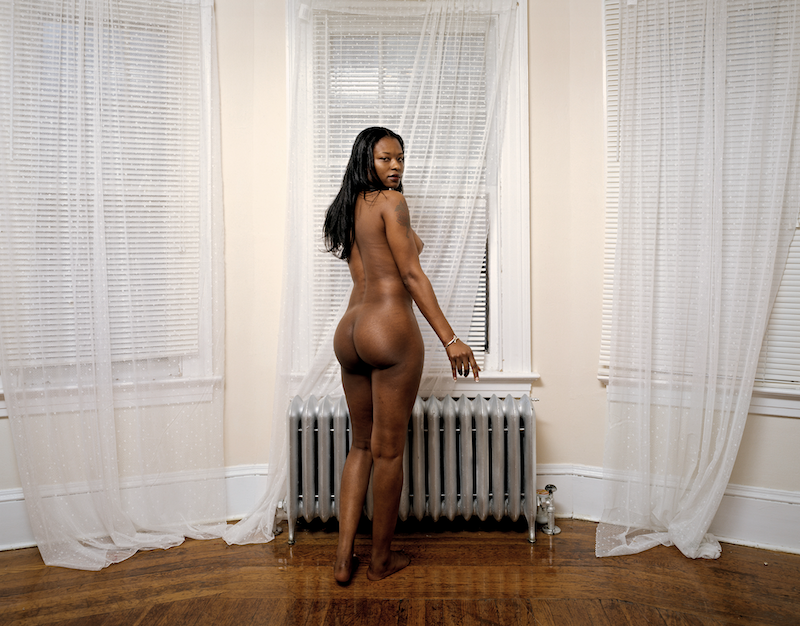
The Room Is Never Just a Room
Domestic space is one of Lawson’s most important formal and psychological tools.
The rooms often contain patterned upholstery, bedding, curtains, religious imagery, family photographs, cosmetics, televisions, plastic coverings, mirrors, electrical cords, food, clothing, and evidence of everyday use. These details are not neutral background information.
They act on the figures.
The room may suggest class, taste, memory, aspiration, intimacy, labor, protection, sexuality, family history, or social belonging. It can feel comforting and cramped, proud and precarious, familiar and theatrical.
This makes the setting an active pressure system.
The domestic interior tells us something about the subject, but it also complicates our desire to interpret the subject too quickly. The objects appear meaningful, yet their meanings are not entirely explained. They create an environment rich enough to invite projection but specific enough to resist becoming generic.
The room becomes part family archive, part stage, part psychological portrait.
For artists working with figures and environments, this is a major lesson:
A setting becomes powerful when it does not merely surround the figure but changes the conditions under which the figure can be seen.
Why the Formal Choices Matter
Lawson’s formal choices are inseparable from the deeper problem of her work.
Staging
Staging makes the photograph feel both truthful and unstable.
The image contains real people, bodies, belongings, and environments, but their arrangement has been directed. This prevents the viewer from treating the photograph as unmediated access to someone else’s life.
Staging exposes photography as construction.
At the same time, it allows Lawson to transform an individual encounter into something more concentrated, symbolic, and psychologically charged.
Direct gaze
Many of Lawson’s subjects look directly at the camera.
The gaze does not always ask for approval or invite easy intimacy. It can confront, resist, assess, seduce, or withhold. The subject becomes aware of being seen and appears to look back at the viewer through the camera.
That reverses the apparent power relationship.
The viewer may have visual access, but the subject is not necessarily passive within that access.
The body
Bodies in Lawson’s photographs are often physically present, sensuous, imperfect, decorated, exposed, or carefully posed.
The body carries sexuality, vulnerability, history, labor, family relation, age, status, and self-presentation. Yet the body is not treated merely as biological fact. It becomes a site where public meaning is written and contested.
Nudity does not automatically equal surrender.
Clothing does not automatically equal protection.
A body can be revealed and still remain sovereign.
Domestic detail
The density of objects gives each photograph a thick social and material atmosphere.
Nothing feels completely incidental. A curtain, cord, blanket, framed picture, television, hairstyle, wall color, or piece of furniture may alter how the entire scene is read.
The environment becomes a lexicon.
These objects do not merely describe a lifestyle. They help construct a world in which family, desire, memory, class, beauty, and aspiration remain active at once.
Large scale and clarity
When images associated with private albums or modest interiors are enlarged and placed inside museums, their social position changes.
The personal becomes monumental.
People and spaces that could be overlooked within dominant image culture acquire scale, ceremony, and authority. Lawson’s first museum survey emphasized more than fifteen years of work challenging conventional representations of Black life through multiple photographic forms. (ICA Boston)
The shift in scale is therefore not only visual. It is cultural.
The Central Contradiction
Lawson’s work holds several contradictions, but the most important is:
The image offers intimacy while making intimacy impossible to possess.
The viewer sees bodies, relationships, rooms, and gestures associated with private life. Yet the photographic construction prevents those things from becoming transparent.
The subjects may appear:
exposed but protected
familiar but unknown
ordinary but monumental
documentary but invented
sensual but self-possessed
socially vulnerable but pictorially powerful
specific individuals but also mythic figures
This is why the photographs continue opening after the first encounter.
They do not resolve into a simple celebration of family, an ethnographic document, an argument about representation, or a display of photographic style. Each of those readings is present, but none is sufficient by itself.
The contradictions remain active.
From Everyday Life to Myth
One of Lawson’s most distinctive achievements is her ability to elevate ordinary people without erasing the realities of their environments.
The photograph does not require wealth, polished architecture, fashionable restraint, or conventional ideals of refinement to create dignity. Instead, dignity emerges through pose, attention, scale, compositional control, physical presence, and the artist’s belief in the significance of the subject.
Critics have described Lawson’s visual world as one in which Black subjects acquire a sense of grandeur and restored glory. Her images move beyond correcting absence or demanding inclusion. They construct their own terms of beauty, kinship, sensuality, power, and spiritual significance. (The New Yorker)
That is more ambitious than representation alone.
Lawson is not merely asking that the subjects be seen.
She is changing the visual conditions under which seeing takes place.
How the Viewer Becomes Implicated
Lawson’s work gives the viewer an unstable role.
Are we a guest?
A family member?
A witness?
A voyeur?
An intruder?
A museum visitor consuming the signs of another person’s private life?
The photographs do not answer these questions for us. Instead, they make us feel the uncertainty.
The intimacy of the scenes encourages closeness, but their formal construction makes that closeness suspect. We become aware of our desire to interpret bodies, rooms, relationships, class, sexuality, and identity from visual evidence.
The photograph appears to give us information.
Then it reveals how quickly we turn information into assumptions.
This is where the work moves beyond representation and begins criticizing representation itself. In the MoMA PS1 discussion of Coulson Family, Lawson’s images are understood as intimate collaborations that resist stable categories of trauma, joy, documentary truth, or prescribed representation. (MoMA PS1)
The viewer is therefore not outside the pressure system.
Our looking completes it.
The Visual World Lawson Has Built
Across her practice, Lawson has developed a recognizable lexicon:
domestic interiors
frontal light
direct gazes
beds and couches
couples and family groups
nudity and adornment
mirrors and reflective surfaces
patterned fabrics
family photographs
hair, clothing, jewelry, and bodily presentation
intimate rooms transformed into ceremonial spaces
photographs that hover between family album and constructed icon
These elements form more than a style.
They create a world governed by a consistent intelligence: private life becomes staged visibility, visibility becomes power and risk, and ordinary space becomes mythic without ceasing to be materially specific.
What Artists Can Learn
The lesson is not to imitate Lawson’s interiors, direct flash, staged poses, or intimate subject matter.
The lesson is to understand how she makes intimacy structurally unstable.
For artists working with figures, rooms, photography, or domestic life, Lawson offers several larger principles:
An environment should carry social and psychological information.
A room should not merely identify a location. It should influence how the person inside it becomes visible.
Exposure and surrender are not the same thing.
A figure can reveal the body while withholding the self.
Staging can produce truth without pretending to be neutral.
Construction does not necessarily weaken authenticity. It can make the conditions of representation more visible.
Ordinary life can become monumental through attention.
The artist does not need to replace everyday experience with spectacle. The act of looking can change what a culture recognizes as valuable.
The viewer should not remain innocent.
A powerful portrait does more than present a person. It makes the viewer confront how they interpret, classify, desire, judge, or consume that person.
The larger lesson is this:
Intimacy becomes powerful when the image gives the viewer access but refuses possession.
Deana Lawson’s photographs do not merely show people inside private spaces. They create a system in which body, room, pose, photography, history, and viewer all place pressure on one another.
The lesson is not to copy the appearance of the work.
The lesson is to understand the pressure that made the appearance necessary.

What Makes Toyin Ojih Odutola’s Work So Powerful?
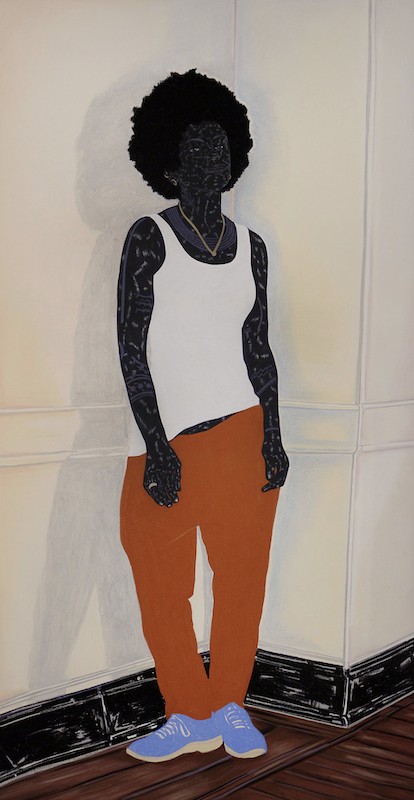
Toyin Ojih Odutola’s work is powerful because she turns surface into identity under construction.
Her drawings are immediately striking: dense marks, luminous skin, elaborate textures, stylized figures, invented aristocracies, domestic settings, social poise, and narrative ambiguity. At first, the viewer may notice the technical virtuosity — the way pen, pencil, charcoal, pastel, and mark-making build skin almost like terrain. But the deeper force of the work is not skill alone.
Ojih Odutola uses surface to ask what identity is made of, who gets to be imagined with complexity, and how race, class, history, fiction, and looking shape the person we think we see.
Skin as Terrain
Ojih Odutola first became widely known for highly detailed portrait drawings, often made with black pen ink. Her early work explored skin through layered marks, treating it less as a flat racial sign and more as a shifting, textured surface. Her practice later expanded into charcoal, pastel, chalk, pencil, and larger narrative works. (Wikipedia)
That is the first major lesson.
Skin is not simply rendered.
Skin is built.
Skin is marked.
Skin is terrain.
Skin is image.
Skin is social reading.
Skin is abstraction and identity at the same time.
In her work, drawing is not just a method of depiction. Drawing becomes a way to complicate the act of seeing. The surface of the body becomes so active, so layered, so deliberately made, that the viewer can no longer treat skin as a simple category.
This matters because much of visual culture reads identity too quickly. Ojih Odutola slows that reading down.
The Problem Beneath the Work
Her central problem might be stated this way:
How can drawing remake the social meanings attached to skin, identity, class, fiction, and visibility?
That question has evolved across her career.
Early work used dense mark-making to examine Blackness as a visual and social symbol. Later work moved toward invented narratives and fictional worlds: aristocratic families, imagined histories, speculative societies, and scenes of power, wealth, intimacy, and leisure. Coverage of her Whitney exhibition To Wander Determined described the work as large-scale, colorful portraits of fictional affluent Nigerian families, asking viewers to imagine Black wealth, elegance, queerness, and aristocratic ease outside the historical limits imposed by colonial narratives. (Vogue)
That is a major shift, but not a break.
The work moves from the surface of skin to the surface of social worlds.
Who gets to appear wealthy?
Who gets to appear relaxed?
Who gets to appear entitled?
Who gets to occupy elegance without explanation?
Who gets to be fictional without being reduced to biography?
Who gets to exist inside a world not organized around colonial damage?
That makes the work powerful. She does not merely represent identity. She builds worlds where identity can be reimagined.
Fiction as Freedom
One of Ojih Odutola’s strongest moves is her use of fiction.
She has said, in effect, that creating characters allowed viewers to engage with the imagery and stories rather than reducing the work to biographical interpretations of artists of color. Her fictional structures give her room to explore identity, wealth, class, desire, family, and power without forcing the work to become autobiography or documentary evidence. (Wikipedia)
This is important.
A weaker artist might think fiction makes work less serious. Ojih Odutola shows the opposite: fiction can create freedom.
Fiction lets her ask:
What histories were denied?
What worlds could have existed?
What forms of Black wealth, leisure, queerness, and power can be imagined without apology?
What does it mean to see Black figures who are not asking to be justified?
What happens when the image does not explain itself to the viewer?
Fiction becomes a way to resist the demand that Black identity be legible only through suffering, biography, or social proof.
The Figure as Social Construction
Ojih Odutola’s figures often feel composed, elegant, remote, and self-contained. They may occupy interiors, landscapes, family structures, or social systems that seem familiar and invented at the same time.
The viewer senses that there is a story, but does not fully receive it.
That withholding is powerful. It gives the figures interiority. They are not simply there for the viewer to decode. They belong to worlds with histories we only partially access.
This creates a strong contradiction:
visible and withheld
fictional and socially precise
surface-driven and psychologically charged
elegant and critical
Black-specific and speculative
portrait-like and not portraiture
narrative and unresolved
intimate and inaccessible
That is where her work gains depth. The viewer is drawn in by beauty, craft, and narrative possibility, but the work does not surrender the whole story.
Drawing as World-Building
Ojih Odutola is also important because she shows how drawing can operate at a high level.
Drawing is often treated as preparatory, intimate, or secondary to painting. Her work refuses that hierarchy. Drawing becomes monumental, complex, finished, and world-making.
Her tools — pen, charcoal, pastel, pencil, and mark — create not just figures, but social realities. The marks that build skin also build status, atmosphere, fiction, and power.
In A Countervailing Theory, her Barbican commission created a large narrative cycle set in an imagined ancient civilization in central Nigeria’s Jos Plateau. The project constructed a mythic social order involving gendered classes, power structures, and rebellion, extending her drawing practice into speculative history and world-building. (Wikipedia)
That is a very high-level move. The drawing is not only an image. It is part of a system.
Why the Choices Feel Necessary
Ojih Odutola’s formal choices are tightly connected to her problem.
Dense mark-making is necessary because skin is not treated as flat identity, but as constructed surface.
Fiction is necessary because the work imagines possibilities beyond inherited narratives.
Elegance is necessary because the figures occupy power, status, leisure, and self-possession.
Withholding is necessary because the figures are not there to explain themselves.
Narrative ambiguity is necessary because the viewer must sense a world larger than the image.
Drawing is necessary because the hand-made surface makes identity feel built, layered, and unstable.
A weaker artist might draw skin this way because it looks impressive. Ojih Odutola makes the mark carry social and conceptual force.
What Artists Can Learn from Ojih Odutola
The lesson is not to imitate her skin textures, fictional aristocracies, or drawing style.
The lesson is:
Surface becomes powerful when it changes how identity can be read.
Ojih Odutola shows that surface can be a site of construction, resistance, and reimagining. The figure does not have to reveal everything. The surface can make the viewer slow down, misread, reconsider, and enter a world that is not fully available.
This connects directly to the use of pattern and abstraction. If the pattern begins to overtake the figure, it should not only look visually complex. It should change the terms of identity. It should make the figure harder to consume quickly.
A figure can become surface.
A surface can become social code.
A mark can become identity pressure.
A fictional world can liberate the figure from biography.
A drawing can create a history that never existed but feels emotionally and politically necessary.
Closing Insight
Toyin Ojih Odutola’s greatness is not that she draws beautifully textured figures. It is that she turns surface, skin, mark-making, fiction, class, and narrative withholding into a way of remaking identity. Her work shows that a person is never just seen; they are constructed by the surfaces, stories, and worlds through which they become visible.
What Makes Rineke Dijkstra’s Portraits So Powerful?
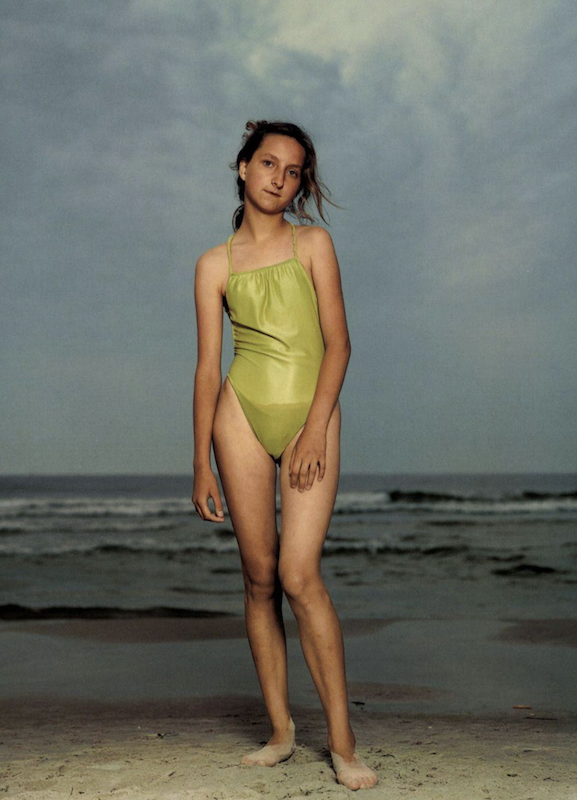
Rineke Dijkstra’s portraits are powerful because they show people at the moment when their social self is not fully assembled.
Her photographs are often simple: a figure stands facing the camera, centered, isolated against a minimal background. A teenager on a beach. A young soldier. A new mother. A bullfighter after a fight. A child in a park. The image does not appear heavily staged, theatrical, or conceptually elaborate.
But the deeper force of the work is that the subject seems caught between states.
They are trying to compose themselves, but not completely succeeding. They are visible, but not fully controlled. They are present, but not yet fixed into a stable public image.
That is the central tension in Dijkstra’s work:
The person is being seen before they know exactly how to appear.
The Problem of Transition
Dijkstra’s work returns to a durable problem:
How can portraiture reveal identity at moments of transition, when the self is vulnerable, unfinished, exhausted, exposed, or not yet socially stabilized?
This is why she often photographs adolescents, young soldiers, new mothers, and people immediately after physically or emotionally intense events. Her subjects are not usually shown performing dramatic action. They are shown in the strange stillness after or between events.
Dijkstra is known for working in series, including Beach Portraits, Almerisa, Olivier, Israeli Soldiers, Park Portraits, and video works such as Buzzclub/Mysteryworld. Her subjects are often shown standing, facing the camera, against minimal backgrounds, and many of her series follow people through adolescence, relocation, military service, or other transitional stages. (Wikipedia)
That structure matters. Dijkstra does not simply photograph “people.” She photographs people when identity is unstable.
The adolescent body is changing.
The soldier is being transformed by an institution.
The new mother has just crossed a bodily threshold.
The refugee child grows into a new social world.
The clubgoer performs identity under music, light, and social pressure.
Her work makes transition visible without turning it into spectacle.
The Beach as Exposure
Dijkstra’s Beach Portraits are among her best-known works. They show adolescents and younger children standing at the water’s edge in places across the United States and Europe. They are often full-length, frontal, nearly life-size color photographs. The settings are minimal: horizon, sea, sand, body, sky. (Wikipedia)
The beach is important because it strips away social protection.
Clothing is minimal.
The body is visible.
The background is open.
The subject has nowhere to hide.
The horizon gives scale.
The camera creates pressure.
But Dijkstra’s portraits are not cruel. They are not mocking adolescent awkwardness. They are deeply attentive to the dignity and uncertainty of becoming.
A swimsuit, posture, wet hair, tense hands, uneven stance, direct gaze, or slightly guarded expression becomes psychologically charged. The subject is not performing a polished identity. They are trying to stand inside their own body while being seen.
That is why the images feel so human.
Vulnerability Without Sentimentality
Dijkstra’s portraits are vulnerable, but not sentimental.
She does not exaggerate emotion. She does not overdramatize the scene. She does not use expressive blur, theatrical lighting, or obvious symbolism. Her restraint is part of the force.
The New Yorker described her work as combining objectivity and empathy, noting that her portraits capture moments of subtle revelation while maintaining a cool yet engaging quality. (The New Yorker)
That balance is crucial.
If the images were too warm, they might become sentimental.
If they were too cold, they might become clinical.
Dijkstra holds both distance and care.
This is one of her great lessons: a portrait can be emotionally powerful without forcing emotion. The subject’s posture, presence, and hesitation can carry the pressure.
The Social Self Under Construction
Dijkstra’s portraits often reveal the gap between who someone is and how they are trying to appear.
This is especially clear in adolescents. They may stand like adults, but the body betrays uncertainty. They may look directly at the camera, but the gaze is not fully armored. They may seem composed, but the pose is awkward. They may try to perform confidence, but vulnerability leaks through.
This connects directly to your current problem:
identity when the self becomes an image optimized for visibility.
Dijkstra shows what happens before the self is optimized. She shows the person before the image fully hardens.
That makes her especially valuable for your work. If you are studying the private self becoming a public image, Dijkstra gives you the fragile pre-image state: the moment before performance becomes polished.
Time and Transformation
Dijkstra often uses serial portraiture to show transformation over time.
Her Almerisa series follows a Bosnian refugee girl over many years, beginning when she was a child in an asylum center and continuing as she grows into adulthood. Her Olivier series follows a young man through his service in the French Foreign Legion. Her Shany series follows a young Israeli woman through stages of military service and after. (Wikipedia)
These projects are important because they show that identity is not a single image. It is cumulative.
A person changes through institutions, migration, adolescence, uniforms, family, time, class, and place. Dijkstra’s serial portraits allow the viewer to see both continuity and alteration.
That is very useful for your triptych idea.
A single portrait can show a state.
A series can show transformation.
A repeated format can reveal what changes and what remains.
This is one reason repetition is so powerful. It turns portraiture into evidence.
Why the Choices Feel Necessary
Dijkstra’s formal choices are quiet, but they are exact.
The frontal pose is necessary because it creates confrontation without drama.
The minimal background is necessary because it removes distraction and lets posture, clothing, gaze, and body carry meaning.
The large format is necessary because the subject gains presence and scale.
The repetition across series is necessary because identity is studied through comparison.
The restraint is necessary because the subject’s subtle discomfort needs room to appear.
The titles with place and date are necessary because the portraits are anchored in a real moment, not symbolic fantasy.
Her technique often includes a 4×5 view camera, tripod, and flash, even outdoors, producing sharp, carefully structured portraits that maintain both realism and psychological distance. (Wikipedia)
A weaker artist might photograph awkwardness as a style. Dijkstra uses awkwardness because transition itself is awkward.
A weaker artist might use a minimal background because it looks clean. Dijkstra uses minimalism because the subject’s presence needs nothing to hide behind.
What Artists Can Learn from Dijkstra
The lesson is not to imitate her beach portraits, large-format photography, or frontal compositions.
The lesson is:
Stillness can reveal pressure when the person is caught between private self and public appearance.
Dijkstra offers an important counterweight to pattern, abstraction, and visual transformation. She reminds you that the figure does not always need to be overwhelmed for the pressure to appear. Sometimes a hand, stance, gaze, or slight hesitation can reveal the entire problem.
Closing Insight
Rineke Dijkstra’s greatness is not that she photographs vulnerable people. It is that she finds the moment when identity has not yet hardened into performance. Her portraits show the fragile space between being a person and becoming an image — the awkward, dignified, exposed interval where the self is still in formation.
What Makes Carrie Mae Weems’s Work So Powerful?
Carrie Mae Weems’s work is powerful because she turns ordinary spaces into sites of witnessing.
Her photographs often appear direct: a woman at a kitchen table, a body in a room, a figure standing before a museum, a staged scene, a historical image with text. But the deeper force of the work is that nothing is merely personal and nothing is merely documentary. Domestic space becomes political. Private life becomes historical. Looking becomes ethical. Memory becomes contested.
Weems’s work asks again and again:
Who is seen, who is excluded, who gets to tell the story, and what histories live inside ordinary rooms, bodies, images, and institutions?
That makes her essential for studying how art can make social pressure visible without becoming simplistic illustration.
The Table as a Stage
Weems’s Kitchen Table Series is one of the clearest examples of a limited visual setup becoming expansive.
The series, completed around 1990, stages Weems herself at a kitchen table under a single overhead lamp, sometimes alone and sometimes with others. The table becomes a setting for relationships, solitude, motherhood, friendship, romance, conflict, thought, and self-possession. Sources describe the series as using Weems’s own constructed image to question tradition, family, monogamy, polygamy, and relationships between men, women, children, and other women. (Wikipedia)
That is the important move.
A weaker artist might think:
“I am photographing a woman at a table.”
Weems makes the table into a social theater.
The table becomes a place where gender is negotiated.
The lamp becomes a spotlight.
The room becomes a stage.
The domestic setting becomes public argument.
The private scene becomes collective memory.
This is high-level artistic economy. She does not need a complicated setting because the setting is charged.
Domestic Space Is Not Neutral
The domestic interior in Weems’s work is not just a home. It is a pressure system.
The kitchen table is associated with care, labor, family, nourishment, conversation, discipline, intimacy, argument, gender roles, solitude, and everyday survival. In Weems’s hands, that familiar space becomes a site where personal life and social power meet.
This matters because the work does not separate the emotional from the political. A woman sitting alone at a table can be a psychological image, but it can also be a cultural image. A family scene can be intimate, but it can also reveal expectations around gender, race, labor, motherhood, power, and visibility.
This is one reason Weems is so important for your work. She shows that a room can carry pressure before anything dramatic happens inside it.
A hotel room, café, street, museum, or patterned interior can also operate this way — not as background, but as a system that shapes what a person is allowed to be.
Presence and Withholding
Weems often appears in her own work, but her presence is not simple confession.
She uses herself as a figure, a witness, a performer, a constructed image, and an Everywoman. This allows the work to feel personal without collapsing into autobiography. Her body becomes a vehicle for larger questions.
In the Kitchen Table Series, she is present, but not fully explained. She looks, waits, listens, smokes, sits, leans, embraces, reads, and occupies the table. The viewer is close to her, but not in possession of her.
That creates a powerful contradiction:
intimate and staged
personal and collective
domestic and political
visible and withheld
ordinary and symbolic
private and historical
still and pressurized
This is one of Weems’s great lessons. The figure can be emotionally available without being fully accessible. The work can feel direct while still holding mystery.
Text, Image, and Historical Pressure
Weems’s work often combines image and text to challenge how history is narrated.
In series such as From Here I Saw What Happened and I Cried, she recontextualizes historical photographs and uses language to expose the violence of looking, classification, racial representation, and institutional power. Coverage of her career repeatedly notes that her work addresses family, beauty, memory, race, gender, class, and the historical representation of Black women and communities. (Time)
The key is that Weems does not treat images as innocent evidence.
A photograph can document.
A photograph can stereotype.
A photograph can wound.
A photograph can remember.
A photograph can exclude.
A photograph can be reclaimed.
A photograph can become testimony.
This gives her work ethical force. She asks not only what an image shows, but what system of power made that image possible.
The Viewer as Witness
Weems’s work implicates the viewer by making looking feel consequential.
In Kitchen Table Series, we are invited into an intimate domestic space, but we are not simply voyeurs. The repeated setup makes us aware of our own position: watching, interpreting, judging, empathizing, projecting. The woman at the table is not simply available to us. She holds the room.
In the historical work, the viewer becomes a witness to how images have been used, misused, archived, and racialized. We are asked to see not only the subjects of the photographs, but the conditions under which they were represented.
This is the deeper force:
Weems does not merely show people being seen. She asks what seeing has done to them.
That is directly relevant to your current problem around identity, visibility, and image culture.
Why the Choices Feel Necessary
Weems’s formal choices are unusually disciplined.
The fixed kitchen table setup is necessary because repetition turns the domestic scene into a structure of inquiry.
The black-and-white photography is necessary because it gives the images clarity, restraint, historical resonance, and theatrical focus.
The overhead lamp is necessary because it isolates the table as a charged zone.
The use of herself as a figure is necessary because the work moves between personal experience and collective representation.
The text is necessary because history, narration, and classification are part of the problem.
The staged quality is necessary because identity and social roles are not simply found; they are performed.
A weaker artist might use domestic space because it feels intimate. Weems uses domestic space because intimacy is where social power becomes visible.
What Artists Can Learn from Weems
The lesson is not to imitate black-and-white photography, kitchen tables, or text panels.
The lesson is:
A simple setting becomes powerful when it concentrates social, psychological, historical, and relational pressure.
Weems shows that the environment does not need to be visually elaborate to become charged. It needs to be structurally meaningful.
A café can become a stage of self-presentation.
A hotel room can become a site of anonymity and performance.
A museum can become a place where history looks back.
A patterned interior can become a mask.
A travel setting can become a fantasy of belonging.
A repeated room can become evidence of transformation.
Weems teaches that the room is never just a room when the right problem enters it.
Closing Insight
Carrie Mae Weems’s greatness is not that she photographs domestic life. It is that she turns domestic space, historical image, text, repetition, and the act of looking into a system of witness. Her work shows that private life is never merely private; it is where history, power, identity, and memory take shape.
What Makes Mickalene Thomas’s Work So Powerful?
Mickalene Thomas’s work is powerful because she turns glamour into a field of authority.
Her paintings are dazzling: rhinestones, acrylic, enamel, collage, patterned interiors, animal prints, wood paneling, saturated color, reclining women, confident gazes, domestic rooms, art-historical poses, and visual excess. At first, the work can look like celebration: beauty, sexuality, style, pleasure, confidence, abundance.
But the deeper force is not decoration. Thomas makes glamour political, psychological, historical, and spatial. The women in her paintings are not simply displayed. They command the image. They occupy the room. They return the gaze.
That is the central tension in her work:
The image may seduce the viewer, but the subject controls the encounter.
Pattern as Power
Thomas is known for elaborate mixed-media paintings using rhinestones, acrylic, and enamel; her work draws from Western art history, pop art, visual culture, and Black cultural experience to explore femininity, beauty, race, sexuality, and gender. (Wikipedia)
That mix matters. In weaker hands, rhinestones and pattern could become surface effect. In Thomas’s work, they become a system of visual power.
Pattern does several things at once:
It attracts the eye.
It builds the room.
It amplifies the figure.
It creates rhythm and excess.
It references fashion, domestic interiors, and popular culture.
It refuses quiet invisibility.
It turns the subject into someone who takes up space.
The room is not neutral. The sofa, wall, rug, plant, dress, and backdrop become part of the figure’s authority. The pattern does not merely surround the subject; it stages her.
This is one of the key lessons for your own work:
Pattern becomes serious when it controls the psychology of the encounter.
Reclaiming Art History
Thomas often reworks art-historical poses and compositions, especially those associated with the female nude, the odalisque, and modernist painting. She has drawn on sources such as Manet, Matisse, Courbet, Romare Bearden, Faith Ringgold, and popular visual culture. Her large-scale Le déjeuner sur l’herbe: Les Trois Femmes Noires reimagines Manet’s famous composition through three fully clothed Black women occupying the pictorial space with confidence and scale. (Wikipedia)
That is not simply appropriation. It is correction and transformation.
The history of Western painting is full of women posed for looking. Thomas changes the terms of that looking. Her subjects are glamorous, sensual, and staged, but they do not feel passive. They look back. They occupy the scene knowingly. They are not there to be consumed without consequence.
Thomas does not abandon pleasure. She reclaims it.
This is why her work is more complex than simple celebration. It asks:
Who gets to recline?
Who gets to be monumental?
Who controls glamour?
Who owns the gaze?
Who gets represented as desirable, powerful, stylish, and self-possessed?
What happens when Black women take up the positions historically reserved for white female muses?
The Room as a Stage
Thomas’s interiors are crucial.
They often include domestic furniture, patterned upholstery, plants, wood paneling, rugs, mirrors, and staged living-room elements. These rooms can feel like 1970s rec rooms, domestic sanctuaries, theatrical sets, memory spaces, and image-making studios all at once. A Vogue profile of her photographic practice notes that her exhibition Muse included an installation referencing 1970s rec rooms from her New Jersey upbringing, and describes her practice as centered on African-American women, muses, real interactions, and staged domestic settings. (Vogue)
The interior is not just background. It is a social and emotional architecture.
The room tells us about taste, memory, class, intimacy, performance, family, sexuality, and self-presentation. Thomas’s figures are not floating symbols. They are located inside designed environments that amplify their presence.
Thomas shows that an interior can become a pressure system. A room can stage identity. A sofa can become a throne. A wall can become a cultural field. A patterned surface can become authority.
The Gaze Is Reciprocal
One of Thomas’s great strengths is the way her figures meet the viewer.
They are often reclining, posed, dressed, ornamented, and surrounded by visual pleasure. But they do not feel unaware. They are not simply looked at. They look back.
Her subjects are often described as asserting agency through the gaze; accounts of her work emphasize that her sitters challenge the traditional male gaze and control the viewer’s encounter. (Wikipedia)
This is the difference between seduction and possession.
Thomas allows the image to be seductive. But the subject does not surrender power. The viewer may be drawn in by color, rhinestones, pattern, flesh, pose, or glamour, but the figure’s gaze creates resistance. The viewer becomes aware of looking.
That is a high-level move. It implicates the viewer without rejecting pleasure.
The question is not simply:
Do you find this beautiful?
The deeper question is:
What are you doing when you look, and who has power in this exchange?
Excess Without Collapse
Thomas’s work often contains a lot: pattern, shine, bodies, art history, domestic space, collage, fashion, sexuality, color, references, decorative surfaces, and scale.
The danger of excess is visual noise. But Thomas’s strongest works hold excess through composition and authority. The density does not collapse because the figure anchors the image. The room may be loud, but the subject is louder.
This creates a powerful contradiction:
decorative and commanding
seductive and confrontational
intimate and theatrical
domestic and monumental
glamorous and political
pleasurable and critical
surface-driven and historically charged
That contradiction is why the work lasts. It is not one thing. It is celebration, critique, desire, memory, power, pleasure, and reclamation all at once.
Why the Choices Feel Necessary
Thomas’s formal choices are not arbitrary.
Rhinestones are necessary because artifice, glamour, light, and surface are part of the work’s subject.
Pattern is necessary because the room and body are both constructed through visual codes.
Scale is necessary because the figures take up pictorial and historical space.
The gaze is necessary because the subject must control the encounter.
Art-historical reference is necessary because the work revises who has been pictured, desired, centered, and monumentalized.
Domestic interiors are necessary because identity is staged through space, taste, intimacy, and cultural memory.
A weaker artist might use pattern because it is attractive. Thomas uses pattern because it helps build power.
A weaker artist might use glamour because it seduces. Thomas uses glamour because seduction itself is part of the politics of visibility.
What Artists Can Learn from Thomas
The lesson is not to imitate rhinestones, 1970s interiors, reclining women, or maximal pattern.
The lesson is:
Surface can become power when it controls the terms of visibility.
Thomas shows that decoration is not automatically shallow. Glamour is not automatically superficial. Pattern is not automatically ornamental. These things become serious when they carry agency, history, desire, memory, and viewer implication.
Thomas offers a direct challenge:
Do the patterns merely beautify the figure, or do they change the power relationship?
Does the setting merely decorate the scene, or does it stage identity?
Does the figure simply appear, or does she control how she is seen?
Does visual pleasure soften the work, or does it sharpen the viewer’s awareness of looking?
Thomas shows that becoming an image does not always mean becoming passive. Sometimes image-making can become self-possession, theatricality, power, and refusal.
Closing Insight
Mickalene Thomas’s greatness is not that she makes glamorous, patterned paintings of women. It is that she turns glamour, pattern, surface, domestic space, art history, and the gaze into a system of power. Her subjects do not simply appear inside beautiful rooms. They take possession of the image.
What Makes Cindy Sherman’s Work So Powerful?
Cindy Sherman’s work is powerful because she makes identity feel constructed, performed, unstable, and strangely empty.
Her photographs often look like portraits, but they are not portraits in the usual sense. They show Sherman transformed into different characters: actresses, housewives, socialites, clowns, historical figures, grotesque bodies, fashion types, aging women, movie clichés, and artificial selves. But the more roles she performs, the less we feel we are getting closer to the “real” Cindy Sherman.
That is the force of the work.
Sherman does not use costume to reveal a hidden self. She uses costume to show that much of what we call identity is already made from images, roles, poses, fantasies, stereotypes, and cultural scripts.
Identity as Performance
Sherman’s central problem might be stated this way:
How does the self become constructed through images, roles, costumes, stereotypes, gender expectations, and the viewer’s projections?
That question has generated decades of work.
Sherman is best known for photographic self-portraits in which she depicts herself across many contexts and invented characters. Her breakthrough series, Untitled Film Stills, consists of black-and-white photographs from 1977–1980 in which she stages herself as female types associated with film, mass media, Hollywood, film noir, B movies, and European art-house cinema. (Wikipedia)
That series is crucial because the images feel familiar even when they do not come from actual films. They seem like scenes we almost remember. A woman stands in a kitchen. A woman waits on a road. A woman looks off-frame. A woman appears vulnerable, glamorous, suspicious, trapped, desirable, anxious, or exposed.
But there is no real movie.
The image gives us a role without a story.
That is Sherman’s brilliance. She shows how quickly viewers invent identity from visual codes.
The Self as Image
In the Untitled Film Stills, Sherman does not simply dress up as different women. She performs the visual languages through which women have been pictured.
The office girl.
The housewife.
The bombshell.
The girl on the run.
The lonely woman.
The actress.
The vulnerable woman in a room.
The woman seen by an implied camera, audience, or gaze.
Sources on the series describe these photographs as staged female roles inspired by 1950s and 1960s Hollywood, film noir, B movies, and European art-house cinema, representing feminine clichés embedded in the cultural imagination. The characters often look away from the camera, which preserves ambiguity and suggests a story outside the frame. (Wikipedia)
That off-frame gaze matters.
The woman is not simply posing for us. She appears caught inside a larger story, but we do not know the story. The viewer has to fill in the narrative. We become part of the machinery that produces the character.
We project onto her.
That means the work is not only about how women are represented. It is also about how viewers consume representation.
No Stable Original
One of Sherman’s strongest moves is that she appears in nearly all the work, but the work does not feel autobiographical in a simple way.
She is the model, photographer, director, costumer, performer, and subject. But the images do not say, “This is who I am.” They ask, “What makes you think you know who this is?”
This creates a powerful contradiction:
self-portrait, but not self-revelation
visibility, but not access
performance, but no stable performer
femininity, but as costume
identity, but as constructed image
intimacy, but through artifice
recognizable, but fictional
familiar, but empty
That is why Sherman is so important for the AI age and image culture. She anticipated a world where the self can be endlessly restyled, filtered, posed, edited, generated, and circulated. A recent review of a Hauser & Wirth exhibition noted that Sherman’s work anticipated social media and the construction of identity for the camera, emphasizing her relevance to contemporary digital self-presentation. (Wallpaper*)
Sherman’s work feels more relevant now because identity has become even more image-mediated.
The Pressure Beneath the Disguise
At first, Sherman’s work can seem playful: costumes, wigs, makeup, scenes, characters.
But the pressure is deep.
Her work asks:
Who created these roles?
Who benefits from them?
Why do they feel familiar?
Why do we recognize a person as a type so quickly?
What happens when femininity becomes a costume?
What happens when identity is assembled from images?
What does the viewer want from these characters?
Where is the person beneath the role?
Is there a person beneath the role?
That final question is unsettling.
Sherman’s work often does not reassure us that there is an authentic, stable self waiting behind the image. Instead, the image keeps producing more images.
A weaker artist might use costume to create fantasy. Sherman uses costume to expose fantasy as a system.
The Viewer’s Role
Sherman’s work strongly implicates the viewer.
The viewer looks at a character and immediately starts reading her: innocent, dangerous, pathetic, glamorous, sexual, lonely, ridiculous, powerful, desperate, artificial. But the work makes us aware that we are doing this.
We are not neutral.
We bring movie memory, gender expectations, stereotypes, desire, suspicion, pity, class assumptions, fashion codes, and cultural scripts to the image. Sherman’s characters become mirrors for the viewer’s projections.
This is why the images do not need explicit explanation to feel charged. They look like familiar media images, but they do not behave comfortably. They expose the viewer’s habit of turning a person into a type.
For your own work, this is an important lesson:
A figure can be psychologically charged not because the figure reveals herself, but because the viewer becomes aware of how quickly they construct her.
That connects directly to your interest in the self becoming a public image.
The Body Becomes Less Stable
Sherman’s later work often moves beyond cinematic femininity into grotesque, artificial, aging, monstrous, clownish, wealthy, historical, and digitally manipulated characters. The beauty becomes stranger. The costumes become more excessive. The masks become less seamless.
This matters because Sherman’s problem keeps evolving.
If the early work asks how women are constructed by film and visual culture, the later work asks what happens when those constructions become grotesque, aging, decaying, ridiculous, monstrous, or digitally unstable.
The performance does not resolve. It mutates.
A 2024 Guardian profile describes Sherman as a trailblazer in portrait photography known for transformations into many personas, with recent work engaging selfie culture and even experiments with AI. (The Guardian)
That is exactly why her practice remains alive. The generative problem keeps absorbing new forms of image culture.
Why the Choices Feel Necessary
Sherman’s choices are necessary because every formal device supports the problem of constructed identity.
Costume is necessary because identity appears through social codes.
Makeup is necessary because the face becomes an artificial surface.
Photography is necessary because the work is about mediated images, not only bodies.
Staging is necessary because identity appears as role.
Untitled works are necessary because the image remains ambiguous and unresolved.
Cinematic framing is necessary because viewers bring movie memory and narrative expectation.
Self-performance is necessary because Sherman turns herself into both subject and image-machine.
A weaker artist might dress up because transformation is fun or visually interesting. Sherman uses transformation because the self in her work is produced by roles.
What Artists Can Learn from Sherman
The lesson is not to imitate Sherman’s wigs, photographs, cinematic staging, or costume changes.
The lesson is:
Identity becomes powerful as an artistic problem when the image of the self is shown as constructed, unstable, and culturally coded.
Sherman helps clarify the risk and opportunity:
The risk is making attractive images of attractive personas.
The opportunity is to reveal the persona as a construction.
A figure can become:
a tourist self
a romantic self
a luxury self
a social-media self
a desired self
a family self
a public self
an algorithmic self
a performed self
an image-self
The key is not simply to show different looks. The key is to make the viewer feel the role being built.
Closing Insight
Cindy Sherman’s greatness is not that she transforms herself into different characters. It is that she shows how identity itself is manufactured through images, roles, costumes, stereotypes, media memory, and the viewer’s projections. In Sherman’s world, the self does not appear before the image; the self is produced by the image.
What Makes Alex Katz’s Paintings So Powerful?
Alex Katz’s paintings are powerful because they make surface feel like a serious condition of modern life.
His portraits, landscapes, and social scenes often appear direct, stylish, simplified, and emotionally cool. Faces are flattened. Backgrounds are clean. Color is crisp. Detail is reduced. The people seem present but not psychologically opened. They are visible, elegant, composed, and distant.
At first, this can make the work seem almost too easy.
But Katz’s deeper achievement is that he makes appearance itself the problem. His paintings ask what it means to see a person as an image, a silhouette, a social presence, a moment, a style, or a flash of perception before deeper knowledge arrives.
That makes him very relevant to your current direction.
The Problem of Surface
Katz returns to a deceptively difficult problem:
How can painting capture the immediacy of appearance without turning people into psychological narratives?
His work does not usually search for hidden trauma, deep confession, or expressive turmoil. Instead, Katz paints the social and perceptual surface: the face seen quickly, the fashionable figure, the party, the summer landscape, the cropped glance, the person as they appear in a moment.
His paintings are often divided between portraiture and landscape, with recurring subjects including New York social circles, family, writers, artists, Maine landscapes, and especially his wife Ada, whom he has painted repeatedly for decades. His style is widely associated with flat color, economy of line, large scale, emotional detachment, dramatic cropping, and influences from film, television, billboard advertising, Japanese woodcuts, and modern visual culture. (Wikipedia)
That combination matters.
Katz is not painting inner psychology in the traditional sense. He is painting social visibility.
The person appears as image.
The face becomes surface.
The moment becomes design.
The social world becomes composition.
The painting withholds depth by staying on the edge of appearance.
A World of Cool Presence
Katz has created a very recognizable visual world:
flat fields of color
clean silhouettes
cropped faces
large scale
fashionable clothing
summer light
social ease
cool expressions
minimal detail
clear edges
figures against simplified grounds
landscapes reduced to atmosphere and immediacy
His paintings often feel like they belong to the world of magazines, cinema, advertising, fashion, and modern leisure — but slowed down into painting.
This is why the work is so important for studying style. Katz proves that style can be serious when it becomes a way of seeing.
A weak artist might use style to make the image look current, polished, or attractive.
Katz uses style to ask what kind of person appears in the modern visual field: a face glimpsed, a body cropped, a figure held at a social distance, a person turned into a cool, legible image.
Emotional Detachment as Pressure
Katz’s paintings are often described as emotionally detached. That detachment can be misunderstood as a lack of feeling.
But in the strongest work, the detachment is the pressure.
The figures do not give themselves away. They often look composed, stylish, socially available, but psychologically withheld. They do not appear tortured, confessional, or dramatically expressive. Instead, they seem to exist at the surface of social life.
That creates a powerful contradiction:
intimate but distant
stylish but emptying
beautiful but withholding
public but private
immediate but unknowable
social but solitary
cool but strangely tender
This is why Katz matters for your work. You are interested in the private self becoming public image. Katz gives us one important model: the self as social surface, flattened by visibility, fashion, and perception.
Ada and Repetition
Ada Katz is one of the most important recurring figures in Katz’s work. He has painted her many times across decades, and she has been described as appearing in over a thousand of his works. (Wikipedia)
That repetition is not merely romantic or biographical. It lets Katz treat the same person as a changing image across time.
Ada becomes:
wife
muse
social figure
silhouette
icon
profile
face
fashion presence
formal structure
public image
private relationship transformed into painting
This is where Katz becomes useful for thinking about repetition.
Repetition does not only say, “Here is the same person again.” It asks how the same person changes when seen through different formats, scales, crops, colors, seasons, clothes, and social atmospheres.
For your triptychs, that is very relevant. The repeated figure can become a way to study how identity shifts under changing conditions.
Cropping, Scale, and the Image-Self
Katz’s use of large scale and dramatic cropping is central to his force.
In the early 1960s, he began making large paintings influenced by film, television, and billboard advertising, often with dramatically cropped faces. (Wikipedia)
That matters because the crop changes the person. The face becomes cinematic. The body becomes image. The figure becomes immediate, public, almost advertised.
The viewer is close, but not intimate.
This is one of Katz’s great tensions. A huge face should feel personal, but in Katz it often feels cool, graphic, and socially distanced. Enlargement does not reveal more interiority. It turns the person into a sharper image.
That is a major lesson:
Visibility can enlarge the image while withholding the self.
Why the Choices Feel Necessary
Katz’s formal choices are not accidental.
The flat color is necessary because the work is about surface, immediacy, and the reduction of perception.
The clean contour is necessary because the figure becomes a social and visual sign.
The cropping is necessary because modern seeing is partial, cinematic, photographic, and fast.
The emotional coolness is necessary because the figures exist as social surfaces rather than psychological confession.
The large scale is necessary because it turns ordinary appearance into public presence.
The fashion details are necessary because clothing carries social information, period, taste, class, personality, and self-presentation.
The simplification is necessary because Katz is not painting everything he sees. He is painting what remains after perception becomes image.
The Danger of Thinness
Katz is especially useful because he shows both the strength and danger of surface.
The danger is that stylish surface can become thin. A painting can look cool, attractive, modern, and confident, but if nothing is being pressured underneath, it may stop at elegance.
Katz’s best work avoids this because the coolness itself becomes the subject. His paintings are not merely stylish; they study the social and perceptual condition of style.
The stronger move is to make style itself unstable:
style as mask
style as performance
style as social armor
style as visibility strategy
style as flattening
style as self-protection
style as the point where the private self becomes image
That is how surface becomes pressure.
What Artists Can Learn from Katz
The lesson is not to imitate Katz’s flatness, clean edges, portraits, or cool expressions.
The lesson is:
Surface becomes serious when it reveals how people appear inside a visual culture.
Katz shows that a figure does not need to be distorted, anguished, fragmented, or overtly symbolic to carry pressure. Sometimes the pressure is in composure. Sometimes it is in the refusal of confession. Sometimes it is in the way a person becomes a clean image.
The warning:
Do not let beauty, fashion, travel, and color remain only stylish.
The guide:
Make style reveal the conditions of being seen.
Closing Insight
Alex Katz’s greatness is not that he paints stylish people with flat color. It is that he makes modern appearance itself feel like a serious artistic problem: the person as image, the moment as surface, the social self as something visible, elegant, immediate, and withheld.