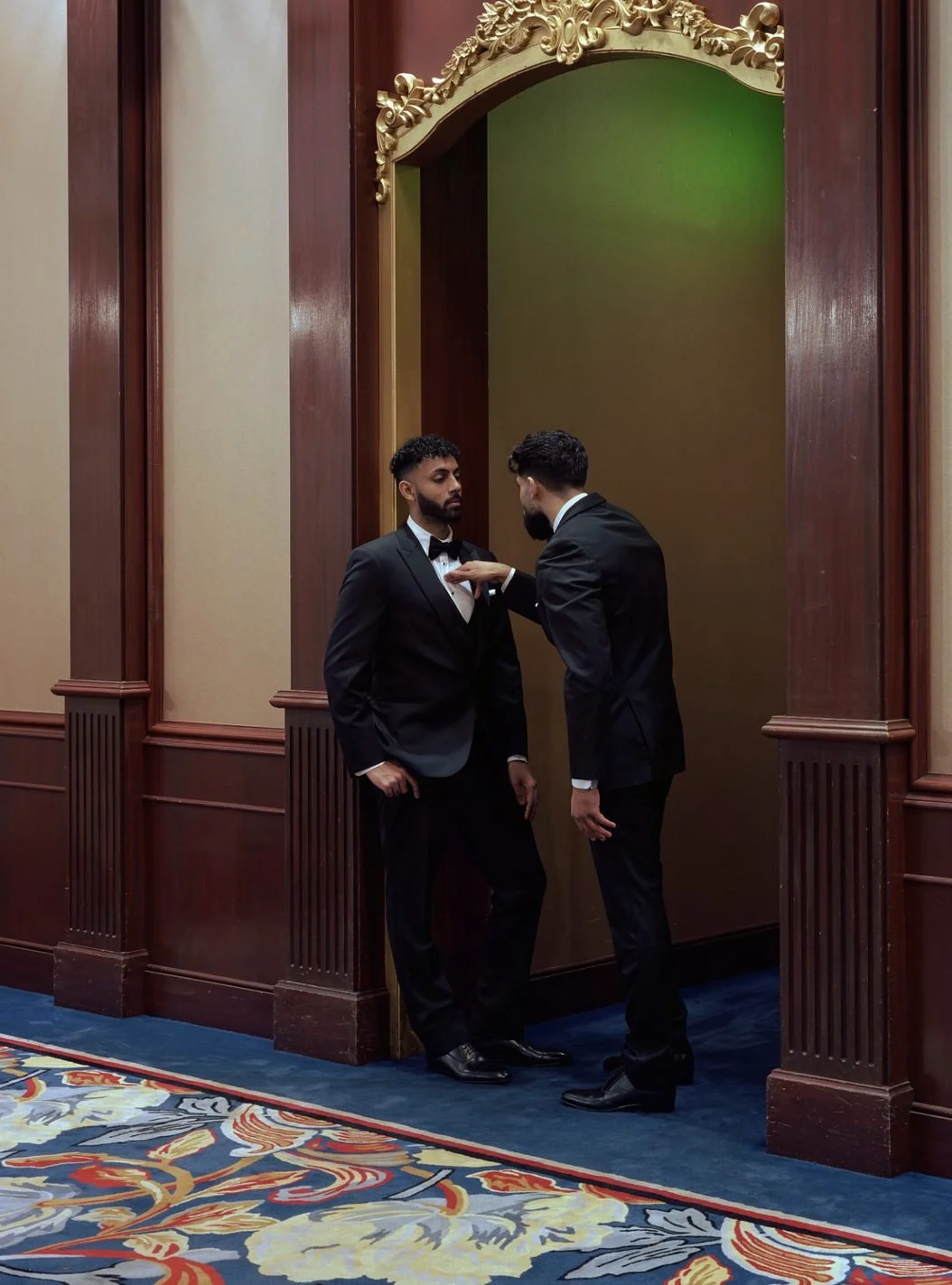
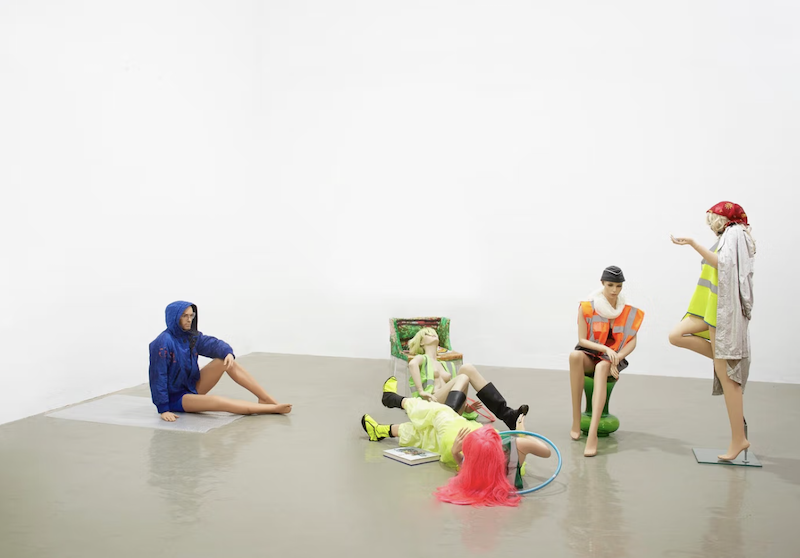
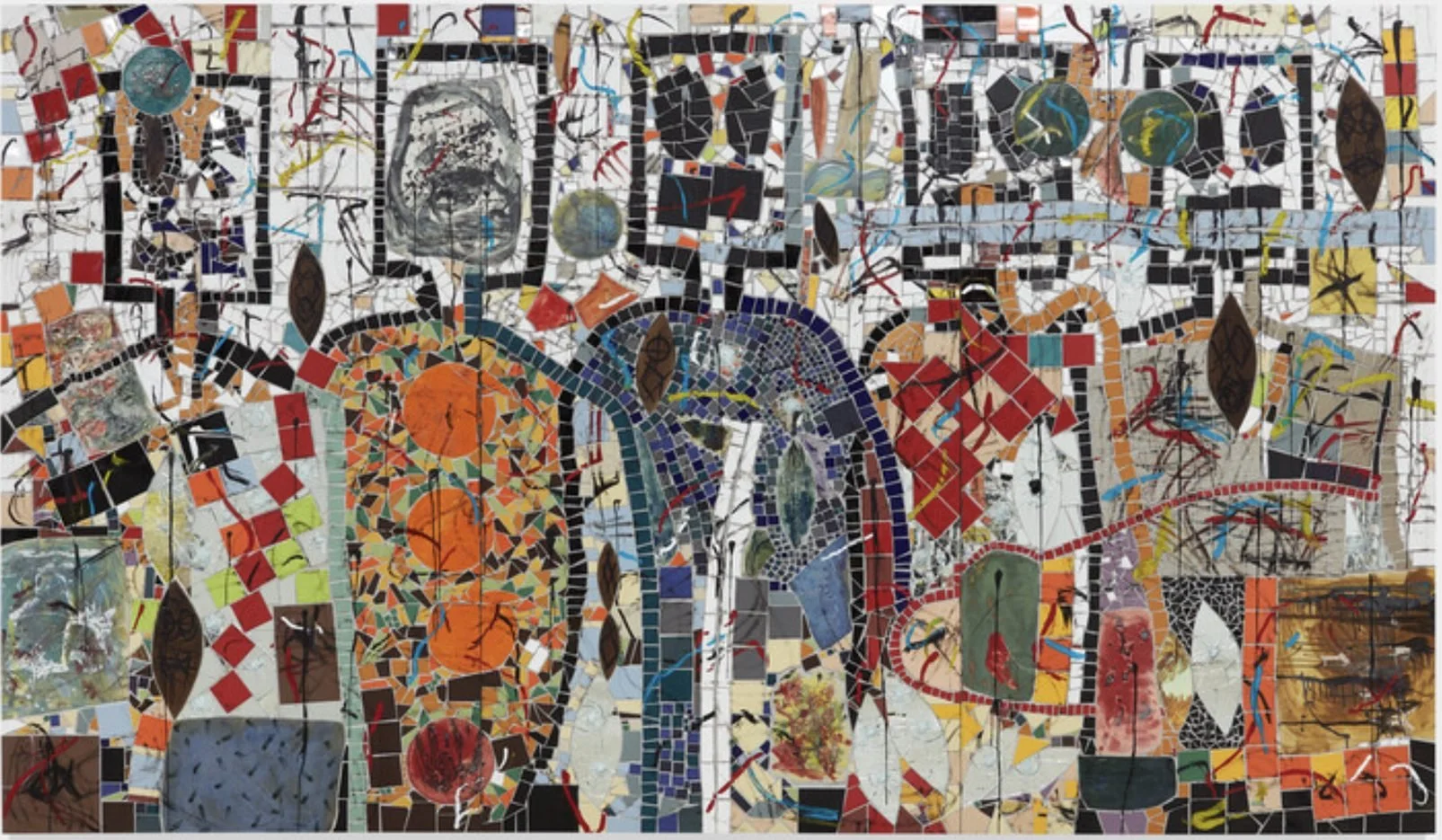
What Makes Tschabalala Self’s Work So Powerful?
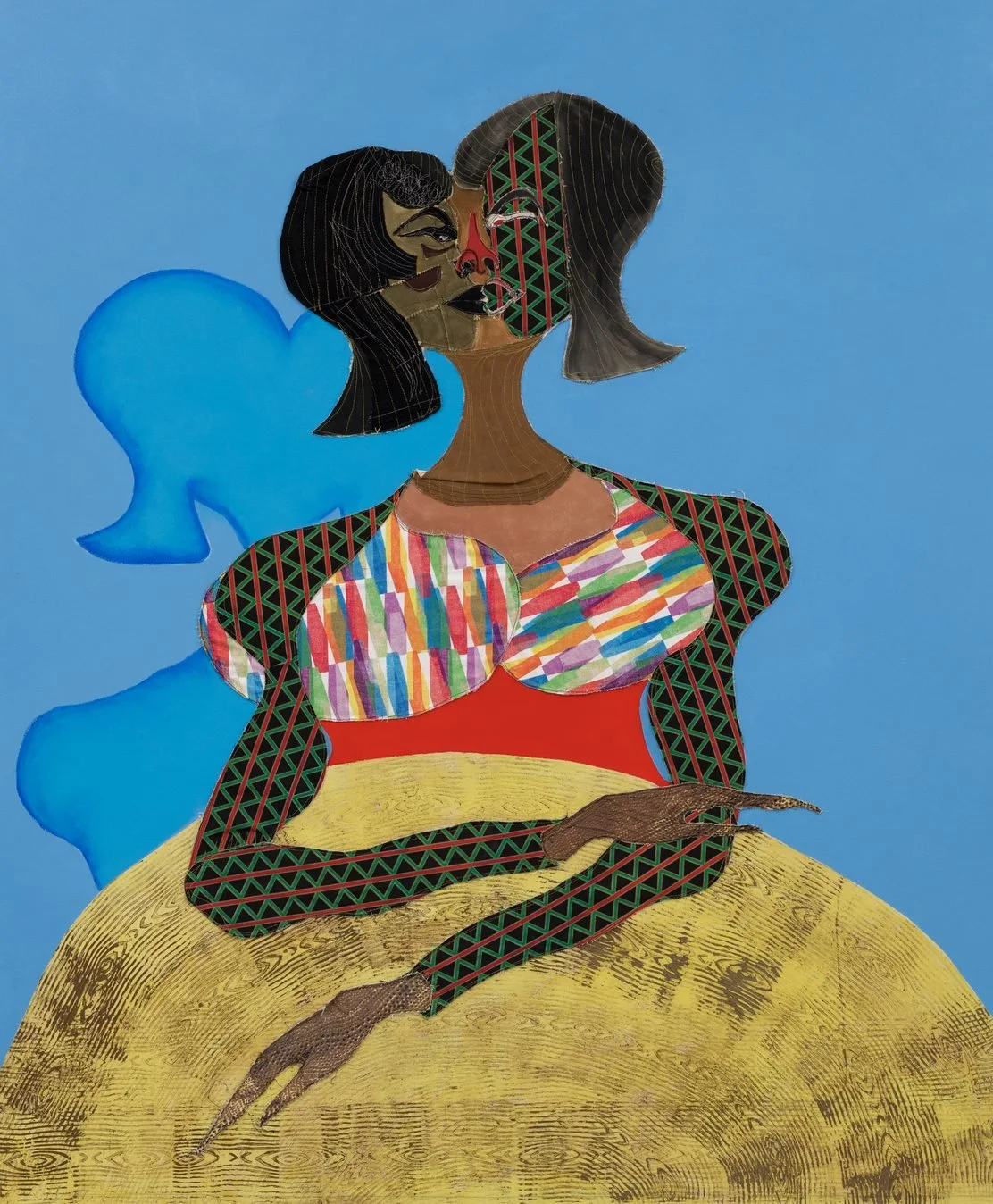
Tschabalala Self’s work is powerful because she makes the body behave like a construction site for identity.
Her figures are assembled from:
painted canvas;
printed fabric;
sewn seams;
drawing;
collage;
spray paint;
oil pastel;
exaggerated limbs;
compressed spaces;
conflicting textures;
fragments that refuse to disappear into one seamless whole.
A hip may seem to belong to one body while a hand appears to come from another visual system. A torso may be built from patterned cloth while the face is drawn with a different kind of line. Clothing can merge with skin. Background can enter the body. A figure may look self-possessed, theatrical, vulnerable, sensual, confrontational, awkward, and socially alert at the same time.
Self’s central inquiry might be stated this way:
How can figuration represent a person as psychologically and socially complex when the body has already been burdened by stereotype, fantasy, projection, and inherited visual codes?
Her work does not attempt to remove all cultural projections and reveal a pure individual underneath.
Instead, she builds figures who absorb those projections, resist them, perform through them, and exceed them.
The result is not a portrait of identity as essence.
It is identity as assembly.
What the Viewer Encounters
Self works across painting, printmaking, collage, sewing, sculpture, and performance, while maintaining a sustained concern with figuration and Black embodiment. Her official biography describes a practice built through the combined use of painting, printmaking, and sculpture, particularly through sewn, printed, and painted materials. (Tschabalala Self)
The viewer may encounter:
monumental figures occupying nearly the entire canvas;
bodies assembled from incompatible materials;
patterned fabric crossing the boundary between clothing and flesh;
exaggerated thighs, hips, mouths, hands, eyes, or genitalia;
characters in bedrooms, bodegas, streets, interiors, or theatrical spaces;
couples in moments of intimacy, tension, display, or mutual observation;
standing and seated figures that appear both sculptural and performative;
bronze bodies that translate her collaged anatomy into three dimensions.
The figures are often instantly legible as bodies, yet difficult to stabilize.
One knows where the person is.
One does not always know where one visual system ends and another begins.
This instability is not a failure of anatomical coherence.
It is the work’s psychological structure.
The Inquiry Beneath the Work
Black bodies in Western visual culture have often been subjected to reductive representation.
They have been:
stereotyped;
sexualized;
exoticized;
criminalized;
idealized;
fetishized;
flattened into symbols;
made to stand for social categories before being allowed individual complexity.
Self’s work confronts that condition without simply producing corrective images of respectable, dignified, or idealized subjects.
She does not replace one fixed image with another.
Instead, she creates characters with desires, moods, contradictions, social roles, private fantasies, and active interiority.
Her gallery has described her work as concerned with the agency involved in myth creation and the emotional effects of projected fantasy, while emphasizing that her characters retain power over self-presentation and external perception. (Galerie Eva Presenhuber)
The key issue is not merely representation.
It is authorship.
Who controls the story a body is made to tell?
The Body as Assembly
Self’s figures are built visibly from parts.
This matters because identity is not presented as one continuous surface.
The figure may contain:
one fabric for the torso;
another for the leg;
a painted hand;
a drawn face;
a stitched outline;
a fragment from an earlier work;
a patterned shape that behaves ambiguously as clothing, skin, shadow, or environment.
The parts remain distinguishable.
The body becomes coherent without becoming seamless.
That formal structure produces a powerful proposition:
A person can be whole without being uniform.
Wholeness does not require visual consistency.
The figure’s unity comes from relation among fragments.
Sewing as a Model of Identity
Sewing carries conceptual weight in Self’s practice.
A seam joins two things while preserving evidence that they were once separate.
It does not erase difference.
It holds difference together.
This distinguishes sewing from illusionistic blending.
A painted transition can make one form appear to dissolve smoothly into another.
A stitched seam insists upon attachment.
The connection is physical.
The figure therefore becomes a record of construction.
A body can contain:
inherited histories;
social roles;
performed identities;
imposed fantasies;
private desires;
contradictory emotional states.
The seam does not resolve those elements.
It gives them a structure in which to coexist.
Fabric and Social Meaning
Fabric carries histories that paint alone does not automatically possess.
It can suggest:
clothing;
domestic labor;
family memory;
decoration;
commerce;
class;
femininity;
cultural belonging;
bodily intimacy;
craft traditions;
mass production.
Fabric is already social before it enters the painting.
Its patterns may recall interiors, dresses, upholstery, shops, quilts, home environments, or vernacular design.
When Self uses fabric to build a body, the figure appears materially entangled with the social world.
The person is not placed inside culture.
The person is constructed through it.
Clothing and Skin
In many of Self’s figures, clothing and body are difficult to separate.
A patterned area may initially appear to be a dress.
Then it may become part of the torso.
A painted surface may behave like skin in one passage and fabric in another.
This instability complicates the boundary between:
body and costume;
identity and performance;
interior self and outward presentation;
person and social code.
Clothing can be:
self-expression;
protection;
seduction;
aspiration;
class signal;
armor;
disguise;
conformity.
But if clothing enters the body structurally, then performance is not merely placed on top of identity.
It helps produce identity.
Exaggeration and Psychological Weight
Self exaggerates bodily features, but exaggeration does not operate uniformly.
A large hand may carry agency.
A widened hip may carry sensuality, stability, social projection, or visual power.
A small head may shift emphasis toward posture and bodily presence.
A compressed face may make expression feel more ambiguous.
The exaggeration directs psychological weight.
It asks the viewer to notice which parts of the body have become socially overread.
Her practice has long been associated with exaggerated depictions of the Black female body through painted, sewn, and printed materials. (Pilar Corrias)
The crucial question is not:
Is the body anatomically correct?
It is:
What cultural and emotional pressure has made this part of the body visually dominant?
Stereotype and Dimensionality
A stereotype reduces a person to a few repeatable characteristics.
It flattens.
Self’s figures resist that flattening not by becoming conventionally realistic, but by becoming more structurally complex.
One figure may contain:
sensual confidence;
theatrical self-awareness;
defensiveness;
humor;
vulnerability;
vanity;
social intelligence;
private uncertainty.
The body may still activate familiar cultural associations, but those associations no longer control the whole figure.
The character has more dimensions than the stereotype can contain.
This is one of Self’s deepest achievements:
She does not pretend projected fantasies can simply be removed. She builds figures capable of surviving and exceeding them.
The Figure as Character
Self often speaks of her figures as characters rather than portraits of specific sitters.
This distinction matters.
A portrait may imply that the artwork records an existing person.
A character is constructed.
It has:
posture;
desire;
history;
social position;
psychology;
relation to others;
a world it inhabits.
Self’s characters are not generic symbols.
They often feel as though they existed before the viewer arrived and will continue afterward.
Their bodies imply active histories.
Her Bodega Run project, for example, presents figures with psychologies, desires, and social histories rather than reducing them to types within urban space. (Two Palms)
The character exceeds the instant of representation.
Presence Before Explanation
Many of Self’s figures possess extraordinary presence.
They do not appear to wait for the viewer’s approval.
They occupy the canvas fully.
This presence may come through:
scale;
frontal posture;
direct gaze;
compressed composition;
exaggerated anatomy;
strong contour;
refusal to recede politely into the background.
The figure often appears aware of being seen.
But awareness does not necessarily produce submission.
The character may return the gaze.
This shifts the viewer’s role.
The viewer is no longer safely positioned as the one who possesses visual authority.
The figure participates in the encounter.
Looking and Being Looked At
Self’s work repeatedly turns the politics of looking back onto the viewer.
The body may appear highly visible, but visibility does not equal availability.
A figure can be seen without becoming fully known.
The viewer may bring assumptions about:
race;
gender;
sexuality;
class;
desire;
danger;
beauty;
respectability.
The painting does not prevent those projections.
It exposes them.
The figure remains more complex than the interpretation imposed upon it.
The viewer’s reading becomes one event in the character’s life, not the final truth of the character.
Sexuality Without Simplification
Self’s figures may be sexually explicit, sensual, exposed, flirtatious, or physically assertive.
But sexuality is rarely isolated from other psychological conditions.
A sexually confident posture may coexist with:
awkwardness;
self-consciousness;
humor;
control;
vulnerability;
performance;
emotional distance.
This matters because representations of Black sexuality have often been shaped by dehumanizing fantasies.
A simple corrective could suppress sexuality in favor of dignity.
Self refuses that exchange.
Her figures can be sexual without being reduced to sexuality.
The body can desire and still retain interior complexity.
Fantasy Absorbed Into the Figure
Self’s practice does not act as though projection occurs outside the work.
The figures seem to know that bodies are read through fantasy.
They absorb:
erotic expectation;
racial myth;
gender performance;
social stereotype;
desire for visibility;
fear of exposure.
But absorption is not surrender.
The figure can use the projected fantasy as material.
A pose may exaggerate what the viewer expects, then complicate it.
A body may perform a stereotype so intensely that the performance becomes unstable.
The viewer cannot easily determine whether the character is:
submitting;
mocking;
enjoying;
controlling;
reversing;
exceeding the fantasy.
That ambiguity preserves agency.
Bodega Run
The Bodega Run series draws upon the social environment of the neighborhood bodega.
A bodega is more than a retail space.
It can be:
marketplace;
meeting point;
local archive;
threshold between private and public life;
stage for neighborhood observation;
site of surveillance;
source of food, gossip, familiarity, and conflict.
Self’s works connected to the series combine figures, product imagery, printed surfaces, and urban social memory.
Two Palms describes the project as exploring the politicization and sexualization of Black bodies while constructing characters with active psychologies and desires. (Two Palms)
The bodega becomes a theater of social character.
People arrive with roles already partially assigned.
They are:
customer;
worker;
neighbor;
stranger;
regular;
observer;
observed person.
The environment participates in identity.
Urban Life as Character Formation
Self grew up in Harlem, and institutional accounts frequently connect her visual world to the textures, smells, rhythms, and social density of urban life. (Studio Museum in Harlem)
Urban environments make identity public.
People are continually:
seen;
overheard;
categorized;
remembered;
recognized;
ignored;
interpreted.
A city produces rapid encounters.
A body may be read before it speaks.
The figure develops strategies of presentation through:
style;
gait;
clothing;
posture;
facial control;
familiarity with place.
Self’s characters often seem to possess that urban intelligence.
They know how to occupy a visual field.
The Background Is Not Neutral
Self’s backgrounds can appear decorative, flat, theatrical, architectural, or psychologically charged.
They may include:
patterned walls;
domestic interiors;
street references;
color fields;
shop-like surfaces;
furniture;
checkerboard floors;
windows;
compressed rooms.
These spaces do not simply locate the figure.
They alter the figure’s meaning.
A pose in a bedroom reads differently from the same pose in a bodega.
A patterned wall may support the figure, compete with it, or absorb parts of the body.
The environment becomes one of the materials from which character is produced.
Pattern as Social Pressure
Pattern can perform several functions at once.
It can be:
decorative pleasure;
cultural memory;
domestic familiarity;
camouflage;
emotional atmosphere;
visual noise;
social code;
material identity.
A patterned surface may attract the eye while also making the body harder to separate from its surroundings.
That creates a tension between distinction and absorption.
The figure asserts individuality while remaining materially continuous with the environment.
This makes pattern conceptually necessary.
It is not simply ornament.
It becomes a structure through which the person negotiates visibility.
The Interior
Self’s interiors frequently feel compressed and psychologically active.
A room can provide:
privacy;
safety;
intimacy;
performance;
domestic control;
vulnerability;
fantasy.
But interiors also contain social histories.
Furniture, textiles, decoration, and spatial arrangement communicate class, taste, gender roles, aspiration, and belonging.
A figure inside such a room is not merely at home.
The room participates in describing who the figure may be.
Self’s exhibition Make Room and later presentations extended this attention to interior space, creating environments in which painting, furniture, sculpture, and staged relations among figures became increasingly interconnected. (Wikipedia)
Out of Body
The title Out of Body captures a recurring contradiction in Self’s work.
Her figures are intensely bodily.
Yet the body is never simply identical with the self.
A person may experience the body as:
home;
social surface;
object of projection;
source of pleasure;
burden;
costume;
memory;
public evidence.
The body can feel both intimate and external.
The ICA Boston described the exhibition as bringing together large-scale paintings and sculpture depicting personal avatars, couples, and social exchanges drawn from urban life. (ICA Boston)
The “out of body” condition is therefore not disembodiment.
It is awareness that the body has meanings beyond personal control.
Coupling and Relation
Self’s work increasingly includes pairs and couples.
A couple introduces new questions:
Who is looking at whom?
Who possesses social power?
Who is performing?
Who is vulnerable?
Is the encounter intimate, staged, defensive, romantic, or competitive?
Does one person’s presence alter the other’s identity?
A figure alone may appear self-contained.
A pair reveals relation.
Posture, proximity, touch, gaze, and bodily scale become psychological evidence.
The person is no longer only an individual character.
The person becomes one version of themselves within a particular encounter.
Art Lovers
Self’s recent public commission Art Lovers places a Black couple in an embrace on the facade of the expanded New Museum. The museum describes the work as exploring connection and romance through architecture and public space. (New Museum)
The placement is important.
The intimate embrace becomes public.
A private gesture is enlarged into architecture.
The couple occupies the museum facade not as anonymous decoration, but as a visible image of Black intimacy and mutual attachment.
Because the work exists on the exterior, it enters the city directly.
Pedestrians, traffic, weather, institutional identity, and urban scale all become part of the encounter.
The relationship is not hidden inside the museum.
It participates in public space.
Intimacy and Public Visibility
Public representation of intimacy always involves risk.
The couple may appear:
tender;
celebratory;
erotic;
idealized;
vulnerable;
monumental;
exposed.
The larger the image becomes, the less private the gesture remains.
Yet public visibility can also claim social space.
The work asks what it means for Black romantic life to occupy monumental cultural architecture.
It does not present intimacy as weakness.
It presents relation as presence.
Dream Girl
Self’s 2025 exhibition Dream Girl addressed the constructed self and the construction of femininity through new paintings and sculpture. The exhibition was conceived as an immersive environment, with individual works functioning as psychological vignettes within a larger conceptual map.
The phrase “dream girl” carries several possibilities.
It may refer to:
ideal femininity;
romantic projection;
self-invention;
fantasy;
desirability;
performance;
impossible expectation.
A dream girl may be someone imagined by others.
She may also be the person a woman imagines becoming.
The title therefore places femininity between projection and authorship.
Who creates the dream?
Who must inhabit it?
What happens when the fantasy acquires its own desire?
Constructed Femininity
Femininity is often presented as natural.
Self’s work shows it as composed through:
posture;
clothing;
bodily emphasis;
gesture;
social expectation;
erotic coding;
performance;
repetition.
This does not make femininity false.
A constructed role can become emotionally real.
A performed style can create genuine pleasure, confidence, belonging, or power.
The difficulty lies in distinguishing chosen performance from imposed expectation.
Self’s figures often remain inside that ambiguity.
They may enjoy the visual codes they inhabit while also resisting the restrictions those codes impose.
Avatars
Self has frequently referred to her figures as avatars.
An avatar is both self and not-self.
It may represent:
a projected identity;
an imagined possibility;
a character through which desire can be explored;
a body capable of actions unavailable to the artist;
a public form for a private idea.
The avatar allows psychological investigation without requiring literal autobiography.
It is a constructed body with enough autonomy to exceed its creator.
This makes the figure a testing ground.
What kind of person becomes possible inside this body?
What does the body know that the artist did not decide in advance?
Character Before Biography
Self’s figures often feel specific without being fully biographical.
The viewer may infer:
confidence;
social class;
desire;
mood;
history;
occupation;
relationship.
But the painting does not supply a complete story.
This partial specificity is productive.
A character needs enough information to become distinct, but not so much that interpretation closes.
The figure remains open to several possible narratives.
That openness resists stereotype because stereotype depends upon immediate certainty.
Sculptural Thinking
Even in two dimensions, Self’s figures often behave sculpturally.
Their bodies are built from layers.
Seams create physical relief.
Fabric produces density.
Shapes appear attached rather than merely painted.
The figure occupies the canvas as an object.
Her later bronze works extend that logic into actual space, translating collaged anatomy into volume. Recent selected works include seated bronze figures alongside large sewn and painted canvases.
The shift to sculpture tests whether the body’s complexity can survive without the literal seam.
Translation Into Bronze
Bronze carries different associations from fabric.
Fabric is flexible, intimate, domestic, wearable, and vulnerable.
Bronze is durable, monumental, public, and historically associated with authority.
Translating Self’s figures into bronze changes their cultural position.
The constructed body becomes permanent.
The exaggerated anatomy becomes monument.
The figure no longer depends upon the flat support of the canvas.
It occupies the viewer’s space.
This creates a productive contradiction:
A body built from instability and assembled identity acquires the permanence of public sculpture.
Performance and Sounding Board
Self has also extended her practice into performance.
Her play Sounding Board, presented in 2021, brought voice, embodiment, theatrical space, and live relation into a practice already concerned with constructed character. (Wikipedia)
Performance changes the figure fundamentally.
A painted character remains fixed.
A performed character exists through:
time;
gesture;
voice;
audience;
repetition;
unpredictability;
relation with other performers.
The body is no longer only represented.
It acts.
This reveals the theatrical dimension already present in the paintings.
Theatricality Without Illusion
Self’s figures frequently appear posed or staged.
They may occupy the canvas like actors holding a scene.
But theatricality does not make them false.
The pose may reveal social intelligence.
A person knows when they are being seen and adjusts accordingly.
The pose becomes part of character.
It can signal:
confidence;
seduction;
self-protection;
humor;
resistance;
readiness;
vulnerability concealed through control.
Theatricality becomes a form of social survival.
Gesture as Character
Because facial features may be stylized or compressed, posture often carries enormous meaning.
A hand on a hip can suggest:
defiance;
impatience;
confidence;
performance;
self-consciousness.
A crossed leg can signal:
composure;
withdrawal;
elegance;
territorial control.
A turned torso may suggest both departure and invitation.
Self’s figures are psychologically legible through the whole body.
Character is distributed.
It does not belong only to the face.
The Face Is Not the Sole Center
Western portraiture often gives the face primary authority.
The face is expected to reveal:
personality;
emotion;
moral character;
identity.
Self redistributes that authority.
The body speaks through:
limbs;
scale;
clothing;
pattern;
pose;
relation to space;
material difference.
A face may remain enigmatic while the figure’s posture creates intense presence.
This expands portraiture beyond facial expression.
The person becomes a total formal arrangement.
Fragmentation Without Collapse
Fragmentation often suggests damage.
A fractured figure may appear wounded, unstable, or psychologically broken.
Self’s figures complicate that expectation.
They are fragmented, but not necessarily defeated.
Their assembly can produce:
strength;
agency;
humor;
pleasure;
self-possession.
Fragmentation becomes a method of expansion.
The figure can contain more because it is not required to conform to one visual system.
The body is divided formally and strengthened conceptually.
Coherence Through Difference
Self’s paintings solve a difficult formal problem.
How can a figure remain coherent when built from highly different materials?
The answer is not uniformity.
It is orchestration.
Shape, contour, repetition, scale, rhythm, color, and pose organize the fragments.
The figure becomes legible because the differences have been composed.
This has broader significance.
Identity does not require the elimination of contradiction.
It requires a structure capable of holding contradiction without collapse.
The Central Contradiction
The deepest contradiction in Self’s practice is:
Her figures are made from cultural projections and material fragments, yet they insist upon agency, interiority, and self-possession.
The work is:
celebratory and critical;
sensual and guarded;
fragmented and whole;
theatrical and sincere;
socially specific and psychologically open;
decorative and structurally rigorous;
public and intimate;
constructed and emotionally convincing.
Self does not remove contradiction.
She turns contradiction into the condition of character.
The Viewer’s Position
Self positions the viewer as someone whose act of looking carries history.
The viewer may recognize:
sexual codes;
racial stereotypes;
fashion;
beauty conventions;
urban types;
gender expectations.
But recognition does not guarantee understanding.
The figure may return the gaze, withhold information, or perform in ways that complicate the viewer’s assumptions.
The viewer is forced to confront the difference between:
seeing a body;
interpreting a body;
believing one knows the person.
This distance is ethically important.
How the Medium Thinks
Each material contributes differently to Self’s inquiry.
Paint
Paint creates gesture, color, atmosphere, illusion, and bodily immediacy.
Fabric
Fabric introduces clothing, domestic life, social code, touch, memory, and cultural materiality.
Sewing
Sewing joins difference while preserving evidence of construction.
Printmaking
Print introduces repetition, transfer, seriality, and the circulation of visual motifs.
Collage
Collage allows incompatible systems to coexist without dissolving into one another.
Sculpture
Sculpture gives assembled character physical volume, gravity, permanence, and public presence.
Performance
Performance activates voice, time, audience, and the instability of live character.
The practice remains coherent because every medium examines how a body becomes socially and psychologically legible.
What the Practice Has Discovered
Across painting, collage, sewing, sculpture, and performance, Self’s work appears to have produced several major discoveries.
1. Wholeness does not require seamlessness
A person can remain coherent while visibly composed from incompatible parts.
2. Stereotype can be exceeded through character
The figure becomes irreducible when granted desire, psychology, history, and agency.
3. Clothing participates in identity
Outward presentation is not merely surface. It helps construct the person.
4. Pattern can carry social and psychological pressure
Decoration becomes meaningful when it changes how the body is read.
5. Fragmentation can produce agency
A divided visual body need not signify defeat or collapse.
6. Sexuality and complexity can coexist
A figure may be erotic without becoming reducible to erotic projection.
7. Environment participates in character
Interior, street, bodega, museum, and public architecture alter the body’s social meaning.
8. The viewer’s projection is part of the work
Interpretation becomes one of the forces the figure must negotiate.
The Artistic Capacity
Self has developed the capacity to make a visibly constructed body feel psychologically autonomous.
She can make:
a seam become identity;
fabric become flesh and social code;
exaggeration become psychological weight;
fragmentation become wholeness;
pattern become environmental pressure;
pose become character;
intimacy become public presence;
projected fantasy become material the figure actively negotiates.
Her figures feel alive because they are not reduced to what they signify.
They retain excess.
Something remains beyond interpretation.
The World Self Has Built
Self’s artistic world includes recurring:
Black figures;
women;
couples;
urban interiors;
bodegas;
bedrooms;
patterned fabrics;
exaggerated anatomy;
stitched seams;
direct gazes;
theatrical poses;
furniture;
public encounters;
social performance.
These elements belong together because they repeatedly ask:
Who controls self-presentation?
How does a body survive projection?
What can a stereotype not contain?
How does material difference become psychological complexity?
What happens when clothing, body, and environment overlap?
Can a figure remain visible without becoming available?
How does relation produce another version of the self?
Is the Language Still Learning?
Self’s visual language is highly recognizable.
The sewn body, exaggerated anatomy, patterned fabric, monumental scale, and frontal pose can now function as an immediate signature.
That creates a real risk.
A recognizable method can begin producing expected meanings automatically.
The critical question is:
Does each new figure possess a distinct psychology and social condition, or does the collaged body merely repeat the general idea of empowered complexity?
The language remains alive when:
the environment changes the figure’s behavior;
relation introduces a new emotional pressure;
material choice becomes specific to character;
sculpture alters the politics of bodily presence;
performance reveals another dimension of the avatar;
intimacy complicates autonomy;
public architecture changes how the figure is read.
Her 2025–26 projects—including Dream Girl, museum exhibitions, new bronzes, Art Lovers at the New Museum, and recent paintings shown in 2026—suggest an expanding interest in constructed femininity, couples, public intimacy, sculpture, and architecture. (New Museum)
The work weakens only when material exuberance substitutes for distinct character.
Risks and Limits
Self’s practice faces several demanding risks.
Signature becoming formula
Fabric collage and exaggerated anatomy may become recognizable before the specific figure has developed psychological necessity.
Celebration becoming generalized
Affirmation can become less complex if every figure communicates the same kind of power or self-possession.
Projection remaining unavoidable
Even resistant images can be absorbed into the stereotypes or fantasies they seek to exceed.
Material richness overpowering character
Pattern, texture, and color can become more memorable than the person represented.
Monumentality simplifying intimacy
Large scale and bronze can make a figure authoritative while reducing vulnerability or ambiguity.
Social meaning becoming assumed
Black embodiment, urban life, and femininity must remain specific rather than functioning as broad signs of cultural significance.
These risks establish the standard of the practice.
The strongest works make each character feel newly encountered.
What the Work Expands
Self expands what portraiture can be.
A portrait can be:
collaged;
sewn;
materially contradictory;
psychologically open;
socially constructed;
visibly assembled.
She expands what fragmentation can mean.
Fragmentation need not imply only damage.
It can become:
multiplicity;
adaptability;
self-invention;
formal freedom;
expanded character.
She expands what decoration can do.
Pattern can carry:
bodily identity;
social code;
environment;
memory;
pressure;
pleasure.
She expands what representation can claim.
The figure does not need to become transparent in order to become fully human.
Complexity can remain partially inaccessible.
What Artists Can Learn
The lesson is not to imitate Self’s sewn figures, exaggerated hips, patterned textiles, or collaged anatomy.
The deeper lesson is to ask:
How can the construction of the figure embody the construction of identity?
If the person is socially assembled, perhaps the body should be materially assembled.
If character contains contradiction, perhaps the figure should contain conflicting visual systems.
If clothing participates in identity, perhaps clothing and skin should become difficult to separate.
If the viewer projects onto the body, perhaps the work should make that projection visible without allowing it to dominate the figure.
Self demonstrates that distortion becomes powerful when it assigns psychological and cultural weight rather than merely producing novelty.
She also shows that a fragmented figure can remain deeply whole.
Tschabalala Self’s achievement is to make the body operate as a complex social and psychological construction: stitched from projection, desire, memory, style, environment, and material difference, yet still capable of asserting a character that exceeds every category imposed upon it.
What Makes Gillian Wearing’s Work So Powerful?
Gillian Wearing’s work is powerful because it reveals that identity is neither the private truth hidden behind a public mask nor the outward role presented to society. Identity emerges through the unstable relationship between the two.
A stranger stands in a public place holding a handwritten sign that contradicts everything their appearance seems to communicate.
An apparently ordinary person speaks an intimate confession while wearing someone else’s face.
The artist recreates family photographs by covering herself with meticulously constructed masks resembling her mother, father, brother, uncle, and younger self.
A woman’s face remains still while another person’s voice emerges from her mouth.
A solitary figure dances exuberantly in a shopping center while passersby continue with their ordinary routines.
Across photography, video, performance, sculpture, painting, masks, and public monuments, Wearing repeatedly returns to a central question:
How can portraiture represent a person when outward appearance, private feeling, social performance, memory, fantasy, and the perceptions of others rarely produce the same identity?
Her work does not attempt to remove performance in order to discover an uncontaminated authentic self.
Instead, it asks whether performance may be one of the processes through which the self becomes visible.
What the Viewer Encounters
Wearing’s practice spans photography, video, sculpture, painting, installation, performance, and public art. Since the early 1990s, she has investigated self-representation, confession, family, social behavior, anonymity, surveillance, public appearance, and the psychological effects of photographic and moving-image media. Her major retrospective Wearing Masks brought together more than one hundred works tracing the development of these concerns from her earliest photographs through later self-portraits. (The Guggenheim Museums and Foundation)
The work often appears straightforward at first.
A photograph resembles a street portrait.
A video resembles a documentary interview.
A self-portrait resembles an archival family photograph.
But the apparent simplicity conceals a carefully constructed instability.
The viewer may not know:
whether a statement is sincere or performed;
whether a voice belongs to the visible person;
whether a portrait shows the artist or a relative;
whether anonymity liberates or conceals;
whether the camera exposes private truth or creates another role;
whether the subject controls the image or is controlled by it.
Wearing uses familiar documentary forms while undermining their promise of transparent access to another person.
The Inquiry Beneath the Work
Portraiture often operates through an implicit agreement:
This is what the person looks like, and appearance provides meaningful access to who the person is.
Wearing repeatedly breaks that agreement.
A face can communicate confidence while the person reports fear.
A formal suit can suggest authority while the handwritten message reveals desperation.
An anonymous mask can permit greater honesty than an uncovered face.
A carefully staged performance may expose something emotionally true.
The apparent contradiction is central:
A mask can conceal identity, but it can also create the conditions under which identity becomes expressible.
Wearing does not divide human behavior neatly into truth and deception. She treats identity as something shaped through context, medium, permission, anonymity, expectation, and relation to an audience.
Signs That Say What You Want Them to Say
Wearing’s early series Signs that say what you want them to say and not Signs that say what someone else wants you to say was made in 1992–93 by approaching strangers in public and asking them to write whatever they wished on a sheet of paper before being photographed holding it.
The resulting images pair visible social appearance with self-authored language.
A professionally dressed man holds a sign declaring:
“I’m desperate.”
Other participants express desires, jokes, political positions, emotional disclosures, or statements that remain difficult to reconcile with their outward presentation.
The series does not prove that the sign reveals the person’s true identity while the face presents a false one.
The sign is also a performance.
The participant chooses what to disclose, exaggerate, conceal, invent, or present to the camera.
What changes is the distribution of authorship. Rather than allowing the photographer or viewer to determine the subject’s meaning entirely through appearance, Wearing gives each participant another representational tool. The portrait becomes a negotiation among face, clothing, posture, handwriting, statement, photographer, and viewer. (The Guggenheim Museums and Foundation)
Appearance and Contradiction
The sign portraits reveal how quickly viewers form narratives about strangers.
Clothing, age, gender presentation, occupation, posture, and facial expression activate assumptions before the written statement is read.
The sign then modifies those assumptions.
Sometimes it confirms them.
Sometimes it contradicts them.
Sometimes it creates greater uncertainty.
The person becomes psychologically complex not because the photograph supplies complete information, but because two partial systems fail to align.
The portrait gains depth through contradiction between what appears visible and what becomes verbally disclosed.
This is one of Wearing’s most important discoveries.
Portraiture does not need to reveal more facts in order to become more truthful.
It may become more truthful by showing that different forms of evidence produce incompatible interpretations.
The Camera Does Not Simply Capture Identity
Photography is often described as capturing a person.
The language suggests that the camera takes possession of something already present.
Wearing’s work treats the photographic encounter as productive rather than merely receptive.
The presence of the camera changes behavior.
A subject may:
become self-conscious;
perform confidence;
imitate a familiar photographic pose;
exaggerate emotion;
become guarded;
use the opportunity to disclose something;
invent a temporary persona.
The resulting image does not exist prior to the encounter.
It is created through it.
This means photographic identity is relational:
photographer + subject + camera + context + anticipated audience.
The portrait records not only a person, but a situation in which a person is being represented.
Dancing in Peckham
In the video Dancing in Peckham, Wearing dances alone in a public shopping center without audible music or headphones.
Her movements appear energetic, absorbed, awkward, liberated, exposed, and socially out of place.
Passersby continue walking around her.
Some look.
Others ignore her.
The work emerged from Wearing’s observation of a woman dancing alone in public. By restaging the action herself, Wearing occupies the unstable position between documentation and performance. The camera turns a socially anomalous act into a deliberate artwork while retaining the vulnerability of performing outside expected behavior. Recent museum presentations have emphasized the work’s examination of public and private boundaries and the involuntary participation of surrounding strangers. (MoMA PS1)
The dance may appear sincere, but it is also consciously reconstructed.
It may appear freeing, but the public environment makes that freedom risky.
The work asks:
What version of a person becomes possible when ordinary social coordination is temporarily abandoned?
Social Composure and Its Breakdown
Public behavior depends upon countless unwritten agreements.
People regulate:
volume;
movement;
facial expression;
emotional intensity;
proximity;
bodily exposure;
attention to strangers.
These rules create social order, but they also limit what parts of the self may appear.
Wearing’s dancing body breaks several of these agreements without directly harming anyone.
The act reveals how tightly behavior is governed even in apparently open public space.
A person may feel free internally while remaining socially disciplined externally.
When the discipline breaks, the result can look joyous, embarrassing, threatening, comic, or irrational depending upon the observer.
The same action therefore produces several possible identities.
Confession and Anonymity
Wearing’s video works frequently invite people to describe experiences, desires, fears, traumas, and fantasies while concealing their identities through masks or other forms of disguise.
Confession is often imagined as the removal of concealment.
A person reveals what was hidden.
Wearing complicates that model by making concealment the condition of disclosure.
Anonymity can reduce the social consequences of speaking.
The mask may protect the speaker from:
shame;
judgment;
recognition;
retaliation;
damage to family or professional relationships.
The concealed face can permit the voice to say what the uncovered person cannot.
This produces a paradox:
The person becomes less visually identifiable and more psychologically revealing at the same time.
The Mask Does Not Eliminate Performance
Anonymity does not guarantee truth.
A masked speaker can still:
exaggerate;
omit;
invent;
rehearse;
manipulate;
protect a preferred self-image;
construct a dramatic narrative.
Wearing does not treat confession as unquestionable evidence.
The spoken account remains a representation.
Memory reorganizes events.
Language simplifies experience.
The audience changes how the story is told.
The mask permits speech while also generating another theatrical role.
Rather than separating authentic confession from false performance, Wearing shows how closely they depend upon one another.
2 into 1
In the video 2 into 1, a mother and her two sons appear separately while their voices are exchanged.
The sons lip-sync statements made by the mother about them.
The mother lip-syncs statements made by the sons about her.
The visible person becomes inhabited by another family member’s interpretation.
A face appears to speak, but the identity expressed through the words belongs partly to someone else.
The work turns family identity into a structure of mutual projection.
Each family member exists as:
a private self;
a visible body;
a role within the household;
a memory held by the others;
a character produced through family narrative.
The person hears an external interpretation emerging from their own mouth.
This is both intimate and unsettling.
The self becomes inseparable from the versions of it carried by other people.
Family as a System of Character Production
Families do not merely know one another.
They assign roles.
A person may become:
the responsible child;
the difficult child;
the favored child;
the absent parent;
the fragile parent;
the family success;
the disappointment;
the caretaker;
the outsider.
These roles may contain truth while also becoming restrictive.
A behavior repeated in one period of life can solidify into an identity preserved by the family long after the person has changed.
Wearing’s work reveals that identity is not privately authored.
It is distributed across memory and relation.
A person may leave the family home but continue encountering the character the family has assigned.
Wearing the Family
In her photographic self-portraits, Wearing has used highly detailed masks, prosthetics, wigs, clothing, lighting, and reconstructed settings to transform herself into members of her family and into earlier versions of herself.
The images initially resemble ordinary archival photographs.
Closer examination reveals the visible edges and eye openings of the mask.
The artist is simultaneously:
herself;
the relative being portrayed;
a performer;
a descendant;
a reconstruction of a photograph;
a contemporary body entering family history.
The work does not claim that Wearing can become her mother, father, brother, or younger self.
Instead, it stages the impossibility and desire contained in that attempt.
Resemblance and Distance
Family resemblance creates a peculiar relationship between identity and inheritance.
A person may recognize:
a parent’s eyes;
a sibling’s expression;
a grandparent’s posture;
a familiar gesture;
an emotional pattern.
Resemblance can produce intimacy, continuity, anxiety, pride, or resistance.
Wearing’s masks make resemblance deliberate and artificial.
She does not merely discover the family inside her face.
She constructs herself into the family through labor, materials, and photographic reenactment.
The resulting portrait is both close and distant.
The eyes belong to the artist in the present.
The face belongs to a relative or earlier self reconstructed from the past.
The image becomes a meeting point between biological inheritance, memory, fantasy, and performance.
The Eyes and the Mask
The eye openings in Wearing’s masks are especially important.
They reveal that the transformation is incomplete.
The artist looks outward from inside another face.
The mask does not fully replace her.
This prevents the image from becoming seamless impersonation.
Two identities remain simultaneously visible:
the represented person;
the person performing the representation.
The eyes become evidence of continuity within transformation.
They also create unease because the face appears almost convincing but not entirely alive.
The viewer is asked to occupy the gap between recognition and artificiality.
Self-Portraiture Without a Stable Self
Traditional self-portraiture often promises introspection.
The artist looks inward and represents who they are.
Wearing’s self-portraits suggest that the self cannot be isolated from:
family images;
inherited features;
cultural expectations;
photographic conventions;
memories;
imagined futures;
earlier versions of the body.
To portray herself, she becomes someone else.
But becoming someone else also reveals something about her.
This produces another central proposition:
The self may be most visible not when stripped of performance, but when observed moving between performances.
Claude Cahun and the Mask Behind the Mask
Wearing has been exhibited in dialogue with Claude Cahun, whose photographs explored gender, masquerade, doubling, theatrical self-presentation, and the instability of identity decades earlier.
The title Behind the mask, another mask captures a principle shared across both practices.
Removing one role does not necessarily reveal an original self beneath it.
Another role appears.
Behind social composure may be anxiety.
Behind anxiety may be performance.
Behind performance may be desire.
Behind desire may be another inherited image.
The process has no guaranteed final layer.
Identity becomes recursive.
Public Self and Private Self
Wearing’s work repeatedly stages the boundary between public and private life.
Public identity is shaped through:
appearance;
occupation;
social behavior;
photographic convention;
class and gender codes;
expectations of normality.
Private identity includes experiences and impulses that may remain:
unspoken;
contradictory;
embarrassing;
traumatic;
socially unacceptable;
difficult to understand even privately.
But Wearing does not treat the private realm as automatically more authentic.
Private experience is also shaped by language, memory, fantasy, media, and social expectation.
The public and private selves continually produce one another.
Media and Borrowed Identity
Contemporary people learn how to perform emotion partly through media.
Television, photography, film, advertising, social media, and family albums supply models for:
happiness;
grief;
romance;
success;
rebellion;
vulnerability;
confession.
A person may experience an emotion sincerely while expressing it through a familiar cultural script.
Wearing’s work does not dismiss that emotion as false.
It asks how much of the self becomes available through already existing images and roles.
Performance can be borrowed and still become personally meaningful.
Trauma
In works involving masked adults recounting traumatic childhood experiences, Wearing separates the apparent age of the visible face from the age and memory of the speaker.
The mask can resemble a child while the adult voice narrates experiences preserved across time.
The image creates temporal instability.
The speaker is:
the adult remembering;
the child who experienced the event;
the masked performer;
the person created through the present act of narration.
Trauma complicates chronological identity because an earlier self can remain emotionally active inside the later person.
The past does not simply stay behind.
It can reorganize the present body, voice, relationships, and sense of self.
Voice and Face
Wearing frequently disconnects the voice from the visible face.
This breaks one of the most basic assumptions of portraiture: that body, face, and speech belong to one unified subject.
When another person’s voice emerges from a face, the viewer searches for coherence.
Does the face now seem to express the borrowed words?
Does the voice change the emotional meaning of the expression?
Which source receives greater authority—the visible body or the spoken account?
The mismatch reveals how eagerly observers construct unity from conflicting evidence.
Authenticity as an Unstable Ideal
Wearing’s work belongs to a period increasingly preoccupied with authenticity.
People are encouraged to:
be themselves;
speak their truth;
reveal vulnerability;
reject artificial roles;
appear unfiltered.
But authenticity can itself become a performance.
Confession can be rehearsed.
Vulnerability can create social authority.
The unfiltered image can be carefully chosen.
A person can sincerely inhabit a constructed persona.
Wearing does not respond with cynicism.
She does not claim that everything is fake.
Instead, she proposes a more complicated possibility:
Sincerity and performance can coexist within the same act.
The Social Mask
The mask in Wearing’s work is not merely an object placed over the face.
Social behavior itself can function as a mask.
Politeness, professionalism, femininity, masculinity, confidence, normality, and emotional composure can all become forms worn in relation to others.
These forms may conceal.
They may also protect, enable, and organize social life.
A professional role can suppress private distress while creating real competence.
A confident performance can precede and help produce confidence.
A family role can become restrictive while preserving belonging.
The mask is therefore neither simply false nor simply liberating.
Its meaning depends upon what it permits and what it prevents.
Public Monuments and Collective Identity
Wearing has also produced public sculptures, including monuments to suffragist Millicent Fawcett in Parliament Square and photographer Diane Arbus in New York.
These works extend her inquiry from individual portraiture into collective memory.
A public monument constructs a social identity for its subject.
It decides how the person will be remembered through:
pose;
scale;
clothing;
inscription;
location;
institutional context.
The monument presents one version of a complex life as publicly durable.
Wearing’s engagement with monuments therefore continues her interest in how representation stabilizes identity—and what may be excluded in the process. (Public Art Fund)
Painting and the Constructed Portrait
Although Wearing is best known for photography and video, her practice has also moved into painting.
This shift is significant because painting makes construction visible in a different way.
A photograph carries a residual association with having captured something that stood before the camera.
A painting declares mediation more openly.
Every surface, expression, color, and relationship has been fabricated.
Painting allows Wearing to continue investigating portraiture while loosening the expectation of documentary evidence.
The portrait becomes less a record of who was present and more an inquiry into how identity is assembled.
The Central Contradiction
The deepest contradiction in Wearing’s practice is:
A person may need a mask in order to reveal something true, yet the revelation immediately becomes another performance.
Her work is:
documentary and staged;
intimate and mediated;
confessional and controlled;
anonymous and revealing;
empathetic and voyeuristic;
socially specific and psychologically uncertain;
autobiographical and inhabited by other people;
concerned with truth while skeptical of transparent access to it.
Wearing does not resolve these contradictions.
She creates structures in which they remain visible.
The Viewer’s Position
Wearing places the viewer in an ethically unstable position.
The viewer becomes:
witness;
interpreter;
voyeur;
judge;
confidant;
participant in the production of identity.
A confession may produce empathy, discomfort, disbelief, or fascination.
A masked face may protect the subject while increasing the viewer’s curiosity.
A sign may interrupt one stereotype while activating another.
The viewer cannot encounter the subject innocently because interpretation is one of the forces constructing the portrait.
The observer does not merely discover character. The observer helps produce it.
How the Medium Thinks
Each medium contributes differently to Wearing’s inquiry.
Photography
Photography activates assumptions about evidence, appearance, recognition, and captured identity.
Video
Video introduces voice, duration, confession, behavior, repetition, and the possibility of separating speech from the body.
Masks and prosthetics
Masks allow simultaneous concealment, transformation, protection, impersonation, and incomplete identification.
Performance
Performance reveals how identity is produced through action, audience, social convention, and risk.
Text
Handwritten language gives the subject a representational system that can support or contradict appearance.
Sculpture and monuments
Sculpture turns temporary representations into durable public identities.
Painting
Painting foregrounds fabrication and releases portraiture from the expectation of documentary transparency.
The practice remains coherent because each medium tests how people become visible to themselves and others.
What the Practice Has Discovered
Across photography, video, masks, performance, and public sculpture, Wearing’s work appears to have produced several major discoveries.
1. Appearance and interior experience do not align reliably
A person’s visible social identity may contradict what they feel, remember, or choose to disclose.
2. Self-representation does not eliminate performance
Giving subjects greater control produces different constructions of identity, not unmediated truth.
3. Masks can reveal as well as conceal
Anonymity may permit speech that visible identity prevents.
4. Identity is partly held by other people
Families, photographers, viewers, and institutions carry versions of a person that affect who that person can become.
5. Earlier selves remain active
Childhood, trauma, family photographs, and inherited roles continue shaping present identity.
6. Sincerity and performance can coexist
A constructed act can express real desire, emotion, or psychological conflict.
7. The viewer participates in portraiture
Interpretation, projection, stereotype, and expectation help produce the character perceived in the image.
8. Removing one mask does not reveal a final self
Identity remains layered, relational, and continually reconstructed.
The Artistic Capacity
Wearing has developed the capacity to make portraiture hold contradictory forms of identity without resolving them into a single explanation.
She can make:
a handwritten statement destabilize appearance;
a mask make confession possible;
another person’s voice reorganize a visible face;
a family photograph become an inhabitable identity;
a public dance expose social discipline;
a self-portrait contain several generations;
anonymity become psychologically specific;
documentation reveal its own theatrical construction.
Her work depends upon giving every representational system enough credibility to compete with the others.
The face, voice, sign, mask, memory, and viewer must each remain partially convincing.
The World Wearing Has Built
Wearing’s artistic world includes recurring:
strangers;
handwritten signs;
confessions;
masks;
family photographs;
borrowed voices;
public behavior;
private memories;
social roles;
reenactments;
monuments;
self-portraits.
These elements belong together because they all ask:
Who controls the portrait?
What can appearance reveal?
When does concealment produce freedom?
Can performance be sincere?
How do others participate in identity?
What remains of earlier selves?
Is there a final self behind the masks?
Is the Language Still Learning?
Wearing’s language is highly recognizable.
Masks, confessional structures, identity exchanges, reenactments, public participation, and reconstructed portraits now immediately signal her central concerns.
This creates a risk.
The mask can become a ready-made metaphor for identity.
A work may appear psychologically complex simply because one face covers another.
The critical question is:
Does each new use of concealment create a distinct relationship among subject, medium, audience, and power—or does the mask merely repeat the general idea that identity is unstable?
The practice remains alive when:
a new medium changes who controls representation;
a family relation creates a specific conflict;
public space changes the meaning of performance;
voice and body produce an unfamiliar ethical tension;
painting complicates photography’s documentary authority;
monumentality reveals how collective memory fixes identity.
Wearing’s ongoing Spiritual Family presentation at London’s National Portrait Gallery extends her family and self-portrait inquiries into 2026–27, suggesting that family resemblance, inheritance, and psychological relation remain active areas of development. (Tanya Bonakdar Gallery)
Risks and Limits
Wearing’s practice faces several important pressures.
Confession becoming spectacle
Private suffering can become emotionally compelling material for public consumption.
Anonymity increasing voyeurism
Concealing identity may protect the speaker while intensifying fascination with the disclosure.
Masks becoming predictable symbols
The literal mask can oversimplify the complexity of performed identity if its function does not change.
Participation appearing more equal than it is
Subjects may contribute language and performance, but the artist and institution still control selection, editing, framing, and circulation.
Psychological ambiguity becoming generalized
Not every contradiction demonstrates profound multiplicity; some may remain visually or conceptually unresolved.
Empathy becoming assumed
Exposure to testimony does not guarantee understanding, ethical relation, or meaningful change.
These risks establish the standard of the practice.
The strongest works make the structure of representation as visible as the person represented.
What the Work Expands
Wearing expands what portraiture can contain.
A portrait can include:
contradictory evidence;
another person’s memory;
a borrowed voice;
an anonymous confession;
a social role;
a family inheritance;
a performed transformation.
She expands what a mask can mean.
A mask can be:
protection;
exposure;
permission;
disguise;
empathy;
impersonation;
another form of selfhood.
She expands what authenticity can mean.
Authenticity need not require behavior untouched by performance.
A performed act may become the form through which something sincere is experienced or communicated.
Most importantly, Wearing reveals that identity is not a possession carried intact inside the individual.
It is continually produced among private experience, public appearance, social roles, media, family memory, and the interpretations of others.
What Artists Can Learn
The lesson is not simply to place masks on figures or add contradictory text to portraits.
The deeper lesson is to construct encounters in which different systems of identity remain active simultaneously.
A portrait might ask:
What does appearance imply?
What does language contradict?
Who controls disclosure?
What role does anonymity permit?
How does another person’s memory reshape the subject?
What does the observer project?
What remains unresolved after the revelation?
Wearing demonstrates that psychological complexity does not require an increasingly expressive face.
It can emerge through conflict among:
face and voice;
image and text;
appearance and confession;
person and family role;
private memory and public behavior;
concealment and revelation.
Gillian Wearing’s achievement is to make portraiture behave like a social encounter: identity appears not as a stable essence captured by the camera, but as a provisional construction formed among performance, disclosure, disguise, memory, medium, and the unstable interpretations of others.
What Makes William Kentridge’s Work So Powerful?
William Kentridge’s work is powerful because he makes history behave like a charcoal drawing: constructed, erased, redrawn, partially recovered, and permanently marked by what has been removed.
A figure crosses a devastated Johannesburg landscape.
A mine owner sits at a desk while industrial machinery consumes the world around him.
A procession of workers, refugees, musicians, dancers, patients, and skeletons moves across multiple screens.
A coffee pot becomes a self-portrait.
A torn sheet of paper becomes a moving body.
An opera becomes a collision among music, projection, puppetry, shadow, political history, and live performance.
Kentridge’s work repeatedly begins with simple materials:
charcoal;
paper;
ink;
scissors;
books;
shadows;
the human body;
the artist’s studio.
Yet these modest materials expand into complex meditations on apartheid, colonialism, memory, guilt, political violence, uncertainty, artistic responsibility, and the instability of knowledge.
His central inquiry might be stated this way:
How can art represent histories of violence and injustice without pretending that history is complete, objective, or fully recoverable?
Kentridge does not offer polished historical certainty.
He gives us traces.
Marks remain where earlier images have been erased. Contradictions are not reconciled. Political histories enter private lives. Humor interrupts grief. Beauty emerges through damage. The artist appears inside the work as both investigator and implicated participant.
His achievement is not simply that he tells difficult stories.
He has developed a visual and theatrical language in which the process of making becomes a model for how history itself is remembered, distorted, revised, and contested.
What the Viewer Encounters
Kentridge works across drawing, animated film, printmaking, sculpture, tapestry, collage, performance, theater, opera, sound, installation, writing, and collaborative production. His practice remains grounded in drawing while repeatedly expanding into temporal and theatrical forms. His studio describes the work as combining drawing, writing, film, performance, music, theater, and collaboration while preserving space for contradiction and uncertainty. (Kentridge Studio)
The viewer may encounter:
charcoal drawings covered with visible erasures;
animated films made from repeatedly altered sheets of paper;
mechanical sculptures that turn fragments into changing silhouettes;
monumental tapestries built from maps and processional figures;
operas layered with projected drawings and historical documents;
split-screen films in which the artist plays several versions of himself;
processions moving across long sequences of screens;
fragments of language that behave as images;
ordinary studio objects becoming characters, props, machines, or metaphors.
The work can feel visually abundant, but its abundance rarely becomes seamless.
Paper edges remain visible.
Erasure marks remain.
Projectors and speakers may remain present in the gallery.
The mechanics of illusion are often exposed.
Kentridge does not ask the viewer to forget that the work has been constructed.
He asks us to remain aware of construction while still becoming emotionally involved.
The Inquiry Beneath the Work
Kentridge was born in Johannesburg in 1955 and developed his practice within the political and social realities of apartheid-era South Africa. His work has remained deeply connected to Johannesburg, apartheid, colonialism, industrial extraction, political violence, and the unstable inheritance of history. (Kentridge Studio)
But his work is not documentary history in a conventional sense.
He does not attempt to reconstruct the past with complete factual authority.
Instead, he investigates the difficulty of knowing history from inside it.
People inherit:
partial records;
official narratives;
family memories;
photographs;
propaganda;
testimony;
absences;
guilt;
denial;
damaged landscapes.
Some events are documented extensively.
Others survive through fragments.
Some histories are suppressed deliberately.
Others are distorted through repetition.
Kentridge’s work asks:
What kind of truth can art produce when memory is incomplete, the archive is political, and the artist is never fully outside the history being examined?
His answer is not to abandon historical responsibility.
It is to make uncertainty visible.
Charcoal as a Historical Medium
Charcoal is central to Kentridge’s work because it can produce deep blacks quickly, cover large areas, remain physically unstable, and be erased without disappearing completely.
It carries several useful properties:
immediacy;
fragility;
dust;
darkness;
reversibility;
visible correction;
bodily touch.
A clean digital image can replace one state with another without leaving evidence of the transition.
Charcoal remembers alteration.
When Kentridge erases a figure, faint residue remains.
When he moves an object across the page, previous positions become ghostly traces.
The drawing accumulates time.
This is not simply a visual style.
It becomes a philosophy of history.
What has been erased continues affecting what can be seen.
Political systems may attempt to remove people, events, names, or evidence from public memory.
But removal does not guarantee absence.
The trace remains capable of returning.
Drawing for Projection
Kentridge’s best-known animated films are created through a process often called drawing for projection.
Rather than producing thousands of separate animation drawings, he begins with one large charcoal drawing. He photographs it, alters it through erasure and addition, photographs it again, and repeats the process. The sequence of photographs becomes an animation. Kentridge has described this repeated transformation of a single drawing as central to his animation process. (SFMOMA)
The method is materially economical.
One sheet of paper may contain many moments.
But the method produces unusual temporal depth.
A conventional animation can replace one clean frame with the next.
Kentridge’s page retains the injuries of movement.
A chair leaves a shadow where it stood.
A body crossing a room produces residue.
A landscape appears scratched by time.
The film does not merely show change.
The physical support has undergone change.
Time Made Visible
Animation usually creates the illusion that static images have begun moving.
Kentridge’s films do something more.
They make the act of revision visible.
Each frame says:
This is what the image is now.
The residue says:
This is what the image was.
The viewer sees presence and memory simultaneously.
This allows one body to contain:
previous gestures;
erased identities;
abandoned intentions;
alternative possibilities.
The image becomes crowded with time.
That quality connects directly with your inquiry into multiple selves.
A person is not only the version visible in the present moment.
Earlier roles, failures, desires, and performances may remain as traces inside the current identity.
Kentridge’s animation gives formal shape to that condition.
Erasure Is Never Neutral
Erasure may appear to be the opposite of drawing.
Drawing adds.
Erasure removes.
Kentridge makes both part of one process.
But the two actions are not equal.
An erased mark cannot return to untouched paper. The surface has been rubbed, stained, and changed.
This creates a deeper proposition:
Revision does not restore innocence.
Political societies may attempt to reform themselves.
Individuals may change roles.
Institutions may revise their language.
But the earlier condition does not simply vanish.
The transformed present carries the material consequences of the past.
Kentridge’s page becomes a field where destruction and construction occur through the same hand.
Johannesburg as Landscape and Psychological Structure
The landscape in Kentridge’s films is often recognizably connected to Johannesburg and its industrial surroundings:
mine dumps;
barren ground;
machinery;
offices;
suburbs;
construction;
excavation;
polluted terrain.
The city does not function merely as setting.
It is shaped by systems of racial segregation, extraction, labor, capital, and unequal access to land and resources.
The landscape appears physically wounded because history has entered the ground.
Mining becomes both economic structure and metaphor.
The earth is excavated.
Value is removed.
Waste accumulates.
Bodies and communities bear the consequences.
Kentridge shows that political history is never purely abstract.
It becomes:
architecture;
property;
infrastructure;
distance;
environmental damage;
bodily vulnerability.
Soho Eckstein and Felix Teitlebaum
Kentridge’s long-running series of animated films often centers on two recurring figures: Soho Eckstein and Felix Teitlebaum.
Soho is frequently represented as an industrialist, mine owner, businessman, and figure of power. He wears a striped suit and appears connected to property, extraction, bureaucracy, and control.
Felix is more exposed, reflective, erotic, vulnerable, and emotionally permeable.
The two figures may appear to be opposites.
But they are not completely separate.
Both have been connected to aspects of Kentridge himself.
This makes them less like stable characters than divided possibilities within one moral and psychological field.
Soho may embody:
authority;
complicity;
control;
productivity;
emotional repression.
Felix may embody:
desire;
observation;
guilt;
tenderness;
evasion;
imagined innocence.
Neither becomes a complete moral answer.
The Divided Self
The recurring characters reveal one of Kentridge’s most important capacities:
He can make political history enter the structure of individual identity.
The self is not positioned outside apartheid and colonial history as an innocent observer.
It is divided by:
benefit and guilt;
knowledge and denial;
action and passivity;
intimacy and public responsibility;
desire for innocence and recognition of complicity.
This is a much more difficult model than hero versus villain.
A person may oppose injustice while still benefiting from systems built through it.
A person may recognize wrongdoing but remain unable or unwilling to relinquish power.
A person may experience genuine grief while also participating in the conditions producing suffering.
Kentridge preserves these contradictions without treating them as excuses.
Complicity Without Paralysis
Artists addressing political violence face a difficult problem.
If they position themselves as morally pure, the work can become self-congratulatory.
If they emphasize their complicity endlessly, political inquiry can collapse into personal guilt.
Kentridge attempts to occupy the unstable space between those failures.
He does not claim innocence.
He also does not treat uncertainty as a reason to remain silent.
The work proceeds through incomplete knowledge.
This gives his practice an ethic:
Act, make, question, revise—but do not pretend to stand outside the history being examined.
That principle is also visible formally.
The artist’s hand creates the image.
The same hand damages, erases, and changes it.
Authorship becomes inseparable from responsibility.
Political Art Without Illustration
Kentridge’s work is political, but it rarely functions as a poster with one clear message.
He does not simply present:
oppressor;
victim;
event;
correct interpretation.
Instead, political meaning develops through:
metaphor;
repetition;
visual transformation;
absurdity;
theatrical distance;
personal contradiction;
historical reference;
gaps in narrative.
This does not make the politics vague.
It recognizes that political reality is lived through fragmented experience.
A newspaper headline, domestic room, mine dump, bureaucratic stamp, wounded body, and musical procession may belong to the same historical system even when no single image explains the whole.
The Absurd as a Tool of Truth
Kentridge’s work often includes humor, absurdity, visual jokes, impossible transformations, and theatrical play.
A nose becomes an independent character.
A coffee pot becomes a self-portrait.
Paper figures dance.
A shadow detaches itself from the body.
Political leaders become grotesque silhouettes.
The absurd does not weaken the seriousness of the work.
It allows him to approach realities that rational explanation alone may fail to contain.
Apartheid itself depended upon an absurd but violently enforced system of classification.
Colonial bureaucracy frequently translated irrational assumptions into legal and administrative structures.
The absurd can reveal the madness inside apparently rational power.
Theater and the Unstable Image
Kentridge trained in theater and has worked extensively in performance and opera. That theatrical experience influences how his visual works behave.
An image is rarely final.
It may become:
backdrop;
actor;
shadow;
prop;
projection;
score;
moving architecture.
Theater brings several conditions into the practice:
rehearsal;
duration;
collaboration;
embodiment;
chance;
multiple media;
the possibility of failure in real time.
A drawing becomes less like a self-contained object and more like one participant within an event.
The Studio as Stage
Kentridge frequently uses his studio as both workplace and performance space.
In films such as Self-Portrait as a Coffee-Pot, the studio becomes a site where the artist argues with himself, tests ideas, performs different roles, manipulates objects, reflects on memory, and exposes the uncertainty of making. His recent exhibition A Natural History of the Studio presented the episodic film series alongside more than seventy related works on paper and sculpture. (Hauser & Wirth)
The studio is not portrayed as a place where inspiration arrives fully formed.
It is a place of:
pacing;
hesitation;
physical trial;
failed ideas;
repetition;
self-division;
play;
revision.
Thinking becomes embodied.
The artist walks before he knows the answer.
The Artist as Several Characters
Kentridge often appears in his films more than once.
Through editing, projection, costume, or performance, one version of the artist may argue with another.
He may appear as:
maker;
critic;
model;
director;
performer;
skeptic;
bureaucrat;
philosopher;
absurd character.
This multiplication rejects the image of the artist as one unified consciousness expressing a stable intention.
The studio contains competing selves.
One wants control.
Another wants accident.
One interprets.
Another resists interpretation.
One speaks.
Another makes.
The artistic process becomes a negotiation among contradictory internal roles.
The Less Good Idea
Kentridge’s practice embraces a principle he has described as the “less good idea,” a concept that also informs the Johannesburg-based Centre for the Less Good Idea.
The phrase challenges the fantasy that the artist must begin with one perfect concept and execute it without deviation.
A supposedly inferior or secondary idea may become more generative because it:
permits improvisation;
responds to material;
introduces collaboration;
exposes an assumption;
moves beyond the original plan.
The best idea may be too complete.
It can leave the work with nothing to discover.
The less good idea remains open.
This principle resonates strongly with the research model you have been developing:
Begin with a question or hypothesis, then allow the work to teach you what the real inquiry is.
Process Before Certainty
Kentridge often begins without knowing exactly what the work will become.
Drawing, pacing, cutting, filming, and rearranging allow thought to emerge through action.
This is not the same as working randomly.
The practice is supported by:
historical knowledge;
technical experience;
visual memory;
repeated motifs;
judgment;
disciplined revision.
But the result is not decided completely in advance.
The artist constructs a process capable of surprising the artist.
This is one of the strongest connections between Kentridge and your painting-as-performance method.
Preparation develops capacity.
Execution remains responsive.
The finished work contains discovery rather than merely demonstrating prior knowledge.
Chance and the Capricious World
Kentridge is especially relevant to your recent thinking about fate, contingency, and the Greek understanding that character acts inside a world it cannot control.
His process includes intentional openness to:
accidental marks;
material resistance;
unexpected associations;
collaboration;
movement;
historical interruption;
failures of representation.
A figure may begin as one thing and become another through erasure.
A torn shape may cast an unexpected shadow.
A piece of music may alter the emotional meaning of an image.
A technical limitation may generate the final form.
The artist makes plans, but the medium responds.
This is not divine capriciousness in a literal Greek sense.
But it gives chance an active role within authorship.
The process says:
Intention enters the world and is transformed by forces it cannot fully command.
Fate and Revision
Greek tragedy often shows a person attempting to avoid a result and becoming one cause of that result.
Kentridge’s animation offers a visual parallel.
Each attempt to correct the drawing leaves another mark.
Erasure creates evidence.
Revision produces new complications.
The artist cannot simply return to the untouched beginning.
This makes the page a tragic structure.
Every action changes the conditions of the next action.
Freedom remains possible, but never from a neutral position.
Processions
Processions recur throughout Kentridge’s work.
Figures march or dance across screens carrying:
instruments;
burdens;
flags;
medical equipment;
household objects;
industrial fragments;
bodies.
A procession can signify:
protest;
migration;
funeral;
celebration;
forced removal;
military parade;
religious ritual;
refugee movement;
theatrical spectacle.
The same formal structure can hold incompatible meanings.
Movement may be voluntary or coerced.
Music may express joy or accompany catastrophe.
A crowd may represent solidarity or displacement.
More Sweetly Play the Dance
More Sweetly Play the Dance is an eight-channel projected procession combining drawing, film, dance, music, shadow, and performance. Silhouetted figures move continuously across a long sequence of screens, accompanied by a brass-band soundscape. The work has been presented as a meditation on migration, political procession, mortality, and collective movement.
The title contains a contradiction.
“Sweetly” suggests grace and pleasure.
The procession includes bodies marked by hardship, displacement, illness, labor, or death.
Dance and suffering occupy the same movement.
The work refuses to separate resilience from grief.
People carry burdens and continue moving.
Music does not cancel pain.
It gives collective form to endurance.
The Procession as History
History is often represented through important leaders, decisive events, treaties, and battles.
Kentridge’s processions offer another model.
History may be made from:
bodies walking;
objects carried;
people expelled;
workers gathering;
refugees crossing;
mourners following;
musicians accompanying.
The procession preserves plurality.
No single figure represents the entire event.
History becomes collective movement through space.
This is especially important in relation to colonial and apartheid histories, which reorganized where bodies could live, travel, work, gather, and remain.
Shadow as Image and Absence
Shadows are central to Kentridge’s visual language.
A shadow is produced by a body but lacks the body’s substance.
It can be:
evidence;
double;
absence;
distortion;
memory;
threat;
theatrical image.
Shadow projection connects his drawing practice with early cinema, puppetry, and political allegory.
A paper fragment can become a monumental figure when projected.
A small material cause produces a large visual consequence.
This relationship exposes representation as transformation.
The image is not identical to the object creating it.
Paper Figures and Provisional Bodies
Kentridge often cuts black paper into figures, machines, plants, and objects.
The forms can appear rough, fragmented, and visibly handmade.
When animated or projected, they become unexpectedly expressive.
A torn edge may become a shoulder.
A fold becomes movement.
A gap becomes a face.
The body is assembled provisionally.
It does not require anatomical completion to become emotionally legible.
This suggests that identity may arise through movement and relation rather than physical completeness.
The Nose and the Rebellion of the Part
Kentridge’s work with Shostakovich’s opera The Nose, based on Gogol’s story, centers upon a bureaucrat whose nose leaves his face and develops an independent social existence.
The premise is comic and absurd.
But it also raises serious questions:
What happens when one part of the self refuses its assigned role?
How much identity depends upon social recognition?
Can an attribute outrank the person it supposedly belongs to?
What happens when bureaucracy treats absurdity as normal?
The nose becomes a rebellious fragment.
The part escapes the whole.
This resonates with Kentridge’s broader interest in divided selves and unstable authority.
Bureaucracy and the Violence of Classification
Apartheid operated through vast systems of documentation, classification, mapping, permits, racial categories, and administrative enforcement.
Bureaucratic language can appear neutral.
Forms, stamps, lists, and files seem impersonal.
But such systems translate ideology into daily constraint.
Kentridge often uses:
printed pages;
maps;
dictionaries;
ledgers;
encyclopedias;
official-looking text.
Drawing across these surfaces allows the image to interfere with the authority of the printed document.
The page that claims to organize knowledge becomes unstable.
Drawing on Books
Kentridge frequently draws on old books, maps, dictionaries, and printed pages.
The existing text remains partially visible beneath or around the image.
This creates an encounter between two systems:
inherited knowledge;
new intervention.
The drawing does not erase the book completely.
The book does not control the drawing completely.
Language and image alter each other.
A printed classification may become a landscape.
A map may become a body.
A dictionary page may support a procession.
The archive becomes active material rather than unquestioned authority.
Maps and the Politics of Space
Maps claim to describe space.
But maps are constructed according to specific purposes.
They establish:
borders;
ownership;
routes;
centers;
margins;
names;
exclusions.
Colonial maps often transformed inhabited land into governable territory.
Kentridge’s use of maps reveals that spatial representation is never neutral.
A body drawn across a map may disrupt its authority.
A procession may cross boundaries the document treats as fixed.
A black silhouette may occupy the geographic system that once rendered certain lives administratively invisible.
Tapestry and Monumental History
Kentridge’s tapestries enlarge silhouetted processional figures across maps and woven surfaces.
Tapestry carries historical associations with:
wealth;
courtly power;
war;
commemoration;
decorative monumentality.
Kentridge uses this prestigious form to present figures who may appear as laborers, migrants, carriers, performers, or displaced people.
The hierarchy shifts.
Those historically treated as background become monumental.
But the figures remain silhouettes rather than individualized portraits.
This preserves both dignity and anonymity.
They stand for themselves and for histories larger than one biography.
Opera as Total Form
Kentridge has directed and designed major opera productions, integrating drawing, projection, mechanical theater, documentary fragments, language, and live music.
Opera is especially suited to his practice because it already joins:
voice;
body;
architecture;
time;
collective labor;
music;
narrative;
spectacle.
No single medium dominates completely.
The work depends upon coordination among many participants.
This challenges the mythology of solitary authorship.
Kentridge remains a strong directorial presence, but the production becomes possible only through collaboration.
Collaboration and the Limits of Control
Kentridge’s work involves performers, musicians, composers, designers, technicians, dancers, printers, fabricators, and researchers.
Collaboration introduces forms of intelligence beyond the artist’s individual plan.
A musician interprets.
A performer moves differently than expected.
A technical system imposes limits.
A collaborator introduces another history.
This makes collaboration both productive and difficult.
The work must remain coherent without reducing every participant to an instrument of one authorial will.
Kentridge’s long-term collaborative practice and Centre for the Less Good Idea emphasize improvisation and discovery across disciplines. (The Guardian)
The Head & the Load
The Head & the Load addresses the largely neglected history of African porters and carriers used by European powers during the First World War.
The title comes from the Ghanaian proverb:
The head and the load are the troubles of the neck.
The work combines projection, procession, music, dance, text, shadow, and performance to make visible people whose labor was essential but frequently excluded from dominant historical accounts.
The work does not reconstruct one conventional heroic narrative.
It presents history as fragmented, multilingual, rhythmically unstable, and resistant to complete recovery.
The formal complexity reflects the historical problem.
A suppressed history cannot simply be restored as though the archive were intact.
Making Absence Present
Kentridge frequently works with histories defined partly by missing evidence.
The challenge is not simply to represent what happened.
It is to represent the fact that much cannot be recovered fully.
Absence becomes active through:
blank paper;
incomplete bodies;
erased marks;
interrupted text;
unnamed silhouettes;
fragmented testimony.
This prevents the artist from pretending to speak completely for those who were silenced.
The work acknowledges the limit while refusing total disappearance.
Monument Against Certainty
Traditional monuments often claim permanence and authority.
They present:
one figure;
one event;
one interpretation;
durable material;
elevated position.
Kentridge’s monuments are often moving, temporary, fragmentary, or mechanically unstable.
A procession passes.
A shadow disappears when the projector stops.
A charcoal image remains vulnerable to touch.
A paper figure bends.
This offers another model of commemoration:
Memory can remain powerful without pretending to become permanent or complete.
Sculpture and the Moving Silhouette
Kentridge’s sculptural practice often begins with flat cut forms that change according to viewpoint.
From one direction, separate fragments may look incoherent.
From another, they align into a recognizable figure.
This makes recognition dependent upon position.
The object does not carry one stable image equally from every angle.
The viewer must find a temporary alignment.
This is a powerful model for historical interpretation.
Fragments may form a provisional image from one perspective and dissolve from another.
The Pull of Gravity
The 2025–26 exhibition The Pull of Gravity at Yorkshire Sculpture Park was the first museum presentation outside South Africa devoted specifically to Kentridge’s sculpture. It brought together more than forty works made between 2007 and 2024, including indoor and outdoor pieces. (Yorkshire Sculpture Park)
The title points toward several kinds of gravity:
physical weight;
historical burden;
moral seriousness;
bodily vulnerability;
the pull of the ground.
Kentridge’s sculptures often appear playful or provisional, yet they remain connected to histories whose weight cannot be escaped.
The work moves between lightness and burden.
A paper-like form becomes bronze.
A comic silhouette becomes monument.
Weight and Lightness
Kentridge repeatedly places serious historical material beside visual play.
This is not an attempt to make injustice entertaining.
It reflects a belief that political art cannot survive through solemnity alone.
Humor can:
expose authority;
interrupt certainty;
create distance;
preserve human complexity;
prevent moral language from becoming rigid.
But humor also carries risk.
It must not trivialize suffering.
Kentridge’s strongest works keep humor and grief active simultaneously.
Music and Collective Memory
Music plays a major role throughout Kentridge’s films, installations, operas, and processions.
Music can carry:
ritual;
protest;
labor;
mourning;
celebration;
military force;
communal identity.
Unlike an image, music surrounds the viewer through time.
It can unify a procession without making every participant identical.
It can make collective movement feel joyful and threatening at once.
Music allows contradiction to become bodily.
The Coffee Pot as Self-Portrait
The coffee pot recurs in Kentridge’s recent studio films and drawings as an indirect self-portrait.
This is characteristic of his approach.
A self-portrait does not need to reveal the face.
An ordinary object may carry:
routine;
habit;
studio life;
shape;
comic resemblance;
domesticity;
memory.
The title Self-Portrait as a Coffee-Pot destabilizes the expectation that selfhood belongs inside bodily likeness.
The artist may be represented through the objects, gestures, rituals, contradictions, and processes surrounding him.
Self-Portrait as Process
Kentridge’s deepest self-portrait may not be any particular image.
It may be the process itself:
draw;
inspect;
doubt;
erase;
revise;
perform;
argue;
begin again.
The self appears as an evolving set of actions.
This connects closely to Roni Horn’s relational identity, but Kentridge emphasizes revision and historical residue.
The self changes, yet the marks of previous selves remain.
The Central Contradiction
The deepest contradiction in Kentridge’s practice is:
He uses highly personal, handmade, provisional methods to confront historical systems of enormous collective violence and political complexity.
The work is:
political and uncertain;
personal and historical;
humorous and mournful;
handmade and monumental;
theatrical and materially exposed;
collaborative and strongly authored;
fragmentary and emotionally coherent;
provisional and authoritative.
Kentridge does not solve these contradictions.
He makes them productive.
Too much certainty would falsify history.
Too much ambiguity would weaken responsibility.
The work must remain open while still taking a position.
The Viewer’s Position
Kentridge positions the viewer as:
witness;
reader;
spectator;
interpreter;
implicated historical subject;
observer of the artist’s uncertainty.
The viewer is not given complete information.
Images disappear.
Text fragments interrupt.
Characters transform.
Historical reference may remain partially unexplained.
But the viewer is not abandoned.
Rhythm, gesture, sound, repetition, and emotional structure create orientation.
The work asks the viewer to tolerate incomplete understanding without withdrawing from responsibility.
How the Medium Thinks
Each medium contributes differently to Kentridge’s inquiry.
Charcoal
Charcoal carries immediacy, darkness, erasure, dust, and historical residue.
Animation
Animation makes revision, transformation, and temporal accumulation visible.
Theater
Theater introduces embodiment, collaboration, rehearsal, accident, and collective presence.
Opera
Opera joins history, image, language, architecture, music, and spectacle.
Shadow
Shadow creates presence through absence and turns small objects into unstable monuments.
Printmaking
Printmaking introduces reversal, pressure, repetition, edition, and transformation across states.
Sculpture
Sculpture makes fragmented images depend on bodily position and physical gravity.
Books and maps
Printed materials bring inherited knowledge, classification, bureaucracy, and political authority into the image.
The practice remains coherent because every medium allows history to appear as something made and remade.
What the Practice Has Discovered
Across drawing, film, theater, opera, sculpture, and performance, Kentridge’s practice appears to have produced several major discoveries.
1. Erasure can become historical evidence
What is removed continues shaping what remains.
2. Revision can become the subject
The work need not conceal its uncertainty, corrections, or changing intentions.
3. Political history can inhabit divided characters
Complicity, guilt, desire, authority, and vulnerability can coexist inside one person.
4. Fragmentation can resist false certainty
An incomplete form may represent damaged history more truthfully than a seamless narrative.
5. Humor can deepen political seriousness
Absurdity can expose irrational power and prevent moral inquiry from becoming rigid.
6. Process can generate thought
Drawing, pacing, performance, and material action can produce ideas that were not available beforehand.
7. Collaboration can expand authorship
Music, movement, language, and technical production can transform the work beyond one medium or individual.
8. The provisional can become monumental
Paper, charcoal, shadows, and rough silhouettes can carry historical weight without imitating permanence.
The Artistic Capacity
Kentridge has developed the capacity to make artistic revision carry political, psychological, and historical meaning.
He can make:
an erased mark become memory;
a moving line become historical time;
a comic object become a self-portrait;
a procession become migration, protest, funeral, and dance simultaneously;
an incomplete body carry collective history;
the artist’s uncertainty become ethical seriousness;
modest studio materials become monumental theater;
contradictory selves inhabit one continuing character.
His work depends on the ability to remain open without becoming vague.
Every provisional mark must still carry pressure.
The World Kentridge Has Built
Kentridge’s artistic world includes recurring:
Johannesburg;
mines;
maps;
desks;
megaphones;
coffee pots;
typewriters;
processions;
shadows;
torn paper;
books;
industrial machinery;
recurring characters;
musical performance;
visible erasure.
These elements form a coherent world because they repeatedly ask:
Who writes history?
What remains after erasure?
How does political violence enter private life?
Can revision repair damage?
What responsibility belongs to the witness?
How does one act without certainty?
What happens when several contradictory selves claim the same body?
Is the Language Still Learning?
Kentridge’s visual language is highly recognizable.
Charcoal animation, processions, silhouetted figures, paper cutouts, studio performance, maps, megaphones, and historical collage can now appear immediately identifiable as his.
This creates a real danger.
The visible signs of inquiry can become a theatrical brand.
A charcoal procession may appear profound before its historical necessity has been established.
A projected shadow may generate atmosphere without producing discovery.
A monumental production may overwhelm the uncertainty that made the earlier work powerful.
The critical question is:
Does each new work uncover another contradiction within history, process, or authorship, or does it repeat the established spectacle of revision?
Recent projects suggest continued development through sculpture, self-portraiture, studio philosophy, and expanded collaborative forms. Major 2025–26 exhibitions included Listen to the Echo, The Pull of Gravity, A Natural History of the Studio, and The Battle Between YES and NO. (Hauser & Wirth)
The language remains alive when the method encounters a new pressure rather than merely reproducing familiar imagery.
Risks and Limits
Kentridge’s practice faces several demanding risks.
Ambiguity becoming moral shelter
Uncertainty can preserve complexity, but it can also protect the artist from taking a sufficiently clear position.
Personal guilt dominating collective history
The artist’s self-examination may become more visible than the people and systems being examined.
Theatrical beauty aestheticizing suffering
Music, projection, movement, and spectacle can make violent history visually compelling.
Repetition becoming signature
Charcoal erasure and processional imagery may lose necessity when their effects are already familiar.
Collaboration remaining unequal
A collaborative production may still concentrate authorship, visibility, and institutional authority around one artist.
Historical fragments becoming symbolic atmosphere
Maps, documents, silhouettes, and archival language must retain specific historical pressure rather than functioning as generalized signs of political seriousness.
These risks do not undermine the practice.
They establish the standard each new work must meet.
What the Work Expands
Kentridge expands what drawing can do.
Drawing can become:
film;
history;
performance;
self-argument;
archive;
moving theater.
He expands what political art can be.
Political art can acknowledge uncertainty without surrendering responsibility.
He expands what self-portraiture can contain.
A self-portrait can include contradictory roles, objects, habits, guilt, performance, and revision.
He expands what historical memory can look like.
Memory does not need to become a polished reconstruction.
It can remain marked by erasure, absence, disagreement, and incomplete recovery.
Most importantly, he expands what artistic process can mean.
Process is not merely how the final work is produced.
Process can become the work’s deepest form of thought.
What Artists Can Learn
The lesson is not to imitate charcoal animation, silhouetted processions, paper figures, maps, or theatrical projection.
The deeper lesson is to let process embody the inquiry.
If the work concerns memory, the material might need to retain traces.
If it concerns contradiction, the image might need to hold incompatible states.
If it concerns history, revision should not cleanly remove the past.
If it concerns contingency, the process should allow the work to redirect the artist.
Kentridge also offers an important model for your developing painting method.
A painting can begin with intention while remaining open to:
erasure;
accident;
repetition;
material interference;
contradictory interpretations;
discoveries that revise the original plan.
The artist’s responsibility is not to control every outcome.
It is to create a process in which uncertainty becomes meaningful rather than arbitrary.
His work also deepens your inquiry into character and fate.
A character does not act from a blank present.
The character carries traces of earlier selves, inherited histories, erased possibilities, social systems, and consequences of prior actions.
Every revision changes what can happen next.
Kentridge’s achievement is to make art behave like historical consciousness: continually drawing, erasing, remembering, denying, revising, and discovering that no correction can completely remove the marks of what came before.
What Makes Anicka Yi’s Work So Powerful?
Anicka Yi’s work is powerful because she challenges the assumption that human beings are the only meaningful subjects, perceivers, and intelligences in the world.
Her installations may contain:
bacteria;
fungi;
algae;
kelp;
ants;
scent;
soap;
tempura-fried flowers;
synthetic skins;
industrial materials;
machine-learning systems;
floating robotic organisms;
self-contained microbial ecosystems.
The work can smell, ferment, glow, decay, reproduce, change color, circulate through the air, or behave unpredictably over time.
Yi does not simply use unusual materials to create novelty. She builds situations in which supposedly stable distinctions become difficult to maintain:
human and nonhuman;
organism and machine;
natural and artificial;
attraction and disgust;
intelligence and instinct;
cleanliness and contamination;
permanence and decay;
individual body and microbial community.
Her central inquiry might be stated this way:
What becomes possible when human life is understood not as autonomous and exceptional, but as entangled with microbes, machines, environments, substances, and forms of intelligence we do not fully control?
Yi’s work does not ask viewers merely to contemplate this proposition intellectually. It often enters the body through smell, humidity, unease, attraction, and awareness of contamination.
The viewer does not stand outside the system.
The viewer breathes it in.
What the Viewer Encounters
Yi works across sculpture, installation, moving image, scent, biology, robotics, artificial intelligence, food-related materials, and experimental fabrication. Her practice draws upon scientific research while exploring symbiosis between living and nonliving forms and the mutability of natural and technological systems. (Esther Schipper)
The viewer may encounter:
illuminated panels containing microbial cultures;
translucent pods suspended in industrial rooms;
scents circulating without a visible source;
floating machines modeled loosely on marine organisms and mushrooms;
vitrines containing organic material undergoing change;
synthetic forms resembling organs, cocoons, food, or laboratory specimens;
environments in which biology and machinery appear to be evolving together.
The work often creates immediate uncertainty.
Is the material alive?
Was it grown or manufactured?
Is the smell pleasant or threatening?
Is the object nourishing, toxic, feminine, technological, diseased, or sacred?
Yi rarely provides one stable answer.
A form may appear simultaneously:
beautiful and repulsive;
vulnerable and invasive;
scientific and fictional;
intimate and alien;
highly designed and biologically uncontrolled.
The work’s meaning emerges from that instability.
The Inquiry Beneath the Work
Western traditions often separate the human individual from the surrounding world.
The self is imagined as:
autonomous;
bounded;
rational;
internally coherent;
distinct from nature;
superior to other organisms;
master of technology.
Yi’s work dismantles this model.
A human body contains and depends upon enormous communities of microorganisms. Smell moves between bodies and environments. Food becomes tissue. Bacteria affect digestion, immunity, mood, and health. Technologies shape behavior while depending upon minerals, electricity, human labor, and global infrastructure.
The human is less an isolated individual than an unstable ecology.
Yi asks:
Where does the self end when bodies continually exchange matter, signals, organisms, scents, and information with the world around them?
This question gives her work particular relevance to identity.
Identity is not only multiple because people perform different roles.
It is multiple because the physical organism itself is already plural.
The self is inhabited.
Smell Against the Dominance of Vision
Contemporary art institutions are organized primarily around sight.
Viewers enter galleries to look.
Objects are lit, spaced, photographed, cataloged, and reproduced visually.
Yi has repeatedly challenged this “ocular-centric” hierarchy by using smell as a central artistic medium. She has described olfactory work as a political counterforce to a culture dominated by vision. (CFA)
Smell operates differently from sight.
Vision can maintain distance.
A viewer can look at an object without touching it.
Smell crosses that separation.
Air carrying volatile molecules enters the nose and body.
The viewer cannot easily determine:
where the smell begins;
where it ends;
who else has breathed it;
whether it belongs to one object;
whether it remains on clothing or skin.
Smell makes boundaries porous.
It also produces immediate judgment.
Before conscious interpretation, a smell may trigger:
attraction;
appetite;
disgust;
warning;
memory;
desire;
fear.
Yi uses this bodily immediacy to expose the cultural assumptions hidden inside sensory response.
Smell, Gender, and Social Power
Smell is not interpreted neutrally.
Bodies are judged according to culturally shaped ideas of:
cleanliness;
femininity;
masculinity;
race;
class;
sexuality;
health;
foreignness;
propriety.
The demand that certain bodies remain odorless can become a form of social discipline.
Fragrance can signal refinement.
Body odor can be treated as failure, danger, labor, sexuality, illness, or lack of control.
Yi’s early installations used scents derived from substances including olive oil, tea, shrimp, organic decay, and bacteria to examine how smell participates in the production and policing of identity. (Vogue)
Smell reveals a contradiction:
The body must appear natural while concealing much of what living bodies naturally do.
Sweat, bacteria, digestion, decomposition, and secretion are necessary processes.
Yet social life often demands that they become invisible and odorless.
Yi brings them back into public experience.
You Can Call Me F: The Collective Female Body
In the 2015 exhibition You Can Call Me F at the Kitchen in New York, Yi worked with bacterial samples collected from approximately one hundred women working in cultural fields. The resulting biological material became part of an installation concerned with feminism, networks, contamination, and the social fear attached to female collectivity. (The New Yorker)
The work transformed bacteria associated with individual bodies into a collective culture.
This was both literal and conceptual.
A bacterial culture grows through contact, reproduction, and shared conditions.
A professional culture also grows through:
relationships;
access;
influence;
exclusion;
collaboration;
competition;
circulation.
The word “culture” joins biology and society.
Yi makes that overlap material.
The collective female body appears not as a unified political symbol, but as a living and unstable microbial mixture.
It cannot be reduced to one identity.
It grows through difference.
Contamination as Relationship
Contamination usually implies unwanted intrusion.
Something pure has been corrupted by something foreign.
Yi complicates this model because biological life depends upon exchange and contamination.
Bodies acquire microorganisms from:
birth;
food;
touch;
air;
soil;
other animals;
shared environments.
Complete biological purity would not be health.
It would be impossible.
Yi’s work reframes contamination as a condition of relation.
To live is to be affected by what is not oneself.
This does not make every exposure safe or desirable.
Disease, toxicity, and exploitation remain real.
But the fantasy of complete separation is equally dangerous.
The self persists not by remaining untouched, but by continually negotiating what enters it.
A person constructs a character, but the world enters the character materially as well as psychologically.
Materials That Refuse Permanence
Traditional sculpture has often valued durable materials:
marble;
bronze;
stone;
steel.
These materials promise continuity across time.
Yi frequently works with substances that alter, perish, leak, ferment, smell, or decay.
She has discussed the importance of change, loss, and deterioration rather than treating material instability as a flaw to be eliminated. (Living Content)
This changes what completion means.
A sculpture may be complete even though it will continue changing.
The artist does not preserve one final ideal state.
Instead, the work includes:
growth;
aging;
contamination;
decomposition;
environmental response.
The artwork becomes temporal.
Its identity cannot be separated from what happens to it.
Decay as Transformation
Decay is often interpreted as the failure of a material to remain itself.
Yi treats it as the production of another state.
During decomposition:
microorganisms multiply;
odors emerge;
textures soften;
colors change;
gases are released;
matter becomes available to other organisms.
One form disappears while another ecology becomes active.
Decay therefore contains both loss and generativity.
This is not sentimental renewal.
Something genuinely ends.
But the ending does not result in emptiness.
Matter continues even when identity does not.
Yi’s works confront viewers with a universe in which stable form is temporary but transformation is continuous.
The Laboratory and the Kitchen
Yi’s practice repeatedly joins scientific and culinary processes.
Both laboratories and kitchens involve:
mixtures;
temperature;
timing;
cultures;
fermentation;
contamination controls;
transformation of matter;
repeated experiments;
recipes or protocols.
Yet they carry different cultural status.
The laboratory is often associated with:
objectivity;
expertise;
rational knowledge;
institutional authority.
The kitchen may be associated with:
care;
domestic labor;
femininity;
tradition;
bodily need;
cultural memory.
Yi refuses that hierarchy.
Cooking can be chemical investigation.
Fermentation can be microbial engineering.
Perfume can be molecular design.
Scientific experiments can involve intuition, failure, improvisation, and aesthetic judgment.
Her work exposes the continuity between supposedly elevated knowledge and ordinary bodily practice.
Scientific Collaboration Without Scientific Illustration
Yi often works with scientists, engineers, perfumers, technicians, and researchers.
But her installations do not simply explain scientific findings.
She uses scientific methods to generate speculative conditions.
The laboratory contributes:
organisms;
growth protocols;
chemical processes;
sensing systems;
fabrication techniques.
Art contributes:
ambiguity;
fiction;
bodily encounter;
symbolic pressure;
questions that need not produce one verifiable answer.
The strongest works do not use science to certify artistic seriousness.
They use scientific processes to complicate what counts as:
life;
intelligence;
agency;
authorship;
identity.
Intelligence Beyond the Brain
Human culture frequently locates intelligence in conscious reasoning.
The brain plans.
The individual acts.
Other forms of behavior may be described as automatic, primitive, or instinctual.
Yi’s practice asks whether intelligence might appear through:
bacterial adaptation;
fungal networks;
collective insect behavior;
plant response;
machine learning;
distributed systems;
environmental feedback.
These systems may not possess human consciousness.
But they can:
sense;
respond;
adjust;
communicate;
cooperate;
compete;
reorganize.
Yi is interested in a broader field of intelligence that includes biological and technological forms rather than treating the human mind as the only meaningful model.
Life Is Cheap: Bacteria, Ants, and Scale
Yi’s 2017 Hugo Boss Prize exhibition at the Solomon R. Guggenheim Museum, Life Is Cheap, brought together bacteria, ants, scent, and sculptural systems to explore nonhuman forms of life and intelligence. The exhibition included work made through collaboration with scientific specialists and examined organisms commonly regarded as threatening, dirty, or insignificant. (WIRED)
The title carries several possible meanings.
Life is abundant.
Life is easily exploited.
Certain lives are socially valued less than others.
Microbial life may be destroyed without notice.
Insects may be exterminated as pests.
Human economies also assign unequal value to different bodies.
The exhibition moved among biological scale, social hierarchy, and economic valuation.
What counts as an important life depends partly upon who is looking.
The Ant Colony and Collective Agency
Ants challenge the idea that intelligence must belong to one individual.
A single ant has limited capacity.
A colony can:
build complex structures;
find food;
regulate activity;
defend territory;
adapt routes;
distribute labor.
The intelligence appears through relation.
No single ant contains the entire plan.
This provides a model for distributed agency.
The system acts, but authorship cannot be located in one controlling subject.
Yi’s interest in colonies parallels her work with bacteria and machine systems.
The question is not simply:
Is this organism intelligent?
It is:
What kinds of intelligence become visible when the individual is no longer treated as the primary unit?
Kelp Sculptures and Imagined Organisms
Yi’s kelp sculptures resemble cocoons, seedpods, organs, marine creatures, lanterns, and speculative bodies.
They appear organic but are also carefully fabricated.
Their suspended forms seem capable of growth, reproduction, or transformation even though their exact biological identity remains unknown.
This ambiguity is central.
The sculptures do not copy one known organism.
They combine visual cues from several categories.
The viewer recognizes life without being able to identify the species.
This produces a speculative biological imagination.
What might life look like under different evolutionary conditions?
What forms might emerge from another combination of environment, material, and intelligence?
Yi creates objects that seem less like representations of existing nature than proposals for possible nature.
Biofiction
Yi’s work frequently operates through something that could be called biofiction.
Science fiction often imagines new technologies, societies, or extraterrestrial worlds.
Biofiction speculates through:
organisms;
ecosystems;
mutation;
evolutionary history;
symbiosis;
sensory worlds.
The work does not predict the future accurately.
It creates plausible conditions through which assumptions about life can be tested.
A fictional organism can reveal how narrowly people define:
body;
species;
intelligence;
naturalness;
autonomy.
The imagined life-form does not need to exist in order to alter our understanding of what does exist.
Biologizing the Machine
In works from the Biologizing the Machine series, Yi brings biological cultures into technological and display structures.
Suspended illuminated panels may contain living microbial patterns whose colors and forms change over time. The work combines the visual language of screens, lightboxes, laboratories, and biological growth.
The title reverses a familiar cultural direction.
Technology is often described as making life more mechanical.
Yi asks what happens when machines become biological.
A machine might:
grow;
adapt;
reproduce;
decay;
depend upon an environment;
coexist with other species.
The work does not simply make technology look organic.
It asks whether the categories were ever fully separate.
Human-built machines are already produced from transformed natural matter and operate inside ecological systems.
In Love With the World
For the 2021 Hyundai Commission at Tate Modern, Yi created In Love With the World, an environment populated by floating robotic forms called aerobes.
The machines moved through the Turbine Hall with behaviors influenced by sensors and programmed systems. Their forms drew upon mushrooms and oceanic organisms, while changing scents evoked different imagined histories of the site. The project began from Yi’s question of what a “natural history of machines” might look and feel like. (Tate)
The title is significant.
The machines are not presented primarily as:
tools;
servants;
weapons;
threats;
efficient products.
They are beings attempting to inhabit a shared world.
The installation asks:
Could humans relate to machines through curiosity, care, coexistence, and affection rather than domination or fear?
This is not naïve technological optimism.
The work retains uncertainty.
The aerobes are attractive but unfamiliar.
They behave independently enough to appear alive while remaining designed systems.
A Natural History of Machines
Natural-history museums usually classify organisms according to:
anatomy;
species;
habitat;
evolutionary relation.
Machines are generally classified by function:
what they do;
how efficiently they perform;
who owns them;
what purpose they serve.
Yi proposes another approach.
What if machines had:
lineages;
habitats;
behavioral variation;
ecological dependencies;
evolutionary futures?
A machine’s identity would no longer be defined solely by human use.
It might become part of an environment whose future could not be completely predicted.
The idea destabilizes the assumed hierarchy:
human creator → machine servant.
Instead, human and machine enter a coevolutionary system.
The Aerobes and Nonhuman Character
The floating aerobes in In Love With the World appeared to possess character.
Some moved quickly.
Others drifted.
They approached certain regions and avoided others.
Viewers could interpret them as:
curious;
shy;
social;
solitary;
graceful;
awkward.
But these psychological interpretations may be projections.
The machines do not need human-like interior lives in order to affect the viewer.
This connects with Roni Horn’s inquiry into projection.
The observer encounters movement and assigns personality.
The environment, machine behavior, and viewer jointly produce the perceived character.
Character can emerge relationally even when no stable self exists behind it.
Scent as Invisible Architecture
The Turbine Hall commission also used scent to create invisible zones within the space.
A scent has no visible wall.
Yet crossing into it changes the experience.
The viewer may enter a new olfactory condition without knowing exactly where the transition occurred.
Scent therefore acts architecturally.
It creates:
boundaries;
atmospheres;
temporal associations;
bodily responses;
emotional territories.
Unlike a wall, it cannot be easily mapped by sight.
Its borders move through air currents and bodies.
Yi shows that architecture need not be solid to organize behavior.
There Exists Another Evolution, But in This One
Yi’s major survey There Exists Another Evolution, But in This One was presented at Leeum Museum of Art in 2024 and at UCCA Beijing in 2025. The UCCA presentation was her first solo exhibition in China and her most extensive presentation to that point, bringing together nearly forty works. (Esther Schipper)
The title refuses the fantasy that alternative evolution belongs only to another planet or distant future.
Another evolution is already happening here.
It may be occurring through:
microbial adaptation;
climate change;
synthetic biology;
machine learning;
altered ecosystems;
human-technological dependence;
changing sensory environments.
The work asks viewers to recognize that evolution is not a completed historical process.
Life and intelligence remain unstable.
The Human Is Not Outside Evolution
People often speak about evolution as something that produced humanity.
Yi treats evolution as an ongoing condition in which humans remain embedded.
Technologies alter:
memory;
attention;
movement;
relationships;
reproduction;
work;
perception.
Environmental changes alter bodies and behaviors.
Microorganisms evolve alongside medicine and industry.
Human life is both agent and material inside these systems.
This complicates the fantasy that people stand outside evolution and direct it from above.
We design systems that redesign us in return.
Message from the Mud
In 2026, Yi presented Message from the Mud at Storm King Art Center, her first large-scale outdoor project. The work centers upon twenty transparent Winogradsky columns containing self-sustaining microbial ecosystems, situated within a pond-like form made with local soil and water. The project engages deep geological time, microbial life, evolutionary history, and what Yi describes as “prehistoric biofiction.” (Vimeo)
The Winogradsky columns develop layers of microorganisms according to:
light;
nutrients;
oxygen;
chemical gradients;
time.
The artist establishes initial conditions, but the microbes determine much of the visible development.
Color, density, and biological composition change.
The columns resemble monuments while containing organisms indifferent to monumentality.
This creates a powerful contradiction:
A form associated with stability and human remembrance houses life defined by continuous transformation.
Mud Against Monumentality
Mud is frequently treated as low, dirty, primitive, or formless.
Monuments are associated with elevation, durability, authority, and cultural memory.
Yi joins these opposites.
Mud contains:
minerals;
water;
organic residue;
microorganisms;
environmental history;
potential life.
It is not empty matter waiting for human meaning.
It is already active.
The “message” from the mud may be that human history occupies only a thin layer within much longer biological and geological time.
The work reduces the scale of human self-importance without making human experience irrelevant.
Time Beyond the Human Lifespan
Yi’s practice contains several temporal systems at once:
rapid scent dispersal;
bacterial reproduction;
fermentation;
material decay;
machine processing;
evolutionary history;
geological duration.
A viewer encounters only one phase.
The work may have looked different before arrival and may continue changing after departure.
This prevents one stable image from representing the entire artwork.
Photography can document a moment but not the complete process.
The work exceeds its reproduction.
That is especially important in a culture where art is often encountered through quickly circulating images.
The Viewer as Host
Yi positions the viewer in an unusual role.
The viewer is not only:
observer;
interpreter;
audience member.
The viewer may also become:
host;
carrier;
contaminant;
organism among organisms;
source of heat;
participant in airflow;
body responding involuntarily to scent.
This changes the ethics of spectatorship.
The viewer does not remain cleanly separate from what is being examined.
The encounter may produce bodily awareness before conscious interpretation.
The museum’s supposedly neutral air becomes shared biological space.
Attraction and Disgust
Many of Yi’s works move deliberately between seduction and repulsion.
A microbial culture may produce luminous color.
A decaying substance may create an attractive scent.
A synthetic organism may appear beautiful and threatening.
A food-related material may become inedible.
Disgust is especially important because it protects boundaries.
People feel disgust toward substances that seem capable of entering or contaminating the body:
rot;
waste;
bodily fluid;
spoiled food;
infection.
Yi uses disgust to reveal how strongly identity depends upon the policing of borders.
What disgusts us often marks what we fear becoming entangled with.
But attraction works in the opposite direction.
It draws the body toward contact.
Yi makes the viewer occupy both impulses simultaneously.
Cleanliness and the Sterile Gallery
Museums often create environments of apparent neutrality:
white walls;
regulated humidity;
controlled temperature;
odorless rooms;
protected objects;
hidden maintenance.
Yi’s organic materials disrupt this fantasy.
Smell cannot be contained neatly by the visual boundary of an object.
Microorganisms complicate conservation.
Decay challenges permanence.
Living systems require care and monitoring.
The gallery becomes visibly ecological.
Sterility is exposed as a constructed condition rather than an absence of conditions.
Femininity, Labor, and the “Soft” Material
Yi’s materials have often been associated with areas historically coded as feminine or minor:
fragrance;
food;
domestic labor;
bodily care;
softness;
perishability;
decoration.
She brings these materials into dialogue with:
robotics;
engineering;
laboratory science;
artificial intelligence;
large-scale museum architecture.
This challenges inherited hierarchies between:
soft and hard;
domestic and technological;
emotional and rational;
feminine and masculine;
ephemeral and monumental.
Yi does not simply reverse the hierarchy by declaring softness superior.
She reveals that technological systems are already dependent on care, maintenance, sensory judgment, bodies, and environments.
The Central Contradiction
The deepest contradiction in Yi’s practice is:
She constructs highly controlled artistic environments in order to reveal that life, matter, perception, and intelligence cannot be fully controlled.
The work is:
scientific and speculative;
organic and manufactured;
seductive and disgusting;
intimate and planetary;
ephemeral and monumental;
technologically advanced and materially unstable;
human-designed and partially autonomous.
Too much control would turn the biological elements into illustrations.
Too little control would make the work arbitrary or unsafe.
Yi’s practice depends upon creating structured situations in which instability can remain active.
How the Medium Thinks
Yi’s materials do not merely represent ideas.
Their physical behaviors create the inquiry.
Bacteria
Bacteria bring reproduction, contamination, symbiosis, mutation, and invisible presence.
Scent
Scent brings bodily entry, memory, attraction, disgust, and porous boundaries.
Food materials
Food brings nourishment, culture, labor, chemistry, appetite, spoilage, and transformation.
Robotic systems
Robots bring programmed behavior, autonomy, projection, and technological evolution.
Artificial intelligence
AI brings learning, classification, unpredictability, and distributed authorship.
Light and display systems
Illumination brings scientific authority, spectacle, and the visual framing of living processes.
Decay
Decay brings time, loss, transformation, and the failure of permanent identity.
The practice remains coherent because every medium challenges the fantasy of separateness.
What the Practice Has Discovered
Across scent, biology, sculpture, robotics, and artificial intelligence, Yi’s work appears to have produced several major discoveries.
1. The human body is already collective
Identity depends upon microbial communities and continual material exchange.
2. Smell can reorganize artistic space
An invisible sensory medium can create bodily boundaries and social judgments more directly than visual form.
3. Contamination is not merely failure
Exchange with what is outside the self can produce life, relation, and transformation.
4. Intelligence can be distributed
Colonies, microbial systems, environments, and machines may act without one central controlling mind.
5. Decay can be generative
Material loss produces other forms, organisms, colors, and relations.
6. Machines can be imagined ecologically
Technology need not be understood only through utility and obedience.
7. Art can speculate through living processes
A fictional ecology becomes more consequential when matter actually changes.
8. The viewer is biologically implicated
Looking does not preserve distance when the work enters through air, scent, and bodily response.
The Artistic Capacity
Yi has developed the capacity to make biological, technological, sensory, and social systems feel inseparable.
She can make:
scent become architecture;
bacteria become portraiture;
decay become composition;
machines appear evolutionary;
a gallery become an ecosystem;
contamination become relation;
disgust expose social hierarchy;
microbial life challenge monumentality;
speculative fiction acquire real material behavior.
Her work depends upon a rare sensitivity to systems that cannot be understood through sight alone.
The World Yi Has Built
Yi’s artistic world includes recurring:
microbes;
scent;
food;
fungi;
algae;
insects;
suspended pods;
illuminated cultures;
floating machines;
synthetic organisms;
laboratories;
fermentation;
mud;
atmospheric environments.
These elements belong together because they all destabilize the autonomous human subject.
The world is:
porous;
inhabited;
metabolizing;
evolving;
decaying;
communicating;
partially unknowable.
Human beings remain present, but they no longer appear as the only authors of meaning.
Is the Language Still Learning?
Yi’s practice carries a clear contemporary risk.
Biology, artificial intelligence, scent, robotics, and speculative ecology can generate fascination before their relationships become conceptually necessary.
A glowing bacterial panel may appear profound because it is alive.
A robotic organism may appear important because it uses advanced technology.
An immersive scent may appear radical because viewers are unaccustomed to olfactory art.
The essential question is:
Does each biological or technological process change what the work can discover, or does scientific complexity merely provide atmosphere and prestige?
The language remains alive when:
a living process introduces real transformation;
scent changes the viewer’s bodily position;
machines develop behavior rather than function as spectacle;
a new ecosystem redistributes authorship;
environmental time complicates human history;
scientific collaboration produces a question unavailable through conventional sculpture.
Yi’s recent survey exhibitions and the 2026 Storm King project demonstrate a continuing expansion from indoor sensory environments toward outdoor microbial systems, geological time, and evolving ecologies. (Esther Schipper)
Risks and Limits
Yi’s practice faces several significant pressures.
Scientific complexity becoming authority
Viewers may accept the work’s importance because specialist knowledge appears inaccessible.
Living material becoming spectacle
Microbes and organisms can become exotic artistic effects rather than meaningful participants.
Nonhuman agency becoming romanticized
Acknowledging other forms of life does not eliminate human control over exhibition conditions.
Disgust becoming predictable
Organic decay and bodily material can lose pressure if transgression becomes a familiar style.
Technology becoming novelty
Artificial intelligence and robotics must alter the inquiry rather than merely update its appearance.
Ethical responsibility becoming invisible
Living systems require care, containment, expertise, and decisions about what survives after exhibition.
These risks do not weaken the underlying inquiry.
They make material necessity essential.
What the Work Expands
Yi expands what portraiture can be.
A portrait can consist of bacteria gathered from many bodies rather than a visible face.
She expands what architecture can be.
A scent can shape movement and atmosphere without a solid wall.
She expands what sculpture can be.
A sculpture can grow, decay, metabolize, respond, and change identity.
She expands what intelligence can mean.
Intelligence may emerge through colonies, environments, machines, and relations rather than one conscious individual.
Most importantly, she expands what the self can be.
The self becomes:
microbial;
environmental;
technological;
relational;
temporary;
continually exchanged with the world.
What Artists Can Learn
The lesson is not to add bacteria, scent, robotics, or artificial intelligence to a work merely to make it contemporary.
The deeper lesson is to ask:
What assumptions about the human subject does the material itself make impossible to maintain?
A scent is necessary when bodily permeability matters.
A living culture is necessary when change and reproduction matter.
A machine is necessary when programmed behavior and emergent agency matter.
Decay is necessary when the loss of fixed identity matters.
Yi’s practice also suggests a powerful extension of your inquiry.
A person does not construct a character from an autonomous interior and then present it to the world.
The character emerges from an ecology:
bodily condition;
microbes;
atmosphere;
food;
technology;
environment;
inherited social judgments;
sensory responses;
encounters with other beings.
The world does not merely interpret the character.
The world is already inside the character.
Yi’s achievement is to make the autonomous self feel biologically and technologically impossible: identity becomes a temporary ecology produced through contamination, symbiosis, metabolism, sensory encounter, and continuous exchange with forms of life and intelligence beyond human control.
What Makes Trevor Paglen’s Work So Powerful?
Trevor Paglen’s work is powerful because he reveals that the contemporary world is shaped by images, machines, infrastructures, and systems that most people rarely see—and that increasingly do not need human beings in order to operate.
A distant military base shimmers through atmospheric distortion.
A surveillance satellite crosses a field of stars.
A drone appears as a nearly invisible speck.
Fiber-optic cables lie beneath the ocean carrying vast quantities of data.
A grid of photographs shows the training images through which computer-vision systems learn to classify human beings.
Clouds and landscapes are processed by algorithms whose internal categories are invisible to the viewer.
A photograph may look beautiful, atmospheric, and almost romantic, while documenting machinery designed for surveillance, targeting, data extraction, or secrecy.
Paglen’s central inquiry might be stated this way:
How can art make visible the hidden systems that increasingly determine what can be seen, known, classified, predicted, and acted upon?
His work does not simply expose secret objects. It investigates the deeper politics of perception.
Who is allowed to see?
Who is being seen?
What remains hidden?
What happens when machines begin interpreting images for other machines rather than for people?
And what kind of world emerges when vision becomes infrastructure?
What the Viewer Encounters
Paglen works across photography, sculpture, moving image, research, writing, engineering, geography, installation, and collaborative technological projects. His practice has examined covert military installations, spy satellites, drone warfare, undersea communications cables, classified government programs, artificial intelligence, facial recognition, influence operations, and the automated interpretation of images. (Pace Gallery)
The viewer may encounter:
blurred photographs of distant military sites;
night skies crossed by satellite trails;
images of drones against clouds or sunlight;
maps and documents revealing hidden infrastructures;
photographs of beaches where undersea cables come ashore;
machine-learning datasets;
computer-generated image classifications;
algorithmically altered landscapes;
sculptural satellites that serve no practical military or commercial purpose;
video feeds that resemble operational surveillance interfaces.
Many of these works are visually restrained.
A photograph may initially resemble:
a landscape;
an astronomical image;
a cloud study;
a sunset;
an abstract color field;
a minimalist grid.
Only later does the viewer learn that the small light in the sky is a surveillance platform, that the distant architecture belongs to a classified facility, or that the image has been filtered through a machine-vision system.
The work operates through delayed recognition.
Beauty draws the viewer closer.
Information changes what beauty means.
The Inquiry Beneath the Work
Modern power does not always appear through visible monuments, uniforms, or public institutions.
It often operates through hidden or ordinary infrastructures:
satellites;
databases;
cables;
classification systems;
server farms;
algorithms;
sensors;
proprietary platforms;
automated weapons;
image-recognition systems.
These structures shape political and social life while remaining largely inaccessible to public observation.
Paglen’s work asks:
How can democratic societies understand systems whose operations are secret, technically obscure, physically remote, or deliberately concealed?
This is not only a problem of hidden information.
It is a problem of perception.
A secret base may exist in a desert, but be located so far away that conventional vision cannot reach it.
A satellite may pass overhead, but remain invisible without specialized knowledge and equipment.
A facial-recognition model may classify a person, but the categories through which it operates remain hidden in code, training data, and proprietary systems.
The contemporary world therefore contains many things that are physically real but perceptually unavailable.
Paglen’s artistic project begins in that gap.
Making the Invisible Visible
Paglen is frequently described as an artist who makes invisible systems visible.
That phrase is useful, but incomplete.
The work does not usually reveal hidden structures with total clarity.
His photographs often remain blurred, distant, incomplete, or ambiguous.
A secret installation may appear only as a heat-distorted cluster on the horizon.
A satellite may be represented by a thin streak crossing the sky.
A drone may be barely distinguishable from dust on the image.
This limited visibility is essential.
The work does not say:
Now the secret has been completely exposed.
It says:
Here is evidence that something consequential exists beyond ordinary access.
The image makes the limit of seeing visible.
Paglen’s photographs frequently depend on extreme distance, specialized lenses, astronomical calculations, geographical research, and sustained waiting. The resulting distortions are not technical failures. They show how secrecy is produced spatially and technologically. (The Guardian)
The work reveals not only the hidden object, but the difficulty of reaching it.
The Landscape of Secrecy
Paglen often describes his practice through the history of landscape art.
His landscapes, however, contain infrastructures that conventional landscape imagery tends to exclude:
classified bases;
weapons-testing zones;
intelligence facilities;
data cables;
satellites;
drones;
radar systems.
This changes what landscape means.
A landscape is not simply nature observed from a distance.
It is territory organized by power.
The desert may contain an invisible military geography.
The ocean floor may contain communications infrastructure.
The sky may contain hundreds or thousands of surveillance and communications objects.
The cloud may be both atmospheric phenomenon and metaphor for data infrastructure.
Paglen’s landscapes show that no apparently empty space is necessarily empty.
The landscape has become crowded with systems whose visibility is unevenly distributed.
Distance as Political Form
Distance plays a major role in Paglen’s work.
A military installation may be hidden because it is:
geographically remote;
legally restricted;
surrounded by controlled land;
obscured by atmospheric conditions;
excluded from ordinary maps;
protected by secrecy laws.
Paglen often photographs such sites from publicly accessible locations many miles away.
The distance becomes visible in the image.
Heat haze breaks the architecture apart.
Light scatters.
Forms lose precision.
The photograph carries the political relationship between observer and subject.
The state possesses:
proximity;
access;
technical clarity;
operational knowledge.
The public possesses:
distance;
partial evidence;
speculation;
blurred visibility.
The image is therefore not merely a photograph of a secret facility.
It is a photograph of unequal access to reality.
The Sublime and the Secret State
Many of Paglen’s photographs are visually beautiful.
They contain:
glowing skies;
deserts;
clouds;
stars;
mountains;
atmospheric color;
distant light.
This beauty connects the work to the history of the sublime: the aesthetic experience of forces that exceed ordinary human scale or comprehension.
Historically, the sublime was associated with:
storms;
mountains;
oceans;
cosmic space;
natural power.
Paglen relocates the sublime into technological and political systems.
The overwhelming force is no longer only nature.
It is also:
surveillance;
planetary computation;
military technology;
artificial intelligence;
information infrastructure.
A night sky remains beautiful, but it is crossed by machines.
A cloud remains atmospheric, but may be read by computer vision.
A desert remains vast, but contains weapons systems and classified architecture.
The technological sublime is attractive and threatening at once.
Spy Satellites and the Reversal of the Gaze
Paglen has spent years identifying and photographing classified or unacknowledged satellites by combining astronomical observation, orbital data, research, and collaborative networks of amateur observers. His satellite photographs make visible objects designed to observe the Earth while remaining difficult for the public to identify. (The Guardian)
This produces a reversal.
The satellite looks down.
Paglen looks back.
The object designed to observe becomes the object observed.
But the relationship is not equal.
The satellite may possess:
high-resolution sensors;
governmental support;
classified information;
continuous coverage;
enormous technical capacity.
The artist possesses a telescope, calculations, patience, and public visibility.
The act of looking back does not neutralize the surveillance system.
It creates symbolic and political resistance.
To observe the observer is to refuse complete invisibility.
The Sky Is No Longer Neutral
For most of art history, the sky has functioned as:
atmosphere;
weather;
divine realm;
symbol of transcendence;
field of astronomical wonder;
compositional space.
Paglen shows that the sky is also infrastructure.
It contains:
reconnaissance satellites;
communications systems;
navigation systems;
missile-warning systems;
debris;
experimental technologies.
The night sky therefore becomes politically occupied.
What appears visually empty may be operationally dense.
This is one of Paglen’s most important discoveries:
The technological systems governing life often hide inside perceptual backgrounds that people have learned to ignore.
The work retrains attention.
A speck becomes a platform.
A streak becomes an orbit.
A cloud becomes a machine-readable object.
Drones and the Asymmetry of Vision
Paglen’s drone photographs often show aircraft at extreme distance.
They may appear:
tiny;
indistinct;
silhouetted;
almost absorbed into the sky.
The drone’s visual insignificance contrasts with its operational power.
A machine that appears as a speck to the observer may see the ground below with extraordinary precision.
This creates an asymmetry:
The drone can see clearly while remaining nearly unseen.
That asymmetry is central to contemporary military power.
Those controlling the machine may remain physically distant from the consequences of its actions.
Those being observed may not know:
when they are visible;
how they are classified;
whether they are considered threatening;
who is making decisions about them.
Paglen’s photographs do not show what the drone sees.
They show how little the observed world can see of the drone.
Operational Images
Some images are made for people to look at.
Others are made in order to perform tasks.
A targeting image may help guide a weapon.
A facial-recognition image may help identify a person.
A satellite image may classify terrain.
A machine-vision system may detect objects in traffic or interpret behavior.
These are sometimes called operational images because their primary purpose is not contemplation but action.
Paglen’s work increasingly investigates this transformation.
Photography is no longer only:
human makes image → human looks at image.
It may become:
sensor captures data → machine classifies image → system acts.
The human viewer may never see the image at all.
This is a major historical shift.
Images become active components inside automated systems.
Invisible Images
Paglen has used the phrase invisible images to describe images produced by machines for interpretation by other machines.
Examples include:
facial-recognition inputs;
object-detection frames;
surveillance feeds;
medical scans processed automatically;
satellite imagery classified computationally;
images embedded inside autonomous systems.
These images may circulate at enormous scale without becoming visible in ordinary public culture.
The political stakes are significant.
Machine-readable images can influence:
policing;
border control;
employment;
credit;
military targeting;
advertising;
social-media visibility;
access to services.
The image may affect a person without that person ever seeing it.
Representation becomes power without becoming public appearance.
A Study of Invisible Images
In A Study of Invisible Images, Paglen examined the image systems underlying artificial intelligence, including machine-training datasets, computer-vision classifications, and generated images. The project asked what happens when images are produced primarily for machine interpretation rather than human perception. (Smithsonian American Art Museum)
Grids of training images may appear visually neutral.
But each image has been assigned labels.
A human face may be classified according to:
age;
emotion;
gender;
race;
attractiveness;
criminality;
personality;
behavioral expectation.
These categories are not simply discovered inside the image.
They are imposed through social assumptions, dataset construction, annotation labor, and institutional goals.
The machine learns not only how the world looks.
It learns how someone decided the world should be divided.
Classification Is Never Neutral
Computer vision often appears technical and objective.
A model processes data.
It detects patterns.
It produces classifications.
But every system depends upon prior decisions:
Which images are collected?
Who appears in them?
Who gave consent?
What categories are used?
Who defines correct labels?
What errors are tolerated?
What purpose will the system serve?
Paglen’s work makes classification visible as a cultural and political act.
To label an image is to decide what difference matters.
A dataset does not merely describe the world.
It creates a framework through which the world will be acted upon.
This is especially consequential when categories are applied to people.
A system that claims to detect emotion, danger, trustworthiness, or identity can transform speculative assumptions into automated judgments.
Training Humans
Paglen’s collaborations with researcher Kate Crawford examined how artificial-intelligence systems are trained through enormous image datasets and how those datasets reproduce historical assumptions about race, gender, labor, emotion, and social value.
The title Training Humans reverses a common formulation.
Humans train machines.
But machines also train humans.
Once automated categories enter institutions, people adapt to them.
A person learns how to:
pose for facial recognition;
avoid triggering moderation;
write for search engines;
present a résumé for automated screening;
behave under surveillance;
make oneself legible to platforms.
The classification system begins shaping the subject it claims merely to observe.
This connects closely to your inquiry into performed identity.
A person may construct a character not only for another person, but for a machine.
Ethical Pressure Inside Dataset Critique
Paglen and Crawford’s treatment of facial-image datasets has also generated criticism. Michael J. Lyons, one of the creators of the JAFFE facial-expression dataset, disputed aspects of their account and argued that their exhibition and writing mishandled the dataset’s history and raised unresolved questions about consent. (arXiv)
This criticism matters because it exposes a contradiction within research-based art.
An artwork may critique surveillance, extraction, and the nonconsensual use of images while still relying upon images of people whose participation remains ethically complicated.
The critique can reproduce part of the condition it opposes.
That does not make the inquiry irrelevant.
It makes the ethical standard more demanding.
Artists investigating image power must also examine their own power to collect, display, interpret, and recirculate images.
Machines Do Not See as Humans See
Computer-vision systems are often described as “seeing.”
But machine vision does not necessarily resemble human perception.
A person may see:
a face;
a gesture;
a mood;
a social situation;
beauty;
ambiguity.
A machine may process:
pixels;
edges;
feature vectors;
statistical correlations;
confidence scores;
detected classes.
Paglen’s work explores the mismatch between these systems.
An image that appears obvious to a human may be misclassified by a model.
An image that appears meaningless to a person may activate a strong machine response.
The machine inhabits another visual world.
This resembles Roni Horn’s interest in different perceptual conditions, but Paglen places the question inside automated power.
The machine’s difference matters because the machine may act.
Adversarially Evolved Hallucinations
Paglen has created images designed through machine-learning processes to activate particular classifications within computer-vision systems.
These images may look abstract, strange, or dreamlike to human viewers while being recognized confidently by a machine as a specific category.
The work exposes the instability of automated recognition.
The system does not understand the object in the human sense.
It detects patterns associated statistically with a label.
This creates a critical distinction:
Recognition is not the same as understanding.
A machine can classify an image confidently while being wrong in ways that appear absurd to people.
Yet confidence scores can still influence real decisions.
The machine’s hallucination may become institutionally consequential.
Clouds Seen by Machines
Paglen’s Cloud works transform skies and landscapes through computer-vision operations and algorithmic processing. His exhibition A Color Notation focused on landscapes altered through programming and artificial-intelligence systems. (Pace Gallery)
Clouds are especially important because they sit between form and formlessness.
Human beings recognize images in clouds through projection.
Machines also divide clouds into:
segments;
lines;
objects;
statistical features;
classifications.
The cloud becomes a test of how perception imposes structure upon ambiguity.
A person sees a face or animal.
An algorithm sees edges, regions, or features.
Neither merely receives the cloud neutrally.
Each system constructs a world from it.
Beauty Under Surveillance
Paglen’s photographs are often genuinely beautiful.
The beauty is not accidental decoration.
It creates a contradiction.
The viewer may admire:
the glowing sky;
atmospheric distortion;
deep color;
cosmic scale;
photographic elegance.
Then the title or context reveals:
a classified satellite;
drone activity;
military infrastructure;
automated vision.
The beauty becomes uncomfortable.
One may ask:
Am I aestheticizing surveillance?
Does the image make power too attractive?
Does distance soften violence?
Can beauty encourage attention without neutralizing critique?
Paglen’s strongest images do not answer these questions.
They make admiration ethically unstable.
The Problem of Proof
A documentary photograph is often expected to prove something.
Paglen’s images frequently provide evidence, but not definitive proof.
A distant blur may be identified through extensive research, but the photograph alone may not establish what the viewer is seeing.
The image depends upon:
captions;
coordinates;
titles;
maps;
technical knowledge;
institutional research;
trust in the artist’s process.
This creates a productive tension.
The work critiques secret systems while asking viewers to accept information they may not independently verify.
The viewer remains caught between skepticism and belief.
That condition resembles the world of secrecy itself.
Citizens often know hidden systems through:
leaks;
fragments;
indirect evidence;
technical reports;
anonymous testimony;
partial images.
Knowledge remains provisional.
Photography as Research Instrument
Paglen does not use photography only to produce pictures.
He uses it as part of a wider investigative method.
The process may involve:
public records;
mapping;
field observation;
astronomy;
engineering;
legal research;
interviews;
leaked documents;
geographical analysis;
collaboration with specialists.
The final image condenses this research without displaying all of it directly.
This creates a different relationship between image and knowledge.
The photograph is not the entire argument.
It is the visible threshold of a larger inquiry.
The work expands photography from image-making into a method for investigating the organization of reality.
Geography as Artistic Method
Paglen trained in geography as well as art, and his work frequently treats geography as the study of how power becomes spatial. His practice tracks where secrecy, communication, observation, and control physically occur. (Kinoki)
This includes:
orbital paths;
desert installations;
restricted zones;
oceanic cable routes;
data corridors;
border infrastructures;
global sensing networks.
The work asks not only:
What is the system?
But:
Where is it?
Where does data travel?
Where does surveillance originate?
Where is the body observed?
Where are decisions made?
Where do supposedly immaterial networks touch the Earth?
Paglen reveals that digital power still requires physical geography.
The cloud has cables.
The algorithm has servers.
The satellite has an orbit.
Undersea Cables and the Material Internet
The internet is often imagined as immaterial.
Information seems to move through “the cloud.”
Paglen’s work on undersea fiber-optic cables reveals the material infrastructure beneath that metaphor.
Data travels through:
cables;
landing stations;
switches;
servers;
physical jurisdictions;
vulnerable geographic points.
These cables carry enormous volumes of global communication and can become sites of surveillance, interception, and strategic control.
The image of a beach becomes politically charged when one learns that a major information artery arrives beneath it.
The ordinary landscape contains invisible circulation.
A place used for recreation may also be a point through which financial, personal, military, and governmental data passes.
Autonomy Cube
Paglen collaborated with Jacob Appelbaum on Autonomy Cube, a transparent sculpture containing functioning network hardware that routed gallery visitors’ internet traffic through the Tor anonymity network.
The sculpture combines:
Minimalist form;
technological infrastructure;
privacy tool;
public experiment;
institutional critique.
The cube does not merely symbolize privacy.
It performs a privacy-related function.
The museum becomes part of an alternative communications network.
This follows a principle also present in Pierre Huyghe’s practice:
A work can make an inquiry operational rather than merely representing it.
But the goals differ.
Huyghe builds contingent ecological systems.
Paglen builds or exposes informational systems.
Orbital Reflector: A Satellite Without Utility
Paglen’s Orbital Reflector was conceived as a nonfunctional satellite intended to become visible from Earth as a slowly moving artificial star.
Unlike ordinary satellites, it was not designed for:
surveillance;
navigation;
communication;
military use;
scientific measurement;
commercial service.
Its intended purpose was aesthetic and speculative.
The project asked:
Can space technology be used for something other than utility, profit, or control?
Although technical and political circumstances prevented its full intended realization, the project remains important as an attempt to redirect aerospace infrastructure toward public imagination.
The satellite becomes a counter-image.
Instead of looking down at Earth, it would be looked at.
Instead of gathering data, it would produce a shared visual event.
The Smithsonian displayed one of Paglen’s related prototypes as an object inviting viewers to imagine machinery in the sky that was not surveilling them.
Counter-Infrastructure
Paglen’s practice is not only diagnostic.
Some works attempt to imagine or build alternatives.
A counter-infrastructure is not simply an image criticizing an existing system.
It creates another possibility.
Examples include:
privacy networks;
nonfunctional satellites;
alternative classification systems;
images designed to confuse machine vision;
public tools for observing secret satellites.
These projects ask whether art can intervene in infrastructure rather than only interpret it.
But the results remain limited and provisional.
Art cannot dismantle planetary surveillance systems by itself.
It can, however:
expose assumptions;
create public knowledge;
produce alternative uses;
reveal technical contingency;
make other futures imaginable.
Influence Operations and the Manufacturing of Reality
Paglen’s more recent work has examined propaganda, psychological operations, conspiracy, belief, and the institutional production of perception. His first New York presentation with Pace focused on the lasting cultural effects of military and CIA influence operations, while his 2026 Guggenheim program addressed belief, deception, and conspiratorial structures. (Pace Gallery)
This development expands his inquiry.
The hidden system does not merely watch the world.
It helps create what people believe the world is.
Influence operations may use:
images;
narratives;
repetition;
media channels;
cultural symbols;
emotional triggers;
false identities;
selective information.
The battlefield becomes perceptual.
Power seeks not only to control territory, but to control interpretation.
The Manufactured Observer
This returns the inquiry to identity.
People do not approach images as neutral viewers.
Their perception has been shaped by:
education;
ideology;
platform design;
cultural memory;
algorithmic recommendation;
political messaging;
fear;
repetition.
The observer is produced by systems before the encounter begins.
A person believes they are independently interpreting an image.
But the categories through which they interpret it may already have been trained.
This adds another layer to my emerging formula:
Character makes plans, but character acts inside a world it does not control.
Paglen would add:
The systems of the world may already be training the character how to see.
Cardinals and Uncertain Aerial Phenomena
Paglen’s 2025 exhibition Cardinals presented photographs of unusual aerial phenomena recorded in the American West over approximately two decades. These works occupy an unstable threshold between observation, secrecy, evidence, belief, and speculation. (Pace Gallery)
A strange light in the sky may be:
military technology;
sensor artifact;
aircraft;
classified experiment;
natural phenomenon;
misidentification;
projection;
unknown object.
The image does not necessarily resolve the question.
Instead, it examines the conditions under which uncertainty becomes culturally charged.
The sky becomes a surface onto which people project:
fear;
conspiracy;
technological awe;
extraterrestrial fantasy;
mistrust of institutions.
The Horizon and the Limit of Certainty
Paglen’s 2026 exhibition The Horizon Waved, and Nothing Was Certain: 2006–2026 brought together new and earlier landscapes and skyscapes addressing surveillance, secret military infrastructure, machine vision, and unidentified objects in orbit. (Jessica Silverman Gallery)
The title captures a central condition of the practice.
The horizon traditionally offers orientation.
It separates land from sky.
It stabilizes the image.
But in Paglen’s work, the horizon may shimmer, blur, or become unreliable.
The line dividing what is visible from what is hidden begins to move.
This is not only optical instability.
It is epistemological instability.
What can be known?
What can be trusted?
What lies beyond the image?
What systems are operating outside public awareness?
The Central Contradiction
The deepest contradiction in Paglen’s practice is:
He uses images to expose systems whose power increasingly depends on images that people never see.
The work is:
documentary and uncertain;
beautiful and politically disturbing;
evidentiary and incomplete;
technically precise and visually blurred;
public and concerned with secrecy;
humanly viewed and increasingly about machine vision;
critical of infrastructure and dependent upon infrastructure;
revelatory and aware that complete revelation is impossible.
The work cannot fully escape the systems it investigates.
Photography relies on optical technology.
Digital images rely on computation.
Exhibitions rely on institutions.
Research relies on data.
That contradiction gives the practice its pressure.
The Viewer’s Position
Paglen positions the viewer as someone attempting to see from a structurally disadvantaged position.
The viewer is given:
a blur;
a streak;
a distant point;
a grid;
a classification;
a fragment of infrastructure.
The work requires:
curiosity;
contextual knowledge;
doubt;
patience;
willingness to look beyond immediate appearance.
But the viewer also becomes implicated.
Many of the systems Paglen studies depend upon ordinary participation:
smartphones;
social media;
cloud services;
location data;
facial images;
online behavior;
automated recommendations.
The observer is also being observed.
The user is also a data source.
The viewer stands inside the system being examined.
How the Medium Thinks
Paglen’s media are chosen according to the structures under investigation.
Photography
Photography carries documentary authority while revealing the limits of visibility.
Astronomy
Astronomical observation makes classified objects in orbit publicly perceptible.
Geography
Geography locates supposedly immaterial power within territory and infrastructure.
Machine learning
Machine learning reveals how automated systems classify and act upon images.
Sculpture
Sculpture materializes satellites, networks, and technological propositions at bodily scale.
Installation
Installation places viewers inside informational, perceptual, or communications systems.
Writing and research
Writing makes visible the institutional and technical knowledge that photographs alone cannot communicate.
The practice remains coherent because every medium asks how seeing is organized by power.
What the Practice Has Discovered
Across photography, investigation, engineering, sculpture, and artificial intelligence, Paglen’s work appears to have produced several major discoveries.
1. Invisibility is often manufactured
Systems remain unseen through distance, classification, technical complexity, legal secrecy, and perceptual habit.
2. Landscape is infrastructure
Deserts, oceans, clouds, and skies contain political and technological systems.
3. Visibility is unequally distributed
Power often sees clearly while remaining difficult to see in return.
4. Images increasingly act without human viewers
Machine-readable images can classify, target, predict, and govern.
5. Classification produces reality
Datasets and labels do not merely describe the world; they shape how institutions treat it.
6. Beauty can reveal and conceal power simultaneously
A beautiful photograph can attract attention while risking the aestheticization of surveillance.
7. Digital systems remain physically grounded
The cloud depends upon cables, servers, sensors, satellites, and territory.
8. Counter-images can become counter-infrastructures
Art can sometimes produce alternative uses of technology rather than merely criticizing existing ones.
The Artistic Capacity
Paglen has developed the capacity to make hidden infrastructures perceptible without pretending they have become fully transparent.
He can make:
a blurred landscape reveal secrecy;
a satellite trail become a political image;
a cloud become a site of machine perception;
a training dataset become cultural history;
a distant drone expose unequal vision;
a beach become global communications infrastructure;
an abstract image reveal machine misrecognition;
a satellite become a speculative public artwork.
His work depends on integration.
Research does not merely accompany the photograph.
It changes what the photograph is.
The image gives the research perceptual force.
The research gives the image political specificity.
The World Paglen Has Built
Paglen’s artistic world includes recurring:
deserts;
horizons;
skies;
satellites;
drones;
cables;
classified architecture;
clouds;
datasets;
grids;
machine vision;
surveillance interfaces;
strange lights;
hidden networks.
These forms belong to one sustained inquiry because they all concern the politics of perception.
What can be seen?
By whom?
For what purpose?
With what consequences?
The world feels uncanny because ordinary visual experience is surrounded by hidden systems that observe, classify, and act.
Is the Language Still Learning?
Paglen’s visual vocabulary is increasingly recognizable.
A blurred military landscape, satellite trail, machine-vision grid, or algorithmically processed cloud can now appear immediately “Paglen-like.”
This creates a critical risk.
Secrecy and technological complexity can generate significance before the specific inquiry has been fully developed.
The central question is:
Does each new work reveal a new structure of perception and power, or does it repeat the atmosphere of hidden technological menace?
The language remains alive when:
a new sensing technology changes what visibility means;
machine vision alters the role of the image;
influence operations shift the inquiry from observation to belief;
counter-infrastructure creates another use for technology;
uncertainty itself becomes politically consequential;
an apparently familiar landscape reveals a newly emerging system.
His 2025–26 exhibitions and projects continue expanding from surveillance and AI toward uncertain aerial phenomena, conspiracy, influence, and the production of belief. (Jessica Silverman Gallery)
The work weakens when technical opacity becomes a substitute for formal or conceptual discovery.
Complexity is not automatically depth.
Risks and Limits
Paglen’s practice faces several important risks.
Research overpowering encounter
The contextual information may be more compelling than the image itself.
Beauty aestheticizing violence
Atmospheric photographs can make military and surveillance systems visually seductive.
Technical authority becoming prestige
Specialized knowledge may grant the artist authority that viewers cannot independently evaluate.
Critique reproducing extraction
The use of datasets and human images may repeat ethical problems involving consent and classification.
Secrecy becoming romantic
Hidden systems can acquire mystery and fascination that overshadow their consequences.
Machine vision becoming generalized
Different automated systems operate through different goals, institutions, and risks. “AI” can become too broad a category.
Exposure without change
Making a system visible does not necessarily weaken it.
These risks do not diminish the work’s importance.
They define the pressures its strongest projects must confront.
What the Work Expands
Paglen expands what landscape art can address.
Landscape can include:
orbital space;
military secrecy;
communications systems;
machine perception;
undersea infrastructure;
data circulation.
He expands what documentary photography can be.
A documentary image may show not only the subject, but the structural difficulty of seeing it.
He expands what image politics means.
The problem is no longer only how humans represent one another.
It is also how machines classify people and how images trigger automated action.
Most importantly, Paglen reveals that vision is not simply a natural human faculty.
It is increasingly engineered, distributed, automated, privatized, and weaponized.
What Artists Can Learn
The lesson is not to photograph drones, satellites, cables, or computer screens merely because technology feels contemporary.
The deeper lesson is to ask:
What system is shaping experience while remaining absent from ordinary representation?
An artist can investigate:
what the environment hides;
what infrastructure enables;
what classifications determine;
what viewers are trained not to notice;
how the image participates in action;
who possesses the power to observe;
what remains invisible to the person being judged.
Paglen also demonstrates how research can become form.
Distance can become blur.
Secrecy can become partial visibility.
Classification can become a grid.
Orbital infrastructure can become a mark across the sky.
Machine interpretation can become a strange image.
The subject is not merely explained.
It changes how the work must look.
His practice also deepens the inquiry into performed identity.
A person does not only perform for other people.
Increasingly, the person performs for systems that:
scan;
classify;
rank;
predict;
approve;
reject;
target;
recommend.
The machine may misunderstand the performance.
But its misunderstanding can still have consequences.
Paglen’s achievement is to make the politics of seeing visible: to reveal that contemporary reality is increasingly organized by hidden infrastructures and nonhuman observers whose images, classifications, and decisions shape the world without ever becoming fully available to public view.
What Makes Torkwase Dyson’s Work So Powerful?
Torkwase Dyson’s work is powerful because she turns abstraction into a way of thinking about how bodies survive, move, rest, hide, escape, and claim freedom within environments that were not designed equally for everyone.
Her paintings and sculptures frequently begin with dark geometric forms:
arcs;
wedges;
circles;
rectangles;
tunnels;
slits;
enclosures;
expanding fields of black, blue, gray, and white.
At first encounter, the work may appear austere and architectural. Its shapes can resemble diagrams, fragments of buildings, abstract landscapes, vessels, shelters, portals, or machines. Yet these forms are not detached exercises in geometry.
They carry histories of movement.
A narrow attic becomes a shape of concealment.
A ship’s hold becomes a structure of forced confinement.
A doorway becomes the possibility of passage.
A curve may shelter a body.
An opening may offer escape.
A wall may protect one person while trapping another.
Dyson’s central inquiry might be stated this way:
How can abstraction make visible the spatial strategies through which Black people have survived confinement, environmental violence, displacement, and unequal access to freedom?
Her work does not illustrate those histories directly. It develops a geometric language through which architecture, ecology, bodily movement, memory, and liberation become inseparable.
What the Viewer Encounters
Dyson describes herself as a painter working across painting, sculpture, drawing, installation, performance, film, sound, and architecture. Her practice examines the continuity among ecology, infrastructure, architecture, and the ways Black and Brown bodies perceive and negotiate space. (pacegallery.com)
The viewer may encounter:
enormous black sculptures that curve overhead;
painted fields layered with graphite, acrylic, ink, and textured marks;
circles contained inside angular steel structures;
narrow apertures that frame the body;
dark surfaces interrupted by white, yellow, or blue lines;
architectural forms large enough to enter, lean against, or move around;
mirrored or reflective passages;
drawings that resemble maps, diagrams, weather systems, and speculative buildings.
The work frequently appears monumental, but it does not behave like a traditional monument.
A conventional monument often stands upright and communicates authority from a stable position.
Dyson’s forms may:
bend;
open;
shelter;
hover;
tilt;
contain absence;
redirect movement;
produce uncertain relations between inside and outside.
The viewer must negotiate them physically.
One walks around them, looks through them, approaches an opening, encounters a blocked view, or becomes aware of another person framed by the structure.
The work therefore begins not simply with shape, but with the body’s relation to shape.
The Inquiry Beneath the Work
Architecture is never merely a collection of neutral forms.
Walls, windows, roads, bridges, property boundaries, railways, levees, prisons, neighborhoods, and public institutions determine:
who can enter;
who must leave;
who is protected;
who is exposed;
who receives clean water;
who lives near pollution;
who has space to rest;
who is watched;
who can move without fear.
Dyson’s work investigates what she calls Black spatial liberation: the ways Black people have historically negotiated environments shaped by slavery, segregation, extraction, displacement, environmental racism, and unequal infrastructure. Her abstractions draw upon historical acts of navigation, concealment, migration, resistance, and self-determination. (Brooklyn Rail)
This means that geometry carries political and bodily consequence.
A rectangle is not simply a rectangle when it recalls a box used for escape.
A trapezoid is not simply a formal variation when it refers to the cramped attic in which Harriet Jacobs concealed herself for nearly seven years.
A narrow passage may be oppressive from one perspective and lifesaving from another.
Dyson asks:
How does a body invent freedom within a structure designed to restrict it?
The answer is not represented through heroic figures.
It emerges through spatial intelligence.
Abstraction as Embodied Knowledge
Abstraction is sometimes treated as a departure from lived reality.
The artist removes recognizable people, objects, and places in order to focus on line, color, surface, and shape.
Dyson reverses that assumption.
Her abstraction is grounded in embodied histories.
The shape matters because a body once had to:
fit inside it;
pass through it;
hide beneath it;
cross it;
survive within it;
imagine a route beyond it.
The abstract form becomes a vessel for bodily knowledge.
This knowledge is not always verbal.
A person facing danger may learn:
how narrow a gap is;
how long they can remain still;
where shadow creates concealment;
whether a structure will hold weight;
how water changes movement;
which route offers cover;
how sound travels through a wall.
Dyson’s work translates these spatial decisions into an abstract language.
The result is not illustration.
It is something closer to an anatomy of movement under pressure.
The Hypershape
One of Dyson’s most important inventions is the hypershape.
Her hypershapes frequently combine three primary forms:
a rectangular box;
a triangle;
a trapezoid.
Each has connections to histories of Black spatial liberation. Public Art Fund explains that these forms refer to people who escaped confinement through spaces of related shape, including Harriet Jacobs’s survival in a trapezoidal attic crawlspace. (Public Art Fund)
The hypershape is not a fixed symbol with one definition.
It is a generative structure.
It can become:
painting;
sculpture;
architecture;
passage;
seating;
frame;
shelter;
monument;
choreography.
The prefix “hyper” suggests movement beyond ordinary dimensional or conceptual limits.
The shape can operate at multiple scales:
the scale of a body;
the scale of architecture;
the scale of landscape;
the scale of historical memory.
A small angular mark inside a painting may later become a structure large enough to enter.
The same form migrates from image to environment.
This migration allows Dyson to ask how liberation changes when it moves among imagination, material, body, and public space.
Harriet Jacobs and the Geometry of Confinement
Harriet Jacobs’s history is especially important to Dyson’s geometric language.
Jacobs escaped enslavement but spent nearly seven years concealed inside a tiny attic space above her grandmother’s home. The space protected her from recapture while imposing extreme physical restriction.
This history contains a difficult contradiction:
The space was simultaneously a prison and an instrument of freedom.
Jacobs could not stand upright.
She lived under intense physical constraint.
Yet the enclosure also allowed her to remain near her children, resist her enslaver’s control, and eventually reach freedom.
The geometry cannot be classified simply as oppressive or liberating.
Its meaning depends on:
who designed it;
who occupies it;
why they are there;
what danger exists outside;
what future the enclosure makes possible.
This complexity is essential to Dyson’s practice.
A shape does not have a single politics.
Its meaning emerges through bodily use.
Architecture as Enemy, Tool, and Possibility
Dyson does not treat architecture only as domination.
Architecture can enforce inequality, but spatial intelligence can also transform structures into resources.
A wall may become cover.
A roof cavity may become refuge.
A river may become an escape route.
A ship may become a site of captivity, survival, memory, or return.
A city street may expose a body to danger while also providing paths of gathering and protest.
This produces one of Dyson’s most important propositions:
Freedom is not always found outside structure. It may be invented through a different use of structure.
Her forms therefore do not simply destroy architecture.
They reconfigure it.
A rigid line becomes curved.
A closed volume gains an opening.
A monumental object becomes something that can hold, shade, or support a body.
The work asks what built environments might become if they were designed around:
care;
breath;
bodily autonomy;
environmental justice;
collective movement;
multiple ways of inhabiting space.
Black Compositional Thought
Dyson uses the term Black Compositional Thought to describe a framework connecting abstraction, liberation, spatial practice, environmental conditions, and Black histories of movement.
Composition, in this sense, is larger than arranging elements on a canvas.
It includes how people compose themselves within the world.
A person composes:
a route;
a refuge;
a temporary home;
a mode of visibility;
a strategy for safety;
a way of moving through infrastructure;
a relationship to land and water.
This expands the meaning of artistic composition.
The painting is not only a composition of shapes.
It is a meditation on how life itself must be composed under unequal conditions.
Dyson’s work suggests that Black spatial history contains profound design intelligence—forms of knowledge produced through necessity, adaptation, resistance, imagination, and survival. Her conversations and writings repeatedly connect physical design with the organization of movement, belonging, visibility, and partial autonomy. (Brooklyn Rail)
The Body Inside Abstraction
Although Dyson’s paintings rarely depict recognizable human figures, the body remains everywhere.
It is implied through:
scale;
passage;
pressure;
enclosure;
reach;
balance;
orientation;
breath;
distance.
A line can become the length of a stride.
A narrow slit can suggest whether a shoulder might pass through.
An arch can establish the height of a body beneath it.
A dark field can feel inhabitable or threatening.
A circle can suggest enclosure, orbit, horizon, portal, or protection.
The absence of depicted bodies does not make the work disembodied.
Instead, the viewer’s own body becomes the figure.
We test the shape against ourselves.
Could I enter?
Could I hide there?
Would it hold me?
Would I feel protected?
Could I see outward?
Could another person see me?
The abstraction becomes bodily because it makes spatial possibility physically imaginable.
The Black Surface
Black dominates much of Dyson’s work.
But black does not function as empty background or symbolic darkness alone.
Her surfaces are often built through layers of:
acrylic;
graphite;
charcoal;
ink;
pigment;
washes;
scumbled marks;
polished passages;
scraped areas.
The black field may appear:
dense;
reflective;
atmospheric;
absorbent;
watery;
architectural;
cosmic;
intimate.
Subtle marks remain visible inside it.
A surface that first appears nearly monochrome gradually reveals:
lines;
abrasions;
geometric boundaries;
changes in sheen;
traces of movement;
zones of depth.
The viewer must adjust to the darkness.
This makes looking temporal.
The work does not disclose itself instantly.
One has to remain before it long enough for differences to emerge.
Black becomes an environment rather than a color applied uniformly across one plane.
Visibility and Concealment
The dark surface also activates the politics of visibility.
Visibility is often described as inherently liberating.
To be seen can mean:
recognition;
representation;
public presence;
political acknowledgment.
But visibility can also bring:
surveillance;
exposure;
vulnerability;
targeting;
control.
Concealment may be necessary for survival.
Dyson’s work does not assume that liberation means becoming completely visible.
Her slits, shadows, dark forms, partial openings, and reflective surfaces produce different degrees of appearance.
A body may be:
visible from one angle;
hidden from another;
framed;
reflected;
obscured;
permitted to look without being fully seen.
This suggests a more complex freedom:
The right not only to be visible, but to determine the conditions of one’s visibility.
Distance as Material
Distance recurs throughout Dyson’s titles and statements.
Distance may be:
physical;
historical;
emotional;
geographic;
environmental;
diasporic.
A person may be separated from:
homeland;
family;
safety;
clean resources;
public power;
ancestral knowledge;
a possible future.
But distance can also create perspective, escape, breathing room, or imagination.
Dyson’s work treats distance as something bodies actively negotiate.
A line may establish a route.
An opening may connect separate spaces.
A sculpture may frame what lies beyond it.
A curved form may make a distant point feel reachable or protected.
The work does not eliminate distance.
It asks how distance can be crossed, inhabited, measured, or transformed.
Water as History and Force
Water plays a major role in Dyson’s practice.
It appears through:
blue and black fields;
reflective surfaces;
curved forms;
references to oceans, rivers, rainfall, and flood;
titles such as Liquid a Place and A Liquid Belonging;
investigations of environmental injustice and displacement.
Water carries multiple historical pressures.
For Black diasporic history, it may evoke:
the Atlantic;
forced migration;
escape routes;
labor;
drowning;
trade;
distance from home;
survival;
ecological change.
But water cannot be reduced to one symbol.
It is also a material force.
It flows, floods, nourishes, erodes, reflects, carries, and transforms.
Dyson’s upcoming 2026 exhibition Seeing in Blue is described as reflecting on what she calls water’s “boundless state change,” attending to both its beauty and devastation. (pacegallery.com)
Water is therefore both subject and model.
Like liberation, it changes form according to conditions.
Liquid a Place
In Liquid a Place, Dyson presented large sculptural structures and paintings that investigated spatial liberation, water, architecture, and bodily movement.
The sculptures resemble vessels, shelters, hulls, wedges, and open architectural containers.
Their dark forms carry enormous physical weight, yet their curves suggest motion.
They can appear:
grounded and floating;
protective and threatening;
solid and fluid;
monumental and provisional.
The title transforms “place” from a fixed noun into something liquid.
A place is not simply a location on a map.
It can shift through:
migration;
memory;
climate;
ownership;
violence;
belonging;
bodily experience.
The work asks whether a place can remain stable when the conditions of inhabiting it are constantly changing.
A Liquid Belonging
In the 2022 exhibition A Liquid Belonging, Dyson created large site-specific sculptural installations and paintings examining human geography, ecological history, and Black spatial strategies. (pacegallery.com)
The phrase “liquid belonging” contains a contradiction.
Belonging usually implies stability:
this is my home;
this is my community;
this is where I am held.
Liquid implies movement and changing form.
A liquid belongs to no single shape. It takes the form of its container while retaining the capacity to move elsewhere.
The phrase therefore suggests a belonging that can survive movement without becoming fixed.
For people shaped by migration, diaspora, displacement, and environmental change, belonging may need to be portable.
It may reside in:
memory;
movement;
relationship;
bodily knowledge;
repeated practice;
adaptive form.
Dyson’s work does not treat mobility as effortless freedom. Movement often arises because staying has become dangerous or impossible.
Liquid belonging contains both possibility and loss.
Ecology and Environmental Racism
Dyson’s interest in environmental conditions is inseparable from racial history.
Environmental harm is not distributed randomly.
Infrastructure and political decisions determine which communities face greater exposure to:
polluted air;
contaminated water;
industrial waste;
flooding;
extreme heat;
inadequate public space;
displacement;
climate vulnerability.
Dyson connects abstraction to these unequal spatial realities.
Her paintings may resemble atmospheric or geological fields, but they are not detached visions of nature.
They ask:
Who is permitted safety within an environment?
Who bears the cost of extraction and development?
How does environmental damage alter the possibility of movement and belonging?
This gives her abstraction an ethical pressure.
Ecology is not landscape without people.
It is the relation among bodies, resources, infrastructure, power, and place.
Infrastructure as Hidden Politics
Infrastructure is often invisible when it functions for those it was designed to serve.
Clean water appears from a tap.
Roads connect neighborhoods.
Electricity arrives.
Waste disappears.
Flood barriers hold.
But infrastructure becomes painfully visible when it fails or when access is unequal.
Dyson’s work draws attention to the spatial systems underlying ordinary life.
A line may recall:
a pipeline;
road;
border;
channel;
rail route;
structural support.
A geometric field may resemble:
city planning;
land division;
extraction zones;
water systems;
architectural diagrams.
These references remain abstract enough to avoid becoming maps of one specific place.
The work instead reveals a broader principle:
Infrastructure composes social possibility before an individual enters the scene.
The environment is already making decisions about the body.
Akua: Sculpture as Public Passage
Dyson’s public sculpture Akua was installed in Brooklyn Bridge Park from May 2025 through March 2026. The work extended her hypershape language into a public environment where people could encounter it through movement, rest, and changing views. (Public Art Fund)
The title refers to an Akan day name associated with Wednesday-born girls and women, while the work also considers Black diasporic history, water, passage, and public belonging.
In a park beside the East River, the sculpture enters into relation with:
tides;
bridges;
skyline;
pedestrians;
weather;
tourism;
histories of trade and movement.
The work is no longer isolated inside a museum.
Its meaning changes through public use.
A child may treat it as a structure to explore.
A visitor may rest near it.
A passerby may see it frame the river.
The city becomes part of the composition.
Public sculpture becomes not only an object to observe, but an instrument for reorganizing relation to place.
Liquid Shadows, Solid Dreams
Dyson’s Liquid Shadows, Solid Dreams (A Monastic Playground) appeared in the 2024 Whitney Biennial and subsequently became the inaugural Hyundai Terrace Commission at the Whitney Museum.
The large black structure combines sweeping arcs, angular planes, reflective surfaces, and spaces through which viewers can look, move, rest, or orient themselves toward the surrounding city.
The title again joins opposing conditions:
liquid and solid;
shadow and dream;
monastery and playground.
A monastery suggests:
contemplation;
discipline;
retreat;
spiritual concentration.
A playground suggests:
motion;
experimentation;
pleasure;
social interaction.
The sculpture holds both.
It can be approached seriously without becoming solemn.
It can support play without becoming entertainment alone.
Dyson creates a structure in which freedom includes:
stillness;
movement;
contemplation;
bodily experimentation.
Liberation is not reduced to forward motion.
It may also mean the ability to rest safely.
Rest as a Spatial Right
Rest is politically significant in Dyson’s work.
A body under constant threat must remain alert.
A person moving through hostile space cannot always relax.
Public environments often regulate who may:
sit;
sleep;
gather;
remain;
occupy space without purchasing something.
Dyson’s structures frequently create possibilities for bodily support, shade, contemplation, or temporary enclosure.
This gives rest conceptual importance.
Rest is not inactivity.
It can be:
recovery;
autonomy;
refusal;
safety;
presence without performance;
belonging without justification.
A liberatory architecture should not only help people escape danger.
It should create conditions in which they no longer need to keep escaping.
Painting and Sculpture as One Practice
Dyson identifies herself fundamentally as a painter, even when working through monumental sculpture and architectural installation.
This is revealing.
Her sculptures often behave like paintings expanded into space.
A line becomes a steel beam.
A dark geometric field becomes a wall.
A curved painted form becomes an inhabitable arc.
At the same time, the paintings carry architectural pressure.
Their lines feel structural.
Their voids feel enterable.
Their scales suggest bodily relation.
The movement between painting and sculpture allows the inquiry to operate in two ways.
Painting can propose impossible spaces through imagination.
Sculpture tests how those spaces affect actual bodies.
The painting asks:
What kind of space can be imagined?
The sculpture asks:
What happens when the body must negotiate it?
The Painted Surface as Environmental Record
Dyson’s paintings often accumulate through layering, rubbing, drawing, erasure, pouring, and repeated physical contact.
Their surfaces may resemble:
weathered walls;
maps;
water;
ash;
geological strata;
blackboards;
cosmic fields;
architectural plans.
These associations are not fixed.
A dark passage may feel simultaneously material and atmospheric.
A scratch can read as:
movement;
damage;
notation;
route;
memory.
The paintings preserve evidence of labor without becoming expressionist performances of personality alone.
Gesture becomes environmental.
It registers the relationship between body, tool, resistance, and surface.
The painting is not simply an image of space.
It is a space that has been physically negotiated.
Line as Route, Boundary, and Force
Line is one of Dyson’s primary tools.
A line may operate as:
edge;
route;
horizon;
border;
support;
cut;
beam;
direction of movement.
This multiplicity matters.
The same line can guide and prohibit.
A road allows passage but may divide a community.
A property line creates belonging for one owner and exclusion for another.
A structural beam supports the building but also determines the shape of movement inside it.
Dyson refuses to treat geometry as politically innocent.
Line organizes possibility.
Her work asks what happens when lines are redrawn according to different priorities.
Of Line and Memory
In Of Line and Memory, Dyson brought painting and large-scale sculpture together around the relation between spatial movement and historical remembrance.
The monumental curved sculptures appear like arches, vessels, thresholds, or massive fragments of an unknown architecture. Their dark surfaces and narrow openings create a tension between protection and restriction. (Richard Gray Gallery)
Memory does not appear as representational narrative.
It enters through form.
A curve may retain the memory of a route.
A slit may retain the memory of limited visibility.
A dark chamber may hold the memory of concealment.
This suggests that memory can be spatial before it is verbal.
Bodies remember:
where danger occurred;
where safety was possible;
how much space was available;
which way movement had to happen.
Dyson gives those bodily memories architectural form.
The Monument Reimagined
Traditional monuments frequently commemorate power through:
height;
permanence;
figurative representation;
heroic posture;
elevated platforms.
Dyson’s monumentality operates differently.
Her forms may commemorate:
survival;
spatial intelligence;
hidden labor;
escape;
endurance;
environmental relation;
collective movement.
They do not necessarily depict the person whose history they carry.
Instead, they preserve the spatial strategy.
This is a profound shift.
The heroic figure is replaced by the geometry of what survival required.
The monument does not say:
Look at this exceptional individual.
It says:
Attend to the intelligence embedded in this act of movement, concealment, adaptation, or resistance.
Designing Superfine
Dyson served as the conceptual exhibition designer for the Metropolitan Museum of Art’s 2025 Costume Institute exhibition Superfine: Tailoring Black Style.
She transformed her hypershape vocabulary into a flexible architectural system of frames, layered platforms, angled pathways, apertures, and changing elevations. Her design was intended to support Black self-fashioning while allowing visitors to move forward, backward, laterally, and through multiple points of view. (The Metropolitan Museum of Art)
This commission reveals the practical potential of her abstraction.
The hypershape was no longer only symbolic or sculptural.
It became:
exhibition architecture;
support for garments;
choreography for viewers;
frame for historical objects;
a way of controlling and opening sightlines.
Dyson described wanting visitors to feel held by a thoughtful system rather than confined by it. (Vogue)
That sentence captures much of her larger inquiry.
What would it mean for structure to hold without imprisoning?
Self-Fashioning and Spatial Fashioning
Superfine focused on Black dandyism and self-fashioning.
Fashion allows a person to construct how they will appear publicly.
But clothing never operates alone.
Its meaning changes according to:
architecture;
lighting;
movement;
social context;
historical framing;
the observer’s expectations.
Dyson’s exhibition design therefore extended the inquiry from self-fashioning to spatial fashioning.
The person constructs a character through dress.
The environment helps determine how that character becomes visible.
This connects directly to the insight developed through Roni Horn:
Character makes plans, but character acts inside a world it does not control.
Dyson adds that the world has already been materially composed.
The room, pathway, frame, platform, and sightline participate in the meaning of the person.
Identity is not only performed.
It is architecturally mediated.
Chance, Movement, and Multiple Views
Dyson’s work rarely gives the viewer one ideal viewpoint.
The forms change as one moves.
An opening that seemed narrow becomes broad.
A dark surface catches light.
Another person appears through a frame.
A reflection creates an unexpected overlap.
This introduces contingency.
The viewer’s experience depends upon:
route;
speed;
bodily height;
weather;
surrounding architecture;
presence of other people;
moment of arrival.
The artist designs the conditions, but cannot control every encounter.
This resembles your emerging interest in identity under contingency.
Dyson’s architecture helps shape perception, but chance determines which relationships become visible at a particular moment.
A work becomes different because someone else crossed the opening at exactly that time.
The Central Contradiction
The deepest contradiction in Dyson’s practice is:
The same structure can confine a body, protect it, or become an instrument of liberation.
Her works are:
abstract and historically specific;
monumental and bodily intimate;
dark and luminous;
architectural and fluid;
protective and threatening;
stable and mobile;
meditative and politically urgent;
solid and shaped by water.
Dyson does not attempt to eliminate these contradictions.
The work gains power by refusing simple classifications.
Freedom is not imagined as the absence of structure.
It becomes the capacity to alter one’s relation to structure.
How the Medium Thinks
Each medium contributes differently to Dyson’s inquiry.
Painting
Painting permits impossible spatial propositions. Shape, darkness, line, memory, water, architecture, and movement can coexist without obeying physical construction.
Sculpture
Sculpture forces abstraction into relation with actual bodies. Scale, weight, passage, balance, obstruction, and support become physically consequential.
Architecture
Architecture organizes collective movement. It controls sightlines, access, rest, containment, and encounter.
Performance
Performance reveals how bodies activate space over time.
Sound
Sound moves through walls and around barriers, making invisible spatial conditions perceptible.
Film
Film introduces duration, sequence, historical testimony, and changing perspective.
The practice remains coherent because every medium examines how freedom is spatially composed.
What the Practice Has Discovered
Across painting, sculpture, public art, performance, and architectural design, Dyson’s practice appears to have produced several major discoveries.
1. Abstraction can carry lived history without illustrating it
Geometry can preserve bodily strategies of escape, concealment, resistance, and survival.
2. Space is never politically neutral
Architecture and infrastructure distribute safety, visibility, mobility, and environmental risk.
3. A restrictive form can be strategically transformed
The same structure may become prison, shelter, route, or instrument of freedom according to use.
4. Liberation includes control over visibility
Freedom can mean the right to appear, disappear, observe, rest, or move under chosen conditions.
5. Rest is an architectural and political possibility
A liberatory space should permit bodies to stop defending themselves continually.
6. Belonging can be mobile
Diasporic and displaced experience may require forms of belonging that travel, adapt, and change shape.
7. Painting can become architecture without abandoning abstraction
A visual language can migrate across scale and medium while retaining conceptual coherence.
8. Historical memory can be preserved through spatial intelligence
A monument can honor not only a person’s image but the form of movement that made survival possible.
The Artistic Capacity
Dyson has developed the capacity to make abstract geometry carry bodily, environmental, historical, and political consequence.
She can make:
a trapezoid hold a history of concealment;
a line become a route or boundary;
a black surface become atmosphere, architecture, and depth;
a sculpture shelter and challenge the body simultaneously;
water become memory, devastation, mobility, and belonging;
monumental form remain intimate;
abstraction function as a plan for possible freedom.
Her work depends on integration.
The historical reference does not sit outside the form as explanation.
The history changes why the form is necessary.
The World Dyson Has Built
Dyson’s artistic world includes recurring:
black fields;
circles;
triangles;
trapezoids;
boxes;
arches;
tunnels;
slits;
water;
vessels;
routes;
reflective surfaces;
monumental structures;
bodily passages.
These forms belong to one sustained world because they repeatedly ask:
Where can the body go?
What holds it?
What restricts it?
What protects it?
What allows it to rest?
What makes another future spatially imaginable?
The work is not simply about surviving the existing world.
It tries to develop forms for inhabiting a different one.
Is the Language Still Learning?
Dyson’s hypershapes and black architectural forms are increasingly recognizable.
This creates a critical risk.
A powerful spatial language can become a visual signature.
The triangle, trapezoid, arc, and dark monumental surface may begin to signify Black liberation before the particular relationships within the work have been fully activated.
The essential question is:
Does each new work generate a distinct spatial possibility, or does it repeat the appearance of liberation?
The language remains alive when:
a form permits a new bodily action;
a public site changes the shape’s meaning;
water introduces another environmental pressure;
an architectural commission transforms movement;
a painting generates a spatial proposition not yet resolved;
historical research changes the geometry;
rest, play, concealment, or collective gathering complicates earlier ideas of escape.
Her recent public works, exhibition design for Superfine, 2024–25 museum presentations, and forthcoming 2026 painting exhibition suggest an expanding inquiry rather than reliance on sculpture alone. (pacegallery.com)
The work weakens only when historical resonance becomes assumed rather than materially produced.
Risks and Limits
Dyson’s practice faces several demanding risks.
Historical meaning becoming inaccessible
Without contextual knowledge, the geometric forms may appear formally elegant but historically opaque.
Monumentality overpowering bodily intimacy
Large structures can command attention while making the viewer feel subordinate rather than held.
Abstraction becoming institutional language
Museums can embrace politically resonant abstraction without changing the unequal spatial systems beyond their walls.
Liberation becoming generalized
Black spatial experience is historically diverse. No single geometric vocabulary can represent every form of movement, constraint, or belonging.
Theory arriving before encounter
Conceptual language such as hypershape, Black Compositional Thought, and spatial liberation can deepen the work, but the forms must also produce experience physically.
These risks establish the standard of the practice.
The strongest works make the spatial question felt before it is fully explained.
What the Work Expands
Dyson expands what political abstraction can do.
Political art does not have to depict an event, person, injustice, or protest directly.
It can examine the structure through which political life becomes possible.
She expands what a monument can preserve.
A monument can hold:
a route;
an opening;
an enclosure;
a survival strategy;
a bodily relation to architecture.
She expands what liberation can mean.
Liberation is not only escape from structure.
It can include:
shelter;
rest;
chosen visibility;
environmental safety;
the ability to move in several directions;
the right to be held without being confined.
Most importantly, Dyson reveals that freedom must become spatial before it can become fully lived.
A person may imagine freedom, but the world must contain somewhere for that freedom to occur.
What Artists Can Learn
The lesson is not to borrow Dyson’s dark palette, monumental arches, hypershapes, or architectural vocabulary.
The deeper lesson is to investigate what formal choices allow bodies to do.
Instead of asking only:
What does this shape symbolize?
Does this composition look strong?
Is this space visually interesting?
An artist can ask:
What kind of movement does this form permit?
Who is protected by this structure?
Who is exposed?
Can the figure rest?
Can the figure disappear?
Can the viewer see without being seen?
Does the environment support the identity being performed, or contradict it?
What history of bodily adaptation makes this form necessary?
Dyson also shows how abstraction can gain depth through research without becoming illustration.
The historical source does not need to appear visibly.
It can determine:
proportion;
scale;
opening;
enclosure;
movement;
material;
relation to the viewer.
Her work offers a powerful expansion of your emerging inquiry into performed identity.
A character does not perform in empty space.
Architecture, infrastructure, weather, distance, and environmental chance participate in the result.
The environment may support the character’s intention.
It may misread it.
It may constrain it.
It may also offer an unexpected route toward another self.
Dyson’s achievement is to make abstraction behave like spatial memory and speculative architecture: a language through which histories of confinement become forms for imagining movement, rest, belonging, and freedom.
What Makes Roni Horn’s Work So Powerful?
Roni Horn’s work is powerful because she treats identity not as something stable that an artwork can reveal, but as something continually produced through relation.
A face changes with weather.
A river changes with light, tide, pollution, movement, and the viewer’s position.
Two apparently identical sculptures become different through proximity.
A solid glass object resembles liquid water.
A self-portrait emerges through gifts selected by other people.
A sentence can become image, drawing, rhythm, hesitation, and emotional pressure.
Horn’s work often appears quiet, restrained, and formally simple. Yet beneath that restraint is a persistent dismantling of certainty.
The viewer repeatedly encounters things that seem recognizable:
a portrait;
a body of water;
a pair of objects;
a word;
a photograph;
a transparent sculpture.
But the longer one looks, the less stable each category becomes.
Her central inquiry might be stated this way:
What if identity is not an essence contained within a person or object, but a mutable condition created through weather, language, memory, repetition, place, and relation to others?
Horn does not illustrate change by showing one stable thing transformed into another. She creates works whose identity remains unsettled throughout the encounter.
What the Viewer Encounters
Horn works across photography, sculpture, drawing, installation, books, and writing. Her practice repeatedly returns to water, doubling, language, portraiture, weather, Iceland, material transformation, and the instability of perception. Hauser & Wirth describes her work as persistently concerned with the protean nature of identity, meaning, and perception, as well as with doubling and difference. (Hauser & Wirth)
The viewer may encounter:
one hundred photographs of the same woman;
paired objects that appear identical;
large cast-glass cylinders with rough sides and luminous surfaces;
photographs of the River Thames annotated with small texts;
drawings cut into pieces and reassembled;
blocks, rods, or forms positioned in relation to architecture;
groups of words repeated until their meaning becomes unstable;
images that operate differently as books than as wall installations.
The work rarely announces its meaning dramatically.
Instead, it creates a situation in which perception begins to doubt itself.
Are two things the same?
Did the object change, or did the light change?
Is the face expressing emotion, or reacting physically to weather?
Is the water deep or merely reflective?
Does repetition establish identity, or dissolve it?
Horn’s work makes uncertainty active without turning it into confusion.
The Inquiry Beneath the Work
Much portraiture is built upon the belief that an image can disclose who a person is.
A face becomes evidence of:
character;
mood;
age;
gender;
history;
individuality.
Horn repeatedly disrupts this belief.
She is less interested in the portrait as a container of identity than in the conditions through which identity appears.
A face may change because of:
sun;
cold;
wind;
water;
the photographer;
the viewer;
duration;
sequencing;
comparison with another image.
The person is not absent.
But the person cannot be separated from the situation producing their appearance.
This principle extends beyond portraiture.
Water has no single appearance independent of:
weather;
light;
depth;
surrounding architecture;
surface movement;
the viewer’s angle.
A glass sculpture changes according to daylight and position.
A word changes according to repetition and context.
A pair changes how each component is perceived.
The deeper proposition is:
Nothing possesses a complete identity alone.
Identity emerges between things.
You Are the Weather: The Face as Changing Environment
One of Horn’s most important works, You Are the Weather, consists of one hundred close photographic images of a woman immersed in Icelandic hot springs. The photographs were made during a 1994 trip, and the complete installation includes black-and-white and color prints arranged in a continuous sequence around the room. (Art-It)
The framing changes very little.
The woman’s wet face repeatedly occupies nearly the same position.
Yet no two images feel identical.
Her expression appears to shift through:
irritation;
alertness;
vulnerability;
confrontation;
amusement;
fatigue;
withdrawal;
desire.
The viewer begins interpreting these changes psychologically.
Perhaps she is reacting to the photographer.
Perhaps she is judging the viewer.
Perhaps her feelings are becoming visible.
But Horn has explained that many apparent emotional changes were caused by weather: sun in the eyes, snow, wind, temperature, and changing atmospheric conditions. The viewer experiences the expression as personally directed, even though the weather may have produced it. (The Guardian)
This creates the work’s central reversal:
The viewer believes they are reading the subject, but may actually be reading their own response to environmental change.
The portrait becomes a feedback system.
The woman is affected by weather.
The viewer interprets her face.
The title implicates the viewer:
You are the weather.
The Portrait That Refuses a Single Person
A conventional portrait often seeks one defining image.
Horn gives us one hundred.
This abundance does not produce complete knowledge.
It produces greater uncertainty.
Each photograph complicates the previous one.
A face that seemed calm becomes severe in the next image.
A hostile expression becomes vulnerable when compared with another.
A seemingly intimate gaze becomes impersonal through repetition.
Horn has said that the work was connected to the possibility of every individual being a multitude rather than a single stable identity. (Art-It)
The series therefore does not reveal the subject gradually, as though one hundred images could finally disclose the whole person.
It demonstrates that the whole person may not exist as one unified image.
More views do not necessarily produce certainty. They may expose multiplicity.
This is a major artistic discovery.
The work does not merely show that people change over time.
It suggests that contradiction may be constitutive of identity.
The person can be:
open and guarded;
intimate and distant;
calm and irritated;
vulnerable and controlling;
recognizable and unknowable.
No single expression cancels the others.
Intimacy Without Possession
The photographs are physically close.
The subject’s face fills the frame.
Her eyes meet the camera.
Wet skin, hair, pores, and minor changes become visible.
This creates intimacy.
But proximity does not grant possession.
The viewer cannot stabilize the woman’s emotional condition.
Her gaze returns attention rather than remaining passively available.
The work therefore distinguishes between:
closeness;
knowledge.
A viewer can be very close to another person and still misread them.
One may feel addressed when the other person is responding to something entirely different.
Horn makes this ordinary interpersonal uncertainty visible.
The work becomes not only a portrait but an inquiry into projection.
We constantly interpret other people’s faces through our own:
desires;
fears;
assumptions;
histories;
insecurities.
The title reveals that the observer is never outside the weather of the encounter.
Doubling and the Difference Inside Sameness
Pairs and doubles recur throughout Horn’s practice.
She may place two objects in relation to one another, present paired photographs, repeat similar forms, or build installations in which apparently identical elements occupy different positions.
At Dia Beacon, Horn’s current long-term presentation emphasizes this sustained interest in doubling through paired sculptures and drawings whose near-identical forms reveal subtle physical differences. (Dia Art Foundation)
The pair creates a specific perceptual condition.
When the viewer encounters one object, the question is:
What is it?
When the viewer encounters two related objects, the question changes:
How are they different?
This shift intensifies attention.
A slight change in:
scale;
material;
angle;
surface;
distance;
placement;
light
becomes consequential.
Doubling does not confirm identity.
It destabilizes it.
Two things may look identical from one position and visibly distinct from another.
The viewer must move, compare, remember, and revise.
The Pair as Relationship
Horn’s paired works suggest that identity may be relational rather than autonomous.
One object affects how the other is perceived.
Neither remains completely independent.
The pair can evoke:
twins;
lovers;
repetition;
mirroring;
memory;
difference;
recognition;
misrecognition.
But Horn does not usually tell the viewer what kind of relationship is being staged.
The space between the objects becomes active.
It may feel like:
distance;
attraction;
tension;
equivalence;
separation;
dependency.
The work resides partly in the interval.
This makes the viewer’s own movement essential.
From one position, the pair may merge visually.
From another, their difference expands.
Identity changes with relation and position.
Water as Perpetual Relation
Water is one of the most persistent forces in Horn’s work.
She has photographed the Thames, worked repeatedly with Icelandic springs and glaciers, created glass sculptures that resemble pools, and described water as compelling partly because its identity exists through continual relation rather than fixed substance. (Art21)
Water can be:
transparent;
opaque;
reflective;
dark;
luminous;
calm;
violent;
shallow;
deep.
It changes according to external conditions while remaining materially water.
This makes it an ideal form for Horn’s inquiry.
Water has identity without visual stability.
It can reflect something else and become temporarily inseparable from what it reflects.
Its surface conceals depth.
Its apparent color may belong to the sky, sediment, light, pollution, or surrounding environment.
Water does not merely symbolize mutability.
It performs it continuously.
Still Water: Looking at the Thames
In Still Water (The River Thames, for Example), Horn photographed sections of the Thames and added small numbered annotations connected to footnotes, quotations, observations, references, and associations. She has discussed the series alongside Some Thames and Doubt by Water as part of her wider inquiry into water, looking, and uncertainty. (Art21)
The photographs can initially look like abstract surfaces.
The river appears as:
texture;
depth;
reflection;
darkness;
turbulence;
color.
Only gradually does the viewer register that this surface is a specific body of water carrying social, historical, emotional, and physical associations.
The annotations interrupt purely visual contemplation.
Language enters the water.
A number sends the viewer elsewhere.
The photograph becomes unstable between:
image;
document;
text;
archive;
meditation;
physical site.
The viewer looks at water while also being pulled into systems of language and thought.
Surface and Depth
Water intensifies a recurring problem throughout Horn’s work:
How much can surface tell us about what lies beneath it?
A face is a surface.
A photograph is a surface.
A river is a surface.
Glass presents a surface.
Language also has surface meanings that may conceal ambiguity.
Horn does not reject surfaces in favor of hidden truth.
She questions the belief that depth exists independently and can eventually be uncovered.
The surface is already active.
It reflects, distorts, conceals, reveals, and changes.
The face does not hide one permanent self behind it.
The river does not conceal one final image below.
The glass sculpture does not have one correct appearance waiting to be discovered.
Depth and surface continually produce one another.
Cast Glass and the Illusion of Liquid
Since the mid-1990s, Horn has produced substantial cast-glass sculptures. Molten glass is poured into molds and cooled slowly, creating objects with rough, opaque sides and smooth, fire-polished upper surfaces. Their tops can resemble perfectly still pools of water. (Hauser & Wirth)
These objects create an extraordinary contradiction.
Glass is physically solid.
The surface appears liquid.
The viewer may experience the urge to touch or penetrate the top while knowing it cannot be entered.
The work can appear:
heavy and weightless;
transparent and opaque;
solid and fluid;
empty and full;
colorless and chromatic.
Light enters the material and seems to become trapped inside.
Minor changes in illumination alter its apparent depth and color.
The sculpture therefore does not possess one stable visual state.
Its identity depends upon:
architecture;
daylight;
weather;
neighboring objects;
the viewer’s movement.
The glass behaves like water without pretending to be water.
Material Contradiction as Inquiry
Horn does not use glass merely because it is beautiful.
The material allows a specific impossibility:
A solid object can appear to be a liquid condition.
This contradiction forces the viewer to negotiate between knowledge and perception.
The viewer knows:
it is solid;
it is glass;
it is heavy;
the surface cannot be entered.
But the eye continues to experience:
depth;
softness;
liquidity;
reflection;
immersion.
The sculpture makes certainty divide against itself.
What we know does not cancel what we perceive.
This is central to Horn’s practice.
She is interested in conditions where two incompatible truths remain active.
Well and Truly: Moving Through Difference
Installations such as Well and Truly place multiple cast-glass sculptures across a large gallery space. The forms may appear related but differ subtly in color, opacity, scale, and light response.
The viewer cannot understand the installation from one fixed position.
Movement becomes necessary.
A sculpture that appeared pale blue from a distance may become nearly transparent at close range.
Another may look dense from one side and luminous from another.
The space between objects creates changing alignments.
The viewer becomes a moving variable within the installation.
This is not interactivity in the technological sense.
The sculpture does not respond mechanically.
Instead, perception itself becomes the changing system.
The work changes because the viewer cannot remain in one position.
Iceland as Place and Method
Horn has traveled regularly to Iceland since the 1970s, and the country has become central to her work through its water, weather, geography, isolation, language, and dramatic environmental change. She has described herself as a “chronic tourist,” emphasizing repeated return without claiming complete belonging.
Iceland is not merely a picturesque subject.
It provides a working condition in which identity appears visibly unstable.
Weather changes rapidly.
Water shifts between:
ocean;
river;
rain;
snow;
ice;
steam;
spring;
glacier.
Light alters dramatically across seasons.
Landscape can appear solid and permanent while remaining geologically and climatically active.
Horn does not use Iceland as untouched nature.
She uses it as a place where mutability cannot be ignored.
The environment continually resists the fantasy of stable appearance.
Library of Water: Place Preserved Through Difference
Horn’s Library of Water in Stykkishólmur, Iceland, contains columns filled with water collected from Icelandic glaciers. The installation also incorporates weather-related language into the floor, joining material, place, memory, climate, and text. (The Guardian)
The project resembles an archive.
But what is being archived is inherently unstable.
Water gathered from different glaciers appears similar.
Yet each sample comes from a distinct geographic and material history.
The library does not preserve books or images.
It preserves difference inside apparent sameness.
The work has gained further pressure as glaciers continue to change and diminish.
The water becomes:
material record;
local presence;
environmental memory;
evidence of transformation.
But it does not provide a complete scientific account.
It remains sensuous, spatial, and poetic.
Weather as an Emotional System
Weather is often treated as external background.
Horn makes it inseparable from subjectivity.
Weather changes:
facial expression;
bodily sensation;
attention;
movement;
mood;
perception of place.
One may believe an emotion originates entirely inside the self, when it is partly produced by temperature, humidity, wind, darkness, or light.
This complicates the idea of psychological interiority.
The self is not sealed.
It is porous.
Environment enters the body.
The body interprets environment.
The face becomes the visible site of that exchange.
Horn’s work suggests:
Emotion may be partly meteorological.
That does not make emotion unreal.
It shows that internal and external conditions cannot be cleanly separated.
Drawing as Construction and Rupture
Horn’s drawings often begin as separate sheets, marks, words, or forms that are cut apart and reassembled. The resulting surfaces preserve visible seams, interruptions, and misalignments.
At Dia Beacon, works such as Untitled (Hamilton) demonstrate this process: Horn divides paper into sections she calls plates and reconstructs them, allowing irregular cut lines to record displacement and the physical construction of space. (Dia Art Foundation)
The drawing is not simply made through accumulation.
It is made through:
cutting;
separation;
relocation;
repair;
recombination.
This process creates a powerful model of identity.
The whole does not precede the fragments.
The whole is produced through their changing relations.
The seams remain visible.
Unity does not erase rupture.
Language as Material
Words appear throughout Horn’s drawings, books, photographs, installations, and titles.
She uses:
quotations;
fragments;
literary references;
repeated phrases;
jokes;
footnotes;
handwritten language;
altered syntax.
Horn has discussed titles as active components that can change how images, sculptures, and installations are encountered rather than merely naming them afterward. (Art21)
Language in her work does not stabilize interpretation.
It often multiplies possibilities.
A title may:
redirect attention;
contradict the image;
create intimacy;
introduce humor;
evoke literature;
make the viewer question what seemed obvious.
Words become visual and spatial.
Their meaning changes through:
repetition;
placement;
fragmentation;
scale;
handwriting;
context.
Language behaves like water.
It changes according to what surrounds it.
Seizure of Hope: Repetition Under Political Pressure
Horn’s 2026 exhibition Seizure of Hope at Hauser & Wirth London presents seventy-six graphite and colored wax pencil drawings built around the repeated phrase “I am paralysed with hope.” The exhibition also includes glass sculpture and extends her ongoing investigation of language, transformation, ambiguity, and emotional contradiction. (Hauser & Wirth)
The phrase contains an immediate contradiction.
Hope is usually associated with:
movement;
possibility;
endurance;
action.
Paralysis implies:
immobility;
fear;
incapacity;
suspension.
To be “paralysed with hope” is to experience hope as both sustaining and disabling.
Repeated across many drawings, the phrase becomes less like a statement and more like:
rhythm;
compulsion;
prayer;
protest;
self-command;
emotional residue.
The writing does not simply communicate the sentence.
Its spacing, smudging, pressure, interruption, and repetition give the phrase a body.
Hope as Contradictory State
The recent drawings reveal something already present throughout Horn’s practice.
She is drawn to conditions that refuse stable opposition.
Hope is not simply the opposite of despair.
Identity is not simply the opposite of difference.
Solidity is not simply the opposite of liquidity.
Sameness is not simply the opposite of variation.
A work can hold both simultaneously.
This connects Horn’s recent language directly to the broader practice.
“I am paralysed with hope” functions like the glass sculptures:
solid and liquid;
fixed and changing.
It functions like the portraits:
intimate and unknowable;
singular and multiple.
The phrase becomes another mutable object.
Self-Portrait Through Other People’s Choices
In The Selected Gifts, 1974–2015, Horn photographed objects that had been given to her over approximately four decades. Together, the images create an indirect self-portrait assembled through other people’s selections.
The work asks:
Can a person be represented through what others believed belonged to them?
Each gift contains an interpretation.
Someone chose an object because it seemed:
appropriate;
humorous;
intimate;
useful;
symbolic;
connected to Horn’s interests or identity.
The self-portrait therefore emerges through accumulated projections.
It is autobiographical but not self-authored in a simple sense.
The work aligns with Horn’s broader understanding of identity as relational.
Others participate in producing who we become.
Their interpretations may be accurate, mistaken, affectionate, controlling, or surprising.
All become part of the archive.
Gender and the Refusal of Fixed Categories
Horn’s work has long resisted fixed gender identification, both through her own public presence and through works that destabilize conventional distinctions between masculine and feminine, subject and object, self and other.
But the practice does not usually transform identity into a direct declaration.
It produces situations in which stable categories become insufficient.
A portrait may feel erotic without establishing a conventional gender relation.
A doubled form may appear identical while remaining distinct.
A self may emerge through environmental and relational conditions rather than fixed attributes.
Horn’s interest lies less in replacing one identity category with another than in preserving multiplicity.
This makes the work especially relevant to a broader inquiry into contradictory selves.
The self does not become authentic by selecting one final version.
Authenticity may involve acknowledging that several incompatible versions remain real.
The Artwork as Encounter Between Two
Horn’s work often avoids the single autonomous object.
Even when only one sculpture is present, it enters into relation with:
architecture;
weather;
light;
language;
the viewer.
The artwork is never fully alone.
This produces an ethic of attention.
To understand something, one must observe:
what it is beside;
what changes around it;
how another position alters it;
what the viewer brings to it;
what time does to perception.
The object does not disclose itself instantly.
It requires sustained relation.
Horn’s quietness is therefore not passive.
It places responsibility on the viewer.
The viewer must remain long enough for certainty to weaken.
The Central Contradiction
The deepest contradiction in Horn’s practice is:
Her works often appear formally stable while making identity, meaning, and perception fundamentally unstable.
They are:
minimal and psychologically complex;
solid and liquid;
intimate and withholding;
repetitive and continuously different;
materially precise and perceptually uncertain;
autobiographical and impersonal;
quiet and emotionally charged;
singular and multiple.
The formal restraint is essential.
If the work were visually chaotic, instability would be obvious.
Horn makes uncertainty emerge inside clarity.
A simple pair becomes difficult.
A transparent object becomes opaque.
A repeated face becomes unknowable.
A familiar sentence becomes strange.
The Viewer’s Position
Horn positions the viewer as an active but unreliable interpreter.
The viewer must:
compare;
remember;
move;
project;
revise;
recognize misreading;
tolerate uncertainty.
In You Are the Weather, the viewer believes the subject’s expression may be directed toward them.
In the paired works, the viewer must decide whether two things are identical.
In the glass sculptures, the eye experiences liquidity while the mind knows solidity.
In the Thames photographs, visual immersion is interrupted by language.
The viewer is never entirely outside the work.
Perception contributes to what the work becomes.
But the viewer is not given complete authority.
The work repeatedly exposes the limits of interpretation.
How the Medium Thinks
Horn’s materials are selected because their physical properties enact the inquiry.
Photography brings:
repetition;
apparent evidence;
sequencing;
comparison;
the possibility of portraiture.
Glass brings:
weight;
transparency;
opacity;
reflection;
the appearance of liquid;
sensitivity to light.
Water brings:
continual change;
relation;
surface;
depth;
environmental responsiveness.
Drawing brings:
touch;
cutting;
reconstruction;
visible seams;
repetition.
Language brings:
ambiguity;
reference;
rhythm;
contradiction;
context.
Each medium does something another cannot.
The practice remains coherent not because every work looks the same, but because every material is asked to test identity under changing conditions.
What the Practice Has Discovered
Across photography, sculpture, drawing, language, books, and installation, Horn’s practice appears to have produced several major discoveries.
1. Identity may be relational rather than internal
A person or object becomes visible through environmental, interpersonal, material, and perceptual conditions.
2. Repetition does not confirm sameness
The more something is repeated, the more difference may become visible.
3. Doubling can intensify individuality
A pair reveals distinctions that one object alone might conceal.
4. More images do not necessarily produce more knowledge
Accumulation can multiply uncertainty rather than resolve it.
5. Surface is not the enemy of depth
Surface actively produces meaning through reflection, concealment, change, and relation.
6. Material contradiction can become philosophical inquiry
A solid glass sculpture can make liquidity perceptually present without representing water literally.
7. Place and self continually alter one another
Weather, landscape, water, language, and bodily experience participate in identity.
8. Unity can preserve rupture
Cut and reconstructed drawings form wholes that retain visible evidence of separation.
The Artistic Capacity
Horn has developed the capacity to make very small perceptual differences carry large psychological and philosophical consequences.
She can make:
one face become many possible people;
a pair destabilize sameness;
a solid object behave like water;
repetition increase difference;
a river become image, text, memory, and physical place;
language become material;
formal restraint produce emotional uncertainty;
a viewer become aware of their own projection.
Her work depends on precision.
A slight change in:
distance;
color;
sequence;
light;
expression;
word placement;
material surface
must matter.
The work does not rely on spectacle.
Its intensity accumulates through comparison.
The World Horn Has Built
Horn’s artistic world includes recurring:
water;
weather;
rivers;
faces;
doubles;
pairs;
glass;
Iceland;
words;
cut paper;
gifts;
books;
reflections;
mutable surfaces.
These elements are connected by one underlying condition:
Nothing remains identical when encountered again.
The same river is not the same river.
The same face is not the same face.
The same phrase is not the same phrase after repetition.
The same sculpture is not the same sculpture under different light.
The same person is not the same person in another relationship.
Horn’s world is coherent because change is not treated as an interruption of identity.
Change is how identity exists.
Is the Language Still Learning?
Horn’s work faces a risk distinct from spectacle-driven practices.
Its restraint can become an established atmosphere:
quiet;
elegant;
ambiguous;
reflective;
materially refined.
Subtlety can become a recognizable style just as easily as visual excess.
The critical question is:
Does each new work create a distinct condition of uncertainty, or does it merely repeat the appearance of ambiguity?
The language remains alive when:
a new pair changes how relation is understood;
text introduces a different emotional pressure;
a material contradiction reorganizes perception;
a portrait changes the viewer’s role;
repetition produces an unexpected difference;
a new installation makes movement necessary.
Recent projects demonstrate continued development across media. The 2025 Dia Beacon installation brought paired sculptures and reconstructed drawings into sustained spatial relation, while Seizure of Hope in 2026 introduces urgent political and emotional pressure through repeated language and new glass work. (Dia Art Foundation)
The work weakens only when uncertainty becomes vague rather than exact.
Horn’s best work is never vaguely mysterious.
It establishes a precise contradiction the viewer cannot easily resolve.
Risks and Limits
Horn’s practice carries several important risks.
Ambiguity becoming emotional distance
Refusing closure can preserve complexity, but it may also prevent emotional consequence if the work becomes too detached.
Refinement becoming authority
Beautiful glass and careful installation can make the work feel significant before its inquiry has been fully activated.
Repetition becoming predictable
Pairs, serial portraits, and recurring water imagery can become familiar devices.
Mutability becoming a universal answer
Not every identity or social condition is equally fluid. Emphasizing change can sometimes understate the force of fixed institutions, histories, and material constraints.
Quietness becoming prestige
Minimal presentation can acquire cultural authority simply through restraint.
These pressures do not invalidate the work.
They establish the standard it must continue meeting.
Every subtle variation must matter.
What the Work Expands
Horn expands what portraiture can be.
A portrait does not need to reveal a stable character.
It can reveal the impossibility of reducing a person to one image.
She expands what sculpture can be.
A solid object can become an inquiry into water, light, weather, reflection, and perceptual instability.
She expands what repetition can do.
Repetition can produce difference rather than uniformity.
She expands what identity can mean.
Identity can be understood not as a possession but as a condition continually created through relation.
Most importantly, Horn shows that contradiction does not have to appear dramatic.
It can exist quietly inside:
two similar objects;
a changing expression;
a polished surface;
a repeated phrase;
a river seen again.
What Artists Can Learn
The lesson is not to imitate Horn’s glass cylinders, paired objects, Icelandic photographs, or restrained installations.
The deeper lesson is to ask whether the work allows its subject to remain variable.
A portrait does not always need to define its subject.
It may create conditions through which several incompatible identities remain visible.
Repetition does not need to reproduce a successful image.
It may reveal differences too subtle to perceive otherwise.
A material can do more than represent an idea.
Its actual physical behavior can become the inquiry.
Horn also demonstrates that artistic pressure does not require visual noise.
A quiet work can be powerful when its apparent simplicity contains a precise instability.
Her achievement is to make identity feel neither hidden nor fixed, but continually generated: by weather, water, language, memory, material, repetition, other people, and the changing position from which we look.
What Makes Pierre Huyghe’s Work So Powerful?
Pierre Huyghe’s work is powerful because he does not treat the artwork as a stable object created for human interpretation.
He creates conditions in which something can happen.
A dog wanders through a garden containing poisonous plants and a statue whose head has become a living beehive. Algae, bacteria, insects, water, machinery, temperature, light, architecture, and computational systems interact. Brain activity is translated through artificial intelligence into continuously mutating images. A macaque wearing a human mask moves through an abandoned restaurant. Film, dust, sound, vibration, living organisms, synthetic matter, and uncertain forms of intelligence occupy the same environment.
The artist initiates the system, but does not completely control its development.
The viewer may be present, but the work does not exist solely for the viewer.
Huyghe’s central inquiry might be stated this way:
What kinds of worlds become possible when art stops representing life and begins behaving like a living, evolving system?
His achievement is not simply the combination of art, biology, technology, film, architecture, and speculative fiction. He creates environments in which distinctions that ordinarily organize experience begin to collapse:
natural and artificial;
organism and machine;
subject and environment;
living and nonliving;
reality and simulation;
observation and participation;
human intelligence and other forms of cognition.
The work does not illustrate these boundaries conceptually.
It makes the viewer enter situations in which the boundaries no longer function reliably.
What the Viewer Encounters
Huyghe’s practice spans film, sculpture, sound, architecture, performance, artificial intelligence, living organisms, environmental systems, public intervention, and exhibition design. Museums and galleries frequently describe his works not as conventional installations but as porous, contingent environments inhabited by biological, technological, and material agents that change over time. (Hauser & Wirth)
The viewer may encounter:
bees;
dogs;
ants;
fish;
algae;
bacteria;
plants;
microorganisms;
aquariums;
climatic systems;
sensors;
algorithms;
synthetic organisms;
moving images;
sculptural bodies;
light;
sound;
dust;
architecture altered to permit unpredictable activity.
These elements do not operate merely as symbols.
The bee pollinates.
The plant grows or dies.
The microorganism reproduces.
The dog changes location.
The algorithm produces images.
The weather affects the environment.
The sculpture accumulates biological matter.
The artwork therefore exists partly through processes that continue whether or not a viewer understands them.
This introduces an unfamiliar condition:
The artwork may be active without performing for us.
From the Artwork as Object to the Artwork as Milieu
Traditional artworks are often understood as bounded things.
A painting ends at its frame.
A sculpture has a distinct material body.
A film has a beginning and an end.
Huyghe increasingly replaces this bounded object with what he calls or treats as a milieu: a field of interacting conditions in which many forms of agency coexist.
The artwork may include:
the physical site;
its climate;
living organisms;
technical infrastructure;
images;
human visitors;
chance events;
biological change;
information passing among components.
No single element is the complete work.
The work lies in the relations among them.
This changes the artist’s role.
Instead of creating every visible event, the artist establishes:
initial conditions;
constraints;
participants;
thresholds;
feedback systems;
openings through which unplanned events can emerge.
Huyghe is therefore less like a traditional fabricator and more like a world-builder, systems designer, experimental director, or ecological instigator.
But even those descriptions remain incomplete because his systems are not designed solely for efficiency or predictable outcomes.
They are designed to produce uncertainty.
The Inquiry Beneath the Work
Much Western art positions the human being as the central subject and interpreter of the world.
Nature becomes scenery.
Animals become symbols.
Technology becomes a human tool.
The artwork exists to communicate with a human viewer.
Huyghe destabilizes that hierarchy.
His works often include entities that possess their own behaviors and temporalities:
an animal follows its own attention;
bacteria transform material;
insects form colonies;
plants respond to environmental conditions;
machine-learning systems produce images that exceed deliberate composition;
water and temperature alter the work physically.
These elements may affect one another without involving the viewer.
The work asks:
What happens when humanity is only one participant within the artistic system rather than its unquestioned center?
This is not simply an ecological message about respecting nature.
It is a deeper reorganization of authorship and subjectivity.
The work suggests that agency may exist across networks rather than inside one autonomous individual.
An environment can act.
A technical system can alter what becomes visible.
A living organism can redirect the work.
Matter can carry tendencies that the artist did not invent.
Early Work: Reality, Fiction, and the Construction of Experience
Before Huyghe became widely associated with living ecosystems, his early films and projects investigated how stories, images, exhibitions, identities, and social situations are constructed.
He was interested in the structures surrounding cultural production:
who owns a fictional character;
how an image acquires meaning;
what happens outside the official narrative;
how reality can be reorganized through framing;
whether an exhibition can become an event rather than a display.
This early work already questioned the self-contained artwork.
A film was not simply a finished narrative.
It might extend into:
performance;
travel;
reenactment;
collective activity;
alternative versions;
events occurring before or after the visible image.
The practice gradually moved from representing constructed realities toward creating realities whose behavior could not be completely predetermined.
That transition is crucial.
Huyghe did not abandon fiction when he began working with biological systems.
He expanded fiction into material life.
Fiction That Becomes Real
Huyghe’s work often begins from speculative or invented conditions, but those inventions can produce real consequences.
A fictional environment may contain living organisms.
An imagined entity may be generated technologically and materialized physically.
A film character may affect the architecture surrounding its projection.
A speculative ecosystem may continue changing after the artist has completed its initial arrangement.
This creates an unusual relationship between fiction and reality.
Fiction is not an escape from the real.
It becomes a method for generating new realities.
The work asks not whether the fiction is true, but what the fiction is capable of causing.
This distinguishes Huyghe from artists who use fantasy primarily to represent alternative worlds.
He constructs situations in which the alternative world begins operating.
Untilled: The Exhibition as an Unscripted Ecology
Huyghe’s Untilled, created for documenta 13 in Kassel in 2012, became one of the defining works of his practice.
The project occupied a composting area in the Karlsaue park. Its elements included uncultivated vegetation, medicinal and poisonous plants, a reclining female sculpture with a living beehive replacing its head, compost, insects, ants, and a white dog named Human whose front leg had been dyed pink. Documenta described the site as a matrix of art, organisms, and objects whose interactions had no predetermined script. (dOCUMENTA (13))
The work appeared simultaneously abandoned and precisely composed.
It resembled:
a neglected garden;
an archaeological site;
a dream;
an ecosystem;
a ruin after culture;
a laboratory without visible scientists.
The classical female sculpture carried the history of the idealized human body.
But the head—the traditional seat of identity, reason, and consciousness—had become a colony.
The bees did not represent collective life.
They lived there.
The sculpture became habitat.
Culture became support for biology.
The dog Human introduced another destabilizing presence. She had a name associated with our species, but remained an animal moving according to her own attention. She could appear or disappear from the viewer’s encounter. She was not an actor repeating a scripted performance.
The work’s essential discovery was:
An exhibition could become a living situation whose meaning emerged through coexistence rather than composition alone.
The Sculpture with the Beehive Head
The beehive-headed figure in Untilled condenses many of Huyghe’s central tensions.
The sculpture begins with a recognizable cultural form: a reclining female nude whose body recalls the idealized traditions of European sculpture.
But the head is absent.
In its place is a colony of bees.
This transformation joins:
human form and animal intelligence;
static sculpture and living activity;
individual body and collective organism;
cultural history and biological process;
ideal beauty and potential danger.
The bees do not simply decorate the sculpture.
They alter its ontology.
It is no longer clear where the work resides.
Is it:
the sculpted body;
the bee colony;
the relation between them;
the changes over time;
the viewer’s uncertainty about approaching it?
The classical body is no longer autonomous.
It has become infrastructure for another form of life.
Human, the Dog
Human, the white Ibizan hound with a pink front leg, became one of the most recognizable presences associated with Huyghe’s work.
But she did not function like a conventional artistic image.
She wandered.
She rested.
She approached or ignored visitors.
She moved beyond predictable viewing conditions.
This made her presence fundamentally different from a representation of an animal.
A painted dog remains where the artist placed it.
A living dog may refuse the composition.
Human introduced autonomy into the artwork.
Yet her inclusion also raises an important ethical question:
When an artist incorporates a living creature, does acknowledging its agency overcome the fact that the creature has still been placed inside an artistic system?
Huyghe’s work does not remove this contradiction.
The animal is both participant and artwork component.
Autonomous and framed.
Living subject and culturally circulated image.
The discomfort matters because it reveals how difficult it is for humans to create a situation entirely free from human control.
Untitled (Human Mask): Performance After the Human
In the 2014 film Untitled (Human Mask), a macaque wearing a female human mask and wig moves through an abandoned restaurant in Fukushima after the nuclear disaster. The animal had previously been trained to perform service tasks in a restaurant. The nineteen-minute work follows the masked figure through a dark, damaged environment. (The Metropolitan Museum of Art)
The figure is deeply unsettling because several categories remain active at once.
It appears:
human;
animal;
theatrical;
abandoned;
trained;
autonomous;
comic;
tragic.
The mask creates a human face without human expression.
The macaque’s body moves with animal intelligence, but its gestures carry traces of learned human labor.
The abandoned restaurant suggests that the social world producing the performance has disappeared.
Yet the performance remains in the body.
This creates a haunting question:
What remains of human culture when the human being is absent but its gestures continue?
The macaque is not pretending to be human in the way a human actor might imitate another identity.
It performs learned actions whose original social purpose has become detached from their environment.
Culture survives as behavioral residue.
The Mask and the Absence of Identity
A mask usually hides one face while offering another.
In Untitled (Human Mask), the mask does not reveal a stable identity underneath.
Instead, it intensifies uncertainty.
The smooth human face appears emotionally blank.
The animal’s actual face is concealed.
The viewer reads intention through posture and movement, but cannot know how much interpretation is projection.
The work exposes the human need to assign consciousness and emotion to visible form.
We search the mask for:
sadness;
loneliness;
fear;
memory;
confusion.
But the expression does not change.
The viewer may be producing the psychology.
This does not make the emotional experience false.
It makes it unstable.
The work asks whether subjectivity belongs only to the figure or also emerges through the encounter between figure and observer.
After ALife Ahead: A System Exposed to Transformation
For Skulptur Projekte Münster in 2017, Huyghe transformed an abandoned ice rink into After ALife Ahead.
The concrete floor was cut open, allowing water, sand, clay, bacteria, algae, bees, and other biological and material components to enter a complex environment. The installation also included an aquarium, sensors, technological systems, and changing physical conditions. The official archive lists materials ranging from groundwater and microorganisms to a logic game and architectural intervention. (Skulptur Projekte Archiv)
The work resembled a laboratory, ruin, geological excavation, and emergent habitat.
Its components affected one another.
Environmental conditions shifted.
The site did not remain visually stable.
The work developed through feedback rather than fixed sequence.
This is a major evolution from Untilled.
The earlier garden demonstrated coexistence among organisms, objects, and cultural forms.
After ALife Ahead became more explicitly systemic.
Information, biology, architecture, and material transformation entered one responsive network.
The artwork no longer merely contained life.
It behaved increasingly like an artificial life system.
The Ruin as Beginning Rather Than Ending
Ruins are often treated as remains of what has disappeared.
Huyghe uses the ruined or damaged site differently.
The broken floor in After ALife Ahead does not simply memorialize architectural collapse.
It permits other processes to enter.
Water rises.
Organisms grow.
Matter circulates.
Damage becomes an opening.
This reverses the normal temporal direction of the ruin.
Instead of:
complete structure → damage → decay,
the work suggests:
damaged structure → permeability → new conditions → unpredictable formation.
The ruin becomes productive.
Collapse does not guarantee renewal, but it creates the possibility of another organization.
This is one of Huyghe’s recurring discoveries:
A system may need to lose control before new forms of agency can emerge.
UUmwelt: Images Generated Through Thought and Machine Interpretation
For UUmwelt at the Serpentine Galleries in 2018, participants were asked to imagine selected images while their brain activity was recorded. A deep neural network then attempted to reconstruct those mental images. The resulting moving images were continually recombined and presented within an environment that also included flies and changing atmospheric conditions. The Serpentine described the exhibition as a contingent environment containing biological reproduction, cognition, instinct, and emerging intelligence. (Serpentine Galleries)
The title recalls the biological concept of Umwelt: the particular perceptual world available to an organism.
Different beings do not simply observe the same reality from different positions.
Their sensory capacities produce different worlds.
A bee, dog, human, bacterium, and machine do not inhabit identical perceptual realities.
UUmwelt adds another layer:
a human imagines an image;
brain activity records traces of that imagining;
a machine interprets the traces;
the network generates another image;
viewers encounter the machine’s reconstruction;
flies perceive the gallery through a different sensory system.
There is no original image that remains intact through this chain.
The work is produced through translation, loss, inference, and mutation.
The Machine Does Not Simply Illustrate Human Thought
In UUmwelt, artificial intelligence is not merely used as an efficient tool for making images.
The machine occupies an interpretive position.
It receives partial data and generates something that did not exist in precisely that form before.
The resulting image belongs neither entirely to the human participant nor entirely to the computational system.
It emerges between them.
This destabilizes authorship.
Who made the image?
the person imagining;
the neural activity;
the recording technology;
the machine-learning model;
the artist designing the conditions;
the system recombining the results?
The answer is distributed.
Huyghe’s work suggests that authorship may no longer describe a single originating consciousness.
It may describe a chain of transformations among heterogeneous agents.
Images That Behave Like Organisms
Many of Huyghe’s recent moving images mutate, glitch, regenerate, and respond rather than repeating as fixed films.
The image is not necessarily a recording of a stable event.
It may be:
generated;
recombined;
altered by input;
synchronized with environmental signals;
allowed to vary over time.
This changes the status of representation.
A traditional image refers to something beyond itself.
Huyghe’s images increasingly behave like entities within the environment.
They affect light.
They produce sound.
They respond to systems.
They may change what other components do.
The image becomes less a window onto a world and more one organism-like participant inside the world.
Liminal: Entering a World Without Stable Bodies
The exhibition Liminal, first presented at Punta della Dogana in Venice in 2024 and later at the Leeum Museum of Art in Seoul in 2025, brought together major works from the preceding decade and new creations. The exhibition transformed the museum into a dark, uncertain environment populated by hybrid figures, technological systems, biological processes, images, sound, and matter. (Pinault Collection)
The title refers to a threshold condition.
The liminal exists between established states:
before and after;
organism and image;
birth and disappearance;
subject and object;
material and virtual;
consciousness and nonconscious process.
Figures in the exhibition appeared incomplete or unstable.
Bodies lacked clear identities.
Images behaved unpredictably.
The architecture ceased to function as a neutral container.
The exhibition became a speculative condition in which unfamiliar forms of subjectivity might appear.
The viewer was not given an explanatory narrative.
One entered without knowing exactly what kind of world had been entered.
The Faceless Figure
A recurring figure in Huyghe’s recent work resembles a human body whose head or face has become an empty opening, smooth absence, or unstable volume.
The figure remains anthropomorphic enough to provoke identification.
Yet the primary site through which identity is normally recognized has disappeared.
There is no expressive face.
No stable gaze.
No clear inner self communicated outward.
This emptiness does not necessarily mean the figure lacks consciousness.
It raises another possibility:
What if subjectivity does not require the familiar image of a human face?
The faceless body may be:
human;
posthuman;
synthetic;
imagined;
generated;
unfinished;
incapable of being classified.
The figure gives form to an intelligence whose internal organization cannot be read through conventional expression.
Liminals and the Expansion of the Environment
In early 2026, Huyghe presented Liminals at Halle am Berghain in Berlin, a large-scale environment involving film, spatial sound, vibration, dust, light, and architectural space. The work was subsequently incorporated into his major 2026 Fondation Beyeler exhibition and is planned to travel to Amsterdam. (Hartwig Art Foundation)
The development is important because the environment no longer depends only on identifiable living organisms.
Physical forces themselves become participants:
vibration;
particulate matter;
acoustic pressure;
darkness;
illumination;
architectural resonance.
The viewer does not merely see the work.
The body receives it.
Sound is felt physically.
Dust enters the atmosphere.
Scale destabilizes orientation.
The distinction between event on screen and event in the room may become uncertain.
The image leaks into physical experience.
The 2026 Fondation Beyeler Exhibition
Huyghe’s current major exhibition at Fondation Beyeler, on view from May through September 2026, combines newly created works with important recent pieces in an exhibition designed specifically for the museum. The institution describes the works as living and dynamic situations joining cinematic, biological, technological, physical, and digital elements. (Fondation Beyeler)
This presentation makes clear that Huyghe’s recent work is moving toward increasingly integrated systems.
A sculpture may contain synthetic and biological material.
An image may emerge through computation.
An architectural surface may carry dust.
A projected being may alter the emotional structure of the physical space.
A tank may hold matter that appears inert but changes over time.
The separate categories of:
film;
sculpture;
installation;
organism;
exhibition design
become less useful.
The exhibition itself becomes the medium.
Time Beyond the Human Visit
Most viewers spend minutes or hours with an artwork.
But Huyghe’s environments may unfold through several temporal scales:
the instantaneous response of a sensor;
the movement of an animal;
the reproduction of microorganisms;
the growth of plants;
the gradual corrosion of material;
the duration of an exhibition;
geological or evolutionary imagination;
computational cycles occurring too quickly to perceive individually.
The viewer encounters only a temporary state.
There is no single definitive appearance of the work.
Someone arriving later may encounter:
different growth;
different atmospheric conditions;
another arrangement of images;
an animal elsewhere;
matter further transformed.
The artwork cannot be fully possessed through one observation.
This weakens the traditional museum promise that the work will remain available in the same condition for repeated viewing.
The Viewer Is Not the Center
Immersive art is often designed to make viewers feel spectacularly included.
The environment responds to them.
Their image appears.
Their movement activates the work.
The experience confirms their importance.
Huyghe’s environments often do something more unsettling.
The viewer enters a system that may remain indifferent.
The bees do not perform for the visitor.
The algae do not explain themselves.
The computational image may not become more legible because someone is watching.
The dog may leave.
The environment can continue without an audience.
This produces a radically different viewer position:
The viewer is present but not sovereign.
One becomes:
witness;
temporary organism;
environmental disturbance;
information source;
uncertain participant;
one agent among others.
The work does not necessarily welcome or reject the viewer.
It decentralizes the viewer.
Agency Without Intention
Human culture often connects agency with intention.
Someone acts because they decide to act.
Huyghe’s systems broaden this idea.
A bacterium affects the environment without planning an artwork.
A plant changes spatial conditions through growth.
An algorithm generates an image through operations it does not consciously understand.
Temperature changes material.
A bee alters a sculpture by building a colony.
These events have consequences without resembling human authorship.
The work asks whether agency must involve:
consciousness;
intention;
language;
self-awareness;
artistic purpose.
Perhaps agency can be understood more simply as the capacity to affect and be affected.
This allows the artwork to include many kinds of actors without pretending that they are all human-like subjects.
Collaboration Without Equality
Huyghe’s practice is often described as collaborative because it includes organisms, technologies, scientists, specialists, and environmental processes.
But “collaboration” can sound too harmonious.
The relationships may involve:
dependence;
containment;
manipulation;
parasitism;
predation;
care;
exploitation;
indifference;
mutual alteration.
A bee colony and a sculpture do not agree to collaborate.
A microorganism does not share the artist’s concept.
The machine does not necessarily understand the image.
The viewer may misread everything.
Huyghe’s work is strongest when it preserves this asymmetry.
The system is not an ideal community in which every participant cooperates.
It is a field of incompatible needs and uneven powers.
The Ethical Pressure of Working with Life
Using living organisms gives Huyghe’s work real unpredictability, but it also introduces ethical responsibility.
A living being is not simply a more exciting artistic material.
It has needs.
It may experience stress.
It can be confined, trained, transported, fed, neglected, protected, or exposed.
The work therefore raises difficult questions:
Who cares for the organisms?
What happens after the exhibition?
How much autonomy do they actually possess?
Does the artistic concept justify their inclusion?
Are they participants or resources?
Can a system be described as nonhuman-centered when a human artist designed it?
These questions do not disappear because the work acknowledges agency.
In fact, the work’s seriousness depends partly on our inability to resolve them easily.
Huyghe reveals the limits of human control while remaining the human who constructed the conditions.
How the Medium Thinks
Huyghe does not have one medium in the traditional sense.
His medium is often the relation among systems.
Biology brings:
growth;
decay;
reproduction;
dependence;
adaptation.
Technology brings:
sensing;
simulation;
computation;
storage;
transformation.
Film brings:
duration;
framing;
fiction;
visual embodiment.
Architecture brings:
containment;
movement;
atmosphere;
scale.
Sound and vibration bring:
bodily transmission;
invisibility;
spatial pressure.
Living organisms bring behavior that cannot be fully scripted.
The work’s intelligence emerges because these media do not remain separate.
They affect one another.
The Central Contradiction
The deepest contradiction in Huyghe’s practice is:
He carefully constructs systems in order to produce events he cannot completely control.
The work is:
authored and autonomous;
artificial and alive;
designed and contingent;
fictional and materially real;
immersive and indifferent to the viewer;
technologically sophisticated and biologically unstable;
intellectually rigorous and resistant to explanation.
The artist must exercise enormous control to create the possibility of losing control.
This is not a minor paradox.
It is the engine of the practice.
Too much control would make the system theatrical.
Too little would make it arbitrary.
The work must remain organized enough to generate meaningful relations while open enough to produce genuine difference.
What the Practice Has Discovered
Across film, exhibition-making, living systems, architecture, and artificial intelligence, Huyghe’s practice appears to have produced several major discoveries.
1. An artwork can be a condition rather than an object
Meaning can emerge through interactions among participants instead of residing in one material form.
2. Fiction can generate reality
An imagined situation can produce real biological, technological, spatial, and emotional consequences.
3. Living systems can exceed representation
An organism in an artwork does not merely stand for life. It introduces actual dependency, change, and unpredictability.
4. Authorship can be distributed
The artist may establish the system while organisms, machines, environments, and chance help determine what appears.
5. An image can become an active agent
Moving images can mutate, respond, produce atmosphere, and alter the environment rather than simply representing something absent.
6. The viewer need not be the work’s central subject
An artwork can continue operating independently of human attention.
7. Ruin can become generative
Damage and permeability can create conditions for new organizations rather than merely recording loss.
8. Intelligence may exist in unfamiliar forms
Cognition, behavior, response, and agency need not resemble individual human consciousness.
The Artistic Capacity
Huyghe has developed the capacity to build environments in which heterogeneous forms of life, matter, technology, fiction, and perception enter real relations.
He can make:
sculpture become habitat;
an exhibition become an ecosystem;
an animal’s behavior alter the work;
computation become an image-producing participant;
architecture become physically responsive;
fiction produce material consequences;
instability remain structured;
the viewer feel present without feeling central.
This capacity requires thinking beyond individual objects.
The artist must understand not only what each component means, but what it can do.
A bee is not chosen merely for its symbolism.
Its behavior matters.
A neural network is not included merely because artificial intelligence is culturally current.
Its method of translation matters.
A damaged building is not merely atmospheric.
Its permeability changes what processes can occur.
The World Huyghe Has Built
Huyghe’s artistic world includes recurring:
animals;
insects;
plants;
aquariums;
masks;
faceless bodies;
ruins;
organisms;
machines;
artificial intelligence;
projection;
climatic systems;
speculative figures;
environments that continue changing.
These elements produce a world in which humanity has lost its position as stable center.
Human culture remains present through:
architecture;
masks;
sculptures;
trained behavior;
algorithms;
images;
technological infrastructure.
But it appears as one layer among others.
A human structure may become an animal habitat.
A human gesture may survive in a nonhuman body.
A human thought may return as a machine-generated mutation.
A human ruin may become the beginning of another ecology.
Is the Language Still Learning?
Huyghe’s work faces a distinctive risk.
Complexity itself can become a signature.
An exhibition containing organisms, sensors, artificial intelligence, darkness, speculative entities, and scientific collaboration may appear profound before the specific relationships have been understood.
Technology can produce awe.
Biology can produce fascination.
Immersion can simulate significance.
The central critical question is:
Does each system generate a new form of relation, or does complexity merely produce an atmosphere of unknowability?
The work remains alive when:
a new technology alters the distribution of authorship;
a living process changes the work materially;
the viewer’s position is reorganized;
fiction produces consequences unavailable through representation;
one component transforms the behavior of another;
the environment develops beyond its initial state.
The work weakens when opacity becomes prestige.
Not understanding a system does not automatically make it philosophically deep.
A complex installation must still create a specific encounter.
Huyghe’s development from the social and narrative constructions of his early work through Untilled, After ALife Ahead, UUmwelt, Liminal, and the 2026 environments suggests that the inquiry continues moving toward more integrated and less human-centered systems rather than simply repeating one ecological format. (dOCUMENTA (13))
What the Work Expands
Huyghe expands what an artwork can be.
It does not have to be:
stable;
fully authored;
visually consistent;
directed toward human interpretation;
separate from its environment;
complete when the artist stops working;
unchanged during exhibition;
composed only of inert material.
An artwork can be:
permeable;
evolving;
responsive;
partially autonomous;
ecologically entangled;
computational;
biologically active;
temporally unfinished.
He also expands the meaning of artistic inquiry.
An artist does not always need to answer a question through representation.
The artist can construct a situation in which the question becomes operational.
Instead of making an image about coexistence, build conditions in which incompatible beings must coexist.
Instead of representing uncertainty, create a system whose outcome cannot be fully known.
Instead of depicting nonhuman agency, permit nonhuman activity to alter the work.
What Artists Can Learn
The lesson is not to place animals, plants, artificial intelligence, sensors, or scientific equipment inside an exhibition.
Complex materials do not automatically create a complex inquiry.
The deeper lesson is to ask:
What can the work do that an image of the subject cannot?
A system becomes necessary when its behavior produces knowledge.
A living organism becomes necessary when its needs and actions change the artistic situation.
A technology becomes necessary when it alters authorship, perception, or possibility—not merely when it makes the work appear contemporary.
An immersive environment becomes necessary when the viewer’s bodily position is part of the inquiry.
Huyghe also demonstrates that artists can move beyond controlling every result.
But relinquishing control is not the same as abandoning responsibility.
The artist must design conditions precise enough to make unpredictability meaningful.
His achievement is to transform the artwork from a statement about the world into a world temporarily capable of acting for itself—a contingent environment in which life, matter, technology, fiction, and perception generate forms that neither artist nor viewer can completely possess.
What Makes Damien Hirst’s Work So Powerful?
Damien Hirst’s work is powerful because he turns the most unavoidable human questions—death, fear, belief, beauty, medicine, money, decay, and the desire for control—into images and objects that can be understood almost instantly.
A shark floats in a glass tank.
A sheep is preserved in formaldehyde.
Colored spots are arranged across a white field.
Butterflies form radiant patterns.
Medicine cabinets promise order and cure.
A human skull is cast in platinum and covered with diamonds.
The work frequently arrives before interpretation. Its basic structure can often be grasped in seconds. Yet the strongest pieces remain psychologically difficult because they place incompatible conditions together:
life and death;
beauty and disgust;
science and religion;
order and decay;
permanence and decomposition;
spiritual longing and commercial spectacle;
serious fear and theatrical entertainment.
Hirst’s central inquiry might be stated this way:
How can art make death emotionally present when the mind cannot fully comprehend its own extinction?
Nearly every major body of work grows from that problem.
The animals, pills, vitrines, butterflies, skulls, spots, spin paintings, medical instruments, and monumental fictions may appear very different, but they repeatedly test the systems human beings create to contain what cannot finally be controlled.
What the Viewer Encounters
Hirst’s work often combines strong visual simplicity with physically or conceptually charged material.
The viewer may encounter:
dead animals preserved in formaldehyde;
insects living and dying inside gallery installations;
rows of pharmaceutical packaging;
brightly colored circles arranged with clinical regularity;
spin paintings produced through centrifugal motion;
real butterfly wings embedded in paint;
cabinets filled with surgical instruments;
skulls, bones, blood, cigarettes, flowers, and diamonds;
fabricated archaeological objects presented through elaborate fiction.
These works often resemble structures associated with authority:
scientific laboratories;
pharmacies;
hospitals;
museums;
churches;
luxury shops;
archaeological collections;
commercial displays.
The work borrows their visual confidence.
Glass vitrines imply preservation.
Grids imply rational organization.
Medicine packaging implies therapeutic knowledge.
Diamonds imply permanent value.
Museum labels imply historical truth.
But Hirst repeatedly reveals that these systems cannot eliminate mortality.
The animal remains dead.
The medicine cannot provide immortality.
The butterfly’s beauty depends upon a fragile body.
The diamond skull preserves the image of death while advertising extraordinary wealth.
The system appears powerful, yet the fact it tries to contain remains untouched.
The Inquiry Beneath the Work
Hirst has said that his practice repeatedly returns to life, death, science, belief, and the fear of mortality. His landmark 1991 work The Physical Impossibility of Death in the Mind of Someone Living consists of a fourteen-foot tiger shark suspended in formaldehyde and has become one of contemporary art’s most recognizable confrontations with death. (Gagosian)
The title describes the problem more precisely than the object alone.
People understand death intellectually.
We see it.
We discuss it.
We know it will happen.
Yet consciousness cannot genuinely imagine its own nonexistence.
The shark gives physical form to that contradiction.
It is unmistakably dead, but it appears suspended in motion.
Its mouth remains open.
Its body seems capable of moving forward.
The tank preserves the animal while also separating it from ordinary life.
The viewer encounters something that looks present and absent at the same time.
The work does not explain death.
It places the viewer before an object the mind cannot comfortably resolve.
The Shark as Image and Encounter
The shark is already culturally charged.
It signifies:
predation;
fear;
speed;
danger;
evolutionary antiquity;
an environment inaccessible to most people.
Hirst did not choose a passive animal.
He chose a creature capable of activating fear even when it is motionless.
But the work’s power does not come only from the animal.
It comes from the entire structure:
the enormous glass tank;
the blue-green liquid;
the white architectural frame;
the museum environment;
the scientific appearance of preservation;
the viewer standing safely outside.
The tank gives the viewer control.
The shark removes it.
The object is contained physically but remains psychologically threatening.
That distinction is central to Hirst’s practice:
We can contain the body without containing what it means.
A Thousand Years: Life and Death as a System
In A Thousand Years from 1990, flies hatch, feed upon a severed cow’s head, move through a glass enclosure, and are killed by an insect electrocution device.
The work does not depict the life cycle symbolically.
It establishes a functioning system in which:
birth occurs;
consumption occurs;
reproduction occurs;
death occurs;
the cycle continues.
The vitrine resembles a scientific experiment.
But the experiment produces no solution.
It reveals process without offering transcendence.
The glass creates visual distance while allowing smell, disgust, fascination, and awareness of time to enter the encounter.
The work is controlled in design but partially uncontrollable in operation.
Flies move unpredictably.
Bodies accumulate.
Organic matter changes.
The artwork continues happening after installation.
This introduces an important capacity in Hirst’s practice:
He can make mortality operate as a real material condition rather than merely represent it as an image.
Vitrines and the Fantasy of Control
The glass vitrine is one of Hirst’s most important forms.
It is associated with:
museums;
science;
preservation;
classification;
sanitation;
display;
protection;
separation.
Glass allows complete visibility while preventing contact.
The viewer can inspect the animal but cannot touch it.
The object is exposed and inaccessible.
This creates a powerful psychological arrangement.
Death is brought close enough to examine but kept far enough away to remain manageable.
The vitrine becomes a model of how modern culture handles mortality:
hospitals isolate it;
morgues store it;
museums preserve it;
religions explain it;
language distances it;
commerce aestheticizes it.
Hirst’s work repeatedly asks whether containment reduces fear or merely gives fear a cleaner shape.
Natural History: Preserving What Cannot Be Saved
Hirst’s Natural History series includes sharks, sheep, cows, calves, zebras, doves, and other animals preserved, divided, or displayed in formaldehyde. Gagosian characterizes the series as one of his central efforts to bridge art and science through the presentation of animal bodies in clinical vitrines. (Gagosian)
The preservation process produces a contradiction.
The animal’s decay is slowed.
Its visible form remains.
But its life cannot be restored.
Preservation therefore becomes both triumph and failure.
Science can delay disappearance.
It cannot reverse death.
The animal looks complete, but completeness has become purely visual.
Hirst exposes the difference between:
keeping a body;
keeping a life.
That difference gives the works much of their emotional force.
Away from the Flock: Isolation Made Physical
In Away from the Flock, a sheep is suspended alone inside a tank.
The title transforms the animal from specimen into psychological figure.
A sheep commonly signifies:
belonging;
obedience;
innocence;
vulnerability;
sacrifice;
religious symbolism.
Separated from the flock, the animal becomes an image of individuality and abandonment.
The work can suggest:
social exclusion;
spiritual isolation;
artistic independence;
death as ultimate separation;
the desire to escape conformity;
the danger of leaving protection.
The sheep’s body remains calm.
The title supplies emotional pressure.
This is a recurring Hirst strategy:
A physically clear object receives instability through language.
The object says one thing.
The title opens several others.
Mother and Child (Divided)
In Mother and Child (Divided), a cow and calf are bisected and displayed in separate formaldehyde tanks. The work contributed to the body of work for which Hirst received the 1995 Turner Prize. (Christie's)
The division is clinical and violent.
The viewer can walk between the separated halves and inspect the animals’ interiors.
Something ordinarily hidden becomes completely visible.
Yet increased visibility does not produce greater understanding.
Seeing inside the animal does not reveal:
consciousness;
attachment;
pain;
motherhood;
life.
The work uses anatomical access to expose the limits of anatomy.
The body can be opened.
The relationship cannot.
The title again introduces emotional and religious associations that the physical specimen cannot contain by itself.
Maternal connection is set against literal separation.
Knowledge is set against loss.
Medicine Cabinets and the Promise of Cure
Hirst began making medicine cabinets early in his career. These works present pharmaceutical packaging in orderly rows behind glass.
The objects resemble commercial and medical systems designed to manage:
pain;
infection;
anxiety;
illness;
aging;
bodily failure.
The medicine cabinet appears reassuring because everything has a name, dosage, package, and place.
Disease has been classified.
Treatment has been organized.
But the system also reveals dependence.
The body is fragile enough to require continual intervention.
Medicine promises extended life but also reminds us that life is vulnerable.
The cabinet becomes a secular altar.
Instead of sacred relics, it contains pharmaceutical products.
Instead of faith in divine intervention, it presents faith in chemistry.
The arrangement does not simply criticize medicine. Hirst is fascinated by its visual and psychological authority.
The packaging looks certain.
The human body remains uncertain.
Pharmacy as a Model of Belief
Hirst’s pharmaceutical works repeatedly compare medicine with religion.
Both systems offer:
named authorities;
ritualized practices;
specialized spaces;
symbolic objects;
promises of relief;
explanations for suffering;
faith in forces the ordinary person may not fully understand.
A patient often cannot independently verify the chemical mechanism of a medication.
Trust enters the system.
The pill becomes a small object invested with enormous hope.
Hirst recognizes that modern belief has not disappeared.
It has shifted institutions.
The pharmacy can function like a church because both address fear, suffering, and mortality.
His work does not claim they are equivalent.
It reveals that human beings repeatedly build structures of belief around what they cannot control alone.
The Spot Paintings: Order Without Final Meaning
The Spot paintings consist of colored circles arranged within systematic grids, usually on white grounds. The series began in the 1980s and eventually expanded into hundreds of works produced in numerous scales and configurations. The titles often derive from chemical compounds or pharmaceutical substances. (Christie's)
At first glance, the works can feel cheerful and rational.
The spots are:
evenly shaped;
clearly separated;
brightly colored;
ordered;
repeatable;
potentially infinite.
They appear to remove:
expressive gesture;
personal handwriting;
narrative;
psychological mess.
Yet their apparent neutrality is unstable.
Color produces pleasure.
The pharmaceutical titles introduce sickness, treatment, dosage, and bodily risk.
The grid promises order.
The number of possible arrangements threatens endless proliferation.
The paintings look complete but belong to a system that could continue indefinitely.
This makes the Spot paintings less about individual composition than about serial production, classification, and the fantasy of perfect organization.
Authorship and the Delegated Hand
Many Spot paintings and other works have been fabricated with the assistance of Hirst’s studio.
This has generated enduring questions about authorship.
Does the artist need to physically make the object?
Can the concept, system, quality control, and final authorization constitute authorship?
Hirst’s practice belongs to a long history of artists who used workshops, assistants, industrial fabricators, and delegated production.
But he makes that structure unusually visible.
The Spot paintings often seem designed to minimize the expressive hand.
Their conceptual logic supports repeatability.
The studio becomes a production system.
This is not separate from the work’s meaning.
The paintings resemble pharmaceutical and industrial products partly because they are produced through organized labor.
The removal of personal touch becomes one of their subjects.
The artist acts less like an isolated craftsperson and more like:
director;
entrepreneur;
system designer;
brand;
producer.
This model transformed expectations surrounding the contemporary artist and intensified the connection among artistic authorship, industrial production, and commercial identity.
Spin Paintings: Control Through Surrender
The Spin paintings appear to reverse the Spot paintings.
Where the spots are regulated, separated, and systematic, spin paintings are made by pouring or applying paint to a rotating surface.
Centrifugal force distributes the color.
The results are:
energetic;
irregular;
theatrical;
difficult to predict;
visually exuberant.
Yet chance is still staged.
The artist selects:
the colors;
the quantity of paint;
the timing;
the rotation;
the scale;
the moment to stop.
The paintings are neither fully controlled nor fully accidental.
They dramatize a different response to uncertainty.
The Spot paintings attempt to order it.
The Spin paintings activate it.
Together they suggest two competing human strategies:
build a system
or
release control and watch what happens.
Butterflies: Beauty Dependent on Death
Butterflies are among Hirst’s most persistent materials and images.
They carry familiar associations:
transformation;
resurrection;
fragility;
the soul;
brief life;
decorative beauty.
Hirst has used live butterflies, dead butterflies, wings embedded in paint, and patterned arrangements resembling stained-glass windows or mandalas.
The resulting works are visually seductive.
But their beauty is inseparable from death.
The wings retain intense color after the organism has died.
This creates a painful contradiction:
The thing survives most beautifully as an image after it can no longer live.
The butterfly therefore becomes an ideal Hirst material.
It joins:
life and object;
transformation and preservation;
spirituality and decoration;
beauty and mortality.
The viewer may first respond to color and pattern, then realize that the surface is composed from bodies.
Pleasure becomes ethically and emotionally unstable.
The Butterfly Rooms
In installations containing live butterflies, the gallery becomes an artificial ecosystem.
Butterflies emerge, fly, feed, reproduce, and die within the exhibition.
The environment may feel enchanting.
It can also feel disturbing.
The viewer becomes part of a system where life has been organized for aesthetic experience.
This produces an ethical pressure that Hirst’s work often depends upon.
Are the butterflies:
living participants;
material;
symbols;
performers;
victims;
evidence of natural beauty;
evidence of human control?
The work does not allow an easy separation between admiration and exploitation.
The beauty remains genuine.
So does the discomfort.
For the Love of God: Death, Luxury, and Value
For the Love of God from 2007 is a platinum cast of an eighteenth-century human skull covered with 8,601 diamonds. The original teeth remain set into the jaw. (tate.org.uk)
The skull is one of the oldest artistic symbols of mortality.
It says:
You will die.
The diamonds signify almost the opposite:
permanence;
rarity;
wealth;
desire;
brilliance;
enduring value.
Hirst forces them together.
The result is both spectacular and absurd.
The skull’s surface appears immortal.
Its form announces death.
The work asks whether wealth can defeat mortality or merely decorate it.
It also collapses several systems of value:
biological;
spiritual;
artistic;
financial;
symbolic.
The human skull is universally common.
The diamonds are economically rare.
The artwork converts the combination into another form of exceptional value.
This makes the object self-implicating.
It is not simply a criticism of luxury.
It is a luxury object.
Its contradiction cannot be observed from a morally clean distance.
Money as Material
Hirst is unusual because money is not merely part of the context surrounding his work.
It frequently becomes part of the work’s subject.
His practice has involved:
large-scale studio production;
aggressive market visibility;
branded series;
high-profile auctions;
direct engagement with collectors;
ownership and display structures;
spectacular materials;
repetition at industrial scale.
In 2008, the Beautiful Inside My Head Forever auction bypassed the conventional gallery route and sold newly produced work directly through Sotheby’s. Many works from the auction later circulated through the secondary market. (Christie's)
The event blurred boundaries among:
exhibition;
auction;
performance;
business strategy;
artistic statement.
It raised a difficult question:
Is market activity external to the art, or can the production of market value itself become part of the artistic experiment?
Hirst’s career makes the distinction difficult to maintain.
The Artist as Brand
Hirst’s imagery is extraordinarily recognizable.
The shark, spots, butterfly wings, pills, skulls, spin paintings, and vitrines function almost like visual logos.
This recognition helped create one of contemporary art’s most powerful artistic brands.
But branding introduces a serious risk.
A living inquiry can become a set of repeatable products.
The shark can become “the Hirst shark.”
The spots can become “the Hirst spots.”
Mortality can become a marketable aesthetic.
Hirst’s practice therefore embodies a contradiction shared by contemporary culture:
The more successfully an image communicates, the more easily it can become a commodity emptied of its original pressure.
His work is valuable for studying this danger because he does not stand outside it.
He amplifies it.
Treasures from the Wreck of the Unbelievable
In 2017, Hirst presented Treasures from the Wreck of the Unbelievable, an enormous project built around a fabricated archaeological narrative.
The exhibition proposed that a collection belonging to a freed slave named Cif Amotan II had sunk in the ancient world and was later recovered from the ocean. The objects were displayed in forms that appeared:
newly restored;
covered with coral;
damaged by submersion;
historically classified;
mythological;
anachronistic.
The fiction mixed archaeology, museum display, cinematic spectacle, historical references, popular culture, and deliberate absurdity. Christie's describes the project as an entirely conceived hoard presented through the logic of excavation and belief. (Christie's)
The inquiry shifted from death as biological fact toward truth as institutional construction.
Museum presentation encourages belief.
Labels create authority.
Material age suggests authenticity.
Documentary imagery simulates evidence.
The project asked:
What are viewers willing to believe when fiction is supported by the visual language of scholarship?
Belief and the Museum
Treasures exposed a mechanism already present throughout Hirst’s practice.
The museum or gallery does not simply display meaning.
It helps produce meaning.
Place a sheep in a farmyard and it remains livestock.
Place the same body in formaldehyde inside a white gallery and it becomes:
specimen;
sculpture;
symbol;
commodity;
cultural event.
Place a newly fabricated object in an archaeological vitrine and the viewer begins searching for historical meaning.
Hirst repeatedly studies how institutional framing transforms perception.
His work is not only about the object.
It is about the authority surrounding the object.
This creates a larger inquiry:
How much of belief comes from what we see, and how much comes from the system telling us how to see it?
Spectacle as Artistic Medium
Hirst is frequently criticized for spectacle.
The criticism is justified when spectacle substitutes for discovery.
A large shark, diamond skull, monumental exhibition, or enormous production budget can command attention regardless of depth.
But spectacle is also one of Hirst’s deliberate materials.
Contemporary life is structured by spectacle:
advertising;
entertainment;
luxury;
news;
branding;
celebrity;
museums;
financial markets;
social media.
Hirst understands that attention itself has value.
He creates images capable of entering mass culture.
This gives the work unusual reach.
But reach introduces instability.
A powerful image may carry philosophical pressure into public consciousness.
It may also become exhausted through familiarity.
The spectacular object can force confrontation or prevent deeper looking.
Hirst’s strongest work uses spectacle as an entrance into fear.
His weaker work risks making spectacle the final experience.
The Central Contradiction
The deepest contradiction in Hirst’s work is:
He uses systems of preservation, beauty, order, wealth, and spectacle to reveal that nothing can finally protect us from death.
The works are:
immediate and philosophically difficult;
beautiful and cruel;
clinical and emotional;
humorous and terrifying;
spiritually charged and commercially aggressive;
materially direct and institutionally constructed;
accessible and ethically unstable.
Hirst does not resolve these contradictions.
He turns them into images powerful enough to circulate widely.
That circulation is both part of the achievement and part of the problem.
How the Medium Thinks
Hirst chooses materials whose real-world identities remain active.
Formaldehyde does not merely symbolize preservation.
It physically preserves tissue.
A pill does not merely symbolize hope.
It is designed to alter the body.
A butterfly wing does not merely depict fragility.
It is the remains of a fragile organism.
A diamond does not merely symbolize value.
It carries actual economic value.
A shark does not represent danger abstractly.
Its body retains the physical form of a predator.
Glass does not merely symbolize separation.
It physically prevents contact.
The materials already contain meaning before the artist arranges them.
Hirst’s capacity lies in choosing materials whose literal functions become philosophical contradictions.
The Viewer’s Position
Hirst often positions the viewer as:
witness;
consumer;
believer;
skeptic;
museum visitor;
patient;
spectator;
potential corpse.
The glass tank protects the viewer while reminding them that protection is temporary.
The medicine cabinet invites trust while revealing dependence.
The butterfly painting offers beauty through death.
The diamond skull seduces through wealth while returning the viewer to mortality.
The spectacle encourages looking.
The content makes looking uncomfortable.
The viewer is rarely given a morally pure position.
To admire the work may be to admire:
death;
preservation;
wealth;
control;
exploitation;
spectacle.
That discomfort is often deliberate.
What the Practice Has Discovered
Across several decades, Hirst’s work appears to have produced several major discoveries.
1. Death becomes more immediate when physically present
A real animal body carries a different pressure from a representation of one.
2. Preservation reveals its own failure
Keeping the form of a body cannot preserve the life it contained.
3. Modern medicine operates partly through belief
Scientific authority does not eliminate fear; it reorganizes hope.
4. Beauty and mortality intensify one another
Butterflies, flowers, diamonds, and color become more powerful when their fragility or futility remains visible.
5. Systems of order can expose anxiety
Grids, vitrines, cabinets, labels, and classifications reveal the fear they were designed to manage.
6. Institutional authority shapes belief
Museum presentation can make fiction feel historical and an ordinary object feel culturally exceptional.
7. Market activity can become part of artistic meaning
Production, pricing, branding, and circulation can be treated as active components of the work rather than invisible background.
8. A universal question can support radically different forms
The recurring fear of death can generate sculpture, painting, installation, performance, fiction, and commercial spectacle.
The Artistic Capacity
Hirst has developed the capacity to turn abstract fears into visually immediate structures.
He can make:
death feel physically present;
preservation look like failure;
medicine resemble faith;
beauty depend upon destruction;
luxury expose mortality;
order reveal anxiety;
commercial display carry spiritual pressure;
a simple object become a universal trigger.
This capacity depends upon compression.
Hirst rarely requires obscure symbolism to establish the central encounter.
The shark is a shark.
The skull is a skull.
The pills are pills.
The butterflies are butterflies.
The work becomes complex through the contradiction among their literal identities, material functions, titles, and institutional settings.
The World Hirst Has Built
Hirst’s artistic world includes recurring:
animals;
tanks;
glass;
steel;
formaldehyde;
pills;
medical packaging;
spots;
butterflies;
skulls;
flowers;
diamonds;
cigarettes;
instruments;
laboratories;
churches;
museums;
displays.
These elements form a coherent world organized around the human desire to manage mortality.
Science tries to explain it.
Medicine tries to delay it.
Religion tries to transcend it.
Beauty tries to make it bearable.
Wealth tries to distract from it.
Art tries to survive it.
None succeeds completely.
Is the Language Still Learning?
This is the crucial critical question in Hirst’s practice.
His early work transformed the possibilities of contemporary art by combining conceptual clarity, real biological material, institutional display, mass-cultural imagery, and aggressive public visibility.
But a successful discovery can harden into formula.
The work risks becoming:
another preserved animal;
another field of spots;
another butterfly pattern;
another expensive material;
another variation on death;
another spectacle identified immediately as Hirst.
The practice remains alive when a new body of work changes the conditions of the inquiry.
The Medicine Cabinets shift death toward cure and belief.
The Spot paintings shift it toward system and pharmaceutical order.
The butterfly works shift it toward beauty and transformation.
The diamond skull shifts it toward wealth and permanence.
Treasures shifts it toward fiction, institutional authority, and belief.
Recent attention to Hirst’s drawings has also exposed the preparatory and developmental processes underlying works often experienced only as highly finished objects or studio productions. The 2025 Albertina Modern exhibition was the first museum survey devoted specifically to his works on paper. (Gagosian)
The language weakens when the recognizable surface arrives before a new discovery.
A Hirst object can be visually effective without extending the inquiry.
Recognition is not the same as development.
Risks and Limits
Hirst’s work faces unusually visible risks.
Spectacle replacing depth
An extraordinary object may command attention without sustaining inquiry.
Repetition becoming product
A series may move from generative system to commercial inventory.
Death becoming entertainment
Mortality can become an exciting visual experience rather than a genuine confrontation.
Real bodies becoming material
The use of animals and insects raises ethical questions about whether life is subordinated to artistic impact.
Commercial success absorbing criticism
The work’s critique of money and value can become indistinguishable from participation in those systems.
Delegation weakening necessity
Studio production can expand artistic capacity, but it can also produce works whose execution feels detached from discovery.
Universal symbolism becoming simplification
Sharks, skulls, pills, and butterflies are powerful triggers, but their accessibility can reduce complexity when not placed under new pressure.
These risks do not sit outside the practice.
They define the terrain on which it operates.
What the Work Expands
Hirst expands what artistic seriousness can look like.
A serious work does not need to be visually difficult, quiet, handmade, obscure, or modest.
It can be:
immediate;
theatrical;
popular;
funny;
horrifying;
industrially produced;
commercially visible;
visually simple.
He also expands the possible role of the artist.
The artist can operate as:
maker;
curator;
director;
collector;
entrepreneur;
exhibition designer;
system builder;
cultural impresario.
That expansion carries costs, but it changed the structure of contemporary artistic practice.
Most importantly, Hirst demonstrates that one foundational inquiry can generate an enormous artistic world.
The work does not require a new existential question every year.
It requires new ways of placing the existing question under pressure.
What Artists Can Learn
The lesson is not to imitate preserved animals, pharmaceutical grids, butterflies, spectacle, or expensive materials.
The deeper lesson is to identify a question strong enough to survive repeated transformation.
Hirst’s inquiry into death moves through:
science;
medicine;
religion;
beauty;
wealth;
preservation;
classification;
market value;
institutional belief;
fiction.
Each system provides another way to approach the same impossible fact.
Artists can also learn from his clarity.
A work can be immediately legible without being shallow.
The central image may be simple when the contradiction surrounding it is deep.
But Hirst also provides a warning.
A powerful discovery can become a brand.
A repeatable language can become inventory.
A universal symbol can become a shortcut.
The artist must continually distinguish between:
extending the inquiry
and
reproducing the evidence of an established identity.
Hirst’s strongest work makes death impossible to ignore while demonstrating how many structures human beings build to avoid facing it directly.
His achievement is to turn the systems designed to reassure us—science, medicine, beauty, wealth, museums, and art itself—into reminders that mortality remains beyond control.
What Makes Jeff Wall’s Work So Powerful?
Jeff Wall’s work is powerful because he makes photography occupy an unstable position between witnessed reality and constructed fiction.
His pictures often appear to capture ordinary life:
people talking on a sidewalk;
workers cleaning a building;
someone lying awake in a room;
figures crossing an industrial landscape;
a domestic argument;
a moment of hostility glimpsed in public;
discarded objects accumulating beneath an overpass.
But many of these scenes were not simply found and photographed. They were remembered, researched, cast, rehearsed, staged, rebuilt, photographed repeatedly, and sometimes assembled digitally from numerous separate exposures.
The result is a paradox.
The image looks like evidence of something that happened, yet the event may have been created specifically for the photograph.
Wall’s central inquiry might be stated this way:
How can a carefully constructed image preserve the openness, ambiguity, and accidental appearance of ordinary life?
His achievement is not merely that he makes photographs look like paintings or films. He creates pictures in which documentary credibility, theatrical construction, memory, social observation, and art history remain active at the same time.
What the Viewer Encounters
Wall’s photographs are often presented at a scale historically associated with ambitious painting. Many of his best-known works are large transparencies mounted in illuminated lightboxes, although his practice also includes large color prints and black-and-white photographs. A major 2024 retrospective at Fondation Beyeler brought together fifty-five works across these formats, while subsequent exhibitions in Turin, Bologna, and Toronto continued presenting several decades of his work through early 2026. (Gallerie d'Italia)
The scale immediately changes the viewer’s relationship to photography.
A small photograph can feel like a fragment, document, or intimate object.
A Wall photograph often confronts the viewer like:
a history painting;
a movie screen;
a stage;
a window;
a public scene reconstructed for prolonged inspection.
The image may contain a single dramatic action, but it frequently avoids explaining that action completely.
The viewer can see:
gestures;
clothing;
architecture;
social distance;
body language;
discarded objects;
environmental details;
expressions;
spatial relationships.
Yet the photograph rarely provides enough information to settle exactly what happened before the depicted moment or what will happen afterward.
The picture becomes narratively dense without becoming narratively closed.
The Inquiry Beneath the Work
Photography has historically carried a special relationship to truth.
A photograph appears to prove that something stood before the camera.
Even when viewers know that photographs can be manipulated, staged, cropped, or selected, the medium retains an evidentiary force. It seems connected to the world through physical contact with light.
Wall uses that credibility without fully submitting to documentary practice.
He often begins with:
an event he witnessed;
an image retained in memory;
a literary scene;
an art-historical composition;
an ordinary social situation;
an invented event that feels as though it might have occurred.
He then reconstructs the conditions needed to make that image visible.
The photograph therefore does not simply record reality.
It asks what kind of construction is required to make an experience feel real.
This creates the practice’s deepest tension:
The image is fabricated in order to recover something that seemed accidental, fleeting, or unavailable when first experienced.
Construction does not necessarily move the work farther from truth.
It may allow Wall to approach a different kind of truth: the way an event persists in memory, imagination, or social understanding.
From Conceptual Art to the Photographic Tableau
Wall began working with photography in the late 1960s, but the mature practice for which he became known emerged in the late 1970s after a period of study and artistic experimentation. MOCA Toronto describes 1977 as the point at which he began producing the photographic art that established his career. (Museum of Contemporary Art Toronto)
His early development occurred in dialogue with Conceptual art, which often used photography as a neutral-looking record of ideas, actions, or systems.
Wall moved in another direction.
Instead of treating photography as modest documentation, he gave it:
scale;
luminosity;
visual complexity;
art-historical ambition;
elaborate composition;
narrative density.
The photographic tableau allowed him to reconnect contemporary photography with the history of ambitious pictorial composition.
A tableau is not merely a large photograph.
It is a picture organized as a complete visual field.
Every figure, object, edge, gesture, light source, and spatial interval contributes to the whole.
Wall’s work helped establish tableau photography as a major form in contemporary art, although the form has also been criticized for converting social scenes into controlled spectacles. That criticism remains important because Wall’s authority over the image is one of both the work’s greatest strengths and its central ethical pressure. (ArtReview)
The Lightbox and the Transformation of Photography
Wall’s illuminated transparencies draw partly from the visual language of commercial advertising.
Lightboxes are associated with:
storefront displays;
transit stations;
commercial persuasion;
public signage;
cinematic illumination.
Wall redirected that format toward slow, complex looking.
The image glows from within.
Color becomes unusually saturated.
Dark passages retain detail.
The photograph appears both materially present and strangely immaterial, as though the scene were generated by light rather than printed on a surface.
The lightbox creates several contradictions:
commercial display and museum contemplation;
physical object and luminous image;
public spectacle and intimate observation;
instant visual attraction and prolonged uncertainty.
The viewer is drawn toward the image by the same kind of luminosity used to sell products.
But instead of receiving a simple message, the viewer encounters a scene whose meaning remains unresolved.
The apparatus attracts quickly.
The picture slows perception down.
Photography After Painting
Wall’s work frequently engages the compositional intelligence of historical painting.
His photographs can recall:
history painting;
nineteenth-century realism;
modern urban painting;
genre scenes;
landscape painting;
Japanese prints;
cinematic staging.
This does not mean that he simply copies paintings with a camera.
He studies how earlier pictures organized:
multiple figures;
social relations;
movement;
gesture;
landscape;
narrative suspense;
foreground and background;
visual attention.
He then asks what happens when these structures enter photography.
The difference matters.
A painter can invent every part of an image.
A photograph, even when staged, retains the visible specificity of actual bodies, clothes, streets, rooms, objects, and weather.
Wall’s photographs therefore bring compositional control into contact with the stubborn detail of the real world.
The image is planned, but reality keeps leaving traces.
Picture for Women: Looking, Power, and the Camera
Picture for Women from 1979 is among Wall’s foundational works.
The photograph presents a woman, the artist, and the camera inside a reflected studio-like space. Its composition enters into dialogue with Édouard Manet’s A Bar at the Folies-Bergère, but Wall replaces the crowded nineteenth-century entertainment setting with a sparse contemporary apparatus of image production.
The camera occupies the center.
The woman looks outward.
Wall appears within the image.
The viewer stands where the camera appears to be looking.
This structure makes vision itself the subject.
Who is looking?
Who is being looked at?
Who controls the image?
Is the woman a model, collaborator, subject, or object of attention?
Is the artist observing her, the camera, himself, or the viewer?
The photograph turns the act of representation into a visible power relation.
The image does not allow the camera to disappear behind the scene.
It reveals photography as an arrangement among:
artist;
subject;
apparatus;
reflection;
viewer.
This establishes a question that continues throughout Wall’s practice:
Can an image acknowledge its own construction while still creating a convincing world?
The “Near Documentary”
Wall uses the term “near documentary” for certain photographs based on situations he witnessed but did not photograph at the time.
He reconstructs them later.
The Art Institute of Chicago identifies Mimic as an important early example: the picture reenacts a racist gesture Wall observed on a Vancouver street. (Art Institute of Chicago Archive)
This method differs from conventional documentary photography.
A documentary photographer might respond immediately to an unfolding event.
Wall allows the event to pass.
Memory then transforms it.
Later, he reconstructs:
the location;
the figures;
the gesture;
the spacing;
the light;
the emotional tension.
The resulting photograph is not evidence of the original incident.
But it may create a more concentrated image of what the incident revealed.
The reconstructed scene can isolate the gesture and make its surrounding social relationships visible.
At the same time, reconstruction introduces ethical questions.
The artist controls:
casting;
timing;
expression;
position;
cultural visibility;
the final appearance of conflict.
The photograph’s power depends partly on this control, but the viewer should remain aware of it.
“Near documentary” is therefore not a compromise between fact and fiction.
It is a method for testing how memory, observation, and reenactment produce different kinds of social truth.
Mimic: The Violence of a Small Gesture
In Mimic, three people pass one another on a city sidewalk.
A white man walking beside a white woman makes a racist gesture toward an Asian man moving in the opposite direction.
The action is brief.
There is no large dramatic event.
No physical attack.
No crowd.
No explanatory text.
Yet the scene contains a concentrated structure of racial hostility.
The gesture is powerful precisely because it appears casual.
It enters ordinary public space as something practiced, available, and socially legible.
Wall’s staging allows viewers to examine:
the aggressor’s body;
the woman’s proximity;
the other man’s direction of movement;
the spacing among the figures;
the surrounding street;
the apparent normality of the day.
The image does not isolate prejudice as an extraordinary eruption.
It presents racism as a small action embedded within everyday life.
The photograph’s construction intensifies rather than neutralizes this observation.
But its control also creates discomfort.
The viewer is looking at a carefully composed representation of another person’s humiliation.
That discomfort is part of the work’s ethical pressure.
The Everyday as a Site of Drama
Wall’s images often focus on situations that would ordinarily receive little sustained attention.
He photographs or reconstructs:
work;
waiting;
walking;
cleaning;
resting;
arguing;
sleeping;
searching;
loitering;
carrying;
repairing.
The events are not necessarily historically important.
But the pictures give them the scale and compositional attention once reserved for grand narratives.
This transforms the everyday without making it heroic in a simple sense.
An ordinary action may become:
mysterious;
socially revealing;
comic;
uncomfortable;
melancholic;
monumental.
Wall demonstrates that dramatic structure does not require extraordinary subject matter.
It can arise from the precise organization of:
gesture;
distance;
posture;
architecture;
timing;
light.
The image makes the ordinary strange by giving it more attention than ordinary life usually receives.
Insomnia: Psychological Space Made Visible
Insomnia depicts a man lying awkwardly beneath a kitchen table in a stark room.
The scene is recognizable but not fully explainable.
The viewer can infer distress, exhaustion, fear, or mental agitation, yet no definitive narrative is supplied.
The kitchen is not simply a setting.
Its structure becomes psychological.
Hard surfaces, empty space, cabinets, floor lines, and artificial light create an environment that feels exposed and inhospitable.
The man’s body appears displaced from the room’s intended use.
He is not seated at the table.
He lies beneath it.
Domestic order remains intact while the individual has lost his ordinary position within it.
Wall frequently achieves this kind of pressure by making architecture behave as an extension of consciousness.
The room does not illustrate insomnia.
It gives insomnia spatial form.
Reconstruction and Embodied Performance
Wall’s pictures may require actors, assistants, sets, repeated sessions, constructed lighting, or digital combination.
This makes photography resemble film production.
But the final work remains a single still image.
All the preparation becomes concentrated into one moment.
This connects Wall’s process to the performance model identified in Stanley Whitney’s painting, but with an important reversal.
Whitney’s long preparation can allow a painting to happen quickly.
Wall’s final exposure may be brief, but preparing the conditions for it can take considerable time.
Both practices compress accumulated judgment into a decisive image.
Wall’s actors must perform a moment that appears unperformed.
They must seem:
unaware of the camera;
caught inside an unfolding situation;
socially and psychologically credible;
neither theatrical nor neutral.
This is extremely difficult.
Overacting would reveal the staging.
Underacting could drain the scene of pressure.
The photograph succeeds when performance passes as lived behavior while retaining pictorial clarity.
The Accident Carefully Constructed
One of Wall’s great capacities is making calculated images feel accidental.
A person may appear caught between gestures.
Objects may seem randomly scattered.
Figures may occupy awkward positions.
A scene may look discovered rather than designed.
But this appearance of contingency is often painstakingly constructed.
That creates a useful distinction:
The work does not imitate perfection. It constructs convincing imperfection.
A poorly composed ordinary scene may feel merely incidental.
Wall studies how irregularity, interruption, and chance can become visually necessary.
He understands that lived reality rarely organizes itself into clean symbolic arrangements.
Therefore, an image that seeks realism may need:
asymmetry;
partially hidden figures;
mundane clutter;
unbalanced space;
actions whose meanings remain incomplete.
His control is used to preserve the appearance that control is absent.
A Sudden Gust of Wind (After Hokusai)
A Sudden Gust of Wind (After Hokusai) reconstructs the composition and energy of a Japanese woodblock print by Katsushika Hokusai within a contemporary landscape near Vancouver.
Figures struggle as papers scatter through the air above a canal and agricultural terrain.
The scene looks like an extraordinary instant captured at exactly the right moment.
In reality, Wall constructed the image from photographs made over an extended period and digitally combined them into a unified scene.
This method introduces several layers of time:
the instant represented;
the time required to stage and photograph the components;
the historical distance from Hokusai;
the time the viewer spends scanning the final tableau.
The image appears instantaneous but contains prolonged construction.
It also tests photography’s relationship to chance.
A documentary photographer might hope to capture a sudden gust.
Wall manufactures the gust’s visual form.
Yet the result does not simply feel fake.
It creates a heightened version of contingency: a moment too perfectly dispersed to have been witnessed so completely.
The photograph turns accident into choreography.
Cinematic Scale Without Cinema
Wall’s pictures are often called cinematic because of their:
lighting;
staging;
scale;
actors;
narrative suggestion;
production methods.
But the stillness of photography is essential.
Cinema moves forward and supplies additional information.
A photograph does not.
The image remains suspended.
The viewer cannot know what occurs next unless they invent it.
Wall uses cinematic production to create an anti-cinematic result:
a scene filled with narrative possibility that never progresses.
This preserves ambiguity.
A film might explain whether two figures reconcile, whether an action succeeds, whether a threat escalates, or why someone entered a room.
The photograph withholds those answers permanently.
Time is implied but arrested.
The viewer becomes responsible for imagining the missing sequence.
Literature and the Invisible Event
Some of Wall’s works begin from literary sources rather than witnessed events.
Literature does not give the artist a visible scene. It gives language, action, atmosphere, and psychological suggestion.
Wall must imagine how the described world might become a picture.
Gagosian’s materials on his practice emphasize the role of literary allusion and the stories preceding individual photographs. (Gagosian)
This process requires translation.
A novel unfolds through time and interior thought.
A photograph must condense that experience into visible arrangement.
Wall does not usually illustrate a famous climax in a straightforward way.
He may select:
a secondary moment;
an imagined aftermath;
an ordinary action implied by the text;
a scene that could have existed beside the written narrative.
This gives the photograph autonomy.
The source remains present, but the image becomes another work rather than a dependent illustration.
Social Observation Without Clear Verdicts
Wall’s images frequently depict:
class difference;
labor;
racial tension;
urban isolation;
domestic conflict;
social awkwardness;
exclusion;
marginal spaces.
But the photographs rarely announce one stable moral interpretation.
This can be productive.
The viewer must examine details and relationships rather than receiving a message.
Yet it also creates a critical risk.
Ambiguity can deepen social observation, but it can also distance viewers from suffering.
A beautifully composed image of vulnerability may turn another person’s difficulty into aesthetic experience.
Wall’s practice continually faces this tension:
Can formal beauty reveal social reality without converting it into spectacle?
The answer differs from picture to picture.
The strongest works use formal control to sharpen ethical discomfort.
The weaker risk is that social inequality becomes atmospheric material inside an elegant composition.
Labor and the Unseen Work of Maintaining the World
Several of Wall’s photographs focus on workers or forms of labor that remain socially overlooked.
Morning Cleaning, Mies van der Rohe Foundation, Barcelona depicts a worker cleaning the glass walls of the reconstructed Barcelona Pavilion.
The building is an icon of modernist architecture.
Its celebrated qualities include:
openness;
clarity;
reflective surfaces;
spatial elegance;
apparent effortlessness.
But that apparent purity requires labor.
Someone must clean the glass.
Wall’s photograph introduces maintenance into the modernist image.
The building’s ideal form depends on a worker whose activity is often excluded from architectural representation.
The photograph creates a powerful contradiction:
The clean image of modernity is sustained by work that the image normally hides.
The worker is neither incidental nor heroicized.
He becomes structurally necessary to the scene and to the building’s visual identity.
Architecture as Social Structure
Architecture in Wall’s photographs is rarely neutral background.
Rooms, roads, sidewalks, bridges, fields, fences, windows, and institutional buildings organize human relationships.
They determine:
proximity;
separation;
visibility;
movement;
access;
exposure;
isolation.
A person beneath an overpass occupies a different social space from someone inside a polished domestic interior.
A worker cleaning glass is positioned differently from the visitors who later admire the building.
A sidewalk encounter becomes tense partly because the street arranges bodies passing one another at close range.
Wall’s work often reveals that social life has a spatial structure.
Power is not only expressed through faces or gestures.
It is built into environments.
The City’s Uncomposed Edges
Wall frequently photographs Vancouver and its surrounding region, but not as a picturesque urban identity.
His images often focus on:
industrial margins;
empty lots;
road infrastructure;
suburban interiors;
drainage systems;
neglected vegetation;
spaces beneath bridges;
transitional zones.
These places resist the clarity of conventional landscape or architectural photography.
They are neither fully urban nor natural.
Neither monumental nor insignificant.
They appear as environments shaped by development, abandonment, maintenance, and informal use.
Such spaces provide an ideal setting for Wall’s inquiry because they already contain contradictions.
They seem accidental, yet they are produced by planning systems.
They seem empty, yet they contain social histories.
They seem visually disordered, yet they organize who can move, rest, work, or remain visible.
Black-and-White Photography and Reduced Spectacle
Although Wall became famous for luminous color transparencies, he has also sustained a substantial black-and-white practice.
Removing color changes the work’s pressure.
The image may feel:
quieter;
less commercial;
less spectacular;
more closely connected to documentary traditions;
more dependent on light, texture, and tonal structure.
Black-and-white photography can reduce the seductive force of the lightbox while preserving the tableau’s compositional complexity.
This demonstrates that Wall’s inquiry does not depend entirely on the signature glow of illuminated color.
His work continues testing how different photographic formats alter the balance among:
realism;
artifice;
beauty;
narrative;
historical reference.
The shift in format can function as self-critique.
It asks whether the picture remains powerful when the most recognizable apparatus is removed.
The Viewer as Investigator
Wall positions the viewer as an investigator who receives abundant visual evidence but insufficient explanation.
The photograph encourages questions:
Who are these people?
What has just happened?
Is the scene dangerous?
Are the figures aware of one another?
Is the action ordinary or exceptional?
Why has this moment been selected?
Was it witnessed or invented?
Which details are clues and which are incidental?
The viewer examines the image as though the truth might be recoverable.
But no final answer arrives.
This resembles the experience of observing strangers in public.
We see gestures, clothing, movement, and context.
We construct stories from fragments.
Wall makes that interpretive habit visible.
The viewer does not merely look at social life.
The viewer becomes aware of inventing it.
The Central Contradiction
The deepest contradiction in Wall’s practice is:
The photographs are meticulously controlled, yet their power depends on appearing open, accidental, and unresolved.
They are:
fictional and documentary;
instantaneous and slowly constructed;
theatrical and ordinary;
painterly and photographic;
cinematic and permanently still;
socially specific and narratively ambiguous;
visually authoritative and ethically unstable.
Neither side can be removed.
Without construction, the pictures might lose their compositional depth.
Without contingency, they would become lifeless illustrations.
Without documentary credibility, their social situations might feel symbolic.
Without fiction, the artist could not recover remembered or imagined events.
The work lives in the unresolved relation between evidence and invention.
How the Medium Thinks
Photography is necessary to Wall’s inquiry because it preserves a visible contact with reality even when the scene has been constructed.
The camera records:
actual faces;
physical textures;
specific clothing;
architectural surfaces;
weather;
light;
gestures performed by real bodies.
A painting could invent these elements, but it would not carry the same evidentiary expectation.
Wall exploits that expectation.
The photograph says:
This was before the camera.
The production process complicates the statement:
This was arranged so that it could be before the camera.
Digital assembly deepens the contradiction further.
A unified scene may contain moments that never occurred simultaneously.
Photography becomes a medium capable of presenting an impossible event with documentary precision.
What the Practice Has Discovered
Across nearly five decades, Wall’s practice appears to have produced several major discoveries.
1. Construction can preserve uncertainty
A staged scene does not have to feel predetermined when its relationships remain open.
2. Memory can generate a photographic event
A missed photograph can return later through reconstruction rather than disappear completely.
3. Ordinary life can support monumental composition
Everyday gestures can carry the scale and complexity of history painting.
4. Documentary truth is not identical to immediacy
A reenacted event may reveal structures that a spontaneous photograph could fail to isolate.
5. Photography can contain multiple times
The depicted instant may be built from prolonged preparation, repeated performances, and separate exposures.
6. Architecture organizes psychological and social experience
Space can reveal power, labor, anxiety, exclusion, and vulnerability.
7. Narrative ambiguity can make viewers conscious of interpretation
The incomplete story exposes how readily observers invent explanations for other people’s lives.
The Artistic Capacity
Wall has developed the capacity to create carefully constructed images that retain the appearance and interpretive openness of witnessed life.
He can make:
performance look unperformed;
accident look discovered;
memory become visible;
ordinary activity feel monumental;
architecture carry psychological meaning;
social conflict remain specific without becoming fully explained;
a still photograph imply an entire invisible sequence;
historical composition inhabit contemporary life.
This capacity depends on extraordinary patience and judgment.
The image must be organized without appearing diagrammatic.
The actors must perform without appearing theatrical.
The scene must be legible without becoming explanatory.
The detail must feel abundant without becoming decorative.
Wall constructs the conditions through which ambiguity can survive.
The World Wall Has Built
Wall’s artistic world contains recurring:
sidewalks;
rooms;
workers;
pedestrians;
roads;
fields;
urban edges;
domestic spaces;
bodily gestures;
social conflicts;
moments of waiting;
actions interrupted or incomplete.
The world feels contemporary but rarely tied to current events in a journalistic sense.
Its subject is closer to the persistent structure of ordinary social life.
People occupy spaces shaped by:
work;
class;
race;
architecture;
habit;
isolation;
proximity;
misunderstanding.
The pictures do not form a single narrative.
Together, they build an archive of situations in which people become briefly visible to one another without becoming fully knowable.
Is the Language Still Learning?
Wall’s influence has been so extensive that the large staged photograph can now appear like an established contemporary-art genre rather than a radical invention.
This creates a danger for both Wall and artists influenced by him.
Elaborate production can become a guarantee of importance.
Large scale can simulate consequence.
Cinematic lighting can make an ordinary scene look profound before its relationships have been tested.
The central question is:
Does the construction reveal something that an unstaged photograph could not, or does it merely advertise the artist’s control?
Wall’s newer work continues moving among illuminated transparencies, conventional prints, color, black and white, elaborate tableaux, and apparently quieter scenes. His 2024 Gagosian exhibition included five new pictures, while museum presentations through early 2026 placed recent works in dialogue with photographs dating back to the 1980s. (Gagosian)
The language remains alive when construction becomes almost invisible and allows a new social, spatial, or psychological ambiguity to emerge.
It weakens when staging becomes spectacle.
Risks and Limits
Wall’s work faces several important risks.
Control becoming domination
The artist determines how other people, social groups, and conflicts appear within the image.
Social reality becoming aesthetic spectacle
Marginalization, labor, distress, or racial hostility may become visually compelling museum material.
Ambiguity becoming avoidance
Refusing explanation can preserve complexity, but it can also allow the work to withhold ethical commitment.
Scale creating false importance
A large luminous image can command attention even when its inquiry is thin.
Art-historical reference becoming authority
A connection to Manet, Hokusai, or history painting does not automatically deepen a contemporary scene.
These risks should not be treated as reasons to dismiss the work.
They are the pressures that make it worth examining closely.
Wall’s strongest photographs remain powerful because they do not fully escape these contradictions.
They make the viewer inhabit them.
What the Work Expands
Wall expands what photography can be without abandoning its relationship to visible reality.
He demonstrates that a photograph can be:
constructed like a painting;
produced like a film;
detailed like a document;
suspended like a memory;
ambiguous like a novel;
physically present like an object.
He also expands what artistic fiction can mean.
Fiction does not have to create fantastical worlds.
It can reconstruct the ordinary so precisely that the viewer becomes newly aware of how strange ordinary life already is.
Most importantly, Wall reveals that truth in art does not depend solely on whether an event occurred exactly as shown.
Truth may also emerge through:
reconstruction;
compression;
memory;
analogy;
composition;
sustained attention.
What Artists Can Learn
The lesson is not to stage elaborate scenes, hire actors, or make enormous photographs.
The deeper lesson is to ask what kind of making the image requires.
Some experiences can be captured immediately.
Others must be reconstructed.
Some images depend on spontaneity.
Others require rehearsal, waiting, research, and precise control.
Wall demonstrates that construction and authenticity are not opposites.
A fabricated image can feel truthful when every decision serves the remembered, observed, literary, psychological, or social condition being investigated.
But he also establishes a demanding standard:
The more control an artist exerts, the more responsibility every detail must carry.
Nothing should be elaborate merely to look cinematic.
Nothing should be staged merely to appear important.
The construction must make something visible that could not otherwise be seen.
Wall’s greatest achievement is to create photographs that appear to contain more life than the camera could have found in a single instant, while preserving enough uncertainty that the image never becomes merely an illustration.
He turns photography into a form of reconstructed attention: a way of returning to ordinary life, rebuilding the conditions of an encounter, and making one suspended moment hold the social, psychological, and narrative complexity that usually passes too quickly to be seen.
What Makes Isa Genzken’s Work So Powerful?
Isa Genzken’s work is powerful because she treats the modern world not as a subject to represent from a distance, but as a material field to enter, dismantle, and rebuild.
Her sculptures may contain concrete, steel, mirrors, colored glass, photographs, plastic flowers, packing materials, tape, clothing, mannequins, medication leaflets, household objects, and fragments gathered from ordinary urban life. Some works resemble architectural models. Others resemble ruins, shop displays, improvised memorials, theatrical characters, construction sites, or debris swept together after a celebration or disaster.
The result can initially look chaotic.
But the work is not simply about disorder.
Genzken repeatedly places the ideals of modern architecture—clarity, order, transparency, verticality, rational construction—against the unstable realities of contemporary life:
consumption;
damage;
fantasy;
advertising;
bodily vulnerability;
urban improvisation;
personal identity;
social collapse;
reinvention.
Her central inquiry might be stated this way:
How can sculpture remain open to the instability, excess, contradiction, and psychological pressure of contemporary life without reducing that life to a clean formal system?
Her practice is especially important because it refuses to settle into one recognizable style. Instead, each major body of work appears to test whether sculpture can change its language without losing its underlying intelligence.
What the Viewer Encounters
Genzken’s work spans sculpture, installation, photography, collage, drawing, painting, film, and architectural intervention. Over more than five decades, she has repeatedly crossed the boundaries among sculpture, design, architecture, mass culture, technology, and personal experience. (Hauser & Wirth)
The viewer may encounter:
elongated wooden or resin forms;
concrete blocks resembling damaged buildings;
mirrored architectural columns;
unstable towers;
cheap plastic attached to steel;
photographs incorporated into sculpture;
mannequins dressed as exaggerated social types;
assemblages placed on wheeled platforms;
enormous roses or antenna-like structures;
groups of objects that seem simultaneously composed and provisional.
The work often refuses a conventional sculptural hierarchy.
There may be no single dominant material.
No stable front.
No clear separation between base and sculpture.
No guarantee that something valuable has been distinguished from something disposable.
A plastic toy may carry as much visual force as a sheet of steel.
A flower arrangement may become architectural.
A mannequin may seem more psychologically present than a classical statue.
A damaged-looking assemblage may feel more alive than a perfectly fabricated object.
This instability forces the viewer to keep reconsidering what counts as structure, completion, beauty, seriousness, and sculpture itself.
The Inquiry Beneath the Work
Genzken’s practice is often described through its dramatic stylistic changes.
Her early works can appear highly controlled, technological, and formally refined. Later works can seem improvised, excessive, broken, comic, theatrical, and intentionally unstable.
But the changes are connected by a persistent question:
What kind of sculpture can belong to the world as it actually exists now?
The modern city is central to this inquiry.
Cities contain:
engineered structures;
reflective towers;
temporary repairs;
commercial displays;
personal improvisations;
construction debris;
public monuments;
private distress;
changing fashions;
technological systems;
fantasies of progress;
evidence of failure.
Genzken does not select only the dignified parts.
She allows sculpture to absorb the contradictions of the entire environment.
Her work therefore moves repeatedly between architecture and the human body.
A tower may appear elegant but wounded.
A mannequin may appear ridiculous but monumental.
A piece of concrete may resemble a room, ruin, coffin, barrier, or abandoned model.
The built world becomes psychologically charged, while the human figure becomes architectural.
Early Precision: The Ellipsoids and Hyperbolos
In the 1970s, Genzken developed long wooden sculptures known as Ellipsoids and Hyperbolos. Their forms were calculated with the assistance of computer technology and fabricated with extreme precision. Despite their geometric basis, they do not behave like neutral Minimalist objects.
They are elongated, tapered, bodily, aerodynamic, and highly sensitive to the space around them.
Placed low to the floor, they can resemble:
tools;
vessels;
projectiles;
limbs;
architectural supports;
forms designed for an unknown technical purpose.
These sculptures demonstrate that Genzken’s early relationship to order was already complicated.
She adopted:
advanced calculation;
industrial fabrication;
repetition;
pure geometric form.
But the resulting objects remain eccentric and physically suggestive.
They are too particular to become anonymous modules.
Their proportions create personality.
Their placement creates vulnerability.
Their precision does not eliminate bodily association.
The early work therefore discovers something important:
Rational systems can produce forms that remain psychologically and physically strange.
Architecture as Aspiration and Pressure
Genzken studied at the Kunstakademie Düsseldorf during a period when postwar German art was deeply engaged with modernism, reconstruction, industry, photography, and the legacy of historical catastrophe. Her work has remained intensely concerned with architecture and the social meanings built into architectural form. (Hauser & Wirth)
Modernist architecture often promised:
rational organization;
better social life;
cleanliness;
technological progress;
universality;
liberation from historical ornament.
But architecture also creates systems that regulate bodies.
It determines:
where people may enter;
how they move;
who is visible;
who belongs;
what is considered orderly;
what must be hidden.
Genzken treats architecture as both an achievement and a fantasy.
A glass tower may suggest openness while functioning as a symbol of corporate power.
Concrete may suggest strength while appearing damaged or incomplete.
A model may suggest a future building while resembling a ruin from the past.
Her sculptures repeatedly ask:
Is architecture a structure that supports human life, or a formal ideal imposed upon its instability?
The answer remains unresolved.
Concrete and the Ruin of Modernism
During the 1980s and early 1990s, Genzken made works from concrete, plaster, steel, and other construction materials. These sculptures often resemble fragments of buildings:
windows;
walls;
rooms;
columns;
facades;
architectural models;
damaged foundations.
Concrete carries contradictory associations.
It is modern, durable, structural, and monumental.
But in Genzken’s hands, it can also appear:
cracked;
stained;
abandoned;
exposed;
unfinished;
fragile.
A concrete sculpture may look like the remains of a building that never existed.
This creates a temporal instability.
Is it:
a proposal?
a fragment under construction?
a ruin after destruction?
a model of a failed future?
a small monument to modern architecture?
The object occupies all these possibilities at once.
The work does not simply condemn modernism. It preserves its ambition while showing its vulnerability.
Order is present, but it has been weathered by reality.
Windows, Facades, and the Problem of Transparency
Windows recur throughout Genzken’s work.
A window is both material object and cultural idea.
It promises:
light;
vision;
access;
connection between inside and outside;
architectural openness.
But a window also frames and controls vision.
It determines what can be seen and from where.
Reflective glass may appear transparent while hiding the interior.
A facade may communicate openness while operating as a protective skin.
Genzken uses glass, resin, mirrors, reflective foil, and architectural frames to complicate the modernist ideal of transparency.
The viewer may see:
through the object;
around it;
themselves reflected in it;
surrounding architecture broken into fragments;
images and surfaces layered together.
Transparency becomes another form of instability.
The object reveals and conceals simultaneously.
New York and the City as Energy System
New York has played an important role in Genzken’s artistic imagination. She encountered the city repeatedly from the 1970s onward and responded to its skyscrapers, street life, commercial imagery, intensity, verticality, glamour, and instability. Her work often treats New York less as a specific place than as an amplified model of contemporary urban experience. (Nasher Sculpture Center)
The skyscraper is especially important.
It can represent:
technological triumph;
capital;
visibility;
ambition;
spectacle;
vulnerability;
social inequality.
Genzken’s vertical sculptures may borrow the posture of skyscrapers while refusing their confidence.
They lean.
They are interrupted.
Their surfaces are covered with tape, images, cheap materials, reflective fragments, and bodily references.
The tower becomes less a symbol of mastery than a nervous, dressed, damaged, performative body.
The city enters sculpture not only as architecture but as tempo.
Her works feel assembled from quick changes of attention:
advertisement;
reflection;
person;
storefront;
trash;
building;
glamour;
construction;
danger.
The sculpture behaves like urban perception.
Fuck the Bauhaus: From Formal Construction to Assemblage
The series Fuck the Bauhaus marked a major transformation in Genzken’s practice. Made from cardboard, foam board, plastic mesh, tape, spray paint, printed material, and other inexpensive substances, the sculptures resemble improvised architectural models or unstable urban structures. The Nasher Sculpture Center identifies the series as a significant move from fabricated construction toward handmade assemblage. (Nasher Sculpture Center)
The title sounds like a rejection of modernist order.
But the work is more complicated than a simple attack.
The Bauhaus represents an extraordinary attempt to unite:
art;
architecture;
design;
industry;
everyday life.
Genzken shares this desire to cross disciplines.
What she rejects is the fantasy that life can be resolved through perfect design.
Her models retain modernist geometry, but they are contaminated by:
cheapness;
improvisation;
instability;
decoration;
humor;
urban debris.
The clean model of the future becomes a patched-together structure surviving in the present.
The work revises the modernist project rather than abandoning it.
It asks what architecture looks like after certainty has collapsed.
The Discovery of the Provisional
Genzken’s later assemblages often appear as though they could still be altered.
Tape remains visible.
Plastic hangs loosely.
Objects sit on carts and temporary platforms.
Materials seem balanced rather than permanently joined.
This provisional quality is not evidence that the works are unfinished.
It is one of their primary discoveries.
Traditional sculpture often asserts permanence.
Its materials—bronze, stone, steel—suggest resistance to time.
Genzken allows sculpture to reflect a world defined by:
temporary construction;
disposable products;
rapid consumption;
changing identities;
unstable institutions;
continual renovation.
The work does not pretend to stand outside these conditions.
It adopts them.
Provisional construction becomes a truthful form for provisional life.
Cheap Materials and High Cultural Value
Genzken repeatedly brings low-cost, mass-produced, culturally disposable materials into high-art spaces.
These may include:
plastic flowers;
shopping materials;
toys;
mirrored film;
tape;
printed advertisements;
household goods;
party decorations;
clothing;
packaging.
Their transformation into art creates an unavoidable contradiction.
The museum preserves what ordinary culture throws away.
The gallery gives economic value to cheap material.
The artist critiques consumer excess while also producing valuable objects within the art market.
Genzken does not purify herself from this contradiction.
Her work inhabits it.
The materials remain visibly cheap.
They do not disguise themselves as bronze or marble.
Their fragility, artificial brightness, and cultural associations continue to operate.
The result can be glamorous and pathetic at once.
Beauty and Bad Taste
Genzken’s work frequently approaches what might be called bad taste:
excessive decoration;
garish color;
artificial flowers;
reflective surfaces;
theatrical costumes;
kitsch objects;
cheap glamour.
But she does not use bad taste merely to mock popular culture.
She is interested in the instability of judgment itself.
Why does one arrangement appear elegant and another vulgar?
Why is one reflective surface associated with sophisticated architecture and another with cheap decoration?
Why can a beautifully fabricated object appear emotionally dead while an awkward assemblage feels alive?
Her work refuses the belief that refinement guarantees artistic intelligence.
It also refuses the idea that ugliness automatically produces critical depth.
Instead, beauty and failure continually pass into one another.
A work may be:
damaged but glamorous;
comic but tragic;
cheap but monumental;
elegant but absurd;
beautiful but socially anxious.
Taste becomes a field of conflict rather than a standard applied from outside.
The Mannequin as Contemporary Figure
Genzken’s mannequin sculptures introduce the human figure directly, but through commercially manufactured substitutes.
The mannequins may be dressed in:
thrift-store clothing;
protective equipment;
masks;
accessories;
costumes;
fragments associated with the artist’s own wardrobe.
They can appear fashionable, injured, homeless, theatrical, defiant, comic, exhausted, or socially exposed.
The mannequin is an especially effective figure for her inquiry because it is already:
a body;
an object;
a commercial display device;
a standardized ideal;
an empty identity awaiting clothing.
Genzken converts this anonymous commercial body into an unstable character.
The figures perform identities without becoming fully human.
They may resemble:
actors;
consumers;
refugees;
celebrities;
survivors;
versions of the artist;
inhabitants of a damaged future.
In Schauspieler, meaning “Actors,” the figures make social identity appear theatrical. The self becomes something assembled from clothing, posture, objects, surfaces, and cultural signals. (Architectural Digest)
Identity as Assemblage
The mannequins reveal a larger principle operating throughout Genzken’s practice:
Identity is constructed in the same way as the sculptures.
A person is assembled from:
appearance;
architecture;
consumer objects;
memory;
social role;
damage;
desire;
cultural imagery;
improvisation.
No single element provides a stable core.
This connects Genzken to the inquiry we have been developing around contradictory selves.
Her figures can appear ridiculous and dignified.
Vulnerable and controlling.
Artificial and emotionally convincing.
Socially composed and internally chaotic.
Performance does not conceal a true self waiting underneath.
Performance helps produce the self that becomes visible.
The mannequin is therefore not merely a fake person.
It represents a person whose identity is always partly constructed through external materials.
Sculpture That Behaves Like Collage
Genzken’s mature sculpture often follows the logic of collage.
Different fragments retain their own identities while entering new relationships.
A photograph remains photographic.
A toy remains recognizable as a toy.
A flower remains visibly artificial.
A strip of tape remains tape.
The materials do not dissolve into a unified illusion.
This creates a sculpture in which contradiction remains visible.
Unlike traditional composition, which may resolve all elements into a harmonious whole, collage allows incompatibility to remain active.
The sculpture can contain:
architecture and decoration;
public history and personal memory;
humor and threat;
luxury and poverty;
monumentality and fragility.
The work does not ask the materials to agree.
It asks them to coexist under pressure.
The World Receiver
Genzken’s World Receiver works resemble radios, speakers, antennas, or technological devices, often made from concrete and metal. They suggest objects designed to receive information from an external environment.
But their functionality remains uncertain.
They may appear obsolete, damaged, sculptural, ceremonial, or strangely futuristic.
The title offers a powerful description of Genzken’s overall practice.
She behaves as a receiver of:
urban signals;
architectural styles;
mass media;
personal experience;
political events;
consumer materials;
art history;
social moods.
The work absorbs the world without organizing it into a single coherent account.
The 2026 exhibition World Receiver at Den Frie in Copenhagen brought together works from several decades around this outward-facing quality. It followed the installation of Genzken’s sixteen-meter Vollmond, an antenna-like public sculpture positioned outside the institution. (Den Frie Udstillingsbygning)
This offers a useful description of her artistic capacity:
She does not impose one style upon reality. She builds forms capable of receiving reality’s contradictions.
Ground Zero and Imagining After Catastrophe
Genzken’s Ground Zero project proposed a group of architectural forms for the site of the World Trade Center after September 11.
The works resemble speculative towers, hospitals, memorials, churches, nightclubs, and public structures. They combine model-making, fantasy, grief, critique, and urban desire. (Hauser & Wirth)
Rather than offering one solemn monument, the project imagines a contradictory urban complex.
This is important.
Catastrophe often produces pressure for unified meaning.
Genzken instead proposes multiple functions and emotional registers.
A city after trauma still contains:
commerce;
worship;
medicine;
pleasure;
mourning;
spectacle;
daily life.
The project resists the idea that architecture can resolve historical damage through one perfect symbolic form.
Rebuilding becomes necessarily conflicted.
Rose II: Fragility Made Monumental
Genzken’s monumental rose enlarges an ordinary flower to architectural scale.
The work appears simple compared with her dense assemblages.
But it contains the same underlying contradictions:
natural form and industrial fabrication;
intimacy and monumentality;
romance and public architecture;
fragility and permanence;
beauty and exaggeration.
A rose is conventionally associated with:
love;
beauty;
femininity;
ceremony;
mortality.
Enlarged to the scale of a building, it becomes strange.
Its beauty turns excessive.
Its stem behaves like a column.
Its petals become architecture.
The work shows that Genzken does not need visual chaos to create instability.
Even an apparently direct image becomes complicated through scale and context.
Continuous Reinvention
One of Genzken’s most remarkable achievements is the extent to which her practice changes.
The progression includes:
mathematically generated wooden forms;
concrete architecture;
photographic and reflective works;
urban collage;
provisional assemblage;
mannequins;
monumental flowers;
architectural proposals;
found-object installations.
These changes could look like inconsistency.
But they may be better understood as a refusal to let an earlier solution become a prison.
The 2019 Nasher Prize recognized not only Genzken’s sculptural importance but the continuing unpredictability of a practice that repeatedly changes its materials and forms. (Nasher Sculpture Center)
Her development does not follow the familiar model:
discover a signature → refine it → repeat it.
It follows another model:
discover a capacity → exhaust its assumptions → change the conditions → test the capacity again.
This is one of the strongest lessons her work offers.
The Central Contradiction
The deepest contradiction in Genzken’s work is:
She uses unstable, disposable, and damaged-looking materials to create sculpture with extraordinary authority and presence.
The works are:
chaotic and controlled;
fragile and monumental;
glamorous and abject;
architectural and bodily;
improvised and deliberate;
comic and disturbing;
socially specific and difficult to decode;
unfinished-looking and fully resolved.
The work depends on preserving these tensions.
Too much order would betray the reality it receives.
Too much disorder would make the relationships arbitrary.
The sculpture must appear capable of collapse while remaining formally convincing.
The Viewer’s Position
Genzken does not give the viewer a stable position outside the work.
Reflective surfaces incorporate the gallery.
Architectural structures alter movement.
Mannequins occupy the viewer’s bodily scale.
Assemblages resemble displays whose purpose remains uncertain.
The viewer may feel like:
a pedestrian;
shopper;
museum visitor;
construction-site observer;
witness to aftermath;
participant in a theatrical scene;
inhabitant of an unstable city.
The work refuses the traditional monument’s clear hierarchy.
It does not stand above the viewer and communicate certainty.
It shares the viewer’s world of objects, surfaces, images, clothing, damage, and improvisation.
Yet it rearranges that world until ordinary categories become unstable.
How the Medium Thinks
Sculpture is necessary to Genzken’s inquiry because sculpture occupies the same physical world as people and architecture.
It has:
weight;
balance;
vulnerability;
scale;
surface;
orientation;
structural dependency.
A taped joint does not only represent instability.
It physically looks unstable.
A reflective panel does not merely symbolize urban experience.
It captures the viewer, gallery, light, and movement.
A mannequin does not merely depict a body.
It occupies bodily space.
A tower does not merely refer to architecture.
It changes how the viewer moves around it.
Genzken’s materials think through their practical identities.
Concrete carries construction.
Tape carries temporary repair.
Clothing carries social performance.
Mirrors carry reflection and self-recognition.
Cheap plastic carries disposability and mass circulation.
The work becomes meaningful because these identities remain active.
What the Practice Has Discovered
Across its many transformations, Genzken’s practice appears to have produced several major discoveries.
1. Precision and instability are not opposites
A sculpture can be formally exact while psychologically strange, or visually chaotic while compositionally disciplined.
2. Architecture can function as a model of the self
Buildings, facades, windows, towers, and rooms can carry vulnerability, aspiration, display, isolation, and damage.
3. Provisional construction can be a finished form
Visible repair, imbalance, tape, and fragility can belong to resolution rather than signal its absence.
4. Cheap materials can carry monumental force
Authority does not require noble material.
5. Identity can be sculptural and performative
Clothing, posture, objects, and surroundings can construct a self without revealing a stable essence beneath them.
6. Contradiction can provide coherence
A body of work does not require one surface style when its deeper conflicts remain consistent.
7. Reinvention can be an artistic discipline
Changing form does not necessarily mean abandoning the inquiry. It can prevent discovery from hardening into branding.
The Artistic Capacity
Genzken has developed the capacity to turn the unstable visual and material conditions of contemporary life into sculpture without cleaning them up.
She can make:
architecture feel bodily;
debris feel monumental;
glamour feel damaged;
cheapness feel authoritative;
a mannequin feel psychologically complex;
improvisation feel structurally necessary;
historical modernism collide with present-day urban life;
abrupt stylistic change feel like continued inquiry.
Her greatest capacity may be her ability to preserve contradiction without turning it into confusion.
The work is messy, but not indifferent.
Open, but not formless.
Unstable, but not weak.
The World Genzken Has Built
Genzken’s artistic world includes recurring:
towers;
windows;
mirrors;
concrete;
antennas;
flowers;
photographs;
tape;
mannequins;
clothing;
plastic;
architectural models;
urban debris;
consumer imagery;
improvised supports.
The vocabulary changes dramatically, but the world remains recognizable through its pressures.
Everything appears caught between:
construction and collapse;
presentation and damage;
individuality and social performance;
modernist aspiration and lived disorder;
beauty and embarrassment;
monument and disposable object.
This world feels contemporary because it does not pretend that contradiction can be eliminated.
Is the Language Still Learning?
Genzken presents a different answer to this question from almost every artist we have studied.
Most artists risk becoming trapped by a recognizable signature.
Genzken risks fragmentation.
Her challenge is not whether she repeats one format too often.
It is whether continuous change can retain sufficient depth and coherence.
The strongest work demonstrates that it can.
A mathematically derived sculpture and a dressed mannequin may look unrelated, but both question how bodies inhabit constructed systems.
A concrete ruin and a plastic assemblage may use opposite material languages, but both test the failures of architectural order.
The recent exhibitions at Liebieghaus in 2025 and Den Frie in 2026 placed works from different periods into dialogue with historical sculpture and with one another, emphasizing the continuity beneath her transformations. (Den Frie Udstillingsbygning)
Her language remains alive because it repeatedly changes what sculpture must absorb.
The risk appears when provocation, casualness, or eclecticism becomes an end in itself.
Not every collision of found materials creates necessity.
But Genzken’s best work distinguishes itself through tension, scale, placement, and a powerful sense that apparent disorder has been precisely judged.
What the Work Expands
Genzken expands the possibilities of sculpture by refusing several inherited assumptions.
Sculpture does not have to be:
materially permanent;
stylistically unified;
elevated above everyday culture;
clearly separated from architecture;
visually refined;
built from noble substances;
centered around a stable human figure.
It can be provisional, excessive, vulnerable, humorous, ugly, glamorous, architectural, personal, and socially unstable at once.
She also expands what a coherent practice can look like.
Coherence does not have to come from repeating the same image.
It can come from repeatedly confronting the same world from new material positions.
What Artists Can Learn
The lesson is not to gather arbitrary objects, tape them together, and call the result contemporary sculpture.
Nor is it to change styles simply to avoid repetition.
Genzken’s work offers a more demanding lesson:
Let the inquiry determine when the existing language has become insufficient.
A material should enter the work because it brings a real condition with it.
Concrete brings architecture and damage.
A mirror brings self-recognition and surveillance.
Clothing brings identity and performance.
Cheap plastic brings consumption and disposability.
A mannequin brings the body as social construction.
A new medium becomes necessary when it reveals something the previous medium could not.
Genzken also demonstrates that finished work does not need to conceal uncertainty.
A sculpture may look unstable and remain resolved.
It may reveal its attachments, supports, repairs, and awkwardness.
Completion can mean that every instability has become active—not that every instability has been removed.
Most importantly, her practice shows that an artist does not need to choose between rigor and freedom.
Rigor can reside in the depth of the recurring inquiry rather than in visual consistency.
Her achievement is to build sculpture that receives the contemporary world in all its damage, glamour, absurdity, ambition, and instability—and to remain artistically coherent without forcing that world into a single stable form.
What Makes Rashid Johnson’s Work So Powerful?
Rashid Johnson’s work is powerful because he turns materials associated with Black cultural life, domestic ritual, intellectual history, self-care, anxiety, and aspiration into a coherent artistic world. Black soap, shea butter, ceramic tile, mirrors, plants, books, rugs, vinyl records, wood, wax, film, painting, and architecture do not function as illustrations of identity. They become active substances through which identity is built, fractured, protected, performed, and revised.
At first encounter, Johnson’s work can feel materially abundant. A wall may be covered in white ceramic tile and smeared with black soap and wax. A face may emerge through frantic scratches. A steel structure may hold tropical plants, books, monitors, rugs, ceramics, and a functioning piano. A mirror may be branded, sprayed, obscured, or interrupted. The viewer encounters a vocabulary that feels domestic, intellectual, bodily, architectural, and ceremonial at once.
The deeper inquiry is:
How can private psychological experience and shared cultural history inhabit the same material system without either one reducing the other?
Johnson’s work does not treat identity as a stable category inherited intact from history. It presents identity as something assembled through materials, habits, readings, fantasies, anxieties, family histories, music, political pressures, and acts of care.
What the Viewer Encounters
Johnson’s practice spans photography, painting, drawing, sculpture, video, film, mosaic, installation, and architecture. His recurring materials include black soap, shea butter, wax, white ceramic tile, mirrors, branded wood, books, plants, rugs, vinyl records, oyster shells, and culturally specific grooming or domestic products. These materials are often combined within dense, highly structured compositions. (Hauser & Wirth)
The contrasts are immediate:
black soap against white tile;
soft shea butter against rigid steel;
living plants inside geometric grids;
mirrors disrupted by spray paint;
books displayed as objects;
frantic faces contained within orderly mosaics;
domestic materials enlarged into monuments.
The work repeatedly places structure and disorder together.
A grid promises order.
The marks inside it appear anxious, wounded, improvised, or explosive.
A plant suggests growth.
The steel frame contains and organizes it.
A mirror offers reflection.
Paint, branding, and material residue interrupt what can be seen.
Johnson’s work therefore begins with a condition of divided experience:
The individual is held by systems while also trying to exceed them.
The Inquiry Beneath the Work
Johnson was born in Chicago in 1977 and initially trained in photography before expanding into sculpture, installation, film, and painting. Across that development, he has remained concerned with personal and collective identity, art history, Black cultural life, literature, philosophy, materiality, and critical history. (Hauser & Wirth)
The work is often described as being about Black identity, but that formulation is too broad.
Johnson is more specifically interested in the unstable relationship between:
the self one inherits;
the self one performs;
the self others expect;
the self one imagines;
the self that becomes anxious under pressure;
the self that seeks healing, escape, or reinvention.
His materials often carry both practical and symbolic functions.
Shea butter can moisturize the body, but it can also signify Afrocentric identity, care, commerce, ancestry, or the performance of cultural authenticity.
Black soap can clean, soothe, and protect. It can also become thick, dark matter that obscures, stains, and accumulates.
Books can transmit intellectual history, but they can also become status objects, cultural signals, or evidence of aspiration.
Plants require care, light, water, and time. They introduce dependence and vulnerability into otherwise rigid structures.
Johnson’s artistic world becomes powerful because no material has only one meaning.
Material as Lived Experience
Johnson has described himself as a materialist at heart. His earliest photographic works already reflected a fascination with process, surface, and historical technique, and his later installations extended that interest into culturally resonant substances. (Art21)
This matters because his materials are not neutral symbols selected from outside his life.
Black soap and shea butter were familiar from childhood and from Afrocentric cultural spaces. Their use connects personal memory, bodily care, cultural commerce, and larger ideas about Blackness. (Art21)
The work therefore asks:
What happens when an ordinary material enters the museum?
Its practical identity does not disappear.
Shea butter remains a substance associated with the body.
Black soap remains connected to cleansing.
But institutional framing changes their status. They become sculpture, pigment, symbol, archive, and commodity.
This transformation creates pressure.
The material is both intimate and public.
Useful and aesthetic.
Culturally specific and internationally circulated.
Personal and marketable.
Johnson does not solve these tensions. He allows the material to carry them.
From Photography to Material Systems
Johnson first became known through photographic portraits, including works made with nineteenth-century processes. These early images already investigated how Black identity was staged, framed, historicized, and made visible.
Photography offered a way to examine representation.
But Johnson’s later move into sculpture and installation allowed him to investigate something broader:
not only how identity looks, but how identity is materially constructed.
A photograph can represent a person associated with particular books, music, rituals, and histories.
An installation can bring those materials into the same physical system.
The change in medium expanded the inquiry from image to environment.
Books could become architecture.
Soap could become paint.
Plants could become living participants.
The viewer could move among the references rather than viewing them from outside.
This was not a rejection of photography. It was a recognition that the inquiry required more than an image.
Black Soap and the Cosmic Slop Works
Johnson’s Cosmic Slop works use black soap and wax on wood panels. The mixture is spread, scraped, marked, and built into dark, highly tactile surfaces. The title refers to the Funkadelic song “Cosmic Slop,” linking the material to music, cultural memory, dirt, excess, and improvisation. Examples of the series appeared prominently in Johnson’s 2025 Guggenheim survey. (The Guggenheim Museums and Foundation)
The term “slop” is important.
It suggests:
mess;
residue;
mixture;
waste;
food;
bodily substance;
something without fixed form.
“Cosmic,” by contrast, suggests:
vastness;
spirituality;
metaphysical scale;
the universe;
transcendence.
Johnson holds those registers together.
The ordinary and the cosmic.
The bodily and the philosophical.
The low and the elevated.
The works transform a cleansing material into something visibly dirty, dense, and unstable.
Soap usually removes residue.
Here, soap becomes residue.
That contradiction makes the material conceptually active.
Anxious Men: Psychology Scratched into Matter
Johnson’s Anxious Men series marked a major turn toward a more direct representation of psychological pressure. The works often feature simplified faces scratched into black soap and wax spread over white ceramic tile. Wide eyes, clenched teeth, looping lines, and compressed features create figures that appear terrified, agitated, trapped, or emotionally overloaded. The series was first presented in a focused 2015 exhibition at the Drawing Center. (Art21)
The faces are crude but not careless.
Their urgency depends on the opposition between:
the regularity of the tile;
the instability of the drawn face.
The tile creates a clean, ordered grid associated with bathrooms, kitchens, sanitation, modern architecture, and domestic space.
The face appears unable to conform to that order.
Its lines twist, repeat, and collide.
The figure looks contained but not calmed.
This creates the series’ central formal insight:
Anxiety is not placed inside the composition as a subject. It is made to disrupt the structure designed to contain it.
The material process enacts psychological distress.
The black soap is applied, then scratched through.
The face emerges through removal and abrasion.
Anxiety becomes both image and action.
The Anxious Face as Individual and Social Condition
The anxious figure can be read as Johnson himself, as a generalized Black male figure, or as a broader emblem of contemporary psychological life.
Its power lies in resisting complete identification.
If the figure were only autobiographical, the work might become private confession.
If it were only sociological, it might become an illustration of collective suffering.
Johnson keeps the face suspended between the two.
The anxiety is personal and historical.
It may carry:
racial pressure;
political instability;
masculine expectation;
social performance;
fear of failure;
fear of visibility;
family responsibility;
creative uncertainty;
the pressures of public identity.
The face becomes a place where several forms of pressure converge.
Johnson later expanded the motif into Anxious Audiences, Broken Men, Broken Crowds, red paintings, mosaics, bronze sculptures, and related series. The figure moved from one isolated face toward groups, fragments, and broader emotional atmospheres. The Guggenheim’s three-decade survey traced this development across more than ninety works. (The Guggenheim Museums and Foundation)
From Anxiety to Brokenness
The Broken Men and Broken Crowds works complicate the earlier anxious figure.
Mirror fragments, ceramic tile, black soap, wax, spray paint, oil stick, oyster shells, and other materials fracture the face into irregular fields. The figure is no longer simply anxious inside an intact structure. The structure itself has broken apart.
This is a meaningful revision.
The earlier works suggest:
the self is under pressure.
The broken works suggest:
the self and its containing system have both become unstable.
Yet brokenness does not produce disappearance.
The face remains.
Fragments are recombined into mosaics.
Damage becomes structure.
This recalls Huma Bhabha’s ability to make damage intensify presence, but Johnson’s method is different. Bhabha works through bodily ruin and archaeological time. Johnson works through cultural materials, psychological pressure, and domestic architecture.
The mosaic format turns fracture into organization.
The broken pieces do not return to seamless unity.
They remain visibly broken while participating in a new whole.
Mirrors and the Divided Viewer
Mirrors recur throughout Johnson’s work.
They may be:
polished;
fragmented;
sprayed;
branded;
partially obscured;
incorporated into mosaics or shelving structures.
The mirror implicates the viewer directly.
A work concerned with identity begins reflecting the person looking at it.
But the reflection is often incomplete.
The viewer sees themselves:
beside black soap;
interrupted by marks;
fragmented by tile;
surrounded by cultural references;
absorbed into a composition they did not control.
The mirror therefore does not simply symbolize self-knowledge.
It reveals the instability of self-recognition.
The viewer enters the work but cannot see themselves clearly.
This produces a strong viewer position:
The observer becomes part of the identity system while losing control over how they appear within it.
Shelves, Grids, and the Architecture of Identity
Johnson’s large steel shelving structures are among his most important inventions.
They may contain:
plants;
books;
monitors;
ceramics;
shea butter sculptures;
rugs;
radios;
vinyl records;
lights;
furniture;
musical instruments.
The grid appears rational and modernist. It offers order, compartmentalization, and display.
But the contents are heterogeneous, living, personal, cultural, and unstable.
This structure becomes a model of identity.
A person is not one thing.
A person may contain:
inherited history;
domestic habit;
intellectual aspiration;
music;
care;
anxiety;
fantasy;
political awareness;
objects of comfort;
signs of status.
The shelving organizes these elements without resolving them into one definition.
The work becomes a self-portrait without depicting a face.
Antoine’s Organ: Structure, Care, and Collective Life
Antoine’s Organ from 2016 is one of Johnson’s clearest demonstrations of this expanded artistic system.
The monumental steel structure contains plants, books, rugs, shea butter objects, monitors, lights, and a piano. Musicians can enter and perform within it, activating the sculpture through live sound.
The installation holds several contradictions:
rigid structure and organic growth;
private study and public performance;
individual identity and collective experience;
cultural archive and living environment;
institutional sculpture and domestic care.
The plants are especially important.
They need ongoing attention.
They cannot remain unchanged.
They grow, wilt, respond to light, and depend on caretakers.
Their presence introduces empathy and responsibility into the work. Johnson has connected plants with care and the capacity to recognize needs beyond one’s own. (The Guggenheim Museums and Foundation)
The sculpture therefore does not merely symbolize growth.
It requires care in order to remain alive.
This is form enacting inquiry.
Books as Material and Intellectual Lineage
Johnson frequently incorporates books by writers such as Ralph Ellison, James Baldwin, Zora Neale Hurston, Richard Wright, W.E.B. Du Bois, and Amiri Baraka. His influences also include artists such as Norman Lewis, Sam Gilliam, Alma Thomas, Cy Twombly, and Marcel Broodthaers. (Hauser & Wirth)
The books operate in several ways.
They are:
sources of thought;
records of Black intellectual history;
autobiographical markers;
objects of display;
symbols of aspiration;
building blocks within installations.
But displaying books can also become performative.
A library communicates intelligence and cultural affiliation.
Johnson appears aware of this tension.
The book may represent genuine intellectual formation while also functioning as a visual sign of being formed.
That contradiction is essential to the work:
Culture shapes the self, but the self also learns to perform culture.
The books remain meaningful because the practice does not treat them as pure, transparent evidence of authenticity.
Self-Care and the Pressure to Heal
Shea butter, soap, plants, yoga, domestic interiors, baths, and bodily rituals introduce ideas of care throughout Johnson’s work.
But care is never presented as a simple solution.
Self-care may be:
practical;
restorative;
commodified;
culturally coded;
aspirational;
insufficient against structural pressure.
In the video Black Yoga, Johnson uses the language of wellness and physical discipline while complicating its relationship to race, masculinity, performance, and absurdity. Other works place shea butter, rugs, furniture, and music within spaces of rest or reflection. (The Guggenheim Museums and Foundation)
The work asks:
Can care repair what history and social pressure have damaged?
The answer is not complete.
Care matters.
But care does not erase anxiety.
Plants may grow inside the grid, but the grid remains.
Shea butter may soothe the body, but the body remains socially exposed.
Healing becomes necessary and provisional.
Film and Interior Life
Johnson’s films extend his inquiry into family, solitude, movement, ritual, and psychological interiority.
Works such as The Hikers, Black and Blue, and Sanguine use cinematic space to investigate bodies navigating landscapes, homes, relationships, and emotional states. His 2024 exhibition Anima brought painting, sculpture, and film together around interiority and self-reflection. (Hauser & Wirth)
Film allows Johnson to introduce duration.
A sculpture presents a material condition.
Film shows a person moving through that condition over time.
Gesture, silence, sound, hesitation, and repetition create forms of psychological pressure unavailable to static objects.
This reveals that Johnson’s practice is not simply multidisciplinary.
Each medium isolates a different part of the same inquiry:
photography examines representation;
sculpture organizes cultural materials;
mosaic makes fragmentation structural;
film reveals interiority through duration;
installation creates environments of care and performance;
painting concentrates emotion into color and gesture.
The Move into Painting
Johnson’s later practice has increasingly embraced oil painting.
His Anxious Red, Bruise, Surrender, Soul, God, and related paintings retain connections to earlier faces and material systems while expanding into color, gesture, repetition, and abstraction.
This move is important because paint changes the role of the material vocabulary.
Black soap, tile, plants, and books arrive with specific cultural and practical associations.
Oil paint carries the long history of painting itself.
Johnson can therefore ask what happens when his inquiry enters a medium with immense art-historical authority.
The paintings risk becoming more conventional.
But they also allow:
greater chromatic range;
speed;
emotional immediacy;
direct gesture;
movement between figure and abstraction.
The strongest paintings preserve the psychological and cultural pressure of the earlier work without depending entirely on recognizable material symbols.
The Central Contradiction
The deepest contradiction in Johnson’s practice is:
Identity is constructed through culture, but no cultural vocabulary can fully contain the individual.
His materials offer belonging.
They also risk becoming categories.
Black soap, shea butter, jazz, books, rugs, plants, and historical references can create a rich world of cultural specificity.
But if they become fixed signs, they can turn identity into a recognizable package.
Johnson’s best work keeps that problem active.
The anxious face resists the orderly grid.
The living plant exceeds the steel structure.
The mirror includes the viewer but fractures the reflection.
The book carries knowledge while also performing intellectual identity.
The self depends on culture and struggles against simplification by culture.
The Viewer’s Position
Johnson positions the viewer as:
observer;
reflected participant;
reader of cultural signs;
visitor within a domestic-intellectual environment;
witness to anxiety;
audience member;
temporary inhabitant.
The installations often invite proximity and contemplation.
Plants, rugs, music, books, and furniture can create a sense of welcome.
But the welcome remains unstable.
The materials may be culturally specific.
The viewer may recognize some references and miss others.
The mirror may implicate the viewer without granting interpretive authority.
The viewer enters the world but does not automatically possess it.
This creates a productive balance between access and opacity.
What the Practice Has Discovered
Across photography, sculpture, mosaics, film, and painting, Johnson’s practice appears to have produced several important discoveries.
1. Identity can be built from materials without becoming reducible to symbols
Objects carry cultural history, but their meanings remain unstable and relational.
2. Anxiety can become structural
Psychological pressure can disrupt the grid, architecture, and surface rather than appearing only as facial expression.
3. Care can become artistic form
Plants, soap, butter, furniture, music, and ritual can require attention rather than merely symbolize healing.
4. Fragmentation can produce a new kind of coherence
Broken tile and mirror can create a whole without pretending that damage has disappeared.
5. Cultural inheritance can be both sustaining and restrictive
The same vocabulary that provides belonging can become a performance imposed on the self.
6. The individual and collective cannot be separated cleanly
Private anxiety is shaped by public history, and public symbols enter intimate life.
7. A multidisciplinary practice can remain coherent through a recurring material logic
The medium changes, but the inquiry remains recognizable.
The Artistic Capacity
Johnson has developed the capacity to make private psychological life and shared cultural history inhabit the same material system.
He can make:
soap carry memory and anxiety;
tile become domestic order and psychological confinement;
plants become care and dependence;
mirrors become unstable self-recognition;
books become intellectual lineage and performance;
grids become structure and restriction;
fragments become damaged continuity;
installations become living self-portraits.
His achievement lies in integration.
The materials do not sit beside one another as references.
They form an ecology.
Each modifies the meaning of the others.
The World Johnson Has Built
Johnson’s artistic world includes recurring:
black soap;
shea butter;
tile;
mirrors;
books;
plants;
branded wood;
rugs;
records;
ceramic vessels;
anxious faces;
grids;
shelves;
films;
music;
domestic rituals.
This is one of the most coherent material lexicons in contemporary art.
The vocabulary remains alive when the materials change function.
A plant can become:
growth;
care;
fragility;
aspiration;
escape;
another life dependent on the structure.
A grid can become:
modernist order;
shelving;
prison;
archive;
support;
social system.
Black soap can become:
cleansing;
dirt;
pigment;
cultural memory;
psychological residue.
A living world accumulates meaning.
A brand merely repeats its signs.
Is the Language Still Learning?
Johnson’s success makes this question essential.
His materials are immediately recognizable. Black soap, tile, plants, shelves, books, mirrors, and anxious faces can produce a familiar Rashid Johnson visual system.
The danger is that cultural richness becomes inventory.
A plant-filled grid may appear meaningful before its specific relationships are examined.
An anxious face may become an emblem rather than a discovery.
A culturally resonant material may carry the work through association rather than formal necessity.
Critical response to his large 2025 Guggenheim survey reflected this tension. The exhibition demonstrated the breadth and development of a three-decade practice, but some critics argued that the abundance of materials and references occasionally became conceptually overextended. (The Guggenheim Museums and Foundation)
The relevant question is:
Does each new work reorganize the relationship among self, culture, anxiety, and care, or does it merely restage an established lexicon?
The language remains alive when:
painting reduces dependence on recognizable symbols;
film deepens interiority;
living materials introduce genuine responsibility;
broken forms revise earlier anxious ones;
performance changes the installation over time;
new works allow care, joy, quiet, or surrender to complicate anxiety.
What the Work Expands
Johnson expands what a self-portrait can be.
A self-portrait does not require a face.
It can be:
a shelf of books;
a plant under artificial light;
a smeared field of black soap;
a mirror that refuses clarity;
a room filled with sound;
a grid strained by organic growth;
a collection of materials tied to memory and aspiration.
He also expands the relationship between conceptual art and lived experience.
The objects are intellectually coded, but they remain sensuous, useful, vulnerable, and bodily.
The work can be read critically and encountered physically.
Johnson demonstrates that cultural identity is neither pure essence nor empty construction.
It is a living arrangement of inherited and chosen materials under continual pressure.
What Artists Can Learn
The lesson is not to borrow culturally resonant materials and expect their associations to create depth.
The lesson is to build a material language through sustained use, lived familiarity, formal transformation, and revision.
A material becomes powerful when it can carry several truths at once.
An object associated with care may also reveal vulnerability.
A cultural symbol may offer belonging while exposing performance.
A grid may create stability while producing confinement.
A mirror may offer recognition while fragmenting the self.
Johnson’s strongest work demonstrates that personal and collective meaning do not need to be separated.
The private self is made through shared culture.
Shared culture becomes real through private use.
His achievement is to make identity feel neither fixed nor formless, but materially constructed: an unstable architecture of memory, anxiety, care, aspiration, history, and continuous self-revision.
What Makes Lucas Arruda’s Work So Powerful?
Lucas Arruda’s work is powerful because he turns landscape painting into an instrument for observing states of consciousness. His small canvases seem to depict oceans, horizons, forests, mist, clouds, and distant light, yet they rarely describe identifiable places. The landscape emerges only provisionally—then begins dissolving back into paint.
At first encounter, the paintings can appear almost empty. A faint horizontal division separates sky from water or earth. Light gathers in the center, disappears into darkness, or spreads through a fog of muted gray, blue, green, ochre, and brown. Some works contain dense forests; others approach complete abstraction. Their modest size stands in sharp contrast to the apparent vastness of the spaces they evoke.
Arruda does not paint from direct observation. His landscapes are developed from memory and imagination in the studio, and he has described them as ideas or states of landscape rather than representations of particular locations. His ongoing Deserto-Modelo series occupies the unstable boundary between abstraction and figuration. (David Zwirner)
The central inquiry beneath the work is:
How can painting create the experience of a vast external landscape when the true subject is an internal condition of memory, perception, and light?
Arruda’s achievement is not merely that he paints atmospheric scenes. He has developed the capacity to make minimal visual information open into immense psychological space.
What the Viewer Encounters
Many of Arruda’s paintings are small enough to demand physical closeness. The viewer cannot absorb them from across a large room in the same way one might encounter a monumental landscape. One must approach, adjust to their scale, and allow the eyes to become sensitive to subtle differences.
The paintings often contain only a few apparent elements:
a horizon;
a dark foreground;
a luminous upper field;
a band of water;
a distant cloud;
a mass of trees;
a faint reflection;
a small accumulation of light.
These elements are never fully secure.
A horizon may be clearly visible at first and then disappear into the surrounding brushwork. What seemed like water may become a horizontal smear of blue. A forest may emerge from scratched, layered paint before collapsing into dense texture. Light may appear to come from the depicted sky, but it may also seem to emanate from the physical surface.
The viewer moves continually between two experiences:
seeing a landscape
and
seeing paint become a landscape.
That movement is the work’s basic perceptual engine.
The image is never so abstract that the possibility of place disappears completely. It is never so descriptive that the place becomes fixed.
The Inquiry Beneath the Work
Landscape painting traditionally suggests that the artist stands before a visible world and translates it into an image.
Arruda weakens that assumption.
His paintings do not begin from a stable landscape waiting to be recorded. They begin from something less tangible:
remembered atmosphere;
emotional temperature;
fragments of natural experience;
accumulated visual memory;
the sensation of distance;
an internal image that has no exact external equivalent.
Arruda grew up and continues to work in São Paulo, but the forests and coastal environments of northern São Paulo state have remained important sources of visual and atmospheric experience. He has described taking in the rainforest’s atmosphere and carrying it back into his city studio rather than reproducing a single observed view. (Financial Times)
The distinction is important.
He is not primarily asking:
What did this location look like?
He is asking:
What remains internally after the location is no longer present?
The landscape becomes a structure through which memory can acquire form without pretending to become exact.
This also explains the title Deserto-Modelo. The phrase draws on Brazilian poet João Cabral de Melo Neto and associates the desert with a metaphysical or irrational space rather than merely a geographic environment. “Modelo” can signify a model, vision, or state.
The desert is therefore not simply a place without vegetation.
It is a mental condition:
open;
emptied;
suspended;
distant from ordinary time;
available for projection.
Landscape as a Cultural Habit
Arruda has observed that the principal reason to call these works landscapes is cultural: viewers recognize a horizontal division and interpret it through the accumulated history of landscape images. (Studio International)
A band crossing a rectangular surface becomes a horizon because viewers have learned how landscape works.
That recognition may occur with very little information.
A dark area below and a lighter field above can become:
land and sky;
sea and atmosphere;
foreground and distance;
matter and light.
Arruda uses this cultural habit as an artistic resource.
He does not need to describe individual trees, waves, rocks, or clouds in order to evoke a world. He can activate the idea of landscape with a few spatial cues, then allow the rest of the painting to remain uncertain.
This produces a deeper inquiry:
How much can be removed before landscape disappears—and how much uncertainty can remain before abstraction becomes emotionally empty?
His paintings occupy that threshold with extraordinary sensitivity.
The Horizon as a Generative Constraint
The horizon is one of Arruda’s most persistent formal devices.
It divides the surface while joining two fields.
It can suggest:
distance;
stability;
separation;
longing;
orientation;
an unreachable elsewhere.
Yet the horizon in these paintings is rarely mechanically precise. It may flicker, fade, thicken, tilt slightly, or become partially obscured.
Its instability matters.
A perfect horizon would make the world feel ordered and secure. Arruda’s horizon often offers orientation without certainty.
The viewer knows approximately where they are:
facing outward;
looking across;
positioned before distance.
But the place itself remains unavailable.
The horizon therefore becomes less a description of geography than a psychological structure.
It gives the mind somewhere to project itself.
Small Paintings, Vast Space
Arruda’s small scale is not incidental.
A large landscape can surround the viewer through physical size. It can simulate the expansiveness of nature by becoming monumental.
Arruda creates magnitude through compression.
The small painting does not reproduce the physical scale of a horizon. It concentrates the sensation of one.
This reversal produces a distinct intimacy.
The viewer does not stand inside the landscape.
The viewer approaches something closer to:
a remembered image;
a mental aperture;
a private vision;
a fragment seen behind closed eyes.
The limited scale also increases the importance of every tonal shift. A narrow line of blue can establish an ocean. A pale abrasion can become distant weather. A dark accumulation at the edge can alter the emotional weight of the entire image.
What appears simple is governed by extreme sensitivity.
The painting feels vast because almost nothing has been used unnecessarily.
The Discovery of Light
Light is the true organizing force in Arruda’s work.
It may appear as:
a glow at the horizon;
a pale opening in dense gray;
illumination passing through trees;
brightness reflected across water;
a vertical band;
a field spreading from within the paint.
Yet the source of illumination is often unclear.
There may be no visible sun.
The light does not necessarily behave according to natural optics.
It may seem atmospheric, spiritual, emotional, or material.
This uncertainty allows light to operate simultaneously as:
depicted phenomenon;
spatial organizer;
emotional condition;
evidence of paint;
metaphor for perception itself.
Arruda’s 2024 exhibition Assum Preto included paintings alongside a site-specific light installation, extending the investigation beyond the painted image and into the physical gallery. The exhibition continued his effort to blur mnemonic and imaginative experience and to treat landscape as a state of mind rather than a specific location. (David Zwirner)
The move into installation reveals that the practice is not simply committed to representing light.
It is investigating what light does to attention.
Paint as Atmosphere
Arruda’s images depend on paint remaining materially active.
The surfaces may contain:
dragged pigment;
soft veils;
scraping;
overpainting;
exposed canvas;
blurred transitions;
dense accumulations;
dry-brushed marks;
erasures.
These operations prevent atmosphere from becoming a purely illustrative effect.
The mist appears because forms have been obscured.
Distance emerges because layers partially conceal one another.
Light becomes visible because paint has been thinned, lifted, softened, or contrasted against darkness.
The medium behaves like the condition it investigates.
Memory does not preserve every detail evenly. Some elements remain sharp. Others fade, merge, or disappear.
Arruda’s surfaces operate similarly.
The landscape feels remembered because the painting has been built through selective appearance and loss.
Forests and the Limits of Visibility
Arruda’s forest paintings introduce a different kind of spatial experience from the open horizons.
Instead of looking outward across distance, the viewer faces density.
Branches, leaves, trunks, shadows, and tangled vegetation gather into compressed fields. Space exists, but entry is difficult. The eye can penetrate only partially before becoming absorbed in texture.
These works hold two apparently opposite experiences:
lush abundance;
visual obstruction.
The forest may promise immersion while denying access.
This produces a useful contrast with the open Deserto-Modelo paintings.
The horizon works create distance through emptiness.
The forest works create distance through excess.
Both arrive at the same deeper condition:
the visible world remains present but cannot be completely entered or possessed.
The 2023 exhibition Assum Preto in Madrid gathered more than twenty forest-oriented paintings, emphasizing the relation between visibility and invisibility in Arruda’s practice.
Memory Without Narrative
Arruda’s paintings are memory-driven, but they rarely provide autobiographical stories.
There are no identifiable figures explaining whose memory is being represented. There is usually no specific event, date, or setting.
Memory appears structurally rather than narratively.
It operates through:
incompleteness;
repetition;
tonal uncertainty;
emotional atmosphere;
indistinct scale;
unstable distance;
the return of related forms.
This distinguishes Arruda from artists who use landscape to reconstruct a personal history through recognizable places.
He preserves the emotional force of memory while removing most of its informational content.
The result is specific without being anecdotal.
A painting may feel mournful, peaceful, ominous, radiant, or suspended, but the viewer cannot reduce that sensation to a single story.
That openness gives the images their psychological reach.
How the Practice Developed
Arruda was born in São Paulo in 1983 and received his BFA from Faculdade Santa Marcelina in 2009. His career has remained centered on the evolving Deserto-Modelo series, while also expanding into film, slide projection, and light installation. (David Zwirner)
This development is notable because it does not represent an abandonment of the original inquiry.
Instead, each medium isolates a different component of the same problem.
Painting investigates how material marks become atmosphere.
Slide projection explores serial images and projected illumination.
Film introduces duration.
Light installation removes the depicted landscape almost entirely and retains only the conditions through which a landscape might be perceived.
The inquiry becomes increasingly concentrated:
What remains of landscape when image, location, and recognizable form are gradually removed?
In this sense, the work develops through reduction rather than expansion.
Arruda does not need to add more information.
He needs to determine how little is necessary for perception to remain alive.
Dialogue with Impressionism
In 2025, the Musée d’Orsay presented Arruda’s paintings in dialogue with works in its Impressionist galleries. The project, Qu’importe le paysage, was the museum’s first monographic contemporary presentation devoted to an artist from the Southern Hemisphere. A simultaneous exhibition at Carré d’Art in Nîmes expanded the presentation to include film and installation. (Musée d'Orsay)
The dialogue with Impressionism is revealing.
Like the Impressionists, Arruda is deeply concerned with:
light;
atmosphere;
fleeting perception;
the instability of visible conditions;
painting as an encounter between sensation and material.
But the difference is equally important.
Impressionist paintings often begin from a visible external motif transformed by changing light.
Arruda’s paintings begin from an internal image already altered by memory.
The historical sequence can be compressed as:
observed landscape → changing perception → painted sensation
in Impressionism,
and:
remembered sensation → imagined landscape → painted state
in Arruda.
The landscape no longer precedes the painting as a stable external fact.
It emerges through the act of painting.
The Central Contradiction
The deepest contradiction in Arruda’s work is:
The paintings offer immense perceptual space while withholding almost all concrete location.
They are:
intimate and vast;
empty and emotionally full;
abstract and recognizably scenic;
materially worked and visually weightless;
quiet and psychologically charged;
specific in sensation and indeterminate in subject.
This contradiction prevents the paintings from becoming generic atmospheric decoration.
A beautiful haze is not enough.
The work becomes consequential because the viewer repeatedly approaches the threshold of recognition without gaining complete certainty.
The world appears.
Then the world withdraws.
The Viewer’s Position
Arruda positions the viewer as a contemplative observer, but not as a master of the view.
Traditional landscape painting can imply possession. The viewer surveys an organized territory from a stable position.
Arruda removes that authority.
The viewer encounters:
an incomplete horizon;
an uncertain scale;
a space without coordinates;
a forest that cannot be entered;
light whose source cannot be located.
The small format intensifies this relationship.
The viewer must approach closely, but proximity does not produce greater factual knowledge.
Instead, closeness reveals:
brushwork;
scraped pigment;
thin layers;
uncertainty in the image’s construction.
The nearer one gets, the less secure the landscape becomes.
This reverses ordinary visual expectation.
Distance gives the illusion of place.
Closeness reveals painting.
The Practice as Sustained Repetition
Arruda has remained committed to a narrow range of formats and recurring visual structures:
small canvases;
horizons;
forests;
muted tonal fields;
light emerging from darkness;
repeated titles within the Deserto-Modelo series.
This concentration resembles Stanley Whitney’s use of a stable grid, though the perceptual objectives are different.
Whitney uses repetition to sharpen relationships among discrete colors.
Arruda uses repetition to test the smallest conditions through which landscape can appear.
Each work asks:
How faint can the horizon become?
How much darkness can surround the light?
How little form is required for depth?
When does atmosphere become vague?
When does abstraction lose emotional specificity?
When does recognizability become too complete?
The repetition becomes meaningful when these questions remain active.
What the Practice Has Discovered
Across painting, projection, film, and installation, Arruda’s work appears to have produced several important discoveries.
1. Landscape can emerge from almost no descriptive information
A horizon, tonal division, and small concentration of light may be sufficient to activate immense space.
2. Memory can be represented without narrative
Loss, distance, and emotional residue can be carried by material and atmosphere rather than biographical detail.
3. Small scale can intensify vastness
Compression can make perceptual space more private and concentrated.
4. Uncertainty can sharpen perception
When the image remains unresolved, the viewer becomes more attentive to minor changes in color, edge, and light.
5. Paint can behave like memory
Layering, scraping, fading, concealment, and reappearance can make the surface enact the instability of recollection.
6. Landscape can exist as an internal state
The work does not need an identifiable place to produce the bodily and emotional experience of one.
7. Light can remain after the image is removed
Arruda’s installations suggest that illumination itself may carry the perceptual structure of landscape.
The Artistic Capacity
Arruda has developed the capacity to make minimal material differences generate expansive psychological space.
He can make:
a narrow band become a horizon;
a stain become weather;
an abrasion become distant light;
layered texture become forest;
a small canvas feel nearly limitless;
uncertainty remain specific rather than vague.
This capacity depends on restraint.
He must know not only what to add, but what can be withheld.
Too much description would fix the location.
Too little structure would leave only atmosphere.
The work succeeds within the narrow interval between those failures.
Arruda does not paint less because the subject is simple. He paints less because every additional fact could weaken the internal image.
The World Arruda Has Built
Arruda’s artistic world contains a limited but evolving vocabulary:
horizons;
oceans;
clouds;
forests;
mist;
darkness;
reflected light;
small canvases;
muted palettes;
projected illumination;
unnamed landscapes.
The works are usually untitled within the larger Deserto-Modelo designation, which prevents the viewer from attaching them to specific geography or narrative.
This world feels coherent because every element participates in the same inquiry into appearance and disappearance.
Water may become reflection or emptiness.
Forest may become memory or obstruction.
The horizon may become orientation or separation.
Light may become perception, revelation, or loss.
The vocabulary remains narrow, but its emotional functions continue changing.
Is the Language Still Learning?
Arruda’s practice faces a clear risk.
The small, hazy landscape has become an immediately recognizable and highly marketable form. The paintings can be mistaken for refined objects of meditative beauty whose primary function is atmosphere.
The central critical question is:
Does each painting produce a distinct perceptual event, or does it merely repeat the appearance of inwardness?
The language remains alive when:
the horizon changes the viewer’s spatial orientation;
light establishes a new emotional pressure;
forest and open space produce different kinds of inaccessibility;
the material process creates genuine tension between image and abstraction;
another medium reveals a previously hidden aspect of the inquiry.
The language weakens when subtlety becomes uniformity.
Muted color is not automatically depth.
Small scale is not automatically intimacy.
Indistinct imagery is not automatically memory.
Quietness must still produce discovery.
The 2024 and 2025 exhibitions suggest that Arruda continues testing the inquiry through forest imagery, light installation, film, and dialogue with historical landscape painting rather than relying only on the familiar horizon format. (David Zwirner)
What the Work Expands
Arruda expands what contemporary landscape painting can be.
He demonstrates that landscape does not require:
direct observation;
geographic specificity;
monumental scale;
detailed description;
narrative;
environmental spectacle.
A landscape can exist as:
a memory threshold;
an internal image;
an emotional orientation;
a structure of light;
a cultural expectation activated by minimal form.
He also expands abstraction by showing that atmospheric ambiguity can remain precise.
The work does not choose between abstraction and representation.
It uses the instability between them as its subject.
Most importantly, Arruda transforms landscape from an object viewed externally into a state generated internally.
What Artists Can Learn
The lesson is not to imitate Arruda’s small horizons, muted palette, hazy surfaces, or contemplative atmosphere.
The lesson is to understand how restraint can concentrate experience.
A work does not need to provide more information in order to produce greater depth.
It may need to identify the smallest formal condition capable of carrying the inquiry.
For an artist investigating memory, this might mean allowing parts of the image to disappear.
For an artist investigating distance, it might mean withholding access rather than illustrating separation.
For an artist investigating perception, it might mean preserving the moment before recognition stabilizes.
For an artist investigating atmosphere, every tonal shift must affect the viewer’s spatial and emotional orientation.
Arruda’s paintings show that quietness becomes powerful when it is highly specific.
His achievement is to make a few inches of paint behave like an immeasurable distance—and to reveal that the landscape we encounter most deeply may be the one that never existed outside the mind.
What Makes Nicolas Party’s Work So Powerful?
Nicolas Party’s work is powerful because he takes the most familiar genres in painting—portraiture, landscape, and still life—and makes them feel like artifacts from a world that resembles ours without fully belonging to it. Faces become smooth masks. Trees rise like theatrical props. Mountains turn into stacked color. Fruit appears sensuous but biologically uncertain. Entire rooms become painted environments in which framed works, murals, sculpture, architecture, and color operate as one constructed world.
At first encounter, the work can seem charming, decorative, even playful. The colors are vivid. The surfaces are soft. The forms are simplified. The imagery is immediately recognizable.
But recognition never produces complete familiarity.
A portrait may depict a person without revealing an individual. A landscape may appear inviting while containing no inhabitable place. A still life may present fruit that looks ripe, swollen, artificial, and faintly threatening at once. The beauty is real, but it is not entirely comfortable.
Party’s central inquiry might be stated this way:
How can familiar forms become strange enough to expose how much perception depends on conventions, categories, and inherited images?
His work does not reject beauty or representation. It uses their apparent accessibility to move the viewer toward uncertainty.
What the Viewer Encounters
Party is best known for portraits, landscapes, and still lifes made primarily in soft pastel. His subjects are simplified into rounded volumes, clear silhouettes, smooth gradients, and saturated color. He also works through painting, drawing, sculpture, murals, and immersive exhibition design. Hauser & Wirth describes his practice as simultaneously celebrating and challenging the conventions of representational painting. (Hauser & Wirth)
The work may include:
androgynous faces;
enlarged heads;
fruit and vessels;
trees and forests;
mountain ranges;
waterfalls;
clouds;
fires;
dinosaurs;
biomorphic forms;
painted architectural walls;
sculptural heads and busts.
Many images initially appear simple enough to grasp at a glance.
A portrait presents a head and shoulders.
A landscape presents trees, mountains, sky, and sun.
A still life presents fruit against a colored ground.
But the simplification does not make the image neutral. It concentrates the viewer’s attention on the small number of decisions that remain:
the unnatural color of skin;
the strange symmetry of a face;
the emotional blankness of the eyes;
the impossible smoothness of a surface;
the theatrical separation of foreground and background;
the way one form resembles another across genres.
A head may resemble an egg, fruit, stone, mask, or planet.
A tree may resemble a flame, body, or architectural column.
Mountains may appear geological, dreamlike, painted, and artificial at the same time.
The work creates a world in which categories are recognizable but unstable.
The Inquiry Beneath the Work
Party repeatedly returns to the traditional genres of Western painting.
This is important because portraiture, landscape, and still life are not merely groups of subjects. They are historical systems for organizing the world.
Portraiture separates the person from the surrounding environment and makes identity visually available.
Landscape converts nature into a coherent view.
Still life isolates objects and turns them into arrangements of matter, value, mortality, abundance, and possession.
Party preserves these genres while weakening the assumptions that make them seem natural.
His portraits appear human, but they often resist:
gender certainty;
psychological access;
specific biography;
natural skin color;
ordinary bodily proportion.
His landscapes contain recognizable natural forms, but they resist:
geographic location;
ordinary scale;
natural perspective;
human habitation;
stable historical time.
His still lifes present objects that seem familiar, but their identity may remain uncertain.
The inquiry is therefore not simply:
What does a portrait, landscape, or still life look like today?
It is:
How little information is required for viewers to identify a person, place, or object—and how far can those conventions be altered before recognition becomes unstable?
Party uses beauty to hold the viewer within that uncertainty.
Soft Pastel and the Construction of Artificial Naturalness
Soft pastel is central to Party’s work.
Pastel occupies an unusual position between drawing and painting. It is a dry material applied directly to a surface and often blended by hand. It can produce extraordinary saturation, softness, and tonal transition without the reflective surface associated with oil paint.
Party’s use of pastel allows him to create forms that appear:
velvety;
powdery;
matte;
luminous;
intensely colored;
almost without visible brushwork.
The absence of conventional brushstrokes matters.
A painted face often carries the visible history of decisions made with a tool. Party’s blended surfaces suppress much of that evidence. Skin becomes impossibly continuous. Gradients appear almost atmospheric. Forms seem less painted than generated.
This gives the work a paradoxical character.
The images are visibly handmade, but their smoothness can feel artificial.
The material is fragile and dusty, but the forms seem sealed.
The colors appear sensual, but the surfaces keep the viewer at a distance.
Pastel therefore supports the inquiry by producing a visual world that feels bodily and disembodied at once.
The surface attracts through softness while withholding the evidence of ordinary flesh.
Historical Fragility and Contemporary Intensity
Pastel also carries an important historical tension.
The medium is associated with eighteenth-century portraiture, especially images of aristocratic refinement, beauty, elegance, and social display. It has also often been treated as more delicate, decorative, or minor than oil painting.
Party revives this historically loaded medium at monumental scale and with extreme chromatic intensity.
In the 2019 exhibition Pastel at the FLAG Art Foundation, he created a unified rose-colored environment containing large pastel murals alongside historical and contemporary pastel works by other artists. The exhibition placed his practice within a much longer material history rather than presenting pastel as an eccentric contemporary novelty. (The FLAG Art Foundation)
His transformation of the medium involves several reversals:
intimate material becomes architectural;
fragile dust becomes visually monumental;
historical elegance becomes uncanny;
delicate portraiture becomes psychologically remote;
decorative color becomes an environmental force.
The softness of pastel does not make the work gentle.
It allows strangeness to arrive without visual aggression.
The Portrait as Person and Type
Party’s portraits often present frontal or nearly frontal heads against flat or simplified grounds. The faces are smooth, symmetrical, highly stylized, and emotionally restrained.
They can recall:
Renaissance portraits;
eighteenth-century pastel sitters;
modernist simplification;
theatrical masks;
mannequins;
dolls;
early digital avatars;
anonymous figures in dreams.
The portraits frequently appear androgynous. Hair, clothing, facial shape, skin color, and pose may offer signals without producing a stable identity. Karma describes his figures as androgynous and biomorphic subjects that challenge conventional codes of representation. (Karma)
This ambiguity does not come from distortion alone.
It comes from the tension between specificity and generalization.
Each face appears carefully constructed. Yet the figure may lack the irregular details through which viewers ordinarily assign:
age;
personality;
gender;
biography;
social class;
mood.
The figure is present but not available.
This creates a central problem:
Can a portrait remain compelling when it withholds the individual psychology portraiture traditionally promises?
Party’s answer is to make identity reside less in biography than in the encounter among color, form, gaze, and cultural type.
The viewer recognizes “a person,” but the person remains closer to an archetype, apparition, or role than a knowable individual.
The Face as Landscape
Party repeatedly makes different genres resemble one another.
A forehead may carry the rounded smoothness of fruit.
Hair may take the shape of a sculpted cloud.
Cheeks may resemble hills.
Eyes may appear as isolated graphic signs within a large field of color.
This visual migration between categories is one of the practice’s deepest strengths.
Portraiture, landscape, and still life are not separate worlds. They share a vocabulary of:
rounded volume;
symmetry;
gradient;
surface;
color;
containment;
organic shape.
A head can become a still life object.
A mountain can become a body.
Fruit can become a portrait.
This suggests that genre is partly an act of classification imposed by the viewer.
The same form can change identity according to context.
Party does not only make familiar subjects strange. He reveals that familiarity depends on where a form is placed and what we are told it is.
Landscapes Without Human History
Party’s landscapes often present trees, mountains, lakes, suns, clouds, and other recognizable natural features. Yet they rarely describe actual locations.
Perspective may be compressed.
Color may be wholly artificial.
Trees may appear as repeated types rather than observed organisms.
Mountains may resemble stacked theatrical scenery.
Human figures are usually absent.
In discussing his landscapes, Party has described environments belonging either to a time before humanity or long after human culture has ceased to shape the land.
This temporal ambiguity gives the landscapes greater pressure.
They can appear:
idyllic and posthuman;
ancient and futuristic;
calm and apocalyptic;
natural and completely constructed.
The absence of people does not necessarily make the scene peaceful.
It may suggest that humanity has not yet arrived—or has already disappeared.
The landscape therefore holds two incompatible fantasies:
nature liberated from human intervention;
nature remaining after human extinction.
Beauty becomes inseparable from absence.
Nature as Stage
Party’s landscapes do not attempt to reproduce the complexity of natural observation.
Their trees and mountains often behave like symbolic units.
A tree becomes “tree.”
A mountain becomes “mountain.”
A sun becomes a perfect disc.
This simplification gives the environment a theatrical quality.
The viewer does not feel transported into unmediated nature. The viewer becomes conscious of entering a representation of nature assembled from cultural signs.
That distinction is crucial.
A naturalistic landscape can create the illusion that the artist is showing the world as it appears.
Party shows how strongly the idea of nature has already been shaped by:
painting;
illustration;
theater;
decorative art;
animation;
museums;
childhood imagery;
historical genre conventions.
His landscapes are artificial because our images of nature are already artificial.
The work does not present nature before culture.
It presents the fantasy of nature after centuries of images.
Still Life and the Anxiety of Matter
Party’s still lifes frequently contain fruit or other rounded objects presented with extreme clarity.
These objects can appear:
ripe;
smooth;
swollen;
sensuous;
artificial;
edible;
inedible;
biological;
sculptural.
A pear may be unmistakably recognizable while also resembling a body part, stone, or invented organism.
This is where the smooth surface becomes especially consequential.
Real fruit carries:
bruises;
irregular texture;
signs of ripening;
decay;
evidence of touch.
Party removes much of this incidental information.
The object becomes idealized and uncanny.
Traditional still life often uses fruit to address mortality. Ripeness contains the beginning of decay. Abundance remains temporary.
Party’s fruit appears almost outside ordinary time. Its perfection can seem preserved, synthetic, or post-biological.
The object may never rot because it was never fully alive.
This shifts the traditional still-life problem:
What happens when natural objects become so perfected by representation that their vitality becomes uncertain?
Murals and the Exhibition as a Total Image
Party does not treat framed pictures as isolated autonomous objects.
He frequently paints gallery walls, changes their colors, creates large murals, adds architectural openings, and arranges portraits, landscapes, still lifes, and sculptures within highly controlled environments.
The exhibition becomes a complete composition.
A framed portrait may appear against a forest mural.
A sculpture may stand before an enormous landscape.
A doorway may become a transition between one chromatic world and another.
The walls do not merely support the art.
They change the meaning of the objects.
The immersive setting at Hauser & Wirth, museum presentations such as When Tomorrow Comes, and earlier projects at the Hammer Museum and elsewhere demonstrate Party’s sustained interest in extending the image into architecture. (Hammer Museum)
This produces a critical distinction from conventional immersive art.
Party’s environments do not dissolve the individual artwork into projection or spectacle. The framed object remains important. Immersion is created through relationships among:
image;
wall color;
mural;
scale;
sculpture;
doorway;
sequence.
The viewer moves through a painting system.
The Framed Work and the Mural
The relationship between mural and framed painting is especially important.
Murals are:
site-specific;
architectural;
temporary;
expansive;
difficult to own as conventional objects.
Framed works are:
portable;
discrete;
collectible;
preserved;
separated from architecture.
Party repeatedly places these two conditions together.
The mural may create the larger world.
The framed work interrupts, concentrates, or contradicts it.
At the Holburne Museum in 2025, Party created a large pastel mural after a seventeenth-century painting of a violent peasant brawl, then hung a smaller work depicting horses and a spectral face over its center, obscuring part of the mural. He explained that the combination was what transformed the historical image into his own work. (The Guardian)
The act of covering is not incidental.
The framed work does not merely decorate the mural.
It interrupts historical visibility.
One image competes with another.
The exhibition becomes an argument about:
quotation;
inheritance;
obstruction;
authorship;
preservation;
disappearance.
How the Practice Developed
Party trained in visual art after an early engagement with graffiti and later expanded across painting, drawing, sculpture, murals, and immersive installations. His graffiti experience is relevant not because the mature work visually resembles tagging, but because it introduced painting as something capable of occupying architecture rather than remaining inside a frame.
The practice has gradually developed through several linked discoveries:
1. Simplification can intensify strangeness
Removing descriptive detail does not necessarily make an image more accessible. It can expose the conventions through which recognition operates.
2. Pastel can become monumental
A historically fragile and intimate medium can transform entire walls and spaces.
3. Genre can behave as a shared vocabulary
Portraits, landscapes, and still lifes can exchange forms rather than remain separate traditions.
4. The exhibition can become an artwork
Color, architecture, framed images, murals, and sculpture can operate as one system.
5. Art history can become active material
Historical works can be enlarged, obstructed, restaged, recolored, and placed in conflict with new images rather than merely cited.
6. Beauty can create uncertainty
The viewer can be seduced into an encounter whose categories become increasingly unstable.
These discoveries gradually expanded Party’s work from discrete images into constructed environments.
Art History as a Living Image Bank
Party’s work contains a broad range of historical references.
His portraits, still lifes, and landscapes have been connected to artists and traditions including:
Rosalba Carriera;
Félix Vallotton;
Giorgio Morandi;
Pablo Picasso;
Milton Avery;
René Magritte;
seventeenth-century Dutch painting;
eighteenth-century pastel portraiture;
modernist landscape;
Surrealism.
The references matter because Party does not treat art history as a linear story of progress.
Older images remain available for reuse.
A historical portrait may become contemporary through altered color and gender ambiguity.
A still life may retain its compositional structure while its objects become biologically uncertain.
A landscape may carry the clarity of decorative modernism while suggesting ecological aftermath.
His relationship to Magritte is particularly revealing. Both artists use clear, polished representation to destabilize the relationship between object and category. Neither requires expressive distortion to produce uncertainty.
But Party’s transformation differs from Magritte’s linguistic and conceptual paradoxes.
Party makes uncertainty sensuous.
Color and surface create pleasure before the viewer recognizes the instability.
Beauty as a Trap Door
Party’s work is visually attractive.
This should not be treated as a weakness automatically.
Beauty performs essential work.
It encourages the viewer to approach.
It makes the simplified forms feel immediately legible.
It creates trust.
Then the image begins to withdraw that trust.
A face is beautiful but emotionally vacant.
A landscape is radiant but uninhabitable.
Fruit is seductive but possibly artificial.
A mural is enchanting but may depict fire, extinction, violence, or a world without humans.
Beauty becomes a trap door.
The viewer enters through pleasure and discovers uncertainty underneath.
This leads to the central pressure in Party’s work:
The work looks easier to know than it actually is.
The Central Contradiction
The deepest contradiction in Party’s practice is:
The images are highly accessible in appearance but resistant to stable recognition.
They are:
familiar and alien;
beautiful and unsettling;
simple and conceptually unstable;
historical and contemporary;
bodily and object-like;
natural and artificial;
playful and post-apocalyptic;
decorative and psychologically distant.
Neither side defeats the other.
If the work became more overtly disturbing, it would lose the strange force of seduction.
If it became merely decorative, the inquiry would collapse into style.
The work depends on maintaining a precise threshold:
enough familiarity to enter, enough estrangement to prevent possession.
The Viewer’s Position
Party positions the viewer as both visitor and classifier.
The viewer moves through his environments while continually making identifications:
portrait;
woman;
man;
tree;
fruit;
mountain;
fire;
water;
night;
day.
But those classifications never feel entirely secure.
The work makes viewers aware of how quickly they turn visual signs into categories.
In the immersive installations, the viewer also becomes physically subordinate to the painted world.
Oversized trees, mountains, heads, and walls transform the gallery into a theatrical environment. The viewer is no longer outside the picture.
Yet unlike Pipilotti Rist’s fluid projections, Party’s environments remain fixed and staged. The viewer does not dissolve into them. The viewer walks through a constructed order whose artificiality remains visible.
This produces a position similar to moving through a dream, museum diorama, theatrical set, or symbolic landscape.
The world invites entry without promising belonging.
Time, Extinction, and the Posthuman Landscape
Party’s later exhibitions have increasingly engaged with time, environmental change, prehistoric life, fire, ruins, and possible futures without humanity.
When Tomorrow Comes included murals of waterfalls, burning forests, cloud formations, mountains, ruins, and paintings of dinosaurs. The exhibition framed these elements around the relationship between nature, humanity, ecological crisis, and recurring cultural fantasies of apocalypse.
This development adds historical and ecological pressure to the earlier artificial landscapes.
The absence of people begins to carry more consequence.
The simplified natural world no longer appears merely whimsical.
It can seem like:
a reconstruction of nature;
a memory of lost ecosystems;
a world before human culture;
a world after human disappearance;
an image generated from fragments of art history.
Party does not depict ecological crisis through documentary imagery.
He makes the landscape’s temporal location uncertain.
The viewer cannot determine whether the scene is a beginning or an aftermath.
How the Medium Thinks
Pastel is necessary to Party’s inquiry because it allows several contradictions to coexist.
It is:
dry but sensuous;
fragile but intense;
historical but contemporary;
handmade but visually seamless;
intimate but capable of monumental scale;
powdery but capable of creating solid-looking forms.
The pastel surface can seem soft enough to touch while remaining physically untouchable. Contact could damage it.
That vulnerability reinforces the distance between visual seduction and material access.
The murals deepen this tension. They transform architecture but remain temporary. After an exhibition, they may be covered or destroyed.
A world that appears complete can disappear.
The material therefore introduces mortality into a practice often defined by smooth, preserved-looking images.
The permanent-looking world is built from dust.
The Artistic Capacity
Party has developed the capacity to make inherited visual conventions feel newly uncertain without abandoning their pleasure or clarity.
He can make:
a portrait remain present without becoming psychologically legible;
a landscape feel beautiful without becoming inhabitable;
fruit become sensuous without remaining fully natural;
pastel act like architecture;
art history become an active spatial environment;
simplification produce ambiguity rather than certainty;
decoration carry philosophical and ecological pressure.
This capacity depends on control.
Party’s work does not create uncertainty through expressive chaos.
It creates uncertainty through excessive clarity.
Everything appears carefully defined, yet the category of what we are seeing remains unstable.
The World Party Has Built
Party’s artistic world includes recurring:
heads;
fruit;
vessels;
mountains;
trees;
flames;
suns;
clouds;
waterfalls;
saturated wall colors;
smooth gradients;
pastel surfaces;
sculptural busts;
architectural murals;
historical quotations.
These elements form a coherent world because they share the same operating logic.
Forms are simplified into types.
Color is intensified beyond ordinary nature.
Surfaces suppress incidental detail.
Objects migrate among categories.
The world appears self-contained, theatrical, and removed from ordinary time.
A portrait, fruit, tree, or mountain does not merely belong to its own genre. Each seems produced by the same artificial ecology.
Is the Language Still Learning?
Party’s visual language is immediately recognizable.
This creates a serious risk.
The combination of:
smooth pastel;
saturated color;
simplified faces;
biomorphic fruit;
fantastical landscapes;
painted gallery walls;
immersive installation
can become a highly successful brand.
The work is visually attractive, photographable, collectible, and compatible with ambitious museum installations. These conditions do not invalidate it, but they increase the importance of critical scrutiny.
The central question is:
Are the familiar forms being placed under new pressure, or are they simply appearing in new combinations?
The practice remains alive when:
portraiture develops new forms of ambiguity;
the landscape gains ecological or temporal consequence;
art-historical quotation changes the viewer’s relationship to the source;
the mural and framed work enter a necessary conflict;
the exhibition structure creates meanings unavailable to isolated images.
The work weakens when uncanniness becomes a predictable coating applied to familiar genres.
A strange-colored face is not automatically psychologically complex.
A beautiful mural is not automatically a meaningful environment.
A historical quotation is not automatically transformation.
Party’s strongest work is not merely recognizable. It reveals why recognizability itself is unstable.
Risks and Limits
Party’s work faces several closely related risks.
Artificiality becoming mannerism
The smooth surfaces and stylized forms may become predictable rather than unsettling.
Immersion becoming luxury display
Painted walls and total environments can amplify meaning, but they can also turn exhibitions into elaborate branded stages.
Ambiguity becoming emotional distance
Withholding identity can create productive uncertainty, but repeated blankness may prevent deeper psychological variation.
Beauty losing pressure
Color and surface can open the inquiry, but pleasure can become the final result.
Art history becoming prestige
Historical references matter only when they alter the inherited form rather than supplying cultural authority.
These limits make Party an especially useful artist to study.
His work sits directly on the boundary between a living artistic world and a highly marketable signature.
What the Work Expands
Party expands what traditional genres can do without abandoning their recognizable structure.
He demonstrates that portraiture can investigate identity without biography.
Landscape can address ecological time without documentary representation.
Still life can question biological reality without losing sensuality.
Pastel can move from intimate drawing to monumental architecture.
An exhibition can become a single painted cosmos rather than a neutral arrangement of objects.
Most importantly, he reveals that representational clarity does not have to produce certainty.
An image can be immediately readable and remain fundamentally unresolved.
What Artists Can Learn
The lesson is not to imitate Party’s smooth faces, strange fruit, vivid landscapes, or painted gallery walls.
The lesson is to understand how familiarity can become an instrument of uncertainty.
A recognizable form can be altered through:
color;
scale;
surface;
simplification;
context;
repetition;
juxtaposition;
architectural placement.
The viewer does not always need to be confronted through chaos, ugliness, or obscurity.
Beauty can establish trust.
Clarity can invite recognition.
Tradition can create familiarity.
Then a precise deviation can make the entire system unstable.
Party’s strongest work demonstrates that strangeness does not require inventing an unrecognizable world.
Sometimes it requires showing the familiar world so clearly, smoothly, and seductively that its categories begin to feel artificial.
His achievement is to make beauty behave like a mask: visually complete, immediately attractive, and increasingly uncertain the longer we remain before it.
What Makes Stanley Whitney’s Work So Powerful?
Stanley Whitney’s work is powerful because he turns limitation into freedom. For decades, he has returned to a loose grid of colored rectangles arranged in horizontal rows. The structure barely changes, yet the paintings never feel identical. Each becomes a new negotiation among hue, weight, rhythm, opacity, pressure, pause, and surprise.
At first encounter, the paintings can appear almost disarmingly straightforward. Large blocks of red, blue, yellow, green, orange, pink, black, brown, violet, and white sit beside one another. Dark horizontal bands divide the rows. The grid looks simple enough to understand immediately.
But recognition is only the beginning.
Whitney’s paintings are not puzzles to decode or diagrams with hidden messages. Their complexity lies in the relationships among colors. A yellow may expand beside black. A red may become heavy next to pink and luminous beside green. A muted brown can slow the entire painting. A thin line may hold several saturated fields together while also interrupting their flow.
The format remains stable so that color can remain unpredictable.
Whitney’s central inquiry might be stated this way:
How can a fixed structure produce continuing freedom, rhythm, emotional variation, and discovery?
His achievement is not merely the creation of a recognizable grid. He has developed a system disciplined enough to concentrate attention and open enough to let each color alter everything around it.
What the Viewer Encounters
Whitney’s mature paintings are usually square or nearly square. They contain three or four horizontal rows of loosely painted rectangular blocks, separated by darker bands. The blocks are not mechanically measured. Edges wobble. Paint overlaps. Brushstrokes remain visible. Some areas are dense and opaque; others are thinner, softer, or more transparent.
The colors do not behave like clean digital units.
They have:
weight;
texture;
temperature;
speed;
depth;
resistance;
memory of the brush.
A red block may seem to push forward. A pale blue may open a pocket of air. Black can create gravity, silence, or interruption. A hot orange may pull nearby colors toward greater intensity. One muted passage can prevent the composition from becoming merely cheerful.
The eye does not follow one prescribed route. It may begin anywhere and move:
horizontally across a row;
vertically through several blocks;
diagonally among distant echoes;
toward the heaviest color;
away from a clash;
back to a color whose meaning changed after seeing the rest.
Whitney has described his desire for paintings that are still and rhythmic at once, without a fixed beginning or end, and that can be lived with rather than merely glanced at. (Gagosian)
The grid provides orientation, but color determines the journey.
The Inquiry Beneath the Work
Whitney’s paintings investigate a basic but inexhaustible problem:
How can separate colors coexist without losing their individuality?
This is not only a formal problem. It is also emotional, spatial, musical, and relational.
Every block must remain itself while participating in a larger whole. No color exists independently. Its character changes according to:
what touches it;
what precedes it;
what sits above or below it;
how much space it occupies;
how thickly it is painted;
whether another color repeats elsewhere;
how the horizontal bands regulate movement.
The painting therefore becomes a structure of coexistence.
Unity is not achieved by making everything similar. It emerges through negotiated difference.
Whitney’s work resists two opposite failures:
chaos, in which every color competes without structure;
uniformity, in which structure suppresses variation.
The grid prevents dispersal.
Color prevents rigidity.
The paintings live in the tension between the two.
A Long Search for Structure
Whitney did not arrive immediately at the format for which he is now known. His first retrospective, How High the Moon, traced roughly fifty years of work and showed the gradual evolution of his abstraction. In the early 1990s, rounded zones of color began settling into loose grids; by 2002, he had arrived at the square paintings composed of richly colored, irregular rows that define much of his mature work. (ICA Boston)
That long development matters.
The grid was not selected because it was fashionable, efficient, or instantly recognizable. It emerged as a solution to a persistent difficulty: how to give color enough space to act without allowing the composition to become diffuse.
Earlier paintings often contained color moving more freely through open or atmospheric space. The energy could be expansive, but Whitney continued searching for a structure capable of concentrating it.
The mature grid appears almost inevitable only in retrospect.
Its simplicity is the result of decades of elimination.
Whitney discovered that he did not need to invent a new composition for every painting. He needed a stable situation in which color could continually reinvent the composition.
This reverses a common assumption about originality.
Instead of asking:
What new form should I create?
Whitney asks:
What new event can occur inside a form I already trust?
Rome and the Discovery of Architectural Color
Time spent living and working in Italy during the 1990s was important to Whitney’s development. He has spoken about Rome and Italian art as helping him understand how color could occupy space with greater physical and architectural clarity. Gagosian’s account of his career identifies his years in Rome as pivotal to the evolution of the mature paintings. (Gagosian)
Italian architecture offered a different model from the open expansiveness associated with much American abstraction.
Color could be:
contained by walls;
organized into rooms;
held within frescoes;
separated by architectural divisions;
experienced as part of a built environment.
The eventual grid can be understood as a kind of architecture for color.
Each rectangle becomes a room.
The horizontal bands become floors, beams, ledges, or pauses.
But the architecture is not rigid. The handmade edges and uneven proportions keep it breathing.
The structure holds color without imprisoning it.
The Grid as a Necessary Constraint
The grid has a long history in modern art. It can suggest:
order;
rationality;
repetition;
industrial design;
architecture;
mathematics;
modernist purity;
control.
Whitney transforms that inheritance.
His grid does not eliminate touch. It makes touch more visible.
Because the overall format is predictable, small deviations matter:
a crooked edge;
a thin strip of underpainting;
a patch of exposed canvas;
an unexpectedly narrow block;
a thickly brushed area beside a translucent one;
a horizontal band that bends under the pressure of the colors around it.
A perfectly measured grid would stabilize the work too completely.
Whitney’s irregular grid holds order and improvisation together.
The paintings are structured but not predetermined.
That distinction is crucial.
A system can establish the conditions for discovery without dictating the result.
The grid tells Whitney where the encounter will occur. It does not tell him what the encounter will become.
Painting One Color at a Time
Whitney generally builds the paintings sequentially, placing one color and then responding to what it demands next. Gagosian describes his process as laying down one vivid color at a time and establishing relationships between each block, its neighbors, and the composition as a whole. (Gagosian)
This means the painting develops through response rather than execution of a complete prior design.
Each decision changes the problem.
A blue placed first may call for:
a warmer counterweight;
a darker interruption;
a softer transition;
an echo elsewhere;
a color that clashes rather than harmonizes.
The artist cannot know the full painting in advance because every new color changes the meaning of those already present.
The process resembles conversation.
One statement creates the need for another.
Some responses agree.
Others interrupt, resist, complicate, or redirect.
The painting is finished not when every color matches, but when all the differences form a convincing whole.
The Relationship Between Freedom and Judgment
Whitney’s work makes improvisation look effortless, but the paintings depend on highly developed judgment.
Freedom in art is often misunderstood as the absence of rules.
Whitney demonstrates another possibility:
Freedom may require a structure strong enough to make each decision consequential.
In an unrestricted field, almost any mark can be added anywhere. That abundance of possibility can weaken necessity.
Inside Whitney’s grid, every color must answer a precise situation:
What can sit beside this red?
How much yellow can the painting bear?
Does this black create gravity or kill the rhythm?
Should a color repeat?
Does the lower row stabilize the upper ones?
Is the painting becoming too harmonious?
Does it need interruption?
Constraint makes judgment visible.
The repeated structure strips away the distraction of constant compositional invention. It concentrates the artist’s attention on the exact behavior of color.
This is why the paintings feel both spontaneous and disciplined.
Their freedom has been earned through limitation.
Color as Relationship Rather Than Symbol
Whitney’s colors do not usually function through fixed symbolism.
Red does not always mean passion.
Black does not always mean grief.
Blue does not always mean calm.
Their meaning emerges relationally.
A red beside yellow may feel hot and expansive. The same red beside brown may become earthy or dense. Black beside pink can sharpen the pink’s sweetness; black beside blue can create a deeper, slower field.
Color acts less like vocabulary and more like tone of voice.
Its effect depends on context.
This makes the paintings resistant to paraphrase. They do not communicate a message that can be extracted from the visual experience.
Their meaning lies in the experience of relation itself.
The viewer learns that no color has a completely independent identity.
Every color is altered by proximity.
Music and the Structure of Time
Music—especially jazz—has been central to Whitney’s thinking. He grew up surrounded by music, and his retrospective took its title, How High the Moon, from a jazz standard associated with improvisational interpretation. (ICA Boston)
The relationship to jazz is not simply metaphorical.
Whitney’s paintings share several operating principles with improvised music:
a stable structure supports variation;
repetition creates expectation;
deviation becomes meaningful because a pattern exists;
individual voices retain identity inside an ensemble;
rhythm organizes movement without dictating one path;
pauses are as important as intensity;
tension does not require permanent resolution.
The horizontal rows can feel like measures or phrases.
Repeated colors act like returning notes.
Dark bands create rests, breaks, or bass lines.
A surprising color can function like an improvised entry that changes how the entire sequence is heard.
Yet painting is physically still.
Whitney’s capacity lies in making stillness contain duration.
The viewer experiences time through the movement of attention.
A painting does not unfold automatically like music. The viewer activates its rhythm by looking.
Call and Response
Jazz also offers a useful way to understand how Whitney’s colors interact.
One block calls.
Another responds.
The response may:
repeat;
reverse;
intensify;
soften;
contradict;
delay;
complete;
reopen.
A green in the top row may receive an answer from another green near the bottom, but the second green is altered by everything encountered between them.
The eye remembers the first color while meeting the second.
This creates temporal depth within a flat surface.
The painting is not a collection of isolated rectangles. It is a field of remembered relationships.
Color becomes both immediate and cumulative.
Black as Structure, Weight, and Pause
Black plays an especially complex role in Whitney’s paintings.
It can function as:
color;
boundary;
interruption;
silence;
weight;
depth;
rhythm;
emotional gravity.
The horizontal dividing bands are often dark, giving the paintings an architectural skeleton. But black also appears inside the grid as one color among others.
This dual role is important.
Black can hold the structure together while also participating in the improvisation.
It may slow the painting, absorb nearby intensity, or force brighter colors into greater visibility. A large black block can create a pause so strong that the surrounding colors seem to reorganize themselves around it.
Whitney does not treat black as the absence of color.
He treats it as an active presence.
Color, Race, and the Freedom to Be Abstract
Whitney’s commitment to abstraction developed within an art world that often expected Black artists to make explicitly representational or politically legible work. He has discussed the difficulty of pursuing abstraction while facing assumptions about what Black art should look like or address. His 2015 Studio Museum exhibition helped bring greater recognition to a practice he had sustained for decades. (Vogue)
This context matters, but it should not reduce the paintings to an argument about identity.
Whitney’s abstraction is not empty of lived experience because it does not depict a body or event.
His insistence on color, freedom, music, beauty, and formal inquiry carries its own historical force.
The freedom to pursue abstraction without having one’s work treated as socially evasive is not distributed equally.
Whitney’s practice therefore holds another contradiction:
The paintings claim complete formal freedom, but that freedom was pursued within institutions that repeatedly tried to define what Black artistic responsibility should be.
The work does not need to illustrate that pressure for the pressure to belong to its history.
Titles as Doors Rather Than Explanations
Whitney often gives his paintings titles connected to:
music;
literature;
political events;
artists;
personal memory;
phrases carrying emotional resonance.
Examples include titles that invoke songs, writers, historical violence, or cultural figures. The titles do not function as codes that explain which color represents which subject.
Instead, they change the atmosphere around the painting.
A title may introduce:
mourning;
admiration;
anger;
longing;
memory;
dedication;
political urgency.
The painting remains abstract, but the title opens another emotional register.
This allows formal autonomy and worldly experience to coexist.
The color does not illustrate the title.
The title places the color under pressure.
Dance the Orange
The title of Whitney’s 2015 Studio Museum exhibition, Dance the Orange, captures his ability to turn color into action.
Orange is not merely present.
It dances.
This suggests that a color can have:
tempo;
posture;
social energy;
physical character.
The phrase also reveals the humor and sensuality in Whitney’s abstraction. The paintings are serious without becoming severe.
Color can think and still remain pleasurable.
That balance is central to his work.
Pleasure is not a distraction from formal intelligence. It is one of the ways formal intelligence becomes perceptible.
How High the Moon: A Practice Seen Across Time
The traveling retrospective How High the Moon offered the clearest account yet of Whitney’s five-decade development. It began at the Buffalo AKG Art Museum in 2024, traveled to the Walker Art Center, and was presented at the Institute of Contemporary Art/Boston in 2025. (ICA Boston)
The retrospective made an important point visible:
Whitney’s mature structure is not evidence that the artist stopped changing.
It is the result of learning what kind of change mattered most.
Earlier works show a search through:
open fields;
atmospheric arrangements;
loosely clustered forms;
shifting geometries;
increasingly concentrated color.
The mature grid does not erase this history. It contains it.
The irregular edges preserve openness.
The brushwork preserves the body.
The color preserves improvisation.
The repeated structure allows the artist to continue asking increasingly precise questions.
This is a model of artistic development through concentration rather than expansion.
Some artists learn by adding media, materials, subjects, and systems.
Whitney learned by removing variables until the remaining ones became inexhaustible.
The Central Contradiction
The deepest contradiction in Whitney’s work is:
The paintings repeat the same structure, yet each one insists on singular experience.
Repetition can become mechanical.
Whitney uses it to sharpen difference.
The grid may suggest control, but the color behaves intuitively.
The paintings are flat, yet they generate space.
They are still, yet they feel rhythmic.
They are abstract, yet they carry emotional and cultural memory.
They are immediately pleasurable, yet they reward prolonged attention.
These opposing conditions remain active because neither cancels the other.
Structure does not defeat freedom.
Freedom does not dissolve structure.
How the Medium Thinks
Painting is necessary to Whitney’s inquiry because color in paint is physical.
It has:
thickness;
opacity;
transparency;
texture;
drag;
edge;
revision;
evidence of touch.
A digital arrangement of the same hues would not behave identically.
Whitney’s colors are not simply selected. They are mixed, applied, adjusted, covered, and physically negotiated.
The uneven surface allows one color to feel materially different from another.
A translucent passage may seem to breathe.
A thick block may feel dense and immovable.
Visible brushwork prevents the grid from becoming a diagram.
Painting turns color relationships into embodied decisions.
The Viewer’s Position
Whitney positions the viewer as an active listener.
The work does not provide a narrative or recognizable subject to follow. The viewer must attend to:
variation;
recurrence;
interval;
weight;
contrast;
tempo;
pause.
This requires a slower kind of looking.
The first impression may be brightness and order.
Sustained attention reveals:
colors that do not quite match expectations;
uneven edges;
subtle shifts in density;
repetitions that are not true repetitions;
moments where the grid nearly loses stability;
passages that become more powerful only after the eye has traveled elsewhere.
The viewer is not asked to solve the painting.
The viewer is asked to remain responsive inside it.
That is closer to listening than decoding.
What the Practice Has Discovered
Across decades of experimentation, Whitney’s practice appears to have made several important discoveries.
1. Constraint can produce greater freedom
A stable structure can release the artist from endless compositional invention and concentrate attention on subtler decisions.
2. Repetition can intensify difference
Returning to the same format makes small variations more consequential.
3. Color creates space through relation
Depth does not require perspective or modeling. One color can advance, recede, expand, or compress according to what surrounds it.
4. Stillness can contain rhythm
A painting can generate duration through the movement and memory of the viewer’s attention.
5. Beauty can remain intellectually rigorous
Pleasure does not weaken formal inquiry when every relationship remains necessary.
6. A mature language need not be abandoned to remain alive
Development can occur through increasing precision inside a recurring system.
7. Unity does not require sameness
A whole can emerge from distinct elements that retain their individual force.
The Artistic Capacity
Whitney has developed the capacity to make color behave as a living social, spatial, and musical relation.
He can make a limited grid produce:
surprise;
harmony;
friction;
pause;
movement;
emotional temperature;
architectural stability;
improvisational freedom.
This capacity depends on extraordinary sensitivity to relation.
No color is impressive by itself.
The achievement lies in knowing:
what it needs beside it;
what can oppose it;
what will make it quieter;
what will make it sing;
when repetition creates rhythm;
when another color would become excessive.
Whitney does not simply choose beautiful colors.
He creates conditions in which colors make one another newly visible.
The World Whitney Has Built
Whitney’s artistic world appears highly concentrated:
square canvases;
horizontal rows;
dark bands;
irregular rectangles;
saturated color;
visible brushwork;
musical titles;
related works on paper.
Yet this limited vocabulary contains enormous range.
A painting may feel:
celebratory;
solemn;
playful;
dense;
meditative;
agitated;
spacious;
compressed.
The recurring forms change emotional function through their relationships.
A yellow block may become radiance in one painting and pressure in another.
Black may stabilize one composition and rupture another.
Pink may create tenderness, irony, heat, or dissonance.
The world remains alive because the vocabulary is stable but its syntax keeps changing.
Is the Language Still Learning?
Whitney’s mature format creates the obvious risk of formula.
The paintings are instantly recognizable. A loose grid of vivid blocks can become a reliable signature, especially within a market that rewards visual consistency.
The critical question is:
Does each painting discover a new color relationship, or merely reproduce the appearance of a Stanley Whitney?
This question cannot be answered by the format alone.
A repeated structure becomes a brand when the internal decisions cease to matter.
It remains a living language when each work establishes a different emotional, spatial, and rhythmic necessity.
Whitney’s recent exhibitions continue to present new variations within the format, including shifts in scale, density, palette, opacity, and works on paper. His 2025 exhibition Return to the Garden brought new and recent paintings to Athens after the major retrospective had made the evolution of his practice more widely visible. (Gagosian)
The strongest paintings justify the repetition because their color relationships feel discovered rather than filled in.
The weaker possibility is always nearby: color blocks arranged competently inside a trusted grid.
That danger is not separate from the achievement.
It is the risk Whitney accepts by working inside such concentrated limits.
What the Work Expands
Whitney expands what repetition can mean in painting.
He shows that repetition does not have to signal:
mechanical production;
exhausted invention;
conceptual neutrality;
market branding.
It can become a method for increasing sensitivity.
The repeated grid allows artists and viewers to perceive differences that a constantly changing format might conceal.
Whitney also expands abstraction by making formal freedom compatible with cultural memory, pleasure, music, and emotional experience.
Most importantly, he offers a model of artistic maturity based not on perpetual reinvention but on deepening attention.
The practice evolves because the artist becomes capable of hearing finer differences inside the same structure.
What Artists Can Learn
The lesson is not to imitate Whitney’s grid or arrange bright rectangles on a canvas.
The lesson is to understand what a productive constraint can do.
A strong structure can:
reduce superficial choices;
concentrate judgment;
make subtle variation visible;
create continuity across a body of work;
allow one result to influence the next;
reveal whether the language is still learning.
Constraint becomes valuable when it opens a field of discovery rather than predetermining the result.
Repetition becomes valuable when it increases difference rather than suppressing it.
Color becomes powerful when it acts relationally rather than decoratively.
Whitney’s paintings demonstrate that freedom does not always come from breaking the structure.
Sometimes freedom comes from trusting a structure deeply enough to discover how much life it can hold.
His achievement is to make a fixed grid feel less like a cage than a musical form—stable enough to return to, open enough to improvise within, and sensitive enough to make every new color change the meaning of the whole.
What Makes Pipilotti Rist’s Work So Powerful?
Pipilotti Rist’s work is powerful because she transforms video from an image watched at a distance into an environment that enters the viewer’s body. Color spreads across walls, ceilings, floors, furniture, and hanging objects. Music vibrates through the room. Flowers, skin, eyes, fruit, water, hair, blood, and landscape expand beyond ordinary scale. Viewers sit, recline, wander, and look upward rather than standing obediently before a rectangular screen.
At first, these installations can feel euphoric. Their saturated colors, flowing movement, enveloping sound, soft furnishings, and dreamlike images offer immediate sensory pleasure. Yet the pleasure is never entirely innocent. Bodies become landscapes. Cameras move uncomfortably close to skin. Technology appears intimate and seductive while also enlarging, fragmenting, and reorganizing what it records.
Rist’s deeper inquiry concerns the relationship among bodily freedom, visual pleasure, technological mediation, and vulnerability:
How can moving images enter the viewer’s body and expand sensory freedom without turning pleasure into passive spectacle?
Her achievement is not simply that she makes video beautiful or immersive. She has developed the capacity to use beauty as a condition through which the viewer becomes more aware of embodiment, desire, scale, intimacy, aggression, and the technologies shaping perception.
What the Viewer Encounters
A Rist installation rarely asks the viewer to remain still.
Projected images may fill an entire wall or stretch around several architectural surfaces. They may appear inside furniture, beneath the floor, within miniature rooms, on curtains, across hanging sheets, or among networks of glowing objects. Cushions and carpets invite visitors to sit or lie down. The customary museum posture—upright, quiet, physically restrained—is softened.
The images are often sensuous and unstable:
a flower becomes larger than a human body;
an eye fills the screen;
skin turns into terrain;
fruit opens like an organ;
water carries the camera through distorted space;
hair drifts as though underwater;
color shifts far beyond natural appearance;
the body appears microscopic and cosmic at once.
Sound is equally important. Rist has collaborated with musicians throughout her career, and audio functions as an integral spatial component rather than background accompaniment. Music can be soothing, melancholic, distorted, repetitive, or emotionally excessive, changing how the projected image is physically received. (Hauser & Wirth)
The encounter is therefore not simply visual.
The work reorganizes:
bodily posture;
distance;
orientation;
attention;
emotional tempo;
social behavior within the gallery.
A screen no longer separates the viewer from an elsewhere. The image occupies the room the viewer inhabits.
The Inquiry Beneath the Work
Rist emerged in the 1980s through single-channel video and later expanded into large spatial installations. Her early works addressed the representation of women’s bodies in popular culture, while her later environments transformed entire architectural spaces through projected images and music. The New Museum’s career survey Pixel Forest made this development especially visible, moving from early television-scale works to expansive installations that surrounded the viewer. (New Museum Digital Archive)
This progression reveals a sustained inquiry rather than a simple increase in scale.
Popular media has traditionally converted bodies—especially women’s bodies—into images to be watched, judged, desired, regulated, and consumed. Rist uses the same technologies of recording, editing, amplification, color manipulation, and repetition, but reorganizes their relationship to the viewer.
The body in her work is not simply displayed.
It may become:
too large to possess visually;
too close to remain idealized;
fragmented across several screens;
merged with plants, water, light, and architecture;
simultaneously exposed and abstracted;
active rather than passively available.
The technology does not merely document the body. It changes what a body can become.
This is where Rist’s work moves beyond conventional feminist critique. She does not only expose how media objectifies women. She asks whether media technology can be redirected toward other forms of bodily experience:
pleasure without obedience;
exposure without complete possession;
beauty without fixed idealization;
intimacy without stable distance;
collective immersion without uniformity.
From the Television Screen to Spatial Video
Rist’s early videos often retained the size and format associated with television. That context mattered. Television was a domestic technology through which popular music, advertising, entertainment, gender roles, and idealized bodies entered everyday life.
Her early work frequently adopted the visual language of music videos:
intense color;
pop songs;
repeated phrases;
direct performance;
quick shifts in scale;
emotional exaggeration;
bodily distortion.
But rather than reproducing the polished surfaces of commercial media, she destabilized them.
The image might shake, blur, stretch, overexpose, fragment, or become chromatically excessive. The voice might repeat until pleasure approached distress. The performer might appear playful while also trapped inside the image.
These works discovered that distortion could be liberating.
A body no longer had to remain proportionate, polished, or stable to retain emotional force. Technical “imperfections” could loosen the standards through which media made bodies acceptable.
As Rist’s practice developed, the screen itself became the next limitation to challenge.
Rather than placing a larger image inside the gallery, she began allowing video to reorganize the gallery.
The shift can be understood as:
from representing bodily freedom inside the image to constructing bodily freedom around the viewer.
I’m Not the Girl Who Misses Much: Ecstasy and Breakdown
In the early video I’m Not the Girl Who Misses Much from 1986, Rist performs before the camera while repeatedly singing an altered line from the Beatles’ song “Happiness Is a Warm Gun.” The image is accelerated and slowed, the voice becomes high-pitched or heavy, and the performer’s movements oscillate between exuberance and loss of control.
The work initially resembles an eccentric music video. Yet repetition gradually destabilizes the apparent playfulness.
The title’s declaration of competence and alertness becomes increasingly uncertain. The performer appears energetic but also caught inside a loop. Her exposed body can seem liberated, absurd, vulnerable, and technologically manipulated at the same time.
The video holds several contradictions:
freedom and compulsion;
pleasure and strain;
self-display and loss of control;
popular music and private breakdown;
bodily agency and technological distortion.
The work does not present liberation as a stable pose.
Freedom appears as something exhilarating but physically precarious.
That discovery continues throughout Rist’s practice: pleasure becomes meaningful when it remains close to vulnerability.
Sip My Ocean: Desire That Cannot Remain Harmonious
In Sip My Ocean from 1996, mirrored video projections produce an enveloping field of underwater imagery, bodies, floating objects, and intense color. The soundtrack adapts Chris Isaak’s “Wicked Game,” with Rist’s voice repeating and eventually screaming the lyric “I don’t want to fall in love.” The work is a two-channel installation with sound rather than a self-contained single screen. (Museum of Contemporary Art Australia)
The imagery is seductive:
water;
drifting fabric;
skin;
household objects;
saturated blue;
red;
yellow;
slow movement.
But the emotional atmosphere becomes increasingly unstable.
The mirrored structure suggests union and symmetry, yet the repeated refusal of love fractures the visual pleasure. The voice shifts from melodic singing toward distress. Desire is present, but intimacy is not secure.
The ocean becomes both:
an environment of surrender;
and a space in which the self may disappear.
The title itself is intimate and impossible. To “sip” another person’s ocean suggests desire for complete closeness, but the scale of the ocean makes complete possession absurd.
The work therefore enacts the contradiction within desire:
The longing to merge with another person exists beside the fear of losing oneself.
The beauty of the installation does not conceal that problem. It makes the problem more emotionally available.
Ever Is Over All: Beauty as Gentle Violence
One of Rist’s most recognized works, Ever Is Over All from 1997, uses two adjacent projections accompanied by melancholic music. One projection shows close views of vivid red flowers. In the other, a woman in a blue dress walks cheerfully along a city street, swinging a long flower-shaped object and smashing the windows of parked cars. (The Museum of Modern Art)
The action is violent, but the atmosphere remains strangely serene.
The woman does not appear enraged. She moves with ease and pleasure. The flower functions simultaneously as:
plant;
decorative object;
weapon;
extension of the body;
symbol of femininity;
instrument of destruction.
A police officer passes and appears to approve rather than intervene.
The work reverses familiar expectations. Public aggression is often coded as masculine, threatening, and punishable. Decorative femininity is associated with harmlessness and compliance. Rist fuses them.
The woman does not abandon femininity to gain agency.
She weaponizes the form presumed to make her harmless.
This creates the work’s central contradiction:
The same beauty that makes the action appear gentle enables the act of destruction.
Rist does not place political critique outside visual pleasure. Pleasure becomes the vehicle through which authority is quietly overturned.
Her influence can be seen in later popular imagery, including Beyoncé’s visual album Lemonade, but the artistic importance of the work lies deeper than its recognizable scene. It demonstrated that video could combine feminist rebellion, dream logic, humor, seduction, and violence without reducing them to a slogan.
How the Medium Thinks
Video is necessary to Rist’s inquiry because it can transform bodies through time.
A still image can magnify a flower or crop a body.
Video can make them:
pulse;
open;
dissolve;
drift;
repeat;
accelerate;
slow down;
merge;
change color;
exceed stable scale.
Editing creates emotional rhythm. Projection turns images into light. Sound enters the body without requiring visual focus. Architecture determines where the image lands. The viewer’s movement produces changing relationships among all these elements.
Rist treats video not merely as moving photography but as a fluid substance.
It behaves like:
water;
pigment;
atmosphere;
skin;
memory;
dream;
nervous energy.
Projection is especially important because it has no fixed material surface of its own. It can attach itself temporarily to walls, objects, curtains, floors, ceilings, and bodies. The image can transform a space without permanently possessing it.
This makes projection well suited to an inquiry about unstable embodiment.
The body becomes visible but remains changeable.
Pour Your Body Out: The Museum Becomes a Shared Body
For Pour Your Body Out (7354 Cubic Meters), commissioned by the Museum of Modern Art in 2008, Rist filled the museum’s atrium with twenty-five-foot-high moving images. Visitors could walk through the space or sit on a sculptural seating island designed for the installation. (The Museum of Modern Art)
The work was significant not only because of its monumental scale.
MoMA’s atrium is an imposing public space associated with architectural authority, institutional prestige, and circulation between galleries. Rist softened that environment through sound, color, slow-moving imagery, and invitations to rest.
Viewers could lie down, remove themselves from the usual flow of museum traffic, and look upward.
This changed the social behavior of the institution.
The museum visitor was no longer only:
spectator;
reader of labels;
consumer moving efficiently from work to work.
The viewer became:
reclining body;
social presence;
dreamer;
temporary inhabitant;
figure inside the installation.
MoMA later described the work as the first installation to engage the atrium fully by wrapping moving imagery around three walls. (The Museum of Modern Art)
The title—Pour Your Body Out—suggests release from the body, but the installation actually intensifies bodily awareness.
Viewers become conscious of:
posture;
gravity;
proximity to strangers;
the scale of the architecture;
images moving above and around them;
the body’s permeability to sound and light.
To pour the body out is not to escape embodiment.
It is to imagine the body as less sealed.
Pixel Forest: Entering the Structure of the Image
In Pixel Forest, thousands of suspended illuminated elements create a field through which viewers can walk. Each glowing unit behaves like an enlarged pixel, while the full environment resembles a digital image released from the flat screen.
The New Museum presented Pixel Forest within its 2016 career survey, which occupied three main floors and included work from the 1980s through Rist’s large-scale installations. (New Museum Digital Archive)
A pixel ordinarily disappears into the image it helps construct.
Rist enlarges and separates the pixel so that the viewer encounters it physically.
The digital image is revealed as:
fragmented;
constructed;
electrical;
spatial;
dependent on many discrete units.
Yet the installation does not feel like a cold technical demonstration. The changing light resembles a forest, nervous system, constellation, or field of bioluminescent organisms.
Technology and nature no longer appear as simple opposites.
The work suggests that digital environments have become part of human sensory nature. We do not merely use screens. Their rhythms, colors, scales, and structures help form perception.
The viewer enters the image rather than looking through it.
That shift produces a new awareness:
Immersion can reveal technological construction even while it seduces us.
The Body as Landscape
Rist repeatedly moves between microscopic and cosmic scales.
A camera approaches skin until it no longer resembles conventional anatomy. A mouth becomes a cavern. Hair becomes vegetation. An eye becomes a reflective planet. Fruit becomes flesh. A body floats through water like a landscape viewed from above.
These transformations weaken the boundary between:
human and environment;
inside and outside;
body and image;
organism and architecture;
self and surrounding world.
The body no longer appears as a complete figure posed against a background.
It becomes a field of:
color;
texture;
fluid;
opening;
rhythm;
vulnerability.
This is one of Rist’s most important artistic capacities:
She makes the body feel vast without making it heroic.
Monumental figurative art often enlarges the body to produce authority.
Rist enlarges fragments of the body until they become intimate, strange, and difficult to control visually.
Scale does not stabilize the figure.
It dissolves it.
Pleasure as Artistic Intelligence
Contemporary art often treats pleasure with suspicion.
Beauty, softness, saturated color, popular music, comfort, and immersion can be dismissed as:
decorative;
commercial;
sentimental;
escapist;
spectacular.
Rist refuses the assumption that seriousness requires sensory deprivation.
Her work asks what pleasure can do.
Pleasure can:
lower defensiveness;
extend attention;
encourage bodily openness;
create temporary social intimacy;
make difficult contradictions emotionally accessible;
challenge institutions organized around restraint;
offer alternatives to shame and bodily discipline.
This does not make pleasure innocent.
Seduction can become manipulation. Immersion can suppress critical distance. Comfort can turn a museum into entertainment. Saturated beauty can overwhelm the viewer before thought begins.
Rist’s strongest work keeps those risks visible.
The scream inside Sip My Ocean interrupts visual harmony.
The shattered windows in Ever Is Over All disturb the floral dream.
The extreme close-ups of bodies create intimacy that can become invasive.
Digital immersion makes perception expansive while revealing how thoroughly technology surrounds it.
Pleasure remains powerful because another pressure moves through it.
The Central Contradiction
The deepest contradiction in Rist’s practice is:
The image liberates the body by dissolving its boundaries, but that dissolution also makes the body vulnerable to technological possession.
Projection can free the body from stable categories.
It can also enlarge, fragment, manipulate, and surround the body.
Immersion can create:
openness;
wonder;
intimacy;
play;
collective experience.
It can also produce:
passivity;
overstimulation;
loss of distance;
visual consumption;
absorption into a system controlled by someone else.
Rist does not solve this tension by rejecting technology.
She enters it fully.
Her work asks whether technologies built to package perception can be redirected toward sensory freedom.
The answer remains provisional.
The Viewer’s Position
Rist’s installations position the viewer differently from most conventional gallery works.
The viewer may become:
reclining body;
dreamer;
swimmer;
child;
participant;
organism inside an image;
cell within a larger body;
social being resting among strangers.
Soft seating and open floors alter museum etiquette. Looking becomes less formal. Visitors may remain for extended periods rather than moving quickly onward.
Yet the viewer is not granted complete control.
Images arrive from several directions. Sound continues regardless of where one looks. Scale overwhelms the ability to take in the whole environment. The body is welcomed and subordinated at once.
This makes the viewer’s position both intimate and unstable.
The installation seems to say:
You are safe enough to surrender.
But it also asks:
What happens to you when you do?
What the Practice Has Discovered
Across early single-channel videos, two-screen installations, monumental projections, miniature environments, and illuminated spatial works, Rist’s practice appears to have made several important discoveries.
1. Distortion can create bodily freedom
Technological alteration does not have to perfect the body. It can release the body from conventional proportion, polish, and legibility.
2. Pleasure can carry contradiction
Beauty becomes serious when it contains aggression, fear, loneliness, or loss of control.
3. Scale can produce intimacy
An enormous projection does not necessarily create heroic distance. Extreme enlargement can make the viewer feel physically close to skin, fluid, and vulnerable matter.
4. Architecture can become part of the moving image
Video does not need to remain inside a screen. Projection can transform how bodies inhabit institutional space.
5. Comfort can be disruptive
Inviting visitors to recline, linger, and share space can challenge the disciplined behavior expected by museums.
6. The digital image can become bodily
Pixels, light, sound, and projection can be experienced spatially rather than treated as immaterial information.
7. Feminist critique does not require the rejection of beauty
Pleasure, softness, flowers, music, fantasy, and saturated color can become tools of agency rather than signs of submission.
The Artistic Capacity
Rist has developed the capacity to make technological images feel physically intimate without allowing them to remain completely safe or decorative.
She can make:
color behave like atmosphere;
sound reorganize emotional space;
video dissolve the boundary between image and architecture;
bodily fragments become environments;
comfort become a form of institutional disruption;
pleasure carry aggression and vulnerability;
technology feel organic without disguising its mediation.
Her medium is therefore not simply video.
It is sensory relation.
The practice organizes relationships among:
body;
image;
sound;
architecture;
technology;
other viewers;
emotional vulnerability.
The installation becomes a temporary world in which perception can operate differently.
The World Rist Has Built
Rist’s artistic world contains a recurring vocabulary:
saturated color;
flowers;
fruit;
eyes;
mouths;
skin;
water;
hair;
domestic objects;
popular songs;
cushions;
carpets;
miniature spaces;
projected light;
hanging luminous forms;
dreamlike movement.
These elements could easily become a recognizable style of psychedelic immersion.
Their continued force depends on changing relationships among them.
A flower may function as:
beauty;
sexual form;
visual explosion;
weapon;
anatomical structure.
Water may become:
pleasure;
memory;
dissolution;
danger;
medium of bodily surrender.
Color may become:
emotional intensity;
artificial nature;
technological manipulation;
visual freedom;
seduction.
The world remains alive when these forms continue changing function rather than merely reproducing the expected “Pipilotti Rist experience.”
Is the Language Still Learning?
Rist’s success has made immersive projection increasingly familiar across museums, biennials, fashion displays, commercial attractions, and digital entertainment.
This creates a difficult problem for her mature practice.
Techniques once capable of challenging the conventional screen can now resemble a widely available language of spectacle:
wall-filling projection;
saturated color;
ambient music;
soft seating;
enveloping digital imagery;
social-media-friendly environments.
The question is no longer whether immersion itself is innovative.
It is:
What does this particular immersion make the viewer newly capable of feeling, perceiving, or questioning?
Rist’s strongest works answer through specific contradictions:
pleasure beside emotional distress;
beauty beside aggression;
intimacy beside technological manipulation;
bodily freedom beside loss of boundaries;
communal rest beside institutional spectacle.
The language weakens when sensory abundance becomes the primary result.
It remains alive when the beauty reorganizes the viewer’s relationship to embodiment and power.
What the Work Expands
Rist expands what video art can do.
She helped move it beyond:
the isolated monitor;
the dark screening room;
the fixed frontal viewer;
the self-contained moving image.
Video becomes:
architecture;
atmosphere;
furniture;
social space;
bodily encounter;
temporary environment;
collective dream.
She also expands feminist art by refusing the idea that critique must stand outside pleasure.
Her work demonstrates that flowers, popular music, comfort, beauty, softness, fantasy, and intense color can carry serious inquiry when their seductions remain under pressure.
Most importantly, she changes the viewer’s status.
The viewer does not merely interpret a body represented on screen.
The viewer becomes a body inside the image.
What Artists Can Learn
The lesson is not to imitate Rist’s saturated projections, flowers, cushions, underwater imagery, or dreamlike editing.
The lesson is to ask what an artwork does to the viewer’s body.
A work about freedom may need to alter posture.
A work about intimacy may need to reorganize distance.
A work about technology may need to place the viewer inside a mediated system.
A work about pleasure may need to preserve the vulnerability or danger within surrender.
A work about perception may need to change the architecture through which perception occurs.
Rist’s strongest installations do not merely show images of sensory freedom. They build temporary conditions in which viewers can experience their own bodies as more open, permeable, and unstable.
Her achievement is to make pleasure intellectually serious by revealing that surrender can be liberating, vulnerable, technologically mediated, and politically charged at the same time.
What Makes Oscar Murillo’s Work So Powerful?
Oscar Murillo’s work is powerful because he makes painting behave like a social and material network. Canvas does not remain an isolated surface on a gallery wall. It is folded, stacked, transported, walked upon, marked by strangers, exposed to factories and schools, divided into fragments, sewn back together, and circulated across borders.
At first, the paintings may appear chaotic: fields of black, red, blue, yellow, and green crossed by scratches, words, diagrams, stains, printed fragments, and aggressive gestures. Some canvases hang loosely. Others are piled on the floor, suspended from structures, or incorporated into installations filled with sound, video, furniture, flags, or industrial materials.
The apparent disorder is not arbitrary. Murillo uses movement, abrasion, accumulation, and collision to investigate how people, commodities, languages, labor, and culture circulate through an unequal global economy.
His central inquiry might be stated this way:
How can painting register the movement of people, labor, language, objects, and cultural value without reducing those forces to illustration?
Murillo does not answer by painting pictures of globalization.
He makes the artwork circulate, accumulate contact, and carry the evidence of its movement.
What the Viewer Encounters
Murillo’s paintings often appear physically restless.
The surfaces may contain:
oil paint;
oil stick;
graphite;
spray paint;
dirt;
footprints;
stitched seams;
printed words;
food packaging;
diagrams;
repeated marks;
partially erased images;
fragments of canvas made at different times.
The marks can resemble writing without becoming fully readable. Words emerge and disappear. Colors compete rather than harmonize. Sections appear finished beside areas that remain raw, stained, or provisional.
The canvas may feel less like a stable picture than like an object that has traveled through several environments.
It can resemble:
a studio floor;
a shipping tarp;
a protest banner;
factory cloth;
a classroom desk;
a street wall;
a map;
a ledger;
a damaged flag;
a painting still waiting to become something else.
This instability changes how the viewer looks.
There is rarely one compositional center. Attention moves among fragments. A word appears, then dissolves into gesture. A patch of bright color becomes buried beneath black paint. A seam interrupts continuity. A stain seems accidental until another part of the painting gives it structure.
The viewer must reconstruct the work from competing signals.
That perceptual activity mirrors the larger condition Murillo investigates: contemporary life is experienced through overlapping systems of migration, commerce, media, memory, class, and cultural translation.
The Inquiry Beneath the Work
Murillo was born in La Paila, Colombia, in 1986 and moved with his family to London during childhood. His practice now includes painting, drawing, sculpture, installation, performance, video, collaborative projects, and long-term participatory work. Across these formats, cultural exchange and the circulation of people, languages, ideas, and everyday materials remain central.
Migration is therefore more than a biographical subject within the work.
It becomes an operating principle.
The paintings themselves are rarely permitted to remain completely settled. Materials move between locations. Canvases are produced in sections, transported, folded, accumulated, altered, exhibited, stored, and sometimes reworked. Images and words pass between cultural contexts without retaining one stable meaning.
This produces a crucial distinction.
A weaker work about migration might represent:
suitcases;
borders;
maps;
displaced figures;
national symbols.
Murillo instead asks how displacement changes the structure of an artwork.
The canvas becomes:
portable rather than fixed;
fragmentary rather than seamless;
culturally mixed rather than pure;
marked by contact rather than protected from it;
provisional rather than resolved.
The work does not simply describe circulation.
It participates in circulation.
Painting as a Carrier of Contact
Murillo frequently treats canvas as a material that can absorb social contact.
This matters because painting has traditionally been protected from ordinary use. The finished canvas is stretched, framed by institutional space, and separated from touch. Its value depends partly on preservation.
Murillo repeatedly violates that protected condition.
Canvas may be:
laid on the studio floor;
exposed to dust and footsteps;
folded and unfolded;
transported without a stretcher;
stacked in piles;
handled by participants;
attached to school desks;
cut apart;
stitched to other sections;
displayed as both painting and working material.
These operations allow the canvas to collect traces of where it has been.
A stain is not necessarily an image of labor. It may be the physical result of labor.
A crease is not a painted symbol of travel. It may be evidence that the canvas was folded and moved.
A seam is not merely a compositional device. It records the joining of parts with different histories.
The surface becomes an archive of contact.
Murillo’s canvas does not only carry an image. It carries events.
How the Practice Developed
Murillo first became widely recognized through large, energetic paintings assembled from sewn canvas and covered with gestural marks, words, stains, and debris. His inclusion in MoMA’s 2014–2015 exhibition The Forever Now placed his work within a broader discussion of contemporary painters who reused and transformed historical strategies such as abstraction, appropriation, and bricolage.
Yet the paintings were never entirely self-contained.
Their stitched construction, portability, and accumulated surfaces already pointed toward larger concerns:
where objects come from;
who produces them;
how value changes through context;
how materials cross borders;
how painting participates in systems of labor and exchange.
Over time, those concerns became more explicit through installations, collaborative actions, videos, factory-based projects, and participatory environments.
This development did not represent an abandonment of painting.
It revealed what Murillo had already been asking painting to do.
The canvas was not merely an image. It was a mobile social object.
A Mercantile Novel: Bringing the Factory into the Gallery
In the 2014 project A Mercantile Novel, Murillo collaborated with Colombina, a confectionery company based in Colombia, to install a functioning candy-production line inside a David Zwirner gallery. Workers from the company produced thousands of chocolate-covered marshmallow sweets each day, which visitors could take freely.
The project displaced a system of industrial production from a Colombian factory into a New York commercial gallery.
This collision brought several normally separated worlds into direct contact:
factory labor;
luxury commerce;
food production;
artistic production;
corporate identity;
migration;
spectatorship;
consumption.
The visitors did not simply observe representations of workers.
They entered a functioning system and consumed its products.
The gallery became temporarily:
workplace;
factory floor;
distribution center;
exhibition;
commercial theater.
The project exposed a disturbing asymmetry. A mass-produced sweet and a work of contemporary art may both circulate through markets, but their values are produced very differently. Factory labor is repetitive, regulated, and often economically invisible. Artistic authorship, by contrast, is rewarded through rarity, recognition, and symbolic prestige.
Murillo did not resolve this contradiction.
He placed both systems in the same room.
The installation’s power came from making it difficult to determine whether the factory was being:
honored;
displaced;
aestheticized;
exploited;
made visible;
transformed into spectacle.
That uncertainty is productive because the ethical problem cannot be solved merely by declaring the artist’s intention.
The work makes the viewer confront the uncomfortable relationship between attention and value.
The labor becomes visible because an artist and a major gallery have reframed it.
But that very reframing demonstrates the inequality being examined.
Frequencies: Canvas as Collective Social Record
Murillo’s long-term project Frequencies, initiated in 2013, offers one of the clearest demonstrations of his expanded approach to painting.
For the project, pieces of raw canvas were fixed to school desks and left in place while students used the desks during their ordinary school lives. Students wrote, drew, doodled, scratched, painted, and left traces of daily activity on the material. The project began in schools in Colombia and expanded internationally through collaboration with students and schools across many countries.
The resulting canvases contain:
names;
jokes;
hearts;
sports references;
celebrity names;
political symbols;
sketches;
private messages;
logos;
accidental marks;
stains;
signs of boredom and concentration.
The students are not asked to illustrate globalization, adolescence, or education.
They use their desks.
The artwork emerges from accumulated behavior.
This is crucial.
Murillo creates the conditions, but he does not control the marks. The project therefore accepts uncertainty as part of its method.
Each canvas becomes a record of a specific social environment, yet similarities appear across geography:
repeated desires;
shared symbols;
commercial imagery;
private codes;
local references;
global media;
common forms of rebellion and self-expression.
The canvases reveal both difference and convergence.
Young people inhabit distinct economic, linguistic, political, and educational systems, but their marks also demonstrate how images and cultural signs circulate globally.
The project turns painting into a method of social observation without asking participants to produce sociological data.
The canvases register social life because they are allowed to participate in it.
The Central Contradiction of Frequencies
The project holds a difficult tension between collective authorship and institutional control.
The students make the marks.
Murillo establishes the system, gathers the canvases, selects how they are shown, and places them within the art world.
The students possess agency, but they do not control the project’s complete meaning or circulation.
This raises important questions:
Who is the artist?
Who owns the marks?
When does ordinary activity become art?
What changes when a classroom object enters a museum?
Does the project preserve student expression or extract it?
Can participation escape the unequal institutions that frame it?
These questions are not flaws external to the project.
They are part of its inquiry.
A participatory artwork does not become ethically pure simply because many people contribute. Participation always involves structure:
someone creates the rules;
someone selects the site;
someone determines duration;
someone controls documentation;
someone decides how the results circulate.
Murillo’s achievement lies partly in keeping those structures visible enough to remain debatable.
The Painting as Social Network
Murillo’s work is often described through the language of globalization, labor, migration, and cultural exchange. Yet its deepest intelligence lies in how those conditions become formal.
Consider the stitched canvas.
A seam can perform several functions at once:
join separate times;
connect different locations;
preserve fragmentation;
prevent visual unity;
turn the painting into an assembled body;
reveal labor that a seamless surface would conceal.
Consider the repeated word.
A word may be:
readable information;
visual rhythm;
cultural residue;
private notation;
commodity language;
political signal;
fragment detached from its original context.
Consider the stain.
A stain may be:
accidental contact;
deliberate mark;
evidence of use;
visual atmosphere;
record of time;
damage;
compositional necessity.
The same element moves among different categories.
That instability gives the work its social intelligence.
Global systems also transform meaning through context. An object, word, person, or material may acquire a different value after crossing a border or entering another institution.
Murillo makes painting behave similarly.
How the Medium Thinks
Painting is necessary to Murillo’s inquiry because canvas combines several identities.
It can be:
image;
cloth;
commodity;
surface;
portable object;
support for writing;
industrial material;
record of touch;
fragment capable of being joined.
A photograph can document movement.
A video can record a factory.
A text can explain labor conditions.
Canvas can physically undergo the processes Murillo investigates.
It can be touched, folded, dirtied, transported, cut, stacked, stretched, sold, and preserved.
That makes painting an especially powerful medium for examining circulation and value.
The work gains meaning from the tension between canvas as ordinary cloth and canvas as culturally valuable painting.
Before it enters the art system, canvas is material.
After it receives the artist’s marks, authorship, exhibition history, and market recognition, it becomes a valuable object.
Murillo repeatedly exposes that transformation rather than hiding it.
Abstraction Under Social Pressure
Murillo’s paintings are abstract, but they are not detached from social reality.
Their marks can feel urgent, dense, aggressive, or turbulent. Black paint frequently covers, crosses, or compresses brighter areas. Words remain partly visible beneath layers. Sections collide without becoming fully reconciled.
The surface may resemble a field in which several systems are competing for control.
This creates the central pressure:
The painting seeks connection, but every connection also reveals inequality, friction, and loss.
Cultural exchange can create:
hybridity;
creativity;
solidarity;
new language;
expanded identity.
It can also produce:
displacement;
exploitation;
cultural flattening;
unequal visibility;
economic extraction;
loss of local specificity.
Murillo’s paintings do not treat circulation as automatically liberating.
Movement leaves damage.
Contact produces contamination as well as exchange.
The surface accumulates without becoming harmonious.
The Meaning of Blackness in the Paintings
Black paint often plays an especially forceful role in Murillo’s work.
It can operate as:
interruption;
cancellation;
weight;
mourning;
concealment;
resistance;
visual noise;
structural binding.
Bright colors may suggest movement, energy, celebration, or commercial imagery. Black marks frequently cross those colors, partially obscuring them.
The result is not simple darkness.
Black becomes an active force that prevents visual pleasure from becoming effortless.
It presses against the seductions of color.
It can make the painting feel censored, wounded, burdened, or held together.
In later bodies of work, expanses of red, black, and saturated color have intensified the emotional register of the paintings, shifting some of the earlier scattered visual vocabulary toward denser and more atmospheric fields. Murillo’s recent exhibitions have continued to combine large paintings with installation, collective activity, and socially oriented modes of display.
The Viewer’s Position
Murillo does not always position the viewer as a distant observer.
The viewer may become:
consumer;
participant;
worker;
reader;
temporary collaborator;
visitor within a social system;
person navigating accumulated cultural debris.
In A Mercantile Novel, the viewer could consume the factory’s product.
In Frequencies, participants generated the visual material through daily use.
In projects that place unstretched canvases on floors or arrange them in piles, the viewer confronts painting as something that can be walked around, handled, stored, or distributed.
At Tate Modern’s The Flooded Garden in 2024, the public was invited into a large participatory painting environment in which visitors contributed marks to expansive shared surfaces. The project extended Murillo’s interest in collective image-making and in weakening the separation between artist, artwork, and audience.
Participation changes the viewer’s responsibility.
It becomes harder to criticize the artwork as though one stands completely outside its system.
The viewer helps produce the event.
But participation does not erase hierarchy. The artist and institution still establish the conditions.
Murillo’s work remains strongest when this tension is not disguised.
What the Practice Has Discovered
Across painting, factory installations, school-based projects, and participatory environments, Murillo’s practice appears to have produced several important discoveries.
1. Painting can record contact without representing it
A canvas can carry the physical evidence of movement, handling, labor, and social use.
2. Fragmentation can preserve history
Stitching different sections together does not erase their separation. The seam allows difference to remain visible inside a larger structure.
3. Participation produces both agency and inequality
Collective authorship does not eliminate power. It creates a new field in which authority must be examined.
4. Abstraction can register social systems
A painting does not need to depict a factory, border, or migrant body in order to carry the pressure of labor and circulation.
5. Meaning changes through movement
A mark made at a school desk becomes something different when installed in a museum. A factory process changes when transported into a gallery. Canvas changes value when it enters the art market.
6. Painting can operate as infrastructure
The artwork may be less a single image than a system connecting people, locations, materials, institutions, and time.
The Artistic Capacity
Murillo has developed the capacity to make painting absorb the structures through which contemporary life circulates.
He can make canvas carry:
migration;
labor;
exchange;
education;
commerce;
collective authorship;
institutional power;
cultural translation.
This capacity depends on more than energetic mark-making.
It requires the artist to organize:
movement;
collaboration;
material exposure;
social participation;
repetition;
institutional displacement;
accumulation across time.
The individual painting is therefore only one part of the practice.
The larger artistic world includes:
classrooms;
factories;
studios;
shipping routes;
museums;
galleries;
collaborators;
families;
workers;
students;
viewers;
objects moving among them.
Murillo’s true medium is not simply paint. It is circulation.
The Central Contradiction
The deepest contradiction in Murillo’s work is:
Circulation creates connection while exposing inequality.
Global movement allows:
cultural exchange;
expanded imagination;
shared symbols;
mobility;
collective experience.
Yet the ability to move is unevenly distributed.
People, commodities, images, and artworks do not cross borders under the same conditions.
A painting may travel freely between international galleries while many workers and migrants face surveillance, economic restriction, or legal precarity.
A factory product may circulate widely while the labor behind it remains invisible.
A student’s mark may enter a prestigious art context without the student acquiring comparable cultural authority.
Murillo’s work gains force when it allows these contradictions to remain active.
It weakens when participation is presented as automatically democratic or when visual chaos is expected to stand in for social complexity.
Is the Language Still Learning?
Murillo developed a recognizable vocabulary early:
stitched canvases;
gestural black marks;
scattered words;
rough surfaces;
folded or stacked paintings;
global circulation;
factory imagery;
collaborative projects.
This creates a real danger of branding.
The signs of labor and disorder could become a repeatable aesthetic. Roughness could be mistaken for authenticity. Participation could become institutional theater. Global references could become generalized symbols of social seriousness.
The critical question is therefore:
Do new projects reveal different relationships among labor, movement, authorship, and value, or do they restage a successful language of circulation?
The strongest developments in the practice occur when the operating system changes.
Frequencies is not merely another gestural painting. It redistributes mark-making across thousands of students and years of accumulated activity.
A Mercantile Novel does not merely depict factory labor. It transports a production system into the gallery.
Participatory painting environments do not simply display completed canvases. They expose painting to uncontrolled collective action.
In each case, the inquiry changes the structure of production.
That is what keeps the language alive.
What the Work Expands
Murillo expands painting beyond the idea of a unique image created by one hand in one studio.
His work demonstrates that painting can become:
social record;
portable archive;
collective surface;
industrial material;
participatory event;
evidence of labor;
commodity under examination;
network connecting distant locations;
object altered by circulation.
This does not mean the individual painting disappears.
It means the painting becomes one temporary concentration within a larger system.
Murillo also expands abstraction by showing that social meaning does not require narrative illustration.
The surface can behave like the world it investigates:
fragmented;
mobile;
layered;
unequal;
contaminated;
collaborative;
unstable;
connected.
What Artists Can Learn
The lesson is not to imitate Murillo’s stitched canvas, black gestures, scattered words, or rough surfaces.
The lesson is to ask whether the artwork can enter the system it investigates.
A work about labor might contain labor in its process.
A work about migration might move between places and change through that movement.
A work about participation might surrender meaningful control.
A work about circulation might accumulate traces from different users, institutions, and environments.
A work about inequality might reveal how its own value is produced.
Murillo’s strongest work does not place social meaning on top of painting.
It redesigns the conditions under which painting is:
made;
handled;
marked;
transported;
exhibited;
valued;
shared.
His achievement is to make painting less like a protected image and more like a traveling body—one that gathers language, labor, damage, exchange, and contradiction wherever it goes.
Huma Bhabha: The Body as Ruin, Survivor, and Visitor
Huma Bhabha is an excellent artist with whom to begin this new phase because her sculpture immediately forces us beyond the image. Her figures occupy the same physical space as we do. They confront us through height, mass, damage, material, and bodily presence.
At first encounter, they can resemble many things at once:
ancient idols or archaeological remains;
mutilated human bodies;
science-fiction creatures;
war monuments;
improvised machines;
zombies, gods, refugees, or extraterrestrial visitors;
objects excavated from the past—or recovered from a ruined future.
That temporal uncertainty is central. Her figures do not belong securely to one civilization, historical period, species, or imagined future. They seem to have survived several worlds.
Bhabha was born in Karachi in 1962 and later moved to the United States. Although she studied painting, she became known primarily for sculpture and works with materials including cork, Styrofoam, clay, wood, metal, found objects, and bronze. MoMA describes her practice as centered on the human figure, often using found materials to produce bodies that appear dissected or dismembered but can also be understood as monuments reclaimed from post-apocalyptic debris. (The Museum of Modern Art)
Her work is often described as post-apocalyptic. That is accurate—but incomplete.
The deeper achievement is not that she makes sculptures look ruined.
It is that she makes ruin behave as a form of continued life.
Begin with the encounter
Imagine standing in front of one of Bhabha’s figures.
The body may be taller than you. Its face is compressed, gouged, mask-like, or difficult to read. Limbs may be blocky, shortened, exposed, or apparently assembled from incompatible parts. The surface carries cuts, holes, abrasions, paint, seams, and irregularities.
The figure is visibly damaged, yet it is not necessarily weak.
It may appear:
wounded but authoritative;
ancient but technologically altered;
grotesque but dignified;
crudely assembled but compositionally controlled;
dead but still watching;
vulnerable but capable of violence.
This gives us our first important contradiction:
Bhabha’s figures appear destroyed, yet their destruction has not eliminated their presence.
In many cases, the damage intensifies their authority.
A polished, anatomically complete body might appear more conventionally heroic. Bhabha’s bodies possess another kind of power: the power of something that has endured transformation without becoming fully intelligible.
The inquiry beneath the work
The preliminary research question is:
How can a damaged body carry the memory of past civilizations, the violence of the present, and the possibility of an unknown future at the same time?
This is more than a theme about war, aliens, or ruins.
It is an inquiry into what happens when the human figure no longer belongs to a single stable category.
Her figures may be read as:
human and nonhuman;
artifact and organism;
corpse and survivor;
victim and monument;
past and future;
sacred object and disposable debris;
individual being and generalized historical witness.
Bhabha has discussed colonialism, war, displacement, and memories of place in relation to her work. She has also spoken about her attraction to the monstrous and to science fiction. (The Metropolitan Museum of Art)
Yet these subjects do not appear as straightforward illustrations. We usually cannot identify a specific war, person, nation, or historical event from the sculpture alone.
Instead, the body has absorbed those pressures.
The figure behaves as though history has happened to its material.
That is much stronger than attaching a political story to an otherwise neutral form.
The first major artistic capacity
Bhabha has developed an unusual capacity to make one body carry several kinds of time simultaneously.
A figure may evoke:
ancient Egyptian statuary;
African or Oceanic sculpture;
Greco-Roman fragments;
modernist sculpture;
twentieth-century war ruins;
horror films;
comic books;
cyborgs;
extraterrestrial beings;
archaeological remains from a civilization that has not yet existed.
The work does not simply quote each source separately.
It collapses their temporal categories.
We cannot tell whether we are encountering:
something ancient that looks futuristic
or
something futuristic that has already become a ruin.
That uncertainty gives the sculptures unusual historical density.
Compressed artistic capacity
Bhabha makes the human figure behave as an archaeological object recovered from several possible histories at once.
This is why “post-apocalyptic” is not quite enough. Post-apocalyptic imagery normally locates us after one imagined catastrophe.
Bhabha’s work feels as though catastrophe, survival, memory, myth, and reconstruction are recurring conditions of civilization.
Why the materials matter
Bhabha’s material choices are not merely used to produce a rough aesthetic.
She often begins with inexpensive, vulnerable, or ordinary substances:
cork;
Styrofoam;
clay;
wood;
plastic;
wire;
found furniture;
fragments of everyday material.
These substances can feel temporary, degraded, improvised, or discarded.
Cork is especially important. It can resemble:
burned earth;
decayed flesh;
volcanic rock;
tree bark;
excavated matter;
charred architecture.
It is soft enough to carve aggressively. Cuts and gouges remain visible. The sculptural surface therefore preserves the physical history of her actions.
That means the body does not merely depict injury.
The sculpture has actually undergone:
cutting;
removal;
abrasion;
assembly;
puncture;
repair;
addition.
The process behaves like the condition being investigated.
The figure appears wounded because its construction consists partly of material injury.
This is an excellent example of form enacting inquiry.
A smooth sculpture painted to resemble a ruined body would illustrate damage.
Bhabha cuts, gouges, joins, and scars the substance itself. Damage becomes part of the body’s creation.
Fragile original, monumental bronze
One of the most productive aspects of her practice is the relationship between provisional materials and bronze.
A figure may begin in cork, foam, clay, wood, or assemblage and later be cast in bronze for an outdoor or monumental presentation. The bronze preserves the dents, cuts, seams, and roughness of the vulnerable original.
This creates another contradiction:
Original conditionCast conditionfragiledurableinexpensivematerially valuableprovisionalmonumentallightheavydisposable-lookingpreservedhandmade and unstableinstitutionally permanent
The bronze does not erase the original vulnerability. It memorializes it.
A gouge that could have resulted from rapidly cutting foam or cork becomes permanent metal. What looked temporary is given the durability associated with public monuments.
This is not merely a technical translation.
It asks:
Which bodies, damages, and discarded materials are considered worthy of preservation?
And perhaps:
Can vulnerability itself become monumental?
We Come in Peace
The 2018 Met Roof Garden commission provides one of the clearest introductions to Bhabha’s system.
The installation consisted of two monumental bronze figures. The title came from the 1951 science-fiction film The Day the Earth Stood Still, in which an extraterrestrial visitor arrives with a warning for humanity. Bhabha connected the project to war, colonialism, displacement, and the unnamed victims of violence. (The Metropolitan Museum of Art)
One figure stood upright: towering, frontal, roughly humanoid, and marked by an alien or mask-like head.
The other appeared lower to the ground, shrouded in a black form, with humanlike hands extending outward.
The relationship is difficult to settle.
Are we seeing:
invader and victim?
god and worshipper?
soldier and civilian?
alien visitor and dead human?
mother and child?
monument and mourner?
survivor and corpse?
two stages of the same being?
The title initially sounds reassuring:
We come in peace.
But placed beside these bodies, the phrase becomes unstable.
Who is “we”?
Who has arrived?
Who has already suffered?
Is the standing figure offering peace, announcing occupation, witnessing destruction, or surviving it?
The installation’s political force comes partly from its refusal to assign one fixed role.
The shrouded figure
Bhabha described the lower form as connected both to death and to possible rebirth: a cocoon-like monument associated with unnamed victims of war, but not necessarily a body whose condition can be settled as simply dead.
That is a revealing contradiction:
corpse / cocoon
A corpse marks an ending.
A cocoon marks transformation.
The same form can therefore hold:
death;
concealment;
mourning;
gestation;
survival;
possible return.
This helps us understand something essential about Bhabha’s work.
Her damaged figures are rarely only images of destruction. They preserve the possibility that transformation may be taking place inside the damage.
The body has not necessarily reached its final form.
The central contradiction
I think Bhabha’s deepest contradiction is:
The body is evidence of catastrophic damage, but it is also evidence that something remains.
Her figures are neither conventional heroes nor passive victims.
A conventional heroic monument often presents:
bodily wholeness;
elevated posture;
idealized anatomy;
mastery;
historical certainty;
public authority.
Bhabha’s figures may possess monumentality without wholeness.
They gain authority through:
incompletion;
scars;
missing parts;
hybrid identity;
rough construction;
resistance to classification.
This creates a different concept of monumentality.
The monument no longer honors triumph. It honors persistence.
That is a powerful expansion of sculpture’s traditional role.
The monstrous as expanded humanity
Bhabha’s figures are often called monsters. She herself has discussed an interest in the monstrous.
But “monster” should not be understood merely as frightening creature design.
Historically, the monster often marks a breached category:
human mixed with animal;
life mixed with death;
natural mixed with artificial;
male mixed with female;
familiar mixed with foreign;
self mixed with other.
A monster disturbs the boundary that tells us what belongs where.
Bhabha’s figures are powerful because they do not allow the human body to remain a clean, protected category.
They suggest that humans are already shaped by:
war;
technology;
migration;
cultural inheritance;
bodily damage;
environmental decay;
fantasy;
other civilizations;
the remains of what preceded us.
The alien is therefore not simply an outsider arriving from elsewhere.
The alien may be what the human has already become.
How influence is transformed
Bhabha’s work has been connected to Giacometti, Picasso, Francis Bacon, classical sculpture, archaeology, African sculpture, science fiction, horror, and popular visual culture. She has spoken directly about influences including Picasso, Bacon, Giacometti, Rembrandt, and science-fiction imagery. (Vanity Fair)
The key question from our framework is not whether those influences are visible.
It is:
What does Bhabha make them do that they did not already do?
From Giacometti
She inherits the isolated standing figure and existential human presence.
But where Giacometti’s figures can seem eroded by distance, solitude, or perception, Bhabha’s often appear reconstructed from cultural and physical wreckage.
From ancient sculpture
She inherits frontality, monumentality, the mask, the idol, and the fragment.
But the ancient object becomes entangled with science fiction and imagined futures.
From modernism
She inherits abstraction, distortion, assemblage, and formal reduction.
But modernist autonomy is placed under the pressure of war, migration, postcolonial history, and popular culture.
From science fiction and horror
She inherits aliens, mutants, cyborgs, ruins, and apocalyptic environments.
But these are removed from entertainment narrative and given the physical authority of sculpture and monument.
Her transformation can be summarized as:
She turns the historical fragment into a future being, and the science-fiction creature into an ancient monument.
That is genuine metabolization rather than quotation.
The viewer’s position
Bhabha’s sculpture positions the viewer bodily.
You do not merely look at an image of an injured or alien being. You share space with something whose scale may equal or exceed yours.
The viewer may become:
witness;
archaeologist;
intruder;
mourner;
potential victim;
possible aggressor;
subordinate body;
member of another species encountering the figure;
survivor arriving after an unknown event.
The uncertainty matters.
Because the figure cannot be easily classified, the viewer cannot securely determine the correct relationship to it.
Should we:
fear it?
pity it?
worship it?
study it?
identify with it?
keep our distance?
recognize ourselves in it?
The sculpture’s physical presence makes those questions bodily rather than purely intellectual.
What the practice appears to have discovered
Here we should distinguish documented statements from interpretation.
Bhabha has explicitly connected her work with war, displacement, colonialism, science fiction, monstrosity, and historical sculptural traditions. (The Metropolitan Museum of Art)
My interpretation is that the practice has discovered several deeper things:
1. Fragmentation does not have to diminish presence
Removing, compressing, or damaging the body can make it more psychologically commanding.
2. Vulnerable material can produce monumental authority
Authority does not require polished marble, ideal anatomy, or seamless bronze.
3. Historical ambiguity can create universality without generic symbolism
By refusing one identifiable period, her figures can carry several histories without becoming empty universal “human” symbols.
4. The grotesque can protect complexity
A conventionally beautiful body can be consumed quickly. The grotesque body delays recognition and resists easy possession.
5. The alien can reveal the human
By pushing the body outside familiar categories, Bhabha makes us reconsider what we count as human in the first place.
6. Damage and becoming can occupy the same form
A figure can appear wounded without appearing finished.
That last discovery may be the most important:
Damage is not necessarily the opposite of formation. Damage can become part of how a new form comes into being.
Is the language still learning?
This is an important question because Bhabha has developed an immediately recognizable language:
standing frontal figures;
distorted faces;
blocky bodies;
carved cork;
rough assemblage;
post-apocalyptic atmosphere;
hybrid ancient-futuristic references.
The risk is obvious. These elements could become a reliable “Huma Bhabha creature” formula.
Her recent exhibitions suggest that she continues varying scale, posture, grouping, drawing, relief, surface, and the relationship among original materials and bronze. Her 2025 Paris exhibition Distant Star followed two concurrent New York exhibitions in 2024 and continued the interaction among sculpture, drawing, monumentality, science fiction, and archaeological imagination. (David Zwirner)
Still, this should remain part of our critical investigation:
Are later figures producing new relationships among body, history, and futurity—or mainly producing new members of an already successful species?
We should not answer that too quickly. It will require looking closely across periods rather than judging a handful of famous examples.
What Bhabha expands
Bhabha expands what contemporary figurative sculpture can be.
She demonstrates that a body can be:
monumental without being idealized;
historical without belonging to one history;
political without illustrating one event;
futuristic without celebrating technology;
damaged without being powerless;
grotesque without losing dignity;
assembled from debris without seeming disposable;
recognizably human without remaining fully human.
Her largest contribution may be a new form of monument:
a monument not to victory, purity, or national certainty, but to damaged continuation across time.
The larger lesson
The lesson is not to imitate Bhabha’s carved cork, alien heads, rough surfaces, or monumental figures.
The lesson is that materials can be made to undergo the same condition the work investigates.
If the inquiry concerns:
damage, the material may need to be damaged;
survival, the form may need to remain standing despite fragmentation;
historical uncertainty, the visual language may need to collapse several periods;
transformation, the body may need to remain visibly unfinished;
vulnerability, monumentality may need to preserve rather than conceal fragility.
That is necessity.
Bhabha does not place the idea of ruin on the surface of sculpture.
She makes construction, destruction, preservation, and survival become nearly the same process.
Her figures are powerful because they do not simply represent what remains after catastrophe. They make remaining itself feel like a bodily achievement.
What Makes George Condo’s Paintings So Powerful?
George Condo’s paintings are powerful because they make the human face behave like a crowded psychological space rather than a stable portrait of one person.
His figures may appear:
elegant
foolish
terrified
arrogant
comic
wounded
predatory
vulnerable
socially polished
mentally fragmented
Often, several of these states occupy the same face.
An eye looks in one direction while another seems to belong to a different emotional world. A mouth smiles and grimaces simultaneously. Noses, cheeks, teeth, ears, and brows multiply, collide, or drift out of alignment. Classical portraiture remains visible, but it has been invaded by caricature, Cubism, cartoons, grotesque anatomy, and painterly improvisation.
Condo is a major figure in contemporary American painting whose work has developed through painting, drawing, sculpture, and printmaking. His invented characters and fractured portraits draw upon an extensive knowledge of European painting while also incorporating modernism, popular imagery, improvisation, and caricature.
His work can initially seem absurd.
The faces are funny.
The anatomy is impossible.
The expressions are excessive.
Yet the comedy rarely feels innocent.
The figures often appear trapped inside their own emotional contradictions.
The deeper problem beneath the work is:
How can portraiture represent several incompatible psychological states at once when a person is never as coherent, stable, or singular as a conventional face suggests?
Condo does not merely distort faces.
He breaks apart the assumption that a face should provide one readable identity.
The Conventional Portrait and the Unified Self
Traditional portraiture often presents the sitter as a coherent individual.
The face is expected to reveal:
identity
personality
intelligence
social status
mood
moral character
psychological depth
Even when a portrait contains ambiguity, the features generally belong to one stable body.
The eyes, mouth, nose, posture, clothing, and setting cooperate to produce a recognizable person.
Condo disrupts this cooperation.
His faces may contain:
several viewpoints
conflicting expressions
mismatched features
incompatible emotional signals
references to different artistic styles
simultaneous beauty and deformity
The portrait no longer confirms a unified self.
It becomes a site of internal conflict.
One part of the figure may appear self-assured.
Another seems panicked.
A smile becomes aggression.
Elegance turns ridiculous.
The face behaves less like a window into personality than like an argument among several competing personalities.
Psychological Cubism
Condo’s paintings are frequently connected to Cubism because they fracture and reorganize the face.
But his purpose differs from the original Cubist investigation of objects seen from multiple spatial viewpoints.
Condo uses fragmentation psychologically.
A face may contain several emotional viewpoints simultaneously.
The viewer does not simply see the subject from the front and side.
The viewer encounters:
confidence and fear
politeness and hostility
pleasure and disgust
intelligence and foolishness
control and breakdown
The fractured anatomy becomes a model of fractured interior life.
This could be called psychological Cubism:
Several versions of the self occupy one image without resolving into a stable whole.
Condo’s recent “Diagonal Portraits,” for example, combine multiple viewpoints of fragmented faces with gestural approaches associated with action painting.
The face becomes an emotional structure rather than a likeness.
Invented Characters
Most of Condo’s portraits are not commissioned likenesses of actual sitters. They depict invented characters whose repeated types and exaggerated features create a fictional social world. Hauser & Wirth describes these figures as imaginary people whose fractured psychological states retain a recognizable humanity.
This fiction gives Condo freedom.
He does not have to preserve someone’s actual appearance.
He can construct a figure around:
a social role
a mental state
a behavioral type
a contradiction
a visual joke
an art-historical language
The figures may resemble:
aristocrats
servants
clowns
priests
musicians
queens
bureaucrats
socialites
monsters
patients
performers
They feel familiar even when they are not identifiable.
This familiarity matters.
The viewer may recognize the social behavior before recognizing the person.
A figure appears pompous.
Another looks desperate to maintain composure.
Another smiles with artificial politeness while seeming emotionally unstable.
The invented character becomes a container for recognizable human performance.
The Social Mask
Condo’s figures frequently appear dressed for social roles.
They may wear:
uniforms
formal clothing
theatrical costume
historical dress
official-looking garments
elaborate hairstyles
The clothing suggests social order.
The face undermines it.
A figure may present herself as refined while her features appear chaotic.
A servant looks deranged.
An aristocrat appears foolish.
A queen becomes grotesque.
A formally posed subject seems unable to maintain psychological coherence.
This creates one of Condo’s central contradictions:
The social role remains intact while the person inside it appears to be coming apart.
The portrait becomes an image of performance under pressure.
The figure knows how to stand, dress, and pose.
But the face reveals that no role can contain everything occurring underneath.
Beauty and Grotesque Form
Condo’s work often holds beauty and deformity together.
The paintings may contain:
elegant color
delicate modeling
refined fabrics
balanced composition
graceful brushwork
art-historical references
Yet the figures possess:
oversized ears
multiple mouths
exposed teeth
swollen cheeks
crossed eyes
impossible noses
fractured skulls
distorted bodies
The grotesque does not destroy beauty completely.
Beauty remains close enough to make the distortion more disturbing.
A purely monstrous figure could be dismissed as fantasy.
A purely elegant figure might remain emotionally safe.
Condo combines them.
The viewer experiences attraction and repulsion almost simultaneously.
This reflects the instability of social judgment.
A person may appear ridiculous and sympathetic.
Ugly and tender.
Threatening and frightened.
The grotesque becomes psychologically human because it contains contradiction.
Humor Without Distance
The paintings are frequently funny.
But laughter creates an ethical complication.
Are we laughing at the figure?
With the artist?
At social pretension?
At the absurdity of human psychology?
The figures often seem humiliated by their own faces. Their exaggerated teeth, eyes, noses, and expressions make private instability publicly visible.
Yet Condo rarely presents them as pure objects of contempt.
Even his most ridiculous characters retain vulnerability.
The viewer may laugh and then feel uncomfortable about laughing.
This gives the humor depth.
It does not merely relieve tension.
It creates tension between:
amusement and cruelty
recognition and superiority
caricature and empathy
comedy and psychological pain
The figure may be absurd, but the absurdity feels familiar.
The viewer recognizes something human inside the distortion.
Caricature as Concentration
Caricature exaggerates selected features.
A large nose becomes larger.
A nervous smile becomes extreme.
A self-important posture becomes ridiculous.
Caricature is often treated as a simplified or lesser form than serious portraiture.
Condo demonstrates that exaggeration can reveal complexity.
By distorting features, he concentrates psychological pressure.
A conventional portrait may subtly imply arrogance.
Condo allows arrogance to reshape the entire head.
Fear does not remain in the eyes.
It reorganizes the face.
Desire, panic, vanity, repression, and hostility become anatomical events.
The figure’s interior state takes possession of the exterior body.
Distortion therefore becomes necessary.
A realistic face would be too orderly to hold the contradiction.
Artificial Realism
Condo has used the phrase Artificial Realism to describe an approach that represents the artificial as though it were real. His practice developed through intensive engagement with historical painting, especially Baroque and Rococo traditions, while inventing characters and visual worlds that do not exist outside the paintings.
This phrase helps clarify the work.
The paintings do not depict real people realistically.
Instead, they give fictional distortions the authority of traditional painting.
The lighting may be convincing.
The surfaces may feel materially rich.
The pose may recall museum portraiture.
The character does not exist, but the painting treats the character as culturally and psychologically real.
This reverses the logic of realism.
Condo is not asking:
Does this look like an actual person?
He is asking:
Does this impossible figure reveal something recognizable about human behavior?
The artificial image becomes psychologically truthful.
Art History as a Mental Vocabulary
Condo draws from a vast range of art-historical languages.
His paintings may evoke:
Velázquez
Goya
Rembrandt
Picasso
Braque
Matisse
de Kooning
Degas
Toulouse-Lautrec
Cezanne
classical portraiture
Cubism
Abstract Expressionism
caricature
cartoons
He studied art history and music theory, and his practice has long treated historical styles as active material rather than distant influence.
The work does not hide these sources.
It allows them to collide.
A face may combine:
a Cubist structure
Rococo elegance
cartoon features
Expressionist brushwork
old-master lighting
This does more than demonstrate knowledge.
Different styles carry different ideas of the human being.
Classical portraiture suggests order.
Cubism fractures perspective.
Caricature exaggerates behavior.
Expressionism intensifies emotion.
Cartoons simplify and expose.
By placing these languages together, Condo creates a figure whose identity is composed from incompatible histories of representation.
Influence as Internal Conflict
Many artists quote art history by borrowing a pose, composition, or recognizable image.
Condo’s use of history is more psychological.
The styles appear to compete inside the figure.
The painting may seem unable to decide whether the person is:
noble
ridiculous
modern
historical
abstract
cartoon-like
emotionally serious
satirical
That indecision becomes productive.
Art history is not a stable archive behind the work.
It becomes another source of internal fragmentation.
The figure appears made from the accumulated visual languages through which people have been represented.
This raises a larger question:
Are we ever seen directly, or only through inherited images and cultural types?
The portrait becomes crowded not only with emotions but with representational history.
The Face as a Crowd
In some paintings, the head appears to contain several people.
Features overlap.
Profiles intersect.
Eyes multiply.
One mouth interrupts another.
The face becomes a crowd compressed inside one body.
This can suggest:
conflicting impulses
several social selves
memory
instability
internal dialogue
public and private identity
emotional contradiction
the pressure of other people’s expectations
The painting gives form to the experience of not feeling singular.
A person may behave differently:
alone
in public
under pressure
in love
in fear
while performing authority
while seeking approval
Conventional portraiture often chooses one state.
Condo allows them to collide.
Internal Riot
The title Internal Riot, used for a major body of Condo’s work, captures this condition directly. The paintings depict invented figures and tangled pictorial structures in which multiple forces appear to compete for control.
The riot is internal because the conflict occurs within:
the face
the body
the composition
the painting’s historical languages
the boundary between abstraction and figuration
The image does not depict a riot as an external event.
The portrait itself becomes disorder.
This is an important distinction.
Psychological instability is not illustrated through a dramatic story.
It is built into the structure of the figure.
Abstraction and Figuration
Condo’s work frequently moves between recognizable faces and abstract arrangements.
A passage may function as:
cheek
shape
color field
shadow
separate face
decorative fragment
pure gesture
The viewer repeatedly shifts between reading the image as a person and reading it as paint.
This instability mirrors the psychological problem.
The figure almost becomes coherent, then dissolves.
Abstraction prevents the portrait from closing around one identity.
Figuration prevents the painting from becoming entirely autonomous.
The work remains suspended between body and structure.
This allows emotion to be experienced without being tied to one realistic expression.
Music and Improvisation
Condo’s training and continuing engagement with music have informed his approach to composition. His work has included “jazz paintings,” imaginary record covers, and paintings described through musical ideas such as improvisation, rhythm, collision, and free association.
The musical comparison is useful.
A figure may function like a theme.
The painting introduces variation.
A line interrupts.
Another form responds.
Several visual voices operate simultaneously.
Some passages feel composed.
Others feel improvised.
This does not mean the work lacks control.
Improvisation depends on accumulated knowledge.
The artist must know the language deeply enough to depart from it without losing coherence.
Condo’s art-historical fluency works like a musician’s knowledge of harmony.
He can distort the structure because he understands what is being distorted.
The Difference Between Distortion and Arbitrary Weirdness
Condo’s work is easy to imitate superficially.
An artist could:
enlarge the ears
multiply the eyes
twist the mouth
combine Cubist shapes
use bright color
produce a grotesque face
But strange anatomy alone does not create psychological complexity.
The strongest distortions feel connected to a specific tension.
A stretched smile may suggest forced politeness.
Several eyes may create hyperawareness or divided attention.
A collapsed face may indicate emotional breakdown.
Elegant clothing may conflict with bodily disorder.
The distortion becomes powerful when it models a condition.
The key question is not:
How can I make the figure stranger?
It is:
What contradiction requires the body to become this way?
Without that necessity, distortion becomes style.
Portraiture Without Recognition
Conventional portraiture depends on likeness.
Condo’s portraiture depends on recognition of another kind.
We do not recognize the person.
We recognize:
vanity
anxiety
pretension
humiliation
desire
authority
repression
loneliness
instability
The paintings replace physical likeness with psychological recognition.
The character may be entirely invented, yet the emotional condition feels real.
This is why the grotesque figures can appear strangely empathetic.
They reveal states people usually attempt to conceal.
Social Hierarchy and Ridicule
Condo often uses historical portrait formats associated with status and authority.
The sitter may appear:
enthroned
formally posed
richly dressed
institutionally important
culturally refined
Then the face becomes ridiculous.
This undermines the portrait’s traditional role as an instrument of prestige.
The painting preserves the signs of authority while exposing the instability beneath them.
Power appears dependent on performance.
The figure must maintain:
posture
dress
expression
decorum
symbolic dignity
But the distorted features reveal that the performance is failing.
Condo does not necessarily offer direct political critique.
His focus is broader and more psychological.
He exposes the absurdity inherent in attempts to present the self as fully controlled.
Empathy for the Grotesque
A major strength of Condo’s work is that grotesque form does not eliminate humanity.
The figures may be monstrous, but they rarely feel completely alien.
Their instability can make them more vulnerable.
The distorted face reveals that composure has become impossible.
The viewer may see:
fear beneath arrogance
loneliness beneath social polish
fragility beneath aggression
confusion beneath authority
desperation beneath humor
This empathy prevents the work from becoming simple mockery.
The paintings suggest that everyone contains unflattering, unstable, or contradictory states.
The grotesque body becomes a truthful body because it refuses the fiction of coherence.
The Risk of the Signature Face
Condo’s greatest strength is also his most obvious risk.
His distorted portraits are immediately recognizable.
Bug eyes, multiple mouths, enlarged teeth, Cubist fragmentation, historical dress, and grotesque humor form a powerful visual signature.
But a recognizable device can become predictable.
The viewer may see a Condo face and understand the operation before engaging with the individual painting.
The critical question is:
Does each distortion produce a distinct psychological condition, or does the work repeat a successful brand of cultivated grotesque?
The strongest paintings make anatomy inseparable from the particular emotional contradiction.
A weaker painting may offer another inventive arrangement of strange features without discovering a new psychological problem.
A lexicon must keep generating difference.
Otherwise, it becomes a logo.
The Risk of Virtuosity
Condo possesses extraordinary control over many visual languages.
That fluency can produce dazzling paintings.
But virtuosity creates another risk.
The viewer may admire:
art-historical knowledge
painterly skill
compositional invention
technical confidence
stylistic range
without experiencing genuine psychological pressure.
The painting can become a demonstration of mastery.
The strongest work uses mastery to create instability.
Skill should not protect the painting from risk.
It should make greater risk possible.
The Risk of Cruelty
Caricature can expose social performance, but it can also dehumanize.
Exaggerated bodies and faces have historically been used to ridicule, stereotype, and diminish people.
Condo’s figures are generally fictional, which gives him distance from direct representation.
Even so, the work must continually negotiate the line between:
psychological exaggeration
comic cruelty
empathy
spectacle
dehumanization
The strongest paintings allow vulnerability to remain visible inside grotesque form.
Without that vulnerability, the figure may become merely an object of sophisticated ridicule.
Why the Work Matters Now
Condo’s portraits belong to a culture that rewards coherent public identity.
People are expected to present:
a recognizable face
a stable brand
consistent opinions
social confidence
emotional control
curated selfhood
Digital profiles compress a person into a manageable public image.
Condo’s figures refuse that compression.
They show identity as:
contradictory
crowded
unstable
performed
emotionally excessive
composed from inherited images
The portraits suggest that the coherent self may be a social convenience rather than a psychological truth.
This feels especially relevant in an era when people continually manage the difference between:
private feeling
public presentation
professional identity
online identity
social role
bodily reality
Condo gives the conflict a face.
What Artists Can Learn
The lesson is not to imitate Condo’s Cubist heads, distorted teeth, multiple eyes, historical costumes, or grotesque humor.
Those are the visible solutions produced by his investigation.
The larger lessons are:
Portraiture does not require a unified self.
Distortion should model a psychological contradiction.
Several emotional states can occupy one figure.
Caricature can concentrate rather than simplify.
Humor becomes deeper when empathy survives inside it.
Fiction can reveal recognizable human behavior without biography.
Social roles can be exposed through conflict between costume and body.
Art history can become an active vocabulary rather than a set of quotations.
Influence should collide and transform inside the work.
Abstraction can keep psychological identity unstable.
Technical mastery should create risk rather than mere polish.
The grotesque becomes human when vulnerability remains visible.
A recurring visual lexicon must continue producing distinct problems.
The viewer should recognize a condition even when the person is invented.
For an artist concerned with identity, performance, environment, and visibility, Condo offers a particularly useful lesson:
The figure does not need to choose between private self and public image; the body can reveal both states fighting for control at the same time.
A useful studio experiment might involve one repeated figure in a socially composed pose.
Rather than changing the entire scene, alter the figure gradually:
The public expression remains controlled.
One feature begins contradicting the pose.
Several expressions appear simultaneously.
Pattern or environment enters the face.
The figure becomes divided between performance and interior pressure.
The surrounding space begins reflecting the conflict.
The purpose would not be to make the body grotesque.
It would be to determine what visual transformation is required to make incompatible selves visible together.
Condo begins with a portrait.
The figure poses.
The costume establishes a role.
The face promises identity.
One expression interrupts another.
The anatomy begins to divide.
Beauty approaches deformity.
Humor approaches pain.
Several selves occupy one body.
The portrait can no longer pretend that a person is singular.
George Condo transforms portraiture into a theater of psychological contradiction, using caricature, art history, fragmentation, and grotesque humor to reveal the human self as crowded, performed, unstable, and never fully contained by one face.
What Makes Mamma Andersson’s Paintings So Powerful?
Mamma Andersson’s paintings are powerful because they turn familiar interiors, landscapes, objects, and inherited images into psychological spaces that feel remembered, staged, and emotionally uncertain.
Her work often includes:
sparsely furnished rooms
northern landscapes
cabins
trees
snow
lakes
paintings within paintings
theater-like spaces
domestic objects
masks
animals
isolated figures
fragments of historical imagery
At first, these scenes can appear quiet and accessible.
A room contains a chair and table.
A road disappears into a forest.
Swans gather on dark water.
Paintings hang inside another painted interior.
The imagery often feels recognizable, but something remains unsettled.
The perspective may not align.
The scale of an object may feel slightly wrong.
One area is densely painted while another dissolves into thin wash.
The room seems inhabited, but no one is present.
The landscape looks remembered rather than observed.
Andersson draws from photography, film, theater sets, art history, period interiors, and the northern Swedish landscape associated with her upbringing. Her paintings frequently merge different temporal and visual sources rather than describing one stable location or moment.
The deeper problem beneath the work is:
How can painting transform familiar images and places into psychological environments where memory, reality, fiction, and art history remain active at the same time?
Her work does not use atmosphere merely to create mood.
Atmosphere becomes the structure through which the viewer experiences uncertainty.
Familiarity Becoming Strange
Andersson often begins with imagery that appears culturally familiar.
The viewer recognizes:
a domestic interior
a romantic landscape
a theater curtain
a wooden cabin
a lake
a portrait
a still life
a winter road
These subjects carry inherited expectations.
A domestic room should offer shelter.
A landscape should provide spatial orientation.
A theater should distinguish performance from reality.
A photograph should refer to a prior event.
But Andersson weakens those expectations.
Her rooms can feel abandoned, staged, or emotionally unavailable.
Her landscapes can seem inaccessible despite their apparent openness.
Her interiors may contain pictures, objects, and furnishings that fail to establish a coherent life.
Familiarity gives the viewer a point of entry.
Strangeness prevents the viewer from settling there.
Earlier descriptions of her work have emphasized this shift from comfortable domestic or natural imagery toward skewed perspectives, incompatible spaces, effaced edges, and an otherworldly atmosphere.
The central contradiction is:
The scene appears known, but it cannot be remembered completely.
Atmosphere as Structure
Atmosphere is often discussed as if it were a vague emotional quality.
A painting feels melancholy.
A room feels lonely.
A landscape feels mysterious.
But Andersson’s atmosphere is constructed through specific formal decisions.
She uses:
muted and unexpected color
abrupt changes in paint handling
compressed perspective
large empty areas
selective detail
cropped forms
unresolved edges
mismatched scale
graphic silhouettes
layered pictorial references
Her paintings combine textured brushwork, loose washes, stark lines, and evocative color in ways that allow surfaces to shift between density and disappearance.
Atmosphere emerges because the parts do not resolve into one stable reality.
A heavily worked tree may stand against a nearly empty sky.
A flat black shape may interrupt a softly painted room.
An interior may appear deep in one passage and abruptly shallow in another.
The emotional tension comes from the painting’s structure.
The mood is not added afterward.
It is built into how the space behaves.
Memory Without Illustration
Andersson’s work frequently engages memory, but she does not treat memory as a collection of accurate images.
Memory is unstable.
It may:
preserve one detail and lose another
merge several places
attach emotion to an ordinary object
reorganize time
repeat an image incorrectly
convert reality into atmosphere
combine lived experience with images seen elsewhere
In paintings associated with The Lost Paradise, Andersson revisited motifs including domestic interiors, trees, horses, and young women while connecting childhood recollection with fantasy and imagined futures.
This is important because the paintings do not simply depict remembered subjects.
Their form behaves like memory.
One passage is clear.
Another disappears.
Objects are present without complete context.
Time feels layered.
The past seems near but cannot be entered.
The image appears emotionally specific while remaining narratively incomplete.
Memory becomes a way of organizing uncertainty.
Images Inside Images
Andersson frequently includes paintings, photographs, posters, screens, or framed pictures within her compositions.
This creates several layers of representation.
The viewer may be looking at:
a painting
of a room
containing another painting
based partly on a photograph
altered through memory and invention
Each layer increases distance from any original event.
The image inside the image may become more vivid than the surrounding room.
A reproduction may appear to contain more emotional life than the space in which it hangs.
The painting asks:
Which image is the primary reality?
Does the room contain the memory?
Or has the memory created the room?
Are we looking at lived experience or at a life assembled through images?
This makes the interior behave like a mind filled with stored visual material.
The room becomes less a physical setting than a chamber of association.
The Theater of Domestic Space
Many Andersson interiors feel theatrical.
Furniture appears arranged rather than used.
Curtains frame space.
Objects stand like props.
Walls resemble constructed backdrops.
Rooms seem prepared for an event that has already ended or never began.
Her interest in theater sets and staged imagery contributes to this quality.
The theatricality changes the meaning of domestic space.
Home is usually associated with:
privacy
familiarity
habit
personal history
safety
But a staged home creates doubt.
Is this a real interior?
Is someone performing domestic life?
Has the person left?
Are the objects preserving presence, or revealing absence?
The room offers evidence of life but no complete access to it.
Domestic space becomes both intimate and artificial.
Absence as Presence
Figures appear in some Andersson paintings, but many of her strongest images depend on absence.
An empty chair suggests a body.
A table suggests prior activity.
A cabin implies habitation.
A curtain implies a performance.
A road implies movement.
A painting on the wall implies someone who selected and lived with it.
The missing figure becomes psychologically present through objects and space.
This allows absence to function as more than emptiness.
It becomes a pressure.
The viewer begins reconstructing:
who was here
what occurred
why the space feels abandoned
whether the absence is temporary
whether the scene belongs to memory, fiction, or death
But the painting provides no final answer.
Absence activates the viewer’s imagination while preserving uncertainty.
Landscape as Psychic Space
Andersson’s landscapes often draw upon the sparse topography of northern Sweden, including forests, water, snow, cabins, and mountainous or remote terrain.
Yet the paintings rarely function as straightforward records of place.
The landscape may feel:
remembered
dreamlike
theatrical
foreboding
nostalgic
isolated
emotionally coded
In Dead End, a snowy road moves toward a dark forest, but the image resists simple scenic beauty. The route becomes psychologically charged, suggesting movement without clear destination.
In Silent Dawn, the contrast between thin trees, water, earth, and a dominant foreground trunk creates depth while also obstructing entry.
In Swannery, pale birds gather against dark water beneath an intense horizon, turning a natural scene into something ceremonial and uncanny.
The landscape does not merely surround the viewer.
It withholds itself.
Place becomes an emotional condition rather than a geographic fact.
Paint Handling as Psychological Difference
Andersson does not treat the whole canvas uniformly.
One form may be:
thick
tactile
opaque
scraped
graphic
loosely washed
almost unfinished
These different treatments create competing levels of reality.
A heavily painted object may feel immediate and bodily.
A washed-out passage may feel remembered or distant.
A sharp silhouette may resemble a cutout or stage prop.
An erased edge may make the image feel unstable.
The painting’s psychology is partly produced through these material differences.
Not everything belongs to the same degree of presence.
Some things insist.
Others recede.
Some appear real.
Others appear reproduced, imagined, or half-forgotten.
The surface becomes a map of attention and emotional weight.
Romanticism Without Escape
Andersson’s landscapes and interiors often recall nineteenth-century Romanticism, particularly its interest in landscape, solitude, mystery, nature, and subjective feeling. Her gallery has described her work as joining aspects of late nineteenth-century Romanticism with layered contemporary psychological composition.
But she does not simply revive Romantic landscape.
Traditional Romanticism often offered nature as:
sublime
spiritually meaningful
emotionally overwhelming
separate from modern life
Andersson’s landscapes are more mediated.
They may derive from photographs, films, reproductions, memories, and other paintings.
Nature has already passed through culture.
The landscape cannot be experienced innocently.
It is filtered through inherited imagery.
This creates a contemporary Romanticism in which longing remains active, but direct access has become impossible.
Time Without a Stable Period
Andersson’s paintings often lack clear contemporary markers.
Furniture, clothing, interiors, and landscapes may appear to belong to several periods simultaneously.
Her work has been described as evoking timelessness and merging past, present, and future.
This does not produce neutral timelessness.
It creates temporal uncertainty.
The viewer cannot locate the scene comfortably.
The image may feel:
historical
recent
remembered
imagined
post-event
outside ordinary time
This makes the painting behave like memory or dream, where several periods coexist without explanation.
Time becomes another unstable material.
The Everyday as Emotionally Loaded
Andersson often uses ordinary subjects:
chairs
tables
curtains
paintings
trees
roads
animals
household objects
None of these subjects is automatically profound.
Their importance comes from arrangement.
A chair becomes charged because of where it sits, what surrounds it, and who is absent.
A road becomes disturbing because it offers direction without reassurance.
A wall of pictures becomes psychologically dense because the images seem to compete with the room containing them.
The everyday is not transformed through spectacle.
It is transformed through attention and displacement.
This is a useful lesson:
Ordinary subject matter becomes powerful when the relationships around it make the familiar difficult to inhabit.
Narrative Without Story
Andersson’s paintings often suggest that something has happened.
But they rarely explain what.
The viewer may sense:
aftermath
waiting
departure
memory
interruption
secrecy
loss
anticipation
These are narrative conditions without narrative closure.
The painting provides clues but no story.
This differs from vagueness.
The objects and spaces are specific.
The emotional relationships are carefully constructed.
What remains missing is the event that would make everything understandable.
The viewer occupies the gap between evidence and explanation.
Borrowed Images and Original Experience
Because Andersson draws from many existing visual sources, her work raises a question about originality.
How can personal experience emerge from images that already exist?
Her answer lies in transformation.
She does not preserve the source as fixed information.
She changes:
scale
context
color
material
spatial relationships
level of detail
emotional emphasis
A film still, historical photograph, or painting reproduction becomes one element inside a larger psychological construction.
Originality does not require inventing every image from nothing.
It can emerge through the specific relationships an artist creates among inherited images.
Quietness With Pressure
Andersson’s work is important to our research because it demonstrates that pressure does not need to appear loud.
Her paintings often avoid:
monumental spectacle
overt political symbols
aggressive gesture
dramatic narrative
direct confrontation
Yet they remain psychologically dense.
The pressure comes through:
silence
absence
spatial mismatch
uncertain time
material shifts
blocked entry
emotional residue
incomplete narrative
The paintings do not force attention.
They gradually make familiarity unstable.
This is concentrated pressure rather than visual aggression.
The Risk of Mood Painting
Andersson’s greatest strength also creates a risk.
Her images are atmospheric, poetic, and visually appealing.
This can encourage viewers or imitators to reduce the work to:
melancholy interiors
Nordic landscape
muted color
nostalgic imagery
mysterious emptiness
tasteful painterly surfaces
Atmosphere can become a style.
A weak imitation might arrange a sparse room, lower the color, leave the story unclear, and assume that emotional depth will follow.
But mood alone is not enough.
The strongest Andersson paintings depend on precise structural instability:
conflicting space
uneven material presence
images nested inside images
temporal ambiguity
emotional relationships among objects
tension between familiarity and estrangement
The critical question is:
Does the atmosphere emerge from the painting’s structure, or has atmosphere been applied as an aesthetic effect?
The Risk of Nostalgia
Andersson’s use of historical imagery, old interiors, northern landscapes, and memories can also risk nostalgia.
Nostalgia simplifies the past into a lost world of emotional coherence.
Her strongest paintings resist this simplification.
The past does not appear complete or comforting.
It appears fragmented, staged, inaccessible, and contaminated by later images.
The paintings do not return the viewer to a secure past.
They show that the past can only be encountered through incomplete representation.
Why the Work Matters Now
Contemporary life is saturated with images.
Personal memory is increasingly entangled with:
photographs
movies
social media
design imagery
advertising
reproductions
archives
It can become difficult to distinguish what was directly experienced from what was seen through another image.
Andersson’s paintings inhabit this condition.
They show memory as a visual construction assembled from:
lived places
cultural images
art history
fantasy
mood
loss
repetition
Her work suggests that identity and memory are not formed only from events.
They are also formed from images that become internal environments.
What Artists Can Learn
The lesson is not to imitate Andersson’s muted landscapes, empty rooms, nostalgic objects, Nordic atmosphere, or paintings within paintings.
Those are the visible outcomes of her investigation.
The larger lessons are:
Atmosphere should emerge from structure.
Familiar imagery becomes powerful when its stability is disturbed.
An environment can carry psychology without containing a figure.
Absence can make a body more present.
Memory should alter space, material, and focus.
Images within images can expose how perception is mediated.
Uneven paint handling can create different degrees of reality.
Quiet work can sustain significant pressure.
Ordinary objects gain meaning through relationships.
Narrative can remain open without becoming vague.
Historical influence should be transformed into contemporary psychological experience.
Nostalgia becomes deeper when the past remains inaccessible.
Borrowed imagery can become personal through reorganization.
Mood should never replace formal decision-making.
For an artist interested in beauty, environments, identity, and visibility, Andersson offers a particularly useful lesson:
The environment does not need to explain the figure; it can become the emotional and psychological evidence of a figure who is absent, remembered, or still forming.
A useful studio experiment might begin with one familiar interior.
Then produce several versions:
one in which the room shelters the figure
one in which the figure has disappeared but remains psychologically present
one in which pictures and objects overpower the room
one in which the space appears remembered rather than physically observed
one in which beauty becomes slightly artificial or staged
The question would not be:
How do I make the room mysterious?
It would be:
What structural relationship makes this familiar room impossible to experience innocently?
Andersson begins with a recognizable place.
A room appears.
An object remains.
A picture opens another world.
Perspective begins to shift.
One surface thickens.
Another disappears.
The figure is absent.
The past enters the present.
The familiar place becomes emotionally specific but impossible to explain completely.
Mamma Andersson transforms interiors, landscapes, and inherited images into psychological environments where memory, absence, fiction, and reality overlap, proving that atmosphere becomes profound when it is constructed through precise spatial, material, and temporal uncertainty.