Sarah Lucas can turn a cucumber, a chair, or a pair of tights into something unmistakably bodily. The unsettling part is how little help we need.
A sagging mattress leans against a wall.
On one side sit two oranges beneath an upright cucumber. On the other are two melons and a bucket.
That is almost everything in Sarah Lucas’s Au Naturel (1994). The materials really are that ordinary: mattress, melons, oranges, cucumber, bucket.
And yet the bodies appear almost immediately.
The cucumber and oranges become male genitals. The melons become breasts. The bucket becomes female anatomy. A worn mattress supplies the sexual situation without Lucas depicting a single person.
The joke is crude.
But the interesting question is not why Lucas chose sexually suggestive objects.
It is why we recognize the joke so quickly.
A cucumber is not a penis. A melon is not a breast. A bucket is not a body.
Lucas provides the objects.
We complete the transformation.
How little does a body require?
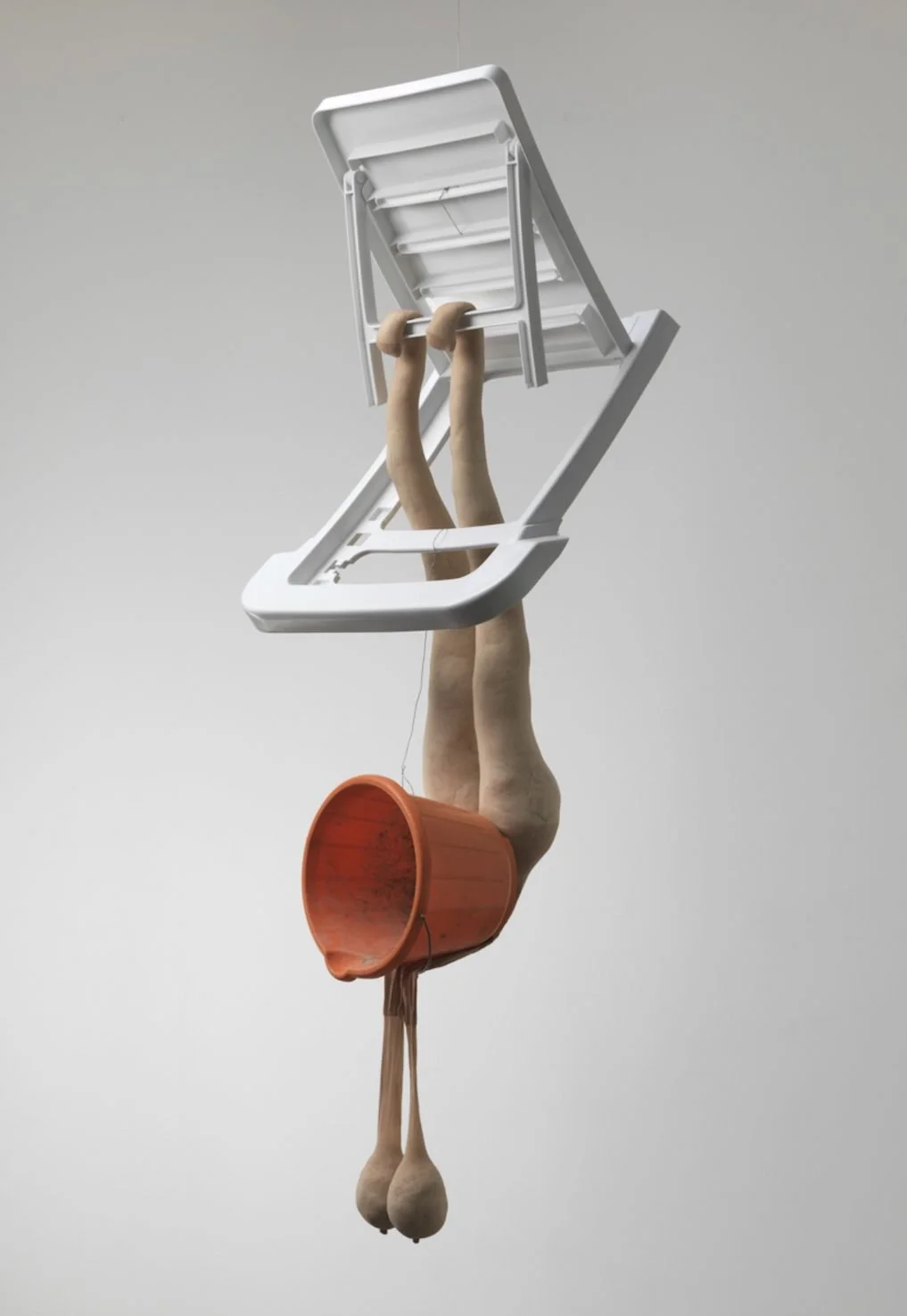
Lucas has spent decades working with materials that already hover between object and body: furniture, food, tights, cigarettes and toilets. Her practice repeatedly uses ordinary things to conjure bodily fragments without relying on conventional anatomical representation.
That makes her sculptures unusually economical.
She does not need to sculpt a complete body when two pieces of fruit can produce breasts.
She does not need skin when nylon tights can suggest it.
She does not need a skeleton when a chair already has legs, a back and a seat designed around the proportions of a human being.
What appears at first to be a series of dirty jokes gradually reveals a deeper perceptual problem.
How little information do we need before we begin turning an object into a person?
Lucas tests that threshold again and again.
In Two Fried Eggs and a Kebab (1992), a tabletop arrangement reduces a female body to a few pieces of food. The humor depends on simplification, but the simplification is also uncomfortable. An entire body has been compressed into several sexually recognizable parts.
The sculpture does not simply show objectification.
It makes objectification happen in real time.
The viewer performs the reduction.
The joke turns back toward us
That is what gives Lucas’s humor more pressure than a visual pun normally carries.
If the cucumber only symbolized a penis, the joke would end as soon as we understood it.
But our own recognition becomes part of the work.
Lucas seems to know exactly how much evidence to provide before cultural habit takes over.
Long object.
Round objects.
Hole.
Suddenly anatomy arrives.
The sculpture can then quietly return the question to the viewer:
Why did you see that?
What seemed natural begins to look learned.
Sexual meaning has accumulated around ordinary shapes through slang, pornography, advertising, jokes, gender stereotypes and countless previous images. Lucas does not have to invent those associations. She selects objects already saturated with them.
This is why calling her sculptures merely “found-object” works understates what she is doing.
Lucas does not simply find objects.
She finds cultural reflexes attached to objects.
What happens when the artist becomes the body?
Her Self-Portrait with Fried Eggs (1996) complicates the operation.
Lucas sits facing the camera with two fried eggs positioned over her breasts. The photograph was included alongside Au Naturel and many of her major sculptural works in the Hammer Museum’s 2019 retrospective.
The sexual shorthand remains deliberately obvious.
Eggs become breasts.
But Lucas herself refuses to behave like the passive object that shorthand might imply.
She looks outward.
Her posture is assertive.
The image contains the sexual joke while also containing a person who appears perfectly aware of the joke and fully capable of using it.
That creates an important ambiguity in Lucas’s work.
She frequently borrows crude languages that have been used to reduce women—the dirty joke, the sexual stereotype, the bodily insult—without pretending those languages do not exist.
Instead, she takes possession of them.
But possession does not make them harmless.
That is part of the risk.
Can an artist use a degrading visual language without merely repeating the degradation?
Lucas’s strongest work does not solve that problem cleanly. The vulgarity remains contaminated.
That unresolved pressure is one reason the work survives the joke.
A pair of tights becomes vulnerable
The Bunny sculptures push the inquiry somewhere more surprising.
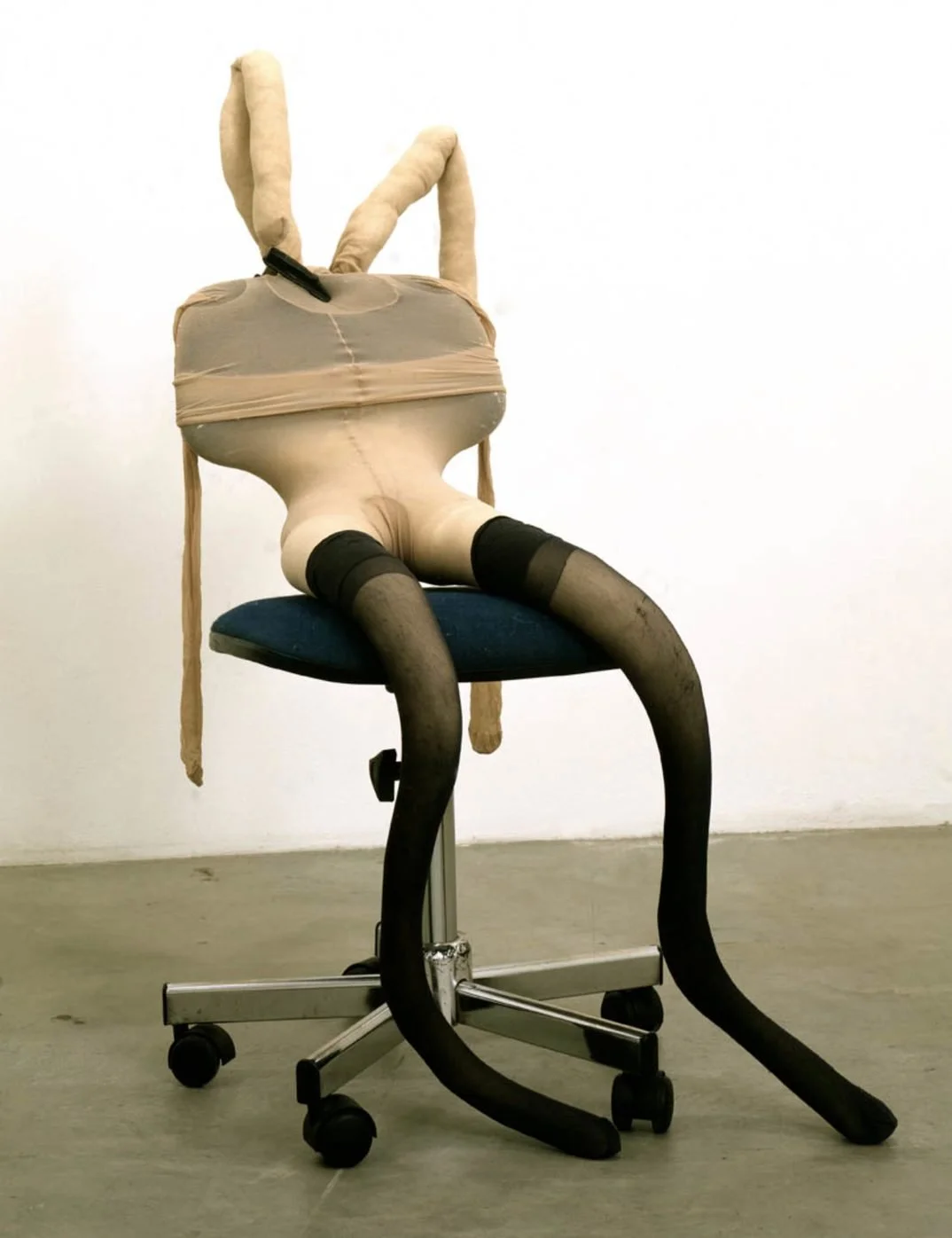
In Bunny Gets Snookered #8 (1997), blue tights and stockings are stuffed and arranged across an ordinary chair. The Hammer lists tights, stockings, vinyl, wood, kapok and wire among the materials.
Again, there is very little conventional anatomy.
And yet the sculpture feels bodily.
More than that, it begins to feel psychological.
The figure slumps.
Its elongated limbs droop from the chair.
The nylon stretches around its stuffing like vulnerable skin.
The chair supports the form but also seems to hold it in place.
Suddenly Lucas’s substitution has moved beyond anatomy.
Posture creates personality.
The Bunny can seem sexually available and exhausted at the same time. Comic and defeated. Artificial and strangely exposed.
This is an important development because Lucas no longer needs the instant visual equation of cucumber equals penis or melon equals breast.
She has discovered that weight, balance, sagging and support can make an object feel human.
The sculpture does not need a face to look tired.
The materials carry the psychology
This is why Lucas’s material choices matter so much.
Tights are not neutral substitutes for skin.
They stretch.
They sag.
They carry intimate associations with bodies, gender and sexuality.
A chair is not merely a pedestal.
Chairs anticipate bodies before anyone sits in them. They are built according to our legs, backs and weight.
When Lucas combines the two, soft nylon becomes dependent on rigid furniture.
The relationship can feel supportive.
Or restrictive.
Or sexual.
Or pathetic.
Often several of these at once.
Replace the tights with marble and much of that vulnerability disappears.
Replace the chair with a conventional sculpture pedestal and the bodily relationship changes.
Lucas’s materials do not illustrate vulnerability.
They perform it.
Then gender begins to come apart
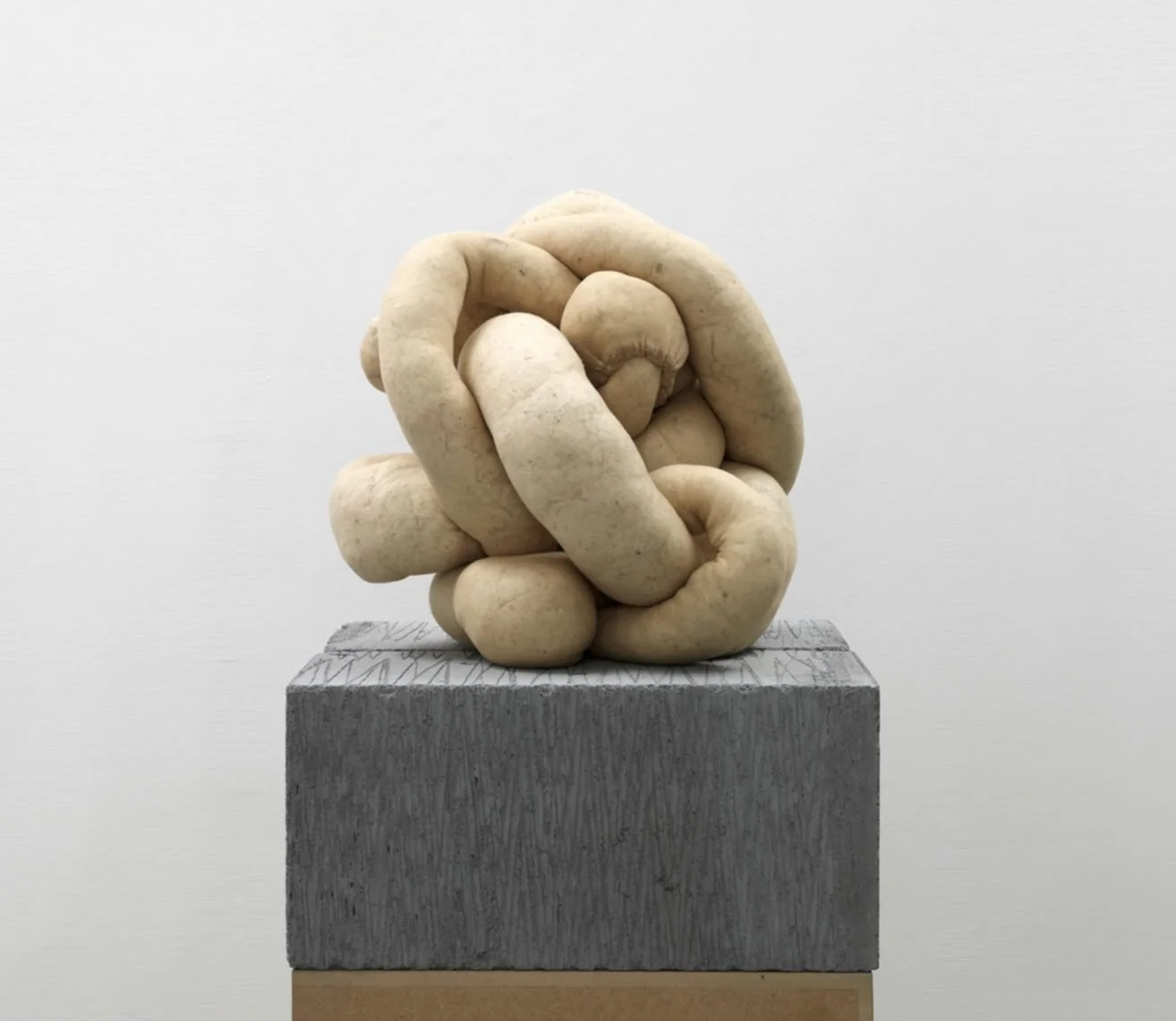
The NUDS, first shown in 2009, push the stuffed-tights language toward abstraction.
Instead of recognizable seated figures, nylon twists into knots, loops and ambiguous organic forms. Sadie Coles describes the series as a major development from the earlier Bunnies: bodily associations remain, but the forms become increasingly indeterminate, moving between limbs, breasts, orifices and other anatomical suggestions.
Something important changes here.
Lucas’s early works often depend on blunt gender codes.
This is male.
This is female.
This looks like a penis.
This looks like breasts.
The NUDS make that certainty harder to sustain.
A protrusion may look phallic from one angle and something entirely different from another. A fold can suggest penetration while also appearing penetrated. One body can contain several anatomical possibilities.
The sculptures become less classifiable without becoming less sexual.
That is genuine development.
Lucas begins by exposing how easily gender can be reduced to crude signs.
Then she discovers that those same signs can be twisted until the categories themselves become unstable.
The body was already hiding inside the object
This may be Lucas’s most unusual artistic capacity.
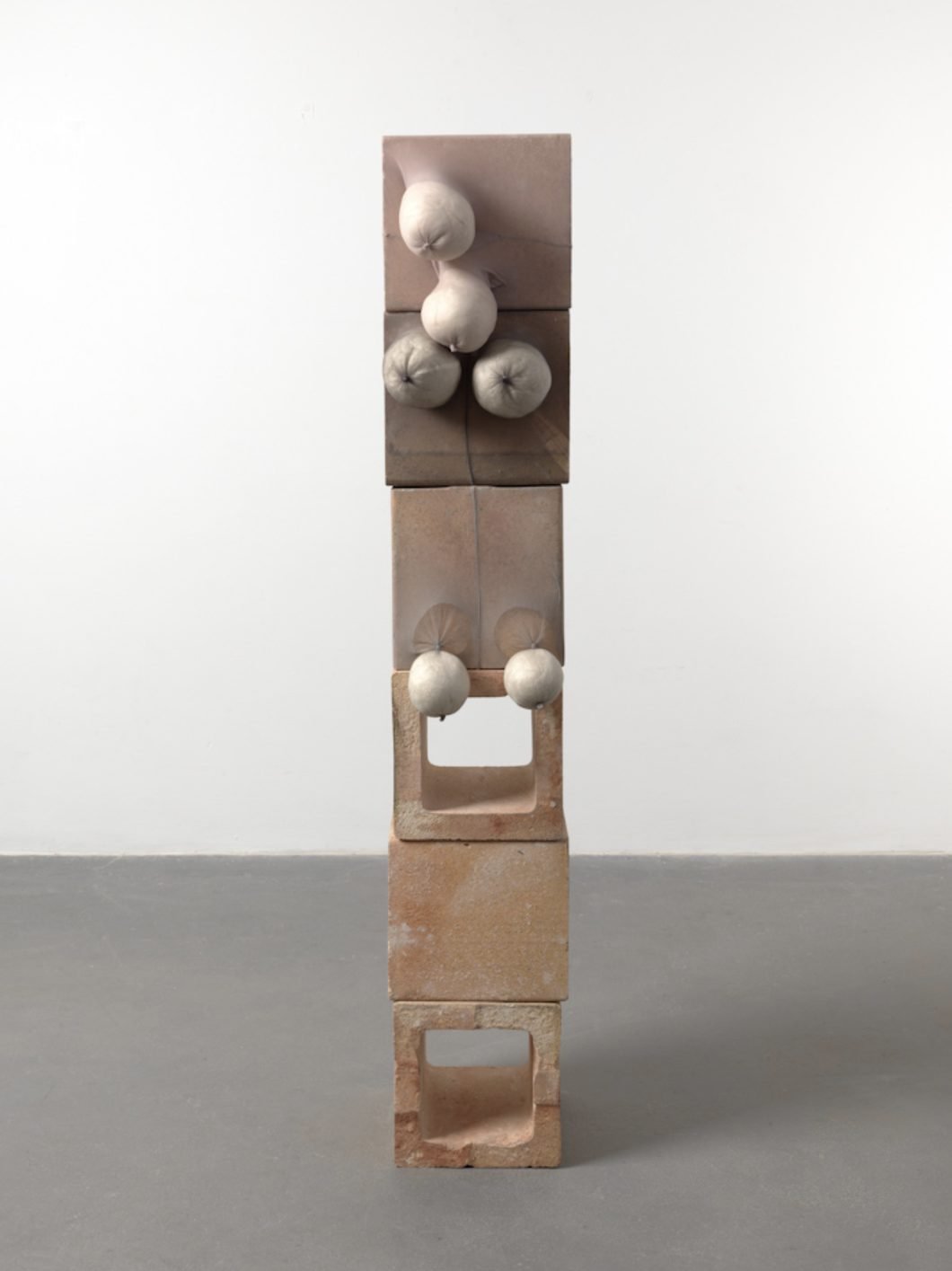
She notices how thoroughly ordinary objects have already been shaped by bodily meaning.
A toilet is built around bodily function.
A chair is built around bodily support.
Stockings anticipate skin and legs.
Cigarettes carry histories of pleasure, danger, rebellion and self-destruction.
Food is already full of sexual metaphor.
Lucas repeatedly selects objects that exist halfway between physical thing and cultural association.
Then she changes their relationships just enough for the latent body to surface.
The viewer does the rest.
That means representation in her work does not depend primarily on resemblance.
A sculpture can become intensely bodily while barely looking anatomically correct.
And the less information Lucas supplies, the more obvious our own contribution becomes.
When the dirty joke becomes monumental
The same problem continues at a completely different scale in Lucas’s newest public sculpture.
VENUS VICTORIA, installed on the New Museum plaza in May 2026, moves Lucas’s irreverent bodily language into civic space. The commission remains on view as part of the museum’s new public program.
That shift matters.
Lucas’s work now has to negotiate not only the gallery but the history of the monumental nude, public sculpture and the architecture surrounding it.
Yet the underlying operation remains familiar.
Classical ideas of the female body collide with contemporary objects and sexual codes.
The high and low contaminate one another.
The body turns the object into something else.
The object changes how we read the body.
Neither category remains stable for long.
The joke is partly ours
It is easy to describe Sarah Lucas as an artist of sex, vulgarity and irreverent humor.
All of that is true.
But those terms do not explain why a few cheap objects can exert such an immediate bodily presence.
Lucas has developed something more precise.
She knows how little information the human imagination requires before it begins projecting bodies, genders, desires and personalities onto things.
A pair of tights slumps over a chair and becomes vulnerable.
Fruit on a mattress becomes sex.
A knot of nylon becomes an ambiguous body.
And every time that transformation occurs, the sculpture reveals something about the person looking at it.
Lucas makes ordinary objects bodily.
But she cannot do it alone.
She makes us catch ourselves turning things into bodies.