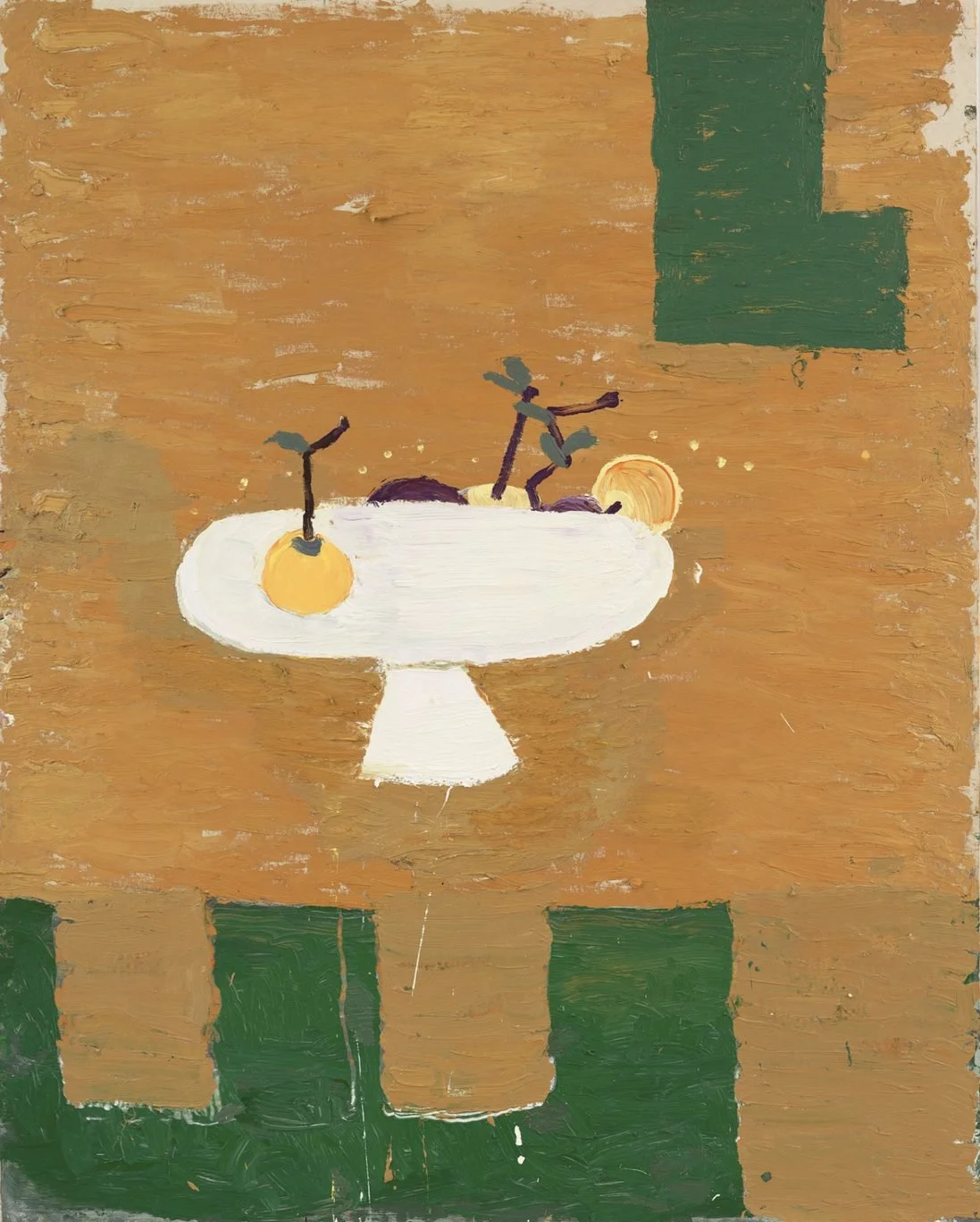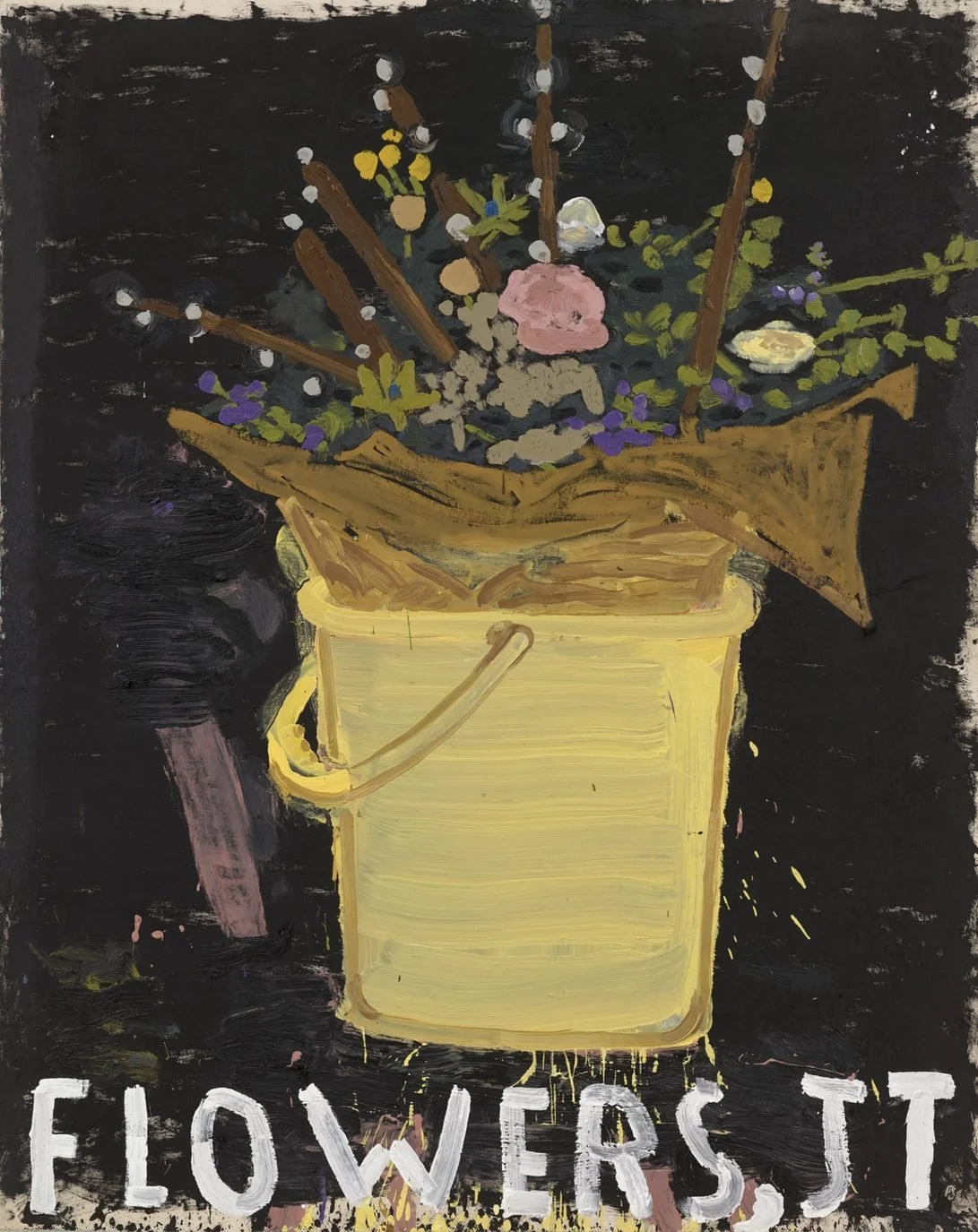
Rose Wylie shows how sophistication can emerge not from cleaning an image up, but from knowing what to leave visible.
Rose Wylie’s paintings can look as though someone stopped working on them too soon.
Figures are bluntly drawn. Perspective slips. Words wander across the canvas, sometimes misspelled or crossed out. Paint thickens, drips or ends abruptly. Shapes collide rather than resolve. A correction may remain sitting beside the thing that replaced it.
The temptation is to call the work naïve, spontaneous or unfinished.
But look longer and that explanation becomes difficult to maintain.
Wylie is not an inexperienced painter who has failed to refine the image. She is an artist with decades of looking, drawing and painting behind her who has become extraordinarily selective about what refinement should remove—and what it should allow to survive.
The paintings aren't unfinished.
They preserve the evidence of deciding.
What does a correction erase?
Imagine drawing a head.
The first outline feels wrong, so you erase it and draw another. By the time the image is finished, the viewer sees only the successful decision.
Now imagine leaving the first head visible, crossing through it, shifting the eyes and drawing the new version beside it.
The second image contains more information.
It shows what you first thought, the moment you rejected that thought, and what you decided instead.
Wylie often works closer to this second condition. She has spoken openly about changing faces, crossing things out and allowing previous decisions to remain visible. What might appear to be sloppiness can therefore be evidence of judgment. The surface remembers alternatives the final image could have taken.
That changes what “finished” means.
Conventional refinement often removes uncertainty. Corrections disappear, edges settle and the history of making is absorbed into a seamless result.
Wylie allows the uncertainty to remain.
The awkwardness isn't necessarily what happens before refinement.
It may be what remains after refinement has rejected conventional polish.
Simplicity can take a long time
This becomes clearer when Wylie describes drawing.
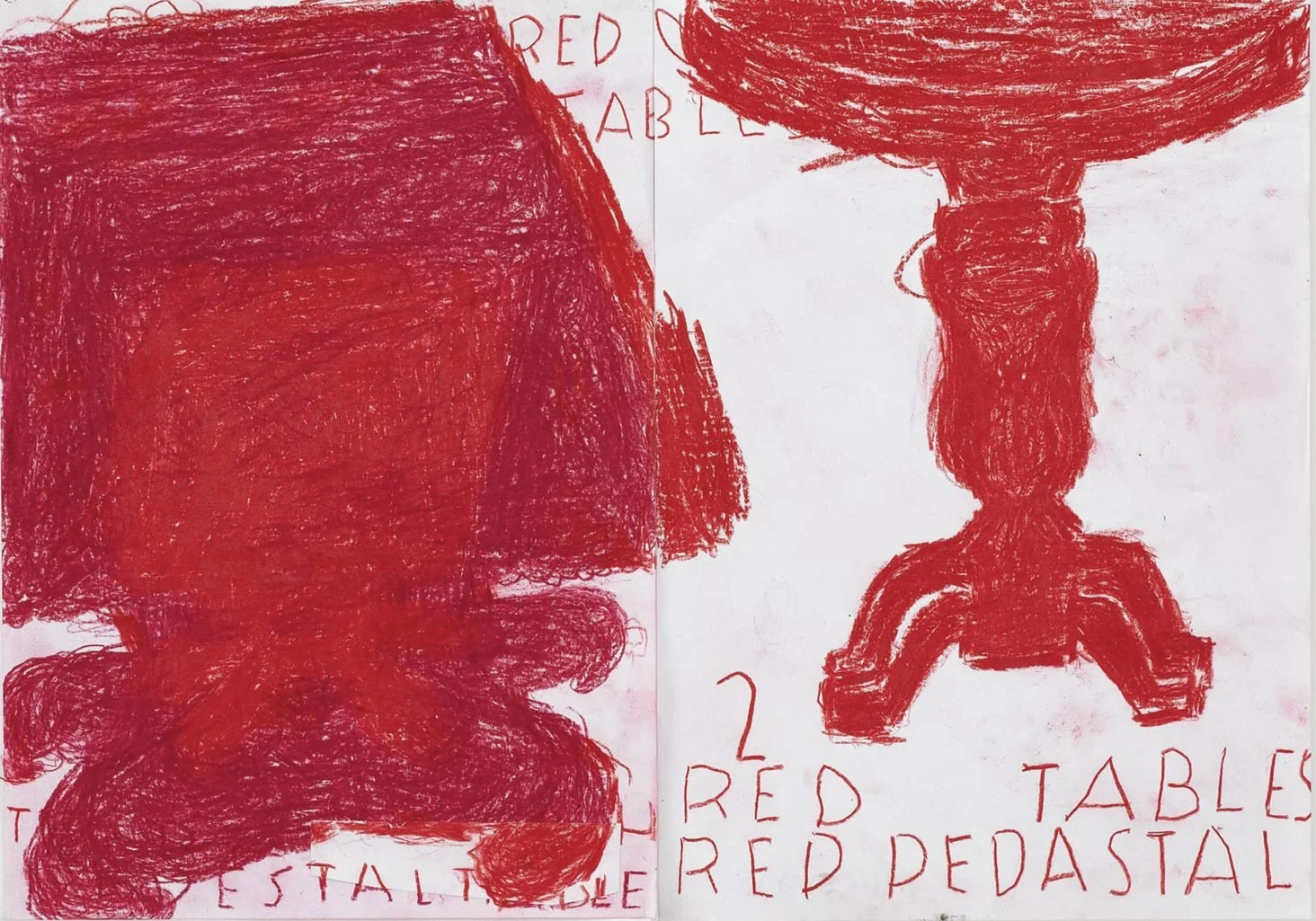
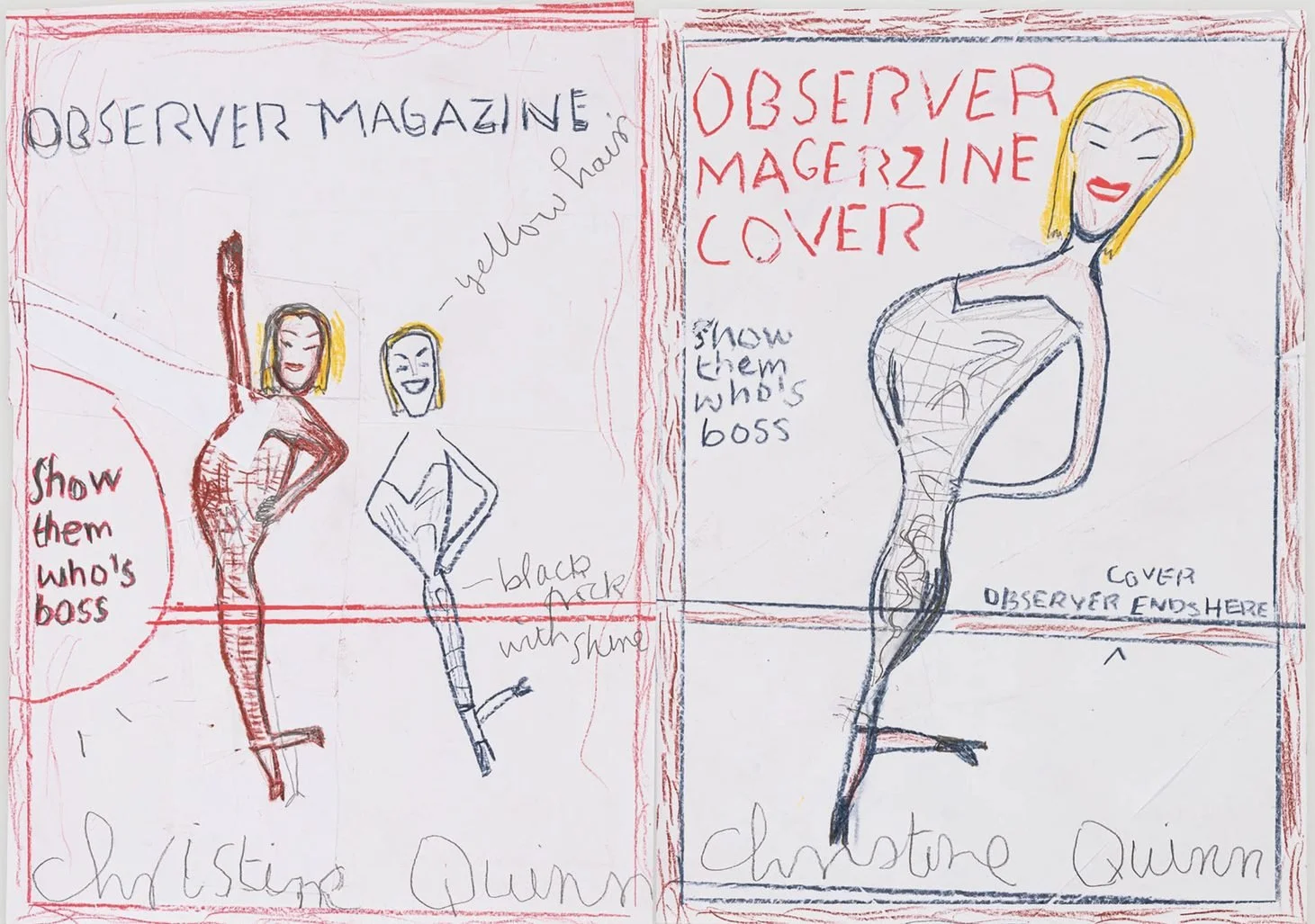
Nearly every painting begins there. She draws constantly, sometimes producing several versions before selecting one that will enter the painting. But the drawing is not merely a blueprint.
It gives her something outside herself to respond to.
Wylie has explained that beginning with nothing but a blank canvas risks producing too much of the artist's existing habits. An observed subject interrupts that repetition. The resulting painting becomes a negotiation among the artist, the drawing, the thing observed, the paint and whatever happens while the work develops.
This helps explain the extraordinary range of images that enter her work.
Film stars. Footballers. Dogs. Flowers. Newspaper photographs. Ancient mosaics. Renaissance paintings. Television. Houses. Wartime memories.
The source matters because it resists complete invention.
But fidelity is not the goal.
Wylie wants what she calls a movement toward “poetic reality”: enough recognition that the original visual excitement remains, but enough transformation that the painting acquires an independent life.
That produces a delicate balance.
Too much fidelity and the painting becomes transcription.
Too much transformation and the thing that made the image worth painting disappears.
The painting has to survive somewhere between the two.
Memory edits what observation sees
Park Dogs & Air Raid (2017) makes this especially visible.
The enormous four-part painting combines dogs, ducks, landscape, aircraft and memories connected to the V-1 flying bombs Wylie encountered as a child during the Second World War. The painting itself is nearly four meters high.
Yet the visual information does not behave according to normal perspective.
A dog can become almost a sign.
A plane becomes a blunt shape.
Words enter the image as readily as figures.
Scale follows importance more readily than physical reality.
The painting begins to resemble not simply a remembered scene, but the structure of remembering itself.
Memory does not preserve everything equally.
It drops details.
Magnifies others.
Combines things that happened separately.
Retains the strange object.
Misplaces the unimportant one.
What Wylie paints is therefore not necessarily what the world looked like at one moment. It is closer to what remains after perception has passed through attention and time.
That makes distortion useful rather than merely eccentric.
She allows the image to resemble the way attention remembers.
The mistake becomes part of the picture
This also explains why words, patches and crossings-out feel so natural in Wylie's paintings.
A crossed-out word does something a corrected word cannot.
Both remain visible.
The viewer sees the failed version and the successful one simultaneously.
The same can happen with drawing, paint and composition. Earlier decisions do not always disappear when later ones arrive.
The painting becomes an accumulation of competing possibilities.
This is very different from pretending to be spontaneous. Wylie has described finishing as precarious: a painting may need another alteration, yet one more change can also destroy what is working.
That is not indifference.
It is discrimination.
She has to decide which irregularities weaken the painting and which irregularities are actually carrying it.
An experienced artist can become more knowledgeable, more perceptive and more precise—and use that knowledge to decide what not to refine.
Why make such crude images so large?
Then there is scale.
Many Wylie paintings are huge.
The mismatch is striking. Marks that could belong to a notebook suddenly occupy an entire wall. A roughly drawn figure confronts the viewer at bodily scale. A scribbled word becomes architectural.
That physical enlargement prevents the drawings from remaining cute.
What looks casual in reproduction becomes imposing in person.
The same transformation happens materially. Wylie's paint may be thin in one passage and thick enough to feel almost sculptural elsewhere. Canvases sometimes expand into multiple panels. Images can push beyond their original support.
The apparently simple picture becomes a complicated physical object.
This helps explain why Wylie insists that the painting itself must ultimately take precedence over the story behind it. Her 2026 Royal Academy survey was called The Picture Comes First, and she has repeatedly argued that a painting cannot simply illustrate an idea; it has to become an independent thing.
The image may begin with a dog, a movie, a newspaper clipping or a Renaissance painting.
But eventually the painting has to answer to itself.
Sophistication without polish
This is where describing Wylie as “childlike” becomes inadequate.
Children may draw directly because they have not yet learned conventional pictorial systems.
Wylie knows those systems.
The important difference is that she does not always obey them.
Her paintings draw freely from art history, film, popular imagery and everyday observation while refusing the assumption that increasing sophistication should produce increasing visual smoothness. Even in her 2026 Paris exhibition Henri, Egypt...Bette, Bear, new works passed Henri Rousseau, Bette Davis, television images, ancient mosaics and domestic observations through the same process of association and transformation.
Knowledge does not disappear.
It becomes less visibly obedient.
And that gives us a different definition of refinement.
Refinement does not have to mean removing awkwardness.
It can mean learning which awkwardness matters.
It does not have to mean hiding revision.
It can mean recognizing when revision itself has become part of the image.
It does not have to mean making every decision appear inevitable.
A painting can be finished while continuing to show that it could have become something else.
That may be one of Wylie's most unusual achievements.
Her paintings often look immediate, but immediacy is not their starting point. Beneath the blunt figures, giant words, crossings-out and ungainly shapes are repeated acts of observation, memory, transformation and judgment.
The simplicity has been worked for.
The roughness has been chosen.
And what first looked unfinished begins to look like something much harder to achieve:
a finished painting that has not erased the evidence of thinking.