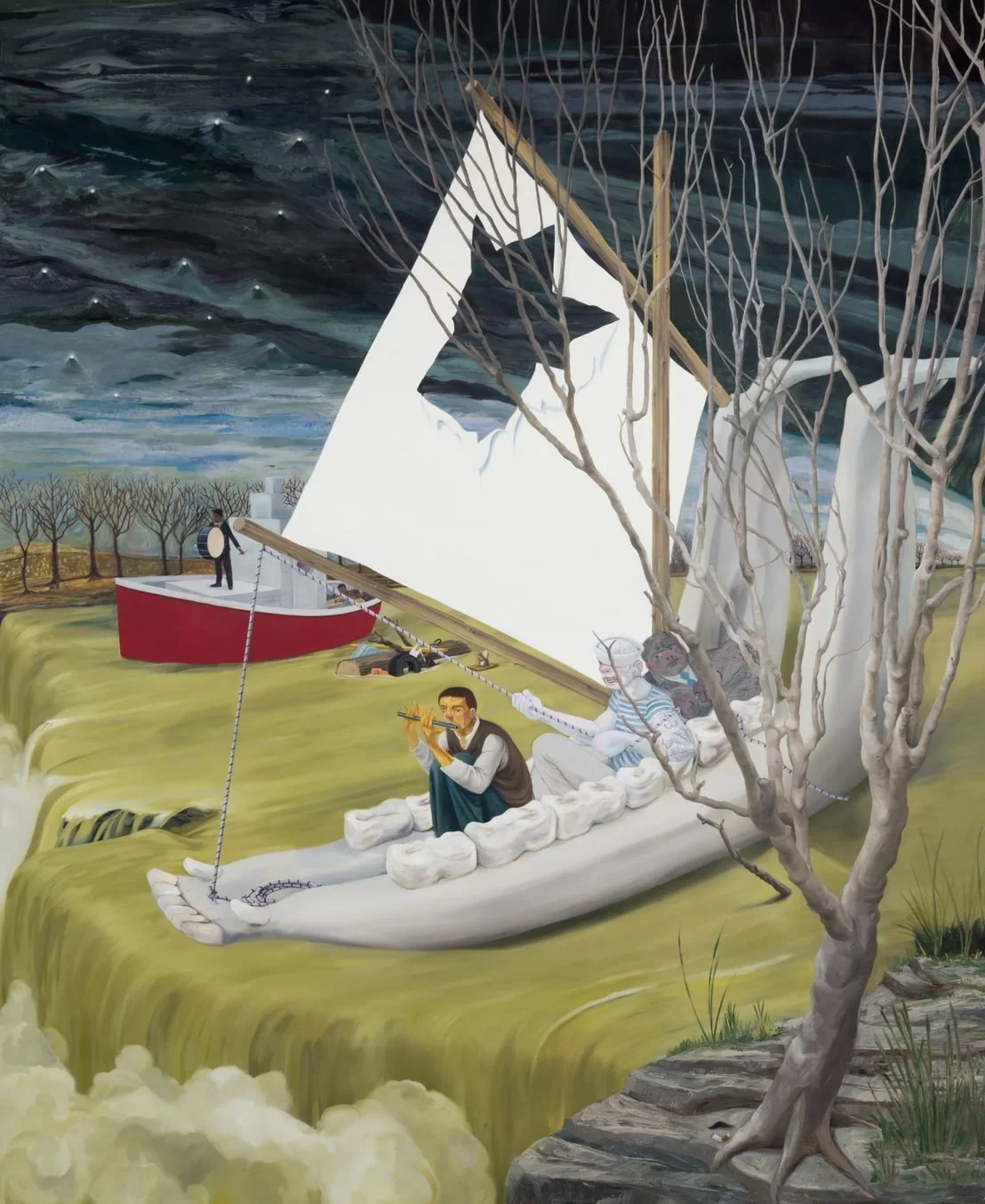
What happens when flawed, isolated, ridiculous, desiring people have to live through the world together?
Nicole Eisenman fills paintings with people.
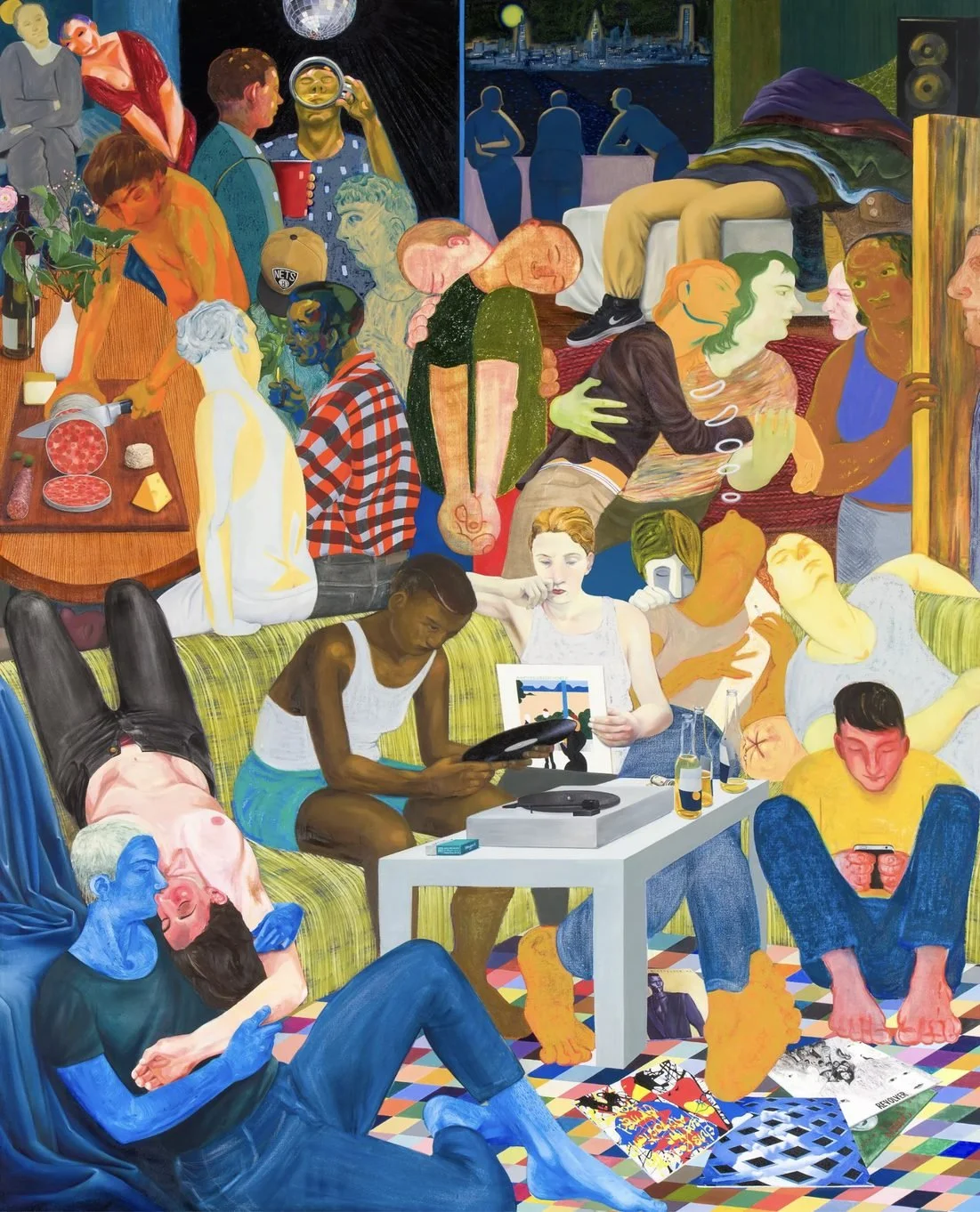
They drink, kiss, draw, work, stare at phones, sit at tables, wander through public spaces. Friends gather. Lovers collapse into each other. Crowds form. From a distance, these can look like paintings about community.
Look longer and something stranger happens.
The people are together, but they do not necessarily seem connected.
A figure stares into space while conversation unfolds nearby. Someone sits among friends yet seems sealed inside a private mood. Bodies touch without becoming fully available to one another. Even within crowded scenes, individual figures can occupy what the Whitney Museum has described as distinct, isolated psychological spaces. (Whitney Museum of American Art)
This tension runs through much of Eisenman's work:
Human beings need one another, yet being together does not solve the difficulty of being separate.
That may be why the paintings can feel funny and sad at exactly the same time.
Together, but not necessarily connected
In Beer Garden with Ulrike and Celeste (2009), Eisenman uses one of painting's oldest social structures: the gathering.
People sit around tables beneath trees. Drinks circulate. Figures overlap. The scene belongs to a long history of paintings about eating, drinking and communal life, but Eisenman's people refuse to merge into one harmonious crowd.
Their bodies are painted differently. Their faces carry different degrees of exaggeration. Some seem animated while others withdraw into themselves.
That variation is deliberate. Eisenman has said that different images ask to be painted in different ways, and the Whitney has connected this approach to the unusual psychological separateness of figures who may occupy the same scene. (Whitney Museum of American Art)
This is an important clue.
Eisenman's stylistic inconsistency is not necessarily inconsistency at all.
One figure may need distortion. Another may need blunt cartooning. Another may require a heavier, more expressionistic face. The paintings borrow freely from art history, illustration, caricature and popular culture because Eisenman does not appear committed to protecting a single visual style.
The social situation comes first.
Style changes because the people do.
That is a different kind of coherence. The paintings do not always look alike, but they repeatedly perform the same operation: they place psychologically different people inside a shared world and allow their differences to remain unresolved.
When ridiculousness protects tenderness
The contradiction becomes more intimate in Sloppy Bar Room Kiss (2011).
Two figures mash themselves together across a bar. The kiss is exaggerated, ungainly and almost cartoonish. This is hardly the polished choreography of romantic painting. Eisenman lets desire become messy.
And yet the joke does not eliminate the intimacy.
That is what makes the painting difficult to reduce.
Make the kiss more beautiful and the scene risks sentimentality. Push the distortion too far and the lovers become merely ridiculous. Eisenman keeps both possibilities active.
The figures can look pathetic and genuinely affectionate.
They can be funny without becoming disposable.
Whitechapel Gallery included Sloppy Bar Room Kiss in its major survey of Eisenman's work, alongside paintings spanning several decades of her practice. (Whitechapel Gallery) But its importance becomes clearer when the painting is understood not simply as another example of Eisenman's humor, but as evidence of something she has learned to control.
Comedy can create emotional distance without destroying emotional seriousness.
Humor becomes a pressure valve that never releases all the pressure.
The viewer may laugh first.
The tenderness remains afterward.
Community as something people do
The Drawing Class (2011) complicates the loneliness reading.
Here, people gather not merely to occupy the same room but to participate in an activity. They look, draw and share attention. The painting grew from a real part of Eisenman's life: she and artist friends held figure-drawing sessions in which they modeled for one another. During the 2012 Whitney Biennial, Eisenman extended that practice into the museum itself, leading a live figure-drawing workshop that mirrored the activity depicted in the painting. (Whitney Museum of American Art)
Suddenly community means something slightly different.
It is not emotional fusion.
It is participation.
People do not have to become psychologically identical in order to make something together. Shared activity creates connection without eliminating separateness.
That distinction prevents Eisenman's social world from becoming simply pessimistic.
Her gatherings can contain loneliness, awkwardness and disengagement, but they can also contain friendship, pleasure, work and collective attention.
Community does not cure human difficulty. It gives human difficulty somewhere to happen.
When the crowd leaves the painting
Eisenman's eventual move into sculpture pushes the same problem into physical space.
In Procession (2019), made for the Whitney Biennial, a group of peculiar figures moves across the museum's outdoor terrace with New York behind them. Some are bronze, others plaster. Sneakers, clothing and a fog machine enter a sculptural language that also invokes the long history of monumental public statuary. (Whitney Museum of American Art)
The figures hardly resemble heroes.
They appear tired, awkward and burdened.
But they keep going.
That matters because a procession traditionally promises some kind of collective purpose: religious ceremony, civic celebration, political demonstration, triumph. Eisenman keeps the collective movement while removing much of the triumph.
Her people persist rather than conquer.
The materials reinforce that instability. Bronze carries associations of durability and monumentality; plaster is more provisional. Ordinary clothes and shoes interrupt both. The group does not become unified through a single noble material. (Whitney Museum of American Art)
The sculpture behaves like the community it depicts.
Different bodies.
Different materials.
Different levels of permanence.
One direction.
With Procession, something Eisenman had long investigated in painting becomes bodily. The viewer no longer looks into a represented social space. The figures occupy the viewer's space.
Painting allowed Eisenman to construct crowds.
Sculpture allowed the crowd to surround us.
The deeper contradiction
It is tempting to describe Eisenman primarily as a comic artist.
The humor is unmistakable. So are the grotesque bodies, historical quotations, sexual jokes and exaggerated faces.
But humor alone does not explain why the work continues to generate pressure.
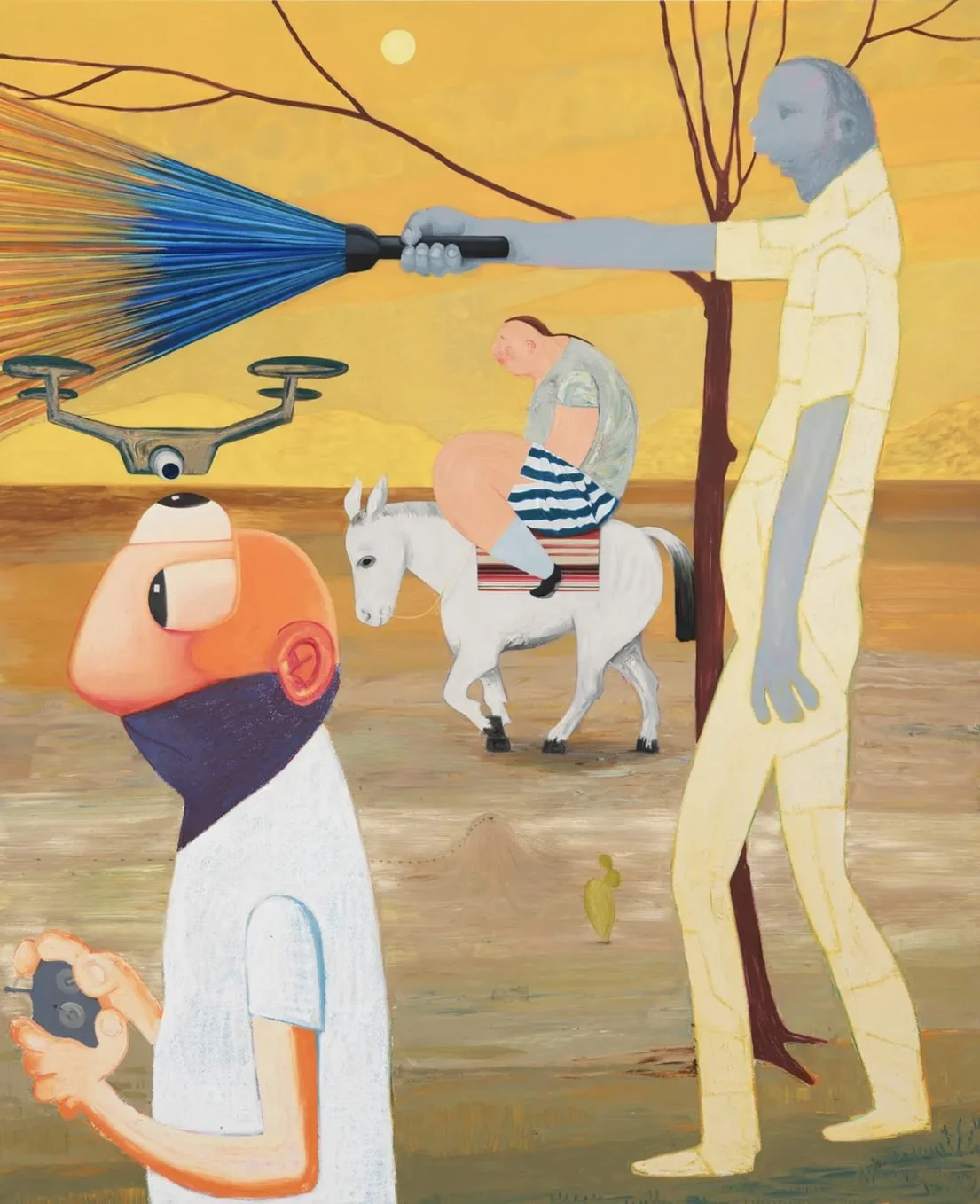
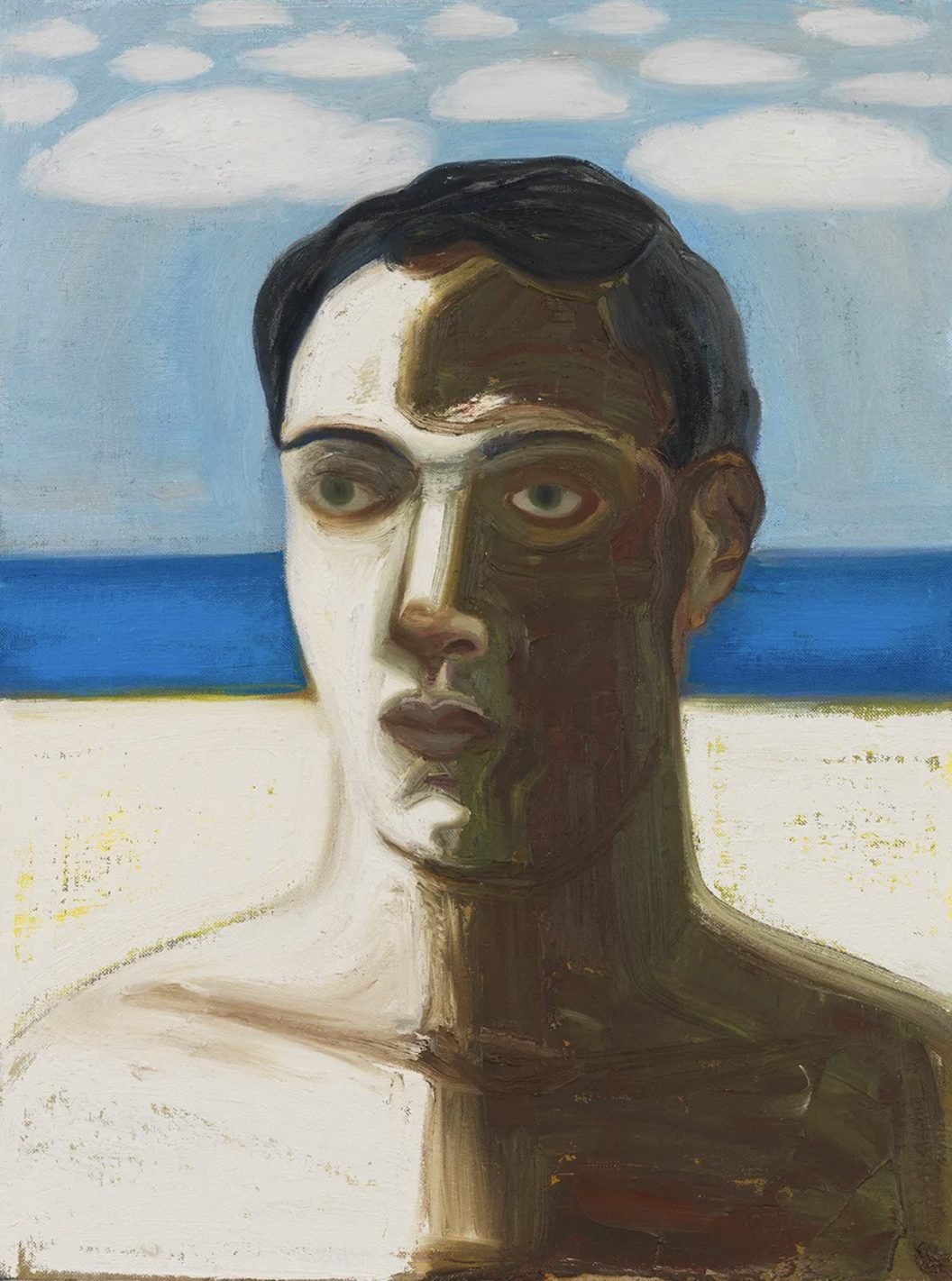
The deeper problem may be isolation and togetherness.
Eisenman's people want things from one another. They desire, drink, work, make art, protest, wait, flirt and gather. They form relationships and communities without ever fully escaping their private psychological worlds.
That is why ugliness can coexist with tenderness.
Why comedy can coexist with sadness.
Why ridiculous people can retain dignity.
Why a procession can look defeated and persistent at once.
Eisenman does not resolve these contradictions because resolving them would make the people less convincing.
Her achievement is more unusual: she makes contradiction feel human rather than theoretical.
A language that still has to move
There is always a danger when an artist becomes exceptionally good at a particular operation.
Grotesque figures can begin guaranteeing interest. Awkward anatomy can become a signature. Art-historical quotation can become cleverness on demand. Even contradiction can harden into style.
Eisenman's recent work makes that question especially interesting.
In the 2026 exhibition Fallen Angels, eleven new paintings and three sculptures narrow attention to three ordinary settings—home, work and beach. Most of the paintings are easel-sized, and Hauser & Wirth describes the exhibition's contraction of scale and more contemplative tone as a departure from the crowded social tableaux strongly associated with Eisenman's practice. (Hauser & Wirth)
That reduction may be important.
A living artistic language cannot survive merely by reproducing its most successful discoveries. It has to place them under new pressure.
For decades, Eisenman has found ways to put human beings together without pretending that togetherness makes them whole. The crowded bars, awkward lovers, drawing groups and exhausted processions keep arriving at variations of the same difficult fact: people remain separate, but they continue reaching toward one another anyway.
Perhaps that is why the work can be so funny without becoming cruel and so sad without becoming hopeless.
The crowd does not solve loneliness. It makes connection possible despite it.