What Makes Anicka Yi’s Work So Powerful?
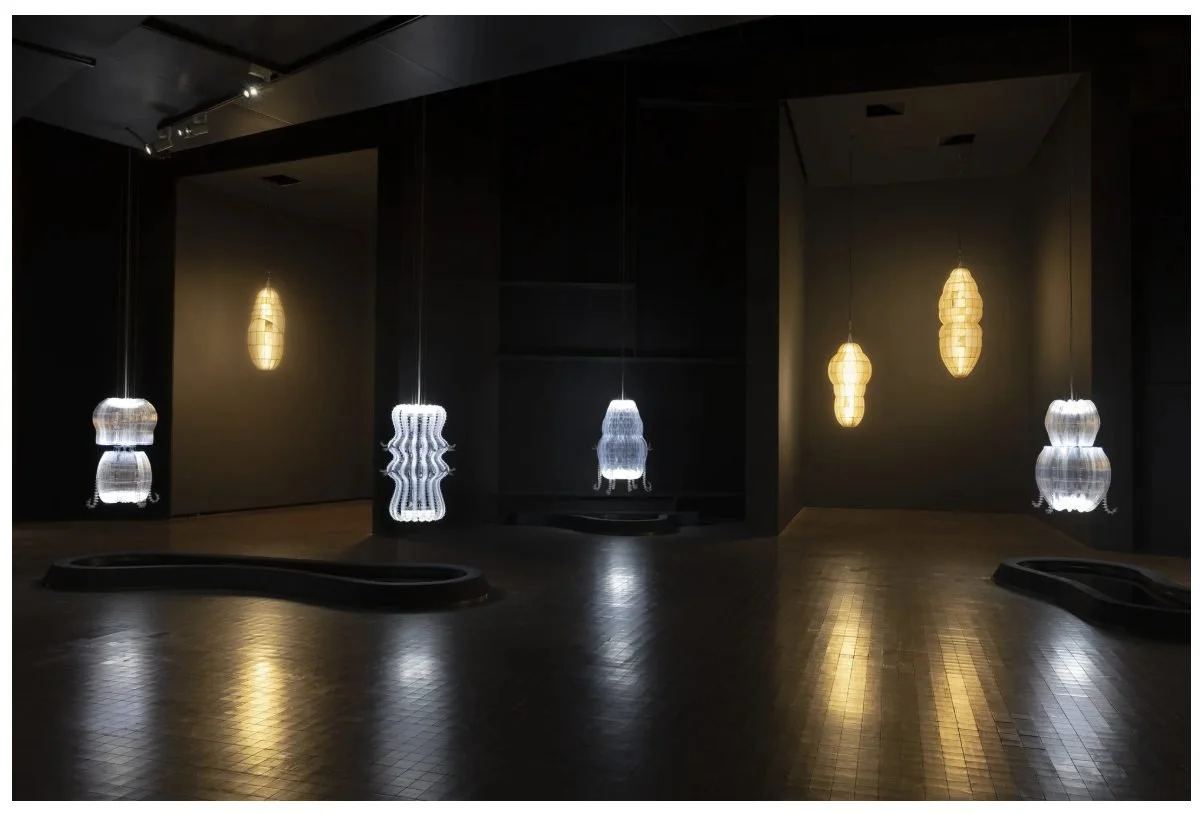
Anicka Yi’s work is powerful because she challenges the assumption that human beings are the only meaningful subjects, perceivers, and intelligences in the world.
Her installations may contain:
bacteria;
fungi;
algae;
kelp;
ants;
scent;
soap;
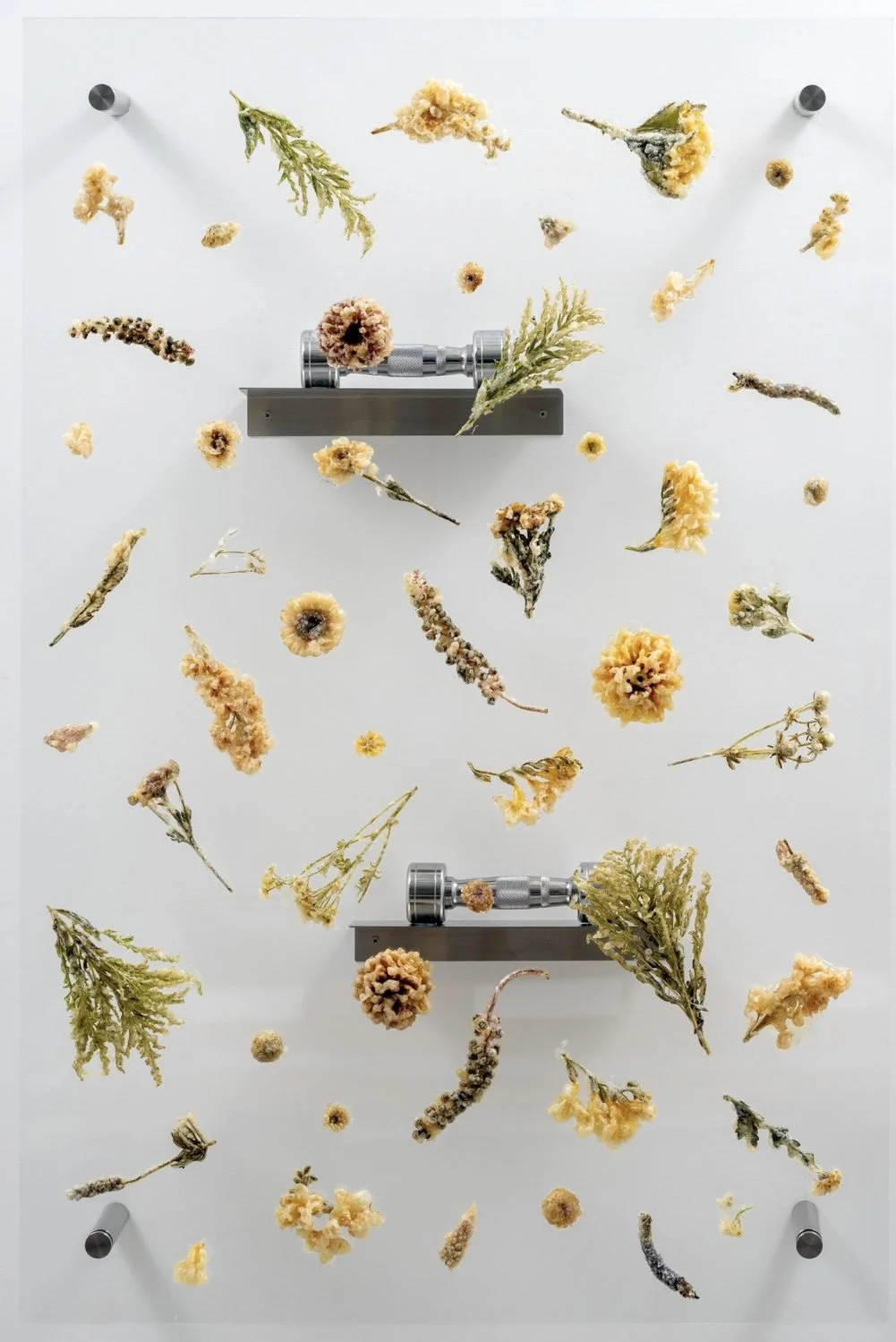
tempura-fried flowers;
synthetic skins;
industrial materials;
machine-learning systems;
floating robotic organisms;
self-contained microbial ecosystems.
The work can smell, ferment, glow, decay, reproduce, change color, circulate through the air, or behave unpredictably over time.
Yi does not simply use unusual materials to create novelty. She builds situations in which supposedly stable distinctions become difficult to maintain:
human and nonhuman;
organism and machine;
natural and artificial;
attraction and disgust;
intelligence and instinct;
cleanliness and contamination;
permanence and decay;
individual body and microbial community.
Her central inquiry might be stated this way:
What becomes possible when human life is understood not as autonomous and exceptional, but as entangled with microbes, machines, environments, substances, and forms of intelligence we do not fully control?
Yi’s work does not ask viewers merely to contemplate this proposition intellectually. It often enters the body through smell, humidity, unease, attraction, and awareness of contamination.
The viewer does not stand outside the system.
The viewer breathes it in.
What the Viewer Encounters
Yi works across sculpture, installation, moving image, scent, biology, robotics, artificial intelligence, food-related materials, and experimental fabrication. Her practice draws upon scientific research while exploring symbiosis between living and nonliving forms and the mutability of natural and technological systems. (Esther Schipper)
The viewer may encounter:
illuminated panels containing microbial cultures;
translucent pods suspended in industrial rooms;
scents circulating without a visible source;
floating machines modeled loosely on marine organisms and mushrooms;
vitrines containing organic material undergoing change;
synthetic forms resembling organs, cocoons, food, or laboratory specimens;
environments in which biology and machinery appear to be evolving together.
The work often creates immediate uncertainty.
Is the material alive?
Was it grown or manufactured?
Is the smell pleasant or threatening?
Is the object nourishing, toxic, feminine, technological, diseased, or sacred?
Yi rarely provides one stable answer.
A form may appear simultaneously:
beautiful and repulsive;
vulnerable and invasive;
scientific and fictional;
intimate and alien;
highly designed and biologically uncontrolled.
The work’s meaning emerges from that instability.
The Inquiry Beneath the Work
Western traditions often separate the human individual from the surrounding world.
The self is imagined as:
autonomous;
bounded;
rational;
internally coherent;
distinct from nature;
superior to other organisms;
master of technology.
Yi’s work dismantles this model.
A human body contains and depends upon enormous communities of microorganisms. Smell moves between bodies and environments. Food becomes tissue. Bacteria affect digestion, immunity, mood, and health. Technologies shape behavior while depending upon minerals, electricity, human labor, and global infrastructure.
The human is less an isolated individual than an unstable ecology.
Yi asks:
Where does the self end when bodies continually exchange matter, signals, organisms, scents, and information with the world around them?
This question gives her work particular relevance to identity.
Identity is not only multiple because people perform different roles.
It is multiple because the physical organism itself is already plural.
The self is inhabited.
Smell Against the Dominance of Vision
Contemporary art institutions are organized primarily around sight.
Viewers enter galleries to look.
Objects are lit, spaced, photographed, cataloged, and reproduced visually.
Yi has repeatedly challenged this “ocular-centric” hierarchy by using smell as a central artistic medium. She has described olfactory work as a political counterforce to a culture dominated by vision. (CFA)
Smell operates differently from sight.
Vision can maintain distance.
A viewer can look at an object without touching it.
Smell crosses that separation.
Air carrying volatile molecules enters the nose and body.
The viewer cannot easily determine:
where the smell begins;
where it ends;
who else has breathed it;
whether it belongs to one object;
whether it remains on clothing or skin.
Smell makes boundaries porous.
It also produces immediate judgment.
Before conscious interpretation, a smell may trigger:
attraction;
appetite;
disgust;
warning;
memory;
desire;
fear.
Yi uses this bodily immediacy to expose the cultural assumptions hidden inside sensory response.
Smell, Gender, and Social Power
Smell is not interpreted neutrally.
Bodies are judged according to culturally shaped ideas of:
cleanliness;
femininity;
masculinity;
race;
class;
sexuality;
health;
foreignness;
propriety.
The demand that certain bodies remain odorless can become a form of social discipline.
Fragrance can signal refinement.
Body odor can be treated as failure, danger, labor, sexuality, illness, or lack of control.
Yi’s early installations used scents derived from substances including olive oil, tea, shrimp, organic decay, and bacteria to examine how smell participates in the production and policing of identity. (Vogue)
Smell reveals a contradiction:
The body must appear natural while concealing much of what living bodies naturally do.
Sweat, bacteria, digestion, decomposition, and secretion are necessary processes.
Yet social life often demands that they become invisible and odorless.
Yi brings them back into public experience.
You Can Call Me F: The Collective Female Body
In the 2015 exhibition You Can Call Me F at the Kitchen in New York, Yi worked with bacterial samples collected from approximately one hundred women working in cultural fields. The resulting biological material became part of an installation concerned with feminism, networks, contamination, and the social fear attached to female collectivity. (The New Yorker)
The work transformed bacteria associated with individual bodies into a collective culture.
This was both literal and conceptual.
A bacterial culture grows through contact, reproduction, and shared conditions.
A professional culture also grows through:
relationships;
access;
influence;
exclusion;
collaboration;
competition;
circulation.
The word “culture” joins biology and society.
Yi makes that overlap material.
The collective female body appears not as a unified political symbol, but as a living and unstable microbial mixture.
It cannot be reduced to one identity.
It grows through difference.
Contamination as Relationship
Contamination usually implies unwanted intrusion.
Something pure has been corrupted by something foreign.
Yi complicates this model because biological life depends upon exchange and contamination.
Bodies acquire microorganisms from:
birth;
food;
touch;
air;
soil;
other animals;
shared environments.
Complete biological purity would not be health.
It would be impossible.
Yi’s work reframes contamination as a condition of relation.
To live is to be affected by what is not oneself.
This does not make every exposure safe or desirable.
Disease, toxicity, and exploitation remain real.
But the fantasy of complete separation is equally dangerous.
The self persists not by remaining untouched, but by continually negotiating what enters it.
A person constructs a character, but the world enters the character materially as well as psychologically.
Materials That Refuse Permanence
Traditional sculpture has often valued durable materials:
marble;
bronze;
stone;
steel.
These materials promise continuity across time.
Yi frequently works with substances that alter, perish, leak, ferment, smell, or decay.
She has discussed the importance of change, loss, and deterioration rather than treating material instability as a flaw to be eliminated. (Living Content)
This changes what completion means.
A sculpture may be complete even though it will continue changing.
The artist does not preserve one final ideal state.
Instead, the work includes:
growth;
aging;
contamination;
decomposition;
environmental response.
The artwork becomes temporal.
Its identity cannot be separated from what happens to it.
Decay as Transformation
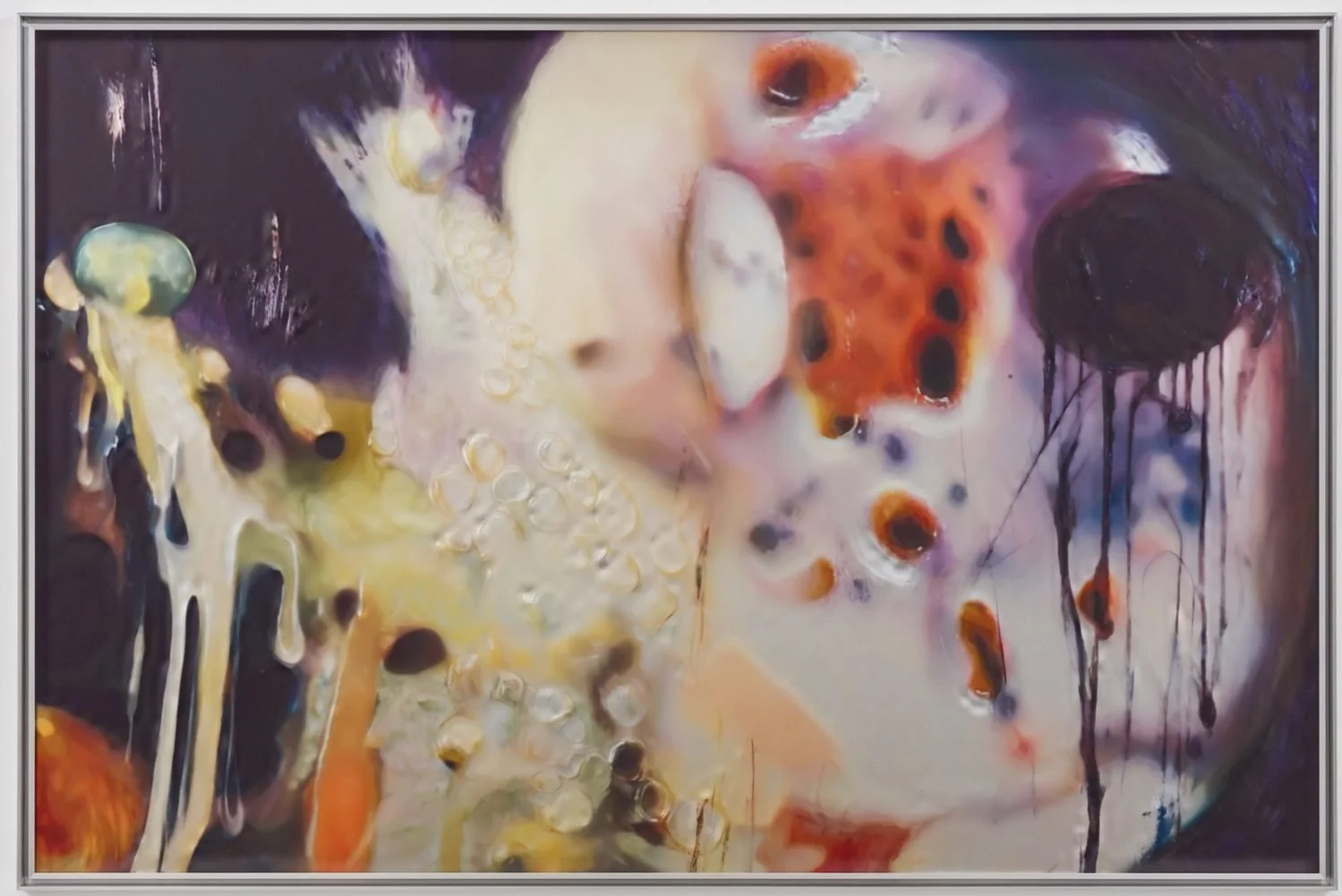
Decay is often interpreted as the failure of a material to remain itself.
Yi treats it as the production of another state.
During decomposition:
microorganisms multiply;
odors emerge;
textures soften;
colors change;
gases are released;
matter becomes available to other organisms.
One form disappears while another ecology becomes active.
Decay therefore contains both loss and generativity.
This is not sentimental renewal.
Something genuinely ends.
But the ending does not result in emptiness.
Matter continues even when identity does not.
Yi’s works confront viewers with a universe in which stable form is temporary but transformation is continuous.
The Laboratory and the Kitchen
Yi’s practice repeatedly joins scientific and culinary processes.
Both laboratories and kitchens involve:
mixtures;
temperature;
timing;
cultures;
fermentation;
contamination controls;
transformation of matter;
repeated experiments;
recipes or protocols.
Yet they carry different cultural status.
The laboratory is often associated with:
objectivity;
expertise;
rational knowledge;
institutional authority.
The kitchen may be associated with:
care;
domestic labor;
femininity;
tradition;
bodily need;
cultural memory.
Yi refuses that hierarchy.
Cooking can be chemical investigation.
Fermentation can be microbial engineering.
Perfume can be molecular design.
Scientific experiments can involve intuition, failure, improvisation, and aesthetic judgment.
Her work exposes the continuity between supposedly elevated knowledge and ordinary bodily practice.
Scientific Collaboration Without Scientific Illustration
Yi often works with scientists, engineers, perfumers, technicians, and researchers.
But her installations do not simply explain scientific findings.
She uses scientific methods to generate speculative conditions.
The laboratory contributes:
organisms;
growth protocols;
chemical processes;
sensing systems;
fabrication techniques.
Art contributes:
ambiguity;
fiction;
bodily encounter;
symbolic pressure;
questions that need not produce one verifiable answer.
The strongest works do not use science to certify artistic seriousness.
They use scientific processes to complicate what counts as:
life;
intelligence;
agency;
authorship;
identity.
Intelligence Beyond the Brain
Human culture frequently locates intelligence in conscious reasoning.
The brain plans.
The individual acts.
Other forms of behavior may be described as automatic, primitive, or instinctual.
Yi’s practice asks whether intelligence might appear through:
bacterial adaptation;
fungal networks;
collective insect behavior;
plant response;
machine learning;
distributed systems;
environmental feedback.
These systems may not possess human consciousness.
But they can:
sense;
respond;
adjust;
communicate;
cooperate;
compete;
reorganize.
Yi is interested in a broader field of intelligence that includes biological and technological forms rather than treating the human mind as the only meaningful model.
Life Is Cheap: Bacteria, Ants, and Scale
Yi’s 2017 Hugo Boss Prize exhibition at the Solomon R. Guggenheim Museum, Life Is Cheap, brought together bacteria, ants, scent, and sculptural systems to explore nonhuman forms of life and intelligence. The exhibition included work made through collaboration with scientific specialists and examined organisms commonly regarded as threatening, dirty, or insignificant. (WIRED)
The title carries several possible meanings.
Life is abundant.
Life is easily exploited.
Certain lives are socially valued less than others.
Microbial life may be destroyed without notice.
Insects may be exterminated as pests.
Human economies also assign unequal value to different bodies.
The exhibition moved among biological scale, social hierarchy, and economic valuation.
What counts as an important life depends partly upon who is looking.
The Ant Colony and Collective Agency
Ants challenge the idea that intelligence must belong to one individual.
A single ant has limited capacity.
A colony can:
build complex structures;
find food;
regulate activity;
defend territory;
adapt routes;
distribute labor.
The intelligence appears through relation.
No single ant contains the entire plan.
This provides a model for distributed agency.
The system acts, but authorship cannot be located in one controlling subject.
Yi’s interest in colonies parallels her work with bacteria and machine systems.
The question is not simply:
Is this organism intelligent?
It is:
What kinds of intelligence become visible when the individual is no longer treated as the primary unit?
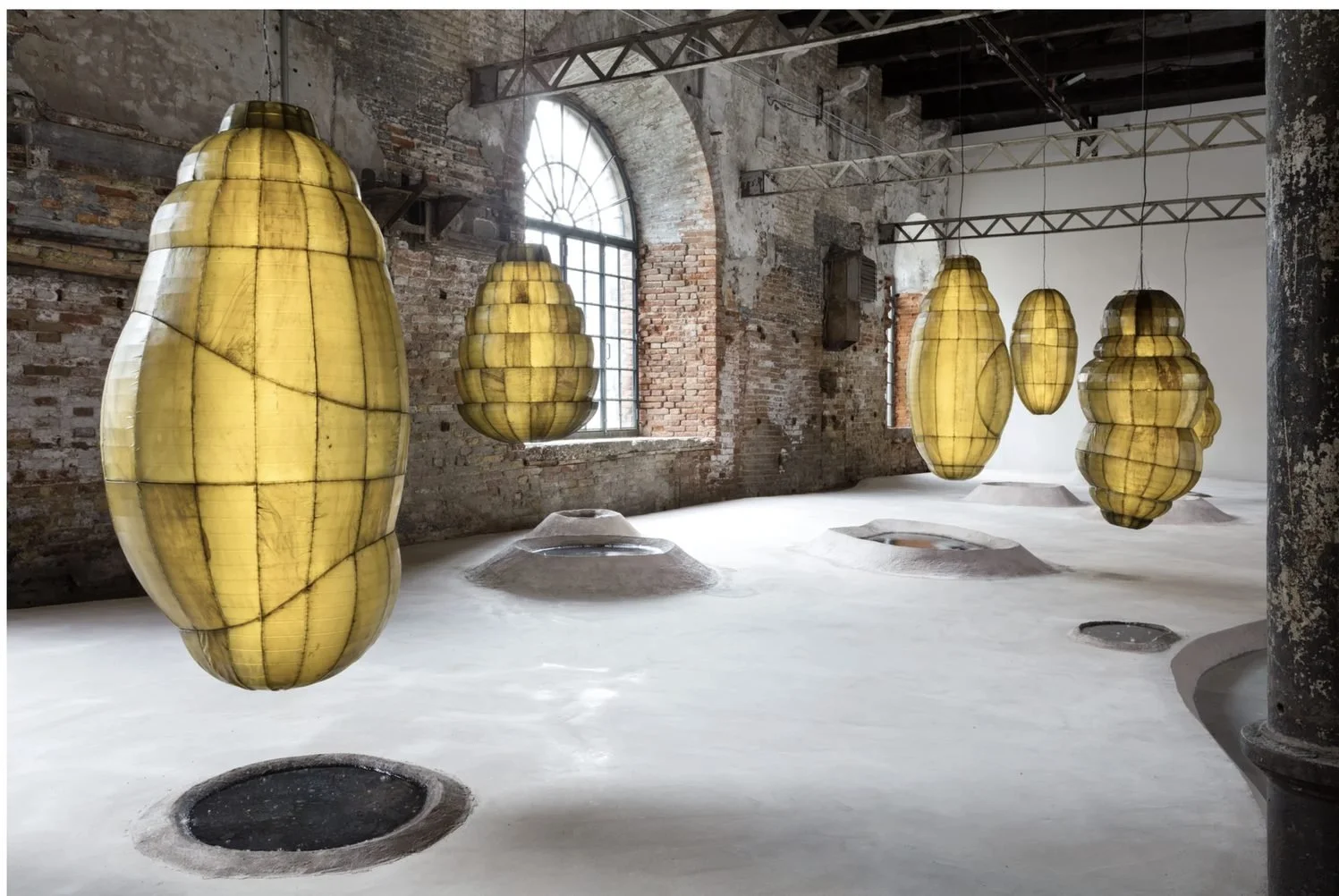
Kelp Sculptures and Imagined Organisms
Yi’s kelp sculptures resemble cocoons, seedpods, organs, marine creatures, lanterns, and speculative bodies.
They appear organic but are also carefully fabricated.
Their suspended forms seem capable of growth, reproduction, or transformation even though their exact biological identity remains unknown.
This ambiguity is central.
The sculptures do not copy one known organism.
They combine visual cues from several categories.
The viewer recognizes life without being able to identify the species.
This produces a speculative biological imagination.
What might life look like under different evolutionary conditions?
What forms might emerge from another combination of environment, material, and intelligence?
Yi creates objects that seem less like representations of existing nature than proposals for possible nature.
Biofiction
Yi’s work frequently operates through something that could be called biofiction.
Science fiction often imagines new technologies, societies, or extraterrestrial worlds.
Biofiction speculates through:
organisms;
ecosystems;
mutation;
evolutionary history;
symbiosis;
sensory worlds.
The work does not predict the future accurately.
It creates plausible conditions through which assumptions about life can be tested.
A fictional organism can reveal how narrowly people define:
body;
species;
intelligence;
naturalness;
autonomy.
The imagined life-form does not need to exist in order to alter our understanding of what does exist.
Biologizing the Machine
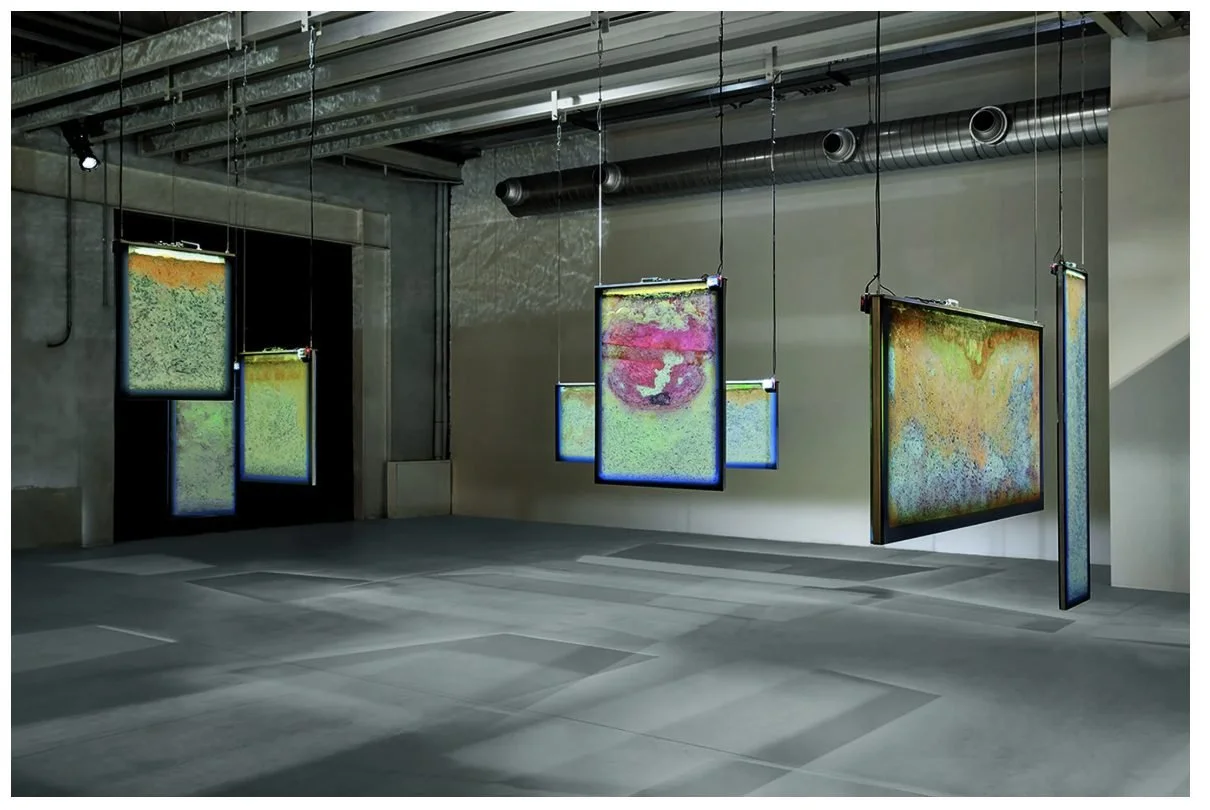
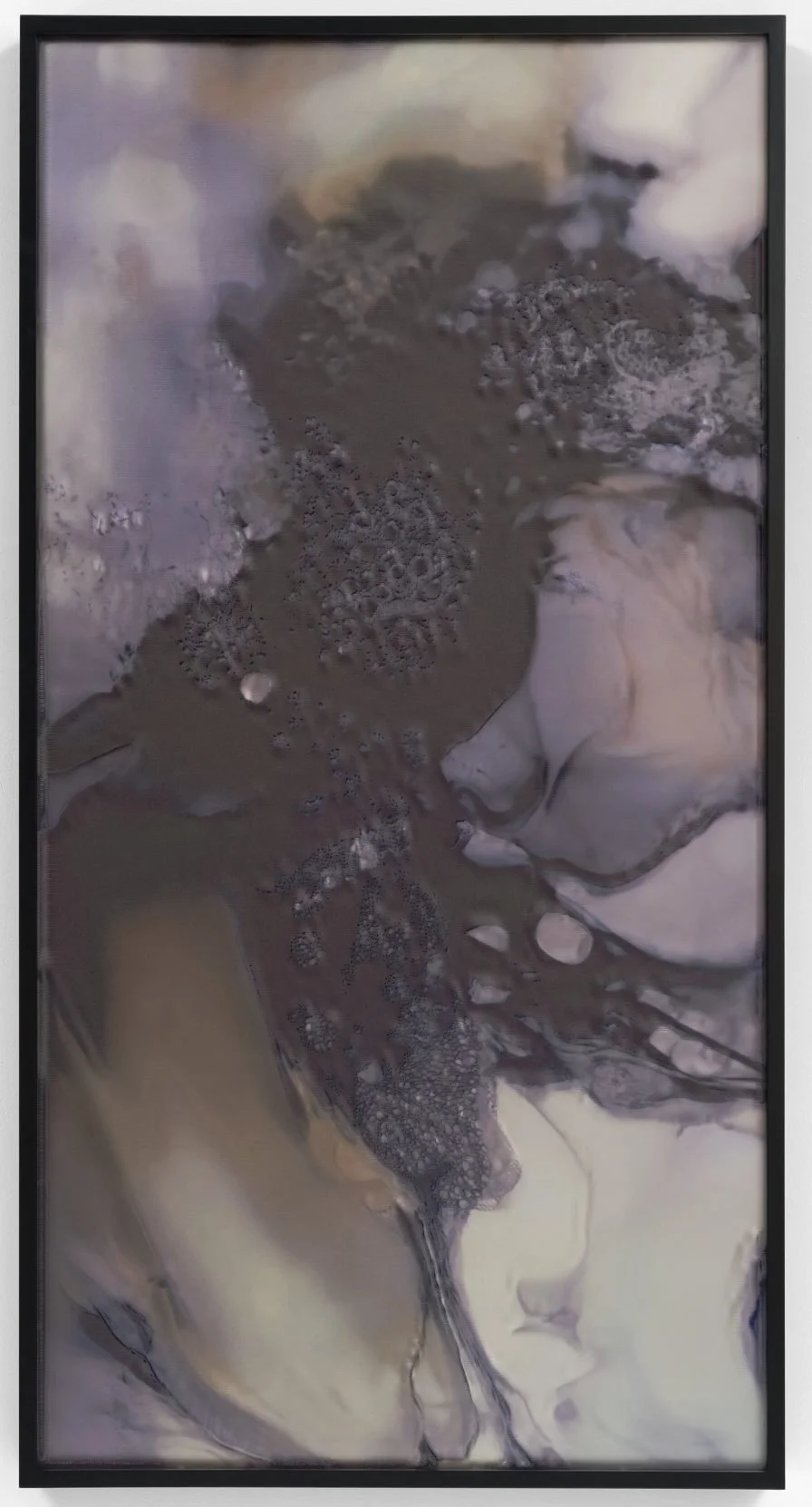
In works from the Biologizing the Machine series, Yi brings biological cultures into technological and display structures.
Suspended illuminated panels may contain living microbial patterns whose colors and forms change over time. The work combines the visual language of screens, lightboxes, laboratories, and biological growth.
The title reverses a familiar cultural direction.
Technology is often described as making life more mechanical.
Yi asks what happens when machines become biological.
A machine might:
grow;
adapt;
reproduce;
decay;
depend upon an environment;
coexist with other species.
The work does not simply make technology look organic.
It asks whether the categories were ever fully separate.
Human-built machines are already produced from transformed natural matter and operate inside ecological systems.
In Love With the World
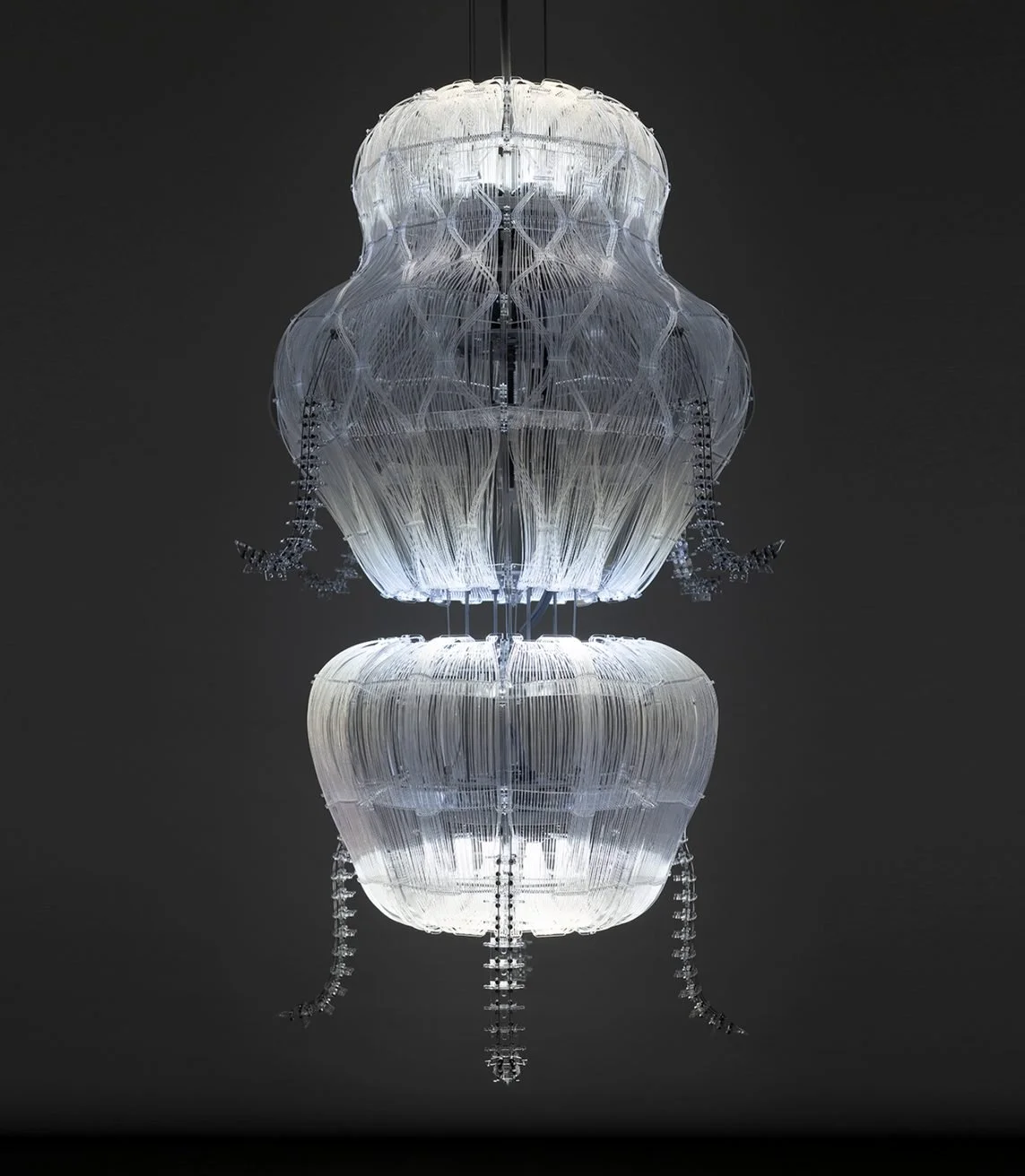
For the 2021 Hyundai Commission at Tate Modern, Yi created In Love With the World, an environment populated by floating robotic forms called aerobes.
The machines moved through the Turbine Hall with behaviors influenced by sensors and programmed systems. Their forms drew upon mushrooms and oceanic organisms, while changing scents evoked different imagined histories of the site. The project began from Yi’s question of what a “natural history of machines” might look and feel like. (Tate)
The title is significant.
The machines are not presented primarily as:
tools;
servants;
weapons;
threats;
efficient products.
They are beings attempting to inhabit a shared world.
The installation asks:
Could humans relate to machines through curiosity, care, coexistence, and affection rather than domination or fear?
This is not naïve technological optimism.
The work retains uncertainty.
The aerobes are attractive but unfamiliar.
They behave independently enough to appear alive while remaining designed systems.
A Natural History of Machines
Natural-history museums usually classify organisms according to:
anatomy;
species;
habitat;
evolutionary relation.
Machines are generally classified by function:
what they do;
how efficiently they perform;
who owns them;
what purpose they serve.
Yi proposes another approach.
What if machines had:
lineages;
habitats;
behavioral variation;
ecological dependencies;
evolutionary futures?
A machine’s identity would no longer be defined solely by human use.
It might become part of an environment whose future could not be completely predicted.
The idea destabilizes the assumed hierarchy:
human creator → machine servant.
Instead, human and machine enter a coevolutionary system.
The Aerobes and Nonhuman Character
The floating aerobes in In Love With the World appeared to possess character.
Some moved quickly.
Others drifted.
They approached certain regions and avoided others.
Viewers could interpret them as:
curious;
shy;
social;
solitary;
graceful;
awkward.
But these psychological interpretations may be projections.
The machines do not need human-like interior lives in order to affect the viewer.
This connects with Roni Horn’s inquiry into projection.
The observer encounters movement and assigns personality.
The environment, machine behavior, and viewer jointly produce the perceived character.
Character can emerge relationally even when no stable self exists behind it.
Scent as Invisible Architecture
The Turbine Hall commission also used scent to create invisible zones within the space.
A scent has no visible wall.
Yet crossing into it changes the experience.
The viewer may enter a new olfactory condition without knowing exactly where the transition occurred.
Scent therefore acts architecturally.
It creates:
boundaries;
atmospheres;
temporal associations;
bodily responses;
emotional territories.
Unlike a wall, it cannot be easily mapped by sight.
Its borders move through air currents and bodies.
Yi shows that architecture need not be solid to organize behavior.
There Exists Another Evolution, But in This One
Yi’s major survey There Exists Another Evolution, But in This One was presented at Leeum Museum of Art in 2024 and at UCCA Beijing in 2025. The UCCA presentation was her first solo exhibition in China and her most extensive presentation to that point, bringing together nearly forty works. (Esther Schipper)
The title refuses the fantasy that alternative evolution belongs only to another planet or distant future.
Another evolution is already happening here.
It may be occurring through:
microbial adaptation;
climate change;
synthetic biology;
machine learning;
altered ecosystems;
human-technological dependence;
changing sensory environments.
The work asks viewers to recognize that evolution is not a completed historical process.
Life and intelligence remain unstable.
The Human Is Not Outside Evolution
People often speak about evolution as something that produced humanity.
Yi treats evolution as an ongoing condition in which humans remain embedded.
Technologies alter:
memory;
attention;
movement;
relationships;
reproduction;
work;
perception.
Environmental changes alter bodies and behaviors.
Microorganisms evolve alongside medicine and industry.
Human life is both agent and material inside these systems.
This complicates the fantasy that people stand outside evolution and direct it from above.
We design systems that redesign us in return.
Message from the Mud
In 2026, Yi presented Message from the Mud at Storm King Art Center, her first large-scale outdoor project. The work centers upon twenty transparent Winogradsky columns containing self-sustaining microbial ecosystems, situated within a pond-like form made with local soil and water. The project engages deep geological time, microbial life, evolutionary history, and what Yi describes as “prehistoric biofiction.” (Vimeo)
The Winogradsky columns develop layers of microorganisms according to:
light;
nutrients;
oxygen;
chemical gradients;
time.
The artist establishes initial conditions, but the microbes determine much of the visible development.
Color, density, and biological composition change.
The columns resemble monuments while containing organisms indifferent to monumentality.
This creates a powerful contradiction:
A form associated with stability and human remembrance houses life defined by continuous transformation.
Mud Against Monumentality
Mud is frequently treated as low, dirty, primitive, or formless.
Monuments are associated with elevation, durability, authority, and cultural memory.
Yi joins these opposites.
Mud contains:
minerals;
water;
organic residue;
microorganisms;
environmental history;
potential life.
It is not empty matter waiting for human meaning.
It is already active.
The “message” from the mud may be that human history occupies only a thin layer within much longer biological and geological time.
The work reduces the scale of human self-importance without making human experience irrelevant.
Time Beyond the Human Lifespan
Yi’s practice contains several temporal systems at once:
rapid scent dispersal;
bacterial reproduction;
fermentation;
material decay;
machine processing;
evolutionary history;
geological duration.
A viewer encounters only one phase.
The work may have looked different before arrival and may continue changing after departure.
This prevents one stable image from representing the entire artwork.
Photography can document a moment but not the complete process.
The work exceeds its reproduction.
That is especially important in a culture where art is often encountered through quickly circulating images.
The Viewer as Host
Yi positions the viewer in an unusual role.
The viewer is not only:
observer;
interpreter;
audience member.
The viewer may also become:
host;
carrier;
contaminant;
organism among organisms;
source of heat;
participant in airflow;
body responding involuntarily to scent.
This changes the ethics of spectatorship.
The viewer does not remain cleanly separate from what is being examined.
The encounter may produce bodily awareness before conscious interpretation.
The museum’s supposedly neutral air becomes shared biological space.
Attraction and Disgust
Many of Yi’s works move deliberately between seduction and repulsion.
A microbial culture may produce luminous color.
A decaying substance may create an attractive scent.
A synthetic organism may appear beautiful and threatening.
A food-related material may become inedible.
Disgust is especially important because it protects boundaries.
People feel disgust toward substances that seem capable of entering or contaminating the body:
rot;
waste;
bodily fluid;
spoiled food;
infection.
Yi uses disgust to reveal how strongly identity depends upon the policing of borders.
What disgusts us often marks what we fear becoming entangled with.
But attraction works in the opposite direction.
It draws the body toward contact.
Yi makes the viewer occupy both impulses simultaneously.
Cleanliness and the Sterile Gallery
Museums often create environments of apparent neutrality:
white walls;
regulated humidity;
controlled temperature;
odorless rooms;
protected objects;
hidden maintenance.
Yi’s organic materials disrupt this fantasy.
Smell cannot be contained neatly by the visual boundary of an object.
Microorganisms complicate conservation.
Decay challenges permanence.
Living systems require care and monitoring.
The gallery becomes visibly ecological.
Sterility is exposed as a constructed condition rather than an absence of conditions.
Femininity, Labor, and the “Soft” Material
Yi’s materials have often been associated with areas historically coded as feminine or minor:
fragrance;
food;
domestic labor;
bodily care;
softness;
perishability;
decoration.
She brings these materials into dialogue with:
robotics;
engineering;
laboratory science;
artificial intelligence;
large-scale museum architecture.
This challenges inherited hierarchies between:
soft and hard;
domestic and technological;
emotional and rational;
feminine and masculine;
ephemeral and monumental.
Yi does not simply reverse the hierarchy by declaring softness superior.
She reveals that technological systems are already dependent on care, maintenance, sensory judgment, bodies, and environments.
The Central Contradiction
The deepest contradiction in Yi’s practice is:
She constructs highly controlled artistic environments in order to reveal that life, matter, perception, and intelligence cannot be fully controlled.
The work is:
scientific and speculative;
organic and manufactured;
seductive and disgusting;
intimate and planetary;
ephemeral and monumental;
technologically advanced and materially unstable;
human-designed and partially autonomous.
Too much control would turn the biological elements into illustrations.
Too little control would make the work arbitrary or unsafe.
Yi’s practice depends upon creating structured situations in which instability can remain active.
How the Medium Thinks
Yi’s materials do not merely represent ideas.
Their physical behaviors create the inquiry.
Bacteria
Bacteria bring reproduction, contamination, symbiosis, mutation, and invisible presence.
Scent
Scent brings bodily entry, memory, attraction, disgust, and porous boundaries.
Food materials
Food brings nourishment, culture, labor, chemistry, appetite, spoilage, and transformation.
Robotic systems
Robots bring programmed behavior, autonomy, projection, and technological evolution.
Artificial intelligence
AI brings learning, classification, unpredictability, and distributed authorship.
Light and display systems
Illumination brings scientific authority, spectacle, and the visual framing of living processes.
Decay
Decay brings time, loss, transformation, and the failure of permanent identity.
The practice remains coherent because every medium challenges the fantasy of separateness.
What the Practice Has Discovered
Across scent, biology, sculpture, robotics, and artificial intelligence, Yi’s work appears to have produced several major discoveries.
1. The human body is already collective
Identity depends upon microbial communities and continual material exchange.
2. Smell can reorganize artistic space
An invisible sensory medium can create bodily boundaries and social judgments more directly than visual form.
3. Contamination is not merely failure
Exchange with what is outside the self can produce life, relation, and transformation.
4. Intelligence can be distributed
Colonies, microbial systems, environments, and machines may act without one central controlling mind.
5. Decay can be generative
Material loss produces other forms, organisms, colors, and relations.
6. Machines can be imagined ecologically
Technology need not be understood only through utility and obedience.
7. Art can speculate through living processes
A fictional ecology becomes more consequential when matter actually changes.
8. The viewer is biologically implicated
Looking does not preserve distance when the work enters through air, scent, and bodily response.
The Artistic Capacity
Yi has developed the capacity to make biological, technological, sensory, and social systems feel inseparable.
She can make:
scent become architecture;
bacteria become portraiture;
decay become composition;
machines appear evolutionary;
a gallery become an ecosystem;
contamination become relation;
disgust expose social hierarchy;
microbial life challenge monumentality;
speculative fiction acquire real material behavior.
Her work depends upon a rare sensitivity to systems that cannot be understood through sight alone.
The World Yi Has Built
Yi’s artistic world includes recurring:
microbes;
scent;
food;
fungi;
algae;
insects;
suspended pods;
illuminated cultures;
floating machines;
synthetic organisms;
laboratories;
fermentation;
mud;
atmospheric environments.
These elements belong together because they all destabilize the autonomous human subject.
The world is:
porous;
inhabited;
metabolizing;
evolving;
decaying;
communicating;
partially unknowable.
Human beings remain present, but they no longer appear as the only authors of meaning.
Is the Language Still Learning?
Yi’s practice carries a clear contemporary risk.
Biology, artificial intelligence, scent, robotics, and speculative ecology can generate fascination before their relationships become conceptually necessary.
A glowing bacterial panel may appear profound because it is alive.
A robotic organism may appear important because it uses advanced technology.
An immersive scent may appear radical because viewers are unaccustomed to olfactory art.
The essential question is:
Does each biological or technological process change what the work can discover, or does scientific complexity merely provide atmosphere and prestige?
The language remains alive when:
a living process introduces real transformation;
scent changes the viewer’s bodily position;
machines develop behavior rather than function as spectacle;
a new ecosystem redistributes authorship;
environmental time complicates human history;
scientific collaboration produces a question unavailable through conventional sculpture.
Yi’s recent survey exhibitions and the 2026 Storm King project demonstrate a continuing expansion from indoor sensory environments toward outdoor microbial systems, geological time, and evolving ecologies. (Esther Schipper)
Risks and Limits
Yi’s practice faces several significant pressures.
Scientific complexity becoming authority
Viewers may accept the work’s importance because specialist knowledge appears inaccessible.
Living material becoming spectacle
Microbes and organisms can become exotic artistic effects rather than meaningful participants.
Nonhuman agency becoming romanticized
Acknowledging other forms of life does not eliminate human control over exhibition conditions.
Disgust becoming predictable
Organic decay and bodily material can lose pressure if transgression becomes a familiar style.
Technology becoming novelty
Artificial intelligence and robotics must alter the inquiry rather than merely update its appearance.
Ethical responsibility becoming invisible
Living systems require care, containment, expertise, and decisions about what survives after exhibition.
These risks do not weaken the underlying inquiry.
They make material necessity essential.
What the Work Expands
Yi expands what portraiture can be.
A portrait can consist of bacteria gathered from many bodies rather than a visible face.
She expands what architecture can be.
A scent can shape movement and atmosphere without a solid wall.
She expands what sculpture can be.
A sculpture can grow, decay, metabolize, respond, and change identity.
She expands what intelligence can mean.
Intelligence may emerge through colonies, environments, machines, and relations rather than one conscious individual.
Most importantly, she expands what the self can be.
The self becomes:
microbial;
environmental;
technological;
relational;
temporary;
continually exchanged with the world.
What Artists Can Learn
The lesson is not to add bacteria, scent, robotics, or artificial intelligence to a work merely to make it contemporary.
The deeper lesson is to ask:
What assumptions about the human subject does the material itself make impossible to maintain?
A scent is necessary when bodily permeability matters.
A living culture is necessary when change and reproduction matter.
A machine is necessary when programmed behavior and emergent agency matter.
Decay is necessary when the loss of fixed identity matters.
Yi’s practice also suggests a powerful extension of your inquiry.
A person does not construct a character from an autonomous interior and then present it to the world.
The character emerges from an ecology:
bodily condition;
microbes;
atmosphere;
food;
technology;
environment;
inherited social judgments;
sensory responses;
encounters with other beings.
The world does not merely interpret the character.
The world is already inside the character.
Yi’s achievement is to make the autonomous self feel biologically and technologically impossible: identity becomes a temporary ecology produced through contamination, symbiosis, metabolism, sensory encounter, and continuous exchange with forms of life and intelligence beyond human control.