What Makes Firelei Báez’s Paintings So Powerful?
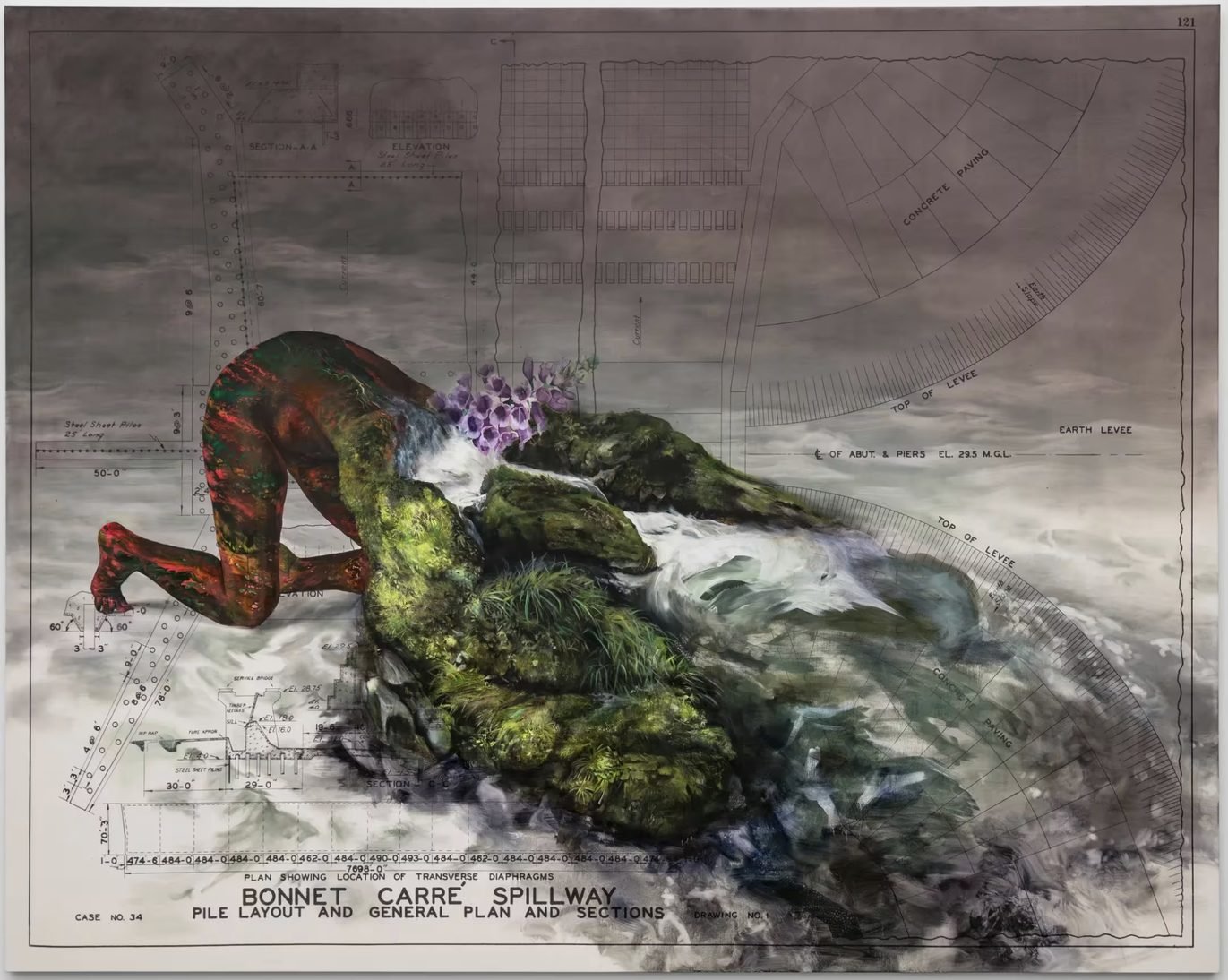
Firelei Báez’s paintings are powerful because they transform the visual languages once used to classify, map, contain, and diminish people into exuberant worlds of movement, beauty, invention, and possibility.
Her work may combine:
historical maps
colonial diagrams
archival documents
architectural plans
heraldic symbols
botanical forms
patterned bodies
mythical creatures
abstract color
ornament
landscape
fragments of human anatomy
Figures emerge from these historical surfaces, but they rarely behave like conventional portraits.
They may appear:
feathered
scaled
fur-covered
floral
aquatic
monstrous
elegant
unstable
partially invisible
fused with the environment
The bodies do not fit easily into one category.
They appear human and nonhuman, historical and futuristic, vulnerable and powerful.
Báez draws from African diasporic histories and the colonial history of the Atlantic world, while also using anthropology, geography, folklore, fantasy, science fiction, and social history to unsettle fixed categories of race, gender, and nationality.
The work is immediately beautiful.
Saturated color moves across the surface.
Patterns multiply.
Bodies seem to grow, dissolve, and reassemble.
But the beauty is not an escape from history.
It is a method of transforming history.
The central problem beneath the work is:
How can painting take the maps, archives, symbols, and categories created by colonial power and turn them into visual worlds that those systems can no longer control?
Báez does not merely expose historical violence.
She imagines what might exist beyond the structures that produced it.
The Map as an Instrument of Power
Maps are often treated as neutral descriptions of the world.
They appear factual.
They measure land.
They identify borders.
They organize territory.
But maps also express power.
They determine:
who owns a place
who names it
which borders appear legitimate
which communities become visible
which histories are omitted
how land can be divided, governed, exploited, or exchanged
Colonial maps did not merely record territory.
They helped make conquest appear orderly and rational.
Báez frequently paints over reproductions of maps and other historical documents. The printed structure remains visible beneath the new image, but it no longer controls the entire surface.
Color spreads across borders.
Figures interrupt grids.
Hair, foliage, feathers, water, flesh, and pattern cross the lines intended to organize them.
The map remains present as evidence.
But its authority has been weakened.
This produces one of the central reversals in her work:
The historical document becomes the background, while the body once subjected to its system becomes the dominant visual force.
The map no longer contains the figure.
The figure overwhelms the map.
History as a Surface to Be Rewritten
Báez does not usually erase the historical material completely.
That is important.
The old map, document, plan, or diagram remains visible enough for the viewer to understand that the painting has entered an inherited system.
The past is not replaced by a clean new image.
It survives beneath the transformation.
This allows several conditions to remain active:
historical violence and imaginative freedom
evidence and invention
inherited structure and visual rebellion
classification and metamorphosis
archival authority and painterly instability
The new image does not pretend that history can simply be overcome.
Instead, it shows history being contested.
The surface becomes a struggle between what has been recorded and what can still be imagined.
This connects Báez to a major principle from our broader research:
History is often strongest in contemporary art when it remains visible as residue rather than appearing as a completed story.
Báez’s paintings preserve the systems of the past while refusing to let them determine the future.
The Body That Cannot Be Classified
Colonial systems depended heavily on classification.
People were organized according to:
race
nationality
gender
legal status
labor
geography
ancestry
perceived biological difference
Classification converts complexity into categories that can be managed.
Báez’s bodies resist that process.
They are frequently hybrid.
A figure may contain:
human limbs
animal textures
floral growth
feathers
scales
patterned skin
flowing hair
abstract color
forms that seem liquid or atmospheric
The viewer recognizes parts but cannot stabilize the whole.
The figure remains visible without becoming fully legible.
This is not ambiguity for its own sake.
The body becomes difficult to classify because classification is part of the historical problem being challenged.
The figure refuses the demand to become one thing.
It may be simultaneously:
beautiful and monstrous
feminine and beyond gender
ancestral and futuristic
bodily and environmental
wounded and triumphant
culturally specific and mythologically open
The deeper artistic strategy is:
The body becomes free by exceeding the categories through which it was once controlled.
The Ciguapa
One recurring figure in Báez’s work draws from the ciguapa, a creature from Dominican folklore often described as a wild female being with long hair and backward-facing feet.
The ciguapa is difficult to track because her footprints appear to indicate the opposite direction of her movement.
This makes her especially powerful within Báez’s larger investigation.
She is a figure who cannot be followed through ordinary systems of evidence.
She resists capture, interpretation, and possession.
The ciguapa may suggest:
freedom from social control
refusal of domestic order
bodily autonomy
environmental belonging
danger
erotic power
cultural memory
unreadable movement
Her backward feet turn the logic of tracking against itself.
The sign remains visible, but its meaning misdirects the pursuer.
This corresponds closely to another major principle from our research:
Visibility does not have to produce access.
The ciguapa can appear without becoming available.
She can leave evidence without surrendering herself to it.
Beauty as Counterpower
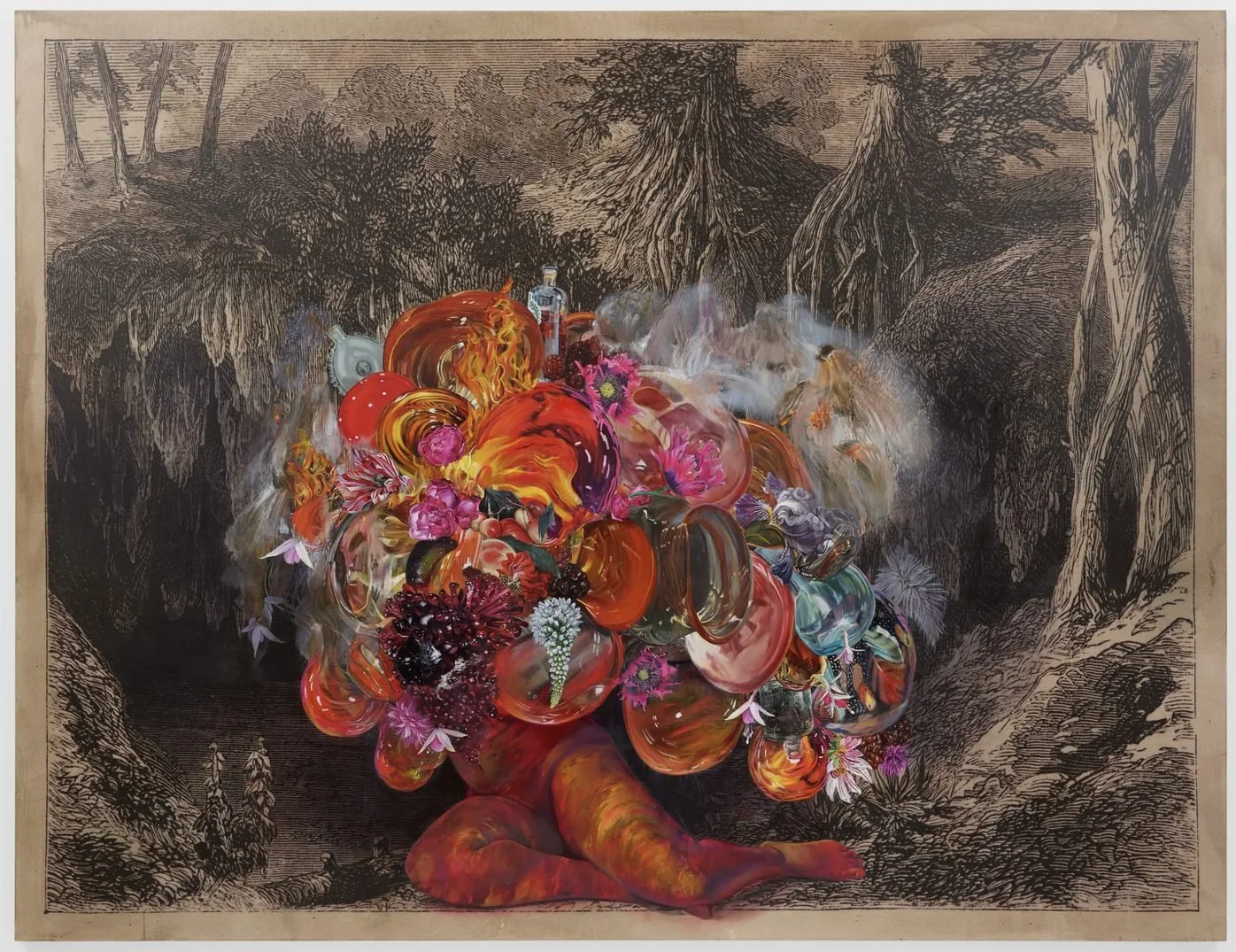
Báez’s paintings are often radiant.
They contain intense reds, blues, greens, pinks, violets, oranges, and golds.
Flowers, feathers, curls, decorative forms, and patterned surfaces generate visual pleasure.
This beauty is not secondary to the political or historical content.
It is part of how the work resists systems based on deprivation, containment, and loss.
Historical critique in contemporary art often uses:
darkness
ruin
absence
damaged imagery
muted color
solemnity
Báez often chooses abundance instead.
Her paintings can feel:
joyful
sensual
excessive
celebratory
luxurious
fertile
energetic
That does not mean the history has become pleasant.
Rather, beauty creates a form of counterpower.
The figure is not restricted to appearing as evidence of suffering.
She can occupy:
fantasy
pleasure
ornament
mystery
elegance
transformation
overwhelming visual presence
Báez fills historical absence not only with information but with imaginative abundance. Hauser & Wirth characterizes her work as placing diasporic histories into imaginative realms and filling gaps in history through joyful rebellion.
The work asks:
What happens when people historically represented through domination are granted extravagance, beauty, instability, and mythic power?
Pattern as Transformation
Pattern plays several roles in Báez’s paintings.
It may operate as:
skin
clothing
environment
camouflage
ornament
cultural memory
movement
bodily transformation
visual excess
Pattern does not merely decorate a completed figure.
It helps construct the figure.
A body may seem to emerge from repeated marks.
A patterned surface may spread beyond the body and into the surrounding space.
The boundary between figure and environment becomes unstable.
This creates a tension between concealment and expansion.
Pattern may hide the body by making it difficult to separate from the background.
But pattern may also enlarge the body by allowing its visual language to spread across the image.
The figure no longer occupies the environment as an isolated object.
She begins to transform the environment into an extension of herself.
This is especially relevant to one of the central ideas in our research:
The strongest figure may eventually reorganize the world around her presence.
In Báez’s work, self-authorship is not limited to the body.
The figure rewrites the surface around her.
Ornament Against Colonial Order
Colonial maps and documents depend on visual order.
They use:
grids
lines
borders
labels
measurements
repeated symbols
standardized categories
Báez counters this order with ornament.
Her decorative language is fluid, layered, irregular, proliferating, and difficult to contain.
The contrast is not simply between geometry and organic form.
It is between two systems of organization.
The colonial document tries to stabilize the world.
Báez’s ornament makes the world mobile again.
Flowers, hair, feathers, scales, waves, and abstract gestures refuse the fixed logic of the underlying map.
Decoration therefore becomes political without functioning as a slogan.
It changes the structure of the image.
The painting replaces the authority of the grid with a system based on growth, mutation, rhythm, and movement.
This gives ornament a serious conceptual role:
Ornament becomes the visual language of a world that refuses to remain administratively fixed.
Fiction as Historical Method
Báez does not respond to gaps in history by attempting a straightforward reconstruction.
She uses fiction.
This may appear risky.
If history has been erased, why introduce fantasy rather than recover facts?
The answer is that archives are never complete.
They often preserve the viewpoint of institutions that had the power to record.
Many lives survive only partially, if at all.
Fiction allows Báez to move beyond the archive’s limitations.
She does not claim that imagined figures are documentary evidence.
Instead, she creates forms of presence that history failed to preserve.
Fantasy can provide:
mobility
power
pleasure
complexity
alternative ancestry
speculative identity
freedom from realism
futures not determined by the past
Her work demonstrates that invention can be historically serious.
The painting does not ask:
What exactly happened?
It may ask:
What forms of life, power, and possibility were excluded from the official record?
This is fiction used not to escape history but to challenge history’s monopoly over reality.
Mythology as an Alternative Archive
Folklore and mythology preserve forms of knowledge that official archives often dismiss.
They carry:
communal memory
warning
survival strategies
cultural identity
spiritual belief
bodily knowledge
alternative ideas of nature and power
Báez brings mythical creatures and folkloric references into contact with maps, diagrams, and official documents.
This creates a confrontation between different systems of knowledge.
The map claims authority through measurement.
Myth claims authority through cultural transmission.
The archive records what institutions considered important.
Folklore preserves what communities continued to remember.
Neither system is presented as completely transparent.
But the painting disrupts the assumption that official documents are the only serious evidence.
Myth becomes another way of knowing.
The Body and the Environment
Báez’s figures often blur into natural forms.
Bodies may appear connected to:
water
plants
geological structures
storms
animal life
coral
hair-like vegetation
atmospheric color
This can suggest that the separation between human identity and environment is itself unstable.
Colonialism did not only classify people.
It also classified land, plants, animals, and resources according to their potential usefulness.
Báez’s hybrid bodies resist the division between person and nature.
A figure may seem less like an individual standing in a landscape and more like an ecosystem.
This changes the meaning of power.
Power does not necessarily appear as domination over the environment.
It may emerge through connection, adaptation, mutation, and interdependence.
The body becomes expansive rather than bounded.
Movement Against Borders
Báez’s forms rarely appear static.
Hair flows.
Color spreads.
Bodies twist.
Patterns cross boundaries.
Water and atmosphere move through the surface.
This motion matters because colonial and national systems rely on stable borders.
The paintings repeatedly refuse stability.
Movement may suggest:
migration
escape
diaspora
transformation
changing identity
cultural circulation
survival
refusal of confinement
The Atlantic world in Báez’s work is not simply a geographic region.
It is a network shaped by forced movement, migration, trade, cultural exchange, violence, and survival.
The paintings do not reduce that history to one narrative.
They create visual conditions in which movement remains active.
Painting Over the Archive
There is a productive ethical question in painting over historical documents.
Does the new image obscure the evidence?
Does beauty aestheticize violence?
Does fantasy make history less specific?
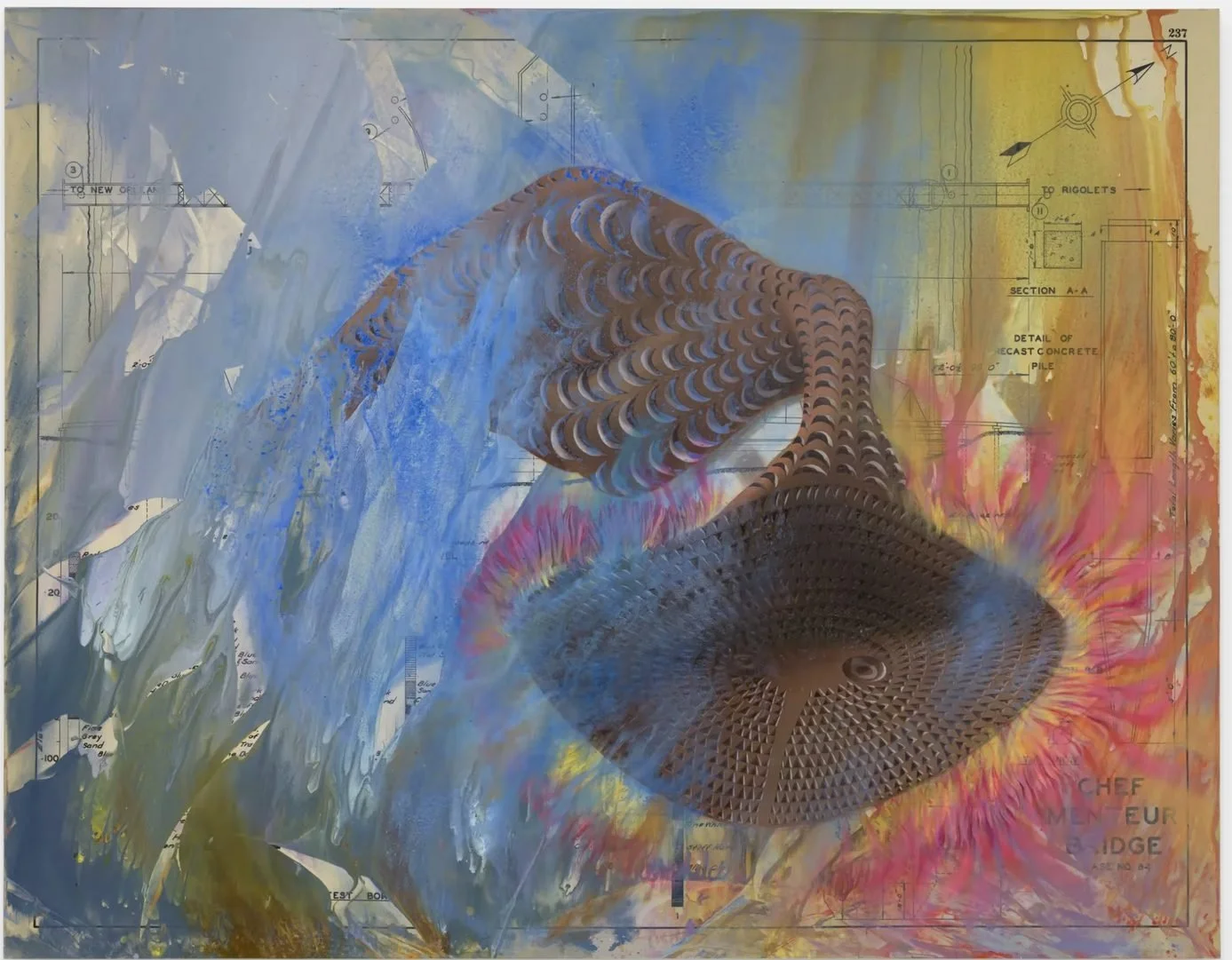
Báez manages this risk by allowing the underlying source to remain partially visible.
The map or document continues to exert pressure.
It is not merely a decorative vintage background.
The viewer can still detect:
grids
labels
geographic outlines
architectural structures
borders
diagrams
The new painting interrupts the source but does not fully silence it.
This preserves the conflict.
The beauty cannot become innocent because the structure beneath it remains visible.
The strongest works create a real contest between historical classification and imaginative transformation.
Monumental Scale and Authority
Many of Báez’s paintings are large enough to confront the viewer physically.
The figure may exceed ordinary human scale.
This gives bodies that were historically classified, studied, exoticized, or marginalized a new form of authority.
Scale changes the viewer’s relationship to the subject.
The viewer does not simply inspect the figure.
The figure occupies the viewer’s field of vision.
This reverses the traditional direction of control.
The body becomes difficult to contain visually, just as it is difficult to classify conceptually.
The ICA Boston’s survey emphasized Báez’s monumental paintings, drawings, installations, and richly layered uses of pattern and saturated color in relation to the colonial histories of the Atlantic basin.
Scale therefore becomes more than spectacle.
It grants the imagined body environmental and pictorial authority.
Ruin and Reconstruction
Báez has also worked sculpturally with architecture and historical ruin.
For the ICA Watershed, she created a monumental installation that reimagined the ruins of Haiti’s Sans-Souci Palace as though they had emerged after water receded from the site. The project connected Haitian history with the Watershed’s location in a working shipyard associated with trade, migration, and entry.
The ruin is significant because ruins usually suggest loss.
They preserve evidence of what no longer survives.
Báez uses ruin as a site of imaginative return.
Architecture appears displaced from its expected location and time.
The historical structure becomes:
ghost
monument
body
survivor
speculative future
submerged memory
The ruin is not restored to an original state.
It is relocated and transformed.
This is consistent with her larger practice.
The goal is not historical reconstruction.
It is the creation of another relationship to historical remains.
Abstraction and Figuration
Báez’s work moves continuously between abstraction and recognizable form.
A passage may initially appear as pure color.
Then it becomes:
hair
water
muscle
foliage
fabric
animal skin
atmospheric movement
A body may emerge briefly and then dissolve again.
This instability is conceptually important.
The figure cannot be separated cleanly from the forces around it.
Abstraction allows the body to remain open.
It resists becoming a fixed portrait or stable symbol.
Figuration provides enough presence for the viewer to encounter a body.
Abstraction prevents the encounter from becoming possession.
The figure remains available and unavailable simultaneously.
The Viewer’s Desire to Identify
Báez’s figures trigger the viewer’s urge to decode.
The viewer may ask:
What creature is this?
Is the figure male or female?
Which culture does this symbol come from?
What map is underneath?
What historical event is being referenced?
What does the pattern mean?
Some of these questions are productive.
But the work also exposes the desire to stabilize the image through identification.
The viewer may be repeating the classificatory impulse that the painting resists.
Knowing the source does not complete the figure.
Recognizing the map does not resolve the painting.
The work remains excessive.
It contains more visual possibility than classification can manage.
The viewer’s failure to finish the image becomes part of the meaning.
Joy Without Innocence
One of the most distinctive qualities of Báez’s work is its joy.
The color can feel generous.
The forms can feel expansive.
The surfaces often suggest vitality rather than deprivation.
But joy is not presented as innocence.
It exists in direct contact with histories of:
slavery
colonialism
racial classification
migration
displacement
cultural erasure
territorial control
This makes joy a deliberate position.
It refuses the idea that historical seriousness requires permanent visual suffering.
Joy may function as:
survival
resistance
imagination
refusal
cultural continuity
future-making
The painting does not deny damage.
It rejects damage as the only possible identity.
The Risk of Visual Abundance
Báez’s greatest strength also presents a risk.
The paintings are extremely rich.
They contain color, pattern, historical references, maps, bodies, mythology, abstraction, and decorative detail.
This abundance can become overwhelming.
A viewer may respond only to:
beauty
virtuosity
color
scale
exotic imagery
symbolic density
The work risks becoming visually spectacular before its structure is understood.
There is also a danger that historical maps may become a recognizable signature device:
archival background plus hybrid figure plus abundant pattern.
The critical question is:
Does each painting create a specific struggle between its source material and its transformed figure, or does the historical document merely support an established visual formula?
The strongest works make the archive and the new image alter one another.
A weaker work might use history as atmospheric credibility.
The Risk of Generalized Liberation
Another risk concerns transformation itself.
Hybrid bodies, fantasy, mythology, and fluid identity are widely used in contemporary art as signs of liberation.
But transformation can become too easy symbolically.
A figure that is part human, part animal, and part plant may automatically suggest resistance to classification.
The challenge is to make each transformation historically and psychologically specific.
What classification is being resisted?
What visual history is being revised?
What form of freedom is being imagined?
What remains unresolved?
Without specificity, hybridity can become a generalized contemporary style.
Báez’s strongest works avoid this by grounding invention in particular maps, archives, folkloric figures, architectural histories, and cultural narratives.
Why the Work Matters Now
Báez’s work belongs to a present shaped by renewed struggles over:
borders
migration
national identity
historical memory
citizenship
race
public monuments
archives
cultural ownership
environmental crisis
Maps and categories continue to organize who belongs, who moves freely, and whose history becomes official.
At the same time, digital culture increasingly turns identity into searchable, measurable, and classifiable information.
Báez responds by creating bodies that cannot be reduced to stable data.
Her figures remain visually intense but informationally incomplete.
They suggest that freedom may require not only better representation but resistance to the demand for complete legibility.
What Artists Can Learn
The lesson is not to imitate Báez’s maps, hybrid bodies, folklore, feathers, flowers, saturated color, or archival surfaces.
Those are the visible solutions produced by her particular investigation.
The larger lessons are:
Historical sources can be transformed rather than merely quoted.
Beauty can function as counterpower.
Pattern can construct the body rather than decorate it.
Fiction can address gaps that documentation cannot repair.
Mythology can operate as an alternative archive.
A figure can remain visible while resisting classification.
Ornament can dismantle rigid systems of order.
Abstraction can protect figuration from becoming fixed.
Scale can reverse the power relationship between viewer and subject.
The environment can become an extension of the body.
Historical evidence should remain active beneath imaginative transformation.
Joy can carry political and historical seriousness.
Hybridity must remain specific rather than become an automatic symbol of freedom.
Visual abundance requires strong structure.
The strongest intervention changes both the inherited source and the new image.
For an artist working with beauty, color, pattern, environment, and identity, Báez offers an especially important lesson:
Pattern and beauty become conceptually powerful when they do not merely describe identity but actively free the figure from the systems attempting to define it.
A useful studio translation might be:
begin with an environment that already carries social authority
identify the visual systems that classify the figure
allow pattern to cross those systems
let color reorganize the hierarchy
make the figure transform the environment rather than merely endure it
preserve enough of the original structure for the conflict to remain visible
Báez begins with a map.
The map divides the world.
It names territory.
It establishes borders.
A figure appears.
The body crosses the lines.
Pattern spreads.
Color overwhelms the grid.
The figure becomes animal, plant, atmosphere, myth, and future.
The map remains visible but can no longer control what it contains.
Firelei Báez transforms the visual systems of colonial classification into abundant worlds of metamorphosis, using beauty, pattern, fiction, and hybrid bodies to imagine forms of diasporic presence that history can neither fully contain nor define.
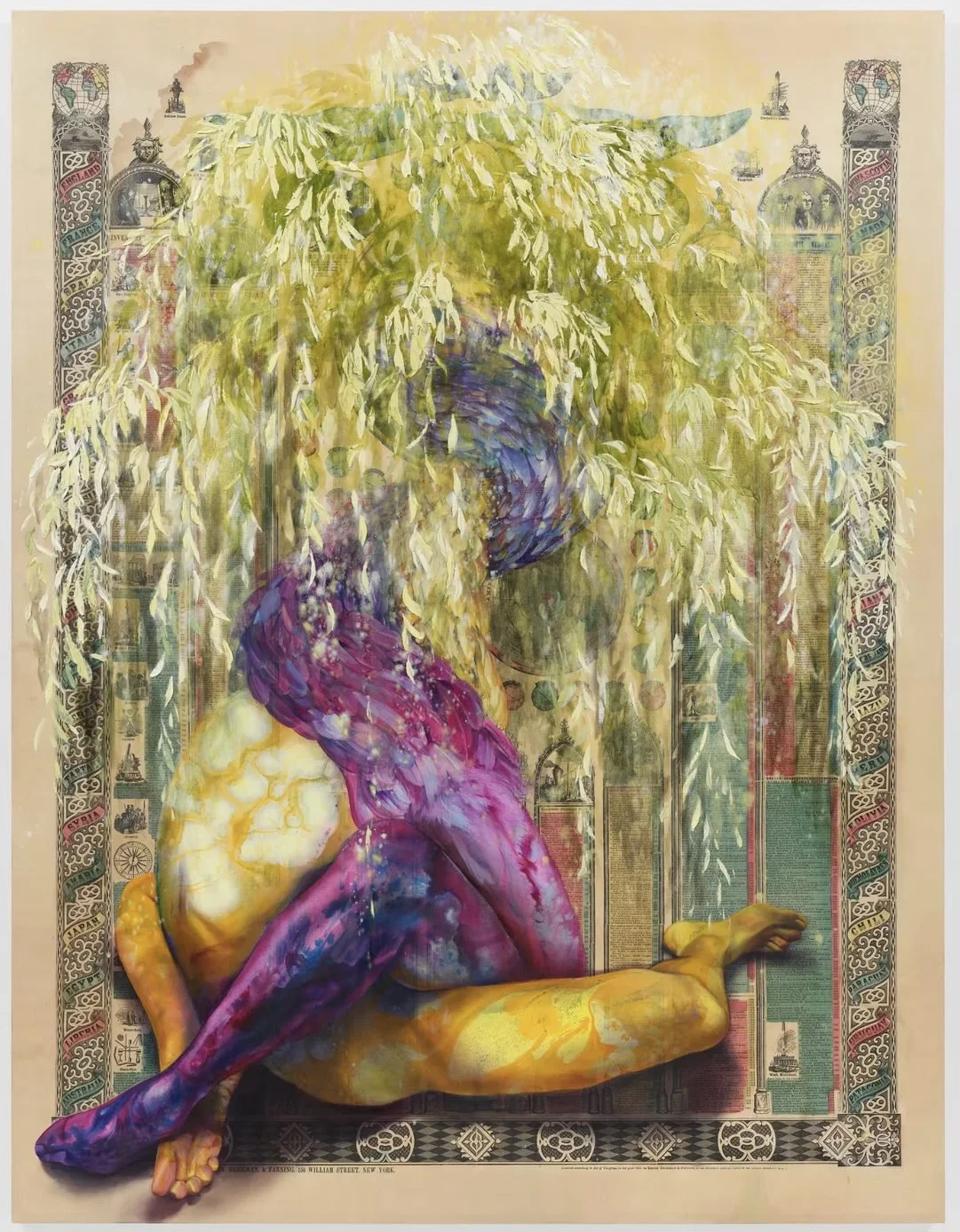
What Makes Tomma Abts’s Paintings So Powerful?
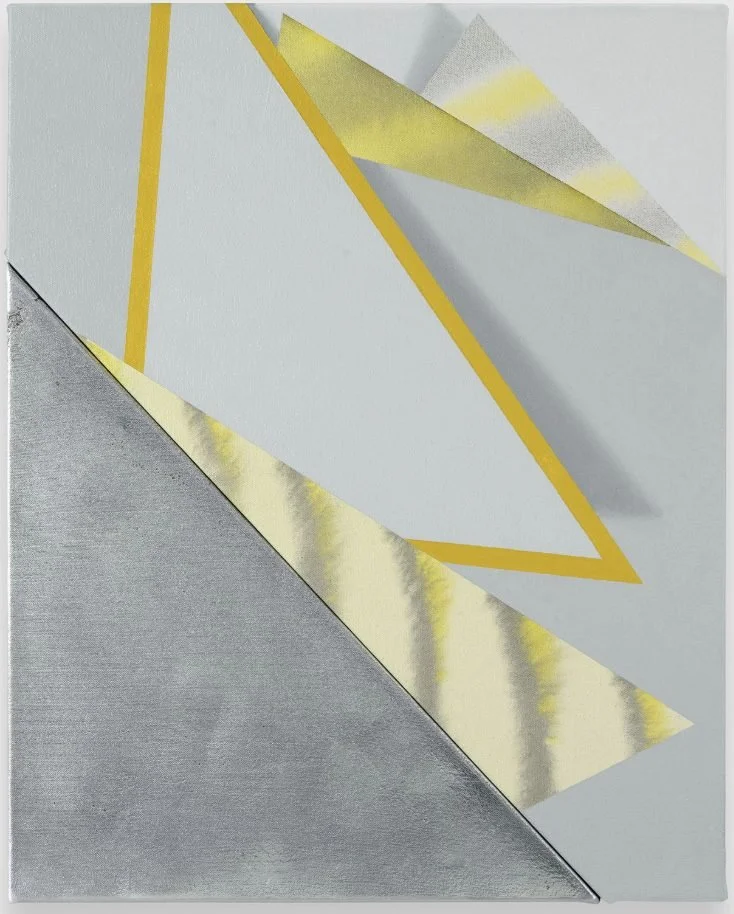
Tomma Abts’s paintings are powerful because they demonstrate that abstraction does not need grand scale, explicit politics, personal narrative, or expressive drama to create serious pressure.
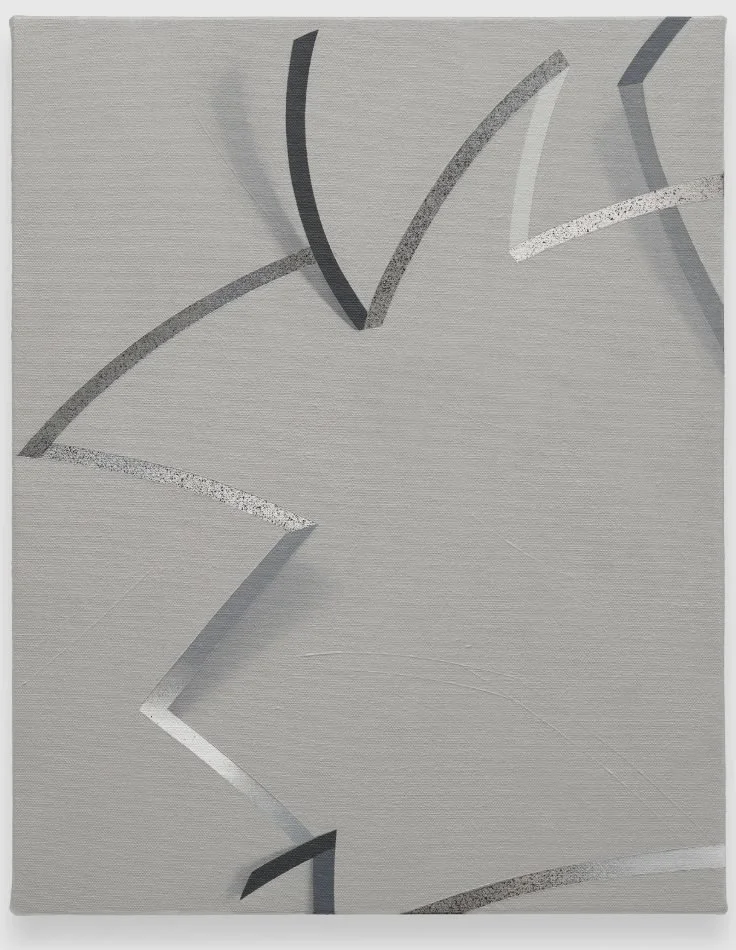
Her paintings are usually small.
Many measure approximately 48 by 38 centimeters—roughly nineteen by fifteen inches—and are surrounded by generous areas of empty gallery wall. Since 1998, she has repeatedly returned to this intimate vertical format, although more recent work has introduced larger supports, multipart paintings, silk, and small cast-metal additions.
At first, the paintings can appear restrained.
They contain:
folded planes
interlocking bands
curved forms
sharp edges
fine ridges
shadows
narrow openings
muted colors
geometric structures
surfaces that seem carved, layered, bent, or suspended
There are no recognizable people, landscapes, historical events, or narrative scenes.
Nothing tells the viewer what the painting is “about.”
Yet the images feel unusually specific.
The shapes do not look like arbitrary design.
They seem to have arrived through a long process of negotiation, correction, resistance, and discovery.
The deeper problem in Abts’s work is:
How can an abstract painting develop enough internal necessity to feel like a discovered reality rather than an invented arrangement?
She does not begin with a predetermined composition or preliminary drawing. Her paintings evolve gradually through addition, removal, overpainting, adjustment, and reconsideration. The final surface preserves traces of that process through ridges, uneven textures, layered edges, subtle shadows, and color changes.
The painting becomes the record of its own search.
Beginning Without a Plan
Abts often begins with no fixed image and no clear idea of how the painting will end.
This does not mean the process is casual or purely spontaneous.
She works within strict conditions:
a repeated scale
a vertical format
a limited physical surface
abstract form
carefully controlled color
sustained revision
no obligation to depict the external world
These restrictions create a contained laboratory.
Because the format remains relatively stable, the real variation occurs inside the painting.
A line is introduced.
A plane begins to form.
Another shape crosses it.
A section is covered.
An earlier edge survives as a ridge.
A shadow creates the illusion of depth.
A color destabilizes the structure.
The artist does not simply execute an idea.
She responds to what the painting has become.
This creates a productive reversal:
The artist begins the painting, but the developing painting begins to determine what the artist can do next.
Each decision changes the field of possibilities.
As the work develops, some directions become available and others disappear.
The composition gradually acquires its own internal demands.
Process as Subject
Abts’s paintings are sometimes described as being about the process of their own creation.
That does not mean they merely display painterly labor.
They are not demonstrations of technique.
The process becomes important because it produces a form of intelligence that could not be planned in advance.
The painting contains evidence of:
hesitation
correction
concealment
persistence
conflict
revision
failed directions
unexpected discoveries
gradual resolution
The finished image does not erase this history completely.
Fine ridges and raised edges reveal that forms have been painted over or moved.
Some shadows appear to describe three-dimensional structures, while others may be remnants of earlier compositional decisions.
The viewer encounters the final state and the pressure of previous states simultaneously.
The surface says:
This image has arrived.
But it also says:
It could have become something else.
That tension prevents the painting from feeling like clean graphic design.
Constraint Produces Freedom
Katharina Grosse creates freedom by allowing color to cross architecture, objects, and landscape.
Tomma Abts creates freedom through the opposite strategy.
She limits the field.
The canvas is small.
The format is repeated.
The subject is absent.
The process unfolds slowly.
Yet these restrictions produce an extraordinary number of possibilities.
This reveals an important artistic principle:
Freedom does not always require expansion. It can emerge through sustained attention inside a narrow structure.
Because Abts does not need to invent a new subject for each work, she can focus on subtle differences:
how one plane overlaps another
whether a curve feels inflated or cut away
whether a shadow creates depth or contradiction
how color changes spatial hierarchy
whether a form appears solid, transparent, folded, or hollow
how much pressure can be created inside a small field
The constraint concentrates thought.
Nothing can rely on scale, narrative, cultural reference, or spectacle to create importance.
Every relationship must earn its place.
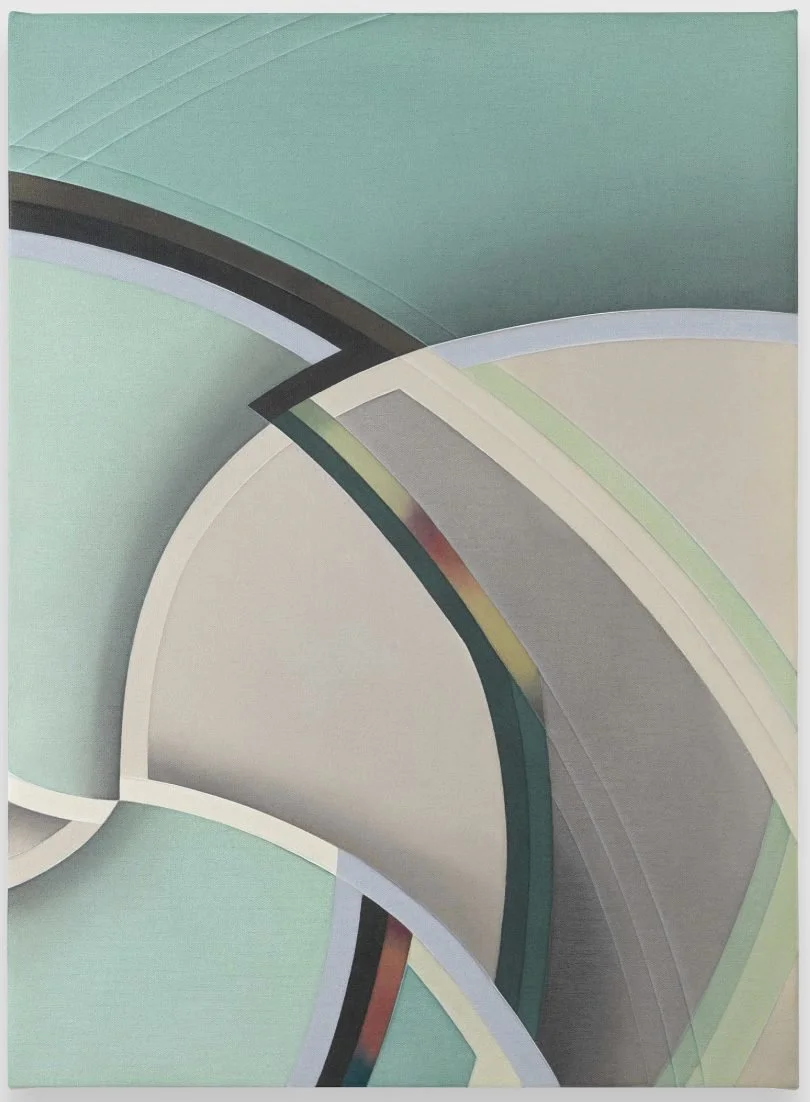
Small Scale and Concentrated Attention
The small size of Abts’s paintings is conceptually important.
A large painting can dominate the viewer physically.
Abts’s paintings cannot rely on that authority.
They ask the viewer to approach.
From across the gallery, they may appear like quiet objects or compressed signs.
At close range, the surfaces reveal:
minute color shifts
fine ridges
thin seams
layered edges
slight irregularities
delicate shadows
evidence of correction
tensions between flatness and depth
The viewer’s relationship becomes intimate.
The painting does not surround the body.
It concentrates the eye.
This scale changes the power dynamic.
The work does not overwhelm the viewer.
It withholds itself until the viewer offers attention.
Its authority is therefore earned through density rather than size.
The painting becomes monumental through concentration rather than physical expansion.
Abstraction Without Generality
Weak abstraction often feels general.
The forms could be moved, replaced, recolored, or removed without changing the deeper meaning.
Abts’s strongest paintings feel highly particular.
A shape may be unfamiliar, but it does not feel interchangeable.
Its exact width, curve, shadow, color, and position determine the entire composition.
The image seems to possess an identity even though it represents nothing recognizable.
This is one of the central achievements of her work:
She makes nonrepresentational forms feel as specific as individual people or objects.
The painting does not depict a thing.
It becomes a thing.
This specificity is strengthened by her titles. Many paintings receive invented personal names, usually assigned after completion. The titles do not explain the images or identify hidden subjects; they give each work an individual identity without converting it into representation.
The painting remains abstract but no longer anonymous.
Illusion Without Representation
Abts’s paintings frequently create the impression of three-dimensional space.
Forms seem to:
fold
bend
cast shadows
rise from the surface
recede behind other forms
twist
open
interlock
hover
Yet the spatial system is rarely physically coherent.
Shadows may imply incompatible light sources.
A form may appear solid in one passage and flat in another.
A plane may seem to fold forward while also occupying impossible depth.
The paintings borrow the visual language of illusion without submitting to realistic space.
This places the viewer between two kinds of knowledge:
the canvas is flat
the forms appear dimensional
The contradiction never resolves.
Abts uses illusion not to convince the viewer that a depicted object exists, but to destabilize the boundary between image and object.
The painting becomes spatially persuasive without representing a believable world.
Shadows That Cannot Be Trusted
The painted shadows are especially important.
In conventional representation, a shadow helps explain:
the location of a light source
the position of an object
the depth of a space
the relationship among forms
Abts uses shadows to create clarity and uncertainty at the same time.
A shadow may make a shape appear raised from the canvas.
But another shadow may contradict it.
A highlight may suggest a fold that could not physically exist.
The painting offers enough illusion to activate bodily understanding, then prevents that understanding from stabilizing.
This creates visual pressure.
The viewer repeatedly tries to reconstruct the object or space.
But there is no complete object to reconstruct.
The painting remains convincing in parts and impossible as a whole.
Structure and Instability
Abts’s paintings often look balanced.
The forms appear carefully distributed.
Edges align.
Colors repeat.
The composition seems resolved.
But this stability contains instability.
A narrow band may appear to hold several larger planes together.
A small opening may prevent the image from becoming visually sealed.
A curve may introduce bodily softness into a rigid geometric system.
A shadow may shift a form from flat pattern into uncertain volume.
The strongest paintings feel as though they have reached a temporary equilibrium.
They are stable, but not inevitable in the sense of being predictable.
They appear to have survived many other possible arrangements.
This is different from decorative harmony.
Decorative harmony makes the relationships pleasing.
Abts’s equilibrium makes the relationships necessary.
Color as Structural Pressure
Color in Abts’s paintings is rarely used as pure emotional display.
Her palettes may be muted, dusty, cool, metallic, pale, or unexpectedly sharp.
Color helps establish:
depth
weight
separation
continuity
emphasis
visual speed
density
temperature
uncertainty
A pale form may appear to move forward because of its relationship to a darker plane.
A sharp color may activate an otherwise restrained field.
Two nearly similar hues may make an edge difficult to locate.
Color becomes inseparable from structure.
It does not decorate completed forms.
It helps determine what the forms are capable of doing.
This differs sharply from Grosse’s environmental color.
Grosse uses color to break boundaries and reorganize space around the viewer.
Abts uses color to construct and destabilize an internal world within the canvas.
Both show that color can act rather than merely express.
But one expands.
The other concentrates.
The Surface Remembers
Because Abts repeatedly revises her paintings, the surface accumulates history.
Covered shapes may leave raised outlines.
Painted-over passages may affect later colors.
A ridge may record a former boundary.
The final painting is not a clean diagram produced in a single stage.
It is materially thick with previous decisions.
The surface therefore functions like memory.
It does not reveal every earlier state.
But those states continue shaping what remains visible.
This connects Abts to a broader principle from our research:
History and memory often operate most powerfully as residue.
The painting’s past survives indirectly.
It is embedded in thickness, pressure, edges, and interruption.
Painting as Decision-Making
Abts’s work makes painting feel like a process of decision under uncertainty.
At each stage, the artist must determine:
what to preserve
what to cover
which relationship has potential
what has become too predictable
when a shape feels arbitrary
when a contradiction becomes productive
whether the painting needs another intervention
when the image has become complete
There is no external subject against which the painting can be checked.
She cannot ask whether the portrait resembles the sitter or whether the landscape looks accurate.
The standard must emerge from the painting itself.
This makes judgment central.
The work depends on sensitivity to internal necessity.
A form is not correct because it corresponds to reality.
It is correct because the painting can no longer function convincingly without it.
That makes Abts especially relevant to the studio test:
Would the painting lose meaning if I removed this choice?
Her paintings appear built through asking that question repeatedly.
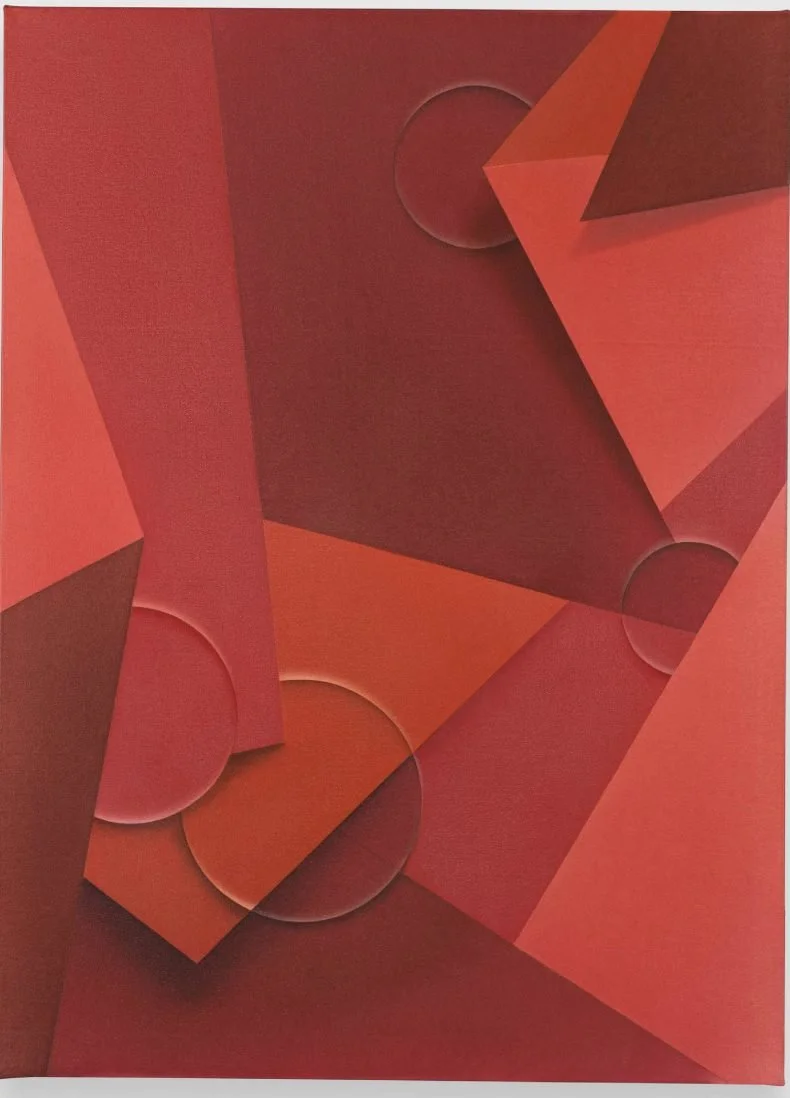
Formalism With Pressure
Abts is an important challenge to the idea that contemporary abstraction needs an explicit social, political, biographical, or historical subject to matter.
Her work demonstrates that formal relationships can still carry serious intellectual and psychological weight.
But the lesson is not that form alone is automatically meaningful.
Her formalism contains pressure because it is grounded in:
uncertainty
revision
duration
judgment
resistance
material memory
unstable perception
the search for necessity
The paintings are not “about nothing.”
They are about how something acquires form when neither its identity nor its destination is known in advance.
This transforms pure abstraction into an inquiry about:
making decisions without certainty
allowing identity to emerge gradually
negotiating freedom and constraint
recognizing when an image has become itself
accepting that resolution contains buried alternatives
The work can therefore feel psychologically resonant without depicting psychology.
Identity Emerging Through Process
Although there are no figures, Abts’s paintings offer an unusual model of identity.
The image does not begin with a fixed essence.
It becomes itself through relationships, changes, failures, revisions, and accumulated decisions.
This resembles one of the major ideas across our artist research:
Identity is relational rather than fixed.
In Abts’s work, that principle applies to the painting itself.
A form has meaning because of what surrounds it.
A color changes according to adjacent colors.
A shape becomes dominant or recessive through context.
The image’s identity emerges from the entire network.
Nothing exists independently.
The painting is not the expression of an already complete idea.
It is the record of an identity becoming visible through process.
The Risk of Formal Insularity
Abts’s work also presents a real risk.
Because the paintings are small, abstract, carefully made, and internally focused, they can seem culturally sealed.
A viewer may ask:
Why do these formal problems matter beyond painting?
Is internal complexity enough?
Does the work withdraw from social reality?
Does refinement become exclusivity?
Is the difficulty productive or simply specialized?
These are legitimate questions.
Her work does not provide the kinds of external urgency found in artists dealing directly with race, political violence, gender, migration, or historical trauma.
Its claim is different.
It argues that sustained attention, visual judgment, uncertainty, and form-making remain serious human activities.
The paintings investigate how order emerges without a predetermined system.
That is less publicly dramatic, but not necessarily less profound.
The risk appears when internal refinement becomes self-protective—when formal intelligence circulates only among viewers already trained to value subtle abstraction.
The strongest works overcome this risk through visual tension immediate enough to attract attention before specialized knowledge arrives.
The Risk of Preciousness
The small scale and meticulous surfaces can also make the paintings appear precious.
They may be treated as exquisite objects whose value lies in rarity, refinement, or connoisseurship.
Abts avoids this when the surface retains visible struggle.
The ridges, corrections, awkward transitions, and spatial contradictions prevent the paintings from becoming perfectly polished design objects.
Their beauty contains labor and uncertainty.
The images feel resolved, but not frictionless.
That distinction is crucial.
A merely precious object asks to be admired.
A strong Abts painting asks to be examined.
Why the Work Matters Now
Contemporary visual culture encourages:
rapid consumption
instant recognition
large scale
clear branding
easy reproduction
immediate explanation
spectacular imagery
Abts’s paintings resist these conditions.
They are:
physically small
slow to understand
difficult to reproduce accurately
resistant to quick interpretation
visually specific without being narratively legible
dependent on close attention
Their power often weakens in a thumbnail.
Subtle surface ridges, spatial contradictions, and color relations require physical proximity.
This gives the work contemporary relevance.
It insists that meaning may emerge slowly.
It suggests that looking can be a sustained encounter rather than an act of immediate classification.
What Artists Can Learn
The lesson is not to imitate Abts’s small canvases, invented titles, geometric forms, muted colors, or painted shadows.
Those are the visible results of her investigation.
The larger lessons are:
Constraint can generate freedom.
Small scale can create concentrated authority.
Abstraction must become specific rather than general.
Process should produce discoveries that planning could not.
Revision can remain materially present.
Formal relationships can carry psychological pressure.
Color should help create structure rather than decorate it.
Illusion can be used without representation.
A painting can hold uncertainty while remaining precise.
Resolution should preserve evidence of struggle.
Repetition of format can deepen investigation rather than create monotony.
A recurring structure should make subtle differences more meaningful.
Formalism remains viable when it contains necessity, resistance, and discovery.
The painting can develop an identity rather than illustrate one.
The artist’s judgment becomes visible through what is retained, revised, and removed.
For an artist working with figures, color, pattern, and environments, Abts provides an important counterweight.
She shows that depth does not always come from adding more subject matter, symbols, or narrative.
Sometimes the painting becomes stronger by narrowing the variables and intensifying the relationships among them.
A useful studio application would be:
hold the figure constant
hold the scale constant
hold the environment constant
change only the pattern’s relationship to the body
allow each painting to develop through revision
preserve evidence of the changes
determine when variation becomes meaning rather than decoration
Abts begins without a fixed image.
A shape appears.
Another shape changes it.
A color establishes depth.
A shadow contradicts that depth.
A form is buried.
Its edge remains.
The composition becomes increasingly specific.
Eventually the painting reaches a state in which every part seems dependent on every other part.
The image represents nothing.
But it has become unmistakably itself.
Tomma Abts transforms abstraction into a record of identity emerging through constraint, revision, judgment, and accumulated decisions, proving that a small painting can achieve enormous pressure when every formal relationship becomes necessary.
What Makes Katharina Grosse’s Paintings So Powerful?
Katharina Grosse’s work is powerful because she treats color not as something placed inside an image, but as a force capable of reorganizing physical reality.
Her paintings may occupy:
stretched canvas
walls
floors
furniture
fabric
sculptural forms
abandoned buildings
trees
soil
public architecture
entire landscapes
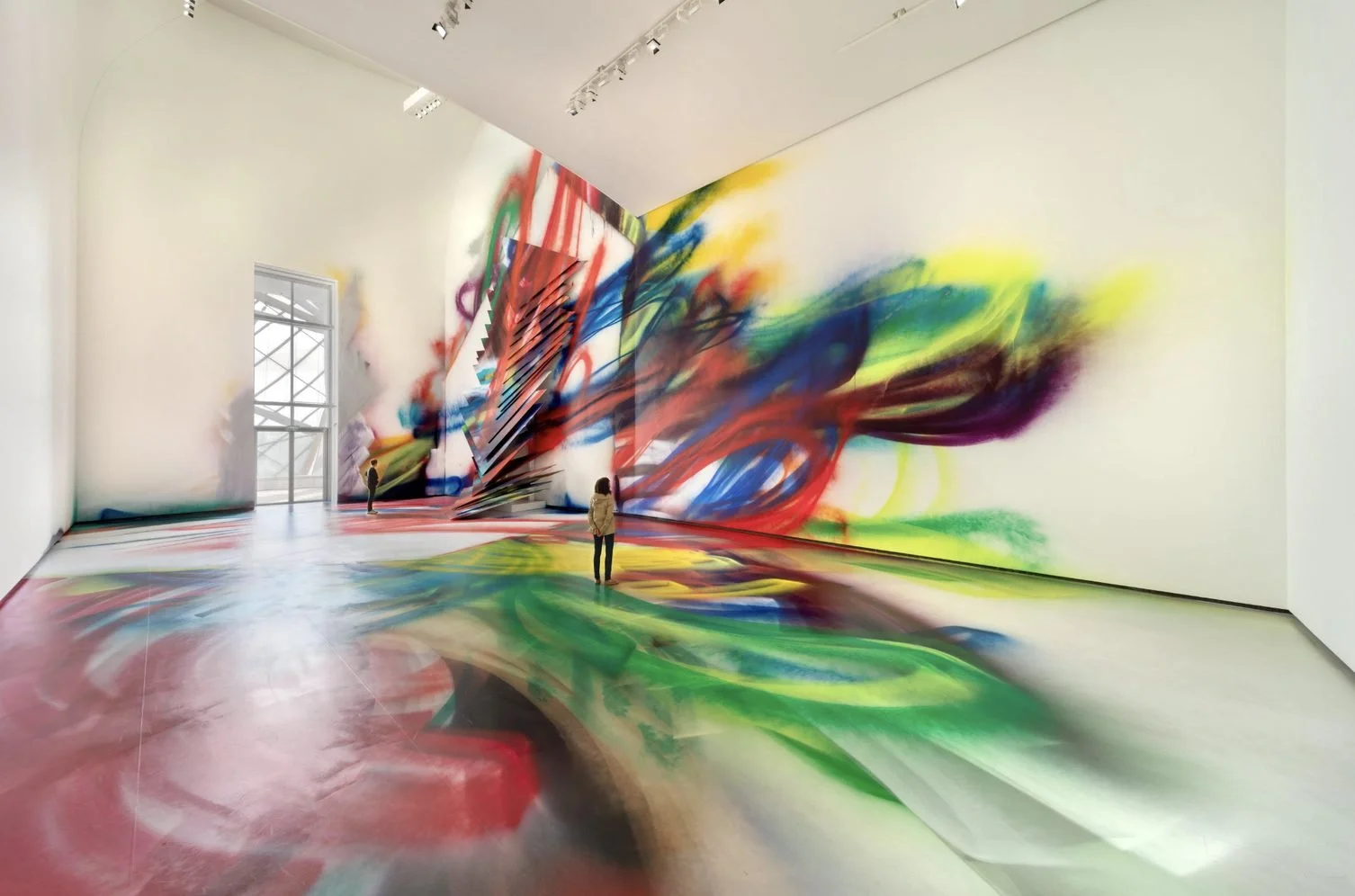
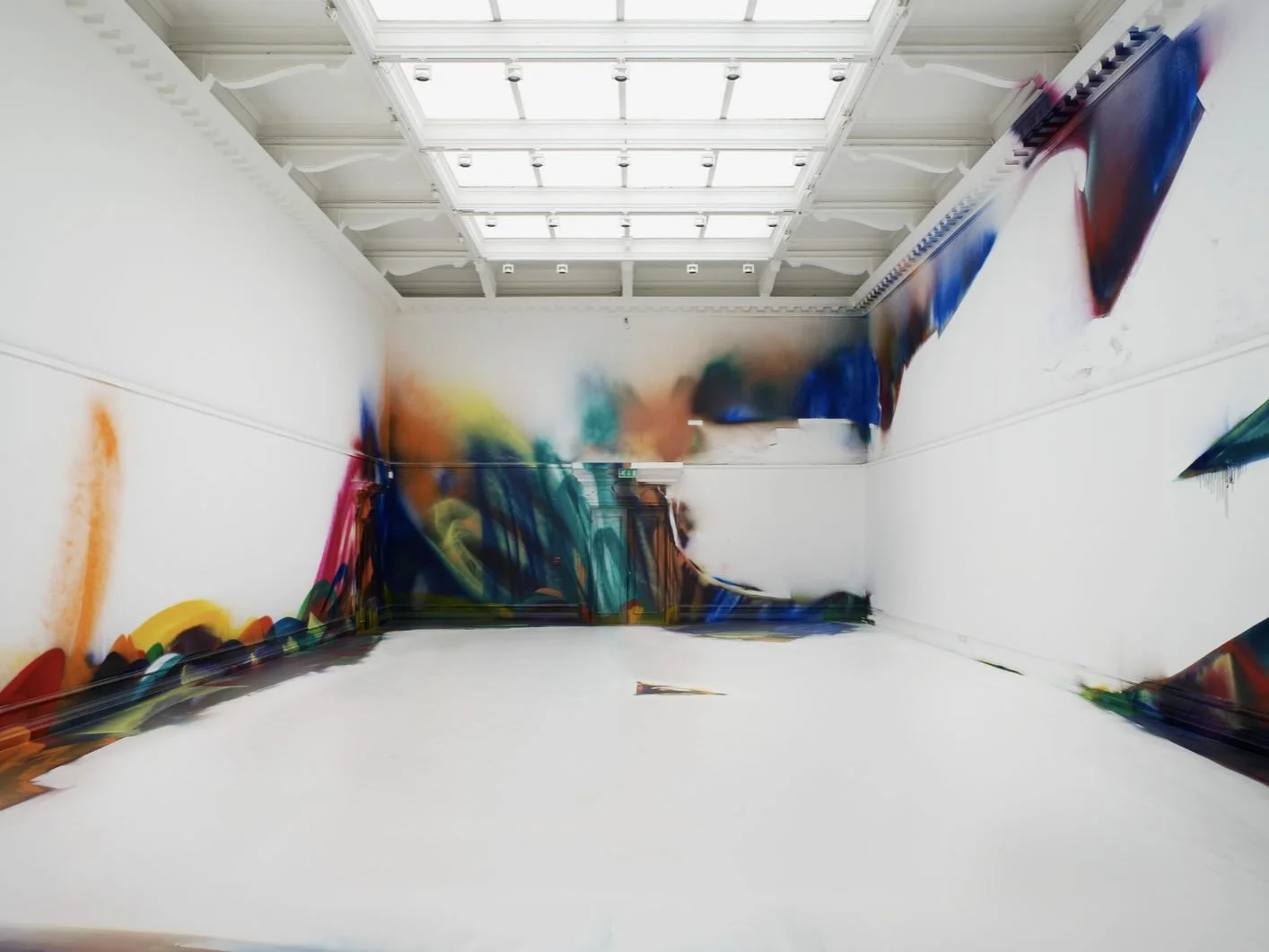
Using an industrial spray gun, Grosse projects acrylic color across these surfaces without respecting the boundaries that normally separate painting, sculpture, architecture, object, and environment. Since the late 1990s, this method has allowed her to move painting beyond the framed canvas while continuing to work within painting’s central concerns: color, gesture, composition, illusion, surface, and bodily perception.
The immediate experience can be exhilarating.
Color appears to explode across the room.
Walls seem to lose their stability.
Objects disappear beneath pigment.
The floor becomes part of the composition.
The viewer no longer stands outside the painting.
The viewer enters it.
But the work is not important merely because it is large, bright, immersive, or spectacular.
The deeper problem is:
How can painting escape the boundaries of the image and become a temporary reality that changes how the viewer experiences space, scale, movement, and physical presence?
Grosse does not simply make large paintings.
She investigates what happens when painting no longer knows where it is supposed to stop.
Color as an Event
In conventional painting, color is usually contained by an object.
The canvas provides an edge.
The wall surrounds the painting.
The viewer stands at a distance.
Grosse disrupts all three conditions.
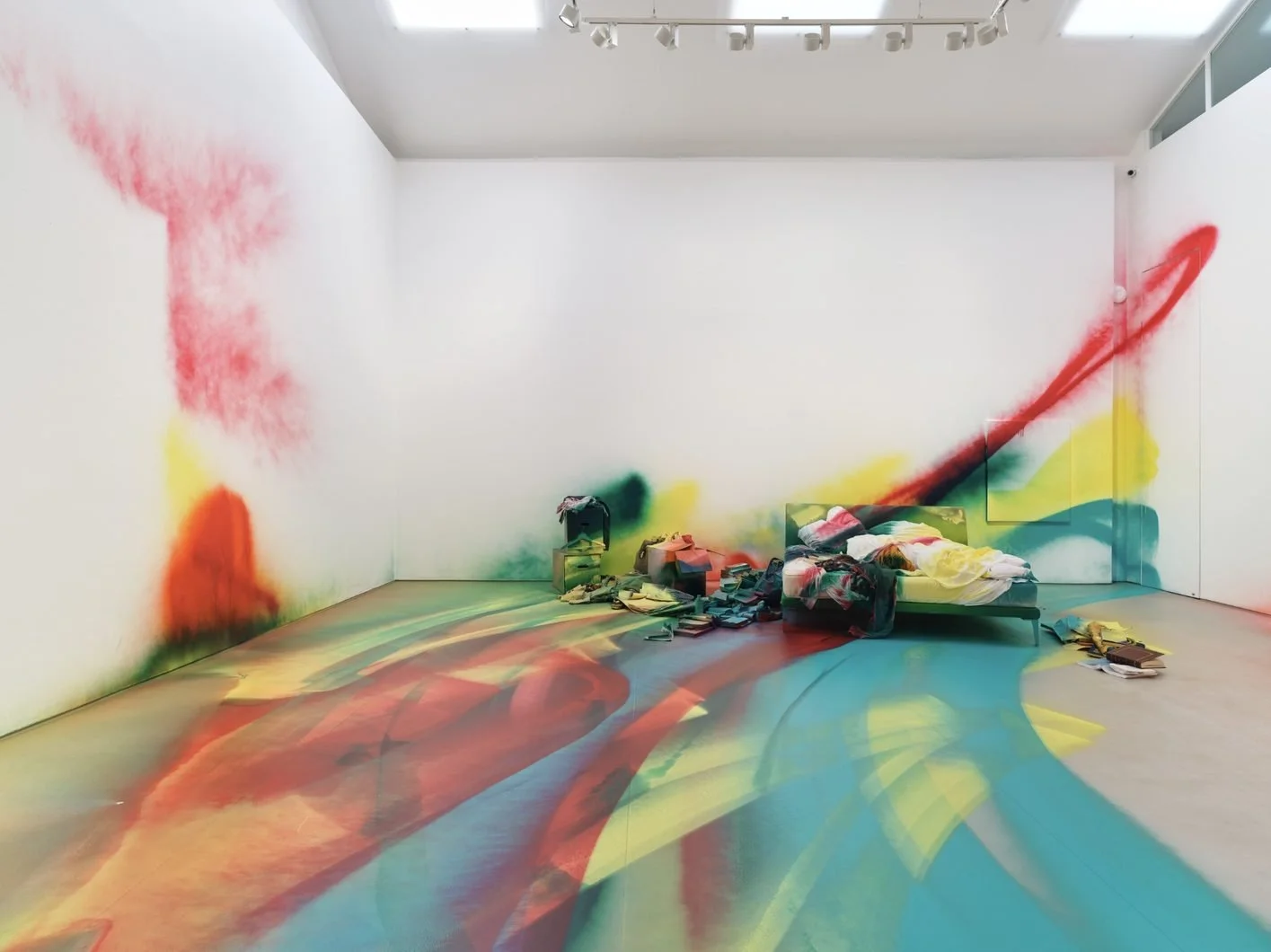
Her color crosses from one surface to another without recognizing the difference between them. A painted gesture may begin on a wall, continue across fabric, pass over an object, and dissolve onto the floor.
The color does not describe an event.
It becomes the event.
This is one of the most important distinctions in her work.
Color is not merely used to represent:
emotion
landscape
atmosphere
light
identity
symbolic meaning
It behaves as an autonomous physical force.
The spray may obscure architecture, flatten differences among objects, create false depth, or make a solid surface appear transparent and unstable.
The viewer sees the room that exists and another visual reality imposed upon it simultaneously.
Grosse’s color therefore creates a contradiction:
The architecture remains physically unchanged while becoming perceptually reorganized.
The wall is still a wall.
But it no longer behaves only like one.
Painting Without a Stable Edge
The edge of a painting traditionally separates artwork from world.
Inside the edge is composition.
Outside the edge is context.
Grosse removes that certainty.
When pigment spreads across floors, walls, objects, and exterior terrain, the viewer can no longer determine where the painting ends and the surrounding world begins.
This changes the role of composition.
Composition is no longer contained inside a rectangle.
It develops through:
architectural scale
walking distance
changing viewpoints
physical obstructions
overlapping surfaces
irregular boundaries
the movement of the viewer
the temporary conditions of the site
A section that appears dominant from one location may disappear when approached from another.
A line that seems continuous may break as it crosses a corner.
A field of color may appear flat from a distance and reveal several separate surfaces at close range.
The painting cannot be experienced from one correct position.
The viewer must move.
This gives the work duration.
Looking becomes physical navigation.
The Spray Gun and the Separation of Hand from Surface
Grosse began using an industrial spray gun in the late 1990s. The tool allows her to apply paint without touching the surface directly and to work across scales far larger than the reach of the arm.
This distance matters conceptually.
A brush confirms contact.
The hand touches the canvas through the tool.
A spray gun projects paint through space.
The mark arrives remotely.
The gesture is bodily, but the body does not directly meet the surface.
That separation gives the work several qualities at once:
immediacy
speed
distance
control
unpredictability
bodily force
mechanical mediation
The spray gun extends the artist’s movement while also transforming it.
A small motion may produce a large mark.
A shift in distance changes the edge.
A change in speed alters density.
Air pressure, angle, surface texture, masking, and the architecture itself influence the result.
The artist directs the event but does not control every particle.
The process therefore sits between intention and consequence.
This is not spontaneous expression in the simple sense.
It is a system in which bodily decisions pass through machinery, air, pigment, architecture, and gravity before becoming visible.
Gesture Larger Than the Body
Abstract Expressionism often treated the brushstroke as evidence of the artist’s body.
The mark recorded the movement of the arm.
Grosse expands this relationship.
Her gestures can exceed human scale.
A painted arc may stretch across an entire building.
A cloud of color may rise several stories.
A sweep may require platforms, lifts, extensive movement, or repeated passes through a site.
The result feels bodily, but no ordinary body could create the gesture through direct touch.
This produces another contradiction:
the work feels intensely physical
the mark appears larger than the body that made it
The artist’s body becomes both present and absent.
We perceive speed, direction, pressure, hesitation, and force.
But the scale prevents us from reconstructing the gesture completely.
The mark becomes something between human action and environmental event.
It resembles:
weather
smoke
light
erosion
impact
growth
contamination
atmospheric movement
Yet the colors often remain visibly artificial.
They do not try to imitate nature.
They interrupt it.
Artificial Color Against the Existing World
Grosse frequently uses intense, synthetic colors that remain distinct from the surfaces beneath them.
A building does not become naturally red.
A tree does not convincingly become purple.
The pigment announces itself as an intervention.
This artificiality is important.
The work is not trying to harmonize with the environment.
It creates a second condition layered over the first.
Natural and artificial realities coexist.
Color may appear liberating because it releases objects from their expected identities.
A wall can become a field.
A tree can become part of a painted rhythm.
A pile of earth can become a sculptural color mass.
But color may also feel invasive.
It covers.
It contaminates.
It disregards established boundaries.
It temporarily subjects everything within reach to one visual system.
Grosse’s installations therefore contain a subtle tension between freedom and domination.
Color appears liberated from the canvas, but it also takes possession of whatever it touches.
Color as Freedom and Control
At first glance, Grosse’s work can feel like pure freedom.
The colors spread.
The gestures expand.
The painting refuses borders.
The viewer is released from the fixed viewpoint of conventional pictorial space.
But the work is also highly controlled.
Grosse selects:
the site
the surfaces
the palette
the direction of movement
the scale
which areas remain unpainted
where masking interrupts the spray
how the viewer enters and moves
how architecture participates
The installation may look explosive, but it is not simply uncontrolled expression.
This matters because energy alone would not sustain the work.
The central contradiction is:
The paintings create an experience of radical freedom through carefully structured decisions.
The work feels open because the structure has been designed to produce openness.
This is a valuable lesson for any artist drawn to energetic color.
Freedom in a painting does not come from avoiding control.
It comes from creating a structure capable of allowing unpredictable visual relationships to occur.
The Unpainted Area
The most dramatic parts of Grosse’s work are often the saturated zones.
But the unpainted areas are equally important.
White walls, raw materials, visible architecture, untouched floor, and masked shapes allow the color to register as an intervention rather than become an undifferentiated environment.
The unpainted surface provides evidence of the world before the painting arrived.
It preserves contrast between:
existing structure and painted event
control and spill
object and visual transformation
permanence and temporary occupation
architecture and illusion
Without restraint, the color could become mere sensory excess.
The unpainted areas create boundaries inside the boundaryless work.
They give the eye places to pause.
They allow separate gestures to remain legible.
They reveal that the apparent expansiveness of the painting is produced through selective decisions.
Absence becomes part of the composition.
Space Becomes Unreliable
Grosse’s work changes how physical space is read.
Sprayed lines may ignore corners.
Color can flatten the distinction between a vertical wall and horizontal floor.
Overlapping transparent fields may create depth where none exists.
Dense pigment can make a flat surface appear like a physical mass.
Painted fabric may behave simultaneously as image, object, wall, landscape, and suspended body.
The viewer knows the architecture remains stable.
Yet perception keeps reorganizing it.
This creates a productive conflict between bodily knowledge and visual experience.
The body says:
This is a room.
The eyes say:
This is a moving field.
The viewer must hold both conditions at once.
The work does not replace reality.
It makes reality unstable enough to be perceived again.
Painting as Temporary Reality
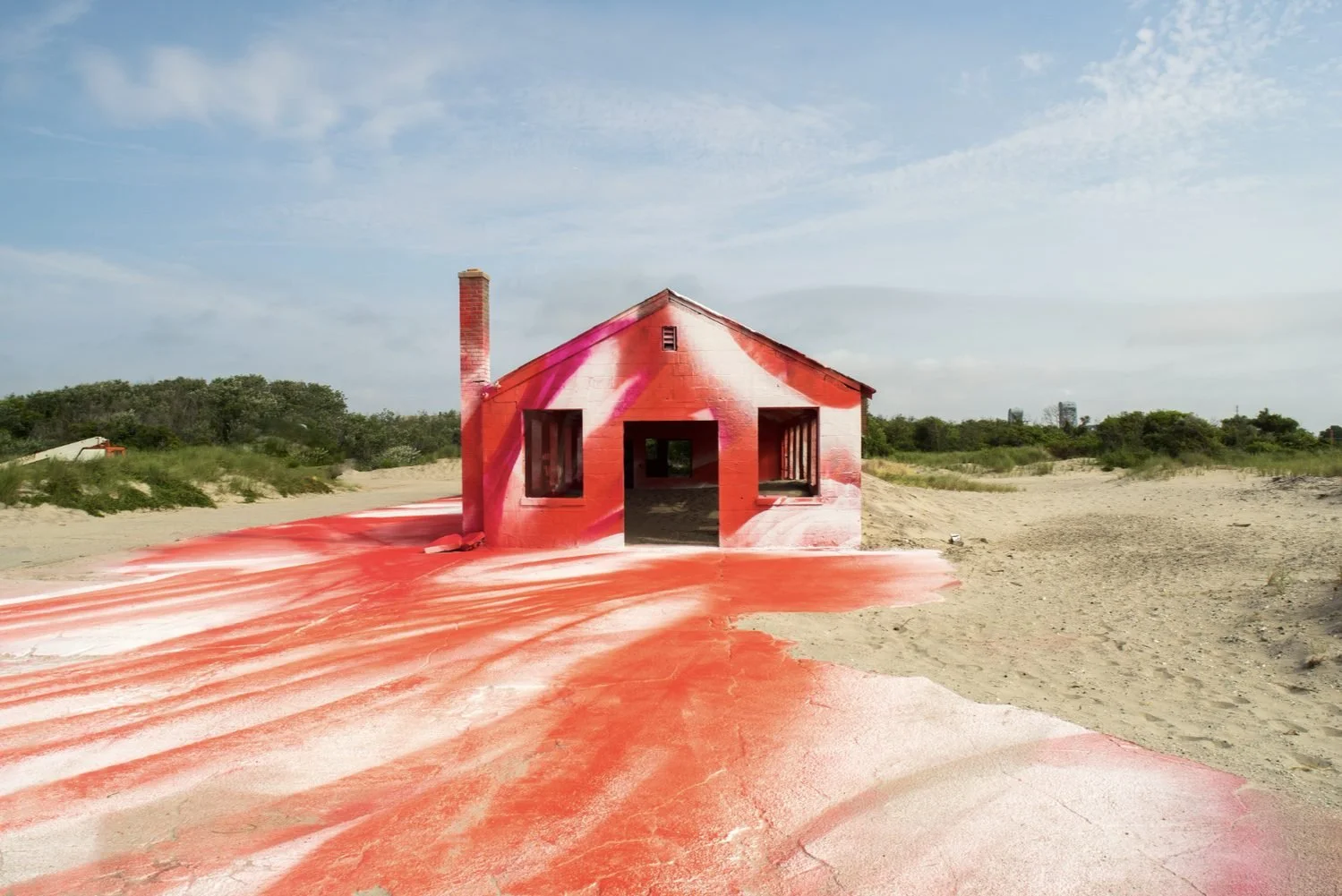
Many of Grosse’s large site-responsive works are temporary.
They may be dismantled, covered, weathered, demolished, or otherwise cease to exist in their original form. Grosse has treated this limited lifespan as part of the work rather than merely an unfortunate consequence of installation.
This temporariness changes the meaning of scale.
Monumental art often seeks permanence.
Grosse creates immense works that may disappear.
The painting occupies architecture or landscape with extraordinary force, yet that occupation remains provisional.
This produces a contradiction between:
monumentality and impermanence
visual power and physical vulnerability
transformation and eventual return
possession and release
The work may dominate a site temporarily while acknowledging that it cannot own the site permanently.
Its disappearance is not necessarily failure.
The work survives as experience, memory, image, and altered perception.
Site-Specific but Not Site-Obedient
Grosse’s installations respond to architecture, but they do not simply enhance or decorate it.
She may use:
scale
entrances
windows
corners
beams
floor transitions
exterior boundaries
circulation routes
Yet the painting often behaves as though the architecture’s rules do not apply.
Color crosses the divisions the building establishes.
A doorway may remain physically important while becoming visually absorbed.
A wall may cease to function as a background.
A floor may become vertically active in the composition.
The work therefore responds to the site by resisting its organization.
This distinction is important.
Site-specificity does not mean obedience to context.
It can mean identifying the structures that control experience and inventing another visual logic across them.
The Viewer Inside the Painting
Most paintings place the viewer outside the depicted world.
Grosse places the viewer inside the visual event.
The viewer’s body becomes a temporary figure within the work.
Other visitors appear against color fields.
Their clothing, movement, scale, and shadows become part of the composition.
The painting changes as people walk through it.
This does not make the viewer a collaborator in the full sense, because the major visual decisions have already been established.
But the viewer completes the work perceptually.
Each person experiences a different sequence:
approach
immersion
partial view
obstruction
bodily comparison
changing scale
exit
recollection
The painting is never available all at once.
This makes memory necessary.
The viewer must assemble the work from successive encounters.
Scale and Human Smallness
Grosse has spoken about the relationship between imagining at an enormous scale and experiencing oneself as physically small within one’s surroundings.
Her installations make this condition tangible.
The viewer may feel:
energized
released
disoriented
diminished
absorbed
overwhelmed
physically alert
Large scale is not simply used to impress.
It changes the viewer’s status.
A conventional painting can be visually possessed from a distance.
A monumental environment cannot.
The viewer cannot hold the whole work in one glance.
The body must surrender the fantasy of complete control.
This connects Grosse’s work to one of the central themes in our wider research:
Access does not equal possession.
The viewer may enter the painting but cannot master it from one position.
Canvas and Environment
Although Grosse is widely known for immersive installations, she also maintains a sustained studio practice on canvas. Museum surveys have emphasized that her studio paintings and environmental works belong to one continuous investigation rather than separate practices.
The canvases show that expansion beyond the frame is not her only concern.
Within rectangular supports, she continues to investigate:
overlapping gestures
masking
visual interruption
depth
transparency
speed
layered time
color relationships
the difference between open and closed space
The canvas becomes a concentrated site where many of the same pressures operate.
Marks appear to continue beyond the edge.
Masked passages interrupt apparent spontaneity.
Layers record revisions.
Color seems simultaneously atmospheric and materially flat.
The canvas paintings demonstrate that scale alone is not the source of the work’s power.
The underlying problem remains active even when the architecture is removed.
Repetition Without an Original
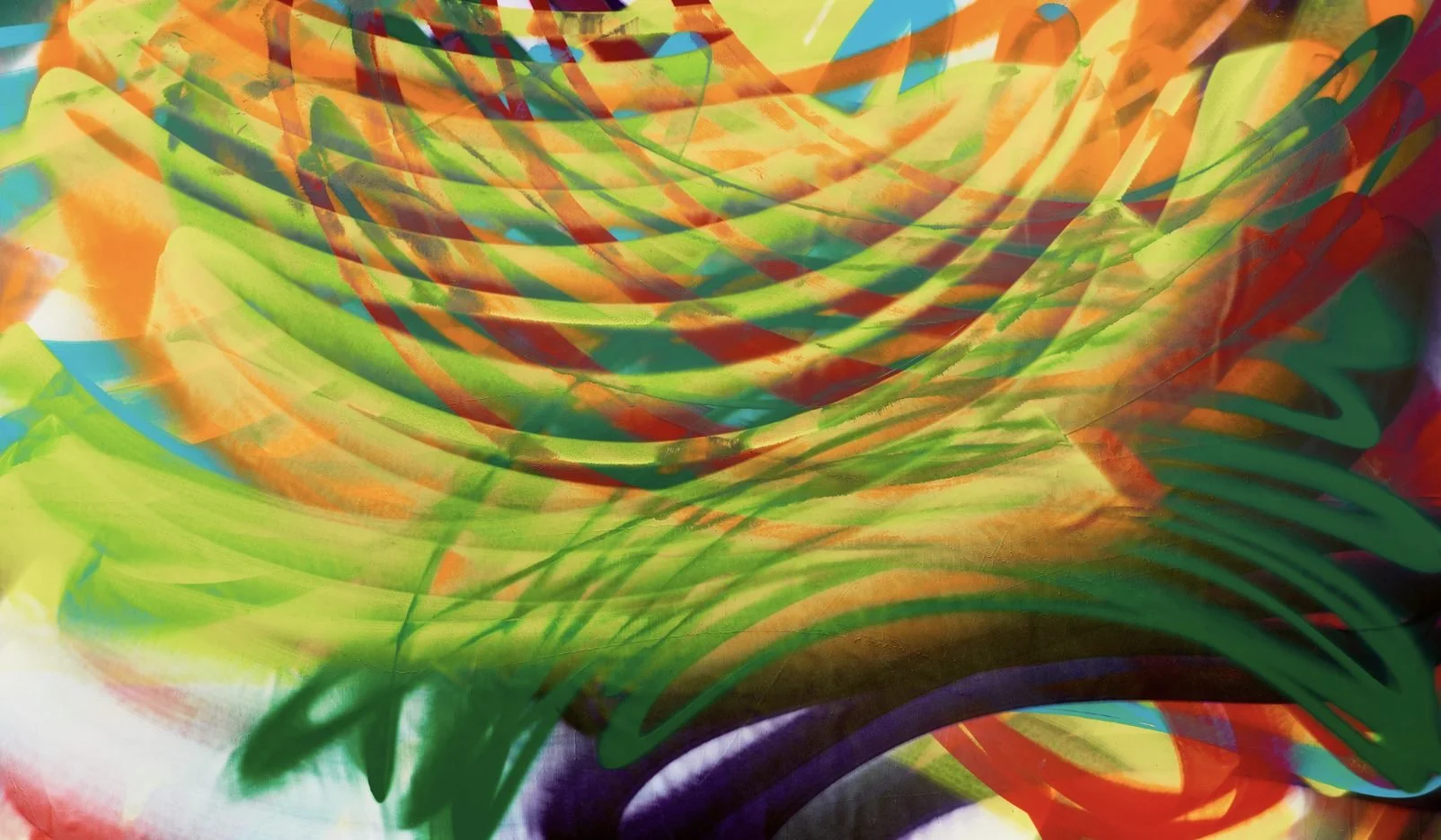
One of Grosse’s important exhibition titles is Repetitions without Origin.
The phrase provides a useful way to understand her visual language.
Her gestures may resemble:
brushstrokes
digital marks
clouds
stains
shadows
projected light
natural formations
But they do not reproduce one original object.
The same kind of mark can appear on canvas, wall, floor, sculpture, or landscape while changing according to surface and scale.
Repetition therefore does not confirm a stable motif.
It tests how a visual action changes when transferred into another condition.
This is the mature form of repetition we identified in our research:
Repetition becomes comparative evidence.
The gesture is repeated, but its meaning shifts.
Painting and Reality
Grosse’s work complicates the division between representation and abstraction.
Her paintings do not usually depict recognizable scenes.
Yet they do not remain separate from reality.
They operate directly upon real objects and spaces.
The painting is abstract, but its consequences are physical.
A painted tree is not an image of a tree.
It is a tree whose visual identity has been changed.
A sprayed room is not a representation of space.
It is space reorganized by painting.
This leads to one of the deepest problems in her practice:
Can painting create reality without representing it?
Grosse’s answer appears to be yes—but only temporarily.
Color establishes another world while leaving the original one visible beneath it.
The Risk of Spectacle
Grosse’s work carries an obvious risk.
Large-scale, brightly colored installations are highly photogenic.
They can be consumed quickly as:
immersive spectacle
social-media background
decorative public art
visual entertainment
evidence of scale and production power
A viewer may respond only to the excitement of color.
The complexity of space, temporariness, bodily scale, control, masking, and perceptual instability may be overlooked.
The work can also risk repeating a recognizable formula:
Spray intense color across a large environment.
This raises the same question we have asked of other artists with powerful signature devices:
Does each installation discover something specific about its site, or does the site merely receive the artist’s established visual language?
The strongest works create a real conflict with the architecture, landscape, history, movement, and scale of the location.
A weaker work might simply enlarge the brand.
Why the Work Matters Now
Grosse’s work belongs to a culture in which images increasingly appear on screens as flat, portable, rapidly consumed surfaces.
Her installations insist on:
bodily presence
physical movement
changing viewpoint
architectural scale
direct sensory experience
the impossibility of seeing everything at once
Yet the work is also exceptionally photogenic and circulates widely as imagery.
This produces a contemporary tension.
The installation resists the screen because it must be experienced physically.
But the screen transforms it into an instantly recognizable spectacle.
The work therefore occupies the boundary between embodied experience and image circulation.
That boundary makes the paintings especially relevant now.
They ask what painting can still do that an image on a screen cannot.
What Artists Can Learn
The lesson is not to imitate Grosse’s spray gun, bright color, monumental scale, painted rooms, or immersive installations.
Those are the visible solutions produced by her problem.
The larger lessons are:
Color can act rather than describe.
Painting can reorganize reality without depicting it.
Scale should change the viewer’s status, not merely impress.
A tool should transform the relationship among body, gesture, and surface.
Freedom requires structure.
Unpainted areas can be as active as saturated ones.
Repetition should test changing conditions.
Architecture can become a participant rather than a backdrop.
The viewer’s movement can become part of composition.
Temporary work can still possess monumental force.
Beauty can be intellectually rigorous without becoming apologetic.
A strong artistic problem should remain active on both canvas and environmental scale.
Spectacle must contain enough structure to survive beyond the first impression.
For an artist interested in color, her most important lesson may be:
Color becomes conceptually powerful when it changes the conditions under which everything else is experienced.
Color should not merely make the painting more expressive.
It can change:
what feels near or distant
where the body appears to belong
how architecture is understood
where the eye can rest
whether the figure feels protected or exposed
whether space appears stable
whether the viewer feels separate from or absorbed by the image
Grosse begins with color.
The color leaves the canvas.
It crosses the wall.
It covers the object.
It interrupts architecture.
It expands beyond the viewer’s field of vision.
The viewer moves through it.
Physical reality remains present but no longer feels visually fixed.
The lesson is not simply to use more color.
It is to ask what color can make possible.
Katharina Grosse transforms color from an element inside painting into a temporary environmental force, making the world itself behave like an unstable image and placing the viewer physically inside the act of seeing.
What Makes Ewa Juszkiewicz’s Paintings So Powerful?
Ewa Juszkiewicz’s paintings are powerful because they use beauty, technical refinement, concealment, and grotesque transformation to challenge the way women have been represented, classified, and controlled within the history of portraiture.
At first, the paintings look historical.
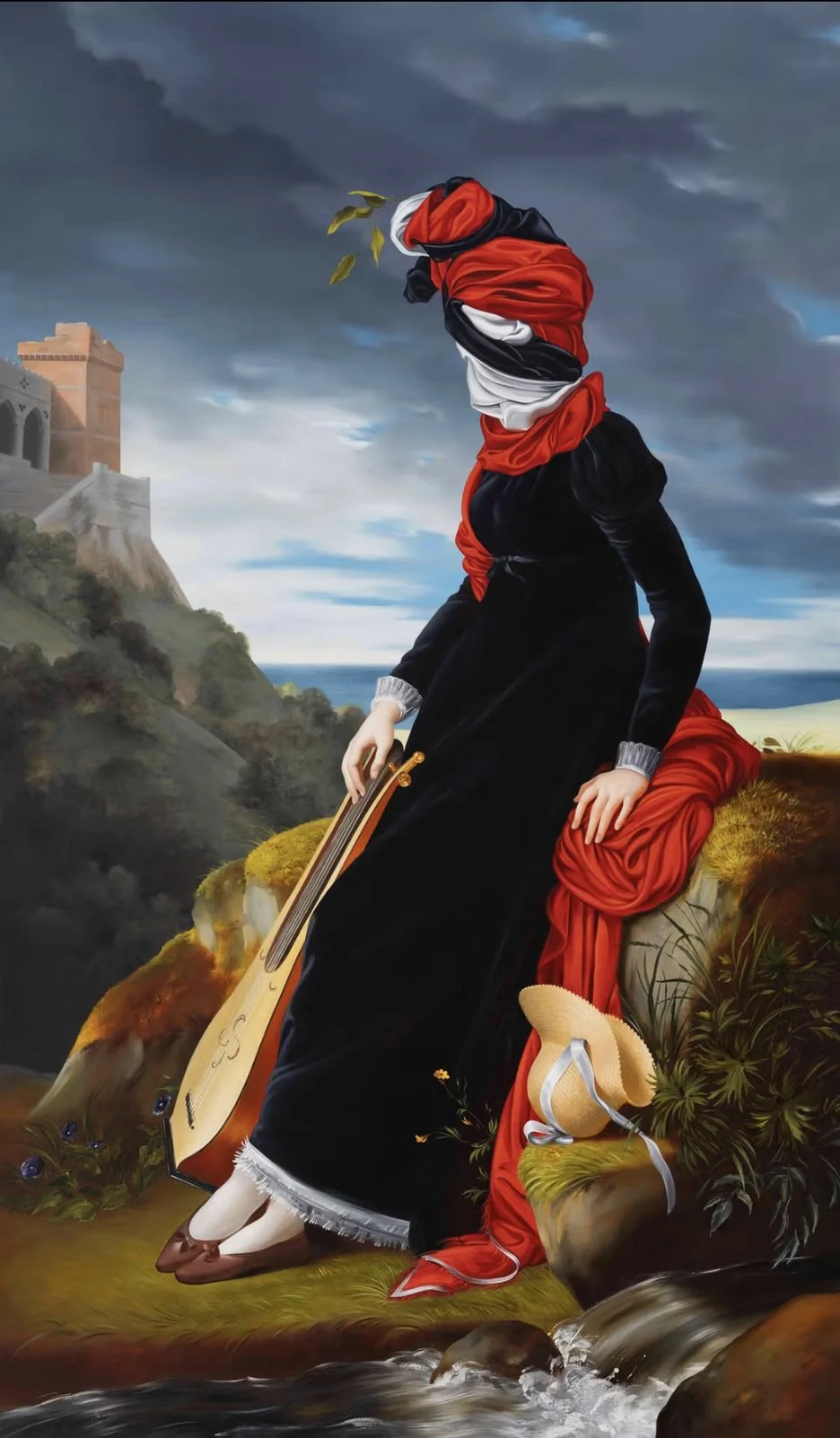
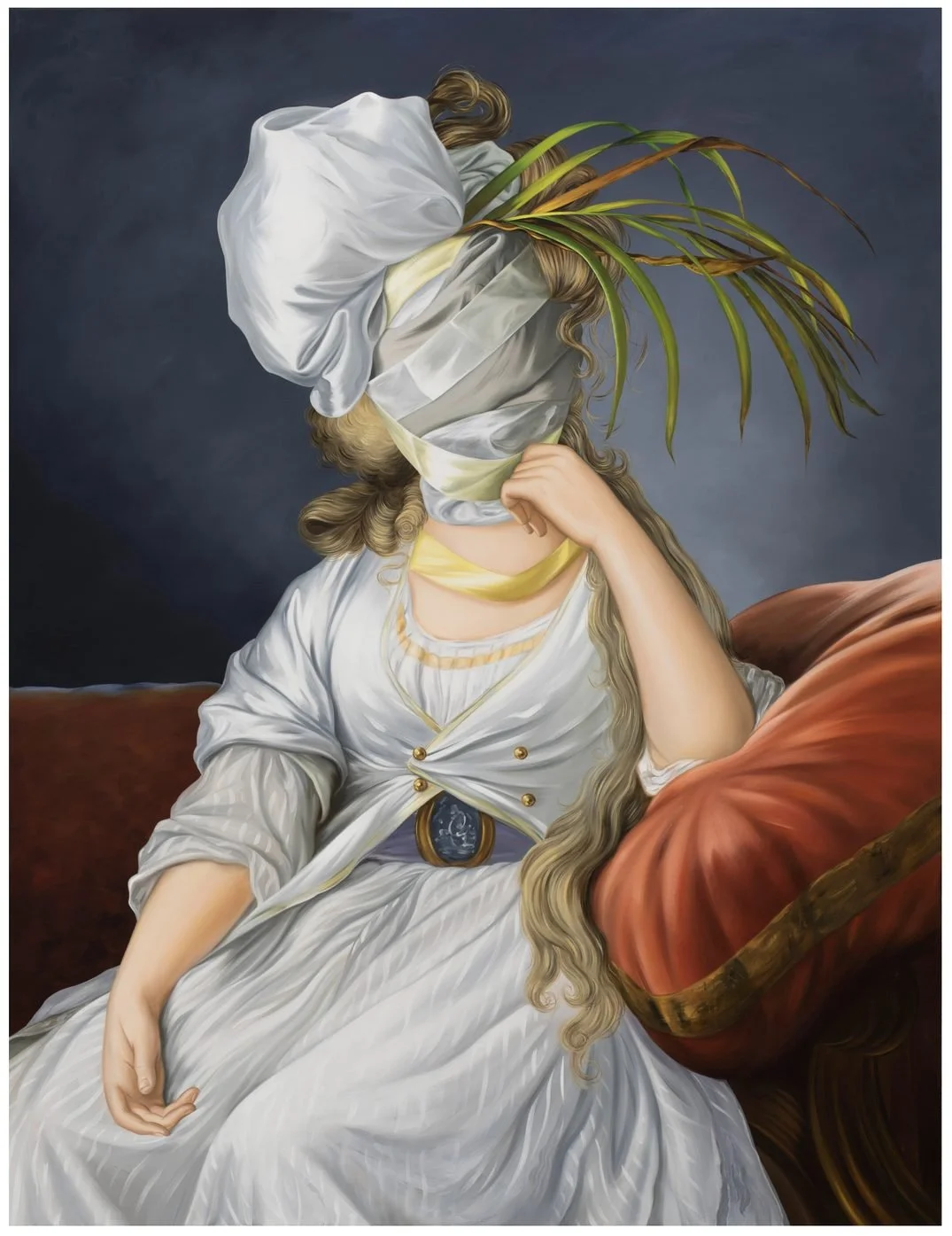
Women wear elaborate dresses, lace collars, gloves, ribbons, shawls, jewelry, and carefully arranged hairstyles. They sit in elegant interiors or stand before cultivated landscapes. The color, lighting, pose, and handling recall European portraits from the Renaissance through the nineteenth century.
Then the viewer reaches the face.
It has disappeared.
In its place may be:
A mass of hair
Folded fabric
Leaves and flowers
Feathers
Fungi
Shells
Knotted ribbons
Drapery
An organic growth
An impossible sculptural structure
The body remains disciplined by historical convention, but the face—the part expected to deliver identity—has become unreadable.
Juszkiewicz began developing this series of transformed female portraits in 2011. She closely reconstructs the visual language of historical European painting, then replaces the sitter’s face with a surreal, organic, or grotesque obstruction. (Gagosian)
The paintings are beautiful enough to invite admiration and strange enough to make admiration uncomfortable.
The Problem Beneath the Work
Juszkiewicz repeatedly returns to a central artistic problem:
How can painting challenge the historical construction of femininity when the visual language of beauty itself has helped enforce that construction?
Her work begins with portraits that appear elegant, harmonious, and culturally authoritative.
These historical images often present women as:
Beautiful
Composed
Wealthy
Modest
Marriageable
Decorative
Socially legible
Available for evaluation
The sitter’s clothing, posture, surroundings, and expression were not merely personal choices. They communicated family status, class, virtue, taste, obedience, and the social role she was expected to occupy.
The portrait preserved an individual likeness, but it also converted the woman into an image that could be judged.
Juszkiewicz does not reject the beauty of this tradition.
She recreates it with extraordinary care.
Then she interrupts the system at its most important point.
The face no longer confirms identity.
It no longer reassures the viewer.
It no longer completes the social performance.
The deeper problem becomes:
Can a woman escape the role assigned to her by the image without disappearing from the image altogether?
The Face as a Site of Control
Portraiture places enormous pressure on the face.
Viewers look to it for:
Identity
Character
Emotion
Beauty
Intelligence
Social disposition
Psychological access
Moral judgment
The face appears to promise knowledge.
We believe we can tell who someone is by looking carefully enough.
But historical portraiture rarely provides neutral access to a person. The face is posed, painted, idealized, softened, corrected, and placed inside a larger social performance.
The sitter is expected to appear in a culturally acceptable way.
Juszkiewicz removes the face not because it is unimportant, but because it has been asked to carry too much.
Its disappearance exposes how strongly viewers depend upon facial legibility.
Without it, the portrait becomes unstable.
The clothing still communicates status.
The body still performs grace.
The setting still suggests refinement.
Yet the person can no longer be classified easily.
The viewer encounters the structure of femininity without receiving the reassuring identity that structure was designed to contain.
Concealment as Refusal
A covered face might initially suggest erasure.
The woman has lost her individuality.
She has been silenced.
She has become anonymous.
That interpretation remains present, but Juszkiewicz complicates it.
Concealment can also become refusal.
The figure no longer offers herself for complete inspection.
She remains visible while denying the viewer access to the part most closely associated with psychological possession.
This creates a productive contradiction:
The woman is simultaneously erased by the history of representation and liberated from its demand that she remain readable.
The obstruction can feel oppressive.
Fabric may appear to suffocate.
Hair may engulf the head.
Plants may overgrow the face.
But the transformation can also feel expansive.
The figure becomes stranger, less obedient, less socially classifiable, and more powerful than the original portrait allowed.
The face is removed, but imagination enters in its place.
Beauty Used Against Itself
Juszkiewicz’s paintings depend on beauty.
The dresses are often luxurious.
The colors are controlled.
The surfaces are polished.
The compositions preserve the elegance and harmony of their historical sources.
This is important because the paintings do not criticize beauty from outside it.
They use beauty to attract the viewer into the very system being questioned.
The viewer may admire:
Satin
Velvet
Lace
Decorative pattern
Flesh tones
Drapery
Flowers
Refined brushwork
Historical atmosphere
Then the concealed face interrupts that pleasure.
Beauty becomes psychologically unstable.
The painting asks:
What does elegance conceal?
Whose behavior does beauty discipline?
When does refinement become control?
Why are women so often required to appear pleasing before they are permitted to appear powerful?
Can visual pleasure survive after the subject refuses to cooperate with it?
Juszkiewicz’s work has been described as reimagining eighteenth- and nineteenth-century portraits in ways that disturb their surfaces of gentility and feminine beauty. (Gagosian)
The beauty remains valid.
But it is no longer innocent.
Why the Historical Style Matters
Juszkiewicz could challenge historical portraiture through parody, rough painting, collage, or obvious contemporary disruption.
Instead, she paints with technical precision.
This choice is essential.
Her visual language earns the viewer’s trust.
The painting initially behaves like the object it is criticizing.
The lighting feels credible.
The fabrics appear convincing.
The body belongs naturally within the inherited composition.
The historical illusion remains intact until the face breaks it.
This produces a sharper disturbance than an openly satirical treatment would.
The viewer enters a familiar system before realizing that its central logic has been sabotaged.
Technical skill therefore becomes conceptual.
Refinement is not simply evidence that the artist can paint.
It allows the work to inhabit historical authority closely enough to alter it from within.
Painting Inside the Canon
Juszkiewicz often begins with specific portraits from European art history.
She reconstructs their poses, garments, settings, and compositional structures while transforming the head into something impossible. Her sources range from Renaissance painting through the nineteenth century. (Gagosian)
This process raises an important question about artistic inheritance.
How should a contemporary painter engage a tradition that contains extraordinary formal achievement but also reflects restrictive social systems?
One response would be rejection.
Another would be imitation.
Juszkiewicz chooses intervention.
She preserves:
The craft
The scale
The elegance
The pictorial authority
The slow attention
The beauty of oil painting
But she changes the terms under which the female subject appears.
The work does not destroy the canon.
It reanimates it as a contested space.
The Replacement Becomes a Second Body
The obscuring forms are not random coverings.
They often appear carefully constructed from materials associated with femininity, domesticity, decoration, nature, or the body.
Hair, fabric, flowers, feathers, and ribbons already have cultural relationships to beauty and self-presentation.
When enlarged or reorganized, they become strange.
A hairstyle grows until it consumes the person.
Drapery leaves the dress and takes control of the face.
Flowers become invasive rather than ornamental.
Fabric appears animated.
Decoration develops agency.
The replacement can feel like a second body emerging from the first.
It may suggest:
Metamorphosis
Defense
Mutation
Excess
Concealment
Rebellion
Suffocation
Psychic eruption
Nature reclaiming the social body
The object that once decorated the woman now overwhelms the identity it was meant to enhance.
Femininity as Construction
Historical portraits often present femininity as natural.
Grace appears inherent.
Modesty appears effortless.
Beauty seems to belong naturally to the sitter.
But the paintings reveal femininity as something constructed through:
Clothing
Hairstyle
posture
gesture
cosmetics
lighting
architecture
props
artistic idealization
social expectation
Juszkiewicz’s substitutions exaggerate this construction until it becomes impossible to overlook.
The woman’s identity appears inseparable from the materials arranged around her.
The dress shapes the body.
The pose controls movement.
The hairstyle regulates appearance.
The portrait converts social discipline into beauty.
By allowing those materials to expand uncontrollably, Juszkiewicz turns the machinery of feminine presentation against itself.
The surface becomes too elaborate to remain obedient.
Identity Without Recognition
The paintings raise a difficult question:
Does removing the face protect identity, or eliminate it?
There is no simple answer.
Without a face, viewers lose access to conventional individuality.
But facial recognition is not the only form of identity.
The body still has posture.
The hands still gesture.
The clothing still carries history.
The transformed head creates a new psychological condition.
The figure may become more memorable after losing her recognizable features.
This suggests that identity does not always depend on likeness.
It can emerge through resistance, withholding, transformation, and the particular way a body occupies space.
Juszkiewicz creates figures who are anonymous but not generic.
Each concealment produces a different kind of personhood.
The Uncanny
The work belongs strongly to the uncanny: something familiar that has become disturbingly strange.
Nearly everything in the painting is recognizable.
The dress is convincing.
The chair behaves normally.
The background follows historical convention.
The body appears human.
Only the face has changed.
Because the disruption is concentrated, it affects the entire image.
The viewer begins to distrust the apparently stable parts.
The dress may now feel like a costume.
The elegant room may feel claustrophobic.
The pose may appear forced.
The hands may seem trapped within social choreography.
The strange head reveals that the normality surrounding it was already artificial.
Juszkiewicz’s gallery describes her work as preserving the aesthetic harmony of its sources while activating their unsettling possibilities. (Gagosian)
The Grotesque Without Ugliness
The word grotesque often suggests ugliness, distortion, excess, or bodily confusion.
Juszkiewicz uses the grotesque differently.
Her transformations may remain highly beautiful.
A mass of flowers can be elegant.
Folded fabric can be luxurious.
Hair can be painted with extraordinary delicacy.
The grotesque emerges not because the object is inherently ugly, but because it occupies the wrong place and has exceeded its expected role.
A flower belongs in the portrait.
A head made entirely of flowers does not.
Fabric belongs on the body.
Fabric that replaces the face becomes threatening.
The work demonstrates that beauty and grotesque transformation are not opposites.
Beauty becomes grotesque when it stops obeying.
Nature Against Social Order
Leaves, fungi, branches, flowers, shells, and other organic forms often replace the head.
Nature is traditionally used in portraiture as ornament, symbolism, or controlled background.
A flower may signify beauty, purity, fertility, mortality, or refinement.
Juszkiewicz allows nature to escape that subordinate role.
It grows over the sitter.
It refuses scale.
It interrupts social identity.
The organic form appears less controllable than the disciplined body beneath it.
This can suggest nature reclaiming a person from the rigid expectations of culture.
But the transformation is not necessarily liberating.
Growth can also become invasion.
The same leaves that create beauty may suffocate.
The paintings preserve that uncertainty.
Stillness and Internal Violence
The figures rarely struggle visibly against their transformation.
They remain seated or standing in elegant poses.
Hands rest carefully.
Bodies maintain decorum.
This stillness creates tension.
Something extraordinary has happened to the head, but the social body continues performing obedience.
The violence is therefore internal to the structure.
The portrait remains composed while identity has undergone radical disruption.
This makes the work more disturbing than a dramatic scene of visible rebellion.
The figure follows the rules even after becoming impossible.
Titles and Poetic Distance
Juszkiewicz’s exhibition and painting titles often draw from poetry, literature, or language associated with nature, beauty, and romantic atmosphere.
Titles such as Locks with Leaves and Swelling Buds and In a Shady Valley, Near a Running Water intensify the lyrical quality of the work rather than explaining its politics directly. Her 2024 Venice exhibition brought together fifteen paintings made between 2019 and 2024, while her 2023 exhibition in Beverly Hills continued her transformation of historical portrait imagery. (Gagosian)
The poetic language creates distance from straightforward critique.
The paintings are not visual arguments with captions.
They remain sensuous, strange, and open.
This allows the viewer to experience the contradiction before reducing it to a message.
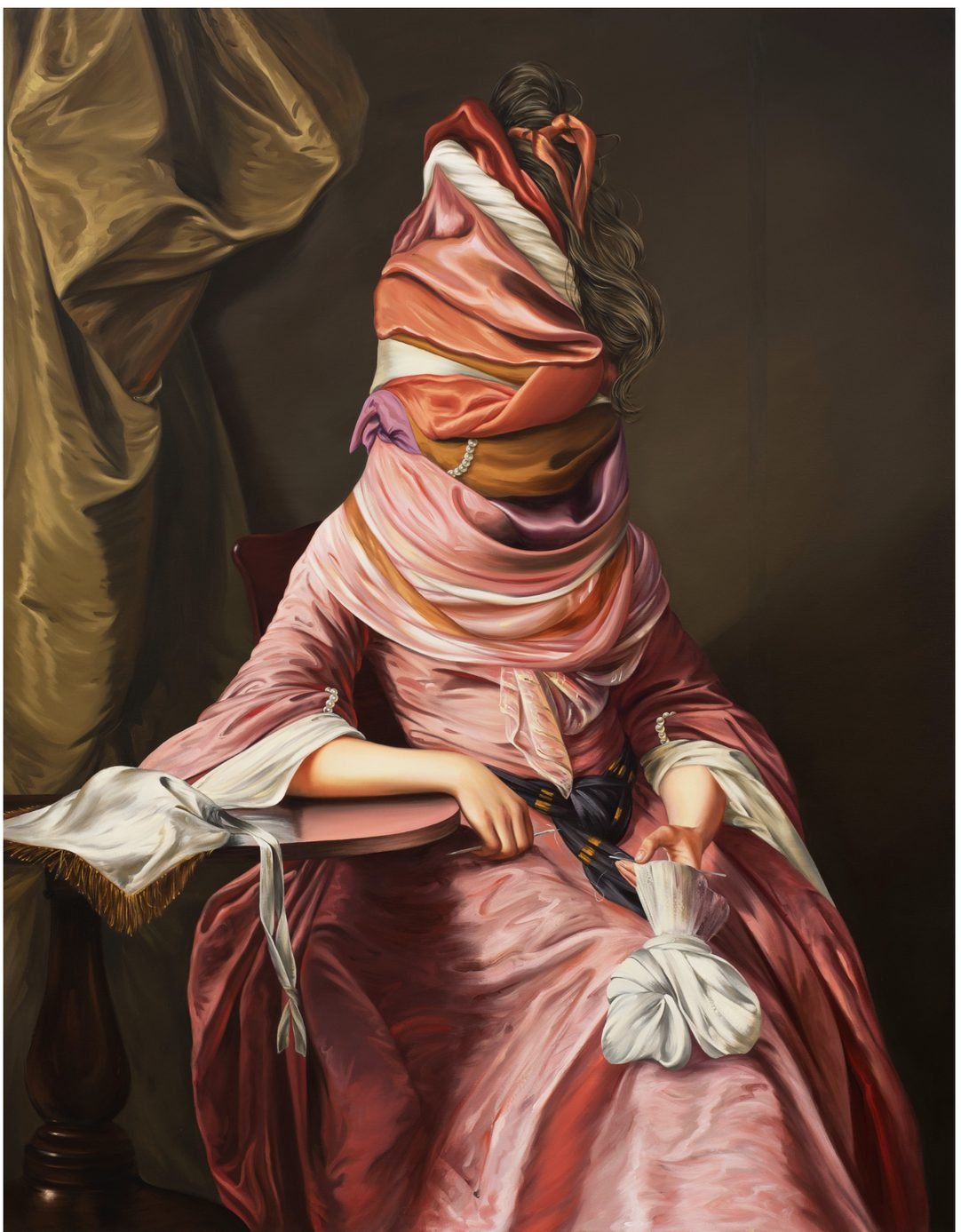
The Central Contradictions
Juszkiewicz’s paintings hold opposing forces together:
Beautiful and grotesque
Refined and rebellious
Historical and contemporary
Visible and unknowable
Elegant and suffocating
Decorative and threatening
Anonymous and psychologically specific
Feminine and resistant to feminine convention
Technically obedient and conceptually disruptive
Concealed and newly liberated
The deepest contradiction may be:
The figure escapes the identity assigned to her by becoming less recognizable and more visually controlled at the same time.
The disguise protects and imprisons.
The transformation erases and expands.
The portrait loses a face and gains a problem.
The Viewer’s Position
Juszkiewicz gives the viewer several roles.
The viewer becomes an admirer
Technical skill, historical beauty, color, and fabric create immediate attraction.
The viewer becomes frustrated
The face refuses the psychological access portraiture normally promises.
The viewer becomes aware of classification
Without facial information, the impulse to identify, evaluate, and diagnose becomes visible.
The viewer becomes historically implicated
The pleasure of the portrait is tied to traditions that turned women into idealized social images.
The viewer becomes uncertain about liberation
The concealment may protect the figure, but it may also repeat her historical erasure.
The paintings do not resolve this ambiguity.
That unresolved state is their strength.
The Risk of the Signature Device
Juszkiewicz’s work has a clear and immediately recognizable device:
Historical female portrait plus transformed or concealed face.
That clarity is powerful, but it creates a risk.
The work can become predictable.
Viewers may understand the operation before encountering the individual painting.
Hair, flowers, mushrooms, fabric, and leaves can begin to function as interchangeable variations on the same idea.
The critical question is:
Does each transformation create a distinct psychological and historical pressure, or does it merely repeat the artist’s successful visual signature?
The strongest works make the replacement feel inseparable from the original pose, dress, setting, and source image.
The transformation changes the meaning of the entire portrait.
A weaker work might offer an inventive head without renewing the deeper problem.
This is the challenge of a highly recognizable lexicon: repetition must continue producing thought rather than merely confirming authorship.
Why the Work Belongs to the Present
Juszkiewicz’s paintings belong to a contemporary culture deeply invested in faces.
Faces are photographed, filtered, measured, recognized by software, evaluated for beauty, and circulated through social media.
Identity is increasingly expected to appear visually coherent.
People construct public selves through:
Profile images
Cosmetic modification
Fashion
Branding
Digital filters
Facial recognition
Algorithmic classification
The face remains one of the primary sites through which society identifies and judges a person.
Juszkiewicz removes it.
Her paintings ask what remains when the image can no longer perform recognition successfully.
The historical portrait and the contemporary profile image may appear very different, but both depend on controlled visibility.
Both turn identity into a readable surface.
Juszkiewicz’s figures refuse that readability while remaining spectacularly visible.
What Artists Can Learn
The lesson is not to imitate Juszkiewicz’s historical dresses, faceless women, flowers, fabric, hair, or polished old-master technique.
Those are the visible solutions produced by her investigation.
The larger lesson is that an inherited visual language can be challenged most effectively from within.
Juszkiewicz demonstrates that:
Beauty can carry critique without becoming invalid.
Technical refinement can create trust that the artwork later destabilizes.
Concealment can function as both erasure and resistance.
Decoration can develop agency.
Historical forms can be preserved while their social logic is altered.
The face does not have to provide complete identity.
The grotesque can emerge through beautiful excess.
A single disruption can transform the meaning of an entire image.
Stillness can contain profound violence.
Ambiguity becomes stronger when both interpretations remain genuinely active.
A recurring device must continue changing the psychological problem rather than merely repeating a signature.
Juszkiewicz begins with an elegant portrait.
The sitter performs femininity.
The clothing establishes status.
The pose offers composure.
The face promises identity.
The face disappears.
Decoration takes control.
Beauty remains.
The viewer can still look but can no longer complete the woman through recognition.
The lesson is not to copy the obstruction. It is to understand why the obstruction is necessary.
Ewa Juszkiewicz turns the beauty and authority of historical portraiture against itself, creating women who remain intensely visible while refusing the identities, judgments, and psychological access the genre traditionally demands.
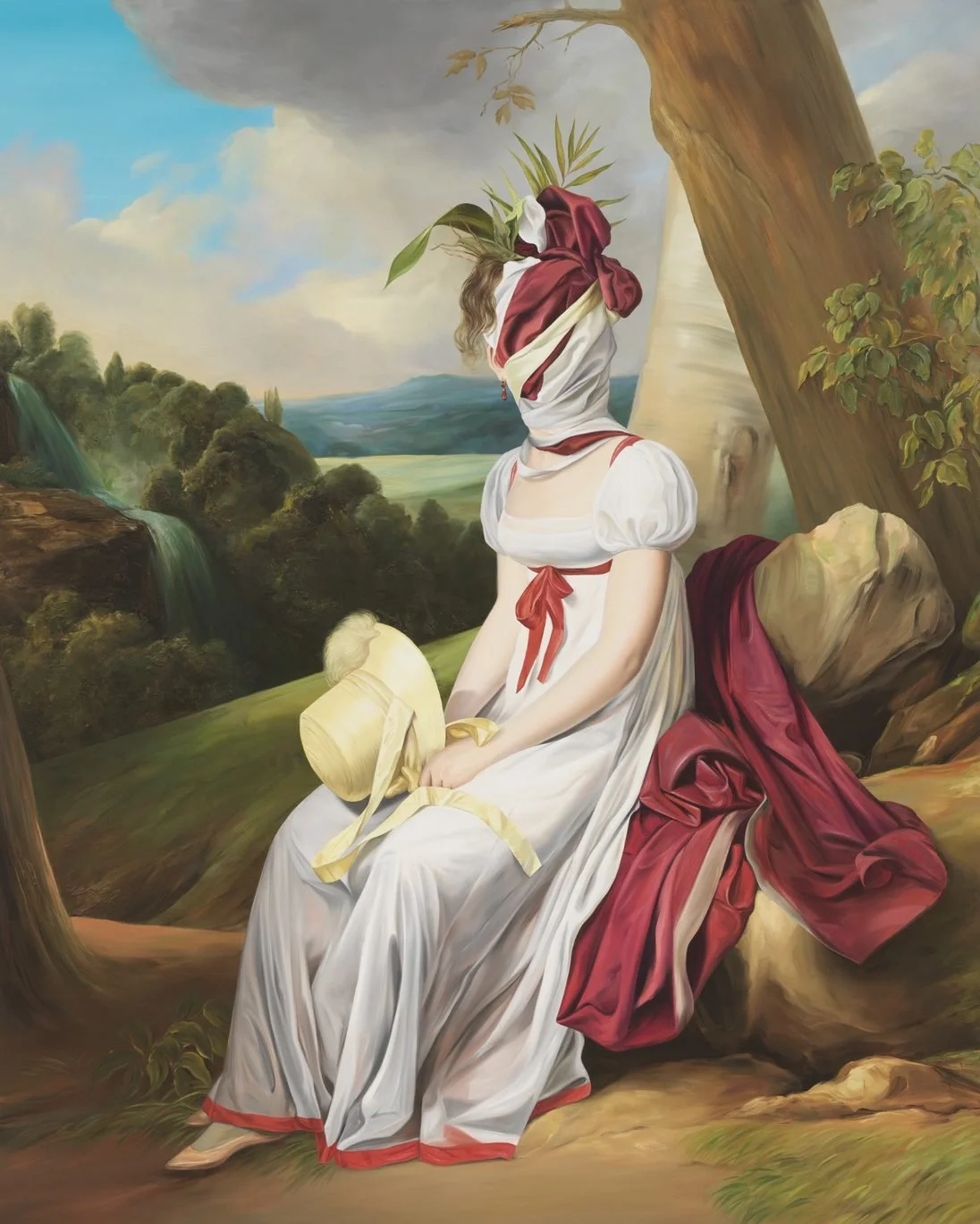
What Makes Tala Madani’s Paintings So Powerful?
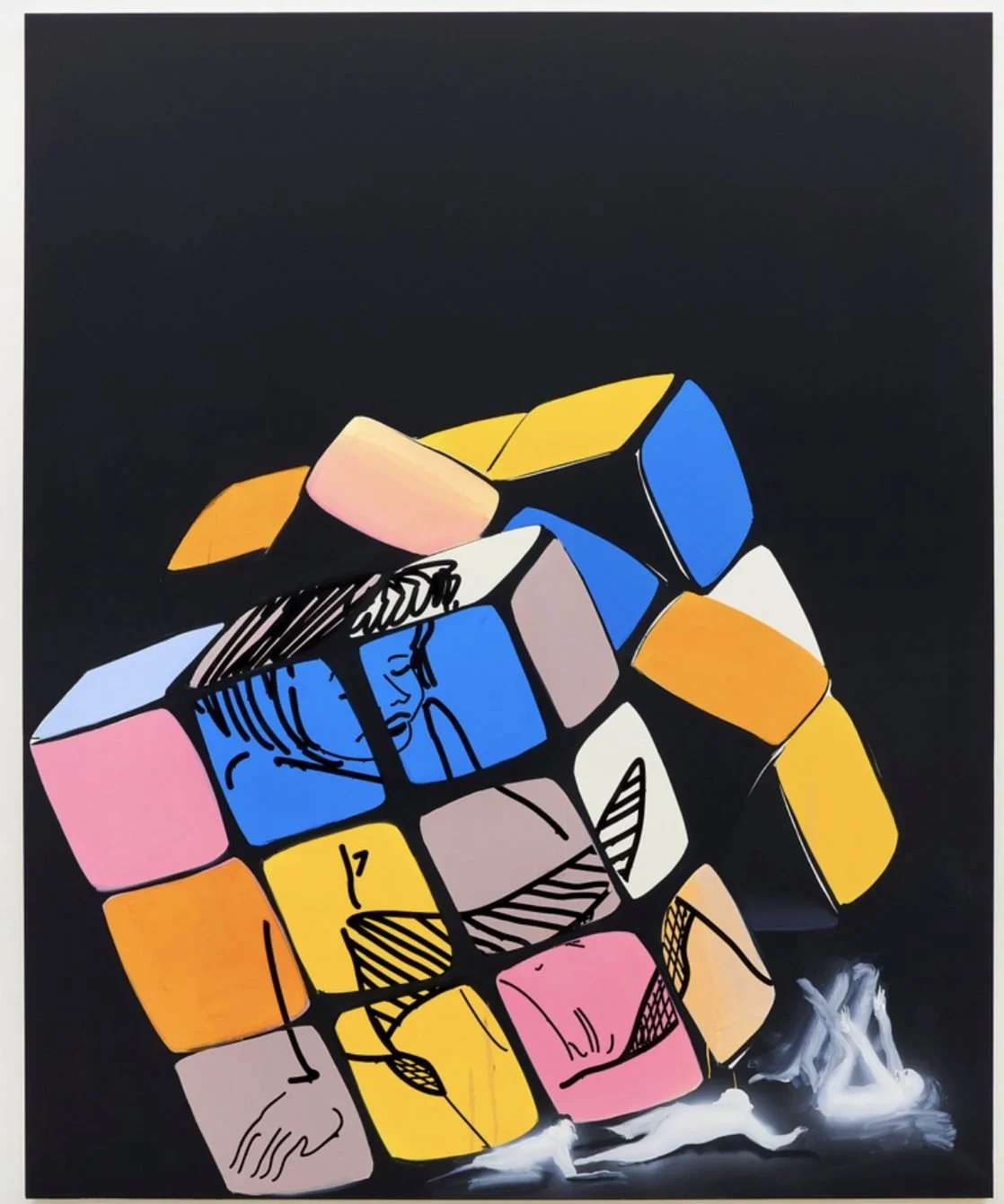
Tala Madani’s paintings are powerful because they use comedy, ugliness, bodily humiliation, and painterly pleasure to expose the absurdity of power.
Her pictures are often immediately funny.
Bald, soft-bodied men crawl, perform rituals, attack one another, worship projections, mishandle objects, or become entangled in bodily fluids. Figures appear arrogant and helpless at once. Light beams shoot from bodies. Paint behaves like excrement, semen, blood, or illumination. Domestic spaces become stages for crude ceremonies whose rules remain unexplained.
The scenes can resemble cartoons, slapstick comedy, political satire, nightmares, or children behaving badly.
Yet beneath the humor is a serious investigation of authority, masculinity, representation, motherhood, and the body. Madani creates alternate worlds that feel ridiculous but remain disturbingly close to our own. MoMA describes her paintings and stop-motion animations as provocative, humorous, and unsettling realities shaped by concerns including patriarchy and xenophobia. (The Museum of Modern Art)
Her work asks what power looks like after dignity collapses.
The Problem Beneath the Work
Madani repeatedly returns to a central artistic problem:
How can painting expose the fantasies, rituals, and insecurities beneath social authority without replacing them with another moralizing image of power?
Her paintings do not generally portray powerful men as impressive villains.
Instead, they make authority look:
Infantile
Bodily
theatrical
insecure
repetitive
sexually confused
dependent on spectators
vulnerable to embarrassment
The figures often seem to be performing masculinity for one another.
They form groups, enact rituals, dominate weaker bodies, create hierarchies, and imitate authority. But their power continually collapses into farce.
A man who appears commanding may also look ridiculous.
A collective ceremony may resemble both political organization and playground cruelty.
A beam of divine light may emerge from an undignified part of the body.
Madani does not simply criticize powerful individuals. She exposes power as a performance sustained through repetition, belief, spectacle, and group participation.
The Male Body Without Heroism
Much of Western painting has used the male body to represent strength, intellect, heroism, divinity, political authority, or artistic genius.
Madani replaces that tradition with a recurring cast of balding, middle-aged, frequently naked men. Art21 describes these figures as stocky men whose libidinal disorder disrupts the situations into which she places them. (Art21)
Their bodies are not idealized.
They sag, leak, crouch, stumble, expose themselves, or submit to incomprehensible procedures. They may be perpetrators and victims within the same scene.
This dismantles the visual connection between masculinity and control.
The men possess bodies they cannot fully govern.
Their authority is constantly interrupted by:
Appetite
fear
desire
waste
aging
dependence
physical vulnerability
Madani does not merely feminize or weaken the male body. She removes the protective myths that make male power appear self-contained.
The body reveals what authority tries to hide.
Humor as a Critical Tool
Humor is central to Madani’s work because it changes the viewer’s relationship to power.
A solemn political image may encourage reverence or direct opposition. Comedy creates another possibility: it makes authority difficult to take at its own estimation.
Laughter reduces distance.
It exposes contradictions quickly.
It allows viewers to recognize cruelty, vanity, insecurity, and irrationality without receiving a formal political lecture.
But the humor is rarely comfortable.
The viewer may laugh at an image involving humiliation, violence, bodily fluids, or domination and then become aware of that laughter.
This creates a second problem:
What exactly did the viewer find funny?
Was it the powerful man becoming ridiculous?
The vulnerable body?
The violence?
The taboo?
The painting does not allow humor to remain innocent.
Laughter becomes a form of implication.
Grotesque Bodies and Social Truth
Madani frequently uses the grotesque.
Bodies deform.
Substances leak.
Anatomy becomes exaggerated.
The boundary between a figure and its waste may collapse.
The grotesque body contradicts the fantasy of the autonomous individual.
It is porous.
It consumes and expels.
It depends on other bodies.
It can be penetrated, contaminated, embarrassed, or transformed.
This makes the grotesque especially useful for questioning political and patriarchal authority. Systems of power often present themselves as orderly, rational, clean, and controlled.
Madani reveals the bodily chaos underneath that image.
Her work asks whether supposedly elevated structures—government, religion, masculinity, artistic authority, family hierarchy—are built over impulses that are far less dignified.
Paint as Body and Image
Madani’s paint often performs several roles simultaneously.
A brushstroke may be:
Light
liquid
bodily waste
illumination
violence
paint itself
the substance from which a figure is made
The Henry Art Gallery notes that beams and bodily fluids emerging from her figures become metaphors for paint’s tactile expressivity. (Henry Art Gallery)
This is important because the work does not merely depict bodily mess.
The material of painting becomes part of that mess.
A loose passage may describe a substance while reminding the viewer that the figure is made from the same substance.
Paint gives the body form and then appears to dissolve, stain, or humiliate it.
Representation becomes unstable:
The material used to create authority can also destroy its image.
This is one reason Madani’s brushwork often remains quick and visibly unresolved. Excessive refinement would stabilize the scene and give its figures too much pictorial dignity.
The looseness keeps them vulnerable.
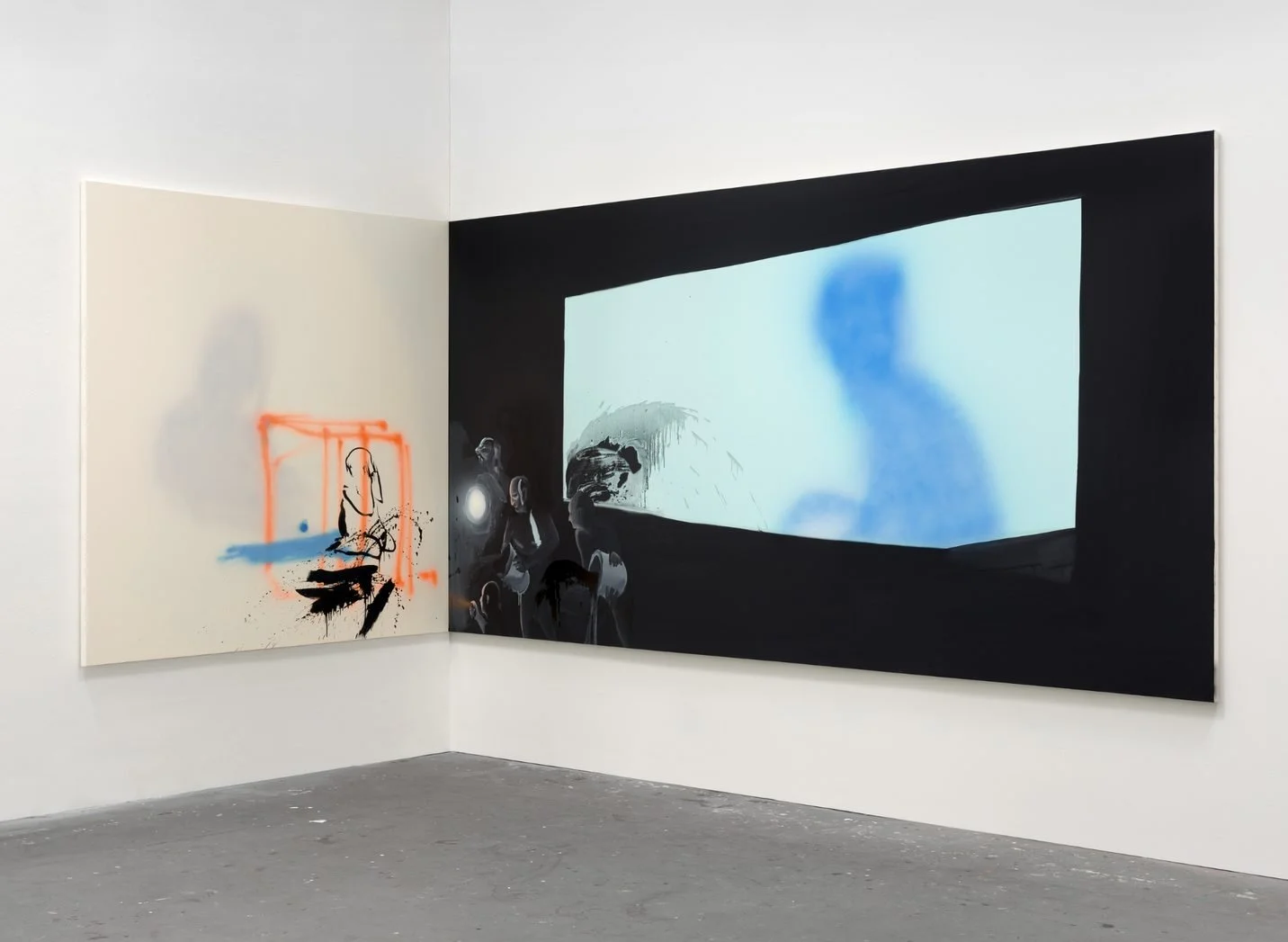
Projection, Screens, and Manufactured Authority
Screens, projected images, framed pictures, shadows, and beams of light recur throughout Madani’s work.
Figures frequently gather around an image or appear controlled by one.
Projection can suggest:
Cinema
propaganda
religious revelation
education
fantasy
surveillance
social media
collective belief
A projected image seems powerful because it organizes attention. People face it, obey it, worship it, fear it, or mistake it for reality.
Yet projection is immaterial.
It depends on machinery, darkness, a surface, and an audience willing to look.
Madani uses that contradiction to investigate authority.
The image dominates the figures, but its power is conditional.
The social order may be organized around something no more substantial than light.
This raises a broader question:
How much authority exists because people continually project it, reproduce it, and orient themselves toward it?
Painting and Animation
Madani works in both painting and stop-motion animation. The animations grow from the same language of drawing and painting rather than functioning as a separate cinematic practice. In discussing her early videos at MoMA, she emphasized that their movement emerged from painted and drawn forms. (The Museum of Modern Art)
Animation allows her scenes to develop consequences.
A figure moves.
A gesture repeats.
A harmless action becomes violent.
A substance spreads.
A visual joke transforms into punishment.
The repetition can feel mechanical, compulsive, or ritualized.
Painting suspends the absurd event at its most charged moment.
Animation shows how absurd systems perpetuate themselves.
Together, the two media explore power as both image and behavior.
The Shit Moms
Madani later introduced figures often called the Shit Moms—maternal forms constructed from brown bodily matter.
These works shifted her attention from male rituals toward motherhood, care, contamination, sacrifice, and cultural expectations imposed on women.
The figures may nurture, clean, protect, stain, or overwhelm their children. Motherhood appears loving and destructive, necessary and impossible, selfless and bodily.
The maternal body is usually idealized as clean, giving, patient, and naturally devoted.
Madani rejects that idealization.
Her mothers are literally made from what culture seeks to hide or remove.
This does not simply degrade motherhood.
It exposes the impossible contradiction within the role:
The mother is expected to absorb every form of disorder while remaining pure herself.
The work turns waste into a form of care.
It also asks whether influence can ever occur without contamination. To raise, teach, or protect another person is inevitably to leave marks upon them.
Madani’s 2022–23 MOCA survey, Biscuits, brought together approximately fifteen years of paintings and animations, including the development of these maternal figures. (303 Gallery)
Why the Formal Choices Matter
Madani’s work can appear casually painted, but the apparent crudity is carefully matched to the problem.
Caricature removes prestige
Simplified bodies make figures readable immediately while denying them heroic individuality.
They behave more like recurring social types than portraits.
Loose brushwork keeps authority unstable
The figures look as though they could dissolve, smear, or be revised at any moment.
Their identity never becomes fully secure.
Empty stages expose behavior
Backgrounds are often sparse.
Without elaborate settings, attention concentrates on gesture, hierarchy, and bodily relationship.
The figures appear as though they are participating in experiments.
Scale shifts between intimacy and spectacle
Small paintings can resemble private jokes or secret acts.
Larger works transform absurd behavior into public ceremony.
Repetition turns comedy into a system
One ridiculous man might be an individual.
A group repeating the same action begins to suggest ideology, ritual, or social conditioning.
Attractive paint complicates disgust
Madani’s color and brushwork can be pleasurable even when the subject is repellent.
The viewer is seduced by the same image that produces discomfort.
The Central Contradictions
Madani’s paintings hold opposing forces together:
Comic and violent
Crude and formally intelligent
Childlike and politically serious
Seductive and disgusting
Masculine and helpless
Authoritative and absurd
Maternal and contaminating
Painterly and scatological
Fantastical and socially recognizable
Playful and punitive
The deepest contradiction may be:
Her figures seek authority, purity, or control through actions that reveal their dependence, insecurity, and bodily disorder.
The more urgently they perform power, the less convincing they become.
The Viewer’s Position
Madani makes the viewer a complicated participant.
The viewer becomes a spectator
The scenes often resemble performances staged for observation.
The viewer becomes amused
The visual joke creates immediate access.
The viewer becomes uncomfortable
Humor gives way to violence, humiliation, or recognition.
The viewer becomes implicated
Laughing may reproduce the cruelty depicted.
The viewer becomes an interpreter
The scenes suggest political, sexual, familial, or religious rituals without settling into one allegory.
This uncertainty is important.
A fixed symbolic translation would make the works easier to master.
Madani keeps their absurdity active.
Cultural Specificity Without Illustration
Madani was born in Tehran in 1981 and is based in Los Angeles. Her work has been shaped by the social and political contexts of Iran and the United States, but she resists assigning her scenes to one nation or culture. (David Kordansky Gallery)
This prevents the figures from becoming illustrations of “Iranian men,” “Western patriarchy,” or any single society.
Their behavior is culturally suggestive but broadly recognizable.
Political cartoons, medieval imagery, animation, modern painting, and popular visual culture all enter the work. (The Museum of Modern Art)
The result is not cultural neutrality.
It is a refusal to let viewers locate irrational authority safely somewhere else.
The men might belong to another culture.
They might also be us.
The Risk of Grotesque Satire
Madani’s work carries real risks.
Grotesque male figures can become predictable.
Bodily fluids can become an easy sign of transgression.
Provocation can overshadow structure.
The paintings can be dismissed as crude jokes or celebrated merely because they violate decorum.
The critical question is:
Does the obscenity reveal something precise about authority, care, representation, or social behavior—or does it merely repeat the pleasure of being offensive?
The strongest paintings use bodily matter as a structural language.
Waste reveals dependency.
Humiliation reveals unstable hierarchy.
Projection reveals manufactured belief.
Repetition reveals social conditioning.
A weaker work would retain the grotesque appearance without renewing the underlying problem.
Why the Work Belongs to the Present
Madani’s work is especially relevant to a culture in which authority is continuously performed through images.
Political leaders manage appearances.
Masculinity is taught and repeated.
Social media converts identity into spectacle.
Public humiliation becomes entertainment.
Ideology travels through memes, screens, symbols, and repeated gestures.
People may obey images whose authority depends entirely on collective attention.
Madani reduces these structures to bodily theatre.
Her work proposes that power is not always majestic.
It may be ridiculous, needy, theatrical, and sustained by people too embarrassed to admit that the performance has failed.
What Artists Can Learn
The lesson is not to imitate Madani’s bald men, bodily fluids, scatological imagery, crude jokes, projections, or loose cartoon-like figures.
Those are the visible solutions produced by her investigation.
The larger lesson is that humor can become a serious method of revealing power.
Madani demonstrates that:
Authority can be criticized by making its performance visible.
Humor can implicate the viewer rather than simply entertain.
The grotesque body can expose fantasies of purity and control.
Paint can function as image, substance, bodily matter, and destruction at once.
Caricature can reveal social behavior without requiring portraiture.
Repetition can transform an absurd act into a system.
Empty settings can concentrate psychological and political relationships.
Ugliness can carry formal intelligence.
Seduction and disgust can remain active together.
Maternal imagery can resist idealization without rejecting care.
Cultural critique becomes stronger when viewers cannot locate the problem entirely outside themselves.
Madani’s paintings begin with a joke.
A figure performs authority.
The performance becomes ritual.
The ritual exposes insecurity.
The body leaks.
The image loses dignity.
The viewer laughs.
The laughter reveals another structure of power.
The lesson is not to copy the appearance of the work. It is to understand why ridicule, paint, bodily vulnerability, and absurdity are necessary to the investigation.
Tala Madani turns grotesque comedy into a painterly examination of how authority, masculinity, motherhood, and social order are performed through bodies that can never remain as controlled or dignified as power requires.
What Makes Hurvin Anderson’s Paintings So Powerful?
Hurvin Anderson’s paintings are powerful because they turn places into unstable psychological spaces where memory, cultural identity, longing, distance, and belonging remain unresolved.
At first, many of the paintings appear to depict familiar locations:
A barbershop
A garden
A public park
A tropical landscape
A domestic interior
An abandoned hotel
A swimming pool
A fenced recreational space
Yet these places rarely feel fully available.
A grille blocks the viewer’s path. Foliage obscures the landscape. A room is empty. A figure appears far away, blurred, turned aside, or almost absorbed by the setting. Objects dissolve into blocks of color. Perspective opens a route into the image while another device prevents entry.
The paintings offer a place and withdraw it simultaneously.
Anderson has described the emotional condition behind his work as being in one place while thinking about another. Born in Birmingham to Jamaican parents, he developed his practice between British experience, inherited Caribbean memory, family photographs, travel, and the history of painting. His work repeatedly explores spaces connected to Caribbean immigrant communities, including barbershops, gardens, parks, and domestic interiors. (Art Collection)
His paintings do not simply ask where someone belongs.
They ask what happens when belonging is divided between places that are lived, remembered, inherited, imagined, or viewed from a distance.
The Problem Beneath the Work
Anderson repeatedly returns to a central artistic problem:
How can painting give form to the experience of belonging to a place while also feeling separated from it?
This is not simply a problem of geographic displacement.
A person may live in Britain while carrying family memories of Jamaica.
A landscape may feel culturally familiar even if it was not the landscape of one’s own childhood.
A photograph may offer apparent access to the past while also emphasizing that the moment is gone.
A community space may feel intimate to those who belong there and inaccessible to those outside it.
A garden may represent home, labor, migration, cultivation, nostalgia, or colonial history at the same time.
Anderson’s paintings inhabit these divided relationships.
They do not present identity as one stable origin.
Instead, identity develops through tension among:
Britain and the Caribbean
Personal experience and inherited memory
Recognition and estrangement
Presence and absence
Observation and recollection
Figuration and abstraction
Public space and private belonging
Access and obstruction
The deeper problem becomes:
How can a painting make a place feel emotionally real without pretending that the artist or viewer can enter it completely?
Place as a Psychological Condition
Anderson’s landscapes are not simply records of physical locations.
They are spaces shaped by memory.
A garden may be reconstructed from photographs, visual fragments, earlier studies, remembered color, and later experience. The resulting image does not function like a documentary photograph. It carries the uncertainty of looking backward.
One section may feel sharply observed.
Another may dissolve.
A plant may become a large abstract field.
A fence may appear more visually dominant than the landscape behind it.
A figure may seem barely anchored to the location.
These disruptions make place behave psychologically.
Memory does not preserve everything equally.
It often retains:
A certain quality of light
A color relationship
The shape of a room
A patterned wall
A doorway
A fence
A person’s posture
A feeling of warmth or exclusion
Other details disappear.
Anderson does not repair those gaps. He uses them.
The incomplete image becomes a truthful form for incomplete access.
The Diasporic Double View
Diaspora often produces a doubled relationship to place.
One location may be physically present while another remains emotionally active.
A person may know a country through parents, stories, food, music, photographs, community rituals, and periodic visits rather than through continuous residence.
That place can feel like home and not-home at once.
Anderson’s paintings do not resolve this contradiction into a simple celebration of multicultural identity.
They preserve the discomfort.
The Caribbean may appear lush, colorful, warm, and desirable, but it can also feel distant, obscured, abandoned, or difficult to possess.
Britain may be the place of lived experience, yet the spaces associated with Caribbean community can operate as cultural interiors within the larger nation.
Anderson’s work is informed by his Birmingham upbringing within an African-Caribbean community and by his family’s Jamaican background. Official accounts of his practice consistently connect his paintings to memory, nationhood, identity, and the experience of occupying more than one cultural position. (Art Collection)
The paintings therefore embody a double view:
The artist looks from inside and outside at the same time.
He belongs to the history he examines.
He is also separated from parts of it by generation, geography, memory, and the mediating image.
The Barbershop as Cultural Space
The barbershop is one of Anderson’s most important recurring subjects.
His paintings show barber chairs, mirrors, posters, counters, tools, fluorescent lights, hair clippings, wall decorations, and improvised interiors.
The rooms are often empty.
That emptiness is central.
A barbershop is not merely a commercial interior. Within Caribbean immigrant communities in Britain, domestic and informal barbershops could function as social spaces, places of conversation, self-presentation, cultural exchange, economic activity, and community formation. Anderson’s Peter’s Series developed from the image of a barbershop established inside a private home, recalling how such spaces served immigrant communities arriving in Britain. (Michael Werner Gallery)
When Anderson removes the people, the room retains their presence indirectly.
The chairs imply bodies.
Hair on the floor suggests recent activity.
Mirrors imply faces.
Posters suggest styles and identities.
Tools remain prepared for use.
The room becomes an archive of social life.
The absence of figures does not empty the painting.
It turns attention toward the structure that made gathering possible.
The Empty Chair
The barber chair becomes one of Anderson’s strongest visual devices.
It may represent:
The absent customer
The barber’s labor
A stage of transformation
A social position waiting to be occupied
Masculine ritual
Cultural continuity
The passage of time
A community no longer physically present
A chair is an ordinary object.
But an empty chair is relational.
It points toward the body that should be there.
In Anderson’s barbershop paintings, the chairs can also resemble abstract shapes or sculptural forms. Their functional identity becomes unstable as they are flattened, simplified, repeated, or separated from human use.
The room begins in representation and moves toward abstraction.
The object remains recognizable, but its meaning expands.
Repetition as Investigation
Anderson frequently returns to the same source image or setting across several paintings, drawings, and variations.
This repetition is not merely serial production.
Each return asks a different question.
A barbershop may become:
More empty
More abstract
More colorful
More spatially fragmented
More dominated by pattern
More dependent on the chair
More distant from its photographic source
A garden may be painted with different obstructions or degrees of visibility.
A repeated scene may move gradually away from representation until only its structural rhythm remains.
Anderson has compared this process to a dub version in music: removing or altering a central element allows the remaining structure to acquire a different life. (Michael Werner Gallery)
This is an important way to understand his development.
He does not repeat because the subject has been solved.
He repeats because each painting reveals that the subject remains unsolved.
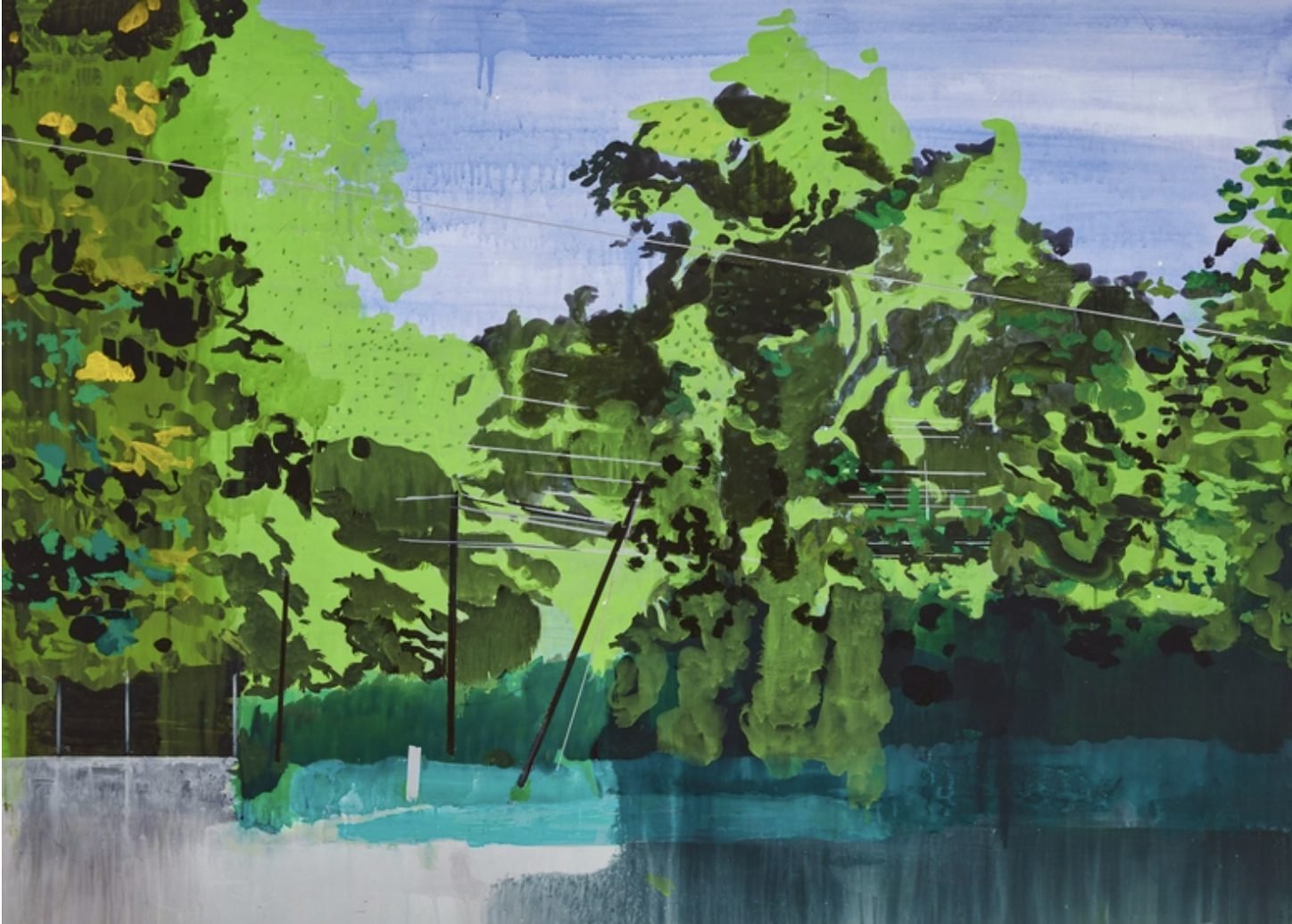
Painting as Dub
Dub music takes an existing recording and transforms it through subtraction, echo, repetition, delay, emphasis, and spatial reorganization.
A vocal line may disappear.
The bass may become more dominant.
A rhythm may echo.
An apparently secondary sound becomes central.
Anderson’s paintings often operate similarly.
He may remove the figure from a source image.
He may enlarge the fence.
He may reduce the posters to rectangles.
He may turn foliage into atmospheric color.
He may retain the architecture while dissolving the event.
What is removed becomes psychologically active.
The absence is not a failure to provide information.
It is a deliberate restructuring of attention.
This gives the paintings a musical logic.
The source remains present as a ghost, but the new work develops through variation.
Barriers and Screens
Fences, grilles, railings, netting, windows, barriers, and patterned screens recur throughout Anderson’s work.
These devices are not simply decorative.
They establish the viewer’s position.
The viewer may see the garden but remain outside it.
The viewer may look through a grille into a room.
The viewer may face a fence whose pattern competes with the landscape beyond.
The barrier creates several simultaneous effects:
It confirms that a place exists.
It allows partial visibility.
It prevents physical or psychological entry.
It divides insider from outsider.
It turns space into pattern.
It makes looking self-conscious.
This is one of Anderson’s most powerful solutions.
Instead of explaining cultural distance through narrative, he turns distance into pictorial structure.
The viewer experiences exclusion through the act of looking.
The Viewer at the Threshold
Many of Anderson’s paintings place the viewer near an entrance without allowing arrival.
A pathway extends inward.
A fence stands across it.
A room opens but remains unoccupied.
Vegetation conceals what lies behind it.
This threshold position mirrors the emotional condition of diasporic memory.
One may feel close to a cultural origin without inhabiting it fully.
One may recognize a space without owning it.
One may enter through family memory while remaining aware that the memory belongs partly to another generation.
The paintings therefore avoid both complete belonging and complete alienation.
The viewer remains suspended between them.
Figuration and Abstraction
Anderson’s work moves continually between recognizable imagery and abstraction.
A landscape may contain trees, pathways, flowers, architecture, and figures. Yet these elements can dissolve into flat planes, stains, grids, loose gestures, or atmospheric fields.
This movement is not simply stylistic experimentation.
It expresses the instability of memory and access.
Figuration offers recognition.
Abstraction interrupts certainty.
The viewer may think:
I know what this is.
I am not sure what I am seeing.
The place feels familiar.
The place remains inaccessible.
That oscillation keeps the painting alive.
The abstract passages do not remove social meaning.
They show where meaning becomes incomplete.
Abstraction as Distance
In Anderson’s work, abstraction can function as distance.
A source photograph may appear to provide factual information. But through repeated painting, cropping, simplification, and revision, specific details disappear.
A poster becomes a colored rectangle.
A person becomes a blurred shape.
Leaves become green marks.
Architecture becomes a grid.
The image is gradually separated from the original event.
This distance can represent:
Time passing
Memory weakening
Emotional uncertainty
Cultural displacement
The limits of photography
The impossibility of returning
Abstraction does not necessarily make the work less personal.
It can reveal how personal experience becomes difficult to recover.
Color as Memory
Anderson uses color with great sensitivity.
His paintings may contain intense greens, blues, yellows, pinks, oranges, and violets, but the color rarely feels simply celebratory.
A tropical green can become lush, oppressive, artificial, nostalgic, or threatening.
A pale blue can create distance.
A pink ground can make a landscape feel remembered rather than observed.
A bright surface may be interrupted by gray architecture or a dark fence.
Color becomes emotionally unstable.
The same hue may suggest both attraction and unease.
Recent criticism of Anderson’s major 2026 Tate Britain retrospective emphasized the hazy, heat-filled, beautiful yet unsettled quality of his paintings, and the way they hold Birmingham and Jamaica, acceptance and rejection, memory and estrangement in unresolved relation. (The Guardian)
This is why color matters so much.
It does not simply describe the environment.
It tells the viewer how uncertain the relationship to that environment has become.
Beauty Without Resolution
Anderson’s paintings can be extraordinarily beautiful.
Gardens shimmer.
Plants spread through saturated fields.
Color creates atmosphere and depth.
Patterns organize the surface.
Yet beauty does not resolve the underlying uncertainty.
The garden remains blocked.
The place remains empty.
The figure remains distant.
The remembered landscape cannot be entered.
This makes Anderson especially relevant to the larger question of whether beauty can remain serious.
His answer is clearly yes.
But beauty must carry pressure.
A beautiful landscape becomes meaningful because it contains distance, history, obstruction, longing, or exclusion.
Beauty does not eliminate complexity.
It attracts the viewer into it.
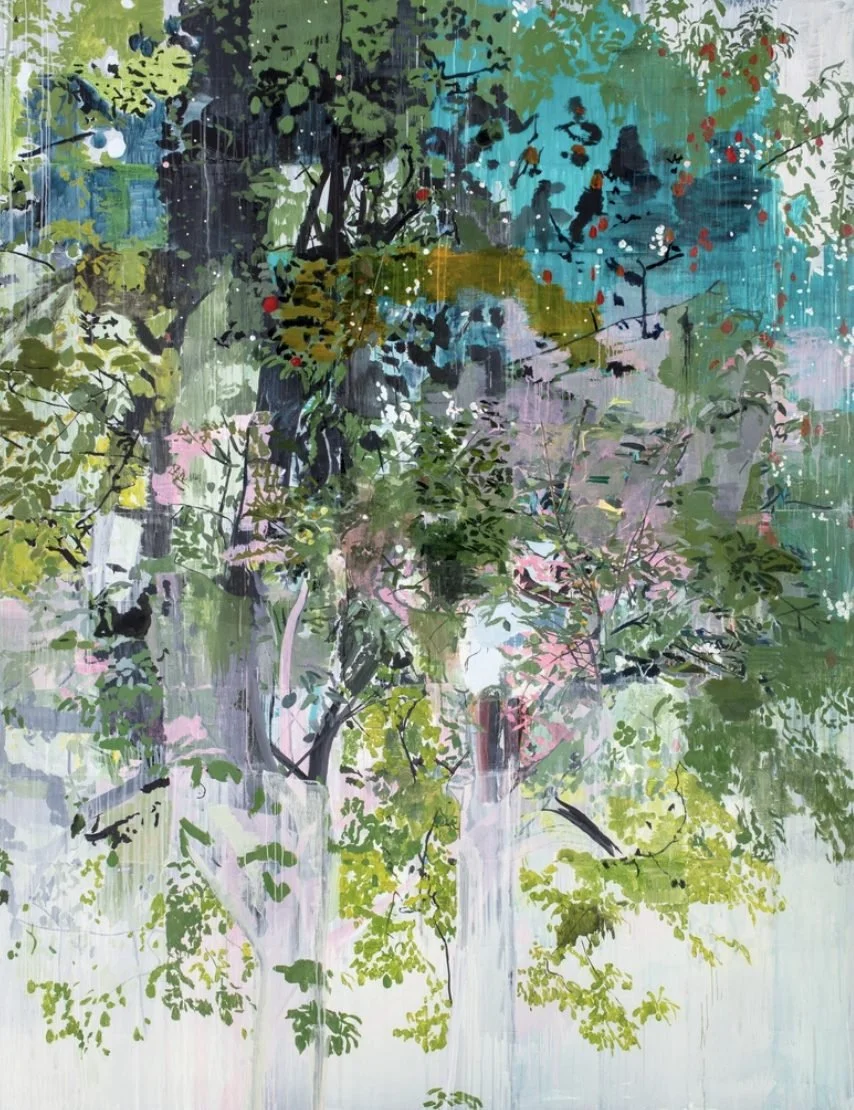
The Garden as Cultural Construction
Gardens appear repeatedly in Anderson’s work.
A garden might initially seem natural, but gardens are constructed spaces.
They reflect:
Climate
Migration
Taste
Labor
Ownership
Domestic life
Cultural memory
Colonial botanical histories
The movement of plants across countries
A Caribbean garden in Britain may preserve a relationship to another climate and culture.
A Jamaican garden may contain traces of colonial land use, tourism, domestic cultivation, or abandoned architecture.
A garden can therefore become a model of diasporic identity.
Plants are moved.
They adapt.
They grow in new contexts.
They preserve traces of origin while becoming part of another environment.
Anderson’s gardens are not simple metaphors, but this parallel gives them psychological depth.
Nature and Architecture
Many of Anderson’s landscapes contain tension between vegetation and built structure.
Leaves grow around walls.
Trees obscure buildings.
Fences divide gardens.
Plants reclaim abandoned hotels.
Architecture attempts to organize space while nature exceeds or conceals it.
The contrast can suggest:
Human control and organic growth
Colonial construction and ecological persistence
Memory and ruin
Order and instability
Occupation and abandonment
In works connected to abandoned Jamaican hotel spaces, foliage enters and overtakes the architecture, turning tourism, modernity, history, and decay into one unstable environment. His Reverb exhibition developed from encounters with abandoned hotel architecture near Oracabessa, Jamaica.
The landscape is not empty nature.
It contains historical structures.
The Abandoned Hotel
An abandoned hotel is a particularly charged subject.
A hotel is designed for temporary occupation.
It promises leisure, travel, service, luxury, and escape.
In a Caribbean context, it may also carry histories of tourism, economic inequality, colonial desire, and the consumption of landscape.
When the hotel is abandoned, these promises collapse.
Architecture remains without guests.
Nature enters.
The building becomes ruin.
Anderson’s treatment of such spaces avoids straightforward historical explanation. Instead, structure and foliage compete.
The viewer sees the remains of hospitality but cannot enter the lost social world.
The painting becomes another threshold.
Family Photographs and Unstable Evidence
Anderson has used family photographs as sources throughout his career.
A family photograph appears to preserve a moment.
But it also contains several forms of distance.
The event has passed.
The people have changed.
The photographer selected the frame.
The image may be faded, cropped, or separated from its original context.
Later viewers may know the people but not the exact emotional condition of the scene.
In Anderson’s paintings, photographic figures can become blurred, doubled, or absorbed into the environment.
A recent review of his Tate retrospective noted paintings in which family figures appear ghostlike or temporally doubled, emphasizing how the promise of photographic truth collapses through painting. (The Guardian)
Painting does not restore the lost moment.
It exposes how unstable the evidence has become.
Photography and the Gap of Memory
Photography offers Anderson useful distance from direct observation.
Working from a photograph allows him to pause, select, crop, repeat, remove, and transform.
But the photograph is not treated as neutral.
It is already an image of separation.
The photograph says:
This existed, but it is no longer here in the same way.
Painting intensifies that distance.
Each translation introduces another layer:
Event
Photograph
Memory
Selection
Drawing
Painting
Revision
The final painting is not a recovery of the original place.
It is a record of repeated mediation.
Black Social Space Without the Figure
One of Anderson’s distinctive achievements is his ability to address Black social experience through spaces and objects rather than through continuous figural representation.
The barbershop can remain culturally specific even when no person appears.
A garden can carry migration and memory.
A grille can represent the structure of access.
A chair can indicate ritual and community.
This expands the possibilities of identity-based painting.
Identity does not always need to appear as a visible body.
It can exist in:
Architecture
Objects
Spatial arrangement
Color
Absence
Use
Social memory
The empty room can carry cultural presence.
The Problem of Nostalgia
Anderson’s subject matter could easily become nostalgic.
Family photographs, community spaces, gardens, Jamaica, and childhood memory all carry the possibility of sentimental longing.
But the paintings resist easy nostalgia.
The remembered place is often:
Obstructed
Empty
Blurred
Fragmented
Overgrown
Repeated until unstable
Visually attractive but unreachable
Nostalgia wants to convert the past into a coherent, emotionally available place.
Anderson prevents that coherence.
The work allows longing while exposing its limits.
The past remains desirable precisely because it cannot be recovered completely.
Nationhood and Landscape
Landscape painting has often helped construct national identity.
A nation imagines itself through its land:
Countryside
Coastline
Gardens
mountains
parks
agricultural fields
tropical vegetation
Anderson complicates this tradition by placing British and Caribbean landscapes into dialogue.
His work asks:
Which landscape represents home?
Can two landscapes occupy one identity?
How does colonial history shape the movement between them?
Who is permitted to belong inside a national landscape?
Can an inherited landscape feel intimate without becoming fully one’s own?
Recent criticism has connected Anderson’s work to the history of British landscape painting while emphasizing how he rethinks nationhood, empire, migration, and the meeting of English and Jamaican environments. (Financial Times)
Landscape is therefore not background.
It is a political and psychological structure.
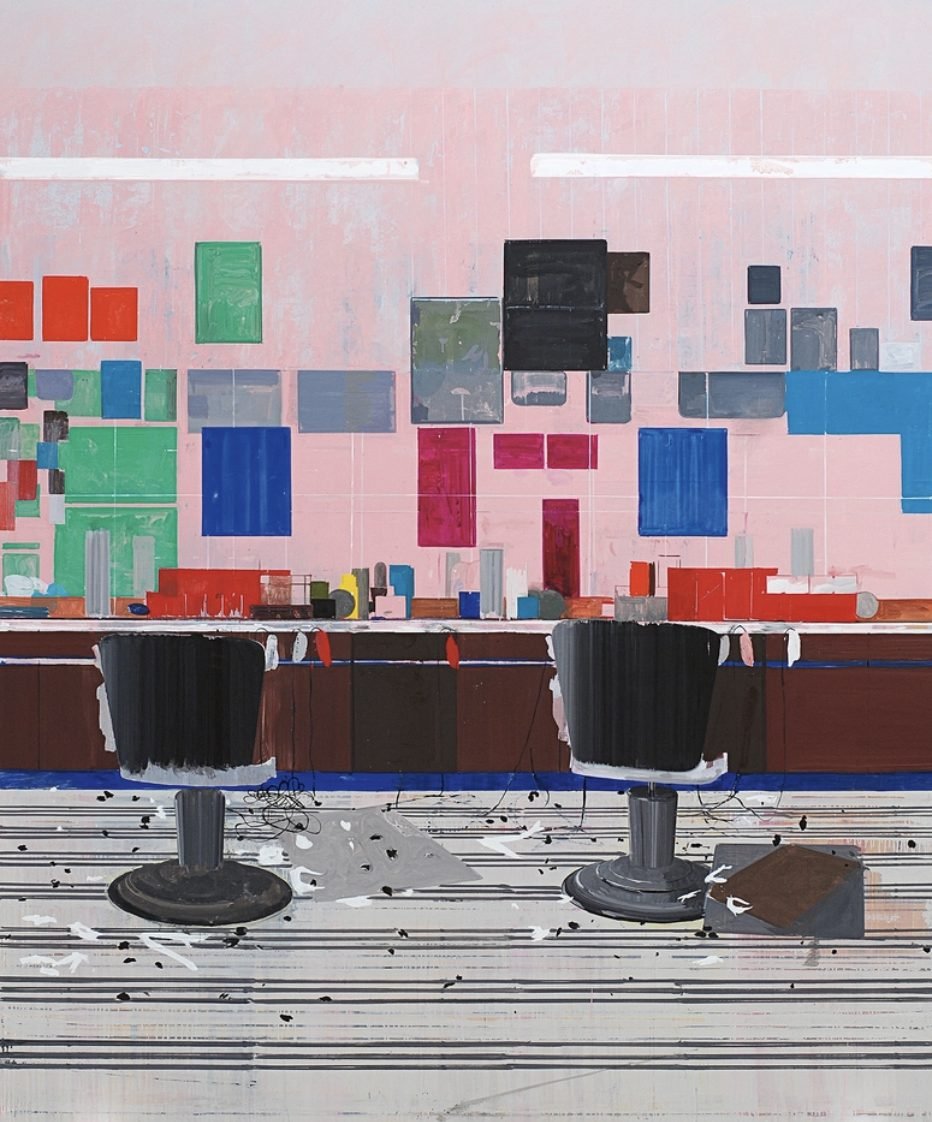
The “Welcome” That Withholds Entry
Some of Anderson’s works use decorative screens or grilles associated with domestic and social spaces.
A title or visual motif may suggest welcome.
Yet the viewer remains outside.
This contradiction is central:
The image offers hospitality while preserving a boundary.
The grille may be beautiful.
Its pattern may create rhythm.
But it is still a barrier.
This allows decoration to perform two roles at once:
Visual invitation
Physical exclusion
Pattern becomes psychologically charged.
It controls access.
Why the Formal Choices Matter
Anderson’s formal vocabulary supports the deeper problem at nearly every level.
Obstruction makes distance visible
Fences, grilles, leaves, and screens prevent direct entry.
Repetition shows memory changing
The same subject becomes less stable each time it is revisited.
Empty rooms make social absence active
Objects retain the memory of bodies.
Blurred figures resist complete possession
The viewer recognizes a person without receiving full access.
Color carries emotional contradiction
Beauty, longing, heat, melancholy, and estrangement coexist.
Abstraction registers loss of detail
The place survives, but its factual completeness does not.
Photographic sources introduce mediation
The scene has already become an image before painting begins.
Sparse narrative preserves uncertainty
The viewer encounters a condition rather than a complete story.
The Central Contradictions
Anderson’s paintings hold several opposing forces together:
Belonging and estrangement
Britain and the Caribbean
Presence and absence
Figuration and abstraction
Beauty and melancholy
Access and obstruction
Personal memory and collective history
Familiarity and distance
Natural growth and built structure
Social space and emptiness
Invitation and exclusion
Observation and recollection
The deepest contradiction may be:
The paintings make a place feel intensely present while showing that it cannot be entered, recovered, or possessed completely.
That is the emotional engine of the work.
The Viewer’s Position
Anderson gives the viewer several roles.
The viewer becomes an outsider
Barriers and empty rooms make entry uncertain.
The viewer becomes a rememberer
The paintings activate the fragmented logic of memory even when the viewer has never visited the depicted place.
The viewer becomes a cultural interpreter
Objects and environments carry histories that may not be immediately legible.
The viewer becomes a navigator
Figuration and abstraction require continual adjustment.
The viewer becomes aware of desire
The beauty of the landscape produces a wish to enter.
The painting makes that wish visible and then frustrates it.
The viewer becomes aware of limits
Seeing a place does not mean belonging to it.
The World Anderson Has Built
His recurring lexicon includes:
Barbershop chairs
Mirrors
Posters
Fluorescent lights
Hair clippings
Grilles
Fences
Gardens
Trees
Tropical foliage
Parks
Empty interiors
Family figures
Abandoned architecture
Pools
Paths
Windows
Patterned screens
Saturated color
Blurred photographic forms
These elements create a coherent world without becoming fixed symbols.
A fence may protect, imprison, decorate, or exclude.
A chair may represent labor, ritual, absence, or transformation.
A garden may embody memory, cultivation, desire, or cultural displacement.
A blurred figure may be disappearing into the past or emerging from it.
A fluorescent light may describe a room while flattening it into geometry.
The lexicon remains alive because each motif changes through repetition.
The Risk of Atmospheric Memory Painting
Anderson’s practice carries real risks.
Haze can become generalized nostalgia.
Blur can become a tasteful sign of memory.
Tropical color can become exotic beauty.
Empty interiors can become elegant melancholy.
Repetition can become a recognizable formula.
Barriers can symbolize distance too predictably.
The critical question is:
Does each painting discover a new relationship among place, memory, identity, and access, or does it merely reproduce the established Anderson atmosphere of beautiful estrangement?
The strongest paintings make formal decisions feel necessary.
The fence does not merely signify separation; it determines the entire visual encounter.
The empty chair reorganizes the room.
The abstract passage shows where the remembered place breaks down.
The color makes longing pleasurable and uneasy at once.
A weaker painting might retain the atmosphere without renewing the problem.
How His Work Differs from Peter Doig’s
Anderson and Peter Doig share an interest in memory, landscape, photography, atmosphere, and places that remain psychologically distant.
But their central problems differ.
Doig often asks:
What happens to a place when lived experience, photographic imagery, cinema, memory, and imagination merge?
Anderson asks more specifically:
What happens when a place is tied to cultural belonging but remains partially inaccessible through migration, generation, geography, and memory?
Doig’s distance is often dreamlike and temporal.
Anderson’s distance is also cultural and social.
Doig’s landscapes can feel like remembered images whose origins have become unstable.
Anderson’s places often carry the pressure of diaspora, community, nationhood, and who is permitted to enter.
The formal similarities make the difference especially useful.
How His Work Differs from Michael Armitage’s
Armitage combines political events, mythology, media, memory, and art history into unstable narrative worlds.
Anderson is quieter.
His paintings often remove the event.
They focus on the place left behind.
Armitage’s instability tends to produce transformation, dream, social conflict, and narrative collision.
Anderson’s instability produces distance, obstruction, repetition, and suspended belonging.
Armitage asks how representation changes an event.
Anderson asks how memory changes a place.
Why the Work Belongs to the Present
Anderson’s work belongs to a world shaped by migration, mixed inheritance, family memory, tourism, cultural displacement, and divided belonging.
Many people live in one country while carrying emotional or familial ties to another.
Places are increasingly encountered through:
Photographs
Video
Family stories
Social media
periodic travel
inherited rituals
food
music
community spaces
cultural imagination
A person may feel attached to a place they know incompletely.
They may feel at home in more than one place and fully at home in neither.
Anderson gives this condition a visual structure.
The work does not define identity as rootlessness.
It shows that attachment can survive distance.
But attachment does not erase the boundary.
What Artists Can Learn
The lesson is not to imitate Anderson’s barbershops, tropical gardens, empty chairs, grilles, blurred photographs, saturated greens, or repeated source images.
Those are the visible solutions produced by his particular investigation.
The larger lesson is that place becomes powerful when it carries a divided relationship.
Anderson demonstrates that:
A landscape can hold cultural identity rather than merely depict scenery.
Absence can preserve social presence.
A barrier can determine the psychology of looking.
Repetition can show memory changing over time.
Abstraction can register incomplete access.
Beauty can carry longing and estrangement.
Objects can preserve the history of a community.
Photographs can function as evidence of distance rather than factual certainty.
Empty space can activate the bodies no longer present.
Pattern can invite and exclude simultaneously.
A recurring subject can remain alive when each return changes the underlying question.
Identity can be embedded in spaces, objects, colors, and structures without requiring a visible figure.
A painting can offer recognition without granting possession.
Anderson does not simply paint a place.
The place is lived.
It becomes a photograph.
The photograph becomes family memory.
Memory crosses geography and generations.
Painting reconstructs the place.
Abstraction interrupts the reconstruction.
A fence blocks entry.
The place remains emotionally present but physically and historically beyond reach.
The lesson is not to copy the appearance of the work. It is to understand the pressure that made the appearance necessary.
Hurvin Anderson turns landscape and interior space into divided fields of memory where beauty, cultural belonging, absence, and obstruction keep the viewer suspended between recognition and distance.
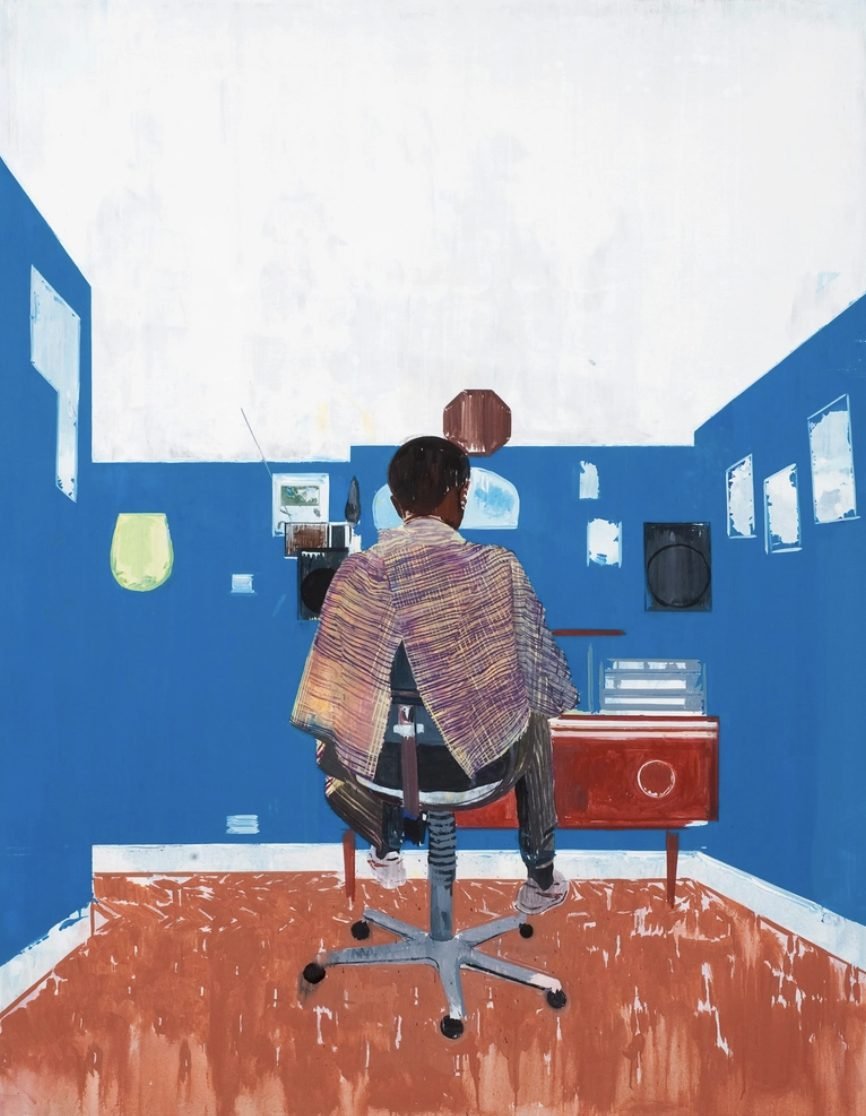
What Makes Michael Armitage’s Paintings So Powerful?
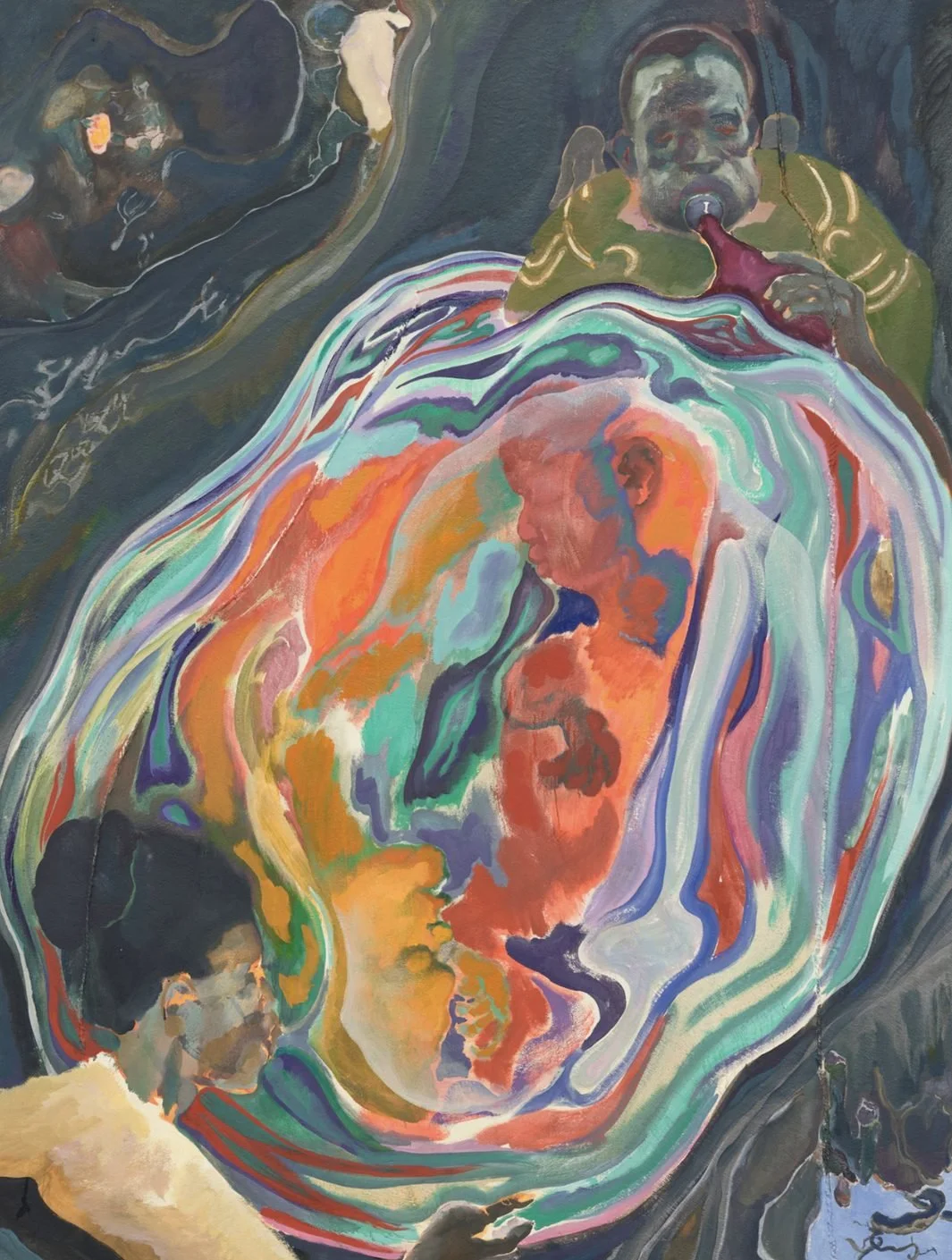
Michael Armitage’s paintings are powerful because they turn contemporary events, personal memories, political conflict, folklore, and art history into unstable visual worlds where reality and invention cannot be separated cleanly.
At first, the paintings can appear lush and seductive.
Figures move through landscapes of pink, green, violet, blue, orange, ochre, and deep black. Bodies stretch, twist, gather, fall, flee, dance, fight, watch, or wait. Animals enter scenes without explanation. Trees curve unnaturally. Faces appear inside foliage or emerge from uncertain spaces. Crowds coexist with isolated individuals. Political rallies, domestic violence, migration, ritual, sexuality, rumor, and myth can occupy the same surface.
The paintings often feel dreamlike.
But the dream is never free from reality.
Armitage draws upon news reports, internet imagery, personal observation, remembered events, gossip, political demonstrations, cinema, East African art, and European painting. MoMA has described his practice as bringing contemporary visual culture into dialogue with art history and with modernism’s development both within and beyond the West. His gallery likewise emphasizes that the paintings weave together current news, historical sources, online material, and recollections of Kenya. (The Museum of Modern Art)
The result is not documentary painting.
It is painting about what happens when events enter memory, culture, rumor, fear, fantasy, and inherited visual language.
The Problem Beneath the Work
Armitage repeatedly returns to a central artistic problem:
How can painting give form to contemporary social and political experience when reality is already entangled with memory, mythology, media, cultural inheritance, and imagination?
His paintings are not simply depictions of Kenya or East Africa.
They are not direct illustrations of political events.
They do not claim to provide complete historical explanation.
Instead, they examine how experience becomes an image.
A political rally may be witnessed directly, recorded by cameras, circulated online, remembered later, connected to earlier violence, and unconsciously reorganized through compositions inherited from European painting.
A childhood memory may remain emotionally vivid while factual details become unstable.
A newspaper image may enter public consciousness and combine with rumor, prejudice, fantasy, or folklore.
A violent event may be remembered through one gesture, one color, one body, or one fragment of landscape.
Armitage paints inside this instability.
His deeper question is not merely:
What happened?
It is:
What does an event become after it passes through perception, memory, representation, cultural history, and the painter’s imagination?
Reality Under the Pressure of Invention
Armitage’s paintings often contain recognizable contemporary situations.
These may include:
Election rallies
Police violence
Public protest
Migration
Social unrest
Religious gatherings
Domestic abuse
Community events
Urban life
Ecological disturbance
Yet the paintings rarely remain faithful to one photographic source or one observed event.
Figures may be rearranged.
Scale may become irrational.
Animals may appear symbolically.
Separate times may occupy one field.
A face may emerge from the landscape.
A political event may acquire the structure of a religious painting, a mythological scene, or a nightmare.
This transformation does not necessarily move the work away from truth.
It proposes that social reality already contains irrationality, symbolism, fear, desire, and cultural memory.
A crowd is never experienced only as a countable group of bodies.
It may feel hopeful, dangerous, euphoric, threatening, vulnerable, theatrical, or uncontrollable.
A political leader may become a symbolic figure before the historical consequences of leadership are fully understood.
A violent scene may become mythic in memory because its emotional force exceeds the available facts.
Armitage uses invention to reveal these psychological and cultural dimensions.
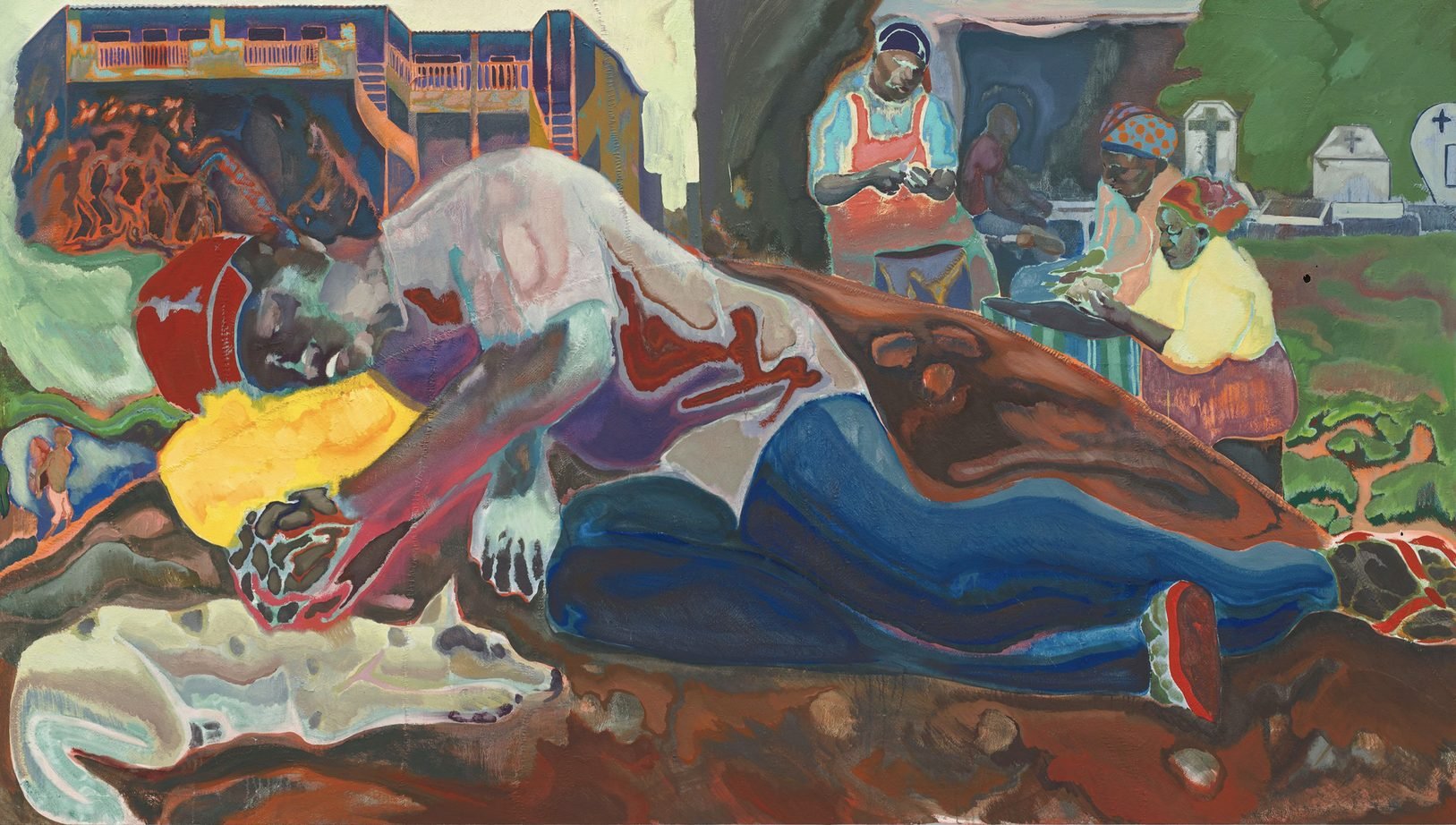
Painting Between Witness and Distance
Armitage occupies a complicated relationship to many of his subjects.
He was born in Nairobi, trained in Britain, and has worked between multiple cultural and geographic contexts. His paintings emerge from real attachments to East Africa, but he does not claim that personal connection grants complete authority over every experience represented. MoMA describes him as Kenyan British and identifies Nairobi and London as important contexts for his practice; more recent gallery information lists his life and work across Nairobi and Indonesia. (The Museum of Modern Art)
This creates an important tension:
He may witness events directly.
He may encounter them through media.
He may remember them from childhood.
He may approach them after geographic distance.
He may translate them through artistic traditions developed elsewhere.
He may remain both culturally connected and critically outside particular experiences.
The paintings do not eliminate this uncertainty.
They preserve it.
The viewer often senses that the artist is close enough to feel the pressure of an event but distant enough to recognize that no single image can explain it completely.
This position prevents the work from becoming simple reportage.
It also creates ethical risk.
How can an artist represent the suffering, displacement, violence, or political vulnerability of others without turning those experiences into visual material?
Armitage’s strongest paintings respond by avoiding complete narrative control. The subjects remain specific, but the painting does not pretend to deliver the final interpretation.
Lubugo Bark Cloth as a Living Ground
One of the most important features of Armitage’s work is his use of lubugo, a traditional Ugandan bark cloth.
Lubugo is made by removing bark from the mutuba tree and repeatedly beating it until it expands into a flexible textile-like sheet. The tree can regenerate its bark, making the process connected to cycles of removal, healing, and continued growth. Armitage has described the adoption of this material as transformative to his painting practice. (The Museum of Modern Art)
The material changes everything.
Lubugo is not a smooth, neutral canvas.
It contains:
Seams
Holes
Tears
Stains
Irregular edges
Variations in thickness
Rough fibers
Evidence of beating and stretching
Marks of organic growth
These features remain active beneath the paint.
A hole may interrupt a body.
A seam may divide a face.
A thickened area may become landscape.
A tear may affect the direction of a figure.
The support does not simply receive the image.
It participates in constructing it.
The Surface Has Its Own History
A conventional primed canvas can create the impression of a blank beginning.
Lubugo arrives with a past already visible.
It has grown as part of a tree.
It has been removed.
It has undergone repeated physical impact.
Separate pieces may have been stitched together.
The surface may be repaired, uneven, or incomplete before painting begins.
This history creates a material parallel to Armitage’s broader subject.
The paintings concern societies, memories, landscapes, and images that are also never blank.
They arrive already marked by:
Colonial history
Cultural inheritance
Political conflict
Personal memory
Media circulation
Religious belief
Existing visual traditions
Previous violence
The image must negotiate with what is already there.
The bark cloth makes that condition physical.
Material Damage and Represented Violence
Lubugo’s irregular surface can intensify the violence within a painting.
A hole may resemble a wound.
A seam may cut through the body.
A rough passage may make flesh appear damaged or unstable.
But this relationship must be handled carefully.
The material should not become a convenient symbol in which every tear automatically means trauma.
Its deeper importance lies in resistance.
The support prevents the image from becoming seamless.
It interrupts pictorial certainty.
The viewer cannot forget that the scene has been built on an object with its own physical condition.
A painted figure and the material beneath it remain partially independent.
This produces a valuable instability:
The image wants to become a world, while the bark cloth keeps returning it to matter.
Beauty and Political Unease
Armitage’s paintings are often exceptionally beautiful.
His color can be luminous, unexpected, and emotionally complex. Landscapes flow through pinks, greens, blues, yellows, and violets. Figures may glow against atmospheric fields. Thin oil paint allows the bark to remain visible, producing delicate and shifting surfaces.
That beauty creates a difficult contradiction.
The paintings may address:
Violence
Political manipulation
Mob behavior
Displacement
Death
Social inequality
Fear
Ecological crisis
Yet the viewer is attracted through color, rhythm, and painterly invention.
This raises a central question:
Does beauty deepen attention to difficult experience, or does it make suffering easier to consume?
Armitage does not avoid this danger.
He uses seduction as an entry point.
The viewer may initially enter through color and atmosphere, then gradually discover bodily distortion, social conflict, or moral uncertainty.
Beauty becomes productive when it delays recognition without neutralizing the event.
The strongest paintings make pleasure and discomfort inseparable.
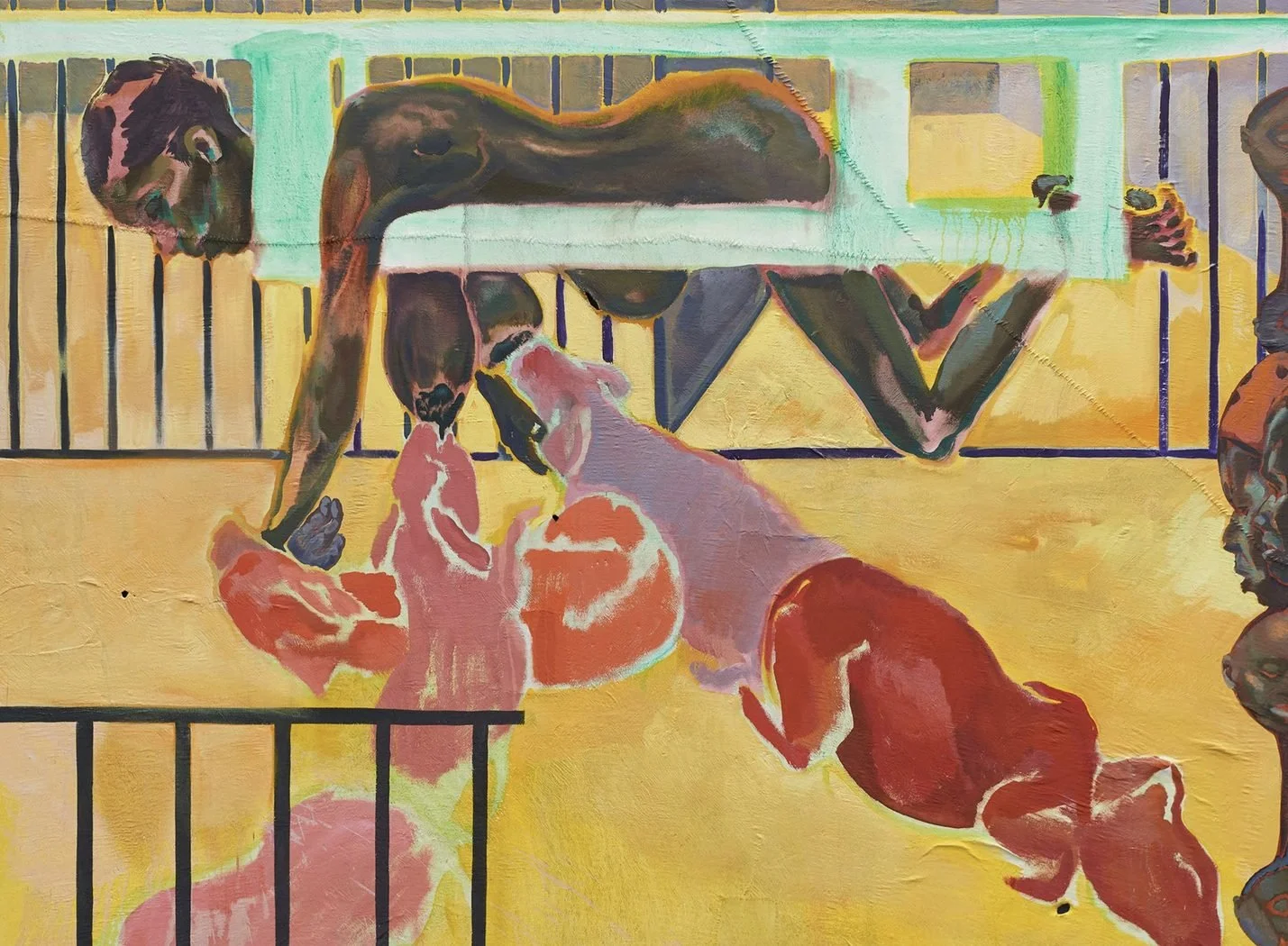
Why the Formal Choices Matter
Armitage’s visual language may appear fluid and dreamlike, but its force depends on highly specific formal decisions.
Thin oil paint preserves the material ground
Armitage often applies oil paint in translucent or relatively thin layers.
This allows the color and texture of the bark cloth to remain visible.
The support enters the flesh, sky, vegetation, and architecture.
The image never becomes completely opaque.
This produces a world that feels simultaneously present and unstable.
The painting appears to emerge from the material rather than simply covering it.
Irregular anatomy prevents easy realism
Bodies in Armitage’s paintings may be elongated, fragmented, compressed, or distorted.
These figures can appear graceful and injured at once.
An arm may stretch unnaturally.
A face may dissolve into surrounding color.
A body may seem to occupy more than one position.
Distortion prevents the scene from functioning as straightforward documentation.
It allows emotional, political, and symbolic forces to become bodily.
A figure is not only shown experiencing instability.
The body is formally made unstable.
Landscape absorbs narrative
The environment often does more than contain the figures.
Color, vegetation, animals, sky, architecture, and bodily forms may flow into one another.
A face can appear within a field.
A branch may resemble a limb.
A crowd may dissolve into terrain.
The landscape becomes psychologically and politically active.
It can suggest:
Witness
Threat
memory
fertility
concealment
territorial conflict
environmental damage
mythological space
The event does not take place on neutral ground.
The ground absorbs it.
Animals destabilize human authority
Monkeys, dogs, crocodiles, birds, and other animals appear throughout Armitage’s work.
They may function as:
Witnesses
doubles
omens
comic disruptions
symbols drawn from folklore
signs of instinct
figures of threat
observers outside human systems
Animals complicate scenes that might otherwise become morally straightforward.
A political crowd and a group of animals may occupy the same field.
Human behavior can begin to appear ritualistic, theatrical, predatory, or absurd.
The animal does not necessarily decode the painting.
It makes human certainty less secure.
Multiple scenes disturb linear time
Armitage may combine several events within one painting.
Foreground and background do not always belong to the same moment.
Different scales can suggest separate temporal or psychological zones.
A central figure may be surrounded by memories, fears, symbols, and parallel events.
This resembles the structure of recollection more than the structure of a photograph.
Memory does not preserve time evenly.
It creates clusters.
One incident becomes central.
Another survives at the edge.
A later interpretation enters an earlier event.
The painting allows those times to coexist.
Cropping removes explanatory certainty
Figures may enter or leave the composition abruptly.
Bodies can be partially visible.
Events extend beyond the frame.
This prevents the scene from becoming a complete account.
The viewer arrives in the middle.
Something occurred before the visible moment and will continue afterward.
The painting becomes a fragment of a world rather than a sealed narrative.
Color separates emotional truth from factual description
Armitage’s color frequently departs from natural observation.
Skin, foliage, ground, and sky may shift into unexpected hues.
This does not simply make the work expressive.
Color reorganizes relationships.
A violent scene may appear strangely luminous.
A landscape may feel seductive and diseased at once.
A figure may become visually connected to the surrounding earth.
Emotional truth becomes more important than local color.
Art History as an Active Structure
Armitage’s paintings engage deeply with European art history.
His sources and affinities include artists such as:
Francisco Goya
Paul Gauguin
Édouard Manet
Titian
Théodore Géricault
Peter Paul Rubens
Edgar Degas
European religious painting
History painting
Romantic landscape
Modern figurative painting
Armitage has identified encountering Goya’s Black Paintings as a particularly profound experience. His gallery and museum presentations also emphasize the dialogue between contemporary East African subjects and compositions inherited from Western art history. (White Cube)
But the work does not simply quote famous paintings.
Historical compositions become frameworks through which contemporary events are reorganized.
A political demonstration may acquire the bodily rhythm of a battle painting.
A crowded public scene may echo religious composition.
A vulnerable figure may occupy a pose inherited from martyrdom, mythology, or classical painting.
This creates friction.
The prestigious visual language of European history painting is used to depict events and populations frequently excluded from that history.
At the same time, the inherited composition carries colonial and cultural authority that cannot be accepted innocently.
Armitage uses the structure while making its instability visible.
Parallel Cultural Histories
MoMA described Armitage’s work as exploring “parallel cultural histories.” This phrase is useful because it avoids treating European and East African art as one central tradition and one peripheral influence. (The Museum of Modern Art)
His paintings enter dialogue with:
European canonical painting
East African modernism
Contemporary Kenyan visual culture
Popular imagery
Folklore
Political media
Local memory
Lubugo production
Cinema
Internet circulation
These sources do not merge into a smooth global style.
They retain different histories and relationships to power.
A European composition may provide structure.
An East African event may provide political urgency.
The bark cloth may shape the physical image.
Folklore may transform the narrative.
Media imagery may determine a gesture.
The painting becomes a meeting place where no source remains fully intact.
The Danger of the Western Canon
Working with European art history creates a genuine risk.
The inherited composition may lend importance to the contemporary scene, but it could also imply that the event becomes artistically significant only after being translated through European precedent.
Armitage’s use of lubugo and engagement with East African artists complicate that hierarchy.
The paintings do not simply place African subjects inside European painting.
They force European painting to operate on an East African material ground and within cultural narratives it cannot control completely.
The bark interrupts the canon.
Local visual traditions interrupt the canon.
Contemporary events alter inherited composition.
The influence moves in more than one direction.
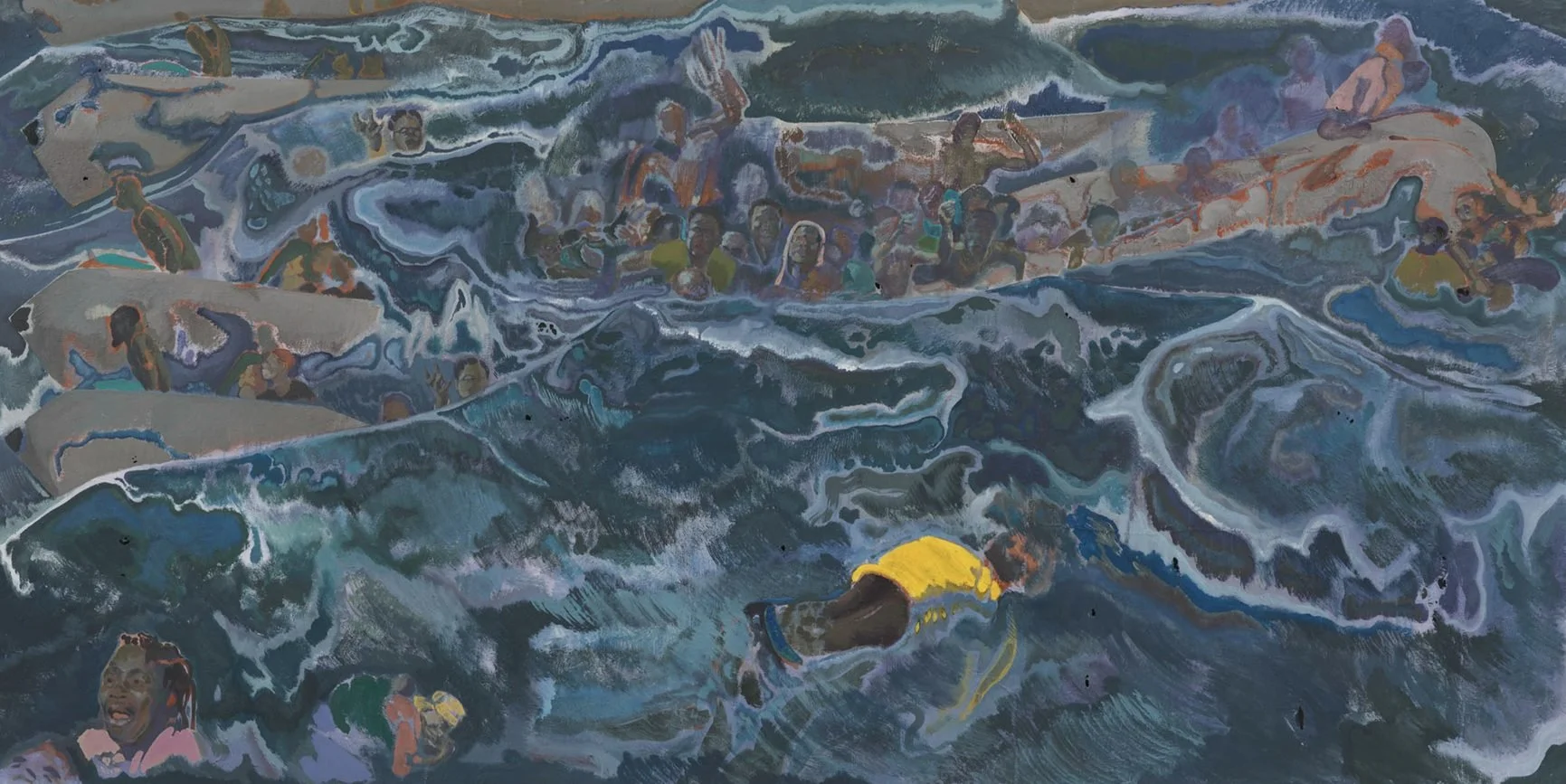
Politics Without Illustration
Political painting often struggles between two dangers.
On one side, it may become too literal:
A message is predetermined.
The image illustrates the correct position.
The viewer receives moral instruction.
Formal complexity becomes secondary.
On the other side, political meaning may become so ambiguous that the real event disappears into aesthetic atmosphere.
Armitage works between these risks.
His paintings often begin with specific political circumstances. Yet they do not usually provide a stable hero, villain, explanation, or resolution.
A crowd can embody hope and danger.
A public gathering can appear democratic and manipulable.
Leadership can promise change and reproduce disappointment.
Violence may be visible without becoming morally simple.
This ambiguity is not neutrality.
It acknowledges that political experience is psychologically, socially, and historically complex.
Crowds and Collective Emotion
Crowds recur throughout Armitage’s paintings.
A crowd can appear as:
Political public
Mob
audience
community
ritual gathering
displaced population
collective witness
field of vulnerability
Individual bodies may remain visible, but personal identity becomes less secure inside the group.
The crowd has emotional force beyond any one person.
It can generate:
Hope
fear
belonging
pressure
anonymity
danger
spectacle
power
Painting allows Armitage to move between the collective and the individual.
A central figure may dominate while smaller bodies accumulate around the edges.
A person may appear caught within forces larger than individual choice.
The crowd becomes a structure through which politics enters the body.
Migration and the Problem of Representation
Armitage’s more recent work has addressed migration routes across the Sahara and Mediterranean, including the emotional and physical pressures of displacement. His 2025 exhibition Crucible included new paintings and bronze reliefs engaging migration and perilous journeys. (David Zwirner)
Migration presents an especially difficult problem for representation.
News imagery often reduces displaced people to:
Crowds
boats
statistics
crisis symbols
anonymous victims
political evidence
An artwork risks repeating that reduction.
Armitage’s painterly distortion can resist documentary consumption by refusing the illusion that the viewer has received complete access.
But beauty, myth, and ambiguity can also distance the suffering involved.
The success of the work depends on whether transformation preserves the event’s pressure rather than converting it into generalized tragedy.
Memory as an Unreliable Witness
Some of Armitage’s works begin from memories formed in childhood or from events that remained psychologically unresolved.
Memory is not neutral evidence.
It changes with age.
Later knowledge enters earlier experience.
Details disappear.
One image becomes exaggerated.
Fear reorganizes scale.
Rumor and fact merge.
A childhood memory may remain vivid precisely because it was never fully understood.
Painting is well suited to this uncertainty.
It does not need to reconstruct an event as a factual sequence.
It can preserve:
Emotional intensity
bodily reaction
fragments
distortions
symbolic associations
uncertainty about what was seen
The image may be unreliable as documentation and truthful as psychological evidence.
Myth, Folklore, and Social Reality
Mythical, spiritual, and folkloric elements can enter otherwise contemporary scenes.
This does not necessarily make the work escapist.
Belief, rumor, superstition, religion, and oral narratives are part of lived reality.
A person may interpret a political event through spiritual language.
An animal may carry cultural meanings beyond biological identity.
A dream may influence real behavior.
A rumor may produce material consequences.
Armitage’s paintings allow these systems to coexist.
The modern world does not eliminate myth.
It reorganizes it.
The Central Contradictions
Armitage’s work holds several opposing forces together:
Beautiful and violent
Observed and invented
Contemporary and art historical
Political and dreamlike
Specific and mythological
Documentary and unreliable
Local and transnational
Seductive and ethically uncomfortable
Materially fragile and pictorially monumental
Personal and collective
Historically grounded and temporally unstable
Familiar and hallucinatory
The deepest contradiction may be:
The paintings seek to bear witness while admitting that every act of representation transforms what it claims to show.
The work does not abandon truth.
It questions the idea that truth can remain untouched by images.
The Viewer’s Position
Armitage gives the viewer several roles.
The viewer becomes a witness
Political and social events appear before the viewer, sometimes with considerable bodily force.
The viewer becomes an interpreter
Narrative relationships remain incomplete.
The viewer must determine how figures, animals, landscapes, and events connect.
The viewer becomes seduced
Color, atmosphere, and painterly beauty draw the viewer toward scenes that may contain distress or violence.
The viewer becomes ethically uncertain
The pleasure of looking may conflict with the seriousness of the subject.
The viewer becomes historically divided
European compositional references coexist with East African materials and narratives.
The viewer must negotiate more than one artistic history.
The viewer becomes aware of incomplete access
The painting offers emotional proximity but not documentary mastery.
The event remains partly beyond possession.
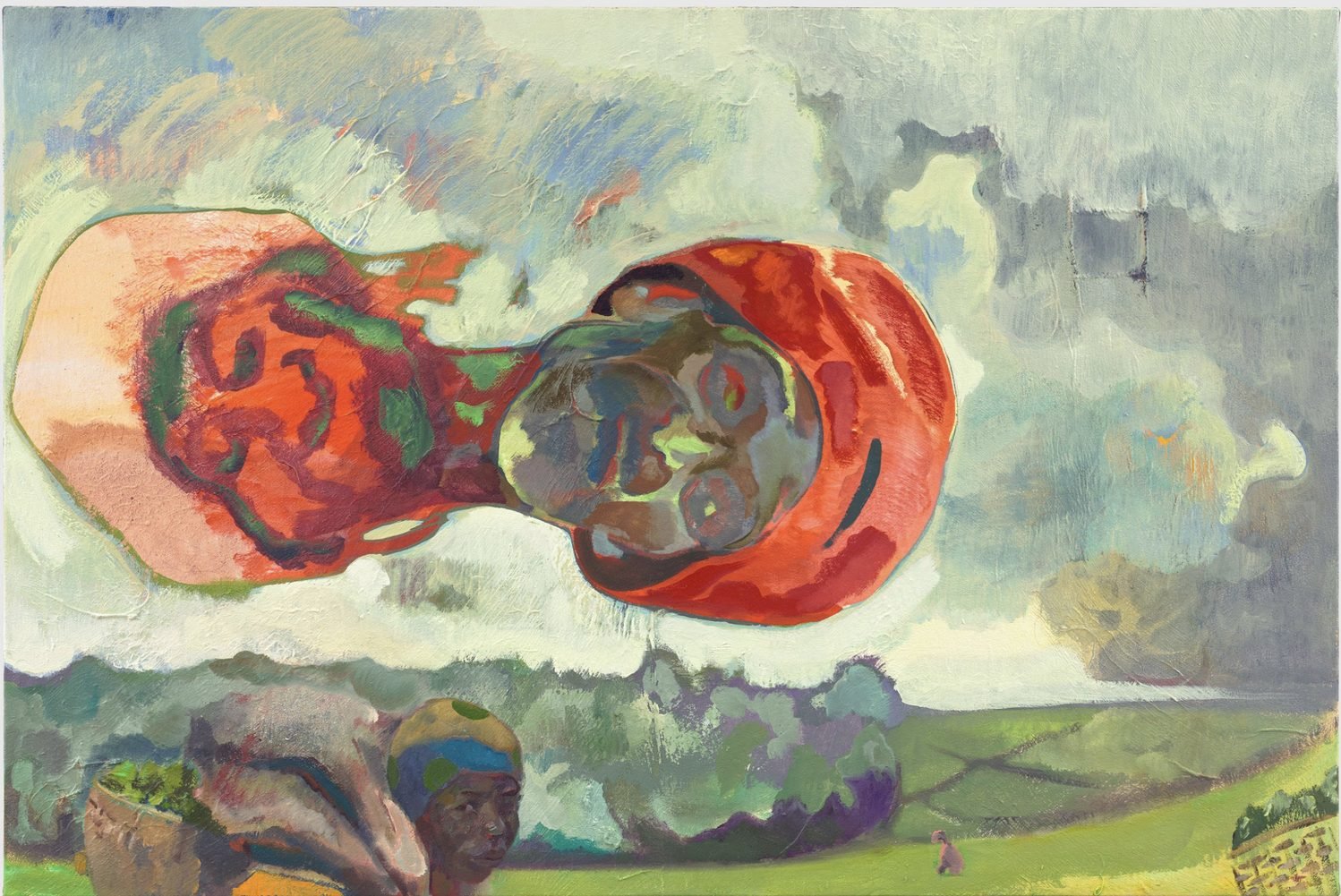
The World Armitage Has Built
His recurring lexicon includes:
Crowds
political gatherings
solitary bodies
animals
trees
mangroves
water
pathways
fires
distorted faces
bodily violence
public ritual
unstable landscapes
lubugo seams
translucent paint
dreamlike color
historical compositions
migration
folklore
memory fragments
These elements form a recognizable world without becoming fixed symbols.
An animal may be witness, threat, omen, comedy, or moral double.
A tree may divide the painting, conceal an event, or connect human activity to ecological space.
Water may offer passage, danger, separation, or death.
A crowd may embody democratic hope or collective violence.
A seam may function as material fact, compositional division, bodily wound, or historical rupture.
The lexicon remains alive because each element changes according to the event surrounding it.
Building Cultural Infrastructure
Armitage’s significance extends beyond his paintings.
He founded the Nairobi Contemporary Art Institute, an organization dedicated to supporting and preserving contemporary art in East Africa. His institutional work reflects a concern with artistic education, archives, exhibition opportunities, and the local conditions through which art becomes visible. (The Standard)
This matters because representation is not shaped only inside paintings.
It is also shaped by:
Museums
Schools
Archives
Galleries
Funding
Writing
Preservation
Access to materials
Local exhibition systems
An artist working across cultural histories must also confront the unequal infrastructure through which some histories are preserved and others remain difficult to access.
Building an institution becomes another way of addressing visibility.
The Risk of Lyrical Political Painting
Armitage’s practice carries several real risks.
Political subject matter can lend seriousness before the painting earns it.
Beautiful color can aestheticize suffering.
Distortion can become a generalized sign of psychological depth.
Lubugo can become a recognizable cultural marker rather than a continuing material problem.
Animals and myth can become exotic atmosphere.
European art-historical quotation can dominate the East African histories the work seeks to engage.
Ambiguous narratives can weaken responsibility.
The critical question is:
Does each painting transform a specific event, memory, or social condition into a necessary visual structure, or does it reproduce the established Armitage atmosphere of beauty, distortion, politics, and dream?
The strongest works maintain pressure among source, material, composition, subject, and ethical uncertainty.
The weaker possibility would be generalized political surrealism.
Why the Work Belongs to the Present
Armitage’s work belongs to a world in which reality increasingly arrives through unstable mixtures of:
News media
Social platforms
Personal testimony
Political propaganda
Historical imagery
Internet gossip
Cultural memory
Video
Photography
Rumor
Algorithmic circulation
An event can become symbolic before facts are established.
Images cross national borders faster than context.
Local suffering can become global content.
Political narratives compete for control of visual evidence.
Armitage’s paintings slow this instability down while refusing to eliminate it.
They acknowledge that contemporary experience is shaped not only by what happens, but by the images, histories, fears, and beliefs through which events are interpreted.
What Artists Can Learn
The lesson is not to imitate Armitage’s lubugo bark cloth, distorted figures, dreamlike landscapes, animals, political crowds, translucent paint, or references to European history painting.
Those are the visible solutions produced by his investigation.
The larger lesson is that social reality can become painterly without being reduced to illustration.
Armitage demonstrates that:
A material ground can carry cultural and physical history.
The support can participate in constructing the image.
Political events can remain morally complex.
Memory can provide psychological truth without documentary certainty.
Art history can become a structure to transform rather than an authority to obey.
Beauty can draw attention toward difficult experience.
Distortion can make social pressure bodily.
Landscape can absorb political and emotional conflict.
Animals and folklore can destabilize human narratives.
Multiple times can coexist inside one composition.
Cultural histories can meet without becoming identical.
Ambiguity becomes meaningful when it remains connected to specific events.
Bearing witness does not require pretending to possess the whole truth.
Armitage does not simply paint an event.
The event becomes an image.
The image enters public circulation.
Public imagery mixes with memory.
Memory encounters art history.
Art history meets an East African material ground.
The bark interrupts the picture.
The painting returns the event as something emotionally present but permanently transformed.
The lesson is not to copy the appearance of the work. It is to understand the pressure that made the appearance necessary.
Michael Armitage turns painting into an unstable meeting place where contemporary events, memory, material, mythology, and competing art histories transform one another without settling into a single truth.
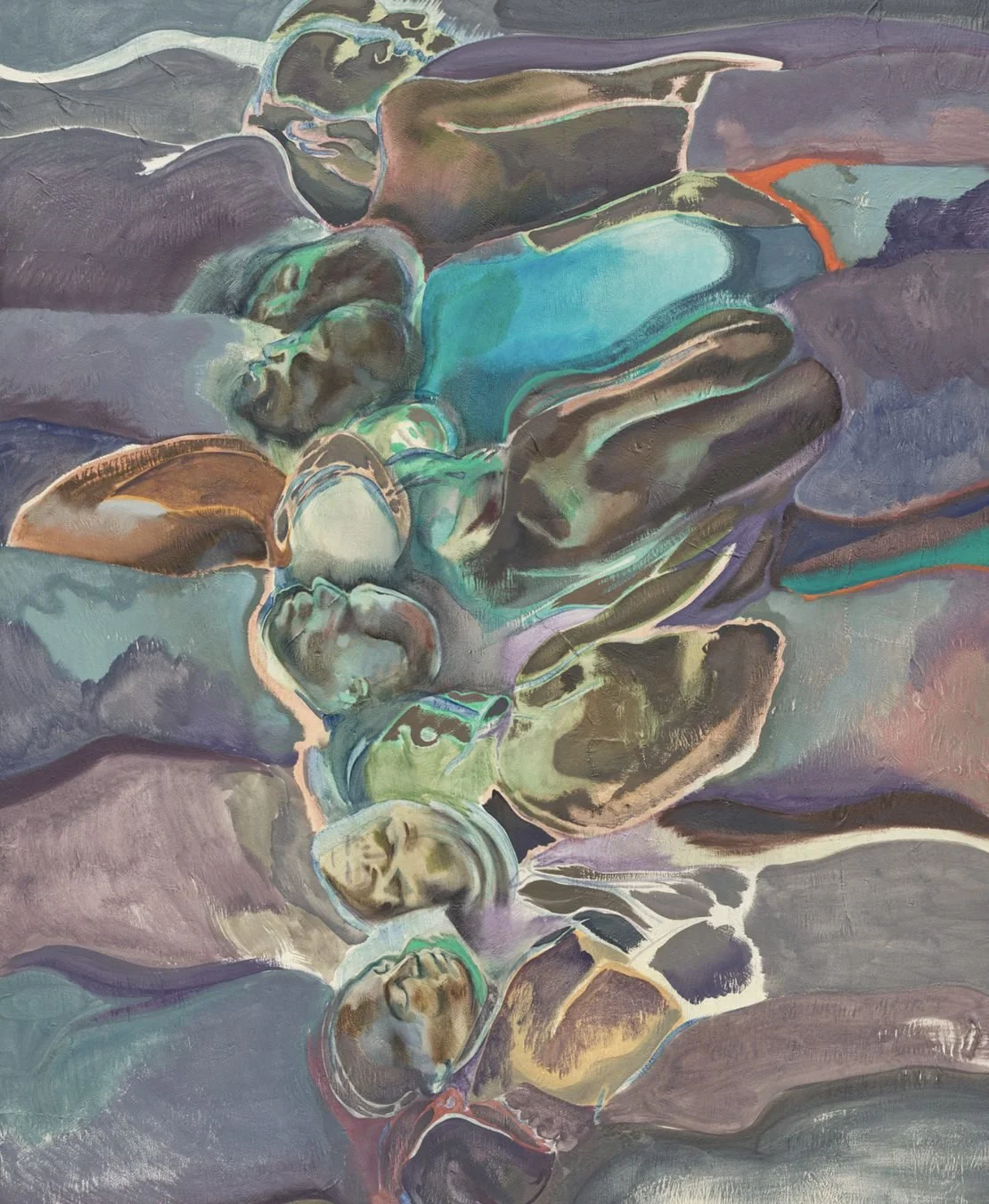
What Makes Lynette Yiadom-Boakye’s Paintings So Powerful?
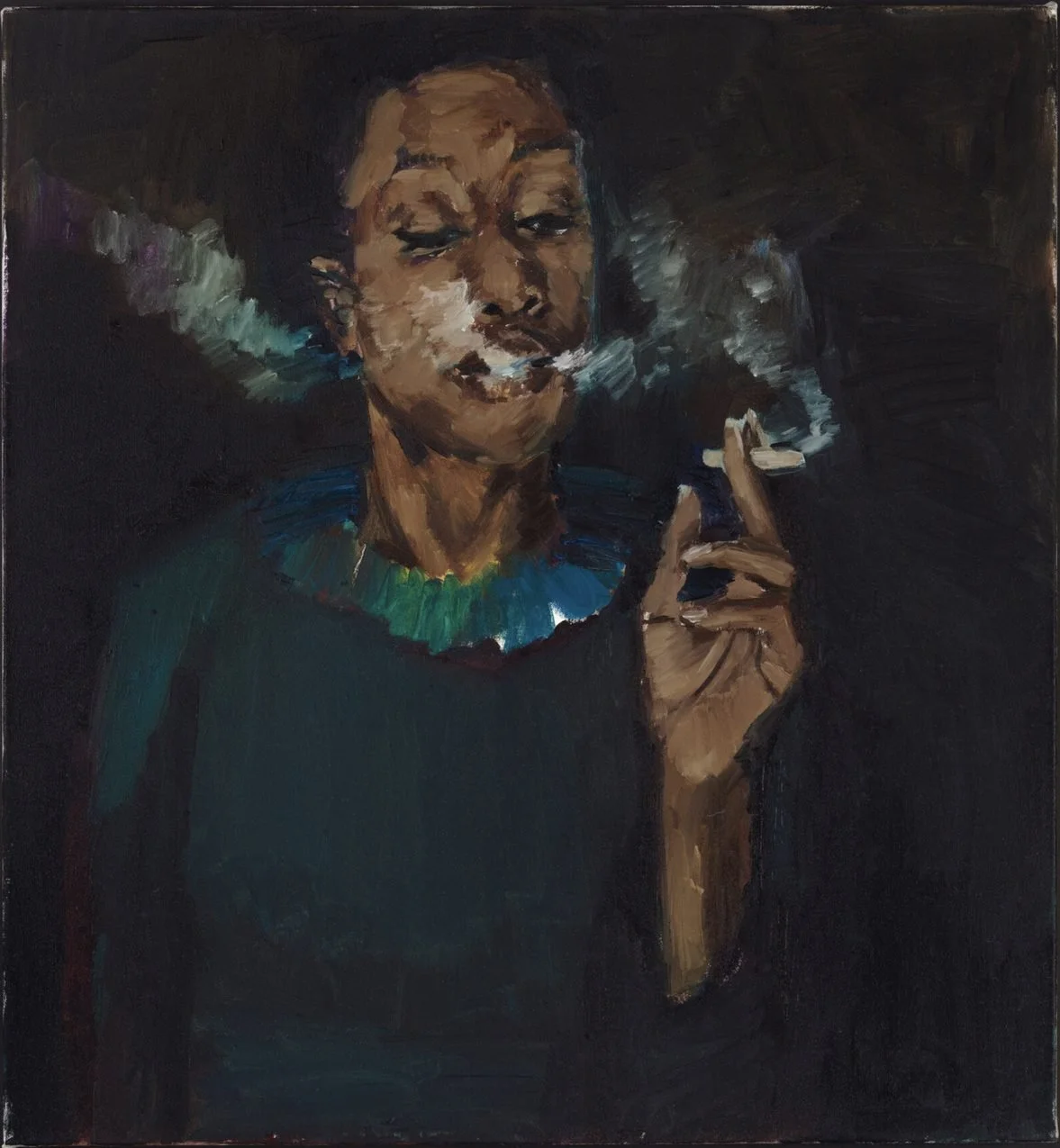
Lynette Yiadom-Boakye’s paintings are powerful because they create Black figures with undeniable presence while refusing to confine them within biography, historical explanation, or a single interpretation.
At first, the works resemble portraits.
A man sits in a dark room. Two women dance. A group gathers against an empty field. A figure reclines, watches, sings, stretches, smiles, or stands in quiet concentration. Clothing is usually simple. Backgrounds remain sparse. The figures possess distinct postures, temperaments, gestures, and relationships.
They appear convincingly alive.
Yet none of them is an identifiable sitter.
Yiadom-Boakye constructs her subjects from imagination, memory, observation, drawings, photographs, scrapbooks, and fragments of other images. They are composites rather than portraits of existing individuals. (Tate)
This fiction gives the figures an unusual freedom.
They do not arrive carrying a documented life that explains them.
They are not illustrations of historical events.
They are not required to represent a profession, social problem, heroic achievement, trauma, or recognizable public identity.
They simply occupy the painting.
That simplicity is radical because the history of Western painting has so often denied Black figures the privilege of appearing without explanation.
The Problem Beneath the Work
Yiadom-Boakye repeatedly returns to a central artistic problem:
How can painting give Black figures complete presence while freeing them from biography, historical duty, social category, and the viewer’s demand for explanation?
Her paintings are not merely fictional portraits.
Fiction is the formal and conceptual condition that makes another kind of visibility possible.
A real sitter arrives with facts:
A name
A profession
A family
A period
A social position
A location
A documented history
Those facts can deepen a portrait, but they can also determine how the figure is interpreted.
The fictional figure cannot be reduced so easily.
The viewer sees posture, expression, clothing, gesture, and relationship, but no stable biography arrives to organize those details.
The figure remains specific without becoming fully explained.
This creates one of the work’s central achievements:
A person can feel psychologically real without being historically identifiable.
The lack of biography is not an absence that weakens the figure.
It is the space in which the figure becomes free.
Fiction as a Form of Freedom
Fiction allows Yiadom-Boakye to invent social and psychological conditions that history did not preserve adequately.
The history of European portraiture contains countless images of aristocrats, merchants, rulers, soldiers, saints, scholars, and wealthy families. Their poses, clothing, objects, interiors, and scale established who deserved to be remembered and how authority should appear.
Black figures often entered that tradition differently:
As servants
Enslaved people
Exoticized bodies
Supporting characters
Anonymous laborers
Ethnographic subjects
Symbols rather than individuals
Yiadom-Boakye does not simply insert Black figures into existing historical narratives.
She removes the obligation to explain why they are there.
Her subjects read, rest, gather, converse, dance, pose, and think. They inhabit the visual authority of portraiture without needing to earn it through exceptional accomplishment or historical significance.
They are not present because something dramatic has happened.
They are present because presence itself is sufficient.
Fiction therefore becomes more than invention.
It becomes a way of expanding pictorial possibility.
The artist can construct a world in which Black figures have always belonged at the center of painting.
Presence Without Biography
Portraiture traditionally promises some connection between appearance and identity.
The viewer assumes that the face belongs to someone whose life exists beyond the canvas. Even without knowing the sitter, the portrait suggests an underlying biography.
Yiadom-Boakye preserves the psychological force of portraiture while removing that guarantee.
The figures appear to have histories.
They seem to possess habits, friendships, moods, private thoughts, and social relationships.
But these remain inaccessible.
This is different from creating generic figures.
A generic figure lacks enough specificity to feel individual.
Yiadom-Boakye’s subjects are highly particular:
One figure leans with casual confidence.
Another appears wary or distracted.
One group shares an unspoken intimacy.
Another seems connected but psychologically separate.
A smile may feel joyful, performative, mocking, or defensive.
A lowered gaze may suggest concentration, privacy, sadness, or simple rest.
The figure feels like someone.
The painting refuses to say exactly who.
That distinction keeps the work alive.
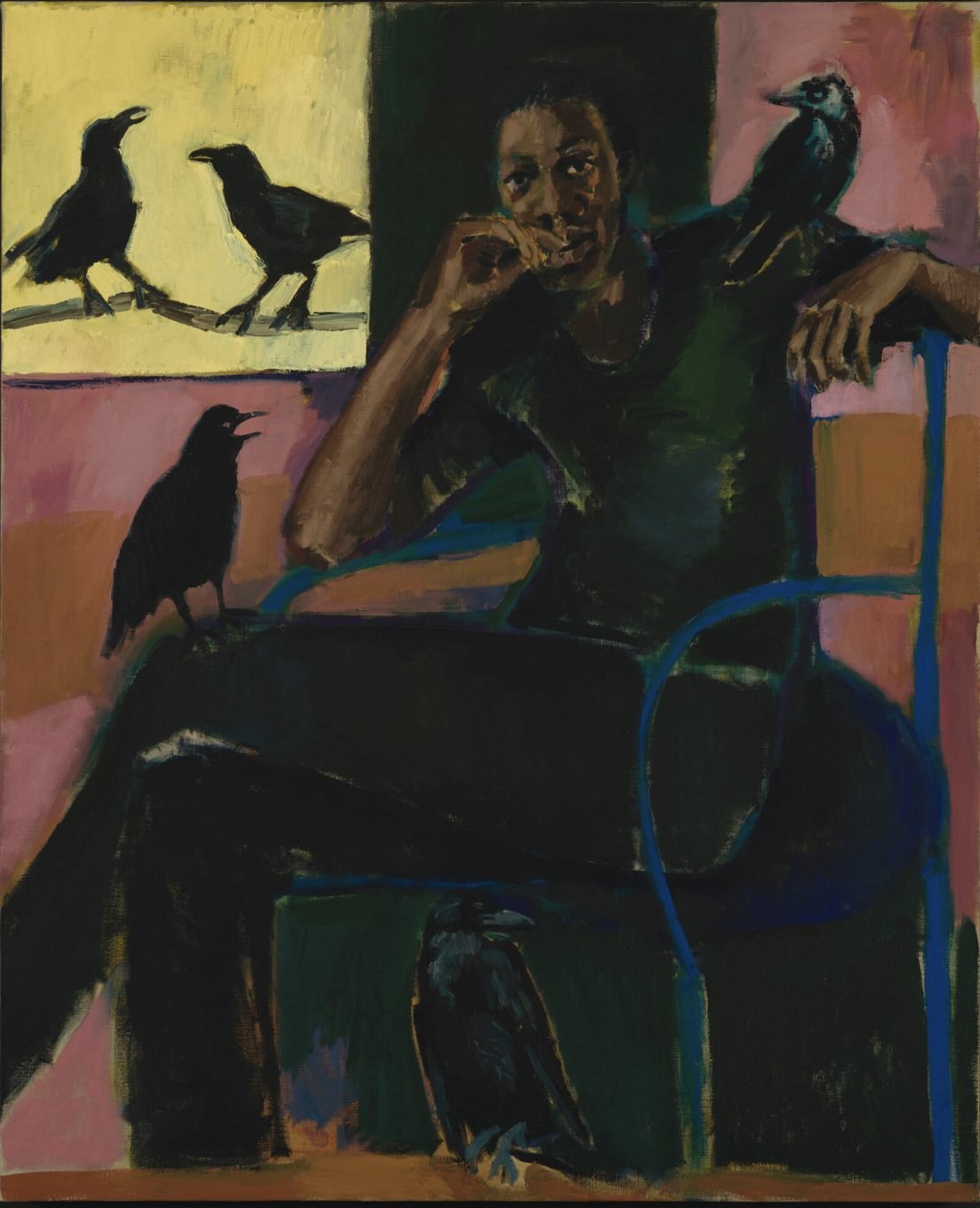
Blackness Without Representational Duty
The figures in Yiadom-Boakye’s paintings are Black, and their Blackness matters.
Yet the paintings resist the expectation that Black representation must always perform a clear explanatory, educational, corrective, or political function.
The figures are not denied social meaning.
But neither are they required to symbolize an entire people or historical condition.
They can be:
Quiet
Awkward
Elegant
Serious
Playful
Ordinary
Strange
Restless
Self-conscious
Graceful
Aloof
Intimate
Bored
Joyful
This range is significant because representational scarcity creates pressure.
When few images of a group are available, each image is asked to carry too much. It may be expected to provide dignity, correction, authenticity, uplift, protest, history, and social explanation simultaneously.
Yiadom-Boakye creates abundance of another kind.
Her figures do not need to represent Blackness correctly.
They are allowed to be particular.
The political force lies partly in the refusal to make political legibility the condition of their existence.
Timelessness and the Refusal of Historical Fixity
Yiadom-Boakye usually avoids details that would locate her figures in a precise time.
Their clothing is often simple and difficult to date. Backgrounds contain few contemporary objects. Technology, brands, recognizable architecture, and explicit historical references rarely establish a fixed period.
The figures may seem contemporary, but they could also belong to an earlier decade or an invented time outside ordinary chronology. Tate and the Guggenheim Bilbao describe these imagined subjects as timeless figures engaged in everyday moments of companionship, movement, rest, and solitude. (Tate)
This timelessness performs several functions.
It prevents clothing and setting from becoming explanatory shortcuts.
It allows the figures to enter into dialogue with the long history of painting.
It also denies the viewer the ability to classify them securely through period.
The subjects seem to belong to painting rather than to one documented historical moment.
But timelessness is not neutrality.
The very appearance of Black figures inside the visual language of European portraiture creates historical pressure.
The figures seem as though they have always belonged there, while their presence also reveals how often they were excluded.
Why the Formal Choices Matter
Yiadom-Boakye’s formal restraint is essential to the freedom and psychological force of her figures.
Fiction prevents biography from closing the image
Because the subjects are invented, viewers cannot resolve the painting through external information.
There is no factual biography waiting to answer the questions raised by the pose or expression.
Interpretation must remain inside the encounter.
Sparse backgrounds protect the figure from narrative
The environments are often dark, open, or minimally described.
A patch of floor, a bench, a chair, a wall, or an ambiguous landscape may be enough to establish space.
This restraint prevents setting from becoming a story.
The background does not explain:
Where the figures are
What they do professionally
What event is occurring
What social class they occupy
What year it is
Why they have gathered
The figure remains the primary fact.
Sparse environments also create psychological space. The body, gaze, and gesture gain intensity because fewer competing details direct interpretation.
Simple clothing withholds social classification
Clothing is one of the fastest ways viewers classify people.
It can reveal occupation, wealth, generation, nationality, subculture, gender performance, or historical period.
Yiadom-Boakye’s clothing often remains understated:
Plain shirts
Dark trousers
Simple dresses
Leotards
Basic jackets
Unadorned shoes
Occasional flashes of red, white, yellow, pink, or blue become visually powerful because they emerge from otherwise restrained palettes.
The clothing gives the figures character without converting them into social types.
Loose brushwork keeps the figure alive
The paintings are rendered with visible, economical brushwork.
Edges remain open.
Hands, faces, clothing, and backgrounds may be established through relatively few marks. Paint does not conceal the fact that the figure is invented.
This looseness prevents the image from becoming frozen or overdetermined.
The figure appears complete enough to command presence but unresolved enough to remain mobile in the viewer’s imagination.
Yiadom-Boakye is known for working quickly and has often completed paintings within a day, allowing concentrated decisions and immediacy to remain visible in the finished work. (Vogue)
Darkness creates presence rather than disappearance
Her palette frequently includes deep browns, blacks, grays, greens, burgundies, ochres, and muted blues.
The figures may emerge from similarly dark environments.
This can make boundaries between body and background unstable, but the figures do not disappear.
Light catches:
An eye
A cheek
A forehead
A hand
A shirt
A collar
A shin
The edge of a face
Visibility becomes selective.
The viewer must remain attentive.
Darkness is not simply an atmospheric effect. It determines how access is granted.
The body becomes present gradually rather than immediately surrendered.
Scale changes the nature of encounter
Yiadom-Boakye moves between intimate portraits and larger group paintings.
A small painting may create a private, concentrated relationship with one figure.
A larger work can make several invented people occupy the viewer’s physical world with collective authority.
The group paintings are especially significant because the figures appear to share relationships the viewer cannot enter fully.
They belong to one another before they belong to the audience.
Gesture carries narrative without explaining it
A raised arm, crossed leg, bent back, tilted head, turned shoulder, or extended hand can suggest an event.
But gesture rarely resolves into a complete story.
In Willow Strip, two figures appear engaged in a shared movement that may be dancing, play, instruction, or affectionate contact. The work gives enough bodily information to create relation without fixing what that relation means.
The gesture becomes a narrative opening rather than a narrative conclusion.
The Returned Gaze
Many of Yiadom-Boakye’s figures look outward.
But their gaze does not necessarily offer access.
A direct gaze may feel:
Confident
Suspicious
Amused
Challenging
Patient
Indifferent
Curious
Withholding
The viewer becomes visible to the figure.
This reverses the conventional structure in which the viewer observes a painted subject without consequence.
The figure seems to assess the person looking.
That returned gaze is especially important within the history of representing Black bodies.
The subject does not remain passively available.
The viewer must confront another consciousness—even though that consciousness is fictional.
The figure’s interiority cannot be proven, but the painting makes it difficult to deny.
Looking Without Possession
The work establishes a careful balance between access and refusal.
Viewers are allowed to observe bodies, expressions, social relationships, and private moments.
But they are not given enough information to possess the figures conceptually.
The lack of biography prevents ownership through knowledge.
The sparse setting prevents ownership through context.
The ambiguous expression prevents ownership through psychological diagnosis.
The invented nature of the figures prevents ownership through documentary truth.
The viewer can look.
The viewer cannot finish them.
This is one reason fiction makes the figures feel free rather than insubstantial.
They remain beyond the viewer’s reach.
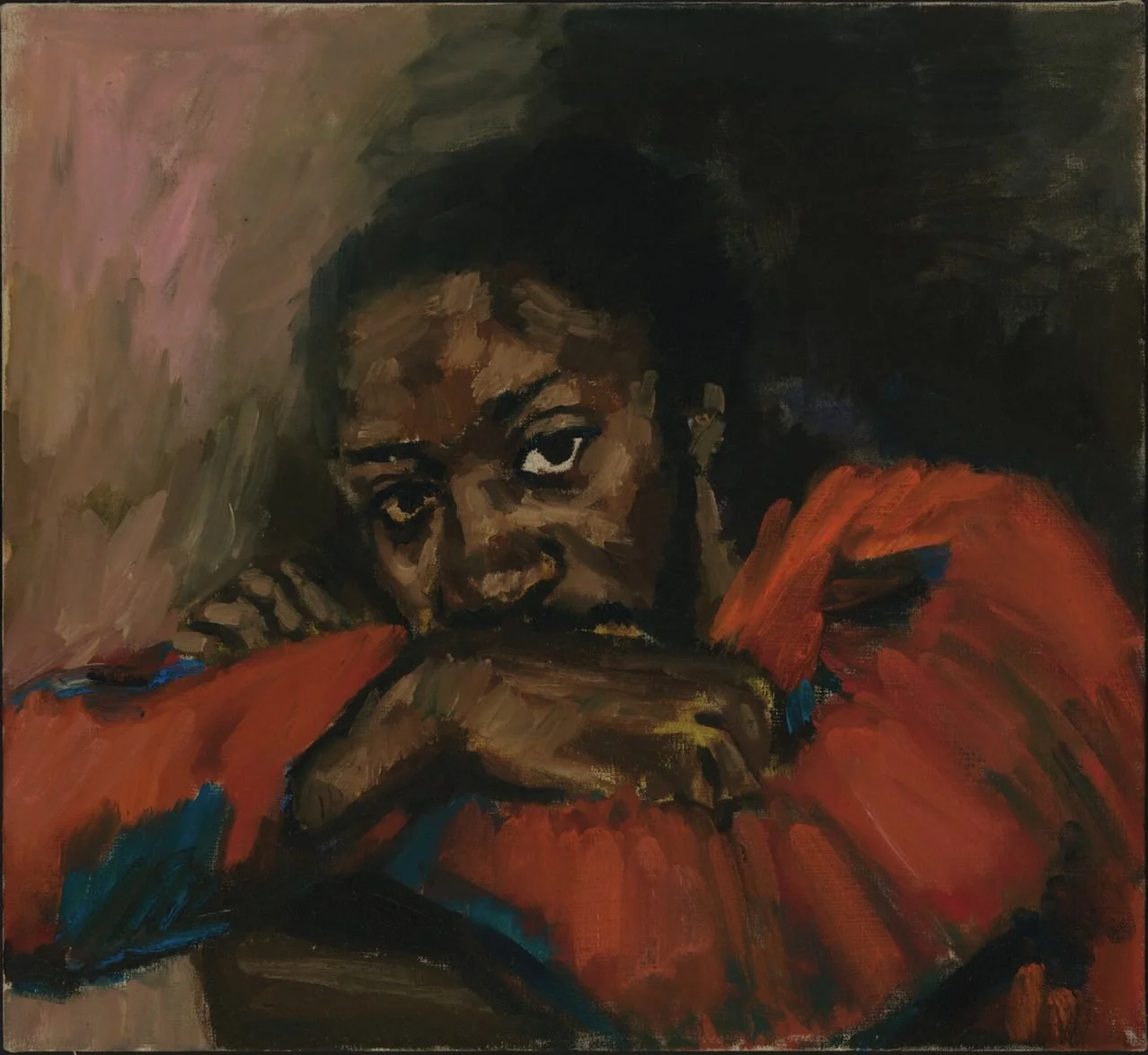
Stillness as an Active Condition
Many of Yiadom-Boakye’s figures are seated, standing, resting, or waiting.
Stillness might appear to indicate inactivity.
In these paintings, it becomes concentrated presence.
A seated figure does not need to perform.
A reclining figure does not need to entertain.
A person standing alone does not need a visible task.
Rest becomes pictorially legitimate.
This matters because Black bodies have often been represented through work, struggle, athletic performance, suffering, entertainment, or social conflict.
Yiadom-Boakye permits her subjects another condition:
They can exist without performing usefulness for the viewer.
Stillness can therefore carry autonomy.
The figure owns time.
Movement Without Spectacle
Other paintings contain dancers, singers, swimmers, athletes, or figures caught in energetic poses.
Yet movement does not necessarily become spectacle.
In a large group painting shown in the Tate survey, several figures stand, lean, gesture, and move across a pale field. One seated figure in red and white extends dramatically, while the others occupy quieter postures. The scene feels socially connected but narratively unresolved.
The movement appears self-contained.
The figures may be performing for one another, but they do not clearly perform for the viewer.
This protects action from becoming display.
The viewer witnesses a world that seems to have its own internal life.
Groups and Unspoken Social Worlds
Group paintings expand Yiadom-Boakye’s problem beyond individual presence.
When several figures occupy the canvas, relationships appear through:
Distance
Orientation
Touch
Shared attention
Mirrored posture
Rhythmic movement
Differences in gaze
Clothing
Proximity and separation
The group may feel intimate without revealing the source of intimacy.
The figures know one another in ways the viewer does not.
This creates an important power relationship:
The viewer is outside a social world that does not require their inclusion.
The figures do not appear assembled to represent community as an abstract idea.
They seem to have actual relationships, even though those relationships are invented.
Fiction creates social density.
Titles as Parallel Fictions
Yiadom-Boakye is also a writer, and her titles often possess unusual poetic force.
Titles such as Fly in League with the Night, No Twilight Too Mighty, The Generosity, or Many A Moonlit Caveat do not describe the paintings literally.
They introduce:
Rhythm
Atmosphere
Humor
Narrative possibility
Literary distance
Emotional temperature
Another layer of fiction
Her major Tate survey assembled around eighty paintings and used the title Fly In League With The Night, underscoring the relationship between painting and language across her practice. (Tate)
A title may make an image feel more mysterious, tender, ominous, comic, or lyrical.
But it does not decode the scene.
The text and image remain adjacent rather than explanatory.
This allows language to deepen the figure’s world without turning it into biography.
Art History Without Submission
Yiadom-Boakye’s paintings engage deeply with European portraiture and figurative painting.
Her work has been discussed in relation to artists such as:
Édouard Manet
Edgar Degas
Diego Velázquez
Francisco Goya
Walter Sickert
John Singer Sargent
These influences can be felt through:
Dark grounds
Economical brushwork
Informal poses
Dramatic light
Cropping
Figure placement
Group arrangements
Painterly incompleteness
But the work does not simply insert Black figures into old compositions.
It changes what the inherited language is allowed to do.
The authority, dignity, psychological privacy, leisure, and pictorial centrality historically granted to selected white subjects become available to invented Black lives.
The historical form survives.
Its social world changes.
This is transformed influence rather than imitation.
Painting Against Documentary Expectation
Contemporary Black figuration is often read through documentary expectations.
Viewers may ask:
Who is this?
What community is being represented?
What historical story is being corrected?
What political condition does the figure embody?
Is this an authentic image of lived experience?
Yiadom-Boakye refuses that documentary demand.
Her paintings are not evidence of particular lives.
They do not claim that fiction is more truthful than reality, but they demonstrate that fiction can reveal possibilities reality has not preserved visibly.
An invented figure can establish presence without being tied to one example.
The work opens a space between representation and documentation.
The Central Contradictions
Yiadom-Boakye’s paintings hold several opposing forces together:
Fictional and psychologically real
Visible and unknowable
Timeless and historically charged
Intimate and withheld
Ordinary and monumental
Painterly and bodily convincing
Quiet and authoritative
Specific and without biography
Socially significant and resistant to political instruction
Art-historical and newly liberated from art history
Accessible and resistant to possession
Still and intensely alive
The deepest contradiction may be:
The figures feel fully present even though everything that might normally establish their identity has been withheld.
The viewer does not receive facts.
The viewer receives presence.
The Viewer’s Position
Yiadom-Boakye assigns the viewer several roles.
The viewer becomes a portrait viewer without a biography
The conventions of portraiture encourage inquiry into identity, but no factual answer exists.
The viewer becomes a projector
The lack of context encourages viewers to invent relationships, emotions, and histories.
The painting exposes that act of projection.
The viewer becomes the object of a gaze
Many figures look back, making the viewer conscious of being observed.
The viewer becomes an outsider
Groups often seem to share a world that predates the viewer’s arrival and will continue after the viewer leaves.
The viewer becomes aware of interpretive appetite
The desire to know the figure may begin to resemble a desire to classify or possess.
The work refuses satisfaction.
The viewer becomes a witness to freedom
The figures occupy painting without needing to justify their presence through biography, achievement, suffering, or symbolic responsibility.
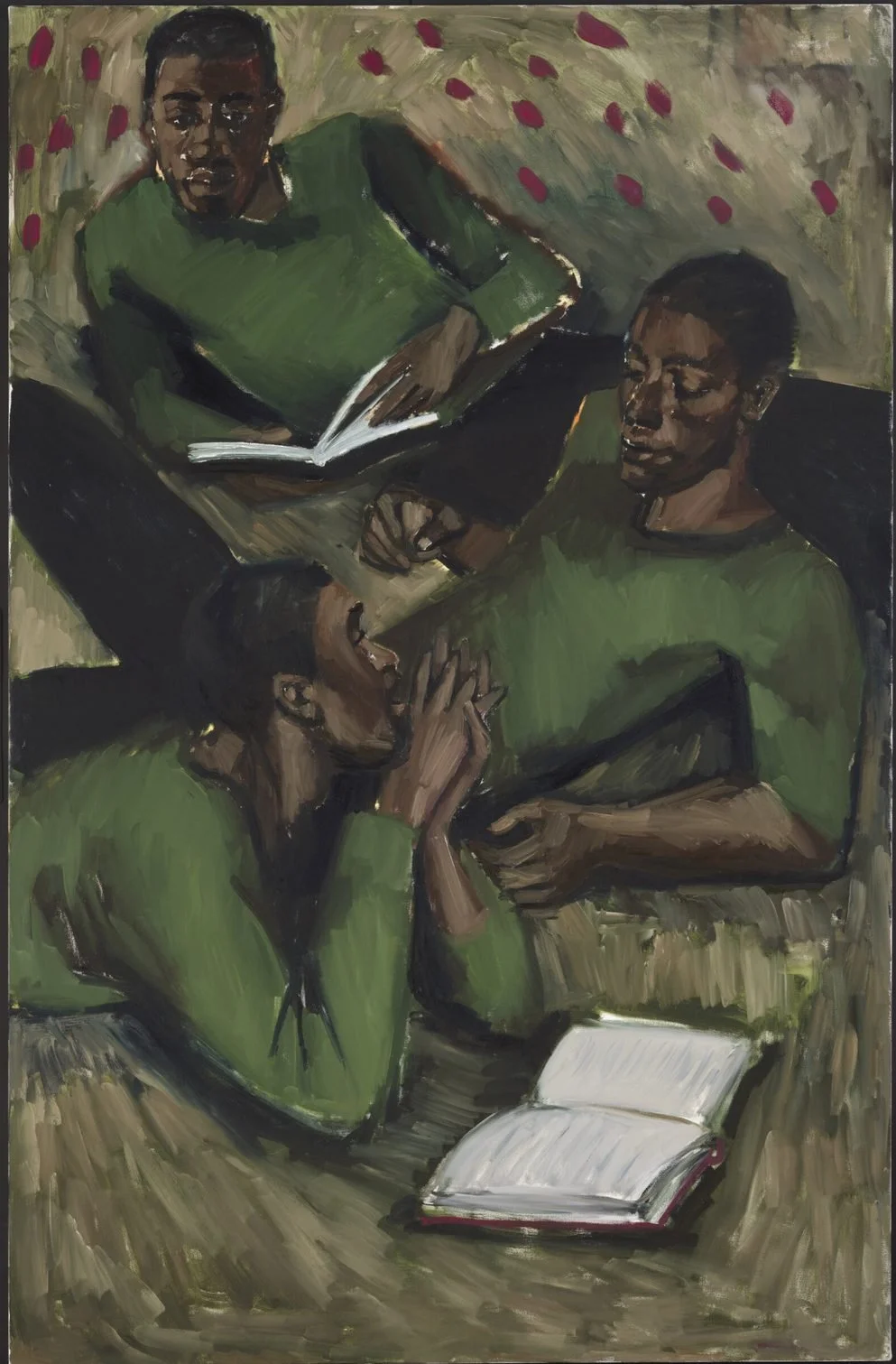
The World Yiadom-Boakye Has Built
Her recurring lexicon includes:
Solitary figures
Pairs and small groups
Seated bodies
Dancers
Readers
Singers
Swimmers
Watchers
Athletes
Plain clothing
Dark backgrounds
Pale open fields
Returned gazes
Loose brushwork
Selective light
Sparse interiors
Ambiguous landscapes
Poetic titles
These motifs create a recognizable world without becoming a fixed narrative system.
A seated figure may be resting, waiting, thinking, or refusing performance.
A dancer may embody joy, discipline, intimacy, or self-absorption.
A dark ground may protect, isolate, dramatize, or suspend.
A white garment may create light, vulnerability, ritual, or visual rhythm.
The lexicon remains alive because the figures retain individual differences even within a coherent pictorial world.
The Risk of Poetic Withholding
Yiadom-Boakye’s method carries real risks.
Timeless clothing, dark palettes, ambiguous settings, fictional sitters, restrained expressions, and poetic titles can become a recognizable formula.
Withholding can become habitual.
Mystery can become elegance.
Psychological privacy can become emotional distance.
The absence of narrative can become a lack of pressure.
A critical review of the Tate survey praised the paintings’ beauty and painterly fluency while questioning whether their continuous atmosphere and inscrutability sometimes became too uniform or comfortable. (The Guardian)
That is a serious criticism worth retaining.
The important question is:
Does each figure produce a distinct encounter, or does the established atmosphere of fictional mystery do too much of the work?
The strongest paintings give each figure a particular bodily and psychological condition.
The gaze, posture, scale, color, and relationship feel necessary.
A weaker painting might rely on the general elegance of dark, enigmatic portraiture.
This is the danger inside coherence:
A protected visual world can preserve freedom, but it can also become too insulated from risk.
Why the Work Belongs to the Present
Yiadom-Boakye’s paintings belong to a contemporary conversation about visibility, representation, identity, and who is permitted to occupy cultural history.
But they resist the demand for complete legibility that often accompanies representation.
Contemporary culture frequently asks people to make themselves explainable through:
Profiles
Categories
Biographies
Identity labels
Public statements
Political positions
Personal disclosure
Documentary evidence
Visibility is often treated as meaningful only when accompanied by information.
Yiadom-Boakye offers another possibility:
A person can be visible without becoming fully available.
The figures do not disappear into anonymity.
They remain distinct, embodied, socially alive, and pictorially authoritative.
But their identities are not surrendered.
This makes the work relevant far beyond portraiture.
It asks whether recognition can exist without classification and whether presence can be respected without being converted into knowledge.
What Artists Can Learn
The lesson is not to imitate Yiadom-Boakye’s dark palette, fictional Black subjects, loose brushwork, sparse settings, simple clothing, poetic titles, or enigmatic gazes.
Those are the visible solutions produced by her particular investigation.
The larger lesson is that fiction can create freedom when reality arrives with too many predetermined meanings.
Yiadom-Boakye demonstrates that:
A figure can be psychologically specific without biography.
Visibility does not require complete access.
Withholding can preserve interiority.
Sparse settings can prevent narrative from controlling the subject.
Simple clothing can reduce social classification.
Gesture can suggest a world without explaining it.
Stillness can become a form of autonomy.
Group relationships can create social depth without documentary narrative.
Fiction can correct historical absence without recreating history literally.
Art-historical influence becomes powerful when the social order inside the inherited form changes.
Dark color can regulate access rather than merely establish mood.
A returned gaze can destabilize the viewer’s authority.
Representation becomes stronger when the subject remains more complex than the image.
Yiadom-Boakye does not give viewers identities to decode.
She gives them people who never existed and makes their presence difficult to deny.
The figure appears.
Biography remains absent.
The gaze returns.
The viewer begins inventing a story.
The painting withholds confirmation.
The figure remains free from the story imposed upon it.
The lesson is not to copy the appearance of the work. It is to understand the pressure that made the appearance necessary.
Lynette Yiadom-Boakye uses fictional portraiture to create Black figures whose presence is complete even though their identities remain permanently beyond possession.
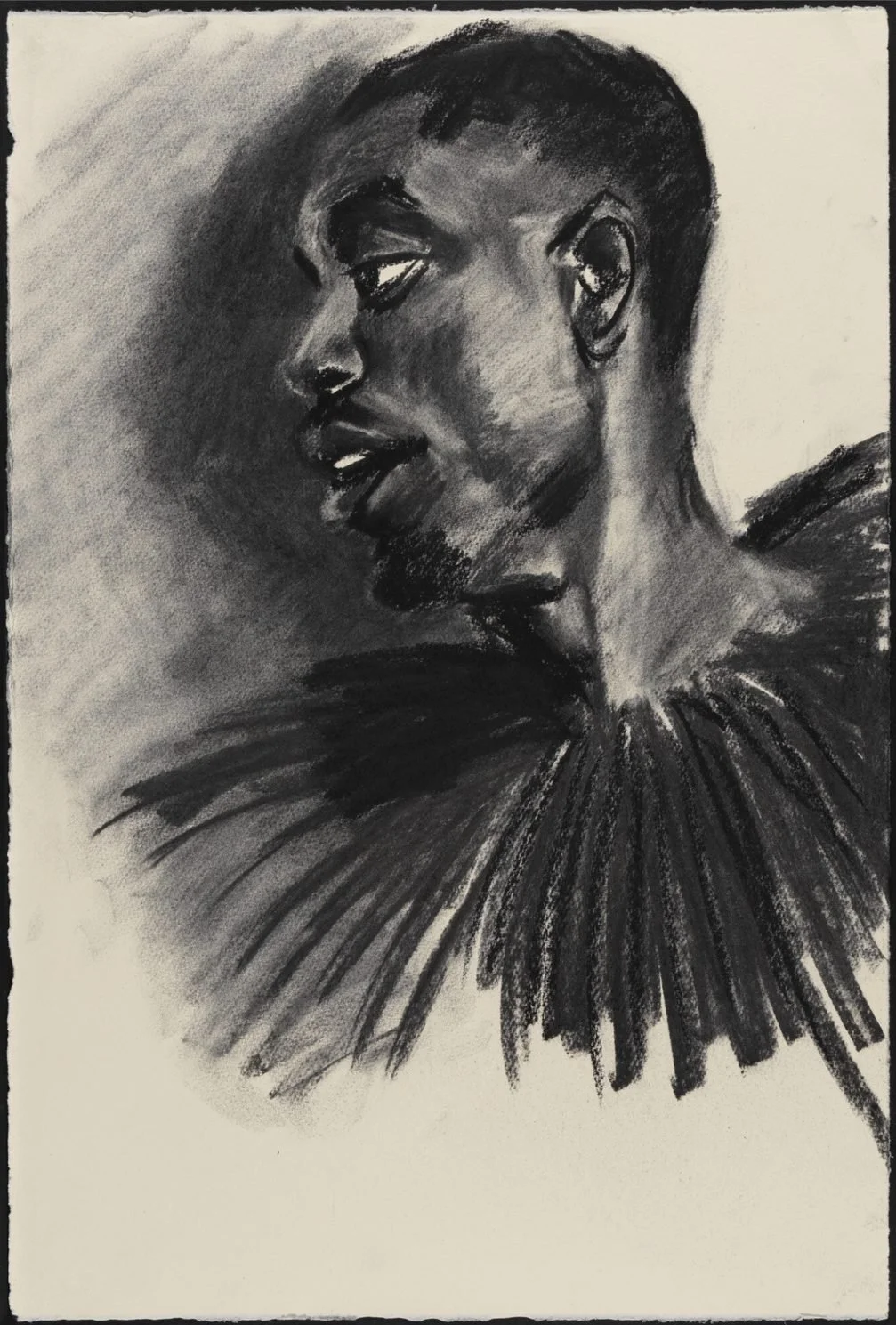
What Makes Anselm Kiefer’s Work So Powerful?
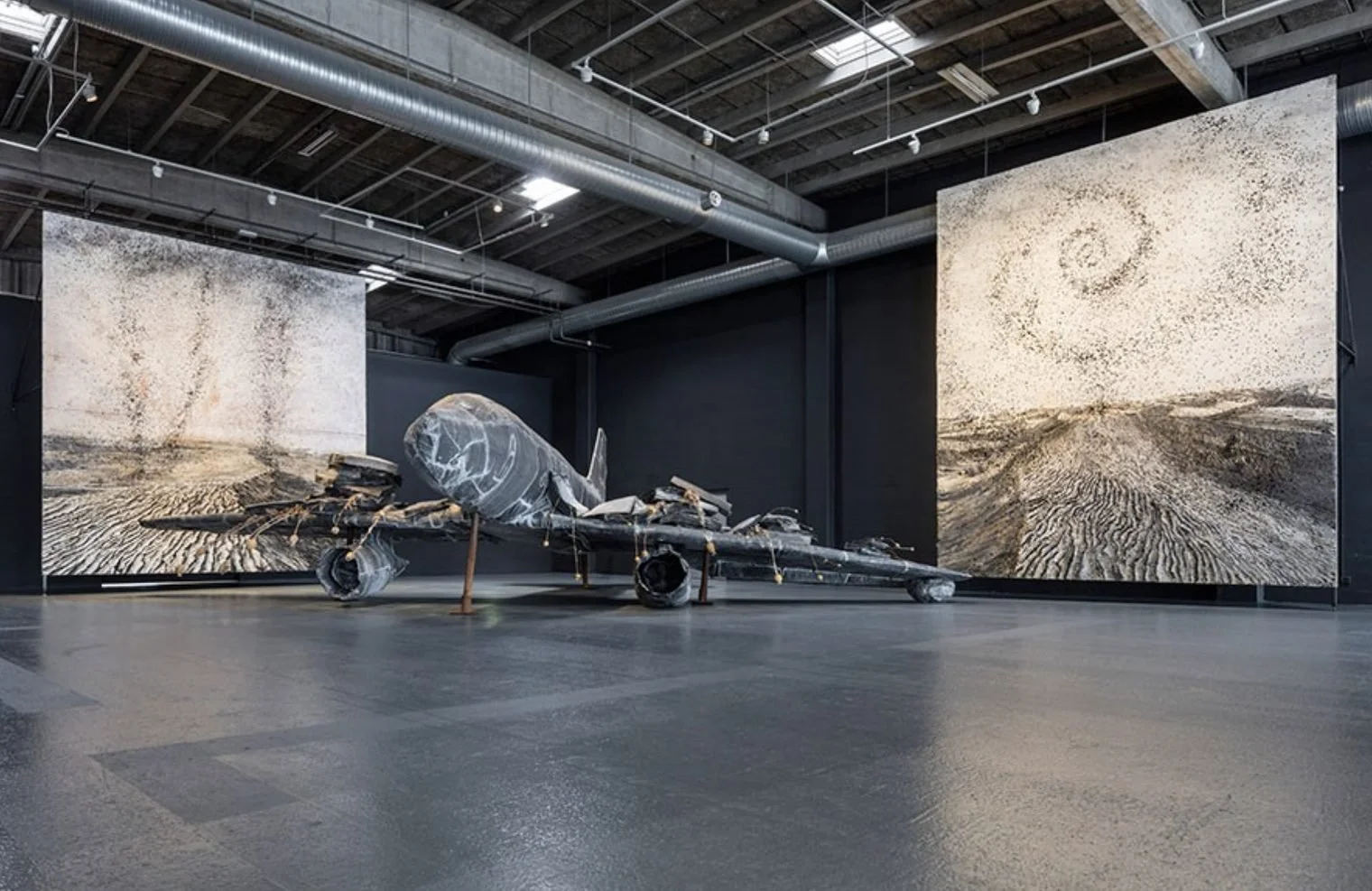
Anselm Kiefer’s work is powerful because he turns painting into a physical confrontation with history: something buried, damaged, mythologized, inherited, and still active beneath the present.
At first, the work can feel overwhelming.
Paintings stretch across entire walls. Their surfaces are loaded with lead, straw, ash, soil, sand, wood, shellac, concrete, fabric, metal, gold leaf, dried plants, and thick deposits of paint. Books appear burned, sealed, corroded, or made impossibly heavy. Sunflowers rise from devastated landscapes. Empty architectural interiors resemble abandoned halls of power. Fields extend toward unreachable horizons. Towers appear ruined before they have finished being built.
The work often looks less like an image than the remains of an event.
Its surfaces may appear:
Burned
Eroded
Buried
Fossilized
Irradiated
Flooded
Scarred
Abandoned
Excavated
Slowly returning to nature
Kiefer does not represent history as a sequence of completed events safely contained in the past.
He treats history as matter.
It accumulates.
It decays.
It contaminates the present.
It is covered and uncovered.
It changes form without disappearing.
White Cube describes Kiefer’s practice as navigating the immensity of history and humanity, especially the political inheritances of postwar Germany, while rejecting the idea that history progresses in a clean, linear sequence. Traditions, beliefs, myths, and political narratives remain tangled together in its construction. (White Cube)
The work asks what happens when a culture cannot simply leave its history behind.
The Problem Beneath the Work
Kiefer repeatedly returns to a central artistic problem:
How can art confront catastrophic history without pretending that history can be fully understood, repaired, or escaped?
This problem emerged from a specific historical condition.
Kiefer was born in Germany in 1945, during the final months of World War II. He came of age in a postwar culture marked by physical destruction, moral catastrophe, national shame, and widespread silence about the Nazi period. (Gagosian)
The question facing his generation was not simply how to remember the past.
It was how to live inside a national identity whose inherited myths, symbols, landscape, philosophy, literature, and artistic traditions had been exploited by fascism.
German forests, heroic legends, monumental architecture, Wagnerian mythology, Romantic landscape, military imagery, and national symbolism could no longer be treated as culturally innocent.
Yet abandoning those traditions completely would leave them uncontested.
Kiefer’s work enters this impossible position.
He returns to compromised histories rather than avoiding them.
He asks:
Can a damaged culture examine its own myths without repeating them?
Can art address atrocity without turning suffering into spectacle?
Can beauty remain possible after historical catastrophe?
Can destruction become transformation without becoming redemption?
Can memory resist erasure without claiming to restore what has been lost?
Can inherited symbols be used after they have been politically contaminated?
Can a nation confront its past without converting guilt into another form of self-mythology?
The paintings do not solve these questions.
They build a world in which the questions remain materially present.
History Is Not Behind Us
A conventional understanding of history places the past behind the present.
An event happens.
Time moves forward.
The event becomes memory, documentation, education, or commemoration.
Kiefer’s work resists that clean sequence.
In his paintings, the past remains embedded in:
Land
Architecture
Language
Materials
Myths
Books
National symbols
Cultural memory
Repeated forms
Damaged objects
History behaves more like geology than chronology.
One layer covers another but does not eliminate it.
A later civilization occupies the remains of an earlier one.
A new ideology reuses an old myth.
A building survives the political system that created it.
A landscape conceals what occurred there.
A book preserves an idea while also becoming vulnerable to burning, censorship, or decay.
The present is therefore not separate from history.
It stands on top of it.
Kiefer’s surfaces make that condition physical. Paint, earth, metal, and plant matter accumulate until the canvas resembles a historical site rather than a transparent image.
Painting as Ruin
Many paintings attempt to create the illusion of a complete world.
Kiefer’s paintings often appear already ruined.
Their surfaces crack, collapse, flake, corrode, and extend beyond conventional pictorial space. Objects may be attached directly to the canvas. Material hangs outward, casting shadows and threatening to fall.
The painting appears to have undergone time.
It may resemble:
An archaeological wall
A battlefield
A scorched field
An abandoned monument
A damaged manuscript
A religious relic
An industrial ruin
A geological cross-section
This changes the status of the artwork.
It is not merely an image of destruction.
It has been constructed to behave like something that has survived destruction.
The distinction is essential.
A painted image of a ruined landscape might depict damage.
Kiefer’s damaged material allows the object itself to carry weight, fracture, instability, and decay.
The surface does not describe history from a distance.
It appears subjected to history.
Material as Historical Language
Kiefer’s materials are never neutral.
They arrive with physical properties and cultural associations already inside them.
Lead
Lead is heavy, toxic, protective, malleable, and associated with alchemy, industry, warfare, radiation shielding, and transformation.
It can be folded like fabric but retains enormous weight.
In Kiefer’s books, aircraft, sculptures, and installations, lead often produces a contradiction between knowledge and silence.
A book promises access to meaning.
A lead book cannot easily be opened or read.
Knowledge becomes physically present but inaccessible.
The object resembles an archive whose contents have survived while becoming unusable.
Lead can therefore suggest:
Burden
Historical weight
Protection
Contamination
Permanence
Transformation
Failed knowledge
Cultural memory sealed shut
Straw
Straw is light, dry, agricultural, temporary, and highly combustible.
It can evoke:
Fields
Harvest
Rural labor
Human fragility
Fire
Decay
Bedding
Gold
Hair
Seasonal cycles
When straw enters a monumental painting, it introduces the possibility that the artwork may continue to age and deteriorate.
Its golden color can appear luminous, but its physical vulnerability remains visible.
Beauty and destruction occupy the same material.
Ash
Ash is what remains after fire.
It is evidence of transformation, but also of irreversible loss.
Ash can suggest:
Burning
Death
War
Cremation
Destroyed books
Ruined cities
Purification
Resurrection
Matter returning to dust
It cannot reveal exactly what existed before the fire.
Ash preserves the fact of destruction while erasing the original form.
That makes it an ideal material for work concerned with memory.
Earth and sand
Earth carries place, burial, agriculture, territory, and physical history.
It is the ground on which events occur and the material that eventually covers their remains.
When earth enters painting, landscape stops being merely represented.
The landscape becomes physically present.
Gold
Gold can signify:
Divinity
Sacred light
Wealth
Power
transcendence
immortality
alchemical transformation
imperial splendor
But in Kiefer’s work, gold often appears beside ash, corrosion, dead plants, damaged figures, and devastated land.
It does not escape ruin.
The sacred and the destroyed remain together.
Recent works have continued this material tension, incorporating oil, acrylic, shellac, collaged canvas, gold leaf, and industrial sediment into thick surfaces concerned with nature, myth, growth, and transformation. (Gagosian)
Destruction and Creation Occur Together
Kiefer’s work repeatedly blurs the distinction between making and destroying.
He builds surfaces and then subjects them to processes that may include:
Burning
Weathering
Breaking
Burying
Oxidation
Exposure to rain
Scraping
Covering
Reopening
Leaving works outdoors
The finished object may continue changing after the artist has stopped working on it.
This introduces time into the material.
The artwork does not simply symbolize transformation.
It undergoes transformation.
That process creates one of the central contradictions of the practice:
Destruction can erase history, but destruction can also reveal what a stable surface was concealing.
A cracked surface exposes lower layers.
Burning changes one material into another.
Decay makes time visible.
A ruined object loses its original function but may acquire the force of evidence.
Kiefer does not romanticize destruction as automatically healing. The work rarely offers clean renewal.
Instead, creation and destruction remain inseparable.
Every new form contains the possibility of collapse.
Every ruin contains the possibility of another beginning.
Landscape After Catastrophe
Landscape is one of Kiefer’s central forms.
His fields often extend toward high horizons beneath enormous skies. Furrows lead the eye into depth. Roads, railway-like lines, or scorched rows organize the terrain. The land may contain straw, ash, flowers, burned books, names, numbers, towers, or fragments of machinery.
These are not peaceful landscapes.
Even when no human figure is present, the earth appears historically occupied.
The viewer may sense:
Agriculture
Battlefields
mass graves
national territory
burned villages
industrial contamination
mythological terrain
spiritual pilgrimage
The absence of figures does not empty the landscape.
It increases the force of what may have happened there.
The land becomes witness.
This is important because landscapes are often used to naturalize national identity. A country may imagine itself through forests, rivers, mountains, fields, and rural traditions.
Kiefer makes national landscape unstable.
The ground carries beauty and guilt.
It can nourish life while concealing death.
It can become homeland and crime scene simultaneously.
The German Forest and Contaminated Myth
The forest has a deep place in German cultural history.
It has been associated with:
Folklore
Romanticism
National origins
Myth
Spiritual encounter
Isolation
Heroic identity
Cultural purity
Those associations were later appropriated by nationalist and fascist ideology.
Kiefer’s use of forests and Germanic myth therefore cannot function as innocent nostalgia.
When trees, branches, names, and legends appear, they carry the pressure of cultural misuse.
The question is not merely whether a symbol is beautiful.
It is what that beauty has been asked to serve.
Kiefer returns to contaminated imagery because abandoning it might allow its ideological use to remain unexamined.
The work enters the symbol and makes its damage visible.
Architecture and the Theatre of Power
Kiefer’s early paintings frequently depict vast wooden halls, monumental interiors, or architectural spaces associated with state power, ritual, memory, and fascist spectacle.
These spaces may appear empty.
That emptiness is crucial.
The architecture remains after the bodies, speeches, ceremonies, and political system have disappeared.
An empty hall can suggest:
Authority without an occupant
Power surviving its leaders
A stage after propaganda
Cultural memory stripped of witnesses
The persistence of institutional form
A tomb
A ruined temple
Monumental architecture attempts to make political power feel permanent.
Kiefer paints that ambition after its failure.
The building survives as a haunted image.
Books That Cannot Speak
Books recur throughout Kiefer’s practice as paintings, sculptures, lead objects, and installation elements.
A book conventionally represents:
Knowledge
Cultural transmission
Law
Religion
History
Poetry
Memory
Authority
Civilization
But Kiefer’s books are often unreadable.
They may be:
Burned
Sealed
Made of lead
Filled with ash
Damaged
Oversized
Fossil-like
Abandoned
Placed inside vitrines
This creates another central contradiction:
The book survives as an object while failing as a carrier of accessible language.
The work asks what happens when knowledge exists but cannot be recovered, believed, or communicated.
In Cette obscure clarté qui tombe des étoiles, cracked paintings and a toppled bookcase filled with decaying manuscripts evoke historical trauma, cultural destruction, and the burning or erasure of literature.
A damaged book can become a memorial to knowledge.
But it can also reveal the fragility of civilization’s claim to preserve truth.
Language, Poetry, and the Limits of Images
Kiefer frequently writes names, quotations, titles, and poetic fragments directly onto paintings.
His sources include poets, philosophers, religious texts, mythology, mysticism, alchemy, astronomy, and history.
Language in the work can function as:
Title
Invocation
Citation
Memorial
Spell
Historical clue
Contradiction
Another material layer
The words do not necessarily explain the image.
They may make it more difficult.
A name can summon an absent person.
A quotation can connect the landscape to a distant myth.
A handwritten phrase can create intimacy inside monumental scale.
Poetry is useful to Kiefer because it allows meaning to remain compressed, suggestive, and unresolved.
Historical explanation seeks clarity.
Poetry can hold contradiction.
Kiefer’s engagement with poets and mythological figures continues in recent work, where literary sources connect landscape to memory, allegory, growth, and mortality. (Gagosian)
Myth as a Dangerous Resource
Kiefer draws heavily from mythology.
This includes:
Germanic legend
Greek and Roman mythology
Jewish mysticism
Christian imagery
Mesopotamian stories
Alchemy
Cosmology
Ancient symbols of death and rebirth
Myth allows the work to move across historical periods.
A contemporary disaster can echo an ancient story.
A field can become a site of national history and cosmic transformation.
A material process can become alchemical.
But myth is not politically innocent.
Myths can create belonging.
They can also justify nationalism, exclusion, hierarchy, conquest, and fantasies of cultural destiny.
Kiefer uses myth from inside this danger.
The work asks whether myths can be transformed after they have been politically abused.
His answer is never secure.
The symbols remain wounded.
Alchemy and Material Transformation
Alchemy is one of Kiefer’s most persistent intellectual structures.
Historically, alchemy sought the transformation of matter: base metal into gold, decay into purification, physical substance into spiritual knowledge.
For Kiefer, alchemy offers a way to think about artistic process.
Lead becomes sculpture.
Ash becomes pigment.
Straw resembles gold.
Decay produces new surfaces.
A ruined object becomes a carrier of meaning.
But Kiefer’s alchemy does not promise easy transcendence.
Matter does not simply rise from impurity into perfection.
Gold remains attached to destruction.
Rebirth remains dependent on death.
The transformed material remembers what it was.
The Met describes one early work involving a lifeless branch emerging from a wounded body as connected to Kiefer’s long interest in historical images of death, rebirth, and alchemical transformation. (The Metropolitan Museum of Art)
The work therefore holds transformation and trauma together.
Sunflowers: Life Facing Death
Sunflowers recur throughout Kiefer’s work.
They can signify:
Solar energy
Growth
Fertility
Seeds
Cyclical time
Van Gogh
Human bodies
Cosmic order
Death after flowering
A sunflower turns toward light while alive.
After maturity, its head bends downward.
The flower contains its future through seeds, but its visible form is already entering decay.
This makes it a powerful image for Kiefer.
Life and death are not separate moments.
One is already present inside the other.
The flower grows, blackens, collapses, and produces the possibility of further growth.
Kiefer’s sunflowers often appear dried, enormous, charred, or humanlike. They can rise above figures or connect bodies to cosmic systems.
The Met notes that he has juxtaposed fossilized sunflower forms with the human body, strengthening the connection among organic cycles, mortality, and transformation. (The Metropolitan Museum of Art)
Why the Formal Choices Matter
Kiefer’s work is visually spectacular, but the major formal choices are tied closely to the deeper problem.
Monumental scale makes history bodily
History can become abstract when presented through dates, summaries, or statistics.
Kiefer’s scale returns history to the body.
The viewer stands before something too large to comprehend from one position.
A painting may resemble:
A wall
A landscape
An institution
A monument
A ruin
A field extending beyond vision
The viewer becomes physically small.
This creates a relationship between individual experience and forces larger than the individual:
National history
War
religion
mythology
time
death
cultural inheritance
Scale does not merely make the work impressive.
It makes limited understanding physical.
Heavy material gives history weight
Lead, earth, concrete, wood, ash, and thick paint make the object visibly heavy.
History ceases to be an abstract idea.
It becomes burden.
Fragile material prevents monumentality from becoming stable
Straw, dried plants, cracked paint, ash, and corroding metal introduce vulnerability.
The monumental object may be physically unstable.
This prevents scale from becoming a simple celebration of power.
High horizons reduce escape
Many landscapes use strong perspective lines leading toward a distant horizon.
The viewer may feel pulled into the field.
But the destination remains unreachable.
The landscape becomes a journey without arrival.
Earth colors create historical atmosphere
Browns, blacks, grays, ochres, whites, rusts, and metallic tones connect the paintings to soil, ruin, ash, architecture, and damaged photographs.
When bright color or gold appears, it becomes charged because it emerges from devastation.
Attached objects break pictorial distance
Branches, dresses, books, tools, plants, and pieces of metal may project from the canvas.
The image enters the viewer’s physical space.
The painting can no longer remain a window.
It becomes an object with consequences.
Handwritten text makes monumentality personal
A small handwritten name or phrase can sit inside an enormous field.
The contrast creates intimacy inside historical scale.
The human gesture survives within the ruin.
The Central Contradictions
Kiefer’s work holds opposing forces together:
Monumental and fragile
Beautiful and devastated
Historical and mythological
Material and spiritual
Ruined and generative
Heavy and transcendent
Nationally specific and cosmological
Scholarly and bodily
Memorializing and uncertain
Constructed and decaying
Sacred and contaminated
Dead and capable of rebirth
The deepest contradiction may be:
The work searches for transformation while refusing to pretend that transformation erases destruction.
This prevents the art from becoming optimistic restoration.
The wound remains visible.
The new form carries the old damage.
The Viewer’s Position
Kiefer gives the viewer several roles.
The viewer becomes physically small
Monumental scale makes the individual confront forces that cannot be mastered from one position.
The viewer becomes an archaeologist
Layers, inscriptions, objects, materials, and references invite excavation.
The viewer looks for evidence inside the surface.
The viewer becomes a witness after the event
The paintings frequently resemble aftermath.
The viewer arrives too late to see what happened but must confront what remains.
The viewer becomes a reader
Titles, names, quotations, myths, and literary references require interpretation.
But reading does not produce final certainty.
The viewer becomes morally uncertain
Beauty, devastation, sacred imagery, and historical trauma coexist.
The viewer may feel awe before work concerned with catastrophe.
That aesthetic pleasure becomes ethically complicated.
The viewer becomes conscious of limited knowledge
No viewer can decode every mythological, historical, religious, poetic, and material reference.
The work makes incomplete understanding unavoidable.
The World Kiefer Has Built
Kiefer’s recurring lexicon includes:
Scorched fields
High horizons
Forests
Towers
monumental halls
lead books
sunflowers
ash
straw
gold
earth
aircraft
ships
ladders
dresses
snakes
palettes
written names
stars
ruins
vitrines
broken architecture
mythological figures
These motifs create a recognizable world, but they do not remain fixed.
A book may represent knowledge, silence, destruction, or burden.
A sunflower may represent growth, mortality, cosmic order, or artistic inheritance.
A tower may suggest ambition, civilization, imprisonment, collapse, or spiritual striving.
Gold may signify transcendence or the danger of false grandeur.
A landscape may be homeland, battlefield, grave, mythic terrain, or psychological condition.
The lexicon remains alive because the symbols continue to change under historical and material pressure.
La Ribaute: The Artistic World Becomes a Place
Kiefer’s former studio estate at La Ribaute in Barjac, southern France, expands his visual world into architecture and landscape.
The site contains studios, tunnels, towers, underground chambers, installations, sculptures, storage spaces, and works integrated with the surrounding environment. It has been maintained by the Eschaton–Anselm Kiefer Foundation and opened for guided public access. (White Cube)
La Ribaute makes clear that Kiefer is not only producing individual paintings.
He is building a total environment.
The site behaves like:
An archaeological ruin
A future civilization
A memory palace
A destroyed city
A private mythology
An evolving archive
A landscape artwork
A laboratory of decay
Works remain exposed to time and weather.
Architecture becomes sculpture.
Movement through space becomes part of interpretation.
The viewer does not simply look at the world Kiefer has created.
The viewer enters it.
The Risk of Monumental Seriousness
Kiefer’s work carries substantial risks.
Its scale, materials, historical subjects, mythological references, and ruined appearance can create immediate grandeur.
That grandeur may become seductive.
The work could risk becoming:
Operatic
Overwhelming
Self-mythologizing
Theatrically profound
Monumental for its own sake
Visually predictable
Burdened by excessive symbolism
Too willing to convert catastrophe into beauty
A scorched landscape is not automatically historically serious.
Lead is not automatically meaningful.
Ash is not automatically memory.
A mythological reference is not automatically deep.
Large scale is not automatically necessary.
The critical question is:
Does each material and symbol make a specific historical, philosophical, or spiritual pressure physically active, or does the work merely reproduce the established Kiefer atmosphere of ruin and transcendence?
The strongest works make material, source, title, scale, and historical problem inseparable.
The weaker possibility would be generalized apocalypse.
Can Catastrophe Become Too Beautiful?
This is one of the most difficult questions raised by Kiefer’s work.
The paintings can be extraordinarily beautiful.
Gold shines across damaged surfaces.
Straw catches light.
Ruined fields become visually magnificent.
Cracked materials create rich textures.
Monumental scale produces awe.
But the work often addresses war, genocide, nationalism, cultural destruction, and historical trauma.
The viewer therefore encounters a troubling contradiction:
Can beauty deepen historical attention, or can it make catastrophe aesthetically consumable?
Kiefer does not eliminate this danger.
He works inside it.
The materials attract viewers and then confront them with weight, decay, toxicity, unreadable language, and unresolved history.
Beauty becomes serious only when it fails to provide relief.
The gold does not repair the ruin.
It illuminates it.
Why the Work Belongs to the Present
Kiefer’s work remains urgent because contemporary societies continue to struggle with:
Historical denial
National mythology
Political extremism
War
Cultural memory
Disinformation
Destruction of archives
Environmental devastation
Contested monuments
Religious conflict
The return of authoritarian symbols
The difficulty of collective accountability
The question of how nations narrate their past has not been resolved.
History is continually revised, weaponized, erased, simplified, commemorated, and denied.
Kiefer’s work refuses historical cleanliness.
It shows that culture is built from overlapping inheritances, some beautiful and some catastrophic, often inseparable from one another.
The work also speaks to ecological instability.
Fields, plants, earth, fire, water, metal, and decay connect political history to natural cycles. Human civilizations appear temporary beside geological and cosmic time.
The ruined monument eventually becomes matter.
The book decays.
The tower collapses.
The field grows again, but not as though nothing happened.
What Artists Can Learn
The lesson is not to imitate Kiefer’s scorched landscapes, monumental scale, lead books, straw, ash, sunflowers, ruined towers, handwritten quotations, or mythological imagery.
Those are the visible solutions produced by his particular investigation.
The larger lesson is that material can become a form of historical thinking.
Kiefer demonstrates that:
History can be embedded in the object rather than merely depicted.
Material should carry meaning through its actual behavior.
Weight can make burden physical.
Fragility can destabilize monumentality.
Decay can introduce real time into the work.
Landscape can become witness.
Architecture can reveal the persistence of power.
Myth can be examined without being treated as innocent.
Books can represent the survival and failure of knowledge.
Beauty can confront catastrophe without resolving it.
Scale can make limited understanding bodily.
Repetition can build a symbolic lexicon across decades.
A body of work can expand into an entire physical world.
Transformation becomes meaningful when it does not erase the evidence of damage.
Kiefer does not treat the past as a subject that can be completed.
History enters matter.
Matter decays.
Decay exposes another layer.
The layer becomes memory.
Memory becomes myth.
Myth becomes politically dangerous.
Art returns to the ruin and begins again without declaring it healed.
The lesson is not to copy the appearance of the work. It is to understand the pressure that made the appearance necessary.
Anselm Kiefer turns painting into a material archaeology of history, where destruction, memory, myth, and the possibility of transformation remain inseparable.
What Makes Jadé Fadojutimi’s Paintings So Powerful?
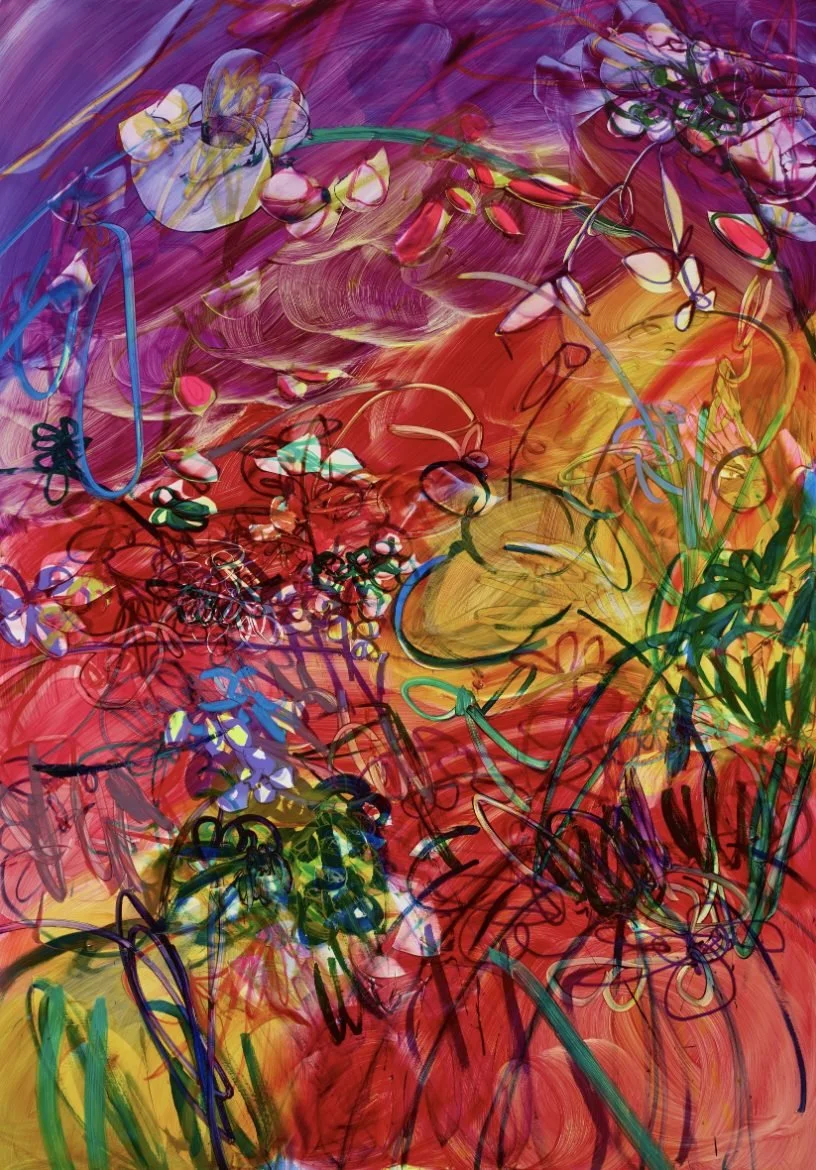
Jadé Fadojutimi’s paintings are powerful because they turn the instability of selfhood into environments of color, movement, memory, and emotional transformation.
At first, the work can appear overwhelmingly energetic.
Lines loop, collide, fracture, and race across the canvas. Bright greens push against violets, yellows, reds, blues, pinks, and dark passages. Thin marks cut through broad fields. Repeated shapes suggest leaves, eyes, clothing, furniture, windows, bodies, pathways, or fragments of landscape without settling into any one identity.
The paintings move between abstraction and figuration, but they do not treat that boundary simply as a perceptual game.
Their instability is psychological.
A space begins to form and then collapses. A figure appears without becoming fully embodied. A mark resembles an object for a moment before returning to color and line. Depth opens and then flattens. Areas of exuberance are interrupted by congestion, darkness, or visual anxiety.
Fadojutimi has referred to her paintings as “emotional landscapes,” using color, space, line, layers, and disparate marks to question everyday experience, memory, and self-knowledge. (British Art at Yale)
The paintings do not describe a stable self moving through a stable world.
They show identity being continually produced through contact with surroundings.
The Problem Beneath the Work
Fadojutimi repeatedly returns to a central artistic problem:
How can painting give form to a self that is continually changing in response to memory, emotion, environment, culture, and everyday experience?
Her paintings are not simply expressions of mood.
Nor are they abstractions whose primary purpose is color, gesture, or formal freedom.
They investigate the relationship between the self and the world that shapes it.
Identity, in this work, does not appear as a fixed inner core waiting to be revealed. It is constructed through encounters:
A room
A piece of clothing
A landscape
A remembered conversation
Music
Anime
Video games
Fashion
Architecture
Weather
Anxiety
Pleasure
Cultural belonging
Private fantasy
Fadojutimi has identified Japanese animation, soundtracks, video games, fashion, objects, and surrounding environments among the sources through which she examines identity and attempts to build a sense of self. (Studio Museum in Harlem)
These sources do not usually appear as illustrations.
They enter the paintings as rhythms, colors, spatial structures, emotional associations, and fragments of visual memory.
The deeper problem is therefore not:
Who am I?
It is closer to:
How is a self temporarily assembled from everything it encounters—and what happens when those relationships change?
Identity as a Moving Relationship
Many artworks concerned with identity seek to make identity visible.
They may present recognizable bodies, cultural symbols, biographies, social categories, or personal narratives.
Fadojutimi works differently.
Her paintings rarely provide a stable figure that can carry identity clearly. Instead, identity is experienced through the organization and disruption of the entire field.
A dark passage may create withdrawal.
A luminous color may create openness.
A cluster of marks may suggest social pressure or mental congestion.
A loose, sweeping line may create physical confidence.
A fragile grid may suggest an attempt to organize unstable experience.
The self does not stand outside these conditions.
It emerges through them.
This gives the work a more relational understanding of identity:
The self is not only what exists internally. It is what forms between a person and the environments, objects, memories, desires, and systems surrounding them.
When those surroundings change, the work changes.
Fadojutimi has described this connection directly: when she changes, the paintings change as well. Her work treats introspection not as the discovery of one permanent identity but as a continuing process. (Studio Museum in Harlem)
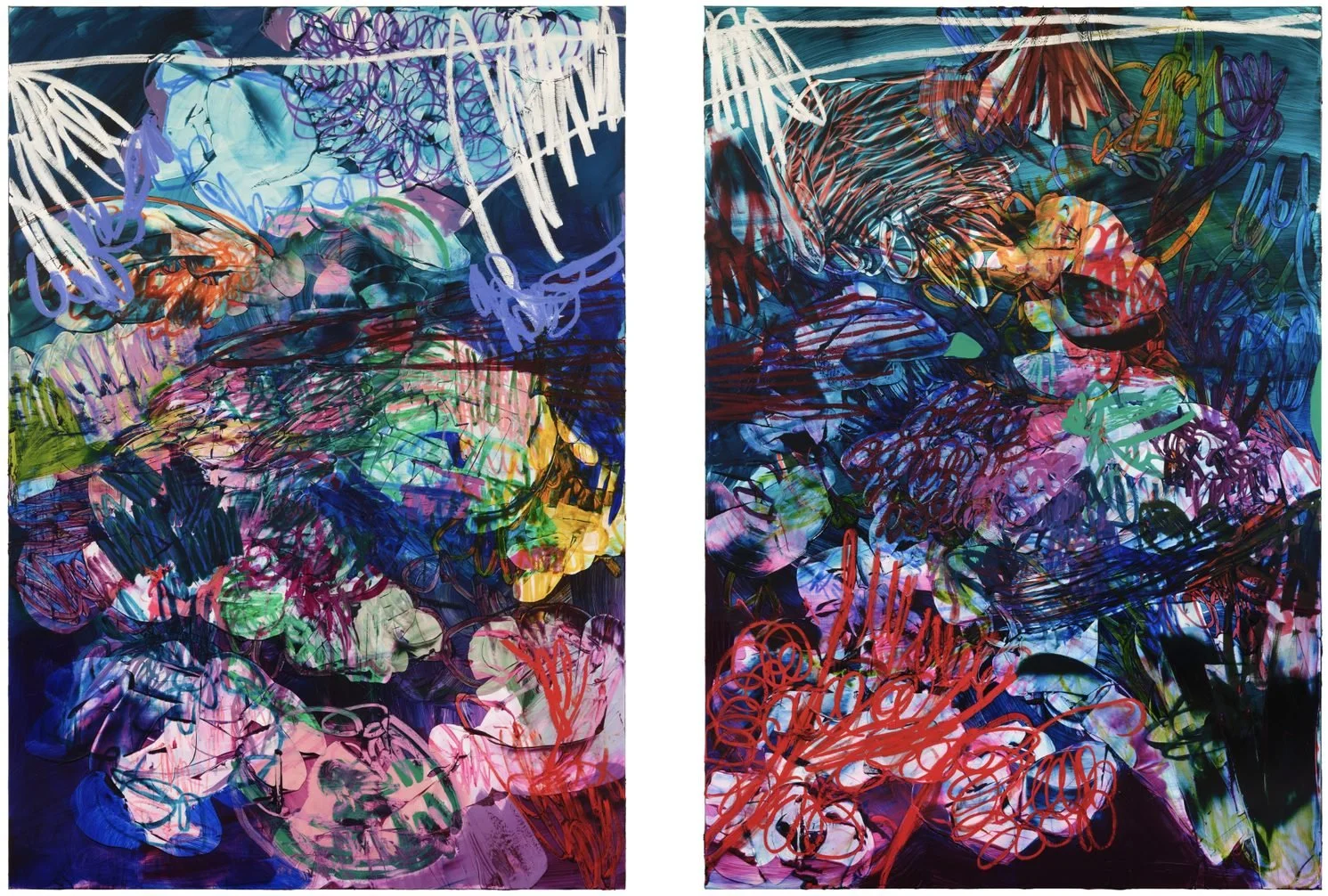
The Painting as Environment
Fadojutimi’s large canvases frequently feel less like images placed on a wall than spaces the viewer encounters bodily.
Some resemble gardens, interiors, forests, maps, theatrical sets, weather systems, or imaginary landscapes. Yet these possible environments remain unstable.
A green area may suggest vegetation.
A rigid line may resemble architecture.
A patterned form may imply clothing or upholstery.
A circular mark may feel like an eye, opening, flower, or signal.
The paintings provide enough visual suggestion for a world to begin forming, but not enough information for that world to become fully named.
This places the viewer inside a condition rather than in front of a narrative.
The question is not merely:
What does this represent?
It becomes:
What kind of emotional and perceptual world is this, and how does it change while it is being observed?
Her monumental scale strengthens this effect. The paintings surround the field of vision and require the viewer to move among different zones of density, openness, color, and rhythm. Institutions describing her work emphasize continual transformation, layered space, and the interaction between large-scale abstraction and hints of figuration. (Institute of Contemporary Art, Miami)
Color as Emotional Structure
Color is one of the most immediate pleasures in Fadojutimi’s work.
But color does not merely beautify the paintings or announce emotional intensity.
It structures the experience.
A painting may contain brilliant green, acidic yellow, hot pink, violet, orange, deep blue, and black. These colors do not always resolve into conventional harmony. They attract, interrupt, destabilize, and redirect one another.
Color can create:
Acceleration
Hesitation
Joy
Unease
Depth
Flatness
Exposure
Protection
Expansion
Compression
One passage may feel ecstatic.
Another may feel claustrophobic.
A color that initially appears joyful may become abrasive when surrounded by darker marks. A heavy field may open when crossed by a luminous line. Several colors can remain active without combining into a single emotional state.
This matters because feelings are rarely pure.
Excitement may contain anxiety.
Belonging may contain estrangement.
Pleasure may coexist with vulnerability.
Confidence may be interrupted by self-doubt.
Fadojutimi’s color holds these emotional shifts without forcing them into one mood.
The painting does not illustrate an emotion.
It behaves like emotion.
Line as Movement and Thought
Lines move through Fadojutimi’s paintings with unusual independence.
They twist, knot, stretch, repeat, enclose, cut through, and escape from larger forms. Some lines feel drawn rapidly. Others appear hesitant, decorative, architectural, or calligraphic.
A line can function as:
Gesture
Boundary
Path
Branch
Limb
Thread
Cage
Rhythm
Writing
Nervous energy
Because the line repeatedly changes its function, it becomes difficult to separate drawing from subject.
The mark does not simply depict movement.
It moves.
This gives the paintings a sense of thought unfolding in real time. One mark proposes a direction. Another interrupts it. A shape creates temporary order. A later gesture undermines that stability.
The surface resembles a mind attempting to understand itself while continuing to receive new information.
Why the Formal Choices Matter
Fadojutimi’s visual language can look spontaneous, but its force depends on the relationships among several formal systems.
Abstraction keeps identity open
A fully described figure could become too stable.
Viewers might read the body through gender, race, age, clothing, expression, and social category before encountering the more fluid psychological condition of the work.
Abstraction prevents that immediate closure.
The self can appear as atmosphere, rhythm, pressure, movement, or spatial instability rather than as one readable body.
Figuration provides a point of entry
The paintings do not remain entirely detached from recognizable life.
Fragments can suggest:
Plants
furniture
clothing
figures
rooms
windows
pathways
skies
eyes
decorative objects
These hints give the viewer a jumping-off point.
They allow perception to begin constructing a world.
But the forms remain incomplete enough to resist final identification.
This creates the balance between entry and openness:
The viewer receives enough structure to begin, but not enough resolution to stop interpreting.
Layering makes changing experience visible
Marks overlap, cover, reveal, and interrupt one another.
Earlier decisions survive beneath later interventions. Separate visual systems can occupy the same area without blending completely.
The painting therefore contains several emotional and temporal states at once.
An open gesture may remain beneath a later structure.
A bright field may be partially buried.
A fragile mark may survive inside visual congestion.
Layering makes identity appear cumulative but unresolved.
Grids create temporary order
Grid-like structures sometimes appear within the paintings.
A grid can suggest:
Architecture
organization
furniture
social systems
perspective
containment
attempts at mental control
But the grids are often unstable.
They bend, dissolve, become obscured, or collide with freer gestures.
The grid does not establish permanent order.
It reveals the desire for order inside a world that resists it.
Scale makes introspection public
The paintings often emerge from private experience and self-questioning, yet their monumental dimensions transform that introspection into an environment shared with viewers.
A feeling that might have remained inward becomes spatial.
The viewer confronts uncertainty at bodily scale.
This prevents introspection from becoming small, confessional, or diary-like. The private self becomes a public field without being translated into a literal personal story.
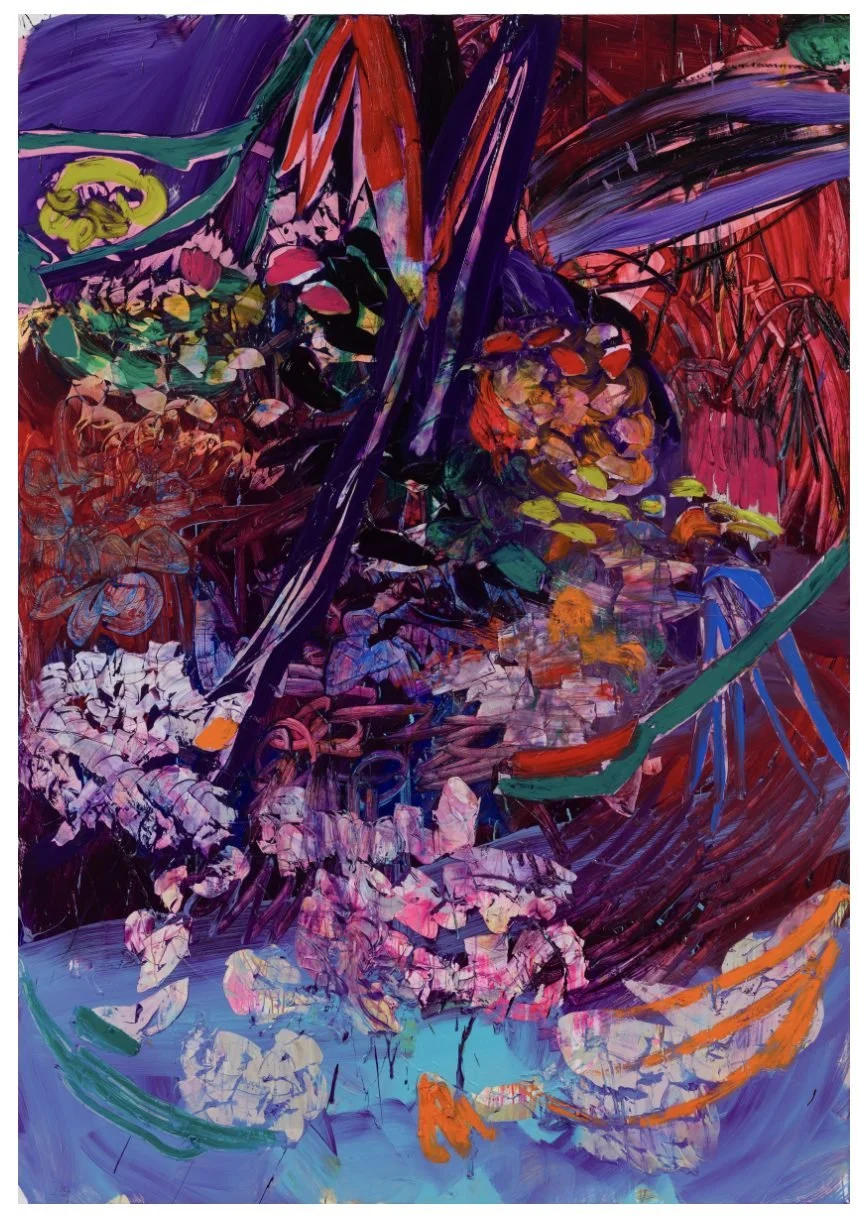
Oil stick preserves drawing inside painting
Fadojutimi uses oil paint alongside oil stick and other materials, allowing lines to remain assertive across painted fields. Works described by galleries and institutions often combine looping drawing, layered oil, and gestural color. (Gagosian)
The oil stick can cut through depth and return attention to the surface.
It allows drawing to interrupt painting.
That interruption prevents the image from becoming too atmospheric or settled.
Memory Without Illustration
Memory enters Fadojutimi’s work indirectly.
A remembered object may not appear as a recognizable object.
A place may survive as a color relationship.
A piece of music may become tempo.
A garment may become pattern.
An animated scene may contribute spatial drama or emotional exaggeration.
A room may return as a grid, enclosure, or visual rhythm.
This is important because memory rarely preserves experience evenly.
Certain colors remain.
A mood survives.
An insignificant object acquires emotional importance.
A place becomes inseparable from what happened there.
Fadojutimi’s 2024 exhibition title, DWELVE: A Goosebump in Memory, combined the ideas of dwelling and delving, linking familiar spaces with deeper discovery. The exhibition included large paintings alongside more intimate works on paper, extending her investigation of memory, environment, and self-questioning. (Gagosian)
Memory becomes not a stored image but a place the artist enters and changes.
The Studio as a Psychological Instrument
The studio is especially important to Fadojutimi’s practice.
It is not merely the room where finished paintings are produced. It functions as an environment through which she examines herself.
Objects, clothing, sounds, books, images, and accumulated materials can become part of the psychological conditions of painting. The Studio Museum describes the studio as integral to her practice and painting as a method of introspection shaped by surrounding materials. (Studio Museum in Harlem)
This offers a broader understanding of artistic environment.
A studio is not neutral.
Its arrangement affects attention.
Its objects activate associations.
Its scale changes bodily movement.
Its sounds alter rhythm.
Its accumulated history changes what feels possible.
Fadojutimi’s work suggests that self-knowledge can emerge through interaction with the physical environment rather than through detached reflection alone.
Japanese Visual Culture as Transformation
Japanese anime, fashion, video games, and landscape have been important to Fadojutimi’s visual development. A period in Kyoto and repeated engagement with Japanese culture contributed to the formation of her painting language. (Taka Ishii Gallery / タカ・イシイギャラリー)
But the work does not simply reproduce anime characters or Japanese design.
The influences are metabolized.
Anime may contribute:
Emotional intensity
Exaggerated atmosphere
Dramatic shifts of scale
Fluid movement
Charged color
fantastical environments
transformations of bodies and spaces
Fashion may contribute:
Pattern
surface
constructed identity
color combinations
self-presentation
the psychological role of clothing
Video games may contribute:
navigable environments
layered worlds
portals
changing perspectives
movement through unstable space
These sources become part of how the paintings think rather than imagery placed on top of them.
The influence is successful because it changes the formal logic of the work.
Clothing and the Construction of Self
Clothing occupies an important position in Fadojutimi’s wider visual world.
Clothing is both external and intimate.
It touches the body but remains visible to others.
It can express:
Desire
belonging
protection
fantasy
social code
transformation
self-invention
performance
A garment can change how a person feels internally as well as how that person is read publicly.
This makes fashion especially relevant to a practice concerned with unstable identity.
The self is not only revealed through appearance.
It can be constructed through appearance.
In the paintings, pattern and color may carry this relationship without depicting clothing literally. Ornament becomes psychological. Surface becomes a way of testing who a person might become.
Titles as Emotional Openings
Fadojutimi’s titles often sound poetic, conversational, anxious, humorous, or introspective.
Examples such as When Teddy Left, A Declaration of War, I Present Your Royal Highness, and A Goosebump in Memory suggest emotional situations without explaining the image. (Gagosian)
The titles create a second field of association.
A painting may appear exuberant until the title introduces loss.
A playful form may acquire defensiveness.
A dense environment may begin to feel like memory rather than landscape.
The title does not decode the painting.
It provides another emotional pressure.
The Central Contradictions
Fadojutimi’s paintings hold several opposing forces together:
Abstract and suggestively figurative
Joyful and anxious
Spontaneous and constructed
Intimate and monumental
Personal and publicly accessible
Decorative and psychologically charged
Open and congested
Fluid and contained
Playful and defensive
Environmental and introspective
Energetic and vulnerable
Self-expressive and uncertain about the self
The deepest contradiction may be:
The paintings search for self-knowledge while showing that the self changes during the search.
Painting does not produce a final answer.
It records the instability of asking.
The Viewer’s Position
Fadojutimi assigns the viewer an active but uncertain role.
The viewer becomes a navigator
The eye moves through paths, barriers, clusters, openings, and layered spaces.
There is rarely one dominant route.
The viewer becomes a projector
Incomplete forms invite associations.
One viewer may see a garden.
Another may see a room, body, map, storm, or animated world.
The viewer becomes emotionally responsive
Color and rhythm generate reactions before the forms are understood.
Feeling arrives before explanation.
The viewer becomes physically involved
Large canvases require movement and changes of distance.
From afar, the work may organize into an environment.
Up close, that environment becomes individual marks and material decisions.
The viewer becomes aware of instability
Each attempt to name the image remains temporary.
The painting changes according to attention, memory, distance, and mood.
The World Fadojutimi Has Built
Her recurring lexicon includes:
Looping lines
grids
foliage-like shapes
fragments of interiors
bright color fields
dark interruptions
pathways
layered marks
textile-like patterns
openings
enclosures
animated movement
oil-stick drawing
shifting depths
poetic titles
monumental canvases
intimate works on paper
These elements create a recognizable visual world, but their functions remain mobile.
A grid may be architecture, protection, order, or confinement.
A green field may become garden, atmosphere, garment, or emotional expansion.
A dark cluster may create shadow, anxiety, shelter, or interruption.
A line may be a route, limb, branch, boundary, or thought.
The lexicon remains alive because nothing is permanently assigned.
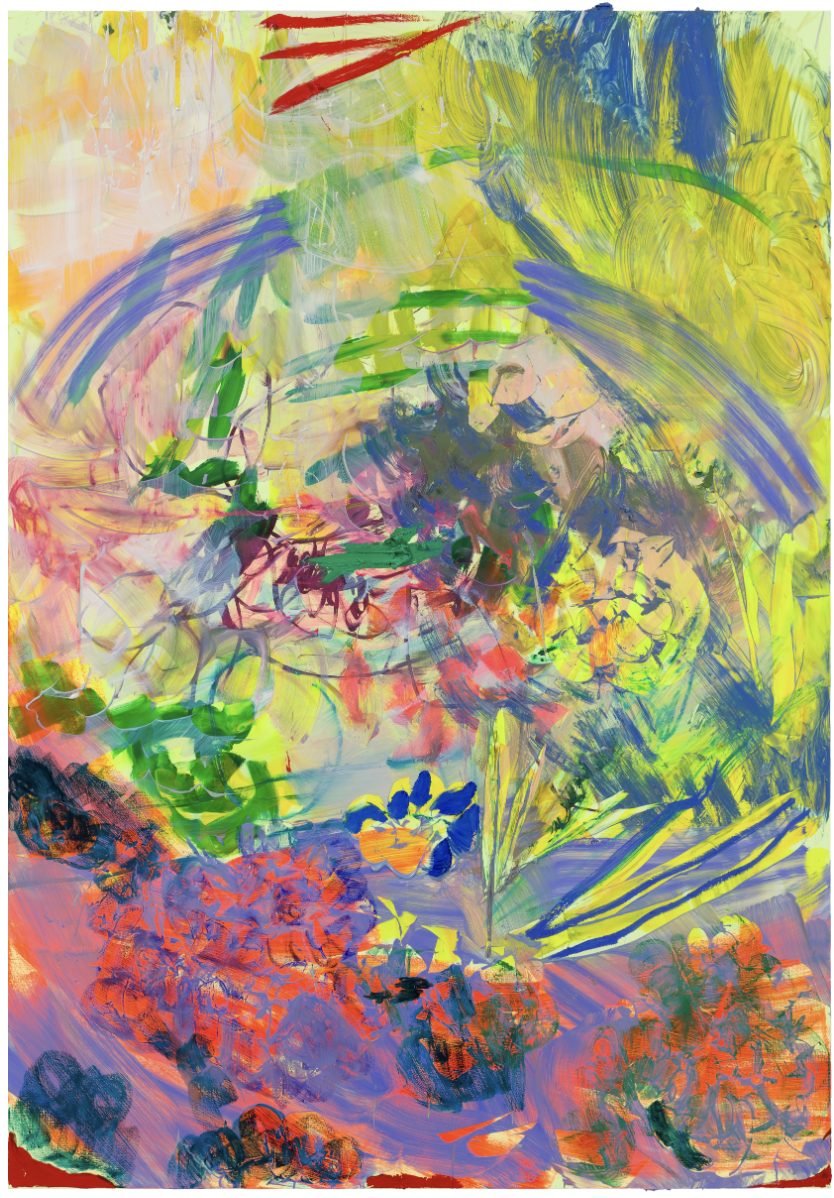
The Risk of Emotional Abstraction
Fadojutimi’s practice carries a real risk.
Large scale, vivid color, energetic gesture, and claims about identity or emotion can produce immediate excitement.
But excitement alone does not guarantee depth.
The paintings could become:
Colorful spectacle
generalized emotional intensity
gestural abundance
fashionable abstraction
repeated visual turbulence
a recognizable mixture of anime influence and painterly expression
The critical question is:
Does each painting make a specific psychological relationship visible, or does it merely reproduce the appearance of emotional complexity?
The strongest works provide enough internal structure to make their instability meaningful.
Forms recur.
Spatial tensions develop.
Color changes emotional roles.
Lines construct and disrupt.
Open areas interact with dense passages.
A weaker version would offer activity without necessity.
This is especially important because “emotion” can become too broad a justification. Nearly any expressive painting can be described as emotional.
Fadojutimi’s work becomes more distinctive when emotion is understood relationally:
A feeling is produced through the changing relationship among self, object, environment, memory, and perception.
How Her Instability Differs from Cecily Brown’s
The visual movement between abstraction and figuration creates an obvious comparison with Cecily Brown.
But their deeper problems differ.
Brown’s paintings repeatedly connect instability with:
Bodies
desire
art history
mortality
erotic recognition
the impossibility of possessing an image
Fadojutimi’s instability is more closely connected to:
Self-knowledge
emotional change
surroundings
memory
cultural influence
the construction of identity
Brown’s image seems to ask:
What do bodies and desire become when nothing remains visually fixed?
Fadojutimi’s paintings ask:
What does the self become when it is continually altered by everything around it?
Brown’s transformations often intensify appetite and mortality.
Fadojutimi’s transformations often intensify introspection and environmental sensitivity.
The formal resemblance makes the difference in artistic problem especially instructive.
Why the Work Belongs to the Present
Fadojutimi’s paintings belong to a contemporary world in which identity is increasingly experienced as fluid, performed, culturally layered, and environmentally responsive.
People construct themselves through:
Clothing
media
music
digital spaces
cultural affiliation
private memory
social expectations
physical environments
online identities
global visual languages
The self may shift from one setting to another.
A person can feel differently in different clothes, rooms, cities, relationships, or communities.
Identity becomes less like a fixed portrait and more like an evolving interface between internal experience and external conditions.
Fadojutimi’s paintings give this instability a physical form.
They do not reduce identity to a category or statement.
They show identity behaving as movement.
What Artists Can Learn
The lesson is not to imitate Fadojutimi’s vivid colors, looping lines, monumental canvases, unstable grids, anime influences, or landscape-like abstractions.
Those are the visible solutions produced by her investigation.
The larger lesson is that selfhood can become a formal system rather than merely a subject.
Fadojutimi demonstrates that:
Color can behave like changing emotional temperature.
Line can record thought and movement.
Abstraction can keep identity from becoming fixed.
Figurative suggestion can provide entry without creating closure.
Environment can become inseparable from psychology.
A studio can function as an instrument of self-investigation.
Cultural influences become powerful when they alter visual structure.
Pattern can carry memory, fashion, protection, and self-construction.
Layering can hold several emotional states at once.
Scale can transform private introspection into shared physical experience.
Titles can open emotional possibilities without explaining the image.
Instability becomes meaningful when the work provides enough structure for the viewer to enter.
Her paintings do not present the self as something already known.
The environment enters the body.
Memory enters color.
Clothing becomes identity.
Feeling becomes space.
A line proposes order.
Another mark changes the terms.
The self begins to appear and is transformed again.
The lesson is not to copy the appearance of the work. It is to understand the pressure that made the appearance necessary.
Jadé Fadojutimi turns abstraction into an evolving emotional environment where identity is not represented as a fixed image but continually assembled through contact with the world.
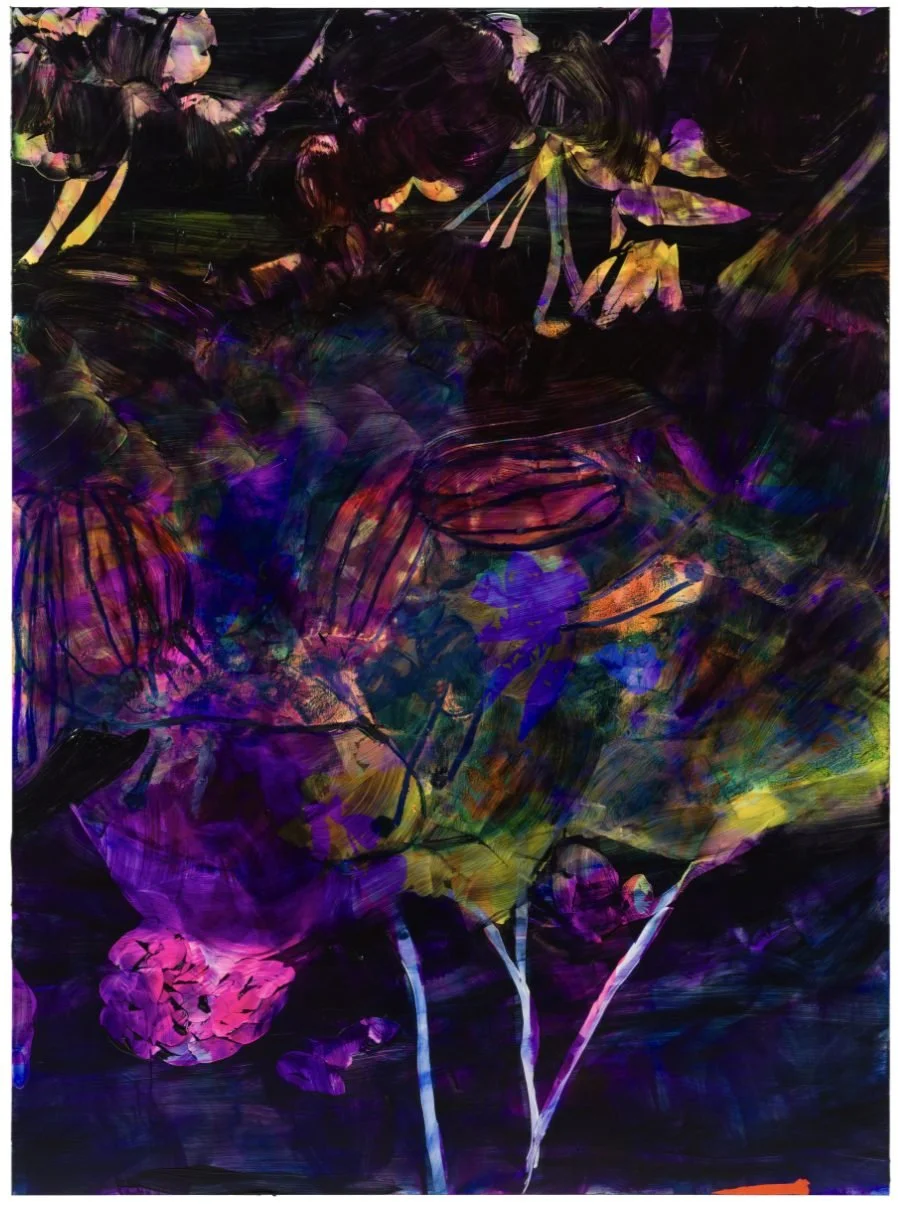
What Makes Luc Tuymans’s Paintings So Powerful?
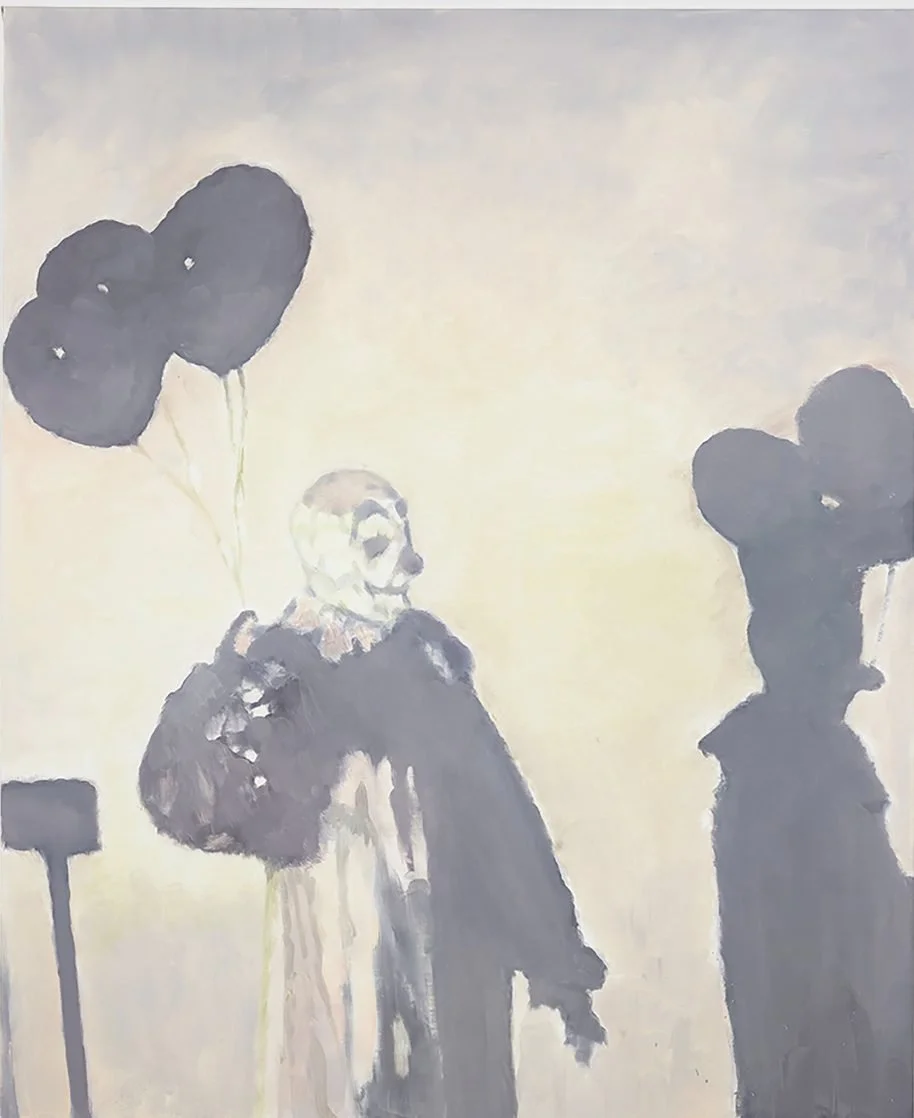
Luc Tuymans’s paintings are powerful because they turn weak, degraded, secondhand images into unsettling encounters with history, memory, violence, and the limits of knowledge.
At first, the paintings can appear almost disappointingly slight.
The colors are pale. The surfaces are thin. Faces look blurred or washed out. Objects appear ordinary. Important historical events may be represented through an empty room, an indistinct face, a fragment of architecture, a cloud of smoke, or a detail whose significance is impossible to recognize without context.
The paintings rarely announce their importance through spectacle.
They often resemble:
Faded photographs
Paused television images
Damaged film stills
Newspaper reproductions
Overexposed snapshots
Medical illustrations
Security-camera footage
Images remembered incorrectly
Pictures copied too many times
Their apparent weakness is deliberate.
Tuymans does not paint history as clear, monumental, or fully recoverable. He paints the compromised images through which history reaches the present.
His gallery describes his work as demonstrating painting’s ability to communicate and withhold at the same time. His canvases are generally based on preexisting imagery and rendered in restrained palettes whose apparent calm conceals moral and historical complexity. (David Zwirner)
The viewer is not given the past itself.
The viewer is given a damaged visual remainder.
The Problem Beneath the Work
Tuymans repeatedly returns to a central artistic problem:
How can painting confront historical violence and political power when the past is available only through incomplete, mediated, and potentially deceptive images?
His paintings are not simply about memory, photography, or history.
They examine the failure of images to deliver secure knowledge.
A photograph appears to document something that happened. But it also crops, selects, freezes, and removes context. Television converts events into consumable sequences. Newspapers compress catastrophe into reproducible images. Archives preserve certain records while excluding others. Propaganda makes constructed appearances feel factual.
By the time an event reaches a viewer, it may already have passed through:
A camera
An editor
An institution
A political narrative
A printing process
A television screen
An archive
Reproduction
Cultural memory
Personal interpretation
Tuymans begins from this compromised condition.
He does not attempt to restore the original event in full.
Instead, he paints the distance between the event and the image that survives it.
The deeper problem becomes:
How can a painting acknowledge that images are inadequate while still asking them to carry historical responsibility?
Weak Images Carrying Heavy History
Tuymans often chooses images that appear visually unremarkable.
A room may look empty.
A face may appear expressionless.
A household object may seem banal.
A landscape may look quiet.
Yet these images can be connected to histories of colonialism, fascism, the Holocaust, political violence, nationalism, or institutional power.
This creates a profound mismatch:
The image looks weak, but the history behind it is overwhelming.
That mismatch is central to the work.
Historical violence does not always survive as a dramatic image. It may remain inside architecture, family photographs, official portraits, bureaucratic documents, ordinary objects, forgotten places, and apparently neutral records.
Tuymans refuses to make the past visually heroic.
He often represents the residue rather than the event.
This can make the paintings initially frustrating. Viewers may expect important subjects to produce powerful imagery. Tuymans reverses that expectation.
The image is inadequate because historical understanding is inadequate.
The faded surface does not minimize the past.
It exposes the difficulty of reaching it.
Painting After Photography
Tuymans belongs to a generation for whom painting could no longer pretend that photography, cinema, television, and mass media had not transformed visual experience.
His relationship to Northern European painting remains important, but so does growing up inside a culture increasingly organized by reproduced images. The Museum of Contemporary Art Chicago described his work as shaped both by the tradition of European painting and by photography, television, and cinema. (Museum of Contemporary Art Chicago)
Tuymans does not usually paint directly from life.
He works from images that already exist:
Photographs
Film stills
Television frames
Newspaper pictures
Digital images
Archival documents
Images he photographs from screens
Reproductions of earlier artworks
This means the subject has already been converted into representation before painting begins.
The painting is not the first image.
It is an image of an image.
That distinction creates distance, but it also makes mediation visible.
Tuymans asks viewers to notice not only what is represented, but how reality has already been filtered before reaching the canvas.
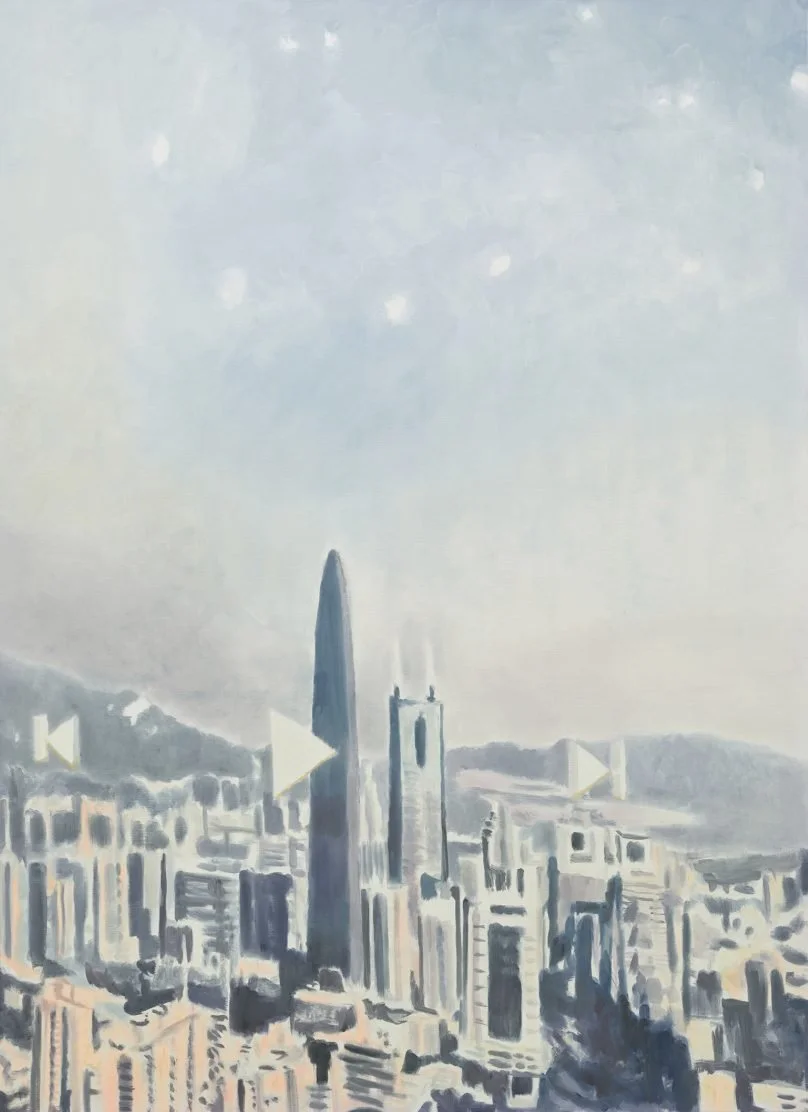
The Failure of Clear Vision
Traditional representational painting can suggest that looking produces knowledge.
A carefully painted face appears to reveal character.
A historical painting appears to explain an event.
A landscape appears to present a place.
Tuymans undermines that confidence.
His images are often cropped, enlarged, blurred, flattened, faded, or stripped of explanatory context. The viewer can see something, but seeing does not produce understanding.
A face may be recognizable without becoming psychologically legible.
An object may be visible without revealing its historical role.
A room may be clearly depicted while withholding what happened there.
The paintings create a distinction between visibility and knowledge:
Something can be completely visible and still remain historically, psychologically, or morally inaccessible.
This is one reason Tuymans’s weak image is not merely a style.
It represents the failure of vision to guarantee truth.
Why the Formal Choices Matter
Tuymans’s restrained visual language can appear simple, but nearly every formal decision supports the deeper problem.
Pale color creates historical distance
His paintings frequently use washed-out whites, grays, pale blues, dusty pinks, faded yellows, bruised greens, and muted browns.
These colors can resemble:
Old photographs
Faded film
Fluorescent light
Television glare
Overexposure
Institutional interiors
Chemical deterioration
Memory losing intensity
The palette makes the image feel as though it has already passed through time.
Color does not bring the subject closer.
It registers separation.
Yet the pale colors can also be unexpectedly beautiful. This creates discomfort. The viewer may enjoy delicate harmonies while confronting subjects connected to violence or political power.
Beauty and moral uncertainty remain active together.
Thin paint denies material comfort
Tuymans often applies paint thinly and quickly.
The surface does not offer the sensual abundance associated with artists such as Cecily Brown, Jenny Saville, or Chris Ofili. Paint rarely becomes lush flesh, heavy matter, or expressive excess.
Instead, it can feel depleted.
The image seems barely present.
This thinness matters because it prevents painting from claiming too much authority. The object does not pretend to restore the lost reality completely.
The paint acknowledges its own inadequacy.
Blur weakens factual certainty
Blur can suggest poor focus, motion, reproduction, memory, concealment, or degraded source material.
In Tuymans’s work, it also frustrates the viewer’s desire to extract definitive information.
The blur does not simply make the image atmospheric.
It places doubt inside representation.
Edges fail to secure objects.
Features do not become fully distinct.
The image appears recognizable but unreliable.
Cropping removes narrative context
Tuymans often isolates fragments.
A face may be enlarged beyond comfortable portrait scale.
A room may be shown without its occupants.
An object may be separated from its original setting.
A historical event may appear through one peripheral detail.
Cropping forces the viewer to confront incomplete evidence.
It also mirrors how mass media works. Public events are often remembered through one selected image that comes to stand for a much larger reality.
The fragment gains enormous power while remaining insufficient.
Scale destabilizes importance
Tuymans does not always match physical scale to historical significance.
A politically powerful figure may appear in a modest canvas.
A trivial object may be enlarged.
A seemingly ordinary still life may become monumental.
This creates uncertainty about hierarchy.
What deserves attention?
What has been inflated?
What has been minimized?
Who determines which image becomes historically important?
Scale makes these questions physical.
Empty space makes absence active
Tuymans often leaves broad areas visually quiet.
The painting may contain one isolated head, object, room, or architectural fragment surrounded by pale emptiness.
This gives absence compositional force.
What is missing becomes as important as what remains.
The empty area may suggest:
Lost context
Suppressed history
Emotional vacancy
Institutional silence
Missing witnesses
Unrecoverable experience
The painting does not fill the historical gap.
It gives the gap a visible form.
Painting in One Day
Tuymans is known for frequently completing individual paintings in a single concentrated day, often after substantial preparation through drawings, photographs, selection, cropping, and planning. His speed is therefore not spontaneous improvisation in the usual sense. It is the final stage of a longer process of conceptual and visual compression. (David Zwirner)
This method matters.
The paintings retain immediacy, but they also risk failure.
A passage cannot be endlessly polished.
The image must remain somewhat unresolved.
The rapid execution helps preserve:
Thinness
Hesitation
Abrupt decisions
Visible correction
Uneven focus
Material vulnerability
The paintings can feel complete and provisional at once.
This supports their historical problem. The past cannot be perfected into certainty. The painting must remain an incomplete attempt.
History Through Peripheral Evidence
Tuymans frequently approaches major history indirectly.
Rather than depicting the dramatic center of an event, he may paint:
A room connected to atrocity
A political figure’s public image
A detail from a propaganda photograph
Smoke after destruction
An apparently harmless object
A place whose violence is no longer visible
A face connected to a larger system
This strategy prevents viewers from receiving history as spectacle.
A spectacular image can produce immediate emotion, but it may also allow the viewer to consume catastrophe quickly and move on.
Tuymans makes the encounter slower and more uncertain.
The viewer first sees something ordinary.
Then context changes the image.
The ordinary surface becomes contaminated by knowledge.
This delayed recognition is one of his strongest devices.
The painting changes after the viewer learns what it represents.
But the visual object itself remains quiet.
History enters the image without becoming completely visible.
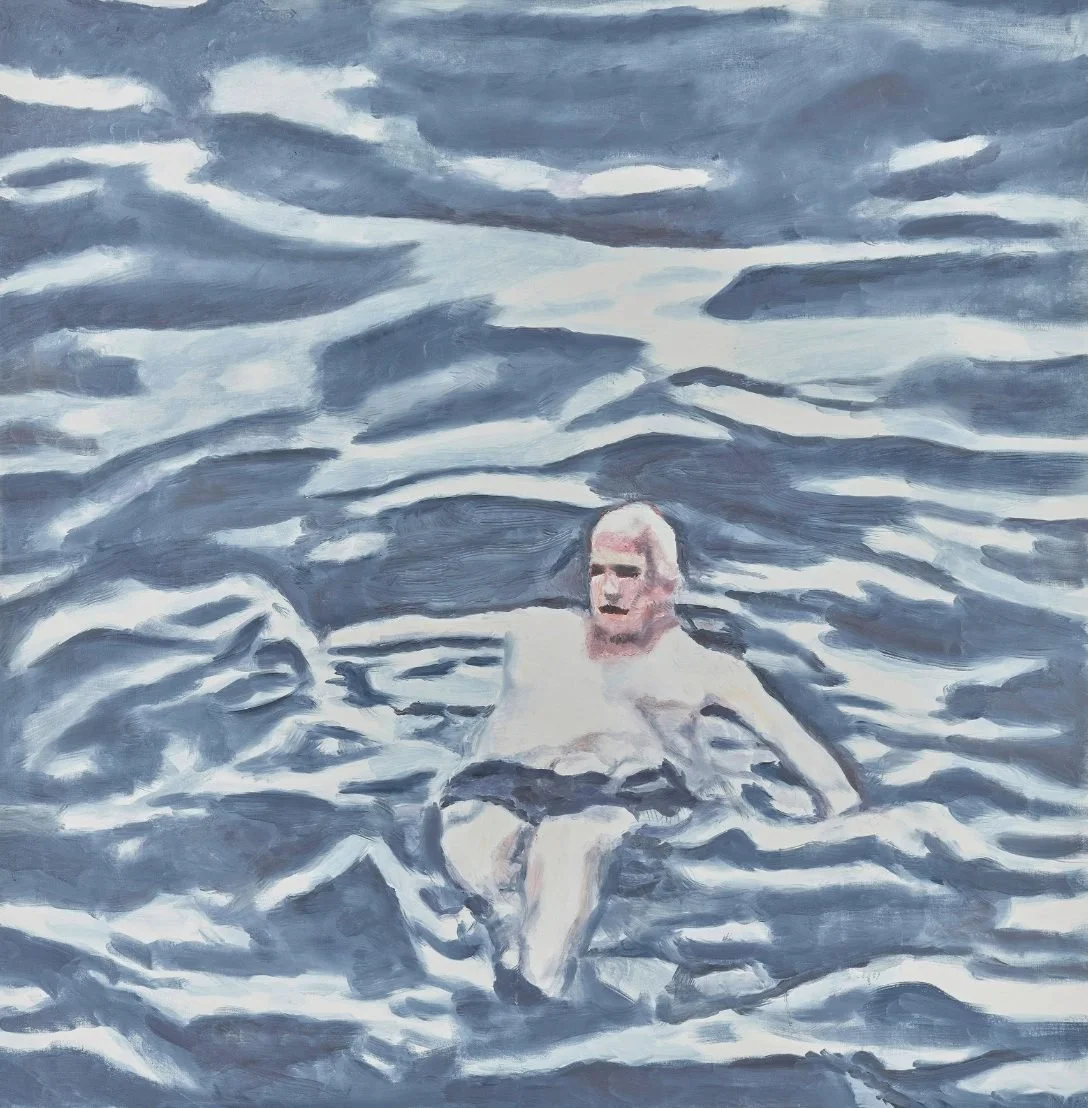
Demolition: Catastrophe Without the Icon
Tuymans’s Demolition from 2005 was based on a photograph of the cloud produced during the collapse of one of the World Trade Center towers in 2001.
Yet the painting removes most identifying information. Only small fragments of a streetlamp and flagpole remain at the edges. Without context, the cloud might resemble smoke, weather, dust, or abstraction. (The Museum of Modern Art)
This transformation is significant.
Widely circulated images of catastrophe can become icons. Repetition makes them instantly recognizable, but familiarity can also reduce their force.
Tuymans removes the iconic structure.
The image becomes uncertain again.
The viewer no longer receives a complete visual symbol of September 11. Instead, the viewer encounters an unstable cloud whose meaning depends on contextual knowledge.
The catastrophe is present and absent simultaneously.
The work asks:
How does an event become an image?
What happens when the image becomes familiar?
Can familiarity weaken moral attention?
What remains after identifying information is removed?
Is abstraction a form of concealment or a more honest acknowledgment of uncertainty?
The painting does not answer these questions.
It keeps them active.
Portraiture Without Psychological Access
Tuymans paints public figures, historical subjects, anonymous people, and faces extracted from photographs.
But his portraits rarely promise intimacy.
The face may appear flattened, blurred, cropped, mask-like, or strangely vacant.
This resists the expectation that portraiture reveals character.
A face can conceal as much as it communicates.
This becomes especially disturbing when the subject is associated with political power or historical violence. Viewers may search the face for evidence of morality, evil, fear, guilt, intelligence, or authority.
The painting refuses to provide it.
Evil does not necessarily have a visually identifiable face.
Power may look ordinary.
A calm expression may conceal devastating consequences.
The face therefore becomes evidence of the limits of physiognomic judgment.
The Secretary of State: Power as Image
Tuymans’s The Secretary of State from 2005 depicts Condoleezza Rice in a tightly cropped, pale portrait based on mediated source imagery. The modestly sized painting isolates her face while denying the surrounding political context. (The Museum of Modern Art)
The work does not tell viewers what to think about Rice.
It focuses instead on the production of public authority through imagery.
Political figures are known through:
Press photographs
Television
Official portraits
Repeated facial expressions
Carefully managed appearances
Public memory
The person becomes inseparable from the circulated image.
Tuymans weakens that image without destroying it.
Rice remains recognizable, but her authority becomes visually unstable.
The portrait is intimate in scale yet impersonal in effect. It brings the face closer while preserving distance from the person and the political systems surrounding her.
Colonial History and Lumumba
In Lumumba from 2000, Tuymans painted Patrice Lumumba, the first democratically elected prime minister of the independent Republic of the Congo, whose assassination became inseparable from Belgian colonial history and international political intervention.
MoMA describes the painting as intertwining history, myth, memory, and cultural identity rather than functioning as straightforward photographic representation. (The Museum of Modern Art)
The painting carries special pressure because Tuymans is Belgian.
The work participates in a historical relationship between Belgium and the Congo that cannot be treated as neutral subject matter.
Yet Tuymans does not attempt to offer complete historical explanation through one portrait.
The face becomes a point where national memory, colonial violence, political mythology, photographic mediation, and personal interpretation collide.
The portrait is insufficient.
That insufficiency is part of its ethical seriousness.
One image cannot contain the history, but refusing the image entirely would create another form of erasure.
The Holocaust and the Problem of Representation
Tuymans has repeatedly addressed the Holocaust and the legacy of fascism.
This presents an extreme artistic problem:
How can art represent historical horror without turning suffering into spectacle, aesthetic pleasure, or false understanding?
Tuymans often approaches the subject through indirect, weak, or peripheral imagery.
He avoids reconstructing atrocity as a dramatic scene.
Instead, he may present the architecture, the visual residue, the administrative world, the memory, or the apparent normality surrounding violence.
This indirectness is not emotional neutrality.
It reflects distrust toward images that claim to make incomprehensible events fully visible.
The work recognizes a moral limit:
Representation may be necessary, but it cannot repair or completely explain what happened.
Banal Appearance and Hidden Violence
Tuymans often places historical pressure inside ordinary appearances.
This reflects something important about power.
Violence is not always visually dramatic before it occurs.
Political systems operate through offices, paperwork, meetings, architecture, portraits, homes, schools, symbols, and routine administration.
Historical horror may develop inside normal-looking environments.
The banality of Tuymans’s subjects therefore becomes ethically charged.
An ordinary room is not necessarily innocent.
A pleasant landscape may conceal what happened there.
A composed public face may belong to a destructive system.
A decorative object may carry ideological history.
The paintings train viewers to distrust visual innocence.
The Central Contradictions
Tuymans’s work holds several opposing forces together:
Visible and unknowable
Weak and historically heavy
Beautiful and morally disturbing
Figurative and close to disappearance
Calm and violent
Ordinary and contaminated
Intimate and impersonal
Factual and unreliable
Historical and mediated
Specific and incomplete
Restrained and psychologically intense
Present and already fading
The central contradiction may be:
The paintings appear to reveal almost nothing, yet their emptiness becomes charged by everything the image cannot adequately contain.
The visual weakness creates conceptual pressure.
What has been removed begins to matter.
What cannot be represented becomes part of the work.
The Viewer’s Position
Tuymans places the viewer in an uncomfortable relationship to knowledge.
The viewer becomes an investigator
The image often appears incomplete.
The viewer searches for context, source, title, and historical reference.
The viewer becomes dependent on outside information
The painting may change radically after its source is understood.
This dependence raises a difficult question:
Is the context deepening the painting, or rescuing an otherwise weak image?
Tuymans deliberately keeps that tension alive.
The viewer becomes aware of interpretive desire
The viewer wants the image to explain itself.
Its refusal can produce frustration.
That frustration exposes the expectation that seeing should create understanding.
The viewer becomes historically distant
The painting makes clear that the viewer arrives after the event.
The past cannot be experienced directly.
The viewer becomes morally implicated
To look at historical suffering through art is to confront the danger of consuming it aesthetically.
Tuymans denies the viewer easy emotional release.
The viewer becomes suspicious
Ordinary subjects begin to appear contaminated.
The viewer learns that visual calm may conceal political or historical pressure.
The World Tuymans Has Built
Tuymans’s recurring lexicon includes:
Pale faces
empty rooms
curtains
lamps
ceilings
smoke
political figures
flowers
domestic objects
institutional interiors
cropped bodies
architectural fragments
historical photographs
screens
faded landscapes
masks
ordinary objects carrying hidden histories
These motifs create a visual world in which representation has lost its innocence.
A face may become public propaganda.
A room may become a container of absence.
Smoke may become historical evidence.
A flower may become decorative concealment.
A domestic object may carry political contamination.
An empty space may contain an event that can no longer be seen.
The recurring elements form a lexicon of compromised vision.
The Risk of Weak Painting
Tuymans’s work takes a real risk because weakness can become merely weak.
A faded palette is not automatically profound.
Blur is not automatically historical memory.
An ordinary source image is not automatically politically charged.
Thin paint can become mannerism.
Ambiguity can become emptiness.
Context can do too much of the work.
The critical question is:
Does the painting make the inadequacy of the image perceptually meaningful, or does the explanation supply an importance the object cannot carry?
This is where independent judgment matters.
Tuymans’s strongest paintings create unease before the viewer understands the historical context. The image already feels compromised, withheld, eerie, or ethically unstable.
The context then deepens that feeling.
A weaker work might depend almost entirely on the title or source story.
The distinction is important:
Explanation should intensify what the object has already begun, not manufacture the work’s entire force.
The Influence of the Weak Image
Tuymans has had enormous influence on subsequent figurative painting, particularly on artists who work from photographs, film stills, archives, and degraded media imagery. His approach helped establish a contemporary language in which painting could appear restrained, uncertain, and deliberately anti-heroic while still addressing politically and historically charged subjects. (David Zwirner)
But his influence also creates a danger.
The pale photographic painting has become a recognizable contemporary style.
Many weaker descendants borrow:
Muted color
Blur
banal source material
cropped photography
emotional coolness
unfinished surfaces
without carrying Tuymans’s deeper historical problem.
This produces a useful distinction:
Weak Tuymans imitation uses faded images as atmosphere.
Strong Tuymans uses faded images to question whether history can still be seen.
The appearance is transferable.
The necessity is not.
Why the Work Belongs to the Present
Tuymans’s paintings are highly relevant to a culture overwhelmed by images.
Contemporary viewers encounter history through:
News feeds
Viral photographs
Video clips
Search results
Screenshots
Memes
Compressed digital files
AI-generated imagery
Edited archives
Political media
Repeated iconic photographs
Images circulate faster than viewers can understand them.
Repetition may make an event more visible while gradually emptying the image of emotional force.
False images can look persuasive.
Authentic images can be cropped or stripped of context.
Political authority is produced through visual management.
Historical memory increasingly depends on unstable digital records.
Tuymans’s paintings understand this condition.
They ask:
What remains of truth when every event reaches us as an image that has already been selected, altered, circulated, and interpreted?
Painting cannot solve this crisis.
But it can slow the image down.
It can make mediation visible.
It can prevent recognition from becoming certainty.
What Artists Can Learn
The lesson is not to imitate Tuymans’s pale palette, blurred photographs, thin paint, ordinary subjects, cropped faces, or historical references.
Those are the visible solutions produced by his investigation.
The larger lesson is that an image’s weakness can become meaningful when it reveals the limits of representation.
Tuymans demonstrates that:
Historical importance does not require visual spectacle.
A quiet image can carry enormous pressure.
Mediation should become part of the subject rather than being hidden.
Blur can question knowledge rather than merely create mood.
Cropping can turn missing context into active meaning.
Pale color can make distance visible.
Thin paint can acknowledge the inadequacy of representation.
Ordinary objects can carry concealed histories.
Absence can become formal structure.
Context should deepen the visual encounter rather than replace it.
Political art does not need to illustrate a political message.
Viewers can be implicated through uncertainty rather than accusation.
Painting can remain ethically serious by refusing the fantasy of complete understanding.
Tuymans does not paint history as something available for recovery.
He paints what remains after history has been converted into images.
The event becomes a photograph.
The photograph becomes an archive.
The archive becomes cultural memory.
The memory fades, distorts, and loses context.
The painting returns that damaged image without pretending to repair it.
The lesson is not to copy the appearance of the work. It is to understand the pressure that made the appearance necessary.
Luc Tuymans turns the weakness of mediated images into a way of confronting history’s resistance to complete visibility or understanding.
What Makes Beatriz Milhazes’s Paintings So Powerful?
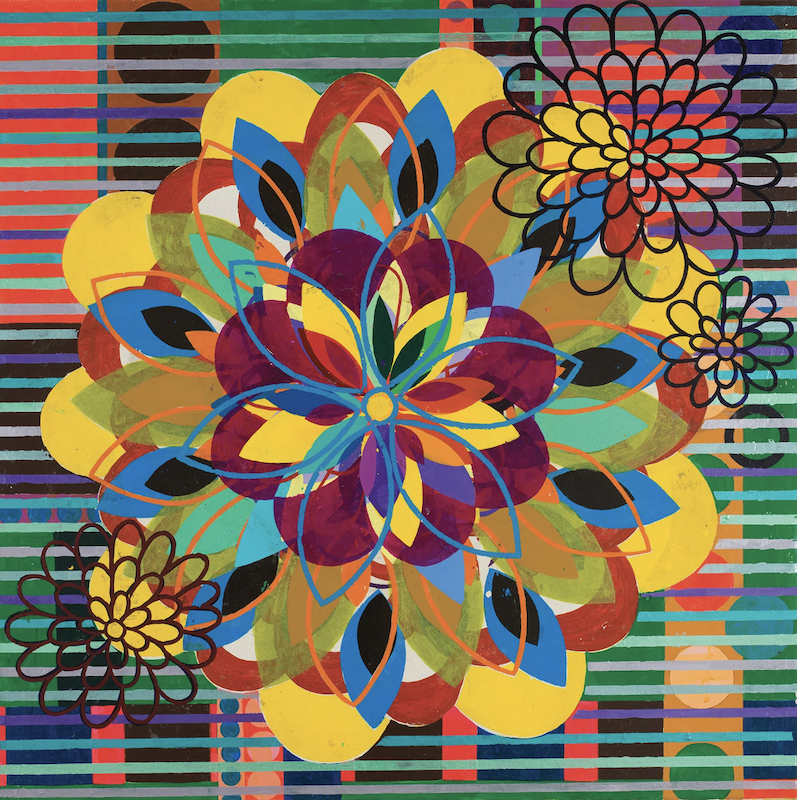
Beatriz Milhazes’s paintings are powerful because they turn decoration into a rigorous system where beauty, cultural memory, geometry, nature, and visual excess struggle for control.
At first, the paintings can appear immediately joyful.
Circles expand across the surface. Flowers unfold into wheels, mandalas, targets, and suns. Stripes, lace patterns, arabesques, leaves, waves, diamonds, and ornamental borders overlap in intense fields of pink, red, orange, green, blue, yellow, purple, black, silver, and gold.
The work is bright, pleasurable, rhythmic, and visually abundant.
Yet the paintings are not simply celebrations of color.
Their surfaces contain conflict:
Organic forms collide with hard geometry.
Decorative motifs compete with structural grids.
Transparency allows layers to coexist while making them difficult to separate.
Repetition creates harmony and visual pressure at the same time.
Brazilian cultural sources meet the history of European abstraction.
Handmade irregularity survives inside highly controlled compositions.
Beauty attracts the viewer while density prevents easy consumption.
Milhazes creates paintings that feel exuberant without becoming uncontrolled.
Their deepest force comes from the tension between freedom and discipline.
The Problem Beneath the Work
Milhazes repeatedly returns to a central artistic problem:
How can painting transform ornament, nature, popular culture, craft, and inherited abstraction into a visual system where beauty remains intense without becoming passive decoration?
Her paintings are not simply colorful abstractions.
They bring together visual languages that have often been separated by cultural hierarchies:
Fine art and applied art
Modernist abstraction and decorative tradition
European geometry and Brazilian popular culture
Intellectual structure and sensual pleasure
Mechanical repetition and handmade variation
Botanical growth and architectural control
Milhazes does not resolve these differences by making one tradition dominate the others.
She constructs a surface where they remain active together.
White Cube describes her paintings as poised between order and chaos, rational structure and spontaneity, as well as between European and Brazilian modernisms. That tension provides a useful entry into the work: the paintings are not chaotic despite their abundance, and they are not rigid despite their geometry. (White Cube)
They occupy the unstable point where control becomes exuberance and exuberance nearly overwhelms control.
Decoration Without Apology
Decoration has often occupied an uncertain position within modern art.
It can be associated with:
Domestic interiors
Textiles
fashion
wallpaper
ceramics
festivals
feminine labor
popular taste
commercial design
visual pleasure
These associations have sometimes caused ornament to be treated as secondary to supposedly more serious artistic concerns.
Milhazes rejects that hierarchy.
She does not use pattern quietly or defensively. She enlarges it, layers it, intensifies it, and allows it to dominate the canvas.
Flowers become monumental.
Lace-like forms become structural.
Decorative circles organize entire compositions.
Repeated motifs create systems as rigorous as geometric abstraction.
The work suggests that visual pleasure does not need to justify itself by becoming austere.
But pleasure alone is not enough.
Milhazes makes decoration serious because ornament determines:
How the eye moves
Which forms dominate
What becomes visible
Where the composition accelerates
Where it becomes congested
How cultural sources collide
How figure and ground exchange roles
How control survives inside abundance
Decoration does not sit on top of the painting.
It is the painting’s method of thought.
Beauty Under Pressure
The paintings are undeniably beautiful, but their beauty is not calm.
Each form competes for attention.
A large circular motif may dominate the center, only to be interrupted by stripes, floral fragments, smaller discs, curving bands, transparent color, or sharply contrasting geometry.
The eye is pulled in several directions.
One pattern establishes order.
Another crosses it.
A flower appears complete.
A neighboring form cuts through it.
A color creates harmony.
Another color disrupts that relationship.
Beauty becomes active because it must continually negotiate conflict.
This is the difference between a decorative surface and a pressurized decorative surface.
A decorative surface may offer immediate harmony.
Milhazes’s paintings offer harmony that is continuously being challenged.
The viewer receives pleasure, but not rest.
The Transfer Process
Milhazes developed a distinctive transfer technique in 1989 based on a dry-monotype process. She paints separate shapes and motifs onto transparent plastic sheets, builds the acrylic into transferable films, adheres those forms to canvas or linen, and then peels the plastic away. (Beatriz Milhazes)
This method is essential to the work.
Rather than painting every motif directly onto the canvas, she constructs the image through prepared fragments.
Each form is made separately before entering the larger composition.
This creates a process closer to:
Collage
Printmaking
assemblage
transfer
construction
choreography
The motif can be planned, repeated, reversed, moved, layered, and positioned.
But the transfer is not perfectly predictable.
Paint may crack.
Sections may fail to adhere.
Earlier traces can remain on the plastic.
The transferred form may carry imperfections from its movement between surfaces.
The process therefore combines control with loss.
Milhazes can design the image carefully, but the material does not obey completely.
That tension mirrors the larger structure of the paintings:
Order is built through a process that preserves accident.
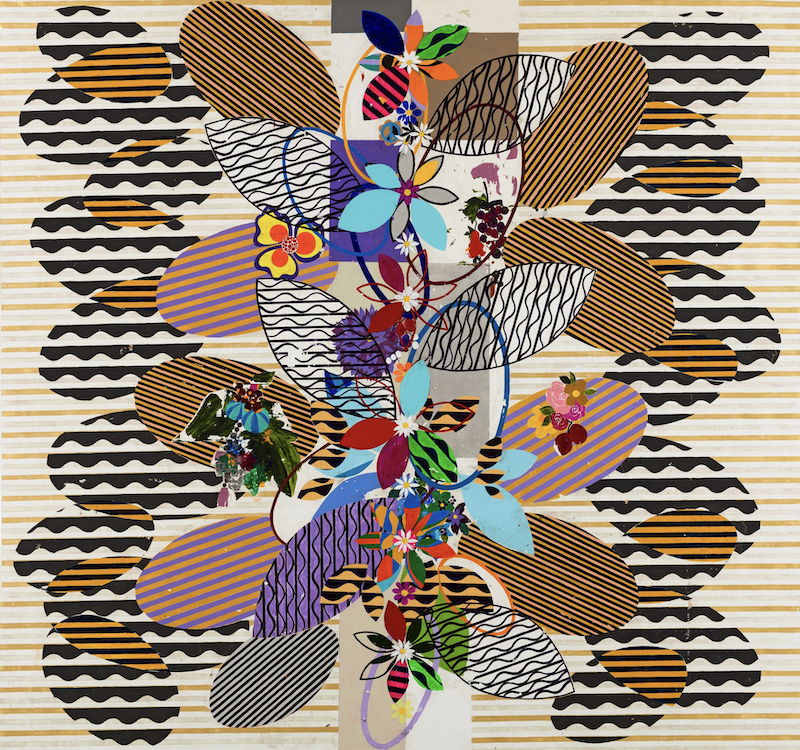
Painting at a Remove
The transfer process also creates distance between the artist’s hand and the finished surface.
A direct brushstroke records the immediate contact between brush and canvas.
Milhazes’s forms pass through an intermediate stage.
The paint touches plastic first.
It dries.
It becomes a removable skin.
It is transferred.
The original painted surface is reversed and repositioned.
This distance changes the meaning of gesture.
The work remains handmade, but it does not rely on spontaneous expression in the conventional sense. The artist’s authority lies partly in constructing the system through which the forms meet.
The paintings therefore complicate the distinction between:
Painting and collage
Original and reproduction
Gesture and design
Handmade and mechanical
Spontaneity and planning
Surface and object
A motif may look direct and immediate even though it has undergone several stages of separation and transfer.
Imperfection Inside Precision
The paintings can look exceptionally polished from a distance.
The circles appear sharp.
Patterns repeat.
Colors remain bold.
Large compositions feel deliberate.
But closer inspection often reveals fractures, abrasions, gaps, marks, and irregular edges created by the transfer process.
These imperfections matter.
Without them, the work might become too smooth, commercial, or mechanically decorative.
The damage provides resistance.
It reminds the viewer that each immaculate-looking form has undergone physical change.
A transferred motif is never identical to its original state.
Something may be lost in the movement.
Something new may appear.
This makes the surface historical.
Each shape carries evidence of how it arrived.
Nature Transformed into Structure
Flowers, leaves, vines, waves, and botanical forms appear throughout Milhazes’s work.
But the paintings are not conventional images of nature.
A flower may become:
A geometric center
A wheel
A rotating system
A mandala
A target
A burst of energy
A decorative emblem
A compositional machine
Nature is translated into rhythm and structure.
The organic motif does not remain naturally irregular. It may be repeated, flattened, mirrored, enlarged, or placed inside a geometric system.
At the same time, geometry does not remain cold.
Circles bloom.
Lines ripple.
Grids pulse with color.
Hard structures begin to behave like living forms.
The paintings do not separate nature from abstraction.
They allow each to transform the other.
Rio de Janeiro as Visual Pressure
Milhazes’s visual language is rooted in Rio de Janeiro, where she was born in 1960 and where her practice developed. Her work draws from the city’s tropical environment and from Brazilian visual culture while remaining deeply engaged with international histories of abstraction. (pacegallery.com)
Relevant sources include:
Botanical gardens
tropical vegetation
Carnival
festival decoration
popular textiles
jewelry
architecture
ceramics
lace
music
graphic design
Brazilian modernism
But the paintings should not be read as simple expressions of Brazilian exuberance.
That interpretation risks reducing a complex visual language to a cultural stereotype.
Milhazes does not merely reproduce the appearance of Rio.
She translates its density, rhythm, collision, color, and mixture into an abstract system.
The city becomes less a depicted location than a condition of visual coexistence.
Different histories and patterns occupy the same field without becoming identical.
Brazilian and European Modernisms
Milhazes’s paintings engage both Brazilian modernism and European abstraction.
Her sources and affinities have been associated with figures such as:
Henri Matisse
Piet Mondrian
Sonia and Robert Delaunay
Henri Rousseau
Bridget Riley
Tarsila do Amaral
Roberto Burle Marx
The significance does not lie in identifying each quotation.
It lies in how these traditions are reorganized.
European modernism often pursued formal reduction, geometric order, optical structure, and the autonomy of painting.
Brazilian modernism absorbed international languages while transforming them through local environment, culture, history, and questions of national identity.
Milhazes brings those histories into contact with ornament, popular imagery, botanical forms, and intense chromatic pleasure.
Geometry no longer needs to remain austere.
Decoration no longer needs to remain outside modernism.
Color does not merely fill structure.
Color becomes structure.
Her work exists at what White Cube calls the “biting point” between European and Brazilian modernisms, where neither source remains unchanged. (White Cube)
Color as Structure
Milhazes does not use color only to produce mood.
Color organizes the painting.
A large red circle may anchor the composition.
A field of blue may create depth before a bright floral motif flattens it again.
Black lines may divide competing areas.
Pinks and oranges may unite forms that differ in scale or pattern.
Contrasting colors can produce vibration along an edge.
Repeated colors can connect distant parts of the canvas.
The viewer may initially experience the color emotionally:
Joyful
tropical
festive
luxurious
excessive
playful
But the color is also architectural.
It determines hierarchy, weight, rhythm, and movement.
This is why the paintings can support so much visual information without collapsing completely.
Color is not added to the structure.
It builds the structure.
Circles as a Generative Lexicon
Circles recur throughout Milhazes’s practice.
They may appear as:
Flowers
wheels
suns
targets
discs
mandalas
eyes
records
decorative medallions
spinning forms
The circle offers several advantages.
It can suggest both stillness and rotation.
It can create a stable center while generating movement around that center.
It can appear organic or geometric.
It can expand outward or contract inward.
It can overlap without establishing a conventional horizon.
It can become an image or remain an abstract structure.
Repeated circles make the paintings feel musical.
One disc establishes a beat.
Another interrupts it.
Smaller circles create faster rhythms.
Large circles slow the composition and provide weight.
The circle becomes less a signature than a flexible piece of visual vocabulary.
Its meaning changes according to scale, color, pattern, and position.
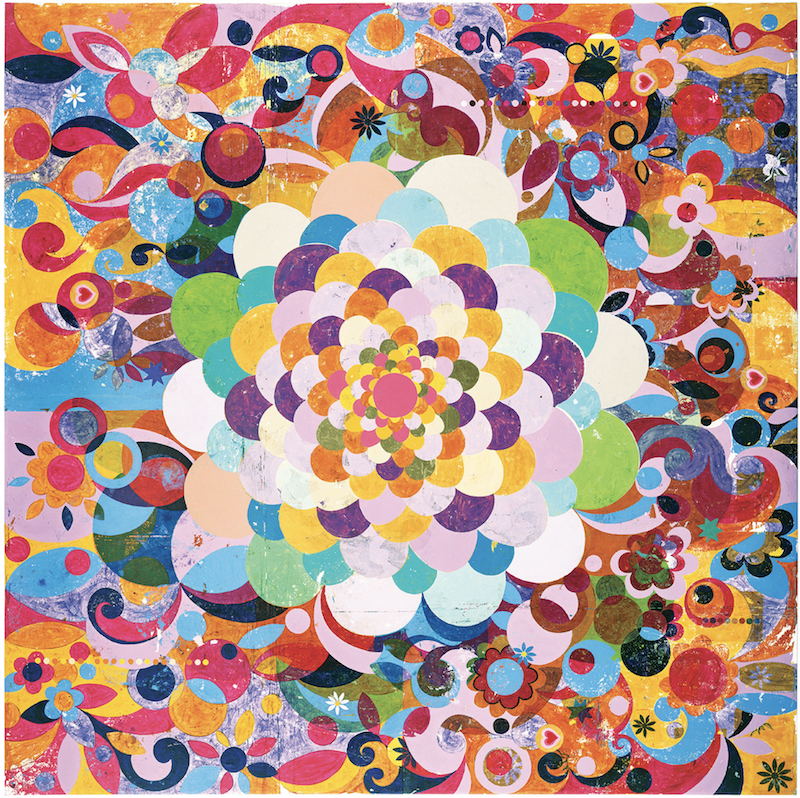
Layers Without Conventional Depth
Milhazes’s paintings contain many overlapping forms, yet they do not create conventional illusionistic space.
One shape covers another.
Transparent areas reveal what lies below.
Patterns move forward and backward.
But the painting repeatedly returns attention to the surface.
Depth exists as accumulation rather than as perspective.
The viewer does not enter a believable three-dimensional world.
The viewer moves through stacked visual events.
This makes the work feel spatial without becoming pictorially deep.
The space resembles memory, music, collage, or cultural history:
One layer interrupts another.
Earlier material remains partially visible.
Separate sources coexist.
No single viewpoint controls the whole.
The surface contains several times at once.
Rhythm and Music
Milhazes’s compositions often feel musical.
Forms repeat with variation.
Lines establish tempo.
Color returns like a refrain.
Large motifs create sustained notes.
Small patterns produce rapid movement.
Transparent layers allow several rhythms to operate simultaneously.
The painting can feel like a visual arrangement in which no single instrument completely dominates.
Music is especially relevant because it offers structure without requiring narrative.
A song can create progression, tension, repetition, release, interruption, and return without depicting an event.
Milhazes’s paintings behave similarly.
The eye experiences sequence even though the entire image is visible at once.
Order and Chaos
The paintings often appear close to visual overload.
This danger is central to their force.
Too much structure would make them rigid.
Too much activity would make them arbitrary.
Milhazes works between these extremes.
Order appears through:
Repeated geometry
central motifs
balanced color
recurring circles
grids
stripes
controlled transfer
compositional hierarchy
Chaos appears through:
Overlap
collision
density
conflicting patterns
chromatic intensity
imperfect transfer
sudden scale changes
competing centers
The painting remains alive because neither force wins.
Order prevents collapse.
Chaos prevents sterility.
The deeper contradiction is:
The work creates visual freedom through extreme discipline.
The Viewer’s Position
Milhazes places the viewer inside abundance.
The viewer is first seduced
Color and pattern create immediate pleasure.
The work does not require theoretical knowledge before the visual encounter begins.
The viewer becomes a navigator
Once inside the painting, the eye must determine how to move through competing motifs and layers.
There is rarely one simple path.
The viewer becomes physically aware of scale
Large floral and geometric forms can become environmental. What might resemble a small decorative motif in another context expands until it confronts the body.
The viewer becomes uncertain about hierarchy
Is the central flower the subject?
Are the surrounding patterns background?
Does the grid organize the ornament, or does the ornament overwhelm the grid?
Figure and ground continue to exchange roles.
The viewer becomes aware of pleasure
The work raises a question often avoided in serious criticism:
Why should intense visual pleasure be considered intellectually suspicious?
Milhazes does not separate pleasure from complexity.
She makes pleasure the entrance into complexity.
The Central Contradictions
Milhazes’s paintings hold multiple opposing forces together:
Decorative and rigorous
Organic and geometric
Brazilian and international
Handmade and mechanically repeated
Controlled and accidental
Beautiful and overwhelming
Flat and spatially layered
Festive and disciplined
Historical and contemporary
Precise and damaged
Harmonious and competitive
Immediate and slow to comprehend
The deepest contradiction may be:
The paintings appear spontaneous and exuberant even though they are produced through slow planning, transfer, revision, and control.
Freedom is not the absence of structure.
It is the effect created by structure working at its highest intensity.
The World Milhazes Has Built
Her recurring lexicon includes:
Flowers
circles
arabesques
lace
stripes
grids
leaves
waves
diamonds
medallions
jewelry-like details
botanical forms
Carnival references
transparent layers
geometric fragments
ornamental borders
vivid color relationships
These elements create a recognizable world, but they do not remain fixed.
A flower can become geometry.
A circle can become architecture.
A stripe can become movement.
Lace can become an abstract network.
A decorative fragment can become the structural center of a monumental canvas.
This constant reassignment prevents the vocabulary from becoming merely ornamental branding.
The motifs keep changing jobs.
The Evolution Toward Geometry
Milhazes’s work has evolved across decades, moving from dense ornamental arabesques toward compositions in which geometric abstraction has become increasingly prominent, while color remains central. A 2025 Guggenheim presentation spanning works from 1995 to 2023 emphasized this development and the continued tension between rigor and beauty. (Vogue)
This evolution is important because it shows that the practice is not dependent on one successful decorative formula.
The vocabulary can change while the central problem remains intact.
Earlier works may feel more floral, layered, intimate, and ornamental.
Later paintings may introduce larger geometric divisions, clearer edges, and more open space.
But the deeper tension persists:
Sensuality and order
Cultural mixture and formal rigor
handmade process and constructed appearance
visual pleasure and compositional pressure
The world evolves without losing its governing intelligence.
The Risk of Decorative Spectacle
Milhazes’s work carries a clear risk.
The paintings are highly photogenic.
Their bright colors and bold patterns can create immediate appeal on screens, in design contexts, and in commercial reproduction.
This creates the possibility that the work will be consumed too quickly as:
Cheerful color
tropical abundance
luxury decoration
visual optimism
Instagram-friendly pattern
Brazilian exoticism
The critical question is therefore:
Does a painting create a governed conflict among its forms, or does it merely reproduce the appearance of Milhazes-style abundance?
The strongest works do more than fill the canvas attractively.
They establish competing systems of rhythm, hierarchy, transparency, scale, and cultural reference.
The pleasure remains active because it is difficult to stabilize.
The weaker possibility would be ornament without pressure.
Why the Work Belongs to the Present
Milhazes’s paintings address a contemporary condition in which cultural identity is formed through mixture rather than purity.
Visual languages move across:
Nations
art history
craft
fashion
advertising
architecture
music
digital imagery
popular festivals
museums
domestic life
Her work does not pretend that artistic influence follows one clean line.
It accepts that a contemporary image may contain local memory, international modernism, decorative tradition, mass culture, personal taste, and historical contradiction at once.
The paintings also challenge inherited hierarchies separating:
Fine art from craft
Seriousness from beauty
intellect from pleasure
modernism from ornament
structure from decoration
cultural specificity from international abstraction
Their present-tense force lies in their refusal to choose one side.
What Artists Can Learn
The lesson is not to imitate Milhazes’s flowers, circles, bright palette, transfer technique, Brazilian references, stripes, lace, or ornamental density.
Those are the visible solutions produced by her particular investigation.
The larger lesson is that decoration becomes powerful when it is treated as structure rather than embellishment.
Milhazes demonstrates that:
Beauty can carry intellectual rigor.
Pattern can organize attention.
Color can build architecture.
Repetition can produce musical rhythm.
Ornament can hold cultural memory.
Geometry can become sensual.
Nature can be transformed rather than illustrated.
A controlled process can preserve accident.
Imperfection can prevent polish from becoming sterile.
Cultural sources can coexist without being flattened into one style.
Visual pleasure becomes deeper when several systems compete beneath it.
A recognizable lexicon can evolve without losing coherence.
The paintings do not choose between rigor and beauty.
Their rigor produces beauty.
Their beauty conceals labor.
Their order generates exuberance.
Their ornament becomes structure.
Their imperfections reveal process.
Their cultural mixture becomes a visual world.
The lesson is not to copy the appearance of the work. It is to understand the pressure that made the appearance necessary.
Beatriz Milhazes turns decoration into a disciplined field where color, culture, nature, geometry, and pleasure remain in continuous, productive collision.
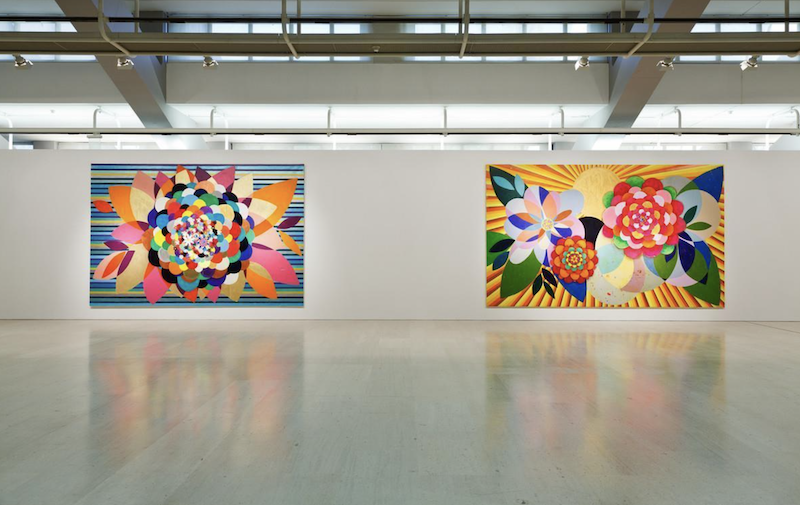
What Makes Marlene Dumas’s Paintings So Powerful?
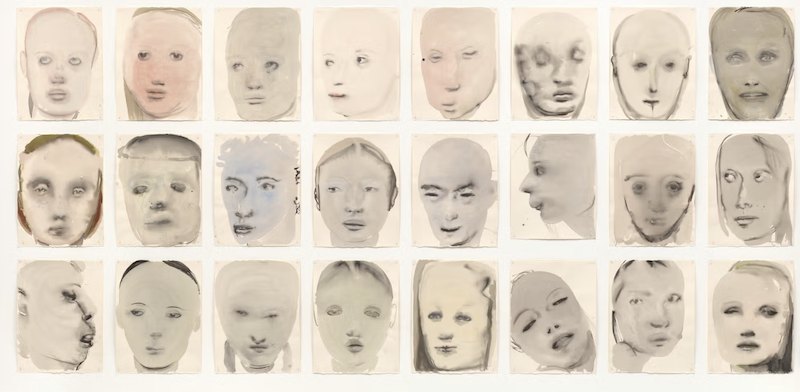
Marlene Dumas’s paintings are powerful because they turn secondhand images into firsthand emotional encounters.
At first, the work often appears direct. A face fills the canvas. A body stands alone. A child looks outward. A dead celebrity lies exposed. A lover, victim, political figure, model, saint, criminal, or anonymous stranger becomes the center of attention.
Yet the paintings do not provide stable portraits.
The features bleed, stain, dissolve, and shift. Flesh becomes pale, blue, green, bruised, gray, pink, red, or nearly transparent. Eyes appear watchful, vacant, accusatory, seductive, terrified, exhausted, or impossible to read. A mouth may suggest pleasure, grief, silence, death, or violence at the same time.
The figures feel intensely present.
But they do not become fully knowable.
Dumas’s paintings are rarely made directly from a living model. They emerge from an extensive archive of photographs drawn from newspapers, magazines, pornography, film, art history, personal snapshots, police images, and other forms of visual culture. She takes images that have already been framed, circulated, interpreted, consumed, or forgotten and subjects them to the instability of paint. (David Zwirner)
The result is not simply a painted copy of a photograph.
It is a confrontation with what happens when one person looks at another through an image.
The Problem Beneath the Work
Dumas repeatedly returns to a central artistic problem:
How can painting recover emotional, bodily, and moral intensity from images that have already been mediated, circulated, and culturally interpreted?
This problem allows her work to move across an enormous range of subjects:
Love
Sex
Birth
Death
Race
Apartheid
Religion
War
Celebrity
Motherhood
Shame
Grief
Violence
Political power
Vulnerability
The subjects differ, but the central tension remains.
A photograph appears to preserve a person or event. Yet every photograph also creates distance. It freezes one instant, removes context, converts a body into an image, and places that image in the hands of viewers who may know nothing about the person depicted.
Dumas begins inside that distance.
She does not attempt to restore the original person completely. Painting cannot return a dead body to life, explain a stranger’s inner world, or recover everything that existed outside the photographic frame.
Instead, she makes the distance itself emotionally active.
The painting asks:
What does this image allow the viewer to feel?
What has already been taken away?
What is being projected onto the subject?
What happens when private experience becomes public imagery?
Can an image preserve dignity while exposing the body?
Can paint make a familiar face strange enough to be seen again?
The deeper subject is not only the person represented.
It is the burden placed upon the image.
The Image as Burden
The title of Dumas’s major retrospective, The Image as Burden, offers one of the clearest ways to understand her practice. The exhibition brought together more than one hundred works and later traveled from the Stedelijk Museum to Tate Modern and Fondation Beyeler. (Stedelijk Museum)
An image becomes a burden because it carries meanings that exceed the person depicted.
A face may carry:
Race
Gender
Fame
Crime
innocence
sexuality
political history
religious symbolism
public scandal
private grief
the viewer’s desire
the viewer’s fear
Once an image enters public circulation, it is no longer controlled by its subject.
A photograph of Marilyn Monroe can become glamour, tragedy, celebrity, sexuality, exploitation, nostalgia, mortality, or cultural decline.
A photograph of a political prisoner can become evidence, propaganda, spectacle, memorial, or news.
A photograph of a child can evoke innocence, vulnerability, discomfort, possession, or fear.
Dumas does not remove those associations.
She allows them to accumulate.
But paint makes them unstable.
The painted image no longer carries the apparent factual certainty of photography. Features distort. Color becomes emotional rather than descriptive. The source is translated through touch, speed, hesitation, accident, and interpretation.
The image remains burdened, but its burden becomes visible.
From Secondhand Image to Firsthand Encounter
Dumas has often worked from images she did not create herself.
This could seem to increase distance from the subject.
Instead, it becomes the source of the work’s intensity.
The photographic source has already transformed life into representation. By painting from that source, Dumas introduces another transformation.
The process might be understood as a sequence:
A person or event exists.
A camera extracts an image.
The image enters an archive or public culture.
Dumas selects it.
Painting alters its scale, color, surface, emphasis, and emotional temperature.
The viewer encounters a new object with only an indirect connection to the original person.
Each stage creates loss.
But each stage also creates new meaning.
Dumas does not hide the fact that the image is mediated. She emphasizes it. The paintings often feel like memories of photographs rather than windows onto reality.
This is why they can seem both intimate and remote.
The viewer is brought close to a face while remaining separated from the life behind it.
Paint as Emotional Instability
Dumas’s handling of paint is fluid, economical, and often visibly vulnerable.
A wash may run downward like tears, blood, sweat, water, or photographic degradation. A single dark stroke may create an eye, shadow, wound, or mouth. Thin paint allows the canvas to remain visible beneath the figure. Features may appear to have been discovered within the stain rather than carefully built through conventional modeling.
This apparent looseness is not merely expressive style.
It allows the image to remain psychologically unstable.
A fully modeled face can create the illusion of solidity. Dumas’s faces often seem to be forming and disintegrating simultaneously.
The paint may suggest:
A body coming into visibility
A memory fading
Flesh losing life
Identity becoming uncertain
Emotion moving across a face
A photograph chemically deteriorating
A person becoming an image
The material behaves like the instability of representation itself.
Paint does not simply describe vulnerability.
It becomes vulnerable.
Why the Formal Choices Matter
Dumas’s work can appear spontaneous, but the formal language is highly purposeful.
Thin paint prevents bodily certainty
Her figures frequently appear through translucent washes and abbreviated marks.
This thinness makes the body feel exposed and insubstantial. It can seem present but unable to defend itself against the viewer.
The figure is not protected by thick material or polished illusion.
It hovers near disappearance.
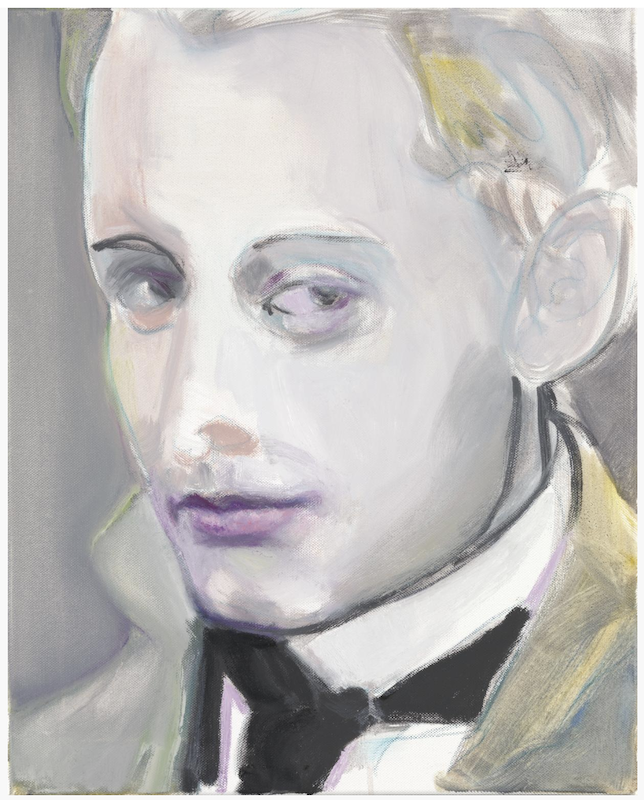
Distorted color separates emotion from likeness
Dumas rarely depends on naturalistic skin color.
Faces may become blue, green, gray, violet, blood-red, or ghostly white. These changes prevent the viewer from treating color as neutral description.
Color may carry:
Fear
Illness
erotic charge
death
racial projection
artificiality
shame
coldness
spiritual intensity
emotional distance
The color does not simply tell viewers how to feel. It destabilizes the category of the body being seen.
A pale face may appear innocent, diseased, dead, spectral, racially coded, or overexposed by photographic light.
The uncertainty remains active.
Cropping creates confrontation
Many portraits fill the canvas tightly.
The face may be cut off near the forehead, chin, or sides. The figure has little environmental context.
This removes narrative escape.
The viewer cannot look elsewhere.
The face becomes an event.
But the closeness does not necessarily create intimacy. It can also resemble surveillance, mugshots, medical photographs, pornography, news photography, or the involuntary exposure of a body.
Cropping intensifies presence while withholding knowledge.
Scale changes the politics of looking
Dumas moves between very small paintings and monumental standing figures.
Small works can feel private, fragile, or almost devotional. The viewer must approach closely.
Large bodies become public, confrontational, and difficult to possess visually. In Myths & Mortals, monumental full-length figures over nine feet tall stood alongside much smaller works, creating dramatic shifts between intimacy and authority. (Marlene Dumas)
Scale allows vulnerability and power to change places.
A naked body may appear exposed at one size and commanding at another.
A famous face may become unexpectedly small, as in Dead Marilyn, which measures only about sixteen by twenty inches despite the subject’s enormous cultural presence. (The Museum of Modern Art)
Empty grounds isolate the figure
Many bodies appear against simplified or undefined backgrounds.
This removes social context and places pressure on gesture, posture, expression, and color.
The subject becomes both an individual and an image detached from ordinary life.
The emptiness may suggest:
Studio space
photographic backdrop
psychological void
public display
timelessness
death
isolation
The figure has nowhere to hide.
Titles redirect interpretation
Dumas’s titles often create friction with the image.
A title may introduce biography, mythology, politics, humor, poetry, or contradiction. It can turn an anonymous figure into a historical subject or make an apparently straightforward portrait more unstable.
The title does not solve the painting.
It adds another voice.
The viewer must negotiate among image, source, title, cultural memory, and personal response.
The Face as an Unstable Field
Dumas is often described as a portrait painter, but her portraits do not behave like conventional records of personality.
They do not promise access to the authentic self.
Instead, the face becomes a field where competing interpretations gather.
A face may be:
A person
A mask
A racial category
A public persona
A sexual object
A victim
A celebrity
A corpse
A political symbol
A remembered loved one
An image separated from its owner
The face appears to offer access because human beings are trained to read emotion through facial expression.
Dumas exploits that expectation.
An eye may seem frightened and then accusing.
A mouth may appear sensual and then wounded.
A blank expression may suggest dignity, shock, vacancy, resistance, or death.
The viewer keeps interpreting because the face appears readable.
The painting remains powerful because that reading never becomes secure.
Exposure and Withholding
Dumas frequently depicts nude or partially nude bodies.
Yet nudity in her work does not produce complete access.
A body may be visually exposed while remaining psychologically withheld.
This is a crucial contradiction.
The viewer can see skin, genitals, breasts, posture, and physical vulnerability. But visibility does not produce possession.
The body may resist through:
Direct gaze
Scale
awkwardness
distortion
emotional opacity
paint
title
absence of narrative
refusal of ideal beauty
Dumas’s figures often appear vulnerable without becoming passive.
They may be embarrassed, sensual, defiant, isolated, exhausted, grieving, or self-possessed. The work does not assign one stable identity.
This allows the body to remain human rather than becoming a simple symbol.
Desire, Shame, and the Viewer
Dumas’s work repeatedly connects painting with desire.
But desire is rarely clean or celebratory.
It may contain:
Awkwardness
loneliness
age
power
objectification
jealousy
shame
grief
absence
fear of loss
Her writing on Myths & Mortals emphasizes emotional multiplicity: eroticism can coexist with injury, love with death, pleasure with isolation, and attraction with awkwardness. (Marlene Dumas)
This makes the viewer’s position unstable.
The viewer may feel attracted to a figure and then become uncomfortable with that attraction.
A vulnerable body may generate tenderness and voyeurism simultaneously.
A corpse may provoke horror, curiosity, grief, and visual fascination.
A child’s face may appear innocent and disturbingly exposed.
Dumas does not tell the viewer which response is morally correct.
She makes the conflict visible.
The viewer becomes aware that looking is never neutral.
Death and the Limits of Portraiture
Death appears repeatedly in Dumas’s work.
This may take the form of:
Corpses
mourning
political victims
suicide
murder
dead celebrities
religious death
mythological death
personal bereavement
Death creates the ultimate problem for portraiture.
A portrait traditionally preserves presence.
A death image records absence.
The person is visible but no longer available.
Dumas’s Dead Marilyn makes this contradiction explicit. She based the small painting on an autopsy photograph of Marilyn Monroe after the image unexpectedly resurfaced from her archive. Dumas connected the work both to the death of her own mother and to a broader sense of historical and cultural ending. She described it as a portrait of Marilyn, death, an era, and one’s own potential mortality. (The Museum of Modern Art)
The work therefore does not merely depict a dead celebrity.
It asks what a portrait becomes when the subject can no longer answer the image.
The viewer looks at a body whose public identity remains powerful but whose private life is permanently inaccessible.
Celebrity and mortality collapse into the same face.
Public Image and Private Self
Dumas’s paintings repeatedly explore the unstable boundary between public and private identity. Her gallery describes this shifting relationship as a major concern across four decades of work. (David Zwirner)
This tension appears especially clearly in images of famous people.
A celebrity is widely recognized but rarely known personally.
The public face circulates through photography, film, gossip, advertising, and collective memory. It becomes familiar enough to feel intimate.
But that intimacy is artificial.
Dumas takes familiar faces and makes them strange again.
Paint interrupts the smoothness of the public image. Features become uncertain. Glamour drains away or turns spectral. The viewer confronts not the person, but the distance between the person and the image through which that person has been consumed.
The same problem extends beyond celebrity.
Any portrait produces a public surface from a private life.
Dumas asks what is lost, invented, projected, or exposed in that conversion.
Race and the Violence of Classification
Dumas grew up in South Africa under apartheid and moved to Amsterdam in 1976. Questions of racial classification, identity, representation, and political power have remained central to her work. (David Zwirner)
Her paintings do not usually explain racial systems through narrative.
Instead, they expose how quickly viewers interpret bodies through color, facial features, titles, photographic conventions, and cultural assumptions.
A face may be described as white, Black, diseased, innocent, foreign, familiar, beautiful, threatening, or vulnerable before the viewer knows anything about the person depicted.
The painting makes that speed of classification visible.
Dumas complicates racial identity through unnatural color and unstable surfaces. Skin no longer behaves like a reliable category.
This does not erase race.
It reveals that race is simultaneously bodily, visual, historical, political, and projected.
The viewer becomes implicated in the act of classification.
The Child as Innocence and Threat
Children recur throughout Dumas’s work.
They may appear fragile, strange, confrontational, ghostly, sexualized by adult projection, or disturbingly self-possessed.
A child is culturally expected to signify innocence.
Dumas rarely allows that meaning to remain uncomplicated.
Her children may have:
Unreadable expressions
stained hands
confrontational gazes
awkward bodies
adult emotional intensity
vulnerable exposure
unsettling scale
The image can activate protection and fear at once.
This destabilizes the viewer’s expectation that childhood should be visually pure or psychologically transparent.
The child becomes a person before becoming a symbol of innocence.
Myth, Religion, and Human Vulnerability
Dumas frequently draws from religious and mythological imagery, including Christ, Mary Magdalene, Venus, Adonis, and other inherited figures.
She does not treat these subjects as remote historical icons.
She returns them to bodily experience.
The divine figure becomes flesh.
The mythological lover becomes awkward.
The saint becomes sexual.
The body experiences pregnancy, pain, pleasure, age, exposure, grief, and mortality.
This translation allows inherited stories to remain emotionally active.
In the Venus and Adonis works, eroticism repeatedly approaches death. Venus reaches toward a lover she cannot keep. The apparent embrace is also contact with a dying body. Dumas’s broader world allows pleasure and death, agony and ecstasy, to occupy the same image. (Marlene Dumas)
Myth becomes powerful because it does not remove ordinary human vulnerability.
It enlarges it.
The Central Contradictions
Dumas’s paintings hold opposing forces without resolving them:
Intimate and mediated
Exposed and withheld
Beautiful and damaged
Tender and cruel
Specific and anonymous
Public and private
Erotic and mournful
Living and deathlike
Spontaneous and controlled
Personal and political
Familiar and strange
Bodily and ghostly
The central contradiction may be:
Her figures are emotionally immediate even though access to them is always secondhand.
The photograph creates distance.
Painting creates presence.
But painting cannot erase the distance.
The viewer remains caught between encounter and separation.
The Viewer’s Position
Dumas assigns the viewer several uncomfortable roles.
The viewer becomes an interpreter
A facial expression appears emotionally meaningful but refuses one stable reading.
The viewer supplies narrative.
The viewer becomes a voyeur
Private bodies, sexual images, corpses, children, and vulnerable figures are made publicly visible.
Looking can feel intrusive.
The viewer becomes a mourner
Images of death and absence can provoke grief even when the subject is personally unknown.
The viewer becomes a consumer of images
The paintings remind viewers that suffering, sexuality, fame, and death circulate through visual culture as material for attention.
The viewer becomes a classifier
Race, gender, age, beauty, innocence, danger, and identity are inferred from unstable visual evidence.
The viewer becomes emotionally exposed
The figure may remain unreadable, but the viewer’s desire, fear, prejudice, tenderness, or discomfort becomes increasingly clear.
Dumas does not simply reveal her subjects.
She reveals the viewer’s habits of interpretation.
The World Dumas Has Built
Dumas’s recurring lexicon includes:
Faces
eyes
mouths
naked bodies
children
lovers
corpses
celebrities
criminals
saints
political figures
mothers
wounds
stains
translucent flesh
photographic sources
mythological figures
isolated bodies
confrontational titles
These motifs create a world where human beings are continuously transformed into images and images are asked to carry lives they cannot fully contain.
A face can be icon, victim, mask, celebrity, memory, or stranger.
A nude can be erotic, humiliated, autonomous, vulnerable, or monumental.
A stain can be shadow, bruise, blood, decay, or paint.
A photograph can be evidence, exploitation, memory, source, or burden.
The lexicon remains alive because no element keeps one meaning.
Openness Without Vagueness
Dumas values openness and multiplicity. Her paintings frequently allow emotional opposites to coexist rather than directing the viewer toward one conclusion. (Marlene Dumas)
But openness does not mean that anything can mean anything.
The paintings begin from specific images, bodies, histories, titles, and cultural situations.
The ambiguity is grounded.
A dead body remains a dead body even while it becomes a portrait of celebrity, history, grief, and mortality.
A racialized face remains politically charged even when color becomes unnatural.
A sexual body remains exposed even while resisting possession.
The work remains open because the specific evidence supports several competing truths.
This is the distinction between ambiguity and vagueness.
Vagueness avoids commitment.
Dumas’s ambiguity intensifies commitment by refusing to reduce complex human experience to one interpretation.
The Risk of Emotional Expression
Dumas’s visual language carries genuine risks.
Loose paint can become mannerism.
Distortion can become a predictable sign of psychological depth.
Extreme subjects can produce emotional intensity through content rather than painting.
Vulnerability can become spectacle.
Ambiguity can become generalized sadness or unease.
The critical question is whether each work transforms its source into a distinct encounter or merely repeats the familiar Dumas effect of spectral flesh and unstable emotion.
Her strongest paintings establish a precise relationship among source, subject, title, scale, color, and material.
The paint does not simply make the image look wounded.
It changes how the image can be understood.
Why the Work Belongs to the Present
Dumas’s work is deeply connected to a culture in which human beings are increasingly known through circulated images.
People encounter:
War through press photography
Death through news media
Desire through pornography and advertising
Public figures through carefully managed portraits
Strangers through social platforms
Victims through documentary evidence
Loved ones through stored photographs
Political conflict through viral imagery
Images make distant people visible.
But visibility can create empathy, exploitation, indifference, desire, judgment, or false intimacy.
Dumas’s paintings slow this process down.
They remove the image from rapid circulation and return it as a physical object that demands sustained looking.
Painting cannot restore the original person.
But it can make the ethical and emotional difficulty of looking harder to avoid.
What Artists Can Learn
The lesson is not to imitate Dumas’s fluid washes, distorted faces, photographic sources, spectral color, naked bodies, or emotionally charged subjects.
Those are the visible solutions produced by her investigation.
The larger lesson is that representation becomes powerful when the distance between image and subject remains active.
Dumas demonstrates that:
A source image should be transformed rather than merely reproduced.
Thin paint can make bodily vulnerability material.
Distorted color can expose the instability of classification.
Cropping can intensify confrontation.
Scale can reverse relationships between vulnerability and power.
A title can complicate rather than explain an image.
The face can remain emotionally forceful without becoming psychologically transparent.
Nudity can expose the body while preserving interiority.
Ambiguity becomes strong when it remains grounded in specific evidence.
The viewer’s act of interpretation can become part of the work.
Painting can make familiar images strange enough to be seen again.
Emotional intensity becomes deeper when tenderness, shame, desire, violence, and mortality remain unresolved.
Dumas does not erase the photographic source.
She paints the distance between the source and the person it claims to show.
The body becomes a photograph.
The photograph becomes public evidence.
The public image becomes private interpretation.
The paint turns that interpretation unstable again.
The lesson is not to copy the appearance of the work. It is to understand the pressure that made the appearance necessary.
Marlene Dumas turns mediated images into unstable encounters where visibility intensifies emotion without ever producing complete knowledge.
What Makes Peter Doig’s Paintings So Powerful?
Peter Doig’s paintings are powerful because they transform remembered places and borrowed images into environments that feel familiar, emotionally charged, and impossible to enter completely.
At first, the works often appear to be landscapes or scenes:
A canoe floating across dark water
A solitary house surrounded by snow
A figure standing beside a road
Skiers moving through a mountain landscape
A person framed by trees
A group gathered near the sea
A building glimpsed through branches
A reflection breaking apart on a lake
The subjects are recognizable, but the paintings do not behave like straightforward records of real locations.
Color drifts away from natural description. Snow becomes pink, yellow, blue, or mottled with pattern. Water becomes an opaque screen. Trees interrupt the view like curtains. Reflections duplicate and distort the scene. Figures appear suspended between presence and absence. Buildings seem inhabited by memory rather than people.
Doig’s landscapes feel known without becoming identifiable.
They resemble places that have been visited, forgotten, dreamed about, seen in a photograph, encountered in a film, or reconstructed years later from incomplete memory.
The paintings do not preserve experience accurately.
They show what happens to experience after time has altered it.
The Problem Beneath the Work
Doig’s work repeatedly returns to a central problem:
How can painting give physical form to the unstable space between lived experience, remembered place, borrowed imagery, and imagination?
His paintings are not simply dreamlike landscapes.
They investigate how images remain inside the mind after their original context has disappeared.
A place may begin with an autobiographical connection, but it rarely remains a literal record. Doig has lived across Trinidad, Canada, Britain, Germany, and the United States, and movement between places has shaped his relationship to landscape and belonging. Yet he has resisted reducing the paintings to exact autobiography, saying that autobiographical elements are present while resisting overly specific readings. (Tate)
This distinction matters.
A painting may begin with a place from Doig’s life, but it is transformed through:
Distance
Recollection
Photographs
Films
Postcards
Newspaper images
Album covers
Earlier paintings
Repeated studies
Changes in color
Material invention
The source becomes a departure point rather than an answer.
The deeper subject is not the place itself.
It is the way a place becomes psychologically charged after it has been left behind.
Memory Does Not Reproduce the Past
Memory is often described as a form of storage, as though an experience enters the mind and remains there unchanged.
Doig’s paintings suggest something less stable.
Memory selects.
It compresses.
It combines unrelated moments.
It exaggerates color.
It loses detail.
It repeats certain images while allowing others to disappear.
It may preserve atmosphere more strongly than fact.
A remembered place can therefore feel emotionally exact while being visually inaccurate.
Doig’s paintings operate within this contradiction. They frequently look specific enough to imply a real location, but altered enough to resist documentary certainty.
A house may be recognizable as a type of house without belonging securely to one place.
A canoe may feel attached to a particular story while also becoming a timeless symbol.
A snowy landscape may evoke Canada, childhood, cinema, loneliness, and painting history at once.
The image is not false simply because it is transformed.
Its truth lies in how memory behaves.
The Distance Between Source and Painting
Doig frequently works from found images and personal photographs rather than painting directly from nature. Tate has documented his use of photographs as starting points, while museum accounts of his practice emphasize the transformation that occurs between the source image and the completed painting. (YouTube)
This distance is essential.
Painting from a photograph removes the artist from the original moment.
The event has already passed.
The photograph has already framed it.
Details have already been flattened.
Scale has already changed.
The image may already have circulated through another cultural context.
Doig then transforms it again through painting.
The process creates several layers:
An event or place once existed.
A photograph or film converted it into an image.
Time separated the image from its original situation.
The artist selected and remembered it.
Painting altered its color, scale, surface, rhythm, and atmosphere.
The viewer encounters the result without access to the original experience.
The painting becomes an image of distance.
It is connected to reality but cannot return to it.
Landscape as a Psychological Condition
Doig’s landscapes do not function primarily as descriptions of scenery.
They function as psychological environments.
Snow, water, forests, roads, buildings, and mountains carry emotional pressure because they regulate access.
A forest may hide something.
Water may separate the viewer from a figure.
A road may suggest departure without revealing a destination.
A house may promise shelter while appearing unreachable.
A reflection may open another world while preventing entry.
The landscape is rarely neutral.
It behaves as though it knows more than the viewer.
This gives the paintings their peculiar mixture of beauty and unease. The scene may appear calm, but that calm often feels suspended. Something has happened, is about to happen, or remains buried inside the image.
Doig does not need to depict a dramatic event.
The environment itself carries the tension.
Water as Distance, Reflection, and Threshold
Water is one of Doig’s most persistent motifs.
It appears as:
Lakes
Seas
Rivers
Pools
Reflections
Dark surfaces
Dividing bands
Open passages
Uncertain depths
Water allows the painting to hold several spaces simultaneously.
There is the world above the water.
There is the reflected version of that world.
There may be another space beneath the surface.
Each one is visible, but none is fully accessible.
Reflection duplicates the image while altering it. A tree becomes a vertical disturbance. A figure becomes a stain. A house becomes a broken pattern. The reflected world resembles the first without being identical to it.
This makes water an ideal structure for memory.
Memory also repeats reality through distortion.
In Echo Lake, completed in 1999, a solitary figure stands near a dark body of water, calling or gesturing toward an unseen space. The scene draws upon the final image of the film Friday the 13th, but Doig transforms the cinematic source into a larger meditation on repetition, distance, reflection, and uncertain response. (The Museum of Modern Art)
The title intensifies the structure.
An echo returns a sound after its source has already occurred.
A reflection returns an image after separating it from the object.
A memory returns an experience after the experience has passed.
The painting operates through all three.
The Canoe as a Vessel of Isolation
The canoe is perhaps Doig’s most recognizable recurring motif.
It can suggest:
Travel
Solitude
Passage
Migration
Recreation
Danger
Suspension
Myth
Cinema
Death
Psychological drift
A canoe is designed for movement, yet Doig’s canoes often appear strangely still.
They float without an obvious destination.
A single figure may sit inside, but the person’s identity and purpose remain unclear.
The boat becomes a vessel between worlds.
It is neither securely attached to land nor fully lost at sea.
This gives it an existential quality.
The canoe carries a body through space, but it may also carry memory through time.
The motif recurs in works spanning different periods, including 100 Years Ago, an oil-on-paper work from 2002 held by MoMA. Repetition does not fix the canoe’s meaning; each appearance places it inside a different atmosphere of isolation, history, travel, or uncertainty. (The Museum of Modern Art)
Snow as Screen and Interference
Snow is another recurring element in Doig’s early work.
Snow can cover detail, simplify space, reflect light, obscure boundaries, and transform familiar environments.
It therefore performs several functions at once:
Atmosphere
Memory
Pattern
Concealment
Silence
Distance
Visual noise
In paintings such as Pink Snow, snow does not merely describe weather. It creates an ornamental screen between the viewer and the depicted world. MoMA describes the work’s jewel-like surface as visual interference that complicates the viewer’s relationship to the scene. The large painting measures approximately eight feet high, turning snowfall into an immersive perceptual field rather than a small descriptive detail. (The Museum of Modern Art)
The viewer looks through the snow and at the snow simultaneously.
The flakes create depth by implying distance.
They also flatten the painting by spreading pattern across the surface.
The scene exists behind a veil that is itself visually seductive.
Snow therefore becomes a model of memory: it preserves a general shape while covering precise information.
Trees as Curtains
Trees frequently interrupt Doig’s landscapes.
Their trunks and branches may stand between the viewer and:
A house
A figure
A body of water
A road
An event
Another layer of space
Rather than framing the scene politely, they can block it.
The viewer is made to look through a barrier.
This creates a tension between access and obstruction.
The painting invites entry into the landscape while making entry difficult.
Branches may also divide the composition into fragments, producing a rhythm that shifts attention between surface and depth.
A tree is simultaneously:
An object in the landscape
A vertical mark
A screen
A frame
A barrier
A repeating pattern
Doig’s trees often make the act of looking visible.
The viewer does not simply see a place.
The viewer sees through something.
Houses and the Problem of Belonging
Buildings in Doig’s work often appear secluded, partially hidden, or psychologically distant.
A house conventionally signifies:
Home
Stability
Shelter
Ownership
Family
Interior life
Belonging
But Doig’s houses rarely provide uncomplicated security.
They may appear abandoned, inaccessible, concealed by trees, surrounded by snow, or suspended within strange color.
The viewer remains outside.
The building becomes an image of belonging that cannot be entered.
This is especially significant in relation to Doig’s itinerant biography, though the works should not be reduced to autobiography. His transitory upbringing and movement among countries provide context for a practice in which place repeatedly appears both familiar and foreign. (Acquavella Galleries)
The house promises an interior.
The painting withholds it.
Why the Formal Choices Matter
Doig’s paintings are recognizable, but their force does not come from atmosphere alone.
The formal choices make instability visible.
Color separates emotional truth from factual truth
Doig’s color often departs from natural observation.
Snow becomes pink.
Water becomes orange, green, black, or electric blue.
Skin tones change according to the painting’s atmosphere.
A forest can become violet, acidic, luminous, or almost opaque.
These alterations prevent the painting from being read as a neutral view.
Color transforms a place into an emotional condition.
The unusual color may feel more psychologically accurate than literal description because it expresses how the scene has been remembered, imagined, or culturally mediated.
Thin washes create uncertainty
Some passages are painted thinly enough for the support or earlier layers to remain visible.
These areas may feel:
Faded
Distant
Weathered
Unfinished
Transparent
Temporally unstable
Thinness allows the image to appear as though it is still arriving or already disappearing.
The painting does not seal the world completely.
Thick paint creates material interruption
Other passages become dense, clotted, or heavily worked.
Paint may interrupt illusion, forcing the viewer to recognize the surface as an object.
A tree may become a heavy vertical deposit.
Snow may become repeated material dots.
A reflection may become streaked pigment.
This tension between image and matter keeps the landscape unstable.
The viewer enters the scene and is then returned to the canvas.
Layering makes recollection visible
Doig revises, covers, repeats, and rebuilds images across studies and paintings.
A source does not move directly into a final work. It passes through multiple versions.
Layering makes this transformation physical.
The finished painting can contain traces of earlier decisions without revealing a clean history of how it was made.
Memory behaves similarly.
Later experiences alter earlier ones.
The past is not erased, but it becomes difficult to separate from what came afterward.
Scale turns private imagery into environment
Many of Doig’s paintings are large enough to surround the viewer’s field of vision.
A small photographic source may become a monumental painted world.
This transformation changes the image’s authority.
What may have begun as a minor snapshot, film still, or remembered scene becomes an environment that the viewer confronts bodily.
Scale gives private memory public presence.
Reflection doubles the world
Reflections create formal symmetry while undermining certainty.
The reflected image may be more visually dominant than the object producing it.
This makes it difficult to determine which space is primary.
The real world and its duplicate become interdependent.
Cropping removes explanation
Scenes often feel taken from a larger narrative.
A figure appears without introduction.
A building is seen from an odd angle.
A road exits the canvas.
A group stands together, but the reason for the gathering is unknown.
Cropping suggests a story while withholding the information required to complete it.
Repetition transforms motifs into memory
Doig returns to canoes, water, houses, trees, snow, roads, music, and solitary figures across decades.
The repetition does not simply produce a signature.
Each return tests how the image changes under new conditions.
A canoe in Canada is not identical to a canoe in Trinidad.
A landscape recalled in London is not the same landscape experienced years earlier.
Repetition allows difference to become visible.
The Central Contradictions
Doig’s paintings hold several opposing forces together:
Familiar and foreign
Remembered and invented
Beautiful and uneasy
Still and psychologically active
Figurative and materially abstract
Personal and culturally borrowed
Specific and unlocatable
Inviting and inaccessible
Nostalgic and resistant to nostalgia
Cinematic and materially handmade
Timeless and built from historical images
Present and already lost
The central contradiction may be:
The paintings make places feel deeply remembered while preventing the viewer from knowing exactly what has been remembered.
The emotional atmosphere is specific.
The factual narrative remains open.
This is why the works can feel intimate without becoming private illustrations.
Atmosphere Without Emptiness
Atmosphere is one of the most difficult qualities to use seriously.
A painting can easily become “moody” without having much beneath the mood.
Doig avoids this at his best because atmosphere is generated by structural decisions:
Barriers interrupt access.
Reflections divide reality.
Figures remain isolated.
Sources arrive through cultural memory.
Color destabilizes location.
Surface shifts between illusion and material.
Repeated motifs carry time.
Narrative fragments remain unresolved.
The atmosphere is not applied afterward.
It emerges from the conditions of looking.
The viewer feels uncertain because the painting is organized around uncertain access.
The Viewer’s Position
Doig gives the viewer several roles.
The viewer becomes a rememberer
The paintings often feel familiar even when the scene has never been personally experienced.
The viewer may project private associations onto:
Snow
Houses
Water
Roads
Night
Boats
Forests
The painting activates memory without providing a shared factual story.
The viewer becomes an outsider
The landscape may appear enterable, but trees, water, distance, darkness, and cropping prevent full access.
The viewer remains at the edge of the event.
The viewer becomes a searcher
Small figures, hidden buildings, reflections, and layered passages reward sustained looking.
The scene reveals itself gradually.
The viewer becomes uncertain about time
The painting may evoke a contemporary photograph, an old postcard, a childhood memory, a film still, and an art-historical landscape at once.
No single period takes control.
The viewer becomes aware of image construction
From a distance, the landscape may feel immersive.
Up close, it becomes stains, brushwork, drips, dots, and layered pigment.
The painting alternates between world and object.
The World Doig Has Built
Doig’s recurring lexicon includes:
Canoes
Lakes
Reflections
Snow
Houses
Trees
Roads
Skiers
Solitary figures
Shadowed faces
Tropical foliage
Night scenes
Music
Film imagery
Repeated horizons
Unreachable buildings
Divided surfaces
These motifs create a recognizable world without becoming fixed symbols.
Water may suggest memory in one work and danger in another.
A house may offer belonging or isolation.
Snow may conceal, beautify, flatten, or distance.
A canoe may carry travel, death, leisure, myth, or suspended time.
A tree may belong to the landscape while also preventing access to it.
The lexicon remains alive because each motif changes according to the atmosphere surrounding it.
Music and Communal Memory
Music has long been part of Doig’s imagery and cultural world, particularly through posters, album covers, musicians, listening spaces, and the StudioFilmClub he helped establish in Trinidad.
His 2025–2026 Serpentine project, House of Music, brought recent paintings together with restored analogue sound systems and music selected from his personal archive of records and tapes. The exhibition extended his interest in sites of communal gathering, listening, cinema, and creative exchange. (Serpentine Galleries)
This development makes sense within the larger practice.
Music also transforms memory without preserving an event literally.
A song can return a person to a place, mood, relationship, or time without reconstructing it completely.
It creates emotional recognition without factual restoration.
In that sense, music and painting perform related work for Doig.
Both allow the past to return as atmosphere.
Art History as Something Remembered
Doig’s paintings draw upon traditions of landscape painting, including Romanticism, Impressionism, Expressionism, Post-Impressionism, and modern figurative painting.
But art history does not appear as a list of quotations.
It enters as remembered visual possibility.
A color may evoke Matisse.
A landscape may recall Munch.
A reflection may suggest Monet.
A figure may carry the awkwardness of Gauguin or the isolation of Edward Hopper.
A surface may shift between decorative beauty and emotional disturbance.
These influences have been absorbed into a world shaped equally by film, photography, popular culture, travel, music, and lived experience.
The important question is not where each element originated.
It is what happens after those sources occupy the same painting.
Doig treats influence much as he treats memory: inherited images are transformed by time, distance, context, and material.
The Risk of Dreamlike Painting
Doig’s work carries a genuine risk.
Dreamlike landscapes, unusual color, solitary figures, reflections, and mysterious buildings can become an easily recognizable atmosphere.
Mystery may harden into style.
A landscape may appear evocative without containing a specific pressure.
Nostalgia may become sentimental.
Source imagery may become merely picturesque.
The critical question is therefore:
Does the painting transform a particular image into a new psychological condition, or does it merely reproduce the appearance of memory and mystery?
Doig’s strongest paintings create precise relationships among source, surface, obstruction, distance, color, and viewer position.
The scene does not simply look strange.
The viewer’s access to it has been carefully structured.
The less successful possibility would be atmosphere without necessity.
Why the Work Belongs to the Present
Doig’s work may appear removed from digital culture, but it addresses a highly contemporary condition.
Modern experience is increasingly mediated through images.
People remember places partly through:
Photographs
Film
Video
News images
Social media
Screens
Advertising
Reproductions
Shared cultural imagery
The memory of an event may become inseparable from the photograph taken during it.
A place may be known through cinema before being visited physically.
An image encountered online may feel autobiographical despite belonging to someone else.
Doig’s practice anticipates and explores this merging of lived and mediated experience.
His paintings do not ask whether an image is purely personal or purely borrowed.
They show that memory is already culturally mixed.
The world reaches the mind through images, and those images return transformed.
What Artists Can Learn
The lesson is not to imitate Doig’s canoes, snowy forests, isolated houses, dark lakes, unusual color, cinematic cropping, or dreamlike atmosphere.
Those are the visible solutions produced by his particular investigation.
The larger lesson is that memory can become a formal system rather than merely a subject.
Doig demonstrates that:
A source image should be transformed rather than copied.
Emotional accuracy does not require factual accuracy.
Landscape can operate as a psychological condition.
Color can separate remembered experience from observed reality.
Reflection can create multiple levels of space and time.
Obstruction can make looking more active.
Repetition can reveal how an image changes across years.
Surface can alternate between immersion and interference.
Atmosphere becomes serious when it arises from structure.
Personal experience can remain present without becoming narrowly autobiographical.
A place can feel deeply specific while remaining open to another viewer’s memory.
Doig does not paint the past as though it can be recovered intact.
He paints the distance between the past and its return.
The event becomes a photograph.
The photograph becomes a memory.
The memory becomes a painting.
The painting becomes a place the viewer almost recognizes.
The lesson is not to copy the appearance of the work. It is to understand the pressure that made the appearance necessary.
Peter Doig turns landscape painting into an unstable meeting place between memory, image, place, and the impossibility of returning completely to what has passed.
What Makes Chris Ofili’s Paintings So Powerful?
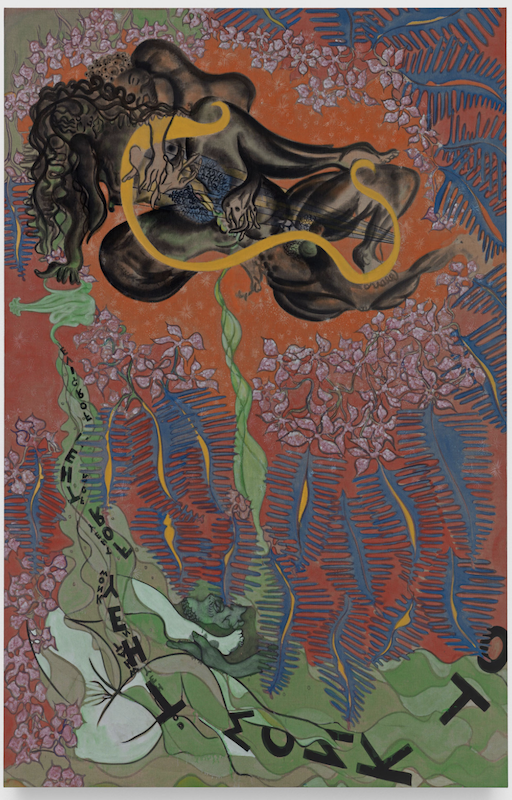
Chris Ofili’s paintings are powerful because they turn visual pleasure into a site of cultural, spiritual, bodily, and moral contradiction.
At first, the work can appear dazzling.
Surfaces shimmer with glitter, resin, beads, dots, layered color, ornamental lines, and fragments of imagery. Figures emerge from dense decorative fields. Sacred references collide with popular culture. Mythological beings share space with contemporary bodies. Beauty, humor, sexuality, violence, religion, caricature, and fantasy can all occupy the same painting.
The images often feel abundant rather than restrained.
They invite the eye through:
Saturated color
Rhythmic pattern
Luminous surfaces
Decorative borders
Repeated dots
Stylized figures
Jewellike details
Layered cultural references
Sensual materials
Dreamlike environments
Yet the pleasure is never simple.
The glitter may intensify a sacred image while also making it theatrical or artificial. Ornament may celebrate beauty while approaching excess. A figure may appear exalted and stereotyped at the same time. Religious imagery may carry reverence, comedy, eroticism, and provocation simultaneously.
Ofili does not treat these forces as contradictions that must be solved.
He allows them to remain active together.
His paintings ask whether beauty can carry historical damage, whether sacred images can survive contact with popular culture, whether identity can be represented without becoming fixed, and whether decoration can function as a serious form of thought.
The Problem Beneath the Work
Ofili’s practice repeatedly returns to a generative problem:
How can painting transform inherited images, cultural stereotypes, religious symbols, bodily desire, and decorative beauty into a visual world that resists fixed meaning?
His paintings are not simply celebrations of Black identity, spiritual imagery, or ornamental excess.
They are sites of transformation.
A stereotype can become a mask, a joke, an accusation, or a self-authored image.
A religious figure can become sacred and profane at once.
Glitter can operate as beauty, artificiality, spectacle, devotion, and seduction.
Pattern can create visual pleasure while also complicating access to the image.
A culturally loaded material can be treated as abject, sacred, comic, bodily, sculptural, or ceremonial.
Ofili’s paintings repeatedly take forms that arrive with established meanings and place them under enough pressure that those meanings begin to shift.
His work bridges figuration and abstraction while drawing from a broad range of cultural and aesthetic sources. His galleries describe the paintings as investigations into desire, identity, representation, and creative transformation rather than as expressions of one stable iconography. (Victoria Miro)
The deeper problem is not simply how to represent identity.
It is how to keep identity, culture, spirituality, and desire from hardening into a single interpretation.
Decoration as a Way of Thinking
One of the most important achievements in Ofili’s work is the transformation of decoration into structure.
Decoration is often treated suspiciously in serious art. It may be dismissed as:
Surface pleasure
Excess
Distraction
Fashion
Craft
Sentimentality
Commercial appeal
Visual entertainment
Ofili does not reject those associations.
He works through them.
His paintings may be intensely attractive. The surfaces shimmer. Repeated dots produce rhythm. Borders frame and contain the image. Color creates density and atmosphere. Decorative elements slow the eye and encourage close inspection.
But ornament does more than beautify the painting.
It regulates visibility.
A figure may emerge only gradually from the patterned field. Dots can both describe and interrupt the body. Glitter can illuminate the image while flattening it into a reflective surface. Repetition can unify the painting while making it more difficult to separate figure from environment.
Decoration becomes active because it changes how the image can be seen.
The pattern does not sit on top of the meaning.
It produces the conditions through which meaning appears.
This is one of Ofili’s largest contributions to contemporary painting:
He demonstrates that ornament can carry history, identity, spirituality, pleasure, concealment, excess, and perceptual uncertainty at the same time.
The Surface as a Cultural Collision
Ofili’s paintings frequently bring together sources that conventional cultural hierarchies might keep separate.
These can include:
Catholic imagery
African and diasporic visual traditions
Hip-hop
comic books
pornography
mythology
popular music
devotional painting
art history
caricature
botanical imagery
Trinidadian culture
Carnival
contemporary politics
The result is not a neutral collage of references.
Each source changes when placed beside the others.
Sacred imagery becomes bodily.
Popular imagery gains ritual weight.
Caricature becomes both critique and self-conscious performance.
Pornographic fragments become decorative, grotesque, humorous, or accusatory.
High art and popular culture no longer remain securely separated.
This matters because cultural identity is rarely formed from one pure source.
It is layered, inherited, imposed, chosen, performed, and revised.
Ofili’s paintings behave in the same way.
They do not present culture as a stable inheritance.
They show culture being continually assembled.
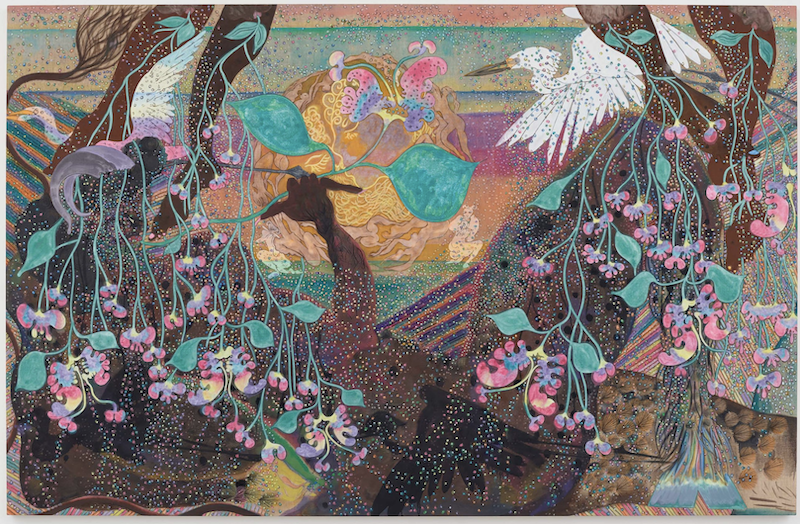
Material That Refuses Neutrality
Ofili became internationally famous partly through his use of elephant dung, glitter, beads, resin, collage, and other unconventional materials.
These materials attracted enormous attention, especially when used in religious works such as The Holy Virgin Mary. But their importance extends beyond provocation.
Elephant dung carries several possible associations:
Bodily waste
Fertility
Nature
Africa
Sacred matter
Humiliation
Humor
Sculpture
Ritual
Stereotype
Cultural projection
The material cannot be assigned one meaning.
A viewer may initially treat it as abject or insulting. Another may understand it through fertility, ritual, earth, bodily life, or sculptural support. The tension among these readings becomes part of the work.
Ofili often used pieces of dung as painted elements and as supports beneath canvases, preventing the material from remaining merely a shocking addition to the surface. It became structural, symbolic, humorous, and materially necessary.
This is important.
A provocative material becomes stronger when it does more than attract attention.
It must alter the object’s logic.
In Ofili’s early paintings, the unusual support changes the viewer’s relationship to the painting. The canvas no longer appears to float neutrally on the wall. It rests on culturally and bodily charged matter.
The supposedly elevated object depends on what polite culture might prefer to reject.
The Sacred and the Profane
Ofili repeatedly draws sacred and profane imagery into the same visual field.
This is not simply irreverence.
Religious traditions themselves often hold contradictions involving:
Spirit and flesh
Purity and sin
Reverence and fear
Transcendence and suffering
Ecstasy and discipline
Beauty and sacrifice
Divine perfection and human desire
Ofili’s paintings bring these contradictions into contemporary visual form.
A sacred figure may be sensuous, stylized, comic, monumental, or materially impure. A mythological scene may become psychologically contemporary. Sin may appear seductive rather than morally simple.
His later series The Seven Deadly Sins does not assign one painting neatly to each sin. Instead, the works encompass broader fields of excess, attraction, transgression, and human behavior. The gallery describes these paintings as dreamlike spaces where human and mythological beings coexist under forces of attraction and repulsion. (Victoria Miro)
This refusal of moral clarity is central.
The paintings do not illustrate sin as a set of lessons.
They make sinfulness feel like a condition of being human.
Beauty That Cannot Remain Innocent
Ofili’s work often offers beauty immediately.
The color is rich.
The surface sparkles.
The compositions can feel lush, rhythmic, and sensuous.
But beauty in these paintings is never completely innocent.
It may attract the viewer toward an image containing violence, stereotype, sexuality, shame, racial history, or moral ambiguity.
The pleasure of looking becomes complicated.
This creates a central pressure:
The viewer enjoys the surface while becoming uncertain about what that enjoyment means.
Is the glitter celebratory?
Is it excessive?
Is it devotional?
Is it artificial?
Is the decorative field protecting the figure or turning the figure into spectacle?
Is the beauty resisting stereotype or making stereotype newly consumable?
The paintings rarely answer these questions.
They keep the viewer inside them.
The Black Figure and the Problem of Representation
Ofili emerged in a cultural environment where Black figures were often either absent from major painting traditions or burdened with representational expectations.
A Black artist could be expected to produce work that was:
Politically legible
Socially responsible
Authentically representative
Oppositional
Educational
Easily interpretable
Corrective of historical absence
Ofili resisted this narrowing.
His figures can be comic, divine, erotic, absurd, glamorous, grotesque, mythological, foolish, vulnerable, heroic, or morally unstable.
They do not bear the burden of presenting one approved image of Blackness.
This gives the work freedom.
Black identity becomes expansive rather than exemplary.
It can include stereotype and fantasy, beauty and failure, cultural pride and cultural contradiction.
The figure is not liberated by becoming ideal.
The figure is liberated by being allowed complexity.
This distinguishes Ofili’s practice from art that treats positive representation as the only corrective to harmful imagery.
Ofili often works closer to transformation:
He takes charged images and subjects them to enough invention that they can no longer remain what they were.
Why the Formal Choices Matter
Ofili’s work is visually distinctive, but its power depends on what the formal choices do.
Repetition creates rhythm and ritual
Repeated dots are one of the most recognizable features of his early paintings.
They can evoke:
Beads
Cells
stars
lights
skin
music
decoration
counting
ceremony
visual noise
Repetition slows the process of making and looking.
Each dot is small, but the accumulation creates an atmosphere larger than the individual mark.
This can make the surface feel ritualized.
The repetition appears devotional and obsessive at once.
It also prevents the viewer from separating figure and ground too easily. The image is embedded within a field of repeated attention.
Glitter creates unstable light
Glitter reflects rather than simply holds color.
Its appearance changes with light, angle, and movement.
This means the surface cannot be experienced fully from one fixed position.
Glitter introduces:
Seduction
instability
theatricality
artificiality
celebration
kitsch
spectacle
luminosity
A sacred image rendered in glitter may feel radiant and devotional.
It may also feel commercial, excessive, or visually unreliable.
That instability is precisely why the material matters.
Resin creates depth and preservation
Resin can seal materials beneath a smooth surface.
It preserves and distances at the same time.
The viewer can see what lies beneath but cannot touch it directly.
This gives the painting a layered, almost archaeological structure.
Images, fragments, dots, and materials appear suspended inside the work.
Resin therefore turns surface into memory.
It protects the image while making its separation from the viewer visible.
Collage interrupts visual unity
Fragments from magazines and other printed sources introduce images that were created for different purposes.
A pornographic fragment may enter a sacred composition.
A popular image may become part of an ornamental system.
The imported image retains traces of its former context while being altered by the new one.
Collage makes cultural collision physically visible.
It prevents the painting from pretending to come from one unified visual tradition.
Dense pattern controls access
Pattern can overwhelm figure and narrative.
A body may be present without becoming immediately legible.
This creates a delayed encounter.
The viewer must search through surface pleasure to locate the image.
Pattern therefore becomes both invitation and obstruction.
Color creates emotional and cultural atmosphere
Ofili’s early paintings frequently use vibrant, high-key color.
Later works, especially after his move to Trinidad, explored darker blue and nocturnal palettes. These paintings require the viewer’s eyes to adjust, allowing figures and scenes to emerge gradually from darkness. His major Night and Day survey emphasized this transition toward moonlit blue works and a more atmospheric visual language. (Wikipedia)
This shift demonstrates that Ofili’s practice is not dependent on one decorative formula.
The underlying concern remains transformation and partial visibility.
In the bright paintings, excess complicates access.
In the blue paintings, darkness complicates access.
The visual solution changes while the deeper problem survives.
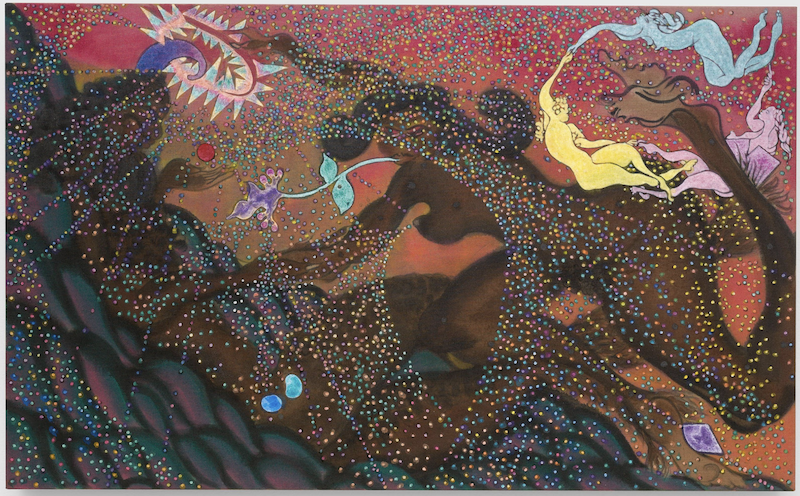
Night Vision and Slow Revelation
The blue paintings mark an important development in Ofili’s practice.
Rather than surrounding the viewer with glittering abundance, these works often require patience.
Figures may be difficult to see at first.
Dark blues, silvers, violets, blacks, and subtle lines create nocturnal scenes that gradually become visible.
The eye must adjust.
This changes the viewer’s role.
Looking becomes less immediate and more bodily.
The painting teaches the viewer how to see it.
The longer the viewer remains, the more the image appears.
But the image may never become completely secure.
This is a different form of seduction from the early work.
The bright paintings attract through excess.
The blue paintings attract through withholding.
Both depend on partial access.
Trinidad and the Expansion of the Visual World
Ofili moved to Trinidad in 2005, and the island’s landscape, light, culture, music, Carnival traditions, and mythological atmosphere became increasingly important to the work.
The change did not produce simple tropical imagery.
Instead, it expanded the visual conditions available to the paintings.
Night, foliage, moonlight, bodies, devils, mythology, landscape, and transformation became increasingly active.
The Trinidadian environment also allowed Ofili to move beyond some of the public controversy surrounding his earlier work and deepen the dreamlike and spiritual dimensions of the practice.
The paintings became less dependent on dense material accumulation and more invested in fluid line, atmospheric color, and ambiguous narrative.
This evolution matters because it demonstrates a strong body of work rather than a successful brand.
The recognizable early vocabulary was not endlessly repeated.
The practice changed.
Myth as a Contemporary Structure
Ofili increasingly uses mythology not as historical illustration but as a flexible structure for desire, morality, violence, identity, and transformation.
Myth allows several times to coexist:
Ancient and contemporary
personal and collective
sacred and popular
local and universal
historical and imagined
A mythological figure does not need to belong to one literal moment.
It can carry inherited meaning while also becoming newly strange.
In Ofili’s work, myth creates distance from immediate social explanation.
It allows cultural and psychological questions to become larger than one event.
But myth also introduces risk.
It can universalize too easily or detach the work from specific historical pressures.
Ofili’s strongest works avoid that emptiness because their materials, bodies, references, and cultural sources remain specific even when the narrative becomes dreamlike.
The Viewer’s Position
Ofili places the viewer in several overlapping roles.
The viewer becomes a seeker
Dense surfaces and dark images require sustained attention.
Meaning is not delivered immediately.
The viewer becomes seduced
Color, glitter, pattern, and sensual material create pleasure before interpretation stabilizes.
The viewer becomes morally uncertain
Sacred, profane, comic, erotic, and stereotyped elements coexist.
The viewer cannot rely on one approved response.
The viewer becomes culturally self-conscious
Loaded materials and images expose assumptions.
A viewer may discover that disgust, reverence, offense, or fascination depends partly on cultural expectations brought to the work.
The viewer becomes physically active
Reflective surfaces and dark palettes change according to movement, angle, distance, and time.
The painting cannot be fully grasped from one position.
The Central Contradictions
Ofili’s work holds many opposing forces together:
Sacred and profane
Beautiful and abject
Decorative and politically charged
Comic and serious
Spiritual and bodily
Black identity and resistance to fixed identity
Excessive and controlled
Popular and art historical
Seductive and obstructive
Reverent and irreverent
Mythological and contemporary
Visible and concealed
The deepest contradiction may be:
The paintings offer visual abundance while refusing interpretive certainty.
The viewer receives more color, material, image, and reference than can be easily processed.
Abundance does not produce clarity.
It produces complexity.
The World Ofili Has Built
Ofili’s recurring lexicon includes:
Glitter
dots
beads
resin
elephant dung
dark blue fields
mythological beings
sacred figures
lovers
sinners
devils
foliage
stars
decorative borders
repeated faces
cultural fragments
nocturnal landscapes
flowing lines
bodies in transformation
These motifs do not retain one meaning.
The dot can be decorative, devotional, cellular, musical, or cosmic.
Dung can be abject, sacred, comic, structural, or fertile.
Blue can suggest night, spirit, concealment, melancholy, or erotic atmosphere.
The figure can be icon, stereotype, fantasy, myth, or person.
The lexicon remains alive because the elements continue to change function.
The Risk of Spectacle
Ofili’s work carries several genuine risks.
The glitter and dung can become more famous than the paintings.
Provocation can overshadow structure.
Decoration can become spectacle.
Cultural references can be consumed as exoticism.
Visual abundance can become branding.
Mythology can become atmospheric rather than necessary.
The critical question is whether the formal system continues to transform its sources or merely repeats a recognizable Ofili vocabulary.
The strongest works do not merely combine unusual materials.
They alter how those materials can be understood.
They do not merely present cultural contradiction.
They make contradiction perceptually active.
The Caged Bird’s Song and Translation Across Media
Ofili’s large tapestry The Caged Bird’s Song demonstrates how his concerns extend beyond painting.
The work originated as a watercolor and was translated into a triptych tapestry by Dovecot’s master weavers over several years. Ofili described the project as a tension between the free-flowing behavior of watercolor and the slow, structured process of weaving. He emphasized that the woven work was an interpretation rather than a reproduction. (National Gallery)
This distinction is important.
Translation introduces transformation.
The image must pass from one material logic into another.
Liquid pigment becomes thread.
Spontaneity becomes accumulated labor.
A private painted gesture becomes a collaborative object.
The image survives, but it does not remain the same.
That process reflects a larger principle running through Ofili’s practice:
Cultural forms remain alive not by staying pure, but by changing as they move.
Why the Work Belongs to the Present
Ofili’s work speaks to a contemporary world shaped by:
Hybrid identities
Migration
diasporic culture
contested symbols
visual stereotypes
religious conflict
popular media
cultural appropriation
moral polarization
struggles over representation
tension between pleasure and politics
Contemporary culture often demands that images declare what side they occupy.
Ofili resists that demand.
His paintings remain morally, culturally, and visually unstable.
This does not make them politically empty.
It allows them to reveal how images gather contradictory meanings.
A symbol may be sacred to one viewer and offensive to another.
A material may signify Africa, waste, fertility, stereotype, nature, or provocation depending on the context.
A decorative surface may celebrate identity while also exposing the desire to consume difference.
Ofili’s work remains contemporary because it understands that cultural meaning is contested rather than fixed.
What Artists Can Learn
The lesson is not to imitate Ofili’s glitter, dots, elephant dung, jeweled surfaces, sacred imagery, mythological figures, or dark blue palette.
Those are the visible solutions produced by his particular investigation.
The larger lesson is that beauty and decoration can become serious when they alter how meaning is produced.
Ofili demonstrates that:
Ornament can control visibility.
Repetition can become ritual.
Material can carry cultural contradiction.
Beauty can complicate moral judgment.
Sacred and profane imagery can remain active together.
Identity can be expanded by refusing ideal representation.
Cultural sources can be transformed rather than merely quoted.
Darkness can slow perception.
Excess can obstruct as well as seduce.
A visual language can evolve radically without losing its underlying problem.
Translation across media can preserve an image by changing it.
His paintings do not treat culture as a stable set of symbols.
They treat culture as a field of transformation.
The sacred becomes bodily.
The bodily becomes spiritual.
The decorative becomes political.
The abject becomes precious.
The stereotype becomes unstable.
The image becomes myth.
Myth returns as contemporary experience.
The lesson is not to copy the appearance of the work. It is to understand the pressure that made the appearance necessary.
Chris Ofili turns beauty, ornament, cultural inheritance, and contradiction into a visual world where no image is allowed to keep only one meaning.
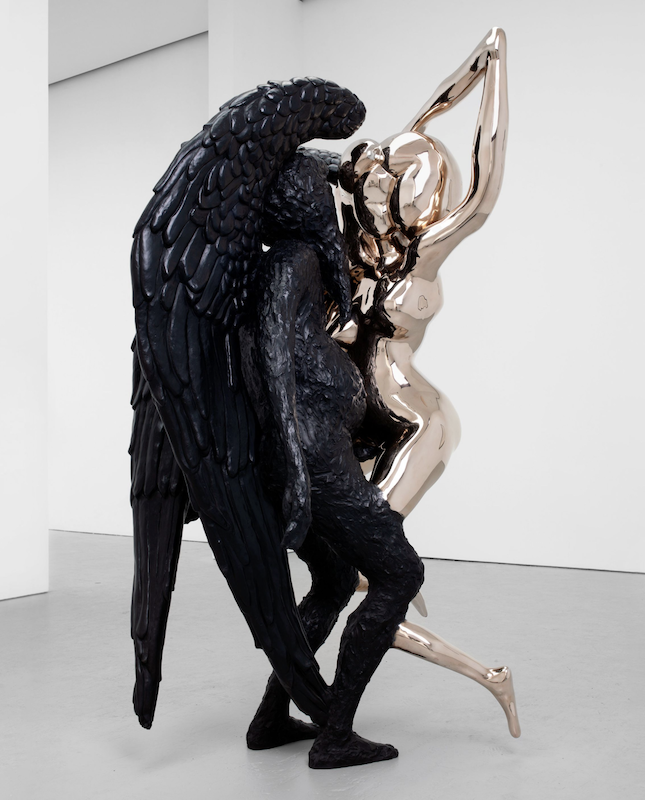
What Makes Mark Bradford’s Work So Powerful?
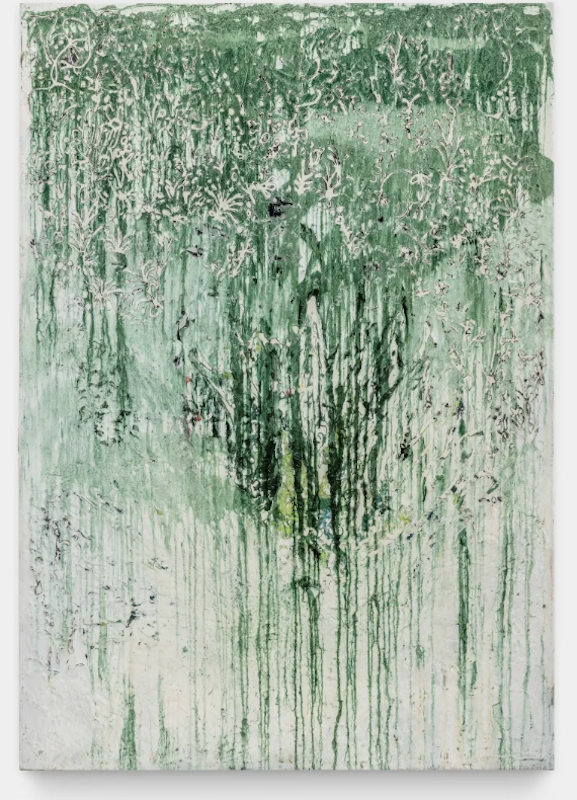
Mark Bradford’s work is powerful because he turns the physical remains of urban life into abstract maps of power, movement, damage, exclusion, and survival.
At first, his paintings can appear to be enormous fields of visual activity. Lines cross and knot. Grids emerge and collapse. Bright colors break through dirty whites, blacks, browns, reds, yellows, and blues. Surfaces appear torn, weathered, scraped, excavated, burned, or eroded.
From a distance, the works may resemble:
Aerial maps
Street networks
Electrical systems
Geological formations
Crowds
Damaged walls
Transportation routes
Data visualizations
Explosions
Ruins
Up close, their apparent imagery breaks down into paper, adhesive, string, fragments of printed language, paint, and accumulated material.
Bradford’s work is often described as abstraction, but it does not withdraw from the social world.
It is built from that world.
Advertisements, merchant posters, billboards, salon papers, comic books, newspapers, maps, and other discarded materials carry traces of the neighborhoods, economies, labor systems, desires, and pressures from which they came. Bradford layers, bonds, tears, sands, scrapes, cuts, and excavates these materials until the surface becomes both image and evidence. (Hauser & Wirth)
His paintings do not illustrate social systems from a safe distance.
They make those systems material.
The Problem Beneath the Work
Bradford’s work repeatedly returns to a central problem:
How can abstraction reveal the social, economic, geographic, and political forces that organize urban life without reducing those forces to a simple illustration or message?
The city is not merely a subject in his work.
It is a structure.
Urban life appears through:
Grids
Routes
Divisions
Accumulations
Barriers
Erasures
Repeated lines
Damaged surfaces
Crowded information
Zones of visibility and disappearance
These structures can resemble the systems through which cities distribute opportunity and risk.
Some neighborhoods receive investment.
Others are neglected.
Some populations move freely.
Others encounter surveillance, policing, displacement, segregation, or economic exclusion.
Some histories become monumental.
Others are covered, erased, or left to deteriorate.
Bradford transforms these conditions into spatial and material relationships rather than depicting them literally. His gallery describes his work as an exploration of social and political systems that objectify marginalized communities and vulnerable bodies, while his map-based paintings expose the boundaries and biases built into cities, neighborhoods, housing systems, and trade routes. (Hauser & Wirth)
The deeper problem is how to make structural power visible when that power often operates indirectly.
Abstraction Made from the Street
Bradford’s materials matter because they come from lived environments.
He does not begin with neutral paper chosen only for its formal qualities. He has used materials associated with hair salons, informal commerce, advertising, public notices, street communication, and disposable urban culture. The Broad notes that his early material vocabulary included permanent-wave endpapers, bobby pins, and hair dyes from the salon environment in which he grew up and worked. His practice later expanded to incorporate discarded signs, flyers, advertisements, and other remnants of city life. (The Broad)
These materials have already performed social work before entering the studio.
They may have:
Advertised employment
Promised credit
Offered legal assistance
Announced a service
Sold beauty
Targeted a particular neighborhood
Communicated urgency
Marked a wall
Divided public space
Recorded an informal economy
Once placed inside the artwork, they retain traces of those functions even when their language becomes unreadable.
The paper may be torn beyond recognition, but it does not become culturally empty.
It remains paper that has circulated through a particular world.
This gives Bradford’s abstraction an unusual density. The material is both visual and historical. It carries color, texture, typography, labor, commerce, neighborhood identity, and social pressure simultaneously.
Surface as Archaeology
Bradford often builds his paintings by layering material and then removing it.
He attaches paper to the support, covers it, bonds it, and later cuts, sands, tears, scrapes, peels, or grinds back through the accumulated surface. The finished painting is therefore produced through construction and destruction at the same time. (Hauser & Wirth)
This process resembles excavation.
A lower layer becomes visible only because an upper layer has been damaged.
A bright color appears through a wound.
A line survives after the surrounding surface has been stripped away.
A fragment of text emerges but cannot be completely recovered.
The painting begins to behave like a city whose history remains present beneath newer development.
Buildings rise over earlier buildings.
Neighborhoods are renamed.
Walls are repainted.
Businesses disappear.
Populations are displaced.
Infrastructure divides communities.
Official narratives cover local memory.
Yet earlier histories remain embedded in the site.
Bradford’s surfaces give physical form to this accumulation.
They do not present history as a clean sequence. They show it as layers competing for visibility.
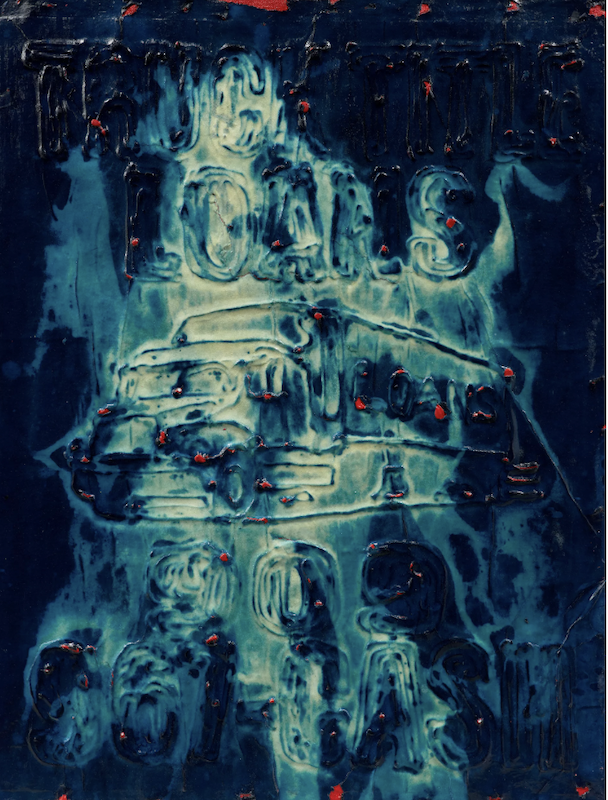
Destruction as a Way of Revealing
In many artistic processes, destruction removes meaning.
In Bradford’s work, destruction often reveals it.
Tearing opens the surface.
Scraping exposes what has been buried.
Erosion produces depth.
Damage creates access to history.
This does not make destruction automatically redemptive. The surfaces can also suggest violence, dispossession, disaster, abandonment, or social fracture.
The important contradiction is that the same action can both injure and uncover.
Bradford’s work therefore holds two opposing possibilities:
A surface can be damaged by history, and damage can be the means through which history becomes visible.
The paintings frequently look as though they have survived something.
But they do not reveal exactly what happened.
They present aftermath without a complete event.
The viewer must read pressure from the condition of the surface.
Why the Formal Choices Matter
Bradford’s large abstract paintings have an immediately recognizable visual language, but their power depends on the necessity behind that language.
Paper carries social circulation
Paper is lightweight, inexpensive, temporary, reproducible, and widely distributed.
It circulates through everyday life in ways that traditional painting materials often do not. It can carry official information, advertising, private appeals, public warnings, entertainment, and economic promises.
By using paper gathered from urban environments, Bradford connects abstraction to systems of communication and exchange.
Paper also remains vulnerable.
It tears, wrinkles, stains, fades, and deteriorates.
Its physical fragility allows social pressure to become visible through damage.
Layering creates historical depth
Each layer adds time.
Earlier decisions are covered but not fully eliminated. Later interventions alter the meaning of what came before.
The surface becomes an archive without becoming a readable document.
This is crucial. Bradford does not simply present research or historical information. He transforms accumulated material into a condition the viewer must encounter bodily.
History becomes density, obstruction, residue, and pressure.
Grids create systems
Grids appear repeatedly in Bradford’s work.
They may resemble streets, city blocks, maps, networks, property divisions, institutional plans, or systems of circulation.
A grid promises order.
It divides space into units.
It suggests that the world can be organized, surveyed, controlled, or navigated.
But Bradford’s grids rarely remain stable. They break, buckle, disappear beneath material, become tangled, or collide with irregular forms.
The grid becomes a model of imposed structure under pressure.
It may organize the city, but it also reveals who controls that organization.
Lines create routes and restrictions
Lines in Bradford’s paintings can resemble roads, borders, transportation paths, wiring, veins, cracks, or movements through crowds.
A line may offer passage.
It may also create separation.
This dual function allows the paintings to hold mobility and confinement at once.
The same visual element can suggest connection, escape, surveillance, access, or exclusion.
Scale creates public experience
Bradford’s paintings are often monumental.
Some stretch across entire walls and exceed the viewer’s field of vision. Deep Blue, for example, extends more than fifty feet across, while Tomorrow Is Another Day spans nearly eighteen feet. (The Broad)
At that scale, the painting behaves less like a private image and more like an environment.
The viewer cannot take it in from one position.
From a distance, the work may resemble a map or total system.
Up close, that apparent system collapses into torn edges, fibers, adhesive, printed fragments, cuts, and scars.
The experience moves between macro and micro:
City and individual
System and material
Geography and body
Structure and wound
Public history and local trace
Scale allows these perspectives to remain active together.
Repetition creates pressure
Repeated lines, fragments, cells, blocks, and gestures can create the feeling of a system operating continuously.
The repetition may evoke:
Bureaucracy
Urban planning
Traffic
Economic circulation
Administrative control
Collective movement
Repeated injury
Accumulated labor
But the repetition is rarely perfectly mechanical.
Irregularities remain.
The system appears powerful but not complete.
Color emerges through damage
Bright color often appears beneath darker or more neutral surfaces.
These colors can feel like signals, buried advertisements, exposed infrastructure, surviving memory, or flashes of vitality.
Because they emerge through tearing and excavation, color does not function merely as decoration.
It becomes evidence that another layer exists below the visible one.
Color may suggest survival, but it may also resemble exposure.
What was protected has been opened.
The Central Contradictions
Bradford’s work holds several forces in unresolved tension:
Abstract and socially specific
Monumental and materially fragile
Ordered and chaotic
Constructed and destroyed
Mapped and disorienting
Public and locally embedded
Beautiful and damaged
Systematic and bodily
Accumulated and erased
Legible and unreadable
The central contradiction may be:
The paintings appear to map social systems while making those systems impossible to comprehend completely.
A viewer may sense roads, boundaries, neighborhoods, crowds, or networks, but no stable legend explains how to read them.
This matters because social systems themselves are often experienced in fragments.
A person encounters a denied loan, a closed business, a longer commute, a police boundary, a changing rent, a missing service, or a neighborhood advertisement.
The larger structure connecting those events may remain invisible.
Bradford’s paintings create a similar relationship between local evidence and systemic uncertainty.
Material and the Body
Bradford’s paintings rarely contain conventional human figures, yet they remain deeply bodily.
The surface is cut, scarred, stretched, scraped, covered, exposed, and repaired.
These actions can evoke bodily experiences without illustrating a body directly.
The painting may resemble:
Skin
Scar tissue
A wound
A bandage
A nervous system
A circulatory network
A body under stress
A body carrying memory
This gives the abstraction emotional and political force.
A city is not merely architecture.
It is experienced through bodies.
Infrastructure determines how long someone travels.
Borders determine who may enter.
Housing systems determine safety and stability.
Economic structures shape health, labor, and exposure.
Public policy becomes physical experience.
Bradford allows material surface to connect structural systems with bodily consequence.
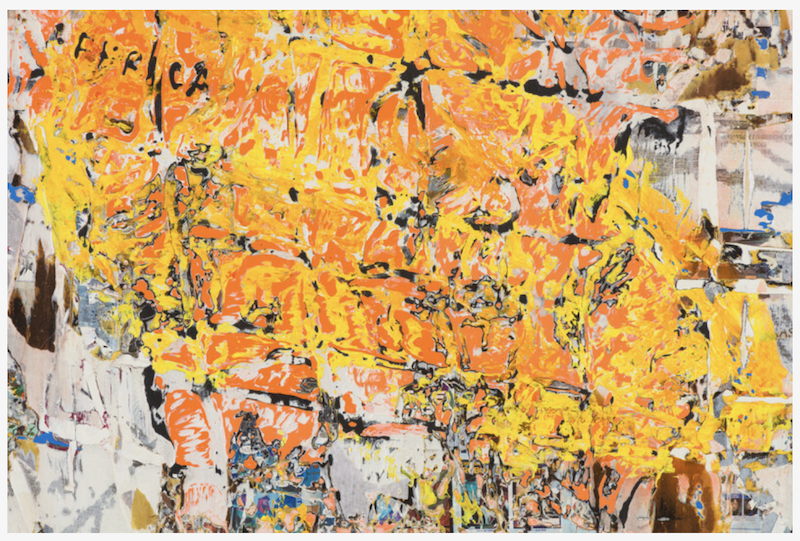
Maps That Cannot Be Neutral
Maps often appear to be objective descriptions of space.
But every map makes choices.
It determines:
What becomes visible
What receives a name
Where boundaries are drawn
Which routes matter
What is placed at the center
What disappears
Who has authority to describe the territory
Bradford’s map-like paintings expose this instability.
His work has drawn upon city plans, neighborhood maps, public-housing layouts, trade routes, and other forms of spatial organization. Rather than treating maps as neutral information, he uses them to investigate how power becomes embedded in geography. (Hauser & Wirth)
The surface may initially appear to provide an overview.
But the overview breaks down.
Routes become tangled.
Borders dissolve.
Areas are blocked.
Information is buried.
The supposedly authoritative view from above becomes uncertain.
This challenges the fantasy that a city can be understood completely from a detached position.
The City as an Unequal Field
Bradford’s abstraction is especially attentive to how urban environments distribute visibility and value.
Public space is covered with signals about what a neighborhood needs and what businesses believe can be sold there.
Advertisements for quick loans, legal services, low-cost goods, employment, housing, beauty, or emergency assistance can reveal economic conditions indirectly.
They form a kind of unofficial portrait of the neighborhood.
By incorporating such material, Bradford allows local economies to enter abstract painting without illustrating individual stories.
The result is not documentary art in a conventional sense.
The evidence has been fragmented.
But its pressure remains.
A torn advertisement may no longer communicate its full message, yet it still carries the urgency, targeting, and visual aggression of street commerce.
History as Something Still Operating
Bradford often engages specific historical events without translating them into conventional narrative images.
Corner of Desire and Piety, for example, uses repeated notices related to propane delivery for FEMA trailers after Hurricane Katrina. Its silver surface behaves like a barrier until the text begins to reveal the social and institutional context embedded within the panels. (The Broad)
Scorched Earth uses a blacked-out aerial map to evoke disappearance, ruin, and the destruction of Black communities. The Broad describes its layered topography as registering both psychological and physical loss. (The Broad)
In works such as these, history does not appear as a scene from the past.
It appears as a condition still embedded in the present.
The material has been damaged because the history remains unresolved.
The Viewer’s Position
Bradford gives the viewer several roles.
The viewer becomes a map reader
From a distance, the eye searches for systems, routes, boundaries, and organizational logic.
The viewer assumes that the surface can be decoded.
The viewer becomes an archaeologist
Up close, the work becomes material evidence.
The viewer studies torn paper, buried language, scars, layers, and exposed fragments.
The viewer becomes physically small
Monumental scale places the body in relation to structures larger than itself.
The painting may feel like a city, institution, wall, or social system that cannot be controlled from one position.
The viewer becomes aware of partial knowledge
No amount of looking produces complete access.
A fragment may reveal something, but the whole remains unstable.
This mirrors the difficulty of understanding systems that people experience personally but cannot observe in their entirety.
The viewer becomes implicated in distance
The map-like view can create the illusion of detached knowledge.
But the damaged materials resist that detachment.
They remind the viewer that every abstract system has material and bodily consequences.
The World Bradford Has Built
Bradford’s recurring lexicon includes:
Maps
Grids
Street lines
Boundaries
Paper
Advertisements
Posters
Repeated text
Blocked zones
Tangled routes
Excavated layers
Blackened areas
Buried color
Damaged walls
Urban residue
Monumental fields
These elements create a recognizable world without functioning as fixed symbols.
A grid may suggest order in one work and confinement in another.
A black field may operate as absence, blockage, protection, or destruction.
A torn surface may suggest violence, archaeology, transformation, or survival.
Paper may function as communication, skin, history, waste, or evidence.
The motifs remain active because their meanings shift with the problem.
Abstraction Without Escape
Abstraction has sometimes been understood as a retreat from politics, narrative, and social specificity.
Bradford demonstrates another possibility.
Abstraction can reveal systems that are too dispersed, large, contradictory, or invisible to be represented through one scene.
A single figurative image might show one person affected by a social structure.
Bradford’s abstraction attempts to model the structure itself.
The painting can hold:
Multiple routes
Accumulated histories
Overlapping populations
Conflicting boundaries
Layers of information
Destruction across time
Movement through unequal space
Abstraction becomes useful precisely because the subject cannot be reduced to one event.
The Risk of Monumental Social Abstraction
Bradford’s work also carries genuine risks.
Large-scale distressed abstraction can become visually spectacular.
A viewer might admire its texture, color, size, and physical intensity without engaging the histories embedded in its materials.
The torn-paper surface could become a recognizable style.
Damage could become an aesthetic.
Social pressure could be reduced to visual drama.
The critical question is therefore:
Does the process make a specific structure, history, or condition newly visible, or does the work merely repeat the appearance of social complexity?
Bradford’s strongest works maintain a connection among material source, process, title, spatial structure, and historical pressure.
The surface does not simply look excavated.
There is something at stake in what has been buried and what becomes exposed.
Why the Work Belongs to the Present
Bradford’s work belongs strongly to a world shaped by:
Urban inequality
Housing pressure
Migration
Infrastructure
Informal economies
Displacement
Environmental disaster
Segregation
Data mapping
Network systems
Public communication
Contested history
Contemporary life is increasingly understood through systems and maps.
People navigate digital networks, transportation systems, economic zones, demographic categories, property boundaries, and algorithmic classifications.
Yet these systems are not experienced equally.
Bradford’s work makes the supposedly abstract structures of contemporary life feel physical.
The grid is torn.
The route is blocked.
The information is buried.
The surface is scarred.
The map no longer appears neutral.
What Artists Can Learn
The lesson is not to imitate Bradford’s monumental scale, torn-paper surfaces, map imagery, grids, street materials, or archaeological appearance.
Those are the solutions produced by his particular investigation.
The larger lesson is that abstraction can remain socially specific without becoming illustration.
Bradford demonstrates that:
Material can arrive with a history already inside it.
Surface can behave like an archive.
Damage can expose rather than merely destroy.
A grid can reveal systems of organization and control.
Maps can make power visible.
Scale can place the body inside a larger structure.
Repetition can evoke bureaucracy, circulation, or accumulated pressure.
Color can operate as buried evidence.
Abstraction can model conditions too complex for a single narrative image.
Social meaning becomes stronger when it is built into the object rather than attached afterward.
His paintings do not simply refer to cities.
They behave like cities.
They accumulate, divide, conceal, circulate, decay, rebuild, and preserve traces of what has been removed.
The lesson is not to copy the appearance of the work. It is to understand the pressure that made the appearance necessary.
Mark Bradford turns abstraction into a material archaeology of the systems that organize public life.
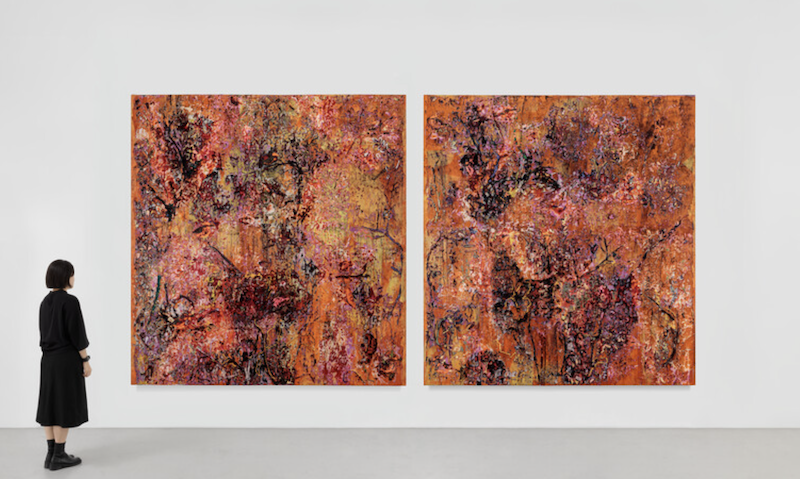
What Makes Cecily Brown’s Paintings So Powerful?
Cecily Brown’s paintings are powerful because they hold the image in a continuous state of becoming and disappearing.
At first, the work can appear overwhelmingly energetic. Bodies, limbs, faces, animals, landscapes, fabrics, flowers, and fragments of art history churn through fields of restless brushwork. Flesh tones collide with greens, reds, blues, yellows, violets, blacks, and dirty whites. Transparent washes pass over thick, opaque marks. Figures emerge for a moment and then dissolve back into paint.
The viewer may recognize an arm, a face, an embracing couple, a reclining body, a flower, a horse, or the suggestion of a landscape. But recognition rarely lasts. Every image threatens to become something else.
Brown’s paintings do not simply alternate between abstraction and figuration. They make the instability between those conditions into the central experience of the work.
The viewer is caught between seeing paint as matter and seeing paint as image.
That perceptual uncertainty carries larger pressures involving desire, touch, appetite, violence, mortality, art history, and the difficulty of possessing what one sees.
The Problem Beneath the Work
Brown’s work repeatedly returns to a generative problem:
How can painting hold bodies, desire, memory, and art history in a state where images continually emerge but never become fully stable or possessable?
Her paintings are not simply gestural abstractions containing hidden figures. Nor are they conventional figurative scenes partially obscured by expressive brushwork.
The deeper problem is the relationship between recognition and dissolution.
A figure begins to appear.
The viewer attempts to complete it.
Another mark interrupts that reading.
The body becomes landscape.
The landscape becomes paint.
A patch of color becomes flesh.
The flesh becomes atmosphere.
This instability matters because desire often begins with partial visibility. Something glimpsed can provoke more attention than something fully described. Brown has explicitly emphasized the power of partial recognition, remarking that what is merely glimpsed can feel more real than what is completely shown. (Gagosian)
The paintings use this condition to keep looking active.
They do not give the viewer a finished image to consume. They create an image that must continually be assembled, lost, and assembled again.
Paint in Continual Transformation
Brown’s paintings seem to remain in motion even after the paint has dried.
A mark may function as several things at once:
A brushstroke
A limb
A fold of fabric
A patch of light
A flower
A bodily opening
A cloud
A shadow
A piece of landscape
This multiplicity gives the paintings their unusual vitality.
Brown has described painting as a form of alchemy in which paint becomes image and both are transformed into something new. Gagosian similarly characterizes her material language as moving between liquid and solid, transparency and opacity, while her compositions shift restlessly between abstraction and figuration. (Gagosian)
The transformation is not merely visual spectacle. It allows the material to behave like the subjects Brown repeatedly explores.
Desire is unstable.
Bodies change.
Pleasure passes.
Life becomes death.
Images are remembered imperfectly.
Art history survives through fragments.
Paint does not simply illustrate these conditions. Its behavior enacts them.
The Body That Cannot Be Secured
Bodies are everywhere in Brown’s work, but they are rarely offered as complete, stable forms.
They appear through fragments:
Bent knees
Open mouths
Eyes
Breasts
Buttocks
Fingers
Backs
Faces
Intertwined limbs
Animal bodies
Human-animal mixtures
At times, multiple figures appear to collide or merge. It becomes difficult to determine where one body ends and another begins.
This uncertainty is central to the erotic force of the work.
Eroticism does not come only from explicit sexual subject matter. It emerges through the instability of boundaries. Bodies appear to enter one another, dissolve into their surroundings, or become inseparable from the act of painting.
The viewer may think a figure has been located, only to realize that the apparent body is produced by several unrelated marks. The eye participates in constructing the erotic image.
The painting therefore places desire partly inside the viewer’s perception.
What is seen depends on what the viewer expects, remembers, imagines, or wants to find.
Desire as Looking
Brown’s paintings frequently make looking feel hungry.
The eye moves quickly across the surface, searching for recognizable forms. A face appears and disappears. A body seems to emerge beneath the brushwork. A dense cluster promises a scene but refuses to become fully legible.
The viewer is encouraged to keep searching.
This makes the act of looking resemble desire itself:
It seeks an object.
It anticipates completion.
It responds intensely to partial revelation.
It becomes frustrated by uncertainty.
It returns to what it cannot fully possess.
The paintings offer continual visual gratification, but they refuse final satisfaction.
This is one reason their sensuality cannot be reduced to sexual imagery. The entire perceptual structure is erotic. The eye approaches, touches, withdraws, loses, and searches again.
The image remains available enough to generate desire but unstable enough to prevent possession.
Why the Formal Choices Matter
Brown’s paintings have a highly distinctive appearance, but their force does not come from energetic brushwork alone. The major formal choices are necessary to the deeper problem.
Abstraction prevents narrative closure
A conventional figurative painting can tell viewers what is happening, who is present, and how bodies relate to one another.
Brown repeatedly interrupts that certainty.
Gesture breaks apart anatomy. Color disconnects objects from natural appearance. Figures collapse into their settings. Marks cover or transform one another.
Abstraction prevents the scene from becoming fixed.
It keeps the image open to several possibilities at once.
Figuration prevents abstraction from becoming merely decorative
Brown does not allow the paintings to settle into pure formalism either.
Fragments of bodies, landscapes, animals, still lifes, and historical compositions continually pull the surface back toward recognizable experience.
The marks carry bodily associations. Pale pinks resemble flesh. Dark openings suggest mouths, eyes, wounds, or shadows. Sweeping forms imply limbs or movement.
Figuration gives the abstraction psychological and erotic pressure.
Each side prevents the other from settling:
Figuration keeps abstraction embodied.
Abstraction keeps figuration unstable.
Layering makes time visible
Brown builds paintings through accumulation, revision, covering, scraping, and overlapping.
Earlier decisions remain partially visible beneath later ones. One image appears to pass through another. Transparent marks reveal what lies underneath, while opaque passages bury previous forms.
The surface records time.
Looking becomes an encounter with several moments at once:
The first image
The revised image
The covered image
The remembered source
The form presently visible
The form that might still emerge
The painting does not illustrate duration. It contains duration materially.
Scale turns looking into bodily immersion
Many of Brown’s paintings are large enough to surround the viewer’s field of vision. All of Your Troubles Come from Yourself, made between 2006 and 2009, measures approximately eight feet in both height and width. (Whitney Museum of American Art)
At this scale, the surface cannot be absorbed as one stable image.
From a distance, viewers may perceive an overall composition. Up close, that composition breaks into marks, drips, edges, stains, and fragments.
The body must move between positions.
The painting changes according to distance:
Far away, an image begins to organize itself.
Closer, that image becomes paint.
Moving sideways, different forms emerge.
Stepping back, the fragments reorganize.
Scale converts uncertainty into a physical experience.
Color creates changing temperatures
Brown’s color is rarely stable or merely harmonious.
Flesh tones may become sickly, lush, overheated, bruised, luminous, or decaying. Greens can suggest vegetation, artificial light, rot, or bodily unease. Reds may carry pleasure, violence, ornament, or exposed flesh. Pale blues and whites can open the surface before darker marks compress it again.
Color moves the paintings between emotional states without assigning a single mood.
The same canvas can feel ecstatic, comic, violent, tender, and exhausted.
Brushwork creates different speeds
Some marks sweep across the surface rapidly. Others are small, hesitant, or concentrated. Thin stains open space. Thick passages slow the eye. Sharp lines create momentary definition before dissolving into broader strokes.
The surface therefore contains several speeds of attention.
The viewer may rush through one area, pause over another, and become trapped inside a dense cluster elsewhere.
Energy is not produced simply by making every mark active. It comes from variation:
Acceleration and pause
Density and openness
Clarity and interference
Expansion and compression
Recognition and loss
The paintings feel alive because their internal rhythms remain unequal.
The Central Contradictions
Brown’s work holds several opposing forces at once:
Figurative and abstract
Seductive and frustrating
Energetic and controlled
Bodily and atmospheric
Pleasurable and violent
Historical and immediate
Comic and grave
Excessive and carefully structured
Recognizable and unstable
Alive and haunted by death
These contradictions do not merely coexist as subjects. They are built into the behavior of the paint.
The central contradiction is:
The paintings make images intensely present while preventing them from becoming fully secure.
The viewer sees more the longer the work is observed, but greater looking does not necessarily produce greater certainty.
Instead, each discovery destabilizes another.
Pleasure and Mortality
Brown’s paintings have often been associated with eroticism, appetite, sensuality, and bodily excess. But pleasure is rarely isolated from mortality.
Her 2023 Metropolitan Museum of Art survey was titled Death and the Maid, bringing together approximately fifty paintings, drawings, sketchbooks, and monotypes from across her career. The exhibition emphasized recurring concerns such as still life, vanitas, mirroring, death, bodily pleasure, and the passage of time. (The Metropolitan Museum of Art)
This relationship between desire and death deepens the work.
Bodies are pleasurable because they are temporary.
Paintings preserve images while showing them dissolving.
Still-life abundance carries the possibility of decay.
Flowers bloom and collapse.
Flesh appears vivid and already on the verge of becoming matter.
Brown’s work often feels caught between an orgy and a battlefield, a garden and a ruin, an ecstatic gathering and an aftermath.
The instability between abstraction and figuration becomes a way of holding life and death within the same surface.
Art History as Living Material
Brown draws extensively from the history of painting, including artists such as Peter Paul Rubens, Nicolas Poussin, Francisco Goya, Édouard Manet, Edgar Degas, Willem de Kooning, Francis Bacon, and Joan Mitchell. Her work also engages still life, vanitas, pastoral scenes, battle painting, erotic imagery, and other inherited genres. (Whitney Museum of American Art)
But these sources do not remain intact.
A historical composition may provide the underlying arrangement of bodies, only to be fragmented by gesture. A pastoral scene may become erotic, violent, or chaotic. A still life may merge with flesh. A familiar pose may survive as only a bent limb or curved passage of paint.
Brown treats art history as material rather than authority.
She does not simply quote earlier paintings to demonstrate knowledge. She breaks them apart, layers them with other sources, and allows their fragments to become active inside a contemporary visual field.
This transformation matters because historical paintings already contain cultural ideas about:
Gender
Beauty
Violence
Desire
Power
Class
Nature
The body
The role of the viewer
By destabilizing their compositions, Brown also destabilizes the meanings they carried.
Her paintings ask what remains alive in an inherited image after its narrative, hierarchy, and historical certainty have been disturbed.
The Female Body and the History of Looking
Brown entered a tradition in which large-scale gestural painting had often been associated with masculine authority, while the female body had frequently been presented as an object for male viewing.
Her work occupies both positions at once.
She assumes the physical scale, painterly freedom, and gestural ambition historically associated with major male painters. At the same time, she fills those fields with unstable bodies, sexual imagery, pleasure, humor, and ambiguity.
This does not simply reverse the gaze or replace one authority with another. The figures often remain too unstable for a fixed relationship between observer and observed.
Who is looking?
Who is being looked at?
Where does one body begin?
Is the viewer witnessing pleasure, inventing it, or participating in the construction of the scene?
The work does not offer a clean answer.
That uncertainty prevents the female body from becoming a stable object while also preventing the painting from becoming a straightforward statement of empowerment.
The problem remains active inside perception.
The Viewer’s Position
Brown gives the viewer an unusually active role.
The viewer becomes a hunter for images
The surface invites searching.
A recognizable form produces a moment of reward, encouraging further inspection.
The viewer becomes a collaborator
Because forms are incomplete, the viewer helps construct them. Marks become bodies partly through expectation and association.
The viewer does not merely receive the image. The viewer participates in making it.
The viewer becomes aware of desire
The attempt to uncover bodies and scenes can reveal the viewer’s own appetite for recognition, intimacy, sexuality, narrative, or visual control.
The viewer becomes physically mobile
Large scale requires changes in distance. No single position provides a complete experience.
The viewer becomes uncertain
The painting repeatedly withdraws what it seemed to reveal.
This instability prevents passive consumption. The viewer must continue negotiating between paint, image, memory, and projection.
The World Brown Has Built
Brown’s artistic world contains a recurring lexicon:
Fragmented bodies
Erotic encounters
Animals
Flowers
Landscapes
Gardens
Battle scenes
Still lifes
Mirrors
Beds
Limbs
Faces
Swirling clusters
Flesh-like color
Transparent washes
Dense fields
Art-historical fragments
These elements do not remain fixed symbols.
A flower may resemble an opening in the body.
A limb may become a branch.
A landscape may become a mass of flesh.
A sexual encounter may become a battle.
A still life may become a vanitas image.
A historical source may become a contemporary perceptual event.
This is what turns repetition into a lexicon rather than a brand. The motifs return, but their meanings remain unstable.
Coherence Inside Apparent Chaos
Brown’s paintings can initially look spontaneous or chaotic. Yet their vitality depends on strong internal organization.
Dense passages are balanced by areas of relative openness. Dark marks anchor lighter fields. Repeated curves move the eye across the canvas. Color reappears in separated areas to establish relationships. Figures may be obscured, but their underlying arrangements often come from carefully studied historical compositions.
The paintings do not abandon structure.
They conceal and destabilize it.
This distinction is essential.
Random activity would produce visual noise. Brown’s work produces governed instability. The viewer senses that the image is under pressure rather than merely disorganized.
The strongest paintings make chaos feel necessary because multiple systems remain active simultaneously:
Historical composition
Bodily recognition
Material gesture
Color rhythm
Erotic suggestion
Spatial ambiguity
Narrative fragments
The surface pulses because these systems continually support and interrupt one another.
The Risk of Painterly Excess
Brown’s visual language carries a real danger.
Expressive brushwork, erotic fragments, art-historical references, and the oscillation between abstraction and figuration can become an easily recognizable formula.
A dense surface is not automatically complex.
A hidden figure is not automatically psychologically charged.
Energetic paint is not automatically alive.
The critical question is whether each painting produces a specific perceptual and emotional condition or merely repeats the established Cecily Brown effect.
Her strongest works create a carefully calibrated struggle between recognition and dissolution. The image emerges enough to matter but never enough to become fixed.
A weaker version of the method would merely scatter bodily clues throughout expressive paint.
This risk offers a larger distinction:
Complexity depends not on how much is present, but on how many meaningful relationships remain active.
Why the Work Belongs to the Present
Brown works deeply within the history of oil painting, yet her paintings model a distinctly contemporary condition.
Modern viewers encounter images in fragments:
Cropped photographs
Rapid video cuts
Layered screens
Scrolling feeds
Partial memories
Overlapping references
Bodies transformed into visual content
Images consumed before they can be fully understood
Brown’s paintings slow this instability down without resolving it.
They present a field in which too much visual information is available, yet certainty remains difficult. Recognition happens quickly and disappears just as quickly.
The paintings therefore address more than the history of abstraction.
They examine how perception operates in a culture of visual excess.
The viewer sees continually but cannot secure what is seen.
What Artists Can Learn
The lesson is not to imitate Brown’s energetic brushwork, fragmented bodies, fleshy palette, large canvases, erotic imagery, or art-historical references.
Those are the visible solutions produced by her particular problem.
The larger lesson is that instability can become a precise artistic structure.
Brown demonstrates that:
Abstraction can keep an image from closing.
Figuration can give gesture bodily pressure.
Layering can make time physically visible.
Scale can turn perception into movement.
Color can shift emotional temperature.
Art history can become active material rather than quotation.
Partial visibility can intensify desire.
The viewer’s search for meaning can become part of the artwork.
Energy becomes meaningful when several visual systems remain in productive conflict.
The paintings do not merely look energetic.
Their energy comes from the fact that nothing is permitted to remain one thing for long.
Paint becomes flesh.
Flesh becomes landscape.
Pleasure becomes violence.
History becomes immediate sensation.
Recognition becomes uncertainty.
Life moves toward death and then returns as paint.
The lesson is not to copy the appearance of the work. It is to understand the pressure that made the appearance necessary.
Cecily Brown turns painting into a field where bodies, images, desire, and history continually emerge without ever becoming fully possessable.
What Makes Michaël Borremans’s Paintings So Powerful?
Michaël Borremans’s paintings are powerful because they use the authority of traditional painting to make images feel less trustworthy.
At first, the work appears familiar. A face emerges from a muted background. A child sits or sleeps. A solitary figure wears an unusual costume. A group performs an activity whose purpose is unclear. The lighting recalls an old photograph, a film still, or a European painting from another century.
The scenes are beautifully rendered. Flesh appears soft and luminous. Forms emerge through restrained tonal shifts. The compositions feel controlled, quiet, and deliberate.
Yet the longer the paintings are observed, the less stable they become.
The figures remain visible but psychologically inaccessible. Their actions appear purposeful, but the purpose is withheld. Their costumes suggest social roles without explaining them. Their environments resemble stages, laboratories, classrooms, ceremonies, or institutional spaces, yet none of those interpretations becomes secure.
The image looks convincing.
What it means remains uncertain.
The Problem Beneath the Work
Borremans repeatedly returns to a central problem:
How can painting make an image appear convincing while revealing that appearance, identity, and meaning are fundamentally unstable?
This is why his technical refinement matters so much.
If these scenes were painted carelessly, their irrationality might appear accidental. Because they are rendered with such control, the viewer assumes that every object, gesture, costume, and expression has been placed there for a reason.
The paintings create confidence before undermining it.
Traditional Western painting often used technical authority to make religious figures, rulers, historical events, social hierarchies, and human identities appear believable and significant. Borremans inherits that authority but changes what it does.
His paintings do not make their subjects easier to understand.
They make uncertainty feel authoritative.
The work asks whether an image can reveal a person at all—or whether it merely creates a persuasive surface onto which viewers project stories, emotions, identities, and judgments.
A World of Staged Appearances
Borremans’s paintings frequently feel staged.
The figures appear posed, costumed, arranged, instructed, examined, or made to perform. Yet the person or system directing the performance remains outside the frame.
This creates the impression that an invisible authority governs the scene.
It might be:
The artist
The camera
Social convention
An institution
Political ideology
Art history
The viewer
The image itself
The paintings rarely identify that authority directly. Instead, they show its effects.
A figure has been placed in a room.
A body has been positioned for inspection.
A costume has been assigned.
An activity is taking place.
But the rules remain inaccessible.
This withheld causality creates much of the psychological pressure. The viewer encounters the evidence of a system without being allowed to understand the system itself.
Borremans’s practice has long crossed painting, drawing, photography, and film, and his work retains a strong awareness of photographic cropping, constructed scenes, selective focus, and mediated imagery. His paintings have been described as meticulously composed works that resist immediate interpretation and challenge the apparent stability of representation. (David Zwirner)
Beauty as a Form of Unease
One of the most important qualities of Borremans’s work is that beauty does not resolve the paintings.
It intensifies them.
His paint handling can be elegant and sensual. Faces glow softly. Clothing catches subdued light. Browns, grays, ochres, faded reds, dirty whites, and restrained flesh tones create visual harmony.
That harmony attracts the viewer.
But the pleasure of looking soon becomes uncomfortable.
The subject may appear vulnerable, passive, artificial, exposed, or controlled. A beautifully painted face may resemble a person, a mannequin, a sculpture, a specimen, or a detached prop. A graceful costume may conceal identity rather than express it. A tender scene may contain the atmosphere of humiliation, punishment, or threat.
The viewer is drawn toward an image that cannot be trusted.
Beauty therefore becomes part of the problem.
It does not decorate the uncertainty. It creates the confidence that uncertainty later disrupts.
Why the Formal Choices Matter
Borremans’s visual language is highly coherent because the major formal choices all support the same deeper investigation.
Technical refinement creates authority
The paintings borrow the visual credibility of European figurative painting.
Careful modeling, subdued illumination, tonal control, and convincing bodily presence tell the viewer that the image deserves attention. The technique gives the scene weight before the narrative begins to fracture.
The refinement is not merely evidence of skill.
It creates the trust that the painting will eventually undermine.
Muted color withholds emotional instruction
Bright color can quickly direct interpretation. Red may signal danger. Yellow may suggest warmth. Blue may imply sadness or distance.
Borremans’s restrained palette rarely provides such simple instructions.
Instead, color creates atmosphere without determining how the viewer should feel. The same brown-gray world can appear tender, institutional, historical, theatrical, oppressive, or dreamlike.
The emotional temperature remains unstable.
Isolation removes explanatory context
Figures often appear against sparse or indeterminate backgrounds.
This removes the information that might make the scene understandable:
Where is the figure?
What occurred before this moment?
What will happen next?
Who else is present?
Is the figure acting voluntarily?
Is the scene real, imagined, rehearsed, or remembered?
The missing environment becomes psychologically active.
The less context the painting provides, the more intensely the viewer examines the remaining evidence.
Cropping suggests a missing world
Borremans often uses photographic and cinematic framing. Bodies may be cut off by the edge. A scene may resemble a fragment extracted from a much larger event.
This suggests that the explanation exists somewhere outside the visible image.
The painting appears to withhold precisely the information that would make it legible.
Selective focus destabilizes reality
Some passages are sharply described, while others dissolve into soft edges and tonal haze.
This resembles the behavior of photography, memory, and attention. The effect allows the scene to feel physically convincing without becoming fully secure.
The image is neither straightforward realism nor an obvious dream.
It occupies a more disturbing territory between the two.
Costume turns identity into performance
Costumes imply social roles, historical periods, occupations, ceremonies, disguises, hierarchies, or forms of discipline.
Yet Borremans’s costumes rarely clarify who the figures are.
Instead, they separate the visible role from the unknown person beneath it.
Identity begins to feel assigned rather than naturally expressed.
Scale controls intimacy and power
Many of Borremans’s paintings are relatively small. Sleeper, painted in 2007–2008, measures only 40 by 50 centimeters. The intimate scale requires viewers to move close, creating a private encounter with a subject who remains psychologically unavailable.
Other works become monumental. Large Rocket from 2019 measures three meters high, transforming a strangely costumed figure into an imposing public presence.
Small scale makes looking intimate.
Large scale makes the irrational authoritative.
Both serve the same problem.
The Central Contradictions
Borremans’s paintings remain alive because they hold multiple opposing truths without resolving them.
They are:
Beautiful and disturbing
Intimate and inaccessible
Historical and contemporary
Controlled and irrational
Tender and cruel
Specific and anonymous
Human and object-like
Visible and unknowable
The deepest contradiction may be this:
The subjects are made intensely visible while being denied stable identity.
This distinguishes Borremans’s work from paintings that merely use mystery as atmosphere.
The ambiguity is not vague. The details are often extremely precise. What remains unstable is how those details should be interpreted.
Vagueness provides too little information to produce meaningful thought.
Borremans provides enough information to produce several incompatible explanations.
The Viewer’s Position
Borremans does not leave the viewer outside the problem.
The paintings make looking itself feel unstable.
The viewer becomes a voyeur
Many figures appear unaware of being watched. They sleep, look downward, turn away, perform an activity, or remain psychologically elsewhere.
The viewer receives access without reciprocity.
The viewer becomes an examiner
Because the scene is unexplained, every detail becomes evidence.
Posture, clothing, skin, gaze, gesture, setting, and scale are inspected for clues. The figure begins to resemble a specimen whose condition must be diagnosed.
The viewer becomes a projection machine
The work does not provide a secure emotional interpretation, so the viewer supplies one.
The figure appears:
Vulnerable
Sinister
Humiliated
Innocent
Artificial
Exhausted
Controlled
Dead
Asleep
These interpretations may reveal as much about the viewer as they do about the painting.
The viewer becomes a consumer of beauty
The surface may remain pleasurable even when the scene feels ethically or psychologically uncomfortable.
The viewer must confront the possibility of enjoying an image that appears to expose, isolate, or objectify its subject.
Borremans does not directly accuse the viewer. He creates enough uncertainty for the viewer’s own habits of looking to become visible.
Painting as an Unreliable Object
Borremans has stated that a painting is not merely an image but an object with a multilayered character. That distinction helps explain why his work cannot be reduced to enigmatic subject matter. (Art Institute of Chicago)
The physical painting matters.
Its scale determines the viewer’s bodily distance.
Its surface alternates between illusion and visible paint.
Its historical appearance carries cultural authority.
Its material presence slows down an image that might otherwise be consumed quickly.
The work therefore asks two questions at once:
What does this image appear to show?
And:
What kind of object is producing that appearance?
The paintings do not merely depict unstable realities. They expose painting itself as a device for constructing belief.
The World Borremans Has Built
Borremans has developed a recognizable artistic world from recurring elements:
Muted theatrical light
Isolated figures
Passive or sleeping bodies
Costumes and disguises
Unexplained tasks
Artificial rooms
Curtains and stages
Selective focus
Strange ceremonies
Historical echoes
Quiet menace
Suspended time
These motifs form more than a recognizable style.
They express a consistent way of seeing:
Human beings exist inside systems of representation, performance, categorization, and power that they do not fully control.
The works do not need to depict the same subject because the same intelligence governs them.
A child, a masked figure, a commuter, an animal, or a porcelain object can enter this world and become subject to its rules.
A recent museum survey brought together nearly fifty paintings from two decades, including portraits, animals, objects, early works, and major series. The range demonstrates how Borremans has sustained a recurring representational problem without limiting the practice to one subject.
The Risk of a Recognizable Formula
Borremans’s method carries a genuine danger.
The combination of muted color, technical refinement, isolated subjects, unexplained activity, and psychological unease is highly recognizable. What begins as a coherent world could eventually harden into a brand.
An enigmatic image is not necessarily a profound one.
The important critical question is whether each painting discovers a new dimension of the central problem or simply reproduces the established Borremans effect.
The strongest works make uncertainty specific.
The weaker possibility would be mystery applied as a familiar atmosphere.
This distinction matters when studying any artist with a recognizable visual language. Coherence creates identity, but too much predictability turns identity into formula.
Why the Work Feels Contemporary
Borremans’s paintings may resemble historical European art, but their central problem belongs strongly to the present.
Contemporary life is saturated with constructed images:
Social-media identities
Advertising
Political image management
Cinematic framing
Public relations
Artificial personas
Edited photographs
Algorithmic feeds
Synthetic images
Deepfakes
People are more visible than ever, yet visibility does not necessarily produce knowledge.
A face can circulate everywhere while the person behind it remains inaccessible. An image can feel intimate while being completely staged. Technical realism can create credibility without truth.
Borremans’s paintings understand this condition without illustrating phones, screens, software, or social media.
Their contemporary force lies deeper:
They examine the authority images exercise even when their meanings cannot be trusted.
What Artists Can Learn
The lesson is not to imitate Borremans’s muted palette, Old Master technique, isolated figures, strange costumes, or enigmatic narratives.
Those are the visible results of his investigation.
The larger lesson is that every formal choice can participate in a central problem.
Technical refinement can create trust.
Beauty can conceal danger.
Cropping can activate missing information.
Scale can control intimacy and authority.
Costume can separate identity from appearance.
Background can withhold context.
Ambiguity can expose the viewer’s need for certainty.
Borremans demonstrates that visual restraint does not require conceptual restraint. A quiet painting can contain enormous pressure when what is visible conflicts with what can be known.
The lesson is not to copy the appearance of the work.
It is to understand the pressure that made the appearance necessary.
Michaël Borremans uses the authority of painting to undermine the authority of images.
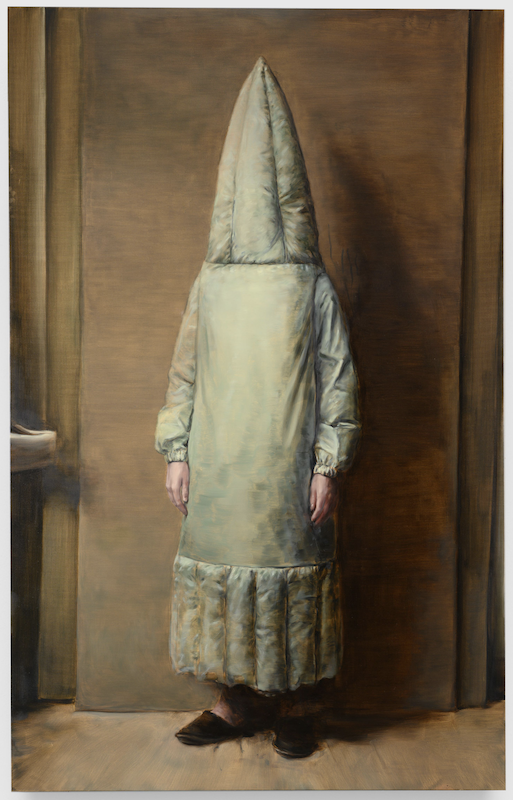
What Makes Arthur Jafa’s Work So Powerful?
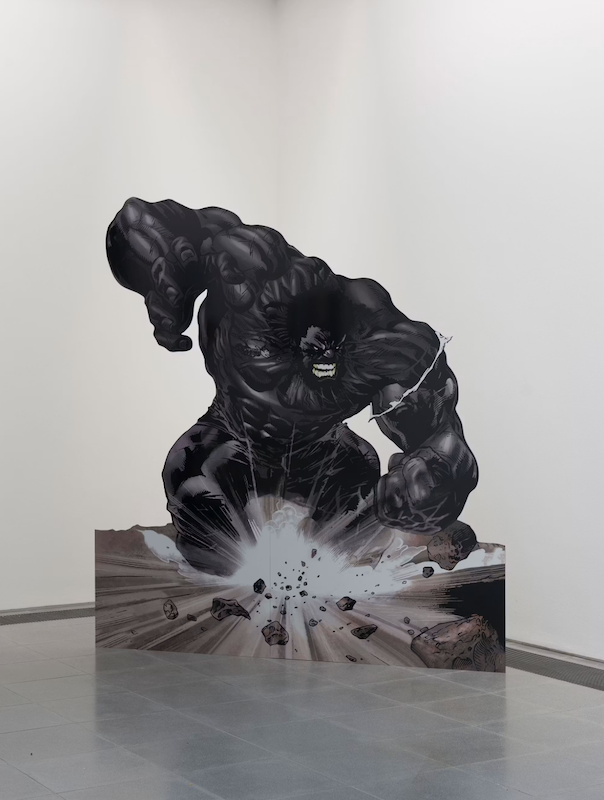
Arthur Jafa’s work is powerful because he turns the accumulated images of Black life into emotionally charged sequences where beauty, violence, joy, virtuosity, grief, intimacy, and historical trauma remain inseparable.
At first, his best-known works may resemble rapidly edited collections of found footage. News broadcasts, home movies, sporting events, music performances, internet clips, historical films, police recordings, religious gatherings, and popular culture pass across the screen in quick succession.
But these images do not function like a documentary archive organized around a stable argument.
They behave more like music.
One image calls to another.
A gesture becomes a rhythm.
A movement becomes an emotional echo.
Beauty is interrupted by violence.
Violence is followed by transcendence.
Private experience collides with public history.
Jafa’s deeper achievement is not simply that he gathers powerful images. He changes what happens between them.
His work asks:
Can moving images achieve the emotional, rhythmic, formal, and cultural force that Black music has achieved?
The Problem Beneath the Work
Jafa’s practice returns to the problem of how Black life can be represented without being reduced to suffering, triumph, identity, documentary evidence, entertainment, or a single historical narrative.
Images of Black people circulate everywhere, but circulation does not guarantee complexity.
Black life has repeatedly been:
stereotyped
commodified
surveilled
sensationalized
idealized
feared
imitated
consumed as entertainment
documented through violence
excluded from dominant visual histories
Jafa’s work does not attempt to correct these distortions by providing one complete or balanced representation.
Instead, he constructs an overwhelming visual field in which radically different expressions of Black life coexist.
In Love Is the Message, The Message Is Death from 2016, footage recorded by Jafa appears alongside material drawn from films, news reports, sports broadcasts, music videos, internet clips, and citizen recordings. The images move across twentieth- and twenty-first-century Black experience against the background of systemic racism and white supremacy. (Smithsonian American Art Museum)
The work includes suffering, but Blackness is not defined only through suffering.
It includes achievement, but Blackness is not resolved into triumph.
It includes celebrity, worship, dance, athleticism, domestic life, rebellion, absurdity, vulnerability, and extraordinary bodily expression.
The deeper problem is:
How can an artwork hold the full emotional and historical density of Black life without reducing that life to a message that can be easily consumed?
Black Visual Intonation
One of Jafa’s important ideas is often described as Black visual intonation.
The concept begins with an observation: Black musical forms developed distinctive relationships to rhythm, timing, repetition, improvisation, intensity, rupture, and emotional expression.
Jafa asks what an equivalent visual language might look like.
This does not mean placing images over Black music and assuming the result becomes Black visual culture. It means studying how images might be organized according to comparable principles:
syncopation
repetition with variation
rupture
acceleration
delay
improvisational association
call and response
compression
intensity
emotional tonal shifts
Jafa has emphasized the significance of the intervals between images, saying that his manipulation happens not simply within individual images but in the gaps between them. (The Museum of Modern Art)
That insight is essential.
A single clip may already possess enormous force. But montage changes its meaning by determining:
what precedes it
what follows it
how long it remains visible
whether it arrives as shock, answer, contradiction, release, or recurrence
how it interacts with sound
what emotional state the viewer is in when it appears
The edit becomes a form of thought.
How the Work Creates Pressure
Jafa’s work creates pressure by refusing to separate experiences that viewers may prefer to keep apart.
Beauty does not exist outside violence.
Joy does not erase grief.
Achievement does not cancel historical injury.
Popular culture cannot be separated from political history.
Private life cannot be protected from public image circulation.
A moment of extraordinary physical grace may be followed by a scene of brutality. A religious expression may collide with celebrity performance. A child’s gesture may appear beside a historical catastrophe. A familiar public figure may suddenly feel vulnerable, strange, ecstatic, or unknowable.
The viewer is repeatedly lifted and dropped.
That movement creates emotional pressure.
The work does not allow a stable emotional position from which the material can be safely interpreted.
One moment may produce awe.
The next may produce horror.
Then humor.
Then tenderness.
Then recognition.
Then helplessness.
This is why the work can feel overwhelming even when it is relatively brief.
The intensity comes from emotional compression.
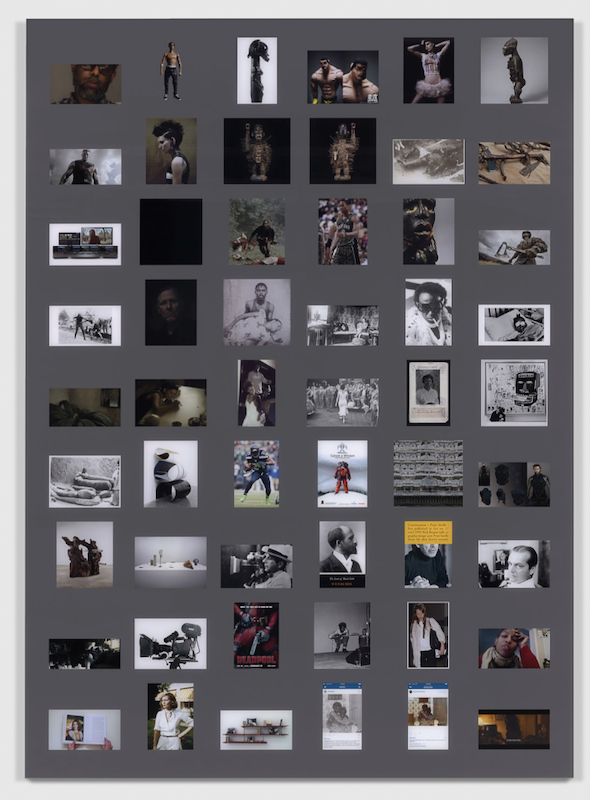
Montage as an Artistic Language
Montage is more than editing separate pieces into a continuous sequence.
In Jafa’s work, montage becomes a method of discovering relationships that ordinary historical narration may conceal.
A conventional documentary often establishes:
a subject
an explanatory structure
a chronology
an argument
evidence supporting that argument
a conclusion
Jafa’s montage operates differently.
It establishes meaning through adjacency.
Two images do not have to come from the same period, source, or event. Their connection may be:
visual
rhythmic
bodily
emotional
historical
symbolic
musical
intuitive
contradictory
A gesture in one clip may continue through a different body in the next.
A movement may rhyme with another movement.
An ecstatic expression may resemble an expression of anguish.
A crowd may become a congregation, protest, audience, or threat depending on the image placed beside it.
The viewer experiences history as a charged network rather than a clean timeline.
Why the Music Matters
Love Is the Message, The Message Is Death is structured around Kanye West’s “Ultralight Beam.” The Smithsonian describes the song as a gospel–hip-hop work that itself brings together multiple voices and strands of Black musical history. (Smithsonian American Art Museum)
The soundtrack does not merely accompany the footage.
It organizes emotional expectation.
Music creates:
anticipation
release
escalation
continuity
spiritual atmosphere
emotional memory
collective feeling
A viewer may hear transcendence while witnessing suffering.
That contradiction changes both the image and the music.
The music can make an image feel sacred, mournful, ecstatic, heroic, or unbearable. The image can make the song’s optimism feel fragile, defiant, or historically burdened.
Sound and image do not simply reinforce one another.
They complicate one another.
This is one reason the work avoids becoming a straightforward political statement. Its emotional register exceeds a single argument.
The Image Archive as Living Material
Like Adam Pendleton, Jafa works with archives, fragments, and cultural materials that already possess histories.
But Jafa’s archive is highly embodied.
It contains:
faces
voices
movement
gesture
dance
violence
performance
athleticism
religious expression
public speech
private recordings
media spectacle
Jafa does not treat these images as neutral documents. Nor does he assume that found footage remains ethically or emotionally unchanged when relocated.
Each clip carries the conditions under which it was originally produced:
Who held the camera?
Who controlled the image?
Was the person performing voluntarily?
Was the recording intimate, commercial, journalistic, celebratory, or surveillant?
Was the image originally circulated as evidence, entertainment, humiliation, memory, or propaganda?
When Jafa brings these images together, he does not erase those questions. He intensifies them.
The archive becomes a contested field of looking.
Beauty and Horror
The most important contradiction in Jafa’s practice may be the relationship between extraordinary beauty and extraordinary violence.
The work refuses the expectation that representations of Black experience should choose one dominant tone.
A celebratory representation can become dishonest if it suppresses historical and ongoing violence.
A representation focused only on brutality can reproduce another kind of reduction, making Black people visible primarily through injury and death.
Jafa keeps both conditions active.
The beauty is not offered as compensation for the horror.
The horror does not invalidate the beauty.
They exist together.
This coexistence produces something closer to the density of lived experience than either celebration or condemnation could accomplish alone.
Intensity Without a Single Narrative
Jafa’s work demonstrates that intensity does not require one continuous story.
A conventional narrative generally builds force by developing characters, conflict, and resolution.
Jafa builds force through accumulation.
Individual fragments gather emotional charge as the sequence continues. Earlier images remain psychologically present as later images appear. Meaning builds through memory, echo, recurrence, contrast, and rhythm.
This creates a different kind of coherence.
The viewer may not be able to summarize the sequence as a plot, but the experience does not feel random.
The coherence is musical rather than literary.
This distinction is important for understanding difficult or nonlinear art.
A work does not always need to explain how every element connects. It can make the viewer feel the connection before being able to name it.
The Central Contradiction
Jafa’s work holds several contradictions simultaneously:
love / death
beauty / violence
transcendence / historical injury
celebration / mourning
individuality / collective history
private life / public circulation
documentary evidence / visual poetry
appropriation / preservation
popular culture / serious historical memory
emotional immediacy / interpretive complexity
recognizable images / unstable meaning
collective identity / irreducible difference
The title Love Is the Message, The Message Is Death contains the structure of the work.
Love and death are not presented as opposites that can be separated.
Love exists under the condition of death.
Death intensifies the urgency of love.
Beauty emerges from a culture shaped by violence, but that beauty cannot be explained only as a reaction to violence.
The contradiction remains unresolved because resolving it would simplify the experience the work is trying to hold.
The Viewer’s Position
Jafa places the viewer inside an emotionally demanding position.
The viewer becomes:
witness
spectator
consumer of circulating images
listener
participant in cultural memory
observer of beauty
observer of suffering
person implicated in how images are distributed and consumed
The work makes it difficult to remain detached.
But it also raises a troubling question:
What does it mean to experience another person’s suffering as part of an aesthetically powerful sequence?
The montage is beautiful, rhythmic, and emotionally compelling. Some of its images record real violence and humiliation.
That creates an ethical contradiction.
The work uses aesthetic force without allowing the viewer to forget that images can also exploit, expose, and injure.
The viewer must confront both the power of the sequence and their own consumption of it.
The World Jafa Has Built
Jafa’s recurring artistic world includes:
found footage
montage
Black popular culture
music
bodily movement
historical archives
internet circulation
religious intensity
celebrity
police violence
intimacy
spectacle
emotional collision
visual rhythm
cinematic scale
repeated cultural images
beauty and horror held together
His work crosses film, video installation, photography, sculpture, music video, and cinematography.
Before becoming widely recognized within contemporary art, Jafa had a substantial career in film, including work as the cinematographer for Julie Dash’s Daughters of the Dust. His broader practice has continually pursued the possibility of a Black cinema possessing the cultural and formal centrality achieved by Black music. (Wikipedia)
The media may change, but the deeper investigation remains consistent:
How can images carry the rhythmic, emotional, historical, and expressive complexity of Black life?
What Artistic Capacity Does This Work Develop?
Jafa’s work develops the capacity to think through sequence rather than through isolated images.
Artists often evaluate images individually:
Is this image strong?
Is this composition resolved?
Does this object work on its own?
Is the subject clear?
Is the focal point effective?
Jafa demonstrates that meaning may emerge from relationships rather than from individual completeness.
An ordinary image may become extraordinary because of where it appears.
A beautiful image may become disturbing because of what follows it.
A traumatic image may become part of mourning, accusation, history, or spectacle depending on the rhythm surrounding it.
Studying Jafa develops several artistic capacities.
The capacity to use rhythm visually
Visual rhythm is not merely repetition of shapes. It can involve acceleration, silence, interruption, recurrence, and release.
The capacity to build emotional intensity through contrast
Intensity does not always come from making every element louder. It can arise from moving between stillness and explosion, intimacy and spectacle, beauty and injury.
The capacity to think relationally
An image does not carry meaning alone. Its meaning changes according to the images, sounds, spaces, and histories around it.
The capacity to allow feeling to precede explanation
The viewer may experience a relationship before intellectually understanding it. That does not make the work vague when the sequence is carefully controlled.
The capacity to construct coherence without conventional narrative
A body of work can be unified by rhythm, atmosphere, recurring pressure, or emotional logic rather than by one continuous story.
The capacity to treat editing as authorship
Selection, timing, juxtaposition, omission, and sequence are not secondary presentation decisions. They are the artistic act.
What Artists Can Learn
The lesson is not to imitate Jafa by assembling dramatic clips, using popular music, or juxtaposing beautiful and traumatic imagery.
The lesson is to understand how he makes relationships carry force.
He does not depend entirely on the inherent power of individual images.
He asks what happens when images:
answer one another
contradict one another
inherit one another’s emotional charge
move according to musical rhythm
collapse historical distance
intensify the viewer’s memory
transform through sequence
For artists working in any medium, this offers a major lesson.
A painting may create rhythm across repeated figures.
A series may make one image revise the meaning of another.
An installation may alternate compression and openness.
Color may function like musical tone.
Empty space may operate like silence.
A visual interruption may function like syncopation.
A body of work may accumulate through echoes rather than explanation.
The larger lesson is:
Energy does not come only from what an artwork contains. It comes from the rhythm of relationships among its parts.
Arthur Jafa reveals an artistic possibility beyond the isolated image:
Art can operate like music—through rhythm, recurrence, rupture, emotional intonation, and the charged space between one experience and the next.
What Makes Adam Pendleton’s Work So Powerful?
Adam Pendleton’s work is powerful because he turns language, history, abstraction, and repetition into an unstable system in which meaning is continually constructed, obscured, interrupted, and remade.
At first, his work may appear to consist of black-and-white letters, sprayed marks, fragments of words, geometric forms, photographs, grids, and overlapping gestures. Some paintings resemble graffiti-covered walls. Others look like enlarged pages, damaged archives, political posters, musical scores, or printing errors. His installations spread these fragments across walls, paintings, video, sound, and architectural structures.
But the deeper force of the work lies in the fact that nothing remains fixed.
Words become shapes.
Images become fragments.
History becomes material.
Blackness becomes more than identity.
Abstraction becomes more than formal freedom.
Repetition creates meaning and destroys it at the same time.
Pendleton’s work does not offer a single message to decode. It creates a field in which language and history remain active but refuse to settle into certainty.
The Problem Beneath the Work
Pendleton’s central artistic problem might be stated this way:
How can an artist use the languages of history without allowing history to remain fixed, complete, or controlled by inherited definitions?
His practice draws from a wide range of cultural sources, including Dada, Minimalism, conceptual art, Black political movements, experimental poetry, photography, typography, music, protest language, and the history of abstraction. His work does not arrange these sources into a clear chronology or stable explanation. Instead, it brings them into contact, allowing them to overlap, contradict, obscure, and transform one another. (The Museum of Modern Art)
This matters because archives often appear to offer stable knowledge. They classify events, preserve documents, establish sequences, and tell us which voices belong together.
Pendleton uses archival material differently.
He treats the archive less as a storehouse of settled knowledge and more as a field of unfinished possibilities.
A photograph may be enlarged until it becomes difficult to read. A phrase may be repeated until it begins to dissolve. A historical reference may appear beside an abstract mark without explanation. A political statement may be transformed into texture.
The work asks whether history can remain available without becoming closed.
It also asks whether meaning can remain politically and culturally charged without becoming a slogan.
Black Dada
The broad framework Pendleton uses to organize much of his practice is Black Dada, a concept he began developing in 2008.
The term brings Blackness into contact with Dada, abstraction, the avant-garde, political history, language, and cultural experimentation. It was partly prompted by Amiri Baraka’s 1964 poem Black Dada Nihilismus, but Pendleton does not use the phrase as a fixed label or doctrine. He has described Black Dada as a way of discussing the future while also discussing the past—a fluid framing device rather than a stable definition. (Berlin Art Week)
That openness is essential.
“Black” in Black Dada can refer to racial identity and Black political and intellectual history. But it can also refer to color, opacity, negation, abstraction, possibility, density, absence, and refusal.
“Dada” refers historically to the avant-garde movement that responded to war and social absurdity through irrationality, fragmentation, performance, chance, and anti-art gestures. But Pendleton does not simply revive historical Dada. He uses it as a way to reconsider the relationship among Blackness, artistic experimentation, political resistance, and the inherited history of modernism.
Black Dada is therefore not simply a subject represented by the work.
It is a method of keeping categories unstable.
It allows Pendleton to ask:
Who has been permitted to represent the avant-garde?
Why has abstraction sometimes been separated from Black political and cultural life?
Can Blackness operate as an open field rather than a restrictive identity category?
Can history be used without being obeyed?
Can political language remain urgent without becoming illustration?
Can abstraction carry historical pressure without resolving it?
The term joins things that art history has often kept apart.
That joining is itself part of the work.
How the Work Creates Pressure
Pendleton’s work is charged by a struggle between legibility and illegibility.
The viewer repeatedly encounters material that appears almost readable:
partial letters
interrupted phrases
spray-painted words
repeated typography
photographic fragments
grids that imply classification
gestures that resemble handwriting
names or slogans that cannot be fully recovered
The eye begins trying to organize the field.
It searches for a sentence.
It looks for hierarchy.
It separates figure from ground.
It attempts to recognize the historical source.
It tries to determine what should be read and what should merely be seen.
But the work frustrates these efforts.
A word may become a block of visual weight. A letter may be buried beneath paint. A black form may erase part of a statement. Repetition may make a phrase more visible while simultaneously emptying it of stable meaning.
The pressure emerges because language is never completely absent, yet it is never entirely available.
The viewer remains caught between reading and looking.
That is the central perceptual condition of the work.
Language Becomes Material
In ordinary communication, language is expected to deliver information.
A word points beyond itself toward a meaning.
Pendleton interrupts that function. He treats letters and words as physical forms:
lines
edges
blocks
rhythms
interruptions
repeated structures
positive and negative space
densities of black and white
Language does not disappear, but its meaning is no longer separate from its appearance.
A letter can be read and seen simultaneously.
A word can carry political history while also functioning as abstract composition.
A sentence can become an architectural structure.
This is a crucial distinction from work in which text merely explains the image. Pendleton’s language does not serve as a caption. It participates in the visual instability of the work.
The formal choices therefore become necessary because the work is not simply discussing unstable meaning.
It is making the viewer experience meaning becoming unstable.
Repetition as Revision
Repetition plays a major role in Pendleton’s visual language.
Letters, gestures, phrases, circles, lines, photographic fragments, and spray-painted forms recur across paintings and installations. But repetition does not create simple consistency.
Every recurrence changes the material.
A phrase may be:
enlarged
cropped
overprinted
obscured
fragmented
rearranged
sprayed over
converted into rhythm
separated from its original context
Repetition therefore operates as revision.
The original source is never merely reproduced. Each repetition places it into a new relationship with the other elements around it.
This offers a broader understanding of what repetition can accomplish in art.
Repetition does not have to confirm identity.
It can destabilize identity.
It does not have to strengthen meaning.
It can expose how meaning changes through circulation, reproduction, framing, and historical reuse.
Pendleton’s repeated marks behave almost like evidence that has passed through multiple hands and systems. Something persists, but it does not remain intact.
Abstraction Carries History
Pendleton’s work challenges the idea that abstraction is separate from history or politics.
Abstraction is sometimes treated as an escape from representation—a field of autonomous color, line, gesture, and composition.
Pendleton demonstrates that abstraction can also be produced by historical pressure.
A partially erased photograph becomes abstract because information has been removed.
A political phrase becomes abstract because it has been repeated, cropped, enlarged, and layered.
A letter becomes abstract because its relationship to the rest of the word has been interrupted.
A field of marks can be formally dynamic while still carrying the residue of protest, Black intellectual history, modernism, institutional power, and social struggle.
Pendleton does not choose between political meaning and formal experimentation.
He makes their relationship the problem.
This is one reason the work resists simple interpretation. A viewer who approaches it only as political communication may become frustrated by its opacity. A viewer who approaches it only as abstraction may overlook the histories embedded in the marks.
The work demands both forms of attention.
The Archive as a Living System
Pendleton draws material from books, photographs, historical documents, political movements, artistic traditions, music, and writing. But he does not present the archive as neutral evidence.
His archive behaves like a changing visual vocabulary.
Sources are detached from their original locations and placed into new arrangements. Their authority is interrupted. Familiar histories become incomplete. Previously separated subjects appear beside one another.
This creates a form of historical simultaneity.
Past and present do not sit in a clean sequence. They overlap.
Dada may encounter Black political history.
Minimalist structure may encounter graffiti-like marks.
Documentary photography may encounter abstraction.
A political slogan may encounter visual noise.
A museum wall may resemble both an archive and a street surface.
The archive becomes less like a timeline and more like an active field.
This approach makes history feel unfinished.
Why Black and White Matter
Pendleton is strongly associated with black-and-white imagery, although his practice has also expanded into color.
The restricted palette does several things simultaneously.
Black and white evoke:
print
photocopying
newspapers
documentary evidence
protest graphics
books
archives
typography
photographic reproduction
racial categories
formal contrast
presence and erasure
The palette seems direct, but it produces ambiguity.
Black may function as figure or ground.
White may suggest openness or absence.
A black mark may create meaning or conceal it.
A white field may clarify the image or expose what has been removed.
The colors are therefore not merely stylistic branding.
They connect the physical appearance of the work to its larger questions about Blackness, visibility, printing, historical evidence, and abstraction.
From Painting to Architecture
Pendleton’s work becomes especially powerful when it expands beyond individual paintings.
In installations such as Who Is Queen?, mounted in MoMA’s atrium in 2021–22, paintings, drawings, moving images, sound, text, and large architectural structures formed a spatial collage. MoMA described the installation as an arena exploring Blackness, abstraction, and the avant-garde. Rather than encountering the work as a sequence of isolated pictures, viewers entered a constructed system of competing voices, surfaces, scales, and histories. (The Museum of Modern Art)
The architecture matters because it prevents the viewer from seeing everything at once.
A person must move.
Some works become visible only from particular positions. Sounds may overlap with images. Black structures divide the museum’s open space, creating temporary walls, passages, obstructions, and stages.
This makes the viewer’s partial knowledge physical.
The viewer does not simply fail to understand the work because it is intellectually complex. The viewer occupies a space that makes total understanding structurally impossible.
That is an important transformation.
Opacity becomes architecture.
Fragmentation becomes bodily experience.
The Central Contradiction
Pendleton’s work holds several contradictions at once:
readable / illegible
historical / unfinished
political / abstract
archival / unstable
systematic / improvised
repetitive / continually changing
black-and-white / conceptually expansive
visually forceful / resistant to immediate explanation
public / opaque
controlled / open-ended
The most important contradiction may be:
The work wants to enter history while preventing history from becoming fixed.
Pendleton draws heavily from archives and historical sources. Yet he does not treat the past as a complete body of knowledge that can simply be retrieved.
He preserves and disrupts at the same time.
He makes history visible while denying the viewer a final authoritative reading.
That contradiction gives the work duration. The viewer cannot fully solve it because the instability is not a puzzle hiding a single correct answer.
The instability is the subject and the method.
The Viewer’s Position
Pendleton places the viewer in several roles simultaneously.
The viewer becomes:
a reader
a witness
an archivist
a historian
a participant
a person trying to classify
a person confronted with the limits of interpretation
At first, the viewer may assume that the work contains a message waiting to be decoded.
That assumption becomes part of the encounter.
Why do viewers expect language to become immediately available?
Why do they expect political art to present a clear position?
Why do they assume an archive should resolve uncertainty?
Why do they treat abstraction and Black history as separate categories?
Pendleton does not merely withhold information. He makes the viewer aware of the desire to organize and master it.
The viewer’s frustration becomes productive.
It reveals the expectation that art, language, and history should become orderly on demand.
The World Pendleton Has Built
Pendleton’s visual and conceptual world includes:
black-and-white contrast
enlarged letters
damaged or interrupted language
photographic fragments
grids
spray-painted gestures
circles and geometric forms
repetition
overprinting
archival material
political language
abstraction
architectural display
video and sound
partial visibility
cultural collision
This lexicon is recognizable, but it is not merely a brand.
Its elements repeatedly return because they allow Pendleton to reconsider the relationships among Blackness, abstraction, language, history, and the avant-garde.
The works change in scale and medium, but the deeper intelligence remains consistent.
His paintings, publications, videos, drawings, and installations behave like parts of one expanding research system.
What Artistic Capacity Does This Work Develop?
Pendleton’s work develops the capacity to remain attentive when meaning does not immediately resolve.
For artists, this is especially valuable.
Many artists are trained to strengthen clarity:
clarify the subject
clarify the narrative
clarify the concept
clarify the focal point
clarify the relationship among elements
Pendleton demonstrates that clarity is not always the highest goal.
Art can make uncertainty precise.
It can establish enough structure for the viewer to know that the instability is intentional while refusing to reduce the work to a single message.
Studying Pendleton can develop several artistic capacities:
The capacity to treat language visually
Words do not need to remain captions, titles, or explanatory devices. They can become weight, rhythm, obstruction, architecture, and surface.
The capacity to use history without illustrating it
Historical material can be fragmented, reorganized, and placed into new relationships rather than reproduced as a lesson.
The capacity to make abstraction carry cultural pressure
Formal experimentation does not need to escape politics, identity, or history. It can become one of the ways those forces are experienced.
The capacity to distinguish ambiguity from indecision
Uncertainty becomes powerful when the artist controls what is visible, what is interrupted, and what remains unresolved.
The capacity to allow sources to collide
Influences do not need to be reconciled into a smooth synthesis. Their incompatibility can generate energy.
The capacity to think beyond the isolated object
Painting, text, sound, video, publication, and architecture can operate as parts of one expanding artistic world.
The larger lesson is that an artist does not always need to provide resolution. The artist may instead construct a system precise enough to keep multiple meanings active.
What Artists Can Learn
The lesson is not to imitate Pendleton’s black-and-white palette, fragmented lettering, spray-painted gestures, or archival imagery.
The lesson is to understand how he transforms research into form.
He does not merely collect references. He subjects them to pressure.
He enlarges them.
Cuts them apart.
Repeats them.
Layers them.
Obscures them.
Places them beside incompatible histories.
Turns them into environments.
The resulting work does not explain Black Dada from a distance.
It behaves according to Black Dada’s logic: open, unstable, historical, abstract, political, and resistant to closure.
That is the deepest studio lesson:
Research becomes art when information is transformed into a visual, material, spatial, or temporal condition that the viewer must experience.
The value of studying Pendleton is not that he provides a style to borrow. He reveals another possibility for what art can be asked to do:
Art can preserve history without freezing it, use language without surrendering to explanation, and create uncertainty without becoming vague.